
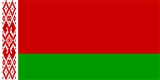
Encyclopedia
Belarus is a landlocked
nation-state in
Eastern Europe, which borders
Russia,
Ukraine,
Poland,
Lithuania, and
Latvia. Its capital city is
Minsk, and other important cities include
Brest,
Grodno,
Gomel,
Mogilev and
Vitebsk.
Throughout much of history, the area which is now known as Belarus was part of various countries including
Lithuania,
Poland and the
Russian Empire. Eventually, in 1922, Belarus became a republic in the
Soviet Union as the Byelorussian SSR. The republic officially declared its sovereignty on 27 August 1990, and following the
collapse of the Soviet Union, declared independence as the Republic of Belarus on 25 August 1991. Since 1994,
Alexander Lukashenko has been the state's president. Belarus is currently in negotiations with neighboring Russia to integrate both of their economies, among other things, in a plan called the
Union of Russia and Belarus.
The country continues to suffer from the effects of
nuclear fallout from the 1986
Chernobyl accident, which took place in neighboring
Ukraine.
Officially, the country is known as the
Republic of Belarus , while the short name is
Belarus. Some consider the use of "Belorussian" derogatory, with its direct implication of russification. The name has incorrectly been translated as "
White Russia", a name that refers to a separate region.
History of the name
Historically, the country was referred to in
English as "White Russia". Although this is not exactly correct – the correct translation is "White Ruthenia" – the practice continues to this day in other languages. The first known use of "White Russia" to refer to Belarus was in the late 16th century by European
Jerome Horsey. He used the term to describe the areas of
Ivan the Terrible's empire. During the 17th century the Russian tsars used "White Ruthenia", asserting that they were trying to recapture their heritage from the
Polish-Lithuanian Commonwealth. After the Commonwealth broke up, the lands that now make up Belarus were officially referred to as "Belarus" and "Belarusi", instead of the then-banned terms of "Litwa" and "Licwiny."
The spellings
Belorussia and
Byelorussia are transliterations of the name of the country in Russian. Belarus was named "Belorussia" in the days of
Imperial Russia, and the Russian
tsar was usually styled "Emperor of All the Russias — Great, Minor, and White". This practice continued throughout the Soviet era, with the country taking the official name of the "Belorussian Soviet Socialist Republic". Some Belarusians object to the name "Belorussia", as it is an unwelcome reminder of the days under Russian and Soviet rule.
In 2002, an informal survey was conducted by the website to see which version of the name was used on a majority of websites. By using Google, the website looked up various terms and it found that "Belarus", the official short form of the name, was used on 93% of websites checked. Spellings "Belorussia", "Bielorussia" and "Byelorussia" were used in 1%–2% of cases. A number of languages today still refer to Belarus as White Russia, such as "Weißrussland" in
German, "Beyaz Rusya" in
Turkish or "?e?????s?a" in Greek.
History
Between the 6th and 8th centuries, what is now known as Belarus was settled by the
Slavs, who still dominate the country. The
Early East Slavs gradually came into contact with the
Varangians and were organized under the state of
Rus', mainly in the area around modern-day
Polatsk in the northern part of the country. In the 13th century, the state was badly affected by a
Mongol invasion, and eventually parts of Rus' were swallowed up by the
Grand Duchy of Lithuania. The core lands of the duchy were territories around
Kernave,
Trakai,
Vilnius cities and
Samogitia. During this time, the Belarusian teritories were largely at peace, but duchy itself was often at war and had famous victories against
Mongols in the east,
Turks in the south and
Teutonic Knights in the west. By the 15th century, the Grand Duchy of Lithuania stretched across much of
Eastern Europe, from the
Baltic Sea to the
Black Sea.
On February 2 1386, Grand Duke of Lithuania
Jogaila was crowned King of Poland, and allied the Grand Duchy with
Poland in a personal union under one monarch. This personal union eventually resulted in the
Polish-Lithuanian Commonwealth, a new state created in 1569. However, by 1795, the state was divided and annexed by
Imperial Russia,
Prussia and
Austria in the course of the
Partitions of the Polish-Lithuanian Commonwealth. Belarus teritories remained part of the Russian Empire until being occupied by
Germany during
World War I. Belarus first declared independence on 25 March 1918, forming the
Belarusian People's Republic. The Republic was, however, short-lived, and the regime was overthrown soon after the German withdrawal. In 1919 Belarus became the Byelorussian Soviet Socialist Republic , and after Russian occupation of eastern Lithuania merged into the
Lithuanian-Byelorussian Soviet Socialist Republic. After the
Polish-Soviet War ended in 1921, Byelorussian lands were split between Poland and the recreated Byelorussian SSR, which became a founding member of the
Union of Soviet Socialist Republics in 1922. In September 1939, the Soviet Union annexed the Polish-held Byelorussian land as a result of the
Molotov-Ribbentrop Pact.
In 1941,
Nazi Germany launched
Operation Barbarossa, invading the Soviet Union. Byelorussia was captured soon afterwards, and
remained in Nazi hands until 1944. Much the country was destroyed and much of its population was killed in the German invasion. The Jewish population of Belarus was also devastated during
The Holocaust. It took until 1971 for the population of Belarus to reach the pre-war level. The Jewish population, however, never recovered. After the war ended, Byelorussia was among the 51 signatories to the founding of the
United Nations, in 1945. The reconstruction that took place in Belarus after the war brought comparative prosperity to the Soviet Republic. During this time, Belarus became a major center of manufacturing in the western region of the USSR. The increase in jobs brought in a huge immigrant population from the Russian Soviet Federated Socialist Republic. During
Joseph Stalin's era, a policy of russification was started to "protect" Byelorussian SSR from influences by the West. This policy involved sending Russians from various parts of the Soviet Union and placing them in key positions in the Belorussian SSR government. The official use of the
Belarusian language and other cultural aspects were also limited by
Moscow. After Stalin died in 1953, his successor
Nikita Khrushchev continued the Russification program, stating in the Byelorussian SSR capital of
Minsk that "The sooner we all start speaking
Russian, the faster we shall build
communism." The President won a landslide victory, over 80% of the vote. It was however deemed unfair by the
OSCE. .
Lukashenko was quoted as saying that he has an "authoritarian ruling style" that he uses to run the country. The
Council of Europe has barred Belarus from membership since 1997 for undemocratic voting irregularities in the November 1996 constitutional referendum and parliament by-elections. According to the Venice Commission of the Council of Europe, Belarus's constitution is "illegal and does not respect minimum democratic standards and thus violates the principles of separation of powers and the rule of law". The Belarusian government is also criticized for
human rights violations and its actions against NGOs, independent journalists, national minorities and opposition politicians. During the rule of the current administration in Belarus, there have been several cases of persecution, including the
disappearance or death of prominent opposition leaders and independent journalists. Belarus is also one of just two nations in Europe that retains the death penalty for certain crimes . In testimony to the U.S. Senate Committee on Foreign Relations,
Secretary of State Condoleezza Rice labeled Belarus, among seven nations, as part of the US's list of
outposts of tyranny. The Belarusian Foreign Ministry announced that the statement from Secretary Rice "are a poor basis" to form a good Belarusian-American alliance.
Belarus has been described as "a small-scale Soviet Union at its finest period".
Administrative Divisions
Belarus is divided into six provinces , named after the cities that serve as their administrative centers. The city of Minsk, located in the Minsk province, has the special status of being a national subordinate as it isn't included in any voblast. Subdivision into
voblasts is inherited from the Soviet era. Voblasts are further subdivided into
raions . Local legislative authorities are elected by the raion's residents; local executive authorities are appointed by higher executive authorities. In the same way, each voblast has its own legislative authority , elected by residents, and an executive authority , whose leader is appointed by the President.
- Minsk
- Brest Province
- Homyel Province
- Hrodna Province
- Mahilyow Province
- Minsk Province
- Vitsebsk Province
Geography
Belarus is
landlocked, relatively flat, and contains large tracts of
marshy land. Lakes and rivers punctuate the country. The largest marsh territory is Polesia, which is also amongst the largest marshes in Europe. There are 11,000 lakes in Belarus, but the majority of the lakes are smaller than 0.5 square kilometres . Three major rivers run through the country, the
Neman River, the
Pripyat River, and the
Dnepr River. Belarus' highest point is Dzyarzhynskaya Hara , 345
metres , and its lowest point is on the Neman River, 90 metres . The
climate ranges from harsh
winters to cool and moist summers .
Forest covers about 34 % of the total landscape, making it one of the most dominant natural resources in Belarus. Other natural resources to be found in Belarus include
peat deposits, small quantities of
oil and natural gas,
granite, dolomite
limestone,
marl,
chalk,
sand,
gravel, and
clay. About one fifth of the territory, mostly in the South-Eastern provinces of
Homyel and
Mahilyow, continues to be affected by fallout from the 1986
nuclear power plant disaster in
Chernobyl,
Ukraine. While the amount of radiation has decreased since the disaster, most of the area is considered uninhabitable.
Economy
The Belarusian economy remains about 80% state-controlled, as it has been since Soviet times. However, the country has arguably handled the difficult transition since the collapse of the Soviet Union better than most of its peers. The country is relatively stable, economically, but depends to a large extent on raw material supplies from its close ally
Russia.
Industry and
agriculture remain largely in state hands. Belarus is therefore one of the very few state-capitalistic national economies remaining. Agriculture is dominated by collective farming, with the major sub-sectors the cultivation of
potatoes and
cattle breeding.
Historically important branches of industry include
textiles and wood processing. After 1965, creation of heavy industry and
mechanical engineering significantly strengthened the country's development. Within the Soviet Union Belarus was one of the industrially most developed republics. Economically, Belarus engages itself in the
Commonwealth of Independent States,
Eurasian Economic Community and
Union with Russia. After 1990, with the introduction of free market structures into the former Soviet Union, industrial production plunged. However, economic growth returned in 1996 and in 2001 Belarus was first of CIS coutries to reach 1990 levels of industrial production and agricultural production.
Gross domestic product for 2005 was $79.13 billion , which equates to an annual income of approximately $7,700 dollar per head. In 2005
GDP increased by about 8-9%, with the inflation rate averaging about 8%. Belarus therefore has the highest standard of living of all the CIS states. According to the
UN, average monthly income grew from 20
United States dollars to 225 USD during the last 10 years.
The
unemployment rate, according to Belarusian government statistics, was about 2% in 2005. However, foreign experts have suggested that the real rate is probably higher. More controversial is the decision to abandon the
Belarusian ruble in favour of the
Russian ruble , starting on January 1 2008, according to Russian news agency
ITAR-TASS.
Demographics
The majority of the
population of Belarus are native
Belarusians, who comprise 81.2% of the total population of 10,293,011 people.
Russians are the second largest group making up 11.4% of the population. The
Poles and
Ukrainians account for 3.9% and 2.4% of the population, respectively.
Languages commonly spoken in Belarus are
Russian and
Belarusian, which are both official languages of Belarus.
The population density is about 50 persons per square kilometer and 71.7% of the total population lives in
urban areas. Of the urban population, 24% live in
Minsk, the national capital and largest city.
Most of the population, 69.7%, are between the ages of 14 and 64. Sixteen percent of the population is under 14 years, while 14.6% are age 65 or older. The median age of the population is 37. The average life expectancy for Belarusian citizens is 68.72 years; for males it is 63.03 years and for females it is 74.96 years.
The literacy rate in Belarus, which is the number of people aged 15 and older who can read and write, is at 99%, with men at 99.8%, and women at 99.3%. The male-to-female ratio in 2005 was estimated to be .88 males to every female.
Most demographic indicators for Belarus resemble other European countries, notably with both the population growth rate and the natural growth rate in the negative. The population growth is currently at −0.06% in 2005, with a fertility rate of 1.43. The population is also growing older, and by the year 2050, the majority of the population will be over the age of 50. The migration rate is +2.3 for every 1 000 people in Belarus.
According to the
Save the Children international organisation report Belarus has the highest rating among all ex-USSR countries. It has 16 place for Mothers' index rank, 14 for Women's index rank and 20 for Children's index rank. Closest ex-USSR counties are
Estonia ,
Ukraine and
Russia Culture
Traditional Belarusian dress originates from the time of
Kievan Rus and over time was under the influence of cultures of neighbors: Poles, Lithuanians, Latvians, Russians, and other European nations. Aside from its predominantly Ruthenian roots, Belarusian cuisine is very close to Lithuanian. It is sometimes considered as somewhat less rich and impressive than those of its imposing neighbors. In fact, however, this may result from the general lack of national identity which still continues to hold back the development of a nation and also led to the loss of many culinary traditions in the last 100 years.
Certain aspects of the Belarusian culture have been lost over time because of the Russification period. President Lukashenko has introduced laws that force
radio and
television stations to showcase a percentage of Belarusian talent daily, but it does not specify whether the performance has to be in the Belarusian or Russian language. The said radio and television stations are state-owned, mostly controlled by the National State Teleradiocompany .
The Belarusian government sponsors many annual cultural festivals: "Slavianski Bazaar in Vitebsk"; "Minsk Spring"; "Slavonic Theatrical Meetings"; International Jazz Festival; National Harvesting Festival; "Arts for Children and Youth"; the Competition of Youth Variety Show Arts; "Muses of Niesvizh"; "Mir Castle"; and the National Festival of the Belarusian Song and Poetry. These events showcase talented Belarusian performers, whether it is in
music,
art,
poetry,
dance or
theater. At these festivals, various prizes named after Soviet and Belarusian heroes are awarded for excellence in music or art. Several state holidays, like Independence Day or Victory Day draw big crowds and include various displays such as