
In Depth
See Also

Golf

Golf is a sport where individual players or teams hit a ball Golf ball

A golf ball is a ball [i] designed for use in the game of golf [i]. ... 

 into a hole using various clubs, and is one of the few ball games that does not use a fixed standard playing area. It is defined in the Rules of Golf as "playing a ball with a club from the teeing ground into the hole by a stroke or successive strokes in accordance with the Rules." Golf originated in Scotland Scotland

Scotland is a nation [i] in northwest Europe [i] and one of the constituent [i] countries [i] ... 

 and has been played for at least five centuries in the British Isles British Isles

Great Britain [i], Ireland [i] and several thousand smaller surrounding islands [i] and islets [i] form an archipelago [i] ... 

. The oldest course in the world is The Old Links at Musselburgh Musselburgh

Musselburgh is a town in East Lothian [i], Scotland [i], on the coast of the Firth of Forth [i], six mil ... 

. Golf, in essentially the form we know it today, has been played on Scotland's Musselburgh Links since 1672, and earlier versions of the game had been played in the British Isles and the low-countries of Northern Europe for several centuries before that.

Discussions

  Discussion Features

   Ask a question about 'Golf'

   Start a new discussion about 'Golf'

   Answer questions about 'Golf'

   'Golf' discussion forum

Timeline

1873   Royal Montreal Club in Montreal, Quebec Montreal

Montreal, or Montral in French [i], is the second largest city [i] ... 

 is founded, becoming the first permanent golf club in North America North America

North America is a continent [i] in the Earth [i]'s northern hemisphere [i] and almost fully in the western hemisphere [i] ... 

.

1900   Harry Vardon Harry Vardon

Harry Vardon was an English [i] champion golfer. ... 

 becomes world golf champion


Quotations

I don't mind taking a two stroke penalty, but I'm damned if I'm going to play the ball where it lies.

American golfer Elaine Johnson to tournament officials when a shot hit a tree and landed in her bra. Given by David Hardy in his book What A Mistake page 151.

       More Quotes >>


Encyclopedia


Golf is a sport where individual players or teams hit a ball Golf ball

A golf ball is a ball [i] designed for use in the game of golf [i].
... 

 into a hole using various clubs, and is one of the few ball games that does not use a fixed standard playing area. It is defined in the Rules of Golf as "playing a ball with a club from the teeing ground into the hole by a stroke or successive strokes in accordance with the Rules."

Golf originated in Scotland Scotland

Scotland is a nation [i] in northwest Europe [i] and one of the constituent [i] countries [i] ... 

 and has been played for at least five centuries in the British Isles British Isles

Great Britain [i], Ireland [i] and several thousand smaller surrounding islands [i] and islets [i] form an archipelago [i] ... 

. The oldest course in the world is The Old Links at Musselburgh Musselburgh

Musselburgh is a town in East Lothian [i], Scotland [i], on the coast of the Firth of Forth [i], six mil ... 

. Golf, in essentially the form we know it today, has been played on Scotland's Musselburgh Links since 1672, and earlier versions of the game had been played in the British Isles and the low-countries of Northern Europe for several centuries before that. Although often viewed as an elite pastime, golf is an increasingly popular sport across all sections of society.

Anatomy of a golf course


Golf is played on a tract of land designated as the course. The course consists of a series of holes. A hole means both the hole in the ground into which the ball is played , as well as the total distance from the tee to the green . Most golf courses consist of nine or eighteen holes. .

The first stroke on each hole is done from the Tee Tee

A tee is a stand used to support a stationary ball [i] so that the player can strike it, particularly in ... 

 , where the player can use a tee to put his ball on, which makes the tee shot easier. Most courses offer a series of Tee boxes to play from, making the hole longer or shorter depending on which Tees the player starts at. Often, the different Tee boxes have names associated with degree of competence , or by sex and age . In addition to a difference in distance, the different Tees may also eliminate or reduce the danger of some hazards for the "Forward" tees such as water hazards.

After teeing off, a player hits the ball towards the green again from the position at which it came to rest, either from the fairway or from the rough. Playing the ball from the fairway is an advantage because the fairway grass is kept very short and even, allowing the player to cleanly strike the ball, while playing from the rough is a disadvantage because the grass in the rough is generally much longer. Once on the green, the ball is putted towards the hole until the ball comes to rest in the cup.

Many holes include hazards, which may be of two types: water hazards and bunkers. Special rules apply to playing balls that come to rest in a hazard. For example, in a hazard, a player must not touch the ground with his club before playing a ball, not even for a practice swing. A ball in any type of hazard may be played as it lies without penalty. If it cannot be played from the hazard for any reason, it may be removed by hand and dropped outside the hazard within two club lengths of its original position; doing so incurs a penalty of one stroke. If a ball was observed entering a hazard but cannot be found, it may be replaced by dropping another ball outside the hazard along the plane at which it made entry, but no closer to the hole, again at the cost of a one stroke penalty. Exactly where a ball may be dropped outside a hazard is governed by strict rules. Bunker Bunker

A bunker is a defensive military fortification.... 

s are hazards from which the ball is more difficult to play than from grass. As in a water hazard, a ball in a sand trap must be played without previously touching the sand with the club.

The grass Lawn

A lawn is an area of recreational or amenity land planted with grass [i], and sometimes clover [i] ... 

 of the putting green is cut very short so that a ball can roll easily over distances of several yards. To putt means to play a stroke, usually but not always on the green, wherein the ball does not leave the ground. The direction of growth of individual blades of grass often affects the roll of a golf ball and is called the grain. The slope of the green, called the break, can also affect the roll of the ball. The cup is always found within the green, and must have a diameter of 108 mm and a depth of at least 100 mm . Its position on the green is not static and may be changed from day to day. The cup usually has a flag on a pole positioned in it so that it may be seen from some distance, but not necessarily from the tee. This flag and pole combination is often called the pin.

Putting greens are not of all the same quality. Generally, the finest quality greens are well kept so that a ball will roll smoothly over the closely mowed grass. Golfers describe a green as being "fast" if a light stroke of the ball allows it to roll a long distance. Conversely, a green is termed "slow" if a stronger stroke is required to roll the ball the required distance.

The borders of a course are marked as such, and beyond them is out of bounds, that is, ground from which a ball must not be played. Some areas on the course may be designated as ground under repair, meaning that a ball coming to rest in them may be lifted and then played from outside such ground without penalty. Certain man-made objects on the course are defined as obstructions, and specific rules determine how a golfer may proceed when the play is impeded by these.


At most golf courses there are additional facilities that are not part of the course itself. Often there is a practice range or driving range Driving range

A driving range is an area where golf [i]ers can practice their swing. ... 

, usually with practice greens, bunkers, and driving areas . There may even be a practice course . A golf school is often associated with a course or club.

Par

A hole is classified by its par. Par is the number of strokes that a skilled golfer should require to complete the hole. For example, a skilled golfer expects to reach the green on a par four hole in two strokes, one from the tee , another to the green , and then roll the ball into the hole with two putts. Traditionally, a golf hole is either a par three, four, or five although, a few par six holes now exist, but will not be found on a traditional golf course.

The par of a hole is primarily, but not exclusively, determined by the distance from tee to green. A typical length for a par three hole is anywhere between 91 and 224 m , for a par four, between 225 and 434 m . Par five holes are typically at between 435 and 630 m , and par six holes are anything longer than that. It should be noted, however, that these distances are not absolute hard and fast rules; for example, it is possible that a hole of length 500 yards could be classed as a par four since the par for a hole is determined by its 'effective playing length.' So, if tee to green on a hole is predominantly downhill, it will play shorter than its physical length and may be given a lower par.

Many 18-hole courses have approximately four par-three, ten par-four, and four par-five holes, though other combinations exist and are not less worthy than those courses of par 72. Many major championships are contested on courses playing to a par of 70 or 71, and it's not too rare to find a worthy test playing to a par of 69 or lower. In many countries, courses are classified by a course rating in addition to the course's par. This rating describes the difficulty of a course and may be used to calculate a golfer's playing handicap for that individual course .

Play of the game

Every game of golf is based on playing a number of holes in a given order. A round typically consists of 18 holes that are played in the order determined by the course layout. On a nine-hole course, a standard round consists of two successive nine-hole rounds. A hole of golf consists of hitting a ball from a tee on the teeing box , and, once the ball comes to rest, striking it again, and repeating this process until the ball at last comes to rest in the cup. Once the ball is on the green the ball is usually putted into the hole. The idea of resting the ball in the hole in as few strokes as possible may be impeded by various hazards, such as bunkers and water hazards.

Players walk over the course, either singly or in groups of two, three, or four, sometimes accompanied by caddies who carry and manage the players' equipment and give them advice. Each player plays a ball from the tee to the hole, except that in the mode of play called foursomes, two teams of two players compete, and the members of each team alternate shots using only one ball, until the ball is holed out. When all individual players or teams have brought a ball into play, the player or team whose ball is the farthest from the hole is next to play. In some team events, a player whose ball is farther from the hole may ask his partner to play first. When all players of a group have completed the hole, the player or team with the best score on that hole has the honor, that is, the right to tee off first on the next tee.

Each player acts as marker for one other player in the group, that is, he or she records the score on a score card. In stroke play , the score consists of the number of strokes played plus any penalty strokes incurred. Penalty strokes are not actually strokes but penalty points that are added to the score for violations of rules or for making use of relief procedures in certain situations.

Scoring

In every form of play, the goal is to play, or play, as few shots per round as possible. Scores for each hole can be described as follows:

Term on a
scoreboard
Specific termDefinition
-4 condor or triple-eaglefour strokes under par
-3 albatross or double-eaglethree strokes under par
-2 eagletwo strokes under par
-1 birdieone stroke under par
+0 parstrokes equal to par
+1 bogeyone stroke more than par
+2 double bogeytwo strokes over par
+3 triple bogeythree strokes over par
+4 quadruple bogeyfour strokes over par


The two basic forms of playing golf are match play and stroke play.
  • In match play, two players play every hole as a separate contest against each other. The party with the lower score wins that hole, or if the scores of both players or teams are equal the hole is "halved" . The game is won by the party that wins more holes than the other. In the case that one team or player has taken a lead that cannot be overcome in the number of holes remaining to be played, the match is deemed to be won by the party in the lead, and the remainder of the holes are not played. For example, if one party already has a lead of six holes, and only five holes remain to be played on the course, the match is over. At any given point, if the lead is equal to the number of holes remaining, the match is said to be "dormie", and is continued until the leader increases the lead by one hole, thereby winning the match, or until the match ends in a tie. When the game is tied after the predetermined number of holes have been played, it may be continued until one side takes a one-hole lead, and thereupon immediately wins by one hole.
  • In stroke play, every player counts the number of shots taken for the whole round or tournament to produce the total score, and the player with the lowest score wins. A variant of stroke play is Stableford scoring, where a number of points are given for each hole, and the fewer shots taken, the more points obtained, so the aim is to have as many points as possible. Another variant of stroke play, the Modified Stableford method, awards points on each hole in relation to par and then adds the points over a round; for more details on this method, see the article on The INTERNATIONAL, a tournament that uses Modified Stableford scoring.


There are many variations of these basic principles, some of which are explicitly described in the "Rules of Golf" and are therefore regarded "official". "Official" forms of play are, among others, foursome and four-ball games.

Fees

If one wishes to play on a golf course, one has to pay certain fees. There are two different fees: the range fee, which is for the practice range; and the green fee, which allows play on the golf course itself. For nearly all courses, the range fee is not a prerequisite to play the course.

The green fee may vary from the equivalent of a few dollars for communal courses in many countries, up to that of several hundred dollars for reputable public courses. However, many golf courses are not open to the public: these private golf clubs also have green fees, but in order to play, one generally must be invited by a member of the club. Discounts on fees may be offered for players starting their round late in the day.

If the course has golf carts, there is usually a fee to use them, even if a member of your group is not actively playing. On some courses, walking is prohibited; in this case the cart fee is often included with the green fee. It is wise to specifically ask if the green fee includes a cart and, if not, what the cart fee is, as well as whether or not a cart is required.

Team play

A foursome is played between two teams of two players each, in which each team has only one ball and players alternate playing it. For example, if players A and B form a team, A tees off on the first hole, B will play the second shot, A the third, and so on until the hole is finished. On the second hole, B will tee off , then A plays the second shot, and so on. Foursomes can be played as match play or stroke play.

A four-ball is also played between two teams of two players each, but every player plays his own ball and for each team, the lower score on each hole is counted. Four-balls can be played as match play or stroke play.

There are also popular unofficial variations on team play. In a scramble, or ambrose, each player in a team tees off on each hole, and the players decide which shot was best, Every player then plays his second shot from where the best ball has come to rest, and the procedure is repeated until the hole is finished. In best ball, each player plays the hole as normal, but the lowest score of all the players on the team counts as the teams score.

In a greensome both players tee off, and then pick the best shot as in a scramble. The player who did not shoot the best first shot plays the second shot. The play then alternates as in a foursome.

There is also a form of starting called "shotgun," which is mainly used for tournament play. A "shotgun" start consists of groups starting at different tees, allowing for all players to start and end their round at the same time.

Handicap systems


A handicap is a numerical measure of an amateur golfer's ability to play golf over 18 holes. The 2 main formulas used in the game are stroke play  and match play.
The Stroke play formula is an individual way of playing the game as you are competing against the par of the course by striking the ball the closest to the it. The Stroke play formula is simply the sum of strokes player shoot over 18 holes and compares it to the par . The difference between your number of strokes and the par determines your handicap.
the match play formula is a game during which two players play against each other. In other words, your score per hole depends on the other player's score. This formula was - and still is - very much appreciated by golfers as the state of mind is totally different from a stroke play game, during which the golfer has to 'secure' each and single of his shots in order to play the lower score possible over 18 holes. In the contrary, the match play rule will allow the player to approach the course in a more aggressive manner in order to win the hole against his opponent. e.g. P1 plays 4 and P2 plays 5: P1 wins the hole and current score on the tee number 2 would be '1 up'. If P2 would like to mention the status of the score, he would say: '1 down' .

The so-called "net" score is a formula commonly preferred by players from different proficiency to play against each other on equal terms. Good Ones handicap is subtracted from their round score thus making a game even between two players. e.g. player 1's round score: 90 handicap: 20 / the course's par: 70 / Player 2's round score: 100 handicap: 30 overall : 70. a players handicap determines the quality of their game making a player with a lower handicap better than one with a higher handicap. However, in practice, motivated and ambitious high handicap players strive to lower their handicaps and thus the current official one they show on their cards might not be their real current level, which consequently might put them in a favourable position when playing 'net' formula games.

Handicaps are complicated, but essentially are the average over par of a number of previous rounds, adjusted for course difficulty. Legislations regarding the calculation of handicaps differs among countries and sometimes becomes so complicated that a golfer's handicap might not always mirror his real level of play. For example, Swiss handicap rules include the difficulty of the course the golfer is player on by taking into consideration factors such as the number of bunkers, the length of the course, the difficulty and slopes of the greens, the width of the fairways, and so on.

Handicap systems are not used in professional golf. Professional golfers typically score several strokes below par for a round thus have a handicap of 0 subtracting 0 from their round score.

Golf rules and other regulations

The rules of golf are internationally standardised and are jointly governed by the Royal and Ancient Golf Club of St Andrews The Royal and Ancient Golf Club of St Andrews

The Royal and Ancient Golf Club of St Andrews is the one of the oldest golf clubs in the world, the olde... 

 , which was founded 1754 and the United States Golf Association United States Golf Association

The United States Golf Association is the United States [i]' national association of golf [i] courses, c ... 

 . By agreement with the R&A, USGA jurisdiction on the enforcement and interpretation of the rules is limited to the United States United States

The United States of America, also known as the United States, the U.S., the U.S.A., a... 

 and Mexico Mexico

The United Mexican States, generally known as Mexico is a country [i] located in North America [i] ... 

. Canada has the separate Royal Canadian Golf Association Royal Canadian Golf Association

The Royal Canadian Golf Association is the governing body of amateur golf [i] in Canada [i].... 

, but generally follows the lead of the two larger bodies in the rules of golf continue to evolve, amended versions of the rule book are usually published and made effective in a four-year cycle.

The underlying principle of the rules is fairness. As stated on the back cover of the official rule book: "play the ball as it lies", "play the course as you find it", and "if you can't do either, do what is fair". Some rules state that:
  • every player is entitled and obliged to play the ball from the position where it has come to rest after a stroke, unless a rule allows or demands otherwise
  • a player must not accept assistance in making a stroke
  • the condition of the ground or other parts of the course may not be altered to gain an advantage, except in some cases defined in the rules
  • a ball may only be replaced by another during play of a hole if it is destroyed , lost , or unplayable , or at some other time permitted by the Rules. The player may always substitute balls between the play of two holes.


The Decisions on the Rules of Golf are based on formal case decisions by the R&A and USGA and are revised and updated every other year.

There are strict regulations regarding the amateur status of golfers . Essentially, everybody who has ever received payment or compensation for giving instruction or played golf for money is not considered an amateur and may not participate in competitions limited solely to amateurs. Non-cash prizes won in a competition may be accepted within the limits established by the Rules of Amateur Status.

In addition to the officially printed rules, golfers also abide by a set of guidelines called golf etiquette. Etiquette guidelines cover matters such as safety, fairness, easiness and pace of play, and a player's obligation to contribute to the care of the course. If someone playing faster than you is behind you, you should stop on a tee box and let them play through. Remember, golf is a gentleman's game, be respectful of other players. Though there are no penalties for breach of etiquette rules, players generally follow the rules of golf etiquette in an effort to improve everyone's playing experience.


Golf course architecture and design

While no two courses are alike, many can be classified into one of the following broad categories:
  • Links courses: the most traditional type of golf course, of which some centuries-old examples have survived in the British isles. Located in coastal areas, on sandy soil, often amid dunes, with few artificial water hazards and few if any trees. Traditional links courses, such as The Old Course at St. Andrews Old Course at St Andrews

    The Old Course at St Andrews is one of the oldest golf [i] courses in the world and possibly the oldest ... 

    , are built on "land reclaimed from the sea," land that was once underwater. Linksland is sometimes said to "link" the beach to the arable land; however, the more likely etymology is from the Middle English for "hill." It was historically suitable primarily for grazing sheep.
  • Parkland courses: typical inland courses, often resembling traditional British parks, with lawn-like fairways and many trees.
  • Heathland – a more open, less-manicured inland course often featuring gorse and heather and typically less wooded than “parkland” courses. Examples include Woodhall Spa in England and Gleneagles in Scotland.
  • Desert courses: a rather recent invention, popular in Australia, parts of the USA and in the Middle East. Desert courses require heavy irrigation for maintenance of the turf, leading to concerns about the ecological consequences of excessive water consumption. A desert course also violates the widely accepted principle of golf course architecture that an aesthetically pleasing course should require minimal alteration of the existing landscape. Nevertheless, many players enjoy the unique experience of playing golf in the desert.
  • Browns courses: Akin to sand courses , but much more involved in terms of using layers of tar and gravel below the sandy surface layer, to give firmness and support and ensure a consistent bounce/roll. Common in arid parts of the Indian Subcontinent. The world's highest course of any type is a 9-hole browns course in Leh, Ladakh Ladakh

    Ladakh is a region in the state [i] of Jammu and Kashmir [i] in Northern India [i] ... 

     , maintained by the Indian Army. It is at 11,600 feet. Being beyond the Great Himalaya in an extension of the arid Tibetan Plateau Tibetan Plateau

    The Tibetan Plateau or Chang Tang, also known as the Qinghai-Tibetan Plateau, is a vast, ele... 

    , the region lies in a rain shadow, which would make a greens course impossible to water. Mixed courses that have both brown and green holes are called 'browns-greens' courses; e.g., the green and the central fairway may be grass, but the tee and rough would be brown.
  • Sand courses: instead of a heavily irrigated 'green', the players play on sand; holes are less 'involved' than browns courses , and are for the casual golfer.
  • Snow courses: another rather recent invention; golf being played on snow, typically with an orange colored or another brightly colored ball. Can be played in Arctic or subarctic regions during winter.
  • Par 3 courses: The course consists entirely of holes with Par 3. These are considered a good test of iron shot precision and short game, as the driver is rarely used.
  • Executive courses: A course which generally is smaller than the typical 18-hole course, designed to cater to the fast-paced, executive lifestyle.


In the United States United States

The United States of America, also known as the United States, the U.S., the U.S.A., a... 

 design varies widely, with courses such as the entirely artificial Shadow Creek in Las Vegas, where a course complete with waterfalls was created in the desert, and on the other end of the spectrum, Rustic Canyon outside of Los Angeles, which was created with a minimal amount of earth moving resulting in an affordable daily green fee and a more natural golfing experience.

Hitting a golf ball

To hit the ball Golf ball

A golf ball is a ball [i] designed for use in the game of golf [i].
... 

, the club is swung at the motionless ball on the ground from a side stance. Many golf shots make the ball travel through the air and roll out for some more distance .

Every shot is a compromise between length and precision, as long shots are generally less precise than short ones. Obviously, a longer shot may result in a better score if it helps reduce the total number of strokes for a given hole, but the benefit may be more than outweighed by additional strokes or penalties if a ball is lost, out of bounds, or comes to rest on difficult ground. Therefore, a skilled golfer must assess the quality of his or her shots in a particular situation in order to judge whether the possible benefits of aggressive play are worth the risks.

Types of shots


  • A tee shot is the first shot played from a teeing ground. It is often made with a driver off a tee for long holes, or with an iron on shorter holes. Ideally, tee shots on long holes have a rather shallow flight and long roll of the ball, while tee shots on short holes are flighted higher and are expected to stop quickly.


  • A fairway shot is similar to a drive when done with a fairway wood. If accuracy and distance control are required, irons are usually played from the fairway. Irons or wedges are also often used when playing from the rough. However, a tee may not be used once the ball has been brought into play; therefore, playing from the fairway may be more difficult depending on how the ball lies. A clean downward strike is required to "pinch" the ball against the turf in order to get the ball airborne. Mis-hits from the fairway include thin shots, also known as "skulls", and fat shots, also known as "chunks". Thin shots are characterized by striking the middle of the ball, while fat shots occur when the club strikes the turf behind the ball.


  • A bunker shot is played when the ball is in a bunker . It resembles a pitch and is played with a "sand wedge." The sand wedge is designed with a wider base allowing the club to skid in the sand. The bunker shot differs from other golf shots in that the ball is not touched by the clubhead, but is lifted together with an amount of sand.


  • Punch/Knockdown/Stinger: a low shot that carries through the air in order to clear a low hanging tree branch or sometimes high winds.


  • On the green, a putter is used to putt the ball. The ball rolls on the ground, never becoming air-borne.


An approach shot is played into the green from outside the green, usually over an intermediate or short distance. Types of approach shots are:

  • Pitch: an approach shot that flies the ball onto or near the green. Depending upon conditions a skilled player may hit a high, soft landing shot with little roll or a low running shot attempting to keep the ball in the air as much as possible. Depending upon the way the ball is struck, this shot may roll out, stop or even spin backwards towards the player. Pitch shots are usually hit with any club from a six iron to a lob wedge.
  • Flop: an even higher approach shot that stops shortly after it hits the ground. It is used when a player must play over an obstacle to the green. It is usually played with a sand wedge or a lob wedge, with the face laid wide open.


  • Chip: a low approach shot where the ball makes a shallow flight and then rolls out on the green. Chips are made with a less lofted club than the "pitch" shot or "lob" shot in order to produce the desired flatter trajectory.

Poor shots

There are several possible causes of poor shots, such as poor alignment of the club, wrong direction of swing, and off-center hits where the clubhead rotates around the ball at impact. Many of these troubles are aggravated with the "longer" clubs and higher speed of swing. Furthermore, the absolute effect of a deviation will increase with a longer shot compared with a short one.

Some of the more common poor shots are explained below:

Hook : The ball flight curves sharply to the left for a right-handed player . A severe hook is commonly called a Duck-Hook or a Snap hook.

Slice : The ball curves sharply to the right for a right-handed player . For beginning golfers this is the typical outcome of most shots. A severe slice is commonly referred to as a Banana-Slice or a Banana-Ball.

Pull : For a right-handed player the ball is 'pulled' across the body and flies to the left of the intended target without curvature . A Pull-Hook indicates that the ball started out left of target and curved even further to the left. A Pull-Slice means the ball starts out left then curves back to the right.

Push : The opposite of a Pull, where the ball is 'pushed' away from the body. The ball flies to the right of the intended target for right-handed players . A Push-Slice indicates that the ball started out right of target and curved even further to the right. A Push-Hook means the ball starts out right then curves back to the left.

Shank : The ball is struck by the hosel or the outer edge of the club rather than the clubface and shoots sharply to the right for a right-handed player.

Thin or Blade or Skull : The ball is struck with the bottom edge of the club and not its face. This may damage the surface of a golf ball with a soft cover material, and may result in a stinging sensation in one's hands on a cold day.

Fat : A fat shot occurs when the club strikes the ground before the ball. A large divot is usually produced along with a clubface covered in the divot.

Top : The topside of the ball is struck with the blade of the club. The result usually consists of the ball rolling forward on the ground with much topspin.

Sky Ball : The opposite of a Top. This occurs most frequently when teeing the ball up too high, though sometimes a Sky Ball will occur when the ball is sitting on top of long blades of grass and the club has space to pass under the ball. The top side of the club strikes the bottom side of the ball and forces the ball higher into the air than desired. A true sky ball occurs when the ball travels farther vertically than it does horizontally.

Double-Hit : Hitting the ball twice in one swing. This occurs most often in chipping or pitching, and is extremely rare in any other kind of shot. This is commonly referred to as a T.C. Chen, named for the Taiwanese golfer who lead the 1985 U.S. Open by 5 shots on Sunday, wherein he double-hit a chip on the fifth hole and made an eight, costing him the championship.

Flyer : This type of shot usually occurs when playing from deep rough. Grass blades come between the club face and the ball, preventing the grooves of the club from imparting maximum backspin on the ball. This loss of lift from backspin will typically cause a lower, longer shot than a cleanly contacted shot. The resulting flight of the ball is that the target is overshot by 10 or more yards and the ball does not stop as quickly on the green.

Hood : Somewhere during the swing the clubface becomes more perpendicular to the ground, or angled more toward the golfer. The clubface may strike the ground first or get caught up in heavy rough. This results in the ball flying lower to the ground than intended and usually resulting in a Pull as well.

Worm burner, Groundhog Killer or Sally Gunnel : The ball is hit extremely low to the ground, or bounces rapidly across the ground, essentially "burning up worms" or hitting groundhogs as it speeds along.

Chili Dip : A common miscue while chipping where the ball is flubbed only a few feet forward. Sometimes referred to as a Chunk.

Fried Egg: This situation occurs when the ball lands in a sand bunker and does not move from its landing spot. A small crater, or frying pan, encircles the "egg" , and makes the next shot a difficult one. This is more commonly known as "plugged".

Foot Wedge : An illegal act of literally kicking one's ball to a better location. The character Judge Smails uses this technique In the movie Caddyshack Caddyshack

Caddyshack is a 1980 [i] U.S. [i] comedy film [i] directed by Harold Ramis [i] and wri... 

.

Whiff: Missing the ball completely after stepping up to hit counts as a stroke. Usually results in a form of embarrassment, followed by another shot. May be referred to as Practice Swing.

Iron Hooker: Holding the club too far forward causing a flicking action which results in a major hook.

Gunnell: A Gunnell is a low shot where the club face makes contact with the top of the ball. Shots that go ¾ distance in this manner are usually referred to as a 'Gunnell', or 'A runner, but not a looker'. The expression originated in England, and is a reference to former Olympic sprinter Sally Gunnell

The golf swing


Putts and short chips are ideally played without much movement of the body, but most other golf shots are played using variants of the full golf swing. The full golf swing itself is used in tee and fairway shots.

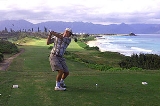
A full swing is a complex rotation of the body aimed at accelerating the club head to a great speed. For a right-handed golfer, it consists of a backswing to the right, a downswing to the left , and a follow through. At address, the player stands with the left shoulder and hip pointing in the intended direction of ball flight, with the ball before the feet. The club is held with both hands , the clubhead resting on the ground behind the ball, hips and knees somewhat flexed, and the arms hanging from the shoulders. The backswing is a rotation to the right, consisting of a shifting of the player's body weight to the right side, a turning of the pelvis and shoulders, lifting of the arms and flexing of the elbows and wrists. At the end of the backswing the hands are above the right shoulder, with the club pointing more or less in the intended direction of ball flight. The downswing is roughly a backswing reversed. After the ball is hit, the follow-through stage consists of a continued rotation to the left. At the end of the swing, the weight has shifted almost entirely to the left foot, the body is fully turned to the left and the hands are above the left shoulder with the club hanging down over the players' back.

The full golf swing is an unnatural, highly complex motion and notoriously difficult to learn. It is not uncommon for beginners to spend several months practising the very basics before playing their first ball on a course. It is usually considered impossible to acquire a stable and successful swing without professional instruction and even highly skilled golfers may continue to take golf lessons for many years. One can also purchase or use a new golf simulator that can cost upwards of $50,000.

Relatively few golfers play left-handed , with even players who are strongly left-handed in their daily life preferring the right-handed golf swing. In the past, this may have been due to the difficulty of finding left-handed golf clubs. Today, more manufacturers provide left-handed versions of their club lines, and the clubs are more readily purchased from mail-order and Internet catalogues, as well as golf stores. A golfer who plays right-handed, but holds the club left-hand-below-right is said to be "cack-handed". It is difficult to obtain the same consistency and power with this arrangement as is possible with conventional technique.

Besides the physical part, the mental aspect contributes to the difficulty of the golf swing. Golfers play against the course, not each other directly, and hit a stationary object, not one put into motion by an opponent. This means that there is never anyone to blame but oneself for a bad result, and in most competitive formats there are no teammates to directly help one out. Knowledge of this creates a great deal of psychological pressure on the golfer; this pressure exists at all levels of play. Even the best professional golfers sometimes succumb to this pressure, such as getting the "yips" a severe putting disorder caused by uncontrolled muscle spasms of the arms, resulting in a jerking motion during the follow through of the putt causing the ball to go much farther than desired, or having collapses of their full swing .

A golf ball acquires spin when it is hit. Backspin is imparted for almost every shot due to the golf club's loft . A spinning ball deforms the flow of air around it similar to an airplane wing; a back-spinning ball therefore experiences an upward force which makes it fly higher and longer than a ball without spin. The amount of backspin also influences the behavior of a ball when it impacts the ground. A ball with little backspin will usually roll out for a few yards/meters while a ball with more backspin may not roll at all, even backwards.
Sidespin occurs when the clubface is not aligned perpendicularly to the plane of swing. Sidespin makes the ball curve left or right: a curve to the left is a draw, and to the right a fade . Accomplished golfers purposely use sidespin to steer their ball around obstacles or towards the safe side of fairways and greens. But because it's sometimes difficult to control or predict the amount of sidespin, balls may take an undesirable trajectory, such as hook to the left, or slice to the right .

Equipment


Golf clubs


A player usually carries several clubs during the game . There are three major types of clubs, known as woods, irons, and putters. Wedges are irons used to play shorter shots. Woods are played for long shots from the tee or fairway, and occasionally rough, while irons are for precision shots from fairways as well as from the rough. A new type of wood known as a "hybrid" combines the straight-hitting characteristics of irons with the easy-to-hit-in-the-air characteristics of higher-lofted woods. A "hybrid" is often used for long shots from difficult rough. Hybrids are also used by players who have a difficult time getting the ball airborne with long irons. Wedges are played from difficult ground such as sand or the rough and for approach shots to the green. Putters are mostly played on the green, but can also be useful when playing from bunkers or for some approach shots.

Golf balls


The minimum allowed diameter of a golf ball is 42.67mm and its mass may not exceed 45.93g. Modern golf balls have a two-, three-, or four-layer design constructed from various synthetic materials. The surface usually has a pattern of 300-400 dimples designed to improve the ball's aerodynamics. The method of construction and materials used greatly affect the ball's playing characteristics such as distance, trajectory, spin and feel. Harder materials, such as Surlyn, usually result in the ball's traveling longer distances, while softer covers, such as Balata, tend to generate higher spin, more "feel" and greater stopping potential. Golf balls are separated into three groups depending on their construction: two-, three-, or four-piece covers. Generally four-piece golf balls tend to be the most expensive, though price is no assurance of quality. As of 2006 there are golf balls that utilize RFID Radio Frequency Identification

Radio Frequency Identification is an automatic identification [i]... 

 technology, which allow golfers to locate errant shots easily using a handheld homing device.

Golf shafts


Golf shafts are used between the grip and the "club head". The profile of the golf shaft is circlular in shape and some of the strongest and lightest materials are used to make the golf shaft. Graphite and tempered steels are used for the best strength. In 2006 the newest profiles that are USGA approved and have ultimate strength are Triangle Golf Shafts or some call the shaft Trigraphite Shafts.

Other equipment


Sometimes transport is by special golf car Golf car

A golf cart,, is a small vehicle [i] designed originally to carry two golf [i]ers and their golf clubs [i] ... 

ts. Clubs and other equipment are carried in golf bags. Golfers wear special shoes with exchangeable spikes attached to the soles. They also often wear gloves that help grip the club and prevent blistering. Golf tee Tee

A tee is a stand used to support a stationary ball [i] so that the player can strike it, particularly in ... 

s resemble nails with a small cup on the head and are usually made of wood or plastic. A tee is pushed into the ground to rest a ball on top of for an easier shot; however, this is only allowed for the first stroke of each hole. When on the green, the ball may be picked up to be cleaned or if it is in the way of an opponent's putting line; its position must then be marked using a ball marker . A ball mark repair tool is used to repair a ball mark . To repair a ball mark, one pushes the tool under the mark, and lifts upwards gently, loosening the compacted turf to allow rapid regrowth of grass. Scores are recorded on a score card during the round.

History

See also Timeline of golf history 1353-1850, Timeline of golf history 1851-1945, and Timeline of golf history 1945-1999.

The origin of golf is open to debate among Chinese, French, Dutch and Scottish. Golf was mentioned on February 26 in the year 1297 for the first time in Holland in a city called Loenen aan de Vecht. Here the Dutch played a game with a stick and leather ball. He who hit the ball in a target several hundreds of meters away the least number of times, won. However, golf is generally regarded to be a Scottish Scotland

Scotland is a nation [i] in northwest Europe [i] and one of the constituent [i] countries [i] ... 

 invention, as the game was mentioned in two 15th-century laws prohibiting the playing of the game of "gowf". Some scholars, however, suggest that this refers to another game which is much akin to shinty Shinty

Shinty, also known as camanachd or iomain, is a team sport [i] played with sticks and a ball... 

 or hurling Hurling

Hurling is an outdoor team sport [i] of Celt [i]ic origin, administered by the Gaelic Athletic Association [i]... 

, or to modern field hockey Field hockey

Field hockey is a popular sport for men and women in many countries around the world.... 

. They point out that a game of putting a small ball in a hole in the ground using golf clubs was played in 17th-century Netherlands Netherlands

The Netherlands is the Europe [i]an part of the Kingdom of the Netherlands [i] , which is formed ... 

. The term golf is believed to have originated from a Germanic Germanic languages

The Germanic languages are a group of related languages constituting a branch of the Indo-European language family [i] ... 

 word for "club".

The oldest playing golf course in the world is The Old Links at Musselburgh Musselburgh

Musselburgh is a town in East Lothian [i], Scotland [i], on the coast of the Firth of Forth [i], six mil ... 

. Evidence has shown that golf was played on Musselburgh Links in 1672 although Mary, Queen of Scots Mary I of Scotland

Mary I of Scotland was the Queen of Scots [i] from December 14 [i] 1542 [i] to July 24 [i] 1567 [i]. ... 

 reputedly played there in 1567.

Golf courses have not always had eighteen holes. The St Andrews Links St Andrews Links

St Andrews Links in the Royal Burgh [i] of St Andrews [i], Fife [i], Scotland [i], is regarded as the "h ... 

 occupy a narrow strip of land along the sea. As early as the 15th century, golfers at St. Andrews established a customary route through the undulating terrain, playing to holes whose locations were dictated by topography. The course that emerged featured eleven holes, laid out end to end from the clubhouse to the far end of the property. One played the holes out, turned around, and played the holes in, for a total of 22 holes. In 1764, several of the holes were deemed too short, and were therefore combined. The number was thereby reduced from 11 to nine, so that a complete round of the links comprised 18 holes.

The major changes in equipment since the 19th century have been better mowers, especially for the greens, better golf ball designs, using rubber and man-made materials since about 1900, and the introduction of the metal shaft beginning in the 1930s. Also in the 1930s the wooden golf tee was invented. In the 1970s the use of metal to replace wood heads began, and shafts made of graphite composite materials were introduced in the 1980s.


In January 2006, new evidence re-invigorated the debate concerning the origins of golf. Recent evidence unearthed by Prof. Ling Hongling of Lanzhou University suggests that a game similar to modern-day golf was played in China China

China is a cultural region [i] and ancient civilization [i] in East Asia [i]. ... 

 since Southern Tang Dynasty, 500 years before golf was first mentioned in Scotland.

Dongxuan Records from the Song Dynasty Song Dynasty

The Song Dynasty was a ruling dynasty in China [i] from 960 [i]-1279 [i]. ... 

 describe a game called chuiwan and also include drawings. It was played with 10 clubs including a cuanbang, pubang, and shaobang, which are comparable to a driver, two-wood, and three-wood. Clubs were inlaid with jade Jade

An ornamental stone [i], jade is a name applied to two different rocks that are made up of different sil ... 

 and gold Gold

Gold is a highly sought-after precious metal [i] that for many centuries has been used as money [i], a store of value [i] ... 

, suggesting golf was for the wealthy. Chinese archive includes references to a Southern Tang official who asked his daughter to dig holes as a target. Ling suggested golf was exported to Europe and then Scotland by Mongolian travellers in the late Middle Ages Middle Ages

The Middle Ages formed the middle period in a traditional schematic division of European history [i] ... 

.

A spokesman for the Royal and Ancient Golf Club of St. Andrews The Royal and Ancient Golf Club of St Andrews

The Royal and Ancient Golf Club of St Andrews is the one of the oldest golf clubs in the world, the olde... 

, one of the oldest Scotland golf organization, said "Stick and ball games have been around for many centuries, but golf as we know it today, played over 18 holes, clearly originated in Scotland."

Social aspects of golf

In the United States United States

The United States of America, also known as the United States, the U.S., the U.S.A., a... 

, golf is the unofficial sport of the business world. It is often said that board meetings merely confirm decisions that are actually made on the golf course. For this reason, the successful conduct of business golf is considered a useful business skill; various schools, including prestigious universities such as Stanford University Stanford University

The Leland Stanford Junior University, commonly known as Stanford University , is a private university [i] ... 

, have started both undergraduate and graduate-level courses that teach "business golf". The PGA of America, an organization separate from the PGA Tour, helps to sponsor these programs at universities nationwide.

Cost to play

The cost of an average round of golf in the United States is USD United States dollar

For details of current paper money [i] and coins, see Federal Reserve Note [i] and United States coinage [i] ... 

 $36 , and the sport is regularly enjoyed by over 26 million Americans and many more world-wide. Most regions of the U.S. feature public courses which strive to be affordable for the average golfer. Excepting public courses subsidized by local governments , green fees tend to be lower in areas of inexpensive real estate, especially the American South and Midwest. Michigan Michigan

Michigan is a Midwestern [i] state [i] of the United States [i], located in the east north central [i] ... 

 has more courses open to the public than any other U.S. state .

By contrast, green fees are more expensive, sometimes dramatically so, in more urban areas with high real estate values. Despite golf's popularity in densely populated East Asian countries such as South Korea South Korea

South Korea, officially the Republic of Korea, is an East Asia [i]n state [i] on the southern half ... 

 and Japan Japan

is an island country [i] in East Asia [i]. ... 

, the citizen of average means is limited to hitting balls on driving ranges as play on an actual course requires memberships priced at several times the average worker's annual salary.

The fact that golf tends to be a sport associated with wealthy businesspeople and professionals , not to mention the high prices and wealthy clientele that can afford to pay to join elite country clubs, contribute to the perception that golf is expensive. By contrast, there is no other single sport that might be compared to golf as a sport for affluent people. .

To compare golf against other sports is to quantify what makes it more expensive:

  • Golf is not a game in which equipment can be comfortably shared. By comparison, 22 people can share one soccer ball and 10 people can share one basketball. Buying or even renting an entire set of golf clubs immediately becomes more expensive.
  • Playing golf requires paying greens fees to enter a golf course. By comparison, playing soccer or touch-football or basketball at a school field or public playground is free of cost.
  • Exposure to golf is also not as accessible as other sports. For example, many children will play baseball, hockey, American football or soccer in school or youth programs, and the equipment is provided . However, few high schools or youth programs offer a golf program where kids can be exposed to and learn the game at a relatively cheaper price.
  • Comparing golf to other individual sports, golf is still more expensive. One racquet for a racquet sport is still much cheaper than a set of clubs, and registration at a racquet club or even a local YMCA YMCA

    The Young Men's Christian Association is an ecumenical [i] service organization [i] ... 

     for a month can be cheaper than one day at the golf course. Moreover, kids can borrow an old racquet and hit a ball against a school wall for free. It is difficult for a golfer to practice hitting shots longer than short pitch shots unless one pays to play golf or pays to practice at a driving range or indoor golf training facility.
  • School teams usually provide access to a golf course with unlimited access as with any other high school sport


Further, the social status of better equipment cannot be overlooked. Few will notice or care the condition of a baseball glove as long as it can catch a baseball adequately. Similarly, as long as a basketball has enough air to bounce evenly, it's brand name and condition is mostly irrelevant. In order to be outfitted with the latest equipment one can end up spending quite a sum. Also, greens fees at some of the more picturesque and prestigious courses can be quite sizeable. Again, because golf has become the platform through which business people interact, evaluate each other, and generally talk/negotiate, the quality of one's clubs and dress are an expression of their success.

Cost of maintenance

The maintenance and upkeep of a golf course demands significant expense. Public outdoor tennis courts also require fees which are allocated in part to maintenance and upkeep. Moreover, unlike a basketball or tennis court, grass continues to grow, as do weeds, trees, etc, which must be continually and regularly trimmed and kept in order to maintain a clean course. As well, families of local fauna must be kept in check .

The sheer size of a golf course demands no small amount of crew and equipment. But, not just any crew or any equipment - specialized groundskeepers and specialized equipment must be used to maintain a stimulating and beautiful tee, fairway, green, as well as bunkers, water hazards, etc. Quality grasses, soils, flora, and a high degree of ever-changing technology requires that a country club can't really "go cheap" and expect to remain profitable.

Golfing countries

In 2005 Golf Digest Golf Digest

Golf Digest is a monthly golf [i] magazine [i] published by Advance Publications [i] in the United States [i] ... 

calculated that there were nearly 32,000 golf courses in the world, approximately half of them in the United States United States

The United States of America, also known as the United States, the U.S., the U.S.A., a... 

. The countries with most golf courses in relation to population, starting with the best endowed were: Scotland Scotland

Scotland is a nation [i] in northwest Europe [i] and one of the constituent [i] countries [i] ... 

, New Zealand New Zealand

New Zealand is a country in the south-western Pacific Ocean [i] consisting of two large islands and many ... 

, Australia Australia

Australia, officially the Commonwealth of Australia, is a country in the Southern Hemisphere [i] c ... 

, Republic of Ireland Republic of Ireland

The Republic of Ireland is the official description of the sovereign state which covers approximately f... 

, Northern Ireland Northern Ireland

Northern Ireland is part of the United Kingdom [i] and covers 5,459 square miles [i] in the north... 

, Canada Canada

Canada is the world's second-largest [i] country by total area, occupying most ... 

, Wales Wales

Wales is one of four constituent parts [i] of the United Kingdom [i]. ... 

, United States United States

The United States of America, also known as the United States, the U.S., the U.S.A., a... 

, Sweden Sweden

The Kingdom of Sweden is a Nordic country [i] in Scandinavia [i]. ... 

, and England England

England is the largest and most populous constituent country [i] of the United Kingdom [i]. ... 

 . Apart from Sweden all of these countries have English English language

English is a widely distributed language that originated in England [i] but is now the primary language ... 

 as the official language, but the number of courses in new golfing territories is increasing rapidly. For example the first golf course in the People's Republic of China People's Republic of China

The People's Republic of China , is a country [i] in East Asia [i]. ... 

 only opened in the mid-1980s, but by 2005 there were 200 courses in that country.

The professional sport was initially dominated by British golfers, but since World War I World War I

World War I, also known as the First World War, the Great War and "The War to End All War... 

, America has produced the greatest quantity of leading professionals. Other Commonwealth Commonwealth of Nations

The Commonwealth of Nations, usually known as the Commonwealth, is a voluntary association [i] of ... 

 countries such as Australia Australia

Australia, officially the Commonwealth of Australia, is a country in the Southern Hemisphere [i] c ... 

 and South Africa South Africa

The Republic of South Africa is a country located at the southern tip of the Africa [i]n continent [i]. ... 

 are also traditional powers in the sport. Since around the 1970s, Japan Japan

is an island country [i] in East Asia [i]. ... 

, Scandinavia Scandinavia

Scandinavia is a region [i] in Northern Europe [i]. ... 

n and other Western Europe Western Europe

Western Europe is mainly a socio-political concept coined [i], forged and used during the Cold War [i]. ... 

an countries have produced leading players on a regular basis. The number of countries with high-class professionals continues to increase steadily, especially in East Asia East Asia

East Asia is a subregion [i] of Asia [i] that can be defined in either geographical [i] or cul ... 

. South Korea South Korea

South Korea, officially the Republic of Korea, is an East Asia [i]n state [i] on the southern half ... 

 is notably strong in women's golf. More information is available at .

Professional golf

Golf is played professionally in many different countries. The majority of professional golfers work as club or teaching professionals, and only compete in local competitions. A small elite of professional golfers are "tournament pros" who compete full time on international "tours".

Golf tours


There are at least twenty professional golf tours, each run by a PGA or an independent tour organisation, which is responsible for arranging events, finding sponsors, and regulating the tour. Typically a tour has "members" who are entitled to compete in all of its events, and also invites non-members to compete in some of them. Gaining membership of an elite tour is highly competitive, and most professional golfers never achieve it.

The most widely known tour is the PGA TOUR PGA Tour

The PGA Tour is an organization headquartered in Ponte Vedra Beach, Florida [i], USA [i] t... 

 , which attracts the best golfers from all the other men's tours. This is due mostly to the fact that most PGA TOUR events have a first prize of at least USD United States dollar

For details of current paper money [i] and coins, see Federal Reserve Note [i] and United States coinage [i] ... 

 800,000. The European Tour PGA European Tour

The PGA European Tour is an organisation which operates the three leading men's professional golf [i] tour [i] ... 

, which attracts a substantial number of top golfers from outside North America, ranks second to the PGA TOUR in worldwide prestige. Some top professionals from outside North America play enough tournaments to maintain membership on both the PGA TOUR and European Tour. There are several other men's tours around the world.

Golf is unique in having lucrative competition for older players. There are several senior tours for men 50 and older, the best known of which is the U.S.-based Champions Tour Champions Tour

waii]] [i]
||-
|Jan 27-29
|Turtle Bay Championship [i]
... 

.

There are five principal tours for women, each based in a different country or continent. The most prestigious of these is the U.S-based LPGA Tour LPGA

The LPGA, in full the Ladies Professional Golf Association, is an American [i] organ ... 

.

Men's major championships

The major championships are the four most prestigious men's tournaments of the year. In current chronological order they are:

  • The Masters The Masters Tournament

    The Masters Tournament, commonly referred to as The Masters or The US Masters, is one of fou... 

  • U.S. Open
  • The Open Championship The Open Championship

    The Open Championship - often known as the British Open outside the United Kingdom [i] and Ireland [i] ... 

  • PGA Championship PGA Championship

    |-

|1956||Jack Burke, Jr [i]||||Ted Kroll [i]||3 & 2||Blue Hill Country Club [i]||Boston [i] ... 


The fields for these events include the top several dozen golfers from all over the world. The Masters has been played at Augusta National Golf Club in Augusta, Georgia since its inception in 1934. The U.S. Open and PGA Championship are played at various courses around the United States, while The Open Championship is played at various courses in the UK.

The number of major championships a player accumulates in his career has a very large impact on his stature in the sport. Jack Nicklaus Jack Nicklaus

Jack William Nicklaus, also known as "The Golden Bear", was a major force in professional golf [i], firs ... 

 is widely regarded as the greatest golfer of all time, largely because he has won a record 18 professional majors, or 20 majors in total if his two U.S. Amateurs are included. Tiger Woods Tiger Woods

Eldrick "Tiger" Woods is an American [i] golf [i]er whose achievements to date rank him a ... 

, who may be the only golfer likely to challenge Nicklaus's record, has won twelve professional majors , all before the age of thirty-one. Woods also came closest to winning all four current majors in one season when he won them consecutively across two seasons: the 2000 U.S. Open, Open Championship, and PGA Championship; and the 2001 Masters. This feat has been frequently called the Tiger Slam.

Prior to the advent of the PGA Championship and The Masters, the four Majors were the U.S. Open, the U.S. Amateur, the Open Championship, and the British Amateur. These are the four that Bobby Jones won in 1930 to become the only player ever to have earned a Grand Slam.

Women's majors

Women's golf does not have a globally agreed set of majors. The LPGA's list of majors has changed several times over the years, with the last change in 2001. Like the PGA TOUR, the LPGA currently has four majors:

  • Kraft Nabisco Championship
  • U.S. Women's Open
  • LPGA Championship
  • Women's British Open Women's British Open

    The Women's British Open, also known for sponsorship reasons as the Weetabix [i] Wom ... 


Only the last of these is also recognised by the Ladies European Tour Ladies European Tour

The Ladies European Tour is a professional golf [i] tour for women which was founded in 1979.
... 

.

Environmental impact

Environmental concerns over the use of land for golf courses have grown over the past 50 years. Specific concerns include the amount of water Water

Water is a taste [i]less, odor [i]less substance that is essential to all known forms of life [i] and i ... 

 and chemical pesticide Pesticide

The U.S Environmental Protection Agency [i] defines a pesticide as "any substance or mixture of substan ... 

s and fertilizer Fertilizer

Fertilizers or fertilisers are compounds given to plant [i]s with the intention of promoting grow ... 

s used for maintenance, as well as the destruction of wetland Wetland

In physical geography [i], a wetland is an environment "at the interface between truly terrestrial [i] ... 

s and other environmentally important areas during construction.


These, along with health and cost concerns, have led to significant research into more environmentally sound practices and turf grasses. The modern golf course superintendent is well trained in the uses of these practices and grasses. This has led to reductions in the amount of chemicals and water used on courses. The turf on golf courses is an excellent filter for water and has been used in many communities to cleanse grey water. While many people continue to oppose golf courses for environmental reasons, there are others who feel that they are beneficial for the community and the environment as they provide corridors for migrating animals and sanctuaries for birds and other wildlife.

A major result of modern equipment is that today's players can hit the ball much further than previously. In a concern for safety, modern golf course architects have had to lengthen and widen their design envelope. This has led to a ten percent increase in the amount of area that is required for golf courses today. At the same time, water restrictions placed by many communities have forced many courses to limit the amount of maintained turf grass. While most modern 18-hole golf courses occupy as much as 60 ha of land, the average course has 30 ha of maintained turf.

Golf courses are built on many different types of land, including sandy areas along coasts, abandoned farms, strip mines and quarries, deserts and forests. Many Western countries have instituted significant environmental restrictions on where and how courses can be built .

In some parts of the world, attempts to build courses and resorts have led to significant protests along with vandalism and violence by both sides. Although golf is a relatively minor issue compared to other land-ethics questions, it has symbolic importance as it is a sport normally associated with the wealthier Westernized population, and the culture of colonization and globalization of non-native land ethics. Resisting golf tourism Tourism

Tourism is the act of travel [i] for predominantly recreation [i]al or leisure [i] purposes, and also re ... 

 and golf's expansion has become an objective of some land-reform movements, especially in the Philippines Philippines

The Philippines , officially the Republic of the Philippines , is an island nation [i] located in ... 

 and Indonesia Indonesia

Indonesia, officially the Republic of Indonesia , is a nation of islands [i] consist ... 

.

In Saudi Arabia Saudi Arabia

The Kingdom of Saudi Arabia is the largest country on the Arabian Peninsula [i]. ... 

, golf courses have been constructed on nothing more than oil-covered sand. However, in some cities such as Dhahran Dhahran

Dhahran in Saudi Arabia [i]'s Eastern Province [i].
... 

, modern, grass golf courses have been built recently.

In Coober Pedy Coober Pedy, South Australia

Coober Pedy, population 3,500, is a small town in South Australia [i], 846 kilometres north of Adelaide [i] ... 

, Australia Australia

Australia, officially the Commonwealth of Australia, is a country in the Southern Hemisphere [i] c ... 

, there is a famous golf course that consists of nine holes dug into mounds of sand, diesel and oil and not a blade of grass or a tree to be seen. You carry a small piece of astroturf from which you tee.

In New Zealand New Zealand

New Zealand is a country in the south-western Pacific Ocean [i] consisting of two large islands and many ... 

 it is not uncommon for rural courses to have greens fenced off and sheep graze the fairways.
Many golf courses have been displaced by urban planning practices. Many things that displace golf courses range from neighborhoods to shopping mall Shopping mall

A shopping mall, shopping center, or shopping arcade is a building or set of buildings that ... 

s.

At the 125-year-old Royal Colombo Golf Club in Sri Lanka Sri Lanka

Sri Lanka, officially the Democratic Socialist Republic of Sri Lanka , is a tropical [i] island nation [i] ... 

 steam trains, from the Kelani Valley railway, run through the course at the 6th hole.

Technology in Golf


Equipment

As golf has grown more competitive, players have wanted equipment that performs better. Golf balls have changed from feather-filled leather sacs to complex composites. Golf clubs have changed from wooden shafts and club heads to carbon fiber shafts and precisely engineered club heads.

Health

As sports nutrition has increased, treatment of injuries improved and knowledge of the human body grown, athletic potential has increased. Athletes today are now able to play at an older age, recover more quickly from injuries, and train more effectively than in previous generations.

Instruction

Golf has often been in the forefront of technological advances in sporting. Systems have been developed that measure the speed and spin of golf balls after they are hit, measure club head speed and even how the body moves during the golf swing. Video motion capture has played a large role in measuring aspects of golf that are difficult if not impossible to measure and understand with the human eye.

Tools such as launch monitors are able to measure club head speed as well as golf ball speed and spin, projecting the most likely flight path of the ball. Video capture devices allow body position and angles to be determined at different points of the swing. Motion capture devices allow for most information to be gathered at one time, measuring position, angles, orientations, as well as velocities at many points of the swing. The benefit of motion capture devices is that they utilize computers, which are cheaper to store data on than high speed video and are more precise.

Etymology

The word golf was first mentioned in writing in 1457 on a Scottish statute on forbidden games as gouf, which may be related to the Dutch word "kolf," meaning "bat," or "club."

Golf humor

Many jokes revolve around the game of golf, either as a setting for an otherwise generic punchline or as the target of a barb. Mark Twain Mark Twain

Samuel Langhorne Clemens, better known by his pen name [i] Mark Twain, was an American [i] ... 

's definition of golf was "a good walk spoiled". John McEnroe John McEnroe

John Patrick McEnroe, Jr. is a former World No. 1 [i] professi ... 

 asked rhetorically, in reference to whether golf is a sport, "I thought a sport was where you had to run or something."

Golf movies

  • A Gentlemen's Game
  • Happy Gilmore Happy Gilmore

    Happy Gilmore is a 1996 [i] sports [i] comedy film [i] starring Adam Sandler [i], Carl Weathers [i], ... 

  • The Greatest Game Ever Played The Greatest Game Ever Played