

SWAT

Encyclopedia
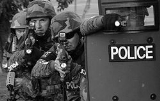
A SWAT team is an elite tactical unit in various national law enforcement departments. They are trained to perform high-risk operations that fall outside of the abilities of regular officers. SWAT team members' duties include: performing hostage rescues and counter-terrorism
operations; serving high risk arrest and search warrants; subduing barricaded suspects; and engaging heavily-armed criminals. SWAT teams are often equipped with specialized firearms including submachine guns, assault rifles, breaching shotguns
, riot control agents, stun grenades, and sniper rifles. They have specialized equipment including heavy body armor, ballistic shields, entry tools, armored vehicles, advanced night vision
optics, and motion detectors for covertly determining the positions of hostages or hostage takers inside enclosed structures.
The first SWAT team was established by inspector Daryl Gates
in the Los Angeles Police Department
in 1968. Since then, many American and Canadian police departments, especially in major cities and at the federal
and state
-levels of government, have established their own elite units under various names; these units, regardless of their official name, are referred to collectively as SWAT teams in colloquial usage.
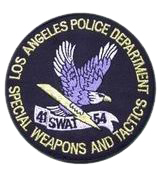 Gates explained in his autobiography Chief: My Life in the LAPD that he neither developed SWAT tactics nor the associated and often distinctive equipment; but that he supported the underlying concept, tried to empower his people to develop it, and generally lent them moral support.
Gates originally named the platoon "Special Weapons Assault Team"; however, this name was not generally favored and was rejected by his manager, deputy police chief Ed Davis
, as sounding too much like a military organization. Wanting to keep the acronym "SWAT", Gates changed its expanded form to "special weapons and tactics".
While the public image of SWAT first became known through the LAPD, perhaps because of its proximity to the mass media and the size and professionalism of the Department itself, the first SWAT-type operations were conducted north of Los Angeles
in the farming community of Delano, California
on the border between Kern
and Tulare
Counties in the San Joaquin Valley
. At the time, César Chavez
' United Farm Workers
union was staging numerous protests in Delano, both at cold storage facilities and outside non-supportive farm workers' homes on city streets. The Delano Police Department responded by forming ad-hoc units using special weapons and tactics. Television news stations and print media carried live and delayed reportage of these events across the United States. Personnel from the LAPD, having seen these broadcasts, contacted Delano and inquired about the program. One officer then obtained permission to observe the Delano Police Department's special weapons and tactics units in action, and afterwards took what he had learned back to Los Angeles where his knowledge was used and expanded on to form the LAPD's own first SWAT unit.
John Nelson
was the officer who conceived the idea to form a specially trained and equipped unit in the LAPD, intended to respond to and manage critical situations involving shootings while minimizing police casualties. Inspector Gates approved this idea, and he formed a small select group of volunteer officers. This first SWAT unit initially consisted of fifteen teams of four men each, making a total staff of sixty. These officers were given special status and benefits, and were required to attend special monthly training sessions. The unit also served as a security unit for police facilities during civil unrest. The LAPD SWAT units were organized as "D Platoon" in the Metro division.
A report issued by the Los Angeles Police Department, following a shootout with the Symbionese Liberation Army in 1974, offers one of the few firsthand accounts by the department regarding SWAT history, operations, and organization.
On page 100 of the report, the Department cites four trends which prompted the development of SWAT. These included riots such as the Watts Riots
, which in the 1960s forced the LAPD and other police departments into tactical situations for which they were ill-prepared; the emergence of snipers as a challenge to civil order; political assassinations
; and the threat of urban guerrilla warfare
by militant groups. "The unpredictability of the sniper and his anticipation of normal police response increase the chances of death or injury to officers. To commit conventionally trained officers to a confrontation with a guerrilla-trained militant group would likely result in a high number of casualties among the officers and the escape of the guerrillas." To deal with these under conditions of urban violence, the LAPD formed SWAT, notes the report.
The report states on page 109, "The purpose of SWAT is to provide protection, support, security, firepower, and rescue to police operations in high personal risk situations where specialized tactics are necessary to minimize casualties."
On February 7, 2008, a siege and subsequent firefight with a gunman in Winnetka, California
led to the first line-of-duty death of a member of the LAPD's SWAT team in its 41 years of existence.
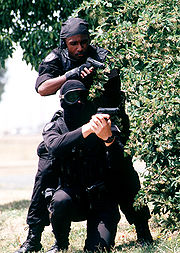 SWAT duties include:
. The Panthers eventually surrendered, with three Panthers and three officers being injured. By 1974, there was a general acceptance of SWAT as a resource for the city and county of Los Angeles.
On the afternoon of May 17, 1974, elements of the Symbionese Liberation Army
(SLA), a group of heavily-armed left-wing
guerrillas, barricaded themselves in a residence on East 54th Street at Compton Avenue in Los Angeles. Coverage of the siege was broadcast to millions via television and radio and featured in the world press for days after. Negotiations were opened with the barricaded suspects on numerous occasions, both prior to and after the introduction of tear gas. Police units did not fire until the SLA had fired several volleys of semi-automatic and automatic gunfire at them. In spite of the 3,772 rounds fired by the SLA, no uninvolved citizens or police officers sustained injury from gunfire. However all the gunmen inside were killed.
During the gun battle, a fire erupted inside the residence. The cause of the fire is officially unknown, although police sources speculated that an errant round ignited one of the suspects' Molotov cocktail
s. Others suspect that the repeated use of tear gas grenades, which function by burning chemicals at high temperatures, started the structure fire. All six of the suspects suffered multiple gunshot wounds or perished in the ensuing blaze.
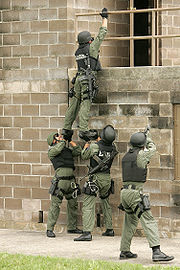 By the time of the SLA shoot-out, SWAT teams had reorganized into six 10-man teams, each team consisting of two five-man units, called elements. An element consisted of an element leader, two assaulters, a scout, and a rear-guard. The normal complement of weapons was a sniper rifle (a .243-caliber bolt-action, based on the ordnance expended by officers at the shootout), two .223-caliber semi-automatic rifles, and two shotguns. SWAT officers also carried their service revolvers in shoulder holsters. Standard gear included a first aid kit, gloves, and a gas mask
. At a time when officers were usually issued six-shot revolvers and shotguns, it was a significant change to have police armed with semi-automatic rifles. The encounter with the heavily-armed Symbionese Liberation Army, however, sparked a trend towards SWAT teams being issued body armor and automatic weapons of various types.
The Columbine High School massacre
in Colorado on April 20, 1999 was another seminal event in SWAT tactics and police response. As noted in an article in the Christian Science Monitor
, "Instead of being taught to wait for the SWAT team to arrive, street officers are receiving the training and weaponry to take immediate action during incidents that clearly involve suspects' use of deadly force."
The article further reported that street officers were increasingly being armed with rifles, and issued heavy body armor and ballistic helmets, items traditionally associated with SWAT units. The idea is to train and equip street officers to make a rapid response to so-called active-shooter
situations. In these situations, it was no longer acceptable to simply set up a perimeter and wait for SWAT.
As an example, in the policy and procedure manual of the Minneapolis Police Department
, it is stated, "MPD personnel shall remain cognizant of the fact that in many active shooter incidents, innocent lives are lost within the first few minutes of the incident. In some situations, this dictates the need to rapidly assess the situation and act quickly in order to save lives."
With this shift in police response, SWAT units remain in demand for their traditional roles as hostage rescue, counter-terrorist operations, and serving high-risk warrants.
Although due to Officers having to be on call-out most of the day, they may put on regular patrol. To decrease response times to serious situations that need the direct attention of SWAT Officers, it is now a widely used method to place SWAT equipment and weaponry in secured lockers in the trunks of specialized police cruisers. Such departments that need to use this are Sheriffs due to the size of the counties and places like Los Angeles traffic may be high so LAPD use cruisers to respond with their Officers so they do not have to return to the police building. Although for heavier duty equipment they may need to depending on the situation that arises.
By illustration, the LAPD's website shows that in 2003, their SWAT units were activated 255 times, for 133 SWAT calls and 122 times to serve high-risk warrants.
The New York Police Department's Emergency Service Unit
is one of the few civilian police special-response units that operate autonomously 24 hours a day. However, this unit also provides a wide range of services, including search and rescue functions, and vehicle extraction, normally handled by fire departments or other agencies.
The need to summon widely-dispersed personnel, then equip and brief them, makes for a long lag between the initial emergency and actual SWAT deployment on the ground. The problems of delayed police response at the 1999 Columbine High School shooting has led to changes in police response, mainly rapid deployment of line officers to deal with an active shooter, rather than setting up a perimeter and waiting for SWAT to arrive.
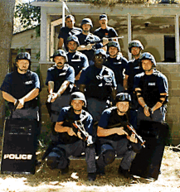 SWAT officers are selected from volunteers within their law enforcement organization. Depending on the department's policy, officers generally have to serve a minimum tenure within the department before being able to apply for a specialist section such as SWAT. This tenure requirement is based on the fact that SWAT officers are still law enforcement officers and must have a thorough knowledge of department policies and procedures.
SWAT applicants undergo rigorous selection and training. Applicants must pass stringent physical agility, written, oral, and psychological testing to ensure they are not only fit enough but also psychologically suited for tactical operations.
Emphasis is placed on physical fitness so an officer will be able to withstand the rigors of tactical operations. After an officer has been selected, the potential member must undertake and pass numerous specialist courses that will make him a fully qualified SWAT operator. Officers are trained in marksmanship for the development of accurate shooting skills. Other training that could be given to potential members includes training in explosives, sniper-training, defensive tactics, first-aid, negotiation, handling K9
units, rappelling and roping techniques and the use of specialized weapons and equipment. They may also be trained specifically in the handling and use of special ammunition such as bean bags
, flash bang grenades, taser
s, and the use of crowd control methods, and special non-lethal munitions. Of primary importance is close-quarters defensive tactics training, as this will be the primary mission upon becoming a full-time SWAT officer.
Tactical aids include K9 Units, as well as flash bang
, stinger, and tear gas grenades.
Semi-automatic pistols are the most popular sidearms. Examples may include, but are not limited to: M1911 pistol series, Sig Sauer series (especially the Sig P226
and Sig P229), Beretta 92
series, Glock pistol
s, H&K USP series, and 5.7x28mm FN Five-seveN pistol.
Common submachine guns used by SWAT teams include the 9 mm and 10 mm Heckler & Koch MP5
, Heckler & Koch UMP
, and 5.7x28mm FN P90
.
Common shotguns used by SWAT units include the Benelli M1, Benelli M4, Benelli M1014, Remington 870
and 1100
, Mossberg 500
and 590.
Common carbines include the LWRC PSD Rifle, Colt CAR-15
resp. M4
and Heckler & Koch G36
resp. HK416. While affording SWAT teams increased penetration and accuracy at longer ranges, the compact size of these weapons is essential as SWAT units frequently operate in Close quarters combat (CQB) environments. The Colt M16A2
can be found used by marksmen or SWAT officers when a longer ranged weapon is needed.
Common sniper rifles used are M14 rifle
and the Remington 700P. Many different variants of bolt action rifles are used by SWAT, including limited use of .50 caliber
sniper rifles for more intense situations.
To breach doors quickly, battering ram
s, shotguns with breaching rounds, or explosive charges can be used to break the lock or hinges, or even demolish the door frame itself. SWAT teams also use many non-lethal munitions and weapons. These include Taser
s, pepper spray
canisters, shotguns loaded with bean bag rounds, Pepperball guns, stinger grenades, flash bang grenades, and tear gas. Ballistic shields are used in close quarters situations to provide cover for SWAT team members and reflect gunfire. Pepperball guns are essentially paint ball
markers loaded with balls containing Oleoresin Capsicum ("pepper spray").
. To avoid detection by suspects during insertion in urban environments, SWAT units may also use modified buses, vans, trucks, or other seemingly normal vehicles. During the 1997 North Hollywood shootout
, LAPD SWAT commandeered an armored cash-delivery truck, which they used to extract wounded civilians and officers from the raging battle scene.
Units such as the Ohio State Highway Patrol
's Special Response Team (SRT) used a vehicle called a B.E.A.R., made by Lenco Engineering which is a very large armored vehicle with a ladder on top to make entry into the second and third floors of buildings. Numerous other agencies such as the LAPD, LASD
and NYPD use both the B.E.A.R. and the smaller Lenco BearCat
variant. Anaheim Police Department
has a customized B.E.A.R. fitted with a ladder for assaulting multi-story buildings. The LAPD as well as other agencies also fit their vehicles with the 'MARS' (Mobile Adjustable Ramp System for gaining entry to elevated platforms.
The Tulsa Police Department's SOT (Special Operations Team) uses an Alvis Saracen
, a British-built armored personnel carrier. The Saracen was modified to accommodate the needs of the SOT. A Night Sun was mounted on top and a ram was mounted to the front. The Saracen has been used from warrant service to emergency response. It has enabled team members to move from one point to another safely.
The police departments of Killeen and Austin, Texas and Washington, D.C. use the Cadillac Gage Ranger
, as does the Florida Highway Patrol
.
, authored Overkill: The Rise of Paramilitary Police Raids in America.
Other studies include Warrior Cops: The Ominous Growth of Paramilitarism in American Police Departments by Diane Cecilia Weber from the same institute and Militarizing American Police: The Rise and Normalization of Paramilitary Units by Dr. Peter Kraska and his colleague Victor Kappeler, professors of criminal justice at Eastern Kentucky University, who surveyed police departments nationwide and found that their deployment of paramilitary units had grown tenfold since the early 1980s.
Counter-terrorism
Counter-terrorism is the practices, tactics, techniques, and strategies that governments, militaries, police departments and corporations adopt to prevent or in response to terrorist threats and/or acts, both real and imputed.The tactic of terrorism is available to insurgents and governments...
operations; serving high risk arrest and search warrants; subduing barricaded suspects; and engaging heavily-armed criminals. SWAT teams are often equipped with specialized firearms including submachine guns, assault rifles, breaching shotguns
Shotgun
A shotgun is a firearm that is usually designed to be fired from the shoulder, which uses the energy of a fixed shell to fire a number of small spherical pellets called shot, or a solid projectile called a slug...
, riot control agents, stun grenades, and sniper rifles. They have specialized equipment including heavy body armor, ballistic shields, entry tools, armored vehicles, advanced night vision
Night vision
Night vision is the ability to see in low light conditions. Whether by biological or technological means, night vision is made possible by a combination of two approaches: sufficient spectral range, and sufficient intensity range...
optics, and motion detectors for covertly determining the positions of hostages or hostage takers inside enclosed structures.
The first SWAT team was established by inspector Daryl Gates
Daryl Gates
Daryl Gates was the Chief of the Los Angeles Police Department from 1978 to 1992.-Early life:...
in the Los Angeles Police Department
Los Angeles Police Department
The Los Angeles Police Department is the police department of the city of Los Angeles, California. With just under 10,000 officers and more than 3,000 civilian staff, covering an area of with a population of more than 4.1 million people, it is the third largest local law enforcement agency in...
in 1968. Since then, many American and Canadian police departments, especially in major cities and at the federal
Federal government of the United States
The federal government of the United States is the national government of the constitutional republic of fifty states that is the United States of America. The federal government comprises three distinct branches of government: a legislative, an executive and a judiciary. These branches and...
and state
U.S. state
A U.S. state is any one of the 50 federated states of the United States of America that share sovereignty with the federal government. Because of this shared sovereignty, an American is a citizen both of the federal entity and of his or her state of domicile. Four states use the official title of...
-levels of government, have established their own elite units under various names; these units, regardless of their official name, are referred to collectively as SWAT teams in colloquial usage.
History
Gates originally named the platoon "Special Weapons Assault Team"; however, this name was not generally favored and was rejected by his manager, deputy police chief Ed Davis
Edward M. Davis
Edward Michael Davis was the chief of the Los Angeles Police Department from , and later a California State Senator from and an unsuccessful Republican candidate for the United States Senate in 1986...
, as sounding too much like a military organization. Wanting to keep the acronym "SWAT", Gates changed its expanded form to "special weapons and tactics".
While the public image of SWAT first became known through the LAPD, perhaps because of its proximity to the mass media and the size and professionalism of the Department itself, the first SWAT-type operations were conducted north of Los Angeles
Los Angeles, California
Los Angeles , with a population at the 2010 United States Census of 3,792,621, is the most populous city in California, USA and the second most populous in the United States, after New York City. It has an area of , and is located in Southern California...
in the farming community of Delano, California
Delano, California
Delano's climate is characteristic of the San Joaquin Valley. The weather is hot and dry during the summer and cool and damp in winter. Frequent ground fog known regionally as "tule fog" can obscure vision. Record temperatures range between 115°F and 14°F...
on the border between Kern
Kern County, California
Spreading across the southern end of the California Central Valley, Kern County is the fifth-largest county by population in California. Its economy is heavily linked to agriculture and to petroleum extraction, and there is a strong aviation and space presence. Politically, it has generally...
and Tulare
Tulare County, California
Tulare County is a county located in the Central Valley of the U.S. state of California, south of Fresno. Sequoia National Park is located in the county, as are part of Kings Canyon National Park, in its northeast corner , and part of Mount Whitney, on its eastern border...
Counties in the San Joaquin Valley
San Joaquin Valley
The San Joaquin Valley is the area of the Central Valley of California that lies south of the Sacramento – San Joaquin River Delta in Stockton...
. At the time, César Chavez
César Chávez
César Estrada Chávez was an American farm worker, labor leader, and civil rights activist who, with Dolores Huerta, co-founded the National Farm Workers Association, which later became the United Farm Workers ....
' United Farm Workers
United Farm Workers
The United Farm Workers of America is a labor union created from the merging of two groups, the Agricultural Workers Organizing Committee led by Filipino organizer Larry Itliong, and the National Farm Workers Association led by César Chávez...
union was staging numerous protests in Delano, both at cold storage facilities and outside non-supportive farm workers' homes on city streets. The Delano Police Department responded by forming ad-hoc units using special weapons and tactics. Television news stations and print media carried live and delayed reportage of these events across the United States. Personnel from the LAPD, having seen these broadcasts, contacted Delano and inquired about the program. One officer then obtained permission to observe the Delano Police Department's special weapons and tactics units in action, and afterwards took what he had learned back to Los Angeles where his knowledge was used and expanded on to form the LAPD's own first SWAT unit.
John Nelson
John Nelson (LAPD officer)
John Nelson was an officer of the Los Angeles Police Department who is considered to be the founding father of the SWAT special forces. His idea was presented to LAPD chief William Parker in the 1960s and he gained approval to create a special weapons and tactics group to deal with unusual and...
was the officer who conceived the idea to form a specially trained and equipped unit in the LAPD, intended to respond to and manage critical situations involving shootings while minimizing police casualties. Inspector Gates approved this idea, and he formed a small select group of volunteer officers. This first SWAT unit initially consisted of fifteen teams of four men each, making a total staff of sixty. These officers were given special status and benefits, and were required to attend special monthly training sessions. The unit also served as a security unit for police facilities during civil unrest. The LAPD SWAT units were organized as "D Platoon" in the Metro division.
A report issued by the Los Angeles Police Department, following a shootout with the Symbionese Liberation Army in 1974, offers one of the few firsthand accounts by the department regarding SWAT history, operations, and organization.
On page 100 of the report, the Department cites four trends which prompted the development of SWAT. These included riots such as the Watts Riots
Watts Riots
The Watts Riots or the Watts Rebellion was a civil disturbance in the Watts neighborhood of Los Angeles, California from August 11 to August 15, 1965. The 5-day riot resulted in 34 deaths, 1,032 injuries, and 3,438 arrests...
, which in the 1960s forced the LAPD and other police departments into tactical situations for which they were ill-prepared; the emergence of snipers as a challenge to civil order; political assassinations
Assassination
To carry out an assassination is "to murder by a sudden and/or secret attack, often for political reasons." Alternatively, assassination may be defined as "the act of deliberately killing someone, especially a public figure, usually for hire or for political reasons."An assassination may be...
; and the threat of urban guerrilla warfare
Guerrilla warfare
Guerrilla warfare is a form of irregular warfare and refers to conflicts in which a small group of combatants including, but not limited to, armed civilians use military tactics, such as ambushes, sabotage, raids, the element of surprise, and extraordinary mobility to harass a larger and...
by militant groups. "The unpredictability of the sniper and his anticipation of normal police response increase the chances of death or injury to officers. To commit conventionally trained officers to a confrontation with a guerrilla-trained militant group would likely result in a high number of casualties among the officers and the escape of the guerrillas." To deal with these under conditions of urban violence, the LAPD formed SWAT, notes the report.
The report states on page 109, "The purpose of SWAT is to provide protection, support, security, firepower, and rescue to police operations in high personal risk situations where specialized tactics are necessary to minimize casualties."
On February 7, 2008, a siege and subsequent firefight with a gunman in Winnetka, California
California
California is a state located on the West Coast of the United States. It is by far the most populous U.S. state, and the third-largest by land area...
led to the first line-of-duty death of a member of the LAPD's SWAT team in its 41 years of existence.
SWAT duties
- Hostage rescue
- Riot controlRiot controlRiot control refers to the measures used by police, military, or other security forces to control, disperse, and arrest civilians who are involved in a riot, demonstration, or protest. Law enforcement officers or soldiers have long used non-lethal weapons such as batons and whips to disperse crowds...
- Perimeter security against snipers for visiting dignitaries
- Providing superior assault firepower in certain situations, e.g. barricaded suspects
- Rescuing officers or citizens endangered by gunfire
- Counter-terrorist operations
- Resolving high-risk situations with a minimum loss of life, injury, or property damage
- Resolving situations involving barricaded subjects (specifically covered by a hostage barricade team)
- Stabilizing situations involving high-risk suicidal subjects
- Providing assistance on arrest warrants and search warrants
- Providing additional security at special events
- Special stealth operations with silenced or suppressed weapons
- Special Training
Notable events
The first significant deployment of LAPD's SWAT unit was on December 9, 1969, in a four-hour confrontation with members of the Black PanthersBlack Panther Party
The Black Panther Party wasan African-American revolutionary leftist organization. It was active in the United States from 1966 until 1982....
. The Panthers eventually surrendered, with three Panthers and three officers being injured. By 1974, there was a general acceptance of SWAT as a resource for the city and county of Los Angeles.
On the afternoon of May 17, 1974, elements of the Symbionese Liberation Army
Symbionese Liberation Army
The Symbionese Liberation Army was an American self-styled left-wing urban militant group active between 1973 and 1975 that considered itself a revolutionary vanguard army...
(SLA), a group of heavily-armed left-wing
Left-wing politics
In politics, Left, left-wing and leftist generally refer to support for social change to create a more egalitarian society...
guerrillas, barricaded themselves in a residence on East 54th Street at Compton Avenue in Los Angeles. Coverage of the siege was broadcast to millions via television and radio and featured in the world press for days after. Negotiations were opened with the barricaded suspects on numerous occasions, both prior to and after the introduction of tear gas. Police units did not fire until the SLA had fired several volleys of semi-automatic and automatic gunfire at them. In spite of the 3,772 rounds fired by the SLA, no uninvolved citizens or police officers sustained injury from gunfire. However all the gunmen inside were killed.
During the gun battle, a fire erupted inside the residence. The cause of the fire is officially unknown, although police sources speculated that an errant round ignited one of the suspects' Molotov cocktail
Molotov cocktail
The Molotov cocktail, also known as the petrol bomb, gasoline bomb, Molotov bomb, fire bottle, fire bomb, or simply Molotov, is a generic name used for a variety of improvised incendiary weapons...
s. Others suspect that the repeated use of tear gas grenades, which function by burning chemicals at high temperatures, started the structure fire. All six of the suspects suffered multiple gunshot wounds or perished in the ensuing blaze.
Gas mask
A gas mask is a mask put on over the face to protect the wearer from inhaling airborne pollutants and toxic gases. The mask forms a sealed cover over the nose and mouth, but may also cover the eyes and other vulnerable soft tissues of the face. Some gas masks are also respirators, though the word...
. At a time when officers were usually issued six-shot revolvers and shotguns, it was a significant change to have police armed with semi-automatic rifles. The encounter with the heavily-armed Symbionese Liberation Army, however, sparked a trend towards SWAT teams being issued body armor and automatic weapons of various types.
The Columbine High School massacre
Columbine High School massacre
The Columbine High School massacre occurred on Tuesday, April 20, 1999, at Columbine High School in Columbine, an unincorporated area of Jefferson County, Colorado, United States, near Denver and Littleton. Two senior students, Eric Harris and Dylan Klebold, embarked on a massacre, killing 12...
in Colorado on April 20, 1999 was another seminal event in SWAT tactics and police response. As noted in an article in the Christian Science Monitor
The Christian Science Monitor
The Christian Science Monitor is an international newspaper published daily online, Monday to Friday, and weekly in print. It was started in 1908 by Mary Baker Eddy, the founder of the Church of Christ, Scientist. As of 2009, the print circulation was 67,703.The CSM is a newspaper that covers...
, "Instead of being taught to wait for the SWAT team to arrive, street officers are receiving the training and weaponry to take immediate action during incidents that clearly involve suspects' use of deadly force."
The article further reported that street officers were increasingly being armed with rifles, and issued heavy body armor and ballistic helmets, items traditionally associated with SWAT units. The idea is to train and equip street officers to make a rapid response to so-called active-shooter
Active shooter
An active shooter is defined as "... an armed person who has used deadly physical force on other persons and continues to do so while having unrestricted access to additional victims."...
situations. In these situations, it was no longer acceptable to simply set up a perimeter and wait for SWAT.
As an example, in the policy and procedure manual of the Minneapolis Police Department
Minneapolis Police Department
The Minneapolis Police Department is the police department for the city of Minneapolis in the U.S. state of Minnesota. Formed in 1867, it is the second oldest police department in the state of Minnesota, after the Saint Paul Police Department . A short-lived Board of Police Commissioners existed...
, it is stated, "MPD personnel shall remain cognizant of the fact that in many active shooter incidents, innocent lives are lost within the first few minutes of the incident. In some situations, this dictates the need to rapidly assess the situation and act quickly in order to save lives."
With this shift in police response, SWAT units remain in demand for their traditional roles as hostage rescue, counter-terrorist operations, and serving high-risk warrants.
Organization
The relative infrequency of SWAT call-outs means these expensively-trained and equipped officers cannot be left to sit around, waiting for an emergency. In many departments the officers are normally deployed to regular duties, but are available for SWAT calls via pagers, mobile phones or radio transceivers. Even in the larger police agencies, such as the Los Angeles PD, SWAT personnel would normally be seen in crime suppression roles—specialized and more dangerous than regular patrol, perhaps, but the officers would not be carrying their distinctive armor and weapons.Although due to Officers having to be on call-out most of the day, they may put on regular patrol. To decrease response times to serious situations that need the direct attention of SWAT Officers, it is now a widely used method to place SWAT equipment and weaponry in secured lockers in the trunks of specialized police cruisers. Such departments that need to use this are Sheriffs due to the size of the counties and places like Los Angeles traffic may be high so LAPD use cruisers to respond with their Officers so they do not have to return to the police building. Although for heavier duty equipment they may need to depending on the situation that arises.
By illustration, the LAPD's website shows that in 2003, their SWAT units were activated 255 times, for 133 SWAT calls and 122 times to serve high-risk warrants.
The New York Police Department's Emergency Service Unit
New York City Police Department Emergency Service Unit
The New York City Police Department Emergency Service Unit is the Emergency Service Unit for the New York City Police Department. A component of the Special Operations Division of the Patrol Services Bureau, the unit provides specialized support and advanced equipment to other NYPD units. For...
is one of the few civilian police special-response units that operate autonomously 24 hours a day. However, this unit also provides a wide range of services, including search and rescue functions, and vehicle extraction, normally handled by fire departments or other agencies.
The need to summon widely-dispersed personnel, then equip and brief them, makes for a long lag between the initial emergency and actual SWAT deployment on the ground. The problems of delayed police response at the 1999 Columbine High School shooting has led to changes in police response, mainly rapid deployment of line officers to deal with an active shooter, rather than setting up a perimeter and waiting for SWAT to arrive.
Training
SWAT applicants undergo rigorous selection and training. Applicants must pass stringent physical agility, written, oral, and psychological testing to ensure they are not only fit enough but also psychologically suited for tactical operations.
Emphasis is placed on physical fitness so an officer will be able to withstand the rigors of tactical operations. After an officer has been selected, the potential member must undertake and pass numerous specialist courses that will make him a fully qualified SWAT operator. Officers are trained in marksmanship for the development of accurate shooting skills. Other training that could be given to potential members includes training in explosives, sniper-training, defensive tactics, first-aid, negotiation, handling K9
Police dog
A police dog, often referred to as a "K-9 dog" in some areas , is a dog that is trained specifically to assist police and other law-enforcement personnel in their work...
units, rappelling and roping techniques and the use of specialized weapons and equipment. They may also be trained specifically in the handling and use of special ammunition such as bean bags
Flexible baton round
A bean bag round, also known by its trademarked name flexible baton round, is a baton round fired as a shotgun shell used for less lethal apprehension of suspects.-Description:...
, flash bang grenades, taser
Taser
A Taser is an electroshock weapon that uses electrical current to disrupt voluntary control of muscles. Its manufacturer, Taser International, calls the effects "neuromuscular incapacitation" and the devices' mechanism "Electro-Muscular Disruption technology"...
s, and the use of crowd control methods, and special non-lethal munitions. Of primary importance is close-quarters defensive tactics training, as this will be the primary mission upon becoming a full-time SWAT officer.
SWAT equipment
SWAT teams use equipment designed for a variety of specialist situations including close quarters combat (CQC) in an urban environment. The particular pieces of equipment vary from unit to unit, but there are some consistent trends in what they wear and use.Weapons
While a wide variety of weapons are used by SWAT teams, the most common weapons include submachine guns, assault rifles, shotguns, and sniper rifles.Tactical aids include K9 Units, as well as flash bang
Stun grenade
A stun grenade, also known as a flash grenade or a flashbang, is a non-lethal weapon. The first devices like this were created in the 1960s at the order of the British Special Air Service as an incapacitant....
, stinger, and tear gas grenades.
Semi-automatic pistols are the most popular sidearms. Examples may include, but are not limited to: M1911 pistol series, Sig Sauer series (especially the Sig P226
SIG P226
The SIG P226 is a full-sized, service-type pistol made by SIG Sauer. It is chambered for the 9×19mm Parabellum, .40 S&W, .357 SIG, and .22 Long Rifle. It is essentially the same basic design of the SIG P220, but developed to use higher capacity, staggered-column magazines in place of the...
and Sig P229), Beretta 92
Beretta 92
The Beretta 92 is a series of semi-automatic pistols designed and manufactured by Beretta of Italy. The model 92 was designed in 1972 and production of many variants in different calibers continues today...
series, Glock pistol
Glock pistol
The Glock pistol, sometimes referred to by the manufacturer as Glock "Safe Action" Pistol, is a series of semi-automatic pistols designed and produced by Glock Ges.m.b.H., located in Deutsch-Wagram, Austria. The company's founder, engineer Gaston Glock, had no experience with firearm design or...
s, H&K USP series, and 5.7x28mm FN Five-seveN pistol.
Common submachine guns used by SWAT teams include the 9 mm and 10 mm Heckler & Koch MP5
Heckler & Koch MP5
The Heckler & Koch MP5 is a 9mm submachine gun of German design, developed in the 1960s by a team of engineers from the German small arms manufacturer Heckler & Koch GmbH of Oberndorf am Neckar....
, Heckler & Koch UMP
Heckler & Koch UMP
The UMP is a submachine gun developed and manufactured by Heckler & Koch. The UMP has been adopted by various agencies such as the U.S. Customs and Border Protection...
, and 5.7x28mm FN P90
FN P90
The FN P90 is a selective fire personal defense weapon designed and manufactured by FN Herstal in Belgium. The P90's name is taken from 1990, the year it was introduced...
.
Common shotguns used by SWAT units include the Benelli M1, Benelli M4, Benelli M1014, Remington 870
Remington 870
The Remington Model 870 is a U.S.-made pump-action shotgun manufactured by Remington Arms Company, Inc. It is widely used by the public for sport shooting, hunting, and self-defense. It is also commonly used by law enforcement and military organizations worldwide.-Development:The Remington 870 was...
and 1100
Remington 1100
The Remington 1100 is a gas-operated semi-automatic shotgun, popular among sportsmen. The Remington 1100 was the first semiautomatic shotgun to feature significant reduction in felt recoil, light weight and reliability.- History :...
, Mossberg 500
Mossberg 500
Mossberg 500 is a series of shotguns manufactured by O.F. Mossberg & Sons. The 500 series comprises widely varying models of hammerless, pump action repeaters, all of which share the same basic receiver and action, but differ in bore size, barrel length, choke options, magazine capacity, and...
and 590.
Common carbines include the LWRC PSD Rifle, Colt CAR-15
CAR-15
The Colt Automatic Rifle-15 Military Weapons System or CAR-15 was a family of AR-15 and M16 rifle–based firearms marketed by Colt in the late 1960s and early 1970s. Due to their compact size, the short-barreled Colt Commando and XM177 versions of this family continued to be issued to the U.S...
resp. M4
M4 carbine
The M4 carbine is a family of firearms tracing its lineage back to earlier carbine versions of the M16, all based on the original AR-15 designed by Eugene Stoner and made by ArmaLite. It is a shorter and lighter variant of the M16A2 assault rifle, with 80% parts commonality.It is a gas-operated,...
and Heckler & Koch G36
Heckler & Koch G36
The Heckler & Koch G36 is a 5.56×45mm assault rifle, designed in the early 1990s by Heckler & Koch in Germany as a replacement for the 7.62mm G3 battle rifle. It was accepted into service with the Bundeswehr in 1997, replacing the G3...
resp. HK416. While affording SWAT teams increased penetration and accuracy at longer ranges, the compact size of these weapons is essential as SWAT units frequently operate in Close quarters combat (CQB) environments. The Colt M16A2
M16 rifle
The M16 is the United States military designation for the AR-15 rifle adapted for both semi-automatic and full-automatic fire. Colt purchased the rights to the AR-15 from ArmaLite, and currently uses that designation only for semi-automatic versions of the rifle. The M16 fires the 5.56×45mm NATO...
can be found used by marksmen or SWAT officers when a longer ranged weapon is needed.
Common sniper rifles used are M14 rifle
M14 rifle
The M14 rifle, formally the United States Rifle, 7.62 mm, M14, is an American selective fire automatic rifle firing 7.62x51mm NATO ammunition. It was the standard issue U.S. rifle from 1959 to 1970. The M14 was used for U.S...
and the Remington 700P. Many different variants of bolt action rifles are used by SWAT, including limited use of .50 caliber
.50 BMG
The .50 Browning Machine Gun or 12.7×99mm NATO is a cartridge developed for the Browning .50 caliber machine gun in the late 1910s. Entering service officially in 1921, the round is based on a greatly scaled-up .30-06 cartridge...
sniper rifles for more intense situations.
To breach doors quickly, battering ram
Battering ram
A battering ram is a siege engine originating in ancient times and designed to break open the masonry walls of fortifications or splinter their wooden gates...
s, shotguns with breaching rounds, or explosive charges can be used to break the lock or hinges, or even demolish the door frame itself. SWAT teams also use many non-lethal munitions and weapons. These include Taser
Taser
A Taser is an electroshock weapon that uses electrical current to disrupt voluntary control of muscles. Its manufacturer, Taser International, calls the effects "neuromuscular incapacitation" and the devices' mechanism "Electro-Muscular Disruption technology"...
s, pepper spray
Pepper spray
Pepper spray, also known as OC spray , OC gas, and capsicum spray, is a lachrymatory agent that is used in riot control, crowd control and personal self-defense, including defense against dogs and bears...
canisters, shotguns loaded with bean bag rounds, Pepperball guns, stinger grenades, flash bang grenades, and tear gas. Ballistic shields are used in close quarters situations to provide cover for SWAT team members and reflect gunfire. Pepperball guns are essentially paint ball
Paintball
Paintball is a sport in which players compete, in teams or individually, to eliminate opponents by tagging them with capsules containing water soluble dye and gelatin shell outside propelled from a device called a paintball marker . Paintballs have a non-toxic, biodegradable, water soluble...
markers loaded with balls containing Oleoresin Capsicum ("pepper spray").
Vehicles
SWAT units may also employ ARVs, (Armored Rescue Vehicle) for insertion, maneuvering, or during tactical operations such as the rescue of civilians/officers pinned down by gunfire. Helicopters may be used to provide aerial reconnaissance or even insertion via rappelling or fast-ropingFast-roping
Fast-roping, sometimes known as Fast Rope Insertion Extraction System , is a technique for descending a thick rope. It is useful for deploying troops from a helicopter in places where the helicopter itself cannot touch down. First developed by the British with UK rope manufacturer Marlow Ropes,...
. To avoid detection by suspects during insertion in urban environments, SWAT units may also use modified buses, vans, trucks, or other seemingly normal vehicles. During the 1997 North Hollywood shootout
North Hollywood shootout
The North Hollywood shootout was an armed confrontation between two heavily armed bank robbers and officers of the Los Angeles Police Department in the North Hollywood district of Los Angeles on February 28, 1997...
, LAPD SWAT commandeered an armored cash-delivery truck, which they used to extract wounded civilians and officers from the raging battle scene.
Units such as the Ohio State Highway Patrol
Ohio State Highway Patrol
The Ohio State Highway Patrol is a division of the Ohio Department of Public Safety and is the official highway patrol agency of Ohio. The several missions of the Patrol include providing roadway patrol, emergency response to all public lands, the investigation of crimes which occur on state...
's Special Response Team (SRT) used a vehicle called a B.E.A.R., made by Lenco Engineering which is a very large armored vehicle with a ladder on top to make entry into the second and third floors of buildings. Numerous other agencies such as the LAPD, LASD
Los Angeles County Sheriff's Department
The Los Angeles County Sheriff's Department is a local county law enforcement agency that serves Los Angeles County, California. It is the fourth largest local policing agency in the United States, with the New York City Police Department being the first. The second largest is the Chicago Police...
and NYPD use both the B.E.A.R. and the smaller Lenco BearCat
Lenco BearCat
The Lenco BearCat is a wheeled armored personnel carrier in use with numerous military and law enforcement agencies.-History:Since 1981 the Massachusetts based Lenco Industries, known as Lenco Armoured Vehicles has designed and manufactured armored vehicles for Law Enforcement, Military, Government...
variant. Anaheim Police Department
Anaheim Police Department
The Anaheim Police Department is the police department of the city of Anaheim, California. The department was created in 1870 when David Davies was elected as the city's first Marshal. The department currently employs over 400 sworn officers and upwards of 170 civilian support staff. Anaheim police...
has a customized B.E.A.R. fitted with a ladder for assaulting multi-story buildings. The LAPD as well as other agencies also fit their vehicles with the 'MARS' (Mobile Adjustable Ramp System for gaining entry to elevated platforms.
The Tulsa Police Department's SOT (Special Operations Team) uses an Alvis Saracen
Alvis Saracen
The FV603 Saracen is a six-wheeled armoured personnel carrier built by Alvis and used by the British army. It became a recognisable vehicle as a result of its part in the policing of Northern Ireland.-History:...
, a British-built armored personnel carrier. The Saracen was modified to accommodate the needs of the SOT. A Night Sun was mounted on top and a ram was mounted to the front. The Saracen has been used from warrant service to emergency response. It has enabled team members to move from one point to another safely.
The police departments of Killeen and Austin, Texas and Washington, D.C. use the Cadillac Gage Ranger
Cadillac Gage Ranger
The Cadillac Gage Ranger is a 4×4 armored personnel carrier produced by Cadillac Gage. The largest customer was the United States Air Force which at one time had over 700. It is also used by Luxembourg and Indonesia...
, as does the Florida Highway Patrol
Florida Highway Patrol
The Division of the Florida Highway Patrol is a division of the Florida Department of Highway Safety and Motor Vehicles and the law enforcement agency charged with ensuring the safety of the highways and roads of the state.-History:...
.
Criticism of SWAT
The use of SWAT teams in non-emergency situations has been criticized. Radley Balko, a policy analyst at the Cato InstituteCato Institute
The Cato Institute is a libertarian think tank headquartered in Washington, D.C. It was founded in 1977 by Edward H. Crane, who remains president and CEO, and Charles Koch, chairman of the board and chief executive officer of the conglomerate Koch Industries, Inc., the largest privately held...
, authored Overkill: The Rise of Paramilitary Police Raids in America.
Other studies include Warrior Cops: The Ominous Growth of Paramilitarism in American Police Departments by Diane Cecilia Weber from the same institute and Militarizing American Police: The Rise and Normalization of Paramilitary Units by Dr. Peter Kraska and his colleague Victor Kappeler, professors of criminal justice at Eastern Kentucky University, who surveyed police departments nationwide and found that their deployment of paramilitary units had grown tenfold since the early 1980s.
See also
- Hostage Rescue TeamHostage Rescue TeamThe FBI Hostage Rescue Team is the United States Federal Bureau of Investigation's counter-terrorism paramilitary tactical team. The HRT is trained to rescue U.S. citizens and allies who are held by a hostile force, either terrorist or criminal...
- List of special response units
- SWAT World ChallengeSWAT World ChallengeThe Original SWAT World Challenge is an annual competition of law enforcement SWAT teams. It is usually held close to Little Rock, Arkansas, USA and its goals are to encourage exchange of ideas/techniques and promote the high level of tactical skills, mental focus and physical endurance possessed...
- Manhunt (law enforcement)Manhunt (law enforcement)In law enforcement, a manhunt is a search for a dangerous fugitive involving the use of all available police units and technology and sometimes help from the public....
- SWAT videogame series
- SwattingSwattingSwatting is an attempt to trick an emergency service into dispatching an emergency response team. The name is derived from SWAT , one type of such team.- History and current status :...
- Special reaction team
External links
- NTOA.org The National Tactical Officers Association, a national organization of tactical professionals.
- ITOTA.net The International Tactical Officers Training Association, an organization of tactical professionals more recently established than the NTOA.
- SWAT USA Court TV program that broadcasts real SWAT video.
- Cato Institute Overkill: The Rise of Paramilitary Police Raids in America