

Swedish nobility

Encyclopedia
The Swedish nobility were historically a legally and/or socially privileged class
in Sweden
, part of the so-called frälse (a classification defined by tax exemptions and representation in the diet
that also applied to clergy). Today, the nobility is still very much a part of Swedish society but they do not maintain many of their former privileges. They still do possess some privileges such as the protection by law of their family names, titles and coats of arms. The Swedish nobility consists of both "introduced" (introducerad adel) and "unintroduced" nobility (ointroducerad adel), the latter has not been "introduced" at the House of Nobility (Riddarhuset).
The House of Nobility also has a special tax for all noblemen over the age of 18. Belonging to the nobility in present day Sweden still carries some social privileges, and is of certain social and historical significance.
The two last classes contains the so called untitled nobility
. The division into classes has roots in the middle ages
when the nobility frälse was divided into lords in the Privy Council, knights and esquires.
Until 1719 the three classes voted separately, but in the Age of Liberty all classes were voting together with one vote for each family head . This made the vast majority of the untitled nobility in power, for example officers
and civil servants were represented.
In 1778 Gustav III
restored the classes and class voting and at the same time he reformed the Class of Knights. Originally this class only contained family descendants of Privy Councillors and was the smallest class of the three classes. But Gustav III also introduced in this class the 300 oldest families in the Class of Esquire and also the "commander
families", who are of the descendants of commanders of the Order of the Northern Star
and the Order of the Sword
. No more commander families were introduced in the House of Knights after 1809, and thereafter also the class voting was abolished and the nobility was then voting as during the Age of Liberty.
A Swedish duke
(hertig) has almost always been of royal status and counted as such. An exception in medieval times
was Benedict, Duke of Halland
. Two men were also created princes (furstar
) in the 18th century: Fredrik Vilhelm von Hessenstein
and Vilhelm Putbus but neither were introduced.
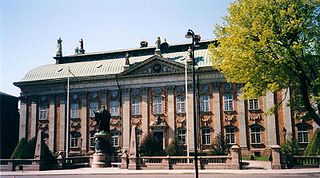 Following the elevation of a commoner into nobility by the Swedish monarch, the new nobleman had to seek introduction in order to be a fully recognised member of the House of Nobility (Riddarhuset), a term that also refers to its function as a chamber in the Riksdag of the Estates
, the Swedish Parliament. In 1866 the Nobility was formally separated from government and incorporated as a separate institution, governed by statutes handed down by the monarch (from 1975: the government). This last link to the government and state was abolished in 2003. The Palace of the Nobility served as official representation for the nobility and was regulated by the Swedish government
, but this regulation ceased completely in 2003, as have the privileges. The membership roster is published every three years.
The King could confer both hereditary and non-hereditary ennoblements up until 1975, although no hereditary ennoblement has occurred since 1902.
s who could afford to contribute a mounted soldier to the cavalry
were to be exempted from tax - at least from ordinary taxes - just as the clergy
already had been. The archaic Swedish term for nobility, frälse, also included the clergy with respect to their exemption from tax.
The background for this was that the old system of a leiðangr fleet and a king constantly on travel through the realm (between the estates of Uppsala öd
) had by this time become outmoded. The crown
's court and castles were now to be financed through taxes on land.
Soon it was agreed that the king should govern the realm in cooperation with a Privy Council
(or Royal Council), in which the bishops and the most distinguished magnates (i.e. the most prominent contributors to the army) participated. When critical decisions were necessary, the whole frälse was summoned to the diet
s.
Swedish nobility had no hereditary fiefs. In the case where a noble was granted a castle belonging to the crown, his heirs couldn't later claim their ancestors' civil or military rights. The lands of the magnates who constituted the medieval nobility were their own and not "on lease" from a feudal king. If they by their own means or exploitation of peasants built a castle and financed troops, then the castle was theirs, but the troops were expected to serve as a part of the army of the realm.
For extended periods, the commander of Viborg
at the Novgorod/Russian front did, in practice, function as a margrave
, keeping all the crown's income from the fief to use for the defense of the realm's eastern border. But despite heavy German influence during the medieval period, the elaborate German system
with titles such as Lantgraf, Reichsgraf, Burggraf and Pfalzgraf was never applied in Sweden.
 At the coronation of Eric XIV
in 1561, Swedish nobility became formally hereditary for the first time upon the creation of the higher titles of Count
(greve) and Baron
(friherre). The House of Knights
was organized in 1626. The grounds for introduction into this chamber became either birth into an "ancient" noble family
or ennoblement by the sovereign. Consequently, genealogy
flourished.
The Lord High Chancellor, Axel Oxenstierna
, was the architect of the Instrument of Government
of 1634, which laid the foundation of modern Sweden. It guaranteed that all government appointments were to be filled by candidates from the nobility, a move which helped mobilize support for, rather than opposition to, a centralized national government.
Due to the many wars fought by Sweden, the crown needed some means of rewarding its officers, and since the royal coffers were not without end, ennoblement and grants of land were useful substitutes for cash payments. During the 17th century, the number of noble families grew by a factor of five. In less than a century, the nobility's share of Swedish land ownership rose from 16% to over 60%, which led to considerably lower tax revenue for the crown. The "Reduction
" of 1655 and 1680, however, brought land back into the crown's possession.
Historically all members of a noble family were generally titled. If the family was of the rank of a Count or a Baron, all members received that title as well. However, following the new Instrument of Government
from 1809, a change was made more in line with the British system so that, for later nobility, only the head of the family would be part of hold the title (if there is one). There are a few families where these systems overlap such that the vast majority are nobles pre-1809 without title, while the heads of the families have been elevated to count or baron after 1809. The vast majority of noble families are still of the old kind where all members are regarded as nobles.
No hereditary title of nobility has been granted since 1902, when explorer Sven Hedin
was ennobled by the King (that honor was hereditary, but he left no heirs). Since 1975 the Swedish monarch no longer has the right to ennoble or to confer knighthoods and orders on Swedes. Titles are still given to members of the royal family when princes and princesses are made dukes or duchesses. On the announcement of the now broken engagement between Princess Madeleine and Mr. Jonas Bergström it was announced that he would be styled Hertig Jonas after the wedding. Prince Daniel was born a commoner and created a Swedish prince, elevated to Royal Highness, and assumed the title Duke of Västergötland upon his marriage to Crown Princess Victoria who already holds the title Duchess of Västergötland.
Sweden has a significant number of unintroduced noble families, several of which are historically prominent (as of 2010 comprising 99 living families and around 450 individuals). The families fall into four groups:
Three successive almanachs of unintroduced nobility have been published; the first one was started in 1886, the second in 1912, and the third in 1935; it was most recently published in 2010. An association of unintroduced nobility, Sveriges Ointroducerade Adels Förening
, was founded in 1911. Several branches of the House of Bernadotte have been members of this association, as a result of members of the royal family losing their Swedish titles and being granted foreign (Luxembourg
ish or Belgian
) titles upon marrying non-royals. Notably Count Carl Johan Bernadotte of Wisborg was chairman of the association for many years.
The first counts and barons, created in 1561 by Eric XIV
:
John III
granted the first baronal titles accompanied by territorial grants (earlier titles elevated the family's hereditary estate to countly or baronial status):
Charles IX
created only one:
(he made Svante Bielke and Nils Bielke barons without grant of entail
ed lands)
Gustav II Adolf
granted:
Christina
granted:
Charles X Gustav
granted:
Charles XI
granted:
Princes
Dukes
Marquis
Counts
Barons
, but their privileged position has been weakened step by step since 1680. The nobility's political privileges were practically abolished by the reformation of the Riksdag of the Estates
in 1866, and the last rights of precedence to certain governmental offices were removed in the 1920s. By then the last tax exemption privileges had also been abolished. However, some minor privileges remained up until 2003, including the right to be beheaded by sword, when the law granting these noble privileges was completely abolished and the government no longer has the right to call the heads of families to be assembled in session.
The prerogatives of nobility today are limited to protection of noble titles and certain elements and styles used in their coats of arms
: a helm with an open visor, a coronet
showing rank, a medallion and the use of supporters. Modern Swedish law makes no distinctions on the basis of nobility.
Social class
Social classes are economic or cultural arrangements of groups in society. Class is an essential object of analysis for sociologists, political scientists, economists, anthropologists and social historians. In the social sciences, social class is often discussed in terms of 'social stratification'...
in Sweden
Sweden
Sweden , officially the Kingdom of Sweden , is a Nordic country on the Scandinavian Peninsula in Northern Europe. Sweden borders with Norway and Finland and is connected to Denmark by a bridge-tunnel across the Öresund....
, part of the so-called frälse (a classification defined by tax exemptions and representation in the diet
Diet (assembly)
In politics, a diet is a formal deliberative assembly. The term is mainly used historically for the Imperial Diet, the general assembly of the Imperial Estates of the Holy Roman Empire, and for the legislative bodies of certain countries.-Etymology:...
that also applied to clergy). Today, the nobility is still very much a part of Swedish society but they do not maintain many of their former privileges. They still do possess some privileges such as the protection by law of their family names, titles and coats of arms. The Swedish nobility consists of both "introduced" (introducerad adel) and "unintroduced" nobility (ointroducerad adel), the latter has not been "introduced" at the House of Nobility (Riddarhuset).
The House of Nobility also has a special tax for all noblemen over the age of 18. Belonging to the nobility in present day Sweden still carries some social privileges, and is of certain social and historical significance.
Organization
Introduced Swedish nobility is organized into three classes according to a scheme introduced in riddarhusordningen (Standing orders of the House of Knights) 1626- CountCountA count or countess is an aristocratic nobleman in European countries. The word count came into English from the French comte, itself from Latin comes—in its accusative comitem—meaning "companion", and later "companion of the emperor, delegate of the emperor". The adjective form of the word is...
s (greve) and baronBaronBaron is a title of nobility. The word baron comes from Old French baron, itself from Old High German and Latin baro meaning " man, warrior"; it merged with cognate Old English beorn meaning "nobleman"...
s (friherre, baron) in the Class of Lords , these two titles were introduced in 1561 by Erik XIV; - the Class of Knights , untitled descendants of Swedish Privy CouncillorsPrivy Council of SwedenThe High Council of Sweden or Council of the Realm consisted originally of those men of noble, common and clergical background, that the king saw fit for advisory service...
and since 1778 the 300 oldest families in the Class of Esquire as well as the "commanderCommanderCommander is a naval rank which is also sometimes used as a military title depending on the individual customs of a given military service. Commander is also used as a rank or title in some organizations outside of the armed forces, particularly in police and law enforcement.-Commander as a naval...
families", who are of the descendants of commanders of Swedish royal orders; - the Class of EsquireEsquireEsquire is a term of West European origin . Depending on the country, the term has different meanings...
s , other untitled nobles.
The two last classes contains the so called untitled nobility
Nobility
Nobility is a social class which possesses more acknowledged privileges or eminence than members of most other classes in a society, membership therein typically being hereditary. The privileges associated with nobility may constitute substantial advantages over or relative to non-nobles, or may be...
. The division into classes has roots in the middle ages
Middle Ages
The Middle Ages is a periodization of European history from the 5th century to the 15th century. The Middle Ages follows the fall of the Western Roman Empire in 476 and precedes the Early Modern Era. It is the middle period of a three-period division of Western history: Classic, Medieval and Modern...
when the nobility frälse was divided into lords in the Privy Council, knights and esquires.
Until 1719 the three classes voted separately, but in the Age of Liberty all classes were voting together with one vote for each family head . This made the vast majority of the untitled nobility in power, for example officers
Officer (armed forces)
An officer is a member of an armed force or uniformed service who holds a position of authority. Commissioned officers derive authority directly from a sovereign power and, as such, hold a commission charging them with the duties and responsibilities of a specific office or position...
and civil servants were represented.
In 1778 Gustav III
Gustav III of Sweden
Gustav III was King of Sweden from 1771 until his death. He was the eldest son of King Adolph Frederick and Queen Louise Ulrica of Sweden, she a sister of Frederick the Great of Prussia....
restored the classes and class voting and at the same time he reformed the Class of Knights. Originally this class only contained family descendants of Privy Councillors and was the smallest class of the three classes. But Gustav III also introduced in this class the 300 oldest families in the Class of Esquire and also the "commander
Commander
Commander is a naval rank which is also sometimes used as a military title depending on the individual customs of a given military service. Commander is also used as a rank or title in some organizations outside of the armed forces, particularly in police and law enforcement.-Commander as a naval...
families", who are of the descendants of commanders of the Order of the Northern Star
Order of the Polar Star
The Order of the Polar Star is a Swedish order of chivalry created by King Frederick I of Sweden on 23 February 1748, together with the Order of the Sword and the Order of the Seraphim....
and the Order of the Sword
Order of the Sword
The Order of the Sword is a Swedish order of chivalry created by King Frederick I of Sweden on February 23, 1748, together with the Order of the Seraphim and the Order of the Polar Star.Awarded to officers, and originally intended as an award for bravery and particularly long or useful service, it...
. No more commander families were introduced in the House of Knights after 1809, and thereafter also the class voting was abolished and the nobility was then voting as during the Age of Liberty.
A Swedish duke
Dukes of Swedish provinces
Duchies in Sweden have been allotted since the 13th century to powerful Swedes, almost always to Princes of Sweden and wives of the latter. From the beginning these duchies were often centers of regional power, where their dukes and duchesses had considerable executive authority of their own,...
(hertig) has almost always been of royal status and counted as such. An exception in medieval times
Medieval Times
Medieval Times Dinner and Tournament is a family dinner theater featuring staged medieval-style games, sword-fighting, and jousting performed by a cast of 75 actors and 20 horses. Each location is housed in a replica 11th-century castle, with the exception of the Toronto location, which is housed...
was Benedict, Duke of Halland
Benedict, Duke of Halland
Duke Benedict of Halland and Finland , aka Bengt Algotsson, was a medieval Swedish lord, and royal favourite.He was born to a family who descended from Svantepolk of Skarsholm and his wife Benedikta Sunadotter...
. Two men were also created princes (furstar
Fürst
Fürst is a German title of nobility, usually translated into English as Prince.The term refers to the head of a principality and is distinguished from the son of a monarch, who is referred to as Prinz...
) in the 18th century: Fredrik Vilhelm von Hessenstein
Frederick William von Hessenstein
Frederick William, Prince von Hessenstein , was a Swedish soldier and statesman. He was an extramarital son of King Frederick of Sweden and his mistress Hedvig Taube.-Biography:...
and Vilhelm Putbus but neither were introduced.
Riksdag of the Estates
The Riksdag of the Estates , was the name used for the Estates of the Swedish realm when they were assembled. Until its dissolution in 1866, the institution was the highest authority in Sweden next to the King...
, the Swedish Parliament. In 1866 the Nobility was formally separated from government and incorporated as a separate institution, governed by statutes handed down by the monarch (from 1975: the government). This last link to the government and state was abolished in 2003. The Palace of the Nobility served as official representation for the nobility and was regulated by the Swedish government
Government of Sweden
The Government of the Kingdom of Sweden is the supreme executive authority of Sweden. It consists of the Prime Minister and cabinet ministers appointed by the Prime Minister. The Government is responsible for their actions to the Riksdag, which is the legislative assembly...
, but this regulation ceased completely in 2003, as have the privileges. The membership roster is published every three years.
The King could confer both hereditary and non-hereditary ennoblements up until 1975, although no hereditary ennoblement has occurred since 1902.
Medieval nobility: Frälse
The institution of Swedish (and Finnish) nobility dates back to 1280, when it was stated in the Decree of Alsnö that magnateMagnate
Magnate, from the Late Latin magnas, a great man, itself from Latin magnus 'great', designates a noble or other man in a high social position, by birth, wealth or other qualities...
s who could afford to contribute a mounted soldier to the cavalry
Cavalry
Cavalry or horsemen were soldiers or warriors who fought mounted on horseback. Cavalry were historically the third oldest and the most mobile of the combat arms...
were to be exempted from tax - at least from ordinary taxes - just as the clergy
Clergy
Clergy is the generic term used to describe the formal religious leadership within a given religion. A clergyman, churchman or cleric is a member of the clergy, especially one who is a priest, preacher, pastor, or other religious professional....
already had been. The archaic Swedish term for nobility, frälse, also included the clergy with respect to their exemption from tax.
The background for this was that the old system of a leiðangr fleet and a king constantly on travel through the realm (between the estates of Uppsala öd
Uppsala öd
Uppsala öd, Old Norse: Uppsala auðr or Uppsala øðr was the name given to the collection of estates which was the property of the Swedish Crown in medieval Sweden. Its purpose was to finance the Swedish king, originally the "king of Uppsala", and they supported the king and his retinue while he...
) had by this time become outmoded. The crown
The Crown
The Crown is a corporation sole that in the Commonwealth realms and any provincial or state sub-divisions thereof represents the legal embodiment of governance, whether executive, legislative, or judicial...
's court and castles were now to be financed through taxes on land.
Soon it was agreed that the king should govern the realm in cooperation with a Privy Council
Privy Council of Sweden
The High Council of Sweden or Council of the Realm consisted originally of those men of noble, common and clergical background, that the king saw fit for advisory service...
(or Royal Council), in which the bishops and the most distinguished magnates (i.e. the most prominent contributors to the army) participated. When critical decisions were necessary, the whole frälse was summoned to the diet
Diet (assembly)
In politics, a diet is a formal deliberative assembly. The term is mainly used historically for the Imperial Diet, the general assembly of the Imperial Estates of the Holy Roman Empire, and for the legislative bodies of certain countries.-Etymology:...
s.
Swedish nobility had no hereditary fiefs. In the case where a noble was granted a castle belonging to the crown, his heirs couldn't later claim their ancestors' civil or military rights. The lands of the magnates who constituted the medieval nobility were their own and not "on lease" from a feudal king. If they by their own means or exploitation of peasants built a castle and financed troops, then the castle was theirs, but the troops were expected to serve as a part of the army of the realm.
For extended periods, the commander of Viborg
Viborg
Viborg may refer to:*Viborg, Denmark, a city in Jutland, Denmark**Viborg Municipality, a Danish municipality named for the city**Viborg County, a former county of Denmark**Diocese of Viborg**Viborg FF, a professional football team based in Viborg...
at the Novgorod/Russian front did, in practice, function as a margrave
Margrave
A margrave or margravine was a medieval hereditary nobleman with military responsibilities in a border province of a kingdom. Border provinces usually had more exposure to military incursions from the outside, compared to interior provinces, and thus a margrave usually had larger and more active...
, keeping all the crown's income from the fief to use for the defense of the realm's eastern border. But despite heavy German influence during the medieval period, the elaborate German system
Graf
Graf is a historical German noble title equal in rank to a count or a British earl...
with titles such as Lantgraf, Reichsgraf, Burggraf and Pfalzgraf was never applied in Sweden.
Nobility after 1561
Eric XIV of Sweden
-Family and descendants:Eric XIV had several relationships before his marriage. With Agda Persdotter he had four daughters:#Margareta Eriksdotter , married 1592 to Olov Simonsson, vicar of Horn....
in 1561, Swedish nobility became formally hereditary for the first time upon the creation of the higher titles of Count
Count
A count or countess is an aristocratic nobleman in European countries. The word count came into English from the French comte, itself from Latin comes—in its accusative comitem—meaning "companion", and later "companion of the emperor, delegate of the emperor". The adjective form of the word is...
(greve) and Baron
Baron
Baron is a title of nobility. The word baron comes from Old French baron, itself from Old High German and Latin baro meaning " man, warrior"; it merged with cognate Old English beorn meaning "nobleman"...
(friherre). The House of Knights
Swedish House of Knights
The Swedish House of Nobility maintains records and acts as an interest group on behalf of the Swedish nobility.-Name:The name means either the corporation of the Swedish nobility or the palace of the nobility....
was organized in 1626. The grounds for introduction into this chamber became either birth into an "ancient" noble family
Swedish ancient nobility
Swedish ancient nobility is the term used for families whose de facto status as nobility was formalised by the Ordinance of Alsnö in 1280.These noble families have no original patents of nobility, the first known being from 1360...
or ennoblement by the sovereign. Consequently, genealogy
Genealogy
Genealogy is the study of families and the tracing of their lineages and history. Genealogists use oral traditions, historical records, genetic analysis, and other records to obtain information about a family and to demonstrate kinship and pedigrees of its members...
flourished.
The Lord High Chancellor, Axel Oxenstierna
Axel Oxenstierna
Axel Gustafsson Oxenstierna af Södermöre , Count of Södermöre, was a Swedish statesman. He became a member of the Swedish Privy Council in 1609 and served as Lord High Chancellor of Sweden from 1612 until his death. He was a confidant of first Gustavus Adolphus and then Queen Christina.Oxenstierna...
, was the architect of the Instrument of Government
Instrument of Government (1634)
The Instrument of Government of 1634 was Sweden's first. It regulated some of the administration, judiciary and the military. It was never accepted by the monarch but was nonetheless in use until Charles XI became an absolute monarch.-See also:...
of 1634, which laid the foundation of modern Sweden. It guaranteed that all government appointments were to be filled by candidates from the nobility, a move which helped mobilize support for, rather than opposition to, a centralized national government.
Due to the many wars fought by Sweden, the crown needed some means of rewarding its officers, and since the royal coffers were not without end, ennoblement and grants of land were useful substitutes for cash payments. During the 17th century, the number of noble families grew by a factor of five. In less than a century, the nobility's share of Swedish land ownership rose from 16% to over 60%, which led to considerably lower tax revenue for the crown. The "Reduction
Reduction (Sweden)
In the reductions in Sweden, fiefs that had been granted to the Swedish nobility were returned to the Crown.The first reduction under Charles X Gustav of Sweden in 1655 restored a quarter of "donations" made after 1632. In the Great Reduction of 1680 under Charles XI of Sweden the Crown...
" of 1655 and 1680, however, brought land back into the crown's possession.
Historically all members of a noble family were generally titled. If the family was of the rank of a Count or a Baron, all members received that title as well. However, following the new Instrument of Government
Instrument of Government (1809)
The Instrument of Government adopted on 6 June 1809 by the Riksdag of the Estates was one of the fundamental laws that made up the constitution of Sweden from 1809 to 1974...
from 1809, a change was made more in line with the British system so that, for later nobility, only the head of the family would be part of hold the title (if there is one). There are a few families where these systems overlap such that the vast majority are nobles pre-1809 without title, while the heads of the families have been elevated to count or baron after 1809. The vast majority of noble families are still of the old kind where all members are regarded as nobles.
No hereditary title of nobility has been granted since 1902, when explorer Sven Hedin
Sven Hedin
Sven Anders Hedin KNO1kl RVO was a Swedish geographer, topographer, explorer, photographer, and travel writer, as well as an illustrator of his own works...
was ennobled by the King (that honor was hereditary, but he left no heirs). Since 1975 the Swedish monarch no longer has the right to ennoble or to confer knighthoods and orders on Swedes. Titles are still given to members of the royal family when princes and princesses are made dukes or duchesses. On the announcement of the now broken engagement between Princess Madeleine and Mr. Jonas Bergström it was announced that he would be styled Hertig Jonas after the wedding. Prince Daniel was born a commoner and created a Swedish prince, elevated to Royal Highness, and assumed the title Duke of Västergötland upon his marriage to Crown Princess Victoria who already holds the title Duchess of Västergötland.
Unintroduced nobility
Being "introduced" at the House of Nobility means that the body confirms the status of a family as Swedish nobility. Even when a family was ennobled by the Swedish monarch, it still had to seek introduction at the House of Nobility to achieve such status. Introduction, however, was not necessary for being considered noble as such, although only the introduced families had a legally privileged position. Unintroduced families still could use their titles, if they had any, and noble elements and styles in their coats of arms. The recognition of their noble status in the society was chiefly of social, rather than legal, nature.Sweden has a significant number of unintroduced noble families, several of which are historically prominent (as of 2010 comprising 99 living families and around 450 individuals). The families fall into four groups:
- Foreign nobility, i.e. families of foreign origin (particularly German/Baltic, but also other nationalities) which had noble status in a different country than Sweden, and which partially or wholly live in Sweden. This group is the largest by far among the unintroduced nobility.
- Families of Swedish origin which were granted noble status and/or titles by a foreign country (for example, members of the House of Bernadotte have been granted Luxembourgish comital titles).
- Families which have been ennobled by the Swedish monarch, but which have not been introduced at the House of Nobility. This group is made up by a small number of families.
- Armigerous families of foreign origin which have traditionally been included in the various directories of unintroduced nobility, but whose original noble status has not been proven. These families are nevertheless considered part of the Swedish unintroduced nobility for traditional reasons, i.e. because they have been considered noble in Sweden for an extended period of time. This group consists of a small number of families.
Three successive almanachs of unintroduced nobility have been published; the first one was started in 1886, the second in 1912, and the third in 1935; it was most recently published in 2010. An association of unintroduced nobility, Sveriges Ointroducerade Adels Förening
Ointroducerad Adels Förening
Ointroducerad Adels Förening , which translates to "Association of the Unintroduced Nobility" and "Association of the Unintroduced Nobility of Sweden" respectively, is an association of noble families which are resident in Sweden, and which have not been "introduced" at the Swedish House of Nobility...
, was founded in 1911. Several branches of the House of Bernadotte have been members of this association, as a result of members of the royal family losing their Swedish titles and being granted foreign (Luxembourg
Luxembourg
Luxembourg , officially the Grand Duchy of Luxembourg , is a landlocked country in western Europe, bordered by Belgium, France, and Germany. It has two principal regions: the Oesling in the North as part of the Ardennes massif, and the Gutland in the south...
ish or Belgian
Belgium
Belgium , officially the Kingdom of Belgium, is a federal state in Western Europe. It is a founding member of the European Union and hosts the EU's headquarters, and those of several other major international organisations such as NATO.Belgium is also a member of, or affiliated to, many...
) titles upon marrying non-royals. Notably Count Carl Johan Bernadotte of Wisborg was chairman of the association for many years.
Introduced
According to the Nordisk Familjebok:The first counts and barons, created in 1561 by Eric XIV
Eric XIV of Sweden
-Family and descendants:Eric XIV had several relationships before his marriage. With Agda Persdotter he had four daughters:#Margareta Eriksdotter , married 1592 to Olov Simonsson, vicar of Horn....
:
- Svante Sture of Hörningsholm, 1562 count of Vestervik and later also Stegeholm
- Peder Joakimsson Brahe of Rydboholm, 1562 count of Visingsborg
- Göstaff Johansson of Haga, 1562 count of Bogesund (originally Enköping)
- Stenbock Gustaf Olofsson, baron of Torpa
- Leijonhufvud Sten Eriksson, baron of Grevsnes
- GripGripGrip may refer to:* Handle , a part of, or attachment to, an object, allowing it to be moved or used by hand* Grip strength, a measure of hand strength* Grippers, exercise machines used to increase hand strength- In sports :...
Birger Nilsson, baron of Vines - OxenstiernaOxenstiernaOxenstierna, an ancient Swedish noble family, the origin of which can be traced up to the middle of the 14th century, which had vast estates in Södermanland and Uppland, and began to adopt its armorial designation of Oxenstierna as a personal name towards the end of the 16th century...
Gabriel Kristersson, baron of Mörby - Lars Fleming, baron of Arvasalo (in Finland)
- GeraGeraGera, the third-largest city in the German state of Thuringia , lies in east Thuringia on the river Weiße Elster, approximately 60 kilometres to the south of the city of Leipzig and 80 kilometres to the east of Erfurt...
Karl Holgersson, baron of Björkvik - Gera Göran Holgersson, baron of Ållonö
- Horn af Åminne Klas Kristersson, baron of Joensuu (in Finland)
- Stenbock Erik Gustafsson, baron of Torpa (younger son of Gustaf Olofsson)
John III
John III of Sweden
-Family:John married his first wife, Catherine Jagellonica of Poland , house of Jagiello, in Vilnius on 4 October 1562. In Sweden, she is known as Katarina Jagellonica. She was the sister of king Sigismund II Augustus of Poland...
granted the first baronal titles accompanied by territorial grants (earlier titles elevated the family's hereditary estate to countly or baronial status):
- Öresten and Kronobäck to Erik Gustafsson of Torpa
- Lundholm to Nils Göransson Gyllenstierna, new baron
- Viikki (in Finland) to Klas Eriksson Fleming, new baron
- Läckö to Hogenskild Bielke, new baron
- Ekholmen to Pontus De La GardiePontus De la GardiePontus De la Gardie was a French nobleman and general in the service of Denmark and Sweden.He was born Ponce De La Gardie in Russol , Languedoc, as a son of Jacques De la Gardie and Catherine de Sainte-Colombe. As a youngster, he wanted to become a priest and was educated in a monastery...
, new baron - Kungs-Lena to Olof Gustafsson Stenbock (elder son and heir of Gustaf Olofsson)
- county of Raseborg (in Finland) to baron Sten Eriksson of Grevsnes' widow and heirs inh 1571
Charles IX
Charles IX of Sweden
Charles IX of Sweden also Carl, was King of Sweden from 1604 until his death. He was the youngest son of King Gustav I of Sweden and his second wife, Margaret Leijonhufvud, brother of Eric XIV and John III of Sweden, and uncle of Sigismund III Vasa king of both Sweden and Poland...
created only one:
- barony of Nynäs (in Finland) to Abraham Leijonhufvud
(he made Svante Bielke and Nils Bielke barons without grant of entail
Entail
Entail may refer to:* Fee tail, a term of art in common law describing a limited form of succession....
ed lands)
Gustav II Adolf
Gustavus Adolphus of Sweden
Gustav II Adolf has been widely known in English by his Latinized name Gustavus Adolphus Magnus and variously in historical writings also as Gustavus, or Gustavus the Great, or Gustav Adolph the Great,...
granted:
- county of LäcköLäckö CastleLäckö Castle is a medieval castle in Sweden. Läckö Castle is best known as Magnus de la Gardie's magnificent castle on the shores of Lake Vänern, the largest lake in Sweden....
to Jacob De la GardieJacob De la GardieField Marshal and Count Jacob Pontusson De la Gardie was a statesman and a soldier of the Swedish Empire.... - county of PärnuPärnuPärnu is a city in southwestern Estonia on the coast of Pärnu Bay, an inlet of the Gulf of Riga in the Baltic Sea. It is a popular summer vacation resort with many hotels, restaurants, and large beaches. The Pärnu River flows through the city and drains into the Gulf of Riga...
(in northern Livonia, now Estonia) to Franz Bernhard von Thurn (son of Jindrich Matyas ThurnJindrich Matyas ThurnJindřich Matyáš Thurn-Valsassina , was a leading Bohemian nobleman, one of leaders against Ferdinand II of Bohemia and in events that led to the Thirty Years War, and in the end a...
) - barony of KimitoKimitoKimito is a former municipality of Finland. On January 1, 2009, it was consolidated with Dragsfjärd and Västanfjärd to form the new municipality of Kimitoön...
(in Finland) to Axel OxenstiernaAxel OxenstiernaAxel Gustafsson Oxenstierna af Södermöre , Count of Södermöre, was a Swedish statesman. He became a member of the Swedish Privy Council in 1609 and served as Lord High Chancellor of Sweden from 1612 until his death. He was a confidant of first Gustavus Adolphus and then Queen Christina.Oxenstierna... - barony of Bergkvara to Carl Carlsson GyllenhielmCarl Carlsson GyllenhielmBaron Carl Carlsson Gyllenhielm was a Swedish soldier and politician. He was appointed Field Marshal in 1616, Privy Councilor in 1617, Governor General of Ingria in 1617 and Lord High Admiral in 1620. He was an illegitimate son of Duke Carl, later King Charles IX of Sweden, and Karin Nilsdotter,...
- barony of Tuutarhovi (in Ingria) to Johan SkytteJohan SkytteJohan Skytte was a Swedish politician.Skytte was son of the Mayor of Nyköping, Bengt Nilsson Skräddare...
- barony of Orreholm to Jakob Vilhelmsson Spens
Christina
Christina of Sweden
Christina , later adopted the name Christina Alexandra, was Queen regnant of Swedes, Goths and Vandals, Grand Princess of Finland, and Duchess of Ingria, Estonia, Livonia and Karelia, from 1633 to 1654. She was the only surviving legitimate child of King Gustav II Adolph and his wife Maria Eleonora...
granted:
- county of Södermöre to Axel OxenstiernaAxel OxenstiernaAxel Gustafsson Oxenstierna af Södermöre , Count of Södermöre, was a Swedish statesman. He became a member of the Swedish Privy Council in 1609 and served as Lord High Chancellor of Sweden from 1612 until his death. He was a confidant of first Gustavus Adolphus and then Queen Christina.Oxenstierna...
- county of Vasaborg to Gustav GustavssonGustav, Count of VasaborgCount Gustav Gustavsson af Vasaborg, 1st Count of Nystad was an illegitimate son of King Gustavus Adolphus and his mistress Margareta Slots. -Biography:...
, her illegitimate half-brother - county of Ortala to Lennart TorstensonLennart TorstensonLennart Torstenson, Count of Ortala, Baron of Virestad , was a Swedish Field Marshal and military engineer.-Early career:He was born at Forstena in Västergötland - he always wrote his name Linnardt Torstenson...
- county of KuressaareKuressaareKuressaare is a town and a municipality on Saaremaa island in Estonia. It is the capital of Saare County. The current population is about 14,706 Kuressaare is a town and a municipality on Saaremaa island in Estonia. It is the capital of Saare County. The current population is about 14,706...
(later exchanged for PärnuPärnuPärnu is a city in southwestern Estonia on the coast of Pärnu Bay, an inlet of the Gulf of Riga in the Baltic Sea. It is a popular summer vacation resort with many hotels, restaurants, and large beaches. The Pärnu River flows through the city and drains into the Gulf of Riga...
) to Magnus Gabriel De la GardieMagnus Gabriel De la GardieCount Magnus Gabriel De la Gardie was a Swedish statesman and military man. He became a member of the Swedish Privy Council in 1647 and came to be the holder of three of the five offices counted as the Great Officers of the Realm, namely Lord High Treasurer, Lord High Chancellor and Lord High... - county of Sortavala to Johan Adam Banér
- county of Björneborg (Pori) to Gustav Horn
- county of Vestervik and Stegeholm to Hans Kristofer von Königsmark
- county of KorsholmKorsholmKorsholm is a municipality of Finland. The town of Vaasa was founded in Korsholm parish in 1606 and today the municipality completely surrounds the city. It is a coastal, mostly rural municipality, consisting of a rural landscape and a large, fractured archipelago...
and VasaVaasaVaasa is a city on the west coast of Finland. It received its charter in 1606, during the reign of Charles IX of Sweden and is named after the Royal House of Vasa...
to Gabriel Bengtsson Oxenstierna - county of Bogesund to Fredrik Stenbock
- county of Salmi and Suistamo pogosta to Carl Gustaf WrangelCarl Gustaf WrangelCarl Gustaf Wrangel was a high-ranking Swedish noble, statesman and military commander in the Thirty Years', Torstenson, Bremen, Second Northern and Scanian Wars....
- county of Kruunupori to Ture Oxenstierna
- county of Nyborg to Arvid WittenbergArvid WittenbergArvid Wittenberg or Arvid Wirtenberg von Debern , Swedish count, field marshal and privy councillor. Born in Porvoo, Finland, died in prison in Zamość, Poland, 7 September 1657...
- county of Karleborg to Klas Tott
- county of Liljenborg to Axel LillieAxel LillieCount Axel Lillie, also spelled Lillje was a Swedish soldier and politician. He was appointed Lieutenant Governor General of Pomerania in 1643, Privy Councilor in 1648, Governor General of Pomerania in 1652, Field Marshal in 1657, and Governor General of Livonia in 1661...
- county of Mariestad to Lars Kagg
- county of Skeninge to Robert DouglasRobert Douglas, Count of SkenningeRobert Douglas , Count of Skenninge, Baron of Skalby, was a Scottish Field Marshal in the Swedish army, during the Thirty Years' War and the Swedish-Polish wars...
- county of Skövde to Kristofer Karl von Schlippenbach
- county of Enköping to Antonius von Steinberg
- barony of Vibyholm to Gustav GustavssonGustav, Count of VasaborgCount Gustav Gustavsson af Vasaborg, 1st Count of Nystad was an illegitimate son of King Gustavus Adolphus and his mistress Margareta Slots. -Biography:...
, her illegitimate half-brother - barony of Virestad to Lennart Torstensson
- barony of Kronoberg to Peder Sparre
- barony of Korppoo to Nils Bielke
- barony of Härlunda to Seved Bååt
- barony of Kajaani to Per Brahe
- barony of Örneholma to Johan Adler-Salvius
- barony of Liperi pogosta to Hermann Fleming
- barony of Oulu to Erik Gyllenstierna
- barony of Kitee pogosta to Axel LillieAxel LillieCount Axel Lillie, also spelled Lillje was a Swedish soldier and politician. He was appointed Lieutenant Governor General of Pomerania in 1643, Privy Councilor in 1648, Governor General of Pomerania in 1652, Field Marshal in 1657, and Governor General of Livonia in 1661...
- barony of Loimijoki to Arvid WittenbergArvid WittenbergArvid Wittenberg or Arvid Wirtenberg von Debern , Swedish count, field marshal and privy councillor. Born in Porvoo, Finland, died in prison in Zamość, Poland, 7 September 1657...
- barony of Limingo to Matias Soop
- barony of Marienburg to Gustav Horn af Marienborg and certain of his relatives
- barony of Vöyripori to Carl Gustaf Paijkull
- barony of Tohmajärvi pogosta to Lars Kagg
- barony of Kokkola to Gustav Banér
- barony of Sund to Erik Ryning
- barony of Laihia to Karl Bonde
- barony of Pyhäjoki to Klas Hansson BjelkenstjernaKlas Hansson BjelkenstjernaBaron Klas Hansson Bjelkenstjerna was a Swedish naval officer and civil servant....
- barony of Iijoki to Åke Axelsson Tott
- barony of Ikalapori to Schering Rosenhane
- barony of Hailuoto to Bernt Taube
- barony of Hedensund (then Arnäs) to Knut Posse
- barony of Vinberg to Gustaf Adolf Leijonhudvud
- barony of Lindeberg to Carl Gustav Wrangel and his brothers
- barony of Lindeborg to Lorentz von der Linde
- barony of Willenbruch and Harzefeld to Pierre Bidal
- barony of Ludenhof (LuuaLuuaLuua is a village in Palamuse Parish, Jõgeva County in eastern Estonia, known for its manor , now a professional school....
, now in Palamuse ParishPalamuse ParishPalamuse is a rural municipality of Estonia, in Jõgeva County. It has a population of 2,509 and an area of 216 km².-Populated places:Palamuse Parish has one small borough, Palamuse, and 25 villages: Änkküla, Eerikvere, Ehavere, Imukvere, Järvepera, Kaarepere, Kaiavere, Kassivere, Kivimäe, Kudina,...
, Estonia) to Hans Wrangel - barony of Eksjö to Reinhold LiewenLievenThe Lievens are one of the oldest and noblest families of Baltic Germans. They claim descent from Caupo of Turaida , the Livonian quasi rex who converted to Christianity in 1186, when Bishop Meinhard attempted to Christianize the region...
- barony of Elfkarleby to Mårten Leijonhufvud
- Lauri Cruus baron of Gudhem
- Robert DouglasRobert Douglas, Count of SkenningeRobert Douglas , Count of Skenninge, Baron of Skalby, was a Scottish Field Marshal in the Swedish army, during the Thirty Years' War and the Swedish-Polish wars...
baron of Skälby - Hans Wachtmeister baron of Koivisto
- Johan Kurck baron of Lempäälä
- Adolf Friedrich Wetter, baron of Wetter-Rosenthal
- Jakob and Anders Lilliehöök, barons of Närpes
- Kasper and Karl Henrik Wrede af Elimä, barons of Elimäki
- Erik Fleming, baron of LaisLaiuseLaiuse is a small borough in Estonia. It is located in Jõgeva County and is a part of Jõgeva Parish. is one of the oldest in Estonia, being established in 1822. Laiuse is the location of the medieval Laiuse church. The church was first mentioned in 1319...
Charles X Gustav
Charles X Gustav of Sweden
Charles X Gustav also Carl Gustav, was King of Sweden from 1654 until his death. He was the son of John Casimir, Count Palatine of Zweibrücken-Kleeburg and Catherine of Sweden. After his father's death he also succeeded him as Pfalzgraf. He was married to Hedwig Eleonora of Holstein-Gottorp, who...
granted:
- county of Sölvesborg to Corfitz Ulfeldt
- (Lars Kagg, then Carl Gustav Wrangel, obtained the county of Sölvesborg in exchanges)
- P.Wuertz baron of Örneholma
- barony of Kastell ladugården to Rutger von Ascheberg
Charles XI
Charles XI of Sweden
Charles XI also Carl, was King of Sweden from 1660 until his death, in a period in Swedish history known as the Swedish empire ....
granted:
- county of Börringe to Gustav Carlsson, his illegitimate half-brother
Unintroduced
The following titled families of high nobility are included in Kalender öfver i Sverige lefvande ointroducerad adel (1886–1899), Sveriges ointroducerade adels kalender (1912–1944), and/or Kalender över Ointroducerad adels förening (1935–), which are directories of the living (at the time of publication) unintroduced noble families resident in Sweden. Five of these families have titles as Princes, Dukes or Marquis, the others as Counts and Barons. Most unintroduced noble families, however, are untitled, similar to the introduced families. Some of these families, or their titled branches, have since become extinct.Princes
- BernadotteBernadotteThe House of Bernadotte, the current royal house of Sweden, has reigned since 1818. Between 1818 and 1905, it was also the royal house of the Norway...
(Belgian princely title awarded to Prince Carl Bernadotte) - CantacuzinoCantacuzino familyThe Cantacuzino or Cantacuzène family is an old boyar family of Wallachia and Moldavia, a branch of Greek Kantakouzinos family, allegedly descended from the Byzantine Emperor John VI Cantacuzenus. No definite genealogical links between Byzantine Greek and Romanian Cantacuzinos have been established...
(boyarBoyarA boyar, or bolyar , was a member of the highest rank of the feudal Moscovian, Kievan Rus'ian, Bulgarian, Wallachian, and Moldavian aristocracies, second only to the ruling princes , from the 10th century through the 17th century....
family, Russian princely title)
Dukes
- D'OtranteDuke of Otranto.Duke of Otranto is a hereditary title in the Nobility of the First French Empire which was bestowed in 1808 by Napoleon Bonaparte upon the statesman and Minister of Police Joseph Fouché , who had been made a Count of the French Empire before....
(Napoleonic nobility)
Marquis
- Joussineau de TourdonnetJoussineau de TourdonnetJoussineau de Tourdonnet is a French noble family. Members of the family use titles as Marquis and Counts, confirmed by Louis XIV in 1680. The family lived in Limousin, and according to the family tradition, the family is originally from Normandie....
(French nobility) - LagergrenLagergrenLagergren is a Swedish noble family. Claes Eric Philip Frans Joseph Leo Lagergren converted to Catholicism in 1880 and became a papal chamberlain in 1884, serving under Pope Leo XIII, Pope Pius X, Pope Benedict XV, and Pope Pius XI. He was conferred the hereditary title of Marquis of Lagergren by...
(Papal/Italian nobility)
Counts
- Bernadotte of Wisborg (Luxembourgish title awarded to various members of the House of Bernadotte)
- Crapon de Caprona
- Fouché d'Otrante (Napoleonic nobility)
- von der Groeben (German nobility)
- von Hallwyl (Swiss nobility)
- Joussineau de TourdonnetJoussineau de TourdonnetJoussineau de Tourdonnet is a French noble family. Members of the family use titles as Marquis and Counts, confirmed by Louis XIV in 1680. The family lived in Limousin, and according to the family tradition, the family is originally from Normandie....
(French nobility) - LagergrenLagergrenLagergren is a Swedish noble family. Claes Eric Philip Frans Joseph Leo Lagergren converted to Catholicism in 1880 and became a papal chamberlain in 1884, serving under Pope Leo XIII, Pope Pius X, Pope Benedict XV, and Pope Pius XI. He was conferred the hereditary title of Marquis of Lagergren by...
(Papal/Italian nobility) - Landberg
- MoltkeMoltkeMoltke may refer to:People:* Helmuth von Moltke the Elder , Chief of the Prussian, and then German, General Staff* Helmuth von Moltke the Younger , Chief of the German General Staff* Kuno von Moltke , German general...
(German/Danish nobility) - Moltke-Hvitfeldt (German/Danish nobility)
- de PausPausPaus is a Norwegian and Swedish family of clergymen, civil servants, merchants, industrialists and land-owners, among others, traceable back to the late 15th century and a man named Oluf...
(Papal/Italian nobility) - von Platen zu HallermundVon Platenvon Platen is a noble family originally from Rügen and Pomerania. Several branches of the family live in Sweden, where members have been noted statesmen and high officials....
(German nobility) - RévayRévayThe Révay Family was a Hungarian noble family, who owned estates in Turóc county, the Kingdom of Hungary until the early 20th century. Their property included i.a...
(Hungarian nobility) - Rewentlow (Danish/German nobility)
- StolbergStolberg- Towns in Germany :* Stolberg, Saxony-Anhalt in the district of Sangerhausen in Saxony-Anhalt, seat of the counts of Stolberg* Stolberg in the district of Aachen in North Rhine-Westphalia, part of the Duchy of Jülich until 1794, awarded to Prussia in 1815* Stollberg, in the Erzgebirgskreis in the...
(German nobility) - Tolstoy (Russian nobility)
- von Trampe (German nobility)
Barons
- von Bonsdorff (Finnish nobility)
- von Bredow (German nobility)
- von Buddenbrock
- von Buxhoeveden
- CronstedtCronstedtCronstedt may refer to:* Axel Fredrik Cronstedt, a Swedish chemist* Carl Olof Cronstedt, a Swedish naval commander* Carl Johan Cronstedt, a Swedish architect, inventor, Earl, noble, civil servant, scientist and bibliophile...
- von Grothusen
- von Gussich
- von Leithner
- von Mecklenburg
- von der Osten-Sacken
- von der Pahlen (Russian nobility)
- von Rosen (Hoch-Rosen)
- Rosenørn-Lehn (Danish nobility)
- von Strauss
- von Wangenheim
- de WendelWendel (Swedish family)Wendel is a Swedish noble family, forming part of the country's unintroduced nobility. Max Richard Wendel , Civil Engineer and Royal Spanish Consul in Gothenborg, was awarded the hereditary primogeniture title of Baron by Carlos I of Portugal in 1895...
(Portuguese nobility)
Privileges
The noble estates are not abolished in SwedenSweden
Sweden , officially the Kingdom of Sweden , is a Nordic country on the Scandinavian Peninsula in Northern Europe. Sweden borders with Norway and Finland and is connected to Denmark by a bridge-tunnel across the Öresund....
, but their privileged position has been weakened step by step since 1680. The nobility's political privileges were practically abolished by the reformation of the Riksdag of the Estates
Riksdag of the Estates
The Riksdag of the Estates , was the name used for the Estates of the Swedish realm when they were assembled. Until its dissolution in 1866, the institution was the highest authority in Sweden next to the King...
in 1866, and the last rights of precedence to certain governmental offices were removed in the 1920s. By then the last tax exemption privileges had also been abolished. However, some minor privileges remained up until 2003, including the right to be beheaded by sword, when the law granting these noble privileges was completely abolished and the government no longer has the right to call the heads of families to be assembled in session.
The prerogatives of nobility today are limited to protection of noble titles and certain elements and styles used in their coats of arms
Heraldry
Heraldry is the profession, study, or art of creating, granting, and blazoning arms and ruling on questions of rank or protocol, as exercised by an officer of arms. Heraldry comes from Anglo-Norman herald, from the Germanic compound harja-waldaz, "army commander"...
: a helm with an open visor, a coronet
Coronet
A coronet is a small crown consisting of ornaments fixed on a metal ring. Unlike a crown, a coronet never has arches.The word stems from the Old French coronete, a diminutive of coronne , itself from the Latin corona .Traditionally, such headgear is – as indicated by the German equivalent...
showing rank, a medallion and the use of supporters. Modern Swedish law makes no distinctions on the basis of nobility.
See also
- List of Swedish noble families
- Naming law in SwedenNaming law in SwedenThe Naming law is a law in Sweden which requires approval of the names given to Swedish children. The law was enacted in 1982, primarily in order to prevent non-noble families from giving their children the names of noble families. The Swedish Tax Agency administers the registration of names in...
- Nobility in Finland
- Norwegian nobilityNorwegian nobilityNorwegian nobility are persons and families who in early times belonged to the supreme social, political, and military class and who later were members of the institutionalised nobility in the Kingdom of Norway. It has its historical roots in the group of chieftains and warriors which evolved...
- Swedish Royal FamilySwedish Royal FamilyThe Swedish Royal Family since 1818 consists of a number of persons in the Swedish Royal House of Bernadotte, closely related to the King of Sweden. They are entitled to royal titles and style , and some perform official engagements and ceremonial duties of state...
External links
- The House of Nobility - Official site
- Law on Privileges for the Nobility (1723) - at Wikisource (in Swedish)
- Constitution for the House of Knights (1866) - at Wikisource (in Swedish)
- A Who's Who of the Swedish Aristocracy