
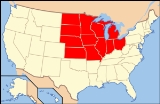
The
Midwestern United States is one of the four
U.S. geographic regions defined by the
United States Census BureauThe United States Census Bureau is the government agency that is responsible for the United States Census. It also gathers other national demographic and economic data...
, providing an official definition of the American
Midwest.
The region consists of 12 states in the north-central and north-eastern United States:
IllinoisIllinois is the fifth-most populous state of the United States of America, and is often noted for being a microcosm of the entire country. With Chicago in the northeast, small industrial cities and great agricultural productivity in central and northern Illinois, and natural resources like coal,...
,
IndianaIndiana is a US state, admitted to the United States as the 19th on December 11, 1816. It is located in the Midwestern United States and Great Lakes Region. With 6,483,802 residents, the state is ranked 15th in population and 16th in population density. Indiana is ranked 38th in land area and is...
,
IowaIowa is a state located in the Midwestern United States, an area often referred to as the "American Heartland". It derives its name from the Ioway people, one of the many American Indian tribes that occupied the state at the time of European exploration. Iowa was a part of the French colony of New...
,
KansasKansas is a US state located in the Midwestern United States. It is named after the Kansas River which flows through it, which in turn was named after the Kansa Native American tribe, which inhabited the area. The tribe's name is often said to mean "people of the wind" or "people of the south...
,
MichiganMichigan is a U.S. state located in the Great Lakes Region of the United States of America. The name Michigan is the French form of the Ojibwa word mishigamaa, meaning "large water" or "large lake"....
,
MinnesotaMinnesota is a U.S. state located in the Midwestern United States. The twelfth largest state of the U.S., it is the twenty-first most populous, with 5.3 million residents. Minnesota was carved out of the eastern half of the Minnesota Territory and admitted to the Union as the thirty-second state...
,
MissouriMissouri is a US state located in the Midwestern United States, bordered by Iowa, Illinois, Kentucky, Tennessee, Arkansas, Oklahoma, Kansas and Nebraska. With a 2010 population of 5,988,927, Missouri is the 18th most populous state in the nation and the fifth most populous in the Midwest. It...
,
NebraskaNebraska is a state on the Great Plains of the Midwestern United States. The state's capital is Lincoln and its largest city is Omaha, on the Missouri River....
,
North DakotaNorth Dakota is a state located in the Midwestern region of the United States of America, along the Canadian border. The state is bordered by Canada to the north, Minnesota to the east, South Dakota to the south and Montana to the west. North Dakota is the 19th-largest state by area in the U.S....
,
OhioOhio is a Midwestern state in the United States. The 34th largest state by area in the U.S.,it is the 7th‑most populous with over 11.5 million residents, containing several major American cities and seven metropolitan areas with populations of 500,000 or more.The state's capital is Columbus...
,
South DakotaSouth Dakota is a state located in the Midwestern region of the United States. It is named after the Lakota and Dakota Sioux American Indian tribes. Once a part of Dakota Territory, South Dakota became a state on November 2, 1889. The state has an area of and an estimated population of just over...
and
WisconsinWisconsin is a U.S. state located in the north-central United States and is part of the Midwest. It is bordered by Minnesota to the west, Iowa to the southwest, Illinois to the south, Lake Michigan to the east, Michigan to the northeast, and Lake Superior to the north. Wisconsin's capital is...
. A 2010 United States Census put the population at 66,927,001. Both the population center and the
geographic center of the contiguous United StatesOne of the locations claimed to be the Geographic Center of the Contiguous United States is pinpointed by a historical marker that is located within a small park near the town of Lebanon, Kansas. It is located at the intersection of AA Road and K-191, accessible by a turn-off from U.S...
are in the Midwest, in
MissouriMissouri is a US state located in the Midwestern United States, bordered by Iowa, Illinois, Kentucky, Tennessee, Arkansas, Oklahoma, Kansas and Nebraska. With a 2010 population of 5,988,927, Missouri is the 18th most populous state in the nation and the fifth most populous in the Midwest. It...
and
KansasKansas is a US state located in the Midwestern United States. It is named after the Kansas River which flows through it, which in turn was named after the Kansa Native American tribe, which inhabited the area. The tribe's name is often said to mean "people of the wind" or "people of the south...
, respectively.
ChicagoChicago is the largest city in the US state of Illinois. With nearly 2.7 million residents, it is the most populous city in the Midwestern United States and the third most populous in the US, after New York City and Los Angeles...
is the largest city in the region, followed by
IndianapolisIndianapolis is the capital of the U.S. state of Indiana, and the county seat of Marion County, Indiana. As of the 2010 United States Census, the city's population is 839,489. It is by far Indiana's largest city and, as of the 2010 U.S...
,
ColumbusColumbus is the capital of and the largest city in the U.S. state of Ohio. The broader metropolitan area encompasses several counties and is the third largest in Ohio behind those of Cleveland and Cincinnati. Columbus is the third largest city in the American Midwest, and the fifteenth largest city...
, Detroit, and Milwaukee. Chicago and its suburbs form the largest metropolitan statistical area, followed by
Metro DetroitThe Detroit metropolitan area, often referred to as Metro Detroit, is the metropolitan area located in Southeast Michigan centered on the city of Detroit which shares an international border with Windsor, Ontario. The Detroit metropolitan area is the second largest U.S. metropolitan area...
, the Twin Cities,
Greater ClevelandGreater Cleveland is a nickname for the metropolitan area surrounding Cleveland, Ohio and is part of what used to be the Connecticut Western Reserve.Northeast Ohio refers to a similar but substantially larger area as described below...
, Metro St. Louis and
Kansas CityThe Kansas City Metropolitan Area is a fifteen-county metropolitan area that is anchored by Kansas City, Missouri and is bisected by the border between the states of Missouri and Kansas. As of the 2010 Census, the metropolitan area has a population of 2,035,334. The metropolitan area is the...
area.
Sault Ste. Marie, MichiganSault Ste. Marie is a city in and the county seat of Chippewa County in the U.S. state of Michigan. It is in the north-eastern end of Michigan's Upper Peninsula, on the Canadian border, separated from its twin city of Sault Ste. Marie, Ontario, by the St. Marys River...
is the oldest city in the region, having been founded by French missionaries and explorers in 1668.
The term
Midwestern has been in use since the 1880s to refer to portions of the central U.S. A variant term, "Middle West," has been in use since the 19th century and remains relatively common. Another term sometimes applied to the same general region is "the heartland". Other designations for the region have fallen into disuse, such as the "Northwest" or "Old Northwest" (from "
Northwest TerritoryThe Territory Northwest of the River Ohio, more commonly known as the Northwest Territory, was an organized incorporated territory of the United States that existed from July 13, 1787, until March 1, 1803, when the southeastern portion of the territory was admitted to the Union as the state of Ohio...
") and "Mid-America". The four westernmost states of the Midwest—the Dakotas, Kansas and Nebraska—were in the late 19th century very much part of the "Old West".
Since the book
MiddletownThe Middletown studies were sociological case studies of the City of Muncie in Indiana conducted by Robert Staughton Lynd and Helen Merrell Lynd, husband-and-wife sociologists. The Lynds' findings were detailed in Middletown: A Study in Modern American Culture, published in 1929, and Middletown in...
appeared in 1929, sociologists once used Midwestern cities (and the Midwest generally) as "typical" of the entire nation, however coastal cities are now considered the epicenter of American culture often portrayed in the media. The region has a higher employment-to-population ratio (the percentage of employed people at least 16 years old) than the
NortheastThe Northeastern United States is a region of the United States as defined by the United States Census Bureau.-Composition:The region comprises nine states: the New England states of Connecticut, Maine, Massachusetts, New Hampshire, Rhode Island and Vermont; and the Mid-Atlantic states of New...
, the
West.The Western United States, commonly referred to as the American West or simply "the West," traditionally refers to the region comprising the westernmost states of the United States. Because the U.S. expanded westward after its founding, the meaning of the West has evolved over time...
, the
SouthThe Southern United States—commonly referred to as the American South, Dixie, or simply the South—constitutes a large distinctive area in the southeastern and south-central United States...
, or the
Sun BeltThe Sun Belt or Spanish Belt is a region of the United States generally considered to stretch across the South and Southwest . Another rough boundary of the region is the area south of the 36th parallel, north latitude. It is the largest region which the U.S government does not recognize officially...
states, most probably due to the region's relatively smaller populations.
The U.S. Census Bureau further divides the Midwest into two distinct regions, the
East North CentralThe East North Central States form one of the nine geographic divisions within the United States which are officially recognized by the United States Census Bureau....
"Great Lakes States," which include Michigan, Ohio, Indiana, Illinois, Wisconsin, and Minnesota (Midwestern states that come in contact with a
Great LakeThe Great Lakes are a collection of freshwater lakes located in northeastern North America, on the Canada – United States border. Consisting of Lakes Superior, Michigan, Huron, Erie, and Ontario, they form the largest group of freshwater lakes on Earth by total surface, coming in second by volume...
), and the
West North CentralThe West North Central States form one of the nine geographic divisions within the United States that are officially recognized by the U.S. Census Bureau....
"Great Plains States," which include Iowa, Missouri, North Dakota, South Dakota, Nebraska and Kansas (states that are located within the
Great PlainsThe Great Plains are a broad expanse of flat land, much of it covered in prairie, steppe and grassland, which lies west of the Mississippi River and east of the Rocky Mountains in the United States and Canada. This area covers parts of the U.S...
region of the country).
Definition
Traditional definitions of the Midwest include the Northwest Ordinance "
Old NorthwestThe Territory Northwest of the River Ohio, more commonly known as the Northwest Territory, was an organized incorporated territory of the United States that existed from July 13, 1787, until March 1, 1803, when the southeastern portion of the territory was admitted to the Union as the state of Ohio...
" states and many states that were part of the
Louisiana PurchaseThe Louisiana Purchase was the acquisition by the United States of America of of France's claim to the territory of Louisiana in 1803. The U.S...
. The states of the Old Northwest are also known as "
Great Lakes statesThe Great Lakes region of North America, occasionally known as the Third Coast or the Fresh Coast , includes the eight U.S. states of Illinois, Indiana, Michigan, Minnesota, New York, Ohio, Pennsylvania and Wisconsin as well as the Canadian province of Ontario...
". Many of the Louisiana Purchase states are also known as "
Great PlainsThe Great Plains are a broad expanse of flat land, much of it covered in prairie, steppe and grassland, which lies west of the Mississippi River and east of the Rocky Mountains in the United States and Canada. This area covers parts of the U.S...
states".
The North Central Region is defined by the
U.S.The United States of America is a federal constitutional republic comprising fifty states and a federal district...
Census BureauThe United States Census Bureau is the government agency that is responsible for the United States Census. It also gathers other national demographic and economic data...
as these 12 states:
- Illinois
Illinois is the fifth-most populous state of the United States of America, and is often noted for being a microcosm of the entire country. With Chicago in the northeast, small industrial cities and great agricultural productivity in central and northern Illinois, and natural resources like coal,...
: Old NorthwestThe Territory Northwest of the River Ohio, more commonly known as the Northwest Territory, was an organized incorporated territory of the United States that existed from July 13, 1787, until March 1, 1803, when the southeastern portion of the territory was admitted to the Union as the state of Ohio...
, Ohio River, and Great LakesThe Great Lakes region of North America, occasionally known as the Third Coast or the Fresh Coast , includes the eight U.S. states of Illinois, Indiana, Michigan, Minnesota, New York, Ohio, Pennsylvania and Wisconsin as well as the Canadian province of Ontario...
state.
- Indiana
Indiana is a US state, admitted to the United States as the 19th on December 11, 1816. It is located in the Midwestern United States and Great Lakes Region. With 6,483,802 residents, the state is ranked 15th in population and 16th in population density. Indiana is ranked 38th in land area and is...
: Old Northwest, Ohio River, and Great Lakes state.
- Iowa
Iowa is a state located in the Midwestern United States, an area often referred to as the "American Heartland". It derives its name from the Ioway people, one of the many American Indian tribes that occupied the state at the time of European exploration. Iowa was a part of the French colony of New...
: Louisiana PurchaseThe Louisiana Purchase was the acquisition by the United States of America of of France's claim to the territory of Louisiana in 1803. The U.S...
.
- Kansas
Kansas is a US state located in the Midwestern United States. It is named after the Kansas River which flows through it, which in turn was named after the Kansa Native American tribe, which inhabited the area. The tribe's name is often said to mean "people of the wind" or "people of the south...
: Louisiana Purchase, Great PlainsThe Great Plains are a broad expanse of flat land, much of it covered in prairie, steppe and grassland, which lies west of the Mississippi River and east of the Rocky Mountains in the United States and Canada. This area covers parts of the U.S...
state.
- Michigan
Michigan is a U.S. state located in the Great Lakes Region of the United States of America. The name Michigan is the French form of the Ojibwa word mishigamaa, meaning "large water" or "large lake"....
: Old Northwest and Great Lakes state.
- Minnesota
Minnesota is a U.S. state located in the Midwestern United States. The twelfth largest state of the U.S., it is the twenty-first most populous, with 5.3 million residents. Minnesota was carved out of the eastern half of the Minnesota Territory and admitted to the Union as the thirty-second state...
: Old Northwest, Louisiana Purchase, part of Red River ColonyThe Red River Colony was a colonization project set up by Thomas Douglas, 5th Earl of Selkirk in 1811 on of land granted to him by the Hudson's Bay Company under what is referred to as the Selkirk Concession. The colony along the Red River of the North was never very successful...
before 1818, Great Lakes state.
- Missouri
Missouri is a US state located in the Midwestern United States, bordered by Iowa, Illinois, Kentucky, Tennessee, Arkansas, Oklahoma, Kansas and Nebraska. With a 2010 population of 5,988,927, Missouri is the 18th most populous state in the nation and the fifth most populous in the Midwest. It...
: Louisiana Purchase, Border state.
- Nebraska
Nebraska is a state on the Great Plains of the Midwestern United States. The state's capital is Lincoln and its largest city is Omaha, on the Missouri River....
: Louisiana Purchase, Great Plains state.
- North Dakota
North Dakota is a state located in the Midwestern region of the United States of America, along the Canadian border. The state is bordered by Canada to the north, Minnesota to the east, South Dakota to the south and Montana to the west. North Dakota is the 19th-largest state by area in the U.S....
: Louisiana Purchase, part of Red River ColonyThe Red River Colony was a colonization project set up by Thomas Douglas, 5th Earl of Selkirk in 1811 on of land granted to him by the Hudson's Bay Company under what is referred to as the Selkirk Concession. The colony along the Red River of the North was never very successful...
before 1818, Great Plains state.
- Ohio
Ohio is a Midwestern state in the United States. The 34th largest state by area in the U.S.,it is the 7th‑most populous with over 11.5 million residents, containing several major American cities and seven metropolitan areas with populations of 500,000 or more.The state's capital is Columbus...
: Old Northwest (Historic Connecticut Western ReserveThe Connecticut Western Reserve was land claimed by Connecticut from 1662 to 1800 in the Northwest Territory in what is now northeastern Ohio.-History:...
), Ohio River, and Great Lakes state. The southeasternAppalachian Ohio is a bioregion and political unit in the southeastern part of the U.S. state of Ohio characterized by the foothills of the Appalachian Mountains. The Appalachian Regional Commission defines the region as consisting of twenty-nine counties...
part of the state is part of Northern AppalachiaAppalachia is a term used to describe a cultural region in the eastern United States that stretches from the Southern Tier of New York state to northern Alabama, Mississippi, and Georgia. While the Appalachian Mountains stretch from Belle Isle in Canada to Cheaha Mountain in the U.S...
.
- South Dakota
South Dakota is a state located in the Midwestern region of the United States. It is named after the Lakota and Dakota Sioux American Indian tribes. Once a part of Dakota Territory, South Dakota became a state on November 2, 1889. The state has an area of and an estimated population of just over...
: Louisiana Purchase, Great Plains state.
- Wisconsin
Wisconsin is a U.S. state located in the north-central United States and is part of the Midwest. It is bordered by Minnesota to the west, Iowa to the southwest, Illinois to the south, Lake Michigan to the east, Michigan to the northeast, and Lake Superior to the north. Wisconsin's capital is...
: Old Northwest and Great Lakes state.
Physical geography
The vast central area of the U.S., into
CanadaCanada is a North American country consisting of ten provinces and three territories. Located in the northern part of the continent, it extends from the Atlantic Ocean in the east to the Pacific Ocean in the west, and northward into the Arctic Ocean...
, is a landscape of low, flat to rolling terrain in the
Interior PlainsThe Interior Plains is a vast physiographic region that spreads across the Laurentian craton of central North America.-Geography:The Interior Plains are an extensive physiographic division encompassing 8 distinct physiographic provinces, the Interior Low Plateaus, Great Plains, Central Lowland,...
. Most of its eastern two-thirds form the
Interior LowlandsFor purposes of description, the physical geography of the United States is split into several major physiographic divisions, three of which being the Laurentian Highlands, Interior Highlands and the Interior Plains lie in the interior of the U.S...
. The Lowlands gradually rise westward, from a line passing through eastern Kansas, up to 5,000+ feet in the unit known as the
Great PlainsThe Great Plains are a broad expanse of flat land, much of it covered in prairie, steppe and grassland, which lies west of the Mississippi River and east of the Rocky Mountains in the United States and Canada. This area covers parts of the U.S...
). Much of the Plains are now converted land use-wise to farming.
While these states are for the most part relatively flat, consisting either of plains or of rolling and small hills, there is a measure of geographical variation. In particular, the eastern Midwest near the foothills of the
Appalachian MountainsThe Appalachian Mountains #Whether the stressed vowel is or ,#Whether the "ch" is pronounced as a fricative or an affricate , and#Whether the final vowel is the monophthong or the diphthong .), often called the Appalachians, are a system of mountains in eastern North America. The Appalachians...
; the
Great Lakes BasinThe Great Lakes Basin consists of the Great Lakes and the surrounding lands of the states of Illinois, Indiana, Michigan, Minnesota, New York, Ohio, Pennsylvania, and Wisconsin in the United States, and the province of Ontario in Canada, whose direct surface runoff and watersheds form a large...
; the Ozark Mountains of southern Missouri; the rugged topography of Southern Indiana and far Southern Illinois; and the Driftless Area of northwest Illinois, southwest Wisconsin, southeast Minnesota, and northeast Iowa exhibit a high degree of topographical variety.
Proceeding westward, the
Appalachian PlateauThe Appalachian Plateau is the western part of the Appalachian mountains, stretching from New York and Alabama. The plateau is a second level United States physiographic region....
topography gradually gives way to gently rolling hills and then (in central Ohio) to flat lands converted principally to farms and urban areas. This is the beginning of the vast Interior Plains of North America. As a result,
prairiePrairies are considered part of the temperate grasslands, savannas, and shrublands biome by ecologists, based on similar temperate climates, moderate rainfall, and grasses, herbs, and shrubs, rather than trees, as the dominant vegetation type...
s cover most of the states west of the
Mississippi RiverThe Mississippi River is the largest river system in North America. Flowing entirely in the United States, this river rises in western Minnesota and meanders slowly southwards for to the Mississippi River Delta at the Gulf of Mexico. With its many tributaries, the Mississippi's watershed drains...
with the exception of
taigaTaiga , also known as the boreal forest, is a biome characterized by coniferous forests.Taiga is the world's largest terrestrial biome. In North America it covers most of inland Canada and Alaska as well as parts of the extreme northern continental United States and is known as the Northwoods...
-clad northern Minnesota. Illinois lies within an area called the "prairie peninsula", an eastward extension of prairies that borders
deciduousDeciduous means "falling off at maturity" or "tending to fall off", and is typically used in reference to trees or shrubs that lose their leaves seasonally, and to the shedding of other plant structures such as petals after flowering or fruit when ripe...
forests to the north, east, and south.
Geographers subdivide the Interior Plains into the Interior Lowlands and the Great Plains on the basis of elevation. The Lowlands are mostly below 1,500 feet above sealevel whereas the Great Plains to the west are higher, rising in
ColoradoColorado is a U.S. state that encompasses much of the Rocky Mountains as well as the northeastern portion of the Colorado Plateau and the western edge of the Great Plains...
to around 5,000 feet. The Lowlands, then, are confined to parts of Minnesota, Iowa, Michigan, Ohio, Indiana,
TennesseeTennessee is a U.S. state located in the Southeastern United States. It has a population of 6,346,105, making it the nation's 17th-largest state by population, and covers , making it the 36th-largest by total land area...
, and
KentuckyThe Commonwealth of Kentucky is a state located in the East Central United States of America. As classified by the United States Census Bureau, Kentucky is a Southern state, more specifically in the East South Central region. Kentucky is one of four U.S. states constituted as a commonwealth...
. Missouri and
ArkansasArkansas is a state located in the southern region of the United States. Its name is an Algonquian name of the Quapaw Indians. Arkansas shares borders with six states , and its eastern border is largely defined by the Mississippi River...
have regions of Lowlands elevations but in the Ozarks (within the Interior Highlands) are higher. Those familiar with the topography of eastern Ohio may be confused by this; that region is hilly but its rocks are horizontal and are an extension of the Appalachian Plateau.
The Interior Plains are largely coincident with the vast Mississippi River Drainage System (other major components are the
MissouriThe Missouri River flows through the central United States, and is a tributary of the Mississippi River. It is the longest river in North America and drains the third largest area, though only the thirteenth largest by discharge. The Missouri's watershed encompasses most of the American Great...
and Ohio Rivers). These rivers have for tens of millions of years been eroding downward into the mostly horizontal sedimentary rocks of
PaleozoicThe Paleozoic era is the earliest of three geologic eras of the Phanerozoic eon, spanning from roughly...
,
MesozoicThe Mesozoic era is an interval of geological time from about 250 million years ago to about 65 million years ago. It is often referred to as the age of reptiles because reptiles, namely dinosaurs, were the dominant terrestrial and marine vertebrates of the time...
, and
CenozoicThe Cenozoic era is the current and most recent of the three Phanerozoic geological eras and covers the period from 65.5 mya to the present. The era began in the wake of the Cretaceous–Tertiary extinction event at the end of the Cretaceous that saw the demise of the last non-avian dinosaurs and...
ages. The modern Mississippi River system has developed during the Pleistocen Epoch of the Cenozoic Eraut its rocks are horizontal and are an extension of the Appalachian Plateau.
Rainfall decreases from east to west, resulting in different types of prairies, with the
tallgrass prairieThe tallgrass prairie is an ecosystem native to central North America, with fire as its primary periodic disturbance. In the past, tallgrass prairies covered a large portion of the American Midwest, just east of the Great Plains, and portions of the Canadian Prairies. They flourished in areas with...
in the wetter eastern region, mixed-grass prairie in the central
Great PlainsThe Great Plains are a broad expanse of flat land, much of it covered in prairie, steppe and grassland, which lies west of the Mississippi River and east of the Rocky Mountains in the United States and Canada. This area covers parts of the U.S...
, and
shortgrass prairieThe shortgrass prairie ecosystem of the North American Great Plains is a prairie that includes lands from the eastern foothills of the Rocky Mountains east to Nebraska and Saskatchewan, including rangelands in Alberta, Wyoming, Montana, North, South Dakota, and Kansas, and extending to the south...
towards the
rain shadowA rain shadow is a dry area on the lee side of a mountainous area. The mountains block the passage of rain-producing weather systems, casting a "shadow" of dryness behind them. As shown by the diagram to the right, the warm moist air is "pulled" by the prevailing winds over a mountain...
of the Rockies. Today, these three prairie types largely correspond to the
cornMaize known in many English-speaking countries as corn or mielie/mealie, is a grain domesticated by indigenous peoples in Mesoamerica in prehistoric times. The leafy stalk produces ears which contain seeds called kernels. Though technically a grain, maize kernels are used in cooking as a vegetable...
/
soybeanThe soybean or soya bean is a species of legume native to East Asia, widely grown for its edible bean which has numerous uses...
area, the
wheatWheat is a cereal grain, originally from the Levant region of the Near East, but now cultivated worldwide. In 2007 world production of wheat was 607 million tons, making it the third most-produced cereal after maize and rice...
belt, and the western rangelands, respectively.
Although hardwood forests in the northern Midwest were clear-cut in the late 19th century, they were replaced by new growth.
OhioOhio is a Midwestern state in the United States. The 34th largest state by area in the U.S.,it is the 7th‑most populous with over 11.5 million residents, containing several major American cities and seven metropolitan areas with populations of 500,000 or more.The state's capital is Columbus...
and
MichiganMichigan is a U.S. state located in the Great Lakes Region of the United States of America. The name Michigan is the French form of the Ojibwa word mishigamaa, meaning "large water" or "large lake"....
's forests are still growing. The majority of the Midwest can now be categorized as
urbanizedA city is a relatively large and permanent settlement. Although there is no agreement on how a city is distinguished from a town within general English language meanings, many cities have a particular administrative, legal, or historical status based on local law.For example, in the U.S...
areas or pastoral agricultural areas.
Prehistory
According to anthropologists and archaeologists,
American IndiansThe indigenous peoples of the Americas are the pre-Columbian inhabitants of North and South America, their descendants and other ethnic groups who are identified with those peoples. Indigenous peoples are known in Canada as Aboriginal peoples, and in the United States as Native Americans...
are virtually immigrants, too. They came to
North AmericaNorth America is a continent wholly within the Northern Hemisphere and almost wholly within the Western Hemisphere. It is also considered a northern subcontinent of the Americas...
through the Beringia land bridge between
AsiaAsia is the world's largest and most populous continent, located primarily in the eastern and northern hemispheres. It covers 8.7% of the Earth's total surface area and with approximately 3.879 billion people, it hosts 60% of the world's current human population...
and
North AmericaNorth America is a continent wholly within the Northern Hemisphere and almost wholly within the Western Hemisphere. It is also considered a northern subcontinent of the Americas...
(it’s said there was once really an ice bridge) about 12,000 years ago. According to the study of ancient Indian skulls by scientists, these people display affinities with populations as diverse as the
AinuThe , also called Aynu, Aino , and in historical texts Ezo , are indigenous people or groups in Japan and Russia. Historically they spoke the Ainu language and related varieties and lived in Hokkaidō, the Kuril Islands, and much of Sakhalin...
of
JapanJapan is an island nation in East Asia. Located in the Pacific Ocean, it lies to the east of the Sea of Japan, China, North Korea, South Korea and Russia, stretching from the Sea of Okhotsk in the north to the East China Sea and Taiwan in the south...
, peoples of central Asia,
AustralasiaAustralasia is a region of Oceania comprising Australia, New Zealand, the island of New Guinea, and neighbouring islands in the Pacific Ocean. The term was coined by Charles de Brosses in Histoire des navigations aux terres australes...
,
IndiaIndia , officially the Republic of India , is a country in South Asia. It is the seventh-largest country by geographical area, the second-most populous country with over 1.2 billion people, and the most populous democracy in the world...
, southwest Asia, and the Neandertals of
EuropeEurope is, by convention, one of the world's seven continents. Comprising the westernmost peninsula of Eurasia, Europe is generally 'divided' from Asia to its east by the watershed divides of the Ural and Caucasus Mountains, the Ural River, the Caspian and Black Seas, and the waterways connecting...
.
Prior to European colonization in North America, Native Americans had developed a large population in this vast land, estimated as between 1 million to 18 million, scattered across all of North America. There were many different tribes which belong to several main cultures and societies. In Midwestern America, the American Indians had experienced three main periods before the arrival of Europeans in the 17th century.
Paleoindian cultures was the earliest one, occupied North America, with some restricted to the Great Plains and Great Lakes of the modern United States and Canada, as well as adjacent areas to the west and southwest from about 12,000 B.C. to around 8,000 B.C. These people moved into North America when the continental glaciers of the last great ice age, the Wisconsin glacier period, began to melt.
Following the Paleo-Indian period is the Archaic period (8,000 B.C. to 1,000 B.C.), the Woodland Tradition (1,000 B.C. to 100 A.D.), and the Mississippi Period (900 to 1600 A.D.). Archeological evidence indicates that Mississippi culture probably began in the
St. LouisSt. Louis is an independent city on the eastern border of Missouri, United States. With a population of 319,294, it was the 58th-largest U.S. city at the 2010 U.S. Census. The Greater St...
,
MissouriMissouri is a US state located in the Midwestern United States, bordered by Iowa, Illinois, Kentucky, Tennessee, Arkansas, Oklahoma, Kansas and Nebraska. With a 2010 population of 5,988,927, Missouri is the 18th most populous state in the nation and the fifth most populous in the Midwest. It...
area and spread northwest along the Mississippi and Illinois rivers and entered the state along the Kankakee River system. It also spread northward into Indiana along the Wabash, Tippecanoe, and White Rivers.
The Mississippi period was characterized by a mound-building culture. The namesake cultural trait of the mound builders was their construction of large, truncated earthwork pyramid mounds, or platform mounds, and other
earthworksIn archaeology, earthwork is a general term to describe artificial changes in land level. Earthworks are often known colloquially as 'lumps and bumps'. Earthworks can themselves be archaeological features or they can show features beneath the surface...
. These burial and ceremonial structures were typically flat-topped pyramids or platform mounds, flat-topped or rounded cones, elongated ridges, and sometimes a variety of other forms. Domestic houses, temples, burial buildings were usually constructed on the tops of such mounds. Prehistoric
moundA mound is a general term for an artificial heaped pile of earth, gravel, sand, rocks, or debris. The most common use is in reference to natural earthen formation such as hills and mountains, particularly if they appear artificial. The term may also be applied to any rounded area of topographically...
s are common from the plains of the Midwest to the
Atlantic seaboardThe Atlantic seaboard watershed is a watershed of North America along both*the Atlantic Canada coast south of the Gulf of Saint Lawrence Watershed &*the East Coast of the United States north of the watershed of the Okeechobee Waterway....
, but only in this general area was there a culture that regularly constructed mounds in the shape of mammals, birds, or reptiles.
Among the most well known are found at
Effigy Mounds National MonumentEffigy Mounds National Monument preserves three prehistoric sites in Allamakee County and Clayton County, Iowa in the midwestern United States.-Mounds:...
in northeastern Iowa, the largest known collection of mounds in the United States. The monument contains 2526 acres (10.2 km²) with 206 mounds of which 31 are effigies. The others are conical, linear and compound.
Woodland periodThe Woodland period of North American pre-Columbian cultures was from roughly 1000 BCE to 1000 CE in the eastern part of North America. The term "Woodland Period" was introduced in the 1930s as a generic header for prehistoric sites falling between the Archaic hunter-gatherers and the...
Indians built mounds from about 500 BC until the early
EuropeEurope is, by convention, one of the world's seven continents. Comprising the westernmost peninsula of Eurasia, Europe is generally 'divided' from Asia to its east by the watershed divides of the Ural and Caucasus Mountains, the Ural River, the Caspian and Black Seas, and the waterways connecting...
an contact period. When the American prairies were plowed under by European settlers for agriculture, many mound sites were lost.
They were built as part of complex villages that attracted more dense populations, with a specialization of skills and knowledge. The best-known, flat-topped pyramidal structure, which at over 100 feet (30 m) tall is the largest pre-Columbian earthwork north of
MexicoThe United Mexican States , commonly known as Mexico , is a federal constitutional republic in North America. It is bordered on the north by the United States; on the south and west by the Pacific Ocean; on the southeast by Guatemala, Belize, and the Caribbean Sea; and on the east by the Gulf of...
, is Monks Mound at
CahokiaCahokia Mounds State Historic Site is the area of an ancient indigenous city located in the American Bottom floodplain, between East Saint Louis and Collinsville in south-western Illinois, across the Mississippi River from St. Louis, Missouri. The site included 120 human-built earthwork mounds...
Indian Mounds in
Collinsville, IllinoisCollinsville is a city located mainly in Madison County, and partially in St. Clair County, both in Illinois. As of the 2010 census, the city had a population of 26,016. Collinsville is approximately 12 miles from St. Louis, Missouri and is considered part of that city's Metro-East area...
.
The mound builders included many different tribal groups and chiefdoms, involving an array of beliefs and unique cultures over thousands of years. The general term covered their shared architectural practice of earthwork mound construction. This practice, believed to be associated with a
cosmologyCosmology is the discipline that deals with the nature of the Universe as a whole. Cosmologists seek to understand the origin, evolution, structure, and ultimate fate of the Universe at large, as well as the natural laws that keep it in order...
that had a cross-cultural appeal, may indicate common cultural antecedents.
Mississippi Mound tribes in the Midwest were mostly farmers who followed the rich, flat floodplains of Midwestern rivers. They brought with them a well-developed agricultural complex based on three major crops –
maizeMaize known in many English-speaking countries as corn or mielie/mealie, is a grain domesticated by indigenous peoples in Mesoamerica in prehistoric times. The leafy stalk produces ears which contain seeds called kernels. Though technically a grain, maize kernels are used in cooking as a vegetable...
, beans, and squash. Maize, or
cornCorn is the name used in the United States, Canada, and Australia for the grain maize.In much of the English-speaking world, the term "corn" is a generic term for cereal crops, such as* Barley* Oats* Wheat* Rye- Places :...
, was the primary crop of Mississippi farmers. They gathered a wide variety of seeds, nuts, and berries, and fished and hunted for fowl to supplement their diets. With such an intensive form of
agricultureAgriculture is the cultivation of animals, plants, fungi and other life forms for food, fiber, and other products used to sustain life. Agriculture was the key implement in the rise of sedentary human civilization, whereby farming of domesticated species created food surpluses that nurtured the...
, Mississippi Mound culture supported a large Indian population.
Great Lakes Indians
The Great Lakes region –stretching from
New YorkNew York is a state in the Northeastern region of the United States. It is the nation's third most populous state. New York is bordered by New Jersey and Pennsylvania to the south, and by Connecticut, Massachusetts and Vermont to the east...
to Minnesota – has played a vital role in the lives and histories of
Native AmericanThe indigenous peoples of the Americas are the pre-Columbian inhabitants of North and South America, their descendants and other ethnic groups who are identified with those peoples. Indigenous peoples are known in Canada as Aboriginal peoples, and in the United States as Native Americans...
peoples who have resided along their shores for millennia. Tribes living around the Great Lakes area included the Hurons,
OttawaThe Odawa or Ottawa, said to mean "traders," are a Native American and First Nations people. They are one of the Anishinaabeg, related to but distinct from the Ojibwe nation. Their original homelands are located on Manitoulin Island, near the northern shores of Lake Huron, on the Bruce Peninsula in...
, Chippewas or Ojibwas, Potawatomis,
Winnebago (Ho-chunk)The Ho-Chunk, also known as Winnebago, are a tribe of Native Americans, native to what is now Wisconsin and Illinois. There are two federally recognized Ho-Chunk tribes, the Ho-Chunk Nation of Wisconsin and Winnebago Tribe of Nebraska....
, Menominees, Sacs,
NeutralsThe Neutrals, also known as the Attawandaron, were an Iroquoian nation of North American native people who lived near the shores of Lake Ontario and Lake Erie.-Territory:...
,
FoxThe Meskwaki are a Native American people often known to outsiders as the Fox tribe. They have often been closely linked to the Sauk people. In their own language, the Meskwaki call themselves Meshkwahkihaki, which means "the Red-Earths." Historically their homelands were in the Great Lakes region...
, and the Miami. Most numerous were the Hurons and Chippewas. Fighting and battle were often launched between tribes, with some tribes forced to move around.
Most Indian groups living in the Great Lakes region for the last five centuries are of the
Algonquian languageThe Algonquian languages also Algonkian) are a subfamily of Native American languages which includes most of the languages in the Algic language family. The name of the Algonquian language family is distinguished from the orthographically similar Algonquin dialect of the Ojibwe language, which is a...
family. Some tribes—such as the
Stockbridge-MunseeThe Stockbridge-Munsee Community is a Federally recognized Indian tribe consisting of the Mahican and Munsee peoples. Their land-base, the Stockbridge-Munsee Indian Reservation, is located at in Shawano County, Wisconsin, in the towns of Bartelme and Red Springs.-In popular culture:In The West...
and the
BrothertownThe Brothertown Indians are Native American descendants of the Pequot and Mohegan tribes in southern New England...
--are also Algonkian-speaking tribes who relocated from the eastern seaboard to the Great Lakes region in the 19th century. The Oneida belong to the
IroquoisThe Iroquois , also known as the Haudenosaunee or the "People of the Longhouse", are an association of several tribes of indigenous people of North America...
language group and the
Ho-ChunkThe Ho-Chunk, also known as Winnebago, are a tribe of Native Americans, native to what is now Wisconsin and Illinois. There are two federally recognized Ho-Chunk tribes, the Ho-Chunk Nation of Wisconsin and Winnebago Tribe of Nebraska....
of Wisconsin are one of the few Great Lakes tribes to speak a
SiouanThe Western Siouan languages, also called Siouan proper or simply Siouan, are a Native American language family of North America, and the second largest indigenous language family in North America, after Algonquian...
language. American Indians in this area did not develop a written form of language.
In the 16th century, American Indians used projectiles and tools of stone, bone, and wood to hunt and farm. They could made canoes for fishing. Most of them lived in oval or conical
wigwamA wigwam or wickiup is a domed room dwelling used by certain Native American tribes. The term wickiup is generally used to label these kinds of dwellings in American Southwest and West. Wigwam is usually applied to these structures in the American Northeast...
s that could be easily moved away. Various tribes had different ways of living. The Ojibwas were primarily hunters and fishing was also important in the Ojibwas economy. Other tribes such as Sac, Fox, and Miami, who wandered in the south and southwestern section of the Great Lakes region, both hunted and farmed to make their living. They were oriented toward the open prairies where they engaged in communal hunts for
buffaloThe American bison , also commonly known as the American buffalo, is a North American species of bison that once roamed the grasslands of North America in massive herds...
. In the northern forests, the Ottawas and Potawatomis separated into small family groups for hunting. The Winnebagos and Menominees used both hunting methods interchangeably and built up widespread trade networks extending as far west as the Rockies, north to the Great Lakes, south to the
Gulf of MexicoThe Gulf of Mexico is a partially landlocked ocean basin largely surrounded by the North American continent and the island of Cuba. It is bounded on the northeast, north and northwest by the Gulf Coast of the United States, on the southwest and south by Mexico, and on the southeast by Cuba. In...
, and east to the
Atlantic OceanThe Atlantic Ocean is the second-largest of the world's oceanic divisions. With a total area of about , it covers approximately 20% of the Earth's surface and about 26% of its water surface area...
.
The Hurons reckoned descent through the female line, while the others favored the patrilineal method. All tribes were governed under chiefdoms or complex chiefdoms. For example, Hurons were divided into matrilineal clans, each represented by a chief in the town council, where they met with a town chief on civic matters. But Chippewa people’s social and political life was simpler than that of settled tribes.
The religious beliefs varied among tribes. Hurons believed in Yoscaha, a supernatural being who lived in the sky and was believed to have created the world and the Huron people. At death, Hurons thought the soul left the body to live in a village in the sky. Chippewas were a deeply religious people who believed in the Great Spirit. They worshipped the Great Spirit through all their seasonal activities and viewed religion as a private matter: each person’s relation with his personal guardian spirit was part of his thinking every day of life. Ottawa and Potawatomi people had very similar religious beliefs to that of the Chippewas.
Great Plains Indians
The Plains Indians are the
indigenous peoplesThe indigenous peoples of the Americas are the pre-Columbian inhabitants of North and South America, their descendants and other ethnic groups who are identified with those peoples. Indigenous peoples are known in Canada as Aboriginal peoples, and in the United States as Native Americans...
who live on the plains and rolling hills of the
Great Plains of North AmericaThe Great Plains are a broad expanse of flat land, much of it covered in prairie, steppe and grassland, which lies west of the Mississippi River and east of the Rocky Mountains in the United States and Canada. This area covers parts of the U.S...
. Their colorful equestrian culture and resistance to white domination have made the Plains Indians archetypical in literature and art for American Indians everywhere.
Plains Indians are usually divided into two broad classifications which overlap to some degree. The first group were fully nomadic, following the vast herds of
buffaloThe American bison , also commonly known as the American buffalo, is a North American species of bison that once roamed the grasslands of North America in massive herds...
. Some tribes occasionally engaged in agriculture; growing tobacco and corn primarily. These included the
BlackfootThe Blackfoot Confederacy or Niitsítapi is the collective name of three First Nations in Alberta and one Native American tribe in Montana....
,
ArapahoThe Arapaho are a tribe of Native Americans historically living on the eastern plains of Colorado and Wyoming. They were close allies of the Cheyenne tribe and loosely aligned with the Sioux. Arapaho is an Algonquian language closely related to Gros Ventre, whose people are seen as an early...
, Assiniboine,
CheyenneCheyenne are a Native American people of the Great Plains, who are of the Algonquian language family. The Cheyenne Nation is composed of two united tribes, the Só'taeo'o and the Tsétsêhéstâhese .The Cheyenne are thought to have branched off other tribes of Algonquian stock inhabiting lands...
,
ComancheThe Comanche are a Native American ethnic group whose historic range consisted of present-day eastern New Mexico, southern Colorado, northeastern Arizona, southern Kansas, all of Oklahoma, and most of northwest Texas. Historically, the Comanches were hunter-gatherers, with a typical Plains Indian...
,
CrowThe Crow, also called the Absaroka or Apsáalooke, are a Siouan people of Native Americans who historically lived in the Yellowstone River valley, which extends from present-day Wyoming, through Montana and into North Dakota. They now live on a reservation south of Billings, Montana and in several...
,
Gros VentreThe Gros Ventre people , also known as the A'ani, A'aninin, Haaninin, and Atsina, are a historically Algonquian-speaking Native American tribe located in north central Montana...
,
KiowaThe Kiowa are a nation of American Indians and indigenous people of the Great Plains. They migrated from the northern plains to the southern plains in the late 17th century. In 1867, the Kiowa moved to a reservation in southwestern Oklahoma...
, Lakota, Lipan,
Plains Apache (or Kiowa Apache)The Plains Apache are a Southern Athabaskan group that traditionally live on the Southern Plains of North America and today are centered in Southwestern Oklahoma...
, Plains Cree,
Plains OjibweThe Saulteaux are a First Nation in Ontario, Manitoba, Saskatchewan, Alberta and British Columbia, Canada.-Ethnic classification:The Saulteaux are a branch of the Ojibwe nations. They are sometimes also called Anihšināpē . Saulteaux is a French term meaning "people of the rapids," referring to...
,
SarsiThe Tsuu T'ina Nation is a First Nation in Canada. Their territory is located on the Indian reserve Tsuu T'ina Nation 145, whose east side is adjacent to the southwest city limits of Calgary, Alberta...
,
ShoshoneThe Shoshone or Shoshoni are a Native American tribe in the United States with three large divisions: the Northern, the Western and the Eastern....
,
StoneyThe Nakoda are a First Nation group, indigenous to both Canada and, originally, the United States....
, and
TonkawaThe Tickanwa•tic Tribe , better known as the Tonkawa , are a Native American people indigenous to present-day Oklahoma and Texas. They once spoke the now-extinct Tonkawa language believed to have been a language isolate not related to any other indigenous tongues...
.
The second group of Plains Indians (sometimes referred to as Prairie Indians) were the semi-sedentary tribes who, in addition to hunting buffalo, lived in villages and raised crops. These included the
ArikaraArikara are a group of Native Americans in North Dakota...
,
HidatsaThe Hidatsa are a Siouan people, a part of the Three Affiliated Tribes. The Hidatsa's autonym is Hiraacá. According to the tribal tradition, the word hiraacá derives from the word "willow"; however, the etymology is not transparent and the similarity to mirahací ‘willows’ inconclusive...
,
IowaThe Iowa , also known as the Báxoje, are a Native American Siouan people. Today they are enrolled in either of two federally recognized tribes, the Iowa Tribe of Oklahoma and the Ioway Tribe of Kansas and Nebraska....
,
Kaw (or Kansa)The Kaw Nation are an American Indian people of the central Midwestern United States. The tribe known as Kaw have also been known as the "People of the South wind", "People of water", Kansa, Kaza, Kosa, and Kasa. Their tribal language is Kansa, classified as a Siouan language.The toponym "Kansas"...
, Kitsai,
Mandan, Missouria, Nez Perce,
OmahaThe Omaha are a federally recognized Native American nation which lives on the Omaha Reservation in northeastern Nebraska and western Iowa, United States...
,
OsageThe Osage Nation is a Native American Siouan-language tribe in the United States that originated in the Ohio River valley in present-day Kentucky. After years of war with invading Iroquois, the Osage migrated west of the Mississippi River to their historic lands in present-day Arkansas, Missouri,...
,
OtoeThe Otoe or Oto are a Native American people. The Otoe language, Chiwere, is part of the Siouan family and closely related to that of the related Iowa and Missouri tribes.-History:...
, Pawnee,
PoncaThe Ponca are a Native American people of the Dhegihan branch of the Siouan-language group. There are two federally recognized Ponca tribes: the Ponca Tribe of Nebraska and the Ponca Tribe of Indians of Oklahoma...
,
QuapawThe Quapaw people are a tribe of Native Americans who historically resided on the west side of the Mississippi River in what is now the state of Arkansas.They are federally recognized as the Quapaw Tribe of Indians.-Government:...
,
SanteeThe Santee Indian Organization, a remnant tribe, was officially recognized by the South Carolina Commission for Minority Affairs, January 27, 2006. Historically it was a small tribe , speaking a Siouan language and centered in the area of the present town of Santee, South Carolina...
,
WichitaThe Wichita people are indigenous inhabitants of North America, who traditionally spoke the Wichita language, a Caddoan language. They have lived in Kansas, Oklahoma, and Texas...
, and
YanktonThe Sioux are Native American and First Nations people in North America. The term can refer to any ethnic group within the Great Sioux Nation or any of the nation's many language dialects...
.
The nomadic tribes of the Great Plains survived on
huntingHunting is the practice of pursuing any living thing, usually wildlife, for food, recreation, or trade. In present-day use, the term refers to lawful hunting, as distinguished from poaching, which is the killing, trapping or capture of the hunted species contrary to applicable law...
, and the
bisonMembers of the genus Bison are large, even-toed ungulates within the subfamily Bovinae. Two extant and four extinct species are recognized...
was their main source of food. Some tribes are described as part of the 'Buffalo Culture' (sometimes called, for the
American BisonThe American bison , also commonly known as the American buffalo, is a North American species of bison that once roamed the grasslands of North America in massive herds...
. Although the Plains Indians hunted other animals, such as
elkThe Elk is the large deer, also called Cervus canadensis or wapiti, of North America and eastern Asia.Elk may also refer to:Other antlered mammals:...
or
antelopeAntelope is a term referring to many even-toed ungulate species indigenous to various regions in Africa and Eurasia. Antelopes comprise a miscellaneous group within the family Bovidae, encompassing those old-world species that are neither cattle, sheep, buffalo, bison, nor goats...
, bison was the primary game food source and the chief source for items which Plains Indians made from their flesh, hide and bones, such as food, cups, decorations, crafting tools, knives, and clothing. (See
Bison huntingBuffalo hunting was an activity fundamental to the Plains Indian tribes of the United States, which was later adopted by American professional hunters, leading to the near-extinction of the species.- Native hunting :...
.)
The tribes followed the seasonal grazing and migration of bison. The Plains Indians lived in teepees because they were easily disassembled and allowed the nomadic life of following game. When
SpanishSpain , officially the Kingdom of Spain languages]] under the European Charter for Regional or Minority Languages. In each of these, Spain's official name is as follows:;;;;;;), is a country and member state of the European Union located in southwestern Europe on the Iberian Peninsula...
horses were obtained, the Plains tribes rapidly integrated them into their daily lives. By the early 18th century, many tribes had fully adopted a
horse cultureThe term "Horse culture" is used to define a tribal group or community whose day to day life revolves around the herding and breeding of horses...
. Before their adoption of guns, the Plains Indians hunted with
spearA spear is a pole weapon consisting of a shaft, usually of wood, with a pointed head.The head may be simply the sharpened end of the shaft itself, as is the case with bamboo spears, or it may be made of a more durable material fastened to the shaft, such as flint, obsidian, iron, steel or...
s,
bowThe bow and arrow is a projectile weapon system that predates recorded history and is common to most cultures.-Description:A bow is a flexible arc that shoots aerodynamic projectiles by means of elastic energy. Essentially, the bow is a form of spring powered by a string or cord...
s, and bows and arrows, and various forms of clubs. The use of horses by the Plains Indians made hunting (and warfare) much easier.
Among the most powerful and dominant tribes were the Dakota or
SiouxThe Sioux are Native American and First Nations people in North America. The term can refer to any ethnic group within the Great Sioux Nation or any of the nation's many language dialects...
, who occupied large amounts of territory in the Great Plains of the Midwest. The area of the
Great Sioux NationThe Great Sioux Nation is a general term sometimes applied to the Sioux. The Great Sioux Nation is divided into three linguistically and regionally based groups and several subgroups:# Lakota...
spread throughout the South and Midwest, up into the areas of Minnesota and stretching out west into the Rocky Mountains. At the same time, they occupied the heart of prime buffalo range and also an excellent region for furs which could be sold to French and American traders for goods such as guns. The Sioux (Dakota) became the most powerful of the Plains tribes and the greatest threat to American expansion.
The Sioux comprise three major divisions based on Siouan
dialectThe term dialect is used in two distinct ways, even by linguists. One usage refers to a variety of a language that is a characteristic of a particular group of the language's speakers. The term is applied most often to regional speech patterns, but a dialect may also be defined by other factors,...
and
subcultureIn sociology, anthropology and cultural studies, a subculture is a group of people with a culture which differentiates them from the larger culture to which they belong.- Definition :...
:
- Isáŋyathi or Isáŋathi ("Knife," originating from the name of a lake in present-day Minnesota): residing in the extreme east of the Dakotas, Minnesota and northern Iowa, and are often referred to as the Santee or Eastern Dakota.
- Iháŋktȟuŋwaŋ and Iháŋktȟuŋwaŋna ("Village-at-the-end" and "little village-at-the-end"): residing in the Minnesota River
The Minnesota River is a tributary of the Mississippi River, approximately 332 miles long, in the U.S. state of Minnesota. It drains a watershed of nearly , in Minnesota and about in South Dakota and Iowa....
area, they are considered to be the middle Sioux, and are often referred to as the Yankton and the Yanktonai, or, collectively, as the Wičhíyena (endonym) or the Western Dakota (and have been erroneously classified as “NakotaThe term Nakota is the endonym used by the native peoples of North America who usually go by the name of Assiniboine , in the United States, and of Stoney, in Canada....
”).
- Thítȟuŋwaŋ or Teton (uncertain, perhaps "Dwellers on the Prairie"; this name is archaic among the natives, who prefer to call themselves Lakȟóta): the westernmost Sioux, known for their hunting and warrior culture, are often referred to as the Lakota.
The Plains Indians followed no single religion.
AnimistAnimism refers to the belief that non-human entities are spiritual beings, or at least embody some kind of life-principle....
religion was an important part of a Great Plains Indians' life, as they believed that all things possessed spirits. Their worship was centered on one main god, in the Sioux language
Wakan TankaIn the Sioux way of life, Wakan Tanka is the term for "the sacred" or "the divine". This is usually translated as "The Great Spirit"...
(the Great Spirit). The Great Spirit had power over everything that had ever existed, and the Plains Indians believed that by worshiping him they would become stronger. Earth was also quite important, as she was the mother of all spirits. Spirits were worshiped daily. People sometimes prayed alone, while other times there were group gatherings. The most important group ceremony was the
Sun DanceThe Sun Dance is a religious ceremony practiced by a number of Native American and First Nations peoples, primarily those of the Plains Nations. Each tribe has its own distinct practices and ceremonial protocols...
, in which participants danced for four days around a sacred object, and some would inflict harm upon themselves on purpose, all while staring at the sun. They believed this self-sacrifice would encourage powerful spirits to support and defend them.
Today, the Sioux maintain many separate tribal governments scattered across several reservations, communities, and reserves in the Dakotas, Nebraska, Minnesota, and
MontanaMontana is a state in the Western United States. The western third of Montana contains numerous mountain ranges. Smaller, "island ranges" are found in the central third of the state, for a total of 77 named ranges of the Rocky Mountains. This geographical fact is reflected in the state's name,...
in the United States; and
ManitobaManitoba is a Canadian prairie province with an area of . The province has over 110,000 lakes and has a largely continental climate because of its flat topography. Agriculture, mostly concentrated in the fertile southern and western parts of the province, is vital to the province's economy; other...
and southern
SaskatchewanSaskatchewan is a prairie province in Canada, which has an area of . Saskatchewan is bordered on the west by Alberta, on the north by the Northwest Territories, on the east by Manitoba, and on the south by the U.S. states of Montana and North Dakota....
in
CanadaCanada is a North American country consisting of ten provinces and three territories. Located in the northern part of the continent, it extends from the Atlantic Ocean in the east to the Pacific Ocean in the west, and northward into the Arctic Ocean...
.
New France
European settlement of the area began in the 17th century following
FrenchThe French are a nation that share a common French culture and speak the French language as a mother tongue. Historically, the French population are descended from peoples of Celtic, Latin and Germanic origin, and are today a mixture of several ethnic groups...
explorationExploration is the act of searching or traveling around a terrain for the purpose of discovery of resources or information. Exploration occurs in all non-sessile animal species, including humans...
of the region and became known as
New FranceNew France was the area colonized by France in North America during a period beginning with the exploration of the Saint Lawrence River by Jacques Cartier in 1534 and ending with the cession of New France to Spain and Great Britain in 1763...
, the area
colonizedThe French colonization of the Americas began in the 16th century, and continued in the following centuries as France established a colonial empire in the Western Hemisphere. France founded colonies in much of eastern North America, on a number of Caribbean islands, and in South America...
by
FranceThe French Republic , The French Republic , The French Republic , (commonly known as France , is a unitary semi-presidential republic in Western Europe with several overseas territories and islands located on other continents and in the Indian, Pacific, and Atlantic oceans. Metropolitan France...
in
North AmericaNorth America is a continent wholly within the Northern Hemisphere and almost wholly within the Western Hemisphere. It is also considered a northern subcontinent of the Americas...
during a period beginning with the exploration of the
Saint Lawrence RiverThe Saint Lawrence is a large river flowing approximately from southwest to northeast in the middle latitudes of North America, connecting the Great Lakes with the Atlantic Ocean. It is the primary drainage conveyor of the Great Lakes Basin...
by
Jacques CartierJacques Cartier was a French explorer of Breton origin who claimed what is now Canada for France. He was the first European to describe and map the Gulf of Saint Lawrence and the shores of the Saint Lawrence River, which he named "The Country of Canadas", after the Iroquois names for the two big...
in 1534 and ending with the cession of New France to
SpainSpain , officially the Kingdom of Spain languages]] under the European Charter for Regional or Minority Languages. In each of these, Spain's official name is as follows:;;;;;;), is a country and member state of the European Union located in southwestern Europe on the Iberian Peninsula...
and
Great BritainThe former Kingdom of Great Britain, sometimes described as the 'United Kingdom of Great Britain', That the Two Kingdoms of Scotland and England, shall upon the 1st May next ensuing the date hereof, and forever after, be United into One Kingdom by the Name of GREAT BRITAIN. was a sovereign...
in 1763.
At its peak in 1712 (before the
Treaty of UtrechtThe Treaty of Utrecht, which established the Peace of Utrecht, comprises a series of individual peace treaties, rather than a single document, signed by the belligerents in the War of Spanish Succession, in the Dutch city of Utrecht in March and April 1713...
), the territory of New France extended from
Newfoundland to the Rocky Mountains and from
Hudson BayHudson Bay , sometimes called Hudson's Bay, is a large body of saltwater in northeastern Canada. It drains a very large area, about , that includes parts of Ontario, Quebec, Saskatchewan, Alberta, most of Manitoba, southeastern Nunavut, as well as parts of North Dakota, South Dakota, Minnesota,...
to the
Gulf of MexicoThe Gulf of Mexico is a partially landlocked ocean basin largely surrounded by the North American continent and the island of Cuba. It is bounded on the northeast, north and northwest by the Gulf Coast of the United States, on the southwest and south by Mexico, and on the southeast by Cuba. In...
. The territory was then divided in five colonies, each with its own administration:
CanadaCanada was the name of the French colony that once stretched along the St. Lawrence River; the other colonies of New France were Acadia, Louisiana and Newfoundland. Canada, the most developed colony of New France, was divided into three districts, each with its own government: Quebec,...
,
AcadiaAcadia was the name given to lands in a portion of the French colonial empire of New France, in northeastern North America that included parts of eastern Quebec, the Maritime provinces, and modern-day Maine. At the end of the 16th century, France claimed territory stretching as far south as...
,
Hudson BayHudson Bay , sometimes called Hudson's Bay, is a large body of saltwater in northeastern Canada. It drains a very large area, about , that includes parts of Ontario, Quebec, Saskatchewan, Alberta, most of Manitoba, southeastern Nunavut, as well as parts of North Dakota, South Dakota, Minnesota,...
,
Newfoundland (Plaisance)Placentia is a town on the Avalon Peninsula, Newfoundland and Labrador, consisting of the amalgamated communities of Jerseyside, Townside, Freshwater, Dunville and Argentia...
, and
LouisianaLouisiana or French Louisiana was an administrative district of New France. Under French control from 1682–1763 and 1800–03, the area was named in honor of Louis XIV, by French explorer René-Robert Cavelier, Sieur de la Salle...
.
The Treaty of Utrecht resulted in the relinquishing of French claims to mainland Acadia, the Hudson Bay and Newfoundland colonies, and the establishment of the colony of
Île RoyaleCape Breton Island is an island on the Atlantic coast of North America. It likely corresponds to the word Breton, the French demonym for Brittany....
(Cape Breton Island) as the successor to Acadia.
Marquette and Jolliet
Many governors of settlements and kings of nations were hoping to be the first to find the
Northwest PassageThe Northwest Passage is a sea route through the Arctic Ocean, along the northern coast of North America via waterways amidst the Canadian Arctic Archipelago, connecting the Atlantic and Pacific Oceans...
- a shortcut through the
New WorldThe New World is one of the names used for the Western Hemisphere, specifically America and sometimes Oceania . The term originated in the late 15th century, when America had been recently discovered by European explorers, expanding the geographical horizon of the people of the European middle...
to the
IndiesThe Indies is a term that has been used to describe the lands of South and Southeast Asia, occupying all of the present India, Pakistan, Bangladesh, Myanmar, Nepal, Sri Lanka, the Maldives, and also Thailand, Cambodia, Laos, Vietnam, Brunei, Singapore, the Philippines, East Timor, Malaysia and...
of
southeast AsiaSoutheast Asia, South-East Asia, South East Asia or Southeastern Asia is a subregion of Asia, consisting of the countries that are geographically south of China, east of India, west of New Guinea and north of Australia. The region lies on the intersection of geological plates, with heavy seismic...
. The discovery of a Northwest Passage would result in great wealth for the founding nation because it would be able to directly import goods from the Asian markets while controlling the passage itself.
In 1673, the governor of
New FranceNew France was the area colonized by France in North America during a period beginning with the exploration of the Saint Lawrence River by Jacques Cartier in 1534 and ending with the cession of New France to Spain and Great Britain in 1763...
(
QuebecQuebec or is a province in east-central Canada. It is the only Canadian province with a predominantly French-speaking population and the only one whose sole official language is French at the provincial level....
- the
FrenchThe French are a nation that share a common French culture and speak the French language as a mother tongue. Historically, the French population are descended from peoples of Celtic, Latin and Germanic origin, and are today a mixture of several ethnic groups...
settlement started by
Samuel de ChamplainSamuel de Champlain , "The Father of New France", was a French navigator, cartographer, draughtsman, soldier, explorer, geographer, ethnologist, diplomat, and chronicler. He founded New France and Quebec City on July 3, 1608....
), sent
Jacques MarquetteFather Jacques Marquette S.J. , sometimes known as Père Marquette, was a French Jesuit missionary who founded Michigan's first European settlement, Sault Ste. Marie, and later founded St. Ignace, Michigan...
, a Catholic
priestThe ministerial orders of the Catholic Church include the orders of bishops, deacons and presbyters, which in Latin is sacerdos. The ordained priesthood and common priesthood are different in function and essence....
and
missionaryA missionary is a member of a religious group sent into an area to do evangelism or ministries of service, such as education, literacy, social justice, health care and economic development. The word "mission" originates from 1598 when the Jesuits sent members abroad, derived from the Latin...
, and
Louis JollietLouis Jolliet , also known as Louis Joliet, was a French Canadian explorer known for his discoveries in North America...
, a
French CanadianFrench Canadian or Francophone Canadian, , generally refers to the descendents of French colonists who arrived in New France in the 17th and 18th centuries...
fur trader, along with seven other explorers, on a mission to find the Northwest Passage. The team began their trip in Quebec and traveled through Michigan's upper peninsula to the northern tip of Lake Michigan. On canoes, they crossed the massive lake and landed at present-day
Green BayGreen Bay is a city in and the county seat of Brown County in the U.S. state of Wisconsin, located at the head of Green Bay, a sub-basin of Lake Michigan, at the mouth of the Fox River. It has an elevation of above sea level and is located north of Milwaukee. As of the 2010 United States Census,...
,
WisconsinWisconsin is a U.S. state located in the north-central United States and is part of the Midwest. It is bordered by Minnesota to the west, Iowa to the southwest, Illinois to the south, Lake Michigan to the east, Michigan to the northeast, and Lake Superior to the north. Wisconsin's capital is...
at the mouth of the
Fox RiverThe Fox River is a river in eastern and central Wisconsin in the United States. Along the banks is a chain of cities, including Oshkosh, Neenah, Menasha, Appleton, Little Chute, Kimberly, Combined Locks, and Kaukauna. Except for Oshkosh, these cities refer to themselves as the Fox Cities...
. They met native
American IndiansThe indigenous peoples of the Americas are the pre-Columbian inhabitants of North and South America, their descendants and other ethnic groups who are identified with those peoples. Indigenous peoples are known in Canada as Aboriginal peoples, and in the United States as Native Americans...
who described various rivers they would encounter. After portaging their canoes to the Wisconsin River, they entered the Mississippi River on June 17, 1673.
Marquette and Jolliet soon realized that the Mississippi couldn't possibly be the Northwest Passage they were hoping for because it flowed south. Nevertheless, the journey continued. They recorded much of the wildlife they encountered. They described the
catfishCatfishes are a diverse group of ray-finned fish. Named for their prominent barbels, which resemble a cat's whiskers, catfish range in size and behavior from the heaviest and longest, the Mekong giant catfish from Southeast Asia and the second longest, the wels catfish of Eurasia, to detritivores...
as a monster with the head of a tiger, the nose of a wildcat, and with whiskers. They encountered herds of
buffaloThe American bison , also commonly known as the American buffalo, is a North American species of bison that once roamed the grasslands of North America in massive herds...
which they described as cattle. The pair rowed south past the junction of the Mississippi River and the Ohio River at present day
St. LouisSt. Louis is an independent city on the eastern border of Missouri, United States. With a population of 319,294, it was the 58th-largest U.S. city at the 2010 U.S. Census. The Greater St...
,
MissouriMissouri is a US state located in the Midwestern United States, bordered by Iowa, Illinois, Kentucky, Tennessee, Arkansas, Oklahoma, Kansas and Nebraska. With a 2010 population of 5,988,927, Missouri is the 18th most populous state in the nation and the fifth most populous in the Midwest. It...
, and turned around at the junction of the Mississippi River and
Arkansas RiverThe Arkansas River is a major tributary of the Mississippi River. The Arkansas generally flows to the east and southeast as it traverses the U.S. states of Colorado, Kansas, Oklahoma, and Arkansas. The river's initial basin starts in the Western United States in Colorado, specifically the Arkansas...
. They believed that the Mississippi River flowed into the
Gulf of MexicoThe Gulf of Mexico is a partially landlocked ocean basin largely surrounded by the North American continent and the island of Cuba. It is bounded on the northeast, north and northwest by the Gulf Coast of the United States, on the southwest and south by Mexico, and on the southeast by Cuba. In...
and were wary of being captured by Spaniards who controlled the area.
The Marquette and Jolliet party returned to
Illinois TerritoryThe Territory of Illinois was an organized incorporated territory of the United States that existed from March 1, 1809, until December 3, 1818, when the southern portion of the territory was admitted to the Union as the State of Illinois. The area was earlier known as "Illinois Country" while under...
in late 1674, becoming the first Europeans to winter in what would become the city of
ChicagoChicago is the largest city in the US state of Illinois. With nearly 2.7 million residents, it is the most populous city in the Midwestern United States and the third most populous in the US, after New York City and Los Angeles...
. As welcomed guests of the Illinois Confederation, the explorers were feasted
en route and fed ceremonial foods such as
sagamiteSagamité is a native-American stew made from hominy or Indian corn. Additional ingredients varyingly include vegetables, wild rice, brown sugar, animal fat, beans, smoked fish or animal brains....
.
Upon journey’s end, Father Marquette and Louis Jolliet became the first Europeans to see and map the northern portion of the Mississippi River. Marquette and Jolliet did not discover the Mississippi. American Indians had been using it for thousands of years, and
SpanishSpain , officially the Kingdom of Spain languages]] under the European Charter for Regional or Minority Languages. In each of these, Spain's official name is as follows:;;;;;;), is a country and member state of the European Union located in southwestern Europe on the Iberian Peninsula...
explorer Hernando de Soto had crossed it more than a century before them. They did confirm, however, that it was possible to travel easily from the Great Lakes all the way to the Gulf of Mexico by water, that the native peoples who lived along the route were generally friendly, and that the natural resources of the lands in between were extraordinary. Equipped with this information, French officials led by LaSalle would erect a 4,000-mile network of trading posts to systematically exploit those riches over the next century and a half.
During the next century, the French established a network of
fur trading postsThe fur trade is a worldwide industry dealing in the acquisition and sale of animal fur. Since the establishment of world market for in the early modern period furs of boreal, polar and cold temperate mammalian animals have been the most valued...
and
JesuitThe Society of Jesus is a Catholic male religious order that follows the teachings of the Catholic Church. The members are called Jesuits, and are also known colloquially as "God's Army" and as "The Company," these being references to founder Ignatius of Loyola's military background and a...
missionsChristian missionary activities often involve sending individuals and groups , to foreign countries and to places in their own homeland. This has frequently involved not only evangelization , but also humanitarian work, especially among the poor and disadvantaged...
along the
Mississippi RiverThe Mississippi River is the largest river system in North America. Flowing entirely in the United States, this river rises in western Minnesota and meanders slowly southwards for to the Mississippi River Delta at the Gulf of Mexico. With its many tributaries, the Mississippi's watershed drains...
system and the upper
Great LakesThe Great Lakes are a collection of freshwater lakes located in northeastern North America, on the Canada – United States border. Consisting of Lakes Superior, Michigan, Huron, Erie, and Ontario, they form the largest group of freshwater lakes on Earth by total surface, coming in second by volume...
.
British American colonization
French control over the area east of the
Mississippi RiverThe Mississippi River is the largest river system in North America. Flowing entirely in the United States, this river rises in western Minnesota and meanders slowly southwards for to the Mississippi River Delta at the Gulf of Mexico. With its many tributaries, the Mississippi's watershed drains...
ended in 1763 with the conclusion of the
French and Indian WarThe French and Indian War is the common American name for the war between Great Britain and France in North America from 1754 to 1763. In 1756, the war erupted into the world-wide conflict known as the Seven Years' War and thus came to be regarded as the North American theater of that war...
.
BritishBritish colonization of the Americas began in 1607 in Jamestown, Virginia and reached its peak when colonies had been established throughout the Americas...
colonists began to expand into the
Ohio CountryThe Ohio Country was the name used in the 18th century for the regions of North America west of the Appalachian Mountains and in the region of the upper Ohio River south of Lake Erie...
during the 1750s. The
Royal Proclamation of 1763The Royal Proclamation of 1763 was issued October 7, 1763, by King George III following Great Britain's acquisition of French territory in North America after the end of the French and Indian War/Seven Years' War...
temporarily restrained expansion west of the
Appalachian MountainsThe Appalachian Mountains #Whether the stressed vowel is or ,#Whether the "ch" is pronounced as a fricative or an affricate , and#Whether the final vowel is the monophthong or the diphthong .), often called the Appalachians, are a system of mountains in eastern North America. The Appalachians...
, but did not stop it completely. West of the
Mississippi RiverThe Mississippi River is the largest river system in North America. Flowing entirely in the United States, this river rises in western Minnesota and meanders slowly southwards for to the Mississippi River Delta at the Gulf of Mexico. With its many tributaries, the Mississippi's watershed drains...
, French settlers flourished in towns such as
St. LouisSt. Louis is an independent city on the eastern border of Missouri, United States. With a population of 319,294, it was the 58th-largest U.S. city at the 2010 U.S. Census. The Greater St...
and
Ste. GenevieveSte. Genevieve is a city in and the county seat of Ste. Genevieve County, Missouri, United States. The population was 11,654 at the 2000 census...
until the mid 18th century.
France ceded the rest of New France to Great Britain and Spain at the
Treaty of ParisThe Treaty of Paris, often called the Peace of Paris, or the Treaty of 1763, was signed on 10 February 1763, by the kingdoms of Great Britain, France and Spain, with Portugal in agreement. It ended the French and Indian War/Seven Years' War...
, which ended the Seven Years War (the
French and Indian WarThe French and Indian War is the common American name for the war between Great Britain and France in North America from 1754 to 1763. In 1756, the war erupted into the world-wide conflict known as the Seven Years' War and thus came to be regarded as the North American theater of that war...
). Britain received all lands east of the
Mississippi RiverThe Mississippi River is the largest river system in North America. Flowing entirely in the United States, this river rises in western Minnesota and meanders slowly southwards for to the Mississippi River Delta at the Gulf of Mexico. With its many tributaries, the Mississippi's watershed drains...
, including Canada, Acadia, and parts of Louisiana, while Spain received the territory to the west – the larger portion of Louisiana. Spain returned its portion of Louisiana to France in 1800, but French leader Napoleon Bonaparte sold it to the
United StatesThe United States of America is a federal constitutional republic comprising fifty states and a federal district...
in the
Louisiana PurchaseThe Louisiana Purchase was the acquisition by the United States of America of of France's claim to the territory of Louisiana in 1803. The U.S...
of 1803, permanently ending French colonial efforts on the North American mainland.
British AmericanBritish colonization of the Americas began in 1607 in Jamestown, Virginia and reached its peak when colonies had been established throughout the Americas...
settlement began either via routes over the Appalachian Mountains, such as Braddock Road, or through the waterways of the Great Lakes.
Fort PittFort Pitt was a fort built at the location of Pittsburgh, Allegheny County, Pennsylvania.-French and Indian War:The fort was built from 1759 to 1761 during the French and Indian War , next to the site of former Fort Duquesne, at the confluence the Allegheny River and the Monongahela River...
(now Pittsburgh) at the source of the Ohio River was an early outpost of the overland routes. The first settlements in the Midwest via the waterways of the Great Lakes were centered around military forts and trading posts such as
Green BayGreen Bay is a city in and the county seat of Brown County in the U.S. state of Wisconsin, located at the head of Green Bay, a sub-basin of Lake Michigan, at the mouth of the Fox River. It has an elevation of above sea level and is located north of Milwaukee. As of the 2010 United States Census,...
,
Sault Ste. MarieSault Ste. Marie is a city in and the county seat of Chippewa County in the U.S. state of Michigan. It is in the north-eastern end of Michigan's Upper Peninsula, on the Canadian border, separated from its twin city of Sault Ste. Marie, Ontario, by the St. Marys River...
, and Detroit. The first inland settlements via the overland routes were in southern Ohio or northern
KentuckyThe Commonwealth of Kentucky is a state located in the East Central United States of America. As classified by the United States Census Bureau, Kentucky is a Southern state, more specifically in the East South Central region. Kentucky is one of four U.S. states constituted as a commonwealth...
, on either side of the
Ohio RiverThe Ohio River is the largest tributary, by volume, of the Mississippi River. At the confluence, the Ohio is even bigger than the Mississippi and, thus, is hydrologically the main stream of the whole river system, including the Allegheny River further upstream...
, and early such pioneers included
Daniel BooneDaniel Boone was an American pioneer, explorer, and frontiersman whose frontier exploits mad']'e him one of the first folk heroes of the United States. Boone is most famous for his exploration and settlement of what is now the Commonwealth of Kentucky, which was then beyond the western borders of...
and
Spencer RecordsSpencer Records was an early pioneer of the American Midwest, who moved with his large family as a boy, in 1766, from the East Coast over the Appalachians into the area of Fort Pitt in Western Pennsylvania . After staying there a few years, the family moved down the Ohio River into Kentucky,...
.
The region's fertile soil made it possible for farmers to produce abundant harvests of
cerealCereals are grasses cultivated for the edible components of their grain , composed of the endosperm, germ, and bran...
crops such as
cornMaize known in many English-speaking countries as corn or mielie/mealie, is a grain domesticated by indigenous peoples in Mesoamerica in prehistoric times. The leafy stalk produces ears which contain seeds called kernels. Though technically a grain, maize kernels are used in cooking as a vegetable...
,
oatThe common oat is a species of cereal grain grown for its seed, which is known by the same name . While oats are suitable for human consumption as oatmeal and rolled oats, one of the most common uses is as livestock feed...
s, and, most importantly,
wheatWheat is a cereal grain, originally from the Levant region of the Near East, but now cultivated worldwide. In 2007 world production of wheat was 607 million tons, making it the third most-produced cereal after maize and rice...
. The region soon became known as the nation's "breadbasket".
Waterways
Two waterways have been important to the development of the Midwest. The first and foremost was the
Ohio RiverThe Ohio River is the largest tributary, by volume, of the Mississippi River. At the confluence, the Ohio is even bigger than the Mississippi and, thus, is hydrologically the main stream of the whole river system, including the Allegheny River further upstream...
, which flowed into the
Mississippi RiverThe Mississippi River is the largest river system in North America. Flowing entirely in the United States, this river rises in western Minnesota and meanders slowly southwards for to the Mississippi River Delta at the Gulf of Mexico. With its many tributaries, the Mississippi's watershed drains...
. Development of the region was halted until 1795 due to
SpainSpain , officially the Kingdom of Spain languages]] under the European Charter for Regional or Minority Languages. In each of these, Spain's official name is as follows:;;;;;;), is a country and member state of the European Union located in southwestern Europe on the Iberian Peninsula...
's control of the southern part of the Mississippi and its refusal to allow the shipment of American crops down the river and into the
Atlantic OceanThe Atlantic Ocean is the second-largest of the world's oceanic divisions. With a total area of about , it covers approximately 20% of the Earth's surface and about 26% of its water surface area...
.
The second waterway is the network of routes within the Great Lakes. The opening of the
Erie CanalThe Erie Canal is a waterway in New York that runs about from Albany, New York, on the Hudson River to Buffalo, New York, at Lake Erie, completing a navigable water route from the Atlantic Ocean to the Great Lakes. The canal contains 36 locks and encompasses a total elevation differential of...
in 1825 completed an all-water shipping route, more direct than the Mississippi, to
New YorkNew York is a state in the Northeastern region of the United States. It is the nation's third most populous state. New York is bordered by New Jersey and Pennsylvania to the south, and by Connecticut, Massachusetts and Vermont to the east...
and the seaport of
New York CityNew York is the most populous city in the United States and the center of the New York Metropolitan Area, one of the most populous metropolitan areas in the world. New York exerts a significant impact upon global commerce, finance, media, art, fashion, research, technology, education, and...
. In 1848, The
Illinois and Michigan CanalThe Illinois and Michigan Canal ran from the Bridgeport neighborhood in Chicago on the Chicago River to LaSalle-Peru, Illinois, on the Illinois River. It was finished in 1848 when Chicago Mayor James Hutchinson Woodworth presided over its opening; and it allowed boat transportation from the Great...
breached the
continental divideA continental divide is a drainage divide on a continent such that the drainage basin on one side of the divide feeds into one ocean or sea, and the basin on the other side either feeds into a different ocean or sea, or else is endorheic, not connected to the open sea...
spanning the
Chicago PortageThe Chicago Portage connects the watersheds and the navigable waterways of the Mississippi River and the Great Lakes. It crosses the continental divide that separates the Great Lakes and Gulf of St. Lawrence watersheds from the Gulf of Mexico watershed.Near Chicago, the St...
and linking the waters of the Great Lakes with those of the Mississippi Valley and the
Gulf of MexicoThe Gulf of Mexico is a partially landlocked ocean basin largely surrounded by the North American continent and the island of Cuba. It is bounded on the northeast, north and northwest by the Gulf Coast of the United States, on the southwest and south by Mexico, and on the southeast by Cuba. In...
. Lakeport and river cities grew up to handle these new shipping routes. During the
Industrial RevolutionThe Industrial Revolution was a period from the 18th to the 19th century where major changes in agriculture, manufacturing, mining, transportation, and technology had a profound effect on the social, economic and cultural conditions of the times...
, the lakes became a conduit for
iron ore from the
Mesabi RangeThe Mesabi Iron Range is a vast deposit of iron ore and the largest of four major iron ranges in the region collectively known as the Iron Range of Minnesota. Discovered in 1866, it is the chief deposit of iron ore in the United States. The deposit is located in northeast Minnesota, largely in...
of Minnesota to
steel millA steel mill or steelworks is an industrial plant for the manufacture of steel.Steel is an alloy of iron and carbon. It is produced in a two-stage process. First, iron ore is reduced or smelted with coke and limestone in a blast furnace, producing molten iron which is either cast into pig iron or...
s in the
Mid-Atlantic StatesThe Mid-Atlantic states, also called middle Atlantic states or simply the mid Atlantic, form a region of the United States generally located between New England and the South...
. The
Saint Lawrence SeawayThe Saint Lawrence Seaway , , is the common name for a system of locks, canals and channels that permits ocean-going vessels to travel from the Atlantic Ocean to the North American Great Lakes, as far as Lake Superior. Legally it extends from Montreal to Lake Erie, including the Welland Canal...
(1862, widened 1959) opened the Midwest to the Atlantic Ocean.
In the 1870s and 1880s, the Mississippi River inspired two classic books –
Life on the MississippiLife on the Mississippi is a memoir by Mark Twain, of his days as a steamboat pilot on the Mississippi River before the American Civil War, and also a travel book, recounting his trip along the Mississippi many years after the War....
and
Adventures of Huckleberry FinnAdventures of Huckleberry Finn is a novel by Mark Twain, first published in England in December 1884 and in the United States in February 1885. Commonly named among the Great American Novels, the work is among the first in major American literature to be written in the vernacular, characterized by...
– written by native Missourian Samuel Clemens, who used the pseudonym
Mark TwainSamuel Langhorne Clemens , better known by his pen name Mark Twain, was an American author and humorist...
. His stories became staples of Midwestern lore. Twain's hometown of
Hannibal, MissouriHannibal is a city in Marion and Ralls counties in the U.S. state of Missouri. Hannibal is located at the intersection of Interstate 72 and U.S. Routes 24, 36 and 61, approximately northwest of St. Louis. According to the 2010 U.S. Census the population was 17,606...
is a tourist attraction offering a glimpse into the Midwest of his time.
Inland canals in Ohio and Indiana constituted another important waterway, which connected with Great Lakes and Ohio River traffic. The commodities that the Midwest funneled into the
Erie CanalThe Erie Canal is a waterway in New York that runs about from Albany, New York, on the Hudson River to Buffalo, New York, at Lake Erie, completing a navigable water route from the Atlantic Ocean to the Great Lakes. The canal contains 36 locks and encompasses a total elevation differential of...
down the Ohio River contributed to the wealth of
New York CityNew York is the most populous city in the United States and the center of the New York Metropolitan Area, one of the most populous metropolitan areas in the world. New York exerts a significant impact upon global commerce, finance, media, art, fashion, research, technology, education, and...
, which overtook
BostonBoston is the capital of and largest city in Massachusetts, and is one of the oldest cities in the United States. The largest city in New England, Boston is regarded as the unofficial "Capital of New England" for its economic and cultural impact on the entire New England region. The city proper had...
and Philadelphia.
Railroads and the automobile
During the mid-19th century the region got its first railroads, and the railroad junction in Chicago grew to be the world's largest. Even today, a century after
Henry FordHenry Ford was an American industrialist, the founder of the Ford Motor Company, and sponsor of the development of the assembly line technique of mass production. His introduction of the Model T automobile revolutionized transportation and American industry...
, six
Class I railroadA Class I railroad in the United States and Mexico, or a Class I rail carrier in Canada, is a large freight railroad company, as classified based on operating revenue.Smaller railroads are classified as Class II and Class III...
s meet in Chicago.
In the period from 1890 to 1930 many Midwestern cities, towns, villages, and even farms were connected by
interurbanAn interurban, also called a radial railway in parts of Canada, is a type of electric passenger railroad; in short a hybrid between tram and train. Interurbans enjoyed widespread popularity in the first three decades of the twentieth century in North America. Until the early 1920s, most roads were...
s, or electrical streetcars. The Midwest had more interurbans than any other region. In 1916, Ohio led all states with 2798 miles (4,502.9 km), Indiana followed with 1825 miles (2,937 km). These two states alone had almost a third of the country's interurban trackage. The nation's largest interurban junction was in Indianapolis. During the first decade of the 20th century the city's 38% growth in population was attributed largely to the interurban.
Competition with a growing population of
automobileAn automobile, autocar, motor car or car is a wheeled motor vehicle used for transporting passengers, which also carries its own engine or motor...
s and buses traveling on paved highways led to a decline in the interurban and other railroad passenger business. Henry Ford and
Charles KetteringCharles Franklin Kettering was an American inventor, engineer, businessman, and the holder of 186 patents. He was a founder of Delco, and was head of research for General Motors for 27 years from 1920 to 1947. Among his most widely used automotive inventions were the electrical starting motor and...
, the inventor of the electrical starting motor and leaded gasoline, were both products of the Midwest, as were the
Wright BrothersThe Wright brothers, Orville and Wilbur , were two Americans credited with inventing and building the world's first successful airplane and making the first controlled, powered and sustained heavier-than-air human flight, on December 17, 1903...
.
Slavery prohibition and the underground railroad
The Northwest Ordinance region, comprising the heart of the Midwest, was the first large region of the United States that prohibited slavery (the
Northeastern United StatesThe Northeastern United States is a region of the United States as defined by the United States Census Bureau.-Composition:The region comprises nine states: the New England states of Connecticut, Maine, Massachusetts, New Hampshire, Rhode Island and Vermont; and the Mid-Atlantic states of New...
emancipatedAbolitionism is a movement to end slavery.In western Europe and the Americas abolitionism was a movement to end the slave trade and set slaves free. At the behest of Dominican priest Bartolomé de las Casas who was shocked at the treatment of natives in the New World, Spain enacted the first...
slaves in the 1830s). The regional southern boundary was the Ohio River, the border of freedom and slavery in American history and literature (see
Uncle Tom's CabinUncle Tom's Cabin; or, Life Among the Lowly is an anti-slavery novel by American author Harriet Beecher Stowe. Published in 1852, the novel "helped lay the groundwork for the Civil War", according to Will Kaufman....
by
Harriet Beecher StoweHarriet Beecher Stowe was an American abolitionist and author. Her novel Uncle Tom's Cabin was a depiction of life for African-Americans under slavery; it reached millions as a novel and play, and became influential in the United States and United Kingdom...
and
BelovedBeloved is a novel by the American writer Toni Morrison, published in 1987. Set in 1873 just after the American Civil War , it is based on the story of the African-American slave, Margaret Garner, who escaped slavery in 1856 in Kentucky by fleeing to Ohio, a free state...
by
Toni MorrisonToni Morrison is a Nobel Prize and Pulitzer Prize-winning American novelist, editor, and professor. Her novels are known for their epic themes, vivid dialogue, and richly detailed characters. Among her best known novels are The Bluest Eye, Song of Solomon and Beloved...
).
The Midwest, particularly Ohio, provided the primary routes for the "
Underground RailroadThe Underground Railroad was an informal network of secret routes and safe houses used by 19th-century black slaves in the United States to escape to free states and Canada with the aid of abolitionists and allies who were sympathetic to their cause. The term is also applied to the abolitionists,...
", whereby Midwesterners assisted slaves to freedom from their crossing of the Ohio River through their departure on
Lake ErieLake Erie is the fourth largest lake of the five Great Lakes in North America, and the tenth largest globally. It is the southernmost, shallowest, and smallest by volume of the Great Lakes and therefore also has the shortest average water residence time. It is bounded on the north by the...
to Canada. Created in the early 19th century, the Underground Railroad was at its height between 1850 and 1860. One estimate suggests that by 1850, 100,000 slaves had escaped via the "Railroad".
The Underground Railroad consisted of meeting points, secret routes, transportation, and safe houses and assistance provided by abolitionist sympathizers. Individuals were often organized in small, independent groups; this helped to maintain secrecy because individuals knew some connecting "stations" along the route but knew few details of their immediate area. Escaped slaves would move north along the route from one way station to the next. Although the fugitives sometimes traveled on boat or train, they usually traveled on foot or by wagon.
The region was shaped by the relative absence of slavery (except for Missouri), pioneer settlement, education in
one-room free public schoolsOne-room schools were commonplace throughout rural portions of various countries including the United States, Canada, Australia, New Zealand, United Kingdom, Ireland and Spain in the late 19th and early 20th centuries. In most rural and small town schools, all of the students met in a single room...
, democratic notions brought by
American Revolutionary WarThe American Revolutionary War , the American War of Independence, or simply the Revolutionary War, began as a war between the Kingdom of Great Britain and thirteen British colonies in North America, and ended in a global war between several European great powers.The war was the result of the...
veterans, Protestant faiths and experimentation, and agricultural wealth transported on the Ohio River
riverboatA riverboat is a ship built boat designed for inland navigation on lakes, rivers, and artificial waterways. They are generally equipped and outfitted as work boats in one of the carrying trades, for freight or people transport, including luxury units constructed for entertainment enterprises, such...
s,
flatboatFil1800flatboat.jpgA flatboat is a rectangular flat-bottomed boat with Fil1800flatboat.jpgA flatboat is a rectangular flat-bottomed boat with Fil1800flatboat.jpgA flatboat is a rectangular flat-bottomed boat with (mostlyNOTE: "(parenthesized)" wordings in the quote below are notes added to...
s,
canal boatsA barge is a flat-bottomed boat, built mainly for river and canal transport of heavy goods. Some barges are not self-propelled and need to be towed by tugboats or pushed by towboats...
, and
railroadsRail transport is a means of conveyance of passengers and goods by way of wheeled vehicles running on rail tracks. In contrast to road transport, where vehicles merely run on a prepared surface, rail vehicles are also directionally guided by the tracks they run on...
.
Bleeding Kansas
The first violent conflicts leading up to the
Civil WarThe American Civil War was a civil war fought in the United States of America. In response to the election of Abraham Lincoln as President of the United States, 11 southern slave states declared their secession from the United States and formed the Confederate States of America ; the other 25...
occurred between two neighboring Midwestern states, Kansas and Missouri, involving
anti-slaveryAbolitionism is a movement to end slavery.In western Europe and the Americas abolitionism was a movement to end the slave trade and set slaves free. At the behest of Dominican priest Bartolomé de las Casas who was shocked at the treatment of natives in the New World, Spain enacted the first...
Free-Staters and pro-slavery "
Border RuffianIn the decade leading up to the American Civil War, pro-slavery activists infiltrated Kansas Territory from the neighboring slave state of Missouri. To abolitionists and other Free-Staters, who desired Kansas to be admitted to the Union as a free state, they were collectively known as Border...
" elements, that took place in the
Kansas TerritoryThe Territory of Kansas was an organized incorporated territory of the United States that existed from May 30, 1854, until January 29, 1861, when the eastern portion of the territory was admitted to the Union as the State of Kansas....
and the western frontier towns of Missouri roughly between 1854 and 1858. At the heart of the conflict was the question of whether Kansas would enter the
UnionDuring the American Civil War, the Union was a name used to refer to the federal government of the United States, which was supported by the twenty free states and five border slave states. It was opposed by 11 southern slave states that had declared a secession to join together to form the...
as a free state or slave state. As such,
Bleeding KansasBleeding Kansas, Bloody Kansas or the Border War, was a series of violent events, involving anti-slavery Free-Staters and pro-slavery "Border Ruffian" elements, that took place in the Kansas Territory and the western frontier towns of the U.S. state of Missouri roughly between 1854 and 1858...
was a
proxy warA proxy war or proxy warfare is a war that results when opposing powers use third parties as substitutes for fighting each other directly. While powers have sometimes used governments as proxies, violent non-state actors, mercenaries, or other third parties are more often employed...
between
NorthernersNorthern United States, also sometimes the North, may refer to:* A particular grouping of states or regions of the United States of America. The United States Census Bureau divides some of the northernmost United States into the Midwest Region and the Northeast Region...
and
SouthernersThe Southern United States—commonly referred to as the American South, Dixie, or simply the South—constitutes a large distinctive area in the southeastern and south-central United States...
over the issue of slavery. The term "Bleeding Kansas" was coined by
Horace GreeleyHorace Greeley was an American newspaper editor, a founder of the Liberal Republican Party, a reformer, a politician, and an outspoken opponent of slavery...
of the
New York TribuneThe New York Tribune was an American newspaper, first established by Horace Greeley in 1841, which was long considered one of the leading newspapers in the United States...
; the events it encompasses directly presaged the Civil War.
Setting in motion the events later known as “Bleeding Kansas’’ was the Kansas-Nebraska Act. The Act created the territories of Kansas and Nebraska, opened new lands that would help settlement in them, repealed the Missouri Compromise, and allowed settlers in those territories to determine through
popular sovereigntyPopular sovereignty or the sovereignty of the people is the political principle that the legitimacy of the state is created and sustained by the will or consent of its people, who are the source of all political power. It is closely associated with Republicanism and the social contract...
whether to allow slavery within their boundaries. It was hoped the Act would ease relations between the North and the South, because the South could expand slavery to new territories but the North still had the right to abolish slavery in its states. Instead, opponents denounced the law as a concession to the slave power of the South.
The new
Republican PartyThe United States Republican Party is the second oldest currently existing political party in the United States after its great rival, the Democratic Party. It emerged in 1854 to combat the Kansas Nebraska Act which threatened to extend slavery into the territories, and to promote more vigorous...
, born in the Midwest (
Ripon, WisconsinRipon is a city in Fond du Lac County, Wisconsin, United States. As of the 2000 census, the city population was 6,828. The City of Ripon's official website claims the city's current population to be 7,701. The city is surrounded by the Town of Ripon....
, 1854) and created in opposition to the Act, aimed to stop the expansion of slavery and soon emerged as the dominant force throughout the North.
An ostensibly democratic idea, popular sovereignty stated that the inhabitants of each territory or state should decide whether it would be a free or slave state; however, this resulted in immigration
en masse to Kansas by activists from both sides. At one point, Kansas had two separate governments, each with its own constitution, although only one was federally recognized. On January 29, 1861, Kansas was admitted to the
UnionDuring the American Civil War, the Union was a name used to refer to the federal government of the United States, which was supported by the twenty free states and five border slave states. It was opposed by 11 southern slave states that had declared a secession to join together to form the...
as a free state, less than three months before the
Battle of Fort SumterThe Battle of Fort Sumter was the bombardment and surrender of Fort Sumter, near Charleston, South Carolina, that started the American Civil War. Following declarations of secession by seven Southern states, South Carolina demanded that the U.S. Army abandon its facilities in Charleston Harbor. On...
officially began the Civil War.
The calm in Kansas was shattered in May 1856 by two events that are often regarded as the opening shots of the Civil War. On May 21, the
Free SoilThe Free Soil Party was a short-lived political party in the United States active in the 1848 and 1852 presidential elections, and in some state elections. It was a third party and a single-issue party that largely appealed to and drew its greatest strength from New York State. The party leadership...
town of
LawrenceLawrence is the sixth largest city in the U.S. State of Kansas and the county seat of Douglas County. Located in northeastern Kansas, Lawrence is the anchor city of the Lawrence, Kansas, Metropolitan Statistical Area, which encompasses all of Douglas County...
,
KansasKansas is a US state located in the Midwestern United States. It is named after the Kansas River which flows through it, which in turn was named after the Kansa Native American tribe, which inhabited the area. The tribe's name is often said to mean "people of the wind" or "people of the south...
was sacked by an armed pro‐slavery force from Missouri. A few days later, the
Sacking of LawrenceIn the northern spring of 1856, the Sacking of Lawrence helped ratchet up the guerrilla war in Kansas Territory that became known as Bleeding Kansas.-Background:...
led
abolitionistAbolitionism is a movement to end slavery.In western Europe and the Americas abolitionism was a movement to end the slave trade and set slaves free. At the behest of Dominican priest Bartolomé de las Casas who was shocked at the treatment of natives in the New World, Spain enacted the first...
John BrownJohn Brown was an American revolutionary abolitionist, who in the 1850s advocated and practiced armed insurrection as a means to abolish slavery in the United States. He led the Pottawatomie Massacre during which five men were killed, in 1856 in Bleeding Kansas, and made his name in the...
and six of his followers to execute five men along the
Pottawatomie CreekThe Pottawatomie Massacre occurred during the night of May 24 and the morning of May 25, 1856. In reaction to the sacking of Lawrence by pro-slavery forces, John Brown and a band of abolitionist settlers killed five settlers north of Pottawatomie Creek in Franklin County, Kansas...
in
Franklin CountyFranklin County is a county located in East Central Kansas, in the Central United States. As of the 2010 census, the county population was 25,992. Its county seat and most populous city is Ottawa...
,
KansasKansas is a US state located in the Midwestern United States. It is named after the Kansas River which flows through it, which in turn was named after the Kansa Native American tribe, which inhabited the area. The tribe's name is often said to mean "people of the wind" or "people of the south...
, in retaliation.
The so-called "Border War" lasted for another four months, from May through October, between armed bands of pro‐slavery and Free Soil men. The
U.S. ArmyThe United States Army is the main branch of the United States Armed Forces responsible for land-based military operations. It is the largest and oldest established branch of the U.S. military, and is one of seven U.S. uniformed services...
had two garrisons in Kansas, the First Cavalry Regiment at
Fort LeavenworthFort Leavenworth is a United States Army facility located in Leavenworth County, Kansas, immediately north of the city of Leavenworth in the upper northeast portion of the state. It is the oldest active United States Army post west of Washington, D.C. and has been in operation for over 180 years...
and the Second Dragoons and Sixth Infantry at
Fort RileyFort Riley is a United States Army installation located in Northeast Kansas, on the Kansas River, between Junction City and Manhattan. The Fort Riley Military Reservation covers 100,656 acres in Geary and Riley counties and includes two census-designated places: Fort Riley North and Fort...
. The skirmishes endured until a new governor, John W. Geary, managed to prevail upon the Missourians to return home in late 1856. A fragile peace followed, but violent outbreaks continued intermittently for several more years.
National reaction to the events in Kansas demonstrated how deeply divided the country had become. The Border Ruffians were widely applauded in the South, even though their actions had cost the lives of numerous people. In the North, the murders committed by Brown and his followers were ignored by most and lauded by a few.
The civil conflict in Kansas was a product of the political fight over slavery. Federal troops were not used to decide a political question, but they were used by successive territorial governors to pacify the territory so that the political question of slavery in Kansas could finally be decided by peaceful, legal, and political means.
The election of
Abraham LincolnAbraham Lincoln was the 16th President of the United States, serving from March 1861 until his assassination in April 1865. He successfully led his country through a great constitutional, military and moral crisis – the American Civil War – preserving the Union, while ending slavery, and...
in November 1860 was the final trigger for
secessionSecession is the act of withdrawing from an organization, union, or especially a political entity. Threats of secession also can be a strategy for achieving more limited goals.-Secession theory:...
by the Southern states. Efforts at compromise, including the "
Corwin AmendmentThe Corwin Amendment is a proposed amendment to the United States Constitution passed by the 36th Congress, 2nd Session, on March 2, 1861, in the form of House Resolution No. 80...
" and the "
Crittenden CompromiseThe Crittenden Compromise was an unsuccessful proposal introduced by Kentucky Senator John J. Crittenden on December 18, 1860. It aimed to resolve the U.S...
", failed. Southern leaders feared that Lincoln would stop the expansion of slavery and put it on a course toward extinction.
The U.S. federal government was supported by 20 mostly-Northern free states in which slavery already had been abolished, and by five slave states that became known as the
border statesBorder states is a term referring to the European nations that won their independence from the Russian Empire after the Russian Revolution, the treaty of Brest-Litovsk, and ultimately the defeat of the German Empire in World War I...
. All of the Midwestern states but one, Missouri, banned slavery. Though most battles were fought in the South, skirmishes between Kansas and Missouri continued until culmination with the Lawrence Massacre on August 21, 1863. Also known as Quantrill’s Raid, the massacre was a rebel guerrilla attack by Quantrill’s Raiders, led by William Clarke Quantrill, on pro-Union Lawrence, Kansas.
Lawrence was targeted due to the town's long support of abolition and its reputation as a center for
RedlegsRedlegs is a term used to refer to the class of poor whites that live on Barbados, St. Vincent, Grenada and a few other Caribbean islands. Their forebears came from Ireland, Scotland and the West of England. Many of their ancestors were transported by Oliver Cromwell. Others had originally...
and Jayhawkers, which were free-state
militiaThe term militia is commonly used today to refer to a military force composed of ordinary citizens to provide defense, emergency law enforcement, or paramilitary service, in times of emergency without being paid a regular salary or committed to a fixed term of service. It is a polyseme with...
and
vigilanteA vigilante is a private individual who legally or illegally punishes an alleged lawbreaker, or participates in a group which metes out extralegal punishment to an alleged lawbreaker....
groups known for attacking and destroying farms and plantations in Missouri’s pro-slavery western counties.
The Lawrence Massacre was one of the bloodiest events in the history of Kansas and the nation.
Quantrill’s band of 448 Missouri guerrillas raided and plundered Lawrence, killing more than 150 and burning all the business buildings and most of the dwellings. Pursued by federal troops, the band escaped to Missouri.
General Robert E. LeeRobert Edward Lee was a career military officer who is best known for having commanded the Confederate Army of Northern Virginia in the American Civil War....
surrendered his
Army of Northern VirginiaThe Army of Northern Virginia was the primary military force of the Confederate States of America in the Eastern Theater of the American Civil War, as well as the primary command structure of the Department of Northern Virginia. It was most often arrayed against the Union Army of the Potomac...
on April 9, 1865, at the McLean House in the
village of Appomattox Court HouseThe Appomattox Court House National Historical Park is a National Historical Park of original and reconstructed nineteenth century buildings. It was signed into law August 3, 1935. The village was made a national monument in 1940 and a national historical park in 1954...
.
On April 14, 1865, President Lincoln was shot by
John Wilkes BoothJohn Wilkes Booth was an American stage actor who assassinated President Abraham Lincoln at Ford's Theatre, in Washington, D.C., on April 14, 1865. Booth was a member of the prominent 19th century Booth theatrical family from Maryland and, by the 1860s, was a well-known actor...
, a Southern sympathizer. Lincoln died early the next morning, and
Andrew JohnsonAndrew Johnson was the 17th President of the United States . As Vice-President of the United States in 1865, he succeeded Abraham Lincoln following the latter's assassination. Johnson then presided over the initial and contentious Reconstruction era of the United States following the American...
became president.
Industrialization and immigration
By the time of the
American Civil WarThe American Civil War was a civil war fought in the United States of America. In response to the election of Abraham Lincoln as President of the United States, 11 southern slave states declared their secession from the United States and formed the Confederate States of America ; the other 25...
,
EuropeEurope is, by convention, one of the world's seven continents. Comprising the westernmost peninsula of Eurasia, Europe is generally 'divided' from Asia to its east by the watershed divides of the Ural and Caucasus Mountains, the Ural River, the Caspian and Black Seas, and the waterways connecting...
an
immigrantsImmigration to the United States has been a major source of population growth and cultural change throughout much of the history of the United States. The economic, social, and political aspects of immigration have caused controversy regarding ethnicity, economic benefits, jobs for non-immigrants,...
bypassed the
East Coast of the United StatesThe East Coast of the United States, also known as the Eastern Seaboard, refers to the easternmost coastal states in the United States, which touch the Atlantic Ocean and stretch up to Canada. The term includes the U.S...
to settle directly in the interior:
German immigrantsGerman Americans are citizens of the United States of German ancestry and comprise about 51 million people, or 17% of the U.S. population, the country's largest self-reported ancestral group...
to Ohio, Wisconsin, Minnesota, Illinois, and Missouri;
Irish immigrantsIrish Americans are citizens of the United States who can trace their ancestry to Ireland. A total of 36,278,332 Americans—estimated at 11.9% of the total population—reported Irish ancestry in the 2008 American Community Survey conducted by the U.S. Census Bureau...
to port cities on the Great Lakes, especially Chicago;
DanesDanish people or Danes are the nation and ethnic group that is native to Denmark, and who speak Danish.The first mention of Danes within the Danish territory is on the Jelling Rune Stone which mentions how Harald Bluetooth converted the Danes to Christianity in the 10th century...
,
SwedesSwedes are a Scandinavian nation and ethnic group native to Sweden, mostly inhabiting Sweden and the other Nordic countries, with descendants living in a number of countries.-Etymology:...
, and
NorwegiansNorwegians constitute both a nation and an ethnic group native to Norway. They share a common culture and speak the Norwegian language. Norwegian people and their descendants are found in migrant communities worldwide, notably in United States, Canada and Brazil.-History:Towards the end of the 3rd...
to
IowaIowa is a state located in the Midwestern United States, an area often referred to as the "American Heartland". It derives its name from the Ioway people, one of the many American Indian tribes that occupied the state at the time of European exploration. Iowa was a part of the French colony of New...
,
WisconsinWisconsin is a U.S. state located in the north-central United States and is part of the Midwest. It is bordered by Minnesota to the west, Iowa to the southwest, Illinois to the south, Lake Michigan to the east, Michigan to the northeast, and Lake Superior to the north. Wisconsin's capital is...
,
MinnesotaMinnesota is a U.S. state located in the Midwestern United States. The twelfth largest state of the U.S., it is the twenty-first most populous, with 5.3 million residents. Minnesota was carved out of the eastern half of the Minnesota Territory and admitted to the Union as the thirty-second state...
, and the Dakotas; and Finns to
Upper MichiganThe Upper Peninsula of Michigan is the northern of the two major land masses that make up the U.S. state of Michigan. It is commonly referred to as the Upper Peninsula, the U.P., or Upper Michigan. It is also known as the land "above the Bridge" linking the two peninsulas. The peninsula is bounded...
and northern/central Minnesota.
Polesthumb|right|180px|The state flag of [[Poland]] as used by Polish government and diplomatic authoritiesThe Polish people, or Poles , are a nation indigenous to Poland. They are united by the Polish language, which belongs to the historical Lechitic subgroup of West Slavic languages of Central Europe...
,
Hungarians, and
JewsThe Jews , also known as the Jewish people, are a nation and ethnoreligious group originating in the Israelites or Hebrews of the Ancient Near East. The Jewish ethnicity, nationality, and religion are strongly interrelated, as Judaism is the traditional faith of the Jewish nation...
settled in Midwestern cities.
The U.S. was predominantly
ruralRural areas or the country or countryside are areas that are not urbanized, though when large areas are described, country towns and smaller cities will be included. They have a low population density, and typically much of the land is devoted to agriculture...
at the time of the Civil War. The Midwest was no exception, dotted with small farms all across the region. The late 19th century saw industrialization,
immigrationImmigration is the act of foreigners passing or coming into a country for the purpose of permanent residence...
, and
urbanizationUrbanization, urbanisation or urban drift is the physical growth of urban areas as a result of global change. The United Nations projected that half of the world's population would live in urban areas at the end of 2008....
that fed the
Industrial RevolutionThe Industrial Revolution was a period from the 18th to the 19th century where major changes in agriculture, manufacturing, mining, transportation, and technology had a profound effect on the social, economic and cultural conditions of the times...
, and the heart of industrial domination and innovation was in the
Great Lakes statesThe Great Lakes region of North America, occasionally known as the Third Coast or the Fresh Coast , includes the eight U.S. states of Illinois, Indiana, Michigan, Minnesota, New York, Ohio, Pennsylvania and Wisconsin as well as the Canadian province of Ontario...
of the Midwest, which only began its slow decline by the late 20th century.
In the 20th century,
African AmericanAfrican Americans are citizens or residents of the United States who have at least partial ancestry from any of the native populations of Sub-Saharan Africa and are the direct descendants of enslaved Africans within the boundaries of the present United States...
migration from the
Southern United StatesThe Southern United States—commonly referred to as the American South, Dixie, or simply the South—constitutes a large distinctive area in the southeastern and south-central United States...
into the Midwestern states changed Chicago, St. Louis, Cleveland, Milwaukee, Kansas City, Cincinnati, Detroit, Minneapolis, and many other cities in the Midwest dramatically, as factories and schools enticed families by the thousands to new opportunities. Chicago alone gained hundreds of thousands of black citizens from the
Great MigrationThe Great Migration was the movement of 6 million blacks out of the Southern United States to the Northeast, Midwest, and West from 1910 to 1970. Some historians differentiate between a Great Migration , numbering about 1.6 million migrants, and a Second Great Migration , in which 5 million or more...
and the
Second Great MigrationThe Second Great Migration was the migration of more than 5 million African Americans from the South to the North, Midwest and West. It took place from 1941, through World War II, and lasted until 1970. It was much larger and of a different character than the first Great Migration...
.
History of the term Midwest
The term
West was applied to the region in the early years of the country. In 1789, the
Northwest OrdinanceThe Northwest Ordinance was an act of the Congress of the Confederation of the United States, passed July 13, 1787...
was enacted, creating the
Northwest TerritoryThe Territory Northwest of the River Ohio, more commonly known as the Northwest Territory, was an organized incorporated territory of the United States that existed from July 13, 1787, until March 1, 1803, when the southeastern portion of the territory was admitted to the Union as the state of Ohio...
, which was bounded by the Great Lakes and the
OhioThe Ohio River is the largest tributary, by volume, of the Mississippi River. At the confluence, the Ohio is even bigger than the Mississippi and, thus, is hydrologically the main stream of the whole river system, including the Allegheny River further upstream...
and
Mississippi RiverThe Mississippi River is the largest river system in North America. Flowing entirely in the United States, this river rises in western Minnesota and meanders slowly southwards for to the Mississippi River Delta at the Gulf of Mexico. With its many tributaries, the Mississippi's watershed drains...
s. Because the Northwest Territory lay between the East Coast and the then-far-West, the states carved out of it were called the "Northwest". In the early 19th century, anything west of the Mississippi River was considered the West. The first recorded use of the term "Midwestern" to refer to a region of the central U.S. occurred in 1886, "Midwest" appeared in 1894, and "Midwesterner" in 1916.
With the settlement of the western prairie, the new term
Great Plains States was used for the row of states from North Dakota to Kansas. Later, these states also came to be considered Midwest by some.
The states of the "old Northwest" are now called the "East North Central States" by the United States Census Bureau and the "Great Lakes" region by some of its inhabitants, whereas the states just west of the Mississippi and the Great Plains states are called the "West North Central States" by the Census Bureau. Today people as far west as eastern
ColoradoColorado is a U.S. state that encompasses much of the Rocky Mountains as well as the northeastern portion of the Colorado Plateau and the western edge of the Great Plains...
,
WyomingWyoming is a state in the mountain region of the Western United States. The western two thirds of the state is covered mostly with the mountain ranges and rangelands in the foothills of the Eastern Rocky Mountains, while the eastern third of the state is high elevation prairie known as the High...
, and
MontanaMontana is a state in the Western United States. The western third of Montana contains numerous mountain ranges. Smaller, "island ranges" are found in the central third of the state, for a total of 77 named ranges of the Rocky Mountains. This geographical fact is reflected in the state's name,...
, sometimes identify themselves with the term
Midwest.
Some parts of the Midwest are still referred to as "Northwest" for historical reasons – for example,
Northwestern UniversityNorthwestern University is a private research university in Evanston and Chicago, Illinois, USA. Northwestern has eleven undergraduate, graduate, and professional schools offering 124 undergraduate degrees and 145 graduate and professional degrees....
in Illinois – so the Northwest region of the country is called the "
Pacific NorthwestThe Pacific Northwest is a region in northwestern North America, bounded by the Pacific Ocean to the west and, loosely, by the Rocky Mountains on the east. Definitions of the region vary and there is no commonly agreed upon boundary, even among Pacific Northwesterners. A common concept of the...
" to make a clear distinction.
Farming and agriculture
The very dense soil of the Midwest plagued the first settlers who were using wooden
plowsThe plough or plow is a tool used in farming for initial cultivation of soil in preparation for sowing seed or planting. It has been a basic instrument for most of recorded history, and represents one of the major advances in agriculture...
, which were more suitable for loose forest soil. On the prairie, the plows bounced around and the soil stuck to them. This problem was solved in 1837 by an
IllinoisIllinois is the fifth-most populous state of the United States of America, and is often noted for being a microcosm of the entire country. With Chicago in the northeast, small industrial cities and great agricultural productivity in central and northern Illinois, and natural resources like coal,...
blacksmithA blacksmith is a person who creates objects from wrought iron or steel by forging the metal; that is, by using tools to hammer, bend, and cut...
named John Deere who developed a
steelSteel is an alloy that consists mostly of iron and has a carbon content between 0.2% and 2.1% by weight, depending on the grade. Carbon is the most common alloying material for iron, but various other alloying elements are used, such as manganese, chromium, vanadium, and tungsten...
moldboard plow that was stronger and cut the roots, making the fertile soils of the prairie ready for farming.
The tallgrass prairie has been converted into one of the most intensive crop producing areas in
North AmericaNorth America is a continent wholly within the Northern Hemisphere and almost wholly within the Western Hemisphere. It is also considered a northern subcontinent of the Americas...
. Less than one tenth of one percent (<0.09%) of the original landcover of the tallgrass prairie biome remains. States formerly with landcover in native tallgrass prairie such as Iowa, Illinois, Minnesota, Wisconsin, Nebraska, and Missouri have become valued for their highly productive soils and are included in the
Corn BeltThe Corn Belt is a region of the Midwestern United States where corn has, since the 1850s, been the predominant crop, replacing the native tall grasses. By 1950, 99% of the corn was grown from hybrids. Most corn is fed to livestock, especially hogs and poultry. In recent decades soybeans have...
. As an example of this land use intensity, Illinois and Iowa rank 49th and 50th out of 50 states in total uncultivated land remaining.
The region’s fertile soil combined with the steel plow has made it possible for farmers to produce abundant harvests of cereal crops, such as corn, wheat, and oats. The region was soon known as the nation’s “breadbasket.”
Religion
Religiously, like most of the
United StatesThe United States of America is a federal constitutional republic comprising fifty states and a federal district...
, the Midwest is predominantly
ChristianA Christian is a person who adheres to Christianity, an Abrahamic, monotheistic religion based on the life and teachings of Jesus of Nazareth as recorded in the Canonical gospels and the letters of the New Testament...
.
Roman Catholicism is the largest religious denomination in the Midwest, varying between 19 and 29% of the state populations.
Southern BaptistsThe Southern Baptist Convention is a United States-based Christian denomination. It is the world's largest Baptist denomination and the largest Protestant body in the United States, with over 16 million members...
compose 15.42% of
MissouriMissouri is a US state located in the Midwestern United States, bordered by Iowa, Illinois, Kentucky, Tennessee, Arkansas, Oklahoma, Kansas and Nebraska. With a 2010 population of 5,988,927, Missouri is the 18th most populous state in the nation and the fifth most populous in the Midwest. It...
's population and a small percentage in other Midwestern states.
LutheransLutheranism is a major branch of Western Christianity that identifies with the theology of Martin Luther, a German reformer. Luther's efforts to reform the theology and practice of the church launched the Protestant Reformation...
are prevalent in the
Upper MidwestThe Upper Midwest is a region in the northern portion of the U.S. Census Bureau's Midwestern United States. It is largely a sub-region of the midwest. Although there are no uniformly agreed-upon boundaries, the region is most commonly used to refer to the states of Minnesota, Wisconsin, and...
, especially in
MinnesotaMinnesota is a U.S. state located in the Midwestern United States. The twelfth largest state of the U.S., it is the twenty-first most populous, with 5.3 million residents. Minnesota was carved out of the eastern half of the Minnesota Territory and admitted to the Union as the thirty-second state...
and
the DakotasThe Dakotas is a collective term that refers to the U.S. states of North Dakota and South Dakota together. The term has been used historically to describe the Dakota Territory, and is continued to be used to describe the collective heritage, culture, geography, fauna, sociology, the economy, and...
with their large Scandinavian and German populations.
JudaismJudaism ) is the "religion, philosophy, and way of life" of the Jewish people...
is practiced by 2.5% and
IslamIslam . The most common are and . : Arabic pronunciation varies regionally. The first vowel ranges from ~~. The second vowel ranges from ~~~...
is practiced by 1% or less of the population, with higher concentrations in major urban areas. People with no religious affiliation make up 13–16% of the Midwest's population. Surveys show 54% of Midwesterners regularly attend church.
Music
Because of 20th century
African AmericanAfrican Americans are citizens or residents of the United States who have at least partial ancestry from any of the native populations of Sub-Saharan Africa and are the direct descendants of enslaved Africans within the boundaries of the present United States...
migration from the SouthThe Great Migration was the movement of 6 million blacks out of the Southern United States to the Northeast, Midwest, and West from 1910 to 1970. Some historians differentiate between a Great Migration , numbering about 1.6 million migrants, and a Second Great Migration , in which 5 million or more...
, a large African-American urban population lives in most of the region's major cities, although the concentration is not generally as large as that of the
Southern United StatesThe Southern United States—commonly referred to as the American South, Dixie, or simply the South—constitutes a large distinctive area in the southeastern and south-central United States...
. The combination of
industryIndustry refers to the production of an economic good or service within an economy.-Industrial sectors:There are four key industrial economic sectors: the primary sector, largely raw material extraction industries such as mining and farming; the secondary sector, involving refining, construction,...
and
cultureCulture is a term that has many different inter-related meanings. For example, in 1952, Alfred Kroeber and Clyde Kluckhohn compiled a list of 164 definitions of "culture" in Culture: A Critical Review of Concepts and Definitions...
s,
bluesBlues is the name given to both a musical form and a music genre that originated in African-American communities of primarily the "Deep South" of the United States at the end of the 19th century from spirituals, work songs, field hollers, shouts and chants, and rhymed simple narrative ballads...
, and
rock and rollRock and roll is a genre of popular music that originated and evolved in the United States during the late 1940s and early 1950s, primarily from a combination of African American blues, country, jazz, and gospel music...
led to an outpouring of musical creativity in the midwest during the post-
Civil Rights movementThe civil rights movement was a worldwide political movement for equality before the law occurring between approximately 1950 and 1980. In many situations it took the form of campaigns of civil resistance aimed at achieving change by nonviolent forms of resistance. In some situations it was...
years, including major contributions to
jazzJazz is a musical style that originated at the beginning of the 20th century in African American communities in the Southern United States. It was born out of a mix of African and European music traditions. From its early development until the present, jazz has incorporated music from 19th and 20th...
,
funkFunk is a music genre that originated in the mid-late 1960s when African American musicians blended soul music, jazz and R&B into a rhythmic, danceable new form of music. Funk de-emphasizes melody and harmony and brings a strong rhythmic groove of electric bass and drums to the foreground...
, and R&B, and even new sub-genres such as the Motown Sound and
technoTechno is a form of electronic dance music that emerged in Detroit, Michigan in the United States during the mid to late 1980s. The first recorded use of the word techno, in reference to a genre of music, was in 1988...
from Detroit or
houseHouse music is a genre of electronic dance music that originated in Chicago, Illinois, United States in the early 1980s. It was initially popularized in mid-1980s discothèques catering to the African-American, Latino American, and gay communities; first in Chicago circa 1984, then in other...
music from
ChicagoChicago is the largest city in the US state of Illinois. With nearly 2.7 million residents, it is the most populous city in the Midwestern United States and the third most populous in the US, after New York City and Los Angeles...
.
Additionally, the electrified
Chicago bluesThe Chicago blues is a form of blues music that developed in Chicago, Illinois, by taking the basic acoustic guitar and harmonica-based Delta blues, making the harmonica louder with a microphone and an instrument amplifier, and adding electrically amplified guitar, amplified bass guitar, drums,...
sound exemplifies the genre, as popularized by record labels
ChessChess Records was an American record label based in Chicago, Illinois. It specialized in blues, R&B, soul, gospel music, early rock and roll, and occasional jazz releases....
and
AlligatorAlligator Records is a Chicago-based independent blues record label founded by Bruce Iglauer in 1971.Iglauer started the label with his own savings to record and produce his favorite band Hound Dog Taylor & The HouseRockers, whom his employer, Bob Koester of Delmark Records, declined to record...
and portrayed in such films as
The Blues BrothersThe Blues Brothers is a 1980 musical comedy film directed by John Landis and starring John Belushi and Dan Aykroyd as "Joliet" Jake and Elwood Blues, characters developed from a musical sketch on the NBC variety series Saturday Night Live. It features musical numbers by R&B and soul singers James...
,
Godfathers and Sons, and
Adventures in BabysittingAdventures in Babysitting is a 1987 American comedy film written by David Simkins, directed by Chris Columbus, and starring Elisabeth Shue, Maia Brewton, Keith Coogan, Anthony Rapp, Penelope Ann Miller, Bradley Whitford, and a brief cameo by blues singer/guitarist Albert Collins...
.
Rock and rollRock and roll is a genre of popular music that originated and evolved in the United States during the late 1940s and early 1950s, primarily from a combination of African American blues, country, jazz, and gospel music...
music was first identified as a new genre in 1951 by Cleveland,
OhioOhio is a Midwestern state in the United States. The 34th largest state by area in the U.S.,it is the 7th‑most populous with over 11.5 million residents, containing several major American cities and seven metropolitan areas with populations of 500,000 or more.The state's capital is Columbus...
,
disc jockeyA disc jockey, also known as DJ, is a person who selects and plays recorded music for an audience. Originally, "disc" referred to phonograph records, not the later Compact Discs. Today, the term includes all forms of music playback, no matter the medium.There are several types of disc jockeys...
Alan FreedAlbert James "Alan" Freed , also known as Moondog, was an American disc-jockey. He became internationally known for promoting the mix of blues, country and rhythm and blues music on the radio in the United States and Europe under the name of rock and roll...
who began playing this music style while popularizing the term "rock and roll" to describe it. By the mid-
1950sThe 1950s or The Fifties was the decade that began on January 1, 1950 and ended on December 31, 1959. The decade was the sixth decade of the 20th century...
, rock and roll emerged as a defined musical style in the
United StatesThe United States of America is a federal constitutional republic comprising fifty states and a federal district...
, deriving most directly from the
rhythm and bluesRhythm and blues, often abbreviated to R&B, is a genre of popular African American music that originated in the 1940s. The term was originally used by record companies to describe recordings marketed predominantly to urban African Americans, at a time when "urbane, rocking, jazz based music with a...
music of the
1940sFile:1940s decade montage.png|Above title bar: events which happened during World War II : From left to right: Troops in an LCVP landing craft approaching "Omaha" Beach on "D-Day"; Adolf Hitler visits Paris, soon after the Battle of France; The Holocaust occurred during the war as Nazi Germany...
, which itself developed from earlier
bluesBlues is the name given to both a musical form and a music genre that originated in African-American communities of primarily the "Deep South" of the United States at the end of the 19th century from spirituals, work songs, field hollers, shouts and chants, and rhymed simple narrative ballads...
, boogie woogie,
jazzJazz is a musical style that originated at the beginning of the 20th century in African American communities in the Southern United States. It was born out of a mix of African and European music traditions. From its early development until the present, jazz has incorporated music from 19th and 20th...
, and swing music, and was also influenced by
gospelGospel music is music that is written to express either personal, spiritual or a communal belief regarding Christian life, as well as to give a Christian alternative to mainstream secular music....
,
country and westernCountry music is a popular American musical style that began in the rural Southern United States in the 1920s. It takes its roots from Western cowboy and folk music...
, and traditional
folk musicFolk music is an English term encompassing both traditional folk music and contemporary folk music. The term originated in the 19th century. Traditional folk music has been defined in several ways: as music transmitted by mouth, as music of the lower classes, and as music with unknown composers....
.
Freed's contribution in identifying rock as a new genre helped establish the
Rock and Roll Hall of FameThe Rock and Roll Hall of Fame and Museum is a museum located on the shore of Lake Erie in downtown Cleveland, Ohio, United States. It is dedicated to archiving the history of some of the best-known and most influential artists, producers, engineers and others who have, in some major way,...
to be located in Cleveland.
Cultural overlap
Differences in the definition of the Midwest mainly split between the
HeartlandThe Central United States is sometimes conceived as between the Eastern United States and Western United States as part of a three-region model, roughly coincident with the Midwestern United States plus the western and central portions of the Southern United States; the term is also sometimes used...
and the
Great PlainsThe Great Plains are a broad expanse of flat land, much of it covered in prairie, steppe and grassland, which lies west of the Mississippi River and east of the Rocky Mountains in the United States and Canada. This area covers parts of the U.S...
on one side, and the Great Lakes and the
Rust BeltThe Rust Belt is a term that gained currency in the 1980s as the informal description of an area straddling the Midwestern and Northeastern United States, in which local economies traditionally garnered an increased manufacturing sector to add jobs and corporate profits...
on the other. While some point to the small towns and agricultural communities in Kansas, Iowa, the Dakotas, and Nebraska of the Great Plains as representative of traditional Midwestern lifestyles and values, others assert that the declining Rust Belt cities of the Great Lakes – with their histories of 19th- and early-20th-century immigration, manufacturing base, and strong Catholic influence – are more representative of the Midwestern experience.
Certain areas of the traditionally defined Midwest are often cited as not being representative of the region, while other areas traditionally outside of the Midwest are often claimed to be part of the Midwest. These claims often embody historical, cultural, economic or demographic arguments for inclusion or exclusion. Perceptions of the proper classification of the Midwest also vary within the region, and tend toward exclusion rather than inclusion.
Two other regions,
AppalachiaAppalachia is a term used to describe a cultural region in the eastern United States that stretches from the Southern Tier of New York state to northern Alabama, Mississippi, and Georgia. While the Appalachian Mountains stretch from Belle Isle in Canada to Cheaha Mountain in the U.S...
and the Ozark Mountains, overlap geographically with the Midwest – Appalachia in Southern Ohio and the Ozarks in Southern Missouri. The
Ohio RiverThe Ohio River is the largest tributary, by volume, of the Mississippi River. At the confluence, the Ohio is even bigger than the Mississippi and, thus, is hydrologically the main stream of the whole river system, including the Allegheny River further upstream...
has long been the boundary between North and
SouthThe Southern United States—commonly referred to as the American South, Dixie, or simply the South—constitutes a large distinctive area in the southeastern and south-central United States...
and between the Midwest and the Upper South. All of the lower Midwestern states, especially
MissouriMissouri is a US state located in the Midwestern United States, bordered by Iowa, Illinois, Kentucky, Tennessee, Arkansas, Oklahoma, Kansas and Nebraska. With a 2010 population of 5,988,927, Missouri is the 18th most populous state in the nation and the fifth most populous in the Midwest. It...
, have a major Southern component, and Missouri was a slave state before the Civil War.
Western PennsylvaniaWestern Pennsylvania consists of the western third of the state of Pennsylvania in the United States. Pittsburgh is the largest city in the region, with a metropolitan area population of about 2.4 million people, and serves as its economic and cultural center. Erie, Altoona, and Johnstown are its...
, which contains the cities of
ErieErie is a city located in northwestern Pennsylvania in the United States. Named for the lake and the Native American tribe that resided along its southern shore, Erie is the state's fourth-largest city , with a population of 102,000...
and Pittsburgh, plus the
Western New YorkWestern New York is the westernmost region of the state of New York. It includes the cities of Buffalo, Rochester, Niagara Falls, the surrounding suburbs, as well as the outlying rural areas of the Great Lakes lowlands, the Genesee Valley, and the Southern Tier. Some historians, scholars and others...
city of
BuffaloBuffalo is the second most populous city in the state of New York, after New York City. Located in Western New York on the eastern shores of Lake Erie and at the head of the Niagara River across from Fort Erie, Ontario, Buffalo is the seat of Erie County and the principal city of the...
, share history with the Midwest but overlap with
AppalachiaAppalachia is a term used to describe a cultural region in the eastern United States that stretches from the Southern Tier of New York state to northern Alabama, Mississippi, and Georgia. While the Appalachian Mountains stretch from Belle Isle in Canada to Cheaha Mountain in the U.S...
and the
NortheastThe Northeastern United States is a region of the United States as defined by the United States Census Bureau.-Composition:The region comprises nine states: the New England states of Connecticut, Maine, Massachusetts, New Hampshire, Rhode Island and Vermont; and the Mid-Atlantic states of New...
as well.
KentuckyThe Commonwealth of Kentucky is a state located in the East Central United States of America. As classified by the United States Census Bureau, Kentucky is a Southern state, more specifically in the East South Central region. Kentucky is one of four U.S. states constituted as a commonwealth...
is rarely considered part of the Midwest, although it can be grouped with it in some contexts. It is categorized as Southern by the Census Bureau and is usually classified as such, especially from a cultural standpoint.
Linguistic characteristics
The accents of the region are generally distinct from those of the South and of the urban areas of the American Northeast. To a lesser degree, they are also distinct from the accent of the American West.
The accent characteristic of most of the Midwest is considered by many to be that of "standard" American English or
General AmericanGeneral American , also known as Standard American English , is a major accent of American English. The accent is not restricted to the United States...
. This accent is preferred by many national radio and television broadcasters.
This may have started because many prominent broadcast personalities – such as
Walter CronkiteWalter Leland Cronkite, Jr. was an American broadcast journalist, best known as anchorman for the CBS Evening News for 19 years . During the heyday of CBS News in the 1960s and 1970s, he was often cited as "the most trusted man in America" after being so named in an opinion poll...
,
Harry ReasonerHarry Truman Reasoner was an American journalist for ABC and CBS News, known for his inventive use of language as a television commentator, and as a founder of the 60 Minutes program.-Biography:...
,
Johnny CarsonJohn William "Johnny" Carson was an American television host and comedian, known as host of The Tonight Show Starring Johnny Carson for 30 years . Carson received six Emmy Awards including the Governor Award and a 1985 Peabody Award; he was inducted into the Television Academy Hall of Fame in 1987...
,
David LettermanDavid Michael Letterman is an American television host and comedian. He hosts the late night television talk show, Late Show with David Letterman, broadcast on CBS. Letterman has been a fixture on late night television since the 1982 debut of Late Night with David Letterman on NBC...
,
Rush LimbaughRush Hudson Limbaugh III is an American radio talk show host, conservative political commentator, and an opinion leader in American conservatism. He hosts The Rush Limbaugh Show which is aired throughout the U.S. on Premiere Radio Networks and is the highest-rated talk-radio program in the United...
,
Tom BrokawThomas John "Tom" Brokaw is an American television journalist and author best known as the anchor and managing editor of NBC Nightly News from 1982 to 2004. He is the author of The Greatest Generation and other books and the recipient of numerous awards and honors...
,
John MaddenJohn Madden may refer to:*Jack Madden, basketball referee*John Madden , American former football coach and television announcer*John Madden , ice hockey player...
, and
Casey KasemKemal Amin "Casey" Kasem is an American radio personality and voice actor who is best known for being the host of the nationally syndicated Top 40 countdown show American Top 40, and for voicing Shaggy in the popular Saturday morning cartoon franchise Scooby-Doo.Kasem, along with Don Bustany and...
– came from this region and so created this perception. A November 1998
National Geographic article attributed the high number of telemarketing firms in
OmahaOmaha is the largest city in the state of Nebraska, United States, and is the county seat of Douglas County. It is located in the Midwestern United States on the Missouri River, about 20 miles north of the mouth of the Platte River...
to the "neutral accents" of the area's inhabitants. Currently, many cities in the Great Lakes region are undergoing the
Northern cities vowel shiftThe Northern cities vowel shift is a chain shift in the sounds of some vowels in the dialect region of American English known as the Inland North.-Geography:...
away from the standard pronunciation of vowels.
The dialect of
MinnesotaMinnesota is a U.S. state located in the Midwestern United States. The twelfth largest state of the U.S., it is the twenty-first most populous, with 5.3 million residents. Minnesota was carved out of the eastern half of the Minnesota Territory and admitted to the Union as the thirty-second state...
, western
WisconsinWisconsin is a U.S. state located in the north-central United States and is part of the Midwest. It is bordered by Minnesota to the west, Iowa to the southwest, Illinois to the south, Lake Michigan to the east, Michigan to the northeast, and Lake Superior to the north. Wisconsin's capital is...
, much of
North DakotaNorth Dakota is a state located in the Midwestern region of the United States of America, along the Canadian border. The state is bordered by Canada to the north, Minnesota to the east, South Dakota to the south and Montana to the west. North Dakota is the 19th-largest state by area in the U.S....
and Michigan's Upper Peninsula is referred to as the
Upper Midwestern DialectNorth–Central American English is used to refer to a dialect of American English. The region is also known as Upper Midwest among some linguists. It is also sometimes called the Minnesota Accent or Great Lakes Accent. It is widely spoken in the Upper Midwest and the northern portion of the...
(or "Minnesotan"), and has
ScandinaviaScandinavia is a cultural, historical and ethno-linguistic region in northern Europe that includes the three kingdoms of Denmark, Norway and Sweden, characterized by their common ethno-cultural heritage and language. Modern Norway and Sweden proper are situated on the Scandinavian Peninsula,...
n and
CanadianCanadian English is the variety of English spoken in Canada. English is the first language, or "mother tongue", of approximately 24 million Canadians , and more than 28 million are fluent in the language...
influences.
Missouri has elements of three dialects, specifically: Northern Midland, in the extreme northern part of the state; Southern Midland, in the majority of the state, with a distinctive variation in St. Louis and the surrounding area; and Southern, in the southwestern and southeastern parts of the state, with a bulge extending north in the central part, to include approximately the southern one-third.
Major metropolitan areas
Cities
| Rank |
City |
State |
Population (2010 census) |
| 1 |
ChicagoChicago is the largest city in the US state of Illinois. With nearly 2.7 million residents, it is the most populous city in the Midwestern United States and the third most populous in the US, after New York City and Los Angeles...
|
ILIllinois is the fifth-most populous state of the United States of America, and is often noted for being a microcosm of the entire country. With Chicago in the northeast, small industrial cities and great agricultural productivity in central and northern Illinois, and natural resources like coal,...
|
2,695,598 |
| 2 |
Indianapolis Indianapolis is the capital of the U.S. state of Indiana, and the county seat of Marion County, Indiana. As of the 2010 United States Census, the city's population is 839,489. It is by far Indiana's largest city and, as of the 2010 U.S...
|
INIndiana is a US state, admitted to the United States as the 19th on December 11, 1816. It is located in the Midwestern United States and Great Lakes Region. With 6,483,802 residents, the state is ranked 15th in population and 16th in population density. Indiana is ranked 38th in land area and is...
|
829,718 |
| 3 |
ColumbusColumbus is the capital of and the largest city in the U.S. state of Ohio. The broader metropolitan area encompasses several counties and is the third largest in Ohio behind those of Cleveland and Cincinnati. Columbus is the third largest city in the American Midwest, and the fifteenth largest city...
|
OHOhio is a Midwestern state in the United States. The 34th largest state by area in the U.S.,it is the 7th‑most populous with over 11.5 million residents, containing several major American cities and seven metropolitan areas with populations of 500,000 or more.The state's capital is Columbus...
|
787,033 |
| 4 |
Detroit |
MIMichigan is a U.S. state located in the Great Lakes Region of the United States of America. The name Michigan is the French form of the Ojibwa word mishigamaa, meaning "large water" or "large lake"....
|
713,777 |
| 5 |
Milwaukee |
WIWisconsin is a U.S. state located in the north-central United States and is part of the Midwest. It is bordered by Minnesota to the west, Iowa to the southwest, Illinois to the south, Lake Michigan to the east, Michigan to the northeast, and Lake Superior to the north. Wisconsin's capital is...
|
594,833 |
| 6 |
Kansas CityKansas City, Missouri is the largest city in the U.S. state of Missouri and is the anchor city of the Kansas City Metropolitan Area, the second largest metropolitan area in Missouri. It encompasses in parts of Jackson, Clay, Cass, and Platte counties...
|
MOMissouri is a US state located in the Midwestern United States, bordered by Iowa, Illinois, Kentucky, Tennessee, Arkansas, Oklahoma, Kansas and Nebraska. With a 2010 population of 5,988,927, Missouri is the 18th most populous state in the nation and the fifth most populous in the Midwest. It...
|
459,787 |
| 7 |
OmahaOmaha is the largest city in the state of Nebraska, United States, and is the county seat of Douglas County. It is located in the Midwestern United States on the Missouri River, about 20 miles north of the mouth of the Platte River...
|
NENebraska is a state on the Great Plains of the Midwestern United States. The state's capital is Lincoln and its largest city is Omaha, on the Missouri River....
|
408,958 |
| 8 |
Cleveland |
OHOhio is a Midwestern state in the United States. The 34th largest state by area in the U.S.,it is the 7th‑most populous with over 11.5 million residents, containing several major American cities and seven metropolitan areas with populations of 500,000 or more.The state's capital is Columbus...
|
396,815 |
| 9 |
Minneapolis |
MNMinnesota is a U.S. state located in the Midwestern United States. The twelfth largest state of the U.S., it is the twenty-first most populous, with 5.3 million residents. Minnesota was carved out of the eastern half of the Minnesota Territory and admitted to the Union as the thirty-second state...
|
382,578 |
| 10 |
WichitaWichita is the largest city in the U.S. state of Kansas.As of the 2010 census, the city population was 382,368. Located in south-central Kansas on the Arkansas River, Wichita is the county seat of Sedgwick County and the principal city of the Wichita metropolitan area...
|
KSKansas is a US state located in the Midwestern United States. It is named after the Kansas River which flows through it, which in turn was named after the Kansa Native American tribe, which inhabited the area. The tribe's name is often said to mean "people of the wind" or "people of the south...
|
382,368 |
Urban Areas
| Rank |
Urban area |
State(s) |
Population (2000 census) |
| 1 |
Chicago |
ILIllinois is the fifth-most populous state of the United States of America, and is often noted for being a microcosm of the entire country. With Chicago in the northeast, small industrial cities and great agricultural productivity in central and northern Illinois, and natural resources like coal,... -INIndiana is a US state, admitted to the United States as the 19th on December 11, 1816. It is located in the Midwestern United States and Great Lakes Region. With 6,483,802 residents, the state is ranked 15th in population and 16th in population density. Indiana is ranked 38th in land area and is...
|
8,307,904 |
| 2 |
Detroit |
MIMichigan is a U.S. state located in the Great Lakes Region of the United States of America. The name Michigan is the French form of the Ojibwa word mishigamaa, meaning "large water" or "large lake"....
|
3,903,377 |
| 3 |
Minneapolis- St. Paul |
MNMinnesota is a U.S. state located in the Midwestern United States. The twelfth largest state of the U.S., it is the twenty-first most populous, with 5.3 million residents. Minnesota was carved out of the eastern half of the Minnesota Territory and admitted to the Union as the thirty-second state...
|
2,388,593 |
| 4 |
St. Louis |
MOMissouri is a US state located in the Midwestern United States, bordered by Iowa, Illinois, Kentucky, Tennessee, Arkansas, Oklahoma, Kansas and Nebraska. With a 2010 population of 5,988,927, Missouri is the 18th most populous state in the nation and the fifth most populous in the Midwest. It... -ILIllinois is the fifth-most populous state of the United States of America, and is often noted for being a microcosm of the entire country. With Chicago in the northeast, small industrial cities and great agricultural productivity in central and northern Illinois, and natural resources like coal,...
|
2,077,662 |
| 5 |
Cleveland |
OHOhio is a Midwestern state in the United States. The 34th largest state by area in the U.S.,it is the 7th‑most populous with over 11.5 million residents, containing several major American cities and seven metropolitan areas with populations of 500,000 or more.The state's capital is Columbus...
|
1,786,647 |
| 6 |
Cincinnati |
OHOhio is a Midwestern state in the United States. The 34th largest state by area in the U.S.,it is the 7th‑most populous with over 11.5 million residents, containing several major American cities and seven metropolitan areas with populations of 500,000 or more.The state's capital is Columbus... -KYThe Commonwealth of Kentucky is a state located in the East Central United States of America. As classified by the United States Census Bureau, Kentucky is a Southern state, more specifically in the East South Central region. Kentucky is one of four U.S. states constituted as a commonwealth... -INIndiana is a US state, admitted to the United States as the 19th on December 11, 1816. It is located in the Midwestern United States and Great Lakes Region. With 6,483,802 residents, the state is ranked 15th in population and 16th in population density. Indiana is ranked 38th in land area and is...
|
1,503,262 |
| 7 |
Kansas City |
MOMissouri is a US state located in the Midwestern United States, bordered by Iowa, Illinois, Kentucky, Tennessee, Arkansas, Oklahoma, Kansas and Nebraska. With a 2010 population of 5,988,927, Missouri is the 18th most populous state in the nation and the fifth most populous in the Midwest. It... -KSKansas is a US state located in the Midwestern United States. It is named after the Kansas River which flows through it, which in turn was named after the Kansa Native American tribe, which inhabited the area. The tribe's name is often said to mean "people of the wind" or "people of the south...
|
1,361,744 |
| 8 |
Milwaukee |
WIWisconsin is a U.S. state located in the north-central United States and is part of the Midwest. It is bordered by Minnesota to the west, Iowa to the southwest, Illinois to the south, Lake Michigan to the east, Michigan to the northeast, and Lake Superior to the north. Wisconsin's capital is...
|
1,308,913 |
| 9 |
Indianapolis |
INIndiana is a US state, admitted to the United States as the 19th on December 11, 1816. It is located in the Midwestern United States and Great Lakes Region. With 6,483,802 residents, the state is ranked 15th in population and 16th in population density. Indiana is ranked 38th in land area and is...
|
1,287,919 |
| 10 |
Columbus |
OHOhio is a Midwestern state in the United States. The 34th largest state by area in the U.S.,it is the 7th‑most populous with over 11.5 million residents, containing several major American cities and seven metropolitan areas with populations of 500,000 or more.The state's capital is Columbus...
|
1,133,193 |
Metro Areas
| Rank |
Metro area |
State(s) |
Population (2010 census) |
| 1 |
Chicago |
ILIllinois is the fifth-most populous state of the United States of America, and is often noted for being a microcosm of the entire country. With Chicago in the northeast, small industrial cities and great agricultural productivity in central and northern Illinois, and natural resources like coal,... -INIndiana is a US state, admitted to the United States as the 19th on December 11, 1816. It is located in the Midwestern United States and Great Lakes Region. With 6,483,802 residents, the state is ranked 15th in population and 16th in population density. Indiana is ranked 38th in land area and is... -WIWisconsin is a U.S. state located in the north-central United States and is part of the Midwest. It is bordered by Minnesota to the west, Iowa to the southwest, Illinois to the south, Lake Michigan to the east, Michigan to the northeast, and Lake Superior to the north. Wisconsin's capital is...
|
9,686,021 |
| 2 |
DetroitThe Detroit metropolitan area, often referred to as Metro Detroit, is the metropolitan area located in Southeast Michigan centered on the city of Detroit which shares an international border with Windsor, Ontario. The Detroit metropolitan area is the second largest U.S. metropolitan area...
|
MIMichigan is a U.S. state located in the Great Lakes Region of the United States of America. The name Michigan is the French form of the Ojibwa word mishigamaa, meaning "large water" or "large lake"....
|
5,218,852 |
| 3 |
Minneapolis- St. Paul |
MNMinnesota is a U.S. state located in the Midwestern United States. The twelfth largest state of the U.S., it is the twenty-first most populous, with 5.3 million residents. Minnesota was carved out of the eastern half of the Minnesota Territory and admitted to the Union as the thirty-second state... -WIWisconsin is a U.S. state located in the north-central United States and is part of the Midwest. It is bordered by Minnesota to the west, Iowa to the southwest, Illinois to the south, Lake Michigan to the east, Michigan to the northeast, and Lake Superior to the north. Wisconsin's capital is...
|
3,615,902 |
| 4 |
ClevelandGreater Cleveland is a nickname for the metropolitan area surrounding Cleveland, Ohio and is part of what used to be the Connecticut Western Reserve.Northeast Ohio refers to a similar but substantially larger area as described below...
|
OHOhio is a Midwestern state in the United States. The 34th largest state by area in the U.S.,it is the 7th‑most populous with over 11.5 million residents, containing several major American cities and seven metropolitan areas with populations of 500,000 or more.The state's capital is Columbus...
|
2,945,831 |
| 5 |
St. Louis |
MOMissouri is a US state located in the Midwestern United States, bordered by Iowa, Illinois, Kentucky, Tennessee, Arkansas, Oklahoma, Kansas and Nebraska. With a 2010 population of 5,988,927, Missouri is the 18th most populous state in the nation and the fifth most populous in the Midwest. It... -ILIllinois is the fifth-most populous state of the United States of America, and is often noted for being a microcosm of the entire country. With Chicago in the northeast, small industrial cities and great agricultural productivity in central and northern Illinois, and natural resources like coal,...
|
2,892,874 |
| 6 |
Cincinnati |
OHOhio is a Midwestern state in the United States. The 34th largest state by area in the U.S.,it is the 7th‑most populous with over 11.5 million residents, containing several major American cities and seven metropolitan areas with populations of 500,000 or more.The state's capital is Columbus... -KYThe Commonwealth of Kentucky is a state located in the East Central United States of America. As classified by the United States Census Bureau, Kentucky is a Southern state, more specifically in the East South Central region. Kentucky is one of four U.S. states constituted as a commonwealth... -INIndiana is a US state, admitted to the United States as the 19th on December 11, 1816. It is located in the Midwestern United States and Great Lakes Region. With 6,483,802 residents, the state is ranked 15th in population and 16th in population density. Indiana is ranked 38th in land area and is...
|
2,214,954 |
| 7 |
Kansas CityThe Kansas City Metropolitan Area is a fifteen-county metropolitan area that is anchored by Kansas City, Missouri and is bisected by the border between the states of Missouri and Kansas. As of the 2010 Census, the metropolitan area has a population of 2,035,334. The metropolitan area is the...
|
MOMissouri is a US state located in the Midwestern United States, bordered by Iowa, Illinois, Kentucky, Tennessee, Arkansas, Oklahoma, Kansas and Nebraska. With a 2010 population of 5,988,927, Missouri is the 18th most populous state in the nation and the fifth most populous in the Midwest. It... -KSKansas is a US state located in the Midwestern United States. It is named after the Kansas River which flows through it, which in turn was named after the Kansa Native American tribe, which inhabited the area. The tribe's name is often said to mean "people of the wind" or "people of the south...
|
2,136,653 |
| 8 |
Indianapolis |
INIndiana is a US state, admitted to the United States as the 19th on December 11, 1816. It is located in the Midwestern United States and Great Lakes Region. With 6,483,802 residents, the state is ranked 15th in population and 16th in population density. Indiana is ranked 38th in land area and is...
|
2,064,870 |
| 9 |
Columbus |
OHOhio is a Midwestern state in the United States. The 34th largest state by area in the U.S.,it is the 7th‑most populous with over 11.5 million residents, containing several major American cities and seven metropolitan areas with populations of 500,000 or more.The state's capital is Columbus...
|
2,031,229 |
| 10 |
Milwaukee The Milwaukee–Racine–Waukesha metropolitan area is an urban area identified by the U.S. Census Bureau containing five counties in southeastern Wisconsin: Milwaukee, Waukesha, Racine, Washington and Ozaukee...
|
WIWisconsin is a U.S. state located in the north-central United States and is part of the Midwest. It is bordered by Minnesota to the west, Iowa to the southwest, Illinois to the south, Lake Michigan to the east, Michigan to the northeast, and Lake Superior to the north. Wisconsin's capital is...
|
1,760,268 |
Historical
The Midwest has always been a critical region in national elections, with highly contested elections in closely divided states. Especially in the late 19th and early 20th century both parties typically selected either their president or vice president from the region.
One of the two major political parties in the
United StatesThe United States of America is a federal constitutional republic comprising fifty states and a federal district...
, the
Republican PartyThe Republican Party is one of the two major contemporary political parties in the United States, along with the Democratic Party. Founded by anti-slavery expansion activists in 1854, it is often called the GOP . The party's platform generally reflects American conservatism in the U.S...
, originated in
RiponRipon is a city in Fond du Lac County, Wisconsin, United States. As of the 2000 census, the city population was 6,828. The City of Ripon's official website claims the city's current population to be 7,701. The city is surrounded by the Town of Ripon....
, in east-central Wisconsin, in the 1850s. It included opposition to the spread of slavery into new states as one of its agendas. The party stressed the Protestant ideals of thrift, hard work ethic, self-reliance, democratic decision making and religious tolerance influenced both parties.
In the early 1890s the wheat-growing regions were strongholds of the Populist movement in the Plains states. It died out after 1896.
Starting in the 1890s the middle class urban Progressive movement became influential in the region (as it was in other regions), with Wisconsin a major center. It fought against corruption and for efficiency, modernization and the use of experts to solve social, economic and political problems. Theodore Roosevelt's
1912 Progressive PartyThe Progressive Party of 1912 was an American political party. It was formed after a split in the Republican Party between President William Howard Taft and former President Theodore Roosevelt....
had the best showing in this region; carrying the states of Michigan, Minnesota, and South Dakota.
Robert M. La Follette, Sr.'sRobert Marion "Fighting Bob" La Follette, Sr. , was an American Republican politician. He served as a member of the U.S. House of Representatives, was the Governor of Wisconsin, and was also a U.S. Senator from Wisconsin...
1924 Progressive Party also showed a similar trend as he carried his home state of Wisconsin.
The Midwest—especially the areas west of Chicago—has always been a stronghold of
isolationismNon-interventionism, the diplomatic policy whereby a nation seeks to avoid alliances with other nations in order to avoid being drawn into wars not related to direct territorial self-defense, has had a long history in the United States...
, a belief that America should not involve itself in foreign entanglements. This position gained much support from German- and Swedish-American communities, with leaders such as
Robert M. La Follette, Sr.Robert Marion "Fighting Bob" La Follette, Sr. , was an American Republican politician. He served as a member of the U.S. House of Representatives, was the Governor of Wisconsin, and was also a U.S. Senator from Wisconsin...
, Robert A. Taft, and
Colonel Robert McCormickRobert Rutherford "Colonel" McCormick was a member of the McCormick family of Chicago who became owner and publisher of the Chicago Tribune newspaper...
, publisher of the
Chicago Tribune.
Midwestern political caution is sometimes peppered with protest, especially in minority communities or those associated with agrarian, labor, or populist roots. This was especially true in the early 20th century, when Milwaukee was a hub of the Socialist movement in the United States, electing three Socialist mayors and the only Socialist Congressional representative (
Victor L. BergerVictor Luitpold Berger was a founding member of the Socialist Party of America and an important and influential Socialist journalist who helped establish the so-called Sewer Socialist movement. The first Socialist elected to the U.S...
) during that time. The metropolis-strewn Great Lakes region tends to be the most liberal area of the Midwest, and liberal presence diminishes gradually as one moves south and west from that region into the less-populated rural areas. The Great Lakes region has spawned politicians such as the
La FolletteRobert Marion "Fighting Bob" La Follette, Sr. , was an American Republican politician. He served as a member of the U.S. House of Representatives, was the Governor of Wisconsin, and was also a U.S. Senator from Wisconsin...
political family, labor leader and five-time Socialist Party of America presidential candidate
Eugene V. DebsEugene Victor Debs was an American union leader, one of the founding members of the International Labor Union and the Industrial Workers of the World , and several times the candidate of the Socialist Party of America for President of the United States...
, and Communist Party leader
Gus HallGus Hall, born Arvo Kustaa Hallberg , was a leader and Chairman of the Communist Party USA and its four-time U.S. presidential candidate. As a labor leader, Hall was closely associated with the so-called "Little Steel" Strike of 1937, an effort to unionize the nation's smaller, regional steel...
. Minnesota has produced liberal national politicians
Paul WellstonePaul David Wellstone was a two-term U.S. Senator from the state of Minnesota and member of the Democratic-Farmer-Labor Party, which is affiliated with the national Democratic Party. Before being elected to the Senate in 1990, he was a professor of political science at Carleton College...
,
Walter MondaleWalter Frederick "Fritz" Mondale is an American Democratic Party politician, who served as the 42nd Vice President of the United States , under President Jimmy Carter, and as a United States Senator for Minnesota...
,
Eugene McCarthyEugene Joseph "Gene" McCarthy was an American politician, poet, and a long-time member of the United States Congress from Minnesota. He served in the U.S. House of Representatives from 1949 to 1959 and the U.S. Senate from 1959 to 1971.In the 1968 presidential election, McCarthy was the first...
, and
Hubert HumphreyHubert Horatio Humphrey, Jr. , served under President Lyndon B. Johnson as the 38th Vice President of the United States. Humphrey twice served as a United States Senator from Minnesota, and served as Democratic Majority Whip. He was a founder of the Minnesota Democratic-Farmer-Labor Party and...
, and protest musician
Bob DylanBob Dylan is an American singer-songwriter, musician, poet, film director and painter. He has been a major and profoundly influential figure in popular music and culture for five decades. Much of his most celebrated work dates from the 1960s when he was an informal chronicler and a seemingly...
.
Recent trends
The region is now home to many critical
swing stateIn United States presidential politics, a swing state is a state in which no single candidate or party has overwhelming support in securing that state's electoral college votes...
s that do not have strong allegiance to either the
DemocraticThe Democratic Party is one of two major contemporary political parties in the United States, along with the Republican Party. The party's socially liberal and progressive platform is largely considered center-left in the U.S. political spectrum. The party has the lengthiest record of continuous...
or
RepublicanThe Republican Party is one of the two major contemporary political parties in the United States, along with the Democratic Party. Founded by anti-slavery expansion activists in 1854, it is often called the GOP . The party's platform generally reflects American conservatism in the U.S...
party. Upper Midwestern states, such as Illinois, Minnesota, Wisconsin, and Michigan tend to vote Democratic, but the 2010 elections proved they can sometimes swing to either party.
IndianaIndiana is a US state, admitted to the United States as the 19th on December 11, 1816. It is located in the Midwestern United States and Great Lakes Region. With 6,483,802 residents, the state is ranked 15th in population and 16th in population density. Indiana is ranked 38th in land area and is...
is usually considered a Republican stronghold, except in 2008, when the state voted for the Democratic presidential candidate
Barack ObamaBarack Hussein Obama II is the 44th and current President of the United States. He is the first African American to hold the office. Obama previously served as a United States Senator from Illinois, from January 2005 until he resigned following his victory in the 2008 presidential election.Born in...
for the first time in 44 years. Prior to the 2008 presidential election,
MissouriMissouri is a US state located in the Midwestern United States, bordered by Iowa, Illinois, Kentucky, Tennessee, Arkansas, Oklahoma, Kansas and Nebraska. With a 2010 population of 5,988,927, Missouri is the 18th most populous state in the nation and the fifth most populous in the Midwest. It...
had supported the winning candidate all but once since the beginning of the 20th century. As a result of the 2010 midterm elections, Republicans now control the governors' office in every Midwestern state, except Illinois, Minnesota, and Missouri. Republicans control every partisan state legislature in the Midwest, except Illinois and the
Iowa SenateThe Iowa Senate is the upper house of the Iowa General Assembly. There are 50 members of the Senate, representing 50 single-member districts across the state with populations of approximately 59,500 per constituency. Each Senate district is composed of two House districts...
. (The unicameral
Nebraska LegislatureThe Nebraska Legislature is the supreme legislative body of the State of Nebraska, in the Great Plains region of the United States. The Legislature meets at the Nebraska State Capitol in the City of Lincoln, Lancaster County....
is officially nonpartisan.)
The state government of Illinois is currently dominated by the
Democratic PartyThe Democratic Party is one of two major contemporary political parties in the United States, along with the Republican Party. The party's socially liberal and progressive platform is largely considered center-left in the U.S. political spectrum. The party has the lengthiest record of continuous...
. The state currently has one Republican senator, one Democratic senator, and an 11-8 Republican majority House delegation. Illinois voters have preferred the Democratic presidential candidate by a significantly large margin in the past five elections (1992, 1996, 2000, 2004, 2008).
IowaIowa is a state located in the Midwestern United States, an area often referred to as the "American Heartland". It derives its name from the Ioway people, one of the many American Indian tribes that occupied the state at the time of European exploration. Iowa was a part of the French colony of New...
is considered by many analysts to be the most evenly divided state in the country, but it has leaned Democratic for the past fifteen years or more. Iowa had a Democratic governor from 1999 until Terry Branstad was re-elected in the mid-term elections in 2010, has had both a Democratic and Republican Senator since the early 1980s, currently has three Democratic Congressmen out of five, and has voted for the Democratic presidential candidate in four out of the last five elections, (1992, 1996, 2000, 2008). As a result of the 2010 elections, Republicans hold a significant majority in the
Iowa House of RepresentativesThe Iowa House of Representatives is the lower house of the Iowa General Assembly. There are 100 members of the House of Representatives, representing 100 single-member districts across the state with populations of approximately 29,750 for each constituency...
, while Democrats hold a majority in the
Iowa SenateThe Iowa Senate is the upper house of the Iowa General Assembly. There are 50 members of the Senate, representing 50 single-member districts across the state with populations of approximately 59,500 per constituency. Each Senate district is composed of two House districts...
.
MinnesotaMinnesota is a U.S. state located in the Midwestern United States. The twelfth largest state of the U.S., it is the twenty-first most populous, with 5.3 million residents. Minnesota was carved out of the eastern half of the Minnesota Territory and admitted to the Union as the thirty-second state...
voters have chosen the Democratic candidate for president longer than any other state. Minnesota was the only U.S. state (along with Washington, D.C.) to vote for
Walter MondaleWalter Frederick "Fritz" Mondale is an American Democratic Party politician, who served as the 42nd Vice President of the United States , under President Jimmy Carter, and as a United States Senator for Minnesota...
over
Ronald ReaganRonald Wilson Reagan was the 40th President of the United States , the 33rd Governor of California and, prior to that, a radio, film and television actor....
in 1984 (Minnesota is Mondale's home state). In Iowa and Minnesota, however, the recent Democratic pluralities have often been fairly narrow. Minnesota has elected and re-elected a Republican governor, as well as supported some of the strongest gun concealment laws in the nation. As a result of the 2010 elections, Republicans now control both houses of the Minnesota state legislature.
Consistently, Ohio is a battle-ground state in presidential elections - no Republican has won the office without winning Ohio. This trend has contributed to Ohio's reputation as a quintessential swing state. At the state level, however, Republicans are currently dominant. With the exception of one justice of the
Supreme Court of OhioThe Supreme Court of Ohio is the highest court in the U.S. state of Ohio, with final authority over interpretations of Ohio law and the Ohio Constitution. The court has seven members, a chief justice and six associate justices, each serving six-year terms...
, all statewide elected officials are Republicans, and Republicans have a majority in the
Ohio House of RepresentativesThe Ohio House of Representatives is the lower house of the Ohio General Assembly, the state legislature of the U.S. state of Ohio; the other house of the bicameral legislature being the Ohio Senate....
and a supermajority in the
Ohio SenateThe Ohio State Senate is the upper house of the Ohio General Assembly, the legislative body for the U.S. state of Ohio. There are 33 State Senators. The state legislature meets in the state capital, Columbus. The President of the Senate presides over the body when in session, and is currently Tom...
. Ohio has one Democratic and one Republican U.S. Senator. As a result of the 2010 elections, 13 of Ohio's 18 members of the U.S. House of Representatives are Republicans.
The Great Plains states of
North DakotaNorth Dakota is a state located in the Midwestern region of the United States of America, along the Canadian border. The state is bordered by Canada to the north, Minnesota to the east, South Dakota to the south and Montana to the west. North Dakota is the 19th-largest state by area in the U.S....
,
South DakotaSouth Dakota is a state located in the Midwestern region of the United States. It is named after the Lakota and Dakota Sioux American Indian tribes. Once a part of Dakota Territory, South Dakota became a state on November 2, 1889. The state has an area of and an estimated population of just over...
,
NebraskaNebraska is a state on the Great Plains of the Midwestern United States. The state's capital is Lincoln and its largest city is Omaha, on the Missouri River....
, and
KansasKansas is a US state located in the Midwestern United States. It is named after the Kansas River which flows through it, which in turn was named after the Kansa Native American tribe, which inhabited the area. The tribe's name is often said to mean "people of the wind" or "people of the south...
have been strongholds for the Republicans for many decades. These four states have gone for the Republican candidate in every presidential election since 1940, except for
Lyndon B. JohnsonLyndon Baines Johnson , often referred to as LBJ, was the 36th President of the United States after his service as the 37th Vice President of the United States...
's landslide over
Barry GoldwaterBarry Morris Goldwater was a five-term United States Senator from Arizona and the Republican Party's nominee for President in the 1964 election. An articulate and charismatic figure during the first half of the 1960s, he was known as "Mr...
in
1964The United States presidential election of 1964 was held on November 3, 1964. Incumbent President Lyndon B. Johnson had come to office less than a year earlier following the assassination of his predecessor, John F. Kennedy. Johnson, who had successfully associated himself with Kennedy's...
. Although North Dakota and South Dakota have often elected Democrats to Congress, after the 2010 election both states' congressional delegations are majority Republicans. Nebraska has elected Democrats to the Senate and as Governor in recent years, but the state's House delegation has been all-Republican since 1995. Kansas has elected a majority of Democrats as governor since 1956 but has not elected a Democrat to the Senate since 1932. Both of Kansas's U.S. Seantors and all four of its U.S. House members are Republican.
MissouriMissouri is a US state located in the Midwestern United States, bordered by Iowa, Illinois, Kentucky, Tennessee, Arkansas, Oklahoma, Kansas and Nebraska. With a 2010 population of 5,988,927, Missouri is the 18th most populous state in the nation and the fifth most populous in the Midwest. It...
is considered a "bellwether state". Only twice since 1904 has the Show-Me-State not voted for the winner in the presidential election, in
1956The United States presidential election of 1956 saw a popular Dwight D. Eisenhower successfully run for re-election. The 1956 election was a rematch of 1952, as Eisenhower's opponent in 1956 was Democrat Adlai Stevenson, whom Eisenhower had defeated four years earlier.Incumbent President Eisenhower...
and in
2008The United States presidential election of 2008 was the 56th quadrennial presidential election. It was held on November 4, 2008. Democrat Barack Obama, then the junior United States Senator from Illinois, defeated Republican John McCain, the senior U.S. Senator from Arizona. Obama received 365...
, when the state broke for Republican
John McCainJohn Sidney McCain III is the senior United States Senator from Arizona. He was the Republican nominee for president in the 2008 United States election....
. Missouri's House delegation has generally been evenly divided between Democrats and Republicans, with the Democrats holding sway in the large cities at the opposite ends of the state, Kansas City and St. Louis, and the Republicans controlling the rest of the state. However, as a result of the 2010 elections, Republicans now have a 6-3 majority in the state's House delegation. Missouri's Senate seats were mostly controlled by Democrats until the latter part of the 20th century, but the Republicans have held one or both Senate seats continuously since the 1976 elections.
Iowa caucuses
The
Iowa caucuses are an
electoral eventAn election is a formal decision-making process by which a population chooses an individual to hold public office. Elections have been the usual mechanism by which modern representative democracy operates since the 17th century. Elections may fill offices in the legislature, sometimes in the...
in which residents of
IowaIowa is a state located in the Midwestern United States, an area often referred to as the "American Heartland". It derives its name from the Ioway people, one of the many American Indian tribes that occupied the state at the time of European exploration. Iowa was a part of the French colony of New...
meet in precinct
caucusA caucus is a meeting of supporters or members of a political party or movement, especially in the United States and Canada. As the use of the term has been expanded the exact definition has come to vary among political cultures.-Origin of the term:...
es in all of the state's 1,784
precinctA precinct is a space enclosed by the walls or other boundaries of a particular place or building, or by an arbitrary and imaginary line drawn around it. The term has several different uses...
s and elect delegates to the corresponding county conventions. There are 99
counties in Iowa and thus 99 conventions. These county conventions then select delegates for both Iowa's
Congressional District Convention and the
State Convention, which eventually choose the delegates for the
presidential nominating conventionsA United States presidential nominating convention is a political convention held every four years in the United States by most of the political parties who will be fielding nominees in the upcoming U.S. presidential election...
(the national conventions). The 2012 Iowa Caucuses are scheduled to take place on February 6, 2012.
The caucuses are noteworthy for the amount of media attention they receive during U.S. presidential election years. Since 1972, the Iowa caucuses have been the first major electoral event of the nominating process for
President of the United StatesElections for President and Vice President of the United States are indirect elections in which voters cast ballots for a slate of electors of the U.S. Electoral College, who in turn directly elect the President and Vice President...
. Although only about one percent of the nation's delegates are chosen by the Iowa State Convention, the Iowa caucuses have served as an early indication of which candidates for president might win the nomination of their
political partyA political party is a political organization that typically seeks to influence government policy, usually by nominating their own candidates and trying to seat them in political office. Parties participate in electoral campaigns, educational outreach or protest actions...
at that party's national convention.
The Iowa caucuses are commonly recognized as the first step in the U.S. presidential nomination process for both the
DemocraticThe Democratic Party is one of two major contemporary political parties in the United States, along with the Republican Party. The party's socially liberal and progressive platform is largely considered center-left in the U.S. political spectrum. The party has the lengthiest record of continuous...
and the
RepublicanThe Republican Party is one of the two major contemporary political parties in the United States, along with the Democratic Party. Founded by anti-slavery expansion activists in 1854, it is often called the GOP . The party's platform generally reflects American conservatism in the U.S...
Parties.
See also
- Cuisine of the Midwestern United States
Midwestern cuisine is a regional cuisine of the American Midwest. It draws its culinary roots most significantly from the cuisines of Central, Northern and Eastern Europe, and is influenced by regionally and locally grown foodstuffs and cultural diversity....
- Islands of the Midwest
This is a partial list of islands of the Midwestern United States. -Illinois:*Bardwell Island*Campbell's Island*Chouteau Island*Dillon Island*Gabaret Island*Goose Island...
- Western Interior Seaway
The Western Interior Seaway, also called the Cretaceous Seaway, the Niobraran Sea, and the North American Inland Sea, was a huge inland sea that split the continent of North America into two halves, Laramidia and Appalachia, during most of the mid- and late-Cretaceous Period...
Further reading
- Frederick; John T. ed. Out of the Midwest: A Collection of Present-Day Writing (1944) literary excerpts online edition