
All Topics  
Norse mythology

 
Norse Mythology

   Email Print
   Bookmark   Link


Norse mythology


Norse, Viking or Scandinavian mythology comprises the beliefs, myths and legends of the indigenous pre-Christian religion
Norse paganism

Norse paganism is a term used to describe the religion which were common amongst the Germanic tribes living in Nordic countries prior to and during the Christianization of Scandinavia of Northern Europe....
 of the Scandinavian people, including those who settled on Faroe Islands
Faroe Islands

The Faroe Islands or Faeroe Islands or simply Faroe or Faeroes are an island group situated between the Norwegian Sea and the North Atlantic Ocean, approximately half way between Scotland and Iceland....
 and Iceland
Iceland

Iceland, officially the Republic of Iceland , is an island country located in the North Atlantic Ocean between mainland Europe and Greenland....
, where most of the written sources for Norse mythology were assembled.


Discussion
Ask a question about 'Norse mythology'
Start a new discussion about 'Norse mythology'
Answer questions from other users
Full Discussion Forum


Recent Posts


Encyclopedia


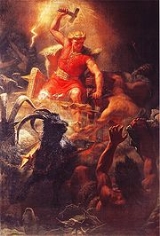
Thor
Georg Von Rosen   Oden Som Vandringsman, 1886 (odin, the Wanderer)
Norse, Viking or Scandinavian mythology comprises the beliefs, myths and legends of the indigenous pre-Christian religion
Norse paganism

Norse paganism is a term used to describe the religion which were common amongst the Germanic tribes living in Nordic countries prior to and during the Christianization of Scandinavia of Northern Europe....
 of the Scandinavian people, including those who settled on Faroe Islands
Faroe Islands

The Faroe Islands or Faeroe Islands or simply Faroe or Faeroes are an island group situated between the Norwegian Sea and the North Atlantic Ocean, approximately half way between Scotland and Iceland....
 and Iceland
Iceland

Iceland, officially the Republic of Iceland , is an island country located in the North Atlantic Ocean between mainland Europe and Greenland....
, where most of the written sources for Norse mythology were assembled. Norse mythology is the best-preserved version of the older common Germanic paganism
Germanic paganism

Germanic paganism refers to the religion beliefs of the Germanic peoples preceding Christianization. The best documented version of the Germanic pagan religions is 10th and 11th century Norse paganism, though other information can be found from Anglo-Saxon paganism and Continental Germanic mythology....
, which also includes the very closely related Anglo-Saxon mythology. Germanic mythology, in turn, developed from an earlier Indo-European mythology
Proto-Indo-European religion

The existence of similarities among the Deity and religious practices of the Indo-Europeans peoples allows glimpses of a common Proto-Indo-Europeans religion and mythology....
.

Norse mythology is a collection of beliefs and stories shared by Northern Germanic tribes. It had no one set of doctrinal beliefs. The mythology was orally transmitted
Oral tradition

Oral tradition, oral culture and oral lore are messages or testimony transmitted orally from one generation to another. The messages or testimony are verbally transmitted in speech or song and may take the form, for example, of folktales, sayings, ballads, songs, or chants....
 in the form of poetry and modern knowledge about it is mainly based on the Edda
Edda

The term Edda applies to the Old Norse Poetic Edda and Prose Edda, both of which were written down in medieval Iceland during the 13th century....
s and other medieval texts written down during and after Christianization
Christianization of Scandinavia

The Christianization of Scandinavia refers to the process of Religious conversion to Christianity of the Scandinavian people, starting in the 8th century with the arrival of missionary in Denmark; it was at least nominally complete by the 12th century, although the Sami people remained unconverted until the 18th century....
.

Some aspects of Norse mythology passed into Scandinavian folklore
Scandinavian folklore

Scandinavian folklore is the folklore of Sweden, Norway, Denmark, Iceland, the Faroe, and the Finland Swedish.In Scandinavia the term 'folklore' is not often used in academic circles, instead terms such as Folketro or Folkesagn have been coined....
 and have survived to modern day. Others have recently been reinvented or reconstructed as Germanic Neopaganism
Germanic neopaganism

Germanic Neopaganism is the Neopaganism of historical Germanic paganism. Precursor movements appeared in the early 20th century in Esotericism in Germany and Austria....
. The mythology also remains as an inspiration in literature
Literature

Literature is the art of written works. Literally translated, the word means "acquaintance with letters" . In Western culture the most basic written literary types include fiction and non-fiction....
 (see Norse mythological influences on later literature) as well as on stage productions and movies.

Sources

Most of the existing records on Norse mythology date from the 11th to 18th century, having gone through more than two centuries of oral preservation in what was at least officially a Christian society. At this point scholars started recording it, particularly in the Edda
Edda

The term Edda applies to the Old Norse Poetic Edda and Prose Edda, both of which were written down in medieval Iceland during the 13th century....
s
and the Heimskringla
Heimskringla

Heimskringla is the best known of the Old Norse kings' sagas. It was written in Old Norse in Iceland by the poet and historian Snorri Sturluson ca....
 by Snorri Sturluson
Snorri Sturluson

Snorri Sturluson was an Icelandic historian, poet and politician. He was two-time elected lawspeaker at the Icelandic parliament, the Althing....
, who believed that pre-Christian deities trace real historical people. There is also the Danish Gesta Danorum
Gesta Danorum

Gesta Danorum is a work of Denmark history, by the 12th century author Saxo Grammaticus . It is the most ambitious literary undertaking of medieval Denmark and is an essential source for the nation's early history....
 by Saxo Grammaticus
Saxo Grammaticus

Saxo Grammaticus also known as Saxo cognomine Longus is thought to have been a secular clerk or secretary to Absalon, Archbishop of Lund....
, where the Norse gods are more strongly Euhemerized
Euhemerus

Euhemerus was a Greek Mythography at the court of Cassander, the king of Macedon. Euhemerus' birthplace is disputed, with Messina in Sicily or Messene in the Peloponnese as the most probable locations, while others champion Chios, or Tegea....
. The Prose or Younger Edda
Prose Edda

The Prose Edda, also known as the Younger Edda, Snorri's Edda or simply Edda, is an Old Norse language Icelandic collection of four sections interspersed with excerpts from earlier skaldic and Eddic poetry containing tales from Norse mythology....
 was written in the early 13th century by Snorri Sturluson
Snorri Sturluson

Snorri Sturluson was an Icelandic historian, poet and politician. He was two-time elected lawspeaker at the Icelandic parliament, the Althing....
, who was a leading skald
Skald

The skald was a member of a group of poets, whose courtly poetry is associated with the courts of Scandinavian and Icelandic leaders during the Viking age, who composed and performed renditions of aspects of what we now characterise as Old Norse poetry ....
, chieftain, and diplomat
Diplomacy

Diplomacy is the art and practice of conducting negotiations between representatives of groups or states. It usually refers to international diplomacy, the conduct of international relations through the intercession of professional diplomats with regard to issues of peace-making, trade, war, economics and culture....
 in Iceland
Iceland

Iceland, officially the Republic of Iceland , is an island country located in the North Atlantic Ocean between mainland Europe and Greenland....
. It may be thought of primarily as a handbook for aspiring skalds. It contains prose
Prose

Prose is writing that resembles everyday Speech communication. The word "prose" is derived from the Latin prosa, which literally translates to "straightforward"....
 explications of traditional "kennings," or compressed metaphors found in poetry. These prose retellings make the various tales of the Norse gods systematic and coherent.

The Poetic Edda
Poetic Edda

The Poetic Edda is a collection of Old Norse poems primarily preserved in the Icelandic mediaeval manuscript Codex Regius. Along with Snorri Sturluson's Prose Edda, the Poetic Edda is the most important extant source on Norse mythology and Germanic heroic legends....
 (also known as the Elder Edda) was committed to writing about 50 years after the Prose Edda. It contains 29 long poems, of which 11 deal with the Germanic deities, the rest with legendary heroes like Sigurd the Volsung (the Siegfried
Sigurd

Sigurd is a legendary hero of Norse mythology, as well as the central character in the Volsunga saga. The earliest extant representations for his legend come in pictorial form from seven runestones in Sweden and most notably the Ramsund carving and the G?k Runestone ....
 of the German version Nibelungenlied
Nibelungenlied

The Nibelungenlied, translated as The Song of the Nibelungs, is an epic poetry in Middle High German. The story tells of dragon-slayer Sigurd at the court of the Burgundians, how he was murdered, and of his wife Gudrun's revenge....
). Although scholars think it was transcribed later than the other Edda, the language and poetic forms involved in the tales appear to have been composed centuries earlier than their transcription.

Besides these sources, there are surviving legends in Scandinavian folklore. Some of these can be corroborated with legends appearing in other Germanic literatures e.g. the tale related in the Anglo-Saxon Battle of Finnsburgh and the many allusions to mythological tales in Deor
Deor

"Deor" is an Old English poetry, from the 10th century in poetry Anno Domini, preserved in the Exeter Book. The poem consists of the lament of the scop Deor, who lends his name to the poem, which was given no formal title....
. When several partial references and tellings survive, scholars can deduce the underlying tale. Additionally, there are hundreds of place names in Scandinavia named after the gods.

A few runic inscriptions, such as the Rök Runestone
Rök Runestone

The R?k Runestone is one of the most famous runestones, featuring the longest known runic alphabet inscription in stone. It is placed by the church in R?k, ?sterg?tland, Sweden, and considered the first piece of written Swedish literature and thus it marks the beginning of the history of Swedish literature....
 and the Kvinneby amulet
Kvinneby amulet

The Kvinneby amulet is an 11th century runic alphabet amulet which was found in the mid-1950's in the soil of the village S?dra Kvinneby in ?land, Sweden....
, make references to the mythology. There are also several runestones and image stones that depict scenes from Norse mythology, such as Thor
Thor

Thor is the red-haired and bearded god of thunder in Germanic mythology and Germanic paganism, and its subsets: Norse paganism, Anglo-Saxon paganism and Continental Germanic mythology....
's fishing trip, scenes depicting Sigurd (Sigfried) the dragon slayer
Sigurd stones

The 'Sigurd stones' form a group of seven or eight runestones and one that depict imagery from the legend of Sigurd the dragon slayer. They were made during the Viking Age and they constitute the earliest Norse representations of the matter of the Nibelungenlied and the Sigurd legends in the Poetic Edda, the Prose Edda and the V?lsu...
, Odin
Odin

Odin , is considered the chief ?sir in Norse paganism. Homologous with the Anglo-Saxons Woden and the Old High German Wotan, it is descended from Proto-Germanic *Wodanaz or *Wodanaz....
 and Sleipnir
Sleipnir

In Norse mythology, Sleipnir is an eight-legged horse. Sleipnir is attested in the Poetic Edda, compiled in the 13th century from earlier traditional sources, and the Prose Edda, written in the 13th century by Snorri Sturluson....
, Odin being devoured by Fenrir, and one of the surviving stones from the Hunnestad Monument
Hunnestad Monument

The Hunnestad Monument , Rundata, once located at Hunnestad in Marsvinsholm Castle north-west of Ystad, Sweden, was the largest and most famous of the Viking Age monuments in Scania, and in Denmark, only comparable to the Jelling stones....
 appears to show Hyrrokkin
Hyrrokkin

In Norse mythology, Hyrrokkin is a J?tunn. She appears to be depicted on from the Hunnestad Monument near Marsvinsholm, Sweden called Rundata....
 riding to Baldr's funeral ().

In Denmark, one image stone depicts Loki
Loki

File:Loke og Sigyn by Eckersberg.jpgIn Norse mythology, Loki is a ?ss or j?tunn . Loki's relation with the gods varies by source. Loki assists the gods, and sometimes causes problems for them....
 with curled dandy-like mustaches and lips that are sewn together and the British Gosforth cross
Gosforth cross

The Gosforth Cross is a large stone Anglo-Saxon art high cross in the churchyard at Gosforth, Cumbria in the England county of Cumbria, an area heavily settled by Vikings....
 shows several mythological images. There are also smaller images, such as figurines depicting the god Odin (with one eye), Thor (with his hammer) and Freyr
Freyr

Freyr is one of the most important gods of Norse paganism. Freyr was highly associated with agriculture, weather and, as a phallus fertility god, Freyr "bestows peace and pleasure on mortals"....
 (with his enormous phallus).

Cosmology

In Norse mythology there are 'nine worlds' (níu heimar), that many scholars summarize as follows:
  • Ásgarđr, world of the Ćsir
    Ćsir

    In Old Norse, ?ss is the term denoting a member of the principal groups of gods of the List of Norse gods of Norse paganism. They include many of the major figures, such as Odin, Frigg, Thor, Baldr and Tyr....
    .
  • Vanaheimr
    Vanaheimr

    The name comes from the home of the Vanir, one of the two clans of gods besides the ?sir. The name appears in the Ynglinga saga by Snorri Sturluson....
    , world of the Vanir
    Vanir

    In Norse mythology, the Vanir are one of two groups of gods, the other being the ?sir. The two groups are described as having waged war against one another in the ?sir-Vanir War?, resulting in the unification of the two into a single tribe of gods....
    .
  • Miđgarđr, world of humans.
  • Muspellheim, world of the primordial element of fire.
  • Niflheimr, world of the primordial element of ice
  • Svartálfaheim
    Svartálfaheim

    In Norse mythology, Svart?lfheimr is the underground domain and home of the Svart?lfar , according to Snorri Sturluson. Note that this could be the same place as the underground realm Ni?avellir in other manuscripts....
    , world of the Svartálfar (black elves).
  • Álfheimr, world of the Álfar (elves).
  • Hel, underground world of the dead.
  • Jötunheimr
    Jötunheimr

    J?tunheimr is the world of the j?tnar in Norse Mythology. From there they menace the humans in Midgard and the gods in Asgard .Gastropnir, home of Menglad, and ?rymheimr, home of ?jazi, were both located in Jotunheim, which was ruled by King Thrym....
    , world of the jötnar.


Note the boundaries between Niflheim, Jötunheimr, Hel, Niđavellir, Svartálfaheimr, and several other significant places like Utgarđr remain uncertain.

Each world also had significant places within. Valhalla
Valhalla

In Norse mythology, Valhalla is a majestic, enormous hall located in Asgard, ruled over by the god Odin. Chosen by Odin, half of those that die in combat travel to Valhalla upon death, led by valkyries, while the other half go to the goddess Freyja's field F?lkvangr....
 is Odin's hall located in Asgaard. It was also home of the Einherjar
Einherjar

In Norse mythology, the einherjar are those that have died in battle and are brought to Valhalla by valkyries. In Valhalla, the einherjar eat their fill of the nightly-resurrecting beast S?hr?mnir, and are brought their fill of mead by valkyries....
, who were the souls of the greatest warriors. These warriors were selected by the Valkyries, Odin
Odin

Odin , is considered the chief ?sir in Norse paganism. Homologous with the Anglo-Saxons Woden and the Old High German Wotan, it is descended from Proto-Germanic *Wodanaz or *Wodanaz....
's mounted female messengers. The Einherjar would help defend the gods during Ragnarok
RagNaRok

Ragnar?k is the fifth album, released in 1995 on Metal Blade Records, by the Rock and roll/Heavy metal music/punk rock band GWAR.This album contains the most varied vocal stylings of any GWAR album, as the majority of the band lends their lungs to the tracklist , as well as guest villain Cardinal Syn....
. Niflhel
Niflhel

Niflhel is the name of a location in Norse mythology which appears in the Poetic Edda Vaf?r??nism?l and Baldrs draumar, and also in Snorri Sturluson's Gylfaginning....
 is a hellish place in Hel, where oathbreakers and other criminals suffer torments.

These worlds are connected by Yggdrasil
Yggdrasil

File:The Ash Yggdrasil by Friedrich Wilhelm Heine.jpgIn Norse mythology, Yggdrasil is the world tree. Yggdrasil is attested in the Poetic Edda, compiled in the 13th century from earlier traditional sources, the Prose Edda, written in the 13th century by Snorri Sturluson....
, the world tree, a giant tree with Asgard at its top. Chewing at its roots in Niflheim is Nidhogg, a ferocious serpent
Serpent

Serpent is a synonym for snake.Serpent and similar can also mean:* Serpent , the name given to a snake in a religious or mythological context...
 or dragon
Dragon

File:Ukiyo-e dragon 2.jpgThe dragon is a legendary creature with serpentine shape or otherwise reptilian traits that features in the mythology of many cultures....
. Asgard can also be reached by Bifrost, a rainbow bridge guarded by Heimdall
Heimdall

Heimdall is one of the ?sir in Norse mythology. Heimdall is the guardian of the gods and of the link between Midgard and Asgard, the Bifrost Bridge....
, a god who can see and hear a thousand miles.

Supernatural beings

There are several "clans" of Vćttir
Vćttir

V?ttir or wights are nature spirits in the Norse mythology. These nature spirits divide up into 'families', including the ?lfar , Dvergar , J?tnar , and even gods, the ?sir and Vanir, who are understood to be prominent families among them....
 or animistic nature spirits: the Ćsir
Ćsir

In Old Norse, ?ss is the term denoting a member of the principal groups of gods of the List of Norse gods of Norse paganism. They include many of the major figures, such as Odin, Frigg, Thor, Baldr and Tyr....
 and Vanir
Vanir

In Norse mythology, the Vanir are one of two groups of gods, the other being the ?sir. The two groups are described as having waged war against one another in the ?sir-Vanir War?, resulting in the unification of the two into a single tribe of gods....
, understood as gods, plus the Jötnar, the Álfar and Dvergar
Norse dwarves

Dvergar or Norse dwarves are highly significant entities in Norse mythology, who associate with stones, the underground, deathliness, luck, magic, and technology, especially forging....
. To this list can be added the dead in the Underworld. The distinction between Ćsir and Vanir is relative, for the two are said to have made peace, exchanged hostages, intermarried and reigned together after the events of the Ćsir-Vanir War
Ćsir-Vanir War

In Norse mythology, the ?sir?Vanir War was a war that occurred between the ?sir and the Vanir, two tribes of gods. The war ultimately resulted in the unification of the two tribes into a single tribe of gods....
, and afterward the gods are generally referred to collectively as Ćsir.

In addition, there are many other beings: Fenrir the gigantic wolf, Jörmungandr
Jörmungandr

J?rmungandr , mostly known as Jormundgand, Midg?rdsormen, or World Serpent, is; in Norse mythology, a sea serpent, and the middle child of the J?tunn Angrbo?a and the god Loki....
 the sea-serpent (or "worm") that is coiled around Midgard, and Hel
HEL

HEL may refer to:* Helsinki-Vantaa Airport* Hardware Emulation Layer* Hensall railway station, England; National Rail station code HEL* High energy laser ...
, ruler of Helgardh. These three monsters are described as the progeny of Loki
Loki

File:Loke og Sigyn by Eckersberg.jpgIn Norse mythology, Loki is a ?ss or j?tunn . Loki's relation with the gods varies by source. Loki assists the gods, and sometimes causes problems for them....
. Other creatures include Hugin and Munin
Hugin and Munin

Huginn and Muninn, sometimes anglicised Hugin and Munin, are a pair of ravens associated with the Norse god Odin.In Norse mythology, Huginn and Muninn travel the world bearing news and information they have collected to Odin....
 (thought and memory, respectively), the two ravens who keep Odin, the chief god, apprised of what is happening on earth, since he gave his eye to the Well of Mimir
Well of Mimir

File:Odin am Brunnen der Weisheit.jpgIn Norse mythology, M?misbrunnr is a well associated with the being M?mir, located beneath the world tree Yggdrasil....
 in his quest for wisdom, Sleipnir
Sleipnir

In Norse mythology, Sleipnir is an eight-legged horse. Sleipnir is attested in the Poetic Edda, compiled in the 13th century from earlier traditional sources, and the Prose Edda, written in the 13th century by Snorri Sturluson....
, Loki's eight legged horse son belonging to Odin and Ratatosk
Ratatosk

In Norse mythology, Ratatoskr is a squirrel who runs up and down the world tree Yggdrasil to carry messages between the Ve?rf?lnir and eagle, perched atop Yggdrasil, and the wyrm N??h?ggr, who dwells beneath one of the three roots of the tree....
, the squirrel which scampers in the branches of Yggdrasil.

Völuspá

In the Poetic Edda poem Völuspá
Völuspá

V?lusp? is the first and best known poem of the Poetic Edda. It tells the story of the creation of the world and its coming end related by a v?lva addressing Odin....
 ("Prophecy [spá] of the völva
Völva

A V?lva was a priestess in Norse paganism, and a recurring motif in Norse mythology....
"), Odin, the chief god of the Norse pantheon, has conjured up the spirit of a dead völva and commanded this spirit to reveal the past and the future. She is reluctant: "What do you ask of me? Why tempt me?"; but since she is already dead, she shows no fear of Odin, and continually taunts him: "Well, would you know more?" But Odin insists: if he is to fulfill his function as king of the gods, he must possess all knowledge. Once the völva has revealed the secrets of past and future, she falls back into oblivion: "I sink now".

Creation
Faroe Stamp 430 the First Human Beings
According to Norse myth, the beginning of life was fire and ice, with the existence of only two worlds: Muspelheim and Niflheim. When the warm air of Muspelheim hit the cold ice of Niflheim, the jötunn Ymir
Ymir

In Norse mythology, Ymir, also named Aurgelmir among the giants themselves, was the founder of the race of J?tunn and an important figure in Norse cosmology....
 and the icy cow Audhumla were created. Ymir's foot bred a son and a man and a woman emerged from his armpits, making Ymir the progenitor of the Jotun
Jotun

A j?tunn, , plural j?tnar, is a Giant in Norse mythology, a member of a race of nature spirits with superhuman strength, described as sometimes standing in opposition to the races of the tribes of the ?sir and Vanir, although they frequently mingle with or intermarry with these....
. Whilst Ymir slept, the intense heat from Muspelheim made him sweat, and he sweated out Surtr
Surtr

In Norse mythology, Surtr is a j?tunn. Surtr is attested in the Poetic Edda, compiled in the 13th century from earlier traditional sources, and the Prose Edda, written in the 13th century by Snorri Sturluson....
, a jötunn of fire. Later Ymir woke and drank Audhumbla's milk. Whilst he drank, the cow Audhumbla licked on a salt stone. On the first day after this a man's hair appeared on the stone, on the second day a head and on the third day an entire man emerged from the stone. His name was Búri
Búri

B?ri was the first god in Norse mythology. He was the father of Borr and grandfather of Odin. He was formed by the cow Au?umbla licking the salty ice of Ginnungagap....
 and with an unknown jötunn female he fathered Bor, the father of the three gods Odin
Odin

Odin , is considered the chief ?sir in Norse paganism. Homologous with the Anglo-Saxons Woden and the Old High German Wotan, it is descended from Proto-Germanic *Wodanaz or *Wodanaz....
, Vili and Ve
VE

VE, Ve or ve may refer to:* V?, a god in Norse mythology* V? , a shrine in Germanic paganism and modern place name element* Ve , a character from the Cyrillic alphabet...
.

When the gods felt strong enough they killed Ymir. His blood flooded the world and drowned all of the jötunn, except two. But jötnar grew again in numbers and soon there were as many as before Ymir's death. Then the gods created seven more worlds using Ymir's flesh for dirt, his blood for the Oceans, rivers and lakes, his bones for stone, his brain as the clouds, his skull for the heaven. Sparks from Muspelheim flew up and became stars.

One day when the gods were walking they found two tree trunks. They transformed them into the shape of humans. Odin gave them life, Vili gave them mind and Ve gave them the ability to hear, see, and speak. The gods named them Ask and Embla
Ask and Embla

In Norse Mythology, Ask and Embla were the first two humans created by the gods. The pair are attested in the Poetic Edda, compiled in the 13th century from earlier traditional sources, and the Prose Edda, written in the 13th century by Snorri Sturluson....
 and built the kingdom of Middle-earth for them; and, to keep out the jötnar, the gods placed a gigantic fence made of Ymir's eyelashes around Middle-earth.

The völva goes on to describe Yggdrasil
Yggdrasil

File:The Ash Yggdrasil by Friedrich Wilhelm Heine.jpgIn Norse mythology, Yggdrasil is the world tree. Yggdrasil is attested in the Poetic Edda, compiled in the 13th century from earlier traditional sources, the Prose Edda, written in the 13th century by Snorri Sturluson....
 and three norns, Urđr (Wyrd), Verđandi and Skuld. She then describes the war between the Ćsir and Vanir and the murder of Baldr, Odin's handsome son whom everyone but Loki loved. (The story is that everything in existence promised not to hurt him except mistletoe. Taking advantage of this weakness, Loki made a projectile of mistletoe
Mistletoe

Mistletoe is the common name for a group of parasitic plant plants in the Order Santalales that grow attached to and within the branches of a tree or shrub....
 and tricked Höđr
Höđr

H??r is the brother of Baldr in Norse mythology. Guided by Loki he shot the mistletoe missile which was to slay the otherwise invulnerable Baldr....
, Odin's blind son and Baldr's brother, into using it to kill Baldr. Hel
HEL

HEL may refer to:* Helsinki-Vantaa Airport* Hardware Emulation Layer* Hensall railway station, England; National Rail station code HEL* High energy laser ...
 said she would revive him if everyone in the nine worlds wept. A female jötunn - Thokk
Thokk

File:AM 738 4to, 41v, BW ??kk.jpeg??kk is a J?tunn in Norse mythology, presumed to be Loki in disguise, who refuses to weep for the slain Baldr, thus forcing him to stay in Hel ....
, who may have been Loki in shape-shifted form - did not weep.) After that she turns her attention to the future.

Ragnarök
Ragnarök refers to a series of major events, including a great battle foretold to ultimately result in the death of a number of major figures (including the gods
Ćsir

In Old Norse, ?ss is the term denoting a member of the principal groups of gods of the List of Norse gods of Norse paganism. They include many of the major figures, such as Odin, Frigg, Thor, Baldr and Tyr....
 Odin
Odin

Odin , is considered the chief ?sir in Norse paganism. Homologous with the Anglo-Saxons Woden and the Old High German Wotan, it is descended from Proto-Germanic *Wodanaz or *Wodanaz....
, Thor
Thor

Thor is the red-haired and bearded god of thunder in Germanic mythology and Germanic paganism, and its subsets: Norse paganism, Anglo-Saxon paganism and Continental Germanic mythology....
, Freya
Freya

Freyja is a major goddess in Norse paganism, a subset of Germanic paganism. Because the documented source of this religious tradition, the Norse mythology, was transmitted and altered by Christian medieval historians, the actual role, heathen practices and worship of the goddess are uncertain....
, Heimdall
Heimdall

Heimdall is one of the ?sir in Norse mythology. Heimdall is the guardian of the gods and of the link between Midgard and Asgard, the Bifrost Bridge....
, and the jötunn Loki
Loki

File:Loke og Sigyn by Eckersberg.jpgIn Norse mythology, Loki is a ?ss or j?tunn . Loki's relation with the gods varies by source. Loki assists the gods, and sometimes causes problems for them....
), the occurrence of various natural disasters, and the subsequent submersion of the world in water. Afterwards, the world resurfaces anew and fertile, the surviving gods meet, and the world is repopulated by two human survivors.

Kings and heroes

The mythological literature relates the legends of heroes and kings, as well as supernatural creatures. These clan and kingdom founding figures possessed great importance as illustrations of proper action or national origins. The heroic literature may have fulfilled the same function as the national epic
National epic

A national epic is an epic poetry or a literary work of epic scope which seeks or is believed to capture and express the essence or spirit of a particular nation; not necessarily a nation-state, but at least an ethnic or linguistic group with aspirations to independence or Wiktionary:autonomy....
 in other European literatures, or it may have been more nearly related to tribal identity. Many of the legendary figures probably existed, and generations of Scandinavian scholars have tried to extract history from myth in the sagas
Norse saga

The sagas , are stories about ancient Scandinavia and Germanic tribes history, about early Viking voyages, about migration to Iceland, and of feuds between Icelandic families....
.

Sometimes the same hero resurfaces in several forms depending on which part of the Germanic world the epics survived such as Weyland
Weyland

In Germanic mythology, Wayland or V?lundr is a legendary Smith . In Old Norse sources, V?lundr appears in V?lundarkvi?a, a poem in the Poetic Edda, and in ?i?rekssaga, and his legend is also depicted on the Ardre image stone....
/Völund and Siegfried
Siegfried

Siegfried is a German language male given name, meaning "victory peace".Siegfried may also refer to:*Siegfried , an opera by Richard Wagner...
/Sigurd
Sigurd

Sigurd is a legendary hero of Norse mythology, as well as the central character in the Volsunga saga. The earliest extant representations for his legend come in pictorial form from seven runestones in Sweden and most notably the Ramsund carving and the G?k Runestone ....
, and probably Beowulf
Beowulf (hero)

Beowulf is a legendary Geatish hero and later king in the Old English epic poem Beowulf, the oldest surviving piece of literature in the English language....
/Bödvar Bjarki
Bödvar Bjarki

B?dvar Bjarki is the hero appearing in tales of Hr?lf Kraki in the Saga of Hr?lf Kraki, in the Latin epitome to the lost Skj?ldunga saga, and as Biarco in Saxo Grammaticus' Gesta Danorum....
. Other notable heroes are Hagbard
Hagbard

Hagbard, the brother of Haki and son of Hamund, was a famous Scandinavian sea-king, in Norse mythology. He is mentioned in Sk?ldskaparm?l, Ynglinga saga, Nafna?ulur, V?lsunga saga and Gesta Danorum....
, Starkad
Starkad

Starkad, Old Norse: Starka?r or St?rku?r, Latin: Starcaterus, and during the late Middle Ages, also known as Starkodder, was a legendary hero in Norse mythology....
, Ragnar Lodbrok
Ragnar Lodbrok

Ragnar Lodbrok was a Norsemen legendary hero from the Viking Age who was thoroughly reshaped in Old Norse poetry and legendary sagas.The namesake and subject of ?Ragnar?s Saga?, and one of the most popular Viking heroes among the Norse themselves, Ragnar was a great Viking commander and the scourge of France....
, Sigurd Ring
Sigurd Ring

Sigurd Ring or Ring was a Swedish and Danish king mentioned in many old Scandinavian legends. According to B?sa saga ok Herrauds, there was once a saga on Sigurd Ring, but this saga is now lost....
, Ivar Vidfamne
Ivar Vidfamne

?varr inn v??fa?mi or Ivar Vidfamne was a semi-legendary king of Sweden and other parts of Scandinavia. He may have died c. 700. According to the Heimskringla and the Hervarar saga, Ivar was also the king of Norway, Denmark, Saxony and parts of England....
 and Harald Hildetand. Notable are also the shieldmaiden
Shieldmaiden

A shieldmaiden was a virgin who had chosen to fight as a warrior in Scandinavian folklore and Scandinavian mythology and they are often mentioned in sagas such as Hervarar saga and in Gesta Danorum....
s who were ordinary women who had chosen the path of the warrior. These women function both as heroines and as obstacles to the heroic journey.

Norse worship


Centres of faith

Gamla Uppsala
The Germanic tribes rarely or never had temples in a modern sense. The Blót, the form of worship practiced by the ancient Germanic and Scandinavian people, resembled that of the Celts
Celtic mythology

Celts mythology is the mythology of Celtic polytheism, apparently the religion of the Iron Age Celts. Like other Iron Age Europeans, the early Celts maintained a polytheistic mythology and religious structure....
 and Balts
Balts

For the similarly named ethnic group inhabiting northern Pakistani Kashmir, see Balti peopleThe Balts or Baltic peoples , defined as speakers of one of the Baltic languages, a branch of the Indo-European languages family, are descended from a group of Indo-Europeans tribes who settled the area between lower Vistula and upper D...
. It occurred either in sacred grove
Sacred grove

Sacred groves were a feature of the mythological landscape and the cult of Old European culture, of the most ancient levels of Germanic paganism, Greek mythology, Slavic mythology, Roman mythology, and in Druidry practice....
s, at home, or at a simple altar of piled stones known as a "horgr". However, there seem to have been a few more important centres, such as Skiringssal
Kaupang

Kaupang is a town founded in the 780s during the time when the Vikings started to launch their raids against Great Britain and other parts of Europe until it was abandoned for unknown reasons in the early 10th century....
, Lejre
Lejre

Lejre is a town and municipality on the island of Zealand in east Denmark. It belongs to Region Sj?lland. The town's Old Norse name was Hlei?ra....
 and Uppsala
Gamla Uppsala

Gamla Uppsala is a parish and a village outside Uppsala in Sweden. It had 16,231 inhabitants in 1991.As early as the 3rd century AD and the 4th century AD and onwards, it was an important religious, economic and political centre....
. Adam of Bremen
Adam of Bremen

Adam of Bremen was one of the most important Germany medieval chroniclers. He lived and worked in the second half of the eleventh century. He is most famous for his chronicle Gesta Hammaburgensis ecclesiae pontificum ....
 claims that there was a temple in Uppsala (see Temple at Uppsala
Temple at Uppsala

The Temple at Uppsala was a religious center in Norse paganism once located at what is now Gamla Uppsala , Sweden attested in Adam of Bremen's 11th century work Gesta Hammaburgensis ecclesiae pontificum and in Heimskringla, written by Snorri Sturluson in the 13th century....
) with four wooden statues of Thor, Odin, Idoki and Freyr.

Priests

While a kind of priesthood seems to have existed, it never took on the professional and semi-hereditary character of the Celtic druidical class. This was because the shamanistic tradition was maintained by women, the Völva
Völva

A V?lva was a priestess in Norse paganism, and a recurring motif in Norse mythology....
s. It is often said that the Germanic kingship evolved out of a priestly office. This priestly role of the king was in line with the general role of godi
GODI

GODI is package management system for Objective Caml programming language. It provides dependency management for OCaml similar to the way CPAN provides package management for Perl....
, who was the head of a kindred group of families (for this social structure, see norse clans
Norse clans

The Scandinavian clan or ?tt was a social group based on common descent or on the formal acceptance into the group at a thing ....
), and who administered the sacrifices.

Despite the shamanistic
Shamanism

Shamanism is a range of traditional beliefs and practices concerned with communication with the spirit world. A practitioner of shamanism is known as a shaman, , noun ....
 Völva
Völva

A V?lva was a priestess in Norse paganism, and a recurring motif in Norse mythology....
s, this religion was not a form of shamanism
Shamanism

Shamanism is a range of traditional beliefs and practices concerned with communication with the spirit world. A practitioner of shamanism is known as a shaman, , noun ....
.

Human sacrifice

Midvinterblot
A unique eye-witness account of Germanic human sacrifice
Human sacrifice

Human sacrifice is the act of killing human beings as part of a religious ritual . Its typology closely parallels the various practices of ritual slaughter of animals and of religious sacrifice in general....
 survives in Ibn Fadlan's account of a Rus
Rus' (people)

Rus? are the historic population of the medieval Rus' Khaganate and Kievan Rus' whose name survives in the cognates Russians, Rusyns, and Ruthenians, and who are viewed by the modern Belarusians, Russians, and Ukrainians as the predecessors of their own peoples....
 ship burial
Ship burial

A ship burial or boat grave is a burial in which a ship or boat is used either as a container for the dead and the grave goods, or as a part of the grave goods itself....
, where a slave-girl had volunteered to accompany her lord to the next world. More indirect accounts are given by Tacitus
Tacitus

Publius Cornelius Tacitus was a Roman Senate and a historian of the Roman Empire. The surviving portions of his two major works—the Annals and the Histories —examine the reigns of the Roman Emperors Tiberius, Claudius, Nero and those that reigned in the Year of the Four Emperors....
, Saxo Grammaticus
Saxo Grammaticus

Saxo Grammaticus also known as Saxo cognomine Longus is thought to have been a secular clerk or secretary to Absalon, Archbishop of Lund....
 and Adam von Bremen.

However, the Ibn Fadlan account is actually a burial ritual. Current understanding of Norse mythology suggests an ulterior motive to the slave-girl's 'sacrifice'. It is believed that in Norse mythology a woman who joined the corpse of a man on the funeral pyre would be that man's wife in the next world. For a slave girl to become the wife of a lord was an obvious increase in status. Although both religions are of the Indo-European tradition, the sacrifice described in the Ibn Fadlan account is not to be confused with the practice of Sati
Sati (practice)

Sati was a funeral practice among some Hindu communities in which a recently-widowed woman would either voluntarily or by use of force and coercion Self-immolation herself on her husband?s funeral pyre....
.

The Heimskringla tells of Swedish King Aun
Aun

Ane, On, One, Auchun or Aun the Old was the son of Jorund and one of the Sweden kings of the House of Yngling, the ancestors of Norway's first king, Harald Fairhair....
 who sacrificed nine of his sons in an effort to prolong his life until his subjects stopped him from killing his last son Egil
Egil

People called Egil:*Agilaz, a legendary archer of Germanic mythology and a brother of V?lund.*Egil , a character in the poem Hymiskvida....
. According to Adam of Bremen, the Swedish kings sacrificed male slaves every ninth year during the Yule
Yule

Yule or Yule-tide is a List of winter festivals that was initially celebrated by the historical Germanic peoples as a Germanic paganism religious festival, though it was later absorbed into, and equated with, the Christianity festival of Christmas....
 sacrifices at the Temple at Uppsala. The Swedes had the right not only to elect kings but also to depose them, and both king Domalde
Domalde

In Norse mythology Domalde, D?maldi or D?maldr was a Sweden king of the House of Ynglings, cursed by his stepmother, according to Snorri Sturluson, with ?sg?ssa, "ill-luck"....
 and king Olof Trätälja
Olof Trätälja

Olaf Tree Feller was the son of the Swedish king Ingjald Ill-ruler of the House of Yngling according to Ynglingatal....
 are said to have been sacrificed after years of famine.

Odin was associated with death by hanging, and a possible practice of Odinic sacrifice by strangling has some archeological support in the existence of bodies such as Tollund Man
Tollund Man

The Tollund Man is the naturally Mummy of a man who lived during the 4th century BC, during the time period characterised in Scandinavia as the Pre-Roman Iron Age....
 that perfectly preserved by the acid of the Jutland
Jutland

File:Jutland peninsula 2.pngJutland , historically also called Cimbria, is a peninsula in Europe. Jutland forms the mainland part of Denmark as well as the northernmost part of Germany....
 peat
Peat

Peat is an accumulation of partially decayed vegetation biological tissue. Peat forms in wetlands or peatlands, variously called bogs, Moorland, muskegs, pocosins, mires, and peat swamp forests....
bogs, into which they were cast after having been strangled. However, scholars possess no written accounts that explicitly interpret the cause of these stranglings, which could obviously have other explanations.

Interactions with Christianity

An important note in interpreting this mythology is that often the closest accounts that scholars have to "pre-contact" times were written by Christians. The Younger Edda and the Heimskringla were written by Snorri Sturluson in the 13th century, over two hundred years after Iceland became Christianized. This results in Snorri's works carrying a large amount of Euhemerism.

Virtually all of the saga literature came out of Iceland
Iceland

Iceland, officially the Republic of Iceland , is an island country located in the North Atlantic Ocean between mainland Europe and Greenland....
, a relatively small and remote island, and even in the climate of religious tolerance there, Snorri was guided by an essentially Christian viewpoint. The Heimskringla
Heimskringla

Heimskringla is the best known of the Old Norse kings' sagas. It was written in Old Norse in Iceland by the poet and historian Snorri Sturluson ca....
 provides some interesting insights into this issue. Snorri introduces Odin as a mortal warlord in Asia who acquires magical powers, settles in Sweden, and becomes a demi-god following his death. Having undercut Odin's divinity, Snorri then provides the story of a pact of Swedish King Aun
Aun

Ane, On, One, Auchun or Aun the Old was the son of Jorund and one of the Sweden kings of the House of Yngling, the ancestors of Norway's first king, Harald Fairhair....
 with Odin to prolong his life by sacrificing his sons. Later in the Heimskringla, Snorri records in detail how converts to Christianity such as Saint Olaf Haraldsson brutally converted Scandinavians to Christianity.

Sejdmen
Trying to avert civil war, the Icelandic parliament voted in Christianity, but for some years tolerated heathenry in the privacy of one's home. Sweden, on the other hand, had a series of civil wars in the 11th century, which ended with the burning of the Temple at Uppsala
Temple at Uppsala

The Temple at Uppsala was a religious center in Norse paganism once located at what is now Gamla Uppsala , Sweden attested in Adam of Bremen's 11th century work Gesta Hammaburgensis ecclesiae pontificum and in Heimskringla, written by Snorri Sturluson in the 13th century....
. In England
England

native_name =|conventional_long_name = England|common_name = England|image_flag = Flag of England.svg|image_coat = England COA.svg|symbol_type = Royal Coat of Arms...
, Christianization occurred earlier and sporadically, rarely by force. Conversion by coercion was sporadic throughout the areas where Norse gods had been worshipped. However, the conversion did not happen overnight. Christian clergy did their utmost to teach the populace that the Norse gods were demons, but their success was limited and the gods never became evil in the popular mind in most of Scandinavia.

The length of time Christianization took is illustrated by two centrally located examples of Lovön and Bergen. Archaeological studies of graves at the Swedish island of Lovön
Lovön

Lov?n is an island located in the Swedish lake M?laren in Eker? Municipality of Stockholm County. It was joined with Eker? Municipality in 1952 after being its own municipality for quite some time....
 have shown that the Christianisation took 150-200 years, and this was a location close to the kings and bishops. Likewise in the bustling trading town of Bergen, many runic inscriptions have been found from the 13th century, among the Bryggen inscriptions
Bryggen inscriptions

The Bryggen inscriptions are a find of some 670 medieval runes inscriptions on wood and bone found from 1955 and forth at Bryggen in Bergen, Norway, Norway....
. One of them says may Thor receive you, may Odin own you, and a second one is a galdra which says I carve curing runes, I carve salvaging runes, once against the elves, twice against the trolls, thrice against the thurs
Thurs

Thurs may refer to:*Thurs, also Thurse, a mythological race with superhuman strength in Norse mythology see J?tunn**a name of Thor*Thurisaz ?, the rune expressing the Thorn phoneme...
. The second one also mentions the dangerous Valkyrie
Valkyrie

File:The Ride of the Valkyrs.jpgIn Norse mythology, a valkyrie is one of a wikt:host#Noun_2 of female figures who choose those who die in battle....
 Skögul
Skögul

In Norse mythology, Sk?gul and Geirsk?gul are valkyries who alternately appear as separate or individual figures. Both valkyries appear in Heimskringla where they seem to be the same being, and are otherwise listed separately in the valkyrie lists in the Poetic Edda poems V?lusp? and Gr?mnism?l, the longer of the two v...
.

There are few accounts from the 14th to the 18th century, but the clergy, such as Olaus Magnus
Olaus Magnus

Olaus Magnus was a Sweden ecclesiastic and writer, who did pioneering work for the interest of Nordic countries people. He was reported as born in October 1490 in ?sterg?tland, and died on August 1, 1557....
 (1555) wrote about the difficulties of extinguishing the old beliefs. The story related in Ţrymskviđa
Ţrymskviđa

?rymskvi?a is one of the best known poems from the Poetic Edda. The Norse myth had enduring popularity in Scandinavia and continued to be told and sung in several forms until the 19th century....
 appears to have been unusually resilient, like the romantic story of Hagbard and Signy
Hagbard and Signy

'Hagbard' and 'Signy' or 'Habor' and 'Signild' were a pair of lovers in Scandinavian mythology and folklore whose legend was widely popular....
, and versions of both were recorded in the 17th century and as late as the 19th century. In the 19th and early 20th century Swedish folklorists documented what commoners believed, and what surfaced were many surviving traditions of the gods of Norse mythology. However, the traditions were by then far from the cohesive system of Snorri's accounts. Most gods had been forgotten and only the hunting Odin and the jötunn-slaying Thor figure in numerous legends. Freyja is mentioned a few times and Baldr only survives in legends about place names.

Other elements of Norse mythology survived without being perceived as such, especially concerning supernatural beings in Scandinavian folklore
Scandinavian folklore

Scandinavian folklore is the folklore of Sweden, Norway, Denmark, Iceland, the Faroe, and the Finland Swedish.In Scandinavia the term 'folklore' is not often used in academic circles, instead terms such as Folketro or Folkesagn have been coined....
. Moreover, the Norse belief in destiny has been very firm until modern times. Since the Christian hell
Hell

In many religious traditions, Hell is a place of suffering and punishment in the afterlife, often in the underworld. Religions with a linear Divinity history often depict Hell as endless ....
 resembled the abode of the dead in Norse mythology one of the names was borrowed from the old faith, Helvíti i.e. Hel's punishment. Many elements of the Yule
Yule

Yule or Yule-tide is a List of winter festivals that was initially celebrated by the historical Germanic peoples as a Germanic paganism religious festival, though it was later absorbed into, and equated with, the Christianity festival of Christmas....
 traditions persevered, such as the Swedish tradition of slaughtering the pig at Christmas (Christmas ham
Christmas ham

A Christmas Ham or Yule Ham is a traditional dish associated with modern Christmas, Yule and Scandinavia Jul. The tradition is suggested to have begun amongst the Germanic peoples as a Bl?t to Freyr, a god in Germanic Paganism associated with Boar, harvest and fertility....
), which originally was part of the sacrifice to Freyr.

Modern influences


The Germanic gods have left numerous traces in modern vocabulary and elements of every day western life in most Germanic language speaking countries. An example of this is some of the names of the days of the week: modelled after the names of the days of the week in Latin
Latin

Latin is an Italic language, historically spoken in Latium and Ancient Rome. Through the Military history of the Roman Empire, Latin spread throughout the Mediterranean and a large part of Europe....
 (named after Mars, Mercury, Jupiter, Venus, and Saturn), the names for Tuesday through to Friday were replaced with Germanic equivalents of the Roman gods and the names for Monday and Sunday after the Sun and Moon. In English, Saturn was not replaced, while Saturday is named after the sabbath in German.

Viking revival

Freya and Heimdall By Blommer
Early modern editions of Old Norse literature begins in the 16th century, e.g. Historia de gentibus septentrionalibus (Olaus Magnus, 1555) and the first edition of the 13th century Gesta Danorum
Gesta Danorum

Gesta Danorum is a work of Denmark history, by the 12th century author Saxo Grammaticus . It is the most ambitious literary undertaking of medieval Denmark and is an essential source for the nation's early history....
 (Saxo Grammaticus
Saxo Grammaticus

Saxo Grammaticus also known as Saxo cognomine Longus is thought to have been a secular clerk or secretary to Absalon, Archbishop of Lund....
), in 1514. The pace of publication increased during the 17th century with Latin translations of the Edda
Edda

The term Edda applies to the Old Norse Poetic Edda and Prose Edda, both of which were written down in medieval Iceland during the 13th century....
 (notably Peder Resen's Edda Islandorum of 1665). The renewed interest of Romanticism
Romanticism

Romanticism is a complex artistic, literary, and intellectual movement that originated in the second half of the 18th century in Western Europe, and gained strength during the Industrial Revolution....
 in the Old North had political implications. Myths about a glorious and brave past is said to have given the Swedes the courage to retake Finland
Finland

Finland , officially the Republic of Finland , is a Nordic countries situated in the Fennoscandian region of northern Europe. It borders Sweden on the west, Russia on the east, and Norway on the north, while Estonia lies to its south across the Gulf of Finland....
, which had been lost in 1809 during the war between Sweden and Russia
Finnish War

The Finnish War was fought between Kingdom of Sweden and Russian Empire from February 1808 to September 1809. As a result of the war, the eastern third of Sweden was established as the autonomous Grand Duchy of Finland within the Russian Empire....
. The Geatish Society
Geatish Society

The Geatish Society, or Gothic League was created by a number of Swedish poets and authors in 1811, as a social club for literary studies among academics in Sweden with a view to raising the moral tone of society through contemplating Scandinavian antiquity ....
, of which Geijer was a member, popularized this myth to a great extent.

A focus for early British enthusiasts was George Hicke, who published a Linguarum vett. septentrionalium thesaurus in 1703–5. In the 1780s, Denmark
Denmark

Denmark is a Scandinavian country in northern Europe and the senior member of the Kingdom of Denmark. It is the southernmost of the Nordic countries....
 offered to cede Iceland
Iceland

Iceland, officially the Republic of Iceland , is an island country located in the North Atlantic Ocean between mainland Europe and Greenland....
 to Britain in exchange for Crab Island (West Indies), and in the 1860s Iceland was considered as a compensation for British support of Denmark in the Slesvig-Holstein conflicts. During this time, British interest and enthusiasm for Iceland and Nordic culture grew dramatically.

Germanic Neopaganism


Romanticist interest in the Old North gave rise to Germanic mysticism involving various schemes of occultist "Runology", notably following Guido von List
Guido von List

Guido Karl Anton List, better known as Guido von List was an Austrian German poet, journalist, writer, businessman and dealer of leather goods, mountaineer, hiker, dramatist, playwright, and rower, but was most notable as an occultist and V?lkisch movement author who is seen as one of the most important figures in Germanic neopa...
 and his Das Geheimnis der Runen
Das Geheimnis der Runen

Das Geheimnis der Runen is a book by Austrian mystic Guido von List, in which he presents his "Armanen Futharkh".It appeared as a periodical article in 1906, and as a standalone publication in 1908....
 (1908) in the early 20th century.

Since the 1970s, there have been revivals of the old Germanic religion as Germanic neopaganism
Germanic neopaganism

Germanic Neopaganism is the Neopaganism of historical Germanic paganism. Precursor movements appeared in the early 20th century in Esotericism in Germany and Austria....
 (Ásatrú
Ásatrú

File:Valknut-Symbol-triquetra.svg in the United States is a form of Germanic Neopaganism, in particular inspired by the Norse paganism as described in the Eddas and as practiced prior to the Christianization of Scandinavia....
) in both Europe
Europe

Europe is, conventionally, one of the world's seven continents. Comprising the westernmost peninsula of Eurasia, Europe is generally divided from Asia to its east by the water divide of the Ural Mountains, the Ural , the Caspian Sea, and by the Caucasus Mountains to the southeast....
 and the United States
United States

The United States of America is a Federal government constitutional republic comprising U.S. state and a federal district. The country is situated mostly in central North America, where its Contiguous United States and Washington, D.C., the Capital districts and territories, lie between the Pacific Ocean and Atlantic Oceans, Borders of the U...
.

Modern popular culture


Norse mythology also influenced Richard Wagner
Richard Wagner

Wilhelm Richard Wagner was a German composer, Conducting, theatre director and essayist, primarily known for his operas . Unlike most other great opera composers, Wagner wrote both the scenario and libretto for his works....
's use of literary themes from it to compose the four operas that make up Der Ring des Nibelungen
Der Ring des Nibelungen

Der Ring des Nibelungen is a literature cycle of four epic poetry music dramas by the Germany composer Richard Wagner. The operas are based loosely on characters from the Sagas and the Nibelungenlied....
 (The Ring of the Nibelung).

Subsequently, J. R. R. Tolkien
J. R. R. Tolkien

John Ronald Reuel Tolkien, Order of the British Empire was an English people English literature, poetry, Philology, and university professor, best known as the author of the classic high fantasy works The Hobbit, The Lord of the Rings and The Silmarillion....
's writings, especially The Silmarillion
The Silmarillion

The Silmarillion is a collection of J. R. R. Tolkien's Mythopoeia works, edited and published posthumously by his son Christopher Tolkien in 1977, with assistance from Guy Gavriel Kay, who later became a noted fantasy writer....
, were heavily influenced by the indigenous beliefs of the pre-Christian Northern Europeans. As the related Tolkien's novel The Lord of the Rings
The Lord of the Rings

The Lord of the Rings is an Epic poetry high fantasy novel written by Philology J.R.R. Tolkien. The story began as a sequel to Tolkien's earlier, less complex children's fantasy novel The Hobbit , but eventually developed into a much larger work....
 became popular, elements of its fantasy world moved steadily into popular perceptions of the fantasy genre. In many fantasy novels today can be found such Norse creatures as elves, dwarves, and frost jötnar. Subsequently, Norse mythology has also greatly influenced popular culture, in literature and modern fiction. (See Marvel Comics' The Mighty Thor or Neil Gaiman's The Sandman (Vertigo) also Neil Gaiman's novel American Gods
American Gods

American Gods is a novel by Neil Gaiman. The novel is a blend of Americana, fantasy, and various strands of ancient and modern mythology, all centering on a mysterious and taciturn protagonist, Shadow....
)

Bibliography


Primary sources

  • The Prose Edda
    Prose Edda

    The Prose Edda, also known as the Younger Edda, Snorri's Edda or simply Edda, is an Old Norse language Icelandic collection of four sections interspersed with excerpts from earlier skaldic and Eddic poetry containing tales from Norse mythology....
  • The Poetic Edda
    Poetic Edda

    The Poetic Edda is a collection of Old Norse poems primarily preserved in the Icelandic mediaeval manuscript Codex Regius. Along with Snorri Sturluson's Prose Edda, the Poetic Edda is the most important extant source on Norse mythology and Germanic heroic legends....
  • Gesta Danorum
    Gesta Danorum

    Gesta Danorum is a work of Denmark history, by the 12th century author Saxo Grammaticus . It is the most ambitious literary undertaking of medieval Denmark and is an essential source for the nation's early history....
  • Ynglinga saga
    Ynglinga saga

    The Ynglinga saga was originally written in Old Norse by the Icelandic poet Snorri Sturluson about 1225. He based it on an earlier Ynglingatal which is attributed to the Norwegian 9th century skald ?j???lfr of Hvinir, and which also appears in Historia Norvegi?....
  • Saga
    Saga

    Saga may refer to:...
    s


General secondary works

(1998). A Piece of Horse Liver: Myth, Ritual and Folklore in Old Icelandic Sources (translated by Terry Gunnell & Joan Turville-Petre). Reykjavík: Félagsvísindastofnun. ISBN 9979542640. (editors) (2006). Old Norse Religion in Long-Term Perspectives: Origins, Changes and Interactions. Lund: Nordic Academic Press. ISBN 918911681X. (1980). Gods of the North. London: Thames and Hudson. (Revised from an earlier hardback edition of 1955). ISBN 0-500-27177-1. (2002). The Norsemen in the Viking Age. Malden, Mass.: Blackwell. ISBN 1405149647. (1994). Prolonged Echoes: Old Norse Myths in Medieval Northern Society, vol. 1: The Myths. Odense: Odense Univ. Press. ISBN 8778380081. (1964). Gods and Myths of Northern Europe. Baltimore: Penguin. New edition 1990 by Penguin Books. ISBN 0-14-013627-4. (Several runestones)
  • —— (1969). Scandinavian Mythology. London and New York: Hamlyn. ISBN 0-87226-041-0. Reissued 1996 as Viking and Norse Mythology. New York: Barnes and Noble.
  • —— (1988). Myths and Symbols in Pagan Europe. Syracuse, NY: Syracuse Univ. Press. ISBN 0815624387.
  • —— (1993). The Lost Beliefs of Northern Europe. London & New York: Routledge. ISBN 0415049377.
Altgermanische Religionsgeschichte, 2 vols., 2nd. ed., Grundriss der germanischen Philogie, 12–13. Berlin: W. de Gruyter. (1999). Nordic Religions in the Viking Age. Philadelphia: Univ. Pennsylvania Press. ISBN 0812217144. (1973). Gods of the Ancient Northmen. Ed. & trans. Einar Haugen. Berkeley: University of California Press. ISBN 0-520-03507-0. (1888). Teutonic Mythology, 4 vols. Trans. S. Stallybras. London. Reprinted 2003 by Kessinger. ISBN 0-7661-7742-4, ISBN 0-7661-7743-2, ISBN 0-7661-7744-0, ISBN 0-7661-7745-9. Reprinted 2004 Dover Publications. ISBN 0-486-43615-2 (4 vols.), ISBN 0-486-43546-6, ISBN 0-486-43547-4, ISBN 0-486-43548-2, ISBN 0-486-43549-0.
(1988). Scandinavian Mythology: An Annotated Bibliography, Garland Folklore Bibliographies, 13. New York: Garland. ISBN 0-8240-9173-6.
  • —— (2001). Norse Mythology: A Guide to the Gods, Heroes, Rituals, and Beliefs. Oxford: Oxford University Press. ISBN 0-19-515382-0. (A dictionary of Norse mythology.)
(2006). Treasure of Norse Mythology Volume I ISBN 978-3-922800-99-6. (1996). The King, the Champion and the Sorcerer: A Study in Germanic Myth. Wien: Fassbaender. ISBN 3900538573. (2007). From Asgard to Valhalla : the remarkable history of the Norse myths. London: I. B. Tauris. ISBN 1845113578. (1997). Cassell's Dictionary of Norse Myth and Legend. London: Cassell. ISBN 0-304-36385-5. (1990). Norse Myths (The Legendary Past). London: British Museum; and Austin: University of Texas Press. ISBN 0-292-75546-5. (2002). The Viking Way: Religion and War in Late Iron Age Scandinavia. Uppsala: Dissertation, Dept. Archaeology & Ancient History. ISBN 9150616269. (1993). Dictionary of Northern Mythology. Trans. Angela Hall. Cambridge: D. S. Brewer. ISBN 0-85991-369-4. New edition 2000, ISBN 0-85991-513-1. (1853–1855) Handbuch der deutschen Mythologie. (2003). Decolonizing the Viking Age. Stockholm: Almqvist & Wiksell. ISBN 9122020063(v. 1); 9122020071(v. 2). (1964). Myth and Religion of the North: The Religion of Ancient Scandinavia. London: Weidenfeld & Nicolson. Reprinted 1975, Westport, Conn.: Greenwood Press. ISBN 0-8371-7420-1.

Romanticism

(1876). Norse Mythology, or, The Religion of Our Forefathers. Chicago: S.C. Griggs. (1909). Myths of the Norsemen: From the Eddas and Sagas. London: George G. Harrap. Reprinted 1992, Mineola, N.Y.: Dover. ISBN 0-486-27348-2. (1909), The Heroes of Asgard. New York: Macmillan Company. Reprinted 1982 by Smithmark Pub. ISBN 0-8317-4475-8. Reprinted 1979 by Pan Macmillan ISBN 0-333-07802-0.
(1901). Norse Stories Retold from the Eddas. Mead and Company. Reprinted 1999, New York: Hippocrene Books. ISBN 0-7818-0770-0.
(1912). Teutonic Myth and Legend. New York: W H Wise & Co. 1934. Reprinted 2003 by University Press of the Pacific. ISBN 1-4102-0740-4.
    • .
(1889). Teutonic Mythology, trans. Rasmus B. Anderson. London: Swan Sonnenschein & Co. Reprinted 2001, Elibron Classics. ISBN 1-4021-9391-2. Reprinted 2004, Kessinger Publishing Company. ISBN 0-7661-8891-4.
    • (Displayed by pages)
(1930). The British Edda. London: Chapman & Hall.

Modern retellings

(1920). The Children of Odin: A Book of Northern Myths, illustrated by Willy Pogány
Willy Pogany

William Andrew Pogany was a Hungary prolific illustrator of children's and adult books.?Born Vilmos Andreas Pogany in Szeged, Hungary.? He studied at Budapest Technical University and in Munich and Paris....
. New York, Macmillan. Reprinted 2004 by Aladdin, ISBN 0-689-86885-5.
    • . (Illustrated.)
(1981). The Norse Myths. New York: Pantheon Books. ISBN 0-394-74846-8. Also released as The Penguin Book of Norse Myths: Gods of the Vikings. Harmondsworth: Penguin. ISBN 0-14-025869-8. (1967). "d'Aulaire's Book of Norse Myths". New York, New York Review of Books. (1927). Norse Mythology: Legends of Gods and Heroes, Scandinavian Classics. Trans. Sigurd Bernhard Hustvedt (1963). New York: American-Scandinavian Foundation. ISBN 0-404-04538-3.


See also

Spelling of names in Norse mythology often varies depending on the nationality of the source material. For more information see Old Norse orthography
Old Norse orthography

The orthography of the Old Norse language since the introduction of the Latin alphabet in Iceland was varied historically. In modern times, scholars established a standardized spelling for the language....
.
  • Alliterative verse
    Alliterative verse

    In meter , alliterative verse is a form of poetry that uses alliteration as the principal structuring device to unify lines of poetry, as opposed to other devices such as rhyme....
  • Numbers in Norse mythology
    Numbers in Norse mythology

    The numbers three and nine are significant numbers in Germanic paganism and later Norse mythology. Both numbers appear throughout surviving attestations of Germanic paganism, in both Germanic mythology and religious practice itself....
  • Project Runeberg
    Project Runeberg

    Project Runeberg is an initiative patterned after Project Gutenberg that publishes freely available electronic versions of books significant to the culture and history of the Nordic countries....
     - a Nordic equivalent to Project Gutenberg
  • Ásatrú
    Ásatrú

    File:Valknut-Symbol-triquetra.svg in the United States is a form of Germanic Neopaganism, in particular inspired by the Norse paganism as described in the Eddas and as practiced prior to the Christianization of Scandinavia....
     The modern practice of Norse beliefs


External links

  • in English translation (northvegr.org)
  • (heimskringla.no)
  • (in Icelandic)