


Fighter aircraft

Encyclopedia
A fighter aircraft is a military aircraft
designed primarily for air-to-air combat with other aircraft, as opposed to a bomber
, which is designed primarily to attack ground targets. The hallmarks of a fighter are its speed, maneuverability, and small size relative to contemporary aircraft types.
Many fighters have secondary ground-attack capabilities, and some are dual-roled as fighter-bomber
s. It is not unusual for aircraft that do not fulfill the standard definition to be labelled or described as fighters. This may be for political or national security reasons, for advertising purposes or other reasons.
Fighters are the means by which armed forces gain air superiority
over their opponents in battle. Since World War I
, achieving and maintaining air superiority has been essential for victory in conventional warfare
. Alternatively guerrilla warfare
attempts to find victory without air superiority but may only do so at a great cost in lives. The initial purchase price represents only small part of the total cost so that maintaining a viable fighter fleet consumes a substantial proportion of the defense budgets of modern armed forces.
. In Great Britain's Royal Flying Corps
and Royal Air Force
these aircraft were referred to as "scouts
" into the early 1920s. The U.S. Army called their fighters "pursuit" aircraft from 1916 until the late 1940s. The French chasseur and German Jagdflugzeuge are terms that continue to be used for fighters, and mean "hunter" and "hunting aircraft" respectively. This lead has been followed in most languages except Russian where the fighter is an "истребитель" , meaning "exterminator".
As a part of military nomenclature, a letter is often assigned to various types of aircraft to indicate their use, along with a number to indicate the specific aircraft. The letters used to designate a fighter in various countries differ - in the English speaking world, "F" is now used to indicate a fighter (eg F-35) or Spitfire F.22
though when the pursuit designation was used in the US, they were "P" types (such as with the P-40). In Russia "I" was used (I-16
), while the French continue to use "C" (Nieuport 17 C.1
).
Although the term "fighter" specifies aircraft designed to shoot down other aircraft, such designs are often also useful as multirole fighter-bomber
s, strike fighter
s, and sometimes lighter, fighter-sized tactical ground-attack aircraft. This has always been the case, for instance the Sopwith Camel
and other "fighting scouts" of World War I performed a great deal of ground attack work. In World War II the USAAF and RAF
would often favor fighters over dedicated light bombers or dive bombers, and types such as the P-47 Thunderbolt
and Hawker Hurricane
which were found to be no longer competitive as fighters were relegated to ground attack. A number of aircraft such as the F-111 and F-117 had no fighter capability despite carrying the designation but did so for political reasons - the F-111 was originally intended to fulfill a fighter role with the Navy but this variant was cancelled, while the F-117 was thus designated for national security reasons. This blurring follows the use of fighters from their earliest days for "attack" or "strike" operations against enemy troops, field positions, vehicles, and facilities by means of strafing
or dropping small bombs and incendiaries. Versatile multirole fighter-bombers such as the F/A-18 Hornet
are a less expensive option than having a range of specialized aircraft types.
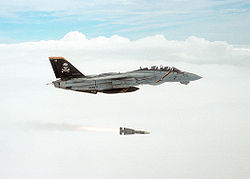
Some of the most expensive fighters such as the F-14 Tomcat
, F-22 Raptor
and F-15 Eagle
were employed as all-weather interceptors as well as air superiority fighter aircraft, while commonly developing air-to-ground roles late in their careers. An interceptor is generally an aircraft intended to target (or intercept) bombers and so often trades speed or maneuverability for climb rate.
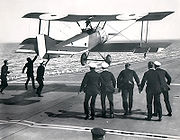 Fighters were developed in World War I to deny enemy aircraft and dirigibles
the ability to gather information by reconnaissance
. Early fighters were very small and lightly armed by later standards, and most were biplane
s built with a wooden frame, covered with fabric, and limited to about 100 mph. As control of the airspace over armies became increasingly important all of the major powers developed fighters to support their military operations. Between the wars, wood was largely replaced by steel tubing, which became aluminium tubing, and finally aluminium stressed skin structures began to predominate.
By World War II
, most fighters were all-metal monoplane
s armed with batteries of machine gun
s or cannons and some were capable of speeds approaching 400 mph. Most fighters up to this point had one engine but a number of twin engined fighters were built, however they were found to be defenseless against single engine fighters and were relegated to other tasks, some becoming night fighters, fitted with very primitive radar sets.
 By the end of the war, turbojet engines were replacing piston engines as the means of propulsion, further increasing their speed. Since the weight of the engine was so much less than on piston engined fighters, having two engines was no longer a handicap and one or two were used, depending on requirements.
This in turn required the development of ejection seats so the pilot could escape and G-suit
s to counter the much greater forces being applied to the pilot during maneuvers.
In the 1950s radar
was being fitted to day fighters since the pilot could no longer see far enough ahead to prepare for any opposition, and since then the capabilities have grown enormously and are now the primary method of target acquisition
. Wings were made thinner and swept back to reduce trans-sonic drag which requiring new manufacturing methods to obtain sufficient strength. Skins were no longer sheet metal rivetted to a structure, but milled from large slabs of alloy. The sound barrier was broken, and after a few false starts due to the changes in control required, speeds quickly reached Mach 2, but this has proven to be the limit at which the human body can tolerate even with the assistance of G-suits - any faster and the aircraft is unable to maneuver to avoid attack.
Air-to-air missile
s largely replaced guns and rockets in the early 1960s since both were believed to be unusable at the speeds being attained, however the Vietnam War
showed that guns still had a role to play and most fighters built since then are fitted with cannon (typically between 20 and 30 mm in caliber) as an adjunct to missiles. Most modern combat aircraft can carry a pair of basic air-to-air missiles and some of the larger fighters such as the Sukhoi Su-27
can carry as many as 12.
 In the 70's, turbofans replaced turbojets, improving fuel economy sufficiently that the last piston engined support aircraft could be replaced with jets, and making multi-role combat aircraft possible. Honeycomb structures began to replace milled structures and the first composite components began to be used on components subjected to little stress.
With the steady improvements in computers, defensive systems have become increasingly efficient and to counter this, stealth technologies have been pursued by the United States, Russia and China. The first step in this was to find ways to reduce the aircraft's reflectivity to radar waves by burying the engines, eliminating sharp corners and diverting any reflections away from the radar sets of opposing forces. Various materials were found to absorb the energy from Radar waves, and were incorporated into special finishes which have since found widespread application. Composite structures have become widespread, and include major structural components, reducing the steadily increasing weight - most modern fighters are larger and heavier than World War 2 medium bombers.
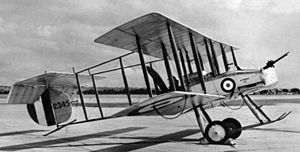 The word "fighter" was first used to describe a two-seater aircraft with sufficient lift to carry a machine gun and its operator as well as the pilot
. Some of the first such "fighters" belonged to the "gunbus" series of experimental gun carriers of the British Vickers
company which culminated in the Vickers F.B.5 Gunbus
of 1914. The main drawback of this type of aircraft was its lack of speed. It was quickly realized that an aircraft intended to destroy its kind in the air needed at least to be fast enough to catch its quarry.
Another type of military aircraft was to form the basis for an effective "fighter" in the modern sense of the word. It was based on the small fast aircraft developed before the war for such air races
as the Gordon Bennett Cup and Schneider Trophy
. The military scout
airplane was not expected to be able to carry serious armament, but rather to rely on its speed to be able to reach the location it was required to "scout" or reconnoiter and then return quickly to report - essentially an aerial horse. British scout aircraft in this sense included the Sopwith Tabloid
and Bristol Scout
; French equivalents included the Morane-Saulnier N.
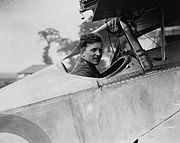 Soon after the commencement of the war, pilots armed themselves with pistols, carbines, grenades
, and an assortment of improvised weapons. Many of these proved ineffective as the pilot had to fly his airplane while attempting to aim a handheld weapon and make a difficult deflection shot. The first step in finding a real solution was to mount the weapon on the aircraft, but the propeller remained a problem since the best direction to shoot is straight ahead. Numerous solutions were tried. A second crew member behind the pilot could aim and fire a swivel-mounted machine gun at enemy airplanes however, this limited the area of coverage chiefly to the rear hemisphere, and effective coordination of the pilot's maneuvering with the gunner's aiming was difficult. This option was chiefly employed as a defensive measure on two-seater reconnaissance aircraft from 1915 on. Both the SPAD A.2 and the Royal Aircraft Factory B.E.9
added a second crewman ahead of the engine in a pod but this was both hazardous to the second crewman and limited performance. The Sopwith L.R.T.Tr.
similarly added a pod on the top wing with no better luck.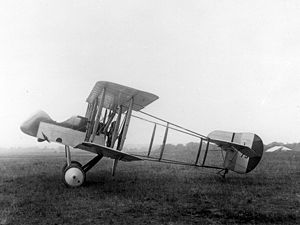 An alternative was to build a "pusher"
scout such as the Airco DH.2
, with the propeller mounted behind the pilot. The main drawback was that the high drag
of a pusher type's tail structure made it slower than a similar "tractor"
aircraft.
A better solution for a single seat scout was to mount the machine gun (rifles and pistols having been dispensed with) to fire forwards but outside the propeller arc. Wing guns were tried but the unreliable weapons available required frequent clearing of jammed rounds and misfires
and remained impractical until after the war. Mounting the machine gun over the top wing worked well and was used long after the ideal solution was found. The Nieuport 11
of 1916 and Royal Aircraft Factory S.E.5
of 1918 both used this system with considerable success, however this placement made aiming difficult and the location made it difficult for a pilot to both maneuver and have access to the gun's breech. The British Foster mounting
was specifically designed for this kind of application, fitted with the Lewis Machine gun, which due to its design was unsuitable for synchronizing.
The need to arm a tractor scout with a forward-firing gun whose bullets passed through the propeller arc was evident even before the outbreak of war and inventors in both France and Germany devised mechanisms
that could time the firing of the individual rounds to avoid hitting the propeller blades. Franz Schneider
, a Swiss engineer, had patented such a device in Germany in 1913, but his original work was not followed up. French aircraft designer Raymond Saulnier patented a practical device in April 1914, but trials were unsuccessful because of the propensity of the machine gun employed to hang fire
due to unreliable ammunition.
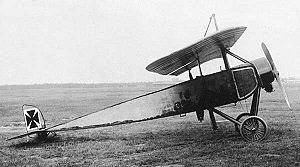
 In December 1914, French aviator Roland Garros asked Saulnier to install his synchronization gear on Garros' Morane-Saulnier Type L
. Unfortunately the gas-operated Hotchkiss
machine gun he was provided had an erratic rate of fire and it was impossible to synchronize it with a spinning propeller. As an interim measure, the propeller blades were armored and fitted with metal wedges to protect the pilot from ricochet
s. Garros' modified monoplane was first flown in March 1915 and he began combat operations soon thereafter. Garros scored three victories in three weeks before he himself was downed on 18 April and his airplane, along with its synchronization gear and propeller was captured by the Germans.
Meanwhile, the synchronization gear (called the Stangensteuerung in German, for "pushrod control system") devised by the engineers of Anthony Fokker
's firm was the first system to see production contracts, and would make the Fokker Eindecker
monoplane a feared name over the Western Front
, despite its being an adaptation of an obsolete pre-war French Morane-Saulnier
racing airplane, with a mediocre performance and poor flight characteristics. The first victory for the Eindecker came on 1 July 1915, when Leutnant Kurt Wintgens
, flying with the Feldflieger Abteilung
6 unit on the Western Front, forced down a Morane-Saulnier Type L two-seat "parasol" monoplane just east of Luneville
. Wintgens' aircraft, one of the five Fokker M.5K/MG
production prototype examples of the Eindecker, was armed with a synchronized, air-cooled aviation version of the Parabellum MG14
machine gun.
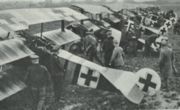
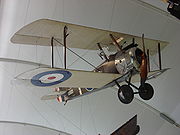 The success of the Eindecker kicked off a competitive cycle of improvement among the combatants, building ever more capable single-seat fighters. The Albatros D.I
and Sopwith Pup
of 1916 set the classic pattern followed by fighters for about twenty years. Most were biplanes
and only rarely monoplanes or triplanes
. The strong box structure of the biplane wing provided a rigid wing that allowed the accurate lateral control essential for dogfighting. They had a single operator, who flew the aircraft and also controlled its armament. They were armed with one or two Maxim
or Vickers
machine guns which were easier to synchronize than other types, firing through the propeller arc. Gun breeches were directly in front of the pilot with obvious implications in case of accidents, but jams could be cleared in flight, while aiming was simplified.
The use of metal aircraft structures was pioneered before World War I by Breguet but would find its biggest proponent with Anthony Fokker who used chrome-molybdenum steel tubing for the fuselage structure of all his fighter designs, while the innovative German engineer Hugo Junkers
developed two all-metal, single-seat fighter monoplane designs with cantilever
wings: the strictly experimental Junkers J 2
private-venture aircraft, made with steel, and some forty examples of the Junkers D.I
, made with corrugated duralumin
, all based on his experience in creating the pioneering Junkers J 1
all-metal airframe technology demonstration aircraft of late 1915. While Fokker would pursue steel tube fuselages with wooden wings until the late 1930s, and Junkers would focus on corrugated sheet metal, Dornier was the first to build a fighter (The Dornier D.I) made with pre-stressed sheet aluminium and having cantelevered wings, a form that would replace all others in the 1930s.
As collective combat experience grew, the more successful pilots such as Oswald Boelcke
, Max Immelmann
, and Edward Mannock
developed innovative tactical formations and maneuvers to enhance their air units' combat effectiveness.
Allied and – before 1918 – German pilots of World War I were not equipped with parachute
s, so in-flight fires or structural failure were often fatal. Parachutes were well-developed by 1918 having previously been used by balloonists, and were adopted by the German flying services during the course of that year (the famous "Red Baron"
was wearing one when he was killed), but the allied command continued to oppose their use on various grounds.
In April 1917 during a brief period of German aerial supremacy, the average life expectancy of a British pilot on the Western Front was claimed by a grandstanding Member of Parliament
(upset at the lack of orders his own aircraft manufacturing firm was receiving) to be 93 flying hours, or about three weeks of active service. More than 50,000 airmen from both sides died during the war.
 Given limited defense budgets, air forces tended to be conservative in their aircraft purchases, and biplanes remained popular with pilots because of their agility, and remained in service long after they had ceased to be competitive. Designs such as the Gloster Gladiator
, Fiat CR.42
, and Polikarpov I-15
were common even in the late 1930s, and many were still in service as late as 1942. Up until the mid-1930s, the majority of fighters in the US, the UK, Italy and Russia remained fabric-covered biplanes.
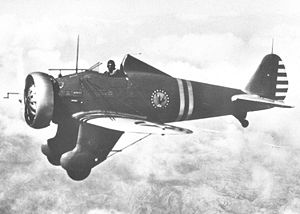 Fighter armament eventually began to be mounted inside the wings, outside the arc of the propeller, though most designs retained two synchronized machine-guns directly ahead of the pilot where they were more accurate (that being the strongest part of the structure). Rifle-caliber .30 and .303 (7.62 mm) caliber guns remained the norm with larger weapons either being too heavy and cumbersome or deemed unnecessary against such lightly built aircraft. It was not considered unreasonable to use World War I-style armament to counter enemy fighter as there was insufficient air to air combat during most of the period to disprove this notion.
The rotary engine
, popular during World War I, quickly disappeared, having reached its peak as rotational forces prevented more fuel and air from being delivered to the cylinders, which limited horsepower. They were replaced chiefly by the stationary radial engine
though major advances continued to be made with inline engines which gained ground with several exceptional engines, including the 1145 cu in (18.8 l) V-12 Curtiss D-12
.
Aircraft engine
s increased in power several-fold over the period, going from a typical 180 hp in the 1918 Fokker D.VII
to 900 hp in the 1938 Curtiss P-36. The debate between the sleek in-line engines
versus the more reliable radial models continued, with naval air forces preferring the radial engines, and land-based forces often choosing in-line units. Radial designs did not require a separate (and vulnerable) cooling system, but had increased drag. In-line engines often had a better power-to-weight ratio
, but there were radial engines that kept working even after having suffered significant battle damage.
Some air forces experimented with "heavy fighter
s" (called "destroyers" by the Germans). These were larger, usually twin-engined aircraft, sometimes adaptations of light
or medium bomber
types. Such designs typically had greater internal fuel capacity (thus longer range) and heavier armament than their single-engine counterparts. In combat, they proved vulnerable to more agile single-engine fighters.
The primary driver of fighter innovation, right up to the period of rapid rearmament in the late thirties, was not military budget, but civilian aircraft races. Aircraft designed for these races introduced innovations like streamlining and more powerful engines that would find their way into the fighters of World War II. The most significant of these was the Schneider Cup races, where competition grew so fierce, only national governments could afford to enter.
At the very end of the inter-war period in Europe came the Spanish Civil War
. This was just the opportunity the German Luftwaffe
, Italian Regia Aeronautica
, and the Soviet Union's Red Air Force needed to test their latest aircraft. Each party sent numerous aircraft types to support their sides in the conflict. In the dogfight
s over Spain, the latest Messerschmitt fighters (Bf 109
) did well, as did the Soviet Polikarpov I-16
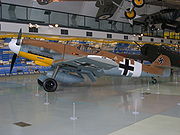
. The German design had considerably more room for development however and the lessons learned led to greatly improved models in World War II. The Russians, whose side lost, failed to keep pace and I-16s were outfought by the improved Bf 109s in World War II, and despite newer models coming into service remained the most common Soviet front-line fighter into 1942.
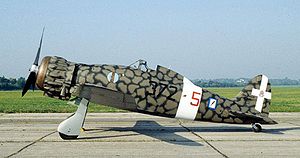
For their part, the Italians developed several monoplanes such as the Fiat G.50
, but being short on funds, were forced to continue operating obsolete Fiat CR.42
biplanes.
From the early 1930s the Japanese had been at war in China against the Nationalist Chinese as well as the Russians, and used the experience to improve both training and aircraft, replacing biplanes with modern cantilever monoplanes and creating a cadre of exceptional pilots for use in the Pacific War.
In the United Kingdom, at the behest of Neville Chamberlain
, (more famous for his 'peace in our time' speech) the entire British aviation industry was retooled, allowing it to change quickly from fabric covered metal framed biplanes to cantilever stressed skin monoplanes in time for the war with Germany. Without his work in the early '30s, Churchill would not have had the tools to take on the Germans.
The period of improving the same biplane design over and over was now coming to an end, and the Hawker Hurricane
and Supermarine Spitfire
finally started to supplant the Gloster Gladiator
and Hawker Fury
biplanes but many of the former remained in front-line service well past the start of World War II. While not a combatant themselves in Spain, they absorbed many of the lessons learned in time to use them.
The Spanish Civil War also provided an opportunity for updating fighter tactics. One of the innovations to result from the aerial warfare experience this conflict provided was the development of the "finger-four
" formation by the German pilot Werner Mölders
. Each fighter squadron
(German: Staffel) was divided into several flights (Schwärme) of four aircraft. Each Schwarm was divided into two Rotten which was a pair of aircraft. Each Rotte was composed of a leader and a wingman. This flexible formation allowed the pilots to maintain greater situational awareness, and the two Rotten could split up at any time and attack on their own. The finger-four would become widely adopted as the fundamental tactical formation over the course of World War
 Aerial combat formed an important part of World War II military doctrine. The ability of aircraft to locate, harass, and interdict ground forces was an instrumental part of the German combined-arms doctrine, and their inability to achieve air superiority over Britain made a German invasion unfeasible. German Field Marshal Erwin Rommel
noted the effect of airpower: "Anyone who has to fight, even with the most modern weapons, against an enemy in complete command of the air, fights like a savage against modern European troops, under the same handicaps and with the same chances of success."
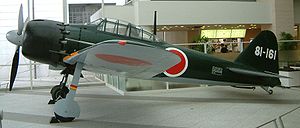
During the 1930s, two different streams of thought about air-to-air combat began to emerge, resulting in two different approaches to monoplane fighter development. In Japan and Italy especially, there continued to be a strong belief that lightly armed, highly maneuverable single-seat fighters would still play a primary role in air-to-air combat. Aircraft such as the Nakajima Ki-27
, Nakajima Ki-43
and the Mitsubishi A6M Zero in Japan, and the Fiat G.50
and Macchi MC.200 in Italy epitomized a generation of monoplanes designed to this concept.
 The other stream of thought, which emerged primarily in Britain, Germany, the Soviet Union, and the United States was the belief that the high speeds of modern combat aircraft and the g-forces
imposed by aerial combat meant that dogfighting in the classic World War I sense would be impossible. Fighters such as the Messerschmitt Bf 109
, the Supermarine Spitfire
, the Yakovlev Yak-1
and the Curtiss P-40 Warhawk were all designed for high level speeds and a good rate of climb. Good maneuverability was desirable, but it was not the primary objective.
The 1939 Soviet-Japanese Battle of Khalkhyn Gol (11 May – 31 August 1939), and the subsequent initial German invasion of Poland
the following day, were too brief to provide much feedback to the participants for further evolution of their respective fighter doctrines. During the Winter War
, the greatly outnumbered Finnish Air Force
, which had adopted the German finger-four formation, bloodied the noses of Russia's Red Air Force, which relied on the less effective tactic of a three-aircraft delta formation.
, the strategic surprise of Operation Barbarossa
demonstrated that Soviet air defense preparations were woefully inadequate, and the Great Purge
rendered any lessons learned by the Red Air Force command from previous experience in Spain and Finland virtually useless. During the first few months of the invasion, Axis
air forces were able to destroy large numbers of Red Air Force aircraft on the ground and in one-sided dogfights. However, by the winter of 1941–1942, the Red Air Force was able to put together a cohesive air defense of Moscow, successfully interdict attacks on Leningrad, and begin production of new aircraft types in the relocated semi-built factories in the Urals
, Siberia, Central Asia and the Caucasus
. These facilities produced more advanced monoplane fighters, such as the Yak-1, Yak-3, LaGG-3, and MiG-3, to wrest air superiority from the Luftwaffe. However, Soviet aircrew training was hasty in comparison to that provided to the Luftwaffe, so Soviet pilot losses continued to be disproportionate until a growing number of survivors were matched to more effective machines.
Beginning in 1942, significant numbers of British, and later U.S., fighter aircraft were also supplied to aid the Soviet war effort, with the Bell P-39 Airacobra proving particularly effective in the lower-altitude combat typical of the Eastern Front. Also from that time, the Eastern Front became the largest arena of fighter aircraft use in the world; fighters were used in all of the roles typical of the period, including close air support
, interdiction
, escort
and interception
roles. Some aircraft were armed with weapons as large as 45 mm cannon (particularly for attacking enemy armored vehicles), and the Germans began installing additional smaller cannons in under-wing pods
to assist with ground-attack missions.
 The war in the Pacific
opened with the Japanese not only surprised their opponents on the ground at Pearl Harbour, the Phillipines and Dutch East India (now Indonesia)
, but also give them a shock as to how advanced their fighters were. The US military for one had assumed they were still using biplane fighters.
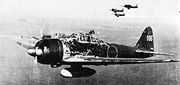
At the start of the war, the Imperial Japanese Navy Air Service
primarily operated the Mitsubishi A6M Zero, while the Imperial Japanese Army Air Service
was phasing out the Nakajima Ki-27
in favour of the Nakajima Ki-43
. Both the A6M and Ki-43 were second to none at the time, and featured double the range of any opponents, and were highly maneuverable as well. Both had been designed before the lessons learned in the European theatre regarding armour plating and self sealing fuel tanks became known, and as a result lacked them until very late in the war, and proved vulnerable to damage, while the light weight that made the long range and maneuverability possible meant they could be out dived by Allied fighters. Early in the war they wreaked havoc against the Brewster Buffalo
, Hawker Hurricane
and Grumman F4F Wildcat to which they were superior in all but diving speed. Allied pilot inexperience made the situation even worse.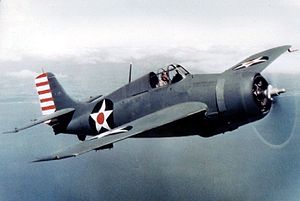 When the Allies captured intact or nearly intact enemy aircraft, they were evaluated by the Allied Technical Air Intelligence Unit
(and other similar organizations), where it was discovered that while no Allied aircraft could match the Japanese fighters in a dogfight, they had the advantage in a dive and tactics were changed as a result. In addition the Thach weave
was developed to improve the chances for the U.S. Navy's
Grumman F4Fs and new types were ordered to replace those found inadequate. The Grumman F6F Hellcat was the first of the new fighters though development had begun before the war started, followed by the distinctive Vought F4U Corsair, whose entry into service had been delayed by teething problems.
 While the Allies were still in full retreat from the Japanese juggernaught, the Flying Tigers
was formed to assist the Chinese, who had already been fighting the Japanese for several years. The Flying Tigers provided the allies with some of their first successes against Army Ki-43s and Ki-27s, though their claims were wildly exaggerated. Aside from supplying the Chinese, the US also provided equipment to Australia.
Japanese pilots had been honing their skills against the Russians and Chinese in Manchuria (the Second Sino-Japanese War
) and Mongolia (the Soviet–Japanese wars) and so started the war with a cadre of experienced fighter pilots, however the inevitable attrition could not be met as the Japanese pilot training system lacked the ability to train sufficient replacements, and as the problem became critical, was then unable to provide trainees with enough flight time due to fuel shortages. By 1945 pilots were being sent to operational units with as few as 20 hours of flying experience while their American and Australian opponents were now able to provide over 100 hours of training, and could rely on a steadily increasing number of veteran pilots. In such a context Kamikaze tactics make some sense, since most of the pilots available were likely to get shot down anyway, and so by deliberately sacrificing themselves, at least accomplished something.
Lacking trained pilots was far from the only problem faced by the Japanese. By 1944, the United States Army Air Forces
(USAAF) was bombing the Japanese homeland with Boeing B-29 Superfortress bombers, which initially proved beyond the capabilities of the Japanese fighters, however despite production being reduced heavily (not by bombing, but because the Japanese relocated their defence industries to make it safe from bombing), new Japanese fighters and interceptors appeared, some of which were again superior to Allied types such as the Nakajima Ki-84
and the Kawanishi N1K, however poor fuel, lack of trained pilots and limited numbers blunted their effect. The Japanese pioneered the use of small anti-aircraft bombs against the B-29's during this period.
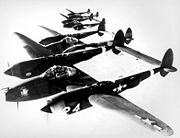
With the war in Europe over, the United States, along with the United Kingdom, were finally able to devote all of their resources to defeating the Japanese. While previously the USAAF had allocated aircraft that were no longer suitable for use against the Germans to the Pacific, such as the Curtiss P-40 Warhawk and Lockheed P-38 Lightning, it now was able to use the North American P-51 Mustang, whose capabilities highlighted just how obsolete the A6M Zero had become.
The war ended before any fighters developed after the start of the Pacific war could enter service - the Grumman F8F Bearcat was within weeks of being operational when the war ended.
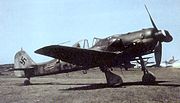
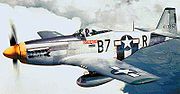 Piston-engine
power increased considerably during the war. The Curtiss P-36 Hawk
had a 900 hp (670 kW) radial engine
but was soon redesigned as the P-40 Warhawk with a 1100 hp (820 kW) in-line engine. By 1943, the latest P-40N had a 1300 hp (970 kW) Allison
engine. At war's end, the German Focke-Wulf Ta 152
interceptor could achieve 2050 hp (1530 kW) with an MW-50 (methanol
-water injection) supercharger
and the American P-51H Mustang fitted with the Packard V-1650-9
could achieve 2218 hp (1650 kW) under war emergency power
. The Spitfire Mk I
of 1939 was powered by a 1030 hp (770 kW) Merlin II
; its 1945 successor, the Spitfire F.Mk 21, was equipped with the 2035 hp (1520 kW) Griffon 61
. Likewise, the radial engines favored for many fighters also grew from 1100 hp to as much as 2090 hp
(1560 kW) during the same timeframe.
 The first turbojet-powered fighter designs became operational in 1944, and clearly outperformed their piston-engined counterparts. New designs such as the Messerschmitt Me 262
and Gloster Meteor
demonstrated the effectiveness of the new propulsion system. Many of these fighters could do over 660 km/h (410 mph) in level flight, and were fast enough in a dive that they started encountering the transonic
buffeting experienced near the speed of sound
; such turbulence occasionally resulted in a jet breaking up in flight due to the heavy load placed on an aircraft near the so-called "sound barrier
". Dive brake
s were added to jet fighters late in World War II to minimize these problems and restore control to fighter pilot
s. Rocket-powered interceptors – most notable the Messerschmitt Me 163
– appeared at around the same time as jet fighters, but proved less effective.
More powerful armament became a priority early in the war, once it became apparent that newer stressed-skin monoplane fighters could not be easily shot down with rifle-caliber machine guns. The Germans' experiences in the Spanish Civil War led them to put 20 mm cannons on their fighters. The British soon followed suit, putting cannons in the wings of their Hurricanes and Spitfires which had previously featured up to twelve machine guns. The Americans, having problems with designing a native cannon design, instead chose to place multiple .50 caliber (12.7 mm) machine guns on their fighters. Armaments continued to increase over the course of the war, with the German Me 262 jet having four 30 mm cannons
, capable of downing a heavy bomber with just a few hits. Cannons fired explosive shells, and could blast a hole in an enemy aircraft rather than relying on kinetic energy
from a solid bullet striking a critical subsystem (fuel line, hydraulics, control cable, pilot, etc.). A debate existed over the merits of high rate-of-fire machine guns versus slower-firing, but more devastating, cannon.
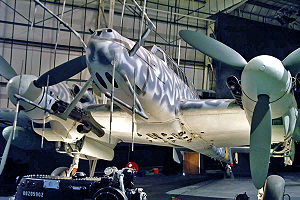
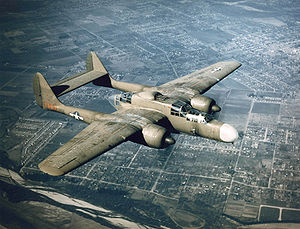 With the increasing need for close air support
on the battlefield, fighters were increasingly fitted with bomb racks and used as fighter-bomber
s. Some designs, such as the German Fw 190, proved extremely capable in this role – though the designer Kurt Tank
had designed it as a pure interceptor. While carrying air-to-surface ordnance
such as bombs or rockets beneath the aircraft's wing, its maneuverability is decreased because of lessened lift
and increased drag
, but once the ordnance is delivered (or jettisoned), the aircraft is again a fully capable fighter aircraft. By their flexible nature, fighter-bombers offer the command staff the freedom to assign a particular air group to air superiority or ground-attack missions, as need requires.
Rapid technology advances in radar
, which had been invented shortly before World War II, would permit their installation in some fighters, such as the Boulton Paul Defiant
, Bristol Beaufighter
, de Havilland Mosquito
and later to the Messerschmitt Bf 110, Fairey Fulmar
, Grumman F6F Hellcat and the purpose built Northrop P-61 Black Widow, enabling them to locate targets at night. The British used the first radar-equipped night fighters during the Battle of Britain
(the Bristol Blenheim
) in 1940 and continued to improve it thereafter. The Germans then developed several night-fighter types when they came under night bombardment by RAF Bomber Command
. Since the radar of the era was fairly primitive and difficult to use, larger aircraft with dedicated radar operators were usually needed for this role though by 1944 smaller sets suitable for single seat fighters had been introduced. As a part of the Lend Lease agreement between the United States and Great Britain, the British provided all their radar research to the US, who developed the final generations of radar used during the war. German developments generally followed slightly behind both British and American advances but were notable in developing radar warning and detection equipment. The Japanese, in contrast ignored radar until very end of the war and only ever produced very primitive sets, despite their early involvement in radar - the widely used Yagi (goalpost) antenna was named for its Japanese inventor.
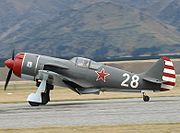 Several prototype fighter programs begun early in 1945 continued on after the war and led to advanced piston-engine fighters that entered production and operational service in 1946. A typical example is the Lavochkin La-9
'Fritz', which was an evolution of the successful wartime Lavochkin La-7
'Fin'. Working through a series of prototypes, the La-120, La-126 and La-130, the Lavochkin design bureau
sought to replace the La-7's wooden airframe with a metal one, as well as fit a laminar-flow
wing to improve maneuver performance, and increased armament. The La-9 entered service in August 1946 and was produced until 1948; it also served as the basis for the development of a long-range escort fighter, the La-11
'Fang', of which nearly 1200 were produced 1947–1951. Over the course of the Korean War, however, it became obvious that the day of the piston-engined fighter was coming to a close and that the future would lie with the jet fighter.
This period also witnessed experimentation with jet-assisted piston engine aircraft. La-9 derivatives included examples fitted with two underwing auxiliary pulsejet engines
(the La-9RD) and a similarly mounted pair of auxiliary ramjet engines
(the La-138); however, neither of these entered service. One which did enter service – with the U.S. Navy in March 1945 – was the Ryan FR-1 Fireball
; production was halted with the war's end on VJ-Day
, with only 66 having been delivered, and the type was withdrawn from service in 1947. The USAAF had ordered its first 13 mixed turboprop-turbojet-powered pre-production prototypes of the Consolidated Vultee XP-81 fighter, but this program was also canceled by VJ Day, with 80% of the engineering work completed.
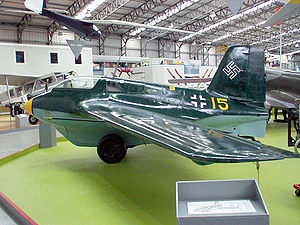 The first rocket-powered aircraft
was the Lippisch Ente, which made a successful maiden flight in March 1928. The only pure rocket aircraft ever to be mass-produced
was the Messerschmitt Me 163
in 1944, one of several German World War II projects aimed at developing rocket-powered aircraft. Later variants of the Me 262 (C-1a and C-2b) were also fitted with rocket powerplants, while earlier models were fitted with rocket boosters, but were not mass-produced with these modifications.
The USSR experimented with a rocket-powered interceptor in the years immediately following World War II, the Mikoyan-Gurevich I-270
. Only two were built.
In the 1950s, the British developed mixed-power jet designs employing both rocket and jet engines to cover the performance gap that existed in turbojet designs. The rocket was the main engine for delivering the speed and height required for high-speed interception of high-level bombers and the turbojet gave increased fuel economy in other parts of flight, most notably to ensure the aircraft was able to make a powered landing rather than risking an unpredictable gliding
return. The Saunders-Roe SR.53
was a successful design and was planned to be developed into production when economics forced curtailment of most British aircraft programs in the late 1950s. Furthermore, rapid advancements in jet engine technology had rendered mixed-power aircraft designs like Saunders-Roe's SR.53 (and its SR.177 maritime variant) obsolete. The American XF-91 Thunderceptor
(which was the first U.S. fighter to exceed Mach 1
in level flight) met a similar fate for the same reason, and no hybrid rocket-and-jet-engine fighter design has ever been placed into service. The only operational implementation of mixed propulsion was Rocket-Assisted Take Off
(RATO), a system rarely used in fighters.
The timeframes associated with each generation are inexact and are only indicative of the period during which their design philosophies and technology employment enjoyed a prevailing influence on fighter design and development. These timeframes also encompass the peak period of service entry for such aircraft.
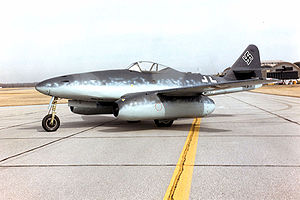 The first generation of jet fighters comprises the initial, subsonic jet fighter designs introduced late in World War II and in the early post-war period. They differed little from their piston-engined counterparts in appearance, and many employed unswept wings
. Guns remained the principal armament. The impetus for the development of turbojet-powered aircraft was to obtain a decisive advantage in maximum speed. Top speeds for fighters rose steadily throughout World War II as more powerful piston engines were developed, and had begun approaching the transonic flight regime where the efficiency of piston-driven propellers drops off considerably.
 The first jets were developed during World War II and saw combat in the last two years of the war. Messerschmitt
developed the first operational jet fighter, the Me 262
. It was considerably faster than contemporary piston-driven aircraft, and in the hands of a competent pilot, was quite difficult for Allied pilots to defeat. The design was never deployed in numbers sufficient to stop the Allied air campaign, and a combination of fuel shortages, pilot losses, and technical difficulties with the engines kept the number of sorties low. Nevertheless, the Me 262 indicated the obsolescence of piston-driven aircraft. Spurred by reports of the German jets, Britain's Gloster Meteor
entered production soon after and the two entered service around the same time in 1944. Meteors were commonly used to intercept the V-1 "buzz bomb"
, as they were faster than available piston-engined fighters. By the end of the war almost all work on piston-powered fighters had ended. A few designs combining piston and jet engines for propulsion – such as the Ryan FR Fireball – saw brief use, but by the end of the 1940s virtually all new combat aircraft were jet-powered.
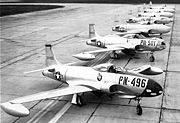 Despite their advantages, the early jet fighters were far from perfect, particularly in the opening years of the generation. Their operational lifespans, especially for their gas turbine powerplants, could be measured primarily in hours; the engines themselves were fragile and bulky, and power could be adjusted only slowly. Many squadrons of piston-engined fighters were retained until the early-to-mid 1950s, even in the air forces of the major powers (though the types retained were the best of the World War II designs). Innovations including ejector seat
s and all-moving tailplanes
were introduced in this period.
The Americans also begin using jet fighters post-war. The Lockheed P-80 Shooting Star
(soon re-designated F-80) was less elegant than the swept-wing Me 262, but had a cruise speed (660 km/h [410 mph]) as high as the combat maximum of many piston-engined fighters. The British designed several new jets, including the iconic de Havilland Vampire
which was sold to the air forces of many nations.
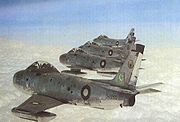 The British transferred the technology of the Rolls-Royce Nene
jet engine to the Soviets, who soon put it to use in their advanced Mikoyan-Gurevich MiG-15
fighters which were the first to introduce swept wing
s in combat, an innovation first proposed by German research which allowed flying much closer to the speed of sound than straight-winged designs such as the F-80. Their top speed of 1075 km/h (668 mph) proved quite a shock to the American F-80 pilots who encountered them over Korea
, along with their armament of two 23 mm cannons and a single 37 mm cannon compared to machine guns. Nevertheless, in the first jet-versus-jet dogfight in history, which occurred during the Korean War on 8 November 1950, an F-80 (as the P-80 had been redesignated) intercepted two North Korean MiG-15s near the Yalu River
and shot them down.
The Americans responded by rushing their own swept-wing F-86
squadrons to battle against the MiGs which had similar trans-sonic performance. The two aircraft had different strengths, but were similar enough that the superior technology such as a radar ranging gunsight and skills of the veteran United States Air Force
pilots allowed them to prevail.
The world's navies also transitioned to jets during this period, despite the need for catapult-launching
of the new aircraft. Grumman's F9F Panther
was adopted by the U.S. Navy as their primary jet fighter in the Korean War period, and it was one of the first jet fighters to employ an afterburner
. The de Havilland Sea Vampire
was the Royal Navy's first jet fighter. Radar was used on specialized night fighters such as the F3D Skyknight
which also downed MiGs over Korea, and later fitted to the F2H Banshee
and swept wing F7U Cutlass
and F3H Demon
as all-weather / night fighters. Early versions of Infra-red (IR) air-to-air missile
s (AAMs) such as the AIM-9 Sidewinder
and radar guided missiles such as the AIM-7 Sparrow
which would be developed into the 21st century were first introduced on swept wing subsonic Demon and Cutlass naval fighters.
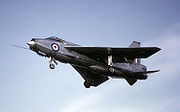 The development of second-generation fighters was shaped by technological breakthroughs, lessons learned from the aerial battles of the Korean War
, and a focus on conducting operations in a nuclear warfare
environment. Technological advances in aerodynamics
, propulsion
and aerospace building materials (primarily aluminium alloy
s) permitted designers to experiment with aeronautical
innovations, such as swept wing
s, delta wing
s, and area-ruled
fuselages. Widespread use of afterburning turbojet engines made these the first production aircraft to break the sound barrier, and the ability to sustain supersonic speeds in level flight became a common capability amongst fighters of this generation.
 Fighter designs also took advantage of new electronics technologies that made effective radars small enough to be carried aboard smaller aircraft. Onboard radars permitted detection of enemy aircraft beyond visual range, thereby improving the handoff of targets by longer-ranged ground-based warning and tracking radars. Similarly, advances in guided missile development allowed air-to-air missiles to begin supplementing the gun as the primary offensive weapon for the first time in fighter history. During this period, passive-homing infrared-guided (IR) missiles became commonplace, but early IR missile sensors had poor sensitivity and a very narrow field of view
(typically no more than 30°), which limited their effective use to only close-range, tail-chase engagement
s. Radar-guided (RF) missiles were introduced as well, but early examples proved unreliable. These semi-active radar homing
(SARH) missiles could track and intercept an enemy aircraft "painted" by the launching aircraft's onboard radar. Medium- and long-range RF air-to-air missiles promised to open up a new dimension of "beyond-visual-range
" (BVR) combat, and much effort was placed in further development of this technology.
 The prospect of a potential third world war featuring large mechanized armies and nuclear weapon strikes led to a degree of specialization along two design approaches: interceptors
, such as the English Electric Lightning
and Mikoyan-Gurevich MiG-21
F; and fighter-bomber
s, such as the Republic F-105 Thunderchief and the Sukhoi Su-7B. Dogfight
ing, per se, was de-emphasized in both cases. The interceptor was an outgrowth of the vision that guided missiles would completely replace guns and combat would take place at beyond visual ranges. As a result, interceptors were designed with a large missile payload and a powerful radar, sacrificing agility in favor of high speed, altitude ceiling and rate of climb
. With a primary air defense role, emphasis was placed on the ability to intercept strategic bombers flying at high altitudes. Specialized point-defense interceptors often had limited range and little, if any, ground-attack capabilities. Fighter-bombers could swing, between air superiority and ground-attack roles, and were often designed for a high-speed, low-altitude dash to deliver their ordnance. Television- and IR-guided air-to-surface missiles were introduced to augment traditional gravity bomb
s, and some were also equipped to deliver a nuclear bomb
.
began to be introduced, replacing older "steam-gauge" cockpit instrumentation. Enhancements to improve the aerodynamic performance of third-generation fighters included flight control surfaces such as canards
, powered slats
, and blown flap
s. A number of technologies would be tried for Vertical/Short Takeoff and Landing, but thrust vectoring
would be successful on the Harrier jump jet
.
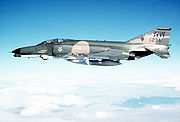 Growth in air combat capability focused on the introduction of improved air-to-air missiles, radar systems, and other avionics. While guns remained standard equipment (early models of F-4 being a notable exception), air-to-air missiles became the primary weapons for air superiority fighters, which employed more sophisticated radars and medium-range RF AAMs to achieve greater "stand-off" ranges, however, kill probabilities proved unexpectedly low for RF missiles due to poor reliability and improved electronic countermeasures
(ECM) for spoofing radar seekers. Infrared-homing AAMs saw their fields of view expand to 45°, which strengthened their tactical usability. Nevertheless, the low dogfight loss-exchange ratios
experienced by American fighters in the skies over Vietnam led the U.S. Navy to establish its famous "TOPGUN
" fighter weapons school, which provided a graduate-level curriculum to train fleet fighter pilots in advanced Air Combat Maneuvering (ACM) and Dissimilar Air Combat Training
(DACT) tactics and techniques.
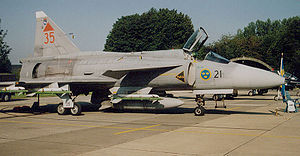 This era also saw an expansion in ground-attack capabilities, principally in guided missiles, and witnessed the introduction of the first truly effective avionics for enhanced ground attack, including terrain-avoidance systems
. Air-to-surface missile
s (ASM) equipped with electro-optical (E-O) contrast seekers – such as the initial model of the widely used AGM-65 Maverick
– became standard weapons, and laser-guided bomb
s (LGBs) became widespread in effort to improve precision-attack capabilities. Guidance for such precision-guided munition
s (PGM) was provided by externally mounted targeting pods
, which were introduced in the mid-1960s.
It also led to the development of new automatic-fire weapons, primarily chain-guns
that use an electric engine to drive the mechanism of a cannon; this allowed a single multi-barrel weapon (such as the 20 mm Vulcan
) to be carried and provided greater rates of fire and accuracy. Powerplant reliability increased and jet engines became "smokeless" to make it harder to visually sight aircraft at long distances.
Dedicated ground-attack aircraft (like the Grumman A-6 Intruder
, SEPECAT Jaguar
and LTV A-7 Corsair II
) offered longer range, more sophisticated night attack systems or lower cost than supersonic fighters. With variable-geometry wings, the supersonic F-111
introduced the Pratt & Whitney TF30, the first turbofan equipped with afterburner. The ambitious project sought to create a versatile common fighter for many roles and services. It would serve well as an all-weather bomber, but lacked the performance to defeat other fighters. The McDonnell F-4 Phantom was designed around radar and missiles as an all-weather interceptor
, but emerged as a versatile strike bomber nimble enough to prevail in air combat, adopted by the U.S. Navy, Air Force and Marine Corps
. Despite numerous shortcomings that would be not be fully addressed until newer fighters, the Phantom claimed 280 aerial kills, more than any other U.S. fighter over Vietnam. With range and payload capabilities that rivaled that of World War II bombers such as B-24 Liberator
, the Phantom would became a highly successful multirole aircraft.
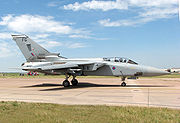 Fourth-generation fighters continued the trend towards multirole configurations, and were equipped with increasingly sophisticated avionics and weapon systems. Fighter designs were significantly influenced by the Energy-Maneuverability (E-M) theory
developed by Colonel John Boyd
and mathematician Thomas Christie, based upon Boyd's combat experience in the Korean War and as a fighter tactics instructor during the 1960s. E-M theory emphasized the value of aircraft specific energy
maintenance as an advantage in fighter combat. Boyd perceived maneuverability as the primary means of getting "inside" an adversary's decision-making cycle, a process Boyd called the "OODA loop
" (for "Observation-Orientation-Decision-Action"). This approach emphasized aircraft designs that were capable of performing "fast transients" – quick changes in speed, altitude, and direction – as opposed to relying chiefly on high speed alone.
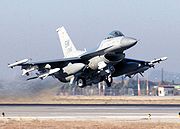 E-M characteristics were first applied to the F-15 Eagle, but Boyd and his supporters believed these performance parameters called for a small, lightweight aircraft with a larger, higher-lift
wing. The small size would minimize drag
and increase the thrust-to-weight ratio
, while the larger wing would minimize wing loading
; while the reduced wing loading tends to lower top speed and can cut range, it increases payload capacity and the range reduction can be compensated for by increased fuel in the larger wing. The efforts of Boyd's "Fighter Mafia
" would result in General Dynamics
' (now Lockheed Martin
's) F-16 Fighting Falcon
.
The F-16's maneuverability was further enhanced by its being designed to be slightly aerodynamically unstable. This technique, called "relaxed static stability" (RSS), was made possible by introduction of the "fly-by-wire" (FBW) flight control system
(FLCS), which in turn was enabled by advances in computers and system integration techniques. Analog avionics, required to enable FBW operations, became a fundamental requirement and began to be replaced by digital flight control systems in the latter half of the 1980s. Likewise, Full Authority Digital Engine Controls
(FADEC) to electronically manage powerplant performance was introduced with the Pratt & Whitney F100
turbofan. The F-16's sole reliance on electronics and wires to relay flight commands, instead of the usual cables and mechanical linkage controls, earned it the sobriquet of "the electric jet". Electronic FLCS and FADEC quickly became essential components of all subsequent fighter designs.
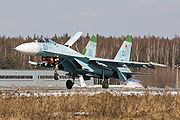 Other innovative technologies introduced in fourth-generation fighters include pulse-Doppler
fire-control radar
s (providing a "look-down/shoot-down
" capability), head-up display
s (HUD), "hands on throttle-and-stick
" (HOTAS) controls, and multi-function display
s (MFD), all of which have become essential equipment. Composite material
s in the form of bonded aluminum honeycomb structural elements and graphite epoxy laminate
skins began to be incorporated into flight control surfaces and airframe skins to reduce weight. Infrared search-and-track
(IRST) sensors became widespread for air-to-ground weapons delivery, and appeared for air-to-air combat as well. "All-aspect" IR AAM became standard air superiority weapons, which permitted engagement of enemy aircraft from any angle (although the field of view remained relatively limited). The first long-range active-radar-homing
RF AAM entered service with the AIM-54 Phoenix
, which solely equipped the Grumman F-14 Tomcat
, one of the few variable-sweep-wing fighter designs to enter production. Even with the tremendous advancement of Air to Air missiles in this era, internal guns were standard equipment.
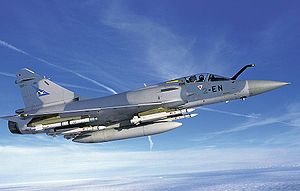 Another revolution came in the form of a stronger reliance on ease of maintenance, which led to standardisation of parts, reductions in the numbers of access panels and lubrication points, and overall parts reduction in more complicated equipment like the engines. Some early jet fighters required 50 man-hours of work by a ground crew for every hour the aircraft was in the air; later models substantially reduced this to allow faster turn-around times and more sorties in a day. Some modern military aircraft only require 10 man-hours of work per hour of flight time, and others are even more efficient.
Aerodynamic innovations included variable-camber
wings and exploitation of the vortex lift effect
to achieve higher angles of attack
through the addition of leading-edge extension
devices such as strakes
.
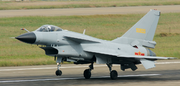 Unlike interceptors of the previous eras, most fourth-generation air-superiority fighters were designed to be agile dogfighters (although the Mikoyan MiG-31
and Panavia Tornado ADV
are notable exceptions). The continually rising cost of fighters, however, continued to emphasize the value of multirole fighters. The need for both types of fighters led to the "high/low mix" concept which envisioned a high-capability and high-cost core of dedicated air-superiority fighters (like the F-15 and Su-27) supplemented by a larger contingent of lower-cost multi-role fighters (such as the F-16 and MiG-29).
Most fourth-generation fighter-bombers, such as the Boeing F/A-18 Hornet
and Dassault Mirage 2000, are true multirole warplanes, designed as such from the start. This was facilitated by multimode avionics which could switch seamlessly between air and ground modes. The earlier approaches of adding on strike capabilities or designing separate models specialized for different roles generally became passé (with the Panavia Tornado
being an exception in this regard). Attack roles were generally assigned to dedicated ground-attack aircraft such as the Sukhoi Su-24
and the A-10 Thunderbolt II.
A typical US Air Force fighter wing of the era might contain a mix of: one air superiority squadron
(F-15C), one strike fighter squadron (F-15E), and two multirole fighter squadrons (F-16C).
Perhaps the most novel technology to be introduced for combat aircraft was "stealth
", which involves the use of special "low-observable" (L-O) materials and design techniques to reduce the susceptibility of an aircraft to detection by the enemy's sensor systems, particularly radars. The first stealth aircraft
to be introduced were the Lockheed F-117 Nighthawk
attack aircraft (introduced in 1983) and the Northrop Grumman B-2 Spirit
bomber (which first flew in 1989). Although no stealthy fighters per se appeared amongst the fourth generation, some radar-absorbent coatings and other L-O treatments developed for these programs are reported to have been subsequently applied to fourth-generation fighters.
in 1991 led many governments to significantly decrease military spending as a "peace dividend
". Air force inventories were cut, and research and development programs intended to produce what was then anticipated to be "fifth-generation" fighters took serious hits; many programs were canceled during the first half of the 1990s, and those which survived were "stretched out". While the practice of slowing the pace of development reduces annual investment expenses, it comes at the penalty of increased overall program and unit costs over the long-term. In this instance, however, it also permitted designers to make use of the tremendous achievements being made in the fields of computers, avionics and other flight electronics, which had become possible largely due to the advances made in microchip
and semiconductor
technologies in the 1980s and 1990s. This opportunity enabled designers to develop fourth-generation designs – or redesigns – with significantly enhanced capabilities. These improved designs have become known as "Generation 4.5" fighters, recognizing their intermediate nature between the 4th and 5th generations, and their contribution in furthering development of individual fifth-generation technologies.
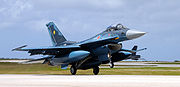 The primary characteristics of this sub-generation are the application of advanced digital avionics and aerospace materials, modest signature reduction (primarily RF "stealth"), and highly integrated systems and weapons. These fighters have been designed to operate in a "network-centric
" battlefield environment and are principally multirole aircraft. Key weapons technologies introduced include beyond-visual-range
(BVR) AAMs; Global Positioning System
(GPS)-guided weapons, solid-state
phased-array
radars; helmet-mounted sights
; and improved secure, jamming-resistant datalinks
. Thrust vectoring to further improve transient maneuvering capabilities has also been adopted by many 4.5th generation fighters, and uprated powerplants have enabled some designs to achieve a degree of "supercruise
" ability. Stealth characteristics are focused primarily on frontal-aspect radar cross section
(RCS) signature-reduction techniques including radar-absorbent materials
(RAM), L-O coatings and limited shaping techniques.
"Half-generation" designs are either based on existing airframes or are based on new airframes following similar design theory as previous iterations; however, these modifications have introduced the structural use of composite materials to reduce weight, greater fuel fractions to increase range, and signature reduction treatments to achieve lower RCS compared to their predecessors. Prime examples of such aircraft, which are based on new airframe designs making extensive use of carbon-fibre composites
, include the Eurofighter Typhoon
, Dassault Rafale
, and Saab JAS 39 Gripen
.
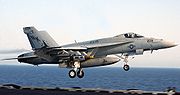 Apart from these fighter jets, most of the 4.5 generation aircraft are actually modified variants of existing airframes from the earlier fourth generation fighter jets. Such fighter jets are generally heavier and examples include the Boeing F/A-18E/F Super Hornet which is an evolution of the 1970s F/A-18 Hornet
design, the F-15E Strike Eagle
which is a ground-attack/multi-role variant of the Cold War-era F-15 Eagle
, the Sukhoi Su-30MKI and the Sukhoi Su-30MKK
which are further developments of the Su-30
fighter and the MiG-29M
, MiG-29K
and MiG-35
, upgraded versions of the 1980s MiG-29
. The Su-30MKI and MiG-35 use thrust vectoring
engine nozzles to enhance maneuvering. The Chengdu J-10B incorporates an Active Electronically Scanned Array
(AESA) radar for reduced cross section and DSI and IRST and vertical stabilisers fitted under the wings. Planned upgrades to the JF-17 Thunder
are expected to also incorporate an AESA radar and reduced cross section measures. Most 4.5 generation aircraft are being retrofitted with AESA radars and other state-of-the art avionics such as electronic counter-measure systems and forward looking infrared.
4.5 generation fighters first entered service in the early 1990s, and most of them are still being produced and evolved. It is quite possible that they may continue in production alongside fifth-generation fighters due to the expense of developing the advanced level of stealth technology needed to achieve aircraft designs featuring very low observables (VLO), which is one of the defining features of fifth-generation fighters. Of the 4.5th generation designs, only the Strike Eagle, Super Hornet, Typhoon, and Rafale have seen combat action.
The United States government defines 4.5 generation fighter aircraft as those that "(1) have advanced capabilities, including— (A) AESA radar; (B) high capacity data-link; and (C) enhanced avionics; and (2) have the ability to deploy current and reasonably foreseeable advanced armaments."
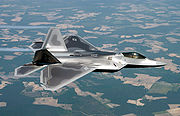 The fifth generation was ushered in by the Lockheed Martin/Boeing F-22 Raptor
in late 2005. Currently the cutting edge of fighter design, fifth-generation fighters are characterized by being designed from the start to operate in a network-centric combat environment, and to feature extremely low, all-aspect, multi-spectral signatures employing advanced materials and shaping techniques. They have multifunction AESA radars with high-bandwidth, low-probability of intercept (LPI) data transmission capabilities. The Infra-red search and track
sensors incorporated for air-to-air combat as well as for air-to-ground weapons delivery in the 4.5th generation fighters are now fused in with other sensors for Situational Awareness IRST or SAIRST, which constantly tracks all targets of interest around the aircraft so the pilot need not guess when he glances. These sensors, along with advanced avionics
, glass cockpit
s, helmet-mounted sights (not currently on F-22), and improved secure, jamming-resistant LPI datalinks are highly integrated to provide multi-platform, multi-sensor data fusion
for vastly improved situational awareness while easing the pilot's workload. Avionics suites rely on extensive use of very high-speed integrated circuit
(VHSIC) technology, common modules, and high-speed data buses. Overall, the integration of all these elements is claimed to provide fifth-generation fighters with a "first-look, first-shot, first-kill capability".
The AESA radar offers unique capabilities for fighters (and it is also quickly becoming essential for Generation 4.5 aircraft designs, as well as being retrofitted onto some fourth-generation aircraft). In addition to its high resistance to ECM and LPI features, it enables the fighter to function as a sort of "mini-AWACS," providing high-gain electronic support measures
(ESM) and electronic warfare
(EW) jamming functions.
Other technologies common to this latest generation of fighters includes integrated electronic warfare system (INEWS) technology, integrated communications, navigation, and identification (CNI) avionics technology, centralized "vehicle health monitoring" systems for ease of maintenance, fiber optics data transmission
, stealth technology
and even hovering capabilities.
Maneuver performance remains important and is enhanced by thrust-vectoring, which also helps reduce takeoff and landing distances. Supercruise may or may not be featured; it permits flight at supersonic speeds without the use of the afterburner – a device that significantly increases IR signature when used in full military power.
A key attribute of fifth-generation fighters is very-low-observables stealth. Great care has been taken in designing its layout and internal structure to minimize RCS over a broad bandwidth of detection and tracking radar frequencies; furthermore, to maintain its VLO signature during combat operations, primary weapons are carried in internal weapon bays that are only briefly opened to permit weapon launch. Furthermore, stealth technology has advanced to the point where it can be employed without a tradeoff with aerodynamics performance, in contrast to previous stealth efforts. Some attention has also been paid to reducing IR signatures, especially on the F-22. Detailed information on these signature-reduction techniques is classified, but in general includes special shaping approaches, thermoset
and thermoplastic materials, extensive structural use of advanced composites, conformal sensors, heat-resistant coatings, low-observable wire meshes to cover intake and cooling vents, heat ablating tiles on the exhaust troughs (seen on the Northrop YF-23), and coating internal and external metal areas with radar-absorbent materials and paint
(RAM/RAP).
Such aircraft are sophisticated and expensive. The U.S. Air Force had originally planned to acquire 650 F-22s, but now only 187 will be built. As a result, its unit flyaway cost (FAC) is around US$150 million. To spread the development costs – and production base – more broadly, the Joint Strike Fighter (JSF) program enrolls eight other countries as cost- and risk-sharing partners. Altogether, the nine partner nations anticipate procuring over 3,000 Lockheed Martin F-35 Lightning II fighters at an anticipated average FAC of $80–85 million. The F-35, however, is designed to be a family of three aircraft, a conventional take-off and landing
(CTOL) fighter, a short take-off and vertical landing
(STOVL) fighter, and a Catapult Assisted Take Off But Arrested Recovery
(CATOBAR) fighter, each of which has a different unit price and slightly varying specifications in terms of fuel capacity (and therefore range), size and payload.
Other countries have initiated fifth-generation fighter development projects, with Russia's Sukhoi PAK FA
and Mikoyan LMFS
. In October 2007, Russia and India signed an agreement for joint participation in a Fifth-Generation Fighter Aircraft Program
(FGFA), which will give India responsibility for development of a two-seat model of the PAK-FA. In December 2010, it was discovered that China is developing the 5th generation fighter Chengdu J-20
. The J-20 took its maiden flight in January 2011 and is planned to be deployed in 2017–19 time frame. India is also developing its own indigenous fifth generation aircraft named Medium Combat Aircraft
. Japan is exploring its technical feasibility to produce fifth-generation fighters.
is a conceptual airplane expected to enter service in the United States Air Force
and United States Navy
in 2025–30 timeframe. With the Chinese
Chengdu J-20
and the Russian
-Indian
Sukhoi PAK FA
under development, the need for of a sixth generation fighter may be urgent for the US military. The USAF seeks new fighter for the 2030–50 period named the "Next Generation Tactical Aircraft"/"Next Gen TACAIR" The US Navy looks to replace its F/A-18E/F Super Hornet
s beginning in 2025 with the Next Generation Air Dominance air superiority fighter.
Military aircraft
A military aircraft is any fixed-wing or rotary-wing aircraft that is operated by a legal or insurrectionary armed service of any type. Military aircraft can be either combat or non-combat:...
designed primarily for air-to-air combat with other aircraft, as opposed to a bomber
Bomber
A bomber is a military aircraft designed to attack ground and sea targets, by dropping bombs on them, or – in recent years – by launching cruise missiles at them.-Classifications of bombers:...
, which is designed primarily to attack ground targets. The hallmarks of a fighter are its speed, maneuverability, and small size relative to contemporary aircraft types.
Many fighters have secondary ground-attack capabilities, and some are dual-roled as fighter-bomber
Fighter-bomber
A fighter-bomber is a fixed-wing aircraft with an intended primary role of light tactical bombing and also incorporating certain performance characteristics of a fighter aircraft. This term, although still used, has less significance since the introduction of rockets and guided missiles into aerial...
s. It is not unusual for aircraft that do not fulfill the standard definition to be labelled or described as fighters. This may be for political or national security reasons, for advertising purposes or other reasons.
Fighters are the means by which armed forces gain air superiority
Air supremacy
Air supremacy is the complete dominance of the air power of one side's air forces over the other side's, during a military campaign. It is the most favorable state of control of the air...
over their opponents in battle. Since World War I
World War I
World War I , which was predominantly called the World War or the Great War from its occurrence until 1939, and the First World War or World War I thereafter, was a major war centred in Europe that began on 28 July 1914 and lasted until 11 November 1918...
, achieving and maintaining air superiority has been essential for victory in conventional warfare
Conventional warfare
Conventional warfare is a form of warfare conducted byusing conventional military weapons and battlefield tactics between two or more states in open confrontation. The forces on each side are well-defined, and fight using weapons that primarily target the opposing army...
. Alternatively guerrilla warfare
Guerrilla warfare
Guerrilla warfare is a form of irregular warfare and refers to conflicts in which a small group of combatants including, but not limited to, armed civilians use military tactics, such as ambushes, sabotage, raids, the element of surprise, and extraordinary mobility to harass a larger and...
attempts to find victory without air superiority but may only do so at a great cost in lives. The initial purchase price represents only small part of the total cost so that maintaining a viable fighter fleet consumes a substantial proportion of the defense budgets of modern armed forces.
Terminology
The word "fighter" did not become the official English term for such aircraft until after World War IWorld War I
World War I , which was predominantly called the World War or the Great War from its occurrence until 1939, and the First World War or World War I thereafter, was a major war centred in Europe that began on 28 July 1914 and lasted until 11 November 1918...
. In Great Britain's Royal Flying Corps
Royal Flying Corps
The Royal Flying Corps was the over-land air arm of the British military during most of the First World War. During the early part of the war, the RFC's responsibilities were centred on support of the British Army, via artillery co-operation and photographic reconnaissance...
and Royal Air Force
Royal Air Force
The Royal Air Force is the aerial warfare service branch of the British Armed Forces. Formed on 1 April 1918, it is the oldest independent air force in the world...
these aircraft were referred to as "scouts
Scout (aircraft)
The term scout, as a description of a class of military aircraft, came into use shortly before the First World War, and referred to a light reconnaissance aircraft, initially unarmed. "Scout" types were generally adaptations of pre-war racing aircraft – although at least one was specifically...
" into the early 1920s. The U.S. Army called their fighters "pursuit" aircraft from 1916 until the late 1940s. The French chasseur and German Jagdflugzeuge are terms that continue to be used for fighters, and mean "hunter" and "hunting aircraft" respectively. This lead has been followed in most languages except Russian where the fighter is an "истребитель" , meaning "exterminator".
As a part of military nomenclature, a letter is often assigned to various types of aircraft to indicate their use, along with a number to indicate the specific aircraft. The letters used to designate a fighter in various countries differ - in the English speaking world, "F" is now used to indicate a fighter (eg F-35) or Spitfire F.22
Supermarine Spitfire
The Supermarine Spitfire is a British single-seat fighter aircraft that was used by the Royal Air Force and many other Allied countries throughout the Second World War. The Spitfire continued to be used as a front line fighter and in secondary roles into the 1950s...
though when the pursuit designation was used in the US, they were "P" types (such as with the P-40). In Russia "I" was used (I-16
Polikarpov I-16
The Polikarpov I-16 was a Soviet fighter aircraft of revolutionary design; it was the world's first cantilever-winged monoplane fighter with retractable landing gear. The I-16 was introduced in the mid-1930s and formed the backbone of the Soviet Air Force at the beginning of World War II...
), while the French continue to use "C" (Nieuport 17 C.1
Nieuport 17
|-Specifications :-See also:-Bibliography:* Bruce, Jack. "Those Classic Nieuports". Air Enthusiast Quarterly. Number Two, 1976. Bromley, UK:Pilot Press. pp. 137–153....
).
Although the term "fighter" specifies aircraft designed to shoot down other aircraft, such designs are often also useful as multirole fighter-bomber
Fighter-bomber
A fighter-bomber is a fixed-wing aircraft with an intended primary role of light tactical bombing and also incorporating certain performance characteristics of a fighter aircraft. This term, although still used, has less significance since the introduction of rockets and guided missiles into aerial...
s, strike fighter
Strike fighter
In a current military parlance, a strike fighter is a multi-role combat aircraft designed to operate primarily in the air-to-surface attack role while also incorporating certain performance characteristics of a fighter aircraft. As a category, it is distinct from fighter-bombers...
s, and sometimes lighter, fighter-sized tactical ground-attack aircraft. This has always been the case, for instance the Sopwith Camel
Sopwith Camel
The Sopwith Camel was a British First World War single-seat biplane fighter introduced on the Western Front in 1917. Manufactured by Sopwith Aviation Company, it had a short-coupled fuselage, heavy, powerful rotary engine, and concentrated fire from twin synchronized machine guns. Though difficult...
and other "fighting scouts" of World War I performed a great deal of ground attack work. In World War II the USAAF and RAF
Royal Air Force
The Royal Air Force is the aerial warfare service branch of the British Armed Forces. Formed on 1 April 1918, it is the oldest independent air force in the world...
would often favor fighters over dedicated light bombers or dive bombers, and types such as the P-47 Thunderbolt
P-47 Thunderbolt
Republic Aviation's P-47 Thunderbolt, also known as the "Jug", was the largest, heaviest, and most expensive fighter aircraft in history to be powered by a single reciprocating engine. It was heavily armed with eight .50-caliber machine guns, four per wing. When fully loaded, the P-47 weighed up to...
and Hawker Hurricane
Hawker Hurricane
The Hawker Hurricane is a British single-seat fighter aircraft that was designed and predominantly built by Hawker Aircraft Ltd for the Royal Air Force...
which were found to be no longer competitive as fighters were relegated to ground attack. A number of aircraft such as the F-111 and F-117 had no fighter capability despite carrying the designation but did so for political reasons - the F-111 was originally intended to fulfill a fighter role with the Navy but this variant was cancelled, while the F-117 was thus designated for national security reasons. This blurring follows the use of fighters from their earliest days for "attack" or "strike" operations against enemy troops, field positions, vehicles, and facilities by means of strafing
Strafing
Strafing is the practice of attacking ground targets from low-flying aircraft using aircraft-mounted automatic weapons. This means, that although ground attack using automatic weapons fire is very often accompanied with bombing or rocket fire, the term "strafing" does not specifically include the...
or dropping small bombs and incendiaries. Versatile multirole fighter-bombers such as the F/A-18 Hornet
F/A-18 Hornet
The McDonnell Douglas F/A-18 Hornet is a supersonic, all-weather carrier-capable multirole fighter jet, designed to dogfight and attack ground targets . Designed by McDonnell Douglas and Northrop, the F/A-18 was derived from the latter's YF-17 in the 1970s for use by the United States Navy and...
are a less expensive option than having a range of specialized aircraft types.
Some of the most expensive fighters such as the F-14 Tomcat
F-14 Tomcat
The Grumman F-14 Tomcat is a supersonic, twin-engine, two-seat, variable-sweep wing fighter aircraft. The Tomcat was developed for the United States Navy's Naval Fighter Experimental program following the collapse of the F-111B project...
, F-22 Raptor
F-22 Raptor
The Lockheed Martin/Boeing F-22 Raptor is a single-seat, twin-engine fifth-generation supermaneuverable fighter aircraft that uses stealth technology. It was designed primarily as an air superiority fighter, but has additional capabilities that include ground attack, electronic warfare, and signals...
and F-15 Eagle
F-15 Eagle
The McDonnell Douglas F-15 Eagle is a twin-engine, all-weather tactical fighter designed by McDonnell Douglas to gain and maintain air superiority in aerial combat. It is considered among the most successful modern fighters with over 100 aerial combat victories with no losses in dogfights...
were employed as all-weather interceptors as well as air superiority fighter aircraft, while commonly developing air-to-ground roles late in their careers. An interceptor is generally an aircraft intended to target (or intercept) bombers and so often trades speed or maneuverability for climb rate.
Development overview
Airship
An airship or dirigible is a type of aerostat or "lighter-than-air aircraft" that can be steered and propelled through the air using rudders and propellers or other thrust mechanisms...
the ability to gather information by reconnaissance
Reconnaissance
Reconnaissance is the military term for exploring beyond the area occupied by friendly forces to gain information about enemy forces or features of the environment....
. Early fighters were very small and lightly armed by later standards, and most were biplane
Biplane
A biplane is a fixed-wing aircraft with two superimposed main wings. The Wright brothers' Wright Flyer used a biplane design, as did most aircraft in the early years of aviation. While a biplane wing structure has a structural advantage, it produces more drag than a similar monoplane wing...
s built with a wooden frame, covered with fabric, and limited to about 100 mph. As control of the airspace over armies became increasingly important all of the major powers developed fighters to support their military operations. Between the wars, wood was largely replaced by steel tubing, which became aluminium tubing, and finally aluminium stressed skin structures began to predominate.
By World War II
World War II
World War II, or the Second World War , was a global conflict lasting from 1939 to 1945, involving most of the world's nations—including all of the great powers—eventually forming two opposing military alliances: the Allies and the Axis...
, most fighters were all-metal monoplane
Monoplane
A monoplane is a fixed-wing aircraft with one main set of wing surfaces, in contrast to a biplane or triplane. Since the late 1930s it has been the most common form for a fixed wing aircraft.-Types of monoplane:...
s armed with batteries of machine gun
Machine gun
A machine gun is a fully automatic mounted or portable firearm, usually designed to fire rounds in quick succession from an ammunition belt or large-capacity magazine, typically at a rate of several hundred rounds per minute....
s or cannons and some were capable of speeds approaching 400 mph. Most fighters up to this point had one engine but a number of twin engined fighters were built, however they were found to be defenseless against single engine fighters and were relegated to other tasks, some becoming night fighters, fitted with very primitive radar sets.
This in turn required the development of ejection seats so the pilot could escape and G-suit
G-suit
A G-suit, or the more accurately named anti-G suit, is worn by aviators and astronauts who are subject to high levels of acceleration force . It is designed to prevent a black-out and G-LOC caused by the blood pooling in the lower part of the body when under acceleration, thus depriving the...
s to counter the much greater forces being applied to the pilot during maneuvers.
In the 1950s radar
Radar
Radar is an object-detection system which uses radio waves to determine the range, altitude, direction, or speed of objects. It can be used to detect aircraft, ships, spacecraft, guided missiles, motor vehicles, weather formations, and terrain. The radar dish or antenna transmits pulses of radio...
was being fitted to day fighters since the pilot could no longer see far enough ahead to prepare for any opposition, and since then the capabilities have grown enormously and are now the primary method of target acquisition
Target Acquisition
In the military, target acquisition denotes any process that provides detailed information about enemy forces and locates them with sufficient accuracy to permit continued monitoring or attacking it....
. Wings were made thinner and swept back to reduce trans-sonic drag which requiring new manufacturing methods to obtain sufficient strength. Skins were no longer sheet metal rivetted to a structure, but milled from large slabs of alloy. The sound barrier was broken, and after a few false starts due to the changes in control required, speeds quickly reached Mach 2, but this has proven to be the limit at which the human body can tolerate even with the assistance of G-suits - any faster and the aircraft is unable to maneuver to avoid attack.
Air-to-air missile
Air-to-air missile
An air-to-air missile is a missile fired from an aircraft for the purpose of destroying another aircraft. AAMs are typically powered by one or more rocket motors, usually solid fuelled but sometimes liquid fuelled...
s largely replaced guns and rockets in the early 1960s since both were believed to be unusable at the speeds being attained, however the Vietnam War
Vietnam War
The Vietnam War was a Cold War-era military conflict that occurred in Vietnam, Laos, and Cambodia from 1 November 1955 to the fall of Saigon on 30 April 1975. This war followed the First Indochina War and was fought between North Vietnam, supported by its communist allies, and the government of...
showed that guns still had a role to play and most fighters built since then are fitted with cannon (typically between 20 and 30 mm in caliber) as an adjunct to missiles. Most modern combat aircraft can carry a pair of basic air-to-air missiles and some of the larger fighters such as the Sukhoi Su-27
Sukhoi Su-27
The Sukhoi Su-27 is a twin-engine supermanoeuverable fighter aircraft designed by Sukhoi. It was intended as a direct competitor for the large United States fourth generation fighters, with range, heavy armament, sophisticated avionics and high manoeuvrability...
can carry as many as 12.
With the steady improvements in computers, defensive systems have become increasingly efficient and to counter this, stealth technologies have been pursued by the United States, Russia and China. The first step in this was to find ways to reduce the aircraft's reflectivity to radar waves by burying the engines, eliminating sharp corners and diverting any reflections away from the radar sets of opposing forces. Various materials were found to absorb the energy from Radar waves, and were incorporated into special finishes which have since found widespread application. Composite structures have become widespread, and include major structural components, reducing the steadily increasing weight - most modern fighters are larger and heavier than World War 2 medium bombers.
World War I
Aviator
An aviator is a person who flies an aircraft. The first recorded use of the term was in 1887, as a variation of 'aviation', from the Latin avis , coined in 1863 by G. de la Landelle in Aviation Ou Navigation Aérienne...
. Some of the first such "fighters" belonged to the "gunbus" series of experimental gun carriers of the British Vickers
Vickers
Vickers was a famous name in British engineering that existed through many companies from 1828 until 1999.-Early history:Vickers was formed in Sheffield as a steel foundry by the miller Edward Vickers and his father-in-law George Naylor in 1828. Naylor was a partner in the foundry Naylor &...
company which culminated in the Vickers F.B.5 Gunbus
Vickers F.B.5
The Vickers F.B.5 was a British two-seat pusher military biplane of the First World War...
of 1914. The main drawback of this type of aircraft was its lack of speed. It was quickly realized that an aircraft intended to destroy its kind in the air needed at least to be fast enough to catch its quarry.
Another type of military aircraft was to form the basis for an effective "fighter" in the modern sense of the word. It was based on the small fast aircraft developed before the war for such air races
Air racing
- History :The first ever air race was held in St. Louis, Missouri, in 1908. The participants piloted the only 4 airships in the U.S. around a course located at Forest Park...
as the Gordon Bennett Cup and Schneider Trophy
Schneider Trophy
The Coupe d'Aviation Maritime Jacques Schneider was a prize competition for seaplanes. Announced by Jacques Schneider, a financier, balloonist and aircraft enthusiast, in 1911, it offered a prize of roughly £1,000. The race was held eleven times between 1913 and 1931...
. The military scout
Scout (aircraft)
The term scout, as a description of a class of military aircraft, came into use shortly before the First World War, and referred to a light reconnaissance aircraft, initially unarmed. "Scout" types were generally adaptations of pre-war racing aircraft – although at least one was specifically...
airplane was not expected to be able to carry serious armament, but rather to rely on its speed to be able to reach the location it was required to "scout" or reconnoiter and then return quickly to report - essentially an aerial horse. British scout aircraft in this sense included the Sopwith Tabloid
Sopwith Tabloid
|-See also:-References:* Bruce, J.M. "". Flight. 8 November 1957. pp. 733–736.* Bruce, J.M. "". Flight. 15 November 1957. pp. 765–766.* Bruce, J.M. "". Flight. 29 November 1957. pp. 845–848....
and Bristol Scout
Bristol Scout
The Bristol Scout was a simple, single seat, rotary-engined biplane originally intended as a civilian racing aircraft. Like other similar fast, light aircraft of the period - it was acquired by the RNAS and the RFC as a "scout", or fast reconnaissance type...
; French equivalents included the Morane-Saulnier N.
Grenade
A grenade is a small explosive device that is projected a safe distance away by its user. Soldiers called grenadiers specialize in the use of grenades. The term hand grenade refers any grenade designed to be hand thrown. Grenade Launchers are firearms designed to fire explosive projectile grenades...
, and an assortment of improvised weapons. Many of these proved ineffective as the pilot had to fly his airplane while attempting to aim a handheld weapon and make a difficult deflection shot. The first step in finding a real solution was to mount the weapon on the aircraft, but the propeller remained a problem since the best direction to shoot is straight ahead. Numerous solutions were tried. A second crew member behind the pilot could aim and fire a swivel-mounted machine gun at enemy airplanes however, this limited the area of coverage chiefly to the rear hemisphere, and effective coordination of the pilot's maneuvering with the gunner's aiming was difficult. This option was chiefly employed as a defensive measure on two-seater reconnaissance aircraft from 1915 on. Both the SPAD A.2 and the Royal Aircraft Factory B.E.9
Royal Aircraft Factory B.E.9
|-See also:-Bibliography:...
added a second crewman ahead of the engine in a pod but this was both hazardous to the second crewman and limited performance. The Sopwith L.R.T.Tr.
Sopwith L.R.T.Tr.
|-See also:-References:*Bruce, J.M. British Aeroplanes 1914-18. London:Putnam, 1957.*Bruce, J.M. War Planes of the First World War: Volume Two Fighters. London:Macdonald, 1968. ISBN 0 356 01473 8....
similarly added a pod on the top wing with no better luck.
Pusher configuration
In a craft with a pusher configuration the propeller are mounted behind their respective engine. According to Bill Gunston, a "pusher propeller" is one mounted behind engine so that drive shaft is in compression...
scout such as the Airco DH.2
Airco DH.2
|-DH.2 aces:Distinguished pilots of the DH.2 included Victoria Cross winner Lanoe Hawker , who was the first commander of No 24 Squadron and ace Alan Wilkinson. The commander of No. 32 Squadron, Lionel Rees won the Victoria Cross flying the D.H.2 for single handedly attacking a formation of 10...
, with the propeller mounted behind the pilot. The main drawback was that the high drag
Drag (physics)
In fluid dynamics, drag refers to forces which act on a solid object in the direction of the relative fluid flow velocity...
of a pusher type's tail structure made it slower than a similar "tractor"
Tractor configuration
thumb|right|[[Evektor-Aerotechnik|Aerotechnik EV97A Eurostar]], a tractor configuration aircraft, being pulled into position by its pilot for refuelling....
aircraft.
A better solution for a single seat scout was to mount the machine gun (rifles and pistols having been dispensed with) to fire forwards but outside the propeller arc. Wing guns were tried but the unreliable weapons available required frequent clearing of jammed rounds and misfires
Firearm malfunction
A firearm malfunction is the partial or complete failure of a firearm to operate as intended. Malfunctions range from temporary and relatively safe situations, such as a casing that didn't eject, to potentially dangerous occurrences that may permanently damage the gun and cause injury or death...
and remained impractical until after the war. Mounting the machine gun over the top wing worked well and was used long after the ideal solution was found. The Nieuport 11
Nieuport 11
|-See also:-References:NotesBibliography* Angelucci, Enzio, ed. The Rand McNally Encyclopedia of Military Aircraft. New York: The Military Press, 1983. ISBN 0-517-41021-4....
of 1916 and Royal Aircraft Factory S.E.5
Royal Aircraft Factory S.E.5
The Royal Aircraft Factory S.E.5 was a British biplane fighter aircraft of the First World War. Although the first examples reached the Western Front before the Sopwith Camel and it had a much better overall performance, problems with its Hispano-Suiza engine, particularly the geared-output H-S...
of 1918 both used this system with considerable success, however this placement made aiming difficult and the location made it difficult for a pilot to both maneuver and have access to the gun's breech. The British Foster mounting
Foster mounting
In early 1916 Sergeant Foster of No. 11 Squadron RFC devised a sliding rail mounting for the upper wing Lewis Gun on a Nieuport 11. It enabled the gun to be pulled down so that its breech was conveniently in front of the pilot, making it much easier to change ammunition drums or to clear stoppages...
was specifically designed for this kind of application, fitted with the Lewis Machine gun, which due to its design was unsuitable for synchronizing.
The need to arm a tractor scout with a forward-firing gun whose bullets passed through the propeller arc was evident even before the outbreak of war and inventors in both France and Germany devised mechanisms
Interrupter gear
An interrupter gear is a device used on military aircraft and warships in order to allow them to target opponents without damaging themselves....
that could time the firing of the individual rounds to avoid hitting the propeller blades. Franz Schneider
Franz Schneider
Franz Schneider was an engineer granted the first patent on 15 July 1913 for a synchronisation device allowing a machine gun to fire between an aircraft's spinning propeller blades...
, a Swiss engineer, had patented such a device in Germany in 1913, but his original work was not followed up. French aircraft designer Raymond Saulnier patented a practical device in April 1914, but trials were unsuccessful because of the propensity of the machine gun employed to hang fire
Hang fire
Hang fire refers to an unexpected delay between the triggering of a firearm and the ignition of the propellant. This failure was common in firearm actions that relied on open primer pans, due to the poor or inconsistent quality of the powder. Modern weapons are susceptible, particularly if the...
due to unreliable ammunition.
Morane-Saulnier Type L
-Bibliography:* Bruce, J.M. The Aeroplanes of the Royal Flying Corps . London:Putnam, 1982. ISBN 0 370 30084 x.* Green, William and Swanborough, Gordon. The Complete Book of Fighters. New York: Smithmark, 1994. ISBN 0-8317-3939-8....
. Unfortunately the gas-operated Hotchkiss
Hotchkiss et Cie
Société Anonyme des Anciens Etablissements Hotchkiss et Cie was a French arms and car company established by United States engineer Benjamin B. Hotchkiss, who was born in Watertown, Connecticut. He moved to France and set up a factory, first at Viviez near Rodez in 1867, then at Saint-Denis near...
machine gun he was provided had an erratic rate of fire and it was impossible to synchronize it with a spinning propeller. As an interim measure, the propeller blades were armored and fitted with metal wedges to protect the pilot from ricochet
Ricochet
A ricochet is a rebound, bounce or skip off a surface, particularly in the case of a projectile. The possibility of ricochet is one of the reasons for the common firearms safety rule "Never shoot at a flat, hard surface."-Variables:...
s. Garros' modified monoplane was first flown in March 1915 and he began combat operations soon thereafter. Garros scored three victories in three weeks before he himself was downed on 18 April and his airplane, along with its synchronization gear and propeller was captured by the Germans.
Meanwhile, the synchronization gear (called the Stangensteuerung in German, for "pushrod control system") devised by the engineers of Anthony Fokker
Anthony Fokker
Anton Herman Gerard "Anthony" Fokker was a Dutch aviation pioneer and an aircraft manufacturer. He is most famous for the fighter aircraft he produced in Germany during the First World War such as the Eindecker monoplanes, the Fokker Triplane the and the Fokker D.VII, but after the collapse of...
's firm was the first system to see production contracts, and would make the Fokker Eindecker
Fokker Eindecker
The Fokker Eindecker was a German World War I monoplane single-seat fighter aircraft designed by Dutch engineer Anthony Fokker. Developed in April 1915, the Eindecker was the first purpose-built German fighter aircraft and the first aircraft to be fitted with synchronizer gear, enabling the pilot...
monoplane a feared name over the Western Front
Western Front (World War I)
Following the outbreak of World War I in 1914, the German Army opened the Western Front by first invading Luxembourg and Belgium, then gaining military control of important industrial regions in France. The tide of the advance was dramatically turned with the Battle of the Marne...
, despite its being an adaptation of an obsolete pre-war French Morane-Saulnier
Morane-Saulnier
Aéroplanes Morane-Saulnier is a French aircraft manufacturing company formed in October 1911 by Raymond Saulnier and the Morane brothers, Leon and Robert...
racing airplane, with a mediocre performance and poor flight characteristics. The first victory for the Eindecker came on 1 July 1915, when Leutnant Kurt Wintgens
Kurt Wintgens
Leutnant Kurt Wintgens was a German World War I fighter ace. He was the first military fighter pilot to score a victory over an opposing aircraft in an aircraft armed with a synchronized machine gun. Wintgens was the recipient of the Iron Cross and the Blue Max.-Background:Wintgens was born into a...
, flying with the Feldflieger Abteilung
Feldflieger Abteilung
Feldflieger Abteilung or Field Flying Companies were the pioneering field aviation units of the Luftstreitkräfte in World War I.-Composition:...
6 unit on the Western Front, forced down a Morane-Saulnier Type L two-seat "parasol" monoplane just east of Luneville
Lunéville
Lunéville is a commune in the Meurthe-et-Moselle department in France.It is a sub-prefecture of the department and lies on the Meurthe River.-History:...
. Wintgens' aircraft, one of the five Fokker M.5K/MG
Fokker M.5
The Fokker M.5 was an unarmed single-seat monoplane aircraft designed and built by Anthony Fokker in 1913. It served as a light reconnaissance aircraft with the German army at the outbreak of World War I and was the basis for the first successful fighter aircraft in German service, the Fokker...
production prototype examples of the Eindecker, was armed with a synchronized, air-cooled aviation version of the Parabellum MG14
Parabellum MG14
The Parabellum MG14 was a 7.9 mm caliber World War I machine gun built by Deutsche Waffen und Munitionsfabriken. It was an adaptation of their Maschinengewehr 08 gun intended for use on aircraft and zeppelins. The MG08's belt-style ammunition feed was enclosed in a drum, the recoil casing was...
machine gun.
Albatros D.I
|-See also:...
and Sopwith Pup
Sopwith Pup
The Sopwith Pup was a British single seater biplane fighter aircraft built by the Sopwith Aviation Company. It entered service with the Royal Flying Corps and the Royal Naval Air Service in the autumn of 1916. With pleasant flying characteristics and good maneuverability, the aircraft proved very...
of 1916 set the classic pattern followed by fighters for about twenty years. Most were biplanes
Biplane
A biplane is a fixed-wing aircraft with two superimposed main wings. The Wright brothers' Wright Flyer used a biplane design, as did most aircraft in the early years of aviation. While a biplane wing structure has a structural advantage, it produces more drag than a similar monoplane wing...
and only rarely monoplanes or triplanes
Triplane
A triplane is a fixed-wing aircraft equipped with three vertically-stacked wing planes. Tailplanes and canard foreplanes are not normally included in this count, although they may occasionally be.-Design principles:...
. The strong box structure of the biplane wing provided a rigid wing that allowed the accurate lateral control essential for dogfighting. They had a single operator, who flew the aircraft and also controlled its armament. They were armed with one or two Maxim
Maxim gun
The Maxim gun was the first self-powered machine gun, invented by the American-born British inventor Sir Hiram Maxim in 1884. It has been called "the weapon most associated with [British] imperial conquest".-Functionality:...
or Vickers
Vickers
Vickers was a famous name in British engineering that existed through many companies from 1828 until 1999.-Early history:Vickers was formed in Sheffield as a steel foundry by the miller Edward Vickers and his father-in-law George Naylor in 1828. Naylor was a partner in the foundry Naylor &...
machine guns which were easier to synchronize than other types, firing through the propeller arc. Gun breeches were directly in front of the pilot with obvious implications in case of accidents, but jams could be cleared in flight, while aiming was simplified.
The use of metal aircraft structures was pioneered before World War I by Breguet but would find its biggest proponent with Anthony Fokker who used chrome-molybdenum steel tubing for the fuselage structure of all his fighter designs, while the innovative German engineer Hugo Junkers
Hugo Junkers
Hugo Junkers was an innovative German engineer, as his many patents in varied areas show...
developed two all-metal, single-seat fighter monoplane designs with cantilever
Cantilever
A cantilever is a beam anchored at only one end. The beam carries the load to the support where it is resisted by moment and shear stress. Cantilever construction allows for overhanging structures without external bracing. Cantilevers can also be constructed with trusses or slabs.This is in...
wings: the strictly experimental Junkers J 2
Junkers J 2
The Junkers J 2 was the first all-metal aircraft intended as a dedicated military aircraft design, the first all-metal aircraft meant to be a fighter aircraft, and was the direct descendant of the pioneering J 1 all-metal aircraft technology demonstrator design of 1915.-Development:Only some two...
private-venture aircraft, made with steel, and some forty examples of the Junkers D.I
Junkers D.I
-External links:* *...
, made with corrugated duralumin
Duralumin
Duralumin is the trade name of one of the earliest types of age-hardenable aluminium alloys. The main alloying constituents are copper, manganese, and magnesium. A commonly used modern equivalent of this alloy type is AA2024, which contains 4.4% copper, 1.5% magnesium, 0.6% manganese and 93.5%...
, all based on his experience in creating the pioneering Junkers J 1
Junkers J 1
The Junkers J 1, nicknamed the Blechesel , was the world's first practical all-metal aircraft. Built early in World War I, when aircraft designers relied largely on fabric-covered wooden structures, the Junkers J 1 was a revolutionary development in aircraft design, being built and flown only 12...
all-metal airframe technology demonstration aircraft of late 1915. While Fokker would pursue steel tube fuselages with wooden wings until the late 1930s, and Junkers would focus on corrugated sheet metal, Dornier was the first to build a fighter (The Dornier D.I) made with pre-stressed sheet aluminium and having cantelevered wings, a form that would replace all others in the 1930s.
As collective combat experience grew, the more successful pilots such as Oswald Boelcke
Oswald Boelcke
Oswald Boelcke was a German flying ace of the First World War and one of the most influential patrol leaders and tacticians of the early years of air combat. Boelcke is considered the father of the German fighter air force, as well as the "Father of Air Fighting Tactics"; he was the first to...
, Max Immelmann
Max Immelmann
Max Immelmann was the first German World War I flying ace. He was a great pioneer in fighter aviation and is often mistakenly credited with the first aerial victory using a synchronized gun...
, and Edward Mannock
Edward Mannock
Major Edward Corringham "Mick" Mannock VC, DSO and Two Bars, MC & Bar was a British First World War flying ace. Mannock was probably born in Ireland, though of English and Scottish parentage....
developed innovative tactical formations and maneuvers to enhance their air units' combat effectiveness.
Allied and – before 1918 – German pilots of World War I were not equipped with parachute
Parachute
A parachute is a device used to slow the motion of an object through an atmosphere by creating drag, or in the case of ram-air parachutes, aerodynamic lift. Parachutes are usually made out of light, strong cloth, originally silk, now most commonly nylon...
s, so in-flight fires or structural failure were often fatal. Parachutes were well-developed by 1918 having previously been used by balloonists, and were adopted by the German flying services during the course of that year (the famous "Red Baron"
Manfred von Richthofen
Manfred Albrecht Freiherr von Richthofen , also widely known as the Red Baron, was a German fighter pilot with the Imperial German Army Air Service during World War I...
was wearing one when he was killed), but the allied command continued to oppose their use on various grounds.
In April 1917 during a brief period of German aerial supremacy, the average life expectancy of a British pilot on the Western Front was claimed by a grandstanding Member of Parliament
Member of Parliament
A Member of Parliament is a representative of the voters to a :parliament. In many countries with bicameral parliaments, the term applies specifically to members of the lower house, as upper houses often have a different title, such as senate, and thus also have different titles for its members,...
(upset at the lack of orders his own aircraft manufacturing firm was receiving) to be 93 flying hours, or about three weeks of active service. More than 50,000 airmen from both sides died during the war.
Inter-war period (1919–38)
Fighter development slowed between the wars, especially in the United States and the United Kingdom, where budgets were deeply slashed. In France, Italy and Russia, where budgets were allowed major development, both monoplanes and all metal structures were common by the end of the 1920s however those countries overspent themselves and were finally overtaken in the early '30s by those powers that hadn't been spending heavily before, namely the British, the Americans and the Germans.Gloster Gladiator
The Gloster Gladiator was a British-built biplane fighter. It was used by the Royal Air Force and the Royal Navy and was exported to a number of other air forces during the late 1930s. It was the RAF's last biplane fighter aircraft and was rendered obsolete by newer monoplane designs even as it...
, Fiat CR.42
Fiat CR.42
The Fiat CR.42 Falco was a single-seat sesquiplane fighter which served primarily in Italy's Regia Aeronautica before and during World War II. The aircraft was produced by the Turin firm, and entered service, in smaller numbers, with the air forces of Belgium, Sweden and Hungary...
, and Polikarpov I-15
Polikarpov I-15
The Polikarpov I-15 was a Soviet biplane fighter aircraft of the 1930s. Nicknamed Chaika because of its gulled upper wings, it was operated in large numbers by the Soviet Air Force, and together with the Polikarpov I-16 monoplane, was one of the standard fighters of the Spanish Republicans during...
were common even in the late 1930s, and many were still in service as late as 1942. Up until the mid-1930s, the majority of fighters in the US, the UK, Italy and Russia remained fabric-covered biplanes.
The rotary engine
Rotary engine
The rotary engine was an early type of internal-combustion engine, usually designed with an odd number of cylinders per row in a radial configuration, in which the crankshaft remained stationary and the entire cylinder block rotated around it...
, popular during World War I, quickly disappeared, having reached its peak as rotational forces prevented more fuel and air from being delivered to the cylinders, which limited horsepower. They were replaced chiefly by the stationary radial engine
Radial engine
The radial engine is a reciprocating type internal combustion engine configuration in which the cylinders point outward from a central crankshaft like the spokes on a wheel...
though major advances continued to be made with inline engines which gained ground with several exceptional engines, including the 1145 cu in (18.8 l) V-12 Curtiss D-12
Curtiss D-12
|-See also:-Bibliography:* Lumsden, Alec. British Piston Engines and their Aircraft. Marlborough, Wiltshire: Airlife Publishing, 2003. ISBN 1-85310-294-6.-External links:*...
.
Aircraft engine
Aircraft engine
An aircraft engine is the component of the propulsion system for an aircraft that generates mechanical power. Aircraft engines are almost always either lightweight piston engines or gas turbines...
s increased in power several-fold over the period, going from a typical 180 hp in the 1918 Fokker D.VII
Fokker D.VII
The Fokker D.VII was a German World War I fighter aircraft designed by Reinhold Platz of the Fokker-Flugzeugwerke. Germany produced around 3,300 D.VII aircraft in the summer and autumn of 1918. In service, the D.VII quickly proved itself to be a formidable aircraft...
to 900 hp in the 1938 Curtiss P-36. The debate between the sleek in-line engines
Straight engine
Usually found in four- and six-cylinder configurations, the straight engine, or inline engine is an internal-combustion engine with all cylinders aligned in one row, with no offset...
versus the more reliable radial models continued, with naval air forces preferring the radial engines, and land-based forces often choosing in-line units. Radial designs did not require a separate (and vulnerable) cooling system, but had increased drag. In-line engines often had a better power-to-weight ratio
Power-to-weight ratio
Power-to-weight ratio is a calculation commonly applied to engines and mobile power sources to enable the comparison of one unit or design to another. Power-to-weight ratio is a measurement of actual performance of any engine or power sources...
, but there were radial engines that kept working even after having suffered significant battle damage.
Some air forces experimented with "heavy fighter
Heavy fighter
A heavy fighter is a fighter aircraft designed to carry heavier weapons or operate at longer ranges. To achieve acceptable performance, most heavy fighters were twin-engined, and many had multi-place crews....
s" (called "destroyers" by the Germans). These were larger, usually twin-engined aircraft, sometimes adaptations of light
Light bomber
A light bomber is a relatively small and fast class of military bomber aircraft which were primarily employed before the 1950s. Such aircraft would typically not carry more than one ton of ordnance....
or medium bomber
Medium bomber
A medium bomber is a bomber aircraft designed to operate with medium bombloads over medium distances; the name serves to distinguish them from the larger heavy bombers and smaller light bombers...
types. Such designs typically had greater internal fuel capacity (thus longer range) and heavier armament than their single-engine counterparts. In combat, they proved vulnerable to more agile single-engine fighters.
The primary driver of fighter innovation, right up to the period of rapid rearmament in the late thirties, was not military budget, but civilian aircraft races. Aircraft designed for these races introduced innovations like streamlining and more powerful engines that would find their way into the fighters of World War II. The most significant of these was the Schneider Cup races, where competition grew so fierce, only national governments could afford to enter.
At the very end of the inter-war period in Europe came the Spanish Civil War
Spanish Civil War
The Spanish Civil WarAlso known as The Crusade among Nationalists, the Fourth Carlist War among Carlists, and The Rebellion or Uprising among Republicans. was a major conflict fought in Spain from 17 July 1936 to 1 April 1939...
. This was just the opportunity the German Luftwaffe
Luftwaffe
Luftwaffe is a generic German term for an air force. It is also the official name for two of the four historic German air forces, the Wehrmacht air arm founded in 1935 and disbanded in 1946; and the current Bundeswehr air arm founded in 1956....
, Italian Regia Aeronautica
Regia Aeronautica
The Italian Royal Air Force was the name of the air force of the Kingdom of Italy. It was established as a service independent of the Royal Italian Army from 1923 until 1946...
, and the Soviet Union's Red Air Force needed to test their latest aircraft. Each party sent numerous aircraft types to support their sides in the conflict. In the dogfight
Dogfight
A dogfight, or dog fight, is a form of aerial combat between fighter aircraft; in particular, combat of maneuver at short range, where each side is aware of the other's presence. Dogfighting first appeared during World War I, shortly after the invention of the airplane...
s over Spain, the latest Messerschmitt fighters (Bf 109
Messerschmitt Bf 109
The Messerschmitt Bf 109, often called Me 109, was a German World War II fighter aircraft designed by Willy Messerschmitt and Robert Lusser during the early to mid 1930s...
) did well, as did the Soviet Polikarpov I-16
Polikarpov I-16
The Polikarpov I-16 was a Soviet fighter aircraft of revolutionary design; it was the world's first cantilever-winged monoplane fighter with retractable landing gear. The I-16 was introduced in the mid-1930s and formed the backbone of the Soviet Air Force at the beginning of World War II...
. The German design had considerably more room for development however and the lessons learned led to greatly improved models in World War II. The Russians, whose side lost, failed to keep pace and I-16s were outfought by the improved Bf 109s in World War II, and despite newer models coming into service remained the most common Soviet front-line fighter into 1942.
For their part, the Italians developed several monoplanes such as the Fiat G.50
Fiat G.50
The Fiat G.50 Freccia was a World War II Italian fighter aircraft. First flown in February 1937, the G.50 was Italy’s first single-seat, all-metal monoplane with an enclosed cockpit and retractable landing gear to go into production...
, but being short on funds, were forced to continue operating obsolete Fiat CR.42
Fiat CR.42
The Fiat CR.42 Falco was a single-seat sesquiplane fighter which served primarily in Italy's Regia Aeronautica before and during World War II. The aircraft was produced by the Turin firm, and entered service, in smaller numbers, with the air forces of Belgium, Sweden and Hungary...
biplanes.
From the early 1930s the Japanese had been at war in China against the Nationalist Chinese as well as the Russians, and used the experience to improve both training and aircraft, replacing biplanes with modern cantilever monoplanes and creating a cadre of exceptional pilots for use in the Pacific War.
In the United Kingdom, at the behest of Neville Chamberlain
Neville Chamberlain
Arthur Neville Chamberlain FRS was a British Conservative politician who served as Prime Minister of the United Kingdom from May 1937 to May 1940. Chamberlain is best known for his appeasement foreign policy, and in particular for his signing of the Munich Agreement in 1938, conceding the...
, (more famous for his 'peace in our time' speech) the entire British aviation industry was retooled, allowing it to change quickly from fabric covered metal framed biplanes to cantilever stressed skin monoplanes in time for the war with Germany. Without his work in the early '30s, Churchill would not have had the tools to take on the Germans.
The period of improving the same biplane design over and over was now coming to an end, and the Hawker Hurricane
Hawker Hurricane
The Hawker Hurricane is a British single-seat fighter aircraft that was designed and predominantly built by Hawker Aircraft Ltd for the Royal Air Force...
and Supermarine Spitfire
Supermarine Spitfire
The Supermarine Spitfire is a British single-seat fighter aircraft that was used by the Royal Air Force and many other Allied countries throughout the Second World War. The Spitfire continued to be used as a front line fighter and in secondary roles into the 1950s...
finally started to supplant the Gloster Gladiator
Gloster Gladiator
The Gloster Gladiator was a British-built biplane fighter. It was used by the Royal Air Force and the Royal Navy and was exported to a number of other air forces during the late 1930s. It was the RAF's last biplane fighter aircraft and was rendered obsolete by newer monoplane designs even as it...
and Hawker Fury
Hawker Fury
The Hawker Fury was a British biplane fighter aircraft used by the Royal Air Force in the 1930s. It was originally named the Hornet and was the counterpart to the Hawker Hart light bomber.-Design and development:...
biplanes but many of the former remained in front-line service well past the start of World War II. While not a combatant themselves in Spain, they absorbed many of the lessons learned in time to use them.
The Spanish Civil War also provided an opportunity for updating fighter tactics. One of the innovations to result from the aerial warfare experience this conflict provided was the development of the "finger-four
Finger-four
The "Finger-four" formation , is a flight formation used by fighter aircraft. It consists of four aircraft, and four of these formations can be combined into a squadron formation.- Description :...
" formation by the German pilot Werner Mölders
Werner Mölders
Werner Mölders was a World War II German Luftwaffe pilot and the leading German fighter ace in the Spanish Civil War. Mölders became the first pilot in aviation history to claim 100 aerial victories—that is, 100 aerial combat encounters resulting in the destruction of the enemy aircraft, and was...
. Each fighter squadron
Squadron (aviation)
A squadron in air force, army aviation or naval aviation is mainly a unit comprising a number of military aircraft, usually of the same type, typically with 12 to 24 aircraft, sometimes divided into three or four flights, depending on aircraft type and air force...
(German: Staffel) was divided into several flights (Schwärme) of four aircraft. Each Schwarm was divided into two Rotten which was a pair of aircraft. Each Rotte was composed of a leader and a wingman. This flexible formation allowed the pilots to maintain greater situational awareness, and the two Rotten could split up at any time and attack on their own. The finger-four would become widely adopted as the fundamental tactical formation over the course of World War
World War II
Erwin Rommel
Erwin Johannes Eugen Rommel , popularly known as the Desert Fox , was a German Field Marshal of World War II. He won the respect of both his own troops and the enemies he fought....
noted the effect of airpower: "Anyone who has to fight, even with the most modern weapons, against an enemy in complete command of the air, fights like a savage against modern European troops, under the same handicaps and with the same chances of success."
During the 1930s, two different streams of thought about air-to-air combat began to emerge, resulting in two different approaches to monoplane fighter development. In Japan and Italy especially, there continued to be a strong belief that lightly armed, highly maneuverable single-seat fighters would still play a primary role in air-to-air combat. Aircraft such as the Nakajima Ki-27
Nakajima Ki-27
The was the main fighter aircraft used by the Imperial Japanese Army Air Force up until 1940. Its Allied nickname was "Nate", although it was called "Abdul" in the "China Burma India" theater by many post war sources; Allied Intelligence had reserved that name for the nonexistent Mitsubishi Navy...
, Nakajima Ki-43
Nakajima Ki-43
The Nakajima Ki-43 Hayabusa was a single-engine land-based tactical fighter used by the Imperial Japanese Army Air Force in World War II...
and the Mitsubishi A6M Zero in Japan, and the Fiat G.50
Fiat G.50
The Fiat G.50 Freccia was a World War II Italian fighter aircraft. First flown in February 1937, the G.50 was Italy’s first single-seat, all-metal monoplane with an enclosed cockpit and retractable landing gear to go into production...
and Macchi MC.200 in Italy epitomized a generation of monoplanes designed to this concept.
G-force
The g-force associated with an object is its acceleration relative to free-fall. This acceleration experienced by an object is due to the vector sum of non-gravitational forces acting on an object free to move. The accelerations that are not produced by gravity are termed proper accelerations, and...
imposed by aerial combat meant that dogfighting in the classic World War I sense would be impossible. Fighters such as the Messerschmitt Bf 109
Messerschmitt Bf 109
The Messerschmitt Bf 109, often called Me 109, was a German World War II fighter aircraft designed by Willy Messerschmitt and Robert Lusser during the early to mid 1930s...
, the Supermarine Spitfire
Supermarine Spitfire
The Supermarine Spitfire is a British single-seat fighter aircraft that was used by the Royal Air Force and many other Allied countries throughout the Second World War. The Spitfire continued to be used as a front line fighter and in secondary roles into the 1950s...
, the Yakovlev Yak-1
Yakovlev Yak-1
The Yakovlev Yak-1 was a World War II Soviet fighter aircraft. Produced from early 1940, it was a single-seat monoplane with a composite structure and wooden wings....
and the Curtiss P-40 Warhawk were all designed for high level speeds and a good rate of climb. Good maneuverability was desirable, but it was not the primary objective.
The 1939 Soviet-Japanese Battle of Khalkhyn Gol (11 May – 31 August 1939), and the subsequent initial German invasion of Poland
Invasion of Poland (1939)
The Invasion of Poland, also known as the September Campaign or 1939 Defensive War in Poland and the Poland Campaign in Germany, was an invasion of Poland by Germany, the Soviet Union, and a small Slovak contingent that marked the start of World War II in Europe...
the following day, were too brief to provide much feedback to the participants for further evolution of their respective fighter doctrines. During the Winter War
Winter War
The Winter War was a military conflict between the Soviet Union and Finland. It began with a Soviet offensive on 30 November 1939 – three months after the start of World War II and the Soviet invasion of Poland – and ended on 13 March 1940 with the Moscow Peace Treaty...
, the greatly outnumbered Finnish Air Force
Finnish Air Force
The Finnish Air Force is one of the branches of the Finnish Defence Forces. Its peacetime tasks are airspace surveillance, identification flights, and production of readiness formations for wartime conditions...
, which had adopted the German finger-four formation, bloodied the noses of Russia's Red Air Force, which relied on the less effective tactic of a three-aircraft delta formation.
European theater (Eastern Front)
On the Eastern FrontEastern Front (World War II)
The Eastern Front of World War II was a theatre of World War II between the European Axis powers and co-belligerent Finland against the Soviet Union, Poland, and some other Allies which encompassed Northern, Southern and Eastern Europe from 22 June 1941 to 9 May 1945...
, the strategic surprise of Operation Barbarossa
Operation Barbarossa
Operation Barbarossa was the code name for Germany's invasion of the Soviet Union during World War II that began on 22 June 1941. Over 4.5 million troops of the Axis powers invaded the USSR along a front., the largest invasion in the history of warfare...
demonstrated that Soviet air defense preparations were woefully inadequate, and the Great Purge
Great Purge
The Great Purge was a series of campaigns of political repression and persecution in the Soviet Union orchestrated by Joseph Stalin from 1936 to 1938...
rendered any lessons learned by the Red Air Force command from previous experience in Spain and Finland virtually useless. During the first few months of the invasion, Axis
Axis Powers
The Axis powers , also known as the Axis alliance, Axis nations, Axis countries, or just the Axis, was an alignment of great powers during the mid-20th century that fought World War II against the Allies. It began in 1936 with treaties of friendship between Germany and Italy and between Germany and...
air forces were able to destroy large numbers of Red Air Force aircraft on the ground and in one-sided dogfights. However, by the winter of 1941–1942, the Red Air Force was able to put together a cohesive air defense of Moscow, successfully interdict attacks on Leningrad, and begin production of new aircraft types in the relocated semi-built factories in the Urals
Ural (region)
Ural is a geographical region located around the Ural Mountains, between the East European and West Siberian plains. It extends approximately from north to south, from the Arctic Ocean to the bend of Ural River near Orsk city. The boundary between Europe and Asia runs along the eastern side of...
, Siberia, Central Asia and the Caucasus
Caucasus
The Caucasus, also Caucas or Caucasia , is a geopolitical region at the border of Europe and Asia, and situated between the Black and the Caspian sea...
. These facilities produced more advanced monoplane fighters, such as the Yak-1, Yak-3, LaGG-3, and MiG-3, to wrest air superiority from the Luftwaffe. However, Soviet aircrew training was hasty in comparison to that provided to the Luftwaffe, so Soviet pilot losses continued to be disproportionate until a growing number of survivors were matched to more effective machines.
Beginning in 1942, significant numbers of British, and later U.S., fighter aircraft were also supplied to aid the Soviet war effort, with the Bell P-39 Airacobra proving particularly effective in the lower-altitude combat typical of the Eastern Front. Also from that time, the Eastern Front became the largest arena of fighter aircraft use in the world; fighters were used in all of the roles typical of the period, including close air support
Close air support
In military tactics, close air support is defined as air action by fixed or rotary winged aircraft against hostile targets that are close to friendly forces, and which requires detailed integration of each air mission with fire and movement of these forces.The determining factor for CAS is...
, interdiction
Air interdiction
Air interdiction is the use of aircraft to attack tactical ground targets that are not in close proximity to friendly ground forces. It differs from close air support because it does not directly support ground operations and is not closely coordinated with ground units...
, escort
Escort fighter
The escort fighter was a World War II concept for a fighter aircraft designed to escort bombers to and from their targets.The perfect escort fighter had long range, a lengthy combat loiter time to protect the bombers, and enough internal fuel to return home...
and interception
Interceptor aircraft
An interceptor aircraft is a type of fighter aircraft designed specifically to prevent missions of enemy aircraft, particularly bombers and reconnaissance aircraft. Interceptors generally rely on high speed and powerful armament in order to complete their mission as quickly as possible and set up...
roles. Some aircraft were armed with weapons as large as 45 mm cannon (particularly for attacking enemy armored vehicles), and the Germans began installing additional smaller cannons in under-wing pods
Gun pod
A gun pod is a detachable pod or pack containing machine guns or automatic cannon and ancillaries, mounted externally on a vehicle such as a military aircraft which may or may not also have its own guns....
to assist with ground-attack missions.
Pacific theatre
Pacific Ocean theater of World War II
The Pacific Ocean theatre was one of four major naval theatres of war of World War II, which pitted the forces of Japan against those of the United States, the British Commonwealth, the Netherlands and France....
opened with the Japanese not only surprised their opponents on the ground at Pearl Harbour, the Phillipines and Dutch East India (now Indonesia)
Dutch East Indies campaign
The Dutch East Indies campaign of 1941–1942 was the conquest of the Dutch East Indies by forces from the Empire of Japan in the early days of the Pacific Campaign of World War II. Forces from the Allies attempted unsuccessfully to defend the islands. Indonesia was targeted by the Japanese for its...
, but also give them a shock as to how advanced their fighters were. The US military for one had assumed they were still using biplane fighters.
At the start of the war, the Imperial Japanese Navy Air Service
Imperial Japanese Navy Air Service
The Imperial Japanese Navy Air Service was the air arm of the Imperial Japanese Navy during World War II, the organization was responsible for the operation of naval aircraft and the conduct of aerial warfare in the Pacific War.It was controlled by the Navy Staff of the Imperial Japanese Navy and...
primarily operated the Mitsubishi A6M Zero, while the Imperial Japanese Army Air Service
Imperial Japanese Army Air Service
The , was the land-based aviation force of the Imperial Japanese Army. As with the IJA itself, the IJAAF was developed along the lines of Imperial German Army Aviation so its primary mission was to provide tactical close air support for ground troops while maintaining a limited air interdiction...
was phasing out the Nakajima Ki-27
Nakajima Ki-27
The was the main fighter aircraft used by the Imperial Japanese Army Air Force up until 1940. Its Allied nickname was "Nate", although it was called "Abdul" in the "China Burma India" theater by many post war sources; Allied Intelligence had reserved that name for the nonexistent Mitsubishi Navy...
in favour of the Nakajima Ki-43
Nakajima Ki-43
The Nakajima Ki-43 Hayabusa was a single-engine land-based tactical fighter used by the Imperial Japanese Army Air Force in World War II...
. Both the A6M and Ki-43 were second to none at the time, and featured double the range of any opponents, and were highly maneuverable as well. Both had been designed before the lessons learned in the European theatre regarding armour plating and self sealing fuel tanks became known, and as a result lacked them until very late in the war, and proved vulnerable to damage, while the light weight that made the long range and maneuverability possible meant they could be out dived by Allied fighters. Early in the war they wreaked havoc against the Brewster Buffalo
Brewster Buffalo
The Brewster F2A Buffalo was an American fighter aircraft which saw limited service early in World War II. Though the Buffalo won a competition against the Grumman F4F Wildcat in 1939 to become the US Navy's first monoplane fighter aircraft, it turned out to be a big disappointment...
, Hawker Hurricane
Hawker Hurricane
The Hawker Hurricane is a British single-seat fighter aircraft that was designed and predominantly built by Hawker Aircraft Ltd for the Royal Air Force...
and Grumman F4F Wildcat to which they were superior in all but diving speed. Allied pilot inexperience made the situation even worse.
Allied Technical Air Intelligence Unit
The Allied Technical Air Intelligence Unit was a joint group of the United States Navy, United States Army Air Forces, Royal Australian Air Force, and Royal Navy formed in November 1942 to recover Japanese aircraft to obtain intelligence on their technical and tactical capabilities...
(and other similar organizations), where it was discovered that while no Allied aircraft could match the Japanese fighters in a dogfight, they had the advantage in a dive and tactics were changed as a result. In addition the Thach weave
Thach Weave
The Thach Weave or Beam Defense Position is an aerial combat tactic developed by naval aviator John S. Thach of the United States Navy soon after the United States' entry into World War II....
was developed to improve the chances for the U.S. Navy's
United States Navy
The United States Navy is the naval warfare service branch of the United States Armed Forces and one of the seven uniformed services of the United States. The U.S. Navy is the largest in the world; its battle fleet tonnage is greater than that of the next 13 largest navies combined. The U.S...
Grumman F4Fs and new types were ordered to replace those found inadequate. The Grumman F6F Hellcat was the first of the new fighters though development had begun before the war started, followed by the distinctive Vought F4U Corsair, whose entry into service had been delayed by teething problems.
Flying Tigers
The 1st American Volunteer Group of the Chinese Air Force in 1941–1942, famously nicknamed the Flying Tigers, was composed of pilots from the United States Army , Navy , and Marine Corps , recruited under presidential sanction and commanded by Claire Lee Chennault. The ground crew and headquarters...
was formed to assist the Chinese, who had already been fighting the Japanese for several years. The Flying Tigers provided the allies with some of their first successes against Army Ki-43s and Ki-27s, though their claims were wildly exaggerated. Aside from supplying the Chinese, the US also provided equipment to Australia.
Japanese pilots had been honing their skills against the Russians and Chinese in Manchuria (the Second Sino-Japanese War
Second Sino-Japanese War
The Second Sino-Japanese War was a military conflict fought primarily between the Republic of China and the Empire of Japan. From 1937 to 1941, China fought Japan with some economic help from Germany , the Soviet Union and the United States...
) and Mongolia (the Soviet–Japanese wars) and so started the war with a cadre of experienced fighter pilots, however the inevitable attrition could not be met as the Japanese pilot training system lacked the ability to train sufficient replacements, and as the problem became critical, was then unable to provide trainees with enough flight time due to fuel shortages. By 1945 pilots were being sent to operational units with as few as 20 hours of flying experience while their American and Australian opponents were now able to provide over 100 hours of training, and could rely on a steadily increasing number of veteran pilots. In such a context Kamikaze tactics make some sense, since most of the pilots available were likely to get shot down anyway, and so by deliberately sacrificing themselves, at least accomplished something.
Lacking trained pilots was far from the only problem faced by the Japanese. By 1944, the United States Army Air Forces
United States Army Air Forces
The United States Army Air Forces was the military aviation arm of the United States of America during and immediately after World War II, and the direct predecessor of the United States Air Force....
(USAAF) was bombing the Japanese homeland with Boeing B-29 Superfortress bombers, which initially proved beyond the capabilities of the Japanese fighters, however despite production being reduced heavily (not by bombing, but because the Japanese relocated their defence industries to make it safe from bombing), new Japanese fighters and interceptors appeared, some of which were again superior to Allied types such as the Nakajima Ki-84
Nakajima Ki-84
The Nakajima Ki-84 was a single-seat fighter used by the Imperial Japanese Army Air Force in World War II. The Allied reporting name was "Frank"; the Japanese Army designation was . Featuring excellent performance and high maneuverability, the Ki-84 was considered to be the best Japanese fighter...
and the Kawanishi N1K, however poor fuel, lack of trained pilots and limited numbers blunted their effect. The Japanese pioneered the use of small anti-aircraft bombs against the B-29's during this period.
With the war in Europe over, the United States, along with the United Kingdom, were finally able to devote all of their resources to defeating the Japanese. While previously the USAAF had allocated aircraft that were no longer suitable for use against the Germans to the Pacific, such as the Curtiss P-40 Warhawk and Lockheed P-38 Lightning, it now was able to use the North American P-51 Mustang, whose capabilities highlighted just how obsolete the A6M Zero had become.
The war ended before any fighters developed after the start of the Pacific war could enter service - the Grumman F8F Bearcat was within weeks of being operational when the war ended.
Technological innovations
Reciprocating engine
A reciprocating engine, also often known as a piston engine, is a heat engine that uses one or more reciprocating pistons to convert pressure into a rotating motion. This article describes the common features of all types...
power increased considerably during the war. The Curtiss P-36 Hawk
P-36 Hawk
The Curtiss P-36 Hawk, also known as the Curtiss Hawk Model 75, was an American-designed and built fighter aircraft of the 1930s and 40s. A contemporary of both the Hawker Hurricane and Messerschmitt Bf 109, it was one of the first of a new generation of combat aircraft—a sleek monoplane design...
had a 900 hp (670 kW) radial engine
Radial engine
The radial engine is a reciprocating type internal combustion engine configuration in which the cylinders point outward from a central crankshaft like the spokes on a wheel...
but was soon redesigned as the P-40 Warhawk with a 1100 hp (820 kW) in-line engine. By 1943, the latest P-40N had a 1300 hp (970 kW) Allison
Allison Engine Company
The Allison Engine Company was a U.S. aircraft engine manufacturer. In 1929, shortly after the death of James Allison, the company was purchased by the Fisher brothers. Fisher sold the company to General Motors, who owned it for most of its history...
engine. At war's end, the German Focke-Wulf Ta 152
Focke-Wulf Ta 152
The Focke-Wulf Ta 152 was a World War II German high-altitude fighter-interceptor designed by Kurt Tank and produced by Focke-Wulf. The Ta 152 was a development of the Focke-Wulf Fw 190 aircraft...
interceptor could achieve 2050 hp (1530 kW) with an MW-50 (methanol
Methanol
Methanol, also known as methyl alcohol, wood alcohol, wood naphtha or wood spirits, is a chemical with the formula CH3OH . It is the simplest alcohol, and is a light, volatile, colorless, flammable liquid with a distinctive odor very similar to, but slightly sweeter than, ethanol...
-water injection) supercharger
Supercharger
A supercharger is an air compressor used for forced induction of an internal combustion engine.The greater mass flow-rate provides more oxygen to support combustion than would be available in a naturally aspirated engine, which allows more fuel to be burned and more work to be done per cycle,...
and the American P-51H Mustang fitted with the Packard V-1650-9
Packard V-1650
The Packard V-1650 was a liquid cooled 27 litre 60° V12 piston aircraft engine variant of the Rolls-Royce Merlin produced under licence by the Packard Motor Car Company...
could achieve 2218 hp (1650 kW) under war emergency power
War emergency power
War Emergency Power is an American term for the throttle setting on some World War II military aircraft engines. For use in emergency situations, it produced more than 100% of the engine's normal rated power for a limited amount of time, often about five minutes...
. The Spitfire Mk I
Supermarine Spitfire (early Merlin powered variants)
The British Supermarine Spitfire was the only fighter aircraft of the Second World War to fight in front line service, from the beginnings of the conflict, in September 1939, through to the end in August 1945. Post-war the Spitfire's service career continued into the 1950s...
of 1939 was powered by a 1030 hp (770 kW) Merlin II
Rolls-Royce Merlin
The Rolls-Royce Merlin is a British liquid-cooled, V-12, piston aero engine, of 27-litre capacity. Rolls-Royce Limited designed and built the engine which was initially known as the PV-12: the PV-12 became known as the Merlin following the company convention of naming its piston aero engines after...
; its 1945 successor, the Spitfire F.Mk 21, was equipped with the 2035 hp (1520 kW) Griffon 61
Rolls-Royce Griffon
The Rolls-Royce Griffon is a British 37-litre capacity, 60-degree V-12, liquid-cooled aero engine designed and built by Rolls-Royce Limited...
. Likewise, the radial engines favored for many fighters also grew from 1100 hp to as much as 2090 hp
Pratt & Whitney R-2800
The Pratt & Whitney R-2800 Double Wasp is a two-row, 18-cylinder, air-cooled radial aircraft engine with a displacement of 2,804 in³ , and is part of the long-lived Wasp family....
(1560 kW) during the same timeframe.
Messerschmitt Me 262
The Messerschmitt Me 262 Schwalbe was the world's first operational jet-powered fighter aircraft. Design work started before World War II began, but engine problems prevented the aircraft from attaining operational status with the Luftwaffe until mid-1944...
and Gloster Meteor
Gloster Meteor
The Gloster Meteor was the first British jet fighter and the Allies' first operational jet. It first flew in 1943 and commenced operations on 27 July 1944 with 616 Squadron of the Royal Air Force...
demonstrated the effectiveness of the new propulsion system. Many of these fighters could do over 660 km/h (410 mph) in level flight, and were fast enough in a dive that they started encountering the transonic
Transonic
Transonic speed is an aeronautics term referring to the condition of flight in which a range of velocities of airflow exist surrounding and flowing past an air vehicle or an airfoil that are concurrently below, at, and above the speed of sound in the range of Mach 0.8 to 1.2, i.e. 600–900 mph...
buffeting experienced near the speed of sound
Speed of sound
The speed of sound is the distance travelled during a unit of time by a sound wave propagating through an elastic medium. In dry air at , the speed of sound is . This is , or about one kilometer in three seconds or approximately one mile in five seconds....
; such turbulence occasionally resulted in a jet breaking up in flight due to the heavy load placed on an aircraft near the so-called "sound barrier
Sound barrier
The sound barrier, in aerodynamics, is the point at which an aircraft moves from transonic to supersonic speed. The term, which occasionally has other meanings, came into use during World War II, when a number of aircraft started to encounter the effects of compressibility, a collection of several...
". Dive brake
Dive brake
Dive brakes or dive flaps are deployed to slow down an aircraft when in a dive. They usually consist of a metal flap that is raised against the air flow, thus creating drag and reducing dive speed....
s were added to jet fighters late in World War II to minimize these problems and restore control to fighter pilot
Fighter pilot
A fighter pilot is a military aviator trained in air-to-air combat while piloting a fighter aircraft . Fighter pilots undergo specialized training in aerial warfare and dogfighting...
s. Rocket-powered interceptors – most notable the Messerschmitt Me 163
Messerschmitt Me 163
The Messerschmitt Me 163 Komet, designed by Alexander Lippisch, was a German rocket-powered fighter aircraft. It is the only rocket-powered fighter aircraft ever to have been operational. Its design was revolutionary, and the Me 163 was capable of performance unrivaled at the time. Messerschmitt...
– appeared at around the same time as jet fighters, but proved less effective.
More powerful armament became a priority early in the war, once it became apparent that newer stressed-skin monoplane fighters could not be easily shot down with rifle-caliber machine guns. The Germans' experiences in the Spanish Civil War led them to put 20 mm cannons on their fighters. The British soon followed suit, putting cannons in the wings of their Hurricanes and Spitfires which had previously featured up to twelve machine guns. The Americans, having problems with designing a native cannon design, instead chose to place multiple .50 caliber (12.7 mm) machine guns on their fighters. Armaments continued to increase over the course of the war, with the German Me 262 jet having four 30 mm cannons
MK 108 cannon
The MK 108 was a 30 mm caliber autocannon manufactured in Germany during World War II by Rheinmetall-Borsig for use in aircraft.-Development:...
, capable of downing a heavy bomber with just a few hits. Cannons fired explosive shells, and could blast a hole in an enemy aircraft rather than relying on kinetic energy
Kinetic energy
The kinetic energy of an object is the energy which it possesses due to its motion.It is defined as the work needed to accelerate a body of a given mass from rest to its stated velocity. Having gained this energy during its acceleration, the body maintains this kinetic energy unless its speed changes...
from a solid bullet striking a critical subsystem (fuel line, hydraulics, control cable, pilot, etc.). A debate existed over the merits of high rate-of-fire machine guns versus slower-firing, but more devastating, cannon.
Close air support
In military tactics, close air support is defined as air action by fixed or rotary winged aircraft against hostile targets that are close to friendly forces, and which requires detailed integration of each air mission with fire and movement of these forces.The determining factor for CAS is...
on the battlefield, fighters were increasingly fitted with bomb racks and used as fighter-bomber
Fighter-bomber
A fighter-bomber is a fixed-wing aircraft with an intended primary role of light tactical bombing and also incorporating certain performance characteristics of a fighter aircraft. This term, although still used, has less significance since the introduction of rockets and guided missiles into aerial...
s. Some designs, such as the German Fw 190, proved extremely capable in this role – though the designer Kurt Tank
Kurt Tank
Kurt Waldemar Tank was a German aeronautical engineer and test pilot, heading the design department at Focke-Wulf from 1931-45. He designed several important aircraft of World War II, including the Focke-Wulf Fw 190 fighter aircraft.-Early life:Tank was born in Bromberg , Province of Posen...
had designed it as a pure interceptor. While carrying air-to-surface ordnance
Air-to-ground weaponry
Air-to-ground weaponry is weapons used by combat aircraft to attack ground targets. The weapons include bombs, machine guns, autocannons, air-to-surface missiles, rockets, air-launched cruise missiles and grenade launchers.-See also:* Aircraft ordnance...
such as bombs or rockets beneath the aircraft's wing, its maneuverability is decreased because of lessened lift
Lift (force)
A fluid flowing past the surface of a body exerts a surface force on it. Lift is the component of this force that is perpendicular to the oncoming flow direction. It contrasts with the drag force, which is the component of the surface force parallel to the flow direction...
and increased drag
Drag (physics)
In fluid dynamics, drag refers to forces which act on a solid object in the direction of the relative fluid flow velocity...
, but once the ordnance is delivered (or jettisoned), the aircraft is again a fully capable fighter aircraft. By their flexible nature, fighter-bombers offer the command staff the freedom to assign a particular air group to air superiority or ground-attack missions, as need requires.
Rapid technology advances in radar
Radar
Radar is an object-detection system which uses radio waves to determine the range, altitude, direction, or speed of objects. It can be used to detect aircraft, ships, spacecraft, guided missiles, motor vehicles, weather formations, and terrain. The radar dish or antenna transmits pulses of radio...
, which had been invented shortly before World War II, would permit their installation in some fighters, such as the Boulton Paul Defiant
Boulton Paul Defiant
The Boulton Paul Defiant was a British interceptor aircraft that served with the Royal Air Force early in the Second World War. The Defiant was designed and built by Boulton Paul Aircraft as a "turret fighter", without any forward-firing guns. It was a contemporary of the Royal Navy's Blackburn Roc...
, Bristol Beaufighter
Bristol Beaufighter
The Bristol Type 156 Beaufighter, often referred to as simply the Beau, was a British long-range heavy fighter modification of the Bristol Aeroplane Company's earlier Beaufort torpedo bomber design...
, de Havilland Mosquito
De Havilland Mosquito
The de Havilland DH.98 Mosquito was a British multi-role combat aircraft that served during the Second World War and the postwar era. It was known affectionately as the "Mossie" to its crews and was also nicknamed "The Wooden Wonder"...
and later to the Messerschmitt Bf 110, Fairey Fulmar
Fairey Fulmar
The Fairey Fulmar was a British carrier-borne fighter aircraft that served with the Fleet Air Arm during the Second World War. A total of 600 were built by Fairey Aviation at its Stockport factory between January 1940 and December 1942...
, Grumman F6F Hellcat and the purpose built Northrop P-61 Black Widow, enabling them to locate targets at night. The British used the first radar-equipped night fighters during the Battle of Britain
Battle of Britain
The Battle of Britain is the name given to the World War II air campaign waged by the German Air Force against the United Kingdom during the summer and autumn of 1940...
(the Bristol Blenheim
Bristol Blenheim
The Bristol Blenheim was a British light bomber aircraft designed and built by the Bristol Aeroplane Company that was used extensively in the early days of the Second World War. It was adapted as an interim long-range and night fighter, pending the availability of the Beaufighter...
) in 1940 and continued to improve it thereafter. The Germans then developed several night-fighter types when they came under night bombardment by RAF Bomber Command
RAF Bomber Command
RAF Bomber Command controlled the RAF's bomber forces from 1936 to 1968. During World War II the command destroyed a significant proportion of Nazi Germany's industries and many German cities, and in the 1960s stood at the peak of its postwar military power with the V bombers and a supplemental...
. Since the radar of the era was fairly primitive and difficult to use, larger aircraft with dedicated radar operators were usually needed for this role though by 1944 smaller sets suitable for single seat fighters had been introduced. As a part of the Lend Lease agreement between the United States and Great Britain, the British provided all their radar research to the US, who developed the final generations of radar used during the war. German developments generally followed slightly behind both British and American advances but were notable in developing radar warning and detection equipment. The Japanese, in contrast ignored radar until very end of the war and only ever produced very primitive sets, despite their early involvement in radar - the widely used Yagi (goalpost) antenna was named for its Japanese inventor.
Post–World War II period
Lavochkin La-9
|-See also:-Bibliography:* Gordon, Yefim. Lavochkin's Piston-Engined Fighters . Earl Shilton, Leicester, UK: Midland Publishing Ltd., 2003. ISBN 1-85780-151-2....
'Fritz', which was an evolution of the successful wartime Lavochkin La-7
Lavochkin La-7
The Lavochkin La-7 was a piston-engined Soviet fighter developed during World War II by the Lavochkin Design Bureau . It was a development and refinement of the Lavochkin La-5, and the last in a family of aircraft that had begun with the LaGG-1 in 1938. Its first flight was in early 1944 and it...
'Fin'. Working through a series of prototypes, the La-120, La-126 and La-130, the Lavochkin design bureau
Lavochkin
NPO Lavochkin is a Russian aerospace company. It is a major player in the Russian space program, being the developer and manufacturer of the Fregat upper stage, as well as interplanetary probes such as Phobos Grunt...
sought to replace the La-7's wooden airframe with a metal one, as well as fit a laminar-flow
Laminar flow
Laminar flow, sometimes known as streamline flow, occurs when a fluid flows in parallel layers, with no disruption between the layers. At low velocities the fluid tends to flow without lateral mixing, and adjacent layers slide past one another like playing cards. There are no cross currents...
wing to improve maneuver performance, and increased armament. The La-9 entered service in August 1946 and was produced until 1948; it also served as the basis for the development of a long-range escort fighter, the La-11
Lavochkin La-11
-See also:-References:NotesBibliography* Gordon, Yefim. Lavochkin's Piston-Engined Fighters . Earl Shilton, Leicester, UK: Midland Publishing Ltd., 2003. ISBN 1-85780-151-2....
'Fang', of which nearly 1200 were produced 1947–1951. Over the course of the Korean War, however, it became obvious that the day of the piston-engined fighter was coming to a close and that the future would lie with the jet fighter.
This period also witnessed experimentation with jet-assisted piston engine aircraft. La-9 derivatives included examples fitted with two underwing auxiliary pulsejet engines
Pulse jet engine
A pulse jet engine is a type of jet engine in which combustion occurs in pulses. Pulsejet engines can be made with few or no moving parts, and are capable of running statically....
(the La-9RD) and a similarly mounted pair of auxiliary ramjet engines
Ramjet
A ramjet, sometimes referred to as a stovepipe jet, or an athodyd, is a form of airbreathing jet engine using the engine's forward motion to compress incoming air, without a rotary compressor. Ramjets cannot produce thrust at zero airspeed and thus cannot move an aircraft from a standstill...
(the La-138); however, neither of these entered service. One which did enter service – with the U.S. Navy in March 1945 – was the Ryan FR-1 Fireball
FR Fireball
The Ryan FR Fireball was a mixed-power fighter aircraft designed by Ryan Aeronautical for the United States Navy during World War II. It was the Navy's first aircraft with jet propulsion. Only 66 aircraft were built before Japan surrendered in August 1945. The FR-1 Fireball equipped a single...
; production was halted with the war's end on VJ-Day
Victory over Japan Day
Victory over Japan Day is a name chosen for the day on which the Surrender of Japan occurred, effectively ending World War II, and subsequent anniversaries of that event...
, with only 66 having been delivered, and the type was withdrawn from service in 1947. The USAAF had ordered its first 13 mixed turboprop-turbojet-powered pre-production prototypes of the Consolidated Vultee XP-81 fighter, but this program was also canceled by VJ Day, with 80% of the engineering work completed.
Rocket-powered fighters
Rocket-powered aircraft
A rocket-powered aircraft or rocket plane is an aircraft that uses a rocket for propulsion, sometimes in addition to airbreathing jet engines. Rocket planes can achieve much higher speeds than similarly sized jet aircraft, but typically for at most a few minutes of powered operation, followed by a...
was the Lippisch Ente, which made a successful maiden flight in March 1928. The only pure rocket aircraft ever to be mass-produced
Mass production
Mass production is the production of large amounts of standardized products, including and especially on assembly lines...
was the Messerschmitt Me 163
Messerschmitt Me 163
The Messerschmitt Me 163 Komet, designed by Alexander Lippisch, was a German rocket-powered fighter aircraft. It is the only rocket-powered fighter aircraft ever to have been operational. Its design was revolutionary, and the Me 163 was capable of performance unrivaled at the time. Messerschmitt...
in 1944, one of several German World War II projects aimed at developing rocket-powered aircraft. Later variants of the Me 262 (C-1a and C-2b) were also fitted with rocket powerplants, while earlier models were fitted with rocket boosters, but were not mass-produced with these modifications.
The USSR experimented with a rocket-powered interceptor in the years immediately following World War II, the Mikoyan-Gurevich I-270
Mikoyan-Gurevich I-270
|-See also:-References:* Belyakov, R. A. and J. Marmain. MiG: Fifty Years of Secret Aircraft Design. Shrewsbury, UK:Airlife Publishing, 1994. ISBN 1 85310 488 4....
. Only two were built.
In the 1950s, the British developed mixed-power jet designs employing both rocket and jet engines to cover the performance gap that existed in turbojet designs. The rocket was the main engine for delivering the speed and height required for high-speed interception of high-level bombers and the turbojet gave increased fuel economy in other parts of flight, most notably to ensure the aircraft was able to make a powered landing rather than risking an unpredictable gliding
Gliding
Gliding is a recreational activity and competitive air sport in which pilots fly unpowered aircraft known as gliders or sailplanes using naturally occurring currents of rising air in the atmosphere to remain airborne. The word soaring is also used for the sport.Gliding as a sport began in the 1920s...
return. The Saunders-Roe SR.53
Saunders-Roe SR.53
|- See also :-References:NotesBibliography* Jones, Barry. "Saro's Mixed Power Saga". Aeroplane Monthly, November 1994, Vol 22 No 11 Issue 259. pp. 32–39. London:IPC. ISSN 0143-7240....
was a successful design and was planned to be developed into production when economics forced curtailment of most British aircraft programs in the late 1950s. Furthermore, rapid advancements in jet engine technology had rendered mixed-power aircraft designs like Saunders-Roe's SR.53 (and its SR.177 maritime variant) obsolete. The American XF-91 Thunderceptor
XF-91 Thunderceptor
|-See also:-References:NotesBibliography* Jenkins, Dennis R. and Tony R. Landis. Experimental & Prototype U.S. Air Force Jet Fighters. North Branch, Minnesota, USA: Specialty Press, 2008. ISBN 978-1-58007-111-6....
(which was the first U.S. fighter to exceed Mach 1
Mach number
Mach number is the speed of an object moving through air, or any other fluid substance, divided by the speed of sound as it is in that substance for its particular physical conditions, including those of temperature and pressure...
in level flight) met a similar fate for the same reason, and no hybrid rocket-and-jet-engine fighter design has ever been placed into service. The only operational implementation of mixed propulsion was Rocket-Assisted Take Off
JATO
JATO is an acronym for jet-fuel assisted take off. It is a system for helping overloaded aircraft into the air by providing additional thrust in the form of small rockets....
(RATO), a system rarely used in fighters.
Jet-powered fighters
It has become common in the aviation community to classify jet fighters by "generations" for historical purposes. There are no official definitions of these generations; rather, they represent the notion that there are stages in the development of fighter design approaches, performance capabilities, and technological evolution.The timeframes associated with each generation are inexact and are only indicative of the period during which their design philosophies and technology employment enjoyed a prevailing influence on fighter design and development. These timeframes also encompass the peak period of service entry for such aircraft.
First generation subsonic jet fighters (mid-1940s to mid-1950s)
Swept wing
A swept wing is a wing planform favored for high subsonic jet speeds first investigated by Germany during the Second World War. Since the introduction of the MiG-15 and North American F-86 which demonstrated a decisive superiority over the slower first generation of straight-wing jet fighters...
. Guns remained the principal armament. The impetus for the development of turbojet-powered aircraft was to obtain a decisive advantage in maximum speed. Top speeds for fighters rose steadily throughout World War II as more powerful piston engines were developed, and had begun approaching the transonic flight regime where the efficiency of piston-driven propellers drops off considerably.
Messerschmitt
Messerschmitt AG was a famous German aircraft manufacturing corporation named for its chief designer, Willy Messerschmitt, and known primarily for its World War II fighter aircraft, notably the Bf 109 and Me 262...
developed the first operational jet fighter, the Me 262
Messerschmitt Me 262
The Messerschmitt Me 262 Schwalbe was the world's first operational jet-powered fighter aircraft. Design work started before World War II began, but engine problems prevented the aircraft from attaining operational status with the Luftwaffe until mid-1944...
. It was considerably faster than contemporary piston-driven aircraft, and in the hands of a competent pilot, was quite difficult for Allied pilots to defeat. The design was never deployed in numbers sufficient to stop the Allied air campaign, and a combination of fuel shortages, pilot losses, and technical difficulties with the engines kept the number of sorties low. Nevertheless, the Me 262 indicated the obsolescence of piston-driven aircraft. Spurred by reports of the German jets, Britain's Gloster Meteor
Gloster Meteor
The Gloster Meteor was the first British jet fighter and the Allies' first operational jet. It first flew in 1943 and commenced operations on 27 July 1944 with 616 Squadron of the Royal Air Force...
entered production soon after and the two entered service around the same time in 1944. Meteors were commonly used to intercept the V-1 "buzz bomb"
V-1 flying bomb
The V-1 flying bomb, also known as the Buzz Bomb or Doodlebug, was an early pulse-jet-powered predecessor of the cruise missile....
, as they were faster than available piston-engined fighters. By the end of the war almost all work on piston-powered fighters had ended. A few designs combining piston and jet engines for propulsion – such as the Ryan FR Fireball – saw brief use, but by the end of the 1940s virtually all new combat aircraft were jet-powered.
Ejector seat
In aircraft, an ejection seat is a system designed to rescue the pilot or other crew of an aircraft in an emergency. In most designs, the seat is propelled out of the aircraft by an explosive charge or rocket motor, carrying the pilot with it. The concept of an eject-able escape capsule has also...
s and all-moving tailplanes
Stabilator
A stabilator is an aircraft control surface that combines the functions of an elevator and a horizontal stabilizer...
were introduced in this period.
The Americans also begin using jet fighters post-war. The Lockheed P-80 Shooting Star
P-80 Shooting Star
The Lockheed P-80 Shooting Star was the first jet fighter used operationally by the United States Army Air Forces. Designed in 1943 as a response to the German Messerschmitt Me-262 jet fighter, and delivered in just 143 days from the start of the design process, production models were flying but...
(soon re-designated F-80) was less elegant than the swept-wing Me 262, but had a cruise speed (660 km/h [410 mph]) as high as the combat maximum of many piston-engined fighters. The British designed several new jets, including the iconic de Havilland Vampire
De Havilland Vampire
The de Havilland DH.100 Vampire was a British jet-engine fighter commissioned by the Royal Air Force during the Second World War. Following the Gloster Meteor, it was the second jet fighter to enter service with the RAF. Although it arrived too late to see combat during the war, the Vampire served...
which was sold to the air forces of many nations.
Rolls-Royce Nene
|-See also:-References:NotesBibliography* Bridgman, L, Jane's fighting aircraft of World War II. Crescent. ISBN 0-517-67964-7-External links:* *...
jet engine to the Soviets, who soon put it to use in their advanced Mikoyan-Gurevich MiG-15
Mikoyan-Gurevich MiG-15
The Mikoyan-Gurevich MiG-15 was a jet fighter developed for the USSR by Artem Mikoyan and Mikhail Gurevich. The MiG-15 was one of the first successful swept-wing jet fighters, and it achieved fame in the skies over Korea, where early in the war, it outclassed all straight-winged enemy fighters in...
fighters which were the first to introduce swept wing
Swept wing
A swept wing is a wing planform favored for high subsonic jet speeds first investigated by Germany during the Second World War. Since the introduction of the MiG-15 and North American F-86 which demonstrated a decisive superiority over the slower first generation of straight-wing jet fighters...
s in combat, an innovation first proposed by German research which allowed flying much closer to the speed of sound than straight-winged designs such as the F-80. Their top speed of 1075 km/h (668 mph) proved quite a shock to the American F-80 pilots who encountered them over Korea
Korean War
The Korean War was a conventional war between South Korea, supported by the United Nations, and North Korea, supported by the People's Republic of China , with military material aid from the Soviet Union...
, along with their armament of two 23 mm cannons and a single 37 mm cannon compared to machine guns. Nevertheless, in the first jet-versus-jet dogfight in history, which occurred during the Korean War on 8 November 1950, an F-80 (as the P-80 had been redesignated) intercepted two North Korean MiG-15s near the Yalu River
Yalu River
The Yalu River or the Amnok River is a river on the border between North Korea and the People's Republic of China....
and shot them down.
The Americans responded by rushing their own swept-wing F-86
F-86 Sabre
The North American F-86 Sabre was a transonic jet fighter aircraft. Produced by North American Aviation, the Sabre is best known as America's first swept wing fighter which could counter the similarly-winged Soviet MiG-15 in high speed dogfights over the skies of the Korean War...
squadrons to battle against the MiGs which had similar trans-sonic performance. The two aircraft had different strengths, but were similar enough that the superior technology such as a radar ranging gunsight and skills of the veteran United States Air Force
United States Air Force
The United States Air Force is the aerial warfare service branch of the United States Armed Forces and one of the American uniformed services. Initially part of the United States Army, the USAF was formed as a separate branch of the military on September 18, 1947 under the National Security Act of...
pilots allowed them to prevail.
The world's navies also transitioned to jets during this period, despite the need for catapult-launching
Aircraft catapult
An aircraft catapult is a device used to launch aircraft from ships—in particular aircraft carriers—as a form of assisted take off. It consists of a track built into the flight deck, below which is a large piston or shuttle that is attached through the track to the nose gear of the aircraft, or in...
of the new aircraft. Grumman's F9F Panther
F9F Panther
|-Popular culture:The Panther played a prominent role in the 1954 movie Men of the Fighting Lady . The F9F was featured in the flying sequences in the 1954 movie The Bridges at Toko-Ri, although in the 1953 James A...
was adopted by the U.S. Navy as their primary jet fighter in the Korean War period, and it was one of the first jet fighters to employ an afterburner
AfterBurner
The AfterBurner is a lighting solution for the Game Boy Advance system that was created by Triton-Labs.Originally, portablemonopoly.net was a website created to petition Nintendo to put some kind of light in their Game Boy Advance system...
. The de Havilland Sea Vampire
De Havilland Vampire
The de Havilland DH.100 Vampire was a British jet-engine fighter commissioned by the Royal Air Force during the Second World War. Following the Gloster Meteor, it was the second jet fighter to enter service with the RAF. Although it arrived too late to see combat during the war, the Vampire served...
was the Royal Navy's first jet fighter. Radar was used on specialized night fighters such as the F3D Skyknight
F3D Skyknight
The Douglas F3D Skyknight, was a United States twin-engine, midwing jet fighter aircraft manufactured by the Douglas Aircraft Company in El Segundo, California. The F3D was designed as a carrier-based all-weather aircraft. It saw service with the United States Navy and United States Marine Corps...
which also downed MiGs over Korea, and later fitted to the F2H Banshee
F2H Banshee
The McDonnell F2H Banshee was a single-seat carrier-based jet fighter aircraft deployed by the United States Navy and United States Marine Corps from 1948 to 1961. It was one of the primary American fighters used during the Korean War and was the only jet-powered fighter ever deployed by the Royal...
and swept wing F7U Cutlass
F7U Cutlass
The Vought F7U Cutlass was a United States Navy carrier-based jet fighter and fighter-bomber of the early Cold War era. It was a highly unusual, semi-tailless design, allegedly based on aerodynamic data and plans captured from the German Arado company at the end of World War II, though Vought...
and F3H Demon
F3H Demon
The McDonnell F3H Demon was a subsonic swept-wing United States Navy carrier-based jet fighter aircraft. After severe problems with Westinghouse J40 engine that was ultimately abandoned, the successor to the McDonnell F2H Banshee served starting in 1956 redesigned with the J71 engine...
as all-weather / night fighters. Early versions of Infra-red (IR) air-to-air missile
Air-to-air missile
An air-to-air missile is a missile fired from an aircraft for the purpose of destroying another aircraft. AAMs are typically powered by one or more rocket motors, usually solid fuelled but sometimes liquid fuelled...
s (AAMs) such as the AIM-9 Sidewinder
AIM-9 Sidewinder
The AIM-9 Sidewinder is a heat-seeking, short-range, air-to-air missile carried mostly by fighter aircraft and recently, certain gunship helicopters. The missile entered service with United States Air Force in the early 1950s, and variants and upgrades remain in active service with many air forces...
and radar guided missiles such as the AIM-7 Sparrow
AIM-7 Sparrow
The AIM-7 Sparrow is an American, medium-range semi-active radar homing air-to-air missile operated by the United States Air Force, United States Navy and United States Marine Corps, as well as various allied air forces and navies. Sparrow and its derivatives were the West's principal beyond visual...
which would be developed into the 21st century were first introduced on swept wing subsonic Demon and Cutlass naval fighters.
Second generation jet fighters (mid-1950s to early 1960s)
Korean War
The Korean War was a conventional war between South Korea, supported by the United Nations, and North Korea, supported by the People's Republic of China , with military material aid from the Soviet Union...
, and a focus on conducting operations in a nuclear warfare
Nuclear warfare
Nuclear warfare, or atomic warfare, is a military conflict or political strategy in which nuclear weaponry is detonated on an opponent. Compared to conventional warfare, nuclear warfare can be vastly more destructive in range and extent of damage...
environment. Technological advances in aerodynamics
Aerodynamics
Aerodynamics is a branch of dynamics concerned with studying the motion of air, particularly when it interacts with a moving object. Aerodynamics is a subfield of fluid dynamics and gas dynamics, with much theory shared between them. Aerodynamics is often used synonymously with gas dynamics, with...
, propulsion
Aircraft engine
An aircraft engine is the component of the propulsion system for an aircraft that generates mechanical power. Aircraft engines are almost always either lightweight piston engines or gas turbines...
and aerospace building materials (primarily aluminium alloy
Aluminium alloy
Aluminium alloys are alloys in which aluminium is the predominant metal. The typical alloying elements are copper, magnesium, manganese, silicon and zinc. There are two principal classifications, namely casting alloys and wrought alloys, both of which are further subdivided into the categories...
s) permitted designers to experiment with aeronautical
Aeronautics
Aeronautics is the science involved with the study, design, and manufacturing of airflight-capable machines, or the techniques of operating aircraft and rocketry within the atmosphere...
innovations, such as swept wing
Swept wing
A swept wing is a wing planform favored for high subsonic jet speeds first investigated by Germany during the Second World War. Since the introduction of the MiG-15 and North American F-86 which demonstrated a decisive superiority over the slower first generation of straight-wing jet fighters...
s, delta wing
Delta wing
The delta wing is a wing planform in the form of a triangle. It is named for its similarity in shape to the Greek uppercase letter delta .-Delta-shaped stabilizers:...
s, and area-ruled
Area rule
The Whitcomb area rule, also called the transonic area rule, is a design technique used to reduce an aircraft's drag at transonic and supersonic speeds, particularly between Mach 0.75 and 1.2....
fuselages. Widespread use of afterburning turbojet engines made these the first production aircraft to break the sound barrier, and the ability to sustain supersonic speeds in level flight became a common capability amongst fighters of this generation.
Field of view
The field of view is the extent of the observable world that is seen at any given moment....
(typically no more than 30°), which limited their effective use to only close-range, tail-chase engagement
Tail-chase engagement
A tail-chase engagement is one where a surface-to-air missile system or jet aircraft engages another aircraft while the target aircraft is flying away from the attacker...
s. Radar-guided (RF) missiles were introduced as well, but early examples proved unreliable. These semi-active radar homing
Semi-active radar homing
Semi-active radar homing, or SARH, is a common type of missile guidance system, perhaps the most common type for longer-range air-to-air and surface-to-air missile systems. The name refers to the fact that the missile itself is only a passive detector of a radar signal – provided by an external ...
(SARH) missiles could track and intercept an enemy aircraft "painted" by the launching aircraft's onboard radar. Medium- and long-range RF air-to-air missiles promised to open up a new dimension of "beyond-visual-range
Beyond Visual Range missile
A beyond-visual-range missile usually refers to an air-to-air missile that is capable of engaging at ranges beyond . This range has been achieved using dual pulse rocket motors or booster rocket motor and ramjet sustainer motor....
" (BVR) combat, and much effort was placed in further development of this technology.
Interceptor aircraft
An interceptor aircraft is a type of fighter aircraft designed specifically to prevent missions of enemy aircraft, particularly bombers and reconnaissance aircraft. Interceptors generally rely on high speed and powerful armament in order to complete their mission as quickly as possible and set up...
, such as the English Electric Lightning
English Electric Lightning
The English Electric Lightning is a supersonic jet fighter aircraft of the Cold War era, noted for its great speed and unpainted natural metal exterior finish. It is the only all-British Mach 2 fighter aircraft. The aircraft was renowned for its capabilities as an interceptor; Royal Air Force ...
and Mikoyan-Gurevich MiG-21
Mikoyan-Gurevich MiG-21
The Mikoyan-Gurevich MiG-21 is a supersonic jet fighter aircraft, designed by the Mikoyan-Gurevich Design Bureau in the Soviet Union. It was popularly nicknamed "balalaika", from the aircraft's planform-view resemblance to the Russian stringed musical instrument or ołówek by Polish pilots due to...
F; and fighter-bomber
Fighter-bomber
A fighter-bomber is a fixed-wing aircraft with an intended primary role of light tactical bombing and also incorporating certain performance characteristics of a fighter aircraft. This term, although still used, has less significance since the introduction of rockets and guided missiles into aerial...
s, such as the Republic F-105 Thunderchief and the Sukhoi Su-7B. Dogfight
Dogfight
A dogfight, or dog fight, is a form of aerial combat between fighter aircraft; in particular, combat of maneuver at short range, where each side is aware of the other's presence. Dogfighting first appeared during World War I, shortly after the invention of the airplane...
ing, per se, was de-emphasized in both cases. The interceptor was an outgrowth of the vision that guided missiles would completely replace guns and combat would take place at beyond visual ranges. As a result, interceptors were designed with a large missile payload and a powerful radar, sacrificing agility in favor of high speed, altitude ceiling and rate of climb
Rate of climb
In aeronautics, the rate of climb is an aircraft's vertical speed - the rate of change in altitude. In most ICAO member countries , this is usually expressed in feet per minute and can be abbreviated as ft/min. Elsewhere, it is commonly expressed in metres per second, abbreviated as m/s...
. With a primary air defense role, emphasis was placed on the ability to intercept strategic bombers flying at high altitudes. Specialized point-defense interceptors often had limited range and little, if any, ground-attack capabilities. Fighter-bombers could swing, between air superiority and ground-attack roles, and were often designed for a high-speed, low-altitude dash to deliver their ordnance. Television- and IR-guided air-to-surface missiles were introduced to augment traditional gravity bomb
Gravity bomb
An unguided bomb, also known as a free-fall bomb, gravity bomb, dumb bomb, or iron bomb, is a conventional aircraft-delivered bomb that does not contain a guidance system and hence, simply follows a ballistic trajectory....
s, and some were also equipped to deliver a nuclear bomb
Nuclear weapon
A nuclear weapon is an explosive device that derives its destructive force from nuclear reactions, either fission or a combination of fission and fusion. Both reactions release vast quantities of energy from relatively small amounts of matter. The first fission bomb test released the same amount...
.
Third-generation jet fighters (early 1960s to circa 1970)
The third generation witnessed continued maturation of second-generation innovations, but it is most marked by renewed emphases on maneuverability and traditional ground-attack capabilities. Over the course of the 1960s, increasing combat experience with guided missiles demonstrated that combat would devolve into close-in dogfights. Analog avionicsAvionics
Avionics are electronic systems used on aircraft, artificial satellites and spacecraft.Avionic systems include communications, navigation, the display and management of multiple systems and the hundreds of systems that are fitted to aircraft to meet individual roles...
began to be introduced, replacing older "steam-gauge" cockpit instrumentation. Enhancements to improve the aerodynamic performance of third-generation fighters included flight control surfaces such as canards
Canard (aeronautics)
In aeronautics, canard is an airframe configuration of fixed-wing aircraft in which the forward surface is smaller than the rearward, the former being known as the "canard", while the latter is the main wing...
, powered slats
Leading edge slats
Slats are aerodynamic surfaces on the leading edge of the wings of fixed-wing aircraft which, when deployed, allow the wing to operate at a higher angle of attack. A higher coefficient of lift is produced as a result of angle of attack and speed, so by deploying slats an aircraft can fly at slower...
, and blown flap
Blown flap
Blown flaps are a powered aerodynamic high-lift device invented by the British and used on the wings of certain aircraft to improve low-speed lift during takeoff and landing. The process is sometimes called a boundary layer control system . They were a popular design feature in the 1960s, but fell...
s. A number of technologies would be tried for Vertical/Short Takeoff and Landing, but thrust vectoring
Thrust vectoring
Thrust vectoring, also thrust vector control or TVC, is the ability of an aircraft, rocket or other vehicle to manipulate the direction of the thrust from its engine or motor in order to control the attitude or angular velocity of the vehicle....
would be successful on the Harrier jump jet
Harrier Jump Jet
The Harrier, informally referred to as the Jump Jet, is a family of British-designed military jet aircraft capable of vertical/short takeoff and landing operations...
.
Electronic countermeasures
An electronic countermeasure is an electrical or electronic device designed to trick or deceive radar, sonar or other detection systems, like infrared or lasers. It may be used both offensively and defensively to deny targeting information to an enemy...
(ECM) for spoofing radar seekers. Infrared-homing AAMs saw their fields of view expand to 45°, which strengthened their tactical usability. Nevertheless, the low dogfight loss-exchange ratios
Loss exchange ratio
Loss exchange ratio is a figure of merit in attrition warfare. It is usually relevant to a condition or state of war where one side depletes the resources of another through attrition...
experienced by American fighters in the skies over Vietnam led the U.S. Navy to establish its famous "TOPGUN
United States Navy Fighter Weapons School
The United States Navy Strike Fighter Tactics Instructor program , more popularly known as TOPGUN, is the modern-day evolution of the United States Navy Fighter Weapons School which was originally established on March 3, 1969 at the former Naval Air Station Miramar in California...
" fighter weapons school, which provided a graduate-level curriculum to train fleet fighter pilots in advanced Air Combat Maneuvering (ACM) and Dissimilar Air Combat Training
Dissimilar air combat training
Dissimilar air combat training was introduced as a formal part of US air combat training after disappointing aerial combat exchange rates in the Vietnam War.Traditionally, pilots would undertake air combat training against similar aircraft...
(DACT) tactics and techniques.
Terrain-following radar
Terrain-following radar is an aerospace technology that allows a very-low-flying aircraft to automatically maintain a relatively constant altitude above ground level. It is sometimes referred-to as ground hugging or terrain hugging flight...
. Air-to-surface missile
Air-to-surface missile
An air-to-surface missile is a missile designed to be launched from military aircraft and strike ground targets on land, at sea, or both...
s (ASM) equipped with electro-optical (E-O) contrast seekers – such as the initial model of the widely used AGM-65 Maverick
AGM-65 Maverick
The AGM-65 Maverick is an air-to-ground tactical missile designed for close-air support. It is effective against a wide range of tactical targets, including armor, air defenses, ships, ground transportation and fuel storage facilities....
– became standard weapons, and laser-guided bomb
Laser-guided bomb
A laser-guided bomb is a guided bomb that uses semi-active laser homing to strike a designated target with greater accuracy than an unguided bomb. LGBs are one of the most common and widespread guided bombs, used by a large number of the world's air forces.- Overview :Laser-guided munitions use a...
s (LGBs) became widespread in effort to improve precision-attack capabilities. Guidance for such precision-guided munition
Precision-guided munition
A precision-guided munition is a guided munition intended to precisely hit a specific target, and to minimize damage to things other than the target....
s (PGM) was provided by externally mounted targeting pods
Targeting pods
Targeting pods are target designation tools used by ground-attack aircraft for identifying targets and guiding precision guided munitions such as laser-guided bombs to those targets...
, which were introduced in the mid-1960s.
It also led to the development of new automatic-fire weapons, primarily chain-guns
Chain gun
A chain gun is a type of machine gun or autocannon that uses an external source of power, rather than diverting energy from the cartridge, to cycle the weapon, and does so via a continuous loop of chain similar to that used on a motorcycle or bicycle. "Chain gun" is a registered trademark of...
that use an electric engine to drive the mechanism of a cannon; this allowed a single multi-barrel weapon (such as the 20 mm Vulcan
M61 Vulcan
The M61 Vulcan is a hydraulically or pneumatically driven, six-barreled, air-cooled, electrically fired Gatling-style rotary cannon which fires 20 mm rounds at an extremely high rate. The M61 and its derivatives have been the principal cannon armament of United States military fixed-wing aircraft...
) to be carried and provided greater rates of fire and accuracy. Powerplant reliability increased and jet engines became "smokeless" to make it harder to visually sight aircraft at long distances.
Dedicated ground-attack aircraft (like the Grumman A-6 Intruder
A-6 Intruder
The Grumman A-6 Intruder was an American, twin jet-engine, mid-wing attack aircraft built by Grumman Aerospace. In service with the U.S. Navy and U.S. Marine Corps between 1963 and 1997, the Intruder was designed as an all-weather medium attack aircraft to replace the piston-engined A-1 Skyraider...
, SEPECAT Jaguar
SEPECAT Jaguar
The SEPECAT Jaguar is an Anglo-French jet ground attack aircraft, originally used by the British Royal Air Force and the French Armée de l'Air in the close air support and nuclear strike role, and still in service with several export customers, notably the Indian Air Force and the Royal Air Force...
and LTV A-7 Corsair II
A-7 Corsair II
The Ling-Temco-Vought A-7 Corsair II is a carrier-based subsonic light attack aircraft introduced to replace the United States Navy's Douglas A-4 Skyhawk, initially entering service during the Vietnam War...
) offered longer range, more sophisticated night attack systems or lower cost than supersonic fighters. With variable-geometry wings, the supersonic F-111
General Dynamics F-111
The General Dynamics F-111 "Aardvark" was a medium-range interdictor and tactical strike aircraft that also filled the roles of strategic bomber, reconnaissance, and electronic warfare in its various versions. Developed in the 1960s by General Dynamics, it first entered service in 1967 with the...
introduced the Pratt & Whitney TF30, the first turbofan equipped with afterburner. The ambitious project sought to create a versatile common fighter for many roles and services. It would serve well as an all-weather bomber, but lacked the performance to defeat other fighters. The McDonnell F-4 Phantom was designed around radar and missiles as an all-weather interceptor
Night fighter
A night fighter is a fighter aircraft adapted for use at night or in other times of bad visibility...
, but emerged as a versatile strike bomber nimble enough to prevail in air combat, adopted by the U.S. Navy, Air Force and Marine Corps
United States Marine Corps
The United States Marine Corps is a branch of the United States Armed Forces responsible for providing power projection from the sea, using the mobility of the United States Navy to deliver combined-arms task forces rapidly. It is one of seven uniformed services of the United States...
. Despite numerous shortcomings that would be not be fully addressed until newer fighters, the Phantom claimed 280 aerial kills, more than any other U.S. fighter over Vietnam. With range and payload capabilities that rivaled that of World War II bombers such as B-24 Liberator
B-24 Liberator
The Consolidated B-24 Liberator was an American heavy bomber, designed by Consolidated Aircraft of San Diego, California. It was known within the company as the Model 32, and a small number of early models were sold under the name LB-30, for Land Bomber...
, the Phantom would became a highly successful multirole aircraft.
Fourth generation jet fighters (circa 1970 to mid-1990s)
Energy-Maneuverability theory
Energy Maneuverability theory is a model of aircraft performance. It was promulgated by Col. John Boyd, and is useful in describing an aircraft's performance as the total of kinetic and potential energies or aircraft specific energy. It relates the thrust, weight, drag, wing area, and other flight...
developed by Colonel John Boyd
John Boyd (military strategist)
Colonel John Boyd was a United States Air Force fighter pilot and Pentagon consultant of the late 20th century, whose theories have been highly influential in the military, sports, and business.-Biography:...
and mathematician Thomas Christie, based upon Boyd's combat experience in the Korean War and as a fighter tactics instructor during the 1960s. E-M theory emphasized the value of aircraft specific energy
Aircraft specific energy
Aircraft specific energy is a form of specific energy applied to aircraft and missile trajectory analysis. It represents the combined kinetic and potential energy of the vehicle at any given time...
maintenance as an advantage in fighter combat. Boyd perceived maneuverability as the primary means of getting "inside" an adversary's decision-making cycle, a process Boyd called the "OODA loop
OODA Loop
The OODA loop is a concept originally applied to the combat operations process, often at the strategic level in military operations. It is now also often applied to understand commercial operations and learning processes...
" (for "Observation-Orientation-Decision-Action"). This approach emphasized aircraft designs that were capable of performing "fast transients" – quick changes in speed, altitude, and direction – as opposed to relying chiefly on high speed alone.
Lift (force)
A fluid flowing past the surface of a body exerts a surface force on it. Lift is the component of this force that is perpendicular to the oncoming flow direction. It contrasts with the drag force, which is the component of the surface force parallel to the flow direction...
wing. The small size would minimize drag
Drag (physics)
In fluid dynamics, drag refers to forces which act on a solid object in the direction of the relative fluid flow velocity...
and increase the thrust-to-weight ratio
Thrust-to-weight ratio
Thrust-to-weight ratio is a ratio of thrust to weight of a rocket, jet engine, propeller engine, or a vehicle propelled by such an engine. It is a dimensionless quantity and is an indicator of the performance of the engine or vehicle....
, while the larger wing would minimize wing loading
Wing loading
In aerodynamics, wing loading is the loaded weight of the aircraft divided by the area of the wing. The faster an aircraft flies, the more lift is produced by each unit area of wing, so a smaller wing can carry the same weight in level flight, operating at a higher wing loading. Correspondingly,...
; while the reduced wing loading tends to lower top speed and can cut range, it increases payload capacity and the range reduction can be compensated for by increased fuel in the larger wing. The efforts of Boyd's "Fighter Mafia
Fighter mafia
The Fighter Mafia was a group of U.S. Air Force officers and civilian defense analysts who, in the 1970s, advocated the use of John Boyd's Energy-Maneuverability theory to develop fighter aircraft...
" would result in General Dynamics
General Dynamics
General Dynamics Corporation is a U.S. defense conglomerate formed by mergers and divestitures, and as of 2008 it is the fifth largest defense contractor in the world. Its headquarters are in West Falls Church , unincorporated Fairfax County, Virginia, in the Falls Church area.The company has...
' (now Lockheed Martin
Lockheed Martin
Lockheed Martin is an American global aerospace, defense, security, and advanced technology company with worldwide interests. It was formed by the merger of Lockheed Corporation with Martin Marietta in March 1995. It is headquartered in Bethesda, Maryland, in the Washington Metropolitan Area....
's) F-16 Fighting Falcon
F-16 Fighting Falcon
The General Dynamics F-16 Fighting Falcon is a multirole jet fighter aircraft originally developed by General Dynamics for the United States Air Force . Designed as an air superiority day fighter, it evolved into a successful all-weather multirole aircraft. Over 4,400 aircraft have been built since...
.
The F-16's maneuverability was further enhanced by its being designed to be slightly aerodynamically unstable. This technique, called "relaxed static stability" (RSS), was made possible by introduction of the "fly-by-wire" (FBW) flight control system
Aircraft flight control systems
A conventional fixed-wing aircraft flight control system consists of flight control surfaces, the respective cockpit controls, connecting linkages, and the necessary operating mechanisms to control an aircraft's direction in flight...
(FLCS), which in turn was enabled by advances in computers and system integration techniques. Analog avionics, required to enable FBW operations, became a fundamental requirement and began to be replaced by digital flight control systems in the latter half of the 1980s. Likewise, Full Authority Digital Engine Controls
FADEC
Full Authority Digital Engine Control is a system consisting of a digital computer, called an electronic engine controller or engine control unit , and its related accessories that control all aspects of aircraft engine performance...
(FADEC) to electronically manage powerplant performance was introduced with the Pratt & Whitney F100
Pratt & Whitney F100
-External links:* * *...
turbofan. The F-16's sole reliance on electronics and wires to relay flight commands, instead of the usual cables and mechanical linkage controls, earned it the sobriquet of "the electric jet". Electronic FLCS and FADEC quickly became essential components of all subsequent fighter designs.
Pulse-doppler radar
Pulse-Doppler is a 4D radar system capable of detecting both target 3D location as well as measuring radial velocity . It uses the Doppler effect to avoid overloading computers and operators as well as to reduce power consumption...
fire-control radar
Fire-control radar
A fire-control radar is a radar which is designed specifically to provide information to a fire-control system in order to calculate a firing solution...
s (providing a "look-down/shoot-down
Look-down/shoot-down
Look-down/shoot-down is a capability a radar system is said to possess if it is able to detect, track and put a weapon onto an air target moving below the horizon as seen by the radar...
" capability), head-up display
Head-Up Display
A head-up display or heads-up display is any transparent display that presents data without requiring users to look away from their usual viewpoints...
s (HUD), "hands on throttle-and-stick
HOTAS
HOTAS, an abbreviation for Hands On Throttle-And-Stick, is the name given to the concept of placing buttons and switches on the throttle stick and flight control stick in an aircraft's cockpit, allowing the pilot to access vital cockpit functions and fly the aircraft without having to remove his...
" (HOTAS) controls, and multi-function display
Multi-function display
A Multi-function display is a small screen in an aircraft surrounded by multiple buttons that can be used to display information to the pilot in numerous configurable ways. Often an MFD will be used in concert with a Primary Flight Display. MFDs are part of the digital era of modern planes or...
s (MFD), all of which have become essential equipment. Composite material
Composite material
Composite materials, often shortened to composites or called composition materials, are engineered or naturally occurring materials made from two or more constituent materials with significantly different physical or chemical properties which remain separate and distinct at the macroscopic or...
s in the form of bonded aluminum honeycomb structural elements and graphite epoxy laminate
Laminate
A laminate is a material that can be constructed by uniting two or more layers of material together. The process of creating a laminate is lamination, which in common parlance refers to the placing of something between layers of plastic and gluing them with heat and/or pressure, usually with an...
skins began to be incorporated into flight control surfaces and airframe skins to reduce weight. Infrared search-and-track
Infra-red search and track
An infra-red search and track system is a method for detecting and tracking objects which give off infra-red radiation such as jet aircraft and helicopters. IRST is a generalized case of Forward Looking Infra-Red , i.e. from Forward-Looking to allround situational awareness...
(IRST) sensors became widespread for air-to-ground weapons delivery, and appeared for air-to-air combat as well. "All-aspect" IR AAM became standard air superiority weapons, which permitted engagement of enemy aircraft from any angle (although the field of view remained relatively limited). The first long-range active-radar-homing
Active radar homing
Active radar homing is a missile guidance method in which a guided missile contains a radar transceiver and the electronics necessary for it to find and track its target autonomously...
RF AAM entered service with the AIM-54 Phoenix
AIM-54 Phoenix
The AIM-54 Phoenix is a radar-guided, long-range air-to-air missile , carried in clusters of up to six missiles on F-14 Tomcats, its only launch platform. The Phoenix was the United States' only long-range air-to-air missile. The weapons system based on Phoenix was the world's first to allow...
, which solely equipped the Grumman F-14 Tomcat
F-14 Tomcat
The Grumman F-14 Tomcat is a supersonic, twin-engine, two-seat, variable-sweep wing fighter aircraft. The Tomcat was developed for the United States Navy's Naval Fighter Experimental program following the collapse of the F-111B project...
, one of the few variable-sweep-wing fighter designs to enter production. Even with the tremendous advancement of Air to Air missiles in this era, internal guns were standard equipment.
Aerodynamic innovations included variable-camber
Camber (aerodynamics)
Camber, in aeronautics and aeronautical engineering, is the asymmetry between the top and the bottom surfaces of an aerofoil. An aerofoil that is not cambered is called a symmetric aerofoil...
wings and exploitation of the vortex lift effect
Vortex lift
Vortex lift is a form of lift generated by delta wings operating at high angles of attack.-How it works:Vortex lift works by capturing vortices generated from the sharply swept leading edge of the wing. The vortex, formed roughly parallel to the leading edge of the wing, is trapped by the airflow...
to achieve higher angles of attack
Angle of attack
Angle of attack is a term used in fluid dynamics to describe the angle between a reference line on a lifting body and the vector representing the relative motion between the lifting body and the fluid through which it is moving...
through the addition of leading-edge extension
Leading edge extension
A leading edge extension is a small extension to an aircraft wing surface, forward of the leading edge. Different kinds of extensions have been used for different reasons.-Leading edge slats:...
devices such as strakes
Strake (aviation)
In aviation, a strake is an aerodynamic surface generally mounted on the fuselage of an aircraft to improve the airflow and hence the flight characteristics.In general a strake is longer than it is wide, in contrast to a winglet or a moustache....
.
Mikoyan MiG-31
The Mikoyan MiG-31 is a supersonic interceptor aircraft developed to replace the MiG-25 "Foxbat". The MiG-31 was designed by the Mikoyan design bureau based on the MiG-25.-Development:...
and Panavia Tornado ADV
Panavia Tornado
The Panavia Tornado is a family of twin-engine, variable-sweep wing combat aircraft, which was jointly developed and manufactured by the United Kingdom, West Germany and Italy...
are notable exceptions). The continually rising cost of fighters, however, continued to emphasize the value of multirole fighters. The need for both types of fighters led to the "high/low mix" concept which envisioned a high-capability and high-cost core of dedicated air-superiority fighters (like the F-15 and Su-27) supplemented by a larger contingent of lower-cost multi-role fighters (such as the F-16 and MiG-29).
Most fourth-generation fighter-bombers, such as the Boeing F/A-18 Hornet
F/A-18 Hornet
The McDonnell Douglas F/A-18 Hornet is a supersonic, all-weather carrier-capable multirole fighter jet, designed to dogfight and attack ground targets . Designed by McDonnell Douglas and Northrop, the F/A-18 was derived from the latter's YF-17 in the 1970s for use by the United States Navy and...
and Dassault Mirage 2000, are true multirole warplanes, designed as such from the start. This was facilitated by multimode avionics which could switch seamlessly between air and ground modes. The earlier approaches of adding on strike capabilities or designing separate models specialized for different roles generally became passé (with the Panavia Tornado
Panavia Tornado
The Panavia Tornado is a family of twin-engine, variable-sweep wing combat aircraft, which was jointly developed and manufactured by the United Kingdom, West Germany and Italy...
being an exception in this regard). Attack roles were generally assigned to dedicated ground-attack aircraft such as the Sukhoi Su-24
Sukhoi Su-24
The Sukhoi Su-24 is a supersonic, all-weather attack aircraft developed in the Soviet Union. This variable-sweep wing, twin-engined two-seater carried the USSR's first integrated digital navigation/attack system...
and the A-10 Thunderbolt II.
A typical US Air Force fighter wing of the era might contain a mix of: one air superiority squadron
Squadron (aviation)
A squadron in air force, army aviation or naval aviation is mainly a unit comprising a number of military aircraft, usually of the same type, typically with 12 to 24 aircraft, sometimes divided into three or four flights, depending on aircraft type and air force...
(F-15C), one strike fighter squadron (F-15E), and two multirole fighter squadrons (F-16C).
Perhaps the most novel technology to be introduced for combat aircraft was "stealth
Stealth technology
Stealth technology also termed LO technology is a sub-discipline of military tactics and passive electronic countermeasures, which cover a range of techniques used with personnel, aircraft, ships, submarines, and missiles, to make them less visible to radar, infrared, sonar and other detection...
", which involves the use of special "low-observable" (L-O) materials and design techniques to reduce the susceptibility of an aircraft to detection by the enemy's sensor systems, particularly radars. The first stealth aircraft
Stealth aircraft
Stealth aircraft are aircraft that use stealth technology to avoid detection by employing a combination of features to interfere with radar as well as reduce visibility in the infrared, visual, audio, and radio frequency spectrum. Development of stealth technology likely began in Germany during...
to be introduced were the Lockheed F-117 Nighthawk
F-117 Nighthawk
The Lockheed F-117 Nighthawk was a single-seat, twin-engine stealth ground-attack aircraft formerly operated by the United States Air Force . The F-117A's first flight was in 1981, and it achieved initial operating capability status in October 1983...
attack aircraft (introduced in 1983) and the Northrop Grumman B-2 Spirit
B-2 Spirit
The Northrop Grumman B-2 Spirit is an American heavy bomber with low observable stealth technology designed to penetrate dense anti-aircraft defenses and deploy both conventional and nuclear weapons. The bomber has a crew of two and can drop up to eighty -class JDAM GPS-guided bombs, or sixteen ...
bomber (which first flew in 1989). Although no stealthy fighters per se appeared amongst the fourth generation, some radar-absorbent coatings and other L-O treatments developed for these programs are reported to have been subsequently applied to fourth-generation fighters.
4.5th generation jet fighters (1990s to the present)
The end of the Cold WarCold War
The Cold War was the continuing state from roughly 1946 to 1991 of political conflict, military tension, proxy wars, and economic competition between the Communist World—primarily the Soviet Union and its satellite states and allies—and the powers of the Western world, primarily the United States...
in 1991 led many governments to significantly decrease military spending as a "peace dividend
Peace dividend
The peace dividend is a political slogan popularized by US President George H.W. Bush and UK Prime Minister Margaret Thatcher in the early 1990s, purporting to describe the economic benefit of a decrease in defense spending. It is used primarily in discussions relating to the guns versus butter...
". Air force inventories were cut, and research and development programs intended to produce what was then anticipated to be "fifth-generation" fighters took serious hits; many programs were canceled during the first half of the 1990s, and those which survived were "stretched out". While the practice of slowing the pace of development reduces annual investment expenses, it comes at the penalty of increased overall program and unit costs over the long-term. In this instance, however, it also permitted designers to make use of the tremendous achievements being made in the fields of computers, avionics and other flight electronics, which had become possible largely due to the advances made in microchip
Integrated circuit
An integrated circuit or monolithic integrated circuit is an electronic circuit manufactured by the patterned diffusion of trace elements into the surface of a thin substrate of semiconductor material...
and semiconductor
Semiconductor device
Semiconductor devices are electronic components that exploit the electronic properties of semiconductor materials, principally silicon, germanium, and gallium arsenide, as well as organic semiconductors. Semiconductor devices have replaced thermionic devices in most applications...
technologies in the 1980s and 1990s. This opportunity enabled designers to develop fourth-generation designs – or redesigns – with significantly enhanced capabilities. These improved designs have become known as "Generation 4.5" fighters, recognizing their intermediate nature between the 4th and 5th generations, and their contribution in furthering development of individual fifth-generation technologies.
Network-centric warfare
Network-centric warfare, also called network-centric operations, is a military doctrine or theory of war pioneered by the United States Department of Defense in the 1990's....
" battlefield environment and are principally multirole aircraft. Key weapons technologies introduced include beyond-visual-range
Beyond Visual Range missile
A beyond-visual-range missile usually refers to an air-to-air missile that is capable of engaging at ranges beyond . This range has been achieved using dual pulse rocket motors or booster rocket motor and ramjet sustainer motor....
(BVR) AAMs; Global Positioning System
Global Positioning System
The Global Positioning System is a space-based global navigation satellite system that provides location and time information in all weather, anywhere on or near the Earth, where there is an unobstructed line of sight to four or more GPS satellites...
(GPS)-guided weapons, solid-state
Solid state (electronics)
Solid-state electronics are those circuits or devices built entirely from solid materials and in which the electrons, or other charge carriers, are confined entirely within the solid material...
phased-array
Phased array
In wave theory, a phased array is an array of antennas in which the relative phases of the respective signals feeding the antennas are varied in such a way that the effective radiation pattern of the array is reinforced in a desired direction and suppressed in undesired directions.An antenna array...
radars; helmet-mounted sights
Helmet mounted display
A helmet mounted display is a device used in some modern aircraft, especially combat aircraft. HMDs project information similar to that of head-up displays on an aircrew’s visor or reticle, thereby allowing him to obtain situational awareness and/or cue weapons systems to the direction his head...
; and improved secure, jamming-resistant datalinks
Data link
In telecommunication a data link is the means of connecting one location to another for the purpose of transmitting and receiving information. It can also refer to a set of electronics assemblies, consisting of a transmitter and a receiver and the interconnecting data telecommunication circuit...
. Thrust vectoring to further improve transient maneuvering capabilities has also been adopted by many 4.5th generation fighters, and uprated powerplants have enabled some designs to achieve a degree of "supercruise
Supercruise
Supercruise is sustained supersonic flight of an aircraft with a useful cargo, passenger, or weapons load performed efficiently and without the use of afterburners ....
" ability. Stealth characteristics are focused primarily on frontal-aspect radar cross section
Radar cross section
Radar cross section is a measure of how detectable an object is with a radar. A larger RCS indicates that an object is more easily detected.An object reflects a limited amount of radar energy...
(RCS) signature-reduction techniques including radar-absorbent materials
Radar absorbent material
Radar-absorbent material, or RAM, is a class of materials used in stealth technology to disguise a vehicle or structure from radar detection. A material's absorbency at a given frequency of radar wave depends upon its composition...
(RAM), L-O coatings and limited shaping techniques.
"Half-generation" designs are either based on existing airframes or are based on new airframes following similar design theory as previous iterations; however, these modifications have introduced the structural use of composite materials to reduce weight, greater fuel fractions to increase range, and signature reduction treatments to achieve lower RCS compared to their predecessors. Prime examples of such aircraft, which are based on new airframe designs making extensive use of carbon-fibre composites
Carbon fiber
Carbon fiber, alternatively graphite fiber, carbon graphite or CF, is a material consisting of fibers about 5–10 μm in diameter and composed mostly of carbon atoms. The carbon atoms are bonded together in crystals that are more or less aligned parallel to the long axis of the fiber...
, include the Eurofighter Typhoon
Eurofighter Typhoon
The Eurofighter Typhoon is a twin-engine, canard-delta wing, multirole combat aircraft, designed and built by a consortium of three companies: EADS, Alenia Aeronautica and BAE Systems; working through a holding company, Eurofighter GmbH, which was formed in 1986...
, Dassault Rafale
Dassault Rafale
The Dassault Rafale is a French twin-engine delta-wing multi-role jet fighter aircraft designed and built by Dassault Aviation. Introduced in 2000, the Rafale is being produced both for land-based use with the French Air Force and for carrier-based operations with the French Navy...
, and Saab JAS 39 Gripen
JAS 39 Gripen
The Saab JAS 39 Gripen is a lightweight single-engine multirole fighter manufactured by the Swedish aerospace company Saab. It was designed to replace the Saab 35 Draken and 37 Viggen in the Swedish Air Force...
.
F/A-18 Hornet
The McDonnell Douglas F/A-18 Hornet is a supersonic, all-weather carrier-capable multirole fighter jet, designed to dogfight and attack ground targets . Designed by McDonnell Douglas and Northrop, the F/A-18 was derived from the latter's YF-17 in the 1970s for use by the United States Navy and...
design, the F-15E Strike Eagle
F-15E Strike Eagle
The McDonnell Douglas F-15E Strike Eagle is an all-weather multirole fighter, derived from the McDonnell Douglas F-15 Eagle. The F-15E was designed in the 1980s for long-range, high speed interdiction without relying on escort or electronic warfare aircraft. United States Air Force F-15E Strike...
which is a ground-attack/multi-role variant of the Cold War-era F-15 Eagle
F-15 Eagle
The McDonnell Douglas F-15 Eagle is a twin-engine, all-weather tactical fighter designed by McDonnell Douglas to gain and maintain air superiority in aerial combat. It is considered among the most successful modern fighters with over 100 aerial combat victories with no losses in dogfights...
, the Sukhoi Su-30MKI and the Sukhoi Su-30MKK
Sukhoi Su-30MKK
The Sukhoi Su-30MKK is a modification of the Su-27 SK manufactured since 1999 by KnAAPO and Shenyang Aircraft Corporation. It is considered an upgraded version of Sukhoi Su-30. It was jointly developed by Russia and China, similar to the Su-30MKI. It is a heavy class, all-weather, long-range...
which are further developments of the Su-30
Sukhoi Su-30
The Sukhoi Su-30 is a twin-engine, two-seat military aircraft developed by Russia's Sukhoi Aviation Corporation. It is a multirole fighter for all-weather, air-to-air and air-to-surface deep interdiction missions.The Su-30 started out as an internal development project in the Sukhoi Su-27 family...
fighter and the MiG-29M
Mikoyan MiG-29M
The Mikoyan MiG-29M is a mature development of the MiG-29M/M2 and MiG-29K/KUB technology. Formerly known as the "MiG-33", it was developed from the Mikoyan MiG-29 fighter jet during mid-1980s...
, MiG-29K
Mikoyan MiG-29K
The Mikoyan MiG-29K is an all-weather carrier-based multirole fighter aircraft developed by the Mikoyan design bureau. The MiG-29K was developed in the late 1980s from MiG-29M....
and MiG-35
Mikoyan MiG-35
The Mikoyan MiG-35 is a further development of the MiG-29M/M2 and MiG-29K/KUB technology. It is classified as a 4++ generation jet fighter by Mikoyan. The first prototype was a modification of the aircraft that previously served as MiG-29M2 model demonstrator. 10 prototypes have been built so far...
, upgraded versions of the 1980s MiG-29
Mikoyan MiG-29
The Mikoyan MiG-29 is a fourth-generation jet fighter aircraft designed in the Soviet Union for an air superiority role. Developed in the 1970s by the Mikoyan design bureau, it entered service with the Soviet Air Force in 1983, and remains in use by the Russian Air Force as well as in many other...
. The Su-30MKI and MiG-35 use thrust vectoring
Thrust vectoring
Thrust vectoring, also thrust vector control or TVC, is the ability of an aircraft, rocket or other vehicle to manipulate the direction of the thrust from its engine or motor in order to control the attitude or angular velocity of the vehicle....
engine nozzles to enhance maneuvering. The Chengdu J-10B incorporates an Active Electronically Scanned Array
Active Electronically Scanned Array
An Active Electronically Scanned Array , also known as active phased array radar is a type of phased array radar whose transmitter and receiver functions are composed of numerous small solid-state transmit/receive modules . AESAs aim their "beam" by broadcasting radio energy that interfere...
(AESA) radar for reduced cross section and DSI and IRST and vertical stabilisers fitted under the wings. Planned upgrades to the JF-17 Thunder
JF-17 Thunder
The PAC JF-17 Thunder , or CAC FC-1 Xiaolong , is a light-weight, single-engine, multi-role combat aircraft developed jointly by the Chengdu Aircraft Industries Corporation of China, the Pakistan Air Force and the Pakistan Aeronautical Complex...
are expected to also incorporate an AESA radar and reduced cross section measures. Most 4.5 generation aircraft are being retrofitted with AESA radars and other state-of-the art avionics such as electronic counter-measure systems and forward looking infrared.
4.5 generation fighters first entered service in the early 1990s, and most of them are still being produced and evolved. It is quite possible that they may continue in production alongside fifth-generation fighters due to the expense of developing the advanced level of stealth technology needed to achieve aircraft designs featuring very low observables (VLO), which is one of the defining features of fifth-generation fighters. Of the 4.5th generation designs, only the Strike Eagle, Super Hornet, Typhoon, and Rafale have seen combat action.
The United States government defines 4.5 generation fighter aircraft as those that "(1) have advanced capabilities, including— (A) AESA radar; (B) high capacity data-link; and (C) enhanced avionics; and (2) have the ability to deploy current and reasonably foreseeable advanced armaments."
Fifth generation jet fighters (2005 to the present)
F-22 Raptor
The Lockheed Martin/Boeing F-22 Raptor is a single-seat, twin-engine fifth-generation supermaneuverable fighter aircraft that uses stealth technology. It was designed primarily as an air superiority fighter, but has additional capabilities that include ground attack, electronic warfare, and signals...
in late 2005. Currently the cutting edge of fighter design, fifth-generation fighters are characterized by being designed from the start to operate in a network-centric combat environment, and to feature extremely low, all-aspect, multi-spectral signatures employing advanced materials and shaping techniques. They have multifunction AESA radars with high-bandwidth, low-probability of intercept (LPI) data transmission capabilities. The Infra-red search and track
Infra-red search and track
An infra-red search and track system is a method for detecting and tracking objects which give off infra-red radiation such as jet aircraft and helicopters. IRST is a generalized case of Forward Looking Infra-Red , i.e. from Forward-Looking to allround situational awareness...
sensors incorporated for air-to-air combat as well as for air-to-ground weapons delivery in the 4.5th generation fighters are now fused in with other sensors for Situational Awareness IRST or SAIRST, which constantly tracks all targets of interest around the aircraft so the pilot need not guess when he glances. These sensors, along with advanced avionics
Avionics
Avionics are electronic systems used on aircraft, artificial satellites and spacecraft.Avionic systems include communications, navigation, the display and management of multiple systems and the hundreds of systems that are fitted to aircraft to meet individual roles...
, glass cockpit
Glass cockpit
A glass cockpit is an aircraft cockpit that features electronic instrument displays, typically large LCD screens, as opposed to the traditional style of analog dials and gauges...
s, helmet-mounted sights (not currently on F-22), and improved secure, jamming-resistant LPI datalinks are highly integrated to provide multi-platform, multi-sensor data fusion
Data fusion
Data fusion, is generally defined as the use of techniques that combine data from multiple sources and gather that information into discrete, actionable items in order to achieve inferences, which will be more efficient and narrowly tailored than if they were achieved by means of disparate...
for vastly improved situational awareness while easing the pilot's workload. Avionics suites rely on extensive use of very high-speed integrated circuit
VHSIC
VHSIC was a 1980s U.S. government program to develop very-high-speed integrated circuits.The United States Department of Defense launched the VHSIC project in 1980 as a joint tri-service project. The project led to advances in integrated circuit materials, lithography, packaging, testing, and...
(VHSIC) technology, common modules, and high-speed data buses. Overall, the integration of all these elements is claimed to provide fifth-generation fighters with a "first-look, first-shot, first-kill capability".
The AESA radar offers unique capabilities for fighters (and it is also quickly becoming essential for Generation 4.5 aircraft designs, as well as being retrofitted onto some fourth-generation aircraft). In addition to its high resistance to ECM and LPI features, it enables the fighter to function as a sort of "mini-AWACS," providing high-gain electronic support measures
Electronic warfare support measures
In military telecommunications, the terms Electronic Support or Electronic Support Measures describe the division of electronic warfare involving actions taken under direct control of an operational commander to detect, intercept, identify, locate, record, and/or analyze sources of radiated...
(ESM) and electronic warfare
Electronic warfare
Electronic warfare refers to any action involving the use of the electromagnetic spectrum or directed energy to control the spectrum, attack an enemy, or impede enemy assaults via the spectrum. The purpose of electronic warfare is to deny the opponent the advantage of, and ensure friendly...
(EW) jamming functions.
Other technologies common to this latest generation of fighters includes integrated electronic warfare system (INEWS) technology, integrated communications, navigation, and identification (CNI) avionics technology, centralized "vehicle health monitoring" systems for ease of maintenance, fiber optics data transmission
Fiber-optic communication
Fiber-optic communication is a method of transmitting information from one place to another by sending pulses of light through an optical fiber. The light forms an electromagnetic carrier wave that is modulated to carry information...
, stealth technology
Stealth technology
Stealth technology also termed LO technology is a sub-discipline of military tactics and passive electronic countermeasures, which cover a range of techniques used with personnel, aircraft, ships, submarines, and missiles, to make them less visible to radar, infrared, sonar and other detection...
and even hovering capabilities.
Maneuver performance remains important and is enhanced by thrust-vectoring, which also helps reduce takeoff and landing distances. Supercruise may or may not be featured; it permits flight at supersonic speeds without the use of the afterburner – a device that significantly increases IR signature when used in full military power.
A key attribute of fifth-generation fighters is very-low-observables stealth. Great care has been taken in designing its layout and internal structure to minimize RCS over a broad bandwidth of detection and tracking radar frequencies; furthermore, to maintain its VLO signature during combat operations, primary weapons are carried in internal weapon bays that are only briefly opened to permit weapon launch. Furthermore, stealth technology has advanced to the point where it can be employed without a tradeoff with aerodynamics performance, in contrast to previous stealth efforts. Some attention has also been paid to reducing IR signatures, especially on the F-22. Detailed information on these signature-reduction techniques is classified, but in general includes special shaping approaches, thermoset
Thermosetting plastic
A thermosetting plastic, also known as a thermoset, is polymer material that irreversibly cures. The cure may be done through heat , through a chemical reaction , or irradiation such as electron beam processing.Thermoset materials are usually liquid or malleable prior to curing and designed to be...
and thermoplastic materials, extensive structural use of advanced composites, conformal sensors, heat-resistant coatings, low-observable wire meshes to cover intake and cooling vents, heat ablating tiles on the exhaust troughs (seen on the Northrop YF-23), and coating internal and external metal areas with radar-absorbent materials and paint
Radar absorbent material
Radar-absorbent material, or RAM, is a class of materials used in stealth technology to disguise a vehicle or structure from radar detection. A material's absorbency at a given frequency of radar wave depends upon its composition...
(RAM/RAP).
Such aircraft are sophisticated and expensive. The U.S. Air Force had originally planned to acquire 650 F-22s, but now only 187 will be built. As a result, its unit flyaway cost (FAC) is around US$150 million. To spread the development costs – and production base – more broadly, the Joint Strike Fighter (JSF) program enrolls eight other countries as cost- and risk-sharing partners. Altogether, the nine partner nations anticipate procuring over 3,000 Lockheed Martin F-35 Lightning II fighters at an anticipated average FAC of $80–85 million. The F-35, however, is designed to be a family of three aircraft, a conventional take-off and landing
CTOL
CTOL is an acronym for conventional take-off and landing, and is the process whereby conventional aircraft take off and land, involving the use of runways. The aircraft will taxi along the runway until its rotation speed is reached, then climb into the air...
(CTOL) fighter, a short take-off and vertical landing
STOVL
STOVL is an acronym for short take off and vertical landing.This is the ability of some aircraft to take off from a short runway or take off vertically if it does not have a very heavy payload and land vertically...
(STOVL) fighter, and a Catapult Assisted Take Off But Arrested Recovery
CATOBAR
CATOBAR is a system used for the launch and recovery of aircraft from the deck of an aircraft carrier...
(CATOBAR) fighter, each of which has a different unit price and slightly varying specifications in terms of fuel capacity (and therefore range), size and payload.
Other countries have initiated fifth-generation fighter development projects, with Russia's Sukhoi PAK FA
Sukhoi PAK FA
The Sukhoi PAK FA is a twin-engine jet fighter being developed by Sukhoi OKB for the Russian Air Force. The Sukhoi T-50 is the prototype for PAK FA. The PAK FA is one of only a handful of stealth jet programs globally...
and Mikoyan LMFS
Mikoyan LMFS
The Mikoyan LMFS is a proposed Russian single-engine stealth fighter aircraft, loosely based on the canceled Mikoyan Project 1.44. Recent images reveal a fighter design with substantially larger internal weapons bays-Design:...
. In October 2007, Russia and India signed an agreement for joint participation in a Fifth-Generation Fighter Aircraft Program
Sukhoi/HAL FGFA
The Sukhoi/HAL Fifth Generation Fighter Aircraft is a fifth-generation fighter being developed by Russia and India. It is a derivative project from the PAK FA being developed for the Indian Air Force .Two separate prototypes will be developed, one by Russia and a separate one by India...
(FGFA), which will give India responsibility for development of a two-seat model of the PAK-FA. In December 2010, it was discovered that China is developing the 5th generation fighter Chengdu J-20
Chengdu J-20
The Chengdu J-20 is a purported fifth-generation, stealth, twin-engine fighter aircraft prototype developed by Chengdu Aircraft Industry Group for the Chinese People's Liberation Army Air Force . In late 2010, the J-20 underwent high speed taxiing tests. The J-20 made its first flight on 11...
. The J-20 took its maiden flight in January 2011 and is planned to be deployed in 2017–19 time frame. India is also developing its own indigenous fifth generation aircraft named Medium Combat Aircraft
Medium Combat Aircraft
-External links:*...
. Japan is exploring its technical feasibility to produce fifth-generation fighters.
Sixth generation jet fighters
A sixth generation jet fighterSixth generation jet fighter
A sixth generation jet fighter is a conceptual airplane expected to enter service in the United States Air Force and United States Navy in 2025–30 timeframe.-Design concept:...
is a conceptual airplane expected to enter service in the United States Air Force
United States Air Force
The United States Air Force is the aerial warfare service branch of the United States Armed Forces and one of the American uniformed services. Initially part of the United States Army, the USAF was formed as a separate branch of the military on September 18, 1947 under the National Security Act of...
and United States Navy
United States Navy
The United States Navy is the naval warfare service branch of the United States Armed Forces and one of the seven uniformed services of the United States. The U.S. Navy is the largest in the world; its battle fleet tonnage is greater than that of the next 13 largest navies combined. The U.S...
in 2025–30 timeframe. With the Chinese
People's Liberation Army Air Force
The People's Liberation Army Air Force is the aviation branch of the People's Liberation Army, the military of the People's Republic of China...
Chengdu J-20
Chengdu J-20
The Chengdu J-20 is a purported fifth-generation, stealth, twin-engine fighter aircraft prototype developed by Chengdu Aircraft Industry Group for the Chinese People's Liberation Army Air Force . In late 2010, the J-20 underwent high speed taxiing tests. The J-20 made its first flight on 11...
and the Russian
Russian Air Force
The Russian Air Force is the air force of Russian Military. It is currently under the command of Colonel General Aleksandr Zelin. The Russian Navy has its own air arm, the Russian Naval Aviation, which is the former Soviet Aviatsiya Voyenno Morskogo Flota , or AV-MF).The Air Force was formed from...
-Indian
Indian Air Force
The Indian Air Force is the air arm of the Indian armed forces. Its primary responsibility is to secure Indian airspace and to conduct aerial warfare during a conflict...
Sukhoi PAK FA
Sukhoi PAK FA
The Sukhoi PAK FA is a twin-engine jet fighter being developed by Sukhoi OKB for the Russian Air Force. The Sukhoi T-50 is the prototype for PAK FA. The PAK FA is one of only a handful of stealth jet programs globally...
under development, the need for of a sixth generation fighter may be urgent for the US military. The USAF seeks new fighter for the 2030–50 period named the "Next Generation Tactical Aircraft"/"Next Gen TACAIR" The US Navy looks to replace its F/A-18E/F Super Hornet
F/A-18E/F Super Hornet
The Boeing F/A-18E/F Super Hornet is a twin-engine carrier-based multirole fighter aircraft. The F/A-18E single-seat variant and F/A-18F tandem-seat variant are larger and more advanced derivatives of the F/A-18C and D Hornet. The Super Hornet has an internal 20 mm gun and can carry air-to-air...
s beginning in 2025 with the Next Generation Air Dominance air superiority fighter.
External links
- Chart of fighter generations at Airforce Magazine.
- USAF posters for five generations of jet fighters.
- "Flying Gun Carriers" Popular SciencePopular SciencePopular Science is an American monthly magazine founded in 1872 carrying articles for the general reader on science and technology subjects. Popular Science has won over 58 awards, including the ASME awards for its journalistic excellence in both 2003 and 2004...
, September 1943 – detailed article on fighter armament since World War One to 1943 - Fighter-planes.com: Data and images on fighter-planes.com
- Fighter aircraft Info, Articles & Pictures on fighterplanes.tk
- Fighter and military aircraft reference on AirToAirCombat.com
- Fighter Aircraft News on defencetalk.com