


Margaret I of Denmark

Encyclopedia
Margaret I (1353 – 28 October 1412) was Queen of Denmark, Norway and Sweden and founder of the Kalmar Union
, which united the Scandinavian countries for over a century. Although she acted as queen regnant
, the laws of contemporary Danish succession denied her formal queenship. Her title in Denmark was derived from her father King Valdemar IV of Denmark
. She became Queen of Norway and Sweden by virtue of her marriage to King Haakon VI of Norway
.
. Denmark did not have a tradition of allowing women to rule and so when her son died she was named "All-powerful Lady and Mistress (Regent) of the Kingdom of Denmark." She only styled herself Queen of Denmark during 1375. Margaret usually referred to herself as "Margaret, by the grace of God, Valdemar the King of Denmark's daughter" and "Denmark's rightful heir" when referring to her position in Denmark. Others simply referred to her as the "Lady Queen" without specifying what she was Queen (or female king) of, but not so Pope
Boniface IX, who in his letters styled her "our beloved daughter in Christ, Margaret, most excellent queen of Denmark, Sweden and Norway."
With regards to Norway, she was known as Queen (Queen-consort, then Dowager Queen) and Regent. In Sweden, she was Dowager Queen and Plenipotentiary Ruler. When she married Haakon
, in 1363, he was yet co-King of Sweden, making Margaret queen, and despite being deposed, they never relinquished the title. When the Swedes expelled Albert I in 1389, in theory, Margaret simply resumed her original position.
, the daughter of Valdemar IV of Denmark
and Helvig of Schleswig. She married, at the age of ten, King Haakon VI of Norway
, who was the younger and only surviving son to Magnus VII of Norway, Magnus II of Sweden.
Her first act after her father's death in (1375) was to procure the election of her infant son Olaf as king of Denmark, despite the claims of her elder sister's husband Duke Henry of Mecklenburg and their son. She insisted that he be proclaimed rightful heir of Sweden among his other titles. Olaf was too young to rule in his own right and Margaret proved herself a competent and shrewd ruler in the years that followed. In 1380, on the death of his father, Oluf succeeded his father as King of Norway. Young Olaf died rather suddenly at age 17. The following year Margaret, who had ruled both kingdoms in his name, was chosen Regent of Norway
and Denmark. She had already proved her superior statesmanship by recovering possession of Schleswig
from the Holstein
Counts. The Counts had held it absolutely for more than a generation and received it back as a gift by the compact of Nyborg, but under such stringent conditions that the Danish Crown got all the advantage of the arrangement. By this compact, moreover, the chronically rebellious Jutish Nobility lost the support they had hitherto always found in Schleswig-Holstein
. Margaret, free from all fear of domestic sedition, could now give her undivided attention to Sweden
, where the mutinous nobles were already in arms against their unpopular King, Albert of Mecklenburg
. Several of the powerful nobles wrote to Margrethe advising her that, if she would help rid Sweden of King Albert, she would become Regent. She lost no time gathering an army and invading Sweden.
At a conference held at Dalaborg Castle, in March 1388, the Swedes were compelled to accept all of Margaret's conditions, elected her "Sovereign Lady and Ruler," and engaged to accept from her any King she chose to appoint. On 24 February 1389, Albert, who had returned from Mecklenburg with an army of mercenaries, was routed and taken prisoner at Aasle near Falköping
, and Margaret was now the omnipotent mistress of three kingdoms.
Stockholm
, then almost entirely a German city, still held out; fear of Margaret induced both the Mecklenburg Princes and the Wendish towns to hasten to its assistance; and the Baltic and the North Sea speedily swarmed with the privateers of the Victual Brothers
or Vitalian Brotherhood, so-called because their professed object was to revictual Stockholm. Finally the Hansa
intervened, and by the compact of Lindholm (1395) Albrecht was released by Margaret on promising to pay 60,000 marks within three years. The Hansa in the meantime were to hold Stockholm in pawn. Albert failed to pay his ransom within the stipulated time; the Hansa surrendered Stockholm to Margaret in September 1398, in exchange for commercial privileges.
(grandson of Henry of Mecklenburg), king of Norway, having adopted him and his sister Catherine. In 1396, homage was rendered to him in Denmark and Sweden; likewise, Margaret reserved to herself the office of Regent during his minority. To weld the united kingdoms still more closely together, Margaret summoned a Congress of the three Councils of the Realm
to Kalmar
in June 1397; and on Trinity Sunday
, on 17 June, Eric was solemnly crowned King of Denmark, Norway and Sweden. The proposed Act of Union divided the three Councils, but the actual deed embodying the terms of the union never got beyond the stage of an unratified draft. Margaret balked at the clauses which insisted that each country should retain exclusive possession of its own laws and customs and be administered by its own dignitaries, because in her opinion this prevented the complete amalgamation of Scandinavia
. But with her usual prudence, she avoided every appearance of an open rupture.
A few years after the Kalmar Union
, Eric, when in his eighteenth year, was declared of age and homage was rendered to him in all his three kingdoms, but during her lifetime Margaret was the real ruler of Scandinavia.
 So long as the union was insecure, Margaret had tolerated the presence near the throne of "good men" from all three realms (the Rigsraad, or council of state, as these councillors now began to be called); but their influence was always insignificant. In every direction, the Royal authority remained supreme. The offices of High Constable and Earl Marshal were left vacant; the Danehof
er or national assemblies fell into ruin, and the great Queen, an ideal despot, ruled through her court officials acting as superior clerks. But law and order were well maintained; the licence of the nobility was sternly repressed; the Kingdoms of Sweden and Norway were treated as integral parts of the Danish State, and national aspirations were frowned upon or checked, though Norway, being more loyal, was treated more indulgently than Sweden.
Margaret also recovered for the Crown all the landed property which had been alienated during the troubled days before Valdemar IV. This so-called "reduktion" or land-recovery, was carried out with the utmost rigour, and hundreds of estates fell into the hands of the Crown
.
Margaret also reformed the Danish currency, substituting good silver coins for the old and worthless copper tokens, to the great advantage both of herself and the state. She had always large sums of money to dispose of, and a considerable proportion of this treasure was dispensed in works of charity.
Margaret's foreign policy was sagaciously circumspect, in sharp contrast with the venturesomeness of her father's. The most tempting offer of alliance, the most favourable conjunctures, could never move her from her system of neutrality. On the other hand she spared no pains to recover lost Danish territory. She purchased the island of Gotland
from its actual possessors, Albert of Mecklenburg and the Livonian Order
, and the greater part of Schleswig was regained in the same way.
In 1402, Queen Margaret entered into negotiations with the King of England, Henry IV
about the possibility of a double-wedding alliance between England
and the Nordic Union. The proposal was for a double-wedding, whereby King Eric would marry King Henry's daughter, Philippa
, and King Henry's son, the Prince of Wales and future King Henry V
would marry King Eric's sister, Catherine. The English side wanted these weddings to seal an offensive alliance between the Nordic Kingdoms and England, which could have led to the involvement of the Nordic union on the English side in the ongoing Hundred Years' War
against France
. Queen Margaret led a consistent foreign policy of not getting entangled in binding alliances and foreign wars. She therefore rejected the English proposals. The double-wedding did not come off, but Eric's wedding to Philippa was successfully negotiated. On 26 October 1406, King Eric married the 13-year-old Philippa, daughter of Henry IV of England and Mary de Bohun
, at Lund
. The wedding was accompanied by a purely defensive alliance with England. For Eric's sister Catherine, a wedding was arranged with John, Count Palatine of Neumarkt
. Margaret thus acquired a southern German ally, who could be useful as a counterweight to the northern German Princes and cities.
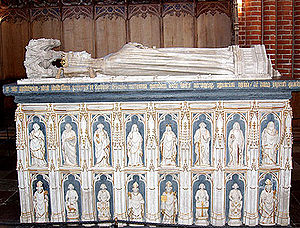
Harbor on 28 October 1412. Her sarcophagus made by the Lübeck sculptor Johannes Junge (1423) stands behind the high altar in the Roskilde Cathedral
, near Copenhagen
. She had left property to the Cathedral on the condition that Masses for her soul would be said regularly in the future. At the Reformation
(1536) this was discontinued; however, to this day, a special bell is being rung twice daily in commemoration of the Queen.
File:Seal of Margaret I of Denmark 1381 and 1403.png|Seal
of Margaret I of Denmark 1381 and 1403
File:Seal of Margaret I of Denmark 1390.svg|Seal of Margaret I of Denmark 1390
File:Okseoer 0354.jpg|Okseøerne, literally ”the ox islands”, two small islands on the Danish side of Flensburg Fjord
. Margaret I of Denmark is said to have died of the plague here in 1412.
Kalmar Union
The Kalmar Union is a historiographical term meaning a series of personal unions that united the three kingdoms of Denmark, Norway , and Sweden under a single monarch, though intermittently and with a population...
, which united the Scandinavian countries for over a century. Although she acted as queen regnant
Queen regnant
A queen regnant is a female monarch who reigns in her own right, in contrast to a queen consort, who is the wife of a reigning king. An empress regnant is a female monarch who reigns in her own right over an empire....
, the laws of contemporary Danish succession denied her formal queenship. Her title in Denmark was derived from her father King Valdemar IV of Denmark
Valdemar IV of Denmark
Valdemar IV of Denmark or Waldemar ; , was King of Denmark from 1340 to 1375.-Ascension to the throne:...
. She became Queen of Norway and Sweden by virtue of her marriage to King Haakon VI of Norway
Haakon VI of Norway
Haakon VI of Norway was King of Norway from 1343 until his death and King of Sweden from 1362 until 1364, when he was deposed by Albert of Mecklenburg in Sweden.-Background:...
.
Name
She is known in Denmark as "Margrete I," to distinguish her from the current queenMargrethe II of Denmark
Margrethe II is the Queen regnant of the Kingdom of Denmark. In 1972 she became the first female monarch of Denmark since Margaret I, ruler of the Scandinavian countries in 1375-1412 during the Kalmar Union.-Early life:...
. Denmark did not have a tradition of allowing women to rule and so when her son died she was named "All-powerful Lady and Mistress (Regent) of the Kingdom of Denmark." She only styled herself Queen of Denmark during 1375. Margaret usually referred to herself as "Margaret, by the grace of God, Valdemar the King of Denmark's daughter" and "Denmark's rightful heir" when referring to her position in Denmark. Others simply referred to her as the "Lady Queen" without specifying what she was Queen (or female king) of, but not so Pope
Pope
The Pope is the Bishop of Rome, a position that makes him the leader of the worldwide Catholic Church . In the Catholic Church, the Pope is regarded as the successor of Saint Peter, the Apostle...
Boniface IX, who in his letters styled her "our beloved daughter in Christ, Margaret, most excellent queen of Denmark, Sweden and Norway."
With regards to Norway, she was known as Queen (Queen-consort, then Dowager Queen) and Regent. In Sweden, she was Dowager Queen and Plenipotentiary Ruler. When she married Haakon
Haakon VI of Norway
Haakon VI of Norway was King of Norway from 1343 until his death and King of Sweden from 1362 until 1364, when he was deposed by Albert of Mecklenburg in Sweden.-Background:...
, in 1363, he was yet co-King of Sweden, making Margaret queen, and despite being deposed, they never relinquished the title. When the Swedes expelled Albert I in 1389, in theory, Margaret simply resumed her original position.
Biography
Margaret was born in Vordingborg CastleVordingborg Castle
The Vordingborg Castle ruins are located in the town of Vordingborg, Denmark and are the town's most famous attraction.-History:...
, the daughter of Valdemar IV of Denmark
Valdemar IV of Denmark
Valdemar IV of Denmark or Waldemar ; , was King of Denmark from 1340 to 1375.-Ascension to the throne:...
and Helvig of Schleswig. She married, at the age of ten, King Haakon VI of Norway
Haakon VI of Norway
Haakon VI of Norway was King of Norway from 1343 until his death and King of Sweden from 1362 until 1364, when he was deposed by Albert of Mecklenburg in Sweden.-Background:...
, who was the younger and only surviving son to Magnus VII of Norway, Magnus II of Sweden.
Her first act after her father's death in (1375) was to procure the election of her infant son Olaf as king of Denmark, despite the claims of her elder sister's husband Duke Henry of Mecklenburg and their son. She insisted that he be proclaimed rightful heir of Sweden among his other titles. Olaf was too young to rule in his own right and Margaret proved herself a competent and shrewd ruler in the years that followed. In 1380, on the death of his father, Oluf succeeded his father as King of Norway. Young Olaf died rather suddenly at age 17. The following year Margaret, who had ruled both kingdoms in his name, was chosen Regent of Norway
Norway
Norway , officially the Kingdom of Norway, is a Nordic unitary constitutional monarchy whose territory comprises the western portion of the Scandinavian Peninsula, Jan Mayen, and the Arctic archipelago of Svalbard and Bouvet Island. Norway has a total area of and a population of about 4.9 million...
and Denmark. She had already proved her superior statesmanship by recovering possession of Schleswig
Schleswig
Schleswig or South Jutland is a region covering the area about 60 km north and 70 km south of the border between Germany and Denmark; the territory has been divided between the two countries since 1920, with Northern Schleswig in Denmark and Southern Schleswig in Germany...
from the Holstein
Holstein
Holstein is the region between the rivers Elbe and Eider. It is part of Schleswig-Holstein, the northernmost state of Germany....
Counts. The Counts had held it absolutely for more than a generation and received it back as a gift by the compact of Nyborg, but under such stringent conditions that the Danish Crown got all the advantage of the arrangement. By this compact, moreover, the chronically rebellious Jutish Nobility lost the support they had hitherto always found in Schleswig-Holstein
Schleswig-Holstein
Schleswig-Holstein is the northernmost of the sixteen states of Germany, comprising most of the historical duchy of Holstein and the southern part of the former Duchy of Schleswig...
. Margaret, free from all fear of domestic sedition, could now give her undivided attention to Sweden
Sweden
Sweden , officially the Kingdom of Sweden , is a Nordic country on the Scandinavian Peninsula in Northern Europe. Sweden borders with Norway and Finland and is connected to Denmark by a bridge-tunnel across the Öresund....
, where the mutinous nobles were already in arms against their unpopular King, Albert of Mecklenburg
Albert of Sweden
Albert was King of Sweden from 1364 to 1389 and Duke of Mecklenburg-Schwerin from 1384 to 1412.-Background:...
. Several of the powerful nobles wrote to Margrethe advising her that, if she would help rid Sweden of King Albert, she would become Regent. She lost no time gathering an army and invading Sweden.
At a conference held at Dalaborg Castle, in March 1388, the Swedes were compelled to accept all of Margaret's conditions, elected her "Sovereign Lady and Ruler," and engaged to accept from her any King she chose to appoint. On 24 February 1389, Albert, who had returned from Mecklenburg with an army of mercenaries, was routed and taken prisoner at Aasle near Falköping
Falköping
Falköping is a locality and the seat of Falköping Municipality, Västra Götaland County, Sweden. It had 15,821 inhabitants in 2005.-History:The city of Falköping most likely emerged during the 15th century but earlier the town was an important site of pilgrimage due to its 12th century church...
, and Margaret was now the omnipotent mistress of three kingdoms.
Stockholm
Stockholm
Stockholm is the capital and the largest city of Sweden and constitutes the most populated urban area in Scandinavia. Stockholm is the most populous city in Sweden, with a population of 851,155 in the municipality , 1.37 million in the urban area , and around 2.1 million in the metropolitan area...
, then almost entirely a German city, still held out; fear of Margaret induced both the Mecklenburg Princes and the Wendish towns to hasten to its assistance; and the Baltic and the North Sea speedily swarmed with the privateers of the Victual Brothers
Victual Brothers
The Victual Brothers were a companionship of privateers who later turned to piracy. They were hired in 1392 by the Dukes of Mecklenburg to fight against Denmark, because the Danish Queen Margaret I had imprisoned Albrecht of Mecklenburg and his son in order to subdue the kingdom of Sweden...
or Vitalian Brotherhood, so-called because their professed object was to revictual Stockholm. Finally the Hansa
Hanseatic League
The Hanseatic League was an economic alliance of trading cities and their merchant guilds that dominated trade along the coast of Northern Europe...
intervened, and by the compact of Lindholm (1395) Albrecht was released by Margaret on promising to pay 60,000 marks within three years. The Hansa in the meantime were to hold Stockholm in pawn. Albert failed to pay his ransom within the stipulated time; the Hansa surrendered Stockholm to Margaret in September 1398, in exchange for commercial privileges.
Eric of Pomerania
It had been understood that Margaret should, at the first convenient opportunity, provide the three kingdoms with a King who was to be a kinsman of all the three old dynasties. However, in Norway it was specified that she would continue ruling alongside the new King. In 1389, she proclaimed her great-nephew, Eric of PomeraniaEric of Pomerania
Eric of Pomerania KG was King Eric III of Norway Norwegian Eirik, King Eric VII of Denmark , and as Eric King of Sweden...
(grandson of Henry of Mecklenburg), king of Norway, having adopted him and his sister Catherine. In 1396, homage was rendered to him in Denmark and Sweden; likewise, Margaret reserved to herself the office of Regent during his minority. To weld the united kingdoms still more closely together, Margaret summoned a Congress of the three Councils of the Realm
Rigsraadet
Rigsraadet, or Riksrådet, , is the name of the councils of the Scandinavian countries that ruled the countries together with the kings from late Middle Ages to the 17th century...
to Kalmar
Kalmar
Kalmar is a city in Småland in the south-east of Sweden, situated by the Baltic Sea. It had 62,767 inhabitants in 2010 and is the seat of Kalmar Municipality. It is also the capital of Kalmar County, which comprises 12 municipalities with a total of 233,776 inhabitants .From the thirteenth to the...
in June 1397; and on Trinity Sunday
Trinity Sunday
Trinity Sunday is the first Sunday after Pentecost in the Western Christian liturgical calendar, and the Sunday of Pentecost in Eastern Christianity...
, on 17 June, Eric was solemnly crowned King of Denmark, Norway and Sweden. The proposed Act of Union divided the three Councils, but the actual deed embodying the terms of the union never got beyond the stage of an unratified draft. Margaret balked at the clauses which insisted that each country should retain exclusive possession of its own laws and customs and be administered by its own dignitaries, because in her opinion this prevented the complete amalgamation of Scandinavia
Scandinavia
Scandinavia is a cultural, historical and ethno-linguistic region in northern Europe that includes the three kingdoms of Denmark, Norway and Sweden, characterized by their common ethno-cultural heritage and language. Modern Norway and Sweden proper are situated on the Scandinavian Peninsula,...
. But with her usual prudence, she avoided every appearance of an open rupture.
A few years after the Kalmar Union
Kalmar Union
The Kalmar Union is a historiographical term meaning a series of personal unions that united the three kingdoms of Denmark, Norway , and Sweden under a single monarch, though intermittently and with a population...
, Eric, when in his eighteenth year, was declared of age and homage was rendered to him in all his three kingdoms, but during her lifetime Margaret was the real ruler of Scandinavia.
Policy
Danehof
Danehof was the name of the Danish medieval parliament which played a certain role between c. 1250 and 1413.The precondition of the Danehof – like that of the Håndfæstning - was the growing power and opposition among the Danish magnates after 1250. They wanted limitations of the royal power,...
er or national assemblies fell into ruin, and the great Queen, an ideal despot, ruled through her court officials acting as superior clerks. But law and order were well maintained; the licence of the nobility was sternly repressed; the Kingdoms of Sweden and Norway were treated as integral parts of the Danish State, and national aspirations were frowned upon or checked, though Norway, being more loyal, was treated more indulgently than Sweden.
Margaret also recovered for the Crown all the landed property which had been alienated during the troubled days before Valdemar IV. This so-called "reduktion" or land-recovery, was carried out with the utmost rigour, and hundreds of estates fell into the hands of the Crown
The Crown
The Crown is a corporation sole that in the Commonwealth realms and any provincial or state sub-divisions thereof represents the legal embodiment of governance, whether executive, legislative, or judicial...
.
Margaret also reformed the Danish currency, substituting good silver coins for the old and worthless copper tokens, to the great advantage both of herself and the state. She had always large sums of money to dispose of, and a considerable proportion of this treasure was dispensed in works of charity.
Margaret's foreign policy was sagaciously circumspect, in sharp contrast with the venturesomeness of her father's. The most tempting offer of alliance, the most favourable conjunctures, could never move her from her system of neutrality. On the other hand she spared no pains to recover lost Danish territory. She purchased the island of Gotland
Gotland
Gotland is a county, province, municipality and diocese of Sweden; it is Sweden's largest island and the largest island in the Baltic Sea. At 3,140 square kilometers in area, the region makes up less than one percent of Sweden's total land area...
from its actual possessors, Albert of Mecklenburg and the Livonian Order
Livonian Order
The Livonian Order was an autonomous Livonian branch of the Teutonic Order and a member of the Livonian Confederation from 1435–1561. After being defeated by Samogitians in the 1236 Battle of Schaulen , the remnants of the Livonian Brothers of the Sword were incorporated into the Teutonic Knights...
, and the greater part of Schleswig was regained in the same way.
In 1402, Queen Margaret entered into negotiations with the King of England, Henry IV
Henry IV of England
Henry IV was King of England and Lord of Ireland . He was the ninth King of England of the House of Plantagenet and also asserted his grandfather's claim to the title King of France. He was born at Bolingbroke Castle in Lincolnshire, hence his other name, Henry Bolingbroke...
about the possibility of a double-wedding alliance between England
England
England is a country that is part of the United Kingdom. It shares land borders with Scotland to the north and Wales to the west; the Irish Sea is to the north west, the Celtic Sea to the south west, with the North Sea to the east and the English Channel to the south separating it from continental...
and the Nordic Union. The proposal was for a double-wedding, whereby King Eric would marry King Henry's daughter, Philippa
Philippa of England
Philippa of England , also known as Philippa of Lancaster and anachronistically as Philippa Plantagenet, was the Queen of Denmark, Sweden and Norway from 1406 to 1430. She was the consort to Eric of Pomerania, who ruled the three kingdoms...
, and King Henry's son, the Prince of Wales and future King Henry V
Henry V of England
Henry V was King of England from 1413 until his death at the age of 35 in 1422. He was the second monarch belonging to the House of Lancaster....
would marry King Eric's sister, Catherine. The English side wanted these weddings to seal an offensive alliance between the Nordic Kingdoms and England, which could have led to the involvement of the Nordic union on the English side in the ongoing Hundred Years' War
Hundred Years' War
The Hundred Years' War was a series of separate wars waged from 1337 to 1453 by the House of Valois and the House of Plantagenet, also known as the House of Anjou, for the French throne, which had become vacant upon the extinction of the senior Capetian line of French kings...
against France
France
The French Republic , The French Republic , The French Republic , (commonly known as France , is a unitary semi-presidential republic in Western Europe with several overseas territories and islands located on other continents and in the Indian, Pacific, and Atlantic oceans. Metropolitan France...
. Queen Margaret led a consistent foreign policy of not getting entangled in binding alliances and foreign wars. She therefore rejected the English proposals. The double-wedding did not come off, but Eric's wedding to Philippa was successfully negotiated. On 26 October 1406, King Eric married the 13-year-old Philippa, daughter of Henry IV of England and Mary de Bohun
Mary de Bohun
Mary de Bohun was the first wife of King Henry IV of England and the mother of King Henry V. Mary was never queen, as she died before her husband came to the throne.-Early life:...
, at Lund
Lund
-Main sights:During the 12th and 13th centuries, when the town was the seat of the archbishop, many churches and monasteries were built. At its peak, Lund had 27 churches, but most of them were demolished as result of the Reformation in 1536. Several medieval buildings remain, including Lund...
. The wedding was accompanied by a purely defensive alliance with England. For Eric's sister Catherine, a wedding was arranged with John, Count Palatine of Neumarkt
John, Count Palatine of Neumarkt
John was the Count Palatine of Neumarkt from 1410 until 1443.-Life:John was born in Neunburg vorm Wald in 1383 as the second surviving son of Rupert III of the Palatinate, King of Germany. In 1407 he married Catherine of Pomerania, the daughter of Duke Warcislaw VII of Pomerania-Stolp...
. Margaret thus acquired a southern German ally, who could be useful as a counterweight to the northern German Princes and cities.
Death
Margaret died suddenly on board her ship in FlensburgFlensburg
Flensburg is an independent town in the north of the German state of Schleswig-Holstein. Flensburg is the centre of the region of Southern Schleswig...
Harbor on 28 October 1412. Her sarcophagus made by the Lübeck sculptor Johannes Junge (1423) stands behind the high altar in the Roskilde Cathedral
Roskilde Cathedral
Roskilde Cathedral , in the city of Roskilde on the island of Zealand in eastern Denmark, is a cathedral of the Lutheran Church of Denmark. The first Gothic cathedral to be built of brick, it encouraged the spread of the Brick Gothic style throughout Northern Europe...
, near Copenhagen
Copenhagen
Copenhagen is the capital and largest city of Denmark, with an urban population of 1,199,224 and a metropolitan population of 1,930,260 . With the completion of the transnational Øresund Bridge in 2000, Copenhagen has become the centre of the increasingly integrating Øresund Region...
. She had left property to the Cathedral on the condition that Masses for her soul would be said regularly in the future. At the Reformation
Protestant Reformation
The Protestant Reformation was a 16th-century split within Western Christianity initiated by Martin Luther, John Calvin and other early Protestants. The efforts of the self-described "reformers", who objected to the doctrines, rituals and ecclesiastical structure of the Roman Catholic Church, led...
(1536) this was discontinued; however, to this day, a special bell is being rung twice daily in commemoration of the Queen.
Ancestry
Gallery
File:Seal of Margaret I of Denmark 1381 and 1403.png|Seal
Seal (device)
A seal can be a figure impressed in wax, clay, or some other medium, or embossed on paper, with the purpose of authenticating a document ; but the term can also mean the device for making such impressions, being essentially a mould with the mirror image of the design carved in sunken- relief or...
of Margaret I of Denmark 1381 and 1403
File:Seal of Margaret I of Denmark 1390.svg|Seal of Margaret I of Denmark 1390
File:Okseoer 0354.jpg|Okseøerne, literally ”the ox islands”, two small islands on the Danish side of Flensburg Fjord
Flensburg Fjord
Flensburg Fjord , occasionally known as Flensburg Firth, is a 50 km long inlet of the Baltic Sea. The fjord or firth forms part of the border between Germany to the south and Denmark to the north....
. Margaret I of Denmark is said to have died of the plague here in 1412.