

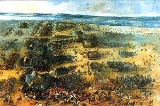
Battle of Kircholm

Encyclopedia
The Battle of Kircholm (27 September 1605, or 17 September in the Old Style calendar then in use in Protestant countries) was one of the major battles in the Polish-Swedish War of 1600-1611. The battle was decided in 20 minutes by the devastating charge of Polish-Lithuanian cavalry
, the Winged Hussars. The battle ended in the decisive victory of Polish-Lithuanian forces, and is remembered as one of the greatest triumphs of Commonwealth cavalry.
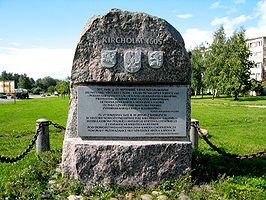 On 27 September 1605, the Commonwealth
and Swedish forces met near the small town of Kircholm
(now Salaspils in Latvia
, some 18 km. South East of Riga
). The forces of Charles IX of Sweden
were numerically superior and were composed of 10,800 men and 11 cannon
s. The Swedish army included a few thousand German and Dutch mercenaries
and even a few hundred Scot
s.
The Polish Crown declined to raise funds for defence, although Great Hetman of Lithuania Chodkiewicz promised to pay out army wages from his own fortune, thereby gathering at least some army. The Polish-Lithuanian Commonwealth army under Jan Karol Chodkiewicz
was composed of roughly 1,300 infantry (1040 pikeman and 260 musketeer), 2,600 cavalry and only 5 cannons. However, the Polish-Lithuanian forces were well-rested and their cavalry consisted mostly of superbly trained Winged Hussars or heavy cavalry armed with lance
s, while the Swedish cavalry were less-well trained, armed with pistols and carbines, on poorer horses, and tired after a long night's march in torrential rain. Most of the hussars were from the Grand Duchy of Lithuania
, about 200 were from the Polish Crown, most of them mercenaries or close personal allies of Chodkiewicz. The Polish-Lithuanian forces were also aided by a small number of Tatars
and Polish-Lithuanian Cossack
horse (a class of light cavalry at this date not to be confused with the Russian Cossacks), used mostly for reconnaissance.
formation, made up of the infantry regiment
s formed into 7 or 8 well-spaced independent blocks, with intersecting fields of fire. The flanks
were covered by the Swedish and German cavalry and the cannons were placed in front of the cavalry.
Jan Karol Chodkiewicz
deployed his forces in the traditional deep Polish-Lithuanian battle formation - the so called "Old Polish Order" - with the left wing
significantly stronger and commanded by Dąbrowa, while the right wing was composed of a smaller number of Hussars under Paweł Jan Sapieha
and the centre, which included Hetman
Chodkiewicz's own company of 300 hussars led by Woyna and a powerful formation of reiters sent by the Duke of Courland
. The Lithuanian infantry supported by Poles, mostly armed in Hungarian
haiduk
-style, drew up in the centre. Some 280 hussars were left as a general reserve under Lacki.
to lure the Swedes off their high position. The Swedes under Charles thought that the Lithuanians and supporting Poles were retreating and therefore advanced, spreading out their formations to give chase. This is what Chodkiewicz was waiting for. The Commonwealth forces now gave fire with their infantry causing the Swedes some losses, at which point the Hussars quickly re-grouped their battle formations and charged at the Swedish lines.
The battle started with the Polish-Lithuanian cavalry charge on the Swedish left flank. At the same time approximately 300 Polish-Lithuanian Hussars charged the Swedish infantry in the centre to prevent them from interfering with the cavalry action on both their flanks. According to one contemporary source "Carolomachia" cavalry went on attack with the Lithuanian battlecry, "Mušk!" (approximate English translation would be "strike" or "beat"). After the Swedish cavalry was pushed back, Chodkiewicz ordered his left wing and all of his reserves to attack the opposing right Swedish flank. The Swedish reiters were beaten back on both wings and the infantry in the centre was attacked from three sides simultaneously. Quickly, with Swedish horsemen running back into their own infantry, the Swedes were in panic, and the whole army collapsed in flight. It was at this point that the Swedes suffered their heaviest casualties.
The fighting lasted barely 20 to 30 minutes, yet the Swedish defeat was utter and complete. The army of Charles IX
had lost at least half, perhaps as much as two-thirds, its original strength. The Polish-Lithuanian losses numbered only about 100 dead and 200 wounded, although the Hussars, in particular, lost a large part of their trained battle horses.
As in all crushing victories in this period, the larger part of the Swedish losses were suffered during the retreat, made more difficult by the dense forests and marshes on the route back to Riga
. The Lithuanians and Poles spared few. Polish-Lithuanian casualties were light, in large part due to the speed of the victory. During the hussar's charges it was the horses that took the greatest damage, the riders being largely protected by the body and heads of their horses.
.jpg)
of Riga
and withdraw by ship back across the Baltic Sea
to Sweden
and to relinquish control of northern Latvia
and Estonia
. However, the Commonwealth proved unable to exploit the victory fully because there was no money for the troops, who had not been paid for months. Without pay they could not buy food or fodder for their horses or replenish their military supplies, and so the campaign faltered. An additional factor was the large number of trained horses lost during the battle, which proved difficult to replace.
A truce was eventually signed in 1611, but by 1617 war broke out again, and finally in 1621 the new Swedish king, Gustavus Adolphus
, landed near Riga
and took the city with a brief siege, wiping away - in Swedish eyes - much of the shame suffered at Kircholm.
Cavalry
Cavalry or horsemen were soldiers or warriors who fought mounted on horseback. Cavalry were historically the third oldest and the most mobile of the combat arms...
, the Winged Hussars. The battle ended in the decisive victory of Polish-Lithuanian forces, and is remembered as one of the greatest triumphs of Commonwealth cavalry.
Eve of the Battle
Polish-Lithuanian Commonwealth
The Polish–Lithuanian Commonwealth was a dualistic state of Poland and Lithuania ruled by a common monarch. It was the largest and one of the most populous countries of 16th- and 17th‑century Europe with some and a multi-ethnic population of 11 million at its peak in the early 17th century...
and Swedish forces met near the small town of Kircholm
Salaspils
Salaspils is a town in Latvia, the administrative centre of Salaspils municipality. The town is situated on the northern bank of the Daugava River 18 kilometers to the south-east of the city of Riga.-History:...
(now Salaspils in Latvia
Latvia
Latvia , officially the Republic of Latvia , is a country in the Baltic region of Northern Europe. It is bordered to the north by Estonia , to the south by Lithuania , to the east by the Russian Federation , to the southeast by Belarus and shares maritime borders to the west with Sweden...
, some 18 km. South East of Riga
Riga
Riga is the capital and largest city of Latvia. With 702,891 inhabitants Riga is the largest city of the Baltic states, one of the largest cities in Northern Europe and home to more than one third of Latvia's population. The city is an important seaport and a major industrial, commercial,...
). The forces of Charles IX of Sweden
Charles IX of Sweden
Charles IX of Sweden also Carl, was King of Sweden from 1604 until his death. He was the youngest son of King Gustav I of Sweden and his second wife, Margaret Leijonhufvud, brother of Eric XIV and John III of Sweden, and uncle of Sigismund III Vasa king of both Sweden and Poland...
were numerically superior and were composed of 10,800 men and 11 cannon
Cannon
A cannon is any piece of artillery that uses gunpowder or other usually explosive-based propellents to launch a projectile. Cannon vary in caliber, range, mobility, rate of fire, angle of fire, and firepower; different forms of cannon combine and balance these attributes in varying degrees,...
s. The Swedish army included a few thousand German and Dutch mercenaries
Mercenary
A mercenary, is a person who takes part in an armed conflict based on the promise of material compensation rather than having a direct interest in, or a legal obligation to, the conflict itself. A non-conscript professional member of a regular army is not considered to be a mercenary although he...
and even a few hundred Scot
Scot
A Scot is a member of an ethnic group indigenous to Scotland, derived from the Latin name of Irish raiders, the Scoti.Scot may also refer to:People with the given name Scot:* Scot Brantley , American football linebacker...
s.
The Polish Crown declined to raise funds for defence, although Great Hetman of Lithuania Chodkiewicz promised to pay out army wages from his own fortune, thereby gathering at least some army. The Polish-Lithuanian Commonwealth army under Jan Karol Chodkiewicz
Jan Karol Chodkiewicz
Jan Karol Chodkiewicz was a famous Lithuanian military commander and one of the most prominent noblemen of the Polish-Lithuanian Commonwealth.-Biography:...
was composed of roughly 1,300 infantry (1040 pikeman and 260 musketeer), 2,600 cavalry and only 5 cannons. However, the Polish-Lithuanian forces were well-rested and their cavalry consisted mostly of superbly trained Winged Hussars or heavy cavalry armed with lance
Lance
A Lance is a pole weapon or spear designed to be used by a mounted warrior. The lance is longer, stout and heavier than an infantry spear, and unsuited for throwing, or for rapid thrusting. Lances did not have tips designed to intentionally break off or bend, unlike many throwing weapons of the...
s, while the Swedish cavalry were less-well trained, armed with pistols and carbines, on poorer horses, and tired after a long night's march in torrential rain. Most of the hussars were from the Grand Duchy of Lithuania
Grand Duchy of Lithuania
The Grand Duchy of Lithuania was a European state from the 12th /13th century until 1569 and then as a constituent part of Polish-Lithuanian Commonwealth until 1791 when Constitution of May 3, 1791 abolished it in favor of unitary state. It was founded by the Lithuanians, one of the polytheistic...
, about 200 were from the Polish Crown, most of them mercenaries or close personal allies of Chodkiewicz. The Polish-Lithuanian forces were also aided by a small number of Tatars
Lipka Tatars
The Lipka Tatars are a group of Tatars who originally settled in the Grand Duchy of Lithuania at the beginning of 14th century. The first settlers tried to preserve their shamanistic religion and sought asylum amongst the non-Christian Lithuanians...
and Polish-Lithuanian Cossack
Cossack
Cossacks are a group of predominantly East Slavic people who originally were members of democratic, semi-military communities in what is today Ukraine and Southern Russia inhabiting sparsely populated areas and islands in the lower Dnieper and Don basins and who played an important role in the...
horse (a class of light cavalry at this date not to be confused with the Russian Cossacks), used mostly for reconnaissance.
Deployment
The Swedish forces seem to have been deployed in a checkerboardCheckerboard
A checkerboard or chequerboard is a board of chequered pattern on which English draughts is played. It is an 8×8 board and the 64 squares are of alternating dark and light color, often red and black....
formation, made up of the infantry regiment
Regiment
A regiment is a major tactical military unit, composed of variable numbers of batteries, squadrons or battalions, commanded by a colonel or lieutenant colonel...
s formed into 7 or 8 well-spaced independent blocks, with intersecting fields of fire. The flanks
Flanking maneuver
In military tactics, a flanking maneuver, also called a flank attack, is an attack on the sides of an opposing force. If a flanking maneuver succeeds, the opposing force would be surrounded from two or more directions, which significantly reduces the maneuverability of the outflanked force and its...
were covered by the Swedish and German cavalry and the cannons were placed in front of the cavalry.
Jan Karol Chodkiewicz
Jan Karol Chodkiewicz
Jan Karol Chodkiewicz was a famous Lithuanian military commander and one of the most prominent noblemen of the Polish-Lithuanian Commonwealth.-Biography:...
deployed his forces in the traditional deep Polish-Lithuanian battle formation - the so called "Old Polish Order" - with the left wing
Wing
A wing is an appendage with a surface that produces lift for flight or propulsion through the atmosphere, or through another gaseous or liquid fluid...
significantly stronger and commanded by Dąbrowa, while the right wing was composed of a smaller number of Hussars under Paweł Jan Sapieha
Paweł Jan Sapieha
Paweł Jan Sapieha was a Polish-Lithuanian nobleman .Paweł Jan became a Hussar Rotmistrz in 1633, courtier in 1635, Obozny of Lithuania in 1638, Podstoli of Lithuania in 1645, voivode of the Witebsk Voivodeship in 1646, voivode of the Vilnius Voivodeship and Great Hetman of Lithuania in 1656.He...
and the centre, which included Hetman
Hetman
Hetman was the title of the second-highest military commander in 15th- to 18th-century Poland and the Grand Duchy of Lithuania, which together, from 1569 to 1795, comprised the Polish-Lithuanian Commonwealth, or Rzeczpospolita....
Chodkiewicz's own company of 300 hussars led by Woyna and a powerful formation of reiters sent by the Duke of Courland
Courland
Courland is one of the historical and cultural regions of Latvia. The regions of Semigallia and Selonia are sometimes considered as part of Courland.- Geography and climate :...
. The Lithuanian infantry supported by Poles, mostly armed in Hungarian
Hungary
Hungary , officially the Republic of Hungary , is a landlocked country in Central Europe. It is situated in the Carpathian Basin and is bordered by Slovakia to the north, Ukraine and Romania to the east, Serbia and Croatia to the south, Slovenia to the southwest and Austria to the west. The...
haiduk
Hajduk (soldiers)
The Hajduk were Hungarian irregular or mercenary soldiers in the 16th and 17th centuries, and a liveried bodyguard of the Polish-Lithuanian Commonwealth in the 17th and 18th centuries. In Serbia and the Banat region in the 18th century, hajduk referred to an infantry soldier, though the term is now...
-style, drew up in the centre. Some 280 hussars were left as a general reserve under Lacki.
Battle
Chodkiewicz, having smaller forces (approximately a 1:3 disadvantage), used a feintFeint
Feint is a French term that entered English from the discipline of fencing. Feints are maneuvers designed to distract or mislead, done by giving the impression that a certain maneuver will take place, while in fact another, or even none, will...
to lure the Swedes off their high position. The Swedes under Charles thought that the Lithuanians and supporting Poles were retreating and therefore advanced, spreading out their formations to give chase. This is what Chodkiewicz was waiting for. The Commonwealth forces now gave fire with their infantry causing the Swedes some losses, at which point the Hussars quickly re-grouped their battle formations and charged at the Swedish lines.
The battle started with the Polish-Lithuanian cavalry charge on the Swedish left flank. At the same time approximately 300 Polish-Lithuanian Hussars charged the Swedish infantry in the centre to prevent them from interfering with the cavalry action on both their flanks. According to one contemporary source "Carolomachia" cavalry went on attack with the Lithuanian battlecry, "Mušk!" (approximate English translation would be "strike" or "beat"). After the Swedish cavalry was pushed back, Chodkiewicz ordered his left wing and all of his reserves to attack the opposing right Swedish flank. The Swedish reiters were beaten back on both wings and the infantry in the centre was attacked from three sides simultaneously. Quickly, with Swedish horsemen running back into their own infantry, the Swedes were in panic, and the whole army collapsed in flight. It was at this point that the Swedes suffered their heaviest casualties.
The fighting lasted barely 20 to 30 minutes, yet the Swedish defeat was utter and complete. The army of Charles IX
Charles IX of Sweden
Charles IX of Sweden also Carl, was King of Sweden from 1604 until his death. He was the youngest son of King Gustav I of Sweden and his second wife, Margaret Leijonhufvud, brother of Eric XIV and John III of Sweden, and uncle of Sigismund III Vasa king of both Sweden and Poland...
had lost at least half, perhaps as much as two-thirds, its original strength. The Polish-Lithuanian losses numbered only about 100 dead and 200 wounded, although the Hussars, in particular, lost a large part of their trained battle horses.
As in all crushing victories in this period, the larger part of the Swedish losses were suffered during the retreat, made more difficult by the dense forests and marshes on the route back to Riga
Riga
Riga is the capital and largest city of Latvia. With 702,891 inhabitants Riga is the largest city of the Baltic states, one of the largest cities in Northern Europe and home to more than one third of Latvia's population. The city is an important seaport and a major industrial, commercial,...
. The Lithuanians and Poles spared few. Polish-Lithuanian casualties were light, in large part due to the speed of the victory. During the hussar's charges it was the horses that took the greatest damage, the riders being largely protected by the body and heads of their horses.
Aftermath
After the defeat, the Swedish king was forced to abandon the siegeSiege
A siege is a military blockade of a city or fortress with the intent of conquering by attrition or assault. The term derives from sedere, Latin for "to sit". Generally speaking, siege warfare is a form of constant, low intensity conflict characterized by one party holding a strong, static...
of Riga
Riga
Riga is the capital and largest city of Latvia. With 702,891 inhabitants Riga is the largest city of the Baltic states, one of the largest cities in Northern Europe and home to more than one third of Latvia's population. The city is an important seaport and a major industrial, commercial,...
and withdraw by ship back across the Baltic Sea
Baltic Sea
The Baltic Sea is a brackish mediterranean sea located in Northern Europe, from 53°N to 66°N latitude and from 20°E to 26°E longitude. It is bounded by the Scandinavian Peninsula, the mainland of Europe, and the Danish islands. It drains into the Kattegat by way of the Øresund, the Great Belt and...
to Sweden
Sweden
Sweden , officially the Kingdom of Sweden , is a Nordic country on the Scandinavian Peninsula in Northern Europe. Sweden borders with Norway and Finland and is connected to Denmark by a bridge-tunnel across the Öresund....
and to relinquish control of northern Latvia
Latvia
Latvia , officially the Republic of Latvia , is a country in the Baltic region of Northern Europe. It is bordered to the north by Estonia , to the south by Lithuania , to the east by the Russian Federation , to the southeast by Belarus and shares maritime borders to the west with Sweden...
and Estonia
Estonia
Estonia , officially the Republic of Estonia , is a state in the Baltic region of Northern Europe. It is bordered to the north by the Gulf of Finland, to the west by the Baltic Sea, to the south by Latvia , and to the east by Lake Peipsi and the Russian Federation . Across the Baltic Sea lies...
. However, the Commonwealth proved unable to exploit the victory fully because there was no money for the troops, who had not been paid for months. Without pay they could not buy food or fodder for their horses or replenish their military supplies, and so the campaign faltered. An additional factor was the large number of trained horses lost during the battle, which proved difficult to replace.
A truce was eventually signed in 1611, but by 1617 war broke out again, and finally in 1621 the new Swedish king, Gustavus Adolphus
Gustavus Adolphus of Sweden
Gustav II Adolf has been widely known in English by his Latinized name Gustavus Adolphus Magnus and variously in historical writings also as Gustavus, or Gustavus the Great, or Gustav Adolph the Great,...
, landed near Riga
Riga
Riga is the capital and largest city of Latvia. With 702,891 inhabitants Riga is the largest city of the Baltic states, one of the largest cities in Northern Europe and home to more than one third of Latvia's population. The city is an important seaport and a major industrial, commercial,...
and took the city with a brief siege, wiping away - in Swedish eyes - much of the shame suffered at Kircholm.