
All Topics  
PBY Catalina

 
PBY Catalina

   Email Print
   Bookmark   Link


PBY Catalina


The Consolidated PBY Catalina was an American
United States

The United States of America is a Federal government constitutional republic comprising U.S. state and a federal district. The country is situated mostly in central North America, where its Contiguous United States and Washington, D.C., the Capital districts and territories, lie between the Pacific Ocean and Atlantic Oceans, Borders of the U...
 flying boat
Flying boat

A flying boat is a specialised form of aircraft that is designed to take off from and land on water, using its fuselage as a floating Hull . Such aircraft are sometimes stabilised on water by underwing floats or by wing-like projections from the fuselage....
 of the 1930s and 1940s produced by Consolidated Aircraft
Consolidated Aircraft

The Consolidated Aircraft Corporation was founded in 1923 in aviation by Reuben Hollis Fleet in Buffalo, New York. The result of a merger between Gaulladet Aircraft Company and Dayton-Wright Company, Consolidated became famous during the 1920s and 1930s for its line of flying boats....
. It could be equipped with depth charge
Depth charge

The depth charge is an anti-submarine weapon intended to defeat its target by the shock of exploding near it. Most use explosives and a Fuse_%28explosives%29#Munition_fuzes set to go off at a predetermined depth....
s, bomb
Bomb

A bomb is any of a range of explosive devices that typically rely on the exothermic chemical reaction of an explosive material to produce an extremely sudden and violent release of energy....
s, torpedo
Torpedo

Note: Prior to 1900, in naval usage "torpedo" could also refer to what today is called a naval mine. For that usage, see naval mine.The modern torpedo is a self-propelled explosive projectile weapon, launched above or below the water surface, propelled underwater toward a target, and designed to detonate on contact or in proximity t...
es, and M2 Browning machine gun
Machine gun

A machine gun is a Automatic firearm mounted or portable firearm, usually designed to fire List of rifle cartridgess in quick succession from an Belt or large-capacity Magazine , typically at a rate of several hundred rounds per minute....
s and was one of the most widely used multi-role aircraft of World War II
World War II

World War II, or the Second World War , was a global military conflict which involved a Participants in World War II, including all of the great powers, organised into two opposing military alliances: the Allies of World War II and the Axis powers....
. PBYs served with every branch of the United States Armed Forces and in the air forces and navies of many other nations. In the U.S. Army Air Forces
United States Army Air Forces

The United States Army Air Forces was the military aviation arm of the United States of America during and immediately after World War II. The direct precursor to the United States Air Force, its peak size was over 2.4 million men and women in service and nearly 80,000 aircraft in 1944, and 783 domestic bases in December 1943....
 and later in the U.S. Air Force
United States Air Force

The United States Air Force is the aerial warfare branch of the Military of the United States and one of the uniformed services of the United States....
 their designation was the OA-10, while Canadian
Canada

Canada is a country occupying most of northern North America, extending from the Atlantic Ocean in the east to the Pacific Ocean in the west and northward into the Arctic Ocean....
-built PBYs were known as Cansos.

In World War II
World War II

World War II, or the Second World War , was a global military conflict which involved a Participants in World War II, including all of the great powers, organised into two opposing military alliances: the Allies of World War II and the Axis powers....
, PBYs were used in anti-submarine warfare
Anti-submarine warfare

Anti-submarine warfare is a branch of naval warfare that uses surface warships, aircraft, or other submarines to find, track and then damage or destroy enemy submarines....
, patrol bombing, convoy escorts
Convoy

A convoy is a group of vehicles traveling together for mutual support and protection. Often, a convoy is organized with armed defensive support, though it may also be used in a non-military sense, for example when driving through remote areas....
, search-and-rescue missions
Search and rescue

Search and rescue is the search for and provision of aid to people who are in distress or imminent danger....
, and cargo transport
Cargo aircraft

File:An-225 Mriya.jpg A cargo aircraft plane is a fixed-wing aircraft designed or converted for the carriage of goods, rather than passengers....
.


Discussion
Ask a question about 'PBY Catalina'
Start a new discussion about 'PBY Catalina'
Answer questions from other users
Full Discussion Forum


Encyclopedia


The Consolidated PBY Catalina was an American
United States

The United States of America is a Federal government constitutional republic comprising U.S. state and a federal district. The country is situated mostly in central North America, where its Contiguous United States and Washington, D.C., the Capital districts and territories, lie between the Pacific Ocean and Atlantic Oceans, Borders of the U...
 flying boat
Flying boat

A flying boat is a specialised form of aircraft that is designed to take off from and land on water, using its fuselage as a floating Hull . Such aircraft are sometimes stabilised on water by underwing floats or by wing-like projections from the fuselage....
 of the 1930s and 1940s produced by Consolidated Aircraft
Consolidated Aircraft

The Consolidated Aircraft Corporation was founded in 1923 in aviation by Reuben Hollis Fleet in Buffalo, New York. The result of a merger between Gaulladet Aircraft Company and Dayton-Wright Company, Consolidated became famous during the 1920s and 1930s for its line of flying boats....
. It could be equipped with depth charge
Depth charge

The depth charge is an anti-submarine weapon intended to defeat its target by the shock of exploding near it. Most use explosives and a Fuse_%28explosives%29#Munition_fuzes set to go off at a predetermined depth....
s, bomb
Bomb

A bomb is any of a range of explosive devices that typically rely on the exothermic chemical reaction of an explosive material to produce an extremely sudden and violent release of energy....
s, torpedo
Torpedo

Note: Prior to 1900, in naval usage "torpedo" could also refer to what today is called a naval mine. For that usage, see naval mine.The modern torpedo is a self-propelled explosive projectile weapon, launched above or below the water surface, propelled underwater toward a target, and designed to detonate on contact or in proximity t...
es, and M2 Browning machine gun
Machine gun

A machine gun is a Automatic firearm mounted or portable firearm, usually designed to fire List of rifle cartridgess in quick succession from an Belt or large-capacity Magazine , typically at a rate of several hundred rounds per minute....
s and was one of the most widely used multi-role aircraft of World War II
World War II

World War II, or the Second World War , was a global military conflict which involved a Participants in World War II, including all of the great powers, organised into two opposing military alliances: the Allies of World War II and the Axis powers....
. PBYs served with every branch of the United States Armed Forces and in the air forces and navies of many other nations. In the U.S. Army Air Forces
United States Army Air Forces

The United States Army Air Forces was the military aviation arm of the United States of America during and immediately after World War II. The direct precursor to the United States Air Force, its peak size was over 2.4 million men and women in service and nearly 80,000 aircraft in 1944, and 783 domestic bases in December 1943....
 and later in the U.S. Air Force
United States Air Force

The United States Air Force is the aerial warfare branch of the Military of the United States and one of the uniformed services of the United States....
 their designation was the OA-10, while Canadian
Canada

Canada is a country occupying most of northern North America, extending from the Atlantic Ocean in the east to the Pacific Ocean in the west and northward into the Arctic Ocean....
-built PBYs were known as Cansos.

In World War II
World War II

World War II, or the Second World War , was a global military conflict which involved a Participants in World War II, including all of the great powers, organised into two opposing military alliances: the Allies of World War II and the Axis powers....
, PBYs were used in anti-submarine warfare
Anti-submarine warfare

Anti-submarine warfare is a branch of naval warfare that uses surface warships, aircraft, or other submarines to find, track and then damage or destroy enemy submarines....
, patrol bombing, convoy escorts
Convoy

A convoy is a group of vehicles traveling together for mutual support and protection. Often, a convoy is organized with armed defensive support, though it may also be used in a non-military sense, for example when driving through remote areas....
, search-and-rescue missions
Search and rescue

Search and rescue is the search for and provision of aid to people who are in distress or imminent danger....
, and cargo transport
Cargo aircraft

File:An-225 Mriya.jpg A cargo aircraft plane is a fixed-wing aircraft designed or converted for the carriage of goods, rather than passengers....
. The PBY was the most successful aircraft of its kind; no other flying boat was produced in greater numbers. The last active military PBYs were not retired from service until the 1980s. Even today, over seventy years after its first flight, the aircraft continues to fly as an airtanker in aerial firefighting
Aerial firefighting

Aerial firefighting is the use of aircraft and other aerial resources to combat wildfires. The types of aircraft used include fixed-wing aircraft and helicopters....
 operations all over the world.

In the acronym
Acronym and initialism

Acronyms, initialisms, and alphabetisms are abbreviations that are formed using the initial components in a phrase or name. These components may be individual letters or parts of words ....
 PBY, "PB" stands for "Patrol Bomber" and "Y" is the code for "Consolidated Aircraft", as designated in the U.S. Navy aircraft designation system of 1922
1922 United States Navy aircraft designation system

Until 1962, the United States Navy used a system to designate its aircraft that included information about a craft's role and its manufacturer....
.

Development


Background

The PBY was originally designed to be a patrol bomber
Patrol bomber

A Maritime patrol aircraft, also simply patrol aircraft, or by the older term patrol bomber, is a fixed-wing aircraft designed to operate for long durations over water in maritime patrol, anti-shipping, Anti-submarine warfare and search and rescue roles....
, an aircraft with a long operational range intended to locate and attack enemy transport ships at sea in order to compromise enemy supply lines. With a mind to a potential conflict in the Pacific Ocean
Pacific Ocean

The Pacific Ocean is the largest of the Earth's oceanic divisions. Its name is derived from the Latin name Mare Pacificum, "peaceful sea", bestowed upon it by the Portugal explorer Ferdinand Magellan....
, where troops would require resupply over great distances, the U.S. Navy in the 1930s invested millions of dollars in developing long-range flying boats for this purpose. Flying boats had the advantage of not requiring runway
Runway

A runway is a strip of land on an airport, on which aircraft can Takeoff and landing. Runways may be a man-made surface or a natural surface ....
s, in effect having the entire ocean available. Several different flying boats were adopted by the Navy, but the PBY was the most widely used and produced.

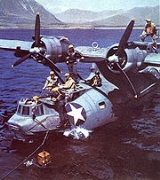
Pby 5a Catalina
Although slow and ungainly, PBYs distinguished themselves in World War II as exceptionally reliable. Allied
Allies of World War II

The Allies of World War II were the countries officially opposed to the Axis powers of World War II during the World War II. Within the ranks of the Allies powers, the British Empire, the Soviet Union, and the United States of America were known as "The Big Three"....
 armed forces used them successfully in a wide variety of roles that the aircraft was never intended for. They are remembered by many veterans of the war for their role in rescuing downed airmen, in which they saved the lives of thousands of aircrew downed over water. PBY airmen called their aircraft the "cat" on combat missions and "Dumbo" in air-sea rescue service.

Prototyping


As American dominance in the Pacific Ocean began to face competition from Japan in the 1930s, the U.S. Navy contracted Consolidated Aircraft and Douglas Aircraft Corporation in October 1933 to build competing prototype
Prototype

A prototype is an original type, form, or instance of something serving as a typical example, basis, or standard for other things of the same category....
s for a patrol flying boat
Flying boat

A flying boat is a specialised form of aircraft that is designed to take off from and land on water, using its fuselage as a floating Hull . Such aircraft are sometimes stabilised on water by underwing floats or by wing-like projections from the fuselage....
. Naval doctrine of the 1930s and 1940s used flying boats in a wide variety of roles that today are handled by multiple special-purpose aircraft. The US Navy had adopted the Consolidated P2Y
Consolidated P2Y

The Consolidated P2Y is a patrol flying-boat aircraft. The plane was a parasol monoplane with a fabric covered wing and aluminum hull....
 and Martin P3M models for this role in 1931, but both aircraft proved to be underpowered and hampered by short ranges and low maximum payloads.

Consolidated and Douglas both delivered single prototypes of their designs, the XP3Y-1 and XP3D-1, respectively. Consolidated's XP3Y-1 was an evolution of the XPY-1 design that had originally competed unsuccessfully for the P3M contract two years earlier and of the XP2Y design that the Navy had authorized for a limited production run. Although the Douglas aircraft was a good design, the Navy opted for Consolidated's because the projected cost was only $90,000 per plane.

Pby Gun Blister
Consolidated's XP3Y-1 design (company Model 28) was revolutionary in a number of ways. The aircraft had a parasol wing
Parasol wing

A parasol wing monoplane is an aircraft design in which the wing is not mounted directly to the fuselage, but rather, the fuselage is supported beneath it by a set of struts....
 with internal bracing that allowed the wing to be a virtual cantilever
Cantilever

A cantilever is a Beam supported on only one end. The beam carries the load to the support where it is resisted by Moment and shear stress. Cantilever construction allows for overhanging structures without external bracing....
, except for two small streamlined
Streamliner

A streamliner is any vehicle that incorporates streamline to produce a shape that provides less air resistance. The term is most often applied to certain high-speed railway trainsets of the 1930s to 1950s, and to their successor "high-speed trains"....
 struts on each side. Stabilizing floats, retractable in flight to form streamlined wingtips, were another aerodynamic innovation. The two-step hull design was similar to that of the P2Y, but the Model 28 had a cantilever cruciform tail
Cruciform tail

The cruciform tail is an aircraft empennage configuration which, when viewed from the aircraft's front or rear, looks much like a cross. In this arrangement, the horizontal stabilizer intersects the vertical tail somewhere near the middle, and above the top of the fuselage....
 unit instead of a strut-braced twin tail
Twin tail

A twin tail is a specific type of vertical stabilizer arrangement found on some aircraft. Two vertical stabilizers ? often smaller on their own than a single conventional tail would be ? are mounted at the outside of the aircraft's horizontal stabilizer....
. Cleaner aerodynamics gave the Model 28 better performance than earlier designs.

The prototype was powered by two 825 hp (615 kW) Pratt & Whitney R-1830-54
Pratt & Whitney R-1830

The Pratt & Whitney R-1830 Twin Wasp was an engine widely used in United States aircraft in the 1930s and 1940s. Produced by Pratt & Whitney, it was a two-row, 14 cylinder, air-cooled radial design....
 Twin Wasp engine
Engine

An engine is a mechanical device that produces some form of output from a given input.An engine whose purpose is to produce kinetic energy output from a fuel is called a Wiktionary:prime mover; alternatively, a motor is a device which produces kinetic energy from a preprocessed "fuel" ....
s mounted on the wing’s leading edges. Armament comprised four 0.30 in (7.62 mm) Browning
Browning Model 1919 machine gun

The Browning M1919 is a .30-06 Springfield medium machine gun family widely used during the 20th century. It was used as a light infantry, coaxial weapon, mounted, aircraft, and anti-aircraft machine gun by the U.S....
 machineguns and up to 2,000 lb (907 kg) of bombs.

The XP3Y-1 had its maiden flight on 28 March 1935, after which it was transferred to the US Navy for service trials. The XP3Y-1 soon proved to have significant performance improvements over current patrol flying boats. The Navy requested further development in order to bring the aircraft into the category of patrol bomber, and in October 1935, the prototype was returned to Consolidated for further work, including installation of 900 hp (671 kW) R-1830-64 engines. For the redesignated XPBY-1, Consolidated introduced redesigned vertical tail surfaces. The XPBY-1 had its maiden flight on 19 May 1936, during which a record non-stop distance flight of 3,443 miles (5,541 km) was achieved.

The XPBY-1 was delivered to VP-11F in October 1936. The second squadron to be equipped was VP-12, which received the first of its aircraft in early 1937. The second production order was placed on 25 July 1936. Over the next three years, the PBY design was gradually developed further and successive models introduced.

Mass-produced U.S. Navy* variants

Model Production period & distinguishing features Quantity
PBY-1 September 1936 - June 1937
Original production model.
60
PBY-2 May 1937 - February 1938
Minor alterations to tail structure, hull reinforcements.
50
PBY-3 November 1936 - August 1938
Higher power engines.
66
PBY-4 May 1938 - June 1939
Higher power engines, propeller spinners, acrylic glass
Acrylic glass

Poly poly is a thermoplastic and transparency plastic. Chemically, it is the synthetic polymer of methyl methacrylate. It is sold by the trade names Plexiglas, Vitroflex, Limacryl, 'R-Cast, 'Per-Clax, 'Perspex, 'Plazcryl, 'Acrylex, 'Acrylite, 'Acrylplast, 'Altuglas, 'Polycast...
 blisters over waist guns (some later units).
32
PBY-5 September 1940 - July 1943
Higher power engines (using higher octane fuel), discontinued use of propeller spinners, standardized waist gun blisters.
684
PBY-5A October 1941 - January 1945
Hydraulically-actuated, retractable tricycle landing gear for amphibious operation. Introduced tail gun position, replaced bow single gun position with bow "eyeball" turret equipped with twin .30 machine guns (some later units), improved armor, self-sealing fuel tanks.
802
PBY-6A January 1945 - May 1945
Incorporated changes from PBN-1, including a taller vertical tail, increased wing strength for greater carrying capacity, new electrical system, standardized "eyeball" turret, and a radome over cockpit for radar
Radar

Radar is a system that uses electromagnetic radiation waves to identify the range, altitude, direction, or speed of both moving and fixed objects such as aircraft, ships, motor vehicles, weather formations, and terrain....
.
175
* An estimated 4,051 Catalinas, Cansos, and GSTs of all variants were produced between June 1937 and May 1945 for the US Navy, USAAF
United States Army Air Forces

The United States Army Air Forces was the military aviation arm of the United States of America during and immediately after World War II. The direct precursor to the United States Air Force, its peak size was over 2.4 million men and women in service and nearly 80,000 aircraft in 1944, and 783 domestic bases in December 1943....
, United States Coast Guard
United States Coast Guard

The United States Coast Guard is a branch of the Military of the United States and one of seven Uniformed services of the United States. In addition to being a military branch at all times, it is unique among the armed forces in that it is also a Admiralty law agency and a Federal government of the United States regulatory agency....
, Allied nations, and civilian customers.


Naval Aircraft Factory production

Pby Cat
The Naval Aircraft Factory
Naval Aircraft Factory

The Naval Aircraft Factory was established by the United States Navy in 1918 at Philadelphia in order to assist in solving the problem of aircraft supply which faced the Navy Department upon the entry of the U.S....
 made significant modifications to the PBY design, many of which would have significantly interrupted deliveries had they been incorporated on the Consolidated production lines. The new aircraft, officially known as the PBN-1 Nomad, had several differences from the basic PBY. The most obvious upgrades were to the bow, which was sharpened and extended two feet, and to the tail, which was enlarged and featured a new shape. Other improvements included larger fuel tanks, increasing range by 50%, and stronger wings permitting a 2,000 lb (908 kg) higher gross takeoff weight. An auxiliary power unit was installed, along with a modernized electrical system, and the weapons were upgraded with continuous-feed mechanisms.

138 of the 156 PBN-1s produced served with the Soviet Navy. The remaining 18 were assigned to training units at NAS Whidbey Island and NAF Newport. Later, improvements found in the PBN-1 – notably, the larger tail – were incorporated into the amphibious PBY-6A.

Operational history


Roles in World War II


The final construction figure is estimated at around 4,000 aircraft, and these were deployed in practically all of the operational theatres of World War II. The PBY served with distinction and played a prominent and invaluable role in the war against the Japanese. This was especially true during the first year of the war in the Pacific, because the PBY and the Boeing B-17 Flying Fortress
B-17 Flying Fortress

The Boeing B-17 Flying Fortress is a four-engine heavy bomber aircraft developed for the United States Army Air Corps . Competing against Douglas Aircraft Company and Glenn L....
 were the only two available aircraft with the range necessary. As a result, they were used in almost every possible military role until a new generation of aircraft became available.

Anti-submarine warfare

PBYs were the most extensively used ASW aircraft in both the Atlantic
Second Battle of the Atlantic

The Battle of the Atlantic was the longest continuous military campaignof World War II,running from 1939 through the defeat of Nazism Nazi Germany in 1945, and was at its height from mid-1940 through to the end of 1943....
 and Pacific Theater
Pacific War

The Pacific War was the part of World War II?and preceding conflicts?that took place in the Pacific Ocean, its islands, and in East Asia, between July 7, 1937 and August 14, 1945....
s of the Second World War, and were also used in the Indian Ocean, flying from the Seychelles
Seychelles

Seychelles , officially the Republic of Seychelles , is an archipelago Country of 115 islands in the Indian Ocean, some east of mainland Africa, northeast of the island of Madagascar....
. Their duties included escorting convoys to Murmansk
Murmansk

Murmansk is a types of inhabited localities in Russia and seaport in the extreme northwest part of Russia, on the Kola Bay, 12 km from the Barents Sea on the northern shore of the Kola Peninsula, not far from Russia's borders with Norway and Finland....
. By 1943, U-boat
U-boat

U-boat is the anglicized#Loanwords version of the German language word , itself an abbreviation of Unterseeboot , and refers to military submarines operated by Germany, particularly in World War I and World War II....
s were well armed with anti-aircraft guns and two Victoria Cross
Victoria Cross

The Victoria Cross is the highest military decoration which is, or has been, awarded for valour "in the face of the enemy" to members of the armed forces of various Commonwealth of Nations countries, and previous British Empire territories....
es were won by Catalina pilots pressing home attacks on U-boats in the face of heavy fire: John Cruickshank
John Cruickshank

John Alexander Cruickshank, Victoria Cross is a Scotland recipient of the Victoria Cross, the highest and most prestigious award for gallantry in the face of the enemy that can be awarded to United Kingdom and Commonwealth of Nations forces....
 RAF, in 1944, against U-347 and in the same year Flight Lt. David Hornell
David Ernest Hornell

David Ernest Hornell, Victoria Cross was a Canada recipient of the Victoria Cross, the highest and most prestigious award for gallantry in the face of the enemy that can be awarded to United Kingdom and Commonwealth of Nations forces....
 RCAF (posthumously) against U-1225. Catalinas destroyed 40 U-boats in total but suffered losses of their own. On December 7, 1941, Mitsubishi A6M fighters from Akagi
Japanese aircraft carrier Akagi

The Akagi was an aircraft carrier serving with the Imperial Japanese Navy during World War II.The only ship in her class, Akagi played a major part in the Attack on Pearl Harbor, but was sunk along with three other large carriers by dive bombers from US carriers USS Enterprise and USS Yorktown in the Battle of Midway....
 attacked NAS Kaneohe Bay at Oahu, Hawaii, destroying or disabling all 33 PBYs stationed there.

Maritime patrol

In their role as patrol aircraft, Catalinas participated in some of the most notable engagements of World War II. The aircraft's parasol wing and large waist blisters allowed for a great deal of visibility; this, combined with its long range and endurance, made it well suited for the task.

  • A Coastal Command
    RAF Coastal Command

    RAF Coastal Command was a formation within the Royal Air Force. The service came to prominence during the Second World War. It defended the United Kingdom from naval threats and countered them by air....
     Catalina located the German battleship Bismarck
    German battleship Bismarck

    Hide header=|Header caption=|Ship class=|Ship displacement=41,700 tonnes standard 50,900 tonnes full load|Ship length= overall waterline...
     on May 26, 1941 while she tried to evade Royal Navy forces.
  • A flight of Catalinas spotted the Japanese fleet approaching Midway Island, beginning the Battle of Midway
    Battle of Midway

    The Battle of Midway was a major naval battle, widely regarded as the most important of the Pacific Theater of Operations of World War II. It took place from 4 June to 7 June 1942, approximately one month after the Battle of the Coral Sea and exactly six months after Empire of Japan's attack on Pearl Harbor....
    .
  • An RCAF Canso flown by Squadron Leader L.J. Birchall
    Leonard Birchall

    Air Commodore Leonard Joseph Birchall, Order of Canada, Order of the British Empire, Distinguished Flying Cross , Order of Ontario, Canadian Forces Decoration , "The Saviour of Ceylon", was a Royal Canadian Air Force officer who warned of a Japanese attack on the island of Ceylon during the Second World War....
     foiled Japanese plans to destroy the Royal Navy's Indian Ocean fleet on April 4, 1942 when it detected the Japanese carrier fleet approaching Ceylon (Sri Lanka).


Night attack and naval interdiction

Several squadrons of PBY-5As and -6As in the Pacific theater were specially modified to operate as night convoy raiders. Outfitted with state-of-the-art magnetic anomaly detection gear
Magnetic anomaly detector

A magnetic anomaly detector is an instrument used to detect minute variations in the Earth's magnetic field. The term refers specifically to magnetometers used by military forces to detect submarines ; the military MAD gear is a descendent of geomagnetic geological survey instruments used to search for minerals by the disturbance of the n...
 and painted flat black, these "Black Cats" attacked Japanese supply convoys at night. Catalinas were surprisingly successful in this highly unorthodox role. Between August 1943 and January 1944, Black Cat squadrons had sunk 112,700 tons of merchant shipping, damaged 47,000 tons, and damaged 10 Japanese warships.

The Royal Australian Air Force (RAAF) also operated Catalinas as night raiders, with four squadrons Nos. 11, 20, 42, and 43 mounting mine-laying operations from 23 April 1943 until July 1945 in the southwest Pacific deep into Japanese-held waters, that bottled up ports and shipping routes and kept ships in the deeper waters to become targets for US submarines; they tied up the major strategic ports such as Balikpapan that shipped 80% of Japanese oil supplies. In late 1944, their precision mining sometimes exceeded 20 hours in duration from as low as 200 feet in the hours of darkness. One included the bottling up the Japanese fleet in Manila Bay planned to assist General MacArthur's landing at Mindoro in the Philippines. They also operated out of Jinamoc in Leyte Gulf, and mined ports on the Chinese coast from Hong Kong as far north as Wenchow. They were the only non-American heavy bombers squadrons operating north of Morotai in 1945. The RAAF Catalinas regularly mounted nuisance night bombing raids on Japanese bases, they earned the motto of 'The first and the Furthest' as a testimony to their design and endurance. These raids included the major base at Rabaul
Rabaul

Rabaul is a township in East New Britain province, Papua New Guinea. The town was the provincial capital and most important settlement in the province until it was destroyed in 1994 by falling ash of a volcanic eruption....
. RAAF aircrews developed 'terror bombs', essentially empty beer bottles with razor blades inserted into the necks, these produced high pitched screams as they fell and kept Japanese soldiers awake and in fear of their life.

Search and rescue

PBYs were employed by every branch of the US military as rescue aircraft. A PBY piloted by Lt. Cmdr. Adrian Marks (USN) rescued 56 sailors from the USS Indianapolis
USS Indianapolis (CA-35)

USS Indianapolis was a of the United States Navy. She holds a place in history due to the notorious circumstances of her sinking, which was the worst single loss of life at-sea in the history of the U.S....
 after the ship was sunk during World War II
World War II

World War II, or the Second World War , was a global military conflict which involved a Participants in World War II, including all of the great powers, organised into two opposing military alliances: the Allies of World War II and the Axis powers....
. PBYs continued to function in this capacity for decades after the end of the war.

Early commercial use

PBYs were also used for commercial air travel. Still the longest commercial flights (in terms of time aloft) ever made in aviation history were the Qantas
Qantas

Qantas Airways Limited is the national airline of Australia. The name was originally "QANTAS", an acronym for "Queensland and Northern Territory Aerial Services"....
 flights flown weekly from 29 June 1943 through July 1945 over the Indian Ocean. To thumb their nose at the Japanese (who controlled the area), Qantas offered non-stop service between Perth
Perth, Western Australia

Perth is the List of Australian capital cities and largest city of the Australian States and territories of Australia of Western Australia. With a population of 1,554,769 , Perth ranks fourth amongst the nation's cities, with a growth rate consistently above the national average....
 and Colombo
Colombo

Colombo is the largest city and former administrative capital of Sri Lanka. It is located on the west coast of the island and adjacent to Sri Jayawardenepura Kotte, the present administrative capital of Sri Lanka....
, a distance of 3,592 nm (5,652 km). As the PBY typically cruised at 110 knots, this took from 28-32 hours and was called the "flight of the double sunrise", since the passengers saw two sunrises during their non-stop journey. The flight was made with radio silence (because of the possibility of Japanese attack) and had a maximum payload of 1000 lbs or three passengers plus 65 kg of armed forces and diplomatic mail.

Post-WWII employment

Pby Catalina Airtanker
With the end of the war, flying boat versions were quickly retired from the U.S. Navy, but amphibians remained in service for many years. The last Catalina on active U.S. service was a PBY-6A operating with a Naval Reserve squadron, retired 3 January 1957. It must be noted a PBY was being maintained at Clark Air Base, Republic of the Philippines, as late as 1968. The PBY subsequently equipped the world's smaller armed services, in fairly substantial numbers, into the late 1960s.

The USAF Strategic Air Command
Strategic Air Command

The Strategic Air Command was both a major command in the United States Air Force and a "specified command" in the United States Department of Defense....
 had PBYs (OA-10s) in service from 1946 through 1947.

The Brazilian Air Force
Brazilian Air Force

The Brazilian Air Force is the air branch of the Brazilian armed forces and one of the three national uniformed services. The FAB was formed when the Army and Navy air branch were merged into a single military force initially called "National Air Forces"....
 flew Catalinas in naval air patrol missions against German submarines starting in 1943. The aircraft also performed air mail service. In 1948 a transport squadron was formed and equipped with PBY-5As converted to the role of amphibian transport. The 1st Air Transport Squadron (ETA-1) was based in the port city of Belem and flew Catalinas and C-47s in well-maintained condition until 1982. Catalinas were convenient for supplying military detachments scattered among the Amazon waterways. They reached places where only long range transport helicopters would dare go. ETA-1 insignia was a winged turtle with the motto "Though slowly, I always get there". Today, the last Brazilian Catalina (ex-RCAF) is displayed at the Airspace Museum (MUSAL), in Rio de Janeiro.

Jacques-Yves Cousteau

Jacques-Yves Cousteau was a France naval officer, exploration, ecologist, filmmaker, innovator, scientist, photographer, author and researcher who studied the sea and all forms of life in water....
 used a PBY-6A (N101CS) as part of his diving expeditions. His second son, Philippe
Philippe Cousteau

Philippe Cousteau was a France oceanography, the second son of Jacques-Yves Cousteau and Simone Cousteau.Born in Toulon, Philippe Cousteau first dived with an aqua-lung in 1945....
, was killed while attempting a water landing in the Tagus
Tagus

The Tagus is the longest river on the Iberian Peninsula. It measures 1,038 kilometers in length, 716 km of which are in Spain, 47 km as border between Portugal and Spain and the remaining 275 km in Portugal, where it empties into the Atlantic Ocean at Lisbon....
 river near Lisbon, Portugal, June 28 1979. His plane had just been repaired when he took it out for a flight. As he landed, one of the plane's propellers separated, cut through the cockpit and killed the younger Cousteau.

Of the few dozen remaining airworthy Catalinas, the majority are in use today as aerial firefighting
Aerial firefighting

Aerial firefighting is the use of aircraft and other aerial resources to combat wildfires. The types of aircraft used include fixed-wing aircraft and helicopters....
 planes.

China Airlines
China Airlines

China Airlines, Limited is the flag carrier of the Republic of China . The airline is not directly state-owned. However, it is 54% owned by the China Aviation Development Foundation which in turn is owned by the government of the Republic of China....
, the official airline of the Republic of China
Republic of China

The Republic of China , also known as Nationalist China is a country in East Asia that has evolved from a single-party state with full global recognition into a multi-party democratic state with Political status of Taiwan....
 (Taiwan
Taiwan

Taiwan is an island in East Asia. "Taiwan" is also commonly used to refer to the country governed by the Republic of China and to the ROC itself, which governs the island of Taiwan, Orchid Island and Green Island, Taiwan in the Pacific Ocean off the Taiwan coast, the Penghu islands in the Taiwan Strait, and Kinmen and the Matsu Islands...
) was founded with two PBY amphibians.

Catalina affair

The Catalina Affair is the name given to a Cold War
Cold War

The Cold War was the continuing state of conflict, tension and competition that existed between a number of world powers, including the United States, the Soviet Union, People's Republic of China, France, United Kingdom and those countries' respective allies from the mid-1940s to the early 1990s....
 incident in which a Swedish military Catalina was shot down by Soviet aircraft over the Baltic Sea
Baltic Sea

The Baltic Sea is a brackish inland sea located in Northern Europe, from 53?N to 66?N latitude and from 20?E to 26?E longitude. It is bounded by the Scandinavian Peninsula, the mainland of Europe, and the Denmark islands....
 in June 1952 while investigating the earlier crash of a Swedish Douglas DC-3
Douglas DC-3

The Douglas DC-3 is an United States fixed-wing aircraft, propeller-driven aircraft whose speed and range revolutionized air transport in the 1930s and 1940s....
.

Variants

Usafcatalina
XP3Y-1
Prototype Model 28 flying boat later re-designated XBPY-1, one built (USN Bureau No. 9459). Later fitted with a 48-foot diameter ring to sweep magnetic mines
Naval mine

A naval mine is a self-contained explosive device placed in water to destroy ships or submarines. Unlike depth charges, mines are deposited and left to wait until they are triggered by the approach of or contact with an enemy ship....
. A 550-HP Ranger engine drove a generator to produce a magnetic field.
XBPY-1
Prototype version of the Model 28 for the United States Navy, a re-engined XP3Y-1 with two 900hp R-1830-64 engines, one built.
PBY-1 (Model 28-1)
Initial production variant with two 900hp R-1830-64 engines, 60 built.
PBY-2 (Model 28-2)
Equipment changes and improved performance, 50 built.
PBY-3 (Model 28-3)
Powered by two 1000hp R-1830-66 engines, 66 built.
PBY-4 (Model 28-4)
Powered by two 1050hp R-1830-72 engines, 33 built (including one initial as a XBPY-4 which later became the XBPY-5A).
PBY-5 (Model 28-5)
Either two 1200hp R-1830-82 or -92 engines and provision for extra fuel tanks, 683 built (plus one built at New Orleans), some aircraft to the RAF as the Catalina IVA and one to the United States Coast Guard. The PBY-5 was also built in the Soviet Union as the GST.
XPBY-5
One PBY-4 converted into an amphibian and first flown in November 1939.
PBY-5A (Model 28-5A)
Amphibious version of the PBY-5 with two 1200hp R-1830-92 engines, first batch (of 124) had one 0.3in bow gun the remainder had two bow guns. 803 built including diversions to the United States Army Air Corps, the RAF (as the Catalina IIIA) and one to the United States Coast Guard.
PBY-6A
Amphibious version with two 1200hp R-1830-92 engines and a taller fin and rudder. Radar scanner fitted above cockpit and two 0.5 in nose guns. 175 built including 21 transferred to the Soviet Navy.
PBY-6AG
One PBY-6A used by the United States Coast Guard as a staff transport.
PB2B-1
Boeing Canada built version of the PBY-5, 165 built most supplied to the RAF and RNZAF as the Catalina IVB.
PB2B-2
Boeing Canada built version of the PBY-5 but having a taller fin of the PBN-1, 67 built most supplied to the RAF as the Catalina VI.
PBN-1
Naval Aircraft Factory built version of the PBY-5 with major modification including a 2ft bow extension, re-designed wingtip floats and tail surfaces and a revised electrical system. 155 built for delivery to the RAF as the Catalina V although 138 were loaned to the Soviet Navy.
PBV-1A
Canadian Vickers built version of the PBY-5A, 380 built including 150 to the Royal Canadian Air Force
Royal Canadian Air Force

The Royal Canadian Air Force was the air force of Canada from 1924 until 1968 when the three branches of the Canadian military were merged into the Canadian Forces....
 as the Canso-A and the rest to the USAAF as the OA-10A.
OA-10
PBY-5A transferred to the United States Army Air Corps, 58 aircraft survivors re-designated A-10 in 1948.
OA-10A
Canadian Vickers built version of the PBV-1, survivors re-designated A-10A in 1948. Three additional aircraft from Navy in 1949 as A-10As.
OA-10B
Former PBY-6As transferred to the USAAC, 75 aircraft re-designated A-10B in 1948.
Catalina I
Direct purchase aircraft for the Royal Air Force, same as the PBY-5 with six 0.303in guns (one in bow, four in beam blisters and one aft of the hull step) and powered by two 1200hp R-1830-S1C3-G engines, 109 built.
Catalina IA
Operated by the Royal Canadian Air Force as the Canso, 14 built.
Catalina IB
Lend-lease PBY-5Bs for the RAF, 225 aircraft built.
Catalina II
Equipment changes, six built.
Catalina IIA
Vickers-Canada built Catalina II for the RAF, 50 built.
Catalina IIIA
Former US Navy PBY-5As used by the RAF on the North Atlantic Ferry Service, 12 aircraft.
Catalina IVA
Lend-lease PBY-5s for the RAF, 93 aircraft.
Catalina IVB
Lend-lease PB2B-1s for the RAF, some to the Royal Australian Air Force.
Catalina VI
Lend-lease PB2B-2s for the RAF, some to the RAAF.
GST
Soviet built version of the PBY-5.


Operators


Survivors


Specifications (PBY-5A)


See also


Bibliography

  • Creed, Roscoe. PBY: The Catalina Flying Boat. Annapolis, MD: US Naval Institute Press, 1986. ISBN 0-87021-526-4.
  • Crocker, Mel. Black Cats and Dumbos: WW II's Fighting PBYs. Crocker Media Expressions, 2002. ISBN 0-97129-010-5.
  • Dorny, Louis B. US Navy PBY Catalina Units of the Pacific War. Botley, Oxford, UK: Osprey Publishing, 2007. ISBN 1-84176-911-8.
  • Hendrie, Andrew. Flying Cats: The Catalina Aircraft in World War II. Annapolis, MD: US Naval Institute Press, 1988. ISBN 0-87021-213-3.
  • Kinzey, Bert. PBY Catalina in Detail & Scale. Carrollton, TX: Squadron/Signal Publications, Inc., 2000. ISBN 1-88897-419-2.
  • Knott, Richard C. Black Cat Raiders of World War II. Annapolis, MD: US Naval Institute Press, 2000. ISBN 1-55750-471-7.
  • Legg, David. Consolidated PBY Catalina: The Peacetime Record. Annapolis, MD: US Naval Institute Press, 2002. ISBN 1-55750-245-5.
  • Ragnarsson, Ragnar. US Navy PBY Catalina Units of the Atlantic War. Botley, Oxford, UK: Osprey Publishing, 2006. ISBN 1-84176-910-X.
  • Scarborough, William E. PBY Catalina in Action (Aircraft number 62). Carrollton, TX: Squadron/Signal Publications, Inc., 1983. ISBN 0-89747-149-0.
  • Scarborough, William E. PBY Catalina - Walk Around. Carrollton, TX: Squadron/Signal Publications, Inc., 1996. ISBN 0-89747-357-4.
  • Wagner, Ray. The Story of the PBY Catalina (Aero Biographies Volume 1). San Diego, CA: Flight Classics, 1972.


External links

  • located in Ocaña, Spain
    Ocaña, Spain

    Oca?a, a town and municipality of central Spain, in the province of Toledo ; on the extreme north of the tableland known as the Mesa de Oca?a, with a station on the railway from Aranjuez to Cuenca, Spain....