
All Topics  
Viking Age


   Email Print
   Bookmark   Link


Viking Age


Viking Age is the term for the period in European history, especially Northern European and Scandinavian history, spanning the eighth to eleventh centuries. Scandinavian (Norse
Norsemen

Norsemen is used to refer to the group of people as a whole who speak one of the North Germanic languages as their native language. The meaning of Norseman was "people from the North" and was applied primarily to Nordic people originating from southern and central Scandinavia....
) Viking
Viking

A Viking is one of the Norsemen explorers, warriors, merchants, and Piracy who raided and colonized wide areas of Europe from the late eighth to the early eleventh century....
s
explored Europe by its oceans and rivers through trade and warfare. The Vikings also reached Iceland
Settlement of Iceland

The settlement of Iceland began in the second half of the 9th century AD, when Norsemen settlers migrated across the North Atlantic. Their reasons for migrating may be traced to a shortage of arable land in Scandinavia, and civil strife brought about by the ambitions of the Norse king Harald I of Norway....
, Greenland
History of Greenland

The history of Greenland, the world's largest island, is the history of life under extreme Arctic conditions: an ice cap covers about 95 percent of the island, largely restricting human activity to the coasts....
, Newfoundland
Norse colonization of the Americas

As early as the 10th century Norsemen sailors explored and settled areas of the North Atlantic, including the northeastern fringes of North America....
, and Anatolia
Anatolia

Anatolia or Asia Minor is a region of Western Asia, comprising most of the modern Republic of Turkey. It is a geographic region bounded by the Black Sea to the north, the Caucasus to the northeast, the Aegean Sea to the west, the Mediterranean Sea to the south, and the Iranian plateau to the east and southeast....
. Additionally, there is evidence to support the Vinland
Vinland

Vinland was the name given to an area of North America by the Norsemen Leif Eriksson, about the year A.D. 1001.In 1960 archaeology evidence of the only known Norse colonization of the Americas in North America was found at L'Anse aux Meadows on the northern tip of the island of Newfoundland , in what is now the Canada province of Newfoundl...
 legend, that Vikings reached farther south to the North American continent.


Discussion
Ask a question about 'Viking Age'
Start a new discussion about 'Viking Age'
Answer questions from other users
Full Discussion Forum


Encyclopedia


Viking Age is the term for the period in European history, especially Northern European and Scandinavian history, spanning the eighth to eleventh centuries. Scandinavian (Norse
Norsemen

Norsemen is used to refer to the group of people as a whole who speak one of the North Germanic languages as their native language. The meaning of Norseman was "people from the North" and was applied primarily to Nordic people originating from southern and central Scandinavia....
) Viking
Viking

A Viking is one of the Norsemen explorers, warriors, merchants, and Piracy who raided and colonized wide areas of Europe from the late eighth to the early eleventh century....
s
explored Europe by its oceans and rivers through trade and warfare. The Vikings also reached Iceland
Settlement of Iceland

The settlement of Iceland began in the second half of the 9th century AD, when Norsemen settlers migrated across the North Atlantic. Their reasons for migrating may be traced to a shortage of arable land in Scandinavia, and civil strife brought about by the ambitions of the Norse king Harald I of Norway....
, Greenland
History of Greenland

The history of Greenland, the world's largest island, is the history of life under extreme Arctic conditions: an ice cap covers about 95 percent of the island, largely restricting human activity to the coasts....
, Newfoundland
Norse colonization of the Americas

As early as the 10th century Norsemen sailors explored and settled areas of the North Atlantic, including the northeastern fringes of North America....
, and Anatolia
Anatolia

Anatolia or Asia Minor is a region of Western Asia, comprising most of the modern Republic of Turkey. It is a geographic region bounded by the Black Sea to the north, the Caucasus to the northeast, the Aegean Sea to the west, the Mediterranean Sea to the south, and the Iranian plateau to the east and southeast....
. Additionally, there is evidence to support the Vinland
Vinland

Vinland was the name given to an area of North America by the Norsemen Leif Eriksson, about the year A.D. 1001.In 1960 archaeology evidence of the only known Norse colonization of the Americas in North America was found at L'Anse aux Meadows on the northern tip of the island of Newfoundland , in what is now the Canada province of Newfoundl...
 legend, that Vikings reached farther south to the North American continent. As of 2008, L'Anse aux Meadows
L'Anse aux Meadows

L'Anse aux Meadows is an archaeological site on the northernmost tip of the island of Newfoundland in the Canada Provinces of Canada of Newfoundland and Labrador....
, an archaeological site on the northernmost tip of the island of Newfoundland, Canada remains the only widely accepted site of pre-Columbian trans-oceanic contact.

Historical considerations

In England
England

native_name =|conventional_long_name = England|common_name = England|image_flag = Flag of England.svg|image_coat = England COA.svg|symbol_type = Royal Coat of Arms...
 the Viking Age began dramatically on June 8, 793 when Norsemen destroyed the abbey
Abbey

An abbey , is a Christianity monastery or convent, under the government of an Abbot or an Abbess, who serves as the spiritual father or mother of the community....
 on Lindisfarne
Lindisfarne

Lindisfarne is a tidal island off the north-east coast of England also known as Holy Island, the name of the civil parish. It has a population of 162 ...
, a center of learning famous across the continent. Monks were killed in the abbey, thrown into the sea to drown or carried away as slaves along with the church treasures. Three Viking ships had beached in Portland Bay four years earlier, but that incursion may have been a trading expedition that went wrong rather than a piratical raid. Lindisfarne was different. The Viking devastation of Northumbria
Northumbria

Northumbria is primarily the name of both a medieval petty kingdom of the Angles people, in what is now north east England and southern Scotland, and of the earldom which succeeded it when a united Anglo-Saxon kingdom became England....
's Holy Island shocked and alerted the royal Courts of Europe. "Never before has such an atrocity been seen," declared the Northumbrian scholar Alcuin of York. More than any other single event, the attack on Lindisfarne cast a shadow on the perception of the Vikings for the next twelve centuries. Not until the 1890s did scholars outside Scandinavia begin seriously to reassess the achievements of the Vikings, recognizing their artistry, the technological skills and the seamanship.

Until Victoria
Victoria of the United Kingdom

Victoria was from 20 June 1837 the Queen regnant of the United Kingdom of Great Britain and Ireland and from 1 May 1876 the first Empress of India of the British Raj until her death....
's reign in Britain
United Kingdom of Great Britain and Ireland

The United Kingdom of Great Britain and Ireland was the formal name and the state form of the United Kingdom from 1 January 1801 until 12 April 1927....
, Vikings were portrayed as violent and bloodthirsty. The chronicles of medieval England had always portrayed them as rapacious 'wolves among sheep'. During the nineteenth century, public perceptions changed. In 1920 a winged-helmeted Viking was introduced as a radiator cap figure on a new Rover car
Rover (car)

The Rover Company was a British automobile manufacturing company originally founded as Starley & Sutton Co. of Coventry in 1878. After developing the template for the modern bicycle with its Rover Safety Bicycle of 1885, the company moved into the automotive industry....
. That marked the cultural rehabilitation of the Vikings in Britain.

The first challenges to the many anti-Viking images in Britain emerged in the 17th century. Pioneering scholarly works on the Viking Age began to reach a small readership in Britain. Archaeologists began to dig up Britain's Viking past. Linguistic enthusiasts started to work on identifying Viking-Age origins for rural idioms and proverbs. The new dictionaries of the Old Norse language enabled the Victorians to grapple with the primary Icelandic Sagas.

In Scandinavia Thomas Bartholin
Thomas Bartholin

Thomas Bartholin was a Denmark physician, mathematician, and theology. He is best known for his work in the discovery of the lymphatic system in humans and for his advancements of the theory of refrigeration anesthesia, being the first to describe it scientifically....
 and Ole Worm
Ole Worm

Ole Worm , who often went by the Latinized form of his name Olaus Wormius, was a Denmark physician and antiquary....
, the 17th-century Danish scholars and Olaf Rudbeck in Sweden were the first to set the standard for using runic inscriptions and Icelandic Sagas as historical sources. During the Age of Enlightenment
Age of Enlightenment

The Age of Enlightenment or The Enlightenment is a term used to describe a time in Western philosophy and cultural life centered upon the eighteenth century, in which rationalism was advocated as the primary source and legitimacy for authority....
 and Nordic Renaissance, historical scholarship in Scandinavia became more rational and pragmatic in the works of a Danish-Norwegian historian Ludvig Holberg
Ludvig Holberg

Ludvig Holberg, Baron of Holberg was a writer, essayist, philosopher, historian and playwright born in Bergen, Norway during the time of the Denmark-Norway, and spent most of his adult life in Denmark....
 and Swedish Olof von Dalin
Olof von Dalin

Olof von Dalin , the Swedish poet, was born on 29 August 1708 in the parish of Vinberg in Halland, where his father was the minister. He was closely related to Andreas Rydelius, the philosophical bishop of Lund, and he was sent at a very early age to be instructed by him – Linnaeus being one of his fellow-pupils....
. During the latter half of the 18th century the Icelandic Sagas were still used as important historical sources, but the Viking Age was regarded as a barbaric and uncivilized period in the history of the Nordic countries. Until recently the history of the Viking Age was largely based on Icelandic Sagas, the history of the Danes written by Saxo Grammaticus
Saxo Grammaticus

Saxo Grammaticus also known as Saxo cognomine Longus is thought to have been a secular clerk or secretary to Absalon, Archbishop of Lund....
, the Russian Primary Chronicle
Primary Chronicle

The Primary Chronicle , or Russian Primary Chronicle, is a history of Kievan Rus' from about 850 to 1110, originally compiled in Kiev about 1113....
 and the The War of the Irish with the Foreigners
The War of the Irish with the Foreigners

Cogad G?edel re Gallaib is a two-part medieval Ireland chronicle that claims to record the depredations of the Vikings in Ireland and the Irish king Brian Boru's great war against them....
. Few scholars still accept these texts as reliable sources; historians nowadays rely more on archaeology and numismatics
Numismatics

Numismatics is the study or collection of currency, including coins, tokens, paper money, and related objects. While numismatists are often characterized as students or collectors of coins, the discipline also includes a much larger study of payment-media used to resolve debts and the exchange of Good s....
, disciplines that have made valuable contributions toward understanding the period.

Historical background

The Vikings who invaded western and eastern Europe were chiefly from Denmark
Denmark

Denmark is a Scandinavian country in northern Europe and the senior member of the Kingdom of Denmark. It is the southernmost of the Nordic countries....
, Norway
Norway

Norway , officially the Kingdom of Norway, is a constitutional monarchy in Northern Europe that occupies the western portion of the Scandinavian Peninsula....
 and Sweden
Sweden

Sweden , officially the Kingdom of Sweden , is a Nordic countries on the Scandinavian Peninsula in Northern Europe. Sweden has land borders with Norway to the west and Finland to the northeast, and it is connected to Denmark by the ?resund Bridge in the south....
. They also settled the Faroe Islands
Faroe Islands

The Faroe Islands or Faeroe Islands or simply Faroe or Faeroes are an island group situated between the Norwegian Sea and the North Atlantic Ocean, approximately half way between Scotland and Iceland....
, Iceland
Iceland

Iceland, officially the Republic of Iceland , is an island country located in the North Atlantic Ocean between mainland Europe and Greenland....
, Caithness
Caithness

Caithness is a registration county, Lieutenancy areas of Scotland and historic Local government in Scotland of Scotland. The name was used also for the Earl of Caithness and the Caithness of the Parliament of the United Kingdom ....
 in Scotland, Greenland
Greenland

Greenland is a member country of the Kingdom of Denmark located between the Arctic Ocean and Atlantic Oceans, east of the Canadian Arctic Archipelago....
 and (briefly) North America
North America

North America is the northern continent of the Americas, situated in the Earth's northern hemisphere and almost totally in the western hemisphere....
.

Their language became the mother-tongue of present-day Scandinavian languages. By 801, a strong central authority appears to have been established in Jutland, and the Danes were beginning to look beyond their own territory for land, trade and plunder.

Norway had been settled over many centuries by Germanic peoples from Denmark and Sweden who had established farming and fishing communities around its coasts and lakes. The mountainous terrain and the fjords formed strong natural boundaries. The communities remained independent of each other, unlike the situation in Denmark which is lowland. By 800, some 30 small kingdoms existed in Norway.

The sea was the easiest way of communication between the Norwegian kingdoms and the outside world. It was in the eighth century that Scandinavians began to build ships of war and send them on raiding expeditions to initiate the Viking Age. The northern sea rovers were traders, colonizers and explorers as well as plunderers.

Probable causes of Viking expansion

Viking society was based on agriculture and trade with other peoples and placed great emphasis on the concept of honour, both in combat (for example, it was unfair and wrong to attack an enemy already in a fight with another) and in the criminal justice system.

It is unknown what triggered the Vikings' expansion and conquests. This era coincided with the Medieval Warm Period
Medieval Warm Period

The Medieval Warm Period or Medieval Climate Optimum was a time of warm climate in the Atlantic Ocean region, lasting from about the tenth century to about the fourteenth century....
 (800 – 1300) and stopped with the start of the Little Ice Age
Little Ice Age

The Little Ice Age was a period of cooling occurring after a warmer North Atlantic era known as the Medieval Warm Period or Medieval Climate Optimum....
 (about 1250 – 1850). The lack of pack-ice would have allowed Scandinavians to go "a-Viking" or "raiding".

With the means of travel (longships and open water), their desire for goods led Scandinavian traders to explore and develop extensive trading partnerships in new territories. It has been suggested that the Scandinavians suffered from unequal trade practices imposed by Christian
Christianity

Christianity is a Monotheistic religion #Christian view religion centered on the life and teachings of Jesus as New Testament view on Jesus' life....
 advocates and that this eventually led to the breakdown in trade relations and raiding. British merchants who declared openly that they were Christian and would not trade with heathens and infidels (Muslims and the Norse) would get preferred status for availability and pricing of goods through a Christian network of traders. A two-tiered system of pricing existed with both declared and undeclared merchants trading secretly with banned parties. Viking raiding expeditions were separate from and coexisted with regular trading expeditions. A people with the tradition of raiding their neighbours when their honour had been impugned might easily fall to raiding foreign peoples who impugned their honour.

Historians also suggest that the Scandinavia
Scandinavia

Scandinavia is a historical and geographical subregion in northern Europe that includes the Scandinavian Peninsula. It consists of the kingdoms of Norway, Sweden, and Denmark; some authorities also include Finland and some might even include Iceland....
n population was too large for the peninsula and there were not enough crops to feed everyone. This led to a hunt for more land to feed the ever growing Viking population. Particularly for the settlement and conquest period that followed the early raids, the internal strife in Scandinavia resulted in the progressive centralisation of power into fewer hands. This meant that lower classes who did not want to be oppressed by greedy kings went in search of their own lands. Thus, Iceland
Iceland

Iceland, officially the Republic of Iceland , is an island country located in the North Atlantic Ocean between mainland Europe and Greenland....
 became Europe's first modern republic
Republic

A republic is a state or country that is not led by a hereditary monarch but in which the people have an impact on its government. The word originates from the Latin term res publica....
, with an annual assembly of elected officials called the Althing
Althing

The Al?ingi, Anglicized variously as Althing or Althingi, is the national parliament?literally, ? all-Thing ??of Iceland. It was founded in 930 at ?ingvellir, , situated approximately 45 km east of what would later become the country's Capital , Reykjav?k, and this event marked the beginning of the Icelandic Commonwealth....
.

Historic overview

The earliest date given for a Viking raid is 787 AD when, according to the Anglo-Saxon Chronicle, a group of men from Norway sailed to Portland, in Dorset. There, they were mistaken for merchants by a royal official. They murdered him when he tried to get them to accompany him to the king's manor to pay a trading tax on their goods.

The beginning of the Viking Age in the British Isles
British Isles

The British Isles are a group of islands off the northwest coast of continental Europe that include Great Britain and Ireland, and numerous smaller islands....
 is, however, often given as 793. It was recorded in the Anglo-Saxon Chronicle
Anglo-Saxon Chronicle

The Anglo-Saxon Chronicle is a collection of annals in Old English language chronicling the history of the Anglo-Saxons. The annals were created late in the 9th century, probably in Wessex, during the reign of Alfred the Great....
 that the Northmen raided the important island monastery of Lindisfarne:
"AD. 793. This year came dreadful fore-warnings over the land of the Northumbrians, terrifying the people most woefully: these were immense sheets of light rushing through the air, and whirlwinds, and fiery dragons flying across the firmament. These tremendous tokens were soon followed by a great famine: and not long after, on the sixth day before the ides of January in the same year, the harrowing inroads of heathen men made lamentable havoc in the church of God in Holy-island (Lindisfarne), by rapine and slaughter." -Anglo Saxon Chronicle.


In 794, according to the Annals of Ulster
Annals of Ulster

The Annals of Ulster are a chronicle of Middle Ages Ireland. The entries span the years between Anno Domini 431 and AD 1540. The entries up to AD 1489 were compiled in the late 15th century by the scribe Ruaidhr? ? Luin?n, under his patron Cathal ?g Mac Maghnusa on the island of Belle Isle on Lough Erne in the province of Ulster....
, there was a serious attack on Lindisfarne's mother-house of Iona
Iona

Iona is a small island in the Inner Hebrides of Scotland that has an important place in the history of Christianity in Scotland and is renowned for its tranquility and natural beauty....
, which was followed in 795 by raids upon the northern coast of Ireland
Ireland

Ireland is the List of islands by area in Europe, and the twentieth-largest island in the world. It lies to the north-west of continental Europe and is surrounded by hundreds of islands and islet....
. From bases there, the Norsemen attacked Iona again in 802, causing great slaughter amongst the Céli Dé
Culdee

The Culdee, Kuldee or C?li D? formed a monastic order with settlements in Ireland, Scotland and England. In early Irish manuscripts the name is Cele De, that is, God's sworn ally....
 Brethren, and burning the abbey to the ground.

The end of the Viking Age is traditionally marked in England
England

native_name =|conventional_long_name = England|common_name = England|image_flag = Flag of England.svg|image_coat = England COA.svg|symbol_type = Royal Coat of Arms...
 by the failed invasion attempted by Haraldr Harđráđi, who was defeated by Saxon King Harold Godwinson
Harold Godwinson

Harold Godwinson also known as Harold II, was the last Anglo-Saxons King of Kingdom of England before the Norman Conquest of England. Harold reigned from 5 January 1066, until his death at the Battle of Hastings on 14 October of that same year, fighting the Normans invaders, led by William I of England....
 in 1066 at the Battle of Stamford Bridge
Battle of Stamford Bridge

The Battle of Stamford Bridge took place at the village of Stamford Bridge, East Riding of Yorkshire in England on 25 September 1066. This was shortly after an invading Norway army under King Harald III of Norway defeated the army of the northern earls Edwin, Earl of Mercia and Morcar, Earl of Northumbria at the Battle of Fulford two miles s...
; in Ireland, the capture of Dublin
Dublin

Dublin is both the largest city and capital of Republic of Ireland. It is located near the midpoint of Ireland's east coast, at the mouth of the River Liffey and at the centre of the Dublin Region....
 by Strongbow
Richard de Clare, 2nd Earl of Pembroke

Richard de Clare, 2nd Earl of Pembroke, Lord of Leinster, Justiciar of Ireland , known as Strongbow, was a Cambro-Norman lord notable for his leading role in the Norman invasion of Ireland....
 and his Hiberno-Norman
Hiberno-Norman

The term Hiberno-Norman is used of those Normans lords who settled in Ireland, admitting little if any real fealty to the Anglo-Norman settlers in England....
 forces in 1171; and 1263 in Scotland by the defeat of King Hákon Hákonarson
Haakon IV of Norway

Haakon Haakonsson , also called Haakon the Old, was List of Norwegian monarchs of Norway from 1217 to 1263. Under his rule, medieval Norway reached its peak....
 at the Battle of Largs
Battle of Largs

The Battle of Largs was an meeting engagement fought between the armies of Norway and Scotland near the present-day town of Largs in North Ayrshire on the Firth of Clyde in Scotland on 2 October 1263....
 by troops loyal to Alexander III
Alexander III of Scotland

Alexander III , King of Scots, was born at Roxburgh, the only son of Alexander II of Scotland by his second wife Marie de Coucy. Alexander's father died on 6 July 1249 and he became king at the age of eight, inaugurated at Scone, Perth and Kinross on 13 July 1249....
. Godwinson was subsequently defeated within a month by another Viking descendant, William
William I of England

William I , better known as William the Conqueror , was Duke of Normandy from 1035 and English monarchy from later 1066 to his death. William is sometimes also referred to as "William II" in relation to his position as the second Duke of Normandy of that name....
, Duke of Normandy
Normandy

Normandy is a geographical region corresponding to the former Duchy of Normandy. It is situated along the coast of France south of the English Channel between Brittany and Picardy and comprises territory in northern France and the Channel Islands....
 (Normandy had been acquired by Vikings (Normans
Normans

The Normans were the people who gave their names to Normandy, a region in northern France. They descended from Viking conquerors of the territory and the native population of mostly Frankish and Gallo-Roman stock....
) in 911). Scotland took its present form when it regained territory from the Norse
Norsemen

Norsemen is used to refer to the group of people as a whole who speak one of the North Germanic languages as their native language. The meaning of Norseman was "people from the North" and was applied primarily to Nordic people originating from southern and central Scandinavia....
 between the thirteenth and the fifteenth centuries.

The traditional definition is no longer accepted by most Scandinavian historians and archaeologists. Instead, the Viking age is thought to have ended with the establishment of royal authority in the Scandinavian countries and the establishment of Christianity as the dominant religion. The date is usually put somewhere in the early 11th century in all three Scandinavian countries.

The end of the Viking-era in Norway is marked by the Battle of Stiklestad
Battle of Stiklestad

The Battle of Stiklestad in 1030 is one of the most famous battles in the history of Norway. In this battle King Olaf II of Norway was killed....
 in 1030. They proclaimed Norway as a Christian nation, and Norwegians could no longer be called Vikings.

The clinker
Clinker (boat building)

Clinker boat building is a method of constructing hull s of boats and ships by fixing wooden planks and, in the early nineteenth century, Wrought iron plates to each other so that the planks overlap along their edges....
-built longship
Longship

Longships were ships primarily used by the Scandinavian Vikings and the Saxons to raid coastal and inland settlements during the European Middle Ages....
s used by the Scandinavians were uniquely suited to both deep and shallow waters. They extended the reach of Norse raiders, traders and settlers along coastlines and along the major river valleys of northwestern Europe. Rurik
Rurik

Rurik or Riurik was a Varangian chieftain who gained control of Staraya Ladoga in 862, built the Holmgard settlement near Novgorod, and founded the Rurik Dynasty which ruled Kievan Rus and then Galicia-Volhynia 14th and Muscovy until the 16th century....
 also expanded to the east and in 859 became ruler either by conquest or invitation by local people of the city of Novgorod (which means "new city") on the Volkhov River
Volkhov River

Volkhov is a river in Novgorod Oblast and Leningrad Oblast in northwestern Russia....
. His successors
Rurik Dynasty

The Rurik Dynasty was the ruling dynasty of Kievan Rus', the successor Russian principalities, and early united Russia, from 862 to 1598.According to the Primary Chronicle, the dynasty was established in 862 by Rurik, the great legendary ruler of Novgorod....
 moved further, founding the state of Kievan Rus with the capital in Kiev
Kiev

Kiev, also known as Kyiv , is the Capital and the largest city of Ukraine, located in the north central part of the country on the Dnieper River....
. This persisted until 1240, the time of Mongol invasion
Mongol invasion

Mongol invasion may refer to:*Mongol invasion of China*Mongol invasion of Central Asia*Mongol invasion of Europe*Battle of Baghdad *Mongol raids into Palestine...
.

Other Norse people, particularly those from the area that is now modern-day Sweden and Norway, continued south to the Black Sea
Black Sea

The Black Sea is an inland sea sea bounded by southeastern Europe, the Caucasus and the Anatolia and is ultimately connected to the Atlantic Ocean via the Mediterranean Sea and Aegean Seas and various straits....
 and then on to Constantinople
Constantinople

Constantinople was the empire capital of the Roman Empire , the Byzantine Empire , the Latin Empire , and the Ottoman Empire . Strategically located between the Golden Horn and the Sea of Marmara at the point where Europe meets Asia, Byzantine Constantinople had been the capital of a Christendom empire, successor to ancient ancient Greece...
. Whenever these Viking ships ran aground in shallow waters, the Vikings would reportedly turn them on their sides and drag them across the land into deeper waters.

The Kingdom of the Franks
Franks

The Franks or Frankish people were a West Germanic ethnic group first identified in the 3rd century as living north and east of the Lower Rhine River....
 under Charlemagne
Charlemagne

Charlemagne was List of Frankish kings from 768 to his death. He expanded the Franks kingdoms into a Carolingian Empire that incorporated much of Western Europe and Central Europe....
 was particularly hard-hit by these raiders, who could sail down the Seine
Seine

The Seine is a slow flowing major river and commercial waterway within Regions of France of ?le-de-France and Haute-Normandie in France and famous as a romantic backdrop in photographs of Paris, France....
 with near impunity. Near the end of Charlemagne's reign (and throughout the reigns of his sons and grandsons), a string of Norse raids began, culminating in a gradual Scandinavian conquest and settlement of the region now known as Normandy.

In 911, French King Charles the Simple
Charles the Simple

Charles III , called the Simple or the Straightforward , was a member of the Carolingian dynasty who ruled as List of French monarchs from 893 to 922/923....
 was able to make an agreement with the Viking warleader Rollo
Rollo of Normandy

Rollo , baptised Robert, was the founder and first ruler of the Viking principality in what soon became known as Normandy.The name Rollo is a Frankish-Latin name probably taken from the Old Norse name Hrolf ....
, a chieftain of disputed Norwegian or Danish origins. Charles gave Rollo the title of duke and granted him and his followers possession of Normandy. In return, Rollo swore fealty
Fealty

An oath of fealty, from the Latin fidelitas , is a pledge of allegiance of one person to another. Typically the oath is made upon a religious object such as a Bible or saint relic, thus binding the oath-taker before God.thus had to swear the oath....
 to Charles, converted to Christianity, and undertook to defend the northern region of France against the incursions of other Viking groups. Several generations later, the Norman descendants of these Viking settlers not only identified themselves as French but carried the French language, and their variant of the French culture, into England
England

native_name =|conventional_long_name = England|common_name = England|image_flag = Flag of England.svg|image_coat = England COA.svg|symbol_type = Royal Coat of Arms...
 in 1066. With the Norman Conquest, they became the ruling aristocracy of Anglo-Saxon England
History of Anglo-Saxon England

The history of Anglo-Saxon England covers the history of early medieval England from the end of Roman Britain and the establishment of Anglo-Saxons kingdoms in the fifth century until the Norman Conquest of England in 1066....
.

Geography

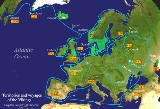
Vikings Voyages
There are various theories concerning the causes of the Viking invasions
Invasion

An invasion is a Offensive consisting of all, or large parts of the armed forces of one geopolitics entity aggressively entering territory controlled by another such entity, generally with the objective of either conquering, liberating or re-establishing control or authority over a territory, altering the established government or gaining c...
. For people living along the coast, it would seem natural to seek new land by the sea. Another reason was that during this period England, Wales and Ireland, which were divided into many different warring kingdoms, were in internal disarray and became easy prey. The Franks
Franks

The Franks or Frankish people were a West Germanic ethnic group first identified in the 3rd century as living north and east of the Lower Rhine River....
, however, had well-defended coasts and heavily fortified ports and harbours. Pure thirst for adventure may also have been a factor. A reason for the raids is believed by some to be over-population caused by technological advances, such as the use of iron. Although another cause could well have been pressure caused by the Frankish expansion to the south of Scandinavia and their subsequent attacks upon the Viking peoples. Another possible contributing factor is that Harald I of Norway
Harald I of Norway

Harald Fairhair or Harald Finehair , was the first king of Norway.Little is known of the historical Harald. The only contemporary sources mentioning him are the two skaldic poems Haraldskv??i and Glymdr?pa, by ?orbj?rn Hornklofi....
 ("Harald Fairhair") had united Norway around this time, and the bulk of the Vikings were displaced warrior
Warrior

According to the Random House Dictionary, the term warrior has two meanings. The first Literal and figurative language use refers to "a person engaged or experienced in warfare." The second Literal and figurative language use refers to "a person who shows or has shown great vigor, courage, or aggressiveness, as in politics or athletics...
s who had been driven out of his kingdom and who had nowhere to go. Consequently, these Vikings became raiders, in search of subsistence and bases to launch counter-raids against Harald. One theory that has been suggested is that the Vikings would plant crops after the winter and go raiding as soon as the ice melted on the sea, then returned home with their loot, in time to harvest the crops. They became wandering raiders and mercenaries, like their Celt
Celt

Celts , is a modern term used to describe any of the European peoples who spoke, or speak, a Celtic languages. The term is also used in a wider sense to describe the Modern Celts of those peoples, notably those who participate in a Celtic culture....
ic cousins.

One important center of trade was at Hedeby
Hedeby

Hedeby , mentioned by Alfred the Great as aet Haethe , in German language Haddeby and Haithabu, a modern spelling of the runic Hei?ab? was an important trading settlement in the Denmark-northern Germany borderland during the Viking Age....
. Close to the border with the Franks, it was effectively a crossroads between the cultures, until its eventual destruction by the Norwegians in an internecine dispute around 1050. York
York

York is a walled city, sited at the confluence of the rivers River Ouse, Yorkshire and River Foss in North Yorkshire, England. The city status in the United Kingdom is noted for its rich heritage and it has played an important role throughout much of its almost 2,000 year existence....
 was the center of the kingdom of Jórvík
Jórvík

The Kingdom of J?rv?k was a Norsemen Viking kingdom, covering the area of what would become Yorkshire and at times further parts of Northern England....
 from 866, and discoveries there (e.g. a silk cap, a counterfeit of a coin from Samarkand
Samarkand

Samarkand , is the second-largest city in Uzbekistan and the capital of Samarqand Province.The city is most noted for its central position on the Silk Road between China and the West, and for being an Islamic centre for scholarly study....
 and a cowry shell from the Red Sea or the Persian Gulf) show that Scandinavian trade connections in the 10th century reached beyond Byzantium
Byzantine Empire

Byzantine Empire and Eastern Roman Empire are conventional names used to describe the Roman Empire during the Middle Ages, centered on its capital of Constantinople....
. On the other hand, those items could have been Byzantine imports, and there is no reason to assume that the Varangians travelled significantly beyond Byzantium and the Caspian Sea
Caspian Sea

The Caspian Sea is the largest enclosed body of water on Earth by area, variously classed as the List of lakes by area or a full-fledged sea. It has a surface area of 371,000 square kilometers and a volume of 78,200 cubic kilometers ....
.

Northwestern Europe


England

According to the Anglo-Saxon Chronicles, after Lindisfarne was raided in 793, Vikings continued on small-scale raids across England. Viking raiders struck England in 793 and raided a Christian monastery that held Saint Cuthbert’s relics. The raiders killed the monks and captured the valuables. This raid was called the beginning of the “Viking Age of Invasion”, made possible by the Viking longship. There was great violence during the last decade of the 8th century on England’s northern and western shores. While the initial raiding groups were small, it is believed that a great amount of planning was involved. During the winter between 840 and 841, the Norwegians raided during the winter instead of the usual summer. They waited on an island off Ireland. In 865 a large army of Danish Vikings
Great Heathen Army

The "Great Heathen Army", also known as the Great Army or the Great Danish Army, was a Viking army originating in Denmark which pillaged and conquered much of England in the late 9th century....
, supposedly led by Ivar, Halfdan and Guthrum, arrived in East Anglia. They proceeded to cross England into Northumbria and captured York (Jorvik), where some settled as farmers. Most of the English kingdoms, being in turmoil, could not stand against the Vikings, but Alfred of Wessex
Alfred the Great

Alfred the Great , also spelled ?lfred, was king of the southern Anglo-Saxons kingdom of Wessex from 871 to 899. Alfred is noted for his defence of the kingdom against the Danish people Vikings, becoming the only English people king to be awarded the epithet "the Great"....
 managed to keep the Vikings out of his country. Alfred and his successors continued to drive back the Viking frontier and take York. A new wave of Norwegian Vikings appeared in England in 947 when Erik Bloodaxe captured York. The Viking presence continued through the reign of the Danish King Canute the Great
Canute the Great

Canute the Great, also known as Cnut in the Anglo-Saxon Chronicles, or Knut was a Viking king of England, Denmark, Norway, and parts of Sweden ....
 (1016-1035), after which a series of inheritance arguments weakened the family reign. The Viking presence dwindled until 1066, when the Norwegians lost their final battle with the English.

Ireland


Longphort
Longphort

A longphort is a term used in Ireland for a Viking ship enclosure or shore fortress. Longphorts were originally built to serve as camps for the raiding parties in Early Medieval Ireland 800?1166....
 phase 841 - 902
The Vikings conducted extensive raids in Ireland
Ireland

Ireland is the List of islands by area in Europe, and the twentieth-largest island in the world. It lies to the north-west of continental Europe and is surrounded by hundreds of islands and islet....
 and founded the cities of Cork
Cork (city)

Cork is the second largest city in the Republic of Ireland and the Ireland third most populous city after Dublin and Belfast. It is the principal city and administrative centre of County Cork and the largest city in the Provinces of Ireland of Munster....
, Dublin
Dublin

Dublin is both the largest city and capital of Republic of Ireland. It is located near the midpoint of Ireland's east coast, at the mouth of the River Liffey and at the centre of the Dublin Region....
 and Limerick
Limerick

Limerick is the third largest city in the Republic of Ireland and the county seat of County Limerick in the province of Munster, in the midwest of Republic of Ireland....
. The Vikings and Scandinavians settled down and intermixed with the Irish. Literature, crafts, and decorative styles in Ireland and Britain reflected Scandinavian culture. Vikings traded at Irish markets in Dublin. Excavations found imported fabrics from England, Byzantium, Persia, and central Asia. Dublin became so crowded by the 11th century that houses were constructed outside the town walls.

The Vikings pillaged monasteries on Ireland's west coast in 795 and then spread out to cover the rest of the coastline. The north and east of the island were most affected. During the first 40 years, the raids were conducted by small, mobile Viking groups. By 830, the groups consisted of large fleets of Viking ships. From 840, the Vikings began establishing permanent bases at the coasts. Dublin was the most significant settlement in the long term. The Irish became accustomed to the Viking presence. In some cases they became allies and also married each other.

In 832, a Viking fleet of about 120 invaded kingdoms on Ireland’s northern and eastern coasts. Some believe that the increased number of invaders coincided with Scandinavian leaders' desires to control the profitable raids on the western shores of Ireland. During the mid-830s, raids began to push deeper into Ireland, as opposed to just touching the coasts. Navigable waterways made this deeper penetration possible. After 840, the Vikings had several bases in strategic locations dispersed throughout Ireland.

In 838, a small Viking fleet entered the River Liffey
River Liffey

The Liffey is a river in Republic of Ireland, which flows through the centre of Dublin. Its major tributaries include the River Dodder, the River Poddle and the River Camac....
 in eastern Ireland. The Vikings set up a base, which the Irish called a longphort
Longphort

A longphort is a term used in Ireland for a Viking ship enclosure or shore fortress. Longphorts were originally built to serve as camps for the raiding parties in Early Medieval Ireland 800?1166....
. This longphort eventually became Dublin. After this interaction, the Irish experienced Viking forces for about 40 years. The Vikings also established longphorts in Cork, Limerick, Waterford, and Wexford. The Vikings could sail through on the main river and branch off into different areas of the country.

Battle of Clontarf
One of the last major battles involving Vikings was the Battle of Clontarf
Battle of Clontarf

The Battle of Clontarf took place on Good Friday in 1014 between the forces of Brian Boru and the forces led by the King of Leinster, M?el M?rda mac Murchada: composed mainly of his own men, Viking mercenaries from Dublin and the Orkney Islands led by his cousin Sigtrygg Silkbeard, as well as the one rebellious king from the province of Uls...
 in 1014, in which Vikings fought both for the Irish over-king Brian Boru
Brian Boru

Brian mac Cenn?tig, called Brian B?ruma, Brian Boru, Emperor of the Irish , , was an Ireland king who ended the centuries-long domination of the High King of Ireland by the U? N?ill....
's army and for the Viking-led army opposing him. Irish and Viking literature depict the Battle of Clontarf as a gathering of this world and the supernatural. For example, witches, goblins, and demons were present. A Viking poem portrays the environment as strongly pagan. Valkyries chanted and decided who would live and die.

Scotland

The Vikings are thought to have led their first raids on what is now modern Scotland
Scotland

conventional_long_name = ScotlandAlba|common_name= Scotland|image_flag = Flag of Scotland.svg|flag_width = 130px...
 by the early eighth century AD. While there are few records, their first known attack was on the Holy island of Iona
Iona

Iona is a small island in the Inner Hebrides of Scotland that has an important place in the history of Christianity in Scotland and is renowned for its tranquility and natural beauty....
 in 794, the year following the raid on the other Holy island of Lindisfarne
Lindisfarne

Lindisfarne is a tidal island off the north-east coast of England also known as Holy Island, the name of the civil parish. It has a population of 162 ...
, Northumbria
Northumbria

Northumbria is primarily the name of both a medieval petty kingdom of the Angles people, in what is now north east England and southern Scotland, and of the earldom which succeeded it when a united Anglo-Saxon kingdom became England....
.

In 839, a large Norse fleet invaded via the River Tay
River Tay

The River Tay originates in the Scottish Highlands and flows down through Strathtay , in the centre of Scotland, through Perth, Scotland and into the Firth of Tay, south of Dundee....
 and River Earn
River Earn

The River Earn in Scotland leaves Loch Earn at St Fillans and runs east through Strathearn, then east and south, joining the River Tay near Abernethy, Perth and Kinross....
, both of which were highly navigable, and reached into the heart of the Pictish kingdom
Picts

The Picts were a confederation of tribes in what was later to become eastern and northern Scotland from Roman Empire times until the 10th century....
 of Fortriu
Fortriu

Fortriu or the Kingdom of Fortriu is the name given by historians for an ancient Picts kingdom, and often used synonymously with Pictland in general....
. They defeated Eogán mac Óengusa
Uen of the Picts

Uuen [Wen] or Eog?n in Gaelic was king of the Picts, or of Fortriu , in modern Scotland.Uuen was a son of Onuist II [son of] Uurguist [Wrguist] and succeeded his cousin Drust IX of the Picts as king in 836 or 837....
, king of the Picts, his brother Bran
Bran

Bran is the hard outer layer of grain and consists of combined aleurone and pericarp. Along with cereal germ, it is an integral part of whole grains, and is often produced as a by-product of milling in the production of refined grains....
 and the king of the Scots of Dál Riata
Dál Riata

D?l Riata was a Gaels overkingdom on the western seaboard of Scotland with some territory on the northern coasts of Ireland. In the late 6th and early 7th century it encompassed roughly what is now Argyll and Bute and Lochaber in Scotland and also County Antrim in Northern Ireland....
, Áed mac Boanta
Áed mac Boanta

?ed mac Boanta is believed to have been a king of D?l Riata.The only reference to ?ed in the Irish annals is found in the Annals of Ulster, where it is recorded that "Uen of the Picts, Bran mac ?engusa, ?ed mac Boanta, and others almost innumerable" in a battle fought by the men of Fortriu against Vikings in 839....
, along with many members of the Pictish aristocracy in battle. The sophisticated kingdom that had been built fell apart, as did the Pictish leadership, which had been stable for over a hundred years since the time of Óengus mac Fergusa
Óengus I of the Picts

?engus son of Fergus , was king of the Picts from 732 until his death in 761. His reign can be reconstructed in some detail from a variety of sources....
 (The accession of Cináed mac Ailpín
Kenneth I of Scotland

Cin?ed mac Ailp?n , commonly Anglicisation as Kenneth MacAlpin and known in most modern regnal lists as Kenneth I was king of the Picts and, according to national myth, first king of Scots, earning him the posthumous nickname of An Ferbasach, "The Conqueror"....
 as king of both Picts and Scots can be attributed to the aftermath of this event).

By the mid-ninth century the Norsemen had settled in Shetland, the Orkneys (the Nordreys- Norđreyjar), the Hebrides
Hebrides

The Hebrides comprise a widespread and diverse archipelago off the west coast of Scotland. There are two main groups, the Inner and Outer Hebrides....
 and Man
Isle of Man

The Isle of Man , or Mann , is a self-governing Crown dependency, located in the Irish Sea at the geographical centre of the British Isles....
, (the Sudreys- Súđreyjar - this survives in the Diocese of Sodor and Man
Diocese of Sodor and Man

Sodor and Man is a diocese of the Church of England. Originally much larger, today it covers just the Isle of Man and its adjacent islets.The Norway diocese of Sodor was formed 1154, covering the Hebrides and the other islands along the west coast of Scotland....
) and parts of mainland Scotland. The Norse settlers were to some extent integrating with the local Gael
Gaël

Ga?l is a Communes of France in the Ille-et-Vilaine Departments of France in Bretagne in northwestern France.It lies southwest of Rennes between Saint-M?en-le-Grand and Mauron....
ic population (see-Gall Gaidheal
Norse-Gaels

The Norse-Gaels were a people who dominated much of the Irish Sea region and western Scotland for a large part of the Middle Ages, who were of Gaelic origin with some Scandinavia admixture, and and as a whole exhibited a great deal of Gaels and Norsemen cultural syncretism....
) in the Hebrides and Man. These areas were ruled over by local Jarl
Jarl

Jarl or JARL may refer to:*Japan Amateur Radio League*The Scandinavian Viking Age form of earl, jarl People with the given name Jarl:...
s, originally captains of ships or Hersir
Hersir

A hersir was a local military commander of a Hundred and owed allegiance to a Earl or king. They were also aspiring landowners, and, like the middle class in many feudal societies, supported the Monarchs in their centralization of power....
s. The Jarl of Orkney
Earl of Orkney

The Earl of Orkney was originally a Norsemen Earl ruling Orkney, Shetland and parts of Caithness and Sutherland. The Earls were periodically subject to the kings of Norway for the Northern Isles, and later also to the kings of Kingdom of Alba for those parts of their territory in mainland Scotland ....
 and Shetland however, claimed supremacy.

In 875, King Harald Finehair
Harald I of Norway

Harald Fairhair or Harald Finehair , was the first king of Norway.Little is known of the historical Harald. The only contemporary sources mentioning him are the two skaldic poems Haraldskv??i and Glymdr?pa, by ?orbj?rn Hornklofi....
 led a fleet from Norway to Scotland. In his attempt to unite Norway
Norway

Norway , officially the Kingdom of Norway, is a constitutional monarchy in Northern Europe that occupies the western portion of the Scandinavian Peninsula....
, he found that many of those opposed to his rise to power had taken refuge in the Isles. From here, they were raiding not only foreign lands but were also attacking Norway itself. He organised a fleet and was able to subdue the rebels, and in doing so brought the independent Jarls under his control, many of the rebels having fled to Iceland
Iceland

Iceland, officially the Republic of Iceland , is an island country located in the North Atlantic Ocean between mainland Europe and Greenland....
. He found himself ruling not only Norway, but the Isles, Man and parts of Scotland.

In 876 the Gall-Gaidheal of Man and the Hebrides rebelled against Harald. A fleet was sent against them led by Ketil Flatnose
Ketil Flatnose

Ketil, nicknamed Flatnose, was a Norway hersir of the mid 800s, son of Bjorn Buna. His holdings were in the Nord-Norge part of the country....
 to regain control. On his success, Ketil was to rule the Sudreys as a vassal of King Harald. His grandson Thorstein the Red
Thorstein the Red

Thorstein the Red or Thorstein Olafsson was a viking chieftain who flourished in late ninth-century Scotland. He was born around 850 CE and was the son of Olaf the White, King of Dublin, and Aud the Deep-minded, who was the daughter of Ketil Flatnose....
 and Sigurd the Mighty
Sigurd Eysteinsson

Sigurd Eysteinsson was the second Viking Earl of Orkney, who succeeded his brother Ragnald the Wise. He was a leader in the Viking conquest of what is now northern Scotland....
, Jarl of Orkney invaded Scotland were able to exact tribute from nearly half the kingdom until their deaths in battle. Ketil declared himself King of the Isles. Ketil was eventually outlawed and fearing the bounty on his head fled to Iceland.

The Gall-Gaidheal Kings of the Isles continued to act semi independently, in 973 forming a defensive pact with the Kings of Scotland and Strathclyde
Kingdom of Strathclyde

Strathclyde , originally Brythonic language Ystrad Clud, was one of the kingdoms of the Brythons in the northern part of the island Great Britain throughout the Sub-Roman Britain period , and the Scotland in the Middle Ages....
. In 1095, the King of Mann and the Isles Godred Crovan
Godred Crovan

Godred Crovan was a Norse-Gael ruler of Kings of Dublin, and King of Mann and the Isles in the second half of the 11th century. Godred's epithet Crovan may mean "white hand" ....
 was killed by Magnus Barelegs, King of Norway. Magnus and King Edgar of Scotland
Edgar of Scotland

Edgar or ?tgar mac Ma?l Choluim , nicknamed Probus, "the Valiant" , was king of Alba from 1097 to 1107. He was the son of Malcolm III of Scotland and Saint Margaret of Scotland ....
 agreed a treaty. The islands would be controlled by Norway, but mainland territories would go to Scotland. The King of Norway nominally continued to be king of the Isles and Man. However, in 1156, The kingdom was split into two. The Western Isles and Man continued as to be called the "Kingdom of Man and the Isles", but the Inner Hebrides
Inner Hebrides

The Inner Hebrides is an archipelago off the west coast of Scotland, to the south east of the Outer Hebrides. They are part of the Hebrides....
 came under the influence of Somerled
Somerled

Somerled was a military and political leader of the Scottish Isles in the 12th century who was known in Gaelic as ri Innse Gall . His father was Gillebride of Clan Angus who had been exiled to Ireland....
, a Gaelic
Scottish Gaelic language

Scottish Gaelic is a member of the Goidelic languages branch of Celtic languages. This branch also includes the Irish language and Manx language languages....
 speaker, who was styled 'King of the Hebrides'. His kingdom was to develop latterly into the Lordship of the Isles
Lord of the Isles

The designation Lord of the Isles , now a Scotland title of Peerage of Scotland, emerged from a series of hybrid Viking/Gaels rulers of the west coast and islands of Scotland in the Middle Ages, who wielded sea-power with fleets of galleys....
.

In eastern Aberdeenshire
Aberdeenshire

Aberdeenshire is one of the 32 unitary authority council areas in Scotland.In this present day Aberdeenshire does not include Aberdeen City which is a Council Area in its own right....
 the Danes invaded at least as far north as the area near Cruden Bay
Cruden Bay

Cruden Bay is a village in Scotland, on the north coast of the Bay of Cruden in Aberdeenshire, 26 miles North of Aberdeen.Just south of Slains Castle, Cruden Bay was the site of a battle between Denmark and Scottish people under King Malcolm II of Scotland in 1012....
.

The Jarls of Orkney continued to rule much of Northern Scotland until 1196, when Harald Maddadsson
Harald Maddadsson

Harald Maddadsson was Earl of Orkney and Mormaer of Caithness from 1139 until 1206. He was the son of Matad, Earl of Atholl, Mormaer of Atholl, and Margaret, daughter of Earl Haakon Paulsson of Orkney....
 agreed to pay tribute to William the Lion, King of Scots for his territories on the Mainland
Mainland

Mainland is usually the continental part of a region, as opposed to the islands nearby. Sometimes the residents are called "the Mainlanders". As a result of the usually larger area of mainland, there are significantly more mainlanders than islanders, and mainlander culture and politics sometimes threaten to dominate those of the islands....
.

The end of the Viking age proper in Scotland is generally considered to be in 1266. In 1263, King Haakon IV of Norway
Haakon IV of Norway

Haakon Haakonsson , also called Haakon the Old, was List of Norwegian monarchs of Norway from 1217 to 1263. Under his rule, medieval Norway reached its peak....
, in retaliation for a Scots expedition to Skye
Skye

Skye or the Isle of Skye , is the largest and most northerly island in the Inner Hebrides of Scotland. The island's peninsulas radiate out from a mountainous centre dominated by the Cuillin hills....
, arrived on the west coast with a fleet from Norway and Orkney. His fleet linked up with those of King Magnus of Man
Magnus III of the Isle of Man

}Magnus Olafsson, brother of Harald I of the Isle of Man, was the last recognized Norse King of Mann and ascended the throne after interruption by more distant and rival relatives....
 and King Dougal of the Hebrides. After peace talks failed, his forces met with the Scots at Largs
Battle of Largs

The Battle of Largs was an meeting engagement fought between the armies of Norway and Scotland near the present-day town of Largs in North Ayrshire on the Firth of Clyde in Scotland on 2 October 1263....
, in Ayrshire. The battle proved indecisive, but it did ensure that the Norse were not able to mount a further attack that year. Haakon died overwintering in Orkney, and by 1266, his son Magnus the Law-mender
Magnus VI of Norway

Magnus Lagab?te or Magnus H?konsson , was king of Norway from 1263 until 1280....
 ceded the Kingdom of Man and the Isles, with all territories on mainland Scotland to Alexander III
Alexander III of Scotland

Alexander III , King of Scots, was born at Roxburgh, the only son of Alexander II of Scotland by his second wife Marie de Coucy. Alexander's father died on 6 July 1249 and he became king at the age of eight, inaugurated at Scone, Perth and Kinross on 13 July 1249....
, through the Treaty of Perth
Treaty of Perth

The Treaty of Perth, 1266, ended military conflict between Norway under Magnus VI of Norway and Scotland under Alexander III of Scotland over the sovereignty of the Hebrides and the Isle of Man....
.

Orkney and Shetland continued to be ruled as autonomous Jarldoms under Norway until 1468, when King Christian I pledged them as security on the dowry of his daughter, who was betrothed to James III of Scotland
James III of Scotland

James III was King of Scots from 1460 to 1488. James was an unpopular and ineffective monarch owing to an unwillingness to administer justice fairly, a policy of pursuing alliance with the Kingdom of England, and a disastrous relationship with nearly all his extended family....
. The dowry was never paid, and the islands passed to Scotland.

Wales

Wales was not colonised by the Vikings as heavily as eastern England. The Vikings did, however, settle in the south around St. David's, Haverfordwest
Haverfordwest

Haverfordwest is the county town of Pembrokeshire, in South West Wales Wales. It is also the second largest town in Pembrokeshire, after Milford Haven....
, and Gower
Gower Peninsula

The Gower Peninsula is a peninsula on the south coast of Wales, on the north side of the Bristol Channel in the southwest of the Historic counties of Wales of Glamorgan....
, among other places. Place names such as Skokholm, Skomer, and Swansea remain as evidence of the Norse settlement. The Vikings, however, did not subdue the Welsh mountain kingdoms.

Iceland

The Norwegians travelled to the north-west and west, founding vibrant communities in the Faroe Islands
Faroe Islands

The Faroe Islands or Faeroe Islands or simply Faroe or Faeroes are an island group situated between the Norwegian Sea and the North Atlantic Ocean, approximately half way between Scotland and Iceland....
, Shetland, Orkney, Iceland
Iceland

Iceland, officially the Republic of Iceland , is an island country located in the North Atlantic Ocean between mainland Europe and Greenland....
, Ireland
Ireland

Ireland is the List of islands by area in Europe, and the twentieth-largest island in the world. It lies to the north-west of continental Europe and is surrounded by hundreds of islands and islet....
 and Great Britain
Great Britain

Great Britain is an island lying to the northwest of Continental Europe. It is the List of islands by area, and the largest in Europe. With a population of 58.9 million people it is List of islands by population....
. Apart from Britain and Ireland, Norwegians mostly found largely uninhabited land, and established settlements in those places. According to the saga of Erik the Red
Erik the Red

Erik the Red founded the first Nordic countries colonization in Greenland. Born in the J?ren district of Rogaland, Norway, as the son of ?orvaldr ?svaldsson , he therefore also appears, patronymically, as Erik Thorvaldsson ....
, when Erik the Red was exiled from Iceland he went west. There he found a land that he named "Greenland" to attract people from Iceland to settle it with him.

Greenland

The Viking Age settlements in Greenland
Greenland

Greenland is a member country of the Kingdom of Denmark located between the Arctic Ocean and Atlantic Oceans, east of the Canadian Arctic Archipelago....
 were established in the sheltered fjords of the southern and western coast. They settled in three separate areas along approximately 650 kilometers of the western coast.
  • The Eastern Settlement
    Eastern Settlement

    The Eastern Settlement was the largest and first settled of the three areas of Greenland settled in approximately 985 AD by Norsemen farmers from Iceland ....
     . The remains of about 450 farms have been found here. Erik the Red settled at Brattahlid on Ericsfjord.
  • The Middle Settlement near modern Ivigtut, consisting of about 20 farms.
  • The Western Settlement
    Western Settlement

    The Western Settlement was the smaller of the two main areas of Greenland settled in around 985 AD by Norsemen farmers from Iceland . There was also a third, still smaller area known as the Ivittuut....
    , at modern Godthĺbsfjord , established before the twelfth century. It has been extensively excavated by archaeologists.


Southern and eastern Europe

The Varangians
Varangians

The Varangians or Varyags , sometimes referred to as Variagians, were Vikings, Norsemen, who went eastwards and southwards through what is now Russia, Belarus and Ukraine mainly in the 9th and 10th centuries....
 or Varyags (Russian
Russian language

Russian is the most geographically widespread language of Eurasia, the most widely spoken of the Slavic languages, and the largest native language in Europe....
, Ukrainian
Ukrainian language

Ukrainian is a language of the East Slavic languages of the Slavic languages. It is the official language of Ukraine. In some areas of Russia there are dialects, Balachka or Surzhyk, which are the Ukrainianized versions of the Russian language....
 : ??????, Varyagi) sometimes referred to as Variagians were Scandinavians
Scandinavians

Scandinavians may refer to:*the historical Norsemen*the modern Nordic countries populations:**Danish people**Norwegians**Swedish ethnic group...
, often Swedes
Swedish people

Swedes are people from Sweden or of Swedish decent. Unlike the United States, United Kingdom, and Australian Censuses, Statistics Sweden does not classify the Swedish population by race or ethnicity....
, who migrated eastwards and southwards through what is now Russia and Ukraine mainly in the 9th and 10th centuries. Engaging in trade
Trade

Tradeis the willing exchange of goods, Service , or both. Trade is also called commerce. A mechanism that allows trade is called a market. The original form of trade was barter , the direct exchange of goods and services....
, piracy
Piracy

Piracy is a warlike act committed by a foreign nonstate actor, especially robbery or crime committed at sea, on a river, or sometimes on shore, either from a vessel flying no national flag, or one flying a national flag but without authorization from a nation....
 and mercenary
Mercenary

A mercenary is a person who takes part in an armed conflict, who is not a national or a party to the conflict, and is "motivated to take part in the hostilities essentially by the desire for private gain and, in fact, is promised, by or on behalf of a party to the conflict, material compensation substantially in excess of that promised or p...
 activities, they roamed the river systems and portages of Gardariki
Garđaríki

Gar?ar?ki or Gar?aveldi is the Old Norse term used in Middle Ages for the states of Rus' Khaganate and Kievan Rus'. The shortened form Gar?ar also refers to the same country, as does the general term for "East", Austr, with its various derivations: Austrvegr , Austrl?nd and Austrr?ki ....
, reaching the Caspian Sea
Caspian Sea

The Caspian Sea is the largest enclosed body of water on Earth by area, variously classed as the List of lakes by area or a full-fledged sea. It has a surface area of 371,000 square kilometers and a volume of 78,200 cubic kilometers ....
 and Constantinople
Constantinople

Constantinople was the empire capital of the Roman Empire , the Byzantine Empire , the Latin Empire , and the Ottoman Empire . Strategically located between the Golden Horn and the Sea of Marmara at the point where Europe meets Asia, Byzantine Constantinople had been the capital of a Christendom empire, successor to ancient ancient Greece...
. Contemporary English publications also use the name "Viking
Viking

A Viking is one of the Norsemen explorers, warriors, merchants, and Piracy who raided and colonized wide areas of Europe from the late eighth to the early eleventh century....
" for early Varangians in some contexts.

The term Varangian remained in usage in the Byzantine Empire
Byzantine Empire

Byzantine Empire and Eastern Roman Empire are conventional names used to describe the Roman Empire during the Middle Ages, centered on its capital of Constantinople....
 until the 13th century, largely disconnected from its Scandinavian roots by then.Having settled Aldeigja (Ladoga) in the 750s, Scandinavian colonists were probably an element in the early ethnogenesis of the Rus' people
Rus' (people)

Rus? are the historic population of the medieval Rus' Khaganate and Kievan Rus' whose name survives in the cognates Russians, Rusyns, and Ruthenians, and who are viewed by the modern Belarusians, Russians, and Ukrainians as the predecessors of their own peoples....
, and likely played a role in the formation of the Rus' Khaganate
Rus' Khaganate

The Rus' Khaganate was a polity that flourished during a poorly documented period in the history of Eastern Europe . A predecessor to the Rurik Dynasty and the Kievan Rus', the Rus' Khaganate was a state set up by a people called Rhos or Rus , at least some of whom were Varangians , in what is today northern Russia....
. The Varangians (Varyags, in Old East Slavic
Old East Slavic language

Old East Slavic, also known as Old Russian or Old Ruthenian, was a vernacular literary language used from the tenth to the fourteenth centuries by East Slavs in Kievan Rus' and states which formed after its collapse....
) are first mentioned by the Primary Chronicle
Primary Chronicle

The Primary Chronicle , or Russian Primary Chronicle, is a history of Kievan Rus' from about 850 to 1110, originally compiled in Kiev about 1113....
 as having exacted tribute from the Slavic
Slavic peoples

The Slavic Peoples are a linguistic branch of Indo-European peoples, living mainly in eastern Europe. From the early 6th century they spread from their original homeland to inhabit most of eastern Central Europe, Eastern Europe and the Balkans....
 and Finnic
Finnic

Finnic can refer to:* Finnic languages* Finnic peoples Adding long comment tag to protect...
 tribes in 859. It was the time of rapid expansion of the Vikings in Northern Europe; England began to pay Danegeld
Danegeld

The Danegeld was a tax raised to pay tribute to the Viking raiders to save a land from being ravaged. It was characteristic of royal policy in both England and Francia during the ninth through eleventh centuries....
 in 859, and the Curonians of Grobin faced an invasion by the Swedes at about the same date.

In 862, the Finnic and Slavic tribes rebelled against the Varangian Rus, driving them overseas back to Scandinavia, but soon started to conflict with each other. The disorder prompted the tribes to invite back the Varangian Rus "to come and rule them" and bring peace to the region. Led by Rurik
Rurik

Rurik or Riurik was a Varangian chieftain who gained control of Staraya Ladoga in 862, built the Holmgard settlement near Novgorod, and founded the Rurik Dynasty which ruled Kievan Rus and then Galicia-Volhynia 14th and Muscovy until the 16th century....
 and his brothers Truvor and Sineus
Truvor and Sineus

Truvor and Sineus were, according to the Primary Chronicle, the brothers of Rurik. The three brothers were asked by the Finnic and Slavic tribes in northern Russia to settle among them and to rule them....
, the invited Varangians (called Rus
Rus' (people)

Rus? are the historic population of the medieval Rus' Khaganate and Kievan Rus' whose name survives in the cognates Russians, Rusyns, and Ruthenians, and who are viewed by the modern Belarusians, Russians, and Ukrainians as the predecessors of their own peoples....
) settled around the town of Holmgard (Novgorod).

In the 9th century, the Rus' operated the Volga trade route
Volga trade route

In the Middle Ages, the Volga trade route connected Northern Europe and Northwestern Russia with the Caspian Sea, via the Volga River. The Rus' used this route to trade with Muslim history#Early Caliphate on the southern shores of the Caspian Sea, sometimes penetrating as far as Baghdad....
, which connected Northern Russia (Gardariki
Garđaríki

Gar?ar?ki or Gar?aveldi is the Old Norse term used in Middle Ages for the states of Rus' Khaganate and Kievan Rus'. The shortened form Gar?ar also refers to the same country, as does the general term for "East", Austr, with its various derivations: Austrvegr , Austrl?nd and Austrr?ki ....
) with the Middle East (Serkland
Serkland

In Old Norse sources, such as sagas and runestones, S?rkland or Serkland was the name of the Abbasid Caliphate and probably some neighbouring Muslim regions....
). As the Volga route declined by the end of the century, the Trade route from the Varangians to the Greeks
Trade route from the Varangians to the Greeks

The trade route from the Varangians to the Greeks was a trade route that connected Scandinavia, Kievan Rus' and the Byzantine Empire. The route allowed traders along the route to establish a direct prosperous trade with Byzantium, and prompted some of them to settle in the territories of present-day Belarus, Russia and Ukraine....
 rapidly overtook it in popularity. Apart from Ladoga and Novgorod, Gnezdovo
Gnezdovo

Gnezdovo or Gnyozdovo is an archeological site located near the types of inhabited localities in Russia of Gnyozdovo in Smolensk Oblast, Russia....
 and Gotland
Gotland

is a Counties of Sweden, Provinces of Sweden and Municipalities of Sweden of Sweden and the largest island in the Baltic Sea. At 3,140 square kilometers in area, it makes up less than one percent of Sweden's total land area....
 were major centres for Varangian trade.

Western historians tend to agree with the Primary Chronicle that these Scandinavians founded Kievan Rus'
Kievan Rus'

Kievan Rus' , also written as Kyivan Rus', was a medieval state which existed from approximately 880 to the middle of the 12th century. Founded by the Scandinavian traders called "Rus' " and centered in the city of Kiev , Rus' polity is considered an early predecessor of three modern East Slavs nations: Belarusians, Russians, and Ukrai...
 in the 880s and gave their name to the land. Many Slavic scholars are opposed to this theory of Germanic influence on the Rus' (people)
Rus' (people)

Rus? are the historic population of the medieval Rus' Khaganate and Kievan Rus' whose name survives in the cognates Russians, Rusyns, and Ruthenians, and who are viewed by the modern Belarusians, Russians, and Ukrainians as the predecessors of their own peoples....
 and have suggested alternative scenarios for this part of Eastern European history.

In contrast to the intense Scandinavian influence in Normandy
Normandy

Normandy is a geographical region corresponding to the former Duchy of Normandy. It is situated along the coast of France south of the English Channel between Brittany and Picardy and comprises territory in northern France and the Channel Islands....
 and the British Isles
British Isles

The British Isles are a group of islands off the northwest coast of continental Europe that include Great Britain and Ireland, and numerous smaller islands....
, Varangian culture did not survive to a great extent in the East. Instead, the Varangian ruling classes of the two powerful city-states of Novgorod and Kiev
Kiev

Kiev, also known as Kyiv , is the Capital and the largest city of Ukraine, located in the north central part of the country on the Dnieper River....
 were thoroughly Slavicized by the end of the 10th century. Old Norse
Old Norse

Old Norse is a North Germanic languages that was spoken by inhabitants of Scandinavia and inhabitants of their overseas settlements during the Viking Age, until about 1300....
 was spoken in one district of Novgorod, however, until the thirteenth century.

Central Europe


Viking Age Scandinavia
Scandinavia

Scandinavia is a historical and geographical subregion in northern Europe that includes the Scandinavian Peninsula. It consists of the kingdoms of Norway, Sweden, and Denmark; some authorities also include Finland and some might even include Iceland....
n settlements were set up along the southern coast of the Baltic Sea
Baltic Sea

The Baltic Sea is a brackish inland sea located in Northern Europe, from 53?N to 66?N latitude and from 20?E to 26?E longitude. It is bounded by the Scandinavian Peninsula, the mainland of Europe, and the Denmark islands....
, primarily for trade purposes. Their appearance coincides with the settlement and consolidation of the Slavic tribes in the respective areas. Scandinavians had contacts to the Slavs since their very immigration, these first contacts were soon followed by both the construction of Scandinavian emporia and Slavic burghs in their vicinity. The Scandinavian settlements were larger than the early Slavic ones, their craftsmen had a considerably higher productivity, and in contrast to the early Slavs, the Scandinavians were capable of seafaring. Their importance for trade with the Slavic world however was limited to the coastal regions and their hinterlands.

Scandinavian settlements at the Mecklenburg
Mecklenburg

Mecklenburg is a region in northern Germany comprising the western and larger part of the federal state Mecklenburg-Vorpommern. The largest cities of the region are Rostock, Schwerin, and Neubrandenburg....
ian coast include Reric
Reric

Reric or Rerik was one of the Viking Age multi-ethnic Slavs-Scandinavian emporia on the southern coast of the Baltic Sea, located near Wismar in the present-day Germany state of Mecklenburg-Vorpommern Reric was built around 700, when Slavs of the Obodrites settled the region....
 (Groß Strömkendorf) on the eastern coast of Wismar Bay, and Dierkow
Dierkow

Dierkow near Rostock, Mecklenburg, was a Viking Age Slavs-Scandinavians settlement at the southern Baltic coast in the late 8th and early 9th century....
 (near Rostock
Rostock

Rostock is the largest city in the north Germany States of Germany Mecklenburg-Vorpommern. Rostock is located on the Warnow river; the quarter of Warnem?nde 12 km north of the city centre lies directly on the coast of the Baltic Sea....
). Reric was set up around the year 700, but following later warfare between Obodrites and Danes, the merchants were resettled to Haithabu. Dierkow prospered from the late 8th to the early 9th century.

Scandinavian settlements at the Pomerania
Pomerania

Pomerania is a historical region on the south coast of the Baltic Sea. Divided between Germany and Poland, it stretches roughly from the Recknitz River near Stralsund in the West, via the Oder River delta near Szczecin, to the mouth of the Vistula River near Gdansk in the East....
n coast include Wollin
Wolin (town)

Wolin [] is a town situated on the southern tip of the Wolin island off the Baltic Sea coast of Poland. The island lies at the edge of the strait of Dziwna in Kamien Pomorski County in the West Pomeranian Voivodeship....
 (on the isle of Wollin), Ralswiek
Ralswiek

Ralswiek is a municipality in the R?gen , in Mecklenburg-Vorpommern, Germany....
 (on the isle of Rügen
Rügen

R?gen or Rugia is Germany's largest island. It is located in the Baltic Sea off the coast of Mecklenburg-Vorpommern. R?gen makes up the vast part of the R?gen , which also includes the neighboring islands Hiddensee and Ummanz, as well as several small islands....
), Altes Lager Menzlin
Altes Lager Menzlin

Altes Lager is a site 1,5 km south of the Menzlin village near Anklam, Western Pomerania, Germany. The site at the banks of the river Peene was an important Viking trade post during the Middle Ages ....
 (at the lower Peene
Peene

The Peene is a river in Germany. The Westpeene, Kleine Peene and Ostpeene flow into the :de:Kummerower See, and from there as Peene proper to Anklam and into the Oder Lagoon....
 river), and Bardy-Swielubie
Bardy-Swielubie

Bardy-Swielubie or Bartin-Zwillipp near modern Kolobrzeg was a Viking Age Slavs-Scandinavians settlement at the southern Baltic coast.Bardy-Swielubie differs from other emporia: The location is rather far from the coastline, and Bardy was built before 800, making it one of the earliest Slavic burghs in the coastal area....
 near modern Kolobrzeg
Kolobrzeg

Kolobrzeg is a city in Middle Pomerania Pomerania in north-western Poland with some 50,000 inhabitants . Kolobrzeg is located on the Parseta River on the south coast of the Baltic Sea ....
 (Kolberg). Menzlin was set up in the mid-8th century. Wollin and Ralswiek began to prosper in the course of the 9th century. A merchants' settlement has also been suggested near Arkona
Arkona

Arkona may refer to:* Cape Arkona on the German island of R?gen* Arkona , the Russian folk metal band* Arkona , a Poland black metal band* Arkona, Ontario...
, but no archeological evidence supports this theory. Menzlin and Bardy-Swielubie were vacated in the late 9th century, Ralswiek made it into the new millennium, but at the time when written chronicles reported the site in the 12th century it had lost all its importance. Wollin, thought to be identical with legendary Vineta
Vineta

Vineta or Wineta is an ancient and possibly legendary town believed to have been on the Germany or Poland coast of the Baltic Sea. It was commonly said to be on the present site of Wolin in Poland or of Zinnowitz on Usedom...
 and semilegendary Jomsborg
Jomsborg

Jomsborg was a legendary Viking settlement in territory at the Baltic Sea later referred to as Pomerania. According to the Jomsvikinga Saga, it was inhabited by a guild of Danish mercenaries known as the Jomsvikings....
, base of the Jomsvikings
Jomsvikings

The Jomsvikings were a possibly-legendary company of Viking mercenaries or brigands of the 900s and 1000s, dedicated to the worship of such deities as Odin and Thor....
, was destroyed by the Danes in the 12th century.

Scandinavian arrowheads from the 8th and 9th centuries were found between the coast and the lake chains in the Mecklenburg
Mecklenburg

Mecklenburg is a region in northern Germany comprising the western and larger part of the federal state Mecklenburg-Vorpommern. The largest cities of the region are Rostock, Schwerin, and Neubrandenburg....
ian and Pomerania
Pomerania

Pomerania is a historical region on the south coast of the Baltic Sea. Divided between Germany and Poland, it stretches roughly from the Recknitz River near Stralsund in the West, via the Oder River delta near Szczecin, to the mouth of the Vistula River near Gdansk in the East....
n hinterlands, pointing at periods of warfare between the Scandinavians and Slavs.

East of Pomerania
Pomerania

Pomerania is a historical region on the south coast of the Baltic Sea. Divided between Germany and Poland, it stretches roughly from the Recknitz River near Stralsund in the West, via the Oder River delta near Szczecin, to the mouth of the Vistula River near Gdansk in the East....
, Scandinavian settlements existed in Truso
Truso

Truso, situated on Lake Druzno, was an Prussia town near the Baltic Sea just east of the Vistula River. It was one of the trading posts on the Amber Road, and is thought to be the antecedent of the city of Elblag ....
 and Kaup
Kaup

Kaup may refer to:*Kaup , a village in Karnataka, India*Johann Jakob Kaup , German naturalist*Kaup?Kupershmidt equation*A hill and medieval trading settlement near Mokhovoye, Russia...
 (Old Prussia
Prussia (region)

Prussia is a Historical regions of Central Europe in Central Europe extending from the south-eastern coast of the Baltic Sea to the Masurian Lake District....
), and in Grobin (Latvia
Latvia

Latvia The Latvians are a Baltic peoples culturally related to the Estonians and Lithuanians, with the Latvian language having many similarities with Lithuanian language, but not with the Estonian language....
).

Western Europe


France


The French region of Normandy
Normandy

Normandy is a geographical region corresponding to the former Duchy of Normandy. It is situated along the coast of France south of the English Channel between Brittany and Picardy and comprises territory in northern France and the Channel Islands....
 takes its name from the Viking invaders who were called
Northmanorum, which means ‘men of the North.’

The first Viking raids began between 790 and 800 along the coasts of western France. They were carried out primarily in the summer, as the Vikings wintered in Scandinavia. Several coastal areas were lost during the reign of Louis the Pious
Louis the Pious

Louis the Pious , also called the Fair, and the Debonaire, was the King of Aquitaine from 781 and Holy Roman Emperor and King of the Franks with his father, Charlemagne, from 813....
 (814-840). But the Vikings took advantage of the quarrels in the royal family caused after the death of Louis the Pious to settle their first colony in the south-west (Gascony
Gascony

Gascony is an area of southwest France that constituted a Provinces of France prior to the French Revolution. In historic references dating from the beginning of the Roman era, it was part of Gaul and became part of the Kingdom of the Franks during the conquests of Clovis I ....
) of the kingdom of Francia, which was more or less abandoned by the Frankish kings after their two defeats at Roncevaux. The incursions in 841 caused severe damage to Rouen
Rouen

Rouen is the historical capital city of Normandy, in northwestern France on the River Seine, and currently the capital of the Haute-Normandie r?gion in France....
 and Jumičges
Jumičges

Jumi?ges is a communes of France in the Seine-Maritime departments of France of the Haute-Normandie region of northern France....
. The Vikings attackers sought to capture the treasures stored at monasteries, easy prey given the monks' lack of defensive capacity. In 845 an expedition up the Seine
Seine

The Seine is a slow flowing major river and commercial waterway within Regions of France of ?le-de-France and Haute-Normandie in France and famous as a romantic backdrop in photographs of Paris, France....
 reached Paris
Paris

Paris is the Capital of France and the country's largest city. It is situated on the river Seine, in northern France, at the heart of the ?le-de-France Regions of France ....
. After 851 Vikings began to stay in the lower Seine valley for the winter. Twice more in the 860s Vikings rowed to Paris, leaving only when they acquired sufficient loot or bribes from the Carolingian
Carolingian

File:Charlemagne denier Mayence 812 814.jpgThe Carolingian dynasty was a Frankish noble family with its origins in the Arnulfing and Pippinid clans of the 7th century....
 rulers.

The Carolingian kings tended to have contradictory politics, which had severe consequences. In 867, Charles the Bald
Charles the Bald

File:Charles le Chauve denier Bourges after 848.jpgCharles the Bald , Holy Roman Emperor and King of West Francia , was the youngest son of the Emperor Louis the Pious by his second wife Judith, daughter of Welf....
 signed the Treaty of Compičgne, by which he agreed to yield the Cotentin Peninsula
Cotentin Peninsula

The Cotentin Peninsula, also known as the Cherbourg Peninsula, is a peninsula in Normandy, forming part of the north-western coast of France....
 to the Breton
Breton people

The Bretons are a distinct Celts ethnic group located in the region of Brittany in France. They trace much of their heritage to groups of Brythons who settled the area from south western Great Britain in the 4th to 6th centuries....
 king Salomon
Salomon

Salomon can refer to:People with the given name Salomon:* The king Solomon* Salomon, King of Brittany, 9th century Breton ruler.* Salomon of Cornwall, late-5th-century 'warrior prince', possibly a king, of Cornwall...
, on the condition that Salomon would take an oath of fidelity and fight as an ally against the Vikings. Nevertheless, in 911 the Viking leader Rollon
Rollo of Normandy

Rollo , baptised Robert, was the founder and first ruler of the Viking principality in what soon became known as Normandy.The name Rollo is a Frankish-Latin name probably taken from the Old Norse name Hrolf ....
 forced Charles the Simple
Charles the Simple

Charles III , called the Simple or the Straightforward , was a member of the Carolingian dynasty who ruled as List of French monarchs from 893 to 922/923....
 to sign the Treaty of Saint-Clair-sur-Epte, under which Charles gave Rouen and the area of modern Haute-Normandie
Haute-Normandie

Haute-Normandie is one of the 26 regions of France of France. It was created in 1956 from two d?partements: Seine-Maritime and Eure, when Normandy was divided into Basse-Normandie and Haute-Normandie....
 to Rollon, establishing the Duchy of Normandy
Duchy of Normandy

The 'Duchy of Normandy' stems from various Denmark, Hiberno-Norse, Orkney Viking and Anglo-Danish invasions of France in the 8th century. A fief, probably as a county, was created by the treaty of Saint-Clair-sur-Epte in 911 out of concessions made by Charles the Simple, and granted to Rollo of Normandy, leader of the Vikings known as Nort...
. In exchange, Rollon pledged vassalage to Charles in 940, agreed to be baptized
Baptism

In Christianity, baptism is the ritual act, with the use of water, by which one is admitted as a full member of the Christian Church and, in the view of some, as a member of the particular Church in which the baptism is administered....
, and vowed to guard the estuaries of the Seine from further Viking attacks.

While many buildings were pillaged, burned, or destroyed by the Viking raids, ecclesiastical sources may have been overly negative as no city was completely destroyed. On the other hand, many monasteries were pillaged and all the abbeys were destroyed. Rollon and his successors brought about rapid recoveries from the raids.

The Scandinavian colonization was principally Danish, with a strong Norwegian element. A few Swedes were present. The merging of the Scandinavian and native elements contributed to the creation of one of the most powerful feudal states of Western Europe
Western Europe

Western Europe refers to the countries in the western most half of Europe. This concept has had different meanings, political and cultural as well as geographical issues have influenced the area....
. The naval ability of the Normans would allow them to conquer England
Norman conquest of England

The Norman conquest of England began in 1066 AD with the invasion of the Kingdom of England by the troops of William I of England, Duke of Normandy , and his victory at the Battle of Hastings....
 and southern Italy
Norman conquest of southern Italy

The Normans conquest of southern Italy spanned most of the eleventh century, involving many battles and many independent players conquering territories of their own....
, and play a key role in the Crusades
Crusades

The Crusades were a series of religious war waged by much of Christian Europe against external and internal opponents. Crusades were fought mainly against Muslims, though campaigns were also directed against Paganism Slavic peoples, Jews, Eastern Orthodox Church, Mongols, Catharism, Hussites, Waldensians, Old Prussians, and political enemi...
.

Spain


After 842, when the Vikings set up a permanent base at the mouth of the Loire River
Loire River

The Loire is the longest river in France. With a length of , it drains an area of , which represents more than a fifth of France's land area....
, they could strike as far as northern Spain. They attacked Cadiz in AD 844.

Portugal


In 844, many dozens of drakkars appeared in the Sea of Palha, and the Vikings, after a siege, conquered Lisbon, at the time Al-Lushbuna, under Muslim rule, leaving after 13 days, due to the resistance led by Alah Ibn Hazm and the city's inhabitants. Another raid was performed in 966, without success.

Other territories


North America

In about 986, Bjarni Herjólfsson
Bjarni Herjólfsson

Bjarni Herj?lfsson was an Icelandic explorer who is the first known European discoverer of the mainland of the Americas, which he sighted in 986....
. Leif Ericson
Leif Ericson

Leif Ericson was a Norsemen explorer who was probably the first European to land in North America . According to the Sagas of Icelanders, he established a Norse settlement at Vinland, which has been tentatively identified with the L'Anse aux Meadows Norse site on the northern tip of the island of Newfoundland in Newfoundland and Labrador,...
 and Ţórfinnur Karlsefni
Thorfinn Karlsefni

Thorfinn Karlsefni , was an Icelandic explorer who circa 1010 Anno Domini led an attempt to settle Vinland with three ships and 160 settlers. Among the settlers was Freyd?s Eir?ksd?ttir, half-sister of Leif Eriksson....
 from Greenland reached North America
North America

North America is the northern continent of the Americas, situated in the Earth's northern hemisphere and almost totally in the western hemisphere....
 and attempted to settle the land they called Vinland
Vinland

Vinland was the name given to an area of North America by the Norsemen Leif Eriksson, about the year A.D. 1001.In 1960 archaeology evidence of the only known Norse colonization of the Americas in North America was found at L'Anse aux Meadows on the northern tip of the island of Newfoundland , in what is now the Canada province of Newfoundl...
. They created a small settlement on the northern peninsula of present-day Newfoundland, near
L'Anse aux Meadows
L'Anse aux Meadows

L'Anse aux Meadows is an archaeological site on the northernmost tip of the island of Newfoundland in the Canada Provinces of Canada of Newfoundland and Labrador....
. The indigenous peoples and a cold climate brought the Viking colony to an end within a few years. The archaeological remains are now a UN World Heritage Site
World Heritage Site

A UNESCO World Heritage Site is a site that is on the list maintained by the international World Heritage Programme administered by the UNESCO World Heritage Committee, composed of 21 Sovereign state which are elected by their General Assembly for a four-year term....
.

Influence of Viking settlement on the English language

The long-term linguistic effect of the Viking settlements in England was threefold: over a thousand words eventually became part of Standard English
Standard English

Standard English is a term generally applied to a form of the English language that is thought to be normative for educated native speakers. It encompasses grammar, vocabulary, spelling, and to some degree pronunciation....
; numerous places in the East and North-east of England have Danish names; and many English personal names are of Scandinavian origin. Scandinavian words that entered the English language included
landing, score, beck, fellow, take, busting, and steersman. The vast majority of loan words did not appear in documents until the early twelfth century; these included many modern words which used sk- sounds, such as skirt, sky, and skin; other words appearing in written sources at this time included again, awkward, birth, cake, dregs, fog, freckles, gasp, law, neck, ransack, root, scowl, sister, seat, sly, smile, want, weak, and window. Some of the words that came into use are among the most common in English, such as both, same, get, and give. The system of personal pronouns was affected, with they, them, and their replacing the earlier forms. Old Norse influenced the verb to be; the replacement of sindon by are is almost certainly Scandinavian in origin, as is the third-person-singular ending -s in the present tense of verbs.

There are more than 1,500 Scandinavian place names in England, mainly in Yorkshire and Lincolnshire (within the former boundaries of the
Danelaw
Danelaw

The Danelaw, as recorded in the Anglo-Saxon Chronicle , is a historical name given to the part of Great Britain in which the laws of the "Danes" dominated those of the Anglo-Saxons....
): over 600 end in -by, the Scandinavian word for "village" or "town" — for example Grimsby, Naseby, and Whitby; many others end in -thorpe ("farm"), -thwaite ("clearing"), and -toft ("homestead").

The distribution of family names showing Scandinavian influence is still, as an analysis of names ending in
-son reveals, concentrated in the north and east, corresponding to areas of former Viking settlement. Early medieval records indicate that over 60% of personal names in Yorkshire and North Lincolnshire showed Scandinavian influence.

Technology


The Vikings were equipped with the technologically superior longships; for purposes of conducting trade however, another type of ship, the
knarr
Knarr

For the Norse ship, see knaar----...
, wider and deeper in draft, were customarily used. The Vikings were competent sailors, adept in land warfare as well as at sea, and they often struck at accessible and poorly defended targets, usually with near impunity. The effectiveness of these tactics earned Vikings a formidable reputation as raiders and pirates. Chroniclers paid little attention to other aspects of medieval Scandinavian culture. This slant was accentuated by the absence of contemporary primary source documentation from within the Viking Age communities themselves. Little documentary evidence was available until later, when Christian sources began to contribute. As historians and archaeologists have developed more resources to challenge the one-sided descriptions of the chroniclers, a more balanced picture of the Norsemen has become apparent.

The Vikings used their longships to travel vast distances and attain certain tactical advantages in battle. They could perform highly efficient hit-and-run attacks, in which they quickly approached a target, then left as rapidly before a counter-offensive could be launched. Because of the ships' negligible draft, the Vikings could sail in shallow waters, allowing them to invade far inland along rivers. The ships' speed was also prodigious for the time, estimated at a maximum of 14 or 15 knots
Knot (speed)

The knot is a unit of speed equal to one nautical mile per hour. Its kn abbreviation is preferred by American and Canadian maritime authorities, and by the Institute of Electrical and Electronics Engineers; however, the kt and kts abbreviations also are used....
. The use of the longships ended when technology changed, and ships began to be constructed using saws instead of axes. This led to a lesser quality of ships.

Together with an increasing centralization of government in the Scandinavian countries, the old system of
leidang
Leidang

The institution known as lei?angr , leidang , leding, , ledung , expeditio or sometimes lething , was a public levy of free farmers typical for medieval Scandinavians....
— a fleet mobilization system, where every skipen (ship community) had to deliver one ship and crew — was discontinued. Changes in shipbuilding in the rest of Europe led to the demise of the longship for military purposes. By the 11th and 12th centuries, European fighting ships were built with raised platforms fore and aft, from which archers could shoot down into the relatively low longships.

The nautical achievements of the Vikings were exceptional. For instance, they made distance tables for sea voyages that were remarkably precise. They have been found to differ only 2-4% from modern satellite measurements, even on such long distances as across the Atlantic Ocean
Atlantic Ocean

The Atlantic Ocean is the second-largest of the world's oceanic divisions; with a total area of about 106.4 million square kilometres . It covers approximately one-fifth of the Earth's surface....
.

The archaeological find known as the Visby lenses
Visby lenses

The Visby lenses are a collection of Lens -shaped manufactured objects made of rock crystal found in a viking grave in Gotland dating from approximately the 10th century....
 from the Swedish island of Gotland
Gotland

is a Counties of Sweden, Provinces of Sweden and Municipalities of Sweden of Sweden and the largest island in the Baltic Sea. At 3,140 square kilometers in area, it makes up less than one percent of Sweden's total land area....
 may be components of a telescope
Telescope

A telescope is an instrument designed for the observation of remote objects by the collection of electromagnetic radiation. The first known practically functioning telescopes were invented in the Netherlands at the beginning of the 17th century....
. It appears to date from long before the invention of the telescope in the 1600s.

An archaeological find in Sweden consists of a bone fragment fixated with in-operated material; the piece is as yet undated. These bones might be the remains of a trader from the Middle East
Middle East

File:GreaterMiddleEast1.pngThe Middle East is a region that spans southwestern Asia, western Asia, and northeastern Africa. It has no clear boundaries, often used as a synonym to Near East, in opposition to Far East....
.

Religion

At the start of the Viking age, the Vikings adhered to the Norse religion and system of beliefs. They believed in a pantheon of gods and goddesses, as well as
Valhalla
Valhalla

In Norse mythology, Valhalla is a majestic, enormous hall located in Asgard, ruled over by the god Odin. Chosen by Odin, half of those that die in combat travel to Valhalla upon death, led by valkyries, while the other half go to the goddess Freyja's field F?lkvangr....
, a heaven for warriors. The lower class of society would go to a place called "hel", similar to life on earth. According to Viking beliefs, Viking chieftains would please their war-gods by their bravery, and would become "worth-ship;" that is, the chieftain would earn a "burial at sea". They also performed land burials which often still included a ship, treasure, weapons, tools, clothing and even slaves and women buried alive with the dead chieftain, for his "journey to Valhalla, and adventure and pleasure in the after-life." Sages then composed sagas about the exploits of these chieftains, keeping their memories alive.

Freyr and his sister Freya were fertility gods. They were responsible for ensuring that people had many children and that the land produced plentiful crops. Some farmers even called their fields after Freyr, in the hope that this would ensure a good harvest. Towards the end of the Viking Age, more and more Scandinavians were converted to Christianity, often (or mostly) by force. The introduction of Christianity did not immediately end Viking voyages, but it may have been a contributing factor to bringing the Viking Age to an end.

Trade centres

Some of the most important trading ports during the period include both existing and ancient cities such as Jelling
Jelling

Jelling is a village situated in Vejle municipality, Denmark on the Jutland peninsula. Previously a Viking royal locality, today Jelling is a small town with a population of 3,178 ....
 (Denmark), Ribe
Ribe

Ribe is the oldest town of Denmark, situated in southwest Jutland. Until 1 January 2007, it was the seat of both the surrounding Ribe Municipality, and Ribe County....
 (Denmark), Roskilde
Roskilde

Roskilde Roskilde train station is a major stop between Copenhagen and the region of Denmark located to its west. The city is an economic center for the region....
 (Denmark), Hedeby
Hedeby

Hedeby , mentioned by Alfred the Great as aet Haethe , in German language Haddeby and Haithabu, a modern spelling of the runic Hei?ab? was an important trading settlement in the Denmark-northern Germany borderland during the Viking Age....
 (Denmark, now Germany), Aarhus
Aarhus

Aarhus also commonly known by its contemporary Danish language spelling ?rhus, is the second largest city and the principal port of Denmark, situated on the peninsula of Jutland....
 (Denmark), Vineta
Vineta

Vineta or Wineta is an ancient and possibly legendary town believed to have been on the Germany or Poland coast of the Baltic Sea. It was commonly said to be on the present site of Wolin in Poland or of Zinnowitz on Usedom...
 (Pomerania), Truso
Truso

Truso, situated on Lake Druzno, was an Prussia town near the Baltic Sea just east of the Vistula River. It was one of the trading posts on the Amber Road, and is thought to be the antecedent of the city of Elblag ....
 (Poland), Kaupang
Kaupang

Kaupang is a town founded in the 780s during the time when the Vikings started to launch their raids against Great Britain and other parts of Europe until it was abandoned for unknown reasons in the early 10th century....
 (Norway), Birka
Birka

During the Viking Age, Birka , on the island of Bj?rk? in Sweden, was an important trading center which handled goods from Scandinavia as well as Central Europe and Eastern Europe and the Orient....
 (Sweden), Bordeaux
Bordeaux

is a Port city on the Garonne in southwest France, with one million inhabitants in its aire urbaine at a 2008 estimate. It is the Capital of the Aquitaine regions of France, as well as the Prefectures in France of the Gironde Departments of France....
 (France), Jorvik
Jórvík

The Kingdom of J?rv?k was a Norsemen Viking kingdom, covering the area of what would become Yorkshire and at times further parts of Northern England....
 (England), Dublin
Dublin

Dublin is both the largest city and capital of Republic of Ireland. It is located near the midpoint of Ireland's east coast, at the mouth of the River Liffey and at the centre of the Dublin Region....
 (Ireland) and Aldeigjuborg
Staraya Ladoga

Staraya Ladoga , Vanha Laatokka in finnish or the Aldeigjuborg of Norse sagas, is a Types of inhabited localities in Russia in the Volkhovsky District of Leningrad Oblast, Russia, located on the Volkhov River near Lake Ladoga....
 (Russia).

Settlements outside Scandinavia

Britain
  • Jórvík
    Jórvík

    The Kingdom of J?rv?k was a Norsemen Viking kingdom, covering the area of what would become Yorkshire and at times further parts of Northern England....
     (Yorkshire
    Yorkshire

    Yorkshire is a Historic counties of England of northern England and the largest in Great Britain. Because of its great size, over time functions were increasingly undertaken by its subdivisions, which have been subject to History of local government in Yorkshire....
    )
  • Danelaw
    Danelaw

    The Danelaw, as recorded in the Anglo-Saxon Chronicle , is a historical name given to the part of Great Britain in which the laws of the "Danes" dominated those of the Anglo-Saxons....
  • Hjaltland
Eastern Europe
  • Bjarmland
  • Garđaríki
    Garđaríki

    Gar?ar?ki or Gar?aveldi is the Old Norse term used in Middle Ages for the states of Rus' Khaganate and Kievan Rus'. The shortened form Gar?ar also refers to the same country, as does the general term for "East", Austr, with its various derivations: Austrvegr , Austrl?nd and Austrr?ki ....
  • Serkland
    Serkland

    In Old Norse sources, such as sagas and runestones, S?rkland or Serkland was the name of the Abbasid Caliphate and probably some neighbouring Muslim regions....
  • Miklagard
Atlantic
  • Faroe Islands
    Faroe Islands

    The Faroe Islands or Faeroe Islands or simply Faroe or Faeroes are an island group situated between the Norwegian Sea and the North Atlantic Ocean, approximately half way between Scotland and Iceland....
  • Greenland
    Greenland

    Greenland is a member country of the Kingdom of Denmark located between the Arctic Ocean and Atlantic Oceans, east of the Canadian Arctic Archipelago....
  • Helluland
    Helluland

    Helluland is the name given to one of the three lands discovered by Leif Eriksson sometime around 1000 on the North Atlantic coast of North America....
  • Iceland
    Iceland

    Iceland, officially the Republic of Iceland , is an island country located in the North Atlantic Ocean between mainland Europe and Greenland....
  • Markland
    Markland

    Markland is the name given to a part of shoreline in Labrador, Canada, named by Leif Eriksson when he landed in North America. Markland, Old Norse language for "forestland" or "borderland", is known to be north of Vinland and south of Helluland....
  • Vinland
    Vinland

    Vinland was the name given to an area of North America by the Norsemen Leif Eriksson, about the year A.D. 1001.In 1960 archaeology evidence of the only known Norse colonization of the Americas in North America was found at L'Anse aux Meadows on the northern tip of the island of Newfoundland , in what is now the Canada province of Newfoundl...


External links

  • from «Kulturformidlingen norrřne tekster og kvad» Norway.