


Consolidation of Sweden

Encyclopedia
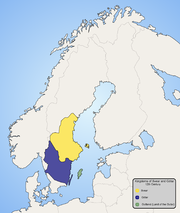
Unlike the history of Norway
Norway
Norway , officially the Kingdom of Norway, is a Nordic unitary constitutional monarchy whose territory comprises the western portion of the Scandinavian Peninsula, Jan Mayen, and the Arctic archipelago of Svalbard and Bouvet Island. Norway has a total area of and a population of about 4.9 million...
and Denmark
Denmark
Denmark is a Scandinavian country in Northern Europe. The countries of Denmark and Greenland, as well as the Faroe Islands, constitute the Kingdom of Denmark . It is the southernmost of the Nordic countries, southwest of Sweden and south of Norway, and bordered to the south by Germany. Denmark...
, there is no agreement on a reliable date for a "unified Sweden". Historians judge differently the sources for the history of Sweden's consolidation. The earliest history blends with Norse mythology
Norse mythology
Norse mythology, a subset of Germanic mythology, is the overall term for the myths, legends and beliefs about supernatural beings of Norse pagans. It flourished prior to the Christianization of Scandinavia, during the Early Middle Ages, and passed into Nordic folklore, with some aspects surviving...
. Early primary sources are foreign; secondary sources were written at a later date.
Older sources
Based on the origins of the name for the kingdom (Kingdom of the SuionesSuiones
The Swedes e, "one's own [tribesmen/kinsmen]"; Old English: Sweonas; , Suehans or Sueones) were an ancient North Germanic tribe in Scandinavia...
) and a reading of the Roman historian Tacitus
Tacitus
Publius Cornelius Tacitus was a senator and a historian of the Roman Empire. The surviving portions of his two major works—the Annals and the Histories—examine the reigns of the Roman Emperors Tiberius, Claudius, Nero and those who reigned in the Year of the Four Emperors...
, who described the early social system with several tribes, some historians argue that Sweden was unified when the Swedes (Suiones) first inhabited the region. However, since the rigor of the historical method
Historical method
Historical method comprises the techniques and guidelines by which historians use primary sources and other evidence to research and then to write histories in the form of accounts of the past. The question of the nature, and even the possibility, of a sound historical method is raised in the...
in 20th century Sweden, historians such as Curt Weibull
Curt Weibull
Curt Weibull was a Swedish historian, educator and author.-Biography:Curt Hugo Johannes Weibull was born in Lund, Sweden. He was a member of the noted Swedish Weibull family. He was the son of history professor Martin Weibull and the brother of Lauritz Weibull, Alexander Weibull, Julius Oscar...
maintain that these perspectives have become obsolete. The historians note that a millennium had passed between Tacitus and more reliable documented accounts of Swedish history. The work of Birger Nerman
Birger Nerman
Birger Nerman was a Swedish archaeologist, professor, and author.-Background:Birger Nerman belonged to a bourgeois family Nerman from Vimmerby. He was the son of Janne Nerman , the bookseller in Norrköping, and his wife Anna Ida Nordberg...
(1925), which argues that Sweden held a senior rank among the existing European states at the time, is a nationalist reaction to the academic historiography
Historiography
Historiography refers either to the study of the history and methodology of history as a discipline, or to a body of historical work on a specialized topic...
that is critical of the older sources of history.
Geats-Swedes arguments
A common definition of Sweden is that it was formed when the Swedes and GeatGeat
Geats , and sometimes Goths) were a North Germanic tribe inhabiting what is now Götaland in modern Sweden...
s were ruled by one king. This is partly because Swedes wanted to glorify themselves as being the same people as the historical Goths
Goths
The Goths were an East Germanic tribe of Scandinavian origin whose two branches, the Visigoths and the Ostrogoths, played an important role in the fall of the Roman Empire and the emergence of Medieval Europe....
, who they thought had left Scandinavia
Scandinavia
Scandinavia is a cultural, historical and ethno-linguistic region in northern Europe that includes the three kingdoms of Denmark, Norway and Sweden, characterized by their common ethno-cultural heritage and language. Modern Norway and Sweden proper are situated on the Scandinavian Peninsula,...
to conquer Europe. (see Gothicismus
Gothicismus
Gothicismus, Gothism, or Gothicism is the name given to what is considered to have been a cultural movement in Sweden, centered around the belief in the glory of the Swedish ancestors, originally considered to be the Geats, which were identified with the Goths. The founders of the movement were...
). The names Swedes and Geats are attested in the Old English poems Beowulf
Beowulf
Beowulf , but modern scholars agree in naming it after the hero whose life is its subject." of an Old English heroic epic poem consisting of 3182 alliterative long lines, set in Scandinavia, commonly cited as one of the most important works of Anglo-Saxon literature.It survives in a single...
(written down in the 11th century) and Widsith
Widsith
Widsith is an Old English poem of 144 lines that appears to date from the 9th century, drawing on earlier oral traditions of Anglo-Saxon tale singing. The only text of the fragment is copied in the Exeter Book, a manuscript of Old English poetry compiled in the late 10th century containing...
(from the 8th century) and building on older legendary and folklore material collected in England. In both poems, an Ongentheow (sw. Angantyr) is named as the King of the Swedes, and the Geats are mentioned as a separate people. These names of peoples having formed in present-day Sweden, the Anglo-Saxon references and now lost tales they were attached to must have travelled across the North Sea. The first king who is considered historical and to have ruled over both peoples, is early 11th century Olof Skötkonung.
Broadly speaking, Kings of Sweden, and the nobility of the land, have seen Götaland and Svealand (as well as growing parts of Finland) as equally important parts of the kingdom at least since the mid-13th century and, in some cases, considerably earlier.
Timeframe arguments
Rather than the unification of tribes under one king, others maintain that the process of consolidation was gradual. Nineteenth-century scholars saw the unification as a result of a series of wars based on evidence from the Norse sagaNorse saga
The sagas are stories about ancient Scandinavian and Germanic history, about early Viking voyages, the battles that took place during the voyages, about migration to Iceland and of feuds between Icelandic families...
s. For example, according to the Norwegian
Norway
Norway , officially the Kingdom of Norway, is a Nordic unitary constitutional monarchy whose territory comprises the western portion of the Scandinavian Peninsula, Jan Mayen, and the Arctic archipelago of Svalbard and Bouvet Island. Norway has a total area of and a population of about 4.9 million...
Historia Norwegiae and the Icelandic historian Snorri Sturlusson, a 7th-century king called Ingjald illråde
Ingjald
Ingjald illråde or Ingjaldr hinn illráði was a legendary Swedish king of the House of Ynglings. Ingjald may have ruled in the 7th century, and he was the son of the former king Anund....
burnt a number of subordinate kings to death inside his hall, thus abolishing the petty kingdoms in the consolidation of Sweden.
To solve the problem of defining an early history of Sweden that coincides with reliable sources, a group of modern Swedish historians have contended that a real state could only exist, in the Middle Ages, if had the backing of Christianity and the clergy. The same connection between Christianity and consolidation is used in other countries where written sources are less scarce, such as England or Harald Bluetooth's Denmark. The definition is based on the fact that English
England
England is a country that is part of the United Kingdom. It shares land borders with Scotland to the north and Wales to the west; the Irish Sea is to the north west, the Celtic Sea to the south west, with the North Sea to the east and the English Channel to the south separating it from continental...
and German
Germany
Germany , officially the Federal Republic of Germany , is a federal parliamentary republic in Europe. The country consists of 16 states while the capital and largest city is Berlin. Germany covers an area of 357,021 km2 and has a largely temperate seasonal climate...
priests would have brought organizational and administrative skills needed for statehood (including by local rulers). The process of consolidation would have required this important ideological shift. While an Iron Age Germanic king would claim the elective support of his people, and the Norse gods, a crowned Christian king would claim that his rule was divinely inspired. According to this definition the unification should be completed in 1210 when Erik Knutsson was crowned by the church, or perhaps in 1247 when the last separatist rising was defeated at Sparrsätra. A major problem sometimes pointed out with that view is that it entails circular proof: we know next to nothing about how the authority of the ruler was envisaged in heathen times, while we know some more of the Christian ideology of kingship, and obviously the Christian kingdom would underline the break with the pagan past, but this does not really allow the conclusion that there could have been no fixed and religiously connected ideas of the authority of the ruler in pre-Christian times. Moreover, we have no solid testimonies fixing it as a fact that the king residing in Central Sweden (the lake Mälar/Östergötland
Östergötland
Östergötland, English exonym: East Gothland, is one of the traditional provinces of Sweden in the south of Sweden. It borders Småland, Västergötland, Närke, Södermanland, and the Baltic Sea. In older English literature, one might also encounter the Latinized version, Ostrogothia...
area) was actually recognized as king in all of the area that was called Sweden by the 13th century, when the mist really clears. There may have existed local kings in Western Sweden, even though their names have not been preserved.
That Sweden went through a process of consolidation in the early Middle Ages is generally agreed upon, but royal authority was often contested all through the Middle Ages, and sometimes barely even exercised. Gustaf Vasa (1523–60) determinedly strengthened the central power and mightily increased the authority and resources of the crown, and his reign marked the beginning of the early modern Swedish state. The full and complete process of territorial consolidation behind natural borders (the Baltic Sea
Baltic Sea
The Baltic Sea is a brackish mediterranean sea located in Northern Europe, from 53°N to 66°N latitude and from 20°E to 26°E longitude. It is bounded by the Scandinavian Peninsula, the mainland of Europe, and the Danish islands. It drains into the Kattegat by way of the Øresund, the Great Belt and...
, the North Sea, and woodland and mountains separating the country from Norway) reached a decisive point only in the 17th century with the treaty of Roskilde
Treaty of Roskilde
The Treaty of Roskilde was concluded on 26 February or 8 March 1658 during the Second Northern War between Frederick III of Denmark–Norway and Charles X Gustav of Sweden in the Danish city of Roskilde...
(1658); however, at the time, the idea of "natural borders" or even territorial continuity was not seen as essential to a state. The current borders of Sweden were not settled until 1809 with the loss of Finland
Grand Duchy of Finland
The Grand Duchy of Finland was the predecessor state of modern Finland. It existed 1809–1917 as part of the Russian Empire and was ruled by the Russian czar as Grand Prince.- History :...
to Russia
Russian Empire
The Russian Empire was a state that existed from 1721 until the Russian Revolution of 1917. It was the successor to the Tsardom of Russia and the predecessor of the Soviet Union...
in the Finnish War
Finnish War
The Finnish War was fought between Sweden and the Russian Empire from February 1808 to September 1809. As a result of the war, the eastern third of Sweden was established as the autonomous Grand Duchy of Finland within the Russian Empire...
. With the loss of Finland, which was seen as a national disaster by contemporary Swedes and certainly redefined the nation, and a few years later of its last German possessions (acquired in the Peace of Westphalia
Peace of Westphalia
The Peace of Westphalia was a series of peace treaties signed between May and October of 1648 in Osnabrück and Münster. These treaties ended the Thirty Years' War in the Holy Roman Empire, and the Eighty Years' War between Spain and the Dutch Republic, with Spain formally recognizing the...
), the country had reached the shape it still has, and also entered a period of peace in relation to its neighbours.
See also
- Sweden properSweden properSweden proper, , is a term used to distinguish those territories that were fully integrated into the Kingdom of Sweden, as opposed to the dominions and possessions of, or states in union with, Sweden....
- History of ScandinaviaHistory of ScandinaviaThe history of Scandinavia is the history of the region of northern Europe known in English as Scandinavia, particularly in Denmark, Norway, and Sweden.- Pre-historic age :...
- Early Swedish historyEarly Swedish historySwedish pre-history ends around 800 CE, when the Viking Age begins and written sources are available. The Viking Age lasted until the mid-11th century, when the Christianization of Scandinavia was largely completed. The period 1050 to 1350 — when the Black Death struck Europe — is considered the...
- Götaland theoryGötaland theoryThe Götaland theory is a local patriotic view which challenges established history and archaeology, and which claims that the foundation of Sweden occurred not in Eastern Sweden, but in the province of Westrogothia...