

Nyckelharpa

Encyclopedia
A nyckelharpa sometimes called a keyed fiddle, is a traditional Swedish
musical instrument. It is a string instrument
or chordophone
. Its keys are attached to tangents which, when a key is depressed, serve as fret
s to change the pitch of the string.
The nyckelharpa is similar in appearance to a fiddle
or the bowed Byzantine lira. Structurally, it is more closely related to the hurdy gurdy
, both employing key-actuated tangents to change the pitch.
 A depiction of two instruments, possibly but not confirmed nyckelharpor, can be found in a relief dating from circa 1350 on one of the gates of Källunge church on Gotland
. Early church paintings are found in Siena
, Italy
, dating to 1408 and in different churches in Denmark and Sweden, such as Tolfta church, Sweden, which dates to circa 1460-1525. Other very early pictures are to be found in Hildesheim
, Germany
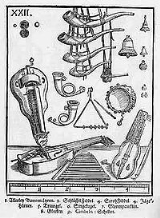
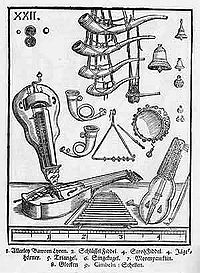
, dating to circa 1590. The Schlüsselfidel (nyckelharpa) is also mentioned in Theatrum Instrumentorum, a famous work written in 1620 by the German organist Michael Praetorius
(1571–1621). The Swedish province of Uppland
has been a stronghold for nyckelharpa music since the late 16th century, including musicians like Byss-Calle (Karl Ersson Bössa, 1783–1847) from Älvkarleby
.
Changes by August Bohlin (1877–1949) in 1929/1930 made the nyckelharpa a chromatic
instrument with a straight bow
, making it a more violin
-like and no longer a bourdon instrument. Composer, player and maker of nyckelharpas Eric Sahlström
(1912–1986) further refined the instrumentand helped to re-popularize it in the mid-20th century. In spite of this, the nyckelharpa's popularity declined until the 1960s roots revival
.
The 1960s and 1970s saw a resurgence in the popularity of the nyckelharpa, with notable artists such as Marco Ambrosini
(Italy
and Germany
), Sture Sahlström, Hasse Gille, and Nils Nordström including the nyckelharpa in both early music
and contemporary music offerings. Continued refinement of the instrument also contributed to the increase in popularity, with instrument builders like Jean-Claude Condi and Annette Osann bringing innovation to the bow and body.
In 1990s, the nyckelharpa was recognised as one of the instruments available for study at the folk music department of the Royal College of Music in Stockholm (Kungliga Musikhögskolan).
The nyckelharpa has been a prominent part of several revival groups in the later part of the century, including the trio Väsen
, the more contemporary group Hedningarna
, the Finnish
folk music group Hyperborea
and the Swedish
folk music groups Dråm
and Nordman
.
The nyckelharpa and its tonal range appear on the reverse of the Swedish 50 kronor banknote.
, violinist and nyckelharpist from Belgium, is noted for using an unusual playing posture, holding the nyckelharpa vertically in front of the chest. This allows a wider range of motion for both arms. It also affects the tone and sound of the instrument. Using a violin bracket to keep the nyckelharpa away from the body so it can swing freely causes it to sound more "open".
The resonance strings, or sympathetic strings, which were added to the instrument during the 2nd half of the 16th century, are not bowed directly but resonate with the other strings.
Traditional variants of the nyckelharpa used to have one or more drone string
s. This is still true for modern chromatic nyckelharpor with three rows of keys for three melody strings. But there are now also types with four or even five rows of keys. These no longer have real drone strings.
Sweden
Sweden , officially the Kingdom of Sweden , is a Nordic country on the Scandinavian Peninsula in Northern Europe. Sweden borders with Norway and Finland and is connected to Denmark by a bridge-tunnel across the Öresund....
musical instrument. It is a string instrument
String instrument
A string instrument is a musical instrument that produces sound by means of vibrating strings. In the Hornbostel-Sachs scheme of musical instrument classification, used in organology, they are called chordophones...
or chordophone
Chordophone
A chordophone is any musical instrument that makes sound by way of a vibrating string or strings stretched between two points. It is one of the four main divisions of instruments in the original Hornbostel-Sachs scheme of musical instrument classification....
. Its keys are attached to tangents which, when a key is depressed, serve as fret
Fret
A fret is a raised portion on the neck of a stringed instrument, that extends generally across the full width of the neck. On most modern western instruments, frets are metal strips inserted into the fingerboard...
s to change the pitch of the string.
The nyckelharpa is similar in appearance to a fiddle
Fiddle
The term fiddle may refer to any bowed string musical instrument, most often the violin. It is also a colloquial term for the instrument used by players in all genres, including classical music...
or the bowed Byzantine lira. Structurally, it is more closely related to the hurdy gurdy
Hurdy gurdy
The hurdy gurdy or hurdy-gurdy is a stringed musical instrument that produces sound by a crank-turned rosined wheel rubbing against the strings. The wheel functions much like a violin bow, and single notes played on the instrument sound similar to a violin...
, both employing key-actuated tangents to change the pitch.
History
Gotland
Gotland is a county, province, municipality and diocese of Sweden; it is Sweden's largest island and the largest island in the Baltic Sea. At 3,140 square kilometers in area, the region makes up less than one percent of Sweden's total land area...
. Early church paintings are found in Siena
Siena
Siena is a city in Tuscany, Italy. It is the capital of the province of Siena.The historic centre of Siena has been declared by UNESCO a World Heritage Site. It is one of the nation's most visited tourist attractions, with over 163,000 international arrivals in 2008...
, Italy
Italy
Italy , officially the Italian Republic languages]] under the European Charter for Regional or Minority Languages. In each of these, Italy's official name is as follows:;;;;;;;;), is a unitary parliamentary republic in South-Central Europe. To the north it borders France, Switzerland, Austria and...
, dating to 1408 and in different churches in Denmark and Sweden, such as Tolfta church, Sweden, which dates to circa 1460-1525. Other very early pictures are to be found in Hildesheim
Hildesheim
Hildesheim is a city in Lower Saxony, Germany. It is located in the district of Hildesheim, about 30 km southeast of Hanover on the banks of the Innerste river, which is a small tributary of the Leine river...
, Germany
Germany
Germany , officially the Federal Republic of Germany , is a federal parliamentary republic in Europe. The country consists of 16 states while the capital and largest city is Berlin. Germany covers an area of 357,021 km2 and has a largely temperate seasonal climate...
, dating to circa 1590. The Schlüsselfidel (nyckelharpa) is also mentioned in Theatrum Instrumentorum, a famous work written in 1620 by the German organist Michael Praetorius
Michael Praetorius
Michael Praetorius was a German composer, organist, and music theorist. He was one of the most versatile composers of his age, being particularly significant in the development of musical forms based on Protestant hymns, many of which reflect an effort to make better the relationship between...
(1571–1621). The Swedish province of Uppland
Uppland
Uppland is a historical province or landskap on the eastern coast of Sweden, just north of Stockholm, the capital. It borders Södermanland, Västmanland and Gästrikland. It is also bounded by lake Mälaren and the Baltic sea...
has been a stronghold for nyckelharpa music since the late 16th century, including musicians like Byss-Calle (Karl Ersson Bössa, 1783–1847) from Älvkarleby
Älvkarleby
Älvkarleby is a locality situated in Älvkarleby Municipality, Uppsala County, Sweden with 1,648 inhabitants in 2005. It is not the seat of the municipality, a function uphold by Skutskär 7 km to the north.- References :...
.
Changes by August Bohlin (1877–1949) in 1929/1930 made the nyckelharpa a chromatic
Chromatic scale
The chromatic scale is a musical scale with twelve pitches, each a semitone apart. On a modern piano or other equal-tempered instrument, all the half steps are the same size...
instrument with a straight bow
Bow (music)
In music, a bow is moved across some part of a musical instrument, causing vibration which the instrument emits as sound. The vast majority of bows are used with string instruments, although some bows are used with musical saws and other bowed idiophones....
, making it a more violin
Violin
The violin is a string instrument, usually with four strings tuned in perfect fifths. It is the smallest, highest-pitched member of the violin family of string instruments, which includes the viola and cello....
-like and no longer a bourdon instrument. Composer, player and maker of nyckelharpas Eric Sahlström
Eric Sahlström
Eric Sahlström was a Swedish player of the nyckelharpa, and riksspelman awardee from Tobo in northern Uppland, Sweden.Sahlström won great respect for his musicianship in an era when folk music was not yet an established art form. He was hired by Bo Nilson in 1962 to play in a new work at the...
(1912–1986) further refined the instrumentand helped to re-popularize it in the mid-20th century. In spite of this, the nyckelharpa's popularity declined until the 1960s roots revival
Roots revival
A roots revival is a trend which includes young performers popularizing the traditional musical styles of their ancestors. Often, roots revivals include an addition of newly-composed songs with socially and politically aware lyrics, as well as a general modernization of the folk sound.After an...
.
The 1960s and 1970s saw a resurgence in the popularity of the nyckelharpa, with notable artists such as Marco Ambrosini
Marco Ambrosini
Marco Ambrosini is an Italian musician, composer and arranger living in Germany. - Studies :From 1971 to 1981, Ambrosini studied violin and viola and composition with Mario Perrucci at the "Instituto Musicale G.B.Pergolesi" in Ancona and at the conservatory "G.Rossini" in Pesaro.- Musician...
(Italy
Italy
Italy , officially the Italian Republic languages]] under the European Charter for Regional or Minority Languages. In each of these, Italy's official name is as follows:;;;;;;;;), is a unitary parliamentary republic in South-Central Europe. To the north it borders France, Switzerland, Austria and...
and Germany
Germany
Germany , officially the Federal Republic of Germany , is a federal parliamentary republic in Europe. The country consists of 16 states while the capital and largest city is Berlin. Germany covers an area of 357,021 km2 and has a largely temperate seasonal climate...
), Sture Sahlström, Hasse Gille, and Nils Nordström including the nyckelharpa in both early music
Early music
Early music is generally understood as comprising all music from the earliest times up to the Renaissance. However, today this term has come to include "any music for which a historically appropriate style of performance must be reconstructed on the basis of surviving scores, treatises,...
and contemporary music offerings. Continued refinement of the instrument also contributed to the increase in popularity, with instrument builders like Jean-Claude Condi and Annette Osann bringing innovation to the bow and body.
In 1990s, the nyckelharpa was recognised as one of the instruments available for study at the folk music department of the Royal College of Music in Stockholm (Kungliga Musikhögskolan).
The nyckelharpa has been a prominent part of several revival groups in the later part of the century, including the trio Väsen
Väsen
Väsen is a Swedish folk music band originally consisting of Olov Johansson , Mikael Marin and Roger Tallroth . Later André Ferrari also joined the group. they have released 14 albums, and have toured every year also outside of Europe...
, the more contemporary group Hedningarna
Hedningarna
Hedningarna is a Swedish and, for some years partly Finnish, folk music band that mixes electronics and rock with elements from old Scandinavian folk music. Their music features Yoik or juoiggus, a traditional Sami form of song.-History:...
, the Finnish
Finland
Finland , officially the Republic of Finland, is a Nordic country situated in the Fennoscandian region of Northern Europe. It is bordered by Sweden in the west, Norway in the north and Russia in the east, while Estonia lies to its south across the Gulf of Finland.Around 5.4 million people reside...
folk music group Hyperborea
Hyperborea (Finnish folk music group)
Hyperborea is a folk music group, comprising four Finnish musicians. They are:*Piia Kleemola - fiddle, viola, kantele, vocals*Antti Paalanen - accordion*Petri Prauda - cittern, mandolin, bagpipes, vocals...
and the Swedish
Sweden
Sweden , officially the Kingdom of Sweden , is a Nordic country on the Scandinavian Peninsula in Northern Europe. Sweden borders with Norway and Finland and is connected to Denmark by a bridge-tunnel across the Öresund....
folk music groups Dråm
Dram
Dram or DRAM may refer to:As a unit of measure:* Dram , an imperial unit of mass and volume* Armenian dram, a monetary unit* Dirham, a unit of currency in several Arab nationsOther uses:...
and Nordman
Nordman
Nordman is a Swedish group founded in 1993, that mixes folk music with rock and pop. This genre is called etnorock or folk rock in Swedish. The group consists of Håkan Hemlin, as singer and frontman and Mats Wester, who plays the nyckelharpa as well as serving as the main songwriter..The group's...
.
The nyckelharpa and its tonal range appear on the reverse of the Swedish 50 kronor banknote.
Technique
Traditionally and usually currently, the nyckelharpa is played with a strap around the neck, stabilised by the right arm. Didier FrançoisDidier François
Didier François is a Belgian musician specialising in the nyckelharpa who lives in Paris.- Studies :From 1992 to 1999 François studied violin with Myriam Quersin and composition with Daan Manneke at the Amsterdam Conservatory...
, violinist and nyckelharpist from Belgium, is noted for using an unusual playing posture, holding the nyckelharpa vertically in front of the chest. This allows a wider range of motion for both arms. It also affects the tone and sound of the instrument. Using a violin bracket to keep the nyckelharpa away from the body so it can swing freely causes it to sound more "open".
Variants
There are four common variants of the nyckelharpa still played today, differing in the number and arrangement of keys, number and arrangement of strings, and general body shape. The predominant type is the so-called "chromatic nyckelharpa", with the melody strings tuned A1 - C1 - G, a drone C (from the highest to the lowest string) that is only touched occasionally, and 12 resonance strings (one for each step of the chromatic scale).The resonance strings, or sympathetic strings, which were added to the instrument during the 2nd half of the 16th century, are not bowed directly but resonate with the other strings.
Traditional variants of the nyckelharpa used to have one or more drone string
Drone (music)
In music, a drone is a harmonic or monophonic effect or accompaniment where a note or chord is continuously sounded throughout most or all of a piece. The word drone is also used to refer to any part of a musical instrument that is just used to produce such an effect.-A musical effect:A drone...
s. This is still true for modern chromatic nyckelharpor with three rows of keys for three melody strings. But there are now also types with four or even five rows of keys. These no longer have real drone strings.
External links
- The American Nyckelharpa Association
- Information about the nyckelharpa (in German)
- International Days of the Nyckelharpa (Germany)
- European Nyckelharpa Training
- "Cadence" - International cooperation in the teaching of the nyckelharpa, supported by the European Commission
- Eric Sahlström Institutet - National Folkmusic Institute in Sweden