
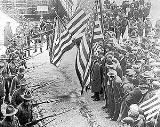
A
trade union (or
labor union) is an organization of workers who have banded together to achieve common goals in key areas, such as working conditions. The trade union, through its leadership, bargains with the employer on behalf of union members (rank and file members) and negotiates labor contracts (
Collective bargainingIn organized labor, collective bargaining is the method whereby workers organize together to meet, converse, and negotiate upon the work conditions with their employers normally resulting in a written contract setting forth the wages, hours, and other conditions to be observed for a stipulated...
) with employers. This may include the negotiation of wages, work rules, complaint procedures, rules governing hiring, firing and promotion of workers, benefits, workplace safety and policies. The agreements negotiated by the union leaders are binding on the rank and file members and the employer and in some cases on other non-member workers.
These organizations may comprise individual workers, professionals, past workers, or the unemployed. The most common, but by no means only, purpose of these organizations is "maintaining or improving the conditions of their
employmentEmployment is a contract between two parties, one being the employer and the other being the employee. An employee may be defined as: "A person in the service of another under any contract of hire, express or implied, oral or written, where the employer has the power or right to control and direct...
".
Over the last three hundred years, many trade unions have developed into a number of forms, influenced by differing political and economic regimes. The immediate objectives and activities of trade unions vary, but may include:
- Provision of benefits to members: Early trade unions, like Friendly Societies, often provided a range of benefits to insure members against unemployment
Unemployment occurs when a person is available to work and seeking work but currently without work. The prevalence of unemployment is usually measured using the unemployment rate, which is defined as the percentage of those in the labor force who are unemployed...
, ill health, old age and funeral expenses. In many developed countries, these functions have been assumed by the state; however, the provision of professional training, legal advice and representation for members is still an important benefit of trade union membership.
- Collective bargaining
In organized labor, collective bargaining is the method whereby workers organize together to meet, converse, and negotiate upon the work conditions with their employers normally resulting in a written contract setting forth the wages, hours, and other conditions to be observed for a stipulated...
: Where trade unions are able to operate openly and are recognized by employers, they may negotiate with employers over wageA wage is a compensation, usually financial, received by a worker in exchange for their labor.Compensation in terms of wages is given to worker and compensation in terms of salary is given to employees...
s and working conditions.
- Industrial action
Industrial action or job action refers collectively to any measure taken by trade unions or other organised labour meant to reduce productivity in a workplace. Quite often it is used and interpreted, mistakenly, as a euphemism for strike, but the scope is much wider...
: Trade unions may enforce strikesStrike action, often simply called a strike, is a work stoppage caused by the mass refusal of employees to perform work. A strike usually takes place in response to employee grievances. Strikes became important during the industrial revolution, when mass labour became important in factories and mines...
or resistance to lockoutsA lockout is a work stoppage in which an employer prevents employees from working. This is different from a strike, in which employees refuse to work.- Causes :...
in furtherance of particular goals.
- Political activity: Trade unions may promote legislation favorable to the interests of their members or workers as a whole. To this end they may pursue campaigns, undertake lobbying, or financially support individual candidates or parties (such as the Labour Party
The Labour Party is a centre-left political party in the United Kingdom. Founded at the start of the 20th century, it has been seen since 1920 as the principal party of the Left in England, Scotland and Wales, but not Northern Ireland, where it has only recently begun to organise again...
in Britain) for public office.
History
The origins of unions' existence can be traced from the eighteenth century, where the rapid expansion of industrial society drew women, children, rural workers, and immigrants to the work force in larger numbers and in new roles. This pool of unskilled and semi-skilled labor spontaneously organized in fits and starts throughout its beginnings, and would later be an important arena for the development of trade unions. Trade unions as such were endorsed by the Catholic Church towards the end of the 19th Century. Pope Leo XIII in his 'Magna Carta':
Rerum NovarumRerum Novarum is an encyclical issued by Pope Leo XIII on May 15 1891. It was an open letter, passed to all Catholic bishops, that addressed the condition of the working classes. The encyclical is entitled: "Rights and Duties of Capital and Labour"...
, spoke against the atrocities workers faced and demanded that workers should be granted certain rights and safety regulations.
Origins and early history
Trade Unions have sometimes been seen as successors to the
guildA guild is an association of craftsmen in a particular trade.The earliest guilds were formed as confraternities of workers. They were organized in a manner something between a trade union, a cartel and a secret society...
s of medieval Europe, though the relationship between the two is disputed. Medieval guilds existed to protect and enhance their members' livelihoods through controlling the
instructional capitalInstructional capital is a term used in educational administration after the 1960s, to reflect capital resulting from investment in producing learning materials....
of
artisanshipA trade is an occupation that requires some particular kind of skilled work. In historical sense, particularly as pertinent to the Medieval history and earlier, the term is usually applied towards people occupied in most kinds of crafts and small-scale production of goods.The households of the...
and the progression of members from
apprenticeApprenticeship is a system of training a new generation of practitioners of a skill. Apprentices or protégés build their careers from apprenticeships...
to
craftsmanAn artisan is a skilled manual worker who crafts items that may be functional or strictly decorative, including furniture, clothing, jewelry, household items, and tools...
,
journeymanA journeyman is a male trader or crafter who has completed an apprenticeship.-Origin of the title:The word 'journeyman' comes from the French word journée, meaning the period of one day; this refers to their right to charge a fee for each day's work. They would normally be employed by a master...
, and eventually to master and
grandmasterA master craftsman or master tradesman was a member of a guild. In the European guild system, only masters were allowed to be members of the guild....
of their craft. A labor union might include workers from only one trade or craft, or might combine several or all the workers in one company or industry.
Since the publication of the
History of Trade UnionismHistory of Trade Unionism is a book by Sidney and Beatrice Webb.First published in 1894, it is a detailed and influential accounting of the roots and development of the British trade union movement. The research materials collected by the Webbs form the Webb Collection at the London School of...
(1894) by Sidney and
Beatrice WebbMartha Beatrice Webb was an English sociologist, economist, socialist and reformer, usually referred to in association with her husband, Sidney Webb...
, the predominant historical view is that a trade union "is a continuous association of wage earners for the purpose of maintaining or improving the conditions of their employment." A modern definition by the Australian Bureau of Statistics states that a trade union is "an organization consisting predominantly of employees, the principal activities of which include the negotiation of rates of pay and conditions of employment for its members."
Yet historian R.A. Leeson, in
United we Stand (1971), said:
Recent historical research by
Bob JamesBob James may refer to:*Bob James , jazz keyboardist, arranger and producer of music*Bob James , former baseball player for the Expos, Tigers, and White Sox...
in
Craft, Trade or Mystery (2001) puts forward the view that trade unions are part of a broader movement of
benefit societiesA benefit society or mutual aid society is an organization or voluntary association formed to provide mutual aid, benefit or insurance for relief from sundry difficulties...
, which includes medieval guilds,
FreemasonsFreemasonry is a fraternal organisation that arose from obscure origins in the late 16th to early 17th century. Freemasonry now exists in various forms all over the world, with a membership estimated at around 5 million, including just under two million in the United States and around 480,000 in...
,
OddfellowsThe Independent Order of Odd Fellows is an altruistic fraternal organization derived from the similar English Oddfellows service organizations which came into being during the 1700s, at a time when altruistic and charitable acts were far less common. In the U.S., it is a "Mutual Benefit...
,
friendly societiesA friendly society is a mutual association for insurance, pensions or savings and loan-like purposes, or cooperative banking. Some friendly societies, especially in the past, served ceremonial and friendship purposes also, while others did not...
, and other fraternal organizations.
The 18th century
economistAn economist is an expert in the social science of economics. The individual may also study, develop, and apply theories and concepts from economics and write about economic policy...
Adam SmithAdam Smith was a Scottish moral philosopher and a pioneer of political economy. One of the key figures of the Scottish Enlightenment, Smith is the author of The Theory of Moral Sentiments and An Inquiry into the Nature and Causes of the Wealth of Nations...
noted the imbalance in the rights of workers in regards to owners (or "masters"). In
The Wealth of NationsAn Inquiry into the Nature and Causes of the Wealth of Nations is the magnum opus of the Scottish economist Adam Smith and was first published in 1776...
, Book I, chapter 8, Smith wrote:
As Smith noted, unions were illegal for many years in most countries (and Smith argued that schemes to fix wages or prices, by employees or employers, should be). There were severe penalties for attempting to organize unions, up to and including execution. Despite this, unions were formed and began to acquire
political powerPolitical power is a type of power held by a group in a society which allows administration of some or all of public resources, including labour, and wealth. There are many ways to obtain possession of such power. At the nation-state level political legitimacy for political power is held by the...
, eventually resulting in a body of labor law that not only legalized organizing efforts, but codified the relationship between employers and those employees organized into unions. Even after the legitimization of trade unions there was opposition, as the case of the
Tolpuddle MartyrsThe Tolpuddle Martyrs were a group of 19th century English agricultural labourers who were arrested for and convicted of swearing a secret oath as members of the Friendly Society of Agricultural Labourers. The rules of the society show it was clearly structured as a friendly society and operated as...
shows.
The right to join a trade union is mentioned in article 23, subsection 4 of the Universal Declaration of Human Rights (
UDHRThe Universal Declaration of Human Rights is a declaration adopted by the United Nations General Assembly . The Guinness Book of Records describes the UDHR as the "Most Translated Document" in the world...
), which also states in article 20, subsection 2 that "No one may be compelled to belong to an association". Prohibiting a person from joining or forming a union, as well as forcing a person to do the same (e.g. "closed shops" or "union shops", see below), whether by a government or by a business, is generally considered a human rights abuse. Similar allegations can be leveled if an employer
discriminatesDiscrimination is a sociological term refering to treatment taken toward or against a person of a certain group that is taken in consideration based on class or category. The United Nations explains: "Discriminatory behaviours take many forms, but they all involve some form of exclusion or...
based on trade union membership. Attempts by an employer, often with the help of outside agencies, to prevent union membership amongst their staff is known as
union bustingUnion busting is a term used by trade unions and others to describe a wide range of activities undertaken by employers, their proxies, and governments, which hinder workers from freely organizing, joining and maintaining trade unions...
.
19th Century American Unionism
In the early 1800s many men from large cities put together the organization which we now call the Trade Union Movement. Individuals who were members of unions at this time were skilled, experienced, and knew how to get the job done. Their main reasoning for starting this movement was to put on strikes. However, they did not have enough men to fulfill their needs and the unions which began this trendy movement, collapsed quickly. The Mechanics’ Union Trade Association was the next approach to bring workers together. In 1827, this union was the first U.S. labor organization which brought together workers of divergent occupations. This was “the first city-wide federation of American workers, which recognized that all labor, regardless of trades, had common problems that could be solved only by united effort as a class.” This organization took off when carpentry workers from Philadelphia went on strike to protest their pay wages and working hours. This union strike was only a premonition of what was to come in the future.
According to history.com:
Workers realized what unionism was all about through the configuration of mechanics association and many people followed in their footsteps. The strike gave others hope that they.could get their concerns out by word of mouth. Before this time many people did not speak about their concerns because of the lack of bodies. However, with more people comes more confidence. Strikes were a new way of speaking your mind and getting things accomplished.
The next established union which made an impact on the trade movement was the Grand National Consolidated Trade Union. This union was founded in 1834 as the first domestic association. However, this union was short lived due to the panic of 1837.
“[Andrew] Jackson thought the Bank of the United States hurt ordinary citizens by exercising too much control over credit and economic opportunity, and he succeeded in shutting it down. But the state banks' reckless credit policies led to massive speculation in Western lands. By 1837, after Van Buren had become president, banks were clearly in trouble. Some began to close, businesses began to fail, and thousands of people lost their land.”
This collapse of financial support and businesses left workers unemployed. Many of these workers, who became affected by the 1837 disaster, were members of a union. It was very hard for them to stay together in an economic hardship. The trade union movement came to a bump in the road and died out for a short while. The economy was restored by the early 1840s and trade unions were at their best. National Labor unions were forming; however, they were different than ones in the past, such as the National Trade Union. The new National Labor unions consisted of members in the same occupation.
The work force was drastically impacted by the Civil War and the economy was thriving. Many workers gained employment because of this economic boom and unions increased greatly. “More than 30 national craft unions were established during the 1860s and early '70s.” One of the significant national craft unions to be formed during this time was the National Labor Union (NLU). The
National Labor UnionThe National Labor Union was the first national labor federation in the United States. Founded in 1866 and dissolved in 1872, it paved the way for other organizations, such as the Knights of Labor and the American Federation of Labor. It was led by William H...
was the first national union in the United States. It was created in 1866 and included many types of workers. Although relatively short-lived, the NLU paved the way for future American unions. Following the decline of the NLU, the
Knights of LaborThe Knights of Labor, also known as Noble and Holy Order of the Knights of Labor, was one of the most important American labor organizations of the 19th century...
became the leading countrywide union in the 1860s. This union did not include Chinese, and partially included black people and women.
Knights of Labor
The Noble and Holy Order of the Knights of Labor (KOL) was founded in Philadelphia in 1869 by Uriah Stevens and six other men. The union was formed for the purpose of organizing, educating and directing the power of the industrial masses, according to their Constitution of 1878. The Knights gathered people to join the Order who believed in creating “the greatest good to the greatest amount of people”. The Knights took their set goals very seriously. Some of which consisted of “productive work, civic responsibility, education, a wholesome family life, temperance, and self-improvement.”
The Knights of Labor worked as a secret fraternal society until 1881. The union grew slowly until the economic depression of the 1870s, when large numbers of workers joined the organization. The Knights only permitted certain groups of individuals into their Order which promoted social division amongst the people around them. Bankers, speculators, lawyers, liquor dealers, gamblers, and teachers were all excluded from the union. These workers were known as the “non-producers” because their jobs did not entail physical labor. Factory workers and business men were known as the “producers” because their job constructed a physical product. The working force producers were welcomed into the Order. Women were also welcome to join the Knights, as well as black workers by the year 1883. However, Asians were excluded. In November 1885, the Knights of a Washington city pushed to get rid of their Asian population. The knights were strongly for the Chinese Exclusion Act of 1882 because it greatly helped them deteriorate the Asian community.
“The Act required the few non-laborers who sought entry to obtain certification from the Chinese government that they were qualified to immigrate. But this group found it increasingly difficult to prove that they were not laborers because the 1882 act defined excludables as ‘skilled and unskilled laborers and Chinese employed in mining.’ Thus very few Chinese could enter the country under the 1882 law.”
The act also stated that if an Asian left the country, they needed a certificate to re-enter.
Although Asians were not welcomed in the union, black workers who joined the union brought a large number of blacks into the white labor movement. In 1886, the Union exceeded 700,000 members, 60,000 of them black. The Knights were told that they “broke the walls of prejudice”; the “color line had been broken and black and white were found working in the same cause.” The knights gained many members again in 1873, after the collapse of the National Labor Union and when Terence V. Powderly took over as Grand Master Working Man in place of Uriah Stephens.
As the association gained members, Powderly helped the knights to work together as a labor union and less like a “fraternal organization”. He transformed the “skilled and unskilled, black and white, male and female, immigrant and native-born” to a powerful group who worked as one. The Knights aided many boycotts and strikes as a way to fight for their goals even though Powderly did not agree with them. He believed they only lead to fighting and stress. Other leaders of the Knights found strikes very beneficial. The union’s utmost success was in the 1884 strike of the Union Pacific Railroad and the Wabash Railroad strike as well. In 1886 the Knights reputation was tarnished by the Haymarket Square Riot. In May 1886 the Knights were campaigning in the Haymarket Square for an 8-hour work day, which is one of their main goals. Chicago workers went on strike and during a violent incident with police, two workers were shot. The rally at Haymarket was to protest this event. During the rally a bomb was set off and because the Knights were present they were associated with the violent act, causing the decline of the union.
“The decline of the Knights of Labor contributed to the rise of the American Federation of Labor, established under the leadership of Samuel Gompers in 1886. Whereas the Knights of Labor aimed at legislative reforms including the eight-hour day and child labor laws, the American Federation of Labor focused on protecting the autonomy and established privileges of individual craft unions.”
With the motto “an injury to one is the concern of all,” the Knights of Labor tried to push their aims through educational sources. The Union reached its prime time in 1886 when the union grew to over 700,000 members. After this quick peak in their association the knights took a turn for the worse. The union slowly began to deteriorate due to many circumstances. Powderly began to emphasize his unlimited authority over the knights which caused the members discontent. The members slowly began to disappear, as did the financial resources. Much of the money was used on strikes which were ineffective and, in the end, a waste of needed money. The union wasted away to 100,000 members by 1890 and the American Federation of Labor began to merge with the Knights despite the leaders wishes. Powderly stepped down from Grand Master Working Man in 1893 because he was unable to reunite his members. The American Federation of Labor picked up where the Knights of Labor left off and the knights were totally inactive by the 1900s.
American Federation of Labor
In 1886, Samuel Gompers brought men together in Ohio to formulate The American Federation of Labor. Gompers was the residing President of the union until his death in 1924. George Meany took over the role as President from 1952 until the merger of the AFL-CIO. The AFL was established due to the vexation of many Knights who parted from the KOL. Many Knights joined the AFL because they set themselves apart from the KOL.
They “tried to teach the American wage-earner that he was a wage-earner first and a bricklayer, carpenter, miner [...] after. This meant that the Order was teaching something that was not so in the hope that sometime it would be.’ But the AFL affiliates organized carpenters as carpenters, bricklayers as bricklayers, and so forth, teaching them all to place their own craft interests before those of other workers.”
The AFL also differed from the KOL because it only allowed associations to be formed from workers and workers were the only people permitted to join them. Unlike the AFL, the knights also allowed small businesses to join. A small business is
“An independently owned and operated business that is not dominant in its field of operation and conforms to standards set by the Small Business Administration or by state law regarding number of employees and yearly income called also small business concern.”
Since the knights allowed an array of members into their association, they ended up getting rid of many because they did not fit the title. However, the AFL was right behind them picking up their pieces. This was another way in which the AFL helped to destroy the Knights. Once an associate was no longer a knight, and they fit the description of an AFL member, they hunted them down and offered them a spot. Many times spots were offered to men who were still Knights. This allowed the AFL to grow very strong with a diverse set of members.
The diversity in the AFL faltered when many of the black members were excluded. Gompers only wanted skilled workers representing his union and many black people were not considered skilled. The AFL claimed to not exclude the black members because of their race but because they were not qualified for the part. “So as long as wages rose, and they did, hours fell, and they did, security increased, and it appeared to, the AFL could grow fat while neglecting millions of laborers doomed to lives of misery and want.” Even black workers considered skilled enough to fit the part were generally excluded from the Union. The AFL conducted literacy tests which had the effect of excluding immigrants and blacks. Regardless of black members being excluded, the AFL was the most prevalent union federation in America before the mid 1940s. The union was composed of over 10 million members before it combined with the Congress of Industrial Organization (CIO).
Congress of Industrial Organizations
The CIO was put forth by John L. Lewis when troubles with the AFL persisted, after the death of Gompers in 1924. Many members of the union requested that they switch the rules which were laid out by Gompers. They wanted to support inexperienced workmen rather than only focusing on experienced workers of one occupation. John L. Lewis was the first member of the AFL to act upon this issue in 1935. He was the founder of the Committee for the Industrial Organization which was an original union branched from the AFL. The Committee for the Industrial Organization transformed into the Congress of Industrial Organization. “The Congress of Industrial Organizations (CIO) encompassed the largest sustained surge of worker organization in American history.” In the 1930s, the CIO grabbed many of their member’s attention through victorious strikes. In the 1935, employees of Goodyear Tire and Rubber Company formed their own union called the United Rubber Workers. The Rubber Workers went on strike in 1936 to protest an increase in product with lower pay wages. “There were forty-eight strikes in 1936 in which the strikers remained at their jobs for at least one day; in twenty-two of these work stoppages, involving 34,565 workers, the strikers stayed inside the plants for more than twenty-four hours.” This tactic was called a “sit-down” strike which entailed workers to stop doing their job and sit in their place of employment. During these strikes, business owners were unable to bring in new workers to replace the ones who were on strike because they were still in their seats at the factory. This was unlike any strikes in the past. Before this time, workers showed their fury by leaving their factory and standing in picket lines.Walter Reuther was in control of the union at this time and moved forward to higher roles during 1955.
AFL-CIO
On May 5, 1955, labor delegates gathered in NY on behalf of 16 million workers, to witness and support the merger of The American Federation of Labor and The Congress of Industrial Organization. The merger is a result of 20 years of effort put forth by both the AFL and CIO presidents, George Meany and Walter Reuther. The gathered delegates applauded loudly when the time came to nominate officers for the new AFL-CIO. Reuther who was named one of the 37 vice presidents of the union, nominated Meany for President. After Meany’s retirement in 1979, Lane Kirkland took over his position. President Dwight D. Eisenhower, who was elected in 1952, was the first to publicly address and congratulate the new union, which was now the largest in the world.
In Eisenhower’s telephone broadcast to the United States he acknowledged the impact union members had made to better the nation and one of these impacts was “the development of the American philosophy of labor.” Eisenhower states three principles which he feels apply to the philosophy of labor. The first principles states that: “the ultimate values of mankind are spiritual; these values include liberty, human dignity, opportunity and equal rights and justice.” Eisenhower was stating that every individual deserves a job with decent compensation, practical hours, and good working conditions that leave them feeling fulfilled. His second principle speaks of the economic interest of the employer and employee being a mutual prosperity. The employers and employees must work together in order for there to be the greatest amount of wealth for all. Workers have a right to strike when they feel their boundaries are being crossed and the best way for the employer to fix the employees unhappiness is to come to a mutual agreement. His last principle which he preached stated: “labor relations will be managed best when worked out in honest negotiation between employers and unions, without Government’s unwarranted interference.” Eisenhower was saying that when both parties cooperate and act in mature fashion, it will be easier to work out situations and a better outcome will result because of it. Once he was done delivering the speech, everyone across the U.S. knew of the new AFL-CIO whose “mission was to bring social and economic justice to our nation by enabling working people to have a voice on the job, in government, in a changing global economy and in their communities.”
This new alliance is made up of 56 nationwide and intercontinental labor unions. The unions which are a part of this alliance are composed of 2.5 million working Americans and 8.5 million other affiliated members. These members do not fall under one job title but they are very diversely spread out among the working area. Their jobs go from doctors to truck drivers and painters to bankers. The mission of these workers and the AFL-CIO “is to improve the lives of working families—to bring economic justice to the workplace and social justice to our nation. To accomplish this mission we will build and change the American labor movement.” The AFL-CIO also has many goals which coincide with their mission:
“We will build a broad movement of American workers by organizing workers into unions. We will build a strong political voice for workers in our nation. We will change our unions to provide a new voice to workers in a changing economy. We will change our labor movement by creating a new voice for workers in our communities.”
The association was willing to go to any extent to help out their employers which is why the membership was so high. Members started to slowly disappear after 25 successful years of a steady membership. Starting out with 16 million members in 1955 and dropping down to 13 million by 1984 is a significant loss. This loss of members is in large part due to the 1957 removal of the Teamsters’ Union who were long time members of the AFL. The Teamsters’ were involved in organized crime and manipulating employers with strong force. The Teamsters’ philosophy was to
“Let each member do his duty as he sees fit. Let each put his shoulder to the wheel and work together to bring about better results. Let no member sow seeds of discord within our ranks, and let our enemies see that the Teamsters of this country are determined to get their just rewards and to make their organization as it should be -- one of the largest and strongest trade unions in the country now and beyond."
This philosophy did not work well for Teamster presidents Beck, Hoffa, and Williams who were all accused of criminal acts and sent to prison. In 1987 the AFL-CIO membership grew to 14 million members when the Teamsters Union was restored to the association.
The AFL-CIO also lost many members due to financial struggles in the United States. During the late 1900’s the U.S. dollar began to oscillate due to rivalry with foreign countries and their coinage. This affects global trafficking and results in job loss for American citizens. The issues between the United States and foreign countries cannot be resolved by Eisenhower’s third principle, which entailed honest negotiations. Consequently, the association has been dynamically supportive in administration policies which deal with global trafficking, the production of goods, and many other issues, which are optimistic policies that will add to an established financial system.
The AFL-CIO is now governed by a gathering of delegates who are present on behalf of association members who meet every four years. The delegates who are the spokespeople of the federation members are chosen by union members. While the delegates vote for new representatives every four years, they also lay down the goals and policies for the union. The most recent representatives for the organization along with 45 vice presidents are President John J. Sweeny, Secretary-treasurer Richard Trumka, and executive vice president Arlene Holt Baker
In the United States there are a total of 15.4 million union members, “11 million of whom belong to unions affiliated with the AFL-CIO.” This number has grown rapidly since the beginning of the union movement because today, all individuals with different occupations are welcomed to join unions. “Today's unions include manufacturing and construction workers, teachers, technicians and doctors—and every type of worker in between. No matter what you do for a living, there's a union that has members who do the same thing.” Educating union members about issues that shape lives of functioning families on a daily basis is one of the AFL-CIO’s policies. They give them confidence to have their voices heard for political purposes. They also prioritize in
“creating family-supporting jobs by investing tax dollars in schools, roads, bridges and airports; improving the lives of workers through education, job training and raising the minimum wage; keeping good jobs at home by reforming trade rules, reindustrializing the U.S. economy and redoubling efforts at worker protections in the global economy; strengthening Social Security and private pensions; making high-quality, affordable health care available to everyone; and holding corporations more accountable for their actions.”
The AFL-CIO is very supportive of political issues and they show their concern by giving out information about existing political issues to families. This information is spread by volunteers and activists and includes where all the candidates stand on the issues.
Europe
In
FranceFrance , officially the French Republic , is a country located in Western Europe, with several overseas islands and territories located on other continents. Metropolitan France extends from the Mediterranean Sea to the English Channel and the North Sea, and from the Rhine to the Atlantic Ocean...
,
GermanyGermany , officially the Federal Republic of Germany , is a country in Central Europe. It is bordered to the north by the North Sea, Denmark, and the Baltic Sea; to the east by Poland and the Czech Republic; to the south by Austria and Switzerland; and to the west by France, Luxembourg, Belgium,...
, and other European countries, socialist parties and democrats played a prominent role in forming and building up trade unions, especially from the 1870s onwards. This stood in contrast to the British experience, where moderate
New Model UnionNew Model Trade Unions were a variety of Trade Unions prominent in the 1850s and 1860s in the UK. The term was coined by Sidney and Beatrice Webb in their History of Trade Unionism , although later historians have questioned how far New Model Trade Unions represented a 'new wave' of unionism, as...
s dominated the union movement from the mid-nineteenth century and where trade unionism was stronger than the political labor movement until the formation and growth of the
Labour PartyThe Labour Party is a centre-left political party in the United Kingdom. Founded at the start of the 20th century, it has been seen since 1920 as the principal party of the Left in England, Scotland and Wales, but not Northern Ireland, where it has only recently begun to organise again...
in the early years of the twentieth century.
Australia
Supporters of Unions, such as the ACTU or
Australian Labor PartyThe Australian Labor Party is an Australian political party.Known as the ALP for short, the party is the current governing party of Australia, since the 2007 federal election...
, often credit trade unions with leading the labor movement in the early 20th century, which generally sought to end
child laborChild labour refers to the employment of children at regular and sustained labour. This practice is considered exploitative by many international organizations and is illegal in many countries...
practices, improve worker safety, increase wages for both union workers and non union workers, raise the entire society's
standard of livingStandard of living is generally measured by standards such as real income per person and poverty rate. Other measures such as access and quality of health care, income growth inequality and educational standards are also used. Examples are access to certain goods , or measures of health such as...
, reduce the hours in a work week, provide public education for children, and bring other benefits to working class families.
Structure and politics
- Union structures, politics, and legal status vary greatly from country to country. For specific country details see below.
Unions may organize a particular section of skilled workers (
craft unionismCraft unionism refers to organizing a union in a manner that seeks to unify workers in a particular industry along the lines of the particular craft or trade that they work in by class or skill level...
), a cross-section of workers from various trades (
general unionA General Union is a trade union which represents workers from all industries and companies, rather than just one organization or a particular sector, as in a craft union or industrial union...
ism), or attempt to organize all workers within a particular industry (
industrial unionismIndustrial unionism is a labor union organizing method through which all workers in the same industry are organized into the same union—regardless of skill or trade—thus giving workers in one industry, or in all industries, more leverage in bargaining and in strike situations...
). These unions are often divided into "
localsA local union, often shortened to local, known as a union branch in the United Kingdom, is a locally-based trade union organization which forms part of a larger, usually national, union....
", and united in national
federations. These federations themselves will affiliate with
InternationalInternational or internationally most often describes interaction between nations, or encompassing two or more nations, constituting a group or association having members in two or more nations, or generally reaching beyond national boundaries...
s, such as the
International Trade Union ConfederationThe International Trade Union Confederation is the world's largest trade union federation. It was formed on November 1, 2006 out of the merger of the International Confederation of Free Trade Unions and the World Confederation of Labour...
.
In many countries, a union may acquire the status of a "juristic person" (an artificial legal entity), with a mandate to negotiate with employers for the workers it represents. In such cases, unions have certain legal rights, most importantly the right to engage in
collective bargainingIn organized labor, collective bargaining is the method whereby workers organize together to meet, converse, and negotiate upon the work conditions with their employers normally resulting in a written contract setting forth the wages, hours, and other conditions to be observed for a stipulated...
with the employer (or employers) over wages, working hours, and other
terms and conditions of employmentA contract of employment is a category of contract used in labour law to attribute right and responsibilities between parties to a bargain. On the one end stands an "employee" who is "employed" by an "employer". It has arisen out of the old master-servant law, used before the 20th century...
. The inability of the parties to reach an agreement may lead to
industrial actionIndustrial action or job action refers collectively to any measure taken by trade unions or other organised labour meant to reduce productivity in a workplace. Quite often it is used and interpreted, mistakenly, as a euphemism for strike, but the scope is much wider...
, culminating in either
strike actionStrike action, often simply called a strike, is a work stoppage caused by the mass refusal of employees to perform work. A strike usually takes place in response to employee grievances. Strikes became important during the industrial revolution, when mass labour became important in factories and mines...
or management
lockoutA lockout is a work stoppage in which an employer prevents employees from working. This is different from a strike, in which employees refuse to work.- Causes :...
, or binding arbitration. In extreme cases, violent or illegal activities may develop around these events.
In other circumstances, unions may not have the legal right to represent workers, or the right may be in question. This lack of status can range from non-recognition of a union to political or criminal prosecution of union activists and members, with many cases of violence and deaths having been recorded both historically and contemporarily.
Unions may also engage in broader political or social struggle.
Social UnionismSocial Movement Unionism is a trend of theory and practice in contemporary trade unionism. Strongly associated with the organising model of trade unionism, it also overlaps with Community Unionism. Social Movement Unionism attempts to integrate workers, trade unions and the labour movement into...
encompasses many unions that use their organizational strength to advocate for social policies and legislation favorable to their members or to workers in general. As well, unions in some countries are closely aligned with
political partiesA political party is a political organization that seeks to attain and maintain political power within government, usually by participating in electoral campaigns...
.
Unions are also delineated by the
service modelThe service model generally describes an approach whereby unions aim to satisfy members' demands for resolving grievances and securing benefits through methods other than direct grassroots-oriented pressure on employers...
and the
organizing modelThe organising model, as the term refers to trade unions , is a broad conception of how those organisations should recruit, operate and advance the interests of their members...
. The service model union focuses more on maintaining worker rights, providing services, and resolving disputes. Alternately, the organizing model typically involves full-time
union organizerA union organizer is a specific type of trade union member or an appointed union official. A majority of unions appoint rather than elect their organizers....
s, who work by building up confidence, strong networks, and leaders within the workforce; and confrontational campaigns involving large numbers of union members. Many unions are a blend of these two philosophies, and the definitions of the models themselves are still debated.
Although their political structure and autonomy varies widely, union leaderships are usually formed through democratic
electionAn election is a formal decision-making process by which a population chooses an individual to hold public office. Elections have been the usual mechanism by which modern representative democracy since the 17th century. Elections may fill offices in the legislature, sometimes in the executive and...
s.
Some research, such as that conducted by the ACIRRT, argues that unionized workers enjoy better conditions and wages than those who are not unionized.
In Britain, the perceived left-leaning nature of trade unions has resulted in the formation of a reactionary right-wing trade union called Solidarity which is supported by the far-right
BNPThe British National Party is a far-right, whites-only political party in the United Kingdom, formed as a splinter group of the British National Front by John Tyndall in 1982. The party's current chairman is Nick Griffin, himself a former national organiser of the National Front.The BNP is not...
.
Shop types
Companies that employ workers with a union generally operate on one of several models:
- A closed shop
A closed shop is a form of union security agreement under which the employer agrees to only hire union members, and employees must remain a member of the union at all times in order to remain employed....
(US) or a "pre-entry closed shop" (UK) employs only people who are already union members. The compulsory hiring hallIn organized labor, a hiring hall is an organization, usually under the auspices of a labor union, which has the responsibility of furnishing new recruits for employers who have a collective bargaining agreement with the union....
is an example of a closed shop — in this case the employer must recruit directly from the union, as well as the employee working strictly for unionized employers.
- A union shop
A union shop is is a form of a union security clause under which the employer agrees to hire either labor union members or nonmembers but where all non-union employees must become union members within a specified period of time or lose their jobs....
(US) or a "post-entry closed shop" (UK) employs non-union workers as well, but sets a time limit within which new employees must join a union.
- An agency shop
An agency shop is a form of union security agreement where the employer may hire union or non-union workers, and employees need not join the union in order to remain employed. However, the non-union worker must pay a fee to cover collective bargaining costs...
requires non-union workers to pay a fee to the union for its services in negotiating their contract. This is sometimes called the Rand formulaIn Canadian labour law, the Rand formula is a workplace situation where the payment of trade union dues is mandatory regardless of the worker's union status...
. In certain situations involving state public employees in the United States, such as CaliforniaCalifornia is the most populous state in the United States, and the third largest by area. California is the second most populous sub-national entity in the Americas, behind only São Paulo, Brazil...
, "fair share laws" make it easy to require these sorts of payments.
- An open shop
An open shop is a place of employment at which one is not required to join or financially support a union as a condition of hiring or continued employment...
does not require union membership in employing or keeping workers. Where a union is active, workers who do not contribute to a union still benefit from the collective bargaining process. In the United States, state level right-to-work laws mandate the open shop in some states.
Diversity of international unions
As labor law varies from country to country, so is the function of unions. For example, in Germany only open shops are legal; that is, all discrimination based on union membership is forbidden. This affects the function and services of the union. In addition, German unions have played a greater role in management decisions through participation in corporate boards and
co-determinationCo-determination is a practice whereby the employees have a role in management of a company. The word is a somewhat clumsy and literal translation from the German word Mitbestimmung. Codetermination rights are different in different legal environments...
than have unions in the United States. (
newsletter/files/BTS012EN_12-15.pdf).
In Britain, a series of laws introduced during the 1980s by
Margaret ThatcherMargaret Hilda Thatcher, Baroness Thatcher LG, OM, PC, FRS served as Prime Minister of the United Kingdom from 1979 to 1990 and Leader of the Conservative Party from 1975 to 1990. She is the only woman to have held either post....
's government restricted closed and union shops. All agreements requiring a worker to join a union are now illegal. In the United States, the
Taft-Hartley ActThe Labor–Management Relations Act, 80 Pub.L. 101; 61 Stat. 136, informally the Taft–Hartley Act, is a United States federal law that monitors the activities and power of labor unions. The act, still effective, was sponsored by Senator Robert Taft and Representative Fred A. Hartley, Jr. and...
of 1947 outlawed the closed shop, but permitted the union shop unless the
stateA U.S. state is any one of 50 federated states of the United States of America that share sovereignty with the federal government . Because of this shared sovereignty, an American is a citizen both of the federal entity and of his or her state of domicile...
government chose to prohibit it.
In addition, unions' relations with political parties vary. In many countries unions are tightly bonded, or even share leadership, with a political party intended to represent the interests of working people. Typically this is a left-wing, socialist, or social democratic party, but many exceptions exist. In the United States, by contrast, although it is historically aligned with the
Democratic PartyThe Democratic Party is one of the two major contemporary political parties in the United States, along with the Republican Party. It is the oldest political party in continuous operation in the United States and it is one of the oldest parties in the world. In the U.S...
, the labor movement is by no means monolithic on that point; this is especially true among the individual "rank and file" members. For example, the International Brotherhood of Teamsters has supported
Republican PartyThe Republican Party is one of the two major contemporary political parties in the United States, along with the Democratic Party. Founded by anti-slavery expansion activists in 1854, it is often called the Grand Old Party or the GOP, despite being the younger of the two major parties. In the U.S...
candidates on a number of occasions and the Professional Air Traffic Controllers Organization (PATCO) endorsed
Ronald ReaganRonald Wilson Reagan was the 40th President of the United States and the 33rd Governor of California .Born in Tampico, Illinois, Reagan moved to Los Angeles, California in the 1930s...
in 1980. (However, when PATCO went on strike in violation of their "no strike" contract, President Reagan ordered them back to work. Those who didn't return to the job were fired and replaced, effectively destroying PATCO.) In Britain the labor movement's relationship with the
Labour PartyThe Labour Party is a centre-left political party in the United Kingdom. Founded at the start of the 20th century, it has been seen since 1920 as the principal party of the Left in England, Scotland and Wales, but not Northern Ireland, where it has only recently begun to organise again...
is fraying as party leadership embarks on
privatizationPrivatization is the incidence or process of transferring ownership of a business, enterprise, agency or public service from the public sector to the private sector...
plans at odds with what unions see as the worker's interests. On top of this in the past there as been a group known as the
Conservative Trade UnionistsConservative Trade Unionists is an organisation within the British Conservative Party made up of Conservative-supporting trade unionists....
or CTU. A group formed of people who sympathized with right wing Tory policy but were Trade Unionists.
In Western Europe, professional associations often carry out the functions of a trade union. In these cases, they may be negotiating for
white-collar workerThe term white-collar worker refers to a salaried professional or an educated worker who performs semi-professional office, administrative, and sales coordination tasks, as opposed to a blue-collar worker, whose job requires manual labor...
s, such as physicians, engineers, or teachers. Typically such trade unions refrain from politics or pursue a more
ordoliberal politicsOrdoliberalism is a school of liberalism that emphasises the need for the state to ensure that the free market produces results close to its theoretical potential . The theory was developed by German economists and legal scholars such as Walter Eucken, Franz Böhm, Hans Grossmann-Doerth and Leonhard...
than their
blue-collarA blue-collar worker is a member of the working class who typically performs manual labor and earns an hourly wage. Blue-collar workers are distinguished from those in the service sector and from white-collar workers, whose jobs are not considered manual labor.Blue-collar work may be skilled or...
counterparts .
In Germany the relation between individual employees and employers is considered to be asymmetrical. In consequence, many working conditions are not negotiable due to a strong legal protection of individuals. However, the German flavor or works legislation has as its main objective to create a balance of power between employees organized in unions and employers organized in employers associations. This allows much wider legal boundaries for collective bargaining, compared to the narrow boundaries for individual negotiations. As a condition to obtain the legal status of a trade union, employee associations need to prove that their leverage is strong enough to serve as a counterforce in negotiations with employers. If such an employees association is competing against another union, its leverage may be questioned by unions and then evaluated in a court trial. In Germany only very few professional associations obtained the right to negotiate salaries and working conditions for their members, notably the medical doctors association Marburger Bund and the pilots association Vereinigung Cockpit. The engineers association
Verein Deutscher IngenieureVerein Deutscher Ingenieure is an organization of 135,000 engineers and natural scientists.Established in 1856, the VDI is today the largest engineering association in Western Europe....
does not strive to act as a union, as it also represents the interests of engineering businesses.
Finally, the structure of employment laws affects unions' roles and how they carry out their business. In many western European countries wages and benefits are largely set by governmental action. The United States takes a more
laissez-faireThe general meaning of Laissez-faire is to allow events to take their own course, or to let people do what they choose. The term is a French phrase literally meaning "let it be" or "leave it alone"....
approach, setting some minimum standards but leaving most workers' wages and benefits to collective bargaining and market forces. Historically, the Republic of Korea has regulated collective bargaining by requiring employers to participate but collective bargaining has been legal only if held in sessions before the
lunar new yearLunar New Year refers to the beginning of the year in several calendars. It is commonly assumed that they are all based on a lunar calendar. However, this is not the case.Several sinospheric cultures' new year is based on the lunisolar Chinese calendar:...
. In totalitarian regimes such as Nazi Germany, Trade Unions were outlawed. In the Soviet Union and China, unions have typically been
de facto government agencies devoted to smooth and efficient operation of government enterprises.
Criticism
Trade unions have been accused of benefiting insider workers, those having secure jobs, at the cost of outsider workers, consumers of the goods or services produced, and the shareholders of the unionized business. Those who are likely to be disadvantaged most from unionization are the unemployed, those at risk of unemployment, or workers who are unable to get the job they want in a particular line of work.
In the United States, the outsourcing of labor to Asia, Latin America, and Africa has been partially driven by increasing costs of union partnership, which gives other countries a
comparative advantageIn economics, the law of comparative advantage refers to the ability of a party to produce a particular good or service at a lower marginal cost and opportunity cost than another party. It is the ability to produce a product most efficiently given all the other products that could be produced...
in labor, making it more efficient to perform labor-intensive work there.
Milton FriedmanMilton Friedman was an American economist, statistician and public intellectual, and a recipient of the Nobel Memorial Prize in Economics...
, Nobel
economistAn economist is an expert in the social science of economics. The individual may also study, develop, and apply theories and concepts from economics and write about economic policy...
an advocate of
laissez-faireThe general meaning of Laissez-faire is to allow events to take their own course, or to let people do what they choose. The term is a French phrase literally meaning "let it be" or "leave it alone"....
capitalismCapitalism is an economic and social system in which the means of production are privately controlled; labor, goods and capital are traded in a market; profits are distributed to owners or invested in technologies and industries; and wages are paid to labor...
sought to show that unionization produces higher wages (for the union members) at the expense of fewer jobs, and that, if some industries are unionized while others are not, wages will tend to decline in non-unionized industries.
Trade unions have been said to have ineffective policies on racism and sexism, such that a union is justified in not supporting a member taking action against another member. This was demonstrated by the 1987 judgment in the Weaver v
NATFEHThe National Association of Teachers in Further and Higher Education was the British trade union and professional association for people working with those above statutory school age, and primarily concerned with providing education, training or research...
case in the UK — in which a black Muslim woman brought a complaint of workplace racist harassment against a co-trade unionist. The finding was that in the event of the union offering assistance to the complainant it would be in violation of the union’s duty to protect the tenure of the accused member and the judgment still sets the precedent for cases of this kind that union members who make complaints to the employer of racist or sexist harassment against member(s) of the same union cannot obtain union advice or assistance; this applies irrespective of the merit of the complaint.
Unions are sometimes accused of holding society to ransom by taking strike actions that result in the disruption of public services.
Unions tend to lead to an increase in not just salaries or benefits, but operating expenses for businesses across the board. This includes such items as additional training for managers, additional Human Resources support, attorney’s fees, cost of arbitrations and handling of grievances, plus negotiations, lost productivity, strike planning, security, and lost sales margin, as well as a number of other items.
Worldwide and International Cooperation
The largest organization of trade union members in the world is the
BrusselsBrussels , officially the Brussels Region or Brussels-Capital Region , is the de facto capital city of the European Union and the largest urban area in Belgium...
-based
International Trade Union ConfederationThe International Trade Union Confederation is the world's largest trade union federation. It was formed on November 1, 2006 out of the merger of the International Confederation of Free Trade Unions and the World Confederation of Labour...
, which today has approximately 309 affiliated organizations in 156 countries and territories, with a combined membership of 166 million. Other global trade union organizations include the
World Federation of Trade UnionsThe World Federation of Trade Unions was established in the wake of the Second World War to bring together trade unions across the world in a single international organization, much like the United Nations...
.
National and regional trade unions organizing in specific industry sectors or occupational groups also form
global union federationA global union federation is an international federation of national and regional trade unions organising in specific industry sectors or occupational groups, previously known as international trade secretariats [ITSs]....
s, such as
Union Network InternationalUNI Global Union is a global union federation for skills and services, gathering national and regional trade unions. It was launched on January 1, 2000. Its more than 900 affiliated unions in 140 countries have 20 million members...
, the
International Federation of JournalistsInternational Federation of Journalists, IFJ, is a global union federation of journalists' trade unions—the largest in the world. The organization aims to protect and strengthen the rights and freedoms of journalists...
or the International Arts and Entertainment Alliance.
{{globalize/USA}}
A
trade union (or
labor union) is an organization of workers who have banded together to achieve common goals in key areas, such as working conditions. The trade union, through its leadership, bargains with the employer on behalf of union members (rank and file members) and negotiates labor contracts (
Collective bargainingIn organized labor, collective bargaining is the method whereby workers organize together to meet, converse, and negotiate upon the work conditions with their employers normally resulting in a written contract setting forth the wages, hours, and other conditions to be observed for a stipulated...
) with employers. This may include the negotiation of wages, work rules, complaint procedures, rules governing hiring, firing and promotion of workers, benefits, workplace safety and policies. The agreements negotiated by the union leaders are binding on the rank and file members and the employer and in some cases on other non-member workers.
These organizations may comprise individual workers, professionals, past workers, or the unemployed. The most common, but by no means only, purpose of these organizations is "maintaining or improving the conditions of their
employmentEmployment is a contract between two parties, one being the employer and the other being the employee. An employee may be defined as: "A person in the service of another under any contract of hire, express or implied, oral or written, where the employer has the power or right to control and direct...
".
Over the last three hundred years, many trade unions have developed into a number of forms, influenced by differing political and economic regimes. The immediate objectives and activities of trade unions vary, but may include:
- Provision of benefits to members: Early trade unions, like Friendly Societies, often provided a range of benefits to insure members against unemployment
Unemployment occurs when a person is available to work and seeking work but currently without work. The prevalence of unemployment is usually measured using the unemployment rate, which is defined as the percentage of those in the labor force who are unemployed...
, ill health, old age and funeral expenses. In many developed countries, these functions have been assumed by the state; however, the provision of professional training, legal advice and representation for members is still an important benefit of trade union membership.
- Collective bargaining
In organized labor, collective bargaining is the method whereby workers organize together to meet, converse, and negotiate upon the work conditions with their employers normally resulting in a written contract setting forth the wages, hours, and other conditions to be observed for a stipulated...
: Where trade unions are able to operate openly and are recognized by employers, they may negotiate with employers over wageA wage is a compensation, usually financial, received by a worker in exchange for their labor.Compensation in terms of wages is given to worker and compensation in terms of salary is given to employees...
s and working conditions.
- Industrial action
Industrial action or job action refers collectively to any measure taken by trade unions or other organised labour meant to reduce productivity in a workplace. Quite often it is used and interpreted, mistakenly, as a euphemism for strike, but the scope is much wider...
: Trade unions may enforce strikesStrike action, often simply called a strike, is a work stoppage caused by the mass refusal of employees to perform work. A strike usually takes place in response to employee grievances. Strikes became important during the industrial revolution, when mass labour became important in factories and mines...
or resistance to lockoutsA lockout is a work stoppage in which an employer prevents employees from working. This is different from a strike, in which employees refuse to work.- Causes :...
in furtherance of particular goals.
- Political activity: Trade unions may promote legislation favorable to the interests of their members or workers as a whole. To this end they may pursue campaigns, undertake lobbying, or financially support individual candidates or parties (such as the Labour Party
The Labour Party is a centre-left political party in the United Kingdom. Founded at the start of the 20th century, it has been seen since 1920 as the principal party of the Left in England, Scotland and Wales, but not Northern Ireland, where it has only recently begun to organise again...
in Britain) for public office.
History
The origins of unions' existence can be traced from the eighteenth century, where the rapid expansion of industrial society drew women, children, rural workers, and immigrants to the work force in larger numbers and in new roles. This pool of unskilled and semi-skilled labor spontaneously organized in fits and starts throughout its beginnings, and would later be an important arena for the development of trade unions. Trade unions as such were endorsed by the Catholic Church towards the end of the 19th Century. Pope Leo XIII in his 'Magna Carta':
Rerum NovarumRerum Novarum is an encyclical issued by Pope Leo XIII on May 15 1891. It was an open letter, passed to all Catholic bishops, that addressed the condition of the working classes. The encyclical is entitled: "Rights and Duties of Capital and Labour"...
, spoke against the atrocities workers faced and demanded that workers should be granted certain rights and safety regulations.
Origins and early history
Trade Unions have sometimes been seen as successors to the
guildA guild is an association of craftsmen in a particular trade.The earliest guilds were formed as confraternities of workers. They were organized in a manner something between a trade union, a cartel and a secret society...
s of medieval Europe, though the relationship between the two is disputed. Medieval guilds existed to protect and enhance their members' livelihoods through controlling the
instructional capitalInstructional capital is a term used in educational administration after the 1960s, to reflect capital resulting from investment in producing learning materials....
of
artisanshipA trade is an occupation that requires some particular kind of skilled work. In historical sense, particularly as pertinent to the Medieval history and earlier, the term is usually applied towards people occupied in most kinds of crafts and small-scale production of goods.The households of the...
and the progression of members from
apprenticeApprenticeship is a system of training a new generation of practitioners of a skill. Apprentices or protégés build their careers from apprenticeships...
to
craftsmanAn artisan is a skilled manual worker who crafts items that may be functional or strictly decorative, including furniture, clothing, jewelry, household items, and tools...
,
journeymanA journeyman is a male trader or crafter who has completed an apprenticeship.-Origin of the title:The word 'journeyman' comes from the French word journée, meaning the period of one day; this refers to their right to charge a fee for each day's work. They would normally be employed by a master...
, and eventually to master and
grandmasterA master craftsman or master tradesman was a member of a guild. In the European guild system, only masters were allowed to be members of the guild....
of their craft. A labor union might include workers from only one trade or craft, or might combine several or all the workers in one company or industry.
Since the publication of the
History of Trade UnionismHistory of Trade Unionism is a book by Sidney and Beatrice Webb.First published in 1894, it is a detailed and influential accounting of the roots and development of the British trade union movement. The research materials collected by the Webbs form the Webb Collection at the London School of...
(1894) by Sidney and
Beatrice WebbMartha Beatrice Webb was an English sociologist, economist, socialist and reformer, usually referred to in association with her husband, Sidney Webb...
, the predominant historical view is that a trade union "is a continuous association of wage earners for the purpose of maintaining or improving the conditions of their employment." A modern definition by the Australian Bureau of Statistics states that a trade union is "an organization consisting predominantly of employees, the principal activities of which include the negotiation of rates of pay and conditions of employment for its members."
Yet historian R.A. Leeson, in
United we Stand (1971), said:
{{quote|Two conflicting views of the trade-union movement strove for ascendancy in the nineteenth century: one the defensive-restrictive guild-craft tradition passed down through journeymen's clubs and friendly societies, ... the other the aggressive-expansionist drive to unite all 'laboring men and women' for a 'different order of things'.}}
Recent historical research by
Bob JamesBob James may refer to:*Bob James , jazz keyboardist, arranger and producer of music*Bob James , former baseball player for the Expos, Tigers, and White Sox...
in
Craft, Trade or Mystery (2001) puts forward the view that trade unions are part of a broader movement of
benefit societiesA benefit society or mutual aid society is an organization or voluntary association formed to provide mutual aid, benefit or insurance for relief from sundry difficulties...
, which includes medieval guilds,
FreemasonsFreemasonry is a fraternal organisation that arose from obscure origins in the late 16th to early 17th century. Freemasonry now exists in various forms all over the world, with a membership estimated at around 5 million, including just under two million in the United States and around 480,000 in...
,
OddfellowsThe Independent Order of Odd Fellows is an altruistic fraternal organization derived from the similar English Oddfellows service organizations which came into being during the 1700s, at a time when altruistic and charitable acts were far less common. In the U.S., it is a "Mutual Benefit...
,
friendly societiesA friendly society is a mutual association for insurance, pensions or savings and loan-like purposes, or cooperative banking. Some friendly societies, especially in the past, served ceremonial and friendship purposes also, while others did not...
, and other fraternal organizations.
The 18th century
economistAn economist is an expert in the social science of economics. The individual may also study, develop, and apply theories and concepts from economics and write about economic policy...
Adam SmithAdam Smith was a Scottish moral philosopher and a pioneer of political economy. One of the key figures of the Scottish Enlightenment, Smith is the author of The Theory of Moral Sentiments and An Inquiry into the Nature and Causes of the Wealth of Nations...
noted the imbalance in the rights of workers in regards to owners (or "masters"). In
The Wealth of NationsAn Inquiry into the Nature and Causes of the Wealth of Nations is the magnum opus of the Scottish economist Adam Smith and was first published in 1776...
, Book I, chapter 8, Smith wrote:
{{quote|We rarely hear, it has been said, of the combination of masters, though frequently of those of workmen. But whoever imagines, upon this account, that masters rarely combine, is as ignorant of the world as of the subject. Masters are always and everywhere in a sort of tacit, but constant and uniform combination, not to raise the wages of labor above their actual rate[.]
When workers combine, masters ... never cease to call aloud for the assistance of the civil magistrate, and the rigorous execution of those laws which have been enacted with so much severity against the combination of servants, laborers, and journeymen.}}
As Smith noted, unions were illegal for many years in most countries (and Smith argued that schemes to fix wages or prices, by employees or employers, should be). There were severe penalties for attempting to organize unions, up to and including execution. Despite this, unions were formed and began to acquire
political powerPolitical power is a type of power held by a group in a society which allows administration of some or all of public resources, including labour, and wealth. There are many ways to obtain possession of such power. At the nation-state level political legitimacy for political power is held by the...
, eventually resulting in a body of labor law that not only legalized organizing efforts, but codified the relationship between employers and those employees organized into unions. Even after the legitimization of trade unions there was opposition, as the case of the
Tolpuddle MartyrsThe Tolpuddle Martyrs were a group of 19th century English agricultural labourers who were arrested for and convicted of swearing a secret oath as members of the Friendly Society of Agricultural Labourers. The rules of the society show it was clearly structured as a friendly society and operated as...
shows.
The right to join a trade union is mentioned in article 23, subsection 4 of the Universal Declaration of Human Rights (
UDHRThe Universal Declaration of Human Rights is a declaration adopted by the United Nations General Assembly . The Guinness Book of Records describes the UDHR as the "Most Translated Document" in the world...
), which also states in article 20, subsection 2 that "No one may be compelled to belong to an association". Prohibiting a person from joining or forming a union, as well as forcing a person to do the same (e.g. "closed shops" or "union shops", see below), whether by a government or by a business, is generally considered a human rights abuse. Similar allegations can be leveled if an employer
discriminatesDiscrimination is a sociological term refering to treatment taken toward or against a person of a certain group that is taken in consideration based on class or category. The United Nations explains: "Discriminatory behaviours take many forms, but they all involve some form of exclusion or...
based on trade union membership. Attempts by an employer, often with the help of outside agencies, to prevent union membership amongst their staff is known as
union bustingUnion busting is a term used by trade unions and others to describe a wide range of activities undertaken by employers, their proxies, and governments, which hinder workers from freely organizing, joining and maintaining trade unions...
.
19th Century American Unionism
In the early 1800s many men from large cities put together the organization which we now call the Trade Union Movement. Individuals who were members of unions at this time were skilled, experienced, and knew how to get the job done. Their main reasoning for starting this movement was to put on strikes. However, they did not have enough men to fulfill their needs and the unions which began this trendy movement, collapsed quickly. The Mechanics’ Union Trade Association was the next approach to bring workers together. In 1827, this union was the first U.S. labor organization which brought together workers of divergent occupations. This was “the first city-wide federation of American workers, which recognized that all labor, regardless of trades, had common problems that could be solved only by united effort as a class.” This organization took off when carpentry workers from Philadelphia went on strike to protest their pay wages and working hours. This union strike was only a premonition of what was to come in the future.
According to history.com:
{{cquote|Besides acting to raise wages and improve working conditions, the federations espoused certain social reforms, such as the institution of free public education, the abolition of imprisonment for debt, and the adoption of universal manhood suffrage. Perhaps the most important effect of these early unions was their introduction of political action.}}
Workers realized what unionism was all about through the configuration of mechanics association and many people followed in their footsteps. The strike gave others hope that they.could get their concerns out by word of mouth. Before this time many people did not speak about their concerns because of the lack of bodies. However, with more people comes more confidence. Strikes were a new way of speaking your mind and getting things accomplished.
The next established union which made an impact on the trade movement was the Grand National Consolidated Trade Union. This union was founded in 1834 as the first domestic association. However, this union was short lived due to the panic of 1837.
“[Andrew] Jackson thought the Bank of the United States hurt ordinary citizens by exercising too much control over credit and economic opportunity, and he succeeded in shutting it down. But the state banks' reckless credit policies led to massive speculation in Western lands. By 1837, after Van Buren had become president, banks were clearly in trouble. Some began to close, businesses began to fail, and thousands of people lost their land.”
This collapse of financial support and businesses left workers unemployed. Many of these workers, who became affected by the 1837 disaster, were members of a union. It was very hard for them to stay together in an economic hardship. The trade union movement came to a bump in the road and died out for a short while. The economy was restored by the early 1840s and trade unions were at their best. National Labor unions were forming; however, they were different than ones in the past, such as the National Trade Union. The new National Labor unions consisted of members in the same occupation.
The work force was drastically impacted by the Civil War and the economy was thriving. Many workers gained employment because of this economic boom and unions increased greatly. “More than 30 national craft unions were established during the 1860s and early '70s.” One of the significant national craft unions to be formed during this time was the National Labor Union (NLU). The
National Labor UnionThe National Labor Union was the first national labor federation in the United States. Founded in 1866 and dissolved in 1872, it paved the way for other organizations, such as the Knights of Labor and the American Federation of Labor. It was led by William H...
was the first national union in the United States. It was created in 1866 and included many types of workers. Although relatively short-lived, the NLU paved the way for future American unions. Following the decline of the NLU, the
Knights of LaborThe Knights of Labor, also known as Noble and Holy Order of the Knights of Labor, was one of the most important American labor organizations of the 19th century...
became the leading countrywide union in the 1860s. This union did not include Chinese, and partially included black people and women.
Knights of Labor
{{main|Knights of Labor}}
The Noble and Holy Order of the Knights of Labor (KOL) was founded in Philadelphia in 1869 by Uriah Stevens and six other men. The union was formed for the purpose of organizing, educating and directing the power of the industrial masses, according to their Constitution of 1878. The Knights gathered people to join the Order who believed in creating “the greatest good to the greatest amount of people”. The Knights took their set goals very seriously. Some of which consisted of “productive work, civic responsibility, education, a wholesome family life, temperance, and self-improvement.”
The Knights of Labor worked as a secret fraternal society until 1881. The union grew slowly until the economic depression of the 1870s, when large numbers of workers joined the organization. The Knights only permitted certain groups of individuals into their Order which promoted social division amongst the people around them. Bankers, speculators, lawyers, liquor dealers, gamblers, and teachers were all excluded from the union. These workers were known as the “non-producers” because their jobs did not entail physical labor. Factory workers and business men were known as the “producers” because their job constructed a physical product. The working force producers were welcomed into the Order. Women were also welcome to join the Knights, as well as black workers by the year 1883. However, Asians were excluded. In November 1885, the Knights of a Washington city pushed to get rid of their Asian population. The knights were strongly for the Chinese Exclusion Act of 1882 because it greatly helped them deteriorate the Asian community.
“The Act required the few non-laborers who sought entry to obtain certification from the Chinese government that they were qualified to immigrate. But this group found it increasingly difficult to prove that they were not laborers because the 1882 act defined excludables as ‘skilled and unskilled laborers and Chinese employed in mining.’ Thus very few Chinese could enter the country under the 1882 law.”
The act also stated that if an Asian left the country, they needed a certificate to re-enter.
Although Asians were not welcomed in the union, black workers who joined the union brought a large number of blacks into the white labor movement. In 1886, the Union exceeded 700,000 members, 60,000 of them black. The Knights were told that they “broke the walls of prejudice”; the “color line had been broken and black and white were found working in the same cause.” The knights gained many members again in 1873, after the collapse of the National Labor Union and when Terence V. Powderly took over as Grand Master Working Man in place of Uriah Stephens.
As the association gained members, Powderly helped the knights to work together as a labor union and less like a “fraternal organization”. He transformed the “skilled and unskilled, black and white, male and female, immigrant and native-born” to a powerful group who worked as one. The Knights aided many boycotts and strikes as a way to fight for their goals even though Powderly did not agree with them. He believed they only lead to fighting and stress. Other leaders of the Knights found strikes very beneficial. The union’s utmost success was in the 1884 strike of the Union Pacific Railroad and the Wabash Railroad strike as well. In 1886 the Knights reputation was tarnished by the Haymarket Square Riot. In May 1886 the Knights were campaigning in the Haymarket Square for an 8-hour work day, which is one of their main goals. Chicago workers went on strike and during a violent incident with police, two workers were shot. The rally at Haymarket was to protest this event. During the rally a bomb was set off and because the Knights were present they were associated with the violent act, causing the decline of the union.
“The decline of the Knights of Labor contributed to the rise of the American Federation of Labor, established under the leadership of Samuel Gompers in 1886. Whereas the Knights of Labor aimed at legislative reforms including the eight-hour day and child labor laws, the American Federation of Labor focused on protecting the autonomy and established privileges of individual craft unions.”
With the motto “an injury to one is the concern of all,” the Knights of Labor tried to push their aims through educational sources. The Union reached its prime time in 1886 when the union grew to over 700,000 members. After this quick peak in their association the knights took a turn for the worse. The union slowly began to deteriorate due to many circumstances. Powderly began to emphasize his unlimited authority over the knights which caused the members discontent. The members slowly began to disappear, as did the financial resources. Much of the money was used on strikes which were ineffective and, in the end, a waste of needed money. The union wasted away to 100,000 members by 1890 and the American Federation of Labor began to merge with the Knights despite the leaders wishes. Powderly stepped down from Grand Master Working Man in 1893 because he was unable to reunite his members. The American Federation of Labor picked up where the Knights of Labor left off and the knights were totally inactive by the 1900s.
American Federation of Labor
{{main|American Federation of Labor}}
In 1886, Samuel Gompers brought men together in Ohio to formulate The American Federation of Labor. Gompers was the residing President of the union until his death in 1924. George Meany took over the role as President from 1952 until the merger of the AFL-CIO. The AFL was established due to the vexation of many Knights who parted from the KOL. Many Knights joined the AFL because they set themselves apart from the KOL.
They “tried to teach the American wage-earner that he was a wage-earner first and a bricklayer, carpenter, miner [...] after. This meant that the Order was teaching something that was not so in the hope that sometime it would be.’ But the AFL affiliates organized carpenters as carpenters, bricklayers as bricklayers, and so forth, teaching them all to place their own craft interests before those of other workers.”
The AFL also differed from the KOL because it only allowed associations to be formed from workers and workers were the only people permitted to join them. Unlike the AFL, the knights also allowed small businesses to join. A small business is
“An independently owned and operated business that is not dominant in its field of operation and conforms to standards set by the Small Business Administration or by state law regarding number of employees and yearly income called also small business concern.”
Since the knights allowed an array of members into their association, they ended up getting rid of many because they did not fit the title. However, the AFL was right behind them picking up their pieces. This was another way in which the AFL helped to destroy the Knights. Once an associate was no longer a knight, and they fit the description of an AFL member, they hunted them down and offered them a spot. Many times spots were offered to men who were still Knights. This allowed the AFL to grow very strong with a diverse set of members.
The diversity in the AFL faltered when many of the black members were excluded. Gompers only wanted skilled workers representing his union and many black people were not considered skilled. The AFL claimed to not exclude the black members because of their race but because they were not qualified for the part. “So as long as wages rose, and they did, hours fell, and they did, security increased, and it appeared to, the AFL could grow fat while neglecting millions of laborers doomed to lives of misery and want.” Even black workers considered skilled enough to fit the part were generally excluded from the Union. The AFL conducted literacy tests which had the effect of excluding immigrants and blacks. Regardless of black members being excluded, the AFL was the most prevalent union federation in America before the mid 1940s. The union was composed of over 10 million members before it combined with the Congress of Industrial Organization (CIO).
Congress of Industrial Organizations
{{main|Congress of Industrial Organizations}}
The CIO was put forth by John L. Lewis when troubles with the AFL persisted, after the death of Gompers in 1924. Many members of the union requested that they switch the rules which were laid out by Gompers. They wanted to support inexperienced workmen rather than only focusing on experienced workers of one occupation. John L. Lewis was the first member of the AFL to act upon this issue in 1935. He was the founder of the Committee for the Industrial Organization which was an original union branched from the AFL. The Committee for the Industrial Organization transformed into the Congress of Industrial Organization. “The Congress of Industrial Organizations (CIO) encompassed the largest sustained surge of worker organization in American history.” In the 1930s, the CIO grabbed many of their member’s attention through victorious strikes. In the 1935, employees of Goodyear Tire and Rubber Company formed their own union called the United Rubber Workers. The Rubber Workers went on strike in 1936 to protest an increase in product with lower pay wages. “There were forty-eight strikes in 1936 in which the strikers remained at their jobs for at least one day; in twenty-two of these work stoppages, involving 34,565 workers, the strikers stayed inside the plants for more than twenty-four hours.” This tactic was called a “sit-down” strike which entailed workers to stop doing their job and sit in their place of employment. During these strikes, business owners were unable to bring in new workers to replace the ones who were on strike because they were still in their seats at the factory. This was unlike any strikes in the past. Before this time, workers showed their fury by leaving their factory and standing in picket lines.Walter Reuther was in control of the union at this time and moved forward to higher roles during 1955.
AFL-CIO
{{main|American Federation of Labor and Congress of Industrial Organizations}}
On May 5, 1955, labor delegates gathered in NY on behalf of 16 million workers, to witness and support the merger of The American Federation of Labor and The Congress of Industrial Organization. The merger is a result of 20 years of effort put forth by both the AFL and CIO presidents, George Meany and Walter Reuther. The gathered delegates applauded loudly when the time came to nominate officers for the new AFL-CIO. Reuther who was named one of the 37 vice presidents of the union, nominated Meany for President. After Meany’s retirement in 1979, Lane Kirkland took over his position. President Dwight D. Eisenhower, who was elected in 1952, was the first to publicly address and congratulate the new union, which was now the largest in the world.
In Eisenhower’s telephone broadcast to the United States he acknowledged the impact union members had made to better the nation and one of these impacts was “the development of the American philosophy of labor.” Eisenhower states three principles which he feels apply to the philosophy of labor. The first principles states that: “the ultimate values of mankind are spiritual; these values include liberty, human dignity, opportunity and equal rights and justice.” Eisenhower was stating that every individual deserves a job with decent compensation, practical hours, and good working conditions that leave them feeling fulfilled. His second principle speaks of the economic interest of the employer and employee being a mutual prosperity. The employers and employees must work together in order for there to be the greatest amount of wealth for all. Workers have a right to strike when they feel their boundaries are being crossed and the best way for the employer to fix the employees unhappiness is to come to a mutual agreement. His last principle which he preached stated: “labor relations will be managed best when worked out in honest negotiation between employers and unions, without Government’s unwarranted interference.” Eisenhower was saying that when both parties cooperate and act in mature fashion, it will be easier to work out situations and a better outcome will result because of it. Once he was done delivering the speech, everyone across the U.S. knew of the new AFL-CIO whose “mission was to bring social and economic justice to our nation by enabling working people to have a voice on the job, in government, in a changing global economy and in their communities.”
This new alliance is made up of 56 nationwide and intercontinental labor unions. The unions which are a part of this alliance are composed of 2.5 million working Americans and 8.5 million other affiliated members. These members do not fall under one job title but they are very diversely spread out among the working area. Their jobs go from doctors to truck drivers and painters to bankers. The mission of these workers and the AFL-CIO “is to improve the lives of working families—to bring economic justice to the workplace and social justice to our nation. To accomplish this mission we will build and change the American labor movement.” The AFL-CIO also has many goals which coincide with their mission:
“We will build a broad movement of American workers by organizing workers into unions. We will build a strong political voice for workers in our nation. We will change our unions to provide a new voice to workers in a changing economy. We will change our labor movement by creating a new voice for workers in our communities.”
The association was willing to go to any extent to help out their employers which is why the membership was so high. Members started to slowly disappear after 25 successful years of a steady membership. Starting out with 16 million members in 1955 and dropping down to 13 million by 1984 is a significant loss. This loss of members is in large part due to the 1957 removal of the Teamsters’ Union who were long time members of the AFL. The Teamsters’ were involved in organized crime and manipulating employers with strong force. The Teamsters’ philosophy was to
“Let each member do his duty as he sees fit. Let each put his shoulder to the wheel and work together to bring about better results. Let no member sow seeds of discord within our ranks, and let our enemies see that the Teamsters of this country are determined to get their just rewards and to make their organization as it should be -- one of the largest and strongest trade unions in the country now and beyond."
This philosophy did not work well for Teamster presidents Beck, Hoffa, and Williams who were all accused of criminal acts and sent to prison. In 1987 the AFL-CIO membership grew to 14 million members when the Teamsters Union was restored to the association.
The AFL-CIO also lost many members due to financial struggles in the United States. During the late 1900’s the U.S. dollar began to oscillate due to rivalry with foreign countries and their coinage. This affects global trafficking and results in job loss for American citizens. The issues between the United States and foreign countries cannot be resolved by Eisenhower’s third principle, which entailed honest negotiations. Consequently, the association has been dynamically supportive in administration policies which deal with global trafficking, the production of goods, and many other issues, which are optimistic policies that will add to an established financial system.
The AFL-CIO is now governed by a gathering of delegates who are present on behalf of association members who meet every four years. The delegates who are the spokespeople of the federation members are chosen by union members. While the delegates vote for new representatives every four years, they also lay down the goals and policies for the union. The most recent representatives for the organization along with 45 vice presidents are President John J. Sweeny, Secretary-treasurer Richard Trumka, and executive vice president Arlene Holt Baker
In the United States there are a total of 15.4 million union members, “11 million of whom belong to unions affiliated with the AFL-CIO.” This number has grown rapidly since the beginning of the union movement because today, all individuals with different occupations are welcomed to join unions. “Today's unions include manufacturing and construction workers, teachers, technicians and doctors—and every type of worker in between. No matter what you do for a living, there's a union that has members who do the same thing.” Educating union members about issues that shape lives of functioning families on a daily basis is one of the AFL-CIO’s policies. They give them confidence to have their voices heard for political purposes. They also prioritize in
“creating family-supporting jobs by investing tax dollars in schools, roads, bridges and airports; improving the lives of workers through education, job training and raising the minimum wage; keeping good jobs at home by reforming trade rules, reindustrializing the U.S. economy and redoubling efforts at worker protections in the global economy; strengthening Social Security and private pensions; making high-quality, affordable health care available to everyone; and holding corporations more accountable for their actions.”
The AFL-CIO is very supportive of political issues and they show their concern by giving out information about existing political issues to families. This information is spread by volunteers and activists and includes where all the candidates stand on the issues.
Europe
In
FranceFrance , officially the French Republic , is a country located in Western Europe, with several overseas islands and territories located on other continents. Metropolitan France extends from the Mediterranean Sea to the English Channel and the North Sea, and from the Rhine to the Atlantic Ocean...
,
GermanyGermany , officially the Federal Republic of Germany , is a country in Central Europe. It is bordered to the north by the North Sea, Denmark, and the Baltic Sea; to the east by Poland and the Czech Republic; to the south by Austria and Switzerland; and to the west by France, Luxembourg, Belgium,...
, and other European countries, socialist parties and democrats played a prominent role in forming and building up trade unions, especially from the 1870s onwards. This stood in contrast to the British experience, where moderate
New Model UnionNew Model Trade Unions were a variety of Trade Unions prominent in the 1850s and 1860s in the UK. The term was coined by Sidney and Beatrice Webb in their History of Trade Unionism , although later historians have questioned how far New Model Trade Unions represented a 'new wave' of unionism, as...
s dominated the union movement from the mid-nineteenth century and where trade unionism was stronger than the political labor movement until the formation and growth of the
Labour PartyThe Labour Party is a centre-left political party in the United Kingdom. Founded at the start of the 20th century, it has been seen since 1920 as the principal party of the Left in England, Scotland and Wales, but not Northern Ireland, where it has only recently begun to organise again...
in the early years of the twentieth century.
Australia
Supporters of Unions, such as the ACTU or
Australian Labor PartyThe Australian Labor Party is an Australian political party.Known as the ALP for short, the party is the current governing party of Australia, since the 2007 federal election...
, often credit trade unions with leading the labor movement in the early 20th century, which generally sought to end
child laborChild labour refers to the employment of children at regular and sustained labour. This practice is considered exploitative by many international organizations and is illegal in many countries...
practices, improve worker safety, increase wages for both union workers and non union workers, raise the entire society's
standard of livingStandard of living is generally measured by standards such as real income per person and poverty rate. Other measures such as access and quality of health care, income growth inequality and educational standards are also used. Examples are access to certain goods , or measures of health such as...
, reduce the hours in a work week, provide public education for children, and bring other benefits to working class families.
Structure and politics
- Union structures, politics, and legal status vary greatly from country to country. For specific country details see below.
Unions may organize a particular section of skilled workers (
craft unionismCraft unionism refers to organizing a union in a manner that seeks to unify workers in a particular industry along the lines of the particular craft or trade that they work in by class or skill level...
), a cross-section of workers from various trades (
general unionA General Union is a trade union which represents workers from all industries and companies, rather than just one organization or a particular sector, as in a craft union or industrial union...
ism), or attempt to organize all workers within a particular industry (
industrial unionismIndustrial unionism is a labor union organizing method through which all workers in the same industry are organized into the same union—regardless of skill or trade—thus giving workers in one industry, or in all industries, more leverage in bargaining and in strike situations...
). These unions are often divided into "
localsA local union, often shortened to local, known as a union branch in the United Kingdom, is a locally-based trade union organization which forms part of a larger, usually national, union....
", and united in national
federations. These federations themselves will affiliate with
InternationalInternational or internationally most often describes interaction between nations, or encompassing two or more nations, constituting a group or association having members in two or more nations, or generally reaching beyond national boundaries...
s, such as the
International Trade Union ConfederationThe International Trade Union Confederation is the world's largest trade union federation. It was formed on November 1, 2006 out of the merger of the International Confederation of Free Trade Unions and the World Confederation of Labour...
.
In many countries, a union may acquire the status of a "juristic person" (an artificial legal entity), with a mandate to negotiate with employers for the workers it represents. In such cases, unions have certain legal rights, most importantly the right to engage in
collective bargainingIn organized labor, collective bargaining is the method whereby workers organize together to meet, converse, and negotiate upon the work conditions with their employers normally resulting in a written contract setting forth the wages, hours, and other conditions to be observed for a stipulated...
with the employer (or employers) over wages, working hours, and other
terms and conditions of employmentA contract of employment is a category of contract used in labour law to attribute right and responsibilities between parties to a bargain. On the one end stands an "employee" who is "employed" by an "employer". It has arisen out of the old master-servant law, used before the 20th century...
. The inability of the parties to reach an agreement may lead to
industrial actionIndustrial action or job action refers collectively to any measure taken by trade unions or other organised labour meant to reduce productivity in a workplace. Quite often it is used and interpreted, mistakenly, as a euphemism for strike, but the scope is much wider...
, culminating in either
strike actionStrike action, often simply called a strike, is a work stoppage caused by the mass refusal of employees to perform work. A strike usually takes place in response to employee grievances. Strikes became important during the industrial revolution, when mass labour became important in factories and mines...
or management
lockoutA lockout is a work stoppage in which an employer prevents employees from working. This is different from a strike, in which employees refuse to work.- Causes :...
, or binding arbitration. In extreme cases, violent or illegal activities may develop around these events.
In other circumstances, unions may not have the legal right to represent workers, or the right may be in question. This lack of status can range from non-recognition of a union to political or criminal prosecution of union activists and members, with many cases of violence and deaths having been recorded both historically and contemporarily.
Unions may also engage in broader political or social struggle.
Social UnionismSocial Movement Unionism is a trend of theory and practice in contemporary trade unionism. Strongly associated with the organising model of trade unionism, it also overlaps with Community Unionism. Social Movement Unionism attempts to integrate workers, trade unions and the labour movement into...
encompasses many unions that use their organizational strength to advocate for social policies and legislation favorable to their members or to workers in general. As well, unions in some countries are closely aligned with
political partiesA political party is a political organization that seeks to attain and maintain political power within government, usually by participating in electoral campaigns...
.
Unions are also delineated by the
service modelThe service model generally describes an approach whereby unions aim to satisfy members' demands for resolving grievances and securing benefits through methods other than direct grassroots-oriented pressure on employers...
and the
organizing modelThe organising model, as the term refers to trade unions , is a broad conception of how those organisations should recruit, operate and advance the interests of their members...
. The service model union focuses more on maintaining worker rights, providing services, and resolving disputes. Alternately, the organizing model typically involves full-time
union organizerA union organizer is a specific type of trade union member or an appointed union official. A majority of unions appoint rather than elect their organizers....
s, who work by building up confidence, strong networks, and leaders within the workforce; and confrontational campaigns involving large numbers of union members. Many unions are a blend of these two philosophies, and the definitions of the models themselves are still debated.
Although their political structure and autonomy varies widely, union leaderships are usually formed through democratic
electionAn election is a formal decision-making process by which a population chooses an individual to hold public office. Elections have been the usual mechanism by which modern representative democracy since the 17th century. Elections may fill offices in the legislature, sometimes in the executive and...
s.
Some research, such as that conducted by the ACIRRT, argues that unionized workers enjoy better conditions and wages than those who are not unionized.
In Britain, the perceived left-leaning nature of trade unions has resulted in the formation of a reactionary right-wing trade union called Solidarity which is supported by the far-right
BNPThe British National Party is a far-right, whites-only political party in the United Kingdom, formed as a splinter group of the British National Front by John Tyndall in 1982. The party's current chairman is Nick Griffin, himself a former national organiser of the National Front.The BNP is not...
.
Shop types
Companies that employ workers with a union generally operate on one of several models:
- A closed shop
A closed shop is a form of union security agreement under which the employer agrees to only hire union members, and employees must remain a member of the union at all times in order to remain employed....
(US) or a "pre-entry closed shop" (UK) employs only people who are already union members. The compulsory hiring hallIn organized labor, a hiring hall is an organization, usually under the auspices of a labor union, which has the responsibility of furnishing new recruits for employers who have a collective bargaining agreement with the union....
is an example of a closed shop — in this case the employer must recruit directly from the union, as well as the employee working strictly for unionized employers.
- A union shop
A union shop is is a form of a union security clause under which the employer agrees to hire either labor union members or nonmembers but where all non-union employees must become union members within a specified period of time or lose their jobs....
(US) or a "post-entry closed shop" (UK) employs non-union workers as well, but sets a time limit within which new employees must join a union.
- An agency shop
An agency shop is a form of union security agreement where the employer may hire union or non-union workers, and employees need not join the union in order to remain employed. However, the non-union worker must pay a fee to cover collective bargaining costs...
requires non-union workers to pay a fee to the union for its services in negotiating their contract. This is sometimes called the Rand formulaIn Canadian labour law, the Rand formula is a workplace situation where the payment of trade union dues is mandatory regardless of the worker's union status...
. In certain situations involving state public employees in the United States, such as CaliforniaCalifornia is the most populous state in the United States, and the third largest by area. California is the second most populous sub-national entity in the Americas, behind only São Paulo, Brazil...
, "fair share laws" make it easy to require these sorts of payments.
- An open shop
An open shop is a place of employment at which one is not required to join or financially support a union as a condition of hiring or continued employment...
does not require union membership in employing or keeping workers. Where a union is active, workers who do not contribute to a union still benefit from the collective bargaining process. In the United States, state level right-to-work laws mandate the open shop in some states.
Diversity of international unions
As labor law varies from country to country, so is the function of unions. For example, in Germany only open shops are legal; that is, all discrimination based on union membership is forbidden. This affects the function and services of the union. In addition, German unions have played a greater role in management decisions through participation in corporate boards and
co-determinationCo-determination is a practice whereby the employees have a role in management of a company. The word is a somewhat clumsy and literal translation from the German word Mitbestimmung. Codetermination rights are different in different legal environments...
than have unions in the United States. (
newsletter/files/BTS012EN_12-15.pdf).
In Britain, a series of laws introduced during the 1980s by
Margaret ThatcherMargaret Hilda Thatcher, Baroness Thatcher LG, OM, PC, FRS served as Prime Minister of the United Kingdom from 1979 to 1990 and Leader of the Conservative Party from 1975 to 1990. She is the only woman to have held either post....
's government restricted closed and union shops. All agreements requiring a worker to join a union are now illegal. In the United States, the
Taft-Hartley ActThe Labor–Management Relations Act, 80 Pub.L. 101; 61 Stat. 136, informally the Taft–Hartley Act, is a United States federal law that monitors the activities and power of labor unions. The act, still effective, was sponsored by Senator Robert Taft and Representative Fred A. Hartley, Jr. and...
of 1947 outlawed the closed shop, but permitted the union shop unless the
stateA U.S. state is any one of 50 federated states of the United States of America that share sovereignty with the federal government . Because of this shared sovereignty, an American is a citizen both of the federal entity and of his or her state of domicile...
government chose to prohibit it.
In addition, unions' relations with political parties vary. In many countries unions are tightly bonded, or even share leadership, with a political party intended to represent the interests of working people. Typically this is a left-wing, socialist, or social democratic party, but many exceptions exist. In the United States, by contrast, although it is historically aligned with the
Democratic PartyThe Democratic Party is one of the two major contemporary political parties in the United States, along with the Republican Party. It is the oldest political party in continuous operation in the United States and it is one of the oldest parties in the world. In the U.S...
, the labor movement is by no means monolithic on that point; this is especially true among the individual "rank and file" members. For example, the International Brotherhood of Teamsters has supported
Republican PartyThe Republican Party is one of the two major contemporary political parties in the United States, along with the Democratic Party. Founded by anti-slavery expansion activists in 1854, it is often called the Grand Old Party or the GOP, despite being the younger of the two major parties. In the U.S...
candidates on a number of occasions and the Professional Air Traffic Controllers Organization (PATCO) endorsed
Ronald ReaganRonald Wilson Reagan was the 40th President of the United States and the 33rd Governor of California .Born in Tampico, Illinois, Reagan moved to Los Angeles, California in the 1930s...
in 1980. (However, when PATCO went on strike in violation of their "no strike" contract, President Reagan ordered them back to work. Those who didn't return to the job were fired and replaced, effectively destroying PATCO.) In Britain the labor movement's relationship with the
Labour PartyThe Labour Party is a centre-left political party in the United Kingdom. Founded at the start of the 20th century, it has been seen since 1920 as the principal party of the Left in England, Scotland and Wales, but not Northern Ireland, where it has only recently begun to organise again...
is fraying as party leadership embarks on
privatizationPrivatization is the incidence or process of transferring ownership of a business, enterprise, agency or public service from the public sector to the private sector...
plans at odds with what unions see as the worker's interests. On top of this in the past there as been a group known as the
Conservative Trade UnionistsConservative Trade Unionists is an organisation within the British Conservative Party made up of Conservative-supporting trade unionists....
or CTU. A group formed of people who sympathized with right wing Tory policy but were Trade Unionists.
In Western Europe, professional associations often carry out the functions of a trade union. In these cases, they may be negotiating for
white-collar workerThe term white-collar worker refers to a salaried professional or an educated worker who performs semi-professional office, administrative, and sales coordination tasks, as opposed to a blue-collar worker, whose job requires manual labor...
s, such as physicians, engineers, or teachers. Typically such trade unions refrain from politics or pursue a more
ordoliberal politicsOrdoliberalism is a school of liberalism that emphasises the need for the state to ensure that the free market produces results close to its theoretical potential . The theory was developed by German economists and legal scholars such as Walter Eucken, Franz Böhm, Hans Grossmann-Doerth and Leonhard...
than their
blue-collarA blue-collar worker is a member of the working class who typically performs manual labor and earns an hourly wage. Blue-collar workers are distinguished from those in the service sector and from white-collar workers, whose jobs are not considered manual labor.Blue-collar work may be skilled or...
counterparts {{Citation needed|date=February 2007}}.
In Germany the relation between individual employees and employers is considered to be asymmetrical. In consequence, many working conditions are not negotiable due to a strong legal protection of individuals. However, the German flavor or works legislation has as its main objective to create a balance of power between employees organized in unions and employers organized in employers associations. This allows much wider legal boundaries for collective bargaining, compared to the narrow boundaries for individual negotiations. As a condition to obtain the legal status of a trade union, employee associations need to prove that their leverage is strong enough to serve as a counterforce in negotiations with employers. If such an employees association is competing against another union, its leverage may be questioned by unions and then evaluated in a court trial. In Germany only very few professional associations obtained the right to negotiate salaries and working conditions for their members, notably the medical doctors association Marburger Bund and the pilots association Vereinigung Cockpit. The engineers association
Verein Deutscher IngenieureVerein Deutscher Ingenieure is an organization of 135,000 engineers and natural scientists.Established in 1856, the VDI is today the largest engineering association in Western Europe....
does not strive to act as a union, as it also represents the interests of engineering businesses.
Finally, the structure of employment laws affects unions' roles and how they carry out their business. In many western European countries wages and benefits are largely set by governmental action. The United States takes a more
laissez-faireThe general meaning of Laissez-faire is to allow events to take their own course, or to let people do what they choose. The term is a French phrase literally meaning "let it be" or "leave it alone"....
approach, setting some minimum standards but leaving most workers' wages and benefits to collective bargaining and market forces. Historically, the Republic of Korea has regulated collective bargaining by requiring employers to participate but collective bargaining has been legal only if held in sessions before the
lunar new yearLunar New Year refers to the beginning of the year in several calendars. It is commonly assumed that they are all based on a lunar calendar. However, this is not the case.Several sinospheric cultures' new year is based on the lunisolar Chinese calendar:...
. In totalitarian regimes such as Nazi Germany, Trade Unions were outlawed. In the Soviet Union and China, unions have typically been
de facto government agencies devoted to smooth and efficient operation of government enterprises.
Criticism
{{main|Opposition to trade unions}}
Trade unions have been accused of benefiting insider workers, those having secure jobs, at the cost of outsider workers, consumers of the goods or services produced, and the shareholders of the unionized business. Those who are likely to be disadvantaged most from unionization are the unemployed, those at risk of unemployment, or workers who are unable to get the job they want in a particular line of work.
In the United States, the outsourcing of labor to Asia, Latin America, and Africa has been partially driven by increasing costs of union partnership, which gives other countries a
comparative advantageIn economics, the law of comparative advantage refers to the ability of a party to produce a particular good or service at a lower marginal cost and opportunity cost than another party. It is the ability to produce a product most efficiently given all the other products that could be produced...
in labor, making it more efficient to perform labor-intensive work there.
Milton FriedmanMilton Friedman was an American economist, statistician and public intellectual, and a recipient of the Nobel Memorial Prize in Economics...
, Nobel
economistAn economist is an expert in the social science of economics. The individual may also study, develop, and apply theories and concepts from economics and write about economic policy...
an advocate of
laissez-faireThe general meaning of Laissez-faire is to allow events to take their own course, or to let people do what they choose. The term is a French phrase literally meaning "let it be" or "leave it alone"....
capitalismCapitalism is an economic and social system in which the means of production are privately controlled; labor, goods and capital are traded in a market; profits are distributed to owners or invested in technologies and industries; and wages are paid to labor...
sought to show that unionization produces higher wages (for the union members) at the expense of fewer jobs, and that, if some industries are unionized while others are not, wages will tend to decline in non-unionized industries.
Trade unions have been said to have ineffective policies on racism and sexism, such that a union is justified in not supporting a member taking action against another member. This was demonstrated by the 1987 judgment in the Weaver v
NATFEHThe National Association of Teachers in Further and Higher Education was the British trade union and professional association for people working with those above statutory school age, and primarily concerned with providing education, training or research...
case in the UK — in which a black Muslim woman brought a complaint of workplace racist harassment against a co-trade unionist. The finding was that in the event of the union offering assistance to the complainant it would be in violation of the union’s duty to protect the tenure of the accused member and the judgment still sets the precedent for cases of this kind that union members who make complaints to the employer of racist or sexist harassment against member(s) of the same union cannot obtain union advice or assistance; this applies irrespective of the merit of the complaint.
Unions are sometimes accused of holding society to ransom by taking strike actions that result in the disruption of public services.
Unions tend to lead to an increase in not just salaries or benefits, but operating expenses for businesses across the board. This includes such items as additional training for managers, additional Human Resources support, attorney’s fees, cost of arbitrations and handling of grievances, plus negotiations, lost productivity, strike planning, security, and lost sales margin, as well as a number of other items.
Worldwide and International Cooperation
The largest organization of trade union members in the world is the
BrusselsBrussels , officially the Brussels Region or Brussels-Capital Region , is the de facto capital city of the European Union and the largest urban area in Belgium...
-based
International Trade Union ConfederationThe International Trade Union Confederation is the world's largest trade union federation. It was formed on November 1, 2006 out of the merger of the International Confederation of Free Trade Unions and the World Confederation of Labour...
, which today has approximately 309 affiliated organizations in 156 countries and territories, with a combined membership of 166 million. Other global trade union organizations include the
World Federation of Trade UnionsThe World Federation of Trade Unions was established in the wake of the Second World War to bring together trade unions across the world in a single international organization, much like the United Nations...
.
National and regional trade unions organizing in specific industry sectors or occupational groups also form
global union federationA global union federation is an international federation of national and regional trade unions organising in specific industry sectors or occupational groups, previously known as international trade secretariats [ITSs]....
s, such as
Union Network InternationalUNI Global Union is a global union federation for skills and services, gathering national and regional trade unions. It was launched on January 1, 2000. Its more than 900 affiliated unions in 140 countries have 20 million members...
, the
International Federation of JournalistsInternational Federation of Journalists, IFJ, is a global union federation of journalists' trade unions—the largest in the world. The organization aims to protect and strengthen the rights and freedoms of journalists...
or the International Arts and Entertainment Alliance.
{{Africa topic|Trade unions in}}
{{Asia topic|Trade unions in}}
{{Caribbean topic|Trade unions in}}
{{Trade unions in Europe}}
{{North America topic|Trade unions in}}
{{globalize/USA}}
A
trade union (or
labor union) is an organization of workers who have banded together to achieve common goals in key areas, such as working conditions. The trade union, through its leadership, bargains with the employer on behalf of union members (rank and file members) and negotiates labor contracts (
Collective bargainingIn organized labor, collective bargaining is the method whereby workers organize together to meet, converse, and negotiate upon the work conditions with their employers normally resulting in a written contract setting forth the wages, hours, and other conditions to be observed for a stipulated...
) with employers. This may include the negotiation of wages, work rules, complaint procedures, rules governing hiring, firing and promotion of workers, benefits, workplace safety and policies. The agreements negotiated by the union leaders are binding on the rank and file members and the employer and in some cases on other non-member workers.
These organizations may comprise individual workers, professionals, past workers, or the unemployed. The most common, but by no means only, purpose of these organizations is "maintaining or improving the conditions of their
employmentEmployment is a contract between two parties, one being the employer and the other being the employee. An employee may be defined as: "A person in the service of another under any contract of hire, express or implied, oral or written, where the employer has the power or right to control and direct...
".
Over the last three hundred years, many trade unions have developed into a number of forms, influenced by differing political and economic regimes. The immediate objectives and activities of trade unions vary, but may include:
- Provision of benefits to members: Early trade unions, like Friendly Societies, often provided a range of benefits to insure members against unemployment
Unemployment occurs when a person is available to work and seeking work but currently without work. The prevalence of unemployment is usually measured using the unemployment rate, which is defined as the percentage of those in the labor force who are unemployed...
, ill health, old age and funeral expenses. In many developed countries, these functions have been assumed by the state; however, the provision of professional training, legal advice and representation for members is still an important benefit of trade union membership.
- Collective bargaining
In organized labor, collective bargaining is the method whereby workers organize together to meet, converse, and negotiate upon the work conditions with their employers normally resulting in a written contract setting forth the wages, hours, and other conditions to be observed for a stipulated...
: Where trade unions are able to operate openly and are recognized by employers, they may negotiate with employers over wageA wage is a compensation, usually financial, received by a worker in exchange for their labor.Compensation in terms of wages is given to worker and compensation in terms of salary is given to employees...
s and working conditions.
- Industrial action
Industrial action or job action refers collectively to any measure taken by trade unions or other organised labour meant to reduce productivity in a workplace. Quite often it is used and interpreted, mistakenly, as a euphemism for strike, but the scope is much wider...
: Trade unions may enforce strikesStrike action, often simply called a strike, is a work stoppage caused by the mass refusal of employees to perform work. A strike usually takes place in response to employee grievances. Strikes became important during the industrial revolution, when mass labour became important in factories and mines...
or resistance to lockoutsA lockout is a work stoppage in which an employer prevents employees from working. This is different from a strike, in which employees refuse to work.- Causes :...
in furtherance of particular goals.
- Political activity: Trade unions may promote legislation favorable to the interests of their members or workers as a whole. To this end they may pursue campaigns, undertake lobbying, or financially support individual candidates or parties (such as the Labour Party
The Labour Party is a centre-left political party in the United Kingdom. Founded at the start of the 20th century, it has been seen since 1920 as the principal party of the Left in England, Scotland and Wales, but not Northern Ireland, where it has only recently begun to organise again...
in Britain) for public office.
History
The origins of unions' existence can be traced from the eighteenth century, where the rapid expansion of industrial society drew women, children, rural workers, and immigrants to the work force in larger numbers and in new roles. This pool of unskilled and semi-skilled labor spontaneously organized in fits and starts throughout its beginnings, and would later be an important arena for the development of trade unions. Trade unions as such were endorsed by the Catholic Church towards the end of the 19th Century. Pope Leo XIII in his 'Magna Carta':
Rerum NovarumRerum Novarum is an encyclical issued by Pope Leo XIII on May 15 1891. It was an open letter, passed to all Catholic bishops, that addressed the condition of the working classes. The encyclical is entitled: "Rights and Duties of Capital and Labour"...
, spoke against the atrocities workers faced and demanded that workers should be granted certain rights and safety regulations.
Origins and early history
Trade Unions have sometimes been seen as successors to the
guildA guild is an association of craftsmen in a particular trade.The earliest guilds were formed as confraternities of workers. They were organized in a manner something between a trade union, a cartel and a secret society...
s of medieval Europe, though the relationship between the two is disputed. Medieval guilds existed to protect and enhance their members' livelihoods through controlling the
instructional capitalInstructional capital is a term used in educational administration after the 1960s, to reflect capital resulting from investment in producing learning materials....
of
artisanshipA trade is an occupation that requires some particular kind of skilled work. In historical sense, particularly as pertinent to the Medieval history and earlier, the term is usually applied towards people occupied in most kinds of crafts and small-scale production of goods.The households of the...
and the progression of members from
apprenticeApprenticeship is a system of training a new generation of practitioners of a skill. Apprentices or protégés build their careers from apprenticeships...
to
craftsmanAn artisan is a skilled manual worker who crafts items that may be functional or strictly decorative, including furniture, clothing, jewelry, household items, and tools...
,
journeymanA journeyman is a male trader or crafter who has completed an apprenticeship.-Origin of the title:The word 'journeyman' comes from the French word journée, meaning the period of one day; this refers to their right to charge a fee for each day's work. They would normally be employed by a master...
, and eventually to master and
grandmasterA master craftsman or master tradesman was a member of a guild. In the European guild system, only masters were allowed to be members of the guild....
of their craft. A labor union might include workers from only one trade or craft, or might combine several or all the workers in one company or industry.
Since the publication of the
History of Trade UnionismHistory of Trade Unionism is a book by Sidney and Beatrice Webb.First published in 1894, it is a detailed and influential accounting of the roots and development of the British trade union movement. The research materials collected by the Webbs form the Webb Collection at the London School of...
(1894) by Sidney and
Beatrice WebbMartha Beatrice Webb was an English sociologist, economist, socialist and reformer, usually referred to in association with her husband, Sidney Webb...
, the predominant historical view is that a trade union "is a continuous association of wage earners for the purpose of maintaining or improving the conditions of their employment." A modern definition by the Australian Bureau of Statistics states that a trade union is "an organization consisting predominantly of employees, the principal activities of which include the negotiation of rates of pay and conditions of employment for its members."
Yet historian R.A. Leeson, in
United we Stand (1971), said:
{{quote|Two conflicting views of the trade-union movement strove for ascendancy in the nineteenth century: one the defensive-restrictive guild-craft tradition passed down through journeymen's clubs and friendly societies, ... the other the aggressive-expansionist drive to unite all 'laboring men and women' for a 'different order of things'.}}
Recent historical research by
Bob JamesBob James may refer to:*Bob James , jazz keyboardist, arranger and producer of music*Bob James , former baseball player for the Expos, Tigers, and White Sox...
in
Craft, Trade or Mystery (2001) puts forward the view that trade unions are part of a broader movement of
benefit societiesA benefit society or mutual aid society is an organization or voluntary association formed to provide mutual aid, benefit or insurance for relief from sundry difficulties...
, which includes medieval guilds,
FreemasonsFreemasonry is a fraternal organisation that arose from obscure origins in the late 16th to early 17th century. Freemasonry now exists in various forms all over the world, with a membership estimated at around 5 million, including just under two million in the United States and around 480,000 in...
,
OddfellowsThe Independent Order of Odd Fellows is an altruistic fraternal organization derived from the similar English Oddfellows service organizations which came into being during the 1700s, at a time when altruistic and charitable acts were far less common. In the U.S., it is a "Mutual Benefit...
,
friendly societiesA friendly society is a mutual association for insurance, pensions or savings and loan-like purposes, or cooperative banking. Some friendly societies, especially in the past, served ceremonial and friendship purposes also, while others did not...
, and other fraternal organizations.
The 18th century
economistAn economist is an expert in the social science of economics. The individual may also study, develop, and apply theories and concepts from economics and write about economic policy...
Adam SmithAdam Smith was a Scottish moral philosopher and a pioneer of political economy. One of the key figures of the Scottish Enlightenment, Smith is the author of The Theory of Moral Sentiments and An Inquiry into the Nature and Causes of the Wealth of Nations...
noted the imbalance in the rights of workers in regards to owners (or "masters"). In
The Wealth of NationsAn Inquiry into the Nature and Causes of the Wealth of Nations is the magnum opus of the Scottish economist Adam Smith and was first published in 1776...
, Book I, chapter 8, Smith wrote:
{{quote|We rarely hear, it has been said, of the combination of masters, though frequently of those of workmen. But whoever imagines, upon this account, that masters rarely combine, is as ignorant of the world as of the subject. Masters are always and everywhere in a sort of tacit, but constant and uniform combination, not to raise the wages of labor above their actual rate[.]
When workers combine, masters ... never cease to call aloud for the assistance of the civil magistrate, and the rigorous execution of those laws which have been enacted with so much severity against the combination of servants, laborers, and journeymen.}}
As Smith noted, unions were illegal for many years in most countries (and Smith argued that schemes to fix wages or prices, by employees or employers, should be). There were severe penalties for attempting to organize unions, up to and including execution. Despite this, unions were formed and began to acquire
political powerPolitical power is a type of power held by a group in a society which allows administration of some or all of public resources, including labour, and wealth. There are many ways to obtain possession of such power. At the nation-state level political legitimacy for political power is held by the...
, eventually resulting in a body of labor law that not only legalized organizing efforts, but codified the relationship between employers and those employees organized into unions. Even after the legitimization of trade unions there was opposition, as the case of the
Tolpuddle MartyrsThe Tolpuddle Martyrs were a group of 19th century English agricultural labourers who were arrested for and convicted of swearing a secret oath as members of the Friendly Society of Agricultural Labourers. The rules of the society show it was clearly structured as a friendly society and operated as...
shows.
The right to join a trade union is mentioned in article 23, subsection 4 of the Universal Declaration of Human Rights (
UDHRThe Universal Declaration of Human Rights is a declaration adopted by the United Nations General Assembly . The Guinness Book of Records describes the UDHR as the "Most Translated Document" in the world...
), which also states in article 20, subsection 2 that "No one may be compelled to belong to an association". Prohibiting a person from joining or forming a union, as well as forcing a person to do the same (e.g. "closed shops" or "union shops", see below), whether by a government or by a business, is generally considered a human rights abuse. Similar allegations can be leveled if an employer
discriminatesDiscrimination is a sociological term refering to treatment taken toward or against a person of a certain group that is taken in consideration based on class or category. The United Nations explains: "Discriminatory behaviours take many forms, but they all involve some form of exclusion or...
based on trade union membership. Attempts by an employer, often with the help of outside agencies, to prevent union membership amongst their staff is known as
union bustingUnion busting is a term used by trade unions and others to describe a wide range of activities undertaken by employers, their proxies, and governments, which hinder workers from freely organizing, joining and maintaining trade unions...
.
19th Century American Unionism
In the early 1800s many men from large cities put together the organization which we now call the Trade Union Movement. Individuals who were members of unions at this time were skilled, experienced, and knew how to get the job done. Their main reasoning for starting this movement was to put on strikes. However, they did not have enough men to fulfill their needs and the unions which began this trendy movement, collapsed quickly. The Mechanics’ Union Trade Association was the next approach to bring workers together. In 1827, this union was the first U.S. labor organization which brought together workers of divergent occupations. This was “the first city-wide federation of American workers, which recognized that all labor, regardless of trades, had common problems that could be solved only by united effort as a class.” This organization took off when carpentry workers from Philadelphia went on strike to protest their pay wages and working hours. This union strike was only a premonition of what was to come in the future.
According to history.com:
{{cquote|Besides acting to raise wages and improve working conditions, the federations espoused certain social reforms, such as the institution of free public education, the abolition of imprisonment for debt, and the adoption of universal manhood suffrage. Perhaps the most important effect of these early unions was their introduction of political action.}}
Workers realized what unionism was all about through the configuration of mechanics association and many people followed in their footsteps. The strike gave others hope that they.could get their concerns out by word of mouth. Before this time many people did not speak about their concerns because of the lack of bodies. However, with more people comes more confidence. Strikes were a new way of speaking your mind and getting things accomplished.
The next established union which made an impact on the trade movement was the Grand National Consolidated Trade Union. This union was founded in 1834 as the first domestic association. However, this union was short lived due to the panic of 1837.
“[Andrew] Jackson thought the Bank of the United States hurt ordinary citizens by exercising too much control over credit and economic opportunity, and he succeeded in shutting it down. But the state banks' reckless credit policies led to massive speculation in Western lands. By 1837, after Van Buren had become president, banks were clearly in trouble. Some began to close, businesses began to fail, and thousands of people lost their land.”
This collapse of financial support and businesses left workers unemployed. Many of these workers, who became affected by the 1837 disaster, were members of a union. It was very hard for them to stay together in an economic hardship. The trade union movement came to a bump in the road and died out for a short while. The economy was restored by the early 1840s and trade unions were at their best. National Labor unions were forming; however, they were different than ones in the past, such as the National Trade Union. The new National Labor unions consisted of members in the same occupation.
The work force was drastically impacted by the Civil War and the economy was thriving. Many workers gained employment because of this economic boom and unions increased greatly. “More than 30 national craft unions were established during the 1860s and early '70s.” One of the significant national craft unions to be formed during this time was the National Labor Union (NLU). The
National Labor UnionThe National Labor Union was the first national labor federation in the United States. Founded in 1866 and dissolved in 1872, it paved the way for other organizations, such as the Knights of Labor and the American Federation of Labor. It was led by William H...
was the first national union in the United States. It was created in 1866 and included many types of workers. Although relatively short-lived, the NLU paved the way for future American unions. Following the decline of the NLU, the
Knights of LaborThe Knights of Labor, also known as Noble and Holy Order of the Knights of Labor, was one of the most important American labor organizations of the 19th century...
became the leading countrywide union in the 1860s. This union did not include Chinese, and partially included black people and women.
Knights of Labor
{{main|Knights of Labor}}
The Noble and Holy Order of the Knights of Labor (KOL) was founded in Philadelphia in 1869 by Uriah Stevens and six other men. The union was formed for the purpose of organizing, educating and directing the power of the industrial masses, according to their Constitution of 1878. The Knights gathered people to join the Order who believed in creating “the greatest good to the greatest amount of people”. The Knights took their set goals very seriously. Some of which consisted of “productive work, civic responsibility, education, a wholesome family life, temperance, and self-improvement.”
The Knights of Labor worked as a secret fraternal society until 1881. The union grew slowly until the economic depression of the 1870s, when large numbers of workers joined the organization. The Knights only permitted certain groups of individuals into their Order which promoted social division amongst the people around them. Bankers, speculators, lawyers, liquor dealers, gamblers, and teachers were all excluded from the union. These workers were known as the “non-producers” because their jobs did not entail physical labor. Factory workers and business men were known as the “producers” because their job constructed a physical product. The working force producers were welcomed into the Order. Women were also welcome to join the Knights, as well as black workers by the year 1883. However, Asians were excluded. In November 1885, the Knights of a Washington city pushed to get rid of their Asian population. The knights were strongly for the Chinese Exclusion Act of 1882 because it greatly helped them deteriorate the Asian community.
“The Act required the few non-laborers who sought entry to obtain certification from the Chinese government that they were qualified to immigrate. But this group found it increasingly difficult to prove that they were not laborers because the 1882 act defined excludables as ‘skilled and unskilled laborers and Chinese employed in mining.’ Thus very few Chinese could enter the country under the 1882 law.”
The act also stated that if an Asian left the country, they needed a certificate to re-enter.
Although Asians were not welcomed in the union, black workers who joined the union brought a large number of blacks into the white labor movement. In 1886, the Union exceeded 700,000 members, 60,000 of them black. The Knights were told that they “broke the walls of prejudice”; the “color line had been broken and black and white were found working in the same cause.” The knights gained many members again in 1873, after the collapse of the National Labor Union and when Terence V. Powderly took over as Grand Master Working Man in place of Uriah Stephens.
As the association gained members, Powderly helped the knights to work together as a labor union and less like a “fraternal organization”. He transformed the “skilled and unskilled, black and white, male and female, immigrant and native-born” to a powerful group who worked as one. The Knights aided many boycotts and strikes as a way to fight for their goals even though Powderly did not agree with them. He believed they only lead to fighting and stress. Other leaders of the Knights found strikes very beneficial. The union’s utmost success was in the 1884 strike of the Union Pacific Railroad and the Wabash Railroad strike as well. In 1886 the Knights reputation was tarnished by the Haymarket Square Riot. In May 1886 the Knights were campaigning in the Haymarket Square for an 8-hour work day, which is one of their main goals. Chicago workers went on strike and during a violent incident with police, two workers were shot. The rally at Haymarket was to protest this event. During the rally a bomb was set off and because the Knights were present they were associated with the violent act, causing the decline of the union.
“The decline of the Knights of Labor contributed to the rise of the American Federation of Labor, established under the leadership of Samuel Gompers in 1886. Whereas the Knights of Labor aimed at legislative reforms including the eight-hour day and child labor laws, the American Federation of Labor focused on protecting the autonomy and established privileges of individual craft unions.”
With the motto “an injury to one is the concern of all,” the Knights of Labor tried to push their aims through educational sources. The Union reached its prime time in 1886 when the union grew to over 700,000 members. After this quick peak in their association the knights took a turn for the worse. The union slowly began to deteriorate due to many circumstances. Powderly began to emphasize his unlimited authority over the knights which caused the members discontent. The members slowly began to disappear, as did the financial resources. Much of the money was used on strikes which were ineffective and, in the end, a waste of needed money. The union wasted away to 100,000 members by 1890 and the American Federation of Labor began to merge with the Knights despite the leaders wishes. Powderly stepped down from Grand Master Working Man in 1893 because he was unable to reunite his members. The American Federation of Labor picked up where the Knights of Labor left off and the knights were totally inactive by the 1900s.
American Federation of Labor
{{main|American Federation of Labor}}
In 1886, Samuel Gompers brought men together in Ohio to formulate The American Federation of Labor. Gompers was the residing President of the union until his death in 1924. George Meany took over the role as President from 1952 until the merger of the AFL-CIO. The AFL was established due to the vexation of many Knights who parted from the KOL. Many Knights joined the AFL because they set themselves apart from the KOL.
They “tried to teach the American wage-earner that he was a wage-earner first and a bricklayer, carpenter, miner [...] after. This meant that the Order was teaching something that was not so in the hope that sometime it would be.’ But the AFL affiliates organized carpenters as carpenters, bricklayers as bricklayers, and so forth, teaching them all to place their own craft interests before those of other workers.”
The AFL also differed from the KOL because it only allowed associations to be formed from workers and workers were the only people permitted to join them. Unlike the AFL, the knights also allowed small businesses to join. A small business is
“An independently owned and operated business that is not dominant in its field of operation and conforms to standards set by the Small Business Administration or by state law regarding number of employees and yearly income called also small business concern.”
Since the knights allowed an array of members into their association, they ended up getting rid of many because they did not fit the title. However, the AFL was right behind them picking up their pieces. This was another way in which the AFL helped to destroy the Knights. Once an associate was no longer a knight, and they fit the description of an AFL member, they hunted them down and offered them a spot. Many times spots were offered to men who were still Knights. This allowed the AFL to grow very strong with a diverse set of members.
The diversity in the AFL faltered when many of the black members were excluded. Gompers only wanted skilled workers representing his union and many black people were not considered skilled. The AFL claimed to not exclude the black members because of their race but because they were not qualified for the part. “So as long as wages rose, and they did, hours fell, and they did, security increased, and it appeared to, the AFL could grow fat while neglecting millions of laborers doomed to lives of misery and want.” Even black workers considered skilled enough to fit the part were generally excluded from the Union. The AFL conducted literacy tests which had the effect of excluding immigrants and blacks. Regardless of black members being excluded, the AFL was the most prevalent union federation in America before the mid 1940s. The union was composed of over 10 million members before it combined with the Congress of Industrial Organization (CIO).
Congress of Industrial Organizations
{{main|Congress of Industrial Organizations}}
The CIO was put forth by John L. Lewis when troubles with the AFL persisted, after the death of Gompers in 1924. Many members of the union requested that they switch the rules which were laid out by Gompers. They wanted to support inexperienced workmen rather than only focusing on experienced workers of one occupation. John L. Lewis was the first member of the AFL to act upon this issue in 1935. He was the founder of the Committee for the Industrial Organization which was an original union branched from the AFL. The Committee for the Industrial Organization transformed into the Congress of Industrial Organization. “The Congress of Industrial Organizations (CIO) encompassed the largest sustained surge of worker organization in American history.” In the 1930s, the CIO grabbed many of their member’s attention through victorious strikes. In the 1935, employees of Goodyear Tire and Rubber Company formed their own union called the United Rubber Workers. The Rubber Workers went on strike in 1936 to protest an increase in product with lower pay wages. “There were forty-eight strikes in 1936 in which the strikers remained at their jobs for at least one day; in twenty-two of these work stoppages, involving 34,565 workers, the strikers stayed inside the plants for more than twenty-four hours.” This tactic was called a “sit-down” strike which entailed workers to stop doing their job and sit in their place of employment. During these strikes, business owners were unable to bring in new workers to replace the ones who were on strike because they were still in their seats at the factory. This was unlike any strikes in the past. Before this time, workers showed their fury by leaving their factory and standing in picket lines.Walter Reuther was in control of the union at this time and moved forward to higher roles during 1955.
AFL-CIO
{{main|American Federation of Labor and Congress of Industrial Organizations}}
On May 5, 1955, labor delegates gathered in NY on behalf of 16 million workers, to witness and support the merger of The American Federation of Labor and The Congress of Industrial Organization. The merger is a result of 20 years of effort put forth by both the AFL and CIO presidents, George Meany and Walter Reuther. The gathered delegates applauded loudly when the time came to nominate officers for the new AFL-CIO. Reuther who was named one of the 37 vice presidents of the union, nominated Meany for President. After Meany’s retirement in 1979, Lane Kirkland took over his position. President Dwight D. Eisenhower, who was elected in 1952, was the first to publicly address and congratulate the new union, which was now the largest in the world.
In Eisenhower’s telephone broadcast to the United States he acknowledged the impact union members had made to better the nation and one of these impacts was “the development of the American philosophy of labor.” Eisenhower states three principles which he feels apply to the philosophy of labor. The first principles states that: “the ultimate values of mankind are spiritual; these values include liberty, human dignity, opportunity and equal rights and justice.” Eisenhower was stating that every individual deserves a job with decent compensation, practical hours, and good working conditions that leave them feeling fulfilled. His second principle speaks of the economic interest of the employer and employee being a mutual prosperity. The employers and employees must work together in order for there to be the greatest amount of wealth for all. Workers have a right to strike when they feel their boundaries are being crossed and the best way for the employer to fix the employees unhappiness is to come to a mutual agreement. His last principle which he preached stated: “labor relations will be managed best when worked out in honest negotiation between employers and unions, without Government’s unwarranted interference.” Eisenhower was saying that when both parties cooperate and act in mature fashion, it will be easier to work out situations and a better outcome will result because of it. Once he was done delivering the speech, everyone across the U.S. knew of the new AFL-CIO whose “mission was to bring social and economic justice to our nation by enabling working people to have a voice on the job, in government, in a changing global economy and in their communities.”
This new alliance is made up of 56 nationwide and intercontinental labor unions. The unions which are a part of this alliance are composed of 2.5 million working Americans and 8.5 million other affiliated members. These members do not fall under one job title but they are very diversely spread out among the working area. Their jobs go from doctors to truck drivers and painters to bankers. The mission of these workers and the AFL-CIO “is to improve the lives of working families—to bring economic justice to the workplace and social justice to our nation. To accomplish this mission we will build and change the American labor movement.” The AFL-CIO also has many goals which coincide with their mission:
“We will build a broad movement of American workers by organizing workers into unions. We will build a strong political voice for workers in our nation. We will change our unions to provide a new voice to workers in a changing economy. We will change our labor movement by creating a new voice for workers in our communities.”
The association was willing to go to any extent to help out their employers which is why the membership was so high. Members started to slowly disappear after 25 successful years of a steady membership. Starting out with 16 million members in 1955 and dropping down to 13 million by 1984 is a significant loss. This loss of members is in large part due to the 1957 removal of the Teamsters’ Union who were long time members of the AFL. The Teamsters’ were involved in organized crime and manipulating employers with strong force. The Teamsters’ philosophy was to
“Let each member do his duty as he sees fit. Let each put his shoulder to the wheel and work together to bring about better results. Let no member sow seeds of discord within our ranks, and let our enemies see that the Teamsters of this country are determined to get their just rewards and to make their organization as it should be -- one of the largest and strongest trade unions in the country now and beyond."
This philosophy did not work well for Teamster presidents Beck, Hoffa, and Williams who were all accused of criminal acts and sent to prison. In 1987 the AFL-CIO membership grew to 14 million members when the Teamsters Union was restored to the association.
The AFL-CIO also lost many members due to financial struggles in the United States. During the late 1900’s the U.S. dollar began to oscillate due to rivalry with foreign countries and their coinage. This affects global trafficking and results in job loss for American citizens. The issues between the United States and foreign countries cannot be resolved by Eisenhower’s third principle, which entailed honest negotiations. Consequently, the association has been dynamically supportive in administration policies which deal with global trafficking, the production of goods, and many other issues, which are optimistic policies that will add to an established financial system.
The AFL-CIO is now governed by a gathering of delegates who are present on behalf of association members who meet every four years. The delegates who are the spokespeople of the federation members are chosen by union members. While the delegates vote for new representatives every four years, they also lay down the goals and policies for the union. The most recent representatives for the organization along with 45 vice presidents are President John J. Sweeny, Secretary-treasurer Richard Trumka, and executive vice president Arlene Holt Baker
In the United States there are a total of 15.4 million union members, “11 million of whom belong to unions affiliated with the AFL-CIO.” This number has grown rapidly since the beginning of the union movement because today, all individuals with different occupations are welcomed to join unions. “Today's unions include manufacturing and construction workers, teachers, technicians and doctors—and every type of worker in between. No matter what you do for a living, there's a union that has members who do the same thing.” Educating union members about issues that shape lives of functioning families on a daily basis is one of the AFL-CIO’s policies. They give them confidence to have their voices heard for political purposes. They also prioritize in
“creating family-supporting jobs by investing tax dollars in schools, roads, bridges and airports; improving the lives of workers through education, job training and raising the minimum wage; keeping good jobs at home by reforming trade rules, reindustrializing the U.S. economy and redoubling efforts at worker protections in the global economy; strengthening Social Security and private pensions; making high-quality, affordable health care available to everyone; and holding corporations more accountable for their actions.”
The AFL-CIO is very supportive of political issues and they show their concern by giving out information about existing political issues to families. This information is spread by volunteers and activists and includes where all the candidates stand on the issues.
Europe
In
FranceFrance , officially the French Republic , is a country located in Western Europe, with several overseas islands and territories located on other continents. Metropolitan France extends from the Mediterranean Sea to the English Channel and the North Sea, and from the Rhine to the Atlantic Ocean...
,
GermanyGermany , officially the Federal Republic of Germany , is a country in Central Europe. It is bordered to the north by the North Sea, Denmark, and the Baltic Sea; to the east by Poland and the Czech Republic; to the south by Austria and Switzerland; and to the west by France, Luxembourg, Belgium,...
, and other European countries, socialist parties and democrats played a prominent role in forming and building up trade unions, especially from the 1870s onwards. This stood in contrast to the British experience, where moderate
New Model UnionNew Model Trade Unions were a variety of Trade Unions prominent in the 1850s and 1860s in the UK. The term was coined by Sidney and Beatrice Webb in their History of Trade Unionism , although later historians have questioned how far New Model Trade Unions represented a 'new wave' of unionism, as...
s dominated the union movement from the mid-nineteenth century and where trade unionism was stronger than the political labor movement until the formation and growth of the
Labour PartyThe Labour Party is a centre-left political party in the United Kingdom. Founded at the start of the 20th century, it has been seen since 1920 as the principal party of the Left in England, Scotland and Wales, but not Northern Ireland, where it has only recently begun to organise again...
in the early years of the twentieth century.
Australia
Supporters of Unions, such as the ACTU or
Australian Labor PartyThe Australian Labor Party is an Australian political party.Known as the ALP for short, the party is the current governing party of Australia, since the 2007 federal election...
, often credit trade unions with leading the labor movement in the early 20th century, which generally sought to end
child laborChild labour refers to the employment of children at regular and sustained labour. This practice is considered exploitative by many international organizations and is illegal in many countries...
practices, improve worker safety, increase wages for both union workers and non union workers, raise the entire society's
standard of livingStandard of living is generally measured by standards such as real income per person and poverty rate. Other measures such as access and quality of health care, income growth inequality and educational standards are also used. Examples are access to certain goods , or measures of health such as...
, reduce the hours in a work week, provide public education for children, and bring other benefits to working class families.
Structure and politics
- Union structures, politics, and legal status vary greatly from country to country. For specific country details see below.
Unions may organize a particular section of skilled workers (
craft unionismCraft unionism refers to organizing a union in a manner that seeks to unify workers in a particular industry along the lines of the particular craft or trade that they work in by class or skill level...
), a cross-section of workers from various trades (
general unionA General Union is a trade union which represents workers from all industries and companies, rather than just one organization or a particular sector, as in a craft union or industrial union...
ism), or attempt to organize all workers within a particular industry (
industrial unionismIndustrial unionism is a labor union organizing method through which all workers in the same industry are organized into the same union—regardless of skill or trade—thus giving workers in one industry, or in all industries, more leverage in bargaining and in strike situations...
). These unions are often divided into "
localsA local union, often shortened to local, known as a union branch in the United Kingdom, is a locally-based trade union organization which forms part of a larger, usually national, union....
", and united in national
federations. These federations themselves will affiliate with
InternationalInternational or internationally most often describes interaction between nations, or encompassing two or more nations, constituting a group or association having members in two or more nations, or generally reaching beyond national boundaries...
s, such as the
International Trade Union ConfederationThe International Trade Union Confederation is the world's largest trade union federation. It was formed on November 1, 2006 out of the merger of the International Confederation of Free Trade Unions and the World Confederation of Labour...
.
In many countries, a union may acquire the status of a "juristic person" (an artificial legal entity), with a mandate to negotiate with employers for the workers it represents. In such cases, unions have certain legal rights, most importantly the right to engage in
collective bargainingIn organized labor, collective bargaining is the method whereby workers organize together to meet, converse, and negotiate upon the work conditions with their employers normally resulting in a written contract setting forth the wages, hours, and other conditions to be observed for a stipulated...
with the employer (or employers) over wages, working hours, and other
terms and conditions of employmentA contract of employment is a category of contract used in labour law to attribute right and responsibilities between parties to a bargain. On the one end stands an "employee" who is "employed" by an "employer". It has arisen out of the old master-servant law, used before the 20th century...
. The inability of the parties to reach an agreement may lead to
industrial actionIndustrial action or job action refers collectively to any measure taken by trade unions or other organised labour meant to reduce productivity in a workplace. Quite often it is used and interpreted, mistakenly, as a euphemism for strike, but the scope is much wider...
, culminating in either
strike actionStrike action, often simply called a strike, is a work stoppage caused by the mass refusal of employees to perform work. A strike usually takes place in response to employee grievances. Strikes became important during the industrial revolution, when mass labour became important in factories and mines...
or management
lockoutA lockout is a work stoppage in which an employer prevents employees from working. This is different from a strike, in which employees refuse to work.- Causes :...
, or binding arbitration. In extreme cases, violent or illegal activities may develop around these events.
In other circumstances, unions may not have the legal right to represent workers, or the right may be in question. This lack of status can range from non-recognition of a union to political or criminal prosecution of union activists and members, with many cases of violence and deaths having been recorded both historically and contemporarily.
Unions may also engage in broader political or social struggle.
Social UnionismSocial Movement Unionism is a trend of theory and practice in contemporary trade unionism. Strongly associated with the organising model of trade unionism, it also overlaps with Community Unionism. Social Movement Unionism attempts to integrate workers, trade unions and the labour movement into...
encompasses many unions that use their organizational strength to advocate for social policies and legislation favorable to their members or to workers in general. As well, unions in some countries are closely aligned with
political partiesA political party is a political organization that seeks to attain and maintain political power within government, usually by participating in electoral campaigns...
.
Unions are also delineated by the
service modelThe service model generally describes an approach whereby unions aim to satisfy members' demands for resolving grievances and securing benefits through methods other than direct grassroots-oriented pressure on employers...
and the
organizing modelThe organising model, as the term refers to trade unions , is a broad conception of how those organisations should recruit, operate and advance the interests of their members...
. The service model union focuses more on maintaining worker rights, providing services, and resolving disputes. Alternately, the organizing model typically involves full-time
union organizerA union organizer is a specific type of trade union member or an appointed union official. A majority of unions appoint rather than elect their organizers....
s, who work by building up confidence, strong networks, and leaders within the workforce; and confrontational campaigns involving large numbers of union members. Many unions are a blend of these two philosophies, and the definitions of the models themselves are still debated.
Although their political structure and autonomy varies widely, union leaderships are usually formed through democratic
electionAn election is a formal decision-making process by which a population chooses an individual to hold public office. Elections have been the usual mechanism by which modern representative democracy since the 17th century. Elections may fill offices in the legislature, sometimes in the executive and...
s.
Some research, such as that conducted by the ACIRRT, argues that unionized workers enjoy better conditions and wages than those who are not unionized.
In Britain, the perceived left-leaning nature of trade unions has resulted in the formation of a reactionary right-wing trade union called Solidarity which is supported by the far-right
BNPThe British National Party is a far-right, whites-only political party in the United Kingdom, formed as a splinter group of the British National Front by John Tyndall in 1982. The party's current chairman is Nick Griffin, himself a former national organiser of the National Front.The BNP is not...
.
Shop types
Companies that employ workers with a union generally operate on one of several models:
- A closed shop
A closed shop is a form of union security agreement under which the employer agrees to only hire union members, and employees must remain a member of the union at all times in order to remain employed....
(US) or a "pre-entry closed shop" (UK) employs only people who are already union members. The compulsory hiring hallIn organized labor, a hiring hall is an organization, usually under the auspices of a labor union, which has the responsibility of furnishing new recruits for employers who have a collective bargaining agreement with the union....
is an example of a closed shop — in this case the employer must recruit directly from the union, as well as the employee working strictly for unionized employers.
- A union shop
A union shop is is a form of a union security clause under which the employer agrees to hire either labor union members or nonmembers but where all non-union employees must become union members within a specified period of time or lose their jobs....
(US) or a "post-entry closed shop" (UK) employs non-union workers as well, but sets a time limit within which new employees must join a union.
- An agency shop
An agency shop is a form of union security agreement where the employer may hire union or non-union workers, and employees need not join the union in order to remain employed. However, the non-union worker must pay a fee to cover collective bargaining costs...
requires non-union workers to pay a fee to the union for its services in negotiating their contract. This is sometimes called the Rand formulaIn Canadian labour law, the Rand formula is a workplace situation where the payment of trade union dues is mandatory regardless of the worker's union status...
. In certain situations involving state public employees in the United States, such as CaliforniaCalifornia is the most populous state in the United States, and the third largest by area. California is the second most populous sub-national entity in the Americas, behind only São Paulo, Brazil...
, "fair share laws" make it easy to require these sorts of payments.
- An open shop
An open shop is a place of employment at which one is not required to join or financially support a union as a condition of hiring or continued employment...
does not require union membership in employing or keeping workers. Where a union is active, workers who do not contribute to a union still benefit from the collective bargaining process. In the United States, state level right-to-work laws mandate the open shop in some states.
Diversity of international unions
As labor law varies from country to country, so is the function of unions. For example, in Germany only open shops are legal; that is, all discrimination based on union membership is forbidden. This affects the function and services of the union. In addition, German unions have played a greater role in management decisions through participation in corporate boards and
co-determinationCo-determination is a practice whereby the employees have a role in management of a company. The word is a somewhat clumsy and literal translation from the German word Mitbestimmung. Codetermination rights are different in different legal environments...
than have unions in the United States. (
newsletter/files/BTS012EN_12-15.pdf).
In Britain, a series of laws introduced during the 1980s by
Margaret ThatcherMargaret Hilda Thatcher, Baroness Thatcher LG, OM, PC, FRS served as Prime Minister of the United Kingdom from 1979 to 1990 and Leader of the Conservative Party from 1975 to 1990. She is the only woman to have held either post....
's government restricted closed and union shops. All agreements requiring a worker to join a union are now illegal. In the United States, the
Taft-Hartley ActThe Labor–Management Relations Act, 80 Pub.L. 101; 61 Stat. 136, informally the Taft–Hartley Act, is a United States federal law that monitors the activities and power of labor unions. The act, still effective, was sponsored by Senator Robert Taft and Representative Fred A. Hartley, Jr. and...
of 1947 outlawed the closed shop, but permitted the union shop unless the
stateA U.S. state is any one of 50 federated states of the United States of America that share sovereignty with the federal government . Because of this shared sovereignty, an American is a citizen both of the federal entity and of his or her state of domicile...
government chose to prohibit it.
In addition, unions' relations with political parties vary. In many countries unions are tightly bonded, or even share leadership, with a political party intended to represent the interests of working people. Typically this is a left-wing, socialist, or social democratic party, but many exceptions exist. In the United States, by contrast, although it is historically aligned with the
Democratic PartyThe Democratic Party is one of the two major contemporary political parties in the United States, along with the Republican Party. It is the oldest political party in continuous operation in the United States and it is one of the oldest parties in the world. In the U.S...
, the labor movement is by no means monolithic on that point; this is especially true among the individual "rank and file" members. For example, the International Brotherhood of Teamsters has supported
Republican PartyThe Republican Party is one of the two major contemporary political parties in the United States, along with the Democratic Party. Founded by anti-slavery expansion activists in 1854, it is often called the Grand Old Party or the GOP, despite being the younger of the two major parties. In the U.S...
candidates on a number of occasions and the Professional Air Traffic Controllers Organization (PATCO) endorsed
Ronald ReaganRonald Wilson Reagan was the 40th President of the United States and the 33rd Governor of California .Born in Tampico, Illinois, Reagan moved to Los Angeles, California in the 1930s...
in 1980. (However, when PATCO went on strike in violation of their "no strike" contract, President Reagan ordered them back to work. Those who didn't return to the job were fired and replaced, effectively destroying PATCO.) In Britain the labor movement's relationship with the
Labour PartyThe Labour Party is a centre-left political party in the United Kingdom. Founded at the start of the 20th century, it has been seen since 1920 as the principal party of the Left in England, Scotland and Wales, but not Northern Ireland, where it has only recently begun to organise again...
is fraying as party leadership embarks on
privatizationPrivatization is the incidence or process of transferring ownership of a business, enterprise, agency or public service from the public sector to the private sector...
plans at odds with what unions see as the worker's interests. On top of this in the past there as been a group known as the
Conservative Trade UnionistsConservative Trade Unionists is an organisation within the British Conservative Party made up of Conservative-supporting trade unionists....
or CTU. A group formed of people who sympathized with right wing Tory policy but were Trade Unionists.
In Western Europe, professional associations often carry out the functions of a trade union. In these cases, they may be negotiating for
white-collar workerThe term white-collar worker refers to a salaried professional or an educated worker who performs semi-professional office, administrative, and sales coordination tasks, as opposed to a blue-collar worker, whose job requires manual labor...
s, such as physicians, engineers, or teachers. Typically such trade unions refrain from politics or pursue a more
ordoliberal politicsOrdoliberalism is a school of liberalism that emphasises the need for the state to ensure that the free market produces results close to its theoretical potential . The theory was developed by German economists and legal scholars such as Walter Eucken, Franz Böhm, Hans Grossmann-Doerth and Leonhard...
than their
blue-collarA blue-collar worker is a member of the working class who typically performs manual labor and earns an hourly wage. Blue-collar workers are distinguished from those in the service sector and from white-collar workers, whose jobs are not considered manual labor.Blue-collar work may be skilled or...
counterparts {{Citation needed|date=February 2007}}.
In Germany the relation between individual employees and employers is considered to be asymmetrical. In consequence, many working conditions are not negotiable due to a strong legal protection of individuals. However, the German flavor or works legislation has as its main objective to create a balance of power between employees organized in unions and employers organized in employers associations. This allows much wider legal boundaries for collective bargaining, compared to the narrow boundaries for individual negotiations. As a condition to obtain the legal status of a trade union, employee associations need to prove that their leverage is strong enough to serve as a counterforce in negotiations with employers. If such an employees association is competing against another union, its leverage may be questioned by unions and then evaluated in a court trial. In Germany only very few professional associations obtained the right to negotiate salaries and working conditions for their members, notably the medical doctors association Marburger Bund and the pilots association Vereinigung Cockpit. The engineers association
Verein Deutscher IngenieureVerein Deutscher Ingenieure is an organization of 135,000 engineers and natural scientists.Established in 1856, the VDI is today the largest engineering association in Western Europe....
does not strive to act as a union, as it also represents the interests of engineering businesses.
Finally, the structure of employment laws affects unions' roles and how they carry out their business. In many western European countries wages and benefits are largely set by governmental action. The United States takes a more
laissez-faireThe general meaning of Laissez-faire is to allow events to take their own course, or to let people do what they choose. The term is a French phrase literally meaning "let it be" or "leave it alone"....
approach, setting some minimum standards but leaving most workers' wages and benefits to collective bargaining and market forces. Historically, the Republic of Korea has regulated collective bargaining by requiring employers to participate but collective bargaining has been legal only if held in sessions before the
lunar new yearLunar New Year refers to the beginning of the year in several calendars. It is commonly assumed that they are all based on a lunar calendar. However, this is not the case.Several sinospheric cultures' new year is based on the lunisolar Chinese calendar:...
. In totalitarian regimes such as Nazi Germany, Trade Unions were outlawed. In the Soviet Union and China, unions have typically been
de facto government agencies devoted to smooth and efficient operation of government enterprises.
Criticism
{{main|Opposition to trade unions}}
Trade unions have been accused of benefiting insider workers, those having secure jobs, at the cost of outsider workers, consumers of the goods or services produced, and the shareholders of the unionized business. Those who are likely to be disadvantaged most from unionization are the unemployed, those at risk of unemployment, or workers who are unable to get the job they want in a particular line of work.
In the United States, the outsourcing of labor to Asia, Latin America, and Africa has been partially driven by increasing costs of union partnership, which gives other countries a
comparative advantageIn economics, the law of comparative advantage refers to the ability of a party to produce a particular good or service at a lower marginal cost and opportunity cost than another party. It is the ability to produce a product most efficiently given all the other products that could be produced...
in labor, making it more efficient to perform labor-intensive work there.
Milton FriedmanMilton Friedman was an American economist, statistician and public intellectual, and a recipient of the Nobel Memorial Prize in Economics...
, Nobel
economistAn economist is an expert in the social science of economics. The individual may also study, develop, and apply theories and concepts from economics and write about economic policy...
an advocate of
laissez-faireThe general meaning of Laissez-faire is to allow events to take their own course, or to let people do what they choose. The term is a French phrase literally meaning "let it be" or "leave it alone"....
capitalismCapitalism is an economic and social system in which the means of production are privately controlled; labor, goods and capital are traded in a market; profits are distributed to owners or invested in technologies and industries; and wages are paid to labor...
sought to show that unionization produces higher wages (for the union members) at the expense of fewer jobs, and that, if some industries are unionized while others are not, wages will tend to decline in non-unionized industries.
Trade unions have been said to have ineffective policies on racism and sexism, such that a union is justified in not supporting a member taking action against another member. This was demonstrated by the 1987 judgment in the Weaver v
NATFEHThe National Association of Teachers in Further and Higher Education was the British trade union and professional association for people working with those above statutory school age, and primarily concerned with providing education, training or research...
case in the UK — in which a black Muslim woman brought a complaint of workplace racist harassment against a co-trade unionist. The finding was that in the event of the union offering assistance to the complainant it would be in violation of the union’s duty to protect the tenure of the accused member and the judgment still sets the precedent for cases of this kind that union members who make complaints to the employer of racist or sexist harassment against member(s) of the same union cannot obtain union advice or assistance; this applies irrespective of the merit of the complaint.
Unions are sometimes accused of holding society to ransom by taking strike actions that result in the disruption of public services.
Unions tend to lead to an increase in not just salaries or benefits, but operating expenses for businesses across the board. This includes such items as additional training for managers, additional Human Resources support, attorney’s fees, cost of arbitrations and handling of grievances, plus negotiations, lost productivity, strike planning, security, and lost sales margin, as well as a number of other items.
Worldwide and International Cooperation
The largest organization of trade union members in the world is the
BrusselsBrussels , officially the Brussels Region or Brussels-Capital Region , is the de facto capital city of the European Union and the largest urban area in Belgium...
-based
International Trade Union ConfederationThe International Trade Union Confederation is the world's largest trade union federation. It was formed on November 1, 2006 out of the merger of the International Confederation of Free Trade Unions and the World Confederation of Labour...
, which today has approximately 309 affiliated organizations in 156 countries and territories, with a combined membership of 166 million. Other global trade union organizations include the
World Federation of Trade UnionsThe World Federation of Trade Unions was established in the wake of the Second World War to bring together trade unions across the world in a single international organization, much like the United Nations...
.
National and regional trade unions organizing in specific industry sectors or occupational groups also form
global union federationA global union federation is an international federation of national and regional trade unions organising in specific industry sectors or occupational groups, previously known as international trade secretariats [ITSs]....
s, such as
Union Network InternationalUNI Global Union is a global union federation for skills and services, gathering national and regional trade unions. It was launched on January 1, 2000. Its more than 900 affiliated unions in 140 countries have 20 million members...
, the
International Federation of JournalistsInternational Federation of Journalists, IFJ, is a global union federation of journalists' trade unions—the largest in the world. The organization aims to protect and strengthen the rights and freedoms of journalists...
or the International Arts and Entertainment Alliance.
{{Africa topic|Trade unions in}}
{{Asia topic|Trade unions in}}
{{Caribbean topic|Trade unions in}}
{{Trade unions in Europe}}
{{North America topic|Trade unions in}}
{{Oceania topic|Trade unions in}
{{South America topic|Trade unions in}}
Union publications
Several sources of current news exist about the trade union movement in the world. These include
LabourStartLabourStart is the online news service of the international trade union movement. Founded in March 1998, it distributes news both from its own website and also through a news syndication service which is used by over 700 trade union websites around the world...
and the official website of the international trade union movement
Global UnionsGlobal Unions is a website, which is jointly owned and managed by the International Trade Union Confederation, ITUC, the Trade Union Advisory Committee to the OECD and ten global union federations....
.
Another source of labor news is the Workers Independent News, a news organization providing radio articles to independent and syndicated radio shows.
Labor NotesLabor Notes is a non-profit organization and network for rank-and-file union members and grassroots labor activists. Though officially titled the Labor Education and Research Project, the project is best known by the title of its monthly magazine. The magazine reports news and analysis about labor...
is the largest circulation cross-union publication remaining in the United States. It reports news and analysis about labor activity or problems facing the labor movement.
See also
{{Social democracy sidebar |expanded=Precursors}}
{{Organized labour portal}}
General
- Eight-hour day
The eight-hour day movement or 40-hour week movement, also known as the short-time movement, had its origins in the Industrial Revolution in Britain, where industrial production in large factories transformed working life and imposed long hours and poor working conditions. With working conditions...
- Anarcho-syndicalism
Anarcho-syndicalism is a branch of anarchism which focuses on the labour movement. Syndicalisme is a French word, ultimately derived from the Greek, meaning "trade unionism" hence, the "syndicalism" qualification. Syndicalism is an alternative co-operative economic system...
- Political Catholicism
Political Catholicism is a political and cultural conception which promotes the ideas and social teaching of the Catholic Church in public life...
- Labor aristocracy
"Labor aristocracy" or "Labour aristocracy" has three meanings: as a term with Marxist theoretical underpinnings, as a specific type of trade unionism, and/or as a shorthand description by revolutionary industrial unions for the...
- New Unionism
New Unionism is a term which has been used twice in the history of the labour movement, both times involving moves to broaden the union agenda.First was the development within the British trade union movement in the late 1880s...
- Solidarity
Solidarity is a Polish trade union federation founded in September 1980 at the Gdańsk Shipyard, and originally led by Lech Wałęsa.Solidarity was the first non-Communist-controlled trade union in a Warsaw Pact country...
- Strike action
Strike action, often simply called a strike, is a work stoppage caused by the mass refusal of employees to perform work. A strike usually takes place in response to employee grievances. Strikes became important during the industrial revolution, when mass labour became important in factories and mines...
- Salt (union organizing)
Salting is a labor union tactic involving the act of getting a job at a specific workplace with the intent of organizing a union.The tactic is often discussed in the United States because under US law, unions are prohibited from talking with workers in the workplace and salting is one of the few...
- Labor Management Reporting and Disclosure Act
The Labor Management Reporting and Disclosure Act , also known as the Landrum-Griffin Act The Labor Management Reporting and Disclosure Act (or LMRDA), also known as the Landrum-Griffin Act The Labor Management Reporting and Disclosure Act (or LMRDA), also known as the Landrum-Griffin Act (for its...
- Syndicalism
Syndicalism is a type of economic system proposed as a replacement for capitalism and state socialism which uses federations of collectivized trade unions. For adherents, labor unions are the potential means of both overcoming economic aristocracy and running society fairly in the interest of the...
- Workers' Memorial Day
- Labour Day
Labour Day or Labor Day is an annual holiday celebrated all over the world that resulted from the labour union movement, to celebrate the economic and social achievements of workers...
- Labour movement
The term labour movement or labor movement is a broad term for the development of a collective organization of working people, to campaign in their own interest for better treatment from their employers and political governments, in particular through the implementation of specific laws governing...
- Hazards Campaign
The Hazards Campaign is a UK national network established in 1988 to campaign for improved workplace health, safety and welfare, and a reduction in the incidence of work-related injury, ill-health and death. It brings together Hazards Centres, Occupational Health Projects, trade unions, health and...
- Opposition to trade unions
Opposition to trade unions comes from a variety of groups in society and there are many different types of argument on which this opposition is based.-Strategic strikes and social disruption:...
- Union busting
Union busting is a term used by trade unions and others to describe a wide range of activities undertaken by employers, their proxies, and governments, which hinder workers from freely organizing, joining and maintaining trade unions...
Types of unions
- Craft unionism
Craft unionism refers to organizing a union in a manner that seeks to unify workers in a particular industry along the lines of the particular craft or trade that they work in by class or skill level...
- Directly Affiliated Local Union
A Directly Affiliated Local Union is a U.S. labor union that belongs to the AFL-CIO but is not a national union and is not entitled to the same rights and privileges within the Federation as national affiliates.Legally, the AFL-CIO is the parent union of the DALU, and the AFL-CIO is responsible...
- General union
A General Union is a trade union which represents workers from all industries and companies, rather than just one organization or a particular sector, as in a craft union or industrial union...
- Industrial unionism
Industrial unionism is a labor union organizing method through which all workers in the same industry are organized into the same union—regardless of skill or trade—thus giving workers in one industry, or in all industries, more leverage in bargaining and in strike situations...
- Labour council
A labour council, trades council or industrial council is an association of labour unions or union branches in a given area. Most commonly, they represent unions in a given geographical area, whether at the district, city, region, or provincial or state level...
- Trades Hall
A Trades Hall is an English term for a building where trade unions meet together, or work from cooperatively, under a local representative organisation, known as a Labor Council or Trades Hall Council...
- National trade union center
A national trade union centre is a federation or confederation of trade unions in a single country. Nearly every country in the world has a national trade union center, and many have more than one. When there is more than one national center, it is often because of ideological differences -- in...
- Anarcho-syndicalism
Anarcho-syndicalism is a branch of anarchism which focuses on the labour movement. Syndicalisme is a French word, ultimately derived from the Greek, meaning "trade unionism" hence, the "syndicalism" qualification. Syndicalism is an alternative co-operative economic system...
Union federation
- AFL-CIO
The American Federation of Labor and Congress of Industrial Organizations, commonly AFL-CIO, is a national trade union center, the largest federation of unions in the United States and Canada, made up of 65 national and international unions, together representing more than 10 million workers. It...
- Change to Win Federation
The Change to Win Federation is a coalition of American labor unions originally formed in 2005 as an alternative to the AFL-CIO. The coalition is associated with strong advocacy of the organizing model.-New Unity Partnership:...
- Labor federation competition in the United States
- International Trade Union Confederation
The International Trade Union Confederation is the world's largest trade union federation. It was formed on November 1, 2006 out of the merger of the International Confederation of Free Trade Unions and the World Confederation of Labour...
- International Labor Rights Forum
- International Workers Association
The International Workers' Association is an international anarcho-syndicalist federation of various labour unions from different countries...
Books
- The Government of British Trade Unions: A study of Apathy and the Democratic Process in the Transport and General Worker Union by Joseph Goldstein
- The Early English Trade Unions: Documents from Home Office Papers in the Public Record Office by A Aspinall
- Magnificent Journey: The Rise of the Trade Unions, by Francis Williams
- Trade Unions by Allan Flanders
- Trade Union Government and Administration in Great Britain by B C Roberts
- Union Power: The Growth and Challenge in Perspective by Claud Cockburn
- Directory of Employer's Associations, Trade Unions, Joint Organisations &c — No author and produced in paperback
- The History of the TUC (Trades Union Congress
The Trades Union Congress is a national trade union centre, a federation of trade unions in the United Kingdom, representing the majority of trade unions...
) 1868-1968: A pictorial Survey of a Social Revolution — Illustrated with Contemporary Prints, Documents and Photographs, edited by Lionel Birch
- Panitch, Leo & Swartz, Donald (2003). From consent to coercion: The assault on trade union freedoms, third edition. Ontario: Garamound Press.
- Phil Dine (2007). State of the Unions: How Labor Can Strengthen the Middle Class, Improve Our Economy, and Regain Political Influence, McGraw-Hill Professional. ISBN 978-0-07-148844-0
Articles
Films
- The 2000 film Bread and Roses
Bread and Roses is a 2000 film directed by Ken Loach, starring Adrien Brody. The plot deals with the struggle of poorly paid janitorial workers in Los Angeles and their fight for better working conditions and the right to unionize...
by British director Ken LoachKenneth Loach is an English film and television director.He is known for his naturalistic, social realist directing style and for his socialist beliefs, which are evident in his film treatment of social issues such as homelessness and labour rights .-Early life and career:Loach was born in...
depicted the struggle of cleanerCleaner is the name of a German project specializing in electronic music. Formerly known as Cleen and Cleaner, Myer released several albums on the American industrial music record label, Metropolis Records, as well as the labels Zoth Ommog and Accession Records.-Members / History:Cleen began as a...
s in Los Angeles to fight for better pay, and working conditions, and the right to join a union.
- "Hoffa" A Danny DeVito film (1992): The man who was willing to pay the price for power."Jack Nicholson gives a gigantic powerhouse performance" - The New York Times
- The 1985 documentary film Final Offer
Final Offer is a Canadian film documenting the 1984 contract negotiations between the United Auto Workers Union and GM. Ultimately, it provided a historical record of the birth of the Canadian Auto Workers Union as Bob White, then head of the Canadian sector of the UAW, led his membership out of...
by Sturla Gunnarsson and Robert Collision shows the 1984 union contract negotiations with General MotorsGeneral Motors Company, often known as simply GM, is a United States based automaker with headquarters in Detroit, Michigan. GM was the world's 18th largest corporate entity and third largest automaker as ranked by 2008 revenues on the Fortune Global 500. Ranked by global unit sales for 2008, it...
.
- The 1979 film Norma Rae
Norma Rae is a 1979 film that tells the story of a factory worker from a small town in the Southern United States , who becomes involved in the labor union activities at the textile factory where she works. It stars Sally Field, Beau Bridges, Ron Leibman, Pat Hingle, Barbara Baxley, Gail...
, directed by Martin RittMartin Ritt was an American director, actor, and playwright who worked in both film and theater. He was born in New York City.-Early Career and influences:...
, is based on the true story of Crystal Lee Jordan's successful attempt to unionize her textile factory.
- Other documentaries: Made in L.A. (2007); American Standoff
American Standoff is an American 2002 documentary film by Kristi Jacobson which documents much of a strike by the Teamsters against a package delivery company, Overnite Transportation . The film follows the strike from early 2000 to mid-2001.-About the film:The Teamsters' strike against Overnite...
(2002); The Fight in the Fields (1997); With Babies and Banners: Story of the Women's Emergency Brigade (1979); Harlan County USA (1976); The Inheritance (1964)
- Other dramatizations: 10,000 Black Men Named George (2002); Matewan (1987); American Playhouse--"The Killing Floor"(1985); Salt of the Earth (1954); The Grapes of Wrath (1940); Black Fury (1935)
External links
{{commons|Trade unions}}
International
Australia
Europe
United States