
The
euro (
€The Euro sign is the currency sign used for the euro, the official currency of the Eurozone in the European Union . The design was presented to the public by the European Commission on 12 December 1996...
) is the official
currencyIn economics, the term currency can refer either to a particular currency, for example the US dollar, or to the coins and banknotes of a particular currency, which comprise the physical aspects of a nation's money supply...
of 16 of the 27
Member StatesA Member State of the European Union is any one of the 27 sovereign states that have acceded to the European Union since its de facto inception in 1951 as the European Coal and Steel Community . From an original membership of six states, there have been six successive enlargements, the largest...
of the
European UnionThe European Union is an economic and political union of 27 Member States, located primarily in Europe. Committed to regional integration, the EU was established by the Treaty of Maastricht on 1 November 1993 upon the foundations of the pre-existing European Economic Community...
(EU). The states, known collectively as the
EurozoneThe eurozone is an economic and monetary union of 16 European Union member states which have adopted the euro currency as their sole legal tender. It currently consists of Austria, Belgium, Cyprus, Finland, France, Germany, Greece, Ireland, Italy, Luxembourg, Malta, the Netherlands, Portugal,...
, are
AustriaAustria , officially the Republic of Austria , is a landlocked country of roughly 8.3 million people in Central Europe. It borders both Germany and the Czech Republic to the north, Slovakia and Hungary to the east, Slovenia and Italy to the south, and Switzerland and Liechtenstein to the west...
,
BelgiumThe Kingdom of Belgium is a country in northwest Europe. It is a founding member of the European Union and hosts its headquarters, as well as those of other major international organizations, including NATO...
,
CyprusCyprus , officially the Republic of Cyprus , is a Eurasian island country situated in the eastern Mediterranean, south of Turkey and west of Syria and Lebanon....
,
FinlandFinland , officially the Republic of Finland
, is a Nordic country and democracy situated in the Fennoscandian region of northern Europe. It borders Sweden on the west, Russia on the east, and Norway on the north, while Estonia lies to its south across the Gulf of Finland...
,
FranceFrance , officially the French Republic , is a country located in Western Europe, with several overseas islands and territories located on other continents. Metropolitan France extends from the Mediterranean Sea to the English Channel and the North Sea, and from the Rhine to the Atlantic Ocean...
,
GermanyGermany , officially the Federal Republic of Germany , is a country in Central Europe. It is bordered to the north by the North Sea, Denmark, and the Baltic Sea; to the east by Poland and the Czech Republic; to the south by Austria and Switzerland; and to the west by France, Luxembourg, Belgium,...
,
GreeceGreece , officially the Hellenic Republic , is a country in southeastern Europe, situated on the southern end of the Balkan Peninsula....
,
IrelandIreland is a country in north-western Europe. The modern sovereign state occupies about five-sixths of the island of Ireland, which was partitioned on 3 May 1921. It is a parliamentary democracy and a republic...
,
ItalyItaly , officially the Italian Republic , is a country located on the Italian Peninsula in Southern Europe and on the two largest islands in the Mediterranean Sea, Sicily and Sardinia. Italy shares its northern, Alpine boundary with France, Switzerland, Austria and Slovenia...
,
LuxembourgLuxembourg , officially the Grand Duchy of Luxembourg , is a small, landlocked country in western Europe, bordered by Belgium, France, and Germany...
,
MaltaMalta , officially the Republic of Malta , is a densely populated developed European country in the European Union. The Southern European island nation is an archipelago that includes the inhabited islands of Malta, Gozo and Comino, along with a number of smaller, uninhabited islands...
, the
NetherlandsThe Netherlands is a country in Northwestern Europe, constituting the major portion of the Kingdom of the Netherlands. It is a parliamentary democratic constitutional monarchy. The Netherlands borders the North Sea to the north and west, Belgium to the south, and Germany to the east...
,
PortugalPortugal , officially the Portuguese Republic , is a country located in southwestern Europe on the Iberian Peninsula. Portugal is the westernmost country of mainland Europe and is bordered by the Atlantic Ocean to the west and south and by Spain to the north and east...
,
SlovakiaThe Slovak Republic is a landlocked country in Eastern Europe with a population of over five million and an area of about . Slovakia borders the Czech Republic and Austria to the west, Poland to the north, Ukraine to the east and Hungary to the south. The largest city is its capital, Bratislava...
,
SloveniaSlovenia , officially the Republic of Slovenia , is a country in Central Europe bordering Italy to the west, the Adriatic Sea to the southwest, Croatia to the south and east, Hungary to the northeast, and Austria to the north...
and
SpainSpain , officially the Kingdom of Spain , is a country located in southwestern Europe on the Iberian Peninsula.
[The Spanish constitution does not establish any official denomination of the country, even though España , Estado español and Nación española are used interchangeably...]
. The currency is also used in a further five European countries, with and without formal agreements and is consequently used daily by some 327 million Europeans. Over 175 million people worldwide use currencies which are pegged to the euro, including more than 150 million people in Africa.
The euro is the second largest
reserve currencyA reserve currency is a currency which is held in significant quantities by many governments and institutions as part of their foreign exchange reserves...
and the second most traded currency in the world after the
U.S. dollarThe United States dollar is the unit of currency of the United States. The U.S. dollar is normally abbreviated as the dollar sign, $, or as USD or US$ to distinguish it from other dollar-denominated currencies and from others that use the $ symbol. It is divided into 100 cents .The U.S...
. , with more than €751 billion in circulation, the euro is the currency with the highest combined value of cash in
circulationWith regards to a particular currency, circulation refers to the total wealth of that currency that is engaged in that currency's economy at a given time. Circulation can also refer to the metaphorical or literal movement of wealth due to transactions between the holders of a currency...
in the world, having surpassed the U.S. dollar. Based on IMF estimates of 2008 GDP and
purchasing power parityThe purchasing power parity theory uses the long-term equilibrium exchange rate of two currencies to equalize their purchasing power...
among the various currencies, the Eurozone is the second largest economy in the world.
The name
euro was officially adopted on 16 December 1995. The euro was introduced to world financial markets as an accounting currency on 1 January 1999, replacing the former
European Currency UnitThe European Currency Unit was a basket of the currencies of the European Community member states, used as the unit of account of the European Community before being replaced by the euro on January 1, 1999, at parity. The ECU itself replaced the European Unit of Account, also at parity, on March...
(ECU) at a ratio of 1:1. Euro
coinA coin is a piece of hard material, usually metal or a metallic material and sometimes made of synthetic materials, usually in the shape of a disc, and most often issued by a government. Coins are used as a form of money in transactions of various kinds, from the everyday circulation coins to the...
s and
banknoteA banknote is a kind of negotiable instrument, a promissory note made by a bank payable to the bearer on demand, used as money, and in many jurisdictions is legal tender. Along with coins, banknotes make up the cash or bearer forms of all modern money...
s entered circulation on 1 January 2002.
Administration
The euro is managed and administered by the
FrankfurtFrankfurt am Main , commonly known simply as Frankfurt, is the largest city in the German state of Hesse and the fifth-largest city in Germany, with a 2008 population of 670,000. The urban area had an estimated population of 2.26 million in 2001...
-based
European Central BankThe European Central Bank is one of the world's most important central banks, responsible for monetary policy covering the 16 member States of the Eurozone. It was established by the European Union in 1998 with its headquarters in Frankfurt, Germany.-History:Technically the predecessor to the ECB...
(ECB) and the
EurosystemThe Eurosystem is the monetary authority of the Eurozone, the collective of European Union member states that have adopted the euro as their sole official currency...
(composed of the
central bankA central bank, reserve bank, or monetary authority is a banking institution granted the exclusive privilege to a lend a government its currency...
s of the Eurozone countries). As an independent central bank, the ECB has sole authority to set
monetary policyMonetary policy is the process by which the government, central bank, or monetary authority of a country controls the supply of money, availability of money, and cost of money or rate of interest, in order to attain a set of objectives oriented towards the growth and stability of the economy...
. The Eurosystem participates in the printing, minting and distribution of
notesEuro banknotes are the banknotes of the euro, the currency of the eurozone . They have been in circulation since 2002 and are issued by the European Central Bank , each bearing the signature of the President of the European Central Bank...
and
coinsThere are eight euro coins, ranging in value from one cent to two euros . The coins first came into use in 2002. They have a common reverse, portraying a map of Europe, but each country in the eurozone has its own design on the obverse, which means that each coin has a variety of different designs...
in all Member States, and the operation of the Eurozone payment systems.
The 1992
Maastricht TreatyThe Maastricht Treaty was signed on 7 February 1992 in Maastricht, the Netherlands after final negotiations on 9 December 1991 between the members of the European Community and entered into force on 1 November 1993 during the Delors Commission. It created the European Union and led to the creation...
obliges most EU Member States to adopt the euro upon meeting
certain monetary and budgetary requirementsThe euro convergence criteria are the criteria for European Union member states to enter the third stage of European Economic and Monetary Union and adopt the euro as their currency...
, however, not all states have done so. The United Kingdom and Denmark negotiated exemptions, while Sweden turned down the euro in a 2003 referendum, and has circumvented the obligation to adopt the euro by not meeting the monetary and budgetary requirements. All nations that have joined the EU since 1993 have pledged to adopt the euro in due course.
Coins and banknotes
The euro is divided into 100
centsIn many national currencies, the cent is a monetary unit that equals 1/100 of the basic monetary unit. The word also refers to the coin which is worth one cent....
(sometimes referred to as
euro-cents, especially when distinguishing them from other currencies). In Community legislative acts the plural forms of
euro and
cent are spelled without the
s, notwithstanding normal English usage. Otherwise, normal English plurals are recommended and used.
All circulating coins have a
common side showing the denomination or value, and a map in the background. For the denominations except the 1-, 2- and 5-cent coins that map only showed the 15 Member States which were members when the euro was introduced. Beginning in 2007 or 2008 (depending on the country) the old map is being replaced by a map of Europe also showing countries outside the Union like
NorwayNorway , officially the Kingdom of Norway, is a country in Northern Europe occupying the western portion of the Scandinavian Peninsula, as well as Jan Mayen and the Arctic archipelago of Svalbard under the Spitsbergen Treaty...
. The 1-, 2- and 5-cent coins, however, keep their old design, showing a geographical map of Europe with the 15 Member States of 2002 raised somewhat above the rest of the map. All common sides were designed by
Luc LuycxLuc Luycx is the designer of the common side of the euro coins.Luycx is a computer engineer living in Dendermonde, Belgium and has worked for the Royal Belgian Mint for 15 years. He designed the euro coins in 1996....
. The coins also have a
national side showing an image specifically chosen by the country that issued the coin. Euro coins from any Member State may be freely used in any nation which has adopted the euro.
The coins are issued in
€22 euro coins are made of two alloys: the inner part of nickel brass, the outer part of copper-nickel. All coins have a common reverse side and country-specific national sides...
,
€11 euro coins are made of two alloys: the inner part of cupronickel, the outer part of nickel brass. All coins have a common reverse side and country-specific national sides...
,
50c50 cent euro coins have a value of half a euro and are composed of an alloy called nordic gold. All coins have a common reverse side and country-specific national sides...
,
20c20 cent euro coins have a value of fifth a euro and are composed of an alloy called nordic gold in the Spanish flower shape. All coins have a common reverse side and country-specific national sides...
,
10c10 cent euro coins have a value of tenth a euro and are composed of an alloy called nordic gold. All coins have a common reverse side and country-specific national sides...
,
5c5 cent euro coins have a value of twentieth a euro and are composed of copper-covered steel. All coins have a common reverse side and country-specific national sides...
,
2c2 cent euro coins have a value of one-fiftieth of a euro and are composed of copper-covered steel. All coins have a common reverse side and country-specific national sides...
, and
1c1 cent euro coins have a value of one-hundredth of a euro and are composed of copper-covered steel. All coins have a common reverse side and country-specific national sides...
denominations. In order to avoid the use of the two smallest coins, some cash transactions are rounded to the nearest five cents in the
NetherlandsThe Netherlands is a country in Northwestern Europe, constituting the major portion of the Kingdom of the Netherlands. It is a parliamentary democratic constitutional monarchy. The Netherlands borders the North Sea to the north and west, Belgium to the south, and Germany to the east...
(by voluntary agreement) and in
FinlandFinland , officially the Republic of Finland
, is a Nordic country and democracy situated in the Fennoscandian region of northern Europe. It borders Sweden on the west, Russia on the east, and Norway on the north, while Estonia lies to its south across the Gulf of Finland...
(by law).
Commemorative coins€2 commemorative coins are special euro coins minted and issued by member states of the eurozone since 2004 as legal tender in all eurozone member states. The coins typically commemorate the anniversaries of historical events or draw attention to current events of special importance...
with €2 face value have been issued with changes to the design of the national side of the coin. These include both commonly issued coins, such as the €2 commemorative coin for the fiftieth anniversary of the signing of the Treaty of Rome, and nationally issued coins, such as the coin to commemorate the
2004 Summer OlympicsThe 2004 Summer Olympic Games, officially known as the Games of the XXVIII Olympiad, was a premier international multi-sport event held in Athens, Greece from August 13 to August 29, 2004 with the motto Welcome Home. 10,625 athletes competed, some 600 more than expected, accompanied by 5,501 team...
issued by Greece. These coins are legal tender throughout the Eurozone. Collector’s coins with various other denominations have been issued as well, but these are not intended for general circulation, and they are legal tender only in the Member State that issued them.
The design for the
euro banknotesEuro banknotes are the banknotes of the euro, the currency of the eurozone . They have been in circulation since 2002 and are issued by the European Central Bank , each bearing the signature of the President of the European Central Bank...
have common designs on both sides. The design was created by the Austrian designer
Robert KalinaRobert Kalina from the National Bank of Austria created the T 382 design, which was the winning design of the 1996 competition for the art shown on the euro banknotes. Kalina's design was chosen by the EMI Council on 3 December 1996. Kalina also designed the current banknotes for the...
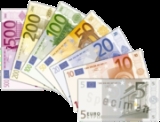
. Notes are issued in €500, €200, €100, €50, €20, €10, €5. Each banknote has its own colour and is dedicated to an artistic period of European architecture. The front of the note features windows or gateways while the back has bridges. While the designs are supposed to be devoid of any identifiable characteristics, the initial designs by
Robert KalinaRobert Kalina from the National Bank of Austria created the T 382 design, which was the winning design of the 1996 competition for the art shown on the euro banknotes. Kalina's design was chosen by the EMI Council on 3 December 1996. Kalina also designed the current banknotes for the...
were of specific bridges, including the
RialtoRialto is an area of the San Polo sestiere of Venice, Italy, known for its markets and for the Rialto Bridge.The area was settled by the ninth century, when a small area in the middle of the Realtine Islands either side of the Rio Businiacus was known as the Rivoaltus, the "high bank"...
and the
Pont de NeuillyLe pont de Neuilly is a road and rail bridge carrying Route nationale 13 and Paris Métro Line 1 which crosses the River Seine between the right bank of Neuilly-sur-Seine and Courbevoie and Puteaux on the left bank in the French department of Hauts-de-Seine...
, and were subsequently rendered more generic; the final designs still bear very close similarities to their specific prototypes; thus they are not truly generic. Some of the highest denominations such as the €500 are not issued in all countries, though they remain legal tender throughout the Eurozone.
Payments clearing, electronic funds transfer
All intra-EU transfers in euro are considered as domestic payments and bear the corresponding domestic transfer costs. This includes all Member States of the EU, even those outside the Eurozone providing the transactions are carried out in euro. Credit/debit card charging and ATM withdrawals within the Eurozone are also charged as domestic, however paper-based payment orders, like cheques, have not been standardised so these are still domestic-based. The ECB has also set up a
clearing systemIn banking and finance, clearing denotes all activities from the time a commitment is made for a transaction until it is settled. Clearing is necessary because the speed of trades is much faster than the cycle time for completing the underlying transaction....
,
TARGETTARGET was an interbank payment system for the real-time processing of cross-border transfers throughout the European Union. It included 16 national real-time gross settlement systems and the ECB payment mechanism...
, for large euro transactions.
Currency sign
A special
euro currency signThe Euro sign is the currency sign used for the euro, the official currency of the Eurozone in the European Union . The design was presented to the public by the European Commission on 12 December 1996...
(€) was designed after a public survey had narrowed the original ten proposals down to two. The European Commission then chose the design created by the Belgian
Alain BillietAlain Billiet is the alleged designer of the euro sign .The logo was proposed by the European Commission at the Summit of Dublin in 1996. Alain Billiet realized under the direction of project leader Jean-Pierre Malivoir a series of eight projects among which was the final logo.However, the actual...
. The official story of the design history of the euro sign is disputed by
Arthur EisenmengerArthur Eisenmenger is a former chief graphic designer for the European Community.Amongst his artistic creations are implementation of the European flag, the CE mark, and possibly the euro sign ....
, a former chief graphic designer for the
EECThe European Community is the first of the three pillars of the European Union created under the Maastricht Treaty . It is based upon the principle of supranationalism and has its origins in the European Economic Community, the predecessor of the European Union. If the Treaty of Lisbon comes into...
, who claims to have created it as a generic symbol of Europe.
The European Commission also specified a euro logo with exact proportions and foreground/background colour tones. While the Commission intended the logo to be a prescribed glyph shape, font designers made it clear that they intended to design their own variants instead.
TypewriterA typewriter is a mechanical or electromechanical device with a set of "keys" that, when pressed, cause characters to be printed on a medium, usually paper...
s lacking the euro sign can create it by typing a capital 'C', backspacing and
overstrikingIn typography, overstrike is a method of printing characters that are missing from the printer's character set. It was widely used around early 1990s...
it with the equal ('=') sign. Placement of the currency sign relative to the numeric amount varies from nation to nation, and there is no official recommendation on the issue.
Introduction of the euro
The euro was established by the provisions in the 1992
Maastricht TreatyThe Maastricht Treaty was signed on 7 February 1992 in Maastricht, the Netherlands after final negotiations on 9 December 1991 between the members of the European Community and entered into force on 1 November 1993 during the Delors Commission. It created the European Union and led to the creation...
. In order to participate in the currency, Member States are meant to meet
strict criteriaThe euro convergence criteria are the criteria for European Union member states to enter the third stage of European Economic and Monetary Union and adopt the euro as their currency...
such as a budget deficit of less than three per cent of their
GDPThe gross domestic product or gross domestic income is a basic measure of a country's economic performance and is the market value of all final goods and services made within the borders of a country in a year...
, a debt ratio of less than sixty per cent of GDP, low
inflationIn economics, inflation is a rise in the general level of prices of goods and services in an economy over a period of time.When the price level rises, each unit of currency buys fewer goods and services; consequently, inflation is also an erosion in the purchasing power of money – a loss of real...
, and
interestInterest is a fee paid on borrowed assets. It is the price paid for the use of borrowed money, or, money earned by deposited funds. Assets that are sometimes lent with interest include money, shares, consumer goods through hire purchase, major assets such as aircraft, and even entire factories in...
rates close to the EU average. In the Maastricht Treaty, the United Kingdom and Denmark were granted exemptions per their request from moving to the stage of monetary union which would result in the introduction of the euro.
Economists who helped create or contributed to the euro include Fred Arditti, Neil Dowling,
Wim DuisenbergWillem Frederik "Wim" Duisenberg was a Dutch Politician, Economist and Financier. He was first President of the European Central Bank from 1998 until 2003, and was instrumental in the Introduction of the euro in the European Union in 2002...
,
Robert MundellRobert Alexander Mundell, CC is a professor of economics at Columbia University and the recipient of the Nobel Memorial Prize in Economics in 1999. Mundell laid the groundwork for the introduction of the euro through his pioneering work in monetary dynamics and optimum currency areas, for which he...
,
Tommaso Padoa-SchioppaTommaso Padoa-Schioppa is an Italian banker and economist who was Italy's Minister of Economy and Finance from May 2006 until May 2008.-Biography:...
, and
Robert TollisonRobert D. Tollison is an American economist who specializes in public choice theory.-Education:A native of Spartanburg, South Carolina, Tollison attended local Wofford College where he earned an A.B. in business administration and economics in 1964. He completed an M.A. in economics at the...
. (For macro-economic theory, see below.) The name
euro was devised on 4 August 1995 by
Germain PirlotGermain PIRLOT in Sart-Custinne is a Belgian esperantist and an ex-teacher of French and history, presently living in Ostend...
, a
BelgianThe Kingdom of Belgium is a country in northwest Europe. It is a founding member of the European Union and hosts its headquarters, as well as those of other major international organizations, including NATO...
esperantistAn Esperantist is a person who speaks or uses Esperanto. Etymologically, an Esperantist is someone who hopes. Although definitions of "Esperantist" vary, according to the Declaration of Boulogne, a document agreed at the first World Congress of Esperanto, an Esperantist is someone who speaks...
and ex-teacher of French and history, and officially adopted in
MadridMadrid is the capital and largest city of Spain. It is the third-most populous municipality in the European Union after Greater London and Berlin, and its metropolitan area is the third-most populous city by urban area in the European Union after Paris and London.The city is located on the river...
on 16 December 1995.
Due to differences in national conventions for rounding and significant digits, all conversion between the national currencies had to be carried out using the process of triangulation via the euro. The
definitive values in euro of these subdivisions (which represent the
exchange rateIn finance, the exchange rates between two currencies specifies how much one currency is worth in terms of the other. It is the value of a foreign nation’s currency in terms of the home nation’s currency...
s at which the currency entered the euro) are shown at right.
The rates were determined by the Council of the European Union, based on a recommendation from the European Commission based on the market rates on 31 December 1998. They were set so that one
European Currency UnitThe European Currency Unit was a basket of the currencies of the European Community member states, used as the unit of account of the European Community before being replaced by the euro on January 1, 1999, at parity. The ECU itself replaced the European Unit of Account, also at parity, on March...
(ECU) would equal one euro. The European Currency Unit was an accounting unit used by the EU, based on the currencies of the Member States; it was not a currency in its own right. They could not be set earlier, because the ECU depended on the closing exchange rate of the non-euro currencies (principally the
pound sterlingThe pound sterling , often simply called the pound, is the currency of the United Kingdom, its Crown dependencies and the British Overseas Territories of South Georgia and the South Sandwich Islands and British Antarctic Territory...
) that day.
The procedure used to fix the irrevocable conversion rate between the drachma and the euro was different, since the euro by then was already two years old. While the conversion rates for the initial eleven currencies were determined only hours before the euro was introduced, the conversion rate for the Greek drachma was fixed several months beforehand.
The currency was introduced in non-physical form (travellers' cheques, electronic transfers, banking, etc.) at midnight on 1 January 1999, when the national currencies of participating countries (the Eurozone) ceased to exist independently. Their exchange rates were locked at fixed rates against each other, effectively making them mere non-decimal subdivisions of the euro. The euro thus became the successor to the
European Currency UnitThe European Currency Unit was a basket of the currencies of the European Community member states, used as the unit of account of the European Community before being replaced by the euro on January 1, 1999, at parity. The ECU itself replaced the European Unit of Account, also at parity, on March...
(ECU). The notes and coins for the old currencies, however, continued to be used as
legal tenderLegal tender or forced tender is an offered payment that, by law, cannot be refused in settlement of a debt, and have the debt remain in force....
until new euro notes and coins were introduced on 1 January 2002.
The changeover period during which the former currencies' notes and coins were exchanged for those of the euro lasted about two months, until 28 February 2002. The official date on which the national currencies ceased to be legal tender varied from Member State to Member State. The earliest date was in Germany where the
markThe Deutsche Mark or German mark was the official currency of West Germany and, from 1990 until the adoption of the euro, all of unified Germany...
officially ceased to be legal tender on 31 December 2001, though the exchange period lasted for two months more. Even after the old currencies ceased to be legal tender, they continued to be accepted by national central banks for periods ranging from several years to forever (the latter in Austria, Germany, Ireland, and Spain). The earliest coins to become non-convertible were the Portuguese escudos, which ceased to have monetary value after 31 December 2002, although banknotes remain exchangeable until 2022.
Direct and indirect usage
Direct usage
The euro is the sole currency of 16 EU Member States: Austria, Belgium, Cyprus, Finland, France, Germany, Greece, Ireland, Italy, Luxembourg, Malta, the Netherlands, Portugal, Slovakia, Slovenia and Spain. These countries comprise the "
EurozoneThe eurozone is an economic and monetary union of 16 European Union member states which have adopted the euro currency as their sole legal tender. It currently consists of Austria, Belgium, Cyprus, Finland, France, Germany, Greece, Ireland, Italy, Luxembourg, Malta, the Netherlands, Portugal,...
" or "Euro Area", some 326 million people in total.
With all but two of the remaining EU members obliged to join, together with future members of the EU, the
enlargement of the eurozoneEnlargement of the eurozone is at present a continuing process within the European Union . All member states of the EU, except for Denmark and the United Kingdom , are obliged to adopt the euro as their sole currency when they meet the criteria...
is set to continue further. Outside the EU, the euro is also the sole currency of two former Yugoslavian states (
MontenegroMontenegro , is a country located in Southeastern Europe. It has a coast on the Adriatic Sea to the south-west and is bordered by Croatia to the west, Bosnia and Herzegovina to the northwest, Serbia to the northeast, Kosovo to the east and Albania to the south...
and
KosovoKosovo is a disputed territory in the Balkans. Its majority is governed by the partially-recognised Republic of Kosovo , a self-declared independent state which has de facto control over the territory; the exceptions are some Serb enclaves...
) and several European micro states (
AndorraAndorra , officially the Principality of Andorra , also called the Principality of the Valleys of Andorra, is a small landlocked country in southwestern Europe, located in the eastern Pyrenees mountains and bordered by Spain and France. It is the sixth smallest nation in Europe having an area of ...
,
MonacoMonaco , officially the Principality of Monaco , is a small sovereign city-state located in South Western Europe on the northern central coast of the Mediterranean Sea, having a land border on three sides only with France, and being about away from Italy. Its size is just under 2 km² with an...
,
San MarinoThe Most Serene Republic of San Marino is a country situated in the Apennine Mountains. It is a landlocked enclave, completely surrounded by Italy. Its size is just over 60 km² with an estimated population of almost 30,000. Its capital is the City of San Marino...
and
Vatican CityVatican City , officially the State of the Vatican City , is a landlocked sovereign city-state whose territory consists of a walled enclave within the city of Rome, the capital city of Italy...
) as well as in overseas territories (
MayotteMayotte , officially the Departmental Collectivity of Mayotte , is an overseas collectivity of France consisting of a main island, Grande-Terre , a smaller island, Petite-Terre , and several islets around these two.Mayotte is very densely populated...
, Saint Pierre and Miquelon,
Akrotiri and DhekeliaThe Sovereign Base Areas of Akrotiri and Dhekelia are two UK-administered areas on the island of Cyprus that comprise the Sovereign Base Areas military bases of the United Kingdom. The bases were retained by the UK following the granting of independence and the eventual transition of Cyprus from a...
, Saint Barthélemy and
Saint MartinSaint Martin is a tropical island in the northeast Caribbean, approximately 300 km east of Puerto Rico. The 87 km
2 island is divided roughly in half between France and the Netherlands Antilles ; it is the smallest inhabited sea island divided between two nations, a division...
). Since January 1, 2009 the city
HöganäsHöganäs is a locality and the seat of Höganäs Municipality, Skåne County, Sweden with 13,550 inhabitants in 2005.Höganäs is nationally known for its ceramics industry, Höganäs Keramik. Höganäs Keramik is part of Iittala Group....
in Sweden is a "Euro-city" and the euro is used alongside of the
Swedish kronaThe krona has been the currency of Sweden since 1873. It is locally abbreviated kr. The plural form is kronor and one krona is subdivided into 100 öre . The currency is sometimes informally referred to as the "Swedish crown" in English...
. Together this direct usage of the euro outside the EU affects over 3 million people.
It is also gaining increasing international usage as a trading currency, in
CubaThe Republic of Cuba is an island country in the Caribbean. It consists of the island of Cuba, the Isla de la Juventud, and several archipelagos. Havana is the largest city in Cuba and the country's capital. Santiago de Cuba is the second largest city. Cuba is home to over 11 million people and is...
,
North KoreaNorth Korea, officially the Democratic People's Republic of Korea , is a state in East Asia, occupying the northern half of the Korean Peninsula. Its capital and largest city is Pyongyang. The Korean Demilitarized Zone serves as the buffer area between North Korea and South Korea...
and
SyriaSyria , officially the Syrian Arab Republic , is a country in Western Asia, bordering Lebanon and the Mediterranean Sea to the west, Turkey to the north, Iraq to the east, Jordan to the south and Israel to the southwest....
. There are also various currencies pegged to the euro (see below). In 2009
ZimbabweZimbabwe , is a landlocked country located in the southern part of the continent of Africa, between the Zambezi and Limpopo rivers...
announced to abandon its local currency and use major currencies instead including the euro and the
United States dollarThe United States dollar is the unit of currency of the United States. The U.S. dollar is normally abbreviated as the dollar sign, $, or as USD or US$ to distinguish it from other dollar-denominated currencies and from others that use the $ symbol. It is divided into 100 cents .The U.S...
.
Usage as reserve currency
Since its introduction, the euro has been the second most widely-held international
reserve currencyA reserve currency is a currency which is held in significant quantities by many governments and institutions as part of their foreign exchange reserves...
after the U.S. dollar. The share of the euro as a reserve currency has increased from 17.9% in 1999 to 26.5% in 2008, at the expense of the U.S. dollar (its share fell from 70.9% to 64.0% in the same timeframe) and the Yen (it fell from 6.4% to 3.3%). The euro inherited the status of the second most important reserve currency from the
German markThe Deutsche Mark or German mark was the official currency of West Germany and, from 1990 until the adoption of the euro, all of unified Germany...
.
The euro remains underweight as a reserve currency in advanced economies while overweight in emerging and developing economies: according to the IMF the total of euros held as a reserve in the world at the end of 2008 was equal to USD 1.1 trillion, with a share of 22% of all currency reserves in advanced economies, but a total of 31% of all currency reserves in emerging and developing economies.
The possibility of the euro becoming the first international reserve currency is now widely debated among economists.
Former Federal Reserve Chairman
Alan GreenspanAlan Greenspan is an American economist who served as Chairman of the Federal Reserve of the United States from 1987 to 2006. He currently works as a private advisor and provides consulting for firms through his company, Greenspan Associates LLC...
gave his opinion in September 2007 that it is "absolutely conceivable that the euro will replace the dollar as reserve currency, or will be traded as an equally important reserve currency." In contrast to Greenspan's 2007 assessment the euro's increase in the share of the worldwide currency reserve basket has slowed considerably since the year 2007 and since the beginning of the worldwide
credit crunchA credit crunch is a reduction in the general availability of loans or a sudden tightening of the conditions required to obtain a loan from the banks. A credit crunch generally involves a reduction in the availability of credit independent of a rise in official interest rates...
related recession.
Currencies pegged to the euro
Outside the Eurozone, a total of 23 countries and territories which do not belong to the EU have currencies that are directly pegged to the euro including 14 countries in mainland Africa (they use the
CFP francThe CFP franc is the currency used in the French overseas possessions of French Polynesia, New Caledonia and Wallis and Futuna. The initials CFP originally stood for Colonies Françaises du Pacifique...
, the
CFA francThe CFA franc is a currency used in fourteen countries: twelve formerly French-ruled African countries, as well as in Guinea-Bissau and in Equatorial Guinea...
and the
Moroccan dirhamThe dirham is the currency of Morocco. The plural form is pronounced darahim, although in French and English "dirhams" is commonly used. Its ISO 4217 code is "MAD". It is subdivided into 100 santimat . The dirham is issued by the Bank Al-Maghrib, the central bank of Morocco...
), two African island countries (
Comorian francThe franc is the official currency of Comoros. It is nominally subdivided into 100 centimes, although no centime denominations have ever been issued.-History:...
and
Cape Verdean escudoThe escudo is the currency of Cape Verde, a former Portuguese colony. Its ISO 4217 code is CVE. Amounts are generally written by using $ as the decimal separator, such as 20$00 for 20 escudos, or 1.000$00 for 1000.- History :...
), three French Pacific territories and another Balkan country,
Bosnia and HerzegovinaBosnia and Herzegovina Bosnia and Herzegovina Bosnia and Herzegovina ( or (Bosnian, Croatian, Serbian Latin: Bosna i Hercegovina; Serbian Cyrillic: Босна и Херцеговина) is a country in Southeast Europe, on the Balkan Peninsula...
(
Bosnia and Herzegovina convertible markThe Bosnia and Herzegovina convertible mark is the currency of Bosnia and Herzegovina. It is divided into 100 fenings...
). On 28 July 2009,
São Tomé and PrincipeSão Tomé and Príncipe, officially the Democratic Republic of São Tomé and Príncipe, is a Portuguese-speaking island nation in the Gulf of Guinea, off the western equatorial coast of Africa. It consists of two islands: São Tomé and Príncipe, located about apart and about , respectively, off the...
signed an agreement with Portugal which will eventually tie its currency to the euro.
With the exception of Bosnia and Herzegovina (which pegged their currency against the German mark) and Cape Verde (formerly pegged to the Portuguese escudo) all of these non-EU countries had a currency peg to the French Franc before pegging their currencies to the euro. Pegging a country's currency to a major currency is regarded as a safety measure, especially for currencies of areas with weak economies, as the euro is seen as a stable currency, prevents runaway inflation and encourages foreign investment due to its stability.
Within the EU several currencies have a peg to the euro, in most instances as a precondition to joining the Eurozone. The
Bulgarian LevThe lev is the currency of Bulgaria. It is divided in 100 stotinki . In archaic Bulgarian the word "lev" meant "lion".Bulgaria seeks to adopt the Euro, the tentative deadline is 2012, set by Finance Minister Plamen Oresharski....
and the
Estonian kroonThe kroon is the currency of Estonia. It is subdivided into 100 senti . The word kroon, meaning "crown", is related to that of other Nordic currencies and to the Latin word corona .-First kroon, 1928–1940:The kroon became the currency of Estonia on 1 January 1928...
were formerly pegged to the German mark, other EU memberstates have a direct peg due to ERM II: the
Danish kroneThe krone is the currency of Denmark, including the autonomous provinces of Greenland and the Faroe Islands. The krone is pegged to the euro via the European Union's exchange rate mechanism. The plural form is "kroner" and one krone is divided into 100 øre, the singular form being the same as the...
, the
Lithuanian litasThe Lithuanian litas is the currency of Lithuania. It is divided into 100 centų...
and the
Latvian latsThe lats is the currency of Latvia. It is abbreviated as Ls. The lats is sub-divided into 100 santīmi ....
.
In total, over 150 million people in Africa use a currency pegged to the euro, 25 million people outside the Eurozone in Europe and another 500,000 people on Pacific islands.
Optimal currency area
In economics, an optimum currency area (or region) (OCA, or OCR) is a geographical region in which it would maximize economic efficiency to have the entire region share a single currency. There are two models, both proposed by Robert A. Mundell: the stationary expectations model and the international risk sharing model. Mundell himself advocates the international risk sharing model and thus concludes in favour of the euro.
Transaction costs and risks
The most obvious benefit of adopting a single currency is to remove the cost of exchanging currency, theoretically allowing businesses and individuals to consummate previously unprofitable trades. For consumers, banks in the Eurozone must charge the same for intra-member cross-border transactions as purely domestic transactions for electronic payments (e.g.,
credit cardA credit card is part of a system of payments named after the small plastic card issued to users of the system. It is a card entitling its holder to buy goods and services based on the holder's promise to pay for these goods and services...
s,
debit cardA debit card is a plastic card that provides an alternative payment method to cash when making purchases. Functionally, it can be called an electronic cheque, as the funds are withdrawn directly from either the bank account, or from the remaining balance on the card...
s and
cash machine"Cash Machine" was the first single from Middlesex group Hard-Fi, taken from their debut album Stars of CCTV. It was originally released on 24 January 2005, where it was ineligible in the UK chart due to the inclusion of a sticker...
withdrawals).
The absence of distinct currencies also removes
exchange rateIn finance, the exchange rates between two currencies specifies how much one currency is worth in terms of the other. It is the value of a foreign nation’s currency in terms of the home nation’s currency...
risks. The risk of unanticipated exchange rate movement has always added an additional risk or uncertainty for companies or individuals that invest or trade outside their own currency zones. Companies that
hedgeIn finance, a hedge is a position established in one market in an attempt to offset exposure to price fluctuations in some opposite position in another market with the goal of minimizing one's exposure to unwanted risk...
against this risk will no longer need to shoulder this additional cost. This is particularly important for countries whose currencies had traditionally fluctuated a great deal, particularly the Mediterranean nations.
Financial markets on the continent are expected to be far more
liquidIn business, economics or investment, market liquidity is an asset's ability to be sold without causing a significant movement in the price and with minimum loss of value...
and flexible than they were in the past. The reduction in cross-border transaction costs will allow larger banking firms to provide a wider array of banking services that can compete across and beyond the Eurozone.
Price parity
Another effect of the common European currency is that differences in prices – in particular in price levels – should decrease because of the '
law of one priceThe law of one price is an economic law stated as: "In an efficient market all identical goods must have only one price." The law of one price relates to the outcome of free trade and globalization...
'. Differences in prices can trigger
arbitrageIn economics and finance, arbitrage is the practice of taking advantage of a price differential between two or more markets: striking a combination of matching deals that capitalize upon the imbalance, the profit being the difference between the market prices...
, i.e.
speculativeIn finance, speculation is a financial action that does not promise safety of the initial investment along with the return on the principal sum...
trade in a
commodityA commodity is some good for which there is demand, but which is supplied without qualitative differentiation across a market. It is a product that is the same no matter who produces it, such as petroleum, notebook paper, or milk. In other words, copper is copper. The price of copper is universal,...
across borders purely to exploit the price differential. Therefore, prices on commonly traded goods are likely to converge, causing inflation in some regions and deflation in others during the transition. Some evidence of this has been observed in specific markets.
Macroeconomic stability
Low levels of inflation are the hallmark of stable and modern economies. Because a high level of inflation acts as a tax (
seigniorageSeigniorage , also spelled seignorage or seigneurage, is the net revenue derived from the issuing of currency.-Overview:Seigniorage derived from specie - metal coins - arises from the difference between the face value of a coin and the cost of producing, distributing and retiring it from...
) and theoretically discourages investment, it is generally viewed as undesirable. In spite of the downside, many countries have been unable or unwilling to deal with serious inflationary pressures. Some countries have successfully contained them by establishing largely independent central banks. One such bank was the Bundesbank in Germany; as the European Central Bank is modelled on the Bundesbank, it is independent of the pressures of national governments and has a mandate to keep inflationary pressures low. Member countries that join the bank commit to lower inflation, hoping to enjoy the macroeconomic stability associated with low levels of expected inflation. The ECB (unlike the
Federal ReserveThe Federal Reserve System is the central banking system of the United States. It was created in 1913 by the enactment of the Federal Reserve Act, largely as a response to a series of financial panics or bank runs, particularly a severe panic in 1907...
in the United States of America) does not have a second objective to sustain growth and employment.
Many national and corporate
bondsIn finance, a bond is a debt security, in which the authorized issuer owes the holders a debt and, depending on the terms of the bond, is obliged to pay interest and/or to repay the principal at a later date, termed maturity...
denominated in euro are significantly more liquid and have lower interest rates than was historically the case when denominated in legacy currencies. While increased liquidity may lower the
nominal interest rateIn finance and economics nominal interest rate or nominal rate of interest refers to the rate of interest before adjustment for inflation ; or, for interest rates "as stated" without adjustment for the full effect of compounding...
on the bond, denominating the bond in a currency with low levels of inflation arguably plays a much larger role. A credible commitment to low levels of inflation and a stable debt reduces the risk that the value of the debt will be eroded by higher levels of inflation or default in the future, allowing debt to be issued at a lower nominal interest rate.
Evidence on the effect of the introduction of the euro
In conformity with the economic predictions, empirical studies have found that the introduction of the euro has had a positive impact on the movement of goods, financial assets, and people within the Eurozone. In addition, countries which previously had weak currencies have benefited from lower interest rates and their firms now have easier access to capital.
Trade. The consensus from the studies of the effect of the introduction of the euro is that it has increased trade within the euro area by 5% to 10%. On the lower bound, one study suggested an increase of 3%. A recent study estimates this effect to be between 9 and 14%.
Investment. Studies have found a positive effect of the introduction of the euro on investment. Physical investment seems to have increased by 5% in the Eurozone due to the introduction. Regarding foreign direct investment, a study found that the intra-Eurozone FDI stocks have increased by about 20% during the first four years of the EMU. Concerning the effect on corporate investment, there is evidence that the introduction of the euro has resulted in an increase in investment rates and that it has made it easier for firms to access financing in Europe. The euro has most specifically stimulated investment in companies that
come from countries that previously had weak currencies. A study found that the introduction of the euro accounts for 22% of the investment rate after 1998 in countries that previously had a weak currency. The effect is however less clear for firms coming from the strong currency countries; the introduction has not been beneficial for most of them.
Inflation. The introduction of the euro has led to extensive discussion about its possible effect on inflation. In the short term, there was a widespread impression in the population of the Eurozone that the introduction of the euro had lead to an increase in prices. Paradoxically, this impression has not been supported by general indices of inflation, showing no major effect of the introduction of the euro. A study of this paradox has found that it is due to an asymmetric effect of the introduction of the euro on prices: while it had no effect on most goods, it had an effect on cheap goods which have seen their price round up after the introduction of the euro. The study found that consumers based their beliefs on inflation of those cheap goods which are often purchased. It has also been suggested that the jump in small prices may be due to the fact that prior to the introduction, retailers made fewer upward adjustments and waited for the introduction of the euro to do so.
Exchange rate risk. One of the advantages of the adoption of a common currency is the reduction of the risk associated with changes in currency exchange rates. It has been found that the introduction of the euro created "significant reductions in market risk exposures for nonfinancial firms both in and outside of Europe". These reductions in market risk "were concentrated in firms domiciled in the Euro area and in non-Euro firms with a high fraction of foreign sales or assets in Europe". These changes were however "statistically and economically small".
Financial integration. The introduction of the euro seems to have had a strong effect on European financial integration. According to a study on this question, it has "significantly reshaped the European financial system, especially with respect to the securities markets [...] However, the real and policy barriers to integration in the retail and corporate banking sectors remain significant, even if the wholesale end of banking has been largely integrated." Specifically, the euro has significantly decreased the cost of trade in bonds, equity, and banking assets within the Eurozone.
On a global level, there is evidence that the introduction of the euro has led to an integration in terms of investment in bond portfolios, with Eurozone countries lending and borrowing more between each other than with other countries.
Effect on interest rates. The introduction of the euro has decreased the interest rates of most members countries, in particular those with a weak currency. As a consequence the market value of firms from countries which previously had a weak currency has very significantly increased. The countries who benefited the most from a decrease in interest rates are Greece, Ireland, Portugal, Spain, and Italy.
Price convergence. The evidence on the convergence of prices in the Eurozone with the introduction of the euro is mixed. Several studies failed to find any evidence of convergence following the introduction of the euro after a phase of convergence in the early 1990s. Other studies have found evidence of price convergence, in particular for cars. A possible reason for the divergence between the different studies is that the processes of convergence may not have been linear, slowing down substantially between
2000 and 2003, and resurfacing after 2003 as suggested by a recent study (2009).
Tourism. A study has found that the introduction of the euro has had a positive effect on tourism flows within the EMU, with an increase of 6.5%.
Exchange rates
U.S. dollarsThe United States dollar is the unit of currency of the United States. The U.S. dollar is normally abbreviated as the dollar sign, $, or as USD or US$ to distinguish it from other dollar-denominated currencies and from others that use the $ symbol. It is divided into 100 cents .The U.S...
per 1 euro 1999-2009
Year |
|
Lowest ↓ |
|
Highest ↑ |
| Date |
Rate |
Date |
Rate |
| 1999 |
03 Dec |
$1.0015 |
05 Jan |
$1.1790 |
| 2000 |
26 Oct |
$0.8252 |
06 Jan |
$1.0388 |
| 2001 |
06 Jul |
$0.8384 |
05 Jan |
$0.9545 |
| 2002 |
28 Jan |
$0.8578 |
31 Dec |
$1.0487 |
| 2003 |
08 Jan |
$1.0377 |
31 Dec |
$1.2630 |
| 2004 |
14 May |
$1.1802 |
28 Dec |
$1.3633 |
| 2005 |
15 Nov |
$1.1667 |
03 Jan |
$1.3507 |
| 2006 |
02 Jan |
$1.1826 |
05 Dec |
$1.3331 |
| 2007 |
12 Jan |
$1.2893 |
27 Nov |
$1.4874 |
| 2008 |
27 Oct |
$1.2460 |
15 Jul |
$1.5990 |
| 2009 |
05 Mar |
$1.2555 |
20 Oct |
$1.4971 |
Source: Euro exchange rates in USD, ECBThe European Central Bank is one of the world's most important central banks, responsible for monetary policy covering the 16 member States of the Eurozone. It was established by the European Union in 1998 with its headquarters in Frankfurt, Germany.-History:Technically the predecessor to the ECB...
|
Flexible exchange rates
The ECB targets interest rates rather than exchange rates and in general does not intervene on the foreign exchange rate markets, because of the implications of the
Mundell-Fleming ModelThe Mundell-Fleming model is an economic model first set forth by Robert Mundell and Marcus Fleming. The model is an extension of the IS-LM model...
which suggest that a central bank cannot maintain interest rate and exchange rate targets simultaneously because increasing the
money supplyIn economics, money supply or money stock, is the total amount of money available in an economy at a particular point in time. There are several ways to define "money", but standard measures usually include currency in circulation and demand deposits....
results in a
depreciationDepreciation is a term used in accounting, economics and finance to spread the cost of an asset over the span of several years.In simple words we can say that depreciation is the reduction in the value of an asset due to usage, passage of time, wear and tear, technological outdating or...
of the currency. In the years following the
Single European ActThe Single European Act was the first major revision of the 1957 Treaty of Rome. The Act set the European Community an objective of establishing a Common Market by 31 December 1992, and codified European Political Cooperation, the forerunner of the European Union's Common Foreign and Security Policy...
, the EU has liberalised its capital markets, and as the
ECBThe European Central Bank is one of the world's most important central banks, responsible for monetary policy covering the 16 member States of the Eurozone. It was established by the European Union in 1998 with its headquarters in Frankfurt, Germany.-History:Technically the predecessor to the ECB...
has chosen monetary autonomy, the
exchange rate regimeThe exchange rate regime is the way a country manages its currency in respect to foreign currencies and the foreign exchange market. It is closely related to monetary policy and the two are generally dependent on many of the same factors....
of the euro is flexible, or
floatingA floating exchange rate or fluctuating exchange rate is a type of exchange rate regime wherein a currency's value is allowed to fluctuate according to the foreign exchange market. A currency that uses a floating exchange rate is known as a floating currency...
. This explains why the exchange rate of the euro vis-à-vis other currencies is characterised by strong fluctuations. Most notable are the fluctuations of the euro versus the U.S. dollar, another free-floating currency. However this focus on the dollar-euro parity is partly subjective. It is taken as a reference because the euro competes with the dollar's role as reserve currency. The effect of this selective reference is misleading, as it gives observers the impression that a rise in the value of the euro versus the dollar is the effect of increased global strength of the euro, while it may be the effect of an intrinsic weakening of the dollar itself.
Against other major currencies
After the introduction of the euro, its exchange rate against other currencies fell heavily, especially against the U.S. dollar. From an introduction at US$1.18/€, the euro fell to a low of $0.8228/€ by 26 October 2000. After the appearance of the coins and notes on 1 January 2002 and the replacement of all national currencies, the euro began steadily appreciating, and regained parity with the U.S. dollar, on 15 July 2002. The euro has not fallen below parity with the U.S. dollar since December 2002 but has risen in value.
On 23 May 2003, the euro surpassed its initial ($1.18) trading value for the first time. At the end of 2004, it reached $1.3668 (€0.7316/$) as the U.S. dollar fell against all major currencies. Against the U.S. dollar, the euro temporarily weakened in 2005, falling to $1.18 (€0.85/$) in July 2005, and was stable throughout the third quarter of 2005. In November 2005 the euro again began to rise steadily against the U.S. dollar, hitting one record high after another. On 15 July 2008, the euro rose to an all-time high of $1.5990 (€0.6254/$). In a reversal, in August 2008 the euro began to drop against the U.S. dollar. In just two weeks the euro fell from its peak to $1.48 and by late October it reached a two and a half year low below $1.25 before moving back above $1.40 by August 2009. On 29 December 2008, the
pound sterlingThe pound sterling , often simply called the pound, is the currency of the United Kingdom, its Crown dependencies and the British Overseas Territories of South Georgia and the South Sandwich Islands and British Antarctic Territory...
fell to an all-time low of £0.97855 (€1.0219/£) against the euro.
Linguistic issues
The formal titles of the currency are
euro for the major unit and
cent for the minor (one hundredth) unit and for official use in most Eurozone languages; according to the ECB, all languages should use the same spelling for the nominative singular. This may contradict normal rules for word formation in some languages; e.g., those where there is no
eu diphthongIn phonetics, a diphthong, or , is a contour vowel—that is, a unitary vowel that changes quality during its pronunciation, or "glides", with a smooth movement of the tongue from one articulation to another, as in the English words eye, boy, and cow...
. Bulgaria has negotiated an exception;
euro in the Cyrillic alphabet is spelled as
eвро (
evro) and not
eуро (
euro) in all official documents. For non-legally binding texts in English, the European Commission's
Directorate-General for TranslationThe Directorate-General for Translation , located in Brussels and Luxembourg, provides translation of written text into and out of the European Union's twenty-three official languages. With an annual output of about 1.5 million pages, it is the largest translation service in the world, employing...
recommends that the plural forms
euros and
cents should be used when appropriate.
Further reading
- Baldwin, Richard and Charles Wyplosz, The Economics of European Integration, New York: McGraw Hill, 2004.
- European Commission, High Level Task Force on Skills and Mobility - Final Report, 14 December 2001.
Official websites
- The euro – Europa
Europa , the official web portal of the European Union, is intended to improve the public’s interaction with EU institutions by quickly directing website visitors to the services or information they are seeking. Europa links to all EU agencies and institutions in addition to press releases and...
- European Central Bank
Other
- The Euro Information Site – ibiblio
ibiblio is a "collection of collections," and hosts a diverse range of publicly available information and open source software, including software, music, literature, art, history, science, politics, and cultural studies. As an "Internet librarianship," ibiblio is a digital library and archive...
- The symbolic power of the euro - Bundeszentrale für politische Bildung