

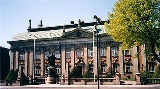
Riksdag of the Estates

Encyclopedia
The Riksdag of the Estates , was the name used for the Estates of the Swedish realm
when they were assembled. Until its dissolution in 1866, the institution was the highest authority in Sweden
next to the King. It was a Diet
made up of the Four Estates
, which historically were the lines of division in Swedish society:
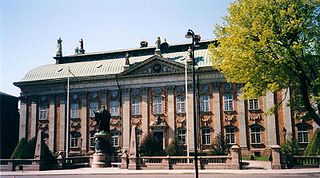 The meeting at Arboga
in 1435 was usually considered to be the first Riksdag, but there is no indication that the fourth estate, the peasants, had been represented there.
 The constitution of 1809
divided the powers of Government between the monarch and the Riksdag of the Estates, and after 1866 between the monarch and the new Riksdag
.
In 1866 all the Estates voted in favor of dissolution and at the same time to found a new assembly, Sveriges Riksdag (the Swedish Riksdag
). The four former estates were abolished. The House of Nobility, , remains as a quasi-official representation of the Swedish nobility
. The modern Centre Party
which grew out of the Swedish farmers' movement, could be construed as a modern representation with a traditional bond to the Estate of the Peasants.
in 1809, Sweden ceded its eastmost provinces to the Russian Empire
. Compromising much of present-day Finland, these became a Grand Duchy
under the Emperor, but the political institutions were kept practically intact. The Finnish estates assembled in 1809 at Porvoo
to confirm the change in their allegiance. This Diet of Finland
followed the forms of the Swedish Riksdag, being the legislative body of the new autonomous region. However, during the reigns of Alexander I
and Nicholas I
it was not assembled and no new legislation was enacted. The diet was next assembled by Czar Alexander II
in 1863, due to the need to modernize the laws. After this the Diet met regularly until 1905, when it passed an act forming a new unicameral parliament. That assembly has been Finland's legislative body since then. The Finnish House of Nobility, , , carries on the tradition of the Estate of Nobility, but no new families have been ennobled since 1906.
Realm of Sweden
The Realm of Sweden or Svenska väldet is a term that historically was used to comprise all the territories under the control of the Swedish monarchs.-Lands of Sweden:...
when they were assembled. Until its dissolution in 1866, the institution was the highest authority in Sweden
Sweden
Sweden , officially the Kingdom of Sweden , is a Nordic country on the Scandinavian Peninsula in Northern Europe. Sweden borders with Norway and Finland and is connected to Denmark by a bridge-tunnel across the Öresund....
next to the King. It was a Diet
Diet (assembly)
In politics, a diet is a formal deliberative assembly. The term is mainly used historically for the Imperial Diet, the general assembly of the Imperial Estates of the Holy Roman Empire, and for the legislative bodies of certain countries.-Etymology:...
made up of the Four Estates
Estates of the realm
The Estates of the realm were the broad social orders of the hierarchically conceived society, recognized in the Middle Ages and Early Modern period in Christian Europe; they are sometimes distinguished as the three estates: the clergy, the nobility, and commoners, and are often referred to by...
, which historically were the lines of division in Swedish society:
- NobilitySwedish nobilityThe Swedish nobility were historically a legally and/or socially privileged class in Sweden, part of the so-called frälse . Today, the nobility is still very much a part of Swedish society but they do not maintain many of their former privileges...
- Clergy
- BurghersBourgeoisieIn sociology and political science, bourgeoisie describes a range of groups across history. In the Western world, between the late 18th century and the present day, the bourgeoisie is a social class "characterized by their ownership of capital and their related culture." A member of the...
- Peasants
Important assemblies
Arboga
Arboga is a locality and the seat of Arboga Municipality in Västmanland County, Sweden with 10,369 inhabitants in 2005.-Overview:The city of Arboga is known to have existed as a town since the 13th century but the area has been inhabited since around 900 AD...
in 1435 was usually considered to be the first Riksdag, but there is no indication that the fourth estate, the peasants, had been represented there.
- The first meeting is likely the one that took place at UppsalaUppsala- Economy :Today Uppsala is well established in medical research and recognized for its leading position in biotechnology.*Abbott Medical Optics *GE Healthcare*Pfizer *Phadia, an offshoot of Pharmacia*Fresenius*Q-Med...
in 1436 after the death of rebel leader Engelbrekt. - At the Riksdag in 1517, regent Sten Sture the YoungerSten Sture the YoungerSten Sture the Younger , Lord of Ekesiö , was a Swedish statesman and regent of Sweden, under the era of the Kalmar Union.-Life:...
and the Privy CouncilPrivy Council of SwedenThe High Council of Sweden or Council of the Realm consisted originally of those men of noble, common and clergical background, that the king saw fit for advisory service...
deposed archbishopArchbishopAn archbishop is a bishop of higher rank, but not of higher sacramental order above that of the three orders of deacon, priest , and bishop...
Gustav TrolleGustav TrolleGustav Eriksson Trolle was Archbishop of Uppsala, Sweden, in two sessions, during the turbulent Reformation events.After returning from studies abroad, in Cologne and Rome, he was in 1513 elected vicar in Linköping. One year later he became Archbishop of Uppsala...
. - At VästeråsVästeråsVästerås is a city in central Sweden, located on the shore of Lake Mälaren in the province Västmanland, some 100 km west of Stockholm...
in 1527 LutheranismLutheranismLutheranism is a major branch of Western Christianity that identifies with the theology of Martin Luther, a German reformer. Luther's efforts to reform the theology and practice of the church launched the Protestant Reformation...
was adopted as the new state religion instead of Roman Catholicism - At ArbogaArbogaArboga is a locality and the seat of Arboga Municipality in Västmanland County, Sweden with 10,369 inhabitants in 2005.-Overview:The city of Arboga is known to have existed as a town since the 13th century but the area has been inhabited since around 900 AD...
in 1561, the term riksdag was used for the first time. - At SöderköpingSöderköpingSöderköping is a locality and the seat of Söderköping Municipality, Östergötland County, Sweden with 6,951 inhabitants in 2005. Söderköping is, despite its small population, for historical reasons normally still referred to as a city...
in 1595, Duke CharlesCharles IX of SwedenCharles IX of Sweden also Carl, was King of Sweden from 1604 until his death. He was the youngest son of King Gustav I of Sweden and his second wife, Margaret Leijonhufvud, brother of Eric XIV and John III of Sweden, and uncle of Sigismund III Vasa king of both Sweden and Poland...
was elected regent of Sweden instead of King SigismundSigismund III VasaSigismund III Vasa was King of Poland and Grand Duke of Lithuania, a monarch of the united Polish–Lithuanian Commonwealth from 1587 to 1632, and King of Sweden from 1592 until he was deposed in 1599...
, who was a CatholicRoman Catholic ChurchThe Catholic Church, also known as the Roman Catholic Church, is the world's largest Christian church, with over a billion members. Led by the Pope, it defines its mission as spreading the gospel of Jesus Christ, administering the sacraments and exercising charity...
and the king of both Sweden and PolandPolish-Lithuanian CommonwealthThe Polish–Lithuanian Commonwealth was a dualistic state of Poland and Lithuania ruled by a common monarch. It was the largest and one of the most populous countries of 16th- and 17th‑century Europe with some and a multi-ethnic population of 11 million at its peak in the early 17th century...
. - In 1612 the Riksdag gave the nobility the privilege and right to hold all higher offices of government, after successful lobbying by Axel OxenstiernaAxel OxenstiernaAxel Gustafsson Oxenstierna af Södermöre , Count of Södermöre, was a Swedish statesman. He became a member of the Swedish Privy Council in 1609 and served as Lord High Chancellor of Sweden from 1612 until his death. He was a confidant of first Gustavus Adolphus and then Queen Christina.Oxenstierna...
. - The first open conflict between the different estates happened in 1650.
- At the Riksdag in 1680 a large scale reduction (a return of lands to the Crown earlier granted to the nobility) was enacted, and Sweden became an absolute monarchyAbsolute monarchyAbsolute monarchy is a monarchical form of government in which the monarch exercises ultimate governing authority as head of state and head of government, his or her power not being limited by a constitution or by the law. An absolute monarch thus wields unrestricted political power over the...
. - In 1718, the Riksdag elected Ulrika EleonoraUlrika Eleonora of SwedenUlrika Eleonora or Ulrica Eleanor , also known as Ulrika Eleonora the Younger, was Queen regnant of Sweden from 5 December 1718 to 29 February 1720, and then Queen consort until her death....
as heir in place of her older sister's son, and Ulrika Eleonora accepted a new constitution restoring the powers of the Riksdag. - In 1809, the Riksdag elected Charles XIIICharles XIII of SwedenCharles XIII & II also Carl, , was King of Sweden from 1809 and King of Norway from 1814 until his death...
was elected King after his nephew Gustav IV AdolfGustav IV Adolf of SwedenGustav IV Adolf of Sweden also Gustav Adolph was King of Sweden from 1792 until his abdication in 1809. He was the son of Gustav III of Sweden and his queen consort Sophia Magdalena, eldest daughter of Frederick V of Denmark and his first wife Louise of Great Britain. He was the last Swedish...
had been deposed, and after the new King had accepted a new constitutionConstitution of SwedenThe Swedish Constitution consists of four fundamental laws :* The 1810 Act of Succession * The 1949 Freedom of the Press Act * The 1974 Instrument of Government * The 1991 Fundamental Law on Freedom of Expression...
that ended Sweden's second Autocracy (1789–1809).
- At the sessions in 1634, 1719, 1720, 1772 and 1809 new constitutions were adopted.
Replaced by the new Riksdag
Instrument of Government (1809)
The Instrument of Government adopted on 6 June 1809 by the Riksdag of the Estates was one of the fundamental laws that made up the constitution of Sweden from 1809 to 1974...
divided the powers of Government between the monarch and the Riksdag of the Estates, and after 1866 between the monarch and the new Riksdag
Parliament of Sweden
The Riksdag is the national legislative assembly of Sweden. The riksdag is a unicameral assembly with 349 members , who are elected on a proportional basis to serve fixed terms of four years...
.
In 1866 all the Estates voted in favor of dissolution and at the same time to found a new assembly, Sveriges Riksdag (the Swedish Riksdag
Parliament of Sweden
The Riksdag is the national legislative assembly of Sweden. The riksdag is a unicameral assembly with 349 members , who are elected on a proportional basis to serve fixed terms of four years...
). The four former estates were abolished. The House of Nobility, , remains as a quasi-official representation of the Swedish nobility
Swedish nobility
The Swedish nobility were historically a legally and/or socially privileged class in Sweden, part of the so-called frälse . Today, the nobility is still very much a part of Swedish society but they do not maintain many of their former privileges...
. The modern Centre Party
Centre Party (Sweden)
The Centre Party is a centrist political party in Sweden. The party maintains close ties to rural Sweden and describes itself as "a green social liberal party". The ideology is sometimes called agrarian, but in a European context, the Centre Party can perhaps best be characterized as social...
which grew out of the Swedish farmers' movement, could be construed as a modern representation with a traditional bond to the Estate of the Peasants.
Riksdag in Finland
Following the Finnish WarFinnish War
The Finnish War was fought between Sweden and the Russian Empire from February 1808 to September 1809. As a result of the war, the eastern third of Sweden was established as the autonomous Grand Duchy of Finland within the Russian Empire...
in 1809, Sweden ceded its eastmost provinces to the Russian Empire
Russian Empire
The Russian Empire was a state that existed from 1721 until the Russian Revolution of 1917. It was the successor to the Tsardom of Russia and the predecessor of the Soviet Union...
. Compromising much of present-day Finland, these became a Grand Duchy
Grand Duchy of Finland
The Grand Duchy of Finland was the predecessor state of modern Finland. It existed 1809–1917 as part of the Russian Empire and was ruled by the Russian czar as Grand Prince.- History :...
under the Emperor, but the political institutions were kept practically intact. The Finnish estates assembled in 1809 at Porvoo
Diet of Porvoo
The Diet of Porvoo , was the summoned legislative assembly to establish the Grand Principality of Finland in 1809 and the heir of the powers of the Swedish Riksdag of the Estates...
to confirm the change in their allegiance. This Diet of Finland
Diet of Finland
The Diet of Finland , was the legislative assembly of the Grand Duchy of Finland from 1809 to 1906 and the recipient of the powers of the Swedish Riksdag of the Estates....
followed the forms of the Swedish Riksdag, being the legislative body of the new autonomous region. However, during the reigns of Alexander I
Alexander I of Russia
Alexander I of Russia , served as Emperor of Russia from 23 March 1801 to 1 December 1825 and the first Russian King of Poland from 1815 to 1825. He was also the first Russian Grand Duke of Finland and Lithuania....
and Nicholas I
Nicholas I of Russia
Nicholas I , was the Emperor of Russia from 1825 until 1855, known as one of the most reactionary of the Russian monarchs. On the eve of his death, the Russian Empire reached its historical zenith spanning over 20 million square kilometers...
it was not assembled and no new legislation was enacted. The diet was next assembled by Czar Alexander II
Alexander II of Russia
Alexander II , also known as Alexander the Liberator was the Emperor of the Russian Empire from 3 March 1855 until his assassination in 1881...
in 1863, due to the need to modernize the laws. After this the Diet met regularly until 1905, when it passed an act forming a new unicameral parliament. That assembly has been Finland's legislative body since then. The Finnish House of Nobility, , , carries on the tradition of the Estate of Nobility, but no new families have been ennobled since 1906.
See also
- History of SwedenHistory of SwedenModern Sweden started out of the Kalmar Union formed in 1397 and by the unification of the country by King Gustav Vasa in the 16th century. In the 17th century Sweden expanded its territories to form the Swedish empire. Most of these conquered territories had to be given up during the 18th century...
- History of FinlandHistory of FinlandThe land area that now makes up Finland was settled immediately after the Ice Age, beginning from around 8500 BCE. Most of the region was part of the Kingdom of Sweden from the 13th century to 1809, when it was ceded to the Russian Empire, becoming the autonomous Grand Duchy of Finland. The...
- History of the RiksdagHistory of the RiksdagThe Riksdag or Sveriges Riksdag is the Parliament of Sweden. However when it was founded in 1866 Sweden did not have a parliamentary system of government. The national parliaments of Estonia and Finland are also called Riksdag in Swedish....
- RiksdagsmusikenRiksdagsmusikenRiksdagsmusiken, or the Riksdag Music, is a suite of music composed by Joseph Martin Kraus, for the grand opening, in 1789, of the Riksdag of the Estates in Sweden. King Gustav III of Sweden wanted to convince the parliament to go along, especially fund, his ongoing war...