
All Topics  
Dynamite


   Email Print
   Bookmark   Link


Dynamite


Dynamite is an explosive
Explosive material

File:M112 Demolition Charge.jpgAn explosive material is a material that either is chemistry or otherwise energetically unstable or produces a sudden expansion of the material usually accompanied by the production of heat and large changes in pressure upon initiation; this is called the explosion....
 based on the explosive potential of nitroglycerin
Nitroglycerin

Nitroglycerin , also known as nitroglycerine, , trinitroglycerin, trinitroglycerine, 1,2,3-trinitroxypropane and glyceryl trinitrate, is a heavy, colorless, oily, explosive liquid obtained by nitration glycerol....
, initially using diatomaceous earth
Diatomaceous earth

Diatomaceous earth ? also known as DE, TSS, diatomite, diahydro, kieselguhr, kieselgur or celite ? is a naturally occurring, soft, chalk-like sedimentary rock that is easily crumbled into a fine white to off-white powder....
 (kieselgur: United States
United States

The United States of America is a Federal government constitutional republic comprising U.S. state and a federal district. The country is situated mostly in central North America, where its Contiguous United States and Washington, D.C., the Capital districts and territories, lie between the Pacific Ocean and Atlantic Oceans, Borders of the U...
 spelling; kieselguhr: UK
United Kingdom

The United Kingdom of Great Britain and Northern Ireland, commonly known as the United Kingdom , the UK or Britain,is a sovereign state located off the northwestern coast of continental Europe....
 spelling) or another absorbent substance such as sawdust as an adsorbent. It was invented by Swedish
Sweden

Sweden , officially the Kingdom of Sweden , is a Nordic countries on the Scandinavian Peninsula in Northern Europe. Sweden has land borders with Norway to the west and Finland to the northeast, and it is connected to Denmark by the ?resund Bridge in the south....
 chemist and engineer Alfred Nobel
Alfred Nobel

was a Sweden chemist, engineer, innovator, armaments manufacturer and the inventor of dynamite. He owned Bofors, a major armaments manufacturer, which he had redirected from its previous role as an iron and steel mill....
 in 1866 in Krümmel (Geesthacht
Geesthacht

Geesthacht is the largest city in the Lauenburg in Schleswig-Holstein in Northern Germany, 34 km southeast of Hamburg on the banks of the River Elbe....
, Schleswig-Holstein
Schleswig-Holstein

Schleswig-Holstein is the Northern Germany of the sixteen States of Germany of Germany. Its capital city is Kiel, other notable cities are L?beck and Flensburg....
, Germany
Germany

Germany , officially the Federal Republic of Germany , is a country in Central Europe. It is bordered to the north by the North Sea, Denmark, and the Baltic Sea; to the east by Poland and the Czech Republic; to the south by Austria and Switzerland; and to the west by France, Luxembourg, Belgium, and the Netherlands....
), and patent
Patent

A patent is a set of exclusive rights granted by a state to an inventor or his assignee for a term of patent in exchange for a disclosure of an invention....
ed in 1867.

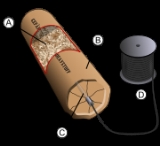
It is usually sold in the form of a stick 20 centimetres (roughly 8 inches) long and 2.5 centimetres (1 inch) in diameter, but other sizes also exist.


Discussion
Ask a question about 'Dynamite'
Start a new discussion about 'Dynamite'
Answer questions from other users
Full Discussion Forum


Recent Posts


Encyclopedia


Dynamite is an explosive
Explosive material

File:M112 Demolition Charge.jpgAn explosive material is a material that either is chemistry or otherwise energetically unstable or produces a sudden expansion of the material usually accompanied by the production of heat and large changes in pressure upon initiation; this is called the explosion....
 based on the explosive potential of nitroglycerin
Nitroglycerin

Nitroglycerin , also known as nitroglycerine, , trinitroglycerin, trinitroglycerine, 1,2,3-trinitroxypropane and glyceryl trinitrate, is a heavy, colorless, oily, explosive liquid obtained by nitration glycerol....
, initially using diatomaceous earth
Diatomaceous earth

Diatomaceous earth ? also known as DE, TSS, diatomite, diahydro, kieselguhr, kieselgur or celite ? is a naturally occurring, soft, chalk-like sedimentary rock that is easily crumbled into a fine white to off-white powder....
 (kieselgur: United States
United States

The United States of America is a Federal government constitutional republic comprising U.S. state and a federal district. The country is situated mostly in central North America, where its Contiguous United States and Washington, D.C., the Capital districts and territories, lie between the Pacific Ocean and Atlantic Oceans, Borders of the U...
 spelling; kieselguhr: UK
United Kingdom

The United Kingdom of Great Britain and Northern Ireland, commonly known as the United Kingdom , the UK or Britain,is a sovereign state located off the northwestern coast of continental Europe....
 spelling) or another absorbent substance such as sawdust as an adsorbent. It was invented by Swedish
Sweden

Sweden , officially the Kingdom of Sweden , is a Nordic countries on the Scandinavian Peninsula in Northern Europe. Sweden has land borders with Norway to the west and Finland to the northeast, and it is connected to Denmark by the ?resund Bridge in the south....
 chemist and engineer Alfred Nobel
Alfred Nobel

was a Sweden chemist, engineer, innovator, armaments manufacturer and the inventor of dynamite. He owned Bofors, a major armaments manufacturer, which he had redirected from its previous role as an iron and steel mill....
 in 1866 in Krümmel (Geesthacht
Geesthacht

Geesthacht is the largest city in the Lauenburg in Schleswig-Holstein in Northern Germany, 34 km southeast of Hamburg on the banks of the River Elbe....
, Schleswig-Holstein
Schleswig-Holstein

Schleswig-Holstein is the Northern Germany of the sixteen States of Germany of Germany. Its capital city is Kiel, other notable cities are L?beck and Flensburg....
, Germany
Germany

Germany , officially the Federal Republic of Germany , is a country in Central Europe. It is bordered to the north by the North Sea, Denmark, and the Baltic Sea; to the east by Poland and the Czech Republic; to the south by Austria and Switzerland; and to the west by France, Luxembourg, Belgium, and the Netherlands....
), and patent
Patent

A patent is a set of exclusive rights granted by a state to an inventor or his assignee for a term of patent in exchange for a disclosure of an invention....
ed in 1867.

It is usually sold in the form of a stick 20 centimetres (roughly 8 inches) long and 2.5 centimetres (1 inch) in diameter, but other sizes also exist. Dynamite is considered a high explosive
Explosive material

File:M112 Demolition Charge.jpgAn explosive material is a material that either is chemistry or otherwise energetically unstable or produces a sudden expansion of the material usually accompanied by the production of heat and large changes in pressure upon initiation; this is called the explosion....
, which means it detonates
Detonation

Detonation is a process of combustion in which a supersonic shock wave is propagated through a fluid due to an energy release in a reaction zone....
 rather than deflagrates
Deflagration

Deflagration is a technical term describing subsonic combustion that usually propagates through thermal conductivity . Most "fire" found in daily life, from flames to explosions, is technically deflagration....
.

Another form of dynamite consists of nitroglycerin dissolved in nitrocellulose
Nitrocellulose

Nitrocellulose is a highly flammable compound formed by nitrating cellulose through exposure to nitric acid or another powerful nitrating agent....
 and a small amount of ketone
Ketone

In organic chemistry, a ketone is a type of organic compound which contains a carbonyl group bonded to two other carbon atoms in the form:Neither of the substituents R1 and R2 may be equal to hydrogen ....
. This form of dynamite is similar to cordite
Cordite

Cordite is a family of smokeless powder developed and produced in the United Kingdom from 1889 to replace gunpowder as a military propellant....
. This form of dynamite is much safer than the simple mix of nitroglycerin and diatomaceous earth/kieselgur.

Uses

Dynamite is predominantly used in the mining
Mining

Mining is the extraction of value minerals or other geology materials from the earth, usually from an ore body, vein or seam. Materials recovered by mining include base metals, precious metals, iron, uranium, coal, diamonds, limestone, oil shale, Sodium chloride and potash....
, quarrying, and construction industries and has had historical use in warfare, but its unstable nature, especially if subjected to freezing, has rendered it obsolete for modern military use. Dynamite has been replaced for combat purposes by military dynamite, a mixture of TNT
Trinitrotoluene

Trinitrotoluene , or more specifically, 2,4,6-trinitrotoluene, is a chemical compound with the formula C6H23CH3....
, RDX
RDX

Cyclotrimethylenetrinitramine, also known as RDX, cyclonite, hexogen, and T4, is an explosive nitroamine widely used in military and industrial applications....
, inert binders and anti-freeze agents. Military dynamite has approximately 60% of the strength of nitroglycerin-based, comercial dynamite. While not technically dynamite, it is called this as a slang term.

History

Dynamite was invented by Alfred Nobel
Alfred Nobel

was a Sweden chemist, engineer, innovator, armaments manufacturer and the inventor of dynamite. He owned Bofors, a major armaments manufacturer, which he had redirected from its previous role as an iron and steel mill....
 and was the first safely manageable explosive stronger than black powder. Nobel obtained patent
Patent

A patent is a set of exclusive rights granted by a state to an inventor or his assignee for a term of patent in exchange for a disclosure of an invention....
s for his invention: in England on 7 May 1867 and in Sweden
Sweden

Sweden , officially the Kingdom of Sweden , is a Nordic countries on the Scandinavian Peninsula in Northern Europe. Sweden has land borders with Norway to the west and Finland to the northeast, and it is connected to Denmark by the ?resund Bridge in the south....
 on 19 October 1867. He originally sold dynamite as "Nobel's Blasting Powder". After its introduction, dynamite rapidly gained popularity as a safe alternative to gunpowder
Gunpowder

Gunpowder, also called black powder, is an explosive mixture of sulfur, charcoal and potassium nitrate, KNO3 that burns rapidly, producing volumes of hot solids and gases which can be used as a propellant in firearms and as a pyrotechnic composition in fireworks....
 and nitroglycerin
Nitroglycerin

Nitroglycerin , also known as nitroglycerine, , trinitroglycerin, trinitroglycerine, 1,2,3-trinitroxypropane and glyceryl trinitrate, is a heavy, colorless, oily, explosive liquid obtained by nitration glycerol....
. Nobel tightly controlled the patent, and unlicensed duplicators were quickly shut down. However, a few American
United States

The United States of America is a Federal government constitutional republic comprising U.S. state and a federal district. The country is situated mostly in central North America, where its Contiguous United States and Washington, D.C., the Capital districts and territories, lie between the Pacific Ocean and Atlantic Oceans, Borders of the U...
 businessmen got around the patent by using a slightly different formula.

Manufacture

Dynamite consists of three parts nitroglycerin
Nitroglycerin

Nitroglycerin , also known as nitroglycerine, , trinitroglycerin, trinitroglycerine, 1,2,3-trinitroxypropane and glyceryl trinitrate, is a heavy, colorless, oily, explosive liquid obtained by nitration glycerol....
, one part diatomaceous earth and a small admixture of sodium carbonate
Sodium carbonate

Sodium carbonate , , is a sodium salt of carbonic acid. It most commonly occurs as a crystalline heptahydrate, which readily efflorescence to form a white powder, the monohydrate....
. This mixture is formed into short sticks and wrapped in paper. Nitroglycerin by itself is a very strong explosive, and in its pure form it is shock-sensitive (physical shock can cause it to explode), degrading over time to even more unstable forms. This makes it highly dangerous to transport or use in its pure form. Adsorbed onto diatomaceous earth, nitroglycerin is less shock-sensitive.

Over time, the dynamite will "weep" or "sweat" its nitroglycerin, which can then pool in the bottom of the box or storage area. Crystals will form on the outside of the sticks. This creates a very dangerous situation. While the actual possibility of explosion without a blasting cap
Blasting cap

A blasting cap is a small explosive device generally used to detonator a larger, more powerful explosive such as dynamite.Blasting caps come in a variety of types, some of which are: non-electric caps, electric caps and fuse caps....
 is minimal, old dynamite is still dangerous.

South Africa

For several decades from the 1940s, the biggest producer of dynamite in the world was the Republic of South Africa, where De Beers
De Beers

De Beers and the various companies within the De Beers Family of Companies engage in exploration for diamond , diamond mining, diamond trading and industrial diamond manufacture....
 established a factory in 1902 at Somerset West. The explosives factory was later operated by AECI
AECI

AECI Limited is a South African chemicals group and is listed on the JSE Securities Exchange.The AECI Group operates companies in the following market segments:...
 (African Explosives and Chemical Industries). The demand for the product came mainly from the country's vast gold mines, centered on the Witwatersrand
Witwatersrand

The Witwatersrand is a low, sedimentary range of hills, at an elevation of 1700-1800 metres above sea-level, which runs in an east-west direction through Gauteng in South Africa....
. The factory at Somerset West was in operation in 1903 and by 1907 was already producing 340,000 cases (22 kilograms (50 lb) each) annually. In addition, a rival factory at Modderfontein was producing another 200,000 cases per year.

One of the drawbacks of dynamite was that it was dangerous to manufacture. There were two massive explosions at the Somerset West plant in the 1960s. Some workers died, but loss of life was limited by the modular design of the factory and earth works and plantations of trees that directed the blasts upwards. Pressure from trade unions forced AECI, after 1985, to phase out production of dynamite. The factory then went on to solely supply ammonium nitrate emulsion based explosives that are far safer to manufacture.

United States

In the United States, in 1885, chemist Russell S. Penniman invented ammonium dynamite, a form which utilized ammonium nitrate
Ammonium nitrate

The chemical compound ammonium nitrate, the nitrate of ammonia with the chemical formula NitrogenHydrogen4NitrogenOxygen3, is a white powder at room temperature and standard pressure....
 in addition to the more costly nitroglycerin. These dynamites were marketed with the trade name "Extra". Ammonium nitrate has 85% of the energy of "straight" nitroglycerin. Dynamite was manufactured by the E. I. du Pont de Nemours & Company, Inc.
DuPont

E. I. du Pont de Nemours and Company is an United States chemical industry that was founded in July 1802 as a gunpowder mill by Eleuth?re Ir?n?e du Pont....
 until the mid-1970s. Other U.S. dynamite makers of the era included Hercules, Atlas, Trojan-US Powder, Austin, and several other smaller firms. Dynamite was eventually phased out in favor of water gel explosive
Water gel explosive

A water gel explosive is an explosive mixture consisting of a saturation aqueous solution of oxidizers and/or fuels. Tovex is an example of a water gel explosive....
s, which are cheaper to manufacture and in many ways safer to handle.

Difference from TNT

It is a common misconception
Misconception

A misconception happens when a person belief in a concept which is Objective approach false.Due to the subjective nature of humanity, it can be assumed that everyone has some kind of misconception....
 that TNT
Trinitrotoluene

Trinitrotoluene , or more specifically, 2,4,6-trinitrotoluene, is a chemical compound with the formula C6H23CH3....
 and dynamite are the same thing. Though both are high explosives, there is no other similarity between them. While dynamite is an absorbent mixture soaked in nitroglycerin, then compacted into a cylindrical shape and wrapped in paper, TNT is a specific chemical compound called 2,4,6-trinitrotoluene.

A stick of dynamite contains roughly 2.1 million joules of energy. The energy density (joules/kilogram
Kilogram

The kilogram or kilogrammeThe spelling kilogram is used by the International Committee for Weights and Measures and the U.S....
) of dynamite is approximately 7.5 megajoules/kilogram, compared to 4.6 megajoules/kilogram of TNT.

See also

  • Nitroglycerin
    Nitroglycerin

    Nitroglycerin , also known as nitroglycerine, , trinitroglycerin, trinitroglycerine, 1,2,3-trinitroxypropane and glyceryl trinitrate, is a heavy, colorless, oily, explosive liquid obtained by nitration glycerol....
  • Nobel Prize
    Nobel Prize

    The Nobel Prize , established in the 1895 will of Swedish chemist Alfred Nobel; it was first awarded in Nobel Prize in Physics, Nobel Prize in Chemistry, Nobel Prize in Physiology or Medicine, Nobel Prize in Literature, and Nobel Peace Prize in 1901....
  • TNT
    Trinitrotoluene

    Trinitrotoluene , or more specifically, 2,4,6-trinitrotoluene, is a chemical compound with the formula C6H23CH3....
  • Titadine
    Titadine

    Titadyn 30 AG is a type of compressed dynamite used in mining and manufactured in southern France by Titanite S.A. The explosive comes in the form of salmon pink-coloured tubes of a range of diameters, from 50 to 120 mm....
  • Tovex
    Tovex

    Tovex is a water gel explosive that has several advantages over traditional dynamite. Tovex has almost entirely replaced dynamite. Tovex enjoys a number of advantages over nitroglycerin based dynamite in that Tovex is less toxic and is less hazardous to manufacture, transport, and store....
  • The Wages of Fear


Patent

|number = 78317 |title = Improved explosive compound |inventor = Alfred Nobel |y = 1868 |m = 05 |d = 26 }}

Footnotes


Sources

  • Cartwright, A. P. (1964). The Dynamite Company: The Story of African Explosives and Chemical Industries Limited. Cape Town: Purnell & Sons (S.A.) (Pty) Ltd.
  • Schück, H. and Sohlman, R.(1929). The Life of Alfred Nobel. London: William Heinemann Ltd.


External links