
Encyclopedia
Tennis is a game played between either two players or two teams of two players . Players use a stringed
racquet to strike a hollow rubber
ball covered with felt over a net into the opponent's
court. In some places tennis is still called
lawn tennis to distinguish it from
real tennis , an older form of the game that originated in France in the
Middle Ages and is played indoors on a very different court. Originating in England in the late 19th century, lawn tennis spread first throughout the English-speaking world, particularly among the upper classes. Tennis is now an
Olympic sport and is played at all levels of society, by all ages, and in many countries around the world. Except for the adoption of the tie-breaker in the
1970s, its rules have remained remarkably unchanged since the
1890s. Along with its millions of players, millions of people follow tennis as a spectator sport, especially the four Grand Slam tournaments.
Manner of play
For individual terms see: Tennis terminology
The court
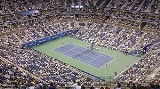
Tennis is played on a rectangular, flat surface, usually
grass,
clay, or a hardcourt of concrete and/or asphalt. The court is 78
feet long, and its width is 27 feet for singles matches and 36 feet for doubles matches. Additional clear space around the court is required in order for players to reach overrun balls. A net is stretched across the full width of the court, parallel with the baselines, dividing it into two equal ends. The net is 3 feet 6 inches high at the posts, and 3 feet high in the center.
Types of Courts
There are three main types of courts. Depending on the materials used for the court surfaces, each surface provides a difference in the speed and bounce of the ball, which in turn can affect the level of play of the individual players. The three most common types of courts are:
Some players are more successful on certain surfaces and are known as, for instance, "Clay-court specialists".
Hardcourt encompasses many different surfaces ranging from old-fashioned concrete courts, to coated asphalt, to wooden gymnasium surfaces, to artificial grass similar to AstroTurf.
Clay courts are considered "slow", meaning that balls first lose speed as they hit the court and then bounce relatively high, making it more difficult for a player to hit an unreturnable shot, called a winner. On clay courts, line calls are easily reviewable because the ball leaves a visible mark.
Hardcourts and grass are "fast" surfaces, where fast, low bounces keep rallies short and where hard-serving and hard-hitting players have an advantage. Grass courts add an additional variable, with bounces depending on how healthy the grass is and how recently it has been mown.
For the Grand Slam tournaments, different kinds of courts are used: The U.S. Open and
Australian Open use hardcourts, the French Open is played on clay, and
Wimbledon is played on grass.
Play of a single point
- Main article: Play of a single point
The players start on opposite sides of the net. One player is designated the
server, and the opposing player, or in doubles one of the opposing players, is the
receiver. Service alternates between the two halves of the court.
For each point, the server starts behind his baseline, between the center mark and the sideline. The receiver may start anywhere on his side of the net, usually behind the service box. When the receiver is ready, the server will serve.
In a legal service, the ball travels over the net and into the diagonally opposite service court. If the ball hits the net but lands in the service court, this is a
let service, which is void, and the server gets to retake that serve. If the first service is otherwise faulty in any way, wide, long or not over the net, the serving player has a second attempt at service. If the second service is also faulty, this is a
double fault and the receiver wins the point. However if the serve is in then it is considered a legal service.
A legal service starts a
rally, in which the players alternate hitting the ball across the net. A legal return consists of the player or team hitting the ball exactly once before it has bounced twice or hit any fixtures except the net provided that it still falls in the server's court. It then travels back over the net and bounces in the court on the opposite side. The first player or team to fail to make a legal return loses the point.
Scoring
- Main article: Tennis score
A tennis match usually comprises one to five
sets. A set consists of a number of
games, and games, in turn, consist of
points.
Matches consist of an odd number of sets, the match winner being the player who wins more than half of the sets. The match ends as soon as this winning condition is met. Some matches may consist of five sets , while most matches are three sets .
A set consists of a sequence of games played with service alternating between games, ending when the count of games won meets certain criteria. Typically, a player wins a set when he wins at least six games and at least two games more than his opponent. It has become common, however, to play a "twelve-point tiebreak" or "tiebreaker" when each player has won six games. A tiebreaker, played under a separate set of rules, allows one player to win one more game and thus the set, to give a final set score of 7-6.
A game consists of a sequence of points played with the same player serving, and is won by the first player to have won at least four points and at least two points more than his opponent. The running score of each game is described in a manner particular to tennis: scores of zero to three points are described as "
love" or "
zero," "
fifteen," "
thirty," and "
forty" respectively. When at least three points have been scored by each side and the players have the same number of points, the score is "
deuce". When at least three points have been scored by each side and a player has one more point than his opponent, the score of the game is "
advantage" for the winning player. During informal games, "advantage" can also be called "ad in" or "ad out", depending on whether the serving player or receiving player, respectively, is ahead.
A
game point occurs in tennis whenever the player who is in the
lead in the
game needs only one more point to win the game. The terminology is extended to
sets ,
matches , and even championships . For example, if the player who is serving has a score of 40-love, he has a triple game point .
A
break point occurs if the receiver, not the server, has a game point. It is of importance in professional tennis, since service breaks happen less frequently with professional players. It may happen that the player who is in the lead in the game has more than one chance to score the winning point, even if his opponent should take the next point. For example, if the player who is serving has a score of 15-40, the receiver has a double break point. Should the player in the lead take any one of the next two points, he wins the game.
For two years before the Open Era, in 1955 and 1956, the United States Pro Championship in
Cleveland, Ohio was played by the Van Alen Streamlined Scoring System rules, created by
James Van Alen, who later invented the tie-breaker. The scoring was the same as that in
table tennis, with sets played to 21 points and players alternating 5 services, with no second service. The rules were partially created in order to limit the effectiveness of the powerful service of the reigning professional champion,
Pancho Gonzales. Even with the new rules, however, Gonzales beat
Pancho Segura in the finals of both tournaments. Even though the 1955 match went to 5 sets, with Gonzales barely holding on to win the last one 21-19, apparently it took only 47 minutes to play. The fans attending the matches preferred the traditional rules, however, and in 1957 the tournament reverted to the old method of scoring.
Officials
In serious play there is an officiating chair umpire , who sits in a raised chair to one side of the court. The umpire has absolute authority to determine matters of fact. The chair umpire may be assisted by line judges, who determine whether the ball has landed within the required part of the court and who also call foot faults. There may also be a net judge who determines whether the ball has touched the net during service. In some open-tournament matches, players are allowed to challenge a limited number of close calls by means of instant replay in order to have the call overturned. The U.S. Open, U.S. Open Series and
World Team Tennis use a "challenge" system similar to the one used in the
NFL, where a player gets a limited number of instant-replay challenges per match/set. In clay-court matches, a call may be questioned by reference to the mark left by the ball's impact on the court surface.
The referee, who is is usually located off the court, is the final authority when it comes to the tennis rules. When called to the court by a player or team captain, he can overrule the chair umpire's decision if tennis rules were violated , but cannot change the chair umpire's call on a fact . If, however, the referee is on the court during play, he can overrule the chair umpire's call.
Ball boys may be employed to retrieve balls, pass them to the players, and hand players their towels. They have no adjudicative role. In rare events the chair umpire can ask them for a statement of what actually happened. He can consider their statement as a basis for his subsequent decision.
In some leagues players will make their own calls, trusting each other to be honest. This is the case for many school and university level matches. However, the referee or referee's assistant can be called on court at the player's request, and they have authority to change the fact on the court.
Juniors
Juniors are the roots of world tennis; everyday new young tennis players are coming onto the international circuit. Juniors are often seen playing in the gentlemen’s tournaments as well as the boy’s section of the tournaments. This gives the new generation of players a look at what they need to play like. There are certain rules for juniors that prevent them from playing all the matches on the circuit until they have been fully physically and mentally developed. Some notable juniors in the year 2006 are Martin Klizan , Dustin Lojda , Donald Young , Daniel Silva , Sho Aida , Mason Jones , Sanam Singh . Each of these Juniors have won major tournaments in the respective countries.
Miscellaneous
A tennis match is intended to be continuous. Stamina is a relevant factor, so arbitrary delays are not permitted. In most cases, service is required to occur no more than 20 or 25 seconds after the end of the previous point. This is increased to 90 seconds when the players change ends , and a 120 second break is permitted between sets. Other than this, breaks are permitted only when forced by events beyond the players' control, such as rain, damaged footwear, or the need to chase an errant ball.
Balls wear out quickly in serious play, and therefore are changed after every nine games. The first such change occurs after only seven games, because the first set of balls is also used for the pre-match warm-up. Continuity of the balls' condition is considered part of the game, so if a re-warm-up is required after an extended break in play then the re-warm-up is done using a separate set of balls, and use of the match balls is resumed only when play resumes.
Wheelchair tennis can be played by able-bodied players as well as people who require a wheelchair for mobility. The use of legs or feet is then prohibited, and the player is required to remain seated in the wheelchair. There is an exception for those who are only able to propel themselves using a foot. In wheelchair tennis, in which the players move in wheelchairs instead of using legs, an extra bounce is permitted. This rule makes it possible to have mixed wheelchair and able-bodied matches. It is possible for a doubles team to consist of a wheelchair player and an able-bodied player , or for a wheelchair player to play against an able-bodied player; in such cases, the extra bounce is permitted for the wheelchair users only.
Another, informal, tennis format is called "Canadian doubles" . This involves three players, with one person playing against a doubles team. For the single player, singles-court rules apply but on the side of the doubles team, doubles-court rules apply . The scoring is the same as a regular game. This format is not sanctioned by any official body and is only played when a fourth player is not available for normal doubles.
It has recently been proposed to allow coaching on court during a match on a limited basis. Also, technological review of official calls made its debut in a major tournament at the 2006 U.S. Open.
Lastly, there is a tennis formation called "Australian doubles" in which both players on the same team line up on the same side of the court, with one player at the net and one in the backcourt. The one in back will generally move to the vacant side of the court after the point begins, which forces the opposing player to hit the ball down the line. This formation also allows the player at the net to poach more easily.
Other rules of play used in American college tennis
As of 1999, in Division I tennis at the college level, a let service is considered playable. This rule change was made to prevent receivers from falsely claiming a valid service to be a let, which is a call that cannot be overruled. Thus, a service that hits the net before landing in the service box is a playable shot, and must be returned by the receiver. Otherwise, the receiver loses the point.
Other rules of play used in American high school tennis
During high school tennis team matches players may have to follow a few different rules:
Pro set: Instead of playing best out of three sets, players may play one pro set. A pro set is first to 8 games instead of 6. All other rules apply.
Super tie-break: This is played sometimes after players split sets . It decides who wins instead of a third set. This is played like a regular tie-break but the winner must attain ten points instead of seven.
No-ad: The players play through the match without any ads. When the game is at deuce the receiving player has the option to choose what side of court they want to receive the serve for the final game-deciding point. The first player or team to four points wins the game.
Shots
A competent tennis player has eight basic shots in his or her repertoire: the serve, forehand, backhand, volley, half-volley, overhead smash, drop shot, and lob.
Serve
- Main article: Serve
A serve in tennis is a shot to start a point. The serve is initiated by tossing the ball into the air and hitting it into the diagonally opposite service box without touching the net. The serve may be hit under- or overhand.
Experienced players strive to master the conventional overhand serve to maximize its power and placement. The server may employ different types of serve:
- American Twist/Twist Serve
- Reverse Slice/Reverse Slider/Reverse Sidespin Serve
- Reverse Twist/Reverse American Twist Serve
- Reverse Topspin-Slice Serve
A reverse type of spin serve is hit in a manner that spins the ball opposite the natural spin of the server, the spin direction depending upon right- or left-handedness.
Some servers are content to use the serve simply to initiate the point; advanced players often try to hit a winning shot with their serve. A winning serve that is not touched by the opponent is called an
ace; if the receiver manages to touch it but fails to successfully return it, it is called a
service winner.
Forehand
- Main article: Forehand
For a right-handed player, the forehand is a stroke that begins on the right side of his body, continues across his body as contact is made with the ball, and ends on the left side of his body. There are various grips for executing the forehand and their popularity has fluctuated over the years. The most important ones are the
continental, the
eastern, "semi-western" and the
western. For a number of years the small, apparently frail 1920s player
Bill Johnston was considered by many to have had the best forehand of all time, a stroke that he hit shoulder-high using a
western grip. Few top players used the
western grip after the 1920s, but in the latter part of the 20th century, as shot-making techniques and equipment changed radically, the
western forehand made a strong comeback and is now used by many modern players. No matter which grip is used, most forehands are generally executed with one hand holding the racquet, but there have been fine players with two-handed forehands. In the 1940s and 50s the Ecuadorian/American player
Pancho Segura used a two-handed forehand to devastating effect against larger, more powerful players, and many females and young players use the two-handed grips today. At a professional event in 1951 the forehand drives of a number of players were electronically measured.
Pancho Gonzales hit the fastest, 112.88 mph, followed by Jack Kramer at 107.8 and Welby Van Horn at 104.
Backhand
- Main article: Backhand
For right-handed players, the backhand is a stroke that begins on the left side of their body, continues across their body as contact is made with the ball, and ends on the right side of their body. It can be executed with either one hand or with both and is generally considered more difficult to master than the forehand. For most of the 20th century it was performed with one hand, using either an
eastern or a
continental grip. The first notable players to use two hands were the 1930s Australians
Vivian McGrath and
John Bromwich, but they were lonely exceptions. The two-handed grip gained popularity in the 1970s as
Björn Borg,
Chris Evert,
Jimmy Connors, and later
Mats Wilander used it to great effect, and it is now used by a large number of the world's best players, including
Andre Agassi and
Venus Williams.
Andy Roddick uses the "extreme western" grip to create massive amounts of top spin. It is difficult to do this and also causes injuries when done incorrectly. Two hands give the player more power, while one hand can generate a slice shot, applying backspin on the ball to produce a low trajectory bounce. The player long considered to have had the best backhand of all time,
Don Budge, had a very powerful one-handed stroke in the 1930s and '40s that imparted topspin onto the ball.
Ken Rosewall, another player noted for his one-handed backhand, used a deadly accurate slice backhand with underspin through the 1950s and '60s. A small number of players, notably
Monica Seles, use two hands on both the backhand and forehand sides.
Other shots
A
volley is made in the air before the ball bounces, generally near the net, and is usually made with a stiff-wristed punching motion to hit the ball into an open area of the opponent's court. The
half volley is made by hitting the ball on the rise just after it has bounced, once again generally in the vicinity of the net. From a poor defensive position on the baseline, the
lob can be used as either an offensive or defensive weapon, hitting the ball high and deep into the opponent's court to either enable the lobber to get into better defensive position or to win the point outright by hitting it over the opponent's head. If the lob is not hit deeply enough into the other court, however, the opponent may then hit an
overhead smash, a hard, serve-like shot, to try to end the point. Finally, if an opponent is deep in his court, a player may suddenly employ an unexpected
drop shot, softly tapping the ball just over the net so that the opponent is unable to run in fast enough to retrieve it.
Tournaments
Tournaments are often organized by gender and number of players. Common tournament configurations include men's singles, women's singles, doubles , and mixed doubles . Tournaments may be arranged for specific age groups, with upper age limits for youth and lower age limits for senior players. There are also tournaments for handicapped players. In the four grand slams, the draw is 128 people.
Players may also be matched by their skill level. According to how well a person does in sanctioned play, he or she is given a rating which is adjusted periodically to maintain competitive matches.
History
Tennis can be traced as far back as the ancient Greek game of sphairistike .
Major Walter Wingfield borrowed the name of this Greek game, in order to name the recreation he patented in 1874. It was soon converted into a three-syllable word rhyming with “pike” and afterwards abbreviated either to sticky or the mock-French stické, before being finally called "lawn tennis", which was a second name patented by Wingfield for the game.
Its establishment as the modern sport can be dated to two separate roots. In 1856, Alex Ryden, a
solicitor, and his friend Batista Pereira, a Portuguese merchant, who both lived in
Birmingham, England played a game they named "
pelota", after a Spanish ball game. The game was played on a lawn in
Edgbaston. In 1872 both men moved to
Leamington Spa, and with two doctors from the Warneford Hospital, played pelota on the lawn behind the Manor House Hotel . Pereira joined with Dr. Frederick Haynes and Dr. A. Wellesley Tomkins to found the first lawn tennis club in the world, and played the game on nearby lawns. In 1874 they formed the Leamington Tennis Club, setting out the original rules of the game. The Courier of 23 July 1884 recorded one of the first tennis tournaments, held in the grounds of Shrubland Hall .
In December 1873, Major Walter Clopton Wingfield devised a similar game for the amusement of his guests at a garden party on his estate at Nantclwyd,
Wales. He based the game on the older sport of indoor tennis or
real tennis , which had been invented in 12th century
France and was played by French aristocrats down to the time of the
French Revolution.
According to most tennis historians, modern tennis terminology also derives from this period, as Wingfield borrowed both the name and much of the French vocabulary of royal tennis and applied them to his new game:
- Tennis comes from the French tenez, the imperative form of the verb tenir, to hold: This was a cry used by the player serving in royal tennis, meaning "I am about to serve!" .
- Racquet comes from raquette, which derives from the Arabic rakhat, meaning the palm of the hand.
- Deuce comes from à deux le jeu, meaning "to both is the game" .
- Love may come from l'œuf, the egg, a reference to the egg-shaped zero symbol; however, since "un œuf" is more commonly used, the etymology remains in question.
- The convention of numbering scores "15", "30" and "40" comes from quinze, trente and quarante, which to French ears makes a euphonious sequence, or from the quarters of a clock with 45 simplified to 40.
Seeing the commercial potential of the game, Wingfield patented it in 1874, but never succeeded in enforcing his patent. Tennis spread rapidly among the leisured classes in
Britain and the
United States. It was first played in the U.S. at the home of Mary Ewing Outerbridge on
Staten Island, New York in 1874.
In 1881 the desire to play tennis competitively led to the establishment of tennis clubs. The first championships at
Wimbledon, in
London were played in 1877. In 1881 the United States National Lawn Tennis Association was formed to standardize the rules and organize competitions. The comprehensive I.L.T.F. rules promulgated in 1924 have remained remarkably stable in the ensuing eighty years, the one major change being the addition of the
tie-breaker system designed by
James Van Alen. U.S. National Men's Singles Championship, now the U.S. Open, was first held in 1881 at
Newport,
Rhode Island. The U.S. National Women's Singles Championships were first held in 1887. The
Davis Cup, an annual competition between national teams, dates to 1900.
Tennis was for many years predominantly a sport of the English-speaking world, dominated by the United States, Britain and
Australia. It was also popular in France, where the French Open dates to 1891. Thus Wimbledon, the U.S. Open, the French Open and the
Australian Open became and have remained the most prestigious events in tennis. Together these four events are called the
Grand Slam . Winning the Grand Slam, by capturing these four titles in one calendar year, is the highest ambition of most tennis players.
In 1926 promoter C.C. Pyle established the first professional tennis tour with a group of American and French tennis players playing exhibition matches to paying audiences. The most notable of these early professionals were the American
Vinnie Richards and the Frenchwoman
Suzanne Lenglen. For 42 years professional and amateur tennis remained strictly separate. Once a player
turned pro he or she could not compete in the major tournaments. In 1968, commercial pressures led to the abandonment of this distinction, inaugurating the Open era, in which all players could compete in all tournaments, and top players were able to make their living from tennis.
With the beginning of the Open era, the establishment of an international professional tennis circuit, and revenues from the sale of television rights, tennis has spread all over the world and has lost its upper-class English-speaking image. Since the 1970s great champions have emerged from
Germany ,
Australia , the former
Czechoslovakia ,
Sweden ,
Brazil ,
Argentina ,
Russia ,
Belgium ,
France ,
Spain ,
Switzerland and from many other countries.
In America, the game has seen a seismic shift from a sport that the "country-club set" played to one that is an activity for anyone. Successes by players from across the spectrum, from the working-class
Jimmy Connors to great African-American stars such as
Arthur Ashe and the Williams sisters
Venus and
Serena, have firmly established tennis as a game for all in the United States. This is perhaps best embodied in the fact that in the 1970s, when popularity of the game was at a peak, the USTA decided to move the U.S. Open from the posh West Side Tennis Club to a public park that is accessible to anyone with the "greens fees" . About the same time, the ruling body's name was also changed from United States Lawn Tennis Association to United States Tennis Association.
In 1954 James Van Alen founded the International Tennis Hall of Fame, a non-profit museum in
Newport, Rhode Island. The building contains a large collection of tennis memorabilia as well as a hall of fame honoring prominent members and tennis players from all over the world. Each year, a grass-court tournament is hosted on the grounds that are home to the Tennis Hall of Fame, as well as an induction ceremony honoring new Hall of Fame members.
Great players
Numerous great players played in the days before tennis's Open era, many of whom are unknown by modern sports fans. Among them, chronologically, are:

- "Big Bill" Tilden - winner of 21 amateur Grand Slam titles, 7 consecutive Davis Cups, 4 professional Grand Slam titles, the professional doubles title at age 52; was for 7 years the World No. 1 player
- Jean Borotra, Henri Cochet, René Lacoste - the three best of the "Four Musketeers", won 46 amateur Grand Slam titles amongst them, 6 consecutive Davis Cups, 1 professional Grand Slam title; one was for 5 years the World No. 1 player
- Ellsworth Vines - winner of 6 amateur Grand Slam titles, 4 professional Grand Slam titles; was world #1 professional player, 1933-1937; had a tremendous flat, hard service; was for 3 years the World No. 1 player
- Fred Perry - won 13 amateur Grand Slam titles including 3 consecutive Wimbledons; was the first to win 4 consecutive Grand Slam titles; won 2 professional Grand Slam titles; was for 4 consecutive years the World No. 1 player
- Don Budge - winner of 14 amateur Grand Slam titles; was the first to win 4 Grand Slam titles in a single year, 4 professional Grand Slam titles; is widely viewed as having had the best backhand of all time before Rosewall; was for 6 consecutive years the World No. 1 player
- Bobby Riggs - winner of 6 amateur Grand Slam titles, 4 professional Grand Slam titles and 7 times a finalist; was world #1 professional player 1946-1947 and for those 2 years the World No. 1 player
- Jack Kramer - won 10 amateur Grand Slam titles and 2 professional Grand Slam titles; was the first great player to play serve-volley on all serves; beat Gonzales badly in the 1949-1950 tour; was for 5 years the World No. 1 player
- Pancho Segura - winner of 3 professional Grand Slam titles, including 2 victories over Gonzales, and 7 times a finalist; was for 1 year the World No. 1 player; Kramer called Segura's two-handed forehand "the single best shot ever produced in tennis."
- Pancho Gonzales - winner of 4 amateur Grand Slam titles, 12 professional Grand Slam titles and 6 times a finalist; world #1 amateur in 1949; was still world #6 player in 1969 and #9 American in 1972 at 44; was for 8 consecutive years the World No. 1 player, an unequalled 9 times overall
- Frank Sedgman - won 22 amateur Grand Slam titles, 3 professional Grand Slam titles and 4 times a finalist; winner of 3 consecutive Davis Cups
- Ken Rosewall - won 18 Grand Slam titles, first 11 as an amateur, then 7 in the Open era, plus another 18 professional Grand Slam titles and was 5 times a finalist; winner of 3 consecutive Davis Cups; was for 2 years the World No. 1 player
- Lew Hoad - won 11 amateur Grand Slam titles and 7 times a finalist in the professional Grand Slam; Gonzales said of him: "I think his game was the best game ever. Better than mine."
Other fine players of the pre-Open era include Maurice McLoughlin,
"Little Bill" Johnston,
Vinnie Richards, Jack Crawford,
Gottfried von Cramm,
Ted Schroeder, Vic Seixas, and
Tony Trabert.
Among women the top two pre-Open era players are considered to be
Suzanne Lenglen and
Helen Wills Moody.
Maureen Connolly was the first female player to win a
Grand Slam in 1953.
Doris Hart was the first player to win all 12 possible singles, doubles and mixed doubles Grand Slam titles
Among the greatest male players of the Open era, with the number of career Grand Slam singles titles in parentheses, are:
Pete Sampras , Roy Emerson ,
Rod Laver ,
Björn Borg ,
Roger Federer ,
Jimmy Connors ,
Ivan Lendl ,
Andre Agassi ,
John Newcombe ,
John McEnroe ,
Mats Wilander ,
Boris Becker ,
Stefan Edberg ,
Jim Courier ,
Guillermo Vilas ,
Arthur Ashe ,
Gustavo Kuerten,
Stan Smith ,
Lleyton Hewitt ,
Yevgeny Kafelnikov ,
Patrick Rafter ,
Marat Safin , and Rafael Nadal
The greatest women players of the Open Era, again with the number of career Grand Slam singles titles in parentheses for each, are:
Margaret Smith Court ,
Steffi Graf ,
Chris Evert ,
Martina Navrátilová ,
Billie Jean King ,
Monica Seles ,
Serena Williams ,
Evonne Goolagong ,
Venus Williams ,
Martina Hingis ,
Justine Henin-Hardenne ,
Hana Mandlíková , Arantxa Sánchez Vicario , Virginia Wade ,
Lindsay Davenport ,
Jennifer Capriati ,
Mary Pierce ,
Amélie Mauresmo , and
Maria SharapovaThe greatest player of all time
Until the mid-1950s, Bill Tilden was generally considered the greatest player ever, his only rivals being Vines, Budge, and Kramer. For much of the 1950s and 1960s, many thought Gonzales had claimed that title. Since then, first Laver, then more recently Borg, McEnroe, and Sampras, were widely regarded by many of their contemporaries as the greatest ever. Roger Federer is now considered by many observers to have the most "complete" game in modern tennis, with the potential to challenge the achievements of these past greats. Even among experts, however, no consensus exists as to who has been the greatest of all. Kramer, for instance, still believes that Budge was the best ever on a consistent basis, while Vines was the best at the top of his game. Segura opts for Gonzales, and Gonzales himself considered Hoad, at the height of his game, to be the best.
It frequently appears to be the case when trying to decide who is the best of all time that contemporaries over-value the worth of great players of their own time. Each time that a great new player such as Tilden, Vines, Budge, Kramer, or Gonzales came on the scene and dominated it for several years, many observers at that time would then declare him to be the best of all time. A clear example of this occurred in early 1986 when
Inside Tennis, a magazine edited in Northern California, devoted parts of four issues to a lengthy article called "Tournament of the Century", an imaginary tournament to determine the greatest of all time. They asked 37 tennis notables such as Kramer, Budge, Perry, and Riggs and observers such as Bud Collins and Allison Danzig to list the 10 greatest players in order. This was probably as prestigious and knowledgeable a group of tennis experts as has ever been assembled. Nevertheless, there appears to be a clear predilection for choosing their near-contemporaries as the best player ever.
Twenty-five players in all were named by the 37 experts in their lists of the 10 best. The magazine then ranked them in descending order by total number of points assigned. The top eight players in overall points, with their number of first-place votes, were: Rod Laver , John McEnroe , Don Budge , Jack Kramer , Björn Borg , Pancho Gonzales , Bill Tilden , and Lew Hoad . McEnroe was still an active player and Laver, Borg, and Gonzales had only recently retired. In the imaginary tournament Laver beat McEnroe in the finals in 5 sets.
Among the women, Lenglen and Wills Moody vie for the distinction of greatest of all time, along with several modern players: Court, Navratilova, Evert, Graf, and Seles.
The great doubles players
Doubles is no longer as important to spectator tennis as it was in the first half of the 20th century, when its attraction, particularly in
Davis Cup rounds, was nearly equal to that of singles.
The most successful doubles team in history are The Woodies . They won 61 ATP Tournaments in their career , and a Gold medal at the 1996 Atlanta Olympics.
George Lott, who himself won 5 U.S. doubles titles as well as 2 at Wimbledon, wrote an article in the May, 1973, issue of
Tennis Magazine in which he ranked the great doubles teams and the great players. The teams, in descending order, were: