


Lutefisk

Encyclopedia
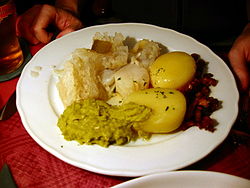
Norway
Norway , officially the Kingdom of Norway, is a Nordic unitary constitutional monarchy whose territory comprises the western portion of the Scandinavian Peninsula, Jan Mayen, and the Arctic archipelago of Svalbard and Bouvet Island. Norway has a total area of and a population of about 4.9 million...
, lʉːtfesk in Central and Northern Norway, lʉːtfɪsk in Sweden
Sweden
Sweden , officially the Kingdom of Sweden , is a Nordic country on the Scandinavian Peninsula in Northern Europe. Sweden borders with Norway and Finland and is connected to Denmark by a bridge-tunnel across the Öresund....
and the Swedish-speaking areas in Finland
Finland
Finland , officially the Republic of Finland, is a Nordic country situated in the Fennoscandian region of Northern Europe. It is bordered by Sweden in the west, Norway in the north and Russia in the east, while Estonia lies to its south across the Gulf of Finland.Around 5.4 million people reside...
) is a traditional dish of the Nordic countries
Nordic countries
The Nordic countries make up a region in Northern Europe and the North Atlantic which consists of Denmark, Finland, Iceland, Norway and Sweden and their associated territories, the Faroe Islands, Greenland and Åland...
and parts of the Midwest United States
United States
The United States of America is a federal constitutional republic comprising fifty states and a federal district...
. It is made from aged stockfish
Stockfish
Stockfish is unsalted fish, especially cod, dried by cold air and wind on wooden racks on the foreshore, called "hjell". The drying of food is the world's oldest known preservation method, and dried fish has a storage life of several years...
(air-dried whitefish
Whitefish (fisheries term)
Whitefish or white fish is a fisheries term referring to several species of demersal fish with fins, particularly cod , whiting , and haddock , but also hake , pollock , or others...
) or dried/salted whitefish
Dried and salted cod
Dried and salted cod, often called salt cod or clipfish , is cod which has been preserved by drying after salting. Cod which has been dried without the addition of salt is called stockfish....
(klippfisk) and lye
Lye
Lye is a corrosive alkaline substance, commonly sodium hydroxide or historically potassium hydroxide . Previously, lye was among the many different alkalis leached from hardwood ashes...
(lut). It is gelatinous in texture, and has an extremely strong, pungent odor. Its name literally means "lye fish."
Preparation
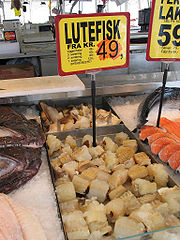
Cod
Cod is the common name for genus Gadus, belonging to the family Gadidae, and is also used in the common name for various other fishes. Cod is a popular food with a mild flavor, low fat content and a dense, flaky white flesh. Cod livers are processed to make cod liver oil, an important source of...
in Norway, but ling
Common Ling
The common ling or simply the ling, Molva molva, is a large member of the cod family. An ocean fish whose habitat is in the Atlantic region and can be found around Iceland, Faroe Islands, British Isles, the Norse coast and occasionally around Newfoundland, the ling has a long slender body that can...
is also used) prepared with lye in a sequence of particular treatments. The watering steps of these treatments differ slightly for salted/dried whitefish because of its high salt content.
The first treatment is to soak the stockfish in cold water for five to six days (with the water changed daily). The saturated stockfish is then soaked in an unchanged solution of cold water and lye for an additional two days. The fish swells during this soaking, and its protein
Protein
Proteins are biochemical compounds consisting of one or more polypeptides typically folded into a globular or fibrous form, facilitating a biological function. A polypeptide is a single linear polymer chain of amino acids bonded together by peptide bonds between the carboxyl and amino groups of...
content decreases by more than 50 percent producing a jelly
Gelatin
Gelatin is a translucent, colorless, brittle , flavorless solid substance, derived from the collagen inside animals' skin and bones. It is commonly used as a gelling agent in food, pharmaceuticals, photography, and cosmetic manufacturing. Substances containing gelatin or functioning in a similar...
-like consistency. When this treatment is finished, the fish (saturated with lye) has a pH
PH
In chemistry, pH is a measure of the acidity or basicity of an aqueous solution. Pure water is said to be neutral, with a pH close to 7.0 at . Solutions with a pH less than 7 are said to be acidic and solutions with a pH greater than 7 are basic or alkaline...
value of 11–12 and is therefore caustic. To make the fish edible, a final treatment of yet another four to six days of soaking in cold water (also changed daily) is needed. Eventually, the lutefisk is ready to be cooked.
In Finland, the traditional reagent
Reagent
A reagent is a "substance or compound that is added to a system in order to bring about a chemical reaction, or added to see if a reaction occurs." Although the terms reactant and reagent are often used interchangeably, a reactant is less specifically a "substance that is consumed in the course of...
used is birch
Birch
Birch is a tree or shrub of the genus Betula , in the family Betulaceae, closely related to the beech/oak family, Fagaceae. The Betula genus contains 30–60 known taxa...
ash. It contains high amounts of potassium carbonate
Potassium carbonate
Potassium carbonate is a white salt, soluble in water , which forms a strongly alkaline solution. It can be made as the product of potassium hydroxide's absorbent reaction with carbon dioxide. It is deliquescent, often appearing a damp or wet solid...
and bicarbonate
Potassium bicarbonate
Potassium bicarbonate , is a colorless, odorless, slightly basic, salty substance...
, giving the fish a more mellow treatment than would lye. It is important not to incubate the fish too long in the lye because saponification
Saponification
Saponification is a process that produces soap, usually from fats and lye. In technical terms, saponification involves base hydrolysis of triglycerides, which are esters of fatty acids, to form the sodium salt of a carboxylate. In addition to soap, such traditional saponification processes...
of the fish fats may occur. The term for such spoiled fish in Finnish is (soap fish).
Cooking
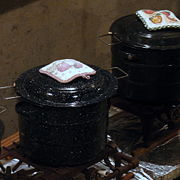
To create a firm consistency in lutefisk, it is common to spread a layer of salt over the fish half an hour before it is cooked. This will "release" some of the water in the fish meat. The salt must be rinsed off before cooking.
There are several ways to cook lutefisk:
Lutefisk does not need additional water for the cooking; it is sufficient to place it in a pan, salt it, seal the lid tightly, and let it steam cook
Steaming
Steaming is a method of cooking using steam. Steaming is considered a healthy cooking technique and capable of cooking almost all kinds of food.-Method:...
under a very low heat for 20–25 minutes. An alternative is to wrap in aluminium foil
Aluminium foil
Aluminium foil is aluminium prepared in thin metal leaves, with a thickness less than , thinner gauges down to are also commonly used. In the USA, foils are commonly gauged in mils. Standard household foil is typically thick and heavy duty household foil is typically .The foil is pliable, and...
and bake at 225 °C (435 °F) for 40–50 minutes.
Another option is to parboil
Parboil
Parboiling is the partial boiling of food as the first step in the cooking process.The word is often used when referring to parboiled rice. Parboiling can also be used for removing poisonous or foul-tasting substances from foodstuffs...
lutefisk; wrap the lutefisk in cheesecloth
Cheesecloth
Cheesecloth is a loosewoven gauze-like cotton cloth used primarily in cheese making and cooking.Cheesecloth is available in at least seven different grades, from open to extra-fine weave. Grades are distinguished by the number of threads per inch in each direction.- Uses :The primary use of...
and gently boil until tender. This usually takes a very short time, so care must be taken to watch the fish and remove it before it falls apart. Prepare a white sauce to serve over the lutefisk.
Lutefisk can also be boiled directly in a pan of water. Fill the pan 2/3 full with water, add 2 ts of salt per liter water, and bring the water to a boil. Add lutefisk pieces to the water until they all are covered with water, and let it simmer for 7 to 8 minutes. Carefully lift the lutefisk out of the water and serve.
Lutefisk sold in North America may also be cooked in a microwave oven
Microwave oven
A microwave oven is a kitchen appliance that heats food by dielectric heating, using microwave radiation to heat polarized molecules within the food...
. The average cooking time is 8–10 minutes per whole fish (a package of two fish sides) at high power in a covered glass cooking dish, preferably made of heat resistant glass
Pyrex
Pyrex is a brand name for glassware, introduced by Corning Incorporated in 1915.Originally, Pyrex was made from borosilicate glass. In the 1940s the composition was changed for some products to tempered soda-lime glass, which is the most common form of glass used in glass bakeware in the US and has...
. The cooking time will vary, depending upon the power of the microwave oven.
When cooking and eating lutefisk, it is important to clean the lutefisk and its residue off pans, plates, and utensils immediately. Lutefisk left overnight becomes nearly impossible to remove. Sterling silver should never be used in the cooking, serving or eating of lutefisk, which will permanently ruin silver. Stainless steel utensils are recommended instead.
Eating
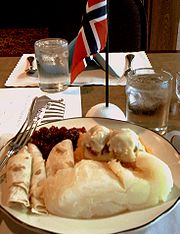
Sointula, British Columbia
Sointula is an isolated village on Malcolm Island in British Columbia, Canada. Lying between Vancouver Island and the British Columbia mainland, northeast of Port McNeill and not far from Alert Bay, the island is part of the historic and present territory of the 'Namgis First Nation...
on Malcolm Island in the province of British Columbia
British Columbia
British Columbia is the westernmost of Canada's provinces and is known for its natural beauty, as reflected in its Latin motto, Splendor sine occasu . Its name was chosen by Queen Victoria in 1858...
, and the United States, particularly in the Upper Midwest
Upper Midwest
The Upper Midwest is a region in the northern portion of the U.S. Census Bureau's Midwestern United States. It is largely a sub-region of the midwest. Although there are no uniformly agreed-upon boundaries, the region is most commonly used to refer to the states of Minnesota, Wisconsin, and...
and Pacific Northwest
Pacific Northwest
The Pacific Northwest is a region in northwestern North America, bounded by the Pacific Ocean to the west and, loosely, by the Rocky Mountains on the east. Definitions of the region vary and there is no commonly agreed upon boundary, even among Pacific Northwesterners. A common concept of the...
. From October to February, there are numerous lutefisk feeds in cities and towns around Puget Sound
Puget Sound
Puget Sound is a sound in the U.S. state of Washington. It is a complex estuarine system of interconnected marine waterways and basins, with one major and one minor connection to the Strait of Juan de Fuca and the Pacific Ocean — Admiralty Inlet being the major connection and...
, northern Minnesota
Minnesota
Minnesota is a U.S. state located in the Midwestern United States. The twelfth largest state of the U.S., it is the twenty-first most populous, with 5.3 million residents. Minnesota was carved out of the eastern half of the Minnesota Territory and admitted to the Union as the thirty-second state...
, Wisconsin
Wisconsin
Wisconsin is a U.S. state located in the north-central United States and is part of the Midwest. It is bordered by Minnesota to the west, Iowa to the southwest, Illinois to the south, Lake Michigan to the east, Michigan to the northeast, and Lake Superior to the north. Wisconsin's capital is...
, and Michigan
Michigan
Michigan is a U.S. state located in the Great Lakes Region of the United States of America. The name Michigan is the French form of the Ojibwa word mishigamaa, meaning "large water" or "large lake"....
. In the Nordic Countries, the "season" for lutefisk starts early in November and typically continues through Christmas.
Lutefisk is usually served with a variety of side dishes, including, but not limited to, bacon
Bacon
Bacon is a cured meat prepared from a pig. It is first cured using large quantities of salt, either in a brine or in a dry packing; the result is fresh bacon . Fresh bacon may then be further dried for weeks or months in cold air, boiled, or smoked. Fresh and dried bacon must be cooked before eating...
, green pea
Pea
A pea is most commonly the small spherical seed or the seed-pod of the pod fruit Pisum sativum. Each pod contains several peas. Peapods are botanically a fruit, since they contain seeds developed from the ovary of a flower. However, peas are considered to be a vegetable in cooking...
s, green pea
Pea
A pea is most commonly the small spherical seed or the seed-pod of the pod fruit Pisum sativum. Each pod contains several peas. Peapods are botanically a fruit, since they contain seeds developed from the ovary of a flower. However, peas are considered to be a vegetable in cooking...
stew, potato
Potato
The potato is a starchy, tuberous crop from the perennial Solanum tuberosum of the Solanaceae family . The word potato may refer to the plant itself as well as the edible tuber. In the region of the Andes, there are some other closely related cultivated potato species...
es, lefse
Lefse
Lefse is a traditional soft, Norwegian flatbread. Lefse is made out of potato, milk or cream and flour, and cooked on a griddle. Special tools are available for lefse baking, including long wooden turning sticks and special rolling pins with deep grooves.-Flavoring:There are many ways of...
, gravy
Gravy
Gravy is a sauce made often from the juices that run naturally from meat or vegetables during cooking. In North America the term can refer to a wider variety of sauces and gravy is often thicker than in Britain...
, mashed rutabaga
Rutabaga
The rutabaga, swede , turnip or yellow turnip is a root vegetable that originated as a cross between the cabbage and the turnip; see Triangle of U...
, white sauce, melted or clarified butter
Clarified butter
Clarified butter is milk fat rendered from butter to separate the milk solids and water from the butterfat. Typically, it is produced by melting butter and allowing the different components to separate by density...
, syrup
Syrup
In cooking, a syrup is a thick, viscous liquid consisting primarily of a solution of sugar in water, containing a large amount of dissolved sugars but showing little tendency to deposit crystals...
, geitost (goat cheese), or "old" cheese
Cheese
Cheese is a generic term for a diverse group of milk-based food products. Cheese is produced throughout the world in wide-ranging flavors, textures, and forms....
(gammelost). In the United States in particular it is sometimes eaten together with meatball
Meatball
A meatball is made from an amount of ground meat rolled into a small ball, sometimes along with other ingredients, such as breadcrumbs, minced onion, spices, and possibly eggs...
s. Side dishes vary greatly from family-to-family and region-to-region, and can be a source of jovial contention when eaters of different "traditions" of lutefisk dine together.
Today, akvavit
Akvavit
Akvavit or aquavit is a traditional flavoured spirit that is principally produced in Scandinavia, where it has been produced since the 15th century....
and beer
Beer
Beer is the world's most widely consumed andprobably oldest alcoholic beverage; it is the third most popular drink overall, after water and tea. It is produced by the brewing and fermentation of sugars, mainly derived from malted cereal grains, most commonly malted barley and malted wheat...
often accompany the meal due to its use at festive and ceremonial occasions. This is a recent innovation, however; due to its preservative qualities, lutefisk has traditionally been a common "everyday" meal in wintertime.
Lutefisk prepared from cod is somewhat notorious, even in Scandinavia, for its intense (and to those unacquainted with the dish, offensive) odor. Conversely, lutefisk prepared from pollock
Pollock
Pollock is the common name used for either of the two species of marine fish in the Pollachius genus. Both P. pollachius and P. virens are commonly referred to as pollock. Other names for P...
or haddock
Haddock
The haddock , also known as the offshore hake, is a marine fish distributed on both sides of the North Atlantic. Haddock is a popular food fish and is widely fished commercially....
emits almost no odor.
The taste of well-prepared lutefisk is very mild, and often the white sauce is spiced with pepper or other strong tasting spices to bring out the flavor. In Minnesota
Minnesota
Minnesota is a U.S. state located in the Midwestern United States. The twelfth largest state of the U.S., it is the twenty-first most populous, with 5.3 million residents. Minnesota was carved out of the eastern half of the Minnesota Territory and admitted to the Union as the thirty-second state...
, this method (seasoned with allspice
Allspice
Allspice, also called Jamaica pepper, pepper, myrtle pepper, pimenta, or newspice, is a spice that is the dried unripe fruit of Pimenta dioica , a mid-canopy tree native to the Greater Antilles, southern Mexico, and Central America, now cultivated in many warm parts of the world...
) is common among Swedish-Americans, while Norwegian-Americans prefer to eat it unseasoned with melted butter.
Origin
The origin of lutefisk is unknown. Legends include the accidental dropping of fish into a lye bucket or sodden wood ash containing lye under a drying rack. Another claims the practice enabled storing fish outdoors. Cold temperature acted as a preservative and the lye deterred wild animals from eating the fish.However, using lye to soften a hard, indigestible base is used to prepare other foods such as hominy
Hominy
Hominy or nixtamal is dried maize kernels which have been treated with an alkali in a process called nixtamalization.The English term hominy is derived from the Powhatan language word for maize. Many other Native American cultures also made hominy and integrated it into their diet...
.
Traces in literature
While some enthusiasts claim the dish has been consumed since the time of the Vikings, most believe that its origins lie in the 16th-century NetherlandsNetherlands
The Netherlands is a constituent country of the Kingdom of the Netherlands, located mainly in North-West Europe and with several islands in the Caribbean. Mainland Netherlands borders the North Sea to the north and west, Belgium to the south, and Germany to the east, and shares maritime borders...
. It is generally agreed that the first reference to "lutefisk" is in a letter by Swedish king Gustav I in 1540, and what seems to be a description of the preparation process in the Swedish archbishop Olaus Magnus
Olaus Magnus
Olaus Magnus was a Swedish ecclesiastic and writer, who did pioneering work for the interest of Nordic people. He was reported as born in October 1490 in Östergötland, and died on August 1, 1557. Magnus, Latin for the Swedish Stor “great”, is a Latin family name taken personally, and not a...
's (1490–1557) personal writings from 1555.
In Norway, author Henry Notaker (in the encyclopedia Apetittleksikon) states that the earliest historical traces are from the late 18th century in the southeastern region of the country. Additionally, a classic Norwegian cookbook (Hanna Winsnes) from 1845 tells about how to make lye for lutefisk from a combination of birch
Birch
Birch is a tree or shrub of the genus Betula , in the family Betulaceae, closely related to the beech/oak family, Fagaceae. The Betula genus contains 30–60 known taxa...
ash, limestone
Limestone
Limestone is a sedimentary rock composed largely of the minerals calcite and aragonite, which are different crystal forms of calcium carbonate . Many limestones are composed from skeletal fragments of marine organisms such as coral or foraminifera....
, and water.
Folklore
Folklore
Folklore consists of legends, music, oral history, proverbs, jokes, popular beliefs, fairy tales and customs that are the traditions of a culture, subculture, or group. It is also the set of practices through which those expressive genres are shared. The study of folklore is sometimes called...
holds that lutefisk originated during the Viking pillages of Ireland, when St. Patrick sent men to feed spoiled fish to the Viking raiders. When the raiders were found to enjoy the spoiled fish, St. Patrick ordered his men to pour lye on the fish, with the hope of poisoning the Vikings. However, rather than dying from ingestion of spoiled fish, or of subsequent poisoning of the spoiled fish, the Vikings declared lutefisk a delicacy. This is obviously a fairy tale, since St. Patrick was in Ireland about three centuries before the Vikings' arrival.
Modern consumption
Although lutefisk is eaten by Norwegians, more lutefisk is eaten by AmericansNorwegian American
Norwegian Americans are Americans of Norwegian descent. Norwegian immigrants went to the United States primarily in the later half of the 19th century and the first few decades of the 20th century. There are more than 4.5 million Norwegian Americans according to the most recent U.S. census, and...
and Canadians of Scandinavian descent. A 2005 survey of Norwegian dietary habits by sociologist Annechen Bahr Bugge indicated that 20% of Norwegians ate lutefisk during the Christmas holiday season.
Lutefisk as a Christmas season meal became increasingly trendy in Norway during the 2000s. The Norwegian Seafood Export Council indicated sales of lutefisk to restaurants and catering companies in Norway increased by 72% between 2005 and 2008. In 2008 over 3,000 tons of lutefisk was sold in Norway, surpassing the annual consumption of cod
Cod
Cod is the common name for genus Gadus, belonging to the family Gadidae, and is also used in the common name for various other fishes. Cod is a popular food with a mild flavor, low fat content and a dense, flaky white flesh. Cod livers are processed to make cod liver oil, an important source of...
.
In the United States, Madison, Minnesota
Madison, Minnesota
As of the census of 2000, there were 1,768 people, 789 households, and 462 families residing in the city. The population density was 1,737.6 people per square mile . There were 882 housing units at an average density of 866.9 per square mile . The racial makeup of the city was 99.21% White,...
has dubbed itself the "lutefisk capital of the world" as well as claiming the largest per capita consumption of lutefisk in Minnesota. St. Olaf College in Northfield, Minnesota serves lutefisk during their famous Christmas Festival concerts. They also host an annual music festival called "Lutefest." Lutefisk, though, is not served at this festival.
Humor
Lutefisk eaters thrive on quotes and jokes from skeptics of lutefisk comparing it to everything from rat poisonRat poison
Rodenticides are a category of pest control chemicals intended to kill rodents.Single feed baits are chemicals sufficiently dangerous that the first dose is sufficient to kill....
(which has a hint of truth to it, because of the traces of nonstandard amino acid
Amino acid
Amino acids are molecules containing an amine group, a carboxylic acid group and a side-chain that varies between different amino acids. The key elements of an amino acid are carbon, hydrogen, oxygen, and nitrogen...
lysinoalanine found in lutefisk due to the reaction with lye) to weapons of mass destruction
Weapons of mass destruction
A weapon of mass destruction is a weapon that can kill and bring significant harm to a large number of humans and/or cause great damage to man-made structures , natural structures , or the biosphere in general...
. A few examples are:
- Quote from Garrison KeillorGarrison KeillorGary Edward "Garrison" Keillor is an American author, storyteller, humorist, and radio personality. He is known as host of the Minnesota Public Radio show A Prairie Home Companion Gary Edward "Garrison" Keillor (born August 7, 1942) is an American author, storyteller, humorist, and radio...
's book Lake Wobegon DaysLake Wobegon DaysLake Wobegon Days is a novel by Garrison Keillor, first published in hardcover by Viking in 1985. Based on material from his radio show A Prairie Home Companion, the book brought Keillor's work to a much wider audience and achieved international success...
:
Every AdventAdventAdvent is a season observed in many Western Christian churches, a time of expectant waiting and preparation for the celebration of the Nativity of Jesus at Christmas. It is the beginning of the Western liturgical year and commences on Advent Sunday, called Levavi...
we entered the purgatory of lutefisk, a repulsive gelatinous fishlike dish that tasted of soap and gave off an odor that would gag a goat. We did this in honor of Norwegian ancestors, much as if survivors of a famine might celebrate their deliverance by feasting on elm bark. I always felt the cold creeps as Advent approached, knowing that this dread delicacy would be put before me and I'd be told, "Just have a little." Eating a little was like vomiting a little, just as bad as a lot.
- Quote from Garrison KeillorGarrison KeillorGary Edward "Garrison" Keillor is an American author, storyteller, humorist, and radio personality. He is known as host of the Minnesota Public Radio show A Prairie Home Companion Gary Edward "Garrison" Keillor (born August 7, 1942) is an American author, storyteller, humorist, and radio...
's book PontoonPontoon: A Novel of Lake WobegonPontoon: A Novel of Lake Wobegon is a novel by Garrison Keillor, a humorous fictional account of life in the fictitious heartland town of Lake Wobegon, Minnesota. It was first published in hardcover by Viking Press in September 2007....
:
Lutefisk is cod that has been dried in a lye solution. It looks like the desiccated cadavers of squirrels run over by trucks, but after it is soaked and reconstituted and the lye is washed out and it's cooked, it looks more fish-related, though with lutefisk, the window of success is small. It can be tasty, but the statistics aren’t on your side. It is the hereditary delicacy of Swedes and Norwegians who serve it around the holidays, in memory of their ancestors, who ate it because they were poor. Most lutefisk is not edible by normal people. It is reminiscent of the afterbirth of a dog or the world's largest chunk of phlegm.
- Interview with Jeffrey SteingartenJeffrey SteingartenJeffrey Steingarten is a leading food writer in the United States. He has been the food critic at Vogue magazine since 1989. His monthly columns in Vogue have earned him a National Magazine Award, and nearly a dozen James Beard Awards and nominations...
, author of The Man Who Ate Everything (translated quote from a 1999 article in Norwegian newspaper DagbladetDagbladetDagbladet is Norway's second largest tabloid newspaper, and the third largest newspaper overall with a circulation of 105,255 copies in 2009, 18,128 papers less than in 2008. The editor in chief is Lars Helle....
):
- The Ole and LenaOle and LenaOle and Lena are central characters in jokes by Scandinavian Americans, particularly in the Upper Midwest region of the U.S., particularly in Minnesota, Wisconsin, Iowa, South Dakota and North Dakota where Scandinavian immigrant traditions are common.-Format:Ole and Lena jokes can be long and...
joke books make frequent references to lutefisk; for example, the punch linePunch lineA punch line is the final part of a joke, comedy sketch, or profound statement, usually the word, sentence or exchange of sentences which is intended to be funny or to provoke laughter or thought from listeners...
of one joke is:
Well, we tried the lutefisk trick and the raccoons went away, but now we've got a family of Norwegians living under our house!
- When Lutefisk is Outlawed, Only Outlaws Will Have Lutefisk! A bumper sticker seen around SeattleBallard, Seattle, WashingtonBallard is a neighborhood located in the northwestern part of Seattle, Washington. To the north it is bounded by Crown Hill, ; to the east by Greenwood, Phinney Ridge and Fremont ; to the south by the Lake Washington Ship Canal; and to the west by Puget Sound’s Shilshole Bay. The neighborhood’s...
in the 1980s, parodying the gun-rights slogan of the era.
- The negative view of lutefisk exemplified in these jokes may have led Ulf Gunnarsson to write his parody Lutefisk and Yams. This take-off starts out in trochaicTrocheeA trochee or choree, choreus, is a metrical foot used in formal poetry consisting of a stressed syllable followed by an unstressed one...
hexameterHexameterHexameter is a metrical line of verse consisting of six feet. It was the standard epic metre in classical Greek and Latin literature, such as in the Iliad and Aeneid. Its use in other genres of composition include Horace's satires, and Ovid's Metamorphoses. According to Greek mythology, hexameter...
: "Hark and ware oh warrior, weird of Sven now hear you". The initial section uses alliteration instead of rhyme, like much Old English heroic poetry (e.g., BeowulfBeowulfBeowulf , but modern scholars agree in naming it after the hero whose life is its subject." of an Old English heroic epic poem consisting of 3182 alliterative long lines, set in Scandinavia, commonly cited as one of the most important works of Anglo-Saxon literature.It survives in a single...
): "Finally pounds of pancakes paired with lingonberries." Then it switches to iambic tetrameterIambic tetrameterIambic tetrameter is a meter in poetry. It refers to a line consisting of four iambic feet. The word "tetrameter" simply means that there are four feet in the line; iambic tetrameter is a line comprising four iambs...
as it imitates Dr. Seuss: "I do not like lutefisk and yams/I do not like them Sven-I-Am".
- The WisconsinWisconsinWisconsin is a U.S. state located in the north-central United States and is part of the Midwest. It is bordered by Minnesota to the west, Iowa to the southwest, Illinois to the south, Lake Michigan to the east, Michigan to the northeast, and Lake Superior to the north. Wisconsin's capital is...
Employees' Right to Know Law specifically exempts lutefisk in defining "toxic substances".
- "Revenge of the Lutefisk", an episode of the animated series King of the HillKing of the HillKing of the Hill is an American animated dramedy series created by Mike Judge and Greg Daniels, that ran from January 12, 1997, to May 6, 2010, on Fox network. It centers on the Hills, a working-class Methodist family in the fictional small town of Arlen, Texas...
, uses the dish as a key plot device. When a new Methodist minister arrives in town from Minnesota, she brings some lutefisk to a potluck welcome dinner. Bobby HillBobby Hill (King of the Hill)Robert Jeffrey "Bobby" Hill is a character on the animated series King of the Hill and is voiced by Pamela Adlon. Bobby is the only child of Hank and Peggy Hill.- Biography :...
steals and eats the entire batch, enjoying the taste despite its strong smell, and inadvertently sets in motion a chain of events that leads to the church being burned down.
- Drop Dead Gorgeous dialog:
- Brett Clemmens: [after Becky has tossed her food tray in, splattering Amber who's working in the cafeteria with its contents - Brett looks apologetic] Oh man...you got some lutefisk in your hair.
- Amber Atkins: (upbeat) Then it must be Wednesday!
- Iona Hildebrandt: (speaking to camera) Lutefisk is codfish that's been salted and soaked in lye for a week or so. It's best with lots of butter.
- In "How I Met Your MotherHow I Met Your MotherHow I Met Your Mother is an American sitcom that premiered on CBS on September 19, 2005, created by Craig Thomas and Carter Bays.As a framing device, the main character, Ted Mosby with narration by Bob Saget, in the year 2030 recounts to his son and daughter the events that led to his meeting...
", Season 6 Episode 2 'Cleaning House', Marshall reveals that his family of Minnesotans leave Santa milk and lutefisk instead of cookies. He tells Lilly in a matter-of-fact tone, "Yeah, that's just what Santa needs at 3 a.m. when he's battling a snow storm over the Rockies, a sugar crash! No, he needs protein."
Spellings
or (earlier spelling still sometimes used in English) or orSee also
- ClipfishClipfishDried and salted cod, often called salt cod or clipfish , is cod which has been preserved by drying after salting. Cod which has been dried without the addition of salt is called stockfish....
: Salted dried fish, usually cod. - Fish and brewisFish and BrewisFish and brewis is a traditional Newfoundland meal consisting of codfish and hard bread or hard tack. With the abundance of cod around the coasts of Newfoundland and Labrador it became synonymous with many Newfoundland households as a delicacy to be served as a main meal.The recipe may vary from...
- SurströmmingSurströmmingSurströmming herring") is a northern Swedish dish consisting of fermented Baltic herring. Surströmming is sold in cans, which often bulge during shipping and storage, due to the continued fermentation. When opened, the contents release a strong and sometimes overwhelming odor, which explains why...
- ÞorramaturÞorramaturÞorramatur is a selection of traditional Icelandic food, consisting mainly of meat and fish products cured in a traditional manner, cut into slices or bits and served with rúgbrauð , butter and brennivín...
- RakfiskRakfiskRakfisk is a traditional eastern Norwegian fish dish made from trout or sometimes char, salted and fermented for two to three months, then eaten without cooking.-Origin:...
- BacalhauBacalhauBacalhau is the Portuguese word for codfish and—in a culinary context—dried and salted codfish. Fresh cod is referred to as bacalhau fresco .-Use:...
: A PortuguesePortuguese cuisinePortuguese cuisine is characterised by rich, filling and full-flavored dishes and is closely related to Mediterranean cuisine. The influence of Portugal's former colonial possessions is also notable, especially in the wide variety of spices used. These spices include piri piri and black pepper, as...
dish also made of reconstituted dried fish. - BaccalàBaccalàBaccalà is Venetian Language for salt cod. Most baccalà dishes require that the fish be soaked numerous times to remove excess saltiness...
- HákarlHákarlHákarl or kæstur hákarl is a food from Iceland. It is a Greenland or basking shark which has been cured with a particular fermentation process and hung to dry for four to five months...
- GravlaxGravlaxGravlax or gravad lax , gravet laks , gravlaks , graavilohi , graavilõhe , graflax is a Nordic dish consisting of raw salmon, cured in salt, sugar, and dill...
External links
- Lutefisk documentary
- The History of Lutfisk
- Lutefisk for Christmas
- Clay Shirky on eating lutefisk
- Chemistry of Lutefisk
- Lutefisk Lament, Boone & Erickson
- O Lutefisk (Full lyrics)
- Bizarre Foods Blog Andrew Zimmern explores Lutefisk in Minnesota