


Swedish Social Democratic Party

Encyclopedia
The Swedish Social Democratic Workers' Party, , contesting elections as 'the Workers' Party – the Social Democrats' (Arbetarepartiet-Socialdemokraterna), or sometimes referred to just as 'the Social Democrats' (Socialdemokraterna) and most commonly as Sossarna (plural of sosse); is the oldest and largest political party
in Sweden
. The party was founded in 1889. In 1917, a schism occurred when revolutionary elements split from the Social Democrats to form what is now the Left Party
. The symbol of the party is traditionally a red rose, which is believed to have been Fredrik Ström
's idea.
The Social Democratic Party's position has a theoretical base within Marxist revisionism. Its party program interchangeably calls their ideology democratic socialism
, or social democracy
. The party supports social welfare provision paid for from progressive tax
ation. The party supports a social corporatist
economy involving the institutionalization of a social partnership system between capital and labour economic interest groups, with government oversight to resolve disputes between the two factions. In recent times they have become strong supporters of feminism
, equality
of all kinds, and maintain a strong opposition to what they perceive as discrimination
and racism
.
On December 7, 2008, the Social Democrats launched the Red-Greens
together with the Greens
and the Left Party
. The parties contested the 2010 election
but lost the election to the centre-right Alliance. On November 26, 2010 the Red-Green alliance was dissolved.
s and public sector
employees. The party has a close, historical relationship with the Swedish Trade Union Confederation
(Landsorganisationen i Sverige, commonly referred to as LO); but as a corporatist organ, the Social Democratic Party has formed policy in compromise mediation with the employers' federations (primarily Confederation of Swedish Enterprise
and its predecessors) as well as the union federations. The party is a member of Socialist International
, the Party of European Socialists
and SAMAK
.
Organisations within the Swedish social democratic movement:
with universal suffrage
, resulting in the loss of office to the opposition, the centre-right
coalition Alliance for Sweden
. Among the support that the Social Democratic Party lost in the 2006 election was the vote of pensioners (down 10% from the 2002 election), and blue-collar trade unionists (down 5%). The combined Social Democratic Party and Left Party vote of citizens with non-Nordic foreign backgrounds sank from 73% in 2002 down to 48% in 2006. Stockholm County
typically votes for center-right parties. Only 23% of Stockholm City residents voted for the Social Democratic Party in 2006.
 The Partys first chapter in its statutes says "the intension of the Swedish Socialdemocratic Workers Party is the struggle towards the Democratic Socialism." The ideology of socialism was founded in the New Testament, Acts (Apostlagarningarna) chapter 4, verse 32-35, where the basics are told for the paroll: "From each according to his ability, to each according to his need."
Since the party has held power of office for a majority of terms after its founding in 1889, the ideology
and policies of the Social Democratic Party (SAP) have had strong influence on Swedish politics. The Swedish social democratic ideology is partially an outgrowth of the strong and well-organized 1880s and 1890s working class emancipation, temperance
, and religious folkrörelser (folk movements), by which peasant
and workers' organizations penetrated state structures early on and paved the way for electoral politics. These movements had influence on political formation in Sweden, at least in part because they experienced less state repression
than similar working-class organizations have, for example, in early twentieth century Russia
. In this way, Swedish social-democratic ideology is inflected by a socialist
tradition foregrounding widespread and individual human development. Gunnar Adler-Karlsson (1967) confidently likened the social democratic project to the successful social democratic effort to divest the king of all power but formal grandeur: “Without dangerous and disruptive internal fights…After a few decades they (capitalists) will then remain, perhaps formally as kings, but in reality as naked symbols of a passed and inferior development state.” However, so far this socialist ambition has not materialised.
has also strongly infused social democratic ideology. Liberalism has oriented social democratic goals to security
, as where Tage Erlander
, prime minister from 1946–1969, described security as “too big a problem for the individual to solve with only his own power”. Up to the 1980s, when neoliberalism
began to provide an alternative, aggressively pro-capitalist model for ensuring social quiescence, the SAP was able to secure capital's co-operation by convincing capital that it shared the goals of increasing economic growth
and reducing social friction. For many social democrats, Marxism
is loosely held to be valuable for its emphasis on changing the world for a more just, better future. In 1889, Hjalmar Branting
, leader of the SAP from its founding to his death in 1925, asserted, "I believe...that one benefits the workers...so much more by forcing through reforms which alleviate and strengthen their position, than by saying that only a revolution
can help them." Some observers have argued that this liberal aspect has hardened into increasingly neoliberal ideology and policies, gradually maximizing the latitude of powerful market actors. Certainly, neoclassical economists have been firmly nudging the Social Democratic Party into capitulating to most of capital's traditional preferences and prerogatives, which they term "modern industrial relations". Both socialist and liberal aspects of the party were influenced by the dual sympathies of early leader Hjalmar Branting
, and manifest in the party’s first actions: reducing the work day to eight hours and establishing the franchise for working class people.
While some commentators have seen the party lose focus with the rise of SAP neoliberal study groups, the Swedish Social Democratic Party has for many years appealed to Swedes as innovative, capable, and worthy of running the state. The Social Democrats became one of the most successful political parties in the world, with some structural advantages in addition to their auspicious birth within vibrant folkrörelser. At the close of the nineteenth century, liberals and socialists had to band together to augment establishment democracy
, which was at that point embarrassingly behind in Sweden; they could point to formal democratic advances elsewhere to motivate political action. In addition to being small, Sweden was a semi-peripheral country at the beginning of the twentieth century, considered unimportant to competing global political factions; so it was permitted more independence, while soon the existence of communist and capitalist
superpower
s allowed social democracy to flourish in the geo-political interstices. The SAP has the resource of sharing ideas and experiences, and working with its sister parties throughout the Nordic countries
. Sweden could also borrow and innovate upon ideas from English-language economists, which was an advantage for the Social Democrats in the Great Depression
; but more advantageous for the bourgeois parties in the 1980s and afterward. While the SAP has not been innocent of repressing communists, the party has overall benefitted, in government coalition and in avoiding severe stagnation and drift, by engaging in relatively constructive relationships with the more radical Left Party
and the Green Party
. The early SAP had internal resources as well, in creative politicians with brilliant tactical minds, and similarly creative labor economists at their disposal.
” from “common ownership of the means of production
” to increasing “democratic influence over the economy.” Starting out in a socialist-liberal coalition fighting for the vote, the Swedish Social Democrats defined socialism
as the development of democracy—political and economic. On that basis they could form coalitions, innovate, and govern where other European social democratic parties became crippled and crumbled under Right-wing regimes. The Swedish Social Democrats could count the middle class
among their solidaristic working class
constituency by recognizing the middle class as “economically dependent”, “working people”, or among the “progressive citizens”, rather than as sub-capitalists. “The party does not aim to support and help [one] working class at the expense of the others,” the Social Democratic congress of 1932 established. In fact, with social democratic policies that refrained from supporting inefficient and low-profit businesses in favor of cultivating higher-quality working conditions, as well as a strong commitment to public education
, the middle class
in Sweden became so large that the capitalist class has remained concentrated. Not only did the SAP fuse the growing middle class into their constituency, they also ingeniously forged periodic coalitions with small-scale farmers (as members of the “exploited classes”) to great strategic effect. The SAP version of socialist ideology allowed them to maintain a prescient view of the working class: “[The SAP] does not question…whether those who have become capitalism’s victims…are industrial workers, farmers, agricultural laborers, forestry workers, store clerks, civil servants or intellectuals,” asserted the party’s 1932 election manifesto.
While the SAP has worked more or less constructively with more radical
Left parties in Sweden, the Social Democrats have borrowed from socialists some of their discourse
, and decreasingly, the socialist understanding of the structurally-compromised position of labor under capitalism. Even more creatively, the Social Democrats commandeered selected, transcendental images from such nationalists as Rudolf Kjellen
(1912), very effectively undercutting fascism
’s appeal in Sweden. In this way, Per Albin Hansson
declared that “there is no more patriotic party than the [SAP since] the most patriotic act is to create a land in which all feel at home,” famously igniting Swedes’ innermost longing for transcendence with the idea of the Folkhem (1928), or People’s Home. The Social Democratic Party promoted Folkhemmet
as a socialist home at a point in which the party turned its back on working class struggle and the policy tool of nationalization
. “The expansion of the party to a people’s party does not mean and must not mean a watering down of socialist demands,” Hansson soothed.
"The basis of the home is community and togetherness. The good home does not recognize any privileged or neglected members, nor any favorite or stepchildren. In the good home there is equality
, consideration, co-operation, and helpfulness. Applied to the great people’s and citizens’ home this would mean the breaking down of all the social and economic barriers that now separate citizens into the privileged and the neglected, into the rulers and the dependents, into the rich and the poor, the propertied and the impoverished, the plunderers and the plundered. Swedish society is not yet the people’s home. There is a formal equality, equality of political rights, but from a social perspective, the class society remains, and from an economic perspective the dictatorship of the few prevails" (Hansson 1928).
ation, fair trade
, low-unemployment, Active Labor Market Policies (ALMP)-based Swedish welfare state
that was developed in the years after World War II
. Sweden emerged sound from the Great Depression
with a brief, successful “Keynesianism-before Keynes
” economic program advocated by Ernst Wigforss
, a prominent Social Democrat who educated himself in economics by studying the work of the British radical Liberal economists. The social democratic labor market policies (ALMPs) were developed in the 1940s and 1950s by LO (Landsorganisationen i Sverige, the blue-collar union federation) economists Gösta Rehn and Rudolf Meidner
. The Rehn-Meidner model featured the centralized system of wage bargaining that aimed to both set wages at a “just” level and promote business efficiency and productivity. With the pre-1983 cooperation of capital and labor federations that bargained independently of the state, the state determined that wages would be higher than the market would set in firms that were inefficient or uncompetitive and lower than the market would set in firms that were highly productive and competitive. Workers were compensated with state-sponsored retraining and relocating; as well, the state reformed wages to the goal of “equal pay for equal work”, eliminated unemployment (“the reserve army of labor”) as a disciplinary device, and kept incomes consistently rising, while taxing progressively and pooling social wealth to deliver services through local governments. Social Democratic policy has traditionally emphasized a state spending structure whereby public services
are supplied via local government, as opposed to emphasizing social insurance
program transfers.
These social democratic policies have had international influence. The early Swedish “red-green” coalition encouraged Nordic-networked socialists in the state of Minnesota
, in the U.S., to dedicate efforts to building a similarly potent labor-farmer alliance that put the socialists in the governorship, ran model innovative statewide anti-racism
programs in the early years of the twentieth century, and enabled federal forest managers in Minnesota to practice a precocious ecological-socialism, before Democratic Party
reformers were transferred from the U.S. East Coast to appropriate the Minnesota Farmer-Labor Party
infrastructure to the liberal Democratic Party in 1944. On the other hand, policies comprising the Nordic model
have often been depicted, in American conservative circles and the American press, as wreaking havoc upon Swedish society. At a July 27, 1960 Republican National Committee
breakfast in Chicago
, President Dwight D. Eisenhower
disingenuously claimed that "a friendly European country (commentators read this as Sweden)... has a tremendous record for socialistic operation, following a socialistic philosophy, and the record shows that their rate of suicide
has gone up almost unbelievably and I think they were almost the lowest nation in the world for that. Now they have more than twice our rate. Drunkenness has gone up. Lack of ambition is discernible on all sides." Unflattering depictions of Swedish society, emanating from conservative American competitive distaste for social democratic policies, have not withered over time. Arguing that the Swedish approach to Muslims is too lenient, a February 5, 2006 New York Times article claims, "(C)learly, various experiments close to the heart of Swedish democracy and Swedish socialism have gone wrong."
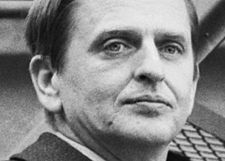 Under the Social Democrats' administration, Sweden retained neutrality, as a foreign policy guideline, during the wars of the twentieth century, including the Cold War
. Neutrality preserved the Swedish economy and boosted Sweden's economic competitiveness in the first half of the twentieth century, as other European countries' economies were devastated by war. Under Olof Palme
's Social Democratic leadership Sweden further aggravated the hostility of United States political conservatives when Palme openly denounced US aggression in Vietnam
. U.S. President Richard Nixon
suspended diplomatic ties with the social democratic country. In 2003, top-ranking Social Democratic Party politician Anna Lindh
--who criticized the U.S. invasion of Iraq, as well as both Israel
i and Palestinian
atrocities, and who was the lead figure promoting the European Union
in Sweden—was assassinated in public in Stockholm
. As Lindh was to succeed Goran Persson in the party leadership, her death was deeply disruptive to the party as well as to the campaign to promote the adoption of the EMU
(euro) in Sweden. The neutrality policy has changed with the contemporary ascendance of the bourgeois coalition, and Sweden has committed troops to support the US and UK's interventions in Afghanistan
. Under Social Democratic governance relatively strong overseas humanitarian programs and a comparatively well-developed refugee
program have been implemented, and frequently reformed.
.
The 1980s were a very turbulent time in Sweden that initiated the occasional decline of Social Democratic Party rule. In the 1980s, pillars of Swedish industry were massively restructured. Shipbuilding was discontinued, wood pulp was integrated into modernized paper production, the steel industry was concentrated and specialized, and mechanical engineering was digitalized. In 1986, one of the Social Democratic Party's strongest champions of egalitarianism
and democracy, Olof Palme
was assassinated. Swedish capital was increasingly moving Swedish investment into other European countries as the European Union
coalesced, and a hegemonic consensus was forming among the elite financial community: progressive taxation and pro-egalitarian redistribution became economic heresy. A leading proponent of capital's cause at the time, Social Democrat Finance Minister Kjell-Olof Feldt reminisced in an interview, "The negative inheritance I received from my predecessor Gunnar Sträng
(Minister of Finance 1955 - 1976) was a strongly progressive tax system with high marginal
taxes. This was supposed to bring about a just and equal society. But I eventually came to the opinion that it simply didn't work out that way. Progressive taxes created instead a society of wranglers, cheaters, peculiar manipulations, false ambitions and new injustices. It took me at least a decade to get a part of the party to see this." With the capitalist confederation's defection from the 1938 Saltsjöbaden Agreement
and Swedish capital investing in other European countries rather than Sweden, as well as the global rise of neoliberal political-economic hegemony
, the Social Democratic Party backed away from the progressive Meidner reform.
The economic crisis in the 1990s has been widely cited in the Anglo-American press as a social democratic failure, but it is important to note not only did profit rates begin to fall worldwide after the 1960s, also this period saw neoliberal ascendance in Social Democratic ideology and policies as well as the rise of bourgeois coalition rule in place of the Social Democrats. 1980s Social Democratic neoliberal measures—such as depressing and deregulating the currency to prop up Swedish exports during the economic restructuring transition, dropping corporate taxation and taxation on high income-earners, and switching from anti-unemployment policies to anti-inflationary policies—were exacerbated by international recession
, unchecked currency speculation, and a centre-right
government led by Carl Bildt
(1991–1994), creating the fiscal crisis of the early 1990s.
When the Social Democrats returned to power in 1994, they responded to the fiscal crisis by stabilizing the currency—and by reducing the welfare state
and privatizing public services and goods, as governments did in many countries influenced by Milton Friedman
, the Chicago Schools of political and economic thought, and the neoliberal movement. Social Democratic Party leaders—including Göran Persson
, Mona Sahlin
, and Anna Lindh
--promoted European Union (E.U.) membership, and the Swedish referendum passed by 52-48% in favor of joining the E.U. on August 14, 1994. Bourgeois leader Lars Leijonborg
at his 2007 retirement could recall the 1990s as a golden age of liberalism in which the Social Democrats were under the expanding influence of the Liberal Party and its partners in the bourgeois political coalition. Leijonborg recounted neoliberal victories such as the growth of private schooling and the proliferation of private, for-profit radio and television.
continued to function at a high level, due in no small part to the high rate of unionization in Sweden, the independence of unions in wage-setting, and the exemplary competency of the feminized public sector
workforce, as well as widespread public support. The Social Democrats initiated studies on the effects of the neoliberal changes, and the picture that emerged from those findings allowed the party to reduce many tax expenditures, slightly increase taxes on high income-earners, and significantly reduce taxes on food. The Social Democratic Finance Minister increased spending on child support and continued to pay down the public debt. By 1998 the Swedish macro-economy recovered from the 1980s industrial restructuring and the currency policy excesses. At the turn of the twenty-first century, Sweden has a well-regarded, generally robust economy, and the average quality of life, after government transfers, is very high, inequality
is low (the Gini coefficient
is .28), and social mobility
is high (compared to the affluent Anglo-America
n and Central European countries).
The Social Democratic Party pursues environmentalist
and feminist policies which promote healthful and humane conditions. Feminist policies formed and implemented by the Social Democratic Party and the Left Party
and the Greens
(which made an arrangement with the Social democrats to support the government, while not forming a coalition), include paid maternity and paternity leave, high employment for women in the public sector, combining flexible work with living wages and benefits, providing public support for women in their traditional responsibilities for care giving, and policies to stimulate women's political participation and leadership. Reviewing policies and institutional practices for their impact on women had become common in social democratic governance.
The legacy of Social Democratic Party governance in Sweden is widely regarded as increasing the quality of life, naturally among those who benefit directly from an affluent, low-inequality society, but even among the wealthy. One Volvo executive admitted that a strong social welfare state, like the Swedish, helps finance a quality of life that low individual taxes cannot. When faced with the question, "Why don't you leave (Sweden)? Certainly, you would pay a lot lower taxes and probably also have a higher salary in the U.S.", he responded, "Yes, of course, I would have a lot more money in my pocket. But I would also almost never get home before 7 o'clock and I certainly would not have the vacations everyone has a right to here... and you know what else, I would have to spend a lot more money on insurance, college for my kids, and travel back home to my family. In the end, I'm not really sure I would be any better off."
between 1923 and 1940.
† = died while in office
Political party
A political party is a political organization that typically seeks to influence government policy, usually by nominating their own candidates and trying to seat them in political office. Parties participate in electoral campaigns, educational outreach or protest actions...
in Sweden
Sweden
Sweden , officially the Kingdom of Sweden , is a Nordic country on the Scandinavian Peninsula in Northern Europe. Sweden borders with Norway and Finland and is connected to Denmark by a bridge-tunnel across the Öresund....
. The party was founded in 1889. In 1917, a schism occurred when revolutionary elements split from the Social Democrats to form what is now the Left Party
Left Party (Sweden)
The Left Party is a socialist and feminist political party in Sweden, from 1967 to 1990 known as the Left Party – The Communists .On welfare issues, the party opposes privatizations...
. The symbol of the party is traditionally a red rose, which is believed to have been Fredrik Ström
Fredrik Ström
Fredrik Ström was a Swedish Socialist politician and a prolific writer. He held a seat in the Riksdag from 1916 - 1921, and from 1930 - 1938....
's idea.
The Social Democratic Party's position has a theoretical base within Marxist revisionism. Its party program interchangeably calls their ideology democratic socialism
Democratic socialism
Democratic socialism is a description used by various socialist movements and organizations to emphasize the democratic character of their political orientation...
, or social democracy
Social democracy
Social democracy is a political ideology of the center-left on the political spectrum. Social democracy is officially a form of evolutionary reformist socialism. It supports class collaboration as the course to achieve socialism...
. The party supports social welfare provision paid for from progressive tax
Progressive tax
A progressive tax is a tax by which the tax rate increases as the taxable base amount increases. "Progressive" describes a distribution effect on income or expenditure, referring to the way the rate progresses from low to high, where the average tax rate is less than the marginal tax rate...
ation. The party supports a social corporatist
Social corporatism
Social corporatism is a form of economic tripartite corporatism supported by social democratic political parties based upon "social partnership" between capital and labour interest groups as well as between the market economy and state regulation that is considered a compromise to regulate conflict...
economy involving the institutionalization of a social partnership system between capital and labour economic interest groups, with government oversight to resolve disputes between the two factions. In recent times they have become strong supporters of feminism
Feminism
Feminism is a collection of movements aimed at defining, establishing, and defending equal political, economic, and social rights and equal opportunities for women. Its concepts overlap with those of women's rights...
, equality
Social equality
Social equality is a social state of affairs in which all people within a specific society or isolated group have the same status in a certain respect. At the very least, social equality includes equal rights under the law, such as security, voting rights, freedom of speech and assembly, and the...
of all kinds, and maintain a strong opposition to what they perceive as discrimination
Discrimination
Discrimination is the prejudicial treatment of an individual based on their membership in a certain group or category. It involves the actual behaviors towards groups such as excluding or restricting members of one group from opportunities that are available to another group. The term began to be...
and racism
Racism
Racism is the belief that inherent different traits in human racial groups justify discrimination. In the modern English language, the term "racism" is used predominantly as a pejorative epithet. It is applied especially to the practice or advocacy of racial discrimination of a pernicious nature...
.
On December 7, 2008, the Social Democrats launched the Red-Greens
Red-Greens (Sweden)
The Red-Greens was the name of a co-operation of red-green political parties in Sweden, publicly launched on 7 December 2008, largely based on the Norwegian ruling Red-Green Coalition. It consisted of the three parties in the Riksdag , sitting in opposition to the Alliance coalition government...
together with the Greens
Green Party (Sweden)
-External links:**...
and the Left Party
Left Party (Sweden)
The Left Party is a socialist and feminist political party in Sweden, from 1967 to 1990 known as the Left Party – The Communists .On welfare issues, the party opposes privatizations...
. The parties contested the 2010 election
Swedish general election, 2010
A general election to the Riksdag, parliament of Sweden, was held on . The main contenders of the election were the governing centre-right coalition the Alliance and the oppositional centre-left Red-Greens coalition A general election to the Riksdag, parliament of Sweden, was held on . The main...
but lost the election to the centre-right Alliance. On November 26, 2010 the Red-Green alliance was dissolved.
Current status
Currently, the Social Democratic Party has about 100,000 members, with about 2,540 local party associations and 500 workplace associations. The member base is diverse, but prominently features organized blue-collar workerBlue-collar worker
A blue-collar worker is a member of the working class who performs manual labor. Blue-collar work may involve skilled or unskilled, manufacturing, mining, construction, mechanical, maintenance, technical installation and many other types of physical work...
s and public sector
Public sector
The public sector, sometimes referred to as the state sector, is a part of the state that deals with either the production, delivery and allocation of goods and services by and for the government or its citizens, whether national, regional or local/municipal.Examples of public sector activity range...
employees. The party has a close, historical relationship with the Swedish Trade Union Confederation
Swedish Trade Union Confederation
The Swedish Trade Union Confederation , commonly referred to as LO, is a national trade union centre, an umbrella organisation for fifteen Swedish trade unions that organise mainly "blue-collar" workers...
(Landsorganisationen i Sverige, commonly referred to as LO); but as a corporatist organ, the Social Democratic Party has formed policy in compromise mediation with the employers' federations (primarily Confederation of Swedish Enterprise
Confederation of Swedish Enterprise
The Confederation of Swedish Enterprise is a major interest organisation for business and industry in Sweden. It has 48 member associations representing close to 55.000 member companies with more than 1.5 million employees....
and its predecessors) as well as the union federations. The party is a member of Socialist International
Socialist International
The Socialist International is a worldwide organization of democratic socialist, social democratic and labour political parties. It was formed in 1951.- History :...
, the Party of European Socialists
Party of European Socialists
The Party of European Socialists is a European political party led by Sergei Stanishev, former Prime Minister of Bulgaria. The PES comprises social-democratic national-level political parties primarily from Member state of the European Union, as well as other nations of the European continent. The...
and SAMAK
SAMAK
The SAMAK assembles the social democratic parties and the trade union councils in the Nordic countries....
.
Organisations within the Swedish social democratic movement:
- The National Federation of Social Democratic Women in Sweden (S-kvinnor) organizes women.
- The Swedish Social Democratic Youth LeagueSwedish Social Democratic Youth LeagueThe Swedish Social Democratic Youth League is a branch of the Swedish social democratic party Socialdemokraterna and the Swedish Trade Union Confederation...
(Sveriges Socialdemokratiska Ungdomsförbund or SSU) organizes youth. - The Social Democratic Students of SwedenSocial Democratic Students of SwedenThe Social Democratic Students of Sweden is the student organization of the Swedish social democratic party Socialdemokraterna.Created again in 1990, the organisation today has about 1200 members spread out over the country, most of them being students at either universities or poly-technics...
(Socialdemokratiska Studentförbundet) organizes university students. - The Swedish Association of Christian Social DemocratsSwedish Association of Christian Social DemocratsThe Swedish Association of Christian Social Democrats organizes Christian members of the Swedish Social Democratic Party. The organization was founded in 1929...
(Broderskap) organizes Christian socialistsChristian socialismChristian socialism generally refers to those on the Christian left whose politics are both Christian and socialist and who see these two philosophies as being interrelated. This category can include Liberation theology and the doctrine of the social gospel...
.
Voter base
The Swedish Social Democratic Party got between 40%-55% of the votes in all elections between 1940 and 1988 making it the most successful political party in the history of the liberal democratic world. The voter base consists of a diverse swathe of people throughout Swedish society, although it is particularly strong amongst organised blue-collar workers.2006 election results
In the 2006 general election, the Social Democratic Party received the smallest share of votes (34.99 %) ever in a general electionGeneral election
In a parliamentary political system, a general election is an election in which all or most members of a given political body are chosen. The term is usually used to refer to elections held for a nation's primary legislative body, as distinguished from by-elections and local elections.The term...
with universal suffrage
Universal suffrage
Universal suffrage consists of the extension of the right to vote to adult citizens as a whole, though it may also mean extending said right to minors and non-citizens...
, resulting in the loss of office to the opposition, the centre-right
Centre-right
The centre-right or center-right is a political term commonly used to describe or denote individuals, political parties, or organizations whose views stretch from the centre to the right on the left-right spectrum, excluding far right stances. Centre-right can also describe a coalition of centrist...
coalition Alliance for Sweden
Alliance for Sweden
The Alliance , formerly Alliance for Sweden , is a political alliance in Sweden. It consists of the four centre-right parties in the Riksdag...
. Among the support that the Social Democratic Party lost in the 2006 election was the vote of pensioners (down 10% from the 2002 election), and blue-collar trade unionists (down 5%). The combined Social Democratic Party and Left Party vote of citizens with non-Nordic foreign backgrounds sank from 73% in 2002 down to 48% in 2006. Stockholm County
Stockholm County
Stockholm County is a county or län on the Baltic sea coast of Sweden. It borders Uppsala County and Södermanland County. It also borders Mälaren and the Baltic Sea. The city of Stockholm is the capital of Sweden. Stockholm County is divided by the historic provinces of Uppland and Södermanland...
typically votes for center-right parties. Only 23% of Stockholm City residents voted for the Social Democratic Party in 2006.
Political impact and history
Since the party has held power of office for a majority of terms after its founding in 1889, the ideology
Ideology
An ideology is a set of ideas that constitutes one's goals, expectations, and actions. An ideology can be thought of as a comprehensive vision, as a way of looking at things , as in common sense and several philosophical tendencies , or a set of ideas proposed by the dominant class of a society to...
and policies of the Social Democratic Party (SAP) have had strong influence on Swedish politics. The Swedish social democratic ideology is partially an outgrowth of the strong and well-organized 1880s and 1890s working class emancipation, temperance
Temperance movement
A temperance movement is a social movement urging reduced use of alcoholic beverages. Temperance movements may criticize excessive alcohol use, promote complete abstinence , or pressure the government to enact anti-alcohol legislation or complete prohibition of alcohol.-Temperance movement by...
, and religious folkrörelser (folk movements), by which peasant
Peasant
A peasant is an agricultural worker who generally tend to be poor and homeless-Etymology:The word is derived from 15th century French païsant meaning one from the pays, or countryside, ultimately from the Latin pagus, or outlying administrative district.- Position in society :Peasants typically...
and workers' organizations penetrated state structures early on and paved the way for electoral politics. These movements had influence on political formation in Sweden, at least in part because they experienced less state repression
Political repression
Political repression is the persecution of an individual or group for political reasons, particularly for the purpose of restricting or preventing their ability to take political life of society....
than similar working-class organizations have, for example, in early twentieth century Russia
Russian Empire
The Russian Empire was a state that existed from 1721 until the Russian Revolution of 1917. It was the successor to the Tsardom of Russia and the predecessor of the Soviet Union...
. In this way, Swedish social-democratic ideology is inflected by a socialist
Socialism
Socialism is an economic system characterized by social ownership of the means of production and cooperative management of the economy; or a political philosophy advocating such a system. "Social ownership" may refer to any one of, or a combination of, the following: cooperative enterprises,...
tradition foregrounding widespread and individual human development. Gunnar Adler-Karlsson (1967) confidently likened the social democratic project to the successful social democratic effort to divest the king of all power but formal grandeur: “Without dangerous and disruptive internal fights…After a few decades they (capitalists) will then remain, perhaps formally as kings, but in reality as naked symbols of a passed and inferior development state.” However, so far this socialist ambition has not materialised.
Liberalism
LiberalismLiberalism
Liberalism is the belief in the importance of liberty and equal rights. Liberals espouse a wide array of views depending on their understanding of these principles, but generally, liberals support ideas such as constitutionalism, liberal democracy, free and fair elections, human rights,...
has also strongly infused social democratic ideology. Liberalism has oriented social democratic goals to security
Security
Security is the degree of protection against danger, damage, loss, and crime. Security as a form of protection are structures and processes that provide or improve security as a condition. The Institute for Security and Open Methodologies in the OSSTMM 3 defines security as "a form of protection...
, as where Tage Erlander
Tage Erlander
was a Swedish politician. He was the leader of the Swedish Social Democratic Party and Prime Minister of Sweden from 1946 to 1969...
, prime minister from 1946–1969, described security as “too big a problem for the individual to solve with only his own power”. Up to the 1980s, when neoliberalism
Neoliberalism
Neoliberalism is a market-driven approach to economic and social policy based on neoclassical theories of economics that emphasizes the efficiency of private enterprise, liberalized trade and relatively open markets, and therefore seeks to maximize the role of the private sector in determining the...
began to provide an alternative, aggressively pro-capitalist model for ensuring social quiescence, the SAP was able to secure capital's co-operation by convincing capital that it shared the goals of increasing economic growth
Economic growth
In economics, economic growth is defined as the increasing capacity of the economy to satisfy the wants of goods and services of the members of society. Economic growth is enabled by increases in productivity, which lowers the inputs for a given amount of output. Lowered costs increase demand...
and reducing social friction. For many social democrats, Marxism
Marxism
Marxism is an economic and sociopolitical worldview and method of socioeconomic inquiry that centers upon a materialist interpretation of history, a dialectical view of social change, and an analysis and critique of the development of capitalism. Marxism was pioneered in the early to mid 19th...
is loosely held to be valuable for its emphasis on changing the world for a more just, better future. In 1889, Hjalmar Branting
Hjalmar Branting
was a Swedish politician. He was the leader of the Swedish Social Democratic Party , and Prime Minister during three separate periods . When Branting came to power in 1920, he was the first Social Democratic Prime Minister of Sweden...
, leader of the SAP from its founding to his death in 1925, asserted, "I believe...that one benefits the workers...so much more by forcing through reforms which alleviate and strengthen their position, than by saying that only a revolution
Revolution
A revolution is a fundamental change in power or organizational structures that takes place in a relatively short period of time.Aristotle described two types of political revolution:...
can help them." Some observers have argued that this liberal aspect has hardened into increasingly neoliberal ideology and policies, gradually maximizing the latitude of powerful market actors. Certainly, neoclassical economists have been firmly nudging the Social Democratic Party into capitulating to most of capital's traditional preferences and prerogatives, which they term "modern industrial relations". Both socialist and liberal aspects of the party were influenced by the dual sympathies of early leader Hjalmar Branting
Hjalmar Branting
was a Swedish politician. He was the leader of the Swedish Social Democratic Party , and Prime Minister during three separate periods . When Branting came to power in 1920, he was the first Social Democratic Prime Minister of Sweden...
, and manifest in the party’s first actions: reducing the work day to eight hours and establishing the franchise for working class people.
While some commentators have seen the party lose focus with the rise of SAP neoliberal study groups, the Swedish Social Democratic Party has for many years appealed to Swedes as innovative, capable, and worthy of running the state. The Social Democrats became one of the most successful political parties in the world, with some structural advantages in addition to their auspicious birth within vibrant folkrörelser. At the close of the nineteenth century, liberals and socialists had to band together to augment establishment democracy
Democracy
Democracy is generally defined as a form of government in which all adult citizens have an equal say in the decisions that affect their lives. Ideally, this includes equal participation in the proposal, development and passage of legislation into law...
, which was at that point embarrassingly behind in Sweden; they could point to formal democratic advances elsewhere to motivate political action. In addition to being small, Sweden was a semi-peripheral country at the beginning of the twentieth century, considered unimportant to competing global political factions; so it was permitted more independence, while soon the existence of communist and capitalist
Capitalism
Capitalism is an economic system that became dominant in the Western world following the demise of feudalism. There is no consensus on the precise definition nor on how the term should be used as a historical category...
superpower
Superpower
A superpower is a state with a dominant position in the international system which has the ability to influence events and its own interests and project power on a worldwide scale to protect those interests...
s allowed social democracy to flourish in the geo-political interstices. The SAP has the resource of sharing ideas and experiences, and working with its sister parties throughout the Nordic countries
Nordic countries
The Nordic countries make up a region in Northern Europe and the North Atlantic which consists of Denmark, Finland, Iceland, Norway and Sweden and their associated territories, the Faroe Islands, Greenland and Åland...
. Sweden could also borrow and innovate upon ideas from English-language economists, which was an advantage for the Social Democrats in the Great Depression
Great Depression
The Great Depression was a severe worldwide economic depression in the decade preceding World War II. The timing of the Great Depression varied across nations, but in most countries it started in about 1929 and lasted until the late 1930s or early 1940s...
; but more advantageous for the bourgeois parties in the 1980s and afterward. While the SAP has not been innocent of repressing communists, the party has overall benefitted, in government coalition and in avoiding severe stagnation and drift, by engaging in relatively constructive relationships with the more radical Left Party
Left Party (Sweden)
The Left Party is a socialist and feminist political party in Sweden, from 1967 to 1990 known as the Left Party – The Communists .On welfare issues, the party opposes privatizations...
and the Green Party
Green Party (Sweden)
-External links:**...
. The early SAP had internal resources as well, in creative politicians with brilliant tactical minds, and similarly creative labor economists at their disposal.
Revisionism
Among the social movement tactics of the Swedish Social Democratic Party in the twentieth century was its redefinition of “socializationSocialization
Socialization is a term used by sociologists, social psychologists, anthropologists, political scientists and educationalists to refer to the process of inheriting and disseminating norms, customs and ideologies...
” from “common ownership of the means of production
Means of production
Means of production refers to physical, non-human inputs used in production—the factories, machines, and tools used to produce wealth — along with both infrastructural capital and natural capital. This includes the classical factors of production minus financial capital and minus human capital...
” to increasing “democratic influence over the economy.” Starting out in a socialist-liberal coalition fighting for the vote, the Swedish Social Democrats defined socialism
Socialism
Socialism is an economic system characterized by social ownership of the means of production and cooperative management of the economy; or a political philosophy advocating such a system. "Social ownership" may refer to any one of, or a combination of, the following: cooperative enterprises,...
as the development of democracy—political and economic. On that basis they could form coalitions, innovate, and govern where other European social democratic parties became crippled and crumbled under Right-wing regimes. The Swedish Social Democrats could count the middle class
Middle class
The middle class is any class of people in the middle of a societal hierarchy. In Weberian socio-economic terms, the middle class is the broad group of people in contemporary society who fall socio-economically between the working class and upper class....
among their solidaristic working class
Working class
Working class is a term used in the social sciences and in ordinary conversation to describe those employed in lower tier jobs , often extending to those in unemployment or otherwise possessing below-average incomes...
constituency by recognizing the middle class as “economically dependent”, “working people”, or among the “progressive citizens”, rather than as sub-capitalists. “The party does not aim to support and help [one] working class at the expense of the others,” the Social Democratic congress of 1932 established. In fact, with social democratic policies that refrained from supporting inefficient and low-profit businesses in favor of cultivating higher-quality working conditions, as well as a strong commitment to public education
Public education
State schools, also known in the United States and Canada as public schools,In much of the Commonwealth, including Australia, New Zealand, South Africa, and the United Kingdom, the terms 'public education', 'public school' and 'independent school' are used for private schools, that is, schools...
, the middle class
Middle class
The middle class is any class of people in the middle of a societal hierarchy. In Weberian socio-economic terms, the middle class is the broad group of people in contemporary society who fall socio-economically between the working class and upper class....
in Sweden became so large that the capitalist class has remained concentrated. Not only did the SAP fuse the growing middle class into their constituency, they also ingeniously forged periodic coalitions with small-scale farmers (as members of the “exploited classes”) to great strategic effect. The SAP version of socialist ideology allowed them to maintain a prescient view of the working class: “[The SAP] does not question…whether those who have become capitalism’s victims…are industrial workers, farmers, agricultural laborers, forestry workers, store clerks, civil servants or intellectuals,” asserted the party’s 1932 election manifesto.
While the SAP has worked more or less constructively with more radical
Radicalization
Radicalization is the process in which an individual changes from passiveness or activism to become more revolutionary, militant or extremist. Radicalization is often associated with youth, adversity, alienation, social exclusion, poverty, or the perception of injustice to self or others.-...
Left parties in Sweden, the Social Democrats have borrowed from socialists some of their discourse
Discourse
Discourse generally refers to "written or spoken communication". The following are three more specific definitions:...
, and decreasingly, the socialist understanding of the structurally-compromised position of labor under capitalism. Even more creatively, the Social Democrats commandeered selected, transcendental images from such nationalists as Rudolf Kjellen
Rudolf Kjellén
Johan Rudolf Kjellén was a Swedish political scientist and politician who first coined the term "geopolitics". His work was influenced by Friedrich Ratzel...
(1912), very effectively undercutting fascism
Fascism
Fascism is a radical authoritarian nationalist political ideology. Fascists seek to rejuvenate their nation based on commitment to the national community as an organic entity, in which individuals are bound together in national identity by suprapersonal connections of ancestry, culture, and blood...
’s appeal in Sweden. In this way, Per Albin Hansson
Per Albin Hansson
Per Albin Hansson , was a Swedish politician, chairman of the Social Democrats from 1925 and two-time Prime Minister in four governments between 1932 and 1946, governing all that period save for a short-lived crisis in the summer of 1936, which he ended by forming a coalition government with his...
declared that “there is no more patriotic party than the [SAP since] the most patriotic act is to create a land in which all feel at home,” famously igniting Swedes’ innermost longing for transcendence with the idea of the Folkhem (1928), or People’s Home. The Social Democratic Party promoted Folkhemmet
Folkhemmet
Folkhemmet is a political concept that played an important role in the history of the Swedish Social Democratic Party and the Swedish welfare state. It is also sometimes used to refer to the long period between 1932-76 when the Social democrats were in power and the concept was put into practice...
as a socialist home at a point in which the party turned its back on working class struggle and the policy tool of nationalization
Nationalization
Nationalisation, also spelled nationalization, is the process of taking an industry or assets into government ownership by a national government or state. Nationalization usually refers to private assets, but may also mean assets owned by lower levels of government, such as municipalities, being...
. “The expansion of the party to a people’s party does not mean and must not mean a watering down of socialist demands,” Hansson soothed.
"The basis of the home is community and togetherness. The good home does not recognize any privileged or neglected members, nor any favorite or stepchildren. In the good home there is equality
Egalitarianism
Egalitarianism is a trend of thought that favors equality of some sort among moral agents, whether persons or animals. Emphasis is placed upon the fact that equality contains the idea of equity of quality...
, consideration, co-operation, and helpfulness. Applied to the great people’s and citizens’ home this would mean the breaking down of all the social and economic barriers that now separate citizens into the privileged and the neglected, into the rulers and the dependents, into the rich and the poor, the propertied and the impoverished, the plunderers and the plundered. Swedish society is not yet the people’s home. There is a formal equality, equality of political rights, but from a social perspective, the class society remains, and from an economic perspective the dictatorship of the few prevails" (Hansson 1928).
Social democracy
The Social Democratic Party is generally recognized as the main architect of the progressive taxProgressive tax
A progressive tax is a tax by which the tax rate increases as the taxable base amount increases. "Progressive" describes a distribution effect on income or expenditure, referring to the way the rate progresses from low to high, where the average tax rate is less than the marginal tax rate...
ation, fair trade
Fair trade
Fair trade is an organized social movement and market-based approach that aims to help producers in developing countries make better trading conditions and promote sustainability. The movement advocates the payment of a higher price to producers as well as higher social and environmental standards...
, low-unemployment, Active Labor Market Policies (ALMP)-based Swedish welfare state
Welfare state
A welfare state is a "concept of government in which the state plays a key role in the protection and promotion of the economic and social well-being of its citizens. It is based on the principles of equality of opportunity, equitable distribution of wealth, and public responsibility for those...
that was developed in the years after World War II
World War II
World War II, or the Second World War , was a global conflict lasting from 1939 to 1945, involving most of the world's nations—including all of the great powers—eventually forming two opposing military alliances: the Allies and the Axis...
. Sweden emerged sound from the Great Depression
Great Depression
The Great Depression was a severe worldwide economic depression in the decade preceding World War II. The timing of the Great Depression varied across nations, but in most countries it started in about 1929 and lasted until the late 1930s or early 1940s...
with a brief, successful “Keynesianism-before Keynes
John Maynard Keynes
John Maynard Keynes, Baron Keynes of Tilton, CB FBA , was a British economist whose ideas have profoundly affected the theory and practice of modern macroeconomics, as well as the economic policies of governments...
” economic program advocated by Ernst Wigforss
Ernst Wigforss
Ernst Johannes Wigforss was a Swedish politician and linguist , mostly known as a prominent member of the Social Democratic Workers' Party and Swedish Minister of Finance...
, a prominent Social Democrat who educated himself in economics by studying the work of the British radical Liberal economists. The social democratic labor market policies (ALMPs) were developed in the 1940s and 1950s by LO (Landsorganisationen i Sverige, the blue-collar union federation) economists Gösta Rehn and Rudolf Meidner
Rudolf Meidner
Rudolf Alfred Meidner was a Swedish economist.Son of Alfred Meidner and Elise Bandmann. Being Jewish and a Socialist he was forced to flee Nazi Germany after the Reichstag fire in Berlin 1933. In 1937 he was married to Ella Jörgenssen...
. The Rehn-Meidner model featured the centralized system of wage bargaining that aimed to both set wages at a “just” level and promote business efficiency and productivity. With the pre-1983 cooperation of capital and labor federations that bargained independently of the state, the state determined that wages would be higher than the market would set in firms that were inefficient or uncompetitive and lower than the market would set in firms that were highly productive and competitive. Workers were compensated with state-sponsored retraining and relocating; as well, the state reformed wages to the goal of “equal pay for equal work”, eliminated unemployment (“the reserve army of labor”) as a disciplinary device, and kept incomes consistently rising, while taxing progressively and pooling social wealth to deliver services through local governments. Social Democratic policy has traditionally emphasized a state spending structure whereby public services
Public services
Public services is a term usually used to mean services provided by government to its citizens, either directly or by financing private provision of services. The term is associated with a social consensus that certain services should be available to all, regardless of income...
are supplied via local government, as opposed to emphasizing social insurance
Social insurance
Social insurance is any government-sponsored program with the following four characteristics:* the benefits, eligibility requirements and other aspects of the program are defined by statute;...
program transfers.
These social democratic policies have had international influence. The early Swedish “red-green” coalition encouraged Nordic-networked socialists in the state of Minnesota
Minnesota
Minnesota is a U.S. state located in the Midwestern United States. The twelfth largest state of the U.S., it is the twenty-first most populous, with 5.3 million residents. Minnesota was carved out of the eastern half of the Minnesota Territory and admitted to the Union as the thirty-second state...
, in the U.S., to dedicate efforts to building a similarly potent labor-farmer alliance that put the socialists in the governorship, ran model innovative statewide anti-racism
Anti-racism
Anti-racism includes beliefs, actions, movements, and policies adopted or developed to oppose racism. In general, anti-racism is intended to promote an egalitarian society in which people do not face discrimination on the basis of their race, however defined...
programs in the early years of the twentieth century, and enabled federal forest managers in Minnesota to practice a precocious ecological-socialism, before Democratic Party
Democratic Party (United States)
The Democratic Party is one of two major contemporary political parties in the United States, along with the Republican Party. The party's socially liberal and progressive platform is largely considered center-left in the U.S. political spectrum. The party has the lengthiest record of continuous...
reformers were transferred from the U.S. East Coast to appropriate the Minnesota Farmer-Labor Party
Minnesota Farmer-Labor Party
The Minnesota Farmer–Labor Party was a political party in the United States state of Minnesota, the most successful and longest-lasting of the constituent elements of the national Farmer–Labor Party movement, which had a presence in other states...
infrastructure to the liberal Democratic Party in 1944. On the other hand, policies comprising the Nordic model
Nordic model
The Nordic model refers to the economic and social models of the Nordic countries . This particular adaptation of the mixed market economy is characterised by "universalist" welfare states , which are aimed specifically at enhancing individual autonomy, ensuring the universal provision of basic human...
have often been depicted, in American conservative circles and the American press, as wreaking havoc upon Swedish society. At a July 27, 1960 Republican National Committee
Republican National Committee
The Republican National Committee is an American political committee that provides national leadership for the Republican Party of the United States. It is responsible for developing and promoting the Republican political platform, as well as coordinating fundraising and election strategy. It is...
breakfast in Chicago
Chicago
Chicago is the largest city in the US state of Illinois. With nearly 2.7 million residents, it is the most populous city in the Midwestern United States and the third most populous in the US, after New York City and Los Angeles...
, President Dwight D. Eisenhower
Dwight D. Eisenhower
Dwight David "Ike" Eisenhower was the 34th President of the United States, from 1953 until 1961. He was a five-star general in the United States Army...
disingenuously claimed that "a friendly European country (commentators read this as Sweden)... has a tremendous record for socialistic operation, following a socialistic philosophy, and the record shows that their rate of suicide
Suicide
Suicide is the act of intentionally causing one's own death. Suicide is often committed out of despair or attributed to some underlying mental disorder, such as depression, bipolar disorder, schizophrenia, alcoholism, or drug abuse...
has gone up almost unbelievably and I think they were almost the lowest nation in the world for that. Now they have more than twice our rate. Drunkenness has gone up. Lack of ambition is discernible on all sides." Unflattering depictions of Swedish society, emanating from conservative American competitive distaste for social democratic policies, have not withered over time. Arguing that the Swedish approach to Muslims is too lenient, a February 5, 2006 New York Times article claims, "(C)learly, various experiments close to the heart of Swedish democracy and Swedish socialism have gone wrong."
Cold War
The Cold War was the continuing state from roughly 1946 to 1991 of political conflict, military tension, proxy wars, and economic competition between the Communist World—primarily the Soviet Union and its satellite states and allies—and the powers of the Western world, primarily the United States...
. Neutrality preserved the Swedish economy and boosted Sweden's economic competitiveness in the first half of the twentieth century, as other European countries' economies were devastated by war. Under Olof Palme
Olof Palme
Sven Olof Joachim Palme was a Swedish politician. A long-time protegé of Prime Minister Tage Erlander, Palme led the Swedish Social Democratic Party from 1969 to his assassination, and was a two-term Prime Minister of Sweden, heading a Privy Council Government from 1969 to 1976 and a cabinet...
's Social Democratic leadership Sweden further aggravated the hostility of United States political conservatives when Palme openly denounced US aggression in Vietnam
Vietnam
Vietnam – sometimes spelled Viet Nam , officially the Socialist Republic of Vietnam – is the easternmost country on the Indochina Peninsula in Southeast Asia. It is bordered by China to the north, Laos to the northwest, Cambodia to the southwest, and the South China Sea –...
. U.S. President Richard Nixon
Richard Nixon
Richard Milhous Nixon was the 37th President of the United States, serving from 1969 to 1974. The only president to resign the office, Nixon had previously served as a US representative and senator from California and as the 36th Vice President of the United States from 1953 to 1961 under...
suspended diplomatic ties with the social democratic country. In 2003, top-ranking Social Democratic Party politician Anna Lindh
Anna Lindh
Ylva Anna Maria Lindh was a Swedish Social Democratic politician, Chairman of the Social Democratic Youth League 1984-1990, Member of Parliament 1982-1985 and 1998-2003...
--who criticized the U.S. invasion of Iraq, as well as both Israel
Israel
The State of Israel is a parliamentary republic located in the Middle East, along the eastern shore of the Mediterranean Sea...
i and Palestinian
Palestinian people
The Palestinian people, also referred to as Palestinians or Palestinian Arabs , are an Arabic-speaking people with origins in Palestine. Despite various wars and exoduses, roughly one third of the world's Palestinian population continues to reside in the area encompassing the West Bank, the Gaza...
atrocities, and who was the lead figure promoting the European Union
European Union
The European Union is an economic and political union of 27 independent member states which are located primarily in Europe. The EU traces its origins from the European Coal and Steel Community and the European Economic Community , formed by six countries in 1958...
in Sweden—was assassinated in public in Stockholm
Stockholm
Stockholm is the capital and the largest city of Sweden and constitutes the most populated urban area in Scandinavia. Stockholm is the most populous city in Sweden, with a population of 851,155 in the municipality , 1.37 million in the urban area , and around 2.1 million in the metropolitan area...
. As Lindh was to succeed Goran Persson in the party leadership, her death was deeply disruptive to the party as well as to the campaign to promote the adoption of the EMU
Economic and Monetary Union of the European Union
The Economic and Monetary Union is an umbrella term for the group of policies aimed at converging the economies of members of the European Union in three stages so as to allow them to adopt a single currency, the euro. As such, it is largely synonymous with the eurozone.All member states of the...
(euro) in Sweden. The neutrality policy has changed with the contemporary ascendance of the bourgeois coalition, and Sweden has committed troops to support the US and UK's interventions in Afghanistan
Afghanistan
Afghanistan , officially the Islamic Republic of Afghanistan, is a landlocked country located in the centre of Asia, forming South Asia, Central Asia and the Middle East. With a population of about 29 million, it has an area of , making it the 42nd most populous and 41st largest nation in the world...
. Under Social Democratic governance relatively strong overseas humanitarian programs and a comparatively well-developed refugee
Refugee
A refugee is a person who outside her country of origin or habitual residence because she has suffered persecution on account of race, religion, nationality, political opinion, or because she is a member of a persecuted 'social group'. Such a person may be referred to as an 'asylum seeker' until...
program have been implemented, and frequently reformed.
Rehn-Meidner Macroeconomics to Neo-liberalism
Because the Rehn-Meidner model allowed capitalists owning very productive and efficient firms to retain excess profits at the expense of the firms’ workers, thus exacerbating inequality, workers in these firms began to agitate for a share of the profits in the 1970s, just as women working in the state sector began to assert pressure for better wages. Meidner established a study committee that came up with a 1976 proposal that entailed transferring the excess profits into investment funds controlled by the workers in the efficient firms, with the intention that firms would create further employment and pay more workers higher wages, rather than increasing the wealth of company owners and managers. Capitalists immediately distinguished this proposal as socialism, and launched an unprecedented opposition—including calling off the class compromise established in the 1938 Saltsjöbaden AgreementSaltsjöbaden Agreement
The Saltsjöbaden Agreement is a Swedish labor market treaty signed between the Swedish Trade Union Confederation and the Swedish Employers Association on December 20, 1938, that became a model for other agreements...
.
The 1980s were a very turbulent time in Sweden that initiated the occasional decline of Social Democratic Party rule. In the 1980s, pillars of Swedish industry were massively restructured. Shipbuilding was discontinued, wood pulp was integrated into modernized paper production, the steel industry was concentrated and specialized, and mechanical engineering was digitalized. In 1986, one of the Social Democratic Party's strongest champions of egalitarianism
Egalitarianism
Egalitarianism is a trend of thought that favors equality of some sort among moral agents, whether persons or animals. Emphasis is placed upon the fact that equality contains the idea of equity of quality...
and democracy, Olof Palme
Olof Palme
Sven Olof Joachim Palme was a Swedish politician. A long-time protegé of Prime Minister Tage Erlander, Palme led the Swedish Social Democratic Party from 1969 to his assassination, and was a two-term Prime Minister of Sweden, heading a Privy Council Government from 1969 to 1976 and a cabinet...
was assassinated. Swedish capital was increasingly moving Swedish investment into other European countries as the European Union
European Union
The European Union is an economic and political union of 27 independent member states which are located primarily in Europe. The EU traces its origins from the European Coal and Steel Community and the European Economic Community , formed by six countries in 1958...
coalesced, and a hegemonic consensus was forming among the elite financial community: progressive taxation and pro-egalitarian redistribution became economic heresy. A leading proponent of capital's cause at the time, Social Democrat Finance Minister Kjell-Olof Feldt reminisced in an interview, "The negative inheritance I received from my predecessor Gunnar Sträng
Gunnar Sträng
Gunnar Sträng was a Swedish Social Democratic politician, most known for being Sweden's longest serving Minister for Finance....
(Minister of Finance 1955 - 1976) was a strongly progressive tax system with high marginal
Marginal
Marginal may refer to:* For marginal constituency in politics, see “Marginal seat”* For the manga, see Marginal * For marginal model in hierarchical linear modeling, see “Marginal model”...
taxes. This was supposed to bring about a just and equal society. But I eventually came to the opinion that it simply didn't work out that way. Progressive taxes created instead a society of wranglers, cheaters, peculiar manipulations, false ambitions and new injustices. It took me at least a decade to get a part of the party to see this." With the capitalist confederation's defection from the 1938 Saltsjöbaden Agreement
Saltsjöbaden Agreement
The Saltsjöbaden Agreement is a Swedish labor market treaty signed between the Swedish Trade Union Confederation and the Swedish Employers Association on December 20, 1938, that became a model for other agreements...
and Swedish capital investing in other European countries rather than Sweden, as well as the global rise of neoliberal political-economic hegemony
Hegemony
Hegemony is an indirect form of imperial dominance in which the hegemon rules sub-ordinate states by the implied means of power rather than direct military force. In Ancient Greece , hegemony denoted the politico–military dominance of a city-state over other city-states...
, the Social Democratic Party backed away from the progressive Meidner reform.
The economic crisis in the 1990s has been widely cited in the Anglo-American press as a social democratic failure, but it is important to note not only did profit rates begin to fall worldwide after the 1960s, also this period saw neoliberal ascendance in Social Democratic ideology and policies as well as the rise of bourgeois coalition rule in place of the Social Democrats. 1980s Social Democratic neoliberal measures—such as depressing and deregulating the currency to prop up Swedish exports during the economic restructuring transition, dropping corporate taxation and taxation on high income-earners, and switching from anti-unemployment policies to anti-inflationary policies—were exacerbated by international recession
Recession
In economics, a recession is a business cycle contraction, a general slowdown in economic activity. During recessions, many macroeconomic indicators vary in a similar way...
, unchecked currency speculation, and a centre-right
Centre-right
The centre-right or center-right is a political term commonly used to describe or denote individuals, political parties, or organizations whose views stretch from the centre to the right on the left-right spectrum, excluding far right stances. Centre-right can also describe a coalition of centrist...
government led by Carl Bildt
Carl Bildt
, Honorary KCMG is a Swedish politician, diplomat and nobleman. Formerly Prime Minister of Sweden from 1991 to 1994 and leader of the liberal conservative Moderate Party from 1986 to 1999, Bildt has served as Swedish Minister for Foreign Affairs since 6 October 2006...
(1991–1994), creating the fiscal crisis of the early 1990s.
When the Social Democrats returned to power in 1994, they responded to the fiscal crisis by stabilizing the currency—and by reducing the welfare state
Welfare state
A welfare state is a "concept of government in which the state plays a key role in the protection and promotion of the economic and social well-being of its citizens. It is based on the principles of equality of opportunity, equitable distribution of wealth, and public responsibility for those...
and privatizing public services and goods, as governments did in many countries influenced by Milton Friedman
Milton Friedman
Milton Friedman was an American economist, statistician, academic, and author who taught at the University of Chicago for more than three decades...
, the Chicago Schools of political and economic thought, and the neoliberal movement. Social Democratic Party leaders—including Göran Persson
Göran Persson
Hans Göran Persson was the Prime Minister of Sweden from 1996 to 2006 and the leader of the Swedish Social Democratic Party from 1996 to 2007. Conceding defeat in the September 2006 general election, he announced that he would resign as party leader, and Mona Sahlin was elected to succeed him as...
, Mona Sahlin
Mona Sahlin
Mona Ingeborg Sahlin is a Swedish politician and the former leader of the Swedish Social Democratic Party.Sahlin has been a Member of Parliament, representing Stockholm County, from 1982 to 1996 and again since 2002. She has also held various ministerial posts in the Swedish government from 1990...
, and Anna Lindh
Anna Lindh
Ylva Anna Maria Lindh was a Swedish Social Democratic politician, Chairman of the Social Democratic Youth League 1984-1990, Member of Parliament 1982-1985 and 1998-2003...
--promoted European Union (E.U.) membership, and the Swedish referendum passed by 52-48% in favor of joining the E.U. on August 14, 1994. Bourgeois leader Lars Leijonborg
Lars Leijonborg
Lars Erik Ansgar Leijonborg is a Swedish politician, Minister for Higher Education and Research 2006-2009 and Head of the Ministry of Education and Research 2006-2007...
at his 2007 retirement could recall the 1990s as a golden age of liberalism in which the Social Democrats were under the expanding influence of the Liberal Party and its partners in the bourgeois political coalition. Leijonborg recounted neoliberal victories such as the growth of private schooling and the proliferation of private, for-profit radio and television.
21st Century
However, many of the aspects of the social democratic welfare stateWelfare state
A welfare state is a "concept of government in which the state plays a key role in the protection and promotion of the economic and social well-being of its citizens. It is based on the principles of equality of opportunity, equitable distribution of wealth, and public responsibility for those...
continued to function at a high level, due in no small part to the high rate of unionization in Sweden, the independence of unions in wage-setting, and the exemplary competency of the feminized public sector
Public sector
The public sector, sometimes referred to as the state sector, is a part of the state that deals with either the production, delivery and allocation of goods and services by and for the government or its citizens, whether national, regional or local/municipal.Examples of public sector activity range...
workforce, as well as widespread public support. The Social Democrats initiated studies on the effects of the neoliberal changes, and the picture that emerged from those findings allowed the party to reduce many tax expenditures, slightly increase taxes on high income-earners, and significantly reduce taxes on food. The Social Democratic Finance Minister increased spending on child support and continued to pay down the public debt. By 1998 the Swedish macro-economy recovered from the 1980s industrial restructuring and the currency policy excesses. At the turn of the twenty-first century, Sweden has a well-regarded, generally robust economy, and the average quality of life, after government transfers, is very high, inequality
Economic inequality
Economic inequality comprises all disparities in the distribution of economic assets and income. The term typically refers to inequality among individuals and groups within a society, but can also refer to inequality among countries. The issue of economic inequality is related to the ideas of...
is low (the Gini coefficient
Gini coefficient
The Gini coefficient is a measure of statistical dispersion developed by the Italian statistician and sociologist Corrado Gini and published in his 1912 paper "Variability and Mutability" ....
is .28), and social mobility
Social mobility
Social mobility refers to the movement of people in a population from one social class or economic level to another. It typically refers to vertical mobility -- movement of individuals or groups up from one socio-economic level to another, often by changing jobs or marrying; but can also refer to...
is high (compared to the affluent Anglo-America
Anglo-America
Anglo-America is a region in the Americas in which English is a main language, or one which has significant British historical, ethnic, linguistic, and cultural links...
n and Central European countries).
The Social Democratic Party pursues environmentalist
Environmentalist
An environmentalist broadly supports the goals of the environmental movement, "a political and ethical movement that seeks to improve and protect the quality of the natural environment through changes to environmentally harmful human activities"...
and feminist policies which promote healthful and humane conditions. Feminist policies formed and implemented by the Social Democratic Party and the Left Party
Left Party (Sweden)
The Left Party is a socialist and feminist political party in Sweden, from 1967 to 1990 known as the Left Party – The Communists .On welfare issues, the party opposes privatizations...
and the Greens
Green Party (Sweden)
-External links:**...
(which made an arrangement with the Social democrats to support the government, while not forming a coalition), include paid maternity and paternity leave, high employment for women in the public sector, combining flexible work with living wages and benefits, providing public support for women in their traditional responsibilities for care giving, and policies to stimulate women's political participation and leadership. Reviewing policies and institutional practices for their impact on women had become common in social democratic governance.
The legacy of Social Democratic Party governance in Sweden is widely regarded as increasing the quality of life, naturally among those who benefit directly from an affluent, low-inequality society, but even among the wealthy. One Volvo executive admitted that a strong social welfare state, like the Swedish, helps finance a quality of life that low individual taxes cannot. When faced with the question, "Why don't you leave (Sweden)? Certainly, you would pay a lot lower taxes and probably also have a higher salary in the U.S.", he responded, "Yes, of course, I would have a lot more money in my pocket. But I would also almost never get home before 7 o'clock and I certainly would not have the vacations everyone has a right to here... and you know what else, I would have to spend a lot more money on insurance, college for my kids, and travel back home to my family. In the end, I'm not really sure I would be any better off."
International affiliations
The party was a member of the Labour and Socialist InternationalLabour and Socialist International
The Labour and Socialist International was an international organization of socialist and labour parties, active between 1923 and 1940. The LSI was a forerunner of the present-day Socialist International....
between 1923 and 1940.
Social Democratic party leaders
| Name | Term |
|---|---|
| collective leadership | 1889–1896 |
| Claes Tholin Claes Tholin Claes Emil Tholin, born October 22, 1860 in Södra Säm, Älvsborgs län, died June 27, 1927 in Stockholm, was the first leader of the Swedish Social Democratic Party 1896–1907, after collective leadership hade been applied in 1889–1896.... |
1896–1907 |
| Hjalmar Branting Hjalmar Branting was a Swedish politician. He was the leader of the Swedish Social Democratic Party , and Prime Minister during three separate periods . When Branting came to power in 1920, he was the first Social Democratic Prime Minister of Sweden... † |
1907–1925 |
| Per Albin Hansson Per Albin Hansson Per Albin Hansson , was a Swedish politician, chairman of the Social Democrats from 1925 and two-time Prime Minister in four governments between 1932 and 1946, governing all that period save for a short-lived crisis in the summer of 1936, which he ended by forming a coalition government with his... † |
1925–1946 |
| Tage Erlander Tage Erlander was a Swedish politician. He was the leader of the Swedish Social Democratic Party and Prime Minister of Sweden from 1946 to 1969... |
1946–1969 |
| Olof Palme Olof Palme Sven Olof Joachim Palme was a Swedish politician. A long-time protegé of Prime Minister Tage Erlander, Palme led the Swedish Social Democratic Party from 1969 to his assassination, and was a two-term Prime Minister of Sweden, heading a Privy Council Government from 1969 to 1976 and a cabinet... † |
1969–1986 |
| Ingvar Carlsson Ingvar Carlsson Gösta Ingvar Carlsson is a Swedish politician, Prime Minister of Sweden and leader of the Swedish Social Democratic Party .... |
1986–1996 |
| Göran Persson Göran Persson Hans Göran Persson was the Prime Minister of Sweden from 1996 to 2006 and the leader of the Swedish Social Democratic Party from 1996 to 2007. Conceding defeat in the September 2006 general election, he announced that he would resign as party leader, and Mona Sahlin was elected to succeed him as... |
1996–2007 |
| Mona Sahlin Mona Sahlin Mona Ingeborg Sahlin is a Swedish politician and the former leader of the Swedish Social Democratic Party.Sahlin has been a Member of Parliament, representing Stockholm County, from 1982 to 1996 and again since 2002. She has also held various ministerial posts in the Swedish government from 1990... |
2007–2011 |
| Håkan Juholt Håkan Juholt Håkan Juholt, born 16 September 1962, is a Swedish photographer, journalist, and Social Democratic politician who has been a member of the Riksdag since 1994, representing Kalmar län... |
2011– |
† = died while in office
See also
- Prime Minister of SwedenPrime Minister of SwedenThe Prime Minister is the head of government in the Kingdom of Sweden. Before the creation of the office of a Prime Minister in 1876, Sweden did not have a head of government separate from its head of state, namely the King, in whom the executive authority was vested...
- Government of SwedenGovernment of SwedenThe Government of the Kingdom of Sweden is the supreme executive authority of Sweden. It consists of the Prime Minister and cabinet ministers appointed by the Prime Minister. The Government is responsible for their actions to the Riksdag, which is the legislative assembly...
- Parliament of SwedenParliament of SwedenThe Riksdag is the national legislative assembly of Sweden. The riksdag is a unicameral assembly with 349 members , who are elected on a proportional basis to serve fixed terms of four years...
- Elections in SwedenElections in SwedenElections in the Kingdom of Sweden are held every four years, and determine the makeup of the legislative bodies on the three levels of administrative division in the country. At the highest level, these elections determine the allocation of seats in the Riksdag, the national legislative body of...
- Politics of SwedenPolitics of SwedenPolitics of Sweden takes place in a framework of a parliamentary representative democratic constitutional monarchy. Executive power is exercised by the government, led by the Prime Minister of Sweden. Legislative power is vested in both the government and parliament, elected within a multi-party...
- Swedish welfareSwedish welfareSocial welfare in Sweden is made up of several organizations and systems dealing with welfare. It is mostly funded by taxes, and executed by the public sector on all levels of government as well as private organisations...
- ABFArbetarnas BildningsförbundArbetarnas bildningsförbund is the educational section of the Swedish labour movement. ABF conducts seminars, classes and study circles on all kinds of subjects, including workshops, languages and music....
External links
- Socialdemokraterna
- United States Department of StateUnited States Department of StateThe United States Department of State , is the United States federal executive department responsible for international relations of the United States, equivalent to the foreign ministries of other countries...
- Sweden - The Swedish Labor Movement Archive and Library (Arbetarrorelsens Arkiv och Bibliotek)