


Winter War

Encyclopedia
The Winter War were a faction of the Marxist Russian Social Democratic Labour Party which split apart from the Menshevik faction at the Second Party Congress in 1903....
Russian government was weak, and with the threat of civil war
Russian Civil War
The Russian Civil War was a multi-party war that occurred within the former Russian Empire after the Russian provisional government collapsed to the Soviets, under the domination of the Bolshevik party. Soviet forces first assumed power in Petrograd The Russian Civil War (1917–1923) was a...
looming Soviet Russia recognized the new Finnish government just three weeks after the declaration of independence. Sovereignty was fully achieved in May 1918 after a short civil war
Finnish Civil War
The Finnish Civil War was a part of the national, political and social turmoil caused by World War I in Europe. The Civil War concerned control and leadership of The Grand Duchy of Finland as it achieved independence from Russia after the October Revolution in Petrograd...
and the expulsion of Bolshevik troops.
Finland joined the League of Nations
League of Nations
The League of Nations was an intergovernmental organization founded as a result of the Paris Peace Conference that ended the First World War. It was the first permanent international organization whose principal mission was to maintain world peace...
in 1920. Finland sought security guarantees from the League, but its primary goal was cooperation with the Scandinavian countries. The Finnish and Swedish militaries engaged in wide-ranging cooperation, but were more focused on the exchange of information and defence planning for the Åland islands
Åland Islands
The Åland Islands form an archipelago in the Baltic Sea. They are situated at the entrance to the Gulf of Bothnia and form an autonomous, demilitarised, monolingually Swedish-speaking region of Finland...
than on military exercise
Military exercise
A military exercise is the employment of military resources in training for military operations, either exploring the effects of warfare or testing strategies without actual combat...
s, or the stockpiling and deployment of materiel
Materiel
Materiel is a term used in English to refer to the equipment and supplies in military and commercial supply chain management....
. Nevertheless, the government of Sweden
Government of Sweden
The Government of the Kingdom of Sweden is the supreme executive authority of Sweden. It consists of the Prime Minister and cabinet ministers appointed by the Prime Minister. The Government is responsible for their actions to the Riksdag, which is the legislative assembly...
carefully avoided committing itself to Finnish foreign policy. Another Finnish military policy was the top secret
Top Secret
Top Secret generally refers to the highest acknowledged level of classified information.Top Secret may also refer to:- Film and television :* Top Secret , a British comedy directed by Mario Zampi...
military cooperation
Finnish–Estonian defense cooperation
Finnish–Estonian defence cooperation began in 1930 with a secret military cooperation pact between Finland and Estonia against the threat of the Soviet Union...
between Finland and Estonia
Estonia
Estonia , officially the Republic of Estonia , is a state in the Baltic region of Northern Europe. It is bordered to the north by the Gulf of Finland, to the west by the Baltic Sea, to the south by Latvia , and to the east by Lake Peipsi and the Russian Federation . Across the Baltic Sea lies...
.
The 1920s and early 1930s were a politically unstable time in Finland. The Communist Party of Finland
Communist Party of Finland
The Communist Party of Finland was a communist political party in Finland. The SKP was a section of Comintern and illegal in Finland until 1944.SKP did not participate in any elections with its own name. Instead, front organisations were used...
was declared illegal in 1931, and the Lapua Movement
Lapua Movement
The Lapua Movement , was a Finnish radical nationalist and anti-communist political movement founded in and named after the town of Lapua. After radicalisation it turned towards far-right politics and was banned after a failed coup-d'état in 1932...
organised anti-communist violence, which culminated in a failed uprising
Mäntsälä rebellion
The Mäntsälä rebellion was a failed coup attempt by the Lapua Movement to overthrow the Finnish government.On February 27, 1932 some 400 armed members of the Suojeluskunta militia interrupted a meeting of Social Democrats in Mäntsälä with small arms fire...
in 1932. Thereafter the ultra-nationalist Patriotic People's Movement
Patriotic People's Movement (Finland)
Patriotic People's Movement, abbreviated to IKL), was a Finnish nationalist and anti-communist political party. IKL was the successor of the previously banned Lapuan liike...
(IKL) had a minor presence – at most 14 seats out of 200 in the Finnish parliament. By the late 1930s, the export-oriented Finnish economy was growing and the country had almost solved its problems with extreme political movements.
Soviet–Finnish relations and politics
Finnish Civil War
The Finnish Civil War was a part of the national, political and social turmoil caused by World War I in Europe. The Civil War concerned control and leadership of The Grand Duchy of Finland as it achieved independence from Russia after the October Revolution in Petrograd...
in 1918, no formal peace treaty was signed. In 1918 and 1919, Finnish volunteer forces conducted two unsuccessful military incursions across the Russian border: the Viena
Viena expedition
The Viena expedition was a military expedition in March 1918 by Finnish volunteer forces to annex White Karelia from Bolshevist Russia. It was one of the many "kinship wars" fought near the newly independent Finland during the Russian Civil War...
and Aunus expedition
Aunus expedition
The Aunus expedition was an attempt by Finnish volunteers to occupy parts of East Karelia in 1919, during the Russian Civil War. Aunus is the Finnish name for Olonets Karelia...
s. In 1920, Finnish communists based in Soviet Russia
Soviet Russia
Soviet Russia usually refers to the Russian Soviet Federative Socialist Republic, one of the fifteen republics of the Soviet Union. It may also denote:* Soviet Russia , magazine of the Friends of Soviet Russia in the United States...
attempted to assassinate the former Finnish White Guards Commander-in-Chief General CGE Mannerheim
Carl Gustaf Emil Mannerheim
Baron Carl Gustaf Emil Mannerheim was the military leader of the Whites in the Finnish Civil War, Commander-in-Chief of Finland's Defence Forces during World War II, Marshal of Finland, and a Finnish statesman. He was Regent of Finland and the sixth President of Finland...
. On 14 October 1920, Finland and Soviet Russia signed the Treaty of Tartu
Treaty of Tartu (Russian–Finnish)
The Treaty of Tartu between Finland and Soviet Russia was signed on 14 October 1920 after negotiations that lasted for four months. The treaty confirmed the border between Finland and Soviet Russia after the Finnish civil war and Finnish volunteer expeditions in Russian East Karelia. Ratifications...
, confirming the new Finnish–Soviet border as the old border between the autonomous Grand Duchy of Finland
Grand Duchy of Finland
The Grand Duchy of Finland was the predecessor state of modern Finland. It existed 1809–1917 as part of the Russian Empire and was ruled by the Russian czar as Grand Prince.- History :...
and Imperial Russia proper. In addition, Finland received Petsamo
Pechengsky District
Pechengsky District is an administrative and municipal district , one of the five in Murmansk Oblast, Russia. It is located to the northwest of the Kola Peninsula on the coast of the Barents Sea and borders with Finland in the south and southwest and with Norway in the west, northwest, and north...
, with its ice-free harbour on the Arctic Ocean. Despite the signing of the treaty, relations between the two countries remained strained. The Finnish government allowed volunteers to cross the border to support the East Karelian Uprising in 1921, and Finnish communists in the Soviet Union continued to prepare for a revanche
Revanchism
Revanchism is a term used since the 1870s to describe a political manifestation of the will to reverse territorial losses incurred by a country, often following a war or social movement. Revanchism draws its strength from patriotic and retributionist thought and is often motivated by economic or...
and staged a cross-border raid into Finland, called the "Pork mutiny
Pork mutiny
The Pork mutiny was an incident in Northern Finland in 1922. On February 2 a group of armed Red Guard members crossed the Finnish-Soviet border near Kuolajärvi and Savukoski. They advanced to a logging yard owned by Kemijoki Oy...
", in 1922.
In 1932, the Soviet Union signed a non-aggression pact with Finland, which was reaffirmed for a 10-year period in 1934. However, relations between the two countries remained largely de minimis
De minimis
De minimis is a Latin expression meaning about minimal things, normally in the locutions de minimis non curat praetor or de minimis non curat lex .In risk assessment it refers to a level of risk that is too small to be concerned with...
. While foreign trade in Finland was booming
Boom and bust
A credit boom-bust cycle is an episode characterized by a sustained increase in several economics indicators followed by a sharp and rapid contraction. Commonly the boom is driven by a rapid expansion of credit to the private sector accompanied with rising prices of commodities and stock market index...
, less than 1% of Finnish trade was with the Soviet Union. In 1934, the Soviet Union joined the League of Nations.
During the Stalin era
Stalinism
Stalinism refers to the ideology that Joseph Stalin conceived and implemented in the Soviet Union, and is generally considered a branch of Marxist–Leninist ideology but considered by some historians to be a significant deviation from this philosophy...
, Soviet propaganda painted Finland's leadership as a "vicious and reactionary Fascist clique." Marshal C.G.E. Mannerheim and Väinö Tanner
Väinö Tanner
Väinö Tanner was a pioneer and leader in the cooperative movement in Finland, and Prime Minister of Finland from 1926 to 1927....
, the leader of the Finnish Social Democratic Party
Social Democratic Party of Finland
The Social Democratic Party of Finland is one of the three major political parties in Finland, along with the Centre Party and the National Coalition Party. Jutta Urpilainen is the current SDP leader. The party has been in the Finnish government cabinet for long periods and has set many...
, were targeted for particular scorn. With Joseph Stalin
Joseph Stalin
Joseph Vissarionovich Stalin was the Premier of the Soviet Union from 6 May 1941 to 5 March 1953. He was among the Bolshevik revolutionaries who brought about the October Revolution and had held the position of first General Secretary of the Communist Party of the Soviet Union's Central Committee...
gaining near-absolute power through the Great Purge
Great Purge
The Great Purge was a series of campaigns of political repression and persecution in the Soviet Union orchestrated by Joseph Stalin from 1936 to 1938...
of 1938, the Soviet Union changed its foreign policy toward Finland in the late 1930s. The Soviet Union began pursuing the reconquest of the provinces of Tsarist Russia lost during the chaos of the October Revolution and the Russian Civil War. The Soviet leadership believed that the old empire had ideal security and territorial possessions, and wanted the newly christened city of Leningrad
Leningrad
Leningrad is the former name of Saint Petersburg, Russia.Leningrad may also refer to:- Places :* Leningrad Oblast, a federal subject of Russia, around Saint Petersburg* Leningrad, Tajikistan, capital of Muminobod district in Khatlon Province...
to enjoy a similar security.
Negotiations
In April 1938, an NKVDNKVD
The People's Commissariat for Internal Affairs was the public and secret police organization of the Soviet Union that directly executed the rule of power of the Soviets, including political repression, during the era of Joseph Stalin....
agent, Boris Yartsev contacted the Finnish foreign minister Rudolf Holsti
Rudolf Holsti
Eino Rudolf Woldemar Holsti was a Finnish politician, journalist and diplomat. He was the Foreign Minister of Finland 1919–1922 and 1936–1938 and a member of the Finnish Parliament 1913–1918 representing the Young Finnish Party...
and Prime Minister Aimo Cajander
Aimo Cajander
Aimo Kaarlo Cajander was, outside of botany, best known as Prime Minister of Finland up to the Winter War....
, stating that the Soviet Union did not trust Germany and that war was considered possible between the two countries. The Red Army would not wait passively behind the border but would rather "advance to meet the enemy." Finnish representatives assured Yartsev that Finland was committed to a policy of neutrality and that the country would resist any armed incursion. Yartsev suggested that Finland cede or lease some islands in the Gulf of Finland
Gulf of Finland
The Gulf of Finland is the easternmost arm of the Baltic Sea. It extends between Finland and Estonia all the way to Saint Petersburg in Russia, where the river Neva drains into it. Other major cities around the gulf include Helsinki and Tallinn...
along the seaward approaches to Leningrad. Finland refused.
Negotiations continued throughout 1938 without results. Finnish reception of Soviet entreaties was decidedly cool, as the violent collectivisation and purges in Stalin's Soviet Union resulted in a poor opinion of the country. In addition, most of the Finnish communist elite in the Soviet Union had been executed during the Great Purge, further tarnishing the Soviet Union's image in Finland. At the same time, Finland was trying to negotiate a military co-operation plan with Sweden
Sweden
Sweden , officially the Kingdom of Sweden , is a Nordic country on the Scandinavian Peninsula in Northern Europe. Sweden borders with Norway and Finland and is connected to Denmark by a bridge-tunnel across the Öresund....
, hoping for a joint defence of the Åland Islands.
The Soviet Union and Nazi Germany
Nazi Germany
Nazi Germany , also known as the Third Reich , but officially called German Reich from 1933 to 1943 and Greater German Reich from 26 June 1943 onward, is the name commonly used to refer to the state of Germany from 1933 to 1945, when it was a totalitarian dictatorship ruled by...
signed the Molotov–Ribbentrop Pact in August 1939. The pact was nominally a non-aggression treaty, but it included a secret protocol in which the Eastern European countries were divided into spheres of interest. Finland fell into the Soviet sphere. On 1 September 1939, Germany began its invasion of Poland
Invasion of Poland (1939)
The Invasion of Poland, also known as the September Campaign or 1939 Defensive War in Poland and the Poland Campaign in Germany, was an invasion of Poland by Germany, the Soviet Union, and a small Slovak contingent that marked the start of World War II in Europe...
and two days later Great Britain and France declared war against Germany. Shortly afterwards, the Soviets invaded eastern Poland
Soviet invasion of Poland
Soviet invasion of Poland can refer to:* the second phase of the Polish-Soviet War of 1920 when Soviet armies marched on Warsaw, Poland* Soviet invasion of Poland of 1939 when Soviet Union allied with Nazi Germany attacked Second Polish Republic...
. The Baltic states
Baltic states
The term Baltic states refers to the Baltic territories which gained independence from the Russian Empire in the wake of World War I: primarily the contiguous trio of Estonia, Latvia, Lithuania ; Finland also fell within the scope of the term after initially gaining independence in the 1920s.The...
were later forced to accept treaties
Occupation and annexation of the Baltic states by the Soviet Union (1940)
The occupation and annexation of the Baltic states by the Soviet Union covers the period from the Soviet–Baltic mutual assistance pacts in 1939, to the illegal annexation in 1940, to the mass deportations of 1941...
allowing the Soviets to establish military bases and to station troops on their soil. The government of Estonia accepted the ultimatum
Ultimatum
An ultimatum is a demand whose fulfillment is requested in a specified period of time and which is backed up by a threat to be followed through in case of noncompliance. An ultimatum is generally the final demand in a series of requests...
, signing the corresponding agreement in September. Latvia
Latvia
Latvia , officially the Republic of Latvia , is a country in the Baltic region of Northern Europe. It is bordered to the north by Estonia , to the south by Lithuania , to the east by the Russian Federation , to the southeast by Belarus and shares maritime borders to the west with Sweden...
and Lithuania
Lithuania
Lithuania , officially the Republic of Lithuania is a country in Northern Europe, the biggest of the three Baltic states. It is situated along the southeastern shore of the Baltic Sea, whereby to the west lie Sweden and Denmark...
followed in October. Unlike the Baltic states, Finland started a gradual mobilisation under the guise of "additional refresher training
Refresher training
Refresher training is a form of updating military knowledge of the reservist troops. After one has completed the conscription service, he or she can be called for refresher training for some amount of days.-Refresher training in the Finnish Defence Forces:...
."
The Soviets had already started an intensive mobilisation near the Finnish border in 1938–1939. However, assault troops necessary for invasion did not begin deployment until October 1939. Operational plans made in September called for the invasion to start in November.
War preparations
On 5 October 1939, the Soviet Union invited a Finnish delegation to Moscow for negotiations. J.K. PaasikiviJuho Kusti Paasikivi
Juho Kusti Paasikivi was the seventh President of Finland . Representing the Finnish Party and the National Coalition Party, he also served as Prime Minister of Finland , and was generally an influential figure in Finnish economics and politics for over fifty years...
, the Finnish ambassador to Sweden, was sent to Moscow to represent the Finnish government. The Soviets demanded that the border between the USSR and Finland on the Karelian Isthmus
Karelian Isthmus
The Karelian Isthmus is the approximately 45–110 km wide stretch of land, situated between the Gulf of Finland and Lake Ladoga in northwestern Russia, to the north of the River Neva . Its northwestern boundary is the relatively narrow area between the Bay of Vyborg and Lake Ladoga...
be moved westward to a point only 30 km (18.6 mi) east of Viipuri
Vyborg
Vyborg is a town in Leningrad Oblast, Russia, situated on the Karelian Isthmus near the head of the Bay of Vyborg, to the northwest of St. Petersburg and south from Russia's border with Finland, where the Saimaa Canal enters the Gulf of Finland...
and that the Finns destroy all existing fortifications on the Karelian Isthmus. They also demanded the cession of islands in the Gulf of Finland
Gulf of Finland
The Gulf of Finland is the easternmost arm of the Baltic Sea. It extends between Finland and Estonia all the way to Saint Petersburg in Russia, where the river Neva drains into it. Other major cities around the gulf include Helsinki and Tallinn...
as well as the Kalastajansaarento peninsula. Furthermore, the Finns would have to lease the Hanko Peninsula
Hanko Peninsula
The Hanko Peninsula , also spelled Hango, is the southernmost point of mainland Finland. The soil is a sandy moraine, the last tip of the Salpausselkä ridge, and vegetation consists mainly of pine and low shrubs...
for 30 years and permit the Soviets to establish a military base
Military base
A military base is a facility directly owned and operated by or for the military or one of its branches that shelters military equipment and personnel, and facilitates training and operations. In general, a military base provides accommodations for one or more units, but it may also be used as a...
there. In exchange, the Soviet Union would cede two municipalities with twice the territory demanded from Finland. Accepting Soviet demands would have forced the Finns to dismantle their defences in Finnish Karelia
Finnish Karelia
Karelia is a historical province of Finland. It refers to the Western Karelia that during the second millennium has been under western dominance, religiously and politically. Western, i.e. Finnish Karelia is separate from Eastern, i.e...
.
The Soviet offer divided the Finnish government, but it was eventually rejected. On 31 October, in the assembly of the Supreme Soviet, Molotov announced Soviet demands in public. The Finns made two counteroffers whereby Finland would cede the Terijoki area to the Soviet Union, which would double the distance between Leningrad and Finnish border, far less than the Soviets had demanded. From the Soviet point of view the negotiations were finished.
Shelling of Mainila
On 26 November, a border incidentShelling of Mainila
The Shelling of Mainila was a military incident on November 26, 1939, where the Soviet Union's Red Army shelled the Russian village of Mainila , declared that the fire originated from Finland across a nearby border and claimed losses in personnel...
was reported near the village of Mainila. A Soviet border guard post had been shelled by an unknown party resulting, according to Soviet reports, in the deaths of four and injuries of nine border guards. Research conducted by several Finnish and Russian historians later concluded that the shelling was carried out from the Soviet side of the border by an NKVD
NKVD
The People's Commissariat for Internal Affairs was the public and secret police organization of the Soviet Union that directly executed the rule of power of the Soviets, including political repression, during the era of Joseph Stalin....
unit with the purpose of providing the Soviet Union with a casus belli
Casus belli
is a Latin expression meaning the justification for acts of war. means "incident", "rupture" or indeed "case", while means bellic...
and a pretext to withdraw from the non-aggression pact.
Soviet Foreign Minister Vyacheslav Molotov
Vyacheslav Molotov
Vyacheslav Mikhailovich Molotov was a Soviet politician and diplomat, an Old Bolshevik and a leading figure in the Soviet government from the 1920s, when he rose to power as a protégé of Joseph Stalin, to 1957, when he was dismissed from the Presidium of the Central Committee by Nikita Khrushchev...
claimed it was a Finnish artillery attack and demanded that Finland apologise for the incident and move its forces beyond a line 20–25 km (12.4–15.5 mi) away from the border. Finland denied responsibility for the attack, rejected the demands, and called for a joint Finnish–Soviet commission to examine the incident. The Soviet Union then claimed that the Finnish response was hostile and renounced the non-aggression pact on 28 November. In the following years, Soviet historiography
Soviet historiography
Soviet historiography is the methodology of history studies by historians in the Soviet Union . In the USSR, the study of history was marked by alternating periods of freedom allowed and restrictions imposed by the Communist Party of the Soviet Union , and also by the struggle of historians to...
described the incident as a Finnish provocation. Doubt on the official Soviet version was cast only in the late 1980s, in the times of glasnost
Glasnost
Glasnost was the policy of maximal publicity, openness, and transparency in the activities of all government institutions in the Soviet Union, together with freedom of information, introduced by Mikhail Gorbachev in the second half of the 1980s...
. However, the issue continued to divide Russian historiography even after the collapse of the Soviet Union.
Soviet political and military offensive
On 30 November, Soviet forces invaded Finland with 21 divisions, totaling some 450,000 men, and bombed Helsinki. Later the Finnish statesman J. K. Paasikivi commented that the Soviet attack without a declaration of warDeclaration of war
A declaration of war is a formal act by which one nation goes to war against another. The declaration is a performative speech act by an authorized party of a national government in order to create a state of war between two or more states.The legality of who is competent to declare war varies...
violated three different non-aggression pacts: the Treaty of Tartu
Treaty of Tartu
The Treaties of Tartu were peace treaties between the Russian SFSR on one side and newly independent Estonia and Finland, which had previously been parts of Imperial Russia, on the other. They were negotiated and signed in Tartu in Estonia in 1920 after the Civil War in Finland, and after war and a...
signed in 1920, the non-aggression pact between Finland and the Soviet Union signed in 1932 and again in 1934, and also the Covenant of the League of Nations
Covenant of the League of Nations
-Creation:Early drafts for a possible League of Nations began even before the end of the First World War. A London-based study group led by James Bryce and G. Lowes Dickinson made proposals adopted by the British League of Nations Society, founded in 1915. Another group in the United States—which...
, which the Soviet Union signed in 1934. C. G. E. Mannerheim was appointed Commander-in-Chief of the Finnish Defence Forces
Finnish Defence Forces
The Finnish Defence Forces are responsible for the defence of Finland. It is a cadre army of 15,000, of which 8,900 are professional soldiers , extended with conscripts and reservists such that the standard readiness strength is 34,700 people in uniform...
after the Soviet attack. In further reshuffling, the Finnish government named Risto Ryti
Risto Ryti
Risto Heikki Ryti was the fifth President of Finland, from 1940 to 1944. Ryti started his career as a politician in the field of economics and as a political background figure during the interwar period. He made a wide range of international contacts in the world of banking and within the...
as the new prime minister and Väinö Tanner
Väinö Tanner
Väinö Tanner was a pioneer and leader in the cooperative movement in Finland, and Prime Minister of Finland from 1926 to 1927....
as foreign minister.
On 1 December, the Soviet Union formed a puppet government intended to rule Finland after the Red Army conquered it. Called the Finnish Democratic Republic
Finnish Democratic Republic
The Finnish Democratic Republic was a short-lived government dependent on and recognised only by the Soviet Union. It nominally operated in those parts of Finnish Karelia that were occupied by the Soviet Union during the Winter War....
, it was headed by O. W. Kuusinen. The government was also called "The Terijoki Government", named after the village of Terijoki, the first place captured by the advancing Soviet army. After the war the puppet government was disbanded. From the very outset of the war, working-class Finns stood behind the legal government in Helsinki. Finnish national unity against the Soviet invasion was later called the spirit of the Winter War
Spirit of the Winter War
The Spirit of Winter War is the national unity which is credited with having saved Finland from disintegrating along class and ideological lines under the Soviet invasion during the Winter War of November 30, 1939 to March 13, 1940....
.
At the start of the Winter War, Finland brought up the matter of the Soviet invasion before the League of Nations
League of Nations
The League of Nations was an intergovernmental organization founded as a result of the Paris Peace Conference that ended the First World War. It was the first permanent international organization whose principal mission was to maintain world peace...
. The League expelled the Soviet Union on 14 December and exhorted its members to aid Finland.
Soviet military plan
Andrei Zhdanov
Andrei Alexandrovich Zhdanov was a Soviet politician.-Life:Zhdanov enlisted with the Russian Social Democratic Labour Party in 1915 and was promoted through the party ranks, becoming the All-Union Communist Party manager in Leningrad after the assassination of Sergei Kirov in 1934...
and military strategist Kliment Voroshilov
Kliment Voroshilov
Kliment Yefremovich Voroshilov , popularly known as Klim Voroshilov was a Soviet military officer, politician, and statesman...
, but other generals had their doubts. The chief of staff
Chief of Staff
The title, chief of staff, identifies the leader of a complex organization, institution, or body of persons and it also may identify a Principal Staff Officer , who is the coordinator of the supporting staff or a primary aide to an important individual, such as a president.In general, a chief of...
of the Red Army, Boris Shaposhnikov
Boris Shaposhnikov
Boris Mikhailovitch Shaposhnikov was a Soviet military commander.-Biography:Shaposhnikov was born at Zlatoust, near Chelyabinsk in the Urals. He joined the army of the Russian Empire in 1901 and graduated from the Nicholas General Staff Academy in 1910, reaching the rank of colonel in the...
, advocated a serious buildup, extensive logistical and fire support
Fire support
Fire support is long-range firepower provided to a front-line military unit. Typically, fire support is provided by artillery or close air support , and is used to shape the battlefield or, more optimistically, define the battle...
preparations, and a rational order of battle
Order of battle
In modern use, the order of battle is the identification, command structure, strength, and disposition of personnel, equipment, and units of an armed force participating in field operations. Various abbreviations are in use, including OOB, O/B, or OB, while ORBAT remains the most common in the...
, deploying the army's best units. Zhdanov's military commander Kirill Meretskov
Kirill Meretskov
Kirill Afanasievich Meretskov was a Soviet military commander. Having joined the Communist Party in 1917, he served in the Red Army from 1920. During the Winter War, he was responsible for penetrating the Mannerheim Line as commander of the 7th Army...
reported at the start of the hostilities: "The terrain of coming operations is split by lakes, rivers, swamps, and is almost entirely covered by forests... The proper use of our forces will be difficult." However, these doubts were not reflected in his troop deployments. Meretskov announced publicly that the Finnish campaign would take at the most two weeks. Soviet soldiers had even been warned not to cross the border into Sweden by mistake.
Stalin's purges devastated the officer corps of the Red Army; those purged included three of its five marshals, 220 of its 264 division-level commanders or higher, and 36,761 officers of all ranks. Fewer than half of the officers remained in total. They were commonly replaced by soldiers who were less competent but more loyal to their superiors. Furthermore, unit commanders were superseded by a political commissar
Political commissar
The political commissar is the supervisory political officer responsible for the political education and organisation, and loyalty to the government of the military...
, who ratified military decisions on their political merits, further complicating the Soviet chain of command. This system of dual command destroyed the independence of commanding officers.
Soviet order of battle
Soviet generals were impressed by the success of the German blitzkriegBlitzkrieg
For other uses of the word, see: Blitzkrieg Blitzkrieg is an anglicized word describing all-motorised force concentration of tanks, infantry, artillery, combat engineers and air power, concentrating overwhelming force at high speed to break through enemy lines, and, once the lines are broken,...
tactics
Military tactics
Military tactics, the science and art of organizing an army or an air force, are the techniques for using weapons or military units in combination for engaging and defeating an enemy in battle. Changes in philosophy and technology over time have been reflected in changes to military tactics. In...
. However, the blitzkrieg had been tailored to central European conditions with a dense, well-mapped network of paved roads. Armies fighting in central Europe
Central Europe
Central Europe or alternatively Middle Europe is a region of the European continent lying between the variously defined areas of Eastern and Western Europe...
had recognised supply and communications centres, which could be easily targeted by armoured vehicle regiments. Finnish army centres, by contrast, were deep inside the country. There were no paved roads, and even gravel or dirt roads were scarce; most of the terrain consisted of trackless forests and swamps. Waging a blitzkrieg in Finland was a highly difficult proposition, and the Red Army failed to meet the level of tactical coordination and local initiative required to execute blitzkrieg tactics in the Finnish theatre.
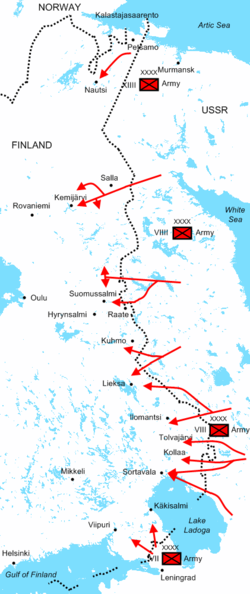
The Soviet forces were positioned as follows:
- The Seventh Army7th Army (Soviet Union)The Soviet Red Army's 7th Army first saw action in the 1939-40 Winter War against Finland. In November 1939, just before the initial Soviet attack, it consisted of the 19th Rifle Corps , 50th Rifle Corps , 10th Tank Corps, 138th Rifle Division, and an independent tank brigade...
, comprising nine divisions, a tank corps and three tank brigades, was located on the Karelian IsthmusKarelian IsthmusThe Karelian Isthmus is the approximately 45–110 km wide stretch of land, situated between the Gulf of Finland and Lake Ladoga in northwestern Russia, to the north of the River Neva . Its northwestern boundary is the relatively narrow area between the Bay of Vyborg and Lake Ladoga...
. Its objective was the city of ViipuriVyborgVyborg is a town in Leningrad Oblast, Russia, situated on the Karelian Isthmus near the head of the Bay of Vyborg, to the northwest of St. Petersburg and south from Russia's border with Finland, where the Saimaa Canal enters the Gulf of Finland...
. The force was later divided into the Seventh and 13th armies13th Army (Soviet Union)The 13th Army was a name given to several field armies of the Soviet Union's Red Army, first created during the Russian Civil War...
. - The Eighth Army8th Army (Soviet Union)The 8th Army was a field army of the Soviet Red Army during the Second World War.The 8th Army was formed in October 1939 from the Novgorod Army Operational Group of the Leningrad Military District with the task of providing security of the Northwestern borders of the USSR. The 8th Army was a field...
, comprising six divisions and a tank brigade, was located north of Lake LadogaLake LadogaLake Ladoga is a freshwater lake located in the Republic of Karelia and Leningrad Oblast in northwestern Russia, not far from Saint Petersburg. It is the largest lake in Europe, and the 14th largest lake by area in the world.-Geography:...
. Its mission was to execute a flanking manoeuvre around the northern shore of Lake Ladoga to strike at the rear of the Mannerheim LineMannerheim LineThe Mannerheim Line was a defensive fortification line on the Karelian Isthmus built by Finland against the Soviet Union. During the Winter War it became known as the Mannerheim Line, after Field Marshal Baron Carl Gustaf Emil Mannerheim. The line was constructed in two phases: 1920–1924 and...
. - The Ninth Army9th Army (Soviet Union)The 9th Army of the Soviet Union's Red Army was a Soviet field army, active from 1939 – 43, and then after the war from 1966 to 1989.It was active during the Winter War against Finland as part of the Leningrad Military District, beginning operations at the end of November 1939 under ComKor M.P....
was positioned to strike into central Finland. It was composed of three divisions with one additional division on its way. Its mission was to thrust westward to cut Finland in half. - The Fourteenth Army14th Army (Soviet Union)The 14th Army was formed in October 1939 in the Leningrad Military District. It participated in the Soviet-Finnish war, during which its 52nd and 104th Rifle Divisions fought in the Battle of Petsamo.From 24 June 1941 the Army included...
, comprising three divisions, was based in MurmanskMurmanskMurmansk is a city and the administrative center of Murmansk Oblast, Russia. It serves as a seaport and is located in the extreme northwest part of Russia, on the Kola Bay, from the Barents Sea on the northern shore of the Kola Peninsula, not far from Russia's borders with Norway and Finland...
. Its objective was to capture the Arctic port of PetsamoPechengsky DistrictPechengsky District is an administrative and municipal district , one of the five in Murmansk Oblast, Russia. It is located to the northwest of the Kola Peninsula on the coast of the Barents Sea and borders with Finland in the south and southwest and with Norway in the west, northwest, and north...
and then advance to the town of RovaniemiRovaniemiRovaniemi is a city and municipality of Finland. It is the administrative capital and commercial centre of Finland's northernmost province, Lapland. It is situated close to the Arctic Circle and is between the hills of Ounasvaara and Korkalovaara, at the confluence of the Kemijoki River and its...
.
Finnish order of battle
Mikkeli
Mikkeli is a town and municipality in Finland. It is located in what used to be the province of Eastern Finland and is part of the Southern Savonia region. The municipality has a population of and covers an area of of which is water...
, estimated seven Soviet divisions on the Isthmus and no more than five along the whole border north of Lake Ladoga. In that case, the manpower ratio would favour the attacker by a ratio of 3:1. The true ratio was much higher; for example, 12 Soviet divisions were deployed to the north of Lake Ladoga.
An even greater problem than lack of soldiers was the lack of materiel
Materiel
Materiel is a term used in English to refer to the equipment and supplies in military and commercial supply chain management....
; foreign shipments of antitank weapons and aircraft were arriving in small quantities. The ammunition situation was alarming, as stockpiles had cartridges, shells and fuel only for 19–60 days. The ammunition shortage meant the Finns could seldom afford counterbattery
Counter-battery fire
Counter-battery fire is a type of mission assigned to military artillery forces, which are given the task of locating and firing upon enemy artillery.-Background:...
or saturation fire
Saturation fire
Saturation fire is a level of intensity of artillery or machine gun fire that is very high and is designed to fill an enemy position with artillery shells or machine gun fire.-Artillery:...
. Finnish tank forces were operationally non-existent.
The Finnish forces were positioned as follows:
- The Army of the IsthmusArmy of the IsthmusThe Army of the Isthmus was a formation of the Finnish Army during the Winter War. It was stationed on the Karelian Isthmus and was the largest formation of the Finnish Army, as it was charged to defend the important isthmus.- Organisation :...
was composed of six divisions under the command of Hugo ÖstermanHugo Viktor ÖstermanHugo Viktor Österman was a Finnish Lieutenant-General during World War II. He was commander of the Finnish Army 1933-1939....
. The II. Army CorpsFinnish II Corps (Winter War)The II Corps was a unit of the Finnish Army during the Winter War.The II Corps with the III Corps formed the Army of the Isthmus...
was positioned on its right flank and the III. Army CorpsFinnish III Corps (Winter War)The III Corps was a unit of the Finnish Army during the Winter War. The III Corps with the II Corps formed the Army of the Isthmus . For most of the war it defended the Mannerheim Line on the northern side of the River Vuoksi against Soviet attacks.-Order of battle:*8th Division *10th Division...
was positioned on its left flank. - The IV. Army CorpsFinnish IV Corps (Winter War)The IV Corps was a formation of the Finnish Army during the Winter War against the Soviet Union. It defended the area north of Lake Ladoga against Soviet attacks. It was commanded by Major General Juho Heiskanen and from 4 December 1939 by Major General Woldemar Hägglund...
was located north of Lake Ladoga. It was composed of two divisions under Juho HeiskanenJuho HeiskanenJuho Henrik Heiskanen was a Finnish Major General during the World War II.Heiskanen joined the Jaeger Movement in 1915 and trained and fought in the Royal Prussian 27th Jäger Battalion. In 1916, he was arrested by Gendarmerie in Jyväskylä and sent to Petrograd...
, who was soon replaced by Woldemar HägglundWoldemar HägglundJohan Woldemar Hägglund was a Major General in the Finnish Army in the Second World War, and an early volunteer in the Finnish Jäger troops in Finnish Civil War 1918.- Early years :...
. - The North Finland GroupNorth Finland GroupNorth Finland Group was a formation of the Finnish Army during the Winter War. It was responsible for an almost 800-kilometer-long border from the town of Lieksa to the Arctic Ocean. The group was under Major General Wiljo Tuompo, and the headquarters was located in Kajaani.It was charged to...
was a collection of Civic GuardWhite Guard (Finland)The White Guard was a voluntary militia that emerged victorious over the socialist Red Guard as part of the Whites in the Finnish Civil War of 1918...
s, border guardBorder guardThe border guard, frontier guard, border patrol, border police, or frontier police of a country is a national security agency that performs border control, i.e., enforces the security of the country's national borders....
s, and drafted reservistReservistA reservist is a person who is a member of a military reserve force. They are otherwise civilians, and in peacetime have careers outside the military. Reservists usually go for training on an annual basis to refresh their skills. This person is usually a former active-duty member of the armed...
units under Wiljo TuompoWiljo TuompoViljo Einar Tuompo was a Finnish Major General during World War II. During the Winter War, he was commander of the North Finland Group. During the Continuation War, Tuompo was the Chief of the Command Group of the General Headquarters in Mikkeli. He was promoted as Lieutenant General in 1941....
.
Weapons
| Type | Soviet Union | Finland |
|---|---|---|
| Tanks | T-26 tank, T-28 T-28 The Soviet T-28 was among the world's first medium tanks. The prototype was completed in 1931 and production began in late 1932. It was an infantry-support tank intended to break through fortified defences... , Kliment Voroshilov tank Kliment Voroshilov tank The Kliment Voroshilov tanks were a series of Soviet heavy tanks, named after the Soviet defense commissar and politician Kliment Voroshilov. The KV series were known for their extremely heavy armour protection during the early war, especially during the first year of the invasion of the Soviet... , BT tank (BT-2 and BT-5 mainly), T-37A tank, T-38 tank and various experimental and prototype fighting vehicles (such as SMK tank SMK tank SMK was an armored vehicle prototype developed by the Soviet Union prior to the Second World War... ) |
Vickers-Armstrong 6 ton tank Vickers 6-Ton The Vickers 6-Ton Tank or Vickers Mark E was a British light tank designed as a private project at Vickers. It was not purchased by the British Army, but was picked up by a large number of foreign armed forces and was copied almost exactly by the Soviets as the T-26. It was also the direct... , Renault F.T. Modèle 1917 (used only as dug-in bunkers) |
| Artillery and anti-tank | 50mm, 82mm and 120mm Mortars, Artillery of various calibres ranging from 76mm Light Field Cannons to the super heavy 203mm Howitzer | Finnish Tampella 81mm Mortars, 82 and 120mm Mortars (captured from Soviet stocks), 76 K/02, also known as 76mm Cannon Model 1902, 37 PstK/36 anti-tank gun Bofors 37 mm The Bofors 37 mm gun was an anti-tank gun designed by Swedish manufacturer Bofors in the early 1930s. Licensed copies were produced in a number of countries. The gun was used by some European armies during World War II, mainly at the early stage of the war.-Development history:The gun was... , Lahti Anti-Tank Rifle Model 1939, 20mm Madsen cannon (converted for anti-tank use) |
| Aircraft | Polikarpov I-15 Polikarpov I-15 The Polikarpov I-15 was a Soviet biplane fighter aircraft of the 1930s. Nicknamed Chaika because of its gulled upper wings, it was operated in large numbers by the Soviet Air Force, and together with the Polikarpov I-16 monoplane, was one of the standard fighters of the Spanish Republicans during... , Polikarpov I-153 "Chaika" Polikarpov I-153 The Russian Polikarpov I-153 Chaika was a late 1930s Soviet biplane fighter. Developed as an advanced version of the I-15 with a retractable undercarriage, the I-153 fought in the Soviet-Japanese combats in Mongolia and was one of the Soviet's major fighter types in the early years of the Second... , Polikarpov I-16 Polikarpov I-16 The Polikarpov I-16 was a Soviet fighter aircraft of revolutionary design; it was the world's first cantilever-winged monoplane fighter with retractable landing gear. The I-16 was introduced in the mid-1930s and formed the backbone of the Soviet Air Force at the beginning of World War II... , Polikarpov R-5 Polikarpov R-5 The Polikarpov R-5 was a Soviet reconnaissance bomber aircraft of the 1930s. It was the standard light bomber and reconnaissance aircraft with the Soviet Air Force for much of the 1930s, while also being used heavily as a civilian light transport, in the order of 7,000 being built in... , Tupolev SB Tupolev SB The Tupolev ANT-40, also known by its service name Tupolev SB , and development co-name TsAGI-40, was a high speed twin-engined three-seat monoplane bomber, first flown in 1934.... , Ilyushin DB-3 Ilyushin DB-3 The Ilyushin DB-3 was a Soviet bomber aircraft of World War II. It was a twin-engined, low-wing monoplane that first flew in 1935. It was the precursor of the Ilyushin Il-4... , Tupolev TB-3 Tupolev TB-3 The Tupolev TB-3 was a heavy bomber aircraft which was deployed by the Soviet Air Force in the 1930s and during World War II. It was the world's first cantilever wing four-engine heavy bomber. Despite obsolescence and being officially withdrawn from service in 1939, TB-3 performed bomber and... |
Fokker D.XXI Fokker D.XXI -See also:-References:NotesBibliography* De Jong, Peter. Le Fokker D.21 . Outreau, France: Éditions Lela Presse, 2005. ISBN 2-914017-26-X.... , Bristol Bulldog (MK IV) Bristol Bulldog |-See also:-References:NotesBibliography* Andrews, C.F. The Bristol Bulldog . Leatherhead, Surrey, UK: Profile Publications Ltd., 1965.* Barnes, C.H. Bristol Aircraft Since 1910. London: Putnam, 1964.... , Gloster Gladiator Gloster Gladiator The Gloster Gladiator was a British-built biplane fighter. It was used by the Royal Air Force and the Royal Navy and was exported to a number of other air forces during the late 1930s. It was the RAF's last biplane fighter aircraft and was rendered obsolete by newer monoplane designs even as it... , Fiat G.50 "Freccia" Fiat G.50 The Fiat G.50 Freccia was a World War II Italian fighter aircraft. First flown in February 1937, the G.50 was Italy’s first single-seat, all-metal monoplane with an enclosed cockpit and retractable landing gear to go into production... , Morane-Saulnier M.S.406, Fokker C.V Fokker C.V Fokker C.V was a Dutch light reconnaissance and bomber biplane aircraft manufactured by Fokker. It was designed by Anthony Fokker and the series manufacture began in 1924 at Fokker in Amsterdam.-Development:... , Fokker C.X Fokker C.X -Bibliography:*Taylor, H.A.. Airspeed Aircraft since 1931. Putnam. 1970. London. ISBN 370 00110 9... , Blackburn Ripon Blackburn Ripon -See also:-External links:* in Flight... , Junkers K 43, Bristol Blenheim Models I,IV Bristol Blenheim The Bristol Blenheim was a British light bomber aircraft designed and built by the Bristol Aeroplane Company that was used extensively in the early days of the Second World War. It was adapted as an interim long-range and night fighter, pending the availability of the Beaufighter... , Hawker Hart Hawker Hart The Hawker Hart was a British two-seater biplane light bomber of the Royal Air Force , which had a prominent role during the RAF's inter-war period. The Hart was designed during the 1920s by Sydney Camm and built by Hawker Aircraft... |
| Small Arms and grenades | Mosin Nagant Model 1891/1930 bolt action rifle, variants included sniper and carbine versions. SVT38 semi automatic rifle, Maxim 1910 belt fed machine gun, DP-27 machine gun, TT33 semi automatic pistol, Nagant M1895 revolver Nagant M1895 The Nagant M1895 Revolver is a seven-shot, gas-seal revolver designed and produced by Belgian industrialist Léon Nagant for the Russian Empire. The Nagant M1895 was chambered for a proprietary cartridge, 7.62x38R, and featured an unusual "gas-seal" system in which the cylinder moved forward when... , F1 pineapple Grenade, RGD-33 stick grenade |
Mosin Nagant Model 1891 rifle (captured 1891/1930 rifles as well as locally produced and improved Finnish models of the basic Model 1891 (Models m1891-24, m/27, m/28 and m/28-30)), SVT38 (captured from Soviet stocks), Swedish Mauser rifle Swedish Mauser "Swedish Mausers" are a family of bolt-action rifles based on an improved variant of Mauser's earlier Model 1893, but using the 6.5x55mm cartridge, and incorporating unique design elements as requested by Sweden. These are the m/94 carbine, m/96 long rifle, m/38 short rifle and m/41 sniper... , Suomi KP/-31 submachine gun, LS-26 light machine gun, DP-27 (captured from Soviet stocks). Luger Pistol Luger pistol The Pistole Parabellum 1908 or Parabellum-Pistole , popularly known as the Luger, is a toggle-locked recoil-operated semi-automatic pistol. The design was patented by Georg J... , Lahti L-35 Lahti L-35 Lahti L-35 is a semi-automatic pistol designed by Finnish Aimo Lahti that was produced between 1935 and 1952. About 9000 pistols were made in four production series.... pistol, TT33 semi automatic pistol, Nagant M1895 revolver Nagant M1895 The Nagant M1895 Revolver is a seven-shot, gas-seal revolver designed and produced by Belgian industrialist Léon Nagant for the Russian Empire. The Nagant M1895 was chambered for a proprietary cartridge, 7.62x38R, and featured an unusual "gas-seal" system in which the cylinder moved forward when... (the latter two pistol types were captured from Soviet stocks), Maxim 1910 Russian as well as Finnish variants including version 09/21, Satchel charge Satchel charge thumb|right|250px|Weapons used in [[Winter War]]. The original Finnish satchel charge at left.A satchel charge is a demolition device, primarily intended for combat, whose primary components are a charge of dynamite or a more potent explosive such as C-4 plastic explosive, a carrying device... s, Molotov Cocktail Molotov cocktail The Molotov cocktail, also known as the petrol bomb, gasoline bomb, Molotov bomb, fire bottle, fire bomb, or simply Molotov, is a generic name used for a variety of improvised incendiary weapons... s, Finnish M32 Stick Grenade, Finnish M32 multi purpose grenade, Soviet RGD-33 stick grenade |
First battles
Mannerheim Line
The Mannerheim Line was a defensive fortification line on the Karelian Isthmus built by Finland against the Soviet Union. During the Winter War it became known as the Mannerheim Line, after Field Marshal Baron Carl Gustaf Emil Mannerheim. The line was constructed in two phases: 1920–1924 and...
, was located on the Karelian Isthmus about 30 to 75 km (18.6 to 46.6 mi) from the old Soviet/Finnish border. Red Army soldiers on the Isthmus numbered 250,000 facing 130,000 Finns. The Finnish command deployed a covering force of about 21,000 men in the area in front of the Mannerheim Line in order to delay and damage the Red Army before it reached the line.
In combat, the biggest cause of confusion among Finnish soldiers were Soviet tank
Tank
A tank is a tracked, armoured fighting vehicle designed for front-line combat which combines operational mobility, tactical offensive, and defensive capabilities...
s. The Finns had few anti-tank weapons and insufficient training in modern anti-tank tactics
Anti-tank warfare
Anti-tank warfare was created by the need to seek technology and tactics to destroy tanks and their supporting infantry during the First World War...
. However, the favoured Soviet armoured tactic was a simple frontal charge, the weaknesses of which could be exploited. The Finns learned that at close range, tanks could be dealt with in many ways; for example, logs and crowbars jammed into the bogie wheels would often immobilise a tank. Soon, Finns fielded a better ad hoc weapon, the Molotov Cocktail
Molotov cocktail
The Molotov cocktail, also known as the petrol bomb, gasoline bomb, Molotov bomb, fire bottle, fire bomb, or simply Molotov, is a generic name used for a variety of improvised incendiary weapons...
. It was a glass bottle filled with flammable
Flammability
Flammability is defined as how easily something will burn or ignite, causing fire or combustion. The degree of difficulty required to cause the combustion of a substance is quantified through fire testing. Internationally, a variety of test protocols exist to quantify flammability...
liquids, with a simple hand-lit fuse
Fuse (explosives)
In an explosive, pyrotechnic device or military munition, a fuse is the part of the device that initiates function. In common usage, the word fuse is used indiscriminately...
. Molotov cocktails were eventually mass-produced by the Finnish Alko
Alko
Alko is the national alcoholic beverage retailing monopoly in Finland. It is the only store in the country which retails beer over 4.7% ABV, wine and spirits. Alcoholic beverages are also sold in licensed restaurants and bars but only for consumption on the premises...
corporation and bundled with matches with which to light them. Eighty Soviet tanks were destroyed in the border-zone fighting.
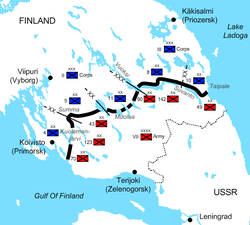
By 6 December, all the Finnish covering forces had withdrawn to the Mannerheim Line. The Red Army began its first major attack against the Line in Taipale – the area between the shore of Lake Ladoga, the Taipale river
Burnaya River
The Burnaya is a young rapid river in Priozersk District of Leningrad Oblast, Russia, on the Karelian Isthmus, which emerged in 1818. It flows from Lake Sukhodolskoye to Lake Ladoga and is a part of Vuoksi River drainage basin...
and the Suvanto waterway. Along the Suvanto sector, the Finns had a slight advantage of elevation and dry ground to dig into. The Finnish artillery
Artillery
Originally applied to any group of infantry primarily armed with projectile weapons, artillery has over time become limited in meaning to refer only to those engines of war that operate by projection of munitions far beyond the range of effect of personal weapons...
had scouted the area and made fire plans in advance, anticipating a Soviet assault. The Battle of Taipale
Battle of Taipale
The Battle of Taipale was fought between Soviet and Finnish forces during the Winter War, 6.-27. December 1939. The Finns managed to hold their defensive position at the eastern end of the Mannerheim Line, close to the shore of Lake Ladoga, till the end of the war....
began with a forty-hour Soviet artillery preparation. After the barrage
Barrage (artillery)
A barrage is a line or barrier of exploding artillery shells, created by the co-ordinated aiming of a large number of guns firing continuously. Its purpose is to deny or hamper enemy passage through the line of the barrage, to attack a linear position such as a line of trenches or to neutralize...
, the Soviet infantry attacked across open ground but was repulsed with heavy casualties. From 6–12 December, the Red Army continued trying to engage using only one division. The Red Army next strengthened its artillery and brought tanks and the 10th Rifle Division to the Taipale front. On 14 December, the bolstered Soviet forces launched a new attack but were pushed back again. A third Soviet division entered the fight but performed poorly and panicked under shell fire. The assaults continued without success, and the Red Army suffered heavy losses. One typical Soviet attack during the battle lasted just an hour but left 1,000 dead and 27 tanks strewn on the ice.
North of Lake Ladoga, on the Ladoga Karelia front, the defending Finnish units relied on the terrain. Ladoga Karelia, as a large forest wilderness, did not have road networks for the modern Red Army. However, the Soviet 8th Army had extended a new railroad line to the border, which could double the supply capability on the front. But on 12 December, the advancing Soviet 139th Rifle Division
139th Rifle Division
The 139th Rifle Division was a infantry division of the Red Army, formed three times during World War II, in 1939 and twice in 1941.Its First Formation was established at Kozelsk in September 1939, on the basis of a regiment of the 81st Rifle Division. It fought in the Winter War with Finland. It...
, supported by the 56th Rifle Division, was defeated by a much smaller Finnish force under Paavo Talvela
Paavo Talvela
Paavo Talvela was a Finnish soldier and a Knight of the Mannerheim Cross. He was one of the volunteers who served in the Finnish Jaeger battalion in Germany in 1916 to 1917. He was a battalion commander in the Finnish Civil War...
in the Tolvajärvi
Battle of Tolvajärvi
The Battle of Tolvajärvi ['tol.va.jær.vi] was fought on 12 December 1939 between Finland and the Soviet Union. It was the first large offensive victory for the Finns in the Winter War.-Prelude:...
, the first Finnish victory of the war.
In central and northern Finland, roads were few and the terrain hostile. The Finns did not expect large-scale Soviet attacks, but the Soviets sent eight divisions, heavily supported by armour and artillery. The 155th Rifle Division attacked at Lieksa
Lieksa
Lieksa is a town and municipality of Finland.It is located in the province of Eastern Finland and is part of the North Karelia region. The municipality has a population of and covers an area of of which is water...
, and further north the 44th attacked at Kuhmo
Kuhmo
Kuhmo is a town and a municipality in Finland and is part of the Kainuu region. The municipality has a population of and covers an area of of which is water. The population density is . It has a borderline of with Russia....
. The 163rd Rifle Division was deployed at Suomussalmi
Suomussalmi
Suomussalmi is a municipality in Finland and is located in the Kainuu region. The municipality has a population of and covers an area of of which is water. The population density is . The municipality is unilingually Finnish...
and charged with cutting Finland in half by marching the Raate Road. In Finnish Lapland, the Soviet 88th and 122nd Rifle Divisions attacked at Salla
Salla
Salla is a municipality of Finland, located in Lapland. The municipality has a population of and covers an area of ofwhich is water. The population density is....
. The Arctic port of Petsamo was attacked by the 104th Mountain Rifle Division by sea and land, supported by naval gunfire
Naval gunfire support
Naval gunfire support is the use of naval artillery to provide fire support for amphibious assault and other troops operating within their range. NGFS is one of a number of disciplines encompassed by the term Naval Fires...
.
Weather conditions
The winter of 1939–1940 was exceptionally cold. One location on the Karelian Isthmus experienced a record low temperature of -43 °C on 16 January 1940. At the beginning of the war, only those Finnish soldiers who were in active serviceMilitary service
Military service, in its simplest sense, is service by an individual or group in an army or other militia, whether as a chosen job or as a result of an involuntary draft . Some nations require a specific amount of military service from every citizen...
had uniforms and weapons. The rest had to make do with their own clothing, which for many soldiers was their normal winter clothing with semblance of an insignia added. Finnish soldiers were skilled in cross-country skiing
Cross-country skiing
Cross-country skiing is a winter sport in which participants propel themselves across snow-covered terrain using skis and poles...
.
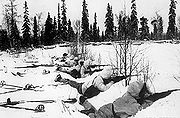
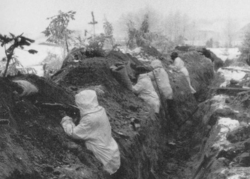
The cold, the snow, the forest, and the long hours of darkness were factors that the Finns could turn to their advantage. The Finns dressed in layers, and the ski trooper
Ski warfare
Ski warfare, the use of ski-equipped troops in war, is first recorded by the Danish historian Saxo Grammaticus in the 13th century. The speed and distance that ski troops are able to cover is comparable to that of light cavalry.-History:...
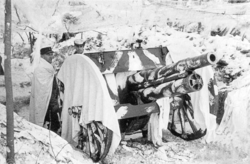
s wore a lightweight white snow cape. This snow-camouflage made the ski troopers almost invisible as the Finns executed guerrilla attacks
Guerrilla warfare
Guerrilla warfare is a form of irregular warfare and refers to conflicts in which a small group of combatants including, but not limited to, armed civilians use military tactics, such as ambushes, sabotage, raids, the element of surprise, and extraordinary mobility to harass a larger and...
against Soviet columns. At the beginning of the war, Soviet tanks were painted in standard olive drab and men dressed in regular khaki
Khaki
This article is about the fabric. For the color, see Khaki . Kaki, another name for the persimmon, is often misspelled "Khaki".Khaki is a type of fabric or the color of such fabric...
uniforms. Not until late January 1940 did the Soviets paint their equipment white and issue snowsuits to their infantry.
Most Soviet soldiers had proper winter clothes, but this was not the case with every unit. In the battle of Suomussalmi
Battle of Suomussalmi
The Battle of Suomussalmi [suo.mus.sal.mi] was fought between Finnish and Soviet forces in the Winter War. The action took place from around December 7, 1939 to January 8, 1940.The outcome was a major Finnish victory against vastly superior forces...
, many Soviet soldiers died of frostbite
Frostbite
Frostbite is the medical condition where localized damage is caused to skin and other tissues due to extreme cold. Frostbite is most likely to happen in body parts farthest from the heart and those with large exposed areas...
. The Soviet troops lacked skill in skiing, so soldiers were restricted to movement by road and were forced to move in long columns. Furthermore, the Red Army lacked proper winter tents, and men had to sleep in improvised shelters. Some Soviet units had frostbite casualties as high as 10% even before crossing the Finnish border. The cold weather did confer one advantage: Soviet tanks were able to move more easily over frozen terrain and bodies of water, rather than being immobilised in swamps and mud.
Finnish tactics
Economy of force
Economy of force is the principle of employing all available combat power in the most effective way possible, in an attempt to allocate a minimum of essential combat power to any secondary efforts. It is the judicious employment and distribution of forces towards the primary objective of any...
. Particularly on the Ladoga Karelia front and during the battle of Raate road, the Finns isolated smaller portions of numerically superior Soviet forces. With Soviet forces divided into smaller pieces, the Finns could deal with them individually and attack from all sides.
For many of the encircled Soviet troops in a pocket
Salients, re-entrants and pockets
A salient is a battlefield feature that projects into enemy territory. The salient is surrounded by the enemy on three sides, making the troops occupying the salient vulnerable. The enemy's line facing a salient is referred to as a re-entrant...
, (motti in Finnish), just staying alive was an ordeal comparable to combat. The men were freezing and starving and endured poor sanitary conditions. Historian William R. Trotter
William R. Trotter
William R. Trotter is an American author and historian.- Writings :Trotter's work has covered a variety of genres and markets. His first published work was "Sibelius and the Tides of Taste" for High Fidelity in 1965. Lawyer Rob Newsom III invited him to write Deadly Kin, a true crime book, which...
describes these conditions thus: "The Soviet soldier had no choice. If he refused to fight, he would be shot. If he tried to sneak through the forest, he would freeze to death. And surrender was no option for him; Soviet propaganda had told him how the Finns would torture prisoners to death."
Defence of the Mannerheim Line
The terrain on the Karelian Isthmus did not allow the exercise of guerilla tactics, so the Finns were forced to resort to more conventional means: a fortified defence line, the Mannerheim LineMannerheim Line
The Mannerheim Line was a defensive fortification line on the Karelian Isthmus built by Finland against the Soviet Union. During the Winter War it became known as the Mannerheim Line, after Field Marshal Baron Carl Gustaf Emil Mannerheim. The line was constructed in two phases: 1920–1924 and...
, with its flanks protected by large bodies of water. Soviet propaganda
Propaganda
Propaganda is a form of communication that is aimed at influencing the attitude of a community toward some cause or position so as to benefit oneself or one's group....
claimed that it was as strong as or even stronger than the Maginot Line
Maginot Line
The Maginot Line , named after the French Minister of War André Maginot, was a line of concrete fortifications, tank obstacles, artillery casemates, machine gun posts, and other defences, which France constructed along its borders with Germany and Italy, in light of its experience in World War I,...
. Finnish historians, for their part, have belittled the line's strength, insisting that it was mostly conventional trenches and log-covered dugouts
Dugout (shelter)
A dugout or dug-out, also known as a pithouse, pit-house, earth lodge, mud hut, is a shelter for humans or domesticated animals and livestock based on a hole or depression dug into the ground. These structures are one of the most ancient types of human housing known to archeologists...
.
The Finns had built 221 strongpoints along the Karelian Isthmus, mostly in the early 1920s. Many were extended in the late 1930s. Despite these defensive preparations, even the most fortified section of the Mannerheim Line had only one reinforced concrete
Reinforced concrete
Reinforced concrete is concrete in which reinforcement bars , reinforcement grids, plates or fibers have been incorporated to strengthen the concrete in tension. It was invented by French gardener Joseph Monier in 1849 and patented in 1867. The term Ferro Concrete refers only to concrete that is...
bunker per kilometre. Overall, the line was weaker than similar lines in mainland Europe. According to the Finns, the real strength of the line were the "stubborn defenders with a lot of sisu
Sisu
Sisu is a Finnish term loosely translated into English as strength of will, determination, perseverance, and acting rationally in the face of adversity. However, the word is widely considered to lack a proper translation into any language. Sisu has been described as being integral to understanding...
" – a Finnish idiom roughly translated as "guts
Courage
Courage is the ability to confront fear, pain, danger, uncertainty, or intimidation...
."
On the eastern side of the isthmus, the Red Army attempted to break through the Mannerheim line in the battle of Taipale
Battle of Taipale
The Battle of Taipale was fought between Soviet and Finnish forces during the Winter War, 6.-27. December 1939. The Finns managed to hold their defensive position at the eastern end of the Mannerheim Line, close to the shore of Lake Ladoga, till the end of the war....
. On the western side, Soviet units faced the Finnish line at Summa, near the city of Viipuri, on 16 December. The Finns had built 41 reinforced concrete bunkers in the Summa area, making the defensive line in this area stronger than anywhere else on the Karelian Isthmus. However, because of a mistake in planning, the nearby Munasuo swamp had a 1 km (0.621372736649807 mi)-wide gap in the line. During the first battle of Summa
Battle of Summa
The Battle of Summa was fought between the Soviet Union and Finland, in two phases, first in December 1939 and then in February 1940. It was part of the Winter War and was fought near the village of Summa along the main road leading from Leningrad to Viipuri.- First battle in December :The village...
, a number of Soviet tanks broke through the thin line on 19 December, but the Soviets could not benefit from the situation because of insufficient cooperation between branches of service. The Finns remained in their trenches, allowing the Soviet tanks to move freely behind the Finnish line, as the Finns had no proper anti-tank weapons. However, the Finns succeeded in repelling the main Soviet assault. The tanks, stranded behind enemy lines, attacked the strongpoints at random until they were eventually destroyed, 20 in all. By 22 December, the battle ended in a Finnish victory.
The Soviet advance was stopped at the Mannerheim Line. Red Army troops suffered from poor morale and a shortage of supplies, eventually refusing to participate in more suicidal frontal attacks
Human wave attack
Human wave attack, also known as human sea attack, is an offensive infantry tactic, in which an attacker conducts an unprotected frontal assault with densely concentrated infantry formations against the enemy line, intended to overrun the defenders by engaging in melee combat.-Definition:According...
. The Finns, led by General Harald Öhquist
Harald Öhquist
Harald Öhquist was a Finnish Lieutenant General during the World War II.Öhquist joined the Jaeger Movement in 1915 and trained and fought in the Royal Prussian 27th Jäger Battalion. During the Finnish Civil War he was promoted as Major, and Öhquist lead the White Guard battalion in the battle of...
, decided to launch a counterattack and encircle three Soviet divisions into a motti near Viipuri on 23 December. Öhquist's plan was bold, but it failed. The Finns lost 1,300 men, and the Soviets were later estimated to have lost a similar number.
Battles in Ladoga Karelia
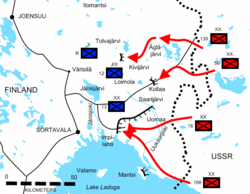
Lauri Tiainen
Lauri Taavetti Tiainen was a Finnish Colonel during the World War II.Tiainen joined the Jaeger Movement in 1915 and trained and fought in the Royal Prussian 27th Jäger Battalion. He worked under the name "Pfadfinder"...
and the 13th Division led by Hannu Hannuksela
Hannu Hannuksela
Hannu Esa Hannuksela was a Finnish Major General during World War II.Hannuksela joined the Jaeger Movement in 1916 and trained and fought in the Royal Prussian 27th Jäger Battalion. He served in a jaeger artillery during the Finnish Civil War...
. They also had a support group of three brigade
Brigade
A brigade is a major tactical military formation that is typically composed of two to five battalions, plus supporting elements depending on the era and nationality of a given army and could be perceived as an enlarged/reinforced regiment...
s, bringing their total strength to over 30,000. The Soviets deployed a division
Division (military)
A division is a large military unit or formation usually consisting of between 10,000 and 20,000 soldiers. In most armies, a division is composed of several regiments or brigades, and in turn several divisions typically make up a corps...
for almost every road leading west to the Finnish border. The Eighth Army was led by Ivan Khabarov, who was replaced by Grigori Shtern
Grigori Shtern
Grigori Mihailovich Shtern 1900, Smila, Kiev Governorate – 28 October 1941) was a Soviet officer in the Red Army and military advisor during the Spanish Civil War. He also served with distinction during the Soviet-Japanese Border Wars and the Winter War....
on 13 December. The Soviets' mission was to destroy the Finnish troops in the area of Ladoga Karelia and advance into the area between Sortavala
Sortavala
Sortavala is a town in the Republic of Karelia, Russia, located at the northern tip of Lake Ladoga. Population: It is an important station of the Vyborg-Joensuu railroad.-History:...
and Joensuu
Joensuu
Joensuu is a city and municipality in North Karelia in eastern Finland. It is located in the province of Eastern Finland and is part of North Karelia region. It was founded in 1848...
within 10 days. The Soviets had a 3:1 advantage in manpower and 5:1 advantage in artillery as well as air supremacy
Air supremacy
Air supremacy is the complete dominance of the air power of one side's air forces over the other side's, during a military campaign. It is the most favorable state of control of the air...
.
Finnish forces panicked and retreated in front of the overwhelming Red Army. The commander of the Finnish IV Army Corps was replaced by Woldemar Hägglund
Woldemar Hägglund
Johan Woldemar Hägglund was a Major General in the Finnish Army in the Second World War, and an early volunteer in the Finnish Jäger troops in Finnish Civil War 1918.- Early years :...
on 4 December. On 7 December, in the middle of the Ladoga Karelian front, Finnish units retreated near the small stream of Kollaa
Kollaa River
thumb|232px|picture taken on December 17th 1939The Kollaa River is a 76-kilometre long river in the Republic of Karelia, Russia. It starts from Lake Kollasjärvi in the Suoyarvsky District and flows to Lake Tulmozero in the Pryazhinsky District....
. The waterway itself did not offer protection, but alongside there were ridge
Ridge
A ridge is a geological feature consisting of a chain of mountains or hills that form a continuous elevated crest for some distance. Ridges are usually termed hills or mountains as well, depending on size. There are several main types of ridges:...
s up to 10 m (32.8 ft) high. The battle of Kollaa
Battle of Kollaa
The Battle of Kollaa was fought from December 7, 1939 - March 13, 1940 in the Ladoga's Karelia, Finland as a part of the Winter War.Despite having far fewer troops than the Soviets, the Finnish forces repelled the Red Army because the Soviets were only prepared to proceed along roads...
lasted until the end of the war. A memorable quote, "Kollaa holds" became a legendary motto among the Finns. Further contributing to the legend of Kollaa was the sniper Simo Häyhä
Simo Häyhä
Simo Häyhä , nicknamed "White Death" by the Red Army, was a Finnish sniper. Using a modified Mosin–Nagant in the Winter War, he has the highest recorded number of confirmed sniper kills - 505 - in any major war....
, dubbed "the White Death" by Soviets, who served in the Kollaa front. To the north, the Finns retreated from Ägläjärvi to Tolvajärvi on 5 December and then repelled a Soviet offensive in the battle of Tolvajärvi
Battle of Tolvajärvi
The Battle of Tolvajärvi ['tol.va.jær.vi] was fought on 12 December 1939 between Finland and the Soviet Union. It was the first large offensive victory for the Finns in the Winter War.-Prelude:...
on 11 December.
In the south, two Soviet divisions were united on the northern side of the Lake Ladoga coastal road. As before, these divisions were trapped as the more mobile Finnish units were able to counterattack from the north to flank the Soviet columns. On 19 December, the Finns temporarily ceased their assaults, as the soldiers were exhausted. It was not until the period 6–16 January 1940 that the Finns went on the offensive again, cutting Soviet division into smaller groups of different-sized mottis.
Contrary to Finnish expectations, the encircled Soviet divisions did not try to break through to the east but instead entrenched. They were expecting reinforcements and supplies to arrive by air
Airlift
Airlift is the act of transporting people or cargo from point to point using aircraft.Airlift may also refer to:*Airlift , a suction device for moving sand and silt underwater-See also:...
. As the Finns lacked the necessary heavy artillery equipment and were short of men, they often did not directly attack mottis they had created; instead, they focused on eliminating only the most dangerous threats. Often the motti tactic was not part of pre-planned doctrine but a Finnish adaptation to the behaviour of Soviet troops under fire.
In spite of the cold and hunger, the Soviet troops did not surrender easily but fought bravely, often entrenching their tanks to be used as pillboxes and building timber dugouts. Some specialist Finnish soldiers were called in to attack the mottis; the most famous of them was Major Matti Aarnio
Matti Aarnio
Matti Armas Aarnio, known as Motti-Matti was a Finnish military officer and a specialist in motti battles during the World War II.- Career :...
, or "Motti-Matti," as he became known.
In northern Karelia, Soviet forces were outmanoeuvred at Ilomantsi
Ilomantsi
Ilomantsi is municipality and a village of Finland.It is located in the province of Eastern Finland and is part of the North Karelia region. The municipality has a population of and covers an area of of which is water. The population density is...
and Lieksa
Lieksa
Lieksa is a town and municipality of Finland.It is located in the province of Eastern Finland and is part of the North Karelia region. The municipality has a population of and covers an area of of which is water...
. The Finns used effective guerrilla tactics, taking special advantage of superior skiing skills and snow-white layered clothing
Layered clothing
Layered clothing is a manner of dressing using multiple garments that are worn on top of each other. Some of the layers have different, largely non-overlapping, functions. Using more or fewer layers, or replacing one layer but not others, allows for flexible clothing to match the needs of each...
and executing many surprise ambushes and raids. By the end of December, the Soviets decided to retreat and transfer resources to more critical fronts.
Suomussalmi–Raate double operation
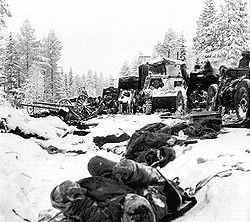
Military academy
A military academy or service academy is an educational institution which prepares candidates for service in the officer corps of the army, the navy, air force or coast guard, which normally provides education in a service environment, the exact definition depending on the country concerned.Three...
as a classic example of what well-led troops and innovative tactics can do against a much larger adversary. Suomussalmi
Suomussalmi
Suomussalmi is a municipality in Finland and is located in the Kainuu region. The municipality has a population of and covers an area of of which is water. The population density is . The municipality is unilingually Finnish...
was a small provincial town of 4,000. The area has long lakes, many wild forests and few roads. The Finnish command believed that the Soviets would not attack here, but the Red Army committed two divisions to the area with orders to cross the wilderness, capture the city of Oulu
Oulu
Oulu is a city and municipality of inhabitants in the region of Northern Ostrobothnia, in Finland. It is the most populous city in Northern Finland and the sixth most populous city in the country. It is one of the northernmost larger cities in the world....
and effectively cut Finland in two. There were two roads leading to Suomussalmi from the frontier: the northern Juntusranta road and the southern Raate road.
The battle of Raate road, which occurred during the month-long battle of Suomussalmi
Battle of Suomussalmi
The Battle of Suomussalmi [suo.mus.sal.mi] was fought between Finnish and Soviet forces in the Winter War. The action took place from around December 7, 1939 to January 8, 1940.The outcome was a major Finnish victory against vastly superior forces...
, resulted in one of the largest losses in the Winter War. The Soviet 44th and parts of the 163rd Rifle Divisions, comprising about 14,000 troops, were almost completely destroyed by a Finnish ambush as they marched along the forest road. A small unit blocked the Soviet advance while Finnish Colonel Hjalmar Siilasvuo
Hjalmar Siilasvuo
Hjalmar Fridolf Siilasvuo was a Finnish general who led troops in the Winter War, Continuation War and Lapland War...
and his 9th Division cut off the retreat route, split the enemy force into smaller fragments, and then proceeded to destroy the remnants as they retreated. The Soviets suffered 7,000–9,000 casualties, while the Finnish units lost only 400 men. In addition, the Finnish troops captured dozens of tanks, artillery pieces, anti-tank guns, hundreds of trucks, almost 2,000 horses, thousands of rifles, and much-needed ammunition and medical supplies.
Finnish Lapland
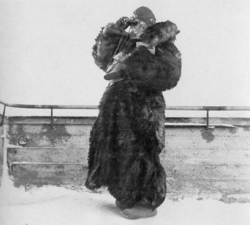
Lapland Group
The Lapland Group was a formation of the Finnish Army during the Winter War between Finland and the Soviet Union. The Group was formed on 13 December 1939 from troops of the North Finland Group. The Group was placed under the command of Major General Kurt Martti Wallenius and had its headquarters...
from the North Finland Group
North Finland Group
North Finland Group was a formation of the Finnish Army during the Winter War. It was responsible for an almost 800-kilometer-long border from the town of Lieksa to the Arctic Ocean. The group was under Major General Wiljo Tuompo, and the headquarters was located in Kajaani.It was charged to...
. The group was placed under the command of Kurt Wallenius
Kurt Martti Wallenius
Kurt Martti Wallenius was a Finnish Major General.Wallenius was a member of the Finnish Jäger troops trained in Germany prior to Finnish independence. In 1915 Wallenius travelled to Germany where he enrolled in the Royal Prussian 27th Jäger Battalion...
.
In southern Lapland, near the tiny rural village of Salla
Salla
Salla is a municipality of Finland, located in Lapland. The municipality has a population of and covers an area of ofwhich is water. The population density is....
, the Soviet force advanced with two divisions, the 88th and 112th, totalling 35,000 men. In the battle of Salla
Battle of Salla (1939)
The Battle of Salla was fought between Finnish and Soviet troops near Salla in northern Finland during the Winter War. The Soviets had orders to advance through Salla to Kemijärvi and Sodankylä, and from there to Rovaniemi in just two weeks. From there they were to advance to Tornio and cut Finland...
the Soviets advanced easily to Salla, where the road forked. The northern branch moved toward Pelkosenniemi
Pelkosenniemi
Pelkosenniemi is a municipality of Finland.It is located in the province of Lapland. The municipality has a population of and covers an area of ofwhich is water. The population density is....
while the rest pushed on toward Kemijärvi
Kemijärvi
Kemijärvi is a municipality of Finland and the northern-most town in Finland. It is located in the province of Lapland. The municipality has a population of and covers an area of of which is water...
. On 17 December, the Soviet northern group, comprising an infantry regiment, a battalion, and a company of tanks, was outflanked by a Finnish battalion
Battalion
A battalion is a military unit of around 300–1,200 soldiers usually consisting of between two and seven companies and typically commanded by either a Lieutenant Colonel or a Colonel...
. The 112th retreated, leaving much of its heavy equipment and vehicles behind. Following this success, the Finns shuttled reinforcements down to the defensive line in front of Kemijärvi. The Soviets hammered the defensive line without success. The Finns counterattacked, and the Soviets were pushed back to a new defensive line where they stayed for the rest of the war.
To the north was Finland's only ice-free port in the Arctic, Petsamo. The Finns did not have the manpower to defend it fully as the main front was down the Karelian Isthmus. In the battle of Petsamo
Battle of Petsamo (1939)
The Battle of Petsamo was fought between Finnish and Soviet troops in the area of Petsamo in the far north of Finland in 1939 and 1940. The Finnish troops were greatly outnumbered but managed to contain the Soviet troops due to the extreme terrain and weather....
, the Soviet 104th division attacked the Finnish 104th Independent Cover Company. The Finns gave up Petsamo easily and concentrated on delaying actions. The area was treeless, windy and relatively low, offering little defensible terrain. However, during the winter, the Finns in Lapland had the advantage of almost constant darkness
Polar night
The polar night occurs when the night lasts for more than 24 hours. This occurs only inside the polar circles. The opposite phenomenon, the polar day, or midnight sun, occurs when the sun stays above the horizon for more than 24 hours.-Description:...
and extreme temperatures. The Finns executed guerrilla attacks against Soviet supply lines and patrols. As a result, the Soviet movements were halted by the efforts of one-fifth as many Finns.
Red Army reforms and offensive preparations
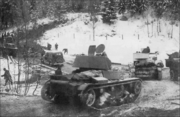
Maginot Line
The Maginot Line , named after the French Minister of War André Maginot, was a line of concrete fortifications, tank obstacles, artillery casemates, machine gun posts, and other defences, which France constructed along its borders with Germany and Italy, in light of its experience in World War I,...
, and that the Americans had sent 1,000 of their best pilots to Finland. Chief of Staff Boris Shaposhnikov was given full authority over operations in the Finnish theatre, and he ordered the suspension of frontal assaults in late December. Kliment Voroshilov was replaced with Semyon Timoshenko
Semyon Timoshenko
Semyon Konstantinovich Timoshenko was a Soviet military commander and senior professional officer of the Red Army at the beginning of the German invasion of the Soviet Union in 1941.-Early life:...
as the commander of the Soviet forces in the war on 7 January.
The main focus of the Soviet attack was switched to the Karelian Isthmus. Timoshenko and Zhdanov
Andrei Zhdanov
Andrei Alexandrovich Zhdanov was a Soviet politician.-Life:Zhdanov enlisted with the Russian Social Democratic Labour Party in 1915 and was promoted through the party ranks, becoming the All-Union Communist Party manager in Leningrad after the assassination of Sergei Kirov in 1934...
reorganised and tightened control between different branches of service in the Red Army. They also changed tactical doctrines to meet the realities of the situation. All Soviet forces on the Karelian Isthmus were divided into two armies: the 7th
7th Army (Soviet Union)
The Soviet Red Army's 7th Army first saw action in the 1939-40 Winter War against Finland. In November 1939, just before the initial Soviet attack, it consisted of the 19th Rifle Corps , 50th Rifle Corps , 10th Tank Corps, 138th Rifle Division, and an independent tank brigade...
and the 13th Armies
13th Army (Soviet Union)
The 13th Army was a name given to several field armies of the Soviet Union's Red Army, first created during the Russian Civil War...
. The 7th Army, now under Kirill Meretskov, would concentrate 75% of its strength against the 16 km (9.9 mi) stretch of the Mannerheim Line between Taipale and the Munasuo swamp. Tactics would be basic: an armoured wedge for the initial breakthrough, followed by the main infantry and vehicle assault force. The Red Army would prepare by pinpointing the Finnish frontline fortifications. The 123rd Assault Division then rehearsed the assault on life-size mockup
Mockup
In manufacturing and design, a mockup, or mock-up, is a scale or full-size model of a design or device, used for teaching, demonstration, design evaluation, promotion, and other purposes...
s. The Soviets shipped massive numbers of new tanks and artillery pieces to the theatre. Troops were increased from ten divisions to 25–26 divisions, six or seven tank brigades and several independent tank platoons, totalling 600,000 men. On 1 February, the Red Army began a massive offensive, firing 300,000 shells into the Finnish line in the first 24 hours of the bombardment
Bombardment
A bombardment is an attack by artillery fire directed against fortifications, troops or towns and buildings.Prior to World War I the term term was only applied to the bombardment of defenceless or undefended objects, houses, public buildings, it was only loosely employed to describe artillery...
.
Soviet all-out offensive on the Karelian Isthmus
Although the Karelian Isthmus front was less active in January than in December, the Soviets began increasing bombardments, wearing down the defenders and softening their fortifications. During daylight hours, the Finns took shelter inside their fortifications from the bombardments and repaired damage during the night. The situation led quickly to war exhaustion among the Finns, who lost over 3,000 men in trench warfareTrench warfare
Trench warfare is a form of occupied fighting lines, consisting largely of trenches, in which troops are largely immune to the enemy's small arms fire and are substantially sheltered from artillery...
. The Soviets also made occasional small infantry assaults with one or two companies. Because of the shortage of ammunition, Finnish artillery emplacements were under orders to fire only against directly threatening ground attacks. On 1 February, the Soviets further escalated their artillery and air bombardments.
Although the Soviets refined their tactics and morale improved, the generals were still willing to accept massive losses in order to reach their objectives. Attacks were screened by smoke, heavy artillery and armour support, but the infantry charged in the open and in dense formations. Unlike their tactics in December, Soviet tanks advanced in smaller numbers. The Finns could not easily eliminate tanks if infantry troops protected them. After 10 days of round-the-clock artillery barrages, the Soviets achieved a breakthrough on the western Karelian Isthmus in the second battle of Summa
Battle of Summa
The Battle of Summa was fought between the Soviet Union and Finland, in two phases, first in December 1939 and then in February 1940. It was part of the Winter War and was fought near the village of Summa along the main road leading from Leningrad to Viipuri.- First battle in December :The village...
.
On 11 February, the Soviets had about 460,000 men, over 3,350 artillery pieces, about 3,000 tanks and about 1,300 aircraft deployed on the Karelian Isthmus. The Red Army was constantly receiving new recruits after the breakthrough. Opposing them the Finns had eight divisions, totalling about 150,000 men. One by one, the defenders' strongholds crumbled under the Soviet attacks and the Finns were forced to retreat. On 15 February, Mannerheim authorised a general retreat of the Second Corps
Finnish II Corps (Winter War)
The II Corps was a unit of the Finnish Army during the Winter War.The II Corps with the III Corps formed the Army of the Isthmus...
to the Intermediate Line. On the eastern side of the isthmus, the Finns continued to resist Soviet assaults, repelling them in the battle of Taipale
Battle of Taipale
The Battle of Taipale was fought between Soviet and Finnish forces during the Winter War, 6.-27. December 1939. The Finns managed to hold their defensive position at the eastern end of the Mannerheim Line, close to the shore of Lake Ladoga, till the end of the war....
.
Peace negotiations
Although the Finns attempted to re-open negotiations with Moscow by every means during the war, the Soviets did not respond. In early January, Finnish communist and feminist playwright Hella WuolijokiHella Wuolijoki
Hella Wuolijoki was a Finnish writer of Estonian origin, known for her Niskavuori series.-Life & career:Wuolijoki was born in Helme, Estonia....
contacted the Finnish government. She offered to contact Moscow through the Soviet Union's ambassador to Sweden, Alexandra Kollontai
Alexandra Kollontai
Alexandra Mikhailovna Kollontai was a Russian Communist revolutionary, first as a member of the Mensheviks, then from 1914 on as a Bolshevik. In 1919 she became the first female government minister in Europe...
. Wuolijoki departed for Stockholm
Stockholm
Stockholm is the capital and the largest city of Sweden and constitutes the most populated urban area in Scandinavia. Stockholm is the most populous city in Sweden, with a population of 851,155 in the municipality , 1.37 million in the urban area , and around 2.1 million in the metropolitan area...
and met Kollontai secretly at a hotel. Soon Molotov decided to extend recognition to the Ryti
Risto Ryti
Risto Heikki Ryti was the fifth President of Finland, from 1940 to 1944. Ryti started his career as a politician in the field of economics and as a political background figure during the interwar period. He made a wide range of international contacts in the world of banking and within the...
–Tanner
Väinö Tanner
Väinö Tanner was a pioneer and leader in the cooperative movement in Finland, and Prime Minister of Finland from 1926 to 1927....
government as the legal government of Finland and put an end to the puppet Terijoki Government of Kuusinen that the Soviets had set up.
By mid-February, it became clear that the Finnish forces were rapidly approaching exhaustion. For the Soviets, casualties were high, the situation was a source of political embarrassment of the Soviet regime, and there was a risk of Franco-British intervention
Franco-British plans for intervention in the Winter War
During the early stages of World War II, the British and French Allies made a series of proposals to send troops to fight against the Soviet Union, which had invaded Finland as a consequence of the Nazi-Soviet Pact...
. Furthermore, with the spring thaw approaching, the Soviet forces risked becoming bogged down in the forests. The Finnish foreign minister Väinö Tanner arrived in Stockholm on 12 February and negotiated the peace terms with the Soviets through the Swedes. German representatives, not aware that the negotiations were underway, suggested on 17 February that Finland negotiate with the Soviet Union.
Both Germany and Sweden were keen to see an end to the Winter War. The Germans feared losing iron ore fields in northern Sweden and threatened to attack at once if the Swedes granted the Allied forces right of passage. The Germans even had a theoretical invasion plan called the Studie Nord against Scandinavian countries, which later became the full-blown Operation Weserübung
Operation Weserübung
Operation Weserübung was the code name for Germany's assault on Denmark and Norway during the Second World War and the opening operation of the Norwegian Campaign...
. As the Finnish Cabinet hesitated in the face of the harsh Soviet conditions, Sweden's King Gustav V made a public statement on 19 February in which he confirmed having declined Finnish pleas for support from Swedish troops. On 25 February, the Soviet peace terms were spelled out in detail. On 29 February, the Finnish government accepted the Soviet terms in principle and was willing to enter into negotiations.
Last days of war
On 5 March, the Red Army advanced 10 to 15 km (6.2 to 9.3 mi) past the Mannerheim Line and entered the suburbs of Viipuri. That same day, the Red Army established a beachhead on the western Gulf of Viipuri. The Finns proposed an armisticeArmistice
An armistice is a situation in a war where the warring parties agree to stop fighting. It is not necessarily the end of a war, but may be just a cessation of hostilities while an attempt is made to negotiate a lasting peace...
on that day, but the Soviets, wanting to keep the pressure on the Finnish government, declined the offer the next day. The Finnish peace delegation went to Moscow via Stockholm and arrived on 7 March. The Soviets made further demands as their military position was strong and improving. On 9 March, the Finnish military situation on the Karelian Isthmus was dire as troops were experiencing heavy casualties. In addition, artillery ammunition supplies were exhausted and weapons were wearing out. The Finnish government, noting that the hoped-for Franco-British military expedition would not arrive in time, as Norway and Sweden had not given the right of Allied passage, had little choice but to accept the Soviet terms. The formal peace treaty was signed in Moscow on 12 March. A cease-fire took effect the next day at noon Leningrad time, 11 a.m. Helsinki time.
Aerial warfare
Soviet bombings
The Soviet Union enjoyed air supremacyAir supremacy
Air supremacy is the complete dominance of the air power of one side's air forces over the other side's, during a military campaign. It is the most favorable state of control of the air...
throughout the war. The Soviet Air Force
Soviet Air Force
The Soviet Air Force, officially known in Russian as Военно-воздушные силы or Voenno-Vozdushnye Sily and often abbreviated VVS was the official designation of one of the air forces of the Soviet Union. The other was the Soviet Air Defence Forces...
, supporting the Red Army's invasion with about 2,500 aircraft (the most common of which was the Tupolev SB
Tupolev SB
The Tupolev ANT-40, also known by its service name Tupolev SB , and development co-name TsAGI-40, was a high speed twin-engined three-seat monoplane bomber, first flown in 1934....
) was not as effective as the Soviets might have hoped. The material damage by the bomb raids was slight as Finland did not offer many valuable targets for strategic bombing
Strategic bombing
Strategic bombing is a military strategy used in a total war with the goal of defeating an enemy nation-state by destroying its economic ability and public will to wage war rather than destroying its land or naval forces...
. Very often, targets were small village depots with little value. The country had only a few modern highways in the interior, therefore making railway systems the main targets for bombers. The rail tracks were cut thousands of times, but they were easy to repair and Finns usually had trains running again in a matter of hours. The Soviet air force learned from its early mistakes, and by late February they instituted more effective tactics.
The largest bombing raid against the capital of Finland, Helsinki
Helsinki
Helsinki is the capital and largest city in Finland. It is in the region of Uusimaa, located in southern Finland, on the shore of the Gulf of Finland, an arm of the Baltic Sea. The population of the city of Helsinki is , making it by far the most populous municipality in Finland. Helsinki is...
, occurred on the first day of the war. The capital was bombed only a few times thereafter. All in all, Finland lost only 5% of total man-hour production time because of Soviet bombings. Nevertheless, Soviet air attacks affected thousands of civilians, killing 957, as the Soviets recorded 2,075 bombing attacks in 516 localities. The city of Viipuri, a major Soviet objective close to the Karelian Isthmus front, was almost levelled by nearly 12,000 bombs. No attacks on civilian targets were mentioned in Soviet radio or newspaper reports. In January 1940, the Pravda
Pravda
Pravda was a leading newspaper of the Soviet Union and an official organ of the Central Committee of the Communist Party between 1912 and 1991....
continued to stress that no civilian targets in Finland had been struck, even by accident.
Finnish Air Force
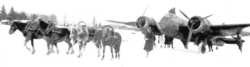
Fighter aircraft
A fighter aircraft is a military aircraft designed primarily for air-to-air combat with other aircraft, as opposed to a bomber, which is designed primarily to attack ground targets...
were mainly used to repel Soviet bombers. Strategic bombings could also double as opportunities for military reconnaissance
Reconnaissance
Reconnaissance is the military term for exploring beyond the area occupied by friendly forces to gain information about enemy forces or features of the environment....
. Old-fashioned and few in number, aircraft could not offer support for Finnish ground troops. In spite of losses, the number of planes in the Finnish Air Force
Finnish Air Force
The Finnish Air Force is one of the branches of the Finnish Defence Forces. Its peacetime tasks are airspace surveillance, identification flights, and production of readiness formations for wartime conditions...
had risen by over 50% by the end of the war. The Finns received shipments of British, French, Italian, Swedish and American aircraft.
Finnish fighter pilots would often fly their motley collection of planes into Soviet formations that outnumbered them 10 or even 20 times. Finnish fighters shot down a confirmed 200 Soviet aircraft, losing 62 of their own. In addition, Finnish anti-aircraft brought down more than 300 enemy aircraft. Many times a Finnish forward air base consisted of a frozen lake, a windsock
Windsock
A windsock is a conical textile tube designed to indicate wind direction and relative wind speed. Windsocks typically are used at airports and at chemical plants where there is risk of gaseous leakage...
, a telephone set and some tents. Air-raid warnings were given by Finnish women organised by the Lotta Svärd
Lotta Svärd
Lotta Svärd was a Finnish voluntary auxiliary paramilitary organisation for women. During the Finnish Civil War it was associated with the Suojeluskunta. After the war Lotta Svärd was founded as a separate organisation on September 9, 1920. The name comes from a poem by Johan Ludvig Runeberg...
. In addition to combat, it is estimated that the Soviet air force lost about 400 aircraft because of inclement weather, lack of fuel and tools, and during transportation to the front. The Soviet Air Force flew approximately 44,000 sorties during the war.
Naval warfare
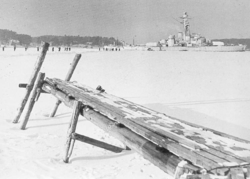
Navies in frost
Naval activity during the Winter War was low. The Baltic SeaBaltic Sea
The Baltic Sea is a brackish mediterranean sea located in Northern Europe, from 53°N to 66°N latitude and from 20°E to 26°E longitude. It is bounded by the Scandinavian Peninsula, the mainland of Europe, and the Danish islands. It drains into the Kattegat by way of the Øresund, the Great Belt and...
began to freeze over by the end of December, which made the movement of warship
Warship
A warship is a ship that is built and primarily intended for combat. Warships are usually built in a completely different way from merchant ships. As well as being armed, warships are designed to withstand damage and are usually faster and more maneuvrable than merchant ships...
s very difficult; by mid-winter, only ice breakers and submarine
Submarine
A submarine is a watercraft capable of independent operation below the surface of the water. It differs from a submersible, which has more limited underwater capability...
s could still move. The other reason for low naval activity was the nature of Soviet Navy
Soviet Navy
The Soviet Navy was the naval arm of the Soviet Armed Forces. Often referred to as the Red Fleet, the Soviet Navy would have played an instrumental role in a Warsaw Pact war with NATO, where it would have attempted to prevent naval convoys from bringing reinforcements across the Atlantic Ocean...
forces in the area. The Baltic Fleet
Baltic Fleet
The Twice Red Banner Baltic Fleet - is the Russian Navy's presence in the Baltic Sea. In previous historical periods, it has been part of the navy of Imperial Russia and later the Soviet Union. The Fleet gained the 'Twice Red Banner' appellation during the Soviet period, indicating two awards of...
was a coastal defence force which did not have the training, logistical structure, or landing craft
Landing craft
Landing craft are boats and seagoing vessels used to convey a landing force from the sea to the shore during an amphibious assault. Most renowned are those used to storm the beaches of Normandy, the Mediterranean, and many Pacific islands during WWII...
to undertake large-scale operations. The Baltic Fleet possessed two battleship
Battleship
A battleship is a large armored warship with a main battery consisting of heavy caliber guns. Battleships were larger, better armed and armored than cruisers and destroyers. As the largest armed ships in a fleet, battleships were used to attain command of the sea and represented the apex of a...
s, one heavy cruiser
Heavy cruiser
The heavy cruiser was a type of cruiser, a naval warship designed for long range, high speed and an armament of naval guns roughly 203mm calibre . The heavy cruiser can be seen as a lineage of ship design from 1915 until 1945, although the term 'heavy cruiser' only came into formal use in 1930...
, almost 20 destroyer
Destroyer
In naval terminology, a destroyer is a fast and maneuverable yet long-endurance warship intended to escort larger vessels in a fleet, convoy or battle group and defend them against smaller, powerful, short-range attackers. Destroyers, originally called torpedo-boat destroyers in 1892, evolved from...
s, 50 motor torpedo boat
Motor Torpedo Boat
Motor Torpedo Boat was the name given to fast torpedo boats by the Royal Navy, and the Royal Canadian Navy.The capitalised term is generally used for the Royal Navy boats and abbreviated to "MTB"...
s, 52 submarines, and other miscellaneous vessels. The Soviets used naval bases in Paldiski
Paldiski
Paldiski is a town and Baltic Sea port situated on the Pakri peninsula of north-western Estonia. Originally a Swedish settlement known as Rågervik, it became a Russian naval base in the 18th century. The Russians renamed it Балтийский Порт Paldiski is a town and Baltic Sea port situated on the...
, Tallinn
Tallinn
Tallinn is the capital and largest city of Estonia. It occupies an area of with a population of 414,940. It is situated on the northern coast of the country, on the banks of the Gulf of Finland, south of Helsinki, east of Stockholm and west of Saint Petersburg. Tallinn's Old Town is in the list...
and Liepāja
Liepaja
Liepāja ; ), is a republican city in western Latvia, located on the Baltic Sea directly at 21°E. It is the largest city in the Kurzeme Region of Latvia, the third largest city in Latvia after Riga and Daugavpils and an important ice-free port...
for their operations.
The Finnish Navy
Finnish Navy
The Finnish Navy is one of the branches of the Finnish Defence Forces. The Navy employs 2,300 people and about 4,300 conscripts are trained each year. Finnish Navy vessels are given the ship prefix "FNS" simply short for "Finnish Navy Ship"...
was a coastal defence force with two coastal defence ship
Coastal defence ship
Coastal defence ships were warships built for the purpose of coastal defence, mostly during the period from 1860 to 1920. They were small, often cruiser-sized warships that sacrificed speed and range for armour and armament...
s, five submarines, four gunboat
Gunboat
A gunboat is a naval watercraft designed for the express purpose of carrying one or more guns to bombard coastal targets, as opposed to those military craft designed for naval warfare, or for ferrying troops or supplies.-History:...
s, seven motor torpedo boats, one minelayer
Minelayer
Minelaying is the act of deploying explosive mines. Historically this has been carried out by ships, submarines and aircraft. Additionally, since World War I the term minelayer refers specifically to a naval ship used for deploying naval mines...
and six minesweeper
Minesweeper (ship)
A minesweeper is a small naval warship designed to counter the threat posed by naval mines. Minesweepers generally detect then neutralize mines in advance of other naval operations.-History:...
s. The two coastal defence ships, and , were moved to the harbour in Turku
Turku
Turku is a city situated on the southwest coast of Finland at the mouth of the Aura River. It is located in the region of Finland Proper. It is believed that Turku came into existence during the end of the 13th century which makes it the oldest city in Finland...
where they were used to bolster the air defences. Their anti-aircraft guns shot down one or two planes over the city, and the ships remained there for the rest of the war. In addition to its role in coastal defence, the Finnish Navy protected the Åland islands and Finnish merchant vessel
Merchant vessel
A merchant vessel is a ship that transports cargo or passengers. The closely related term commercial vessel is defined by the United States Coast Guard as any vessel engaged in commercial trade or that carries passengers for hire...
s in the Baltic Sea.
Soviet aircraft bombed Finnish vessels and harbours and dropped mines
Naval mine
A naval mine is a self-contained explosive device placed in water to destroy surface ships or submarines. Unlike depth charges, mines are deposited and left to wait until they are triggered by the approach of, or contact with, an enemy vessel...
into Finnish seaway
Seaway
Seaway is a Canadian drama series that aired on CBC from 1965 to 1966. The series was a Seaway Films production in collaboration with the UK's ATV, with production money provided by the CBC...
s. Still, Finnish losses were relatively low, numbering 26 merchant vessels, only four of which were lost inside Finnish territorial waters
Territorial waters
Territorial waters, or a territorial sea, as defined by the 1982 United Nations Convention on the Law of the Sea, is a belt of coastal waters extending at most from the baseline of a coastal state...
.
Coastal artillery
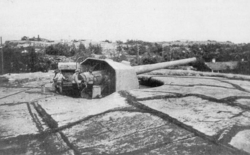
Grand Duchy of Finland
The Grand Duchy of Finland was the predecessor state of modern Finland. It existed 1809–1917 as part of the Russian Empire and was ruled by the Russian czar as Grand Prince.- History :...
, with 152 mm (6 in) guns being the most numerous. However, Finland attempted to modernise its old guns and installed a number of new batteries, the largest of which featured a 305 mm (12 in) gun battery originally intended to block the Gulf of Finland to Soviet ships with the help of batteries on the Estonian side
Finnish–Estonian defense cooperation
Finnish–Estonian defence cooperation began in 1930 with a secret military cooperation pact between Finland and Estonia against the threat of the Soviet Union...
.
The first naval battle took place on 1 December, near the island of Russarö
Russarö
Russarö is an island south of Hanko. The island is closed to the public as it is military area of the Finnish Defence Forces. The island has a five-story stone lighthouse built in 1863 and a Finnish Meteorological Institute weather station.- External links :...
, 5 km (3.1 mi) south of Hanko. That day, the weather was fair and the visibility excellent. The Finns spotted the Soviet cruiser and two destroyers. After the ships were at a range of 24 km (13 nmi; 14.9 mi), the Finns opened fire with 234 mm (9.2 in) coastal guns. After five minutes of firing by four coastal guns, the cruiser had been damaged by near misses and retreated. The destroyers remained undamaged, but Kirov suffered 17 dead and 30 wounded. The Soviets already knew the locations of the Finnish coastal batteries, but were surprised by their firing range.
The coastal artillery had a greater effect upon the land war by helping to reinforce the defence in conjunction with army artillery. Two sets of fortress artillery made significant contributions to the early battles on the Karelian Isthmus and in Ladoga Karelia. These were located at Kaarnajoki on the eastern isthmus and at Mantsi on the northeastern shore of Lake Ladoga. Furthermore, the fortress of Koivisto
Primorsk, Leningrad Oblast
Primorsk is a coastal town in Vyborgsky District of Leningrad Oblast, Russia, and the largest Russian port on the Baltic. It is located on the Karelian Isthmus, west of St. Petersburg, at the northern coast of the Gulf of Finland, near Birch Islands, protected as a sea bird sanctuary...
provided similar support from the southwestern coast of the isthmus. Coastal artilleries had the ability to fire high-explosive shells of 152 mm (6 in) calibre to a range of 25 km (13.5 nmi; 15.5 mi).
Foreign volunteers
World opinion largely supported the Finnish cause, and the Soviet aggression was generally deemed unjustified. The World War had not yet directly affected France, the UK or the US, the Winter War was the only real fighting in Europe at that time and thus held major world interest. Several foreign organisations sent material aid, and many countries granted credit and military materielMateriel
Materiel is a term used in English to refer to the equipment and supplies in military and commercial supply chain management....
to Finland. Nazi Germany allowed arms to pass through Sweden to Finland, but after a Swedish newspaper made this fact public, Adolf Hitler
Adolf Hitler
Adolf Hitler was an Austrian-born German politician and the leader of the National Socialist German Workers Party , commonly referred to as the Nazi Party). He was Chancellor of Germany from 1933 to 1945, and head of state from 1934 to 1945...
initiated a policy of silence towards Finland, as part of improved German–Soviet relations following the signing of the Molotov–Ribbentrop Pact.
Volunteers arrived from various countries. By far, the largest foreign contingent came from neighbouring Sweden, which provided nearly 8,760 volunteers during the war. The Swedish Volunteer Corps (Svenska Frivilligkåren), formed from the Swedes, the Norwegians (727 men) and the Danes (1,010 men), fought on the northern front at Salla
Salla
Salla is a municipality of Finland, located in Lapland. The municipality has a population of and covers an area of ofwhich is water. The population density is....
during the last weeks of the war. A Swedish unit of Gloster Gladiator
Gloster Gladiator
The Gloster Gladiator was a British-built biplane fighter. It was used by the Royal Air Force and the Royal Navy and was exported to a number of other air forces during the late 1930s. It was the RAF's last biplane fighter aircraft and was rendered obsolete by newer monoplane designs even as it...
, named "the Flight Regiment 19" (Lentorykmentti 19, LeR19; 19. flygflottilj, F19). Swedish AA-batteries with Bofors
Bofors
The name Bofors has been associated with the iron industry for more than 350 years.Located in Karlskoga, Sweden, the company originates from the hammer mill "Boofors" founded 1646. The modern corporate structure was created in 1873 with the foundation of Aktiebolaget Bofors-Gullspång...
40mm-guns were responsible for the air defence of northern Finland and the city of Turku
Turku
Turku is a city situated on the southwest coast of Finland at the mouth of the Aura River. It is located in the region of Finland Proper. It is believed that Turku came into existence during the end of the 13th century which makes it the oldest city in Finland...
. Volunteers arrived from Estonia
Estonia
Estonia , officially the Republic of Estonia , is a state in the Baltic region of Northern Europe. It is bordered to the north by the Gulf of Finland, to the west by the Baltic Sea, to the south by Latvia , and to the east by Lake Peipsi and the Russian Federation . Across the Baltic Sea lies...
, Italy and Hungary
Hungarian Volunteers in the Winter War
The Hungarian Volunteers in the Winter War travelled to fight for the Finns after the Soviet invasion of Finland in 1939. For a variety of reasons, volunteers from the Kingdom of Hungary fought on the side of Finland during the Winter War with the Soviet Union.- Hungarian-Finnish Relationship...
. Also, 350 American nationals of Finnish background
Finnish American
Finnish Americans are Americans of Finnish descent, who currently number about 700,000.-History:Some Finns, like the ancestors of John Morton, came to the Swedish colony of New Sweden, that existed in mid-17th century....
volunteered, and 210 volunteers of other nationalities made it to Finland before the war ended. Max Manus
Max Manus
Maximo Guillermo "Max" Manus DSO, MC & Bar was a Norwegian resistance fighter during World War II.Manus was born in Bergen to a Norwegian father and a Danish mother...
, a Norwegian, fought in the Winter War before returning to Norway
Norway
Norway , officially the Kingdom of Norway, is a Nordic unitary constitutional monarchy whose territory comprises the western portion of the Scandinavian Peninsula, Jan Mayen, and the Arctic archipelago of Svalbard and Bouvet Island. Norway has a total area of and a population of about 4.9 million...
and achieving fame as a resistance fighter against the Nazi occupation of Norway. In total, Finland received 12,000 volunteers of whom 50 died during the war.
Franco-British intervention plans
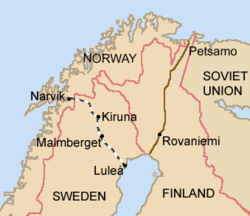
Polish Armed Forces in the West
Polish Armed Forces in the West refers to the Polish military formations formed to fight alongside the Western Allies against Nazi Germany and its allies...
and transport them to the Finnish Arctic port of Petsamo. Another scheme was to execute a massive air strike with Turkish
Turkey
Turkey , known officially as the Republic of Turkey , is a Eurasian country located in Western Asia and in East Thrace in Southeastern Europe...
co-operation against the Caucasus
Caucasus
The Caucasus, also Caucas or Caucasia , is a geopolitical region at the border of Europe and Asia, and situated between the Black and the Caspian sea...
oil field
Oil field
An oil field is a region with an abundance of oil wells extracting petroleum from below ground. Because the oil reservoirs typically extend over a large area, possibly several hundred kilometres across, full exploitation entails multiple wells scattered across the area...
s.
The British, for their part, wanted to block the flow of iron ore from Swedish mines to Germany because the Swedes supplied up to 40% of Germany's need. The matter was raised by the British Admiral Reginald Plunkett on 18 September 1939, and the next day Winston Churchill
Winston Churchill
Sir Winston Leonard Spencer-Churchill, was a predominantly Conservative British politician and statesman known for his leadership of the United Kingdom during the Second World War. He is widely regarded as one of the greatest wartime leaders of the century and served as Prime Minister twice...
brought the subject in the Cabinet
Cabinet of the United Kingdom
The Cabinet of the United Kingdom is the collective decision-making body of Her Majesty's Government in the United Kingdom, composed of the Prime Minister and some 22 Cabinet Ministers, the most senior of the government ministers....
. On 11 December, Churchill opined that the British should gain a foothold in Scandinavia with the objective of helping the Finns but without a war on the Soviet Union. Because of the heavy German reliance on Swedish iron, Hitler had made it clear to the Swedish government in December that any Allied troops on Swedish soil would immediately provoke a German invasion.
On 19 December, French Prime Minister Édouard Daladier
Édouard Daladier
Édouard Daladier was a French Radical politician and the Prime Minister of France at the start of the Second World War.-Career:Daladier was born in Carpentras, Vaucluse. Later, he would become known to many as "the bull of Vaucluse" because of his thick neck and large shoulders and determined...
introduced his plan to the General Staff and the British War Cabinet
War Cabinet
A War Cabinet is a committee formed by a government in a time of war. It is usually a subset of the full executive cabinet of ministers. It is also quite common for a War Cabinet to have senior military officers and opposition politicians as members....
. In his plan, Daladier created linkage between the war in Finland and the iron ore in Sweden. There was a danger of Finland's collapse under Soviet hegemony. In turn, Nazi Germany could occupy both Norway and Sweden. These two dictatorships could divide Scandinavia between them, as they had already done with Poland. The main motivation of France was to export the European battle front to Scandinavia in order to protect French soil, whereas the British were concerned with reducing the German war-making ability.
The Military Coordination Committee met the next day in London, and two days later the French plan was put forward. The Supreme War Council elected to send notes to Norway and Sweden on 27 December in which they urged the Norwegians and Swedes to help Finland and offer the Allies
Western Allies
The Western Allies were a political and geographic grouping among the Allied Powers of the Second World War. It generally includes the United Kingdom and British Commonwealth, the United States, France and various other European and Latin American countries, but excludes China, the Soviet Union,...
their support. Norway and Sweden rejected the offer on 5 January 1940. The Allies then came up with a new plan, in which they would demand that Norway and Sweden give them right of passage by citing the League of Nations resolution as justification. The expedition troops would disembark at the Norwegian port of Narvik
Narvik
is the third largest city and municipality in Nordland county, Norway by population. Narvik is located on the shores of the Narvik Fjord . The municipality is part of the Ofoten traditional region of North Norway, inside the arctic circle...
and proceed by rail toward Finland, passing through the Swedish ore fields on the way. This demand was sent to Norway and Sweden on 6 January, but it too was rejected six days later.
Stymied but not yet dissuaded from the possibility of action, the Allies formulated a new plan on 29 January. First, the Finns would make a formal request for assistance. Then the Allies would ask Norway and Sweden for permission to move the "volunteers" across their territory. Finally, in order to protect the supply line from German actions, the Allies would send additional units ashore at Namsos
Namsos
is a town and municipality in Nord-Trøndelag county, Norway. It is part of the Namdalen region. The administrative centre of the municipality is the town of Namsos. Other villages in the municipality include Bangsund, Klinga, Ramsvika, Skomsvoll, and Spillum....
, Bergen
Bergen
Bergen is the second largest city in Norway with a population of as of , . Bergen is the administrative centre of Hordaland county. Greater Bergen or Bergen Metropolitan Area as defined by Statistics Norway, has a population of as of , ....
, and Trondheim
Trondheim
Trondheim , historically, Nidaros and Trondhjem, is a city and municipality in Sør-Trøndelag county, Norway. With a population of 173,486, it is the third most populous municipality and city in the country, although the fourth largest metropolitan area. It is the administrative centre of...
. The operation would require 100,000 British and 35,000 French soldiers with naval and air support. The supply convoys would sail on 12 March and the landings would begin on 20 March.
Peace of Moscow
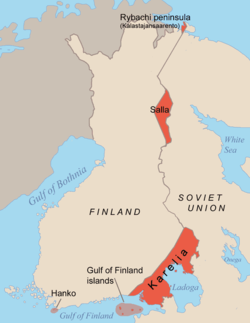
Evacuation of Finnish Karelia
As a result of the 1940 Moscow Peace Treaty that concluded the Winter War, Finland ceded the area of Finnish Karelia and other territories to the Soviet Union...
.
Finland also had to cede a part of the region of Salla
Salla
Salla is a municipality of Finland, located in Lapland. The municipality has a population of and covers an area of ofwhich is water. The population density is....
, the Kalastajansaarento peninsula in the Barents Sea
Barents Sea
The Barents Sea is a marginal sea of the Arctic Ocean, located north of Norway and Russia. Known in the Middle Ages as the Murman Sea, the sea takes its current name from the Dutch navigator Willem Barents...
, and four islands in the Gulf of Finland
Gulf of Finland
The Gulf of Finland is the easternmost arm of the Baltic Sea. It extends between Finland and Estonia all the way to Saint Petersburg in Russia, where the river Neva drains into it. Other major cities around the gulf include Helsinki and Tallinn...
. The Hanko Peninsula
Hanko Peninsula
The Hanko Peninsula , also spelled Hango, is the southernmost point of mainland Finland. The soil is a sandy moraine, the last tip of the Salpausselkä ridge, and vegetation consists mainly of pine and low shrubs...
was leased to the Soviet Union as a military base for 30 years. The region of Petsamo, captured by the Red Army during the war, was returned to Finland according to the treaty.
Finnish views
The 105-day war had a profound and depressing effect in Finland. Useful international support had been minimal and had arrived late, and the German blockade had prevented most armament shipments. The 15-month period between the Winter War and the Continuation WarContinuation War
The Continuation War was the second of two wars fought between Finland and the Soviet Union during World War II.At the time of the war, the Finnish side used the name to make clear its perceived relationship to the preceding Winter War...
was later called the Interim Peace
Interim Peace
The Interim Peace was a short period in the history of Finland during the Second World War. The term is used for the time between the Winter War and the Continuation War, lasting a little over a year, from 13 March 1940 to 24 June 1941...
.
After the end of the war, the situation of the Finnish army on the Karelian Isthmus had been the subject of debate in Finland. Orders were already issued to prepare a retreat to the next line of defence in the Taipale sector. Estimates of how long the Red Army could have been held in these kinds of retreat-and-stand operations varied from a few days to a few weeks or to a couple of months at most.
The Karelian evacuees established an interest group Karjalan Liitto
Karjalan Liitto
Karjalan Liitto is an interest group for Karelian evacuees.The association was established by Karelian local governments, parishes and provincial organizations on 20 April 1940 immediately after Winter War...
. The group was to defend Karelian rights and interests and to find a way to return ceded regions of Karelia
Karelian question in Finnish politics
The Karelian question or Karelian issue is a dispute of Finnish politics over whether or not to try to regain sovereignty over the Finnish Karelia and other territories ceded to the Soviet Union in the Winter War and the Continuation War...
to Finland.
Soviet views
During the period between the war and the perestroikaPerestroika
Perestroika was a political movement within the Communist Party of the Soviet Union during 1980s, widely associated with the Soviet leader Mikhail Gorbachev...
in the late 1980s, Soviet historiography
Soviet historiography
Soviet historiography is the methodology of history studies by historians in the Soviet Union . In the USSR, the study of history was marked by alternating periods of freedom allowed and restrictions imposed by the Communist Party of the Soviet Union , and also by the struggle of historians to...
leaned solely on Vyacheslav Molotov
Vyacheslav Molotov
Vyacheslav Mikhailovich Molotov was a Soviet politician and diplomat, an Old Bolshevik and a leading figure in the Soviet government from the 1920s, when he rose to power as a protégé of Joseph Stalin, to 1957, when he was dismissed from the Presidium of the Central Committee by Nikita Khrushchev...
's speeches on the Winter War. In his radio speech of 29 November 1939, Molotov argued that the Soviet Union had tried to negotiate guarantees of security for Leningrad for two months. However, the Finns had taken a hostile stance to "please foreign imperialists". Finland had undertaken military provocation, and the Soviet Union could no longer hold to non-aggression pacts. According to Molotov, the Soviet Union did not want to occupy or annex Finland; the goal was purely to secure Leningrad.
Another source later used widely in Soviet historiography was Molotov's speech in front of the Supreme Soviet
Supreme Soviet
The Supreme Soviet of the Soviet Union was the Supreme Soviet in the Soviet Union and the only one with the power to pass constitutional amendments...
on 29 March 1940, in which he blamed Western countries for starting the war and argued that they had used Finland as a proxy to fight the Soviet Union. The Western Allies had furthermore tried to take neutral Sweden and Norway along with them. Thus, the "masterminds" behind the war were the UK and France, but also Sweden, the U.S., and Italy, who had issued massive amounts of materiel, money, and men to Finland. According to Molotov, the Soviet Union was merciful in peace terms, as the problem of Leningrad security had been solved.
Military consequences
The Supreme Military Soviet met in April 1940, reviewed the lessons of the Finnish campaign, and recommended reforms. The role of frontline political commissars was reduced and old-fashioned ranks and forms of discipline were reintroduced. Clothing, equipment and tactics for winter operations were improved. However, not all of these reforms had been completed when the Germans began Operation BarbarossaOperation Barbarossa
Operation Barbarossa was the code name for Germany's invasion of the Soviet Union during World War II that began on 22 June 1941. Over 4.5 million troops of the Axis powers invaded the USSR along a front., the largest invasion in the history of warfare...
15 months later.
That same year, Finland and Sweden negotiated a military alliance, but the negotiations ended once it became clear that both Germany and the Soviet Union opposed such an alliance.
Germany
The Winter War was a political success for the Germans. Both the Red Army and the League of Nations were humiliated, and the Allied Supreme War Council had been revealed to be chaotic and powerless. However, the German policy of neutrality was not popular in the homeland, and relations with Italy had suffered badly. After the Peace of Moscow, Germany did not hesitate to move to improve ties with Finland, and within two weeks Finno-German relations were at the top of the agenda.During the Interim Peace
Interim Peace
The Interim Peace was a short period in the history of Finland during the Second World War. The term is used for the time between the Winter War and the Continuation War, lasting a little over a year, from 13 March 1940 to 24 June 1941...
, Finland established close ties with Germany in hopes of a chance to reclaim areas ceded to the Soviet Union. Three days after the beginning of Operation Barbarossa, the Continuation War
Continuation War
The Continuation War was the second of two wars fought between Finland and the Soviet Union during World War II.At the time of the war, the Finnish side used the name to make clear its perceived relationship to the preceding Winter War...
began.
Western Allies
The Winter War put in question the organisation and effectiveness of the Red Army as well as the Western Allies. The Supreme War Council was unable to formulate a workable plan, revealing its total unsuitability to make effective war in either Britain or France. This failure led to the collapse of the Daladier governmentÉdouard Daladier
Édouard Daladier was a French Radical politician and the Prime Minister of France at the start of the Second World War.-Career:Daladier was born in Carpentras, Vaucluse. Later, he would become known to many as "the bull of Vaucluse" because of his thick neck and large shoulders and determined...
in France.
See also
- Winter War in contemporary cultureWinter War in contemporary cultureThe influence of the Winter War in popular culture has been deep and wide, not only in Finnish culture, but also worldwide. The Finnish struggle against the Soviet Union has been seen as a classic David versus Goliath situation...
- Phoney War
- Timeline of the Winter WarTimeline of the Winter WarThe timeline of the Winter War is a chronology of events leading up to, culminating in, and resulting from the Winter War. The war began when the Soviet Union attacked Finland on 30 November 1939 and it ended 13 March 1940.- Prelude :...
- Military history of Finland during World War IIMilitary history of Finland during World War IIFrom 1939 to 1945, Finland fought three wars: the Winter War alone against the Soviet Union, the Continuation War with Nazi Germany against the Soviet Union, and the Lapland War against Nazi Germany...
- Military history of the Soviet UnionMilitary history of the Soviet UnionThe military history of the Soviet Union began in the days following the 1917 October Revolution that brought the Bolsheviks to power. The new government formed the Red Army to fight various enemies in the Russian Civil War. The years 1918-1921 saw Red Army's defeats in Polish-Soviet war and...
- List of Finnish corps in the Winter War
- List of Finnish divisions in the Winter War
- List of wars involving Finland
- Russo-Finnish warsRusso-Finnish warsThe following is a list of Russo-Finnish wars....
External links
- The Battles of the Winter War comprehensively covered by Sami H. E. Korhonen
- Telegrams from each day of the Winter War
- Report and resolution adopted by the assembly of the League of Nations, dated 14 December. 1939.
- The Front Museum on the Hanko Peninsula, documenting the lease of Hanko to the USSR
- Finnish wartime photos and history website Stories by veterans, historians, and wartime pictures.
- Those Burly Finns, History House magazine article