

Liturgical year

Encyclopedia
The liturgical year, also known as the church year, consists of the cycle of liturgical
seasons in Christian
churches which determines when feast days, including celebrations of saints
, are to be observed, and which portions of Scripture are to be read. Distinct liturgical colours
may appear in connection with different seasons of the liturgical year. The dates of the festivals vary somewhat between the different churches
, though the sequence and logic is largely the same.
In both East and West, the dates of many feasts vary from year to year, usually in line with the variation in the date of Easter
, with which most other moveable feast
s are associated. The extent to which feasts and festivals are celebrated also varies between churches; in general, Protestant churches observe far fewer than Catholic and Orthodox, in particular with regard to feasts of the Virgin Mary and the other Saint
s.
emphases, and modes of prayer
, which can be signified by different ways of decorating churches, colors of Parament
s and Vestment
s for clergy, scriptural
readings, themes for preaching and even different traditions and practices often observed personally or in the home. In churches that follow the liturgical year, the scripture passages for each Sunday (and even each day of the year in some traditions) are specified by a list called a lectionary
.
Among non-Catholic Western Christians, Anglicans and Lutherans have traditionally followed the lectionary since the days of the Protestant Reformation
. Following the Roman Catholic liturgical reform of the Roman Rite instituted by Pope Paul VI
in 1969, the adoption and use of lectionaries in other Protestant churches (Methodist
, Reformed
, United
, etc.) has increased. In particular, the growing influence of the Revised Common Lectionary
led to a greater awareness of the Christian year among Protestants in the later decades of the 20th century, especially among mainline denominations.
were solar
(based on the return of the same relative position between the sun and the earth) or lunisolar
(based on months that corresponded to the cycle of the moon, with periodic additional months to bring the calendar back into agreement with the solar cycle) like the present-day Hebrew calendar
.
`
The first month of the year was called אביב (Aviv), meaning the month of green ears of grain. It thus occurred in the spring.
At about the time of the Babylonian captivity, the Jews adopted as the name for the month the term ניסן (Nisan
), based on the Babylonian name Nisanu. Thomas J Talley says that the adoption of the Babylonian term occurred even before the captivity.
In the earlier calendar, most of the months were simply called by a number (such as "the fifth month"). The Babylonian-derived names of the months currently used by Jews are:
In Biblical times, the following Jewish religious feasts were celebrated :
 Western Christian liturgical calendars are based on the cycle of the Roman Rite of the Catholic Church, including Lutheran, Anglican, and other Protestant calendars since this cycle pre-dates the Reformation. Generally, the liturgical seasons in western Christianity are Advent
, Christmas
, Ordinary Time (Time after Epiphany), Lent
, Easter
, and Ordinary Time (Time after Pentecost
).
the liturgical year begins with Advent
, the time of preparation for both the celebration of Jesus' birth, and his expected second coming at the end of time. This season lasts until 24 December (Christmas Eve). Christmas
tide follows, beginning with First Vespers of Christmas on the evening of 24 December and ending with the Feast of the Baptism of the Lord. Lent
is the period of purification and penance which begins on Ash Wednesday
and ends on Holy Thursday
. The Holy Thursday evening Mass of the Lord's Supper
marks the beginning of the Easter Triduum
, which includes Good Friday
, Holy Saturday
, and Easter Sunday. These days recall Jesus' Last Supper
with his disciples, death on the cross, burial, and resurrection. The seven-week liturgical season of Easter
immediately follows the Triduum, climaxing at Pentecost
. This last feast recalls the descent of the Holy Spirit upon Jesus' disciples after the Ascension of Jesus. The rest of the liturgical year is commonly known as Ordinary Time
.
There are many forms of liturgy in the Catholic Church. Even putting aside the many Eastern rites in use, the Latin liturgical rites
alone include the Ambrosian Rite
, the Mozarabic Rite
, and the Cistercian Rite
, as well as other forms that have been largely abandoned in favour of adopting the Roman Rite
. Of this rite, what is now the "ordinary" or, to use a word employed in the Letter of Pope Benedict XVI accompanying the motu proprio Summorum Pontificum, the "normal" form is that which developed from the Second Vatican Council
to the present day, while the form in force in 1962 is authorized as an extraordinary form of the Roman Rite
without restriction in private celebrations and under certain conditions in public celebrations. The liturgical calendar in that form of the Roman Rite (see General Roman Calendar of 1962
) differs in some respects from that of the present ordinary form, as will be noted below, and also from the earlier General Roman Calendar of Pope Pius XII
, the still earlier General Roman Calendar of 1954 and the original Tridentine Calendar
. These articles can be consulted with regard to the Roman-Rite liturgical year before 1962.
adventus, "arrival" or "coming", the first season of the liturgical year begins four Sundays before Christmas and ends on Christmas Eve. Traditionally observed as a "fast", its purpose focuses on preparation for the coming of Christ
. Although often conceived as awaiting the coming of the Christ-child at Christmas, the modern Lectionary points the season more toward eschatological
themes—awaiting the final coming of Christ, when "the wolf shall live with the lamb" (Isaiah 11:6) and when God will have "brought down the powerful from their thrones, and lifted up the lowly" (The Magnificat
, Luke
1:52)—particularly in the earlier half of the season. This period of waiting is often marked by the Advent Wreath
, a garland of evergreens with four candles. Although the main symbolism of the advent wreath is simply marking the progression of time, many churches attach themes to each candle, most often 'hope', 'faith', 'joy', and 'love'.
Color: Violet, but on the third Sunday of Advent, Gaudete Sunday
, Rose may be used instead. Blue vestments were used in some places before the Council of Trent
and are still in the Sarum Rite
, but their use was subsequently confined to the Spanish empire for Marian feasts, of which only the Immaculate Conception
falls within Advent. Some parts of former New Spain
still retain this indulgence .
During this season, the Roman Catholic Church typically omits the "Gloria in Excelsis" except for Masses
celebrating a feast day. The word "Alleluia" is not banned, as in Lent, but in the pre-1970 form of the Roman Rite a Gradual
is used instead of an Alleluia and verse, except on Sunday.
begin with Christmas Eve on the evening of December 24 and continue until the feast of Epiphany. The actual Christmas season continues until the Feast of the Baptism of Christ, which in the present form of the Roman Rite is celebrated on the Sunday after 6 January. In the pre-1970 form, this feast is celebrated on 13 January, unless 13 January is a Sunday, in which case the feast of the Holy Family
is celebrated instead. Until the suppression of the Octave of the Epiphany in the 1960 reforms, 13 January was the Octave day of the Epiphany, providing the date for the end of the season.
Color: White or Gold.
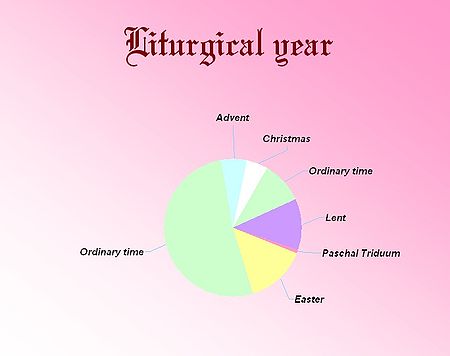
In the current form of the Roman Rite adopted following the Second Vatican Council, Ordinary Time consists of 33 or 34 Sundays and is divided into two sections. The first portion extends from the day following the Feast of the Baptism of Christ until the day before Ash Wednesday (the beginning of Lent). It contains anywhere from three to eight Sundays, depending on how early or late Easter falls. The main focus in the readings of the Mass is Christ's earthly ministry, rather than any one particular event. The counting of the Sundays resumes following Eastertide, however, two Sundays are replaced by Pentecost and Trinity Sunday, and depending on whether the year has 52 or 53 weeks, one may be omitted.
In the pre-1970 form of the Roman Rite, the Time after Epiphany has anywhere from one to six Sundays. As in the current form of the rite, the season mainly concerns Christ's preaching and ministry, with many of his parables read as the Gospel readings. The season begins on 14 January and ends on the Saturday before Septuagesima Sunday. Omitted Sundays after Epiphany are transferred to Time after Pentecost and celebrated between the Twenty-Third and the Last Sunday after Pentecost according to an order indicated in the Code of Rubrics
, 18, with complete omission of any for which there is no Sunday available in the current year. Before the 1960 revisions, the omitted Sunday would be celebrated on the Saturday before Septuagesima Sunday, or, in the case of the Twenty-Third Sunday after Pentecost, on the Saturday before the Last Sunday after Pentecost.
Color: Green
remains the same as during the season per annum, certain customs of Lent are adopted, including the suppression of the "Alleluia", the replacement of the Alleluia
at Mass with the Tract
and the Gloria is no longer said on Sundays.
In the 1969 reform of the Roman Rite, this intermediate season was removed, with these weeks becoming part of Ordinary Time.
Color: Violet
. It begins on Ash Wednesday
and, if the penitential days of Good Friday
and Holy Saturday
are included, lasts for forty days, since the six Sundays within the season are not counted.
In the Roman Rite the Gloria in Excelsis Deo
and the Te Deum
are not used in the Mass and Liturgy of the Hours respectively, except on Solemnities and Feasts, and the Alleluia
and verse that usually precede the reading of the Gospel is either omitted or replaced with another acclamation.
Lutheran churches make these same omissions.
As in Advent, the deacon and subdeacon of the pre-1970 form of the Roman Rite do not wear their habitual dalmatic and tunicle (signs of joy) in Masses of the season during Lent; instead they wear "folded chasubles", in accordance with the ancient custom.
In the pre-1970 form of the Roman Rite, the two weeks before Easter form the season of Passiontide, a subsection of the Lenten season that begins with Matins
of Ash Wednesday
and ends immediately before the Mass of the Easter Vigil
. In this form, what previously was officially called Passion Sunday
, has the official name of the First Sunday in Passiontide, and Palm Sunday
has the additional name of the Second Sunday in Passiontide. In Sunday and ferial Masses (but not on feasts celebrated in the first of these two weeks) the Gloria Patri is omitted at the Entrance Antiphon
< and at the Lavabo, as well as in the responds in the Divine Office.
In the post-1969 form of the Roman Rite, "Passion Sunday" and "Palm Sunday" are both names for the Sunday before Easter, officially called "Palm Sunday of the Lord's Passion". The former Passion Sunday became a fifth Sunday of Lent. The earlier form reads Matthew's account on Sunday, Mark's on Tuesday, and Luke's on Wednesday, while the post-1969 form reads the Passion only on Palm Sunday (with the three Synoptic Gospels arranged in a three-year cycle) and on Good Friday
, when it reads the Passion according to John, as also do earlier forms of the Roman Rite.
The veiling of crucifixes and images of the saints with violet cloth, which was obligatory before 1970, is left to the decision of the national bishops' conferences. In the United States, it is permitted but not required, at the discretion of the pastor. In all forms, the readings concern the events leading up to the Last Supper
and the betrayal, Passion, and death of Christ.
The week before Easter is called Holy Week
.
In the Roman Rite, feasts that fall within that week are simply omitted, unless they have the rank of Solemnity, in which case they are transferred to another date. The only solemnities inscribed in the General Calendar that can fall within that week are those of St. Joseph and the Annunciation
.
Color: violet. In some traditions, rose may be used on the 4th Sunday of Lent, called Laetare Sunday
in the Roman Rite. Red is used for Palm Sunday
in this rite (but only for the blessing of the palms in its 1955-1969 form). In the traditional form of the Palm Sunday liturgy, before the reforms of 1955, violet was used in the Roman rite both for the blessing of palms and procession and for the subsequent Mass.
The triduum begins on the evening before Good Friday with Mass of the Lord's Supper
, celebrated with white vestments, and often includes a ritual of ceremonial footwashing. It is customary on this night for a vigil involving private prayer to take place, beginning after the evening service and continuing until midnight. This vigil is occasionally renewed at dawn, continuing until the Good Friday liturgy.
During the day of Good Friday
Mass is not celebrated in the Catholic Church. Instead a Celebration of the Passion of the Lord is held in the afternoon or evening. It consists of three parts: a Liturgy of the Word that includes the reading of the account of the Passion
by John the Evangelist
and concludes with a solemn Universal Prayer
. Other churches also have their Good Friday commemoration of the Passion. The color of vestments varies: no color, red, or black are used in different traditions. Colored hangings may be removed. Lutheran churches often either remove colorful adornments and icons, or veil them with drab cloth. The service is usually plain with somber music, ending with the congregation leaving in silence. In the Roman Catholic, some Lutheran, and High Anglican rites, a crucifix (not necessarily the one which stands on or near the altar on other days of the year) is ceremoniously unveiled. Other crucifixes are unveiled, without ceremony, after the service.
Holy Saturday
commemorates the day during which Christ lay in the tomb. In the Roman Catholic Church, there is no Mass on this day; the Easter Vigil Mass, which, though celebrated properly at the following midnight, is often celebrated in the evening, is an Easter Mass. With no liturgical celebration, there is no question of a liturgical color.
The Easter Vigil
is held in the night between Holy Saturday and Easter Sunday, to celebrate the resurrection
of Jesus. See also Paschal candle
. The liturgical color is white, often together with gold. In the Roman Rite, during the "Gloria in Excelsis Deo" the organ and bells are used in the liturgy for the first time in 2 days, and the statues, which have been veiled during Passiontide (at least in the Roman Rite through the 1962 version), are unveiled. In Lutheran churches, colors and icons are re-displayed as well.
is the celebration of Jesus' resurrection
. The date of Easter varies from year to year, according to a lunar-calendar dating system (see computus
for details). In the Roman Rite, the Easter season extends from the Easter Vigil
through Pentecost
Sunday. In the pre-1970 form of the rite, this season includes also the Octave
of Pentecost, so Eastertide lasts until None
of the following Saturday.
In the Roman Rite, the Easter octave allows no other feasts to be celebrated or commemorated during it; a solemnity, such as the Annunciation, falling within it is transferred to the following Monday. If Easter Sunday or Easter Monday falls on 25 April, the Greater Litanies, which in the pre-1970 form of the Roman Rite are on that day, are transferred to the following Tuesday.
By a decree of 5 May 2000, the Second Sunday of Easter (the Sunday after Easter Day itself), is known also in the Roman Rite as Divine Mercy Sunday
.
Ascension Thursday, which celebrates the return of Jesus to heaven following his resurrection, is the fortieth day of Easter, but, in places where it is not observed as a Holy Day of Obligation
, the post-1969 form of the Roman rite transfers it to the following Sunday.
Pentecost
is the fiftieth and last day of the Easter season. It celebrates the sending of the Holy Spirit
to the Apostles
, which traditionally marks the birth of the Church, see also Apostolic Age
.
Color: Gold or white, except on Pentecost, on which the color is Red.
Feasts during this season include:
In the final few weeks of Ordinary Time, many churches direct attention to the coming of the Kingdom of God, thus ending the liturgical year with an eschatological
theme that is one of the predominant themes of the season of Advent that began the liturgical year. For instance, in the pre-1970 form of the Roman Rite, the Gospel of the Last Sunday is and in the later form of that rite all the last three Sundays have similar themes.
While the Roman Rite adopts no special designation for this final part of Ordinary Time, some denominations do, and may also change the liturgical colour. The Church of England
uses the term "Sundays before Advent" for the final four Sundays and permits red vestments as an alternative. Other denominations, including the United Methodist Church
and the Christian Church - Synod of Saint Timothy
, speak of "Kingdomtide
". The Lutheran Church - Missouri Synod
(LCMS) uses the terms "Third-Last, Second-Last and Last Sunday in the Church Year" and does not change from green. The LCMS does not officially celebrate a "Feast of Christ the King." The Wisconsin Evangelical Lutheran Synod
(WELS) uses the term "Period of End Times" and assigns red vestments to the first and second Sundays.
. The simple feast commenced with the chapter (capitulum) of First Vespers, and ended with None. It had three lessons and took the psalms of Matins from the ferial office; the rest of the office was like the semidouble. The semidouble feast had two Vespers, nine lessons in Matins, and ended with Compline. The antiphons before the psalms were only intoned. In the Mass, the semidouble had always at least three "orationes" or collect
s. On a double feast the antiphons were sung in their entirety, before and after the psalms. In Lauds and Vespers there were no suffragia of the saints, and the Mass had only one "oratio" (if no commemoration was prescribed). If ordinary double feasts (referred to also as lesser doubles) occurred with feasts of a higher rank, they could be simplified, except the octave days of some feasts and the feasts of the Doctors of the Church, which were transferred. To the existing distinction between major and ordinary or minor doubles, Pope Clement VIII
added two more ranks, those of first-class or second-class doubles. Some of these two classes were kept with octaves. This was still the situation when the 1907 article Ecclesiastical Feasts in the Catholic Encyclopedia
was written. In accordance with the rules then in force, feast days of any form of double, if impeded by "occurrence" (falling on the same day) with a feast day of higher class, were transferred to another day.
Pope Pius X
simplified matters considerably in his 1911 reform of the Roman Breviary. In the case of occurrence the lower-ranking feast day could become a commemoration
within the celebration of the higher-ranking one. Until then, ordinary doubles took precedence over most of the semidouble Sundays, resulting in many of the Sunday Masses rarely being said. While retaining the semidouble rite for Sundays, Pius X's reform permitted only the most important feast days to be celebrated on Sunday, although commemorations were still made until Pope John XXIII
's reform of 1960.
The division into doubles (of various kinds) semidoubles and simples continued until 1955, when Pope Pius XII
abolished the rank of semidouble, making all the previous semidoubles simples, and reducing the previous simples to a mere commemoration in the Mass of another feast day or of the feria on which they fell (see General Roman Calendar of Pope Pius XII
).
Then, in 1960, Pope John XXIII issued the Code of Rubrics
, completely ending the ranking of feast days by doubles etc., and replacing it by a ranking, applied not only to feast days but to all liturgical days, as I, II, III, and IV class days.
The 1969 revision by Pope Paul VI
(see Roman Catholic calendar of saints
) divided feast days into "solemnities", "feasts" and "memorials", corresponding approximately to Pope John XXIII's I, II and III class feast days. Commemorations were abolished. While some of the memorials are considered obligatory, others are optional, permitting a choice on some days between two or three memorials, or between one or more memorials and the celebration of the feria. On a day to which no obligatory celebration is assigned, the Mass may be of any saint mentioned in the Roman Martyrology
for that day.
on November 1, 1950 by Pope Pius XII
in the Papal Bull
, Munificentissimus Deus
.
In other Anglican and Lutheran traditions, as well as a few others, August 15 is celebrated as St. Mary, Mother of the Lord.
Color: white
uses a liturgical year that is in most respects identical to that of the Roman Church. While this is less true of the calendars contained within the Book of Common Prayer
and the Alternative Service Book
(1980), it is particularly true since the Anglican Church adopted its new pattern of services and liturgies contained within Common Worship
, in 2000. Certainly, the broad division of the year into the Christmas and Easter seasons, interspersed with periods of Ordinary Time, is identical, and the majority of the Festivals and Commemorations are also celebrated, with a few exceptions.
In some Anglican traditions (including the Church of England) the Christmas season is followed by an Epiphany season, which begins on the Eve of the Epiphany (on 6 January or the nearest Sunday) and ends on the Feast of the Presentation
(on 2 February or the nearest Sunday). Ordinary Time then begins after this period.
The Book of Common Prayer
contains within it the traditional Western Eucharistic lectionary which traces its roots to the Comes of St. Jerome in the 5th century. Its similarity to the ancient lectionary is particularly obvious during Trinity season (Sundays after the Sunday after Pentecost), reflecting that understanding of sanctification.
is characterized by alternating fasts
and feasts
, and is in many ways similar to the Roman Catholic year described above. However, Church New Year (Indiction
) traditionally begins on September 1
(Old Style or New Style
), rather than the first Sunday of Advent. It includes both feasts on the Fixed Cycle and the Paschal Cycle
(or Moveable Cycle). The most important feast day by far is the Feast of Pascha
(Easter)—the Feast of Feasts. Then the Twelve Great Feasts, which commemorate various significant events in the lives of Jesus Christ and of the Theotokos
(Virgin Mary).
The majority of Orthodox Christians (Russians, in particular) follow the Julian Calendar
in calculating their ecclesiastical feasts, but many (including the Ecumenical Patriarchate and the Church of Greece), while preserving the Julian calculation for feasts on the Paschal Cycle, have adopted the Revised Julian Calendar
(at present coinciding with the Gregorian Calendar
) to calculate those feasts which are fixed according to the calendar date. Between 1900 and 2100, there is a thirteen-day difference between the dates of the Julian and the Revised Julian and Gregorian calendars. Thus, for example, where Christmas is celebrated on December 25 O.S. (Old Style
), the celebration coincides with January 7
in the Revised Calendar. The computation of the day of Pascha
(Easter) is, however, always computed according to a lunar calendar
based on the Julian Calendar, even by those churches which observe the Revised Calendar.
There are four fasting seasons during the year: The most important fast is Great Lent
which is an intense time of fasting, almsgiving and prayer, extending for forty days prior to Palm Sunday
and Holy Week
, as a preparation for Pascha
. The Nativity Fast
(Winter Lent) is a time of preparation for the Feast of the Nativity of Christ
(Christmas), but whereas Advent in the West lasts only four weeks, Nativity Fast lasts a full forty days. The Apostles' Fast
is variable in length, lasting anywhere from eight days to six weeks, in preparation for the Feast of Saints Peter and Paul
(June 29
). The Dormition Fast lasts for two weeks from August 1
to August 14
in preparation for the Feast of the Dormition of the Theotokos
(August 15
). The liturgical year is so constructed that during each of these fasting seasons, one of the Great Feasts occurs, so that fasting may be tempered with joy.
In addition to these fasting seasons, Orthodox Christians fast on Wednesdays and Fridays throughout the year (and some Orthodox monasteries
also observe Monday as a fast day). Certain fixed days are always fast days, even if they fall on a Saturday or Sunday (in which case the fast is lessened somewhat, but not abrogated altogether); these are: The Decollation of St. John the Baptist
, the Exaltation of the Cross and the day before the Epiphany (January 5). There are several fast-free periods, when it is forbidden to fast, even on Wednesday and Friday. These are: the week following Pascha, the week following Pentecost
, the period from the Nativity of Christ until January the 5th and the first week of the Triodion
(the week following the 33rd Sunday after the Pentecost).
that falls on or after March 21 (nominally the day of the vernal equinox). However, whereas Western Christians follow the Gregorian Calendar
in their calculations, the Orthodox calculate the fixed date of 21 March according to the Julian Calendar
, and observe the additional rule that Easter may not precede or coincide with the first day of the Jewish Passover
(see computus
for further details).
The date of Pascha is central to the entire ecclesiastical year, determining not only the date for the beginning of Great Lent and Pentecost, but affecting the cycle of moveable feasts, of scriptural readings and the Octoechos
(texts chanted according to the eight ecclesiastical modes) throughout the year. There are also a number of lesser feasts throughout the year that are based upon the date of Pascha. The moveable cycle begins on the Zacchaeus
Sunday (the first Sunday in preparation for Great Lent or the 33rd Sunday after Pentecost as it is known), though the cycle of the Octoechos continues until Palm Sunday.
The date of Pascha affects the following liturgical seasons:
, and a period of celebration afterward, similar to the Western Octave
, called an Afterfeast. Great Feasts on the Paschal Cycle do not have Forefeasts. The lengths of Forefeasts and Afterfeasts vary, according to the feast.
Every day throughout the year commemorates some saint or some event in the lives of Christ
or the Theotokos
. When a feast on the moveable cycle occurs, the feast on the fixed cycle that was set for that calendar day is transferred, with the propers
of the feast often being chanted at Compline
on the nearest convenient day.
s, and the Octoechos
..
, many features of the Christian year became incorporated into the secular calendar. Many of its feasts (e.g., Mardi Gras
, Saint Patrick's Day
) remain holidays, and are now celebrated by people of all faiths and none — in some cases worldwide. The secular celebrations bear varying degrees of likeness to the religious feasts from which they derived, often also including elements of ritual from pagan
festivals of similar date.
Liturgy
Liturgy is either the customary public worship done by a specific religious group, according to its particular traditions or a more precise term that distinguishes between those religious groups who believe their ritual requires the "people" to do the "work" of responding to the priest, and those...
seasons in Christian
Christianity
Christianity is a monotheistic religion based on the life and teachings of Jesus as presented in canonical gospels and other New Testament writings...
churches which determines when feast days, including celebrations of saints
Calendar of saints
The calendar of saints is a traditional Christian method of organizing a liturgical year by associating each day with one or more saints and referring to the feast day of said saint...
, are to be observed, and which portions of Scripture are to be read. Distinct liturgical colours
Liturgical colours
Liturgical colours are those specific colours which are used for vestments and hangings within the context of Christian liturgy. The symbolism of violet, white, green, red, gold, black, rose, and other colours may serve to underline moods appropriate to a season of the liturgical year or may...
may appear in connection with different seasons of the liturgical year. The dates of the festivals vary somewhat between the different churches
Christian Church
The Christian Church is the assembly or association of followers of Jesus Christ. The Greek term ἐκκλησία that in its appearances in the New Testament is usually translated as "church" basically means "assembly"...
, though the sequence and logic is largely the same.
In both East and West, the dates of many feasts vary from year to year, usually in line with the variation in the date of Easter
Easter
Easter is the central feast in the Christian liturgical year. According to the Canonical gospels, Jesus rose from the dead on the third day after his crucifixion. His resurrection is celebrated on Easter Day or Easter Sunday...
, with which most other moveable feast
Moveable feast
In Christianity, a moveable feast or movable feast is a holy day – a feast day or a fast day – whose date is not fixed to a particular day of the calendar year but moves in response to the date of Easter, the date of which varies according to a complex formula...
s are associated. The extent to which feasts and festivals are celebrated also varies between churches; in general, Protestant churches observe far fewer than Catholic and Orthodox, in particular with regard to feasts of the Virgin Mary and the other Saint
Saint
A saint is a holy person. In various religions, saints are people who are believed to have exceptional holiness.In Christian usage, "saint" refers to any believer who is "in Christ", and in whom Christ dwells, whether in heaven or in earth...
s.
Liturgical cycle
The liturgical cycle divides the year into a series of seasons, each with their own mood, theologicalChristian theology
- Divisions of Christian theology :There are many methods of categorizing different approaches to Christian theology. For a historical analysis, see the main article on the History of Christian theology.- Sub-disciplines :...
emphases, and modes of prayer
Prayer
Prayer is a form of religious practice that seeks to activate a volitional rapport to a deity through deliberate practice. Prayer may be either individual or communal and take place in public or in private. It may involve the use of words or song. When language is used, prayer may take the form of...
, which can be signified by different ways of decorating churches, colors of Parament
Parament
A Parament or Parement; , a term applied by ancient writers to the hangings or ornaments of a room of state. Later it has referred to the liturgical hangings on and around the altar, as well as the cloths hanging from the pulpit and lectern, as well as the ecclesiastical vestments and mitres...
s and Vestment
Vestment
Vestments are liturgical garments and articles associated primarily with the Christian religion, especially among Latin Rite and other Catholics, Eastern Orthodox, Anglicans, and Lutherans...
s for clergy, scriptural
Bible
The Bible refers to any one of the collections of the primary religious texts of Judaism and Christianity. There is no common version of the Bible, as the individual books , their contents and their order vary among denominations...
readings, themes for preaching and even different traditions and practices often observed personally or in the home. In churches that follow the liturgical year, the scripture passages for each Sunday (and even each day of the year in some traditions) are specified by a list called a lectionary
Lectionary
A Lectionary is a book or listing that contains a collection of scripture readings appointed for Christian or Judaic worship on a given day or occasion.-History:...
.
Among non-Catholic Western Christians, Anglicans and Lutherans have traditionally followed the lectionary since the days of the Protestant Reformation
Protestant Reformation
The Protestant Reformation was a 16th-century split within Western Christianity initiated by Martin Luther, John Calvin and other early Protestants. The efforts of the self-described "reformers", who objected to the doctrines, rituals and ecclesiastical structure of the Roman Catholic Church, led...
. Following the Roman Catholic liturgical reform of the Roman Rite instituted by Pope Paul VI
Pope Paul VI
Paul VI , born Giovanni Battista Enrico Antonio Maria Montini , reigned as Pope of the Catholic Church from 21 June 1963 until his death on 6 August 1978. Succeeding Pope John XXIII, who had convened the Second Vatican Council, he decided to continue it...
in 1969, the adoption and use of lectionaries in other Protestant churches (Methodist
Methodism
Methodism is a movement of Protestant Christianity represented by a number of denominations and organizations, claiming a total of approximately seventy million adherents worldwide. The movement traces its roots to John Wesley's evangelistic revival movement within Anglicanism. His younger brother...
, Reformed
Reformed churches
The Reformed churches are a group of Protestant denominations characterized by Calvinist doctrines. They are descended from the Swiss Reformation inaugurated by Huldrych Zwingli but developed more coherently by Martin Bucer, Heinrich Bullinger and especially John Calvin...
, United
United and uniting churches
United and uniting churches are churches formed from the merger or other form of union of two or more different Protestant denominations.Perhaps the oldest example of a united church is found in Germany, where the Evangelical Church in Germany is a federation of Lutheran, United and Reformed...
, etc.) has increased. In particular, the growing influence of the Revised Common Lectionary
Revised Common Lectionary
The Revised Common Lectionary is a lectionary of readings or pericopes from the Bible for use in Christian worship, making provision for the liturgical year with its pattern of observances of festivals and seasons. Its first version was known as the Common Lectionary, assembled in 1983. It was...
led to a greater awareness of the Christian year among Protestants in the later decades of the 20th century, especially among mainline denominations.
Biblical calendars
Scholars are not in agreement about whether the calendars used by the Jews before the Babylonian captivityBabylonian captivity
The Babylonian captivity was the period in Jewish history during which the Jews of the ancient Kingdom of Judah were captives in Babylon—conventionally 587–538 BCE....
were solar
Solar calendar
A solar calendar is a calendar whose dates indicate the position of the earth on its revolution around the sun .-Tropical solar calendars:...
(based on the return of the same relative position between the sun and the earth) or lunisolar
Lunisolar calendar
A lunisolar calendar is a calendar in many cultures whose date indicates both the moon phase and the time of the solar year. If the solar year is defined as a tropical year then a lunisolar calendar will give an indication of the season; if it is taken as a sidereal year then the calendar will...
(based on months that corresponded to the cycle of the moon, with periodic additional months to bring the calendar back into agreement with the solar cycle) like the present-day Hebrew calendar
Hebrew calendar
The Hebrew calendar , or Jewish calendar, is a lunisolar calendar used today predominantly for Jewish religious observances. It determines the dates for Jewish holidays and the appropriate public reading of Torah portions, yahrzeits , and daily Psalm reading, among many ceremonial uses...
.
`
The first month of the year was called אביב (Aviv), meaning the month of green ears of grain. It thus occurred in the spring.
At about the time of the Babylonian captivity, the Jews adopted as the name for the month the term ניסן (Nisan
Nisan
Nisan is the first month of the ecclesiastical year and the seventh month of the civil year, on the Hebrew calendar. The name of the month is Babylonian; in the Torah it is called the month of the Aviv, referring to the month in which barley was ripe. It is a spring month of 30 days...
), based on the Babylonian name Nisanu. Thomas J Talley says that the adoption of the Babylonian term occurred even before the captivity.
In the earlier calendar, most of the months were simply called by a number (such as "the fifth month"). The Babylonian-derived names of the months currently used by Jews are:
- NisanNisanNisan is the first month of the ecclesiastical year and the seventh month of the civil year, on the Hebrew calendar. The name of the month is Babylonian; in the Torah it is called the month of the Aviv, referring to the month in which barley was ripe. It is a spring month of 30 days...
(March–April) - IyarIyarIyar is the eighth month of the civil year and the second month of the ecclesiastical year on the Hebrew calendar. The name is Babylonian in origin. It is a spring month of 29 days. Iyar usually falls in April–June on the Gregorian calendar.In the Hebrew Bible, before the Babylonian Exile, the...
(April–May) - SivanSivanSivan is the ninth month of the civil year and the third month of the ecclesiastical year on the Hebrew calendar. It is a spring month of 30 days...
(May–June) - Tammuz (June–July)
- AvAvAv is the eleventh month of the civil year and the fifth month of the ecclesiastical year on the Hebrew calendar. The name is Babylonian in origin and appeared in the Talmud around the 3rd century. This is the only month which is not named in the Bible. It is a summer month of 30 days...
(July–August) - ElulElulElul is the twelfth month of the Jewish civil year and the sixth month of the ecclesiastical year on the Hebrew calendar. It is a summer month of 29 days...
(August–September) - TishreiTishreiTishrei or Tishri , Tiberian: ; from Akkadian "Beginning", from "To begin") is the first month of the civil year and the seventh month of the ecclesiastical year in the Hebrew calendar. The name of the month is Babylonian. It is an autumn month of 30 days...
(September–October) - CheshvanCheshvanMarcheshvan , sometimes shortened to Cheshvan , is the second month of the civil year and the eighth month of the ecclesiastical year on the Hebrew...
(October–November) - KislevKislevKislev Kislev Tiberian ; also Chislev is the third month of the civil year and the ninth month of the ecclesiastical year on the Hebrew calendar....
(November–December) - TevetTevetTebet is the fourth month of the civil year and the tenth month of the ecclesiastical year on the Hebrew calendar. It follows Kislev and precedes Shevat. It is a winter month of 29 days...
(December–January) - ShevatShevatShevat is the fifth month of the civil year and the eleventh month of the ecclesiastical year on the Hebrew calendar. It is a winter month of 30 days...
(January–February) - AdarAdarAdar is the sixth month of the civil year and the twelfth month of the ecclesiastical year on the Hebrew calendar. It is a winter month of 29 days...
(February–March)
In Biblical times, the following Jewish religious feasts were celebrated :
- Pesach (Passover) – 14 NisanNisanNisan is the first month of the ecclesiastical year and the seventh month of the civil year, on the Hebrew calendar. The name of the month is Babylonian; in the Torah it is called the month of the Aviv, referring to the month in which barley was ripe. It is a spring month of 30 days...
/Abib (sacrifice of a lamb), 15 Nisan/Abib (Passover sederPassover SederThe Passover Seder is a Jewish ritual feast that marks the beginning of the Jewish holiday of Passover. It is conducted on the evenings of the 14th day of Nisan in the Hebrew calendar, and on the 15th by traditionally observant Jews living outside Israel. This corresponds to late March or April in...
) - ShavuotShavuotThe festival of is a Jewish holiday that occurs on the sixth day of the Hebrew month of Sivan ....
(PentecostPentecostPentecost is a prominent feast in the calendar of Ancient Israel celebrating the giving of the Law on Sinai, and also later in the Christian liturgical year commemorating the descent of the Holy Spirit upon the disciples of Christ after the Resurrection of Jesus...
) – 6 SivanSivanSivan is the ninth month of the civil year and the third month of the ecclesiastical year on the Hebrew calendar. It is a spring month of 30 days... - Yom KippurYom KippurYom Kippur , also known as Day of Atonement, is the holiest and most solemn day of the year for the Jews. Its central themes are atonement and repentance. Jews traditionally observe this holy day with a 25-hour period of fasting and intensive prayer, often spending most of the day in synagogue...
(Day of Atonement) – 10 TishreiTishreiTishrei or Tishri , Tiberian: ; from Akkadian "Beginning", from "To begin") is the first month of the civil year and the seventh month of the ecclesiastical year in the Hebrew calendar. The name of the month is Babylonian. It is an autumn month of 30 days... - SukkotSukkotSukkot is a Biblical holiday celebrated on the 15th day of the month of Tishrei . It is one of the three biblically mandated festivals Shalosh regalim on which Hebrews were commanded to make a pilgrimage to the Temple in Jerusalem.The holiday lasts seven days...
(Tabernacles) – 15 TishreiTishreiTishrei or Tishri , Tiberian: ; from Akkadian "Beginning", from "To begin") is the first month of the civil year and the seventh month of the ecclesiastical year in the Hebrew calendar. The name of the month is Babylonian. It is an autumn month of 30 days... - HanukkahHanukkahHanukkah , also known as the Festival of Lights, is an eight-day Jewish holiday commemorating the rededication of the Holy Temple in Jerusalem at the time of the Maccabean Revolt of the 2nd century BCE...
(Dedication or Lights) – 25 KislevKislevKislev Kislev Tiberian ; also Chislev is the third month of the civil year and the ninth month of the ecclesiastical year on the Hebrew calendar....
(instituted in 164 BC) - PurimPurimPurim is a Jewish holiday that commemorates the deliverance of the Jewish people in the ancient Persian Empire from destruction in the wake of a plot by Haman, a story recorded in the Biblical Book of Esther .Purim is celebrated annually according to the Hebrew calendar on the 14th...
(Lots) – 14 AdarAdarAdar is the sixth month of the civil year and the twelfth month of the ecclesiastical year on the Hebrew calendar. It is a winter month of 29 days...
(instituted c. 400 BC)
Western liturgical calendar
Advent
Advent is a season observed in many Western Christian churches, a time of expectant waiting and preparation for the celebration of the Nativity of Jesus at Christmas. It is the beginning of the Western liturgical year and commences on Advent Sunday, called Levavi...
, Christmas
Christmas
Christmas or Christmas Day is an annual holiday generally celebrated on December 25 by billions of people around the world. It is a Christian feast that commemorates the birth of Jesus Christ, liturgically closing the Advent season and initiating the season of Christmastide, which lasts twelve days...
, Ordinary Time (Time after Epiphany), Lent
Lent
In the Christian tradition, Lent is the period of the liturgical year from Ash Wednesday to Easter. The traditional purpose of Lent is the preparation of the believer – through prayer, repentance, almsgiving and self-denial – for the annual commemoration during Holy Week of the Death and...
, Easter
Easter
Easter is the central feast in the Christian liturgical year. According to the Canonical gospels, Jesus rose from the dead on the third day after his crucifixion. His resurrection is celebrated on Easter Day or Easter Sunday...
, and Ordinary Time (Time after Pentecost
Pentecost
Pentecost is a prominent feast in the calendar of Ancient Israel celebrating the giving of the Law on Sinai, and also later in the Christian liturgical year commemorating the descent of the Holy Spirit upon the disciples of Christ after the Resurrection of Jesus...
).
Catholic Church liturgical year
The Catholic Church sets aside certain days and seasons of each year to recall and celebrate various events in the life of Christ. In its Roman RiteRoman Rite
The Roman Rite is the liturgical rite used in the Diocese of Rome in the Catholic Church. It is by far the most widespread of the Latin liturgical rites used within the Western or Latin autonomous particular Church, the particular Church that itself is also called the Latin Rite, and that is one of...
the liturgical year begins with Advent
Advent
Advent is a season observed in many Western Christian churches, a time of expectant waiting and preparation for the celebration of the Nativity of Jesus at Christmas. It is the beginning of the Western liturgical year and commences on Advent Sunday, called Levavi...
, the time of preparation for both the celebration of Jesus' birth, and his expected second coming at the end of time. This season lasts until 24 December (Christmas Eve). Christmas
Christmas
Christmas or Christmas Day is an annual holiday generally celebrated on December 25 by billions of people around the world. It is a Christian feast that commemorates the birth of Jesus Christ, liturgically closing the Advent season and initiating the season of Christmastide, which lasts twelve days...
tide follows, beginning with First Vespers of Christmas on the evening of 24 December and ending with the Feast of the Baptism of the Lord. Lent
Lent
In the Christian tradition, Lent is the period of the liturgical year from Ash Wednesday to Easter. The traditional purpose of Lent is the preparation of the believer – through prayer, repentance, almsgiving and self-denial – for the annual commemoration during Holy Week of the Death and...
is the period of purification and penance which begins on Ash Wednesday
Ash Wednesday
Ash Wednesday, in the calendar of Western Christianity, is the first day of Lent and occurs 46 days before Easter. It is a moveable fast, falling on a different date each year because it is dependent on the date of Easter...
and ends on Holy Thursday
Maundy Thursday
Maundy Thursday, also known as Holy Thursday, Covenant Thursday, Great & Holy Thursday, and Thursday of Mysteries, is the Christian feast or holy day falling on the Thursday before Easter that commemorates the Last Supper of Jesus Christ with the Apostles as described in the Canonical gospels...
. The Holy Thursday evening Mass of the Lord's Supper
Mass of the Lord's Supper
The Mass of the Lord's Supper is the Catholic Mass celebrated on the evening of Holy Thursday. It inaugurates the Easter Triduum, and commemorates the Last Supper of Jesus with his disciples, more explicitly than other celebrations of the Mass....
marks the beginning of the Easter Triduum
Easter Triduum
Easter Triduum, Holy Triduum, or Paschal Triduum is the period of three days that begins with the Mass of the Lord's Supper on the evening of Maundy Thursday and ends with evening prayer on Easter Sunday...
, which includes Good Friday
Good Friday
Good Friday , is a religious holiday observed primarily by Christians commemorating the crucifixion of Jesus Christ and his death at Calvary. The holiday is observed during Holy Week as part of the Paschal Triduum on the Friday preceding Easter Sunday, and may coincide with the Jewish observance of...
, Holy Saturday
Holy Saturday
Holy Saturday , sometimes known as Easter Eve or Black Saturday, is the day after Good Friday. It is the day before Easter and the last day of Holy Week in which Christians prepare for Easter...
, and Easter Sunday. These days recall Jesus' Last Supper
Last Supper
The Last Supper is the final meal that, according to Christian belief, Jesus shared with his Twelve Apostles in Jerusalem before his crucifixion. The Last Supper provides the scriptural basis for the Eucharist, also known as "communion" or "the Lord's Supper".The First Epistle to the Corinthians is...
with his disciples, death on the cross, burial, and resurrection. The seven-week liturgical season of Easter
Easter
Easter is the central feast in the Christian liturgical year. According to the Canonical gospels, Jesus rose from the dead on the third day after his crucifixion. His resurrection is celebrated on Easter Day or Easter Sunday...
immediately follows the Triduum, climaxing at Pentecost
Pentecost
Pentecost is a prominent feast in the calendar of Ancient Israel celebrating the giving of the Law on Sinai, and also later in the Christian liturgical year commemorating the descent of the Holy Spirit upon the disciples of Christ after the Resurrection of Jesus...
. This last feast recalls the descent of the Holy Spirit upon Jesus' disciples after the Ascension of Jesus. The rest of the liturgical year is commonly known as Ordinary Time
Ordinary Time
Ordinary Time is a season of the Christian liturgical calendar, in particular the calendar of the Roman rite and related liturgical rites. The English name is intended to translate the Latin term Tempus per annum...
.
There are many forms of liturgy in the Catholic Church. Even putting aside the many Eastern rites in use, the Latin liturgical rites
Latin liturgical rites
Latin liturgical rites used within that area of the Catholic Church where the Latin language once dominated were for many centuries no less numerous than the liturgical rites of the Eastern autonomous particular Churches. Their number is now much reduced...
alone include the Ambrosian Rite
Ambrosian Rite
Ambrosian Rite, also called the Milanese Rite, is a Catholic liturgical Western Rite. The rite is named after Saint Ambrose, a bishop of Milan in the fourth century...
, the Mozarabic Rite
Mozarabic Rite
The Mozarabic, Visigothic, or Hispanic Rite is a form of Catholic worship within the Latin Rite of the Catholic Church, and in the Spanish Reformed Episcopal Church . Its beginning dates to the 7th century, and is localized in the Iberian Peninsula...
, and the Cistercian Rite
Cistercian Rite
The Cistercian Rite is the liturgical rite, distinct from the Roman Rite, specific to the Cistercian Order of the Roman Catholic Church.The rite is to be found in the liturgical books of this reformed branch of the Benedictines...
, as well as other forms that have been largely abandoned in favour of adopting the Roman Rite
Roman Rite
The Roman Rite is the liturgical rite used in the Diocese of Rome in the Catholic Church. It is by far the most widespread of the Latin liturgical rites used within the Western or Latin autonomous particular Church, the particular Church that itself is also called the Latin Rite, and that is one of...
. Of this rite, what is now the "ordinary" or, to use a word employed in the Letter of Pope Benedict XVI accompanying the motu proprio Summorum Pontificum, the "normal" form is that which developed from the Second Vatican Council
Second Vatican Council
The Second Vatican Council addressed relations between the Roman Catholic Church and the modern world. It was the twenty-first Ecumenical Council of the Catholic Church and the second to be held at St. Peter's Basilica in the Vatican. It opened under Pope John XXIII on 11 October 1962 and closed...
to the present day, while the form in force in 1962 is authorized as an extraordinary form of the Roman Rite
Extraordinary form of the Roman Rite
"An extraordinary form of the Roman Rite" is a phrase used in Pope Benedict XVI's motu proprio Summorum Pontificum to describe the liturgy of the 1962 Roman Missal, widely referred to as the "Tridentine Mass"...
without restriction in private celebrations and under certain conditions in public celebrations. The liturgical calendar in that form of the Roman Rite (see General Roman Calendar of 1962
General Roman Calendar of 1962
This article lists the feast days of the General Roman Calendar as it was in 1962, following the reforms that Pope John XXIII introduced with his motu proprio Rubricarum instructum of 23 July 1960...
) differs in some respects from that of the present ordinary form, as will be noted below, and also from the earlier General Roman Calendar of Pope Pius XII
General Roman Calendar of Pope Pius XII
In 1955 Pope Pius XII made several changes to the General Roman Calendar of 1954, changes that remained in force only until 1960, when Pope John XXIII, on the basis of further recommendations of the commission that Pius XII had set up, decreed a further revision of the Roman Catholic calendar of...
, the still earlier General Roman Calendar of 1954 and the original Tridentine Calendar
Tridentine Calendar
The Tridentine Calendar is the calendar of saints to be honoured in the course of the liturgical year in the official liturgy of the Roman Rite as reformed by Pope Pius V, implementing a decision of the Council of Trent, which entrusted the task to the Pope....
. These articles can be consulted with regard to the Roman-Rite liturgical year before 1962.
Advent
From the LatinLatin
Latin is an Italic language originally spoken in Latium and Ancient Rome. It, along with most European languages, is a descendant of the ancient Proto-Indo-European language. Although it is considered a dead language, a number of scholars and members of the Christian clergy speak it fluently, and...
adventus, "arrival" or "coming", the first season of the liturgical year begins four Sundays before Christmas and ends on Christmas Eve. Traditionally observed as a "fast", its purpose focuses on preparation for the coming of Christ
Christ
Christ is the English term for the Greek meaning "the anointed one". It is a translation of the Hebrew , usually transliterated into English as Messiah or Mashiach...
. Although often conceived as awaiting the coming of the Christ-child at Christmas, the modern Lectionary points the season more toward eschatological
Eschatology
Eschatology is a part of theology, philosophy, and futurology concerned with what are believed to be the final events in history, or the ultimate destiny of humanity, commonly referred to as the end of the world or the World to Come...
themes—awaiting the final coming of Christ, when "the wolf shall live with the lamb" (Isaiah 11:6) and when God will have "brought down the powerful from their thrones, and lifted up the lowly" (The Magnificat
Magnificat
The Magnificat — also known as the Song of Mary or the Canticle of Mary — is a canticle frequently sung liturgically in Christian church services. It is one of the eight most ancient Christian hymns and perhaps the earliest Marian hymn...
, Luke
Gospel of Luke
The Gospel According to Luke , commonly shortened to the Gospel of Luke or simply Luke, is the third and longest of the four canonical Gospels. This synoptic gospel is an account of the life and ministry of Jesus of Nazareth. It details his story from the events of his birth to his Ascension.The...
1:52)—particularly in the earlier half of the season. This period of waiting is often marked by the Advent Wreath
Advent wreath
The Advent wreath, or Advent crown, is a Christian tradition that symbolizes the passage of the four weeks of Advent in the liturgical calendar of the Western church...
, a garland of evergreens with four candles. Although the main symbolism of the advent wreath is simply marking the progression of time, many churches attach themes to each candle, most often 'hope', 'faith', 'joy', and 'love'.
Color: Violet, but on the third Sunday of Advent, Gaudete Sunday
Gaudete Sunday
Gaudete Sunday is the third Sunday of Advent in the liturgical calendar of the Western Church, including the Catholic Church, the Anglican Communion, the Lutheran Churches, and some liturgical Protestant churches...
, Rose may be used instead. Blue vestments were used in some places before the Council of Trent
Council of Trent
The Council of Trent was the 16th-century Ecumenical Council of the Roman Catholic Church. It is considered to be one of the Church's most important councils. It convened in Trent between December 13, 1545, and December 4, 1563 in twenty-five sessions for three periods...
and are still in the Sarum Rite
Sarum Rite
The Sarum Rite was a variant of the Roman Rite widely used for the ordering of Christian public worship, including the Mass and the Divine Office...
, but their use was subsequently confined to the Spanish empire for Marian feasts, of which only the Immaculate Conception
Immaculate Conception
The Immaculate Conception of Mary is a dogma of the Roman Catholic Church, according to which the Virgin Mary was conceived without any stain of original sin. It is one of the four dogmata in Roman Catholic Mariology...
falls within Advent. Some parts of former New Spain
New Spain
New Spain, formally called the Viceroyalty of New Spain , was a viceroyalty of the Spanish colonial empire, comprising primarily territories in what was known then as 'América Septentrional' or North America. Its capital was Mexico City, formerly Tenochtitlan, capital of the Aztec Empire...
still retain this indulgence .
During this season, the Roman Catholic Church typically omits the "Gloria in Excelsis" except for Masses
Mass (liturgy)
"Mass" is one of the names by which the sacrament of the Eucharist is called in the Roman Catholic Church: others are "Eucharist", the "Lord's Supper", the "Breaking of Bread", the "Eucharistic assembly ", the "memorial of the Lord's Passion and Resurrection", the "Holy Sacrifice", the "Holy and...
celebrating a feast day. The word "Alleluia" is not banned, as in Lent, but in the pre-1970 form of the Roman Rite a Gradual
Gradual
The Gradual is a chant or hymn in the liturgical celebration of the Eucharist for many Christian denominations. In the Tridentine Mass it was and is sung after the reading or chanting of the Epistle and before the Alleluia, or, during penitential seasons, before the Tract. In the Mass of Paul VI...
is used instead of an Alleluia and verse, except on Sunday.
Christmas
The Christmas season immediately follows Advent. The traditional Twelve Days of ChristmasTwelve Days of Christmas
The Twelve Days of Christmas are the festive days beginning Christmas Day . This period is also known as Christmastide and Twelvetide. The Twelfth Night of Christmas is always on the evening of 5 January, but the Twelfth Day can either precede or follow the Twelfth Night according to which...
begin with Christmas Eve on the evening of December 24 and continue until the feast of Epiphany. The actual Christmas season continues until the Feast of the Baptism of Christ, which in the present form of the Roman Rite is celebrated on the Sunday after 6 January. In the pre-1970 form, this feast is celebrated on 13 January, unless 13 January is a Sunday, in which case the feast of the Holy Family
Holy Family
The Holy Family consists of the Child Jesus, the Virgin Mary, and Saint Joseph.The Feast of the Holy Family is a liturgical celebration in the Roman Catholic Church in honor of Jesus of Nazareth, his mother, the Blessed Virgin Mary, and his foster father, Saint Joseph, as a family...
is celebrated instead. Until the suppression of the Octave of the Epiphany in the 1960 reforms, 13 January was the Octave day of the Epiphany, providing the date for the end of the season.
Color: White or Gold.
Ordinary Time or Time after Epiphany
"Ordinary" comes from the same root as our word "ordinal", and in this sense means "the counted weeks". In the Roman Catholic Church and in some Protestant traditions, these are the common weeks which do not belong to a proper season. In Latin, these seasons are called the weeks per annum, or "through the year".In the current form of the Roman Rite adopted following the Second Vatican Council, Ordinary Time consists of 33 or 34 Sundays and is divided into two sections. The first portion extends from the day following the Feast of the Baptism of Christ until the day before Ash Wednesday (the beginning of Lent). It contains anywhere from three to eight Sundays, depending on how early or late Easter falls. The main focus in the readings of the Mass is Christ's earthly ministry, rather than any one particular event. The counting of the Sundays resumes following Eastertide, however, two Sundays are replaced by Pentecost and Trinity Sunday, and depending on whether the year has 52 or 53 weeks, one may be omitted.
In the pre-1970 form of the Roman Rite, the Time after Epiphany has anywhere from one to six Sundays. As in the current form of the rite, the season mainly concerns Christ's preaching and ministry, with many of his parables read as the Gospel readings. The season begins on 14 January and ends on the Saturday before Septuagesima Sunday. Omitted Sundays after Epiphany are transferred to Time after Pentecost and celebrated between the Twenty-Third and the Last Sunday after Pentecost according to an order indicated in the Code of Rubrics
Code of Rubrics
The Code of Rubrics is a three-part liturgical document promulgated in 1960 under Pope John XXIII, which in the form of a legal code indicated the rules governing the celebration of the Roman Rite Mass and Divine Office....
, 18, with complete omission of any for which there is no Sunday available in the current year. Before the 1960 revisions, the omitted Sunday would be celebrated on the Saturday before Septuagesima Sunday, or, in the case of the Twenty-Third Sunday after Pentecost, on the Saturday before the Last Sunday after Pentecost.
Color: Green
Septuagesima
Septuagesima (from the Latin word for "seventieth") is a two-and-a-half-week period before Lent. This pre-Lent season is present in the pre-1970 form of the Roman Rite and in some Protestant calendars. It is a transition from the first part of the season per annum to the season of Lent, and a preparation for the fasting and penance which begin on Ash Wednesday. Although most of the Divine OfficeLiturgy of the hours
The Liturgy of the Hours or Divine Office is the official set of daily prayers prescribed by the Catholic Church to be recited at the canonical hours by the clergy, religious orders, and laity. The Liturgy of the Hours consists primarily of psalms supplemented by hymns and readings...
remains the same as during the season per annum, certain customs of Lent are adopted, including the suppression of the "Alleluia", the replacement of the Alleluia
Alleluia
The word "Alleluia" or "Hallelujah" , which at its most literal means "Praise Yah", is used in different ways in Christian liturgies....
at Mass with the Tract
Tract (liturgy)
The tract is part of the proper of the liturgical celebration of the Eucharist for many Christian denominations, which is used instead of the Alleluia during Lenten or pre-Lenten seasons, in a Requiem Mass, and on a few other penitential occasions, when the joyousness of an Alleluia is deemed...
and the Gloria is no longer said on Sundays.
In the 1969 reform of the Roman Rite, this intermediate season was removed, with these weeks becoming part of Ordinary Time.
Color: Violet
Lent and Passiontide
Lent is a major penitential season of preparation for EasterEaster
Easter is the central feast in the Christian liturgical year. According to the Canonical gospels, Jesus rose from the dead on the third day after his crucifixion. His resurrection is celebrated on Easter Day or Easter Sunday...
. It begins on Ash Wednesday
Ash Wednesday
Ash Wednesday, in the calendar of Western Christianity, is the first day of Lent and occurs 46 days before Easter. It is a moveable fast, falling on a different date each year because it is dependent on the date of Easter...
and, if the penitential days of Good Friday
Good Friday
Good Friday , is a religious holiday observed primarily by Christians commemorating the crucifixion of Jesus Christ and his death at Calvary. The holiday is observed during Holy Week as part of the Paschal Triduum on the Friday preceding Easter Sunday, and may coincide with the Jewish observance of...
and Holy Saturday
Holy Saturday
Holy Saturday , sometimes known as Easter Eve or Black Saturday, is the day after Good Friday. It is the day before Easter and the last day of Holy Week in which Christians prepare for Easter...
are included, lasts for forty days, since the six Sundays within the season are not counted.
In the Roman Rite the Gloria in Excelsis Deo
Gloria in Excelsis Deo
"Gloria in excelsis Deo" is the title and beginning of a hymn known also as the Greater Doxology and the Angelic Hymn. The name is often abbreviated to Gloria in Excelsis or simply Gloria.It is an example of the psalmi idiotici "Gloria in excelsis Deo" (Latin for "Glory to God in the highest")...
and the Te Deum
Te Deum
The Te Deum is an early Christian hymn of praise. The title is taken from its opening Latin words, Te Deum laudamus, rendered literally as "Thee, O God, we praise"....
are not used in the Mass and Liturgy of the Hours respectively, except on Solemnities and Feasts, and the Alleluia
Alleluia
The word "Alleluia" or "Hallelujah" , which at its most literal means "Praise Yah", is used in different ways in Christian liturgies....
and verse that usually precede the reading of the Gospel is either omitted or replaced with another acclamation.
Lutheran churches make these same omissions.
As in Advent, the deacon and subdeacon of the pre-1970 form of the Roman Rite do not wear their habitual dalmatic and tunicle (signs of joy) in Masses of the season during Lent; instead they wear "folded chasubles", in accordance with the ancient custom.
In the pre-1970 form of the Roman Rite, the two weeks before Easter form the season of Passiontide, a subsection of the Lenten season that begins with Matins
Matins
Matins is the early morning or night prayer service in the Roman Catholic, Anglican, Lutheran and Eastern Orthodox liturgies of the canonical hours. The term is also used in some Protestant denominations to describe morning services.The name "Matins" originally referred to the morning office also...
of Ash Wednesday
Ash Wednesday
Ash Wednesday, in the calendar of Western Christianity, is the first day of Lent and occurs 46 days before Easter. It is a moveable fast, falling on a different date each year because it is dependent on the date of Easter...
and ends immediately before the Mass of the Easter Vigil
Easter Vigil
The Easter Vigil, also called the Paschal Vigil or the Great Vigil of Easter, is a service held in many Christian churches as the first official celebration of the Resurrection of Jesus. Historically, it is during this service that people are baptized and that adult catechumens are received into...
. In this form, what previously was officially called Passion Sunday
Passion Sunday
Passion Sunday is a name that the Roman Rite liturgy gives to the sixth Sunday of Lent, but that in the pre-1960 form of that liturgy was given to the fifth Sunday...
, has the official name of the First Sunday in Passiontide, and Palm Sunday
Palm Sunday
Palm Sunday is a Christian moveable feast that falls on the Sunday before Easter. The feast commemorates Jesus' triumphal entry into Jerusalem, an event mentioned in all four Canonical Gospels. ....
has the additional name of the Second Sunday in Passiontide. In Sunday and ferial Masses (but not on feasts celebrated in the first of these two weeks) the Gloria Patri is omitted at the Entrance Antiphon
Introit
The Introit is part of the opening of the liturgical celebration of the Eucharist for many Christian denominations. In its most complete version, it consists of an antiphon, psalm verse and Gloria Patri that is spoken or sung at the beginning of the celebration...
< and at the Lavabo, as well as in the responds in the Divine Office.
In the post-1969 form of the Roman Rite, "Passion Sunday" and "Palm Sunday" are both names for the Sunday before Easter, officially called "Palm Sunday of the Lord's Passion". The former Passion Sunday became a fifth Sunday of Lent. The earlier form reads Matthew's account on Sunday, Mark's on Tuesday, and Luke's on Wednesday, while the post-1969 form reads the Passion only on Palm Sunday (with the three Synoptic Gospels arranged in a three-year cycle) and on Good Friday
Good Friday
Good Friday , is a religious holiday observed primarily by Christians commemorating the crucifixion of Jesus Christ and his death at Calvary. The holiday is observed during Holy Week as part of the Paschal Triduum on the Friday preceding Easter Sunday, and may coincide with the Jewish observance of...
, when it reads the Passion according to John, as also do earlier forms of the Roman Rite.
The veiling of crucifixes and images of the saints with violet cloth, which was obligatory before 1970, is left to the decision of the national bishops' conferences. In the United States, it is permitted but not required, at the discretion of the pastor. In all forms, the readings concern the events leading up to the Last Supper
Last Supper
The Last Supper is the final meal that, according to Christian belief, Jesus shared with his Twelve Apostles in Jerusalem before his crucifixion. The Last Supper provides the scriptural basis for the Eucharist, also known as "communion" or "the Lord's Supper".The First Epistle to the Corinthians is...
and the betrayal, Passion, and death of Christ.
The week before Easter is called Holy Week
Holy Week
Holy Week in Christianity is the last week of Lent and the week before Easter...
.
In the Roman Rite, feasts that fall within that week are simply omitted, unless they have the rank of Solemnity, in which case they are transferred to another date. The only solemnities inscribed in the General Calendar that can fall within that week are those of St. Joseph and the Annunciation
Annunciation
The Annunciation, also referred to as the Annunciation to the Blessed Virgin Mary or Annunciation of the Lord, is the Christian celebration of the announcement by the angel Gabriel to Virgin Mary, that she would conceive and become the mother of Jesus the Son of God. Gabriel told Mary to name her...
.
Color: violet. In some traditions, rose may be used on the 4th Sunday of Lent, called Laetare Sunday
Laetare Sunday
Laetare Sunday , so called from the incipit of the Introit at Mass, "Laetare Jerusalem" , is a name often used to denote the fourth Sunday of the season of Lent in the Christian liturgical calendar...
in the Roman Rite. Red is used for Palm Sunday
Palm Sunday
Palm Sunday is a Christian moveable feast that falls on the Sunday before Easter. The feast commemorates Jesus' triumphal entry into Jerusalem, an event mentioned in all four Canonical Gospels. ....
in this rite (but only for the blessing of the palms in its 1955-1969 form). In the traditional form of the Palm Sunday liturgy, before the reforms of 1955, violet was used in the Roman rite both for the blessing of palms and procession and for the subsequent Mass.
Easter Triduum
The Easter Triduum consists of Good Friday, Holy Saturday and Easter Sunday. Each of these days begins liturgically not with the morning but with the preceding evening.The triduum begins on the evening before Good Friday with Mass of the Lord's Supper
Mass of the Lord's Supper
The Mass of the Lord's Supper is the Catholic Mass celebrated on the evening of Holy Thursday. It inaugurates the Easter Triduum, and commemorates the Last Supper of Jesus with his disciples, more explicitly than other celebrations of the Mass....
, celebrated with white vestments, and often includes a ritual of ceremonial footwashing. It is customary on this night for a vigil involving private prayer to take place, beginning after the evening service and continuing until midnight. This vigil is occasionally renewed at dawn, continuing until the Good Friday liturgy.
During the day of Good Friday
Good Friday
Good Friday , is a religious holiday observed primarily by Christians commemorating the crucifixion of Jesus Christ and his death at Calvary. The holiday is observed during Holy Week as part of the Paschal Triduum on the Friday preceding Easter Sunday, and may coincide with the Jewish observance of...
Mass is not celebrated in the Catholic Church. Instead a Celebration of the Passion of the Lord is held in the afternoon or evening. It consists of three parts: a Liturgy of the Word that includes the reading of the account of the Passion
Passion (Christianity)
The Passion is the Christian theological term used for the events and suffering – physical, spiritual, and mental – of Jesus in the hours before and including his trial and execution by crucifixion...
by John the Evangelist
John the Evangelist
Saint John the Evangelist is the conventional name for the author of the Gospel of John...
and concludes with a solemn Universal Prayer
General Intercessions
The General Intercessions or Universal Prayer or Prayers of the Faithful are a series of prayers which form part of the liturgy in the Anglican, Catholic, Lutheran, Methodist and other Western liturgical Churches.-Roman Rite:...
. Other churches also have their Good Friday commemoration of the Passion. The color of vestments varies: no color, red, or black are used in different traditions. Colored hangings may be removed. Lutheran churches often either remove colorful adornments and icons, or veil them with drab cloth. The service is usually plain with somber music, ending with the congregation leaving in silence. In the Roman Catholic, some Lutheran, and High Anglican rites, a crucifix (not necessarily the one which stands on or near the altar on other days of the year) is ceremoniously unveiled. Other crucifixes are unveiled, without ceremony, after the service.
Holy Saturday
Holy Saturday
Holy Saturday , sometimes known as Easter Eve or Black Saturday, is the day after Good Friday. It is the day before Easter and the last day of Holy Week in which Christians prepare for Easter...
commemorates the day during which Christ lay in the tomb. In the Roman Catholic Church, there is no Mass on this day; the Easter Vigil Mass, which, though celebrated properly at the following midnight, is often celebrated in the evening, is an Easter Mass. With no liturgical celebration, there is no question of a liturgical color.
The Easter Vigil
Easter Vigil
The Easter Vigil, also called the Paschal Vigil or the Great Vigil of Easter, is a service held in many Christian churches as the first official celebration of the Resurrection of Jesus. Historically, it is during this service that people are baptized and that adult catechumens are received into...
is held in the night between Holy Saturday and Easter Sunday, to celebrate the resurrection
Resurrection
Resurrection refers to the literal coming back to life of the biologically dead. It is used both with respect to particular individuals or the belief in a General Resurrection of the dead at the end of the world. The General Resurrection is featured prominently in Jewish, Christian, and Muslim...
of Jesus. See also Paschal candle
Paschal candle
The Paschal candle is a large, white candle used at liturgy in the Western Rites of Christianity . A new Paschal candle is blessed and lit every year at Easter, and is used throughout the Paschal season which is during Easter and then throughout the year on special occasions, such as baptisms and...
. The liturgical color is white, often together with gold. In the Roman Rite, during the "Gloria in Excelsis Deo" the organ and bells are used in the liturgy for the first time in 2 days, and the statues, which have been veiled during Passiontide (at least in the Roman Rite through the 1962 version), are unveiled. In Lutheran churches, colors and icons are re-displayed as well.
Easter season
EasterEaster
Easter is the central feast in the Christian liturgical year. According to the Canonical gospels, Jesus rose from the dead on the third day after his crucifixion. His resurrection is celebrated on Easter Day or Easter Sunday...
is the celebration of Jesus' resurrection
Death and Resurrection of Jesus
The Christian belief in the resurrection of Jesus states that Jesus returned to bodily life on the third day following his death by crucifixion. It is a key element of Christian faith and theology and part of the Nicene Creed: "On the third day he rose again in fulfillment of the Scriptures"...
. The date of Easter varies from year to year, according to a lunar-calendar dating system (see computus
Computus
Computus is the calculation of the date of Easter in the Christian calendar. The name has been used for this procedure since the early Middle Ages, as it was one of the most important computations of the age....
for details). In the Roman Rite, the Easter season extends from the Easter Vigil
Easter Vigil
The Easter Vigil, also called the Paschal Vigil or the Great Vigil of Easter, is a service held in many Christian churches as the first official celebration of the Resurrection of Jesus. Historically, it is during this service that people are baptized and that adult catechumens are received into...
through Pentecost
Pentecost
Pentecost is a prominent feast in the calendar of Ancient Israel celebrating the giving of the Law on Sinai, and also later in the Christian liturgical year commemorating the descent of the Holy Spirit upon the disciples of Christ after the Resurrection of Jesus...
Sunday. In the pre-1970 form of the rite, this season includes also the Octave
Octave (liturgical)
"Octave" has two senses in Christian liturgical usage. In the first sense, it is the eighth day after a feast, reckoning inclusively, and so always falls on the same day of the week as the feast itself. The word is derived from Latin octava , with dies understood...
of Pentecost, so Eastertide lasts until None
None (liturgy)
None , or the Ninth Hour, is a fixed time of prayer of the Divine Office of almost all the traditional Christian liturgies. It consists mainly of psalms and is said around 3 p.m...
of the following Saturday.
In the Roman Rite, the Easter octave allows no other feasts to be celebrated or commemorated during it; a solemnity, such as the Annunciation, falling within it is transferred to the following Monday. If Easter Sunday or Easter Monday falls on 25 April, the Greater Litanies, which in the pre-1970 form of the Roman Rite are on that day, are transferred to the following Tuesday.
By a decree of 5 May 2000, the Second Sunday of Easter (the Sunday after Easter Day itself), is known also in the Roman Rite as Divine Mercy Sunday
Divine Mercy Sunday
Divine Mercy Sunday is a Roman Catholic solemnity celebrated the Sunday after Easter. It is based on the Catholic devotion to the Divine Mercy due to Saint Faustina Kowalska, and is associated with specific indulgences.-Background:...
.
Ascension Thursday, which celebrates the return of Jesus to heaven following his resurrection, is the fortieth day of Easter, but, in places where it is not observed as a Holy Day of Obligation
Holy Day of Obligation
In the Catholic Church, Holy Days of Obligation or Holidays of Obligation, less commonly called Feasts of Precept, are the days on which, as of the Code of Canon Law states,-Eastern Catholic Churches:...
, the post-1969 form of the Roman rite transfers it to the following Sunday.
Pentecost
Pentecost
Pentecost is a prominent feast in the calendar of Ancient Israel celebrating the giving of the Law on Sinai, and also later in the Christian liturgical year commemorating the descent of the Holy Spirit upon the disciples of Christ after the Resurrection of Jesus...
is the fiftieth and last day of the Easter season. It celebrates the sending of the Holy Spirit
Holy Spirit
Holy Spirit is a term introduced in English translations of the Hebrew Bible, but understood differently in the main Abrahamic religions.While the general concept of a "Spirit" that permeates the cosmos has been used in various religions Holy Spirit is a term introduced in English translations of...
to the Apostles
Apostle (Christian)
The term apostle is derived from Classical Greek ἀπόστολος , meaning one who is sent away, from στέλλω + από . The literal meaning in English is therefore an "emissary", from the Latin mitto + ex...
, which traditionally marks the birth of the Church, see also Apostolic Age
Apostolic Age
The Apostolic Age of the history of Christianity is traditionally the period of the Twelve Apostles, dating from the Crucifixion of Jesus and the Great Commission in Jerusalem until the death of John the Apostle in Anatolia...
.
Color: Gold or white, except on Pentecost, on which the color is Red.
Ordinary Time, Time after Pentecost, Time after Trinity, or Kingdomtide
This season, under various names, follows the Easter season and the feasts of Easter, Ascension, and Pentecost. In the post-1969 form of the Roman rite, Ordinary Time resumes on Pentecost Monday, omitting the Sunday which would have fallen on Pentecost. In the earlier form, where Pentecost is celebrated with an octave, the Time after Pentecost begins at Vespers on the Saturday after Pentecost. It ends on the Saturday before the First Sunday of Advent. The Sundays resume their numbering at the point that will make the Sunday before Advent the thirty-fourth, omitting any weeks for which there is no room (present-day form of the Roman Rite) or are numbered as "Sundays after Pentecost" (pre-1970 Roman Rite, Eastern Orthodoxy and some Protestants) or as "Sundays after Trinity" (some Protestants).Feasts during this season include:
- Trinity SundayTrinity SundayTrinity Sunday is the first Sunday after Pentecost in the Western Christian liturgical calendar, and the Sunday of Pentecost in Eastern Christianity...
, the first Sunday after Pentecost. - Corpus ChristiCorpus Christi (feast)Corpus Christi is a Latin Rite solemnity, now designated the solemnity of The Most Holy Body and Blood of Christ . It is also celebrated in some Anglican, Lutheran and Old Catholic Churches. Like Trinity Sunday and the Solemnity of Christ the King, it does not commemorate a particular event in...
(Roman Rite and some Anglican and Lutheran traditions), Thursday of the second week after Pentecost, often celebrated on the following Sunday. - Feast of the Sacred HeartSacred HeartThe Sacred Heart is one of the most famous religious devotions to Jesus' physical heart as the representation of His divine love for Humanity....
of Jesus (Roman Rite), Friday in the third week after Pentecost. - Feast of Christ the KingFeast of Christ the KingThe Feast of Christ the King is the last holy Sunday in the western liturgical calendar, celebrated by the Roman Catholic Church as well as many Anglicans, Lutherans, and other Mainline Protestants.-Origin and history in the Catholic Church:Pope Pius XI instituted the Feast of Christ the...
, last Sunday before Advent (Roman Rite, Lutherans, Anglicans) or last Sunday in October (1925-1969 form of the Roman Rite).
In the final few weeks of Ordinary Time, many churches direct attention to the coming of the Kingdom of God, thus ending the liturgical year with an eschatological
Eschatology
Eschatology is a part of theology, philosophy, and futurology concerned with what are believed to be the final events in history, or the ultimate destiny of humanity, commonly referred to as the end of the world or the World to Come...
theme that is one of the predominant themes of the season of Advent that began the liturgical year. For instance, in the pre-1970 form of the Roman Rite, the Gospel of the Last Sunday is and in the later form of that rite all the last three Sundays have similar themes.
While the Roman Rite adopts no special designation for this final part of Ordinary Time, some denominations do, and may also change the liturgical colour. The Church of England
Church of England
The Church of England is the officially established Christian church in England and the Mother Church of the worldwide Anglican Communion. The church considers itself within the tradition of Western Christianity and dates its formal establishment principally to the mission to England by St...
uses the term "Sundays before Advent" for the final four Sundays and permits red vestments as an alternative. Other denominations, including the United Methodist Church
United Methodist Church
The United Methodist Church is a Methodist Christian denomination which is both mainline Protestant and evangelical. Founded in 1968 by the union of The Methodist Church and the Evangelical United Brethren Church, the UMC traces its roots back to the revival movement of John and Charles Wesley...
and the Christian Church - Synod of Saint Timothy
Synod of Saint Timothy
The Christian Church – Synod of Saint Timothy is a synod or communion of local Christian churches that was established as an autocephalous body in 2004...
, speak of "Kingdomtide
Kingdomtide
Kingdomtide is a liturgical season observed in the autumn by the United Methodist Church, particularly in the United States, and certain other Protestant denominations.-Methodist and Presbyterian Usage:...
". The Lutheran Church - Missouri Synod
Lutheran Church - Missouri Synod
The Lutheran Church–Missouri Synod is a traditional, confessional Lutheran denomination in the United States. With 2.3 million members, it is both the eighth largest Protestant denomination and the second-largest Lutheran body in the U.S. after the Evangelical Lutheran Church in America. The Synod...
(LCMS) uses the terms "Third-Last, Second-Last and Last Sunday in the Church Year" and does not change from green. The LCMS does not officially celebrate a "Feast of Christ the King." The Wisconsin Evangelical Lutheran Synod
Wisconsin Evangelical Lutheran Synod
The Wisconsin Evangelical Lutheran Synod is a North American Confessional Lutheran denomination of Christianity. Characterized as theologically conservative, it was founded in 1850 in Milwaukee, Wisconsin. As of 2008, it had a baptized membership of over 389,364 in more than 1,290 congregations,...
(WELS) uses the term "Period of End Times" and assigns red vestments to the first and second Sundays.
Calendar of saints
- In some Protestant traditions, especially those with closer ties to the Lutheran tradition, Reformation SundayReformation DayReformation Day is a religious holiday celebrated on October 31 in remembrance of the Reformation, particularly by Lutheran and some Reformed church communities...
is celebrated on the Sunday preceding October 31, commemorating the purported day Martin LutherMartin LutherMartin Luther was a German priest, professor of theology and iconic figure of the Protestant Reformation. He strongly disputed the claim that freedom from God's punishment for sin could be purchased with money. He confronted indulgence salesman Johann Tetzel with his Ninety-Five Theses in 1517...
posted the 95 Theses95 ThesesThe Ninety-Five Theses on the Power and Efficacy of Indulgences , commonly known as , was written by Martin Luther, 1517 and is widely regarded as the primary catalyst for the Protestant Reformation...
on the door of the Castle Church in WittenbergWittenbergWittenberg, officially Lutherstadt Wittenberg, is a city in Germany in the Bundesland Saxony-Anhalt, on the river Elbe. It has a population of about 50,000....
. The liturgical color is Red, celebrating the Holy SpiritHoly SpiritHoly Spirit is a term introduced in English translations of the Hebrew Bible, but understood differently in the main Abrahamic religions.While the general concept of a "Spirit" that permeates the cosmos has been used in various religions Holy Spirit is a term introduced in English translations of...
's continuing work in renewing the Church. - Most Western traditions celebrate All Saints' Day on November 1 or the Sunday following. The liturgical color is White. The following day, November 2, is All Souls' Day.
- SaintSaintA saint is a holy person. In various religions, saints are people who are believed to have exceptional holiness.In Christian usage, "saint" refers to any believer who is "in Christ", and in whom Christ dwells, whether in heaven or in earth...
s Days are observed by Lutherans and include the apostles, Virgin Mary and noteworthy figures in the Christian faith. The Confession of St. Peter Week of Prayer for Christian UnityWeek of Prayer for Christian UnityThe Week of Prayer for Christian Unity is an international Christian ecumenical observance kept annually between 18 January and 25 January. It is actually an octave, that is, an observance lasting eight days.-Beginnings:...
starting on January 18. Conversion of St. Paul ended week of prayer on January 25. Martin Luther King, Jr.Martin Luther King, Jr.Martin Luther King, Jr. was an American clergyman, activist, and prominent leader in the African-American Civil Rights Movement. He is best known for being an iconic figure in the advancement of civil rights in the United States and around the world, using nonviolent methods following the...
, renewer of society, martyr January 15 (ELCA only), Presentation of Our Lord and Purification of the Mary Candlemas on February 2. Joseph, Guardian of Jesus St Joseph on March 19, AnnunciationAnnunciationThe Annunciation, also referred to as the Annunciation to the Blessed Virgin Mary or Annunciation of the Lord, is the Christian celebration of the announcement by the angel Gabriel to Virgin Mary, that she would conceive and become the mother of Jesus the Son of God. Gabriel told Mary to name her...
March 25, Visitation of Mary on May 31. - Lutherans also celebrate St John the Baptist or the Beheading of St John the Baptist on June 24, St Mary Magdalene July 22, St. Mary, Mother of Our Lord or the Assumption of the Blessed Virgin Mary on August 15, Holy Cross Day September 14, Francis of Assisi, renewal of the Church St. Francis of Assisi on October 4, and the Holy Innocents, Martyrs December 28.
- Lesser Feasts and Commemorations on the Lutheran liturgical calendar include Anthony of Egypt on January 17, Henry, Bishop of Uppsala, martyr Henry of Uppsala on January 19, Timothy, Titus and Silas, missionaries St Timothy, St Titus and St Silas Day on January 26, Ansgar, Bishop of Hamburg, missionary to Denmark and Sweden St Ansgar on February 3, Cyril, monk and Methodius, bishop, missionaries to the Slavs St Cyril and St Methodius on February 14, Gregory the Great on March 12, St Patrick on March 17, Olavus Petri, priest and Laurentius Petri, Bishop of Uppsala, on April 19, St Anselm on April 21, Catherine of SienaCatherine of SienaSaint Catherine of Siena, T.O.S.D, was a tertiary of the Dominican Order, and a Scholastic philosopher and theologian. She also worked to bring the papacy of Gregory XI back to Rome from its displacement in France, and to establish peace among the Italian city-states. She was proclaimed a Doctor...
on April 29, St Athanasius on May 2, St Monica on May 4, Eric IX of SwedenEric IX of SwedenEric "IX" of Sweden, , also called Eric the Lawgiver, Erik the Saint, Eric the Holy and in Sweden Sankt Erik meaning Saint Eric was a Swedish king c.1155 – 1160...
on May 18, St Boniface on June 5, Basil the Great, Gregory of NyssaGregory of NyssaSt. Gregory of Nyssa was a Christian bishop and saint. He was a younger brother of Basil the Great and a good friend of Gregory of Nazianzus. His significance has long been recognized in the Eastern Orthodox, Oriental Orthodox, Eastern Catholic and Roman Catholic branches of Christianity...
and Gregory of NazianzusGregory of NazianzusGregory of Nazianzus was a 4th-century Archbishop of Constantinople. He is widely considered the most accomplished rhetorical stylist of the patristic age...
on June 14, Benedict of NursiaBenedict of NursiaSaint Benedict of Nursia is a Christian saint, honored by the Roman Catholic Church as the patron saint of Europe and students.Benedict founded twelve communities for monks at Subiaco, about to the east of Rome, before moving to Monte Cassino in the mountains of southern Italy. There is no...
on July 11, Birgitta of Sweden on July 23, St Anne, Mother of Mary on July 26, St Dominic on August 8, Augustine of HippoAugustine of HippoAugustine of Hippo , also known as Augustine, St. Augustine, St. Austin, St. Augoustinos, Blessed Augustine, or St. Augustine the Blessed, was Bishop of Hippo Regius . He was a Latin-speaking philosopher and theologian who lived in the Roman Africa Province...
on August 28, St Cyprian on September 16, Teresa of AvilaTeresa of ÁvilaSaint Teresa of Ávila, also called Saint Teresa of Jesus, baptized as Teresa Sánchez de Cepeda y Ahumada, was a prominent Spanish mystic, Roman Catholic saint, Carmelite nun, and writer of the Counter Reformation, and theologian of contemplative life through mental prayer...
on October 15, Martin de PorresMartin de PorresMartin de Porres was a lay brother of the Dominican Order who was beatified in 1837 by Pope Gregory XVI and canonized in 1962 by Pope John XXIII. He is the patron saint of mixed-race people and all those seeking interracial harmony.He was noted for work on behalf of the poor, establishing an...
on November 3, Martin of ToursMartin of ToursMartin of Tours was a Bishop of Tours whose shrine became a famous stopping-point for pilgrims on the road to Santiago de Compostela. Around his name much legendary material accrued, and he has become one of the most familiar and recognizable Christian saints...
on November 11, Elizabeth of Hungary on November 17, St Lucy on December 13. There are many other holy days in the Lutheran calendar.
- Some traditions celebrate St. Michael's DayMichaelmasMichaelmas, the feast of Saint Michael the Archangel is a day in the Western Christian calendar which occurs on 29 September...
(Michaelmas) on September 29. - Some traditions celebrate St. Martin's Day (Martinmas) on November 11.
Hierarchy of feast days
There are degrees of solemnity of the office of the feast days of saints. In the thirteenth century, the Roman Rite distinguished three ranks: simple, semidouble and double, with consequent differences in the recitation of the Divine Office or BreviaryLiturgy of the hours
The Liturgy of the Hours or Divine Office is the official set of daily prayers prescribed by the Catholic Church to be recited at the canonical hours by the clergy, religious orders, and laity. The Liturgy of the Hours consists primarily of psalms supplemented by hymns and readings...
. The simple feast commenced with the chapter (capitulum) of First Vespers, and ended with None. It had three lessons and took the psalms of Matins from the ferial office; the rest of the office was like the semidouble. The semidouble feast had two Vespers, nine lessons in Matins, and ended with Compline. The antiphons before the psalms were only intoned. In the Mass, the semidouble had always at least three "orationes" or collect
Collect
In Christian liturgy, a collect is both a liturgical action and a short, general prayer. In the Middle Ages, the prayer was referred to in Latin as collectio, but in the more ancient sources, as oratio. In English, and in this usage, "collect" is pronounced with the stress on the first syllable...
s. On a double feast the antiphons were sung in their entirety, before and after the psalms. In Lauds and Vespers there were no suffragia of the saints, and the Mass had only one "oratio" (if no commemoration was prescribed). If ordinary double feasts (referred to also as lesser doubles) occurred with feasts of a higher rank, they could be simplified, except the octave days of some feasts and the feasts of the Doctors of the Church, which were transferred. To the existing distinction between major and ordinary or minor doubles, Pope Clement VIII
Pope Clement VIII
Pope Clement VIII , born Ippolito Aldobrandini, was Pope from 30 January 1592 to 3 March 1605.-Cardinal:...
added two more ranks, those of first-class or second-class doubles. Some of these two classes were kept with octaves. This was still the situation when the 1907 article Ecclesiastical Feasts in the Catholic Encyclopedia
Catholic Encyclopedia
The Catholic Encyclopedia, also referred to as the Old Catholic Encyclopedia and the Original Catholic Encyclopedia, is an English-language encyclopedia published in the United States. The first volume appeared in March 1907 and the last three volumes appeared in 1912, followed by a master index...
was written. In accordance with the rules then in force, feast days of any form of double, if impeded by "occurrence" (falling on the same day) with a feast day of higher class, were transferred to another day.
Pope Pius X
Pope Pius X
Pope Saint Pius X , born Giuseppe Melchiorre Sarto, was the 257th Pope of the Catholic Church, serving from 1903 to 1914. He was the first pope since Pope Pius V to be canonized. Pius X rejected modernist interpretations of Catholic doctrine, promoting traditional devotional practices and orthodox...
simplified matters considerably in his 1911 reform of the Roman Breviary. In the case of occurrence the lower-ranking feast day could become a commemoration
Commemoration (prayer)
In the Roman Rite, when a higher-ranked liturgical celebration impedes the celebration of a lesser one that, either permanently or by coincidence, falls on the same day, the prayer of the lower-ranked celebration is usually added to that of the higher...
within the celebration of the higher-ranking one. Until then, ordinary doubles took precedence over most of the semidouble Sundays, resulting in many of the Sunday Masses rarely being said. While retaining the semidouble rite for Sundays, Pius X's reform permitted only the most important feast days to be celebrated on Sunday, although commemorations were still made until Pope John XXIII
Pope John XXIII
-Papal election:Following the death of Pope Pius XII in 1958, Roncalli was elected Pope, to his great surprise. He had even arrived in the Vatican with a return train ticket to Venice. Many had considered Giovanni Battista Montini, Archbishop of Milan, a possible candidate, but, although archbishop...
's reform of 1960.
The division into doubles (of various kinds) semidoubles and simples continued until 1955, when Pope Pius XII
Pope Pius XII
The Venerable Pope Pius XII , born Eugenio Maria Giuseppe Giovanni Pacelli , reigned as Pope, head of the Catholic Church and sovereign of Vatican City State, from 2 March 1939 until his death in 1958....
abolished the rank of semidouble, making all the previous semidoubles simples, and reducing the previous simples to a mere commemoration in the Mass of another feast day or of the feria on which they fell (see General Roman Calendar of Pope Pius XII
General Roman Calendar of Pope Pius XII
In 1955 Pope Pius XII made several changes to the General Roman Calendar of 1954, changes that remained in force only until 1960, when Pope John XXIII, on the basis of further recommendations of the commission that Pius XII had set up, decreed a further revision of the Roman Catholic calendar of...
).
Then, in 1960, Pope John XXIII issued the Code of Rubrics
Code of Rubrics
The Code of Rubrics is a three-part liturgical document promulgated in 1960 under Pope John XXIII, which in the form of a legal code indicated the rules governing the celebration of the Roman Rite Mass and Divine Office....
, completely ending the ranking of feast days by doubles etc., and replacing it by a ranking, applied not only to feast days but to all liturgical days, as I, II, III, and IV class days.
The 1969 revision by Pope Paul VI
Pope Paul VI
Paul VI , born Giovanni Battista Enrico Antonio Maria Montini , reigned as Pope of the Catholic Church from 21 June 1963 until his death on 6 August 1978. Succeeding Pope John XXIII, who had convened the Second Vatican Council, he decided to continue it...
(see Roman Catholic calendar of saints
Roman Catholic calendar of saints
The General Roman Calendar indicates the days of the year to which are assigned the liturgical celebrations of saints and of the mysteries of the Lord that are to be observed wherever the Roman Rite is used...
) divided feast days into "solemnities", "feasts" and "memorials", corresponding approximately to Pope John XXIII's I, II and III class feast days. Commemorations were abolished. While some of the memorials are considered obligatory, others are optional, permitting a choice on some days between two or three memorials, or between one or more memorials and the celebration of the feria. On a day to which no obligatory celebration is assigned, the Mass may be of any saint mentioned in the Roman Martyrology
Roman Martyrology
The Roman Martyrology is the official martyrology of the Roman Rite of the Roman Catholic Church. It provides an extensive but not exhaustive list of the saints recognized by the Church.-History:...
for that day.
Assumption of Mary
Observed by Roman Catholics and some Anglicans on August 15, which is the same as the Eastern and Orthodox feast of the Dormition, the end of the earthly life of the Virgin Mary and, for some, her bodily Assumption into heaven, is celebrated. The Roman Catholic teaching on this feast was defined as dogmaDogma
Dogma is the established belief or doctrine held by a religion, or a particular group or organization. It is authoritative and not to be disputed, doubted, or diverged from, by the practitioners or believers...
on November 1, 1950 by Pope Pius XII
Pope Pius XII
The Venerable Pope Pius XII , born Eugenio Maria Giuseppe Giovanni Pacelli , reigned as Pope, head of the Catholic Church and sovereign of Vatican City State, from 2 March 1939 until his death in 1958....
in the Papal Bull
Papal bull
A Papal bull is a particular type of letters patent or charter issued by a Pope of the Catholic Church. It is named after the bulla that was appended to the end in order to authenticate it....
, Munificentissimus Deus
Munificentissimus Deus
Munificentissimus Deus is the name of an Apostolic constitution written by Pope Pius XII. It defines ex cathedra the dogma of the Assumption of the Blessed Virgin Mary. It was the first ex-cathedra infallible statement since the official ruling on papal infallibility was made at the First Vatican...
.
In other Anglican and Lutheran traditions, as well as a few others, August 15 is celebrated as St. Mary, Mother of the Lord.
Color: white
Anglican Church
The Church of EnglandChurch of England
The Church of England is the officially established Christian church in England and the Mother Church of the worldwide Anglican Communion. The church considers itself within the tradition of Western Christianity and dates its formal establishment principally to the mission to England by St...
uses a liturgical year that is in most respects identical to that of the Roman Church. While this is less true of the calendars contained within the Book of Common Prayer
Book of Common Prayer
The Book of Common Prayer is the short title of a number of related prayer books used in the Anglican Communion, as well as by the Continuing Anglican, "Anglican realignment" and other Anglican churches. The original book, published in 1549 , in the reign of Edward VI, was a product of the English...
and the Alternative Service Book
Alternative Service Book
The Alternative Service Book 1980 was the first complete prayer book produced by the Church of England since 1662. Its name derives from the fact that it was proposed not as a replacement for the Book of Common Prayer but merely as an alternative to it...
(1980), it is particularly true since the Anglican Church adopted its new pattern of services and liturgies contained within Common Worship
Common Worship
Common Worship is the name given to the series of services authorised by the General Synod of the Church of England and launched on the first Sunday of Advent in 2000. It represents the most recent stage of development of the Liturgical Movement within the Church and is the successor to the...
, in 2000. Certainly, the broad division of the year into the Christmas and Easter seasons, interspersed with periods of Ordinary Time, is identical, and the majority of the Festivals and Commemorations are also celebrated, with a few exceptions.
In some Anglican traditions (including the Church of England) the Christmas season is followed by an Epiphany season, which begins on the Eve of the Epiphany (on 6 January or the nearest Sunday) and ends on the Feast of the Presentation
Presentation of Jesus at the Temple
The Presentation of Jesus at the Temple, which falls on 2 February, celebrates an early episode in the life of Jesus. In the Eastern Orthodox Church and some Eastern Catholic Churches, it is one of the twelve Great Feasts, and is sometimes called Hypapante...
(on 2 February or the nearest Sunday). Ordinary Time then begins after this period.
The Book of Common Prayer
Book of Common Prayer
The Book of Common Prayer is the short title of a number of related prayer books used in the Anglican Communion, as well as by the Continuing Anglican, "Anglican realignment" and other Anglican churches. The original book, published in 1549 , in the reign of Edward VI, was a product of the English...
contains within it the traditional Western Eucharistic lectionary which traces its roots to the Comes of St. Jerome in the 5th century. Its similarity to the ancient lectionary is particularly obvious during Trinity season (Sundays after the Sunday after Pentecost), reflecting that understanding of sanctification.
Eastern Orthodox Church
The Liturgical year in the Eastern Orthodox ChurchEastern Orthodox Church
The Orthodox Church, officially called the Orthodox Catholic Church and commonly referred to as the Eastern Orthodox Church, is the second largest Christian denomination in the world, with an estimated 300 million adherents mainly in the countries of Belarus, Bulgaria, Cyprus, Georgia, Greece,...
is characterized by alternating fasts
Fasting
Fasting is primarily the act of willingly abstaining from some or all food, drink, or both, for a period of time. An absolute fast is normally defined as abstinence from all food and liquid for a defined period, usually a single day , or several days. Other fasts may be only partially restrictive,...
and feasts
Calendar of saints
The calendar of saints is a traditional Christian method of organizing a liturgical year by associating each day with one or more saints and referring to the feast day of said saint...
, and is in many ways similar to the Roman Catholic year described above. However, Church New Year (Indiction
Indiction
An indiction is any of the years in a 15-year cycle used to date medieval documents throughout Europe, both East and West. Each year of a cycle was numbered: first indiction, second indiction, etc...
) traditionally begins on September 1
September 1 (Eastern Orthodox liturgics)
Aug. 31 - Eastern Orthodox Church calendar - Sep. 2All fixed commemorations below celebrated on Sep. 14 by Old Calendarists-Saints:* Righteous Joshua, the son of Nun...
(Old Style or New Style
Old Style and New Style dates
Old Style and New Style are used in English language historical studies either to indicate that the start of the Julian year has been adjusted to start on 1 January even though documents written at the time use a different start of year ; or to indicate that a date conforms to the Julian...
), rather than the first Sunday of Advent. It includes both feasts on the Fixed Cycle and the Paschal Cycle
Paschal cycle
The Paschal cycle in the Eastern and Oriental Orthodox Churches, is the cycle of the moveable feasts built around Pascha . The cycle consists of approximately ten weeks before and seven weeks after Pascha. The ten weeks before Pascha are known as the period of the Triodion...
(or Moveable Cycle). The most important feast day by far is the Feast of Pascha
Easter
Easter is the central feast in the Christian liturgical year. According to the Canonical gospels, Jesus rose from the dead on the third day after his crucifixion. His resurrection is celebrated on Easter Day or Easter Sunday...
(Easter)—the Feast of Feasts. Then the Twelve Great Feasts, which commemorate various significant events in the lives of Jesus Christ and of the Theotokos
Theotokos
Theotokos is the Greek title of Mary, the mother of Jesus used especially in the Eastern Orthodox, Oriental Orthodox, and Eastern Catholic Churches. Its literal English translations include God-bearer and the one who gives birth to God. Less literal translations include Mother of God...
(Virgin Mary).
The majority of Orthodox Christians (Russians, in particular) follow the Julian Calendar
Julian calendar
The Julian calendar began in 45 BC as a reform of the Roman calendar by Julius Caesar. It was chosen after consultation with the astronomer Sosigenes of Alexandria and was probably designed to approximate the tropical year .The Julian calendar has a regular year of 365 days divided into 12 months...
in calculating their ecclesiastical feasts, but many (including the Ecumenical Patriarchate and the Church of Greece), while preserving the Julian calculation for feasts on the Paschal Cycle, have adopted the Revised Julian Calendar
Revised Julian calendar
The Revised Julian calendar, also known as the Rectified Julian calendar, or, less formally, New calendar, is a calendar, originated in 1923, which effectively discontinued the 340 years of divergence between the naming of dates sanctioned by those Eastern Orthodox churches adopting it and the...
(at present coinciding with the Gregorian Calendar
Gregorian calendar
The Gregorian calendar, also known as the Western calendar, or Christian calendar, is the internationally accepted civil calendar. It was introduced by Pope Gregory XIII, after whom the calendar was named, by a decree signed on 24 February 1582, a papal bull known by its opening words Inter...
) to calculate those feasts which are fixed according to the calendar date. Between 1900 and 2100, there is a thirteen-day difference between the dates of the Julian and the Revised Julian and Gregorian calendars. Thus, for example, where Christmas is celebrated on December 25 O.S. (Old Style
Old Style and New Style dates
Old Style and New Style are used in English language historical studies either to indicate that the start of the Julian year has been adjusted to start on 1 January even though documents written at the time use a different start of year ; or to indicate that a date conforms to the Julian...
), the celebration coincides with January 7
December 25 (Eastern Orthodox liturgics)
Dec. 24 - Eastern Orthodox Church calendar - Dec. 26-Fixed commemorations:All fixed commemorations below are observed on January 7 by Old Calendarists.-Feasts:*The Nativity, according to the Flesh, of our Lord, God, and Savior Jesus Christ...
in the Revised Calendar. The computation of the day of Pascha
Easter
Easter is the central feast in the Christian liturgical year. According to the Canonical gospels, Jesus rose from the dead on the third day after his crucifixion. His resurrection is celebrated on Easter Day or Easter Sunday...
(Easter) is, however, always computed according to a lunar calendar
Lunar calendar
A lunar calendar is a calendar that is based on cycles of the lunar phase. A common purely lunar calendar is the Islamic calendar or Hijri calendar. A feature of the Islamic calendar is that a year is always 12 months, so the months are not linked with the seasons and drift each solar year by 11 to...
based on the Julian Calendar, even by those churches which observe the Revised Calendar.
There are four fasting seasons during the year: The most important fast is Great Lent
Great Lent
Great Lent, or the Great Fast, is the most important fasting season in the church year in Eastern Christianity, which prepares Christians for the greatest feast of the church year, Pascha . In many ways Great Lent is similar to Lent in Western Christianity...
which is an intense time of fasting, almsgiving and prayer, extending for forty days prior to Palm Sunday
Palm Sunday
Palm Sunday is a Christian moveable feast that falls on the Sunday before Easter. The feast commemorates Jesus' triumphal entry into Jerusalem, an event mentioned in all four Canonical Gospels. ....
and Holy Week
Holy Week
Holy Week in Christianity is the last week of Lent and the week before Easter...
, as a preparation for Pascha
Easter
Easter is the central feast in the Christian liturgical year. According to the Canonical gospels, Jesus rose from the dead on the third day after his crucifixion. His resurrection is celebrated on Easter Day or Easter Sunday...
. The Nativity Fast
Nativity Fast
The Nativity Fast is a period of abstinence and penance practiced by the Eastern Orthodox, Oriental Orthodox, and Eastern Catholic Churches, in preparation for the Nativity of Christ, . The fast is similar to the Western Advent, except that it runs for 40 days instead of four weeks. The fast is...
(Winter Lent) is a time of preparation for the Feast of the Nativity of Christ
Nativity of Jesus
The Nativity of Jesus, or simply The Nativity, refers to the accounts of the birth of Jesus in two of the Canonical gospels and in various apocryphal texts....
(Christmas), but whereas Advent in the West lasts only four weeks, Nativity Fast lasts a full forty days. The Apostles' Fast
Apostles' Fast
The Apostles' Fast, also called the Fast of the Holy Apostles, the Fast of Peter and Paul, or sometimes St. Peter's Fast, is a fast observed by Eastern Orthodox, Oriental Orthodox and Eastern Catholic Christians...
is variable in length, lasting anywhere from eight days to six weeks, in preparation for the Feast of Saints Peter and Paul
Feast of Saints Peter and Paul
The Feast of Saints Peter and Paul, or the Solemnity of Saints Peter and Paul, is a liturgical feast in honour of the martyrdom in Rome of the apostles Saint Peter and Saint Paul, which is observed on 29 June...
(June 29
June 29 (Eastern Orthodox liturgics)
June 28 - Eastern Orthodox Church calendar - June 30All fixed commemorations below celebrated on July 12 by Old Calendarists-Saints:*The holy, glorious, and all-praised leaders of the Apostles, Peter and Paul...
). The Dormition Fast lasts for two weeks from August 1
August 1 (Eastern Orthodox liturgics)
July 31 - Eastern Orthodox Church calendar - Aug. 2-2005:*New Calendarists only: Fasting day *7th Monday after Pentecost*1st Corinthians 5:9-6:11*Matthew 13:54-58-Fixed commemorations:...
to August 14
August 14 (Eastern Orthodox liturgics)
Aug. 13 - Eastern Orthodox Church calendar - Aug. 15-Fixed commemorations:All fixed commemorations below are observed on August 27 by Old calendarists-Saints:*Prophet Micah *Hieromartyr Marcellus of Apamea, bishop...
in preparation for the Feast of the Dormition of the Theotokos
Dormition of the Theotokos
The Dormition of the Theotokos is a Great Feast of the Eastern Orthodox, Oriental Orthodox and Eastern Catholic Churches which commemorates the "falling asleep" or death of the Theotokos , and her bodily resurrection before being taken up into heaven. It is celebrated on August 15 The Dormition...
(August 15
August 15 (Eastern Orthodox liturgics)
Aug. 14 - Eastern Orthodox Church calendar - Aug. 16-Fixed commemorations:All fixed commemorations below are observed on August 28 by Old calendarists-Saints:*Venerable Macarius the Roman, abbot *Saint Chariton*Saint Christos of Ioannina...
). The liturgical year is so constructed that during each of these fasting seasons, one of the Great Feasts occurs, so that fasting may be tempered with joy.
In addition to these fasting seasons, Orthodox Christians fast on Wednesdays and Fridays throughout the year (and some Orthodox monasteries
Monastery
Monastery denotes the building, or complex of buildings, that houses a room reserved for prayer as well as the domestic quarters and workplace of monastics, whether monks or nuns, and whether living in community or alone .Monasteries may vary greatly in size – a small dwelling accommodating only...
also observe Monday as a fast day). Certain fixed days are always fast days, even if they fall on a Saturday or Sunday (in which case the fast is lessened somewhat, but not abrogated altogether); these are: The Decollation of St. John the Baptist
John the Baptist
John the Baptist was an itinerant preacher and a major religious figure mentioned in the Canonical gospels. He is described in the Gospel of Luke as a relative of Jesus, who led a movement of baptism at the Jordan River...
, the Exaltation of the Cross and the day before the Epiphany (January 5). There are several fast-free periods, when it is forbidden to fast, even on Wednesday and Friday. These are: the week following Pascha, the week following Pentecost
Pentecost
Pentecost is a prominent feast in the calendar of Ancient Israel celebrating the giving of the Law on Sinai, and also later in the Christian liturgical year commemorating the descent of the Holy Spirit upon the disciples of Christ after the Resurrection of Jesus...
, the period from the Nativity of Christ until January the 5th and the first week of the Triodion
Triodion
The Triodion , also called the Lenten Triodion , is the liturgical book used by the Eastern Orthodox and Eastern Catholic Churches of Byzantine rite during Great Lent, the three preparatory weeks leading up to it, and during Holy Week.Many canons in the Triodion contain only three odes or...
(the week following the 33rd Sunday after the Pentecost).
Pascha
The greatest feast is Pascha, which for the Orthodox is calculated differently than in the West. Easter for both East and West is calculated as the first Sunday after the full moonFull moon
Full moon lunar phase that occurs when the Moon is on the opposite side of the Earth from the Sun. More precisely, a full moon occurs when the geocentric apparent longitudes of the Sun and Moon differ by 180 degrees; the Moon is then in opposition with the Sun.Lunar eclipses can only occur at...
that falls on or after March 21 (nominally the day of the vernal equinox). However, whereas Western Christians follow the Gregorian Calendar
Gregorian calendar
The Gregorian calendar, also known as the Western calendar, or Christian calendar, is the internationally accepted civil calendar. It was introduced by Pope Gregory XIII, after whom the calendar was named, by a decree signed on 24 February 1582, a papal bull known by its opening words Inter...
in their calculations, the Orthodox calculate the fixed date of 21 March according to the Julian Calendar
Julian calendar
The Julian calendar began in 45 BC as a reform of the Roman calendar by Julius Caesar. It was chosen after consultation with the astronomer Sosigenes of Alexandria and was probably designed to approximate the tropical year .The Julian calendar has a regular year of 365 days divided into 12 months...
, and observe the additional rule that Easter may not precede or coincide with the first day of the Jewish Passover
Passover
Passover is a Jewish holiday and festival. It commemorates the story of the Exodus, in which the ancient Israelites were freed from slavery in Egypt...
(see computus
Computus
Computus is the calculation of the date of Easter in the Christian calendar. The name has been used for this procedure since the early Middle Ages, as it was one of the most important computations of the age....
for further details).
The date of Pascha is central to the entire ecclesiastical year, determining not only the date for the beginning of Great Lent and Pentecost, but affecting the cycle of moveable feasts, of scriptural readings and the Octoechos
Octoechos (liturgy)
The Octoechos —literally, the book "of the Eight Tones"—contains an eight-week cycle, providing texts to be chanted for every day at Vespers, Matins, the Divine Liturgy, Compline and the Midnight Office...
(texts chanted according to the eight ecclesiastical modes) throughout the year. There are also a number of lesser feasts throughout the year that are based upon the date of Pascha. The moveable cycle begins on the Zacchaeus
Zacchaeus
Zacchaeus , according to chapter 19 of the gospel of Luke, was a superintendent of customs; a chief tax-gatherer at Jericho...
Sunday (the first Sunday in preparation for Great Lent or the 33rd Sunday after Pentecost as it is known), though the cycle of the Octoechos continues until Palm Sunday.
The date of Pascha affects the following liturgical seasons:
- The period of the TriodionTriodionThe Triodion , also called the Lenten Triodion , is the liturgical book used by the Eastern Orthodox and Eastern Catholic Churches of Byzantine rite during Great Lent, the three preparatory weeks leading up to it, and during Holy Week.Many canons in the Triodion contain only three odes or...
(the Sundays before Great Lent, Cheesefare Week, Palm Sunday, and Holy Week) - The period of the PentecostarionPentecostarionThe Pentecostarion is the liturgical book used by the Eastern Orthodox and Eastern Catholic Churches which follow the Byzantine Rite during the Paschal Season which extends from Pascha to the Sunday following All Saints Sunday The Pentecostarion (Greek: Πεντηκοστάριον, Pentekostárion; Slavonic:...
(Sunday of Pascha through the Sunday After Pentecost which is also called the Sunday of all saints)
The twelve Great Feasts
Some of these feasts follow the Fixed Cycle, and some follow the Moveable (Paschal) Cycle. Most of those on the Fixed Cycle have a period of preparation called a ForefeastAfterfeast
An Afterfeast is a period of celebration attached to one of the Great Feasts celebrated by the Eastern Orthodox and Eastern Catholic Churches ....
, and a period of celebration afterward, similar to the Western Octave
Octave
In music, an octave is the interval between one musical pitch and another with half or double its frequency. The octave relationship is a natural phenomenon that has been referred to as the "basic miracle of music", the use of which is "common in most musical systems"...
, called an Afterfeast. Great Feasts on the Paschal Cycle do not have Forefeasts. The lengths of Forefeasts and Afterfeasts vary, according to the feast.
- Nativity of the TheotokosNativity of the TheotokosThe Nativity of the Theotokos, celebrating the birth of Mary, is one of the Twelve Great Feasts of the Eastern Orthodox liturgical year. It is celebrated on September 8 on the liturgical calendar .According to the sacred tradition of the Orthodox Church,...
(September 8September 8 (Eastern Orthodox liturgics)Sep. 7 - Eastern Orthodox Church calendar - Sep. 9All fixed commemorations below celebrated on Sep. 21 by Old Calendarists-Saints:*Saint Lucian, abbot of Alexandrov, Kostroma *Saint Arsenius, abbot of Konevits*Martyr Athanasius of Thessalonica...
)- birth of the TheotokosTheotokosTheotokos is the Greek title of Mary, the mother of Jesus used especially in the Eastern Orthodox, Oriental Orthodox, and Eastern Catholic Churches. Its literal English translations include God-bearer and the one who gives birth to God. Less literal translations include Mother of God...
to JoachimJoachimSaint Joachim was the husband of Saint Anne and the father of Mary, the mother of Jesus in the Roman Catholic, Orthodox, and Anglican traditions. The story of Joachim and Anne appears first in the apocryphal Gospel of James...
and AnnaSaint AnneSaint Hanna of David's house and line, was the mother of the Virgin Mary and grandmother of Jesus Christ according to Christian and Islamic tradition. English Anne is derived from Greek rendering of her Hebrew name Hannah...
- birth of the Theotokos
- Elevation of the Cross (September 14September 14 (Eastern Orthodox liturgics)Sep. 13 - Eastern Orthodox Church calendar - Sep. 15All fixed commemorations below celebrated on Sep. 27 by Old Calendarists-Saints:*Holy Fathers of the Seventh Ecumenical Council*Repose of Saint John Chrysostom, Archbishop of Constantinople...
)- the rediscovery of the original CrossChristian crossThe Christian cross, seen as a representation of the instrument of the crucifixion of Jesus Christ, is the best-known religious symbol of Christianity...
on which Christ was crucified
- the rediscovery of the original Cross
- Entrance of the Theotokos into the TemplePresentation of MaryThe Presentation of the Blessed Virgin Mary , or The Entry of the Most Holy Theotokos into the Temple , is a liturgical feast celebrated by the Roman Catholic, Eastern Catholic, and Orthodox Churches....
(November 21November 21 (Eastern Orthodox liturgics)Nov. 20 - Eastern Orthodox Church calendar - Nov. 22-Fixed commemorations:All fixed commemorations below are observed on December 4 by Old Calendarists.-Feasts:*The Entry of the Most Holy Theotokos into the Temple-Saints:...
)- the entry of the TheotokosTheotokosTheotokos is the Greek title of Mary, the mother of Jesus used especially in the Eastern Orthodox, Oriental Orthodox, and Eastern Catholic Churches. Its literal English translations include God-bearer and the one who gives birth to God. Less literal translations include Mother of God...
into the Temple around the age of 3
- the entry of the Theotokos
- NativityNativity of JesusThe Nativity of Jesus, or simply The Nativity, refers to the accounts of the birth of Jesus in two of the Canonical gospels and in various apocryphal texts....
of Our Lord and Saviour Jesus Christ (December 25December 25 (Eastern Orthodox liturgics)Dec. 24 - Eastern Orthodox Church calendar - Dec. 26-Fixed commemorations:All fixed commemorations below are observed on January 7 by Old Calendarists.-Feasts:*The Nativity, according to the Flesh, of our Lord, God, and Savior Jesus Christ...
)- the birth of JesusJesusJesus of Nazareth , commonly referred to as Jesus Christ or simply as Jesus or Christ, is the central figure of Christianity...
, or ChristmasChristmasChristmas or Christmas Day is an annual holiday generally celebrated on December 25 by billions of people around the world. It is a Christian feast that commemorates the birth of Jesus Christ, liturgically closing the Advent season and initiating the season of Christmastide, which lasts twelve days...
- the birth of Jesus
- TheophanyTheophanyTheophany, from the Ancient Greek , meaning "appearance of God"), refers to the appearance of a deity to a human or other being, or to a divine disclosure....
(January 6January 6 (Eastern Orthodox liturgics)Jan. 5 - Eastern Orthodox Church calendar - Jan. 7-Fixed commemorations:All fixed commemorations below are observed on January 19 by Old Calendarists-Feasts:*The Holy Theophany of Jesus, or His Baptism*Traditionally, the beginning of house blessing season...
)- the baptism of Jesus Christ, Christ's blessing of the water, and the revealing of Christ as God
- Presentation of Our Lord in the TemplePresentation of Jesus at the TempleThe Presentation of Jesus at the Temple, which falls on 2 February, celebrates an early episode in the life of Jesus. In the Eastern Orthodox Church and some Eastern Catholic Churches, it is one of the twelve Great Feasts, and is sometimes called Hypapante...
(February 2February 2 (Eastern Orthodox liturgics)Feb. 1 - Eastern Orthodox Church calendar - Feb. 3-Fixed commemorations:All fixed commemorations below are observed on February 15 by those churches which follow the Julian Calendar.-Feasts:...
)- Christ's presentation as an infant in the Temple by the TheotokosTheotokosTheotokos is the Greek title of Mary, the mother of Jesus used especially in the Eastern Orthodox, Oriental Orthodox, and Eastern Catholic Churches. Its literal English translations include God-bearer and the one who gives birth to God. Less literal translations include Mother of God...
and JosephSaint JosephSaint Joseph is a figure in the Gospels, the husband of the Virgin Mary and the earthly father of Jesus Christ ....
.
- Christ's presentation as an infant in the Temple by the Theotokos
- AnnunciationAnnunciationThe Annunciation, also referred to as the Annunciation to the Blessed Virgin Mary or Annunciation of the Lord, is the Christian celebration of the announcement by the angel Gabriel to Virgin Mary, that she would conceive and become the mother of Jesus the Son of God. Gabriel told Mary to name her...
of the TheotokosTheotokosTheotokos is the Greek title of Mary, the mother of Jesus used especially in the Eastern Orthodox, Oriental Orthodox, and Eastern Catholic Churches. Its literal English translations include God-bearer and the one who gives birth to God. Less literal translations include Mother of God...
(March 25March 25 (Eastern Orthodox liturgics)March 24 - Eastern Orthodox Church calendar - March 26-Fixed commemorations:All commemorations below are observed on April 7 by Old Calendarists-Saints:*Martyrs Pelagia, Theodosia, and Dula of Nicomedia...
)- Gabriel's announcement to the TheotokosTheotokosTheotokos is the Greek title of Mary, the mother of Jesus used especially in the Eastern Orthodox, Oriental Orthodox, and Eastern Catholic Churches. Its literal English translations include God-bearer and the one who gives birth to God. Less literal translations include Mother of God...
that she will conceive the Christ, and her "Yes"
- Gabriel's announcement to the Theotokos
NOTE: In Eastern practice, should this feast fall during Holy Week or on Pascha itself, the feast of the Annunciation is not transferred to another day. In fact, the conjunction of the feasts of the Annunciation and Pascha, known as "Kyriou-Pascha," is considered an extremely festive event.
- Entry into JerusalemPalm SundayPalm Sunday is a Christian moveable feast that falls on the Sunday before Easter. The feast commemorates Jesus' triumphal entry into Jerusalem, an event mentioned in all four Canonical Gospels. ....
(Sunday before PaschaEasterEaster is the central feast in the Christian liturgical year. According to the Canonical gospels, Jesus rose from the dead on the third day after his crucifixion. His resurrection is celebrated on Easter Day or Easter Sunday...
)- known in the West as Palm Sunday.
- Ascension (40 days after Pascha)
- Christ's ascension into Heaven following his resurrection.
- PentecostPentecostPentecost is a prominent feast in the calendar of Ancient Israel celebrating the giving of the Law on Sinai, and also later in the Christian liturgical year commemorating the descent of the Holy Spirit upon the disciples of Christ after the Resurrection of Jesus...
(50 days after Pascha)- The Holy SpiritHoly SpiritHoly Spirit is a term introduced in English translations of the Hebrew Bible, but understood differently in the main Abrahamic religions.While the general concept of a "Spirit" that permeates the cosmos has been used in various religions Holy Spirit is a term introduced in English translations of...
comes and indwells the apostles and other Christian believers.
- The Holy Spirit
- Transfiguration of Our LordTransfiguration of JesusThe Transfiguration of Jesus is an event reported in the New Testament in which Jesus is transfigured and becomes radiant upon a mountain. The Synoptic Gospels describe it, and 2 Peter 1:16-18 refers to it....
(August 6August 6 (Eastern Orthodox liturgics)Aug. 5 - Eastern Orthodox Church calendar - Aug. 7-2005:*New Calendarists only: Fasting day , although fish allowed for the feast*7th Saturday after Pentecost*Romans 12:1-3*Matthew 10:37-11:1-Fixed commemorations:...
)- Christ's Transfiguration as witnessed by Peter, James and John.
- Dormition of the TheotokosDormition of the TheotokosThe Dormition of the Theotokos is a Great Feast of the Eastern Orthodox, Oriental Orthodox and Eastern Catholic Churches which commemorates the "falling asleep" or death of the Theotokos , and her bodily resurrection before being taken up into heaven. It is celebrated on August 15 The Dormition...
(August 15August 15 (Eastern Orthodox liturgics)Aug. 14 - Eastern Orthodox Church calendar - Aug. 16-Fixed commemorations:All fixed commemorations below are observed on August 28 by Old calendarists-Saints:*Venerable Macarius the Roman, abbot *Saint Chariton*Saint Christos of Ioannina...
)- The falling asleep of the TheotokosTheotokosTheotokos is the Greek title of Mary, the mother of Jesus used especially in the Eastern Orthodox, Oriental Orthodox, and Eastern Catholic Churches. Its literal English translations include God-bearer and the one who gives birth to God. Less literal translations include Mother of God...
(cf. the Assumption of MaryAssumption of MaryAccording to the belief of Christians of the Roman Catholic Church, Eastern Orthodoxy, Oriental Orthodoxy, and parts of the Anglican Communion and Continuing Anglicanism, the Assumption of Mary was the bodily taking up of the Virgin Mary into Heaven at the end of her life...
in Western ChristianityWestern ChristianityWestern Christianity is a term used to include the Latin Rite of the Catholic Church and groups historically derivative thereof, including the churches of the Anglican and Protestant traditions, which share common attributes that can be traced back to their medieval heritage...
)
- The falling asleep of the Theotokos
Other Feasts
Some additional feasts are observed with as though they were Great Feasts:- The Protection of the Mother of God (October 1), especially among the Russian Orthodox
- The Feast of Saint James the Just (October 23)
- The Feast of Saint Demetrius of ThessalonikiSaint Demetrius of ThessalonikiSaint Demetrius of Thessaloniki was a Christian martyr, who lived in the early 4th century.During the Middle Ages, he came to be revered as one of the most important Orthodox military saints, often paired with Saint George...
(October 26) - The Feast of the Holy Archangels MichaelMichael (archangel)Michael , Micha'el or Mîkhā'ēl; , Mikhaḗl; or Míchaël; , Mīkhā'īl) is an archangel in Jewish, Christian, and Islamic teachings. Roman Catholics, Anglicans, and Lutherans refer to him as Saint Michael the Archangel and also simply as Saint Michael...
and Gabriel (November 8) - The Feast of Saint NicholasSaint NicholasSaint Nicholas , also called Nikolaos of Myra, was a historic 4th-century saint and Greek Bishop of Myra . Because of the many miracles attributed to his intercession, he is also known as Nikolaos the Wonderworker...
, the Bishop of MyraMyraMyra is an ancient town in Lycia, where the small town of Kale is situated today in present day Antalya Province of Turkey. It was located on the river Myros , in the fertile alluvial plain between Alaca Dağ, the Massikytos range and the Aegean Sea.- Historical evidence :Although some scholars...
in LyciaLyciaLycia Lycian: Trm̃mis; ) was a region in Anatolia in what are now the provinces of Antalya and Muğla on the southern coast of Turkey. It was a federation of ancient cities in the region and later a province of the Roman Empire...
(December 6) - The Feast of the Conception of Mary by Saints JoachimJoachimSaint Joachim was the husband of Saint Anne and the father of Mary, the mother of Jesus in the Roman Catholic, Orthodox, and Anglican traditions. The story of Joachim and Anne appears first in the apocryphal Gospel of James...
and AnneSaint AnneSaint Hanna of David's house and line, was the mother of the Virgin Mary and grandmother of Jesus Christ according to Christian and Islamic tradition. English Anne is derived from Greek rendering of her Hebrew name Hannah...
(December 9) - The Feast of Saint Spiridon (December 12)
- The Feast of Saint StephenSaint StephenSaint Stephen The Protomartyr , the protomartyr of Christianity, is venerated as a saint in the Roman Catholic, Anglican, Lutheran, Oriental Orthodox and Eastern Orthodox Churches....
the Deacon (December 27) - The Feast of Saint Basil the Great and the Circumcision of ChristCircumcision of ChristThe Feast of the Circumcision of Christ is a Christian celebration of the circumcision of Jesus in accordance with Jewish tradition, eight days after his birth, the occasion on which the child was formally given his name.The circumcision of Jesus has traditionally been seen, as explained in the...
(January 1) - The Feast of the Three Holy HierarchsThree Holy HierarchsThe Three Holy Hierarchs of Eastern Christianity refers to Basil the Great , Gregory the Theologian and John Chrysostom. They were highly influential bishops of the early church who played pivotal roles in shaping Christian theology...
: Basil the Great, Gregory the Theologian and John ChrysostomJohn ChrysostomJohn Chrysostom , Archbishop of Constantinople, was an important Early Church Father. He is known for his eloquence in preaching and public speaking, his denunciation of abuse of authority by both ecclesiastical and political leaders, the Divine Liturgy of St. John Chrysostom, and his ascetic...
(January 30) - The Feast of the Forty Martyrs of SebasteForty Martyrs of SebasteThe Forty Martyrs of Sebaste or the Holy Forty were a group of Roman soldiers in the Legio XII Fulminata whose martyrdom in 320 for the Christian faith is recounted in traditional martyrologies.They were killed near Sebaste, in Lesser Armenia, victims of the persecutions of Licinius,...
(March 9) - The Feast of Saint GeorgeSaint GeorgeSaint George was, according to tradition, a Roman soldier from Syria Palaestina and a priest in the Guard of Diocletian, who is venerated as a Christian martyr. In hagiography Saint George is one of the most venerated saints in the Catholic , Anglican, Eastern Orthodox, and the Oriental Orthodox...
(April 23) - The Feast of the Holy Emperors ConstantineConstantine IConstantine the Great , also known as Constantine I or Saint Constantine, was Roman Emperor from 306 to 337. Well known for being the first Roman emperor to convert to Christianity, Constantine and co-Emperor Licinius issued the Edict of Milan in 313, which proclaimed religious tolerance of all...
and Helen (May 21) - The Nativity of Saint John the Baptist (June 24)
- The Feast of Saints Peter and Paul (June 29)
- The Feast of Saint Elijah the ProphetProphetIn religion, a prophet, from the Greek word προφήτης profitis meaning "foreteller", is an individual who is claimed to have been contacted by the supernatural or the divine, and serves as an intermediary with humanity, delivering this newfound knowledge from the supernatural entity to other people...
(July 20) - The Beheading of St. John the BaptistBeheading of St. John the BaptistThe Beheading of Saint John the Baptist is a holy day observed by various Christian churches which follow liturgical traditions...
(August 29) - Beginning of the IndictionIndictionAn indiction is any of the years in a 15-year cycle used to date medieval documents throughout Europe, both East and West. Each year of a cycle was numbered: first indiction, second indiction, etc...
-Ecclesiastical Year (September 1) - The Patronal FeastPatron saintA patron saint is a saint who is regarded as the intercessor and advocate in heaven of a nation, place, craft, activity, class, clan, family, or person...
of a church or monastery
Every day throughout the year commemorates some saint or some event in the lives of Christ
Christ
Christ is the English term for the Greek meaning "the anointed one". It is a translation of the Hebrew , usually transliterated into English as Messiah or Mashiach...
or the Theotokos
Theotokos
Theotokos is the Greek title of Mary, the mother of Jesus used especially in the Eastern Orthodox, Oriental Orthodox, and Eastern Catholic Churches. Its literal English translations include God-bearer and the one who gives birth to God. Less literal translations include Mother of God...
. When a feast on the moveable cycle occurs, the feast on the fixed cycle that was set for that calendar day is transferred, with the propers
Proper (liturgy)
The Proper is a part of the Christian liturgy that varies according to the date, either representing an observance within the Liturgical Year, or of a particular saint or significant event...
of the feast often being chanted at Compline
Compline
Compline is the final church service of the day in the Christian tradition of canonical hours. The English word Compline is derived from the Latin completorium, as Compline is the completion of the working day. The word was first used in this sense about the beginning of the 6th century by St...
on the nearest convenient day.
Cycles
In addition to the Fixed and Moveable Cycles, there are a number of other liturgical cycles in the ecclesiastical year that affect the celebration of the divine services. These include, the Daily Cycle, the Weekly Cycle, the Cycle of Matins GospelMatins Gospel
The Matins Gospel is the solemn chanting of a lection from one of the Four Gospels during Matins in the Orthodox Church and those Eastern Catholic churches which follow the Byzantine Rite....
s, and the Octoechos
Octoechos (liturgy)
The Octoechos —literally, the book "of the Eight Tones"—contains an eight-week cycle, providing texts to be chanted for every day at Vespers, Matins, the Divine Liturgy, Compline and the Midnight Office...
..
Secular observance
Because of the dominance of Christianity in Europe throughout the Middle AgesMiddle Ages
The Middle Ages is a periodization of European history from the 5th century to the 15th century. The Middle Ages follows the fall of the Western Roman Empire in 476 and precedes the Early Modern Era. It is the middle period of a three-period division of Western history: Classic, Medieval and Modern...
, many features of the Christian year became incorporated into the secular calendar. Many of its feasts (e.g., Mardi Gras
Mardi Gras
The terms "Mardi Gras" , "Mardi Gras season", and "Carnival season", in English, refer to events of the Carnival celebrations, beginning on or after Epiphany and culminating on the day before Ash Wednesday...
, Saint Patrick's Day
Saint Patrick's Day
Saint Patrick's Day is a religious holiday celebrated internationally on 17 March. It commemorates Saint Patrick , the most commonly recognised of the patron saints of :Ireland, and the arrival of Christianity in Ireland. It is observed by the Catholic Church, the Anglican Communion , the Eastern...
) remain holidays, and are now celebrated by people of all faiths and none — in some cases worldwide. The secular celebrations bear varying degrees of likeness to the religious feasts from which they derived, often also including elements of ritual from pagan
Paganism
Paganism is a blanket term, typically used to refer to non-Abrahamic, indigenous polytheistic religious traditions....
festivals of similar date.
See also
- Calendar of saintsCalendar of saintsThe calendar of saints is a traditional Christian method of organizing a liturgical year by associating each day with one or more saints and referring to the feast day of said saint...
- Ranks of Catholic liturgical days
- Christian worshipChristian worshipIn Christianity, worship is adoration and contemplation of God.-Overview:Throughout most of Christianity's history, corporate Christian worship has been primarily liturgical, characterized by prayers and hymns, with texts rooted in, or closely related to, the Scripture, particularly the Psalter;...
- ComputusComputusComputus is the calculation of the date of Easter in the Christian calendar. The name has been used for this procedure since the early Middle Ages, as it was one of the most important computations of the age....
- computing the date of Easter - Eastern Orthodox liturgical calendarEastern Orthodox liturgical calendarThe Eastern Orthodox liturgical calendar describes and dictates the rhythm of the life of the Eastern Orthodox Church. Associated with each date are passages of Holy Scripture, Saints and events for commemoration, and many times special rules for fasting or feasting that correspond to the day of...
- Gregorian calendarGregorian calendarThe Gregorian calendar, also known as the Western calendar, or Christian calendar, is the internationally accepted civil calendar. It was introduced by Pope Gregory XIII, after whom the calendar was named, by a decree signed on 24 February 1582, a papal bull known by its opening words Inter...
- Julian calendarJulian calendarThe Julian calendar began in 45 BC as a reform of the Roman calendar by Julius Caesar. It was chosen after consultation with the astronomer Sosigenes of Alexandria and was probably designed to approximate the tropical year .The Julian calendar has a regular year of 365 days divided into 12 months...
- Syro Malabar Liturgical Calendar
Resources
- Stookey, L.H. Calendar: Christ's Time for the Church, 1996. ISBN 0-687-01136-1
- Hickman, Hoyt L., et al. Handbook of the Christian Year, 1986. ISBN 0-687-16575-X
- Webber, Robert E. Ancient-Future Time: Forming Spirituality through the Christian Year, 2004. ISBN 0-8010-9175-6
- Schmemann, Fr. Alexander. The Church Year (Celebration of Faith Series, Sermons Vol. 2), 1994. ISBN 0-88141-138-8
External links
- The Roman Catholic Church Calendar
- Universalis — A liturgical calendar of the Catholic Church including the Liturgy of the Hours and the Mass readings.
- Greek Orthodox Calendar - Greek Orthodox Calendar & Online Chapel
- Russian Orthodox Calendar at Holy Trinity Russian Orthodox Church
- Lectionary Central - For the study and use of the traditional Western Eucharistic lectionary (Anglican).