

Search and rescue

Encyclopedia
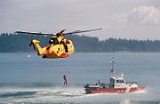
Search and rescue is the search for and provision of aid to people who are in distress or imminent danger.
The general field of search and rescue includes many specialty sub-fields, mostly based upon terrain considerations. These include Mountain rescue
; ground search and rescue, including the use of search and rescue dog
s; urban search and rescue
in cities; combat search and rescue
on the battlefield and air-sea rescue
over water.
merchant ship Vergulde Draeck
off the west coast of Australia
. Survivors sent for help, and in response three separate SAR missions were conducted, without success.
In 1983, Korean Air Lines Flight 007 with 269 occupants was shot down by a Soviet aircraft near Sakhalin. The Soviets sent SAR helicopters and boats to Soviet waters, while a search and rescue operation was initiated by U.S., South Korean, and Japanese ships and aircraft in international waters, but no survivors were found.
, autism
, dementia
, or other conditions that lead to wandering behaviour. Ground search and rescue missions that occur in urban areas should not be confused with "Urban SAR", which in many jurisdictions refers to the location and extraction of people from collapsed buildings or other entrapments.
Some ground search teams also employ search and rescue dog
s.
s have traditionally been the cause of US&R operations, terrorist attacks
and extreme weather such as tornado
es and hurricanes have also resulted in the deployment these resources.
s, floatplane
s, amphibious helicopter
s and non-amphibious helicopters equipped with hoists) and surface vessels to search for and recover survivors of aircraft downed at sea as well as sailors and passengers of sea vessels in distress.
convention. In the Arctic
, SAR responsibilities are since May 2011 governed by the Arctic Search and Rescue Agreement
.
(INSARAG) is a UN Organization that promotes the exchange of information between national Urban Search and Rescue Organizations.
The Australian search and rescue service is provided by AusSAR, which is part of the Australian Maritime Safety Authority
(AMSA).
AusSAR operates a 24 hour Rescue Coordination Centre (RCC) in Canberra
and is responsible for the national coordination of both maritime and aviation search and rescue. AusSAR is also responsible for the management and operation of the Australian ground segment of the Cospas-Sarsat
distress beacon detection system. AusSAR's jurisdiction spans Australia and as well as covering 52.8 million square kilometres of the Indian, Pacific and Southern Oceans.
AusSAR's RCC is staffed by SAR specialists who have a naval, merchant marine, air force, civil aviation
or police service background. The RCC also coordinates medical evacuations, broadcasts maritime safety information and operates the Australian Ship Reporting System (AUSREP).
In coordinating search and rescue missions, AusSAR will call on assistance from organisations as appropriate, such as the Defence forces, Border Protection Command, trained aviation organisations (Civil SAR Units), emergency medical helicopters, state Police services and trained Air Observers from the State Emergency Service
.
There are also other organisations, such as the non-profit Westpac Life Saver Rescue Helicopter Service
that is based at a number of sites around Australia.
 State Police
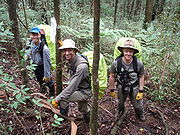
in many states operate state-based search and rescue squads, such as the Victoria Police Search and Rescue Squad
, which provides specialist expertise, advice and practical assistance in land search and rescue on most terrain including snow and vertical cliff search and rescue.
There are also state-based volunteer search and rescue groups such as the Bushwalkers Wilderness Rescue Squad
in New South Wales
and Bush Search and Rescue Victoria in Victoria
. These state-based groups draw searchers from bushwalking, mountaineering and specialist rescue clubs within their State. A few groups respond on horseback as mounted search and rescue
.
The State Emergency Service
is a collection of volunteer-based emergency organisations established in each state or territory which are responsible for many rescue efforts in urban and rural areas and in any rescue that results from flood or storm activity. In rural areas the SES conducts most bush search, vertical and road traffic rescues. In urban areas they assist the police and fire services with USAR.
onshore in cooperation with the State Civil Aviation Administration
in air and the State Maritime Administration
offshore.
are executed by the Belgian Air Component. From its Koksijde Air Base
it operates 5 Westland Sea King Mk.48
helicopters.
are the responsibility of the Para-SAR
, of the Brazilian Air Force
.
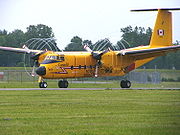 Search and rescue duties in Canada are the responsibility of the Canadian Forces
and Canadian Coast Guard
in conjunction with provincial and municipal governments and private organizations. The Department of National Defence (DND) has overall responsibility for the coordinated search and rescue system. Authority for the provision of maritime SAR is assigned to the Minister of Fisheries and Oceans by the Canada Shipping Act and the Canada Oceans Act. The Royal Canadian Mounted Police (RCMP) and other police forces also coordinate ground search and rescue (GSAR) operations, often using volunteer GSAR teams operating in specific districts under provincial coordinating bodies.
The Canadian Forces has five assigned SAR squadrons:
Plus three Combat Support Squadrons with SAR roles:
Some municipalities and provinces have their own SAR units:
There are also volunteer non-profit associations that conduct SAR in Canada:
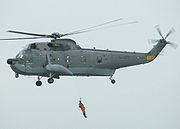 Search and Rescue operators in Denmark
are primarily: Danish air force
Squadron 722, Danish navy air squadron, naval home guard and the Danish Maritime Safety Administration, coordinated by the Joint Rescue Coordination Centre, operated by the navy and air force in the Danish Naval Commands
facilities near Aarhus
. Internationally the Danish works mainly with Germany
, Norway
and Sweden
. With the two latter, the annual exercises Baltic SAREX and
Scan-SAR are conducted.
SAR services in Denmark started in 1957 with seven Sikorsky S-55s. Their piston engines produced only 550 hp and they had limited fuel capacity, so their operational range was short. To increase the operational area, Pembroke
twin-engined fixed-wing aircraft were employed for search. These aircraft would localize the distressed person(s) and the S-55s would then rescue them. The SAR service was started for respond to fighter-plane crashes as 79 aircraft crashed, with 62 dead, in the period 1950-1955., but civilian SAR duties are also conducted.
In 1962 eight ship-based Aérospatiale Alouette III
s were received. These were primarily meant for the ships patrolling the North Atlantic, but also supported the S-55s. In 1964 - 1965 the seven S-55s were replaced with eight Sikorsky S-61A helicopters. This helicopter was originally designed for anti-submarine warfare
, but the Danish variant had the heavy dipping sonar
equipment removed and extra fuel tanks added, giving the helicopters longer range. In 1977 radar
was installed and in 1990 FLIR was added. Further avionics
and navigation systems, including GPS, have also been added over time.
In 1977 the naval air squadron was re-established as an independent squadron in the navy and had their Alouette IIIs replaced with Westland Lynx
helicopters. Their primary operational area was still the North Atlantic, but they continued their support role, although this was reduced with the introduction of the S-61s. In 2006, the first of the S-61s was replaced by one of 14 new AgustaWestland EH101 Merlin helicopters.
In 2007 the Danish Defence held a public display in Horsens
, to raise awareness about rescue services and maritime safety. Maritime SAR is important because Denmark has a relative long coast line to its land mass.
In 2008 the SAR forces in Denmark were equipped with eight EH-101, one or two Lynx, 34 naval home guard vessels and 21 rescue vessels as well as the naval vessels at sea. The EH-101s operate from bases in Aalborg
, Skrydstrup and Roskilde
. When the sea water temperatures are low a helicopter is also deployed to the island of Bornholm in the Baltic Sea
. The Lynx operates from Karup
. Maritime vessels are spread out through the entire coastline and on islands. The S-61s and EH-101s have a crew of six: Two pilots
, a navigator
, a flight engineer
, a physician
and a rescue swimmer.
) is the Estonian security authority responsible for the border security. It is the main support organisation for search and rescue missions in Estonia, and operates a small fleet of SAR vessels and helicopters.
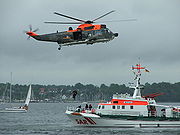 Search and Rescue in German waters is conducted by the Deutsche Gesellschaft zur Rettung Schiffbrüchiger
DGzRS (literally translated: German Society for the Saving of Shipwrecked, more common: German Maritime Rescue Service GMRS) with air support by the German Navy
and the German Air Force
. All incoming requests are coordinated by the Maritime Rescue Coordination Center in Bremen
. The DGzRS is a non-governmental organization entirely supported by donations.
Besides the offshore Search And Rescue services, the German Air Force provides 8 SAR Command Posts on a 24/7 basis with the Bell UH-1D Huey
.
Further, the Technisches Hilfswerk
is a key component of the German disaster relief framework. It is, among other things, regularly involved in urban search and rescue efforts abroad.
. The GFS conducts maritime SAR within the 400 nautical miles (740.8 km) radius of the Hong Kong Flight Information Region (FIR).
As of 2010, the GFS fleet consists of nine aircraft including:
Other civilian rescue units in Hong Kong include:
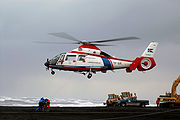 The Icelandic Coast Guard Service is responsible for and supervises search and rescue of aircraft that are considered to be in danger, have crashed or are missing. The Coast Guard Service is responsible for control on the location if the accident took place on the ocean. Isavia is responsible for alerting services. The Icelandic Coast Guard
operates Maritime surveillance aircraft, SAR helicopters and patrol vessels.
The Iceland Association for Search and Rescue is a volunteer organization with more than 100 rescue units which are located in almost every part of the country. All the units contain groups of specially trained individuals.
ICE-SAR
is a specialized rubble rescue squad and was the first rescue squad to arrive in Haiti
following the earthquake of 2010.
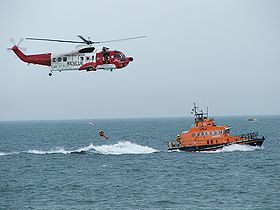 SAR services are provided by a civilian body, the Irish Coast Guard
. It has responsibility for the Irish Search and Rescue Region.
The Royal National Lifeboat Institution RNLI provide the waterborne element of Search and Rescue around the coast of Ireland from 43 lifeboat stations including inland stations at Enniskillen and Lough Derg. In addition, there are community rescue boats at eleven stations: Cahore, Tramore, Bunmahon, Bantry, Derrynane, Banna, Ballybunion, Kilkee, Schull, Limerick City, Corrib/Mask. The coastguard also has inshore rescue boats around the country.
Mountain Rescue in Ireland is provided by 12 voluntary teams based in different regions of the country.
The Irish Defence Forces
are assigned from time to time to carry out search and rescue operations. Ireland's special forces, the Army Ranger Wing have been used for search and rescue operations in difficult or dangerous operations on land and at sea. The Irish Naval Service
frequently assists the other agencies in search and rescue. Its patrol ships at sea and the communications center at Haulbowline
maintain a 24 hour watch on all distress frequencies. The Irish Air Corps
are used for rescue and provide top cover for search and rescue over land or sea.
Home Front Command Search and Rescue (SAR). The unit was established at its current strength in 1984, combining all the specialist units that were involved with SAR until that time.
The SAR unit is a rapid mobilization force and has an airborne transport and deployment capability for its personnel and equipment. The unit is composed of reserve personnel, with a regular cadre based at the Bahad 16
Unit training facility. With a focus on urban SAR, the unit operates specialized equipment, including a locally developed device for locating persons trapped under rubble by detecting seismic and acoustic emissions given off by the victims. The SAR unit also uses Search and rescue dog
s specially trained to locate people buried under debris.
Israeli SAR resources
with means and a complex system of Control Rooms and Secondary Coordination Centres, which are connected together, creating the National System for Search and Rescue (SAR).
The Macau Marine Department and responsible for maritime SAR within Macau's waterways. The Macau Search and Rescue Coordination Centre is under the Vessel Traffic Control Centre of Macao of the Maritime Administration of Macau.
Land and air based SAR is conducted by Macau's Corpo de Bombeiros de Macau
(fire services). Air rescue operations may involve private contractors like Sky Shuttle Helicopters.
(AFM). It is carried out by maritime patrol aircraft, helicopters and vessels under the co-ordination, command and control of the Rescue Co-ordination Centre.
The AFM, in close collaboration with the US Coast Guard, also runs a Search and Rescue Training Centre for International Students http://youtube.com/watch?v=fL7oPxdqvbM in Maritime SAR Mission Co-ordination and Planning. To date more than 30 foreign students from 15 countries including Albania, Cameroon, Croatia, Equatorial Guinea and Kenya have attended these courses.
Malta is also in talks with Libya
about enhancing SAR cooperation between the two countries.
with 40 fast rescue vessels and between 1824 til 2006 answered 36358 distress calls and rescued in that same periode about 79887 people out of distress situations, the Ministry of Transport, Public Works and Water Management and the Navy
and Air Force
. The Navy has No. 7 Squadron which flies the SAR and utility version of the Lynx
maritime helicopter. The RNLAF
has a specialized SAR unit, 303 Squadron, which is equipped with Agusta-Bell AB 412s and based at RNLAF Leeuwarden.
's Search and Rescue Region extends from the South Pole
to the southern border of the Honolulu region, including Norfolk, Tonga, Samoa, and Cook Islands
.
Smaller searches are controlled by the local police
, who call on LandSAR for land-based operations, such as for lost hikers
, and the Royal New Zealand Coastguard
for coastal maritime incidents. Larger maritime search and rescue events, as well as reports of overdue aircraft, fall under the control of the Rescue Coordination Centre New Zealand (RCCNZ), based in Avalon
, which coordinates response from local coastguard, helicopter operators, merchant marine, air force and naval resources.
Other resources:
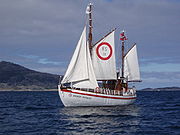 Norsk Selskab til Skibbrudnes Redning
, also called the Redningsselskapet (English: Norwegian Society for Sea Rescue (NSSR)), is Norway's maritime rescue service. They have 43 search and rescue boats based from Oslo in the south to Båtsfjord in the north. Thirteen of these boats are operated by volunteers.
The NSSR was founded on 9 July 1891, with a clearly defined goal – to save lives at sea. The NSSR is a humanitarian organization aiming at saving lives and recovering property at sea. Maintaining rescue services along the Norwegian coast, and neighbouring sea areas where such services may be necessary. The NSSR also runs an information service and educational programs designed to improve safety for boaters. The first rescue boats, the Colin Archer
-class, were introduced in 1893. They were powered by only by sails and oars. NSSR’s boats and crew have saved over 6,200 people. More than 500,000 people have received assistance.
The search and rescue helicopters are operated by the Royal Norwegian Air Force
(RNoAF), who fly 12 Westland Sea King
s. The Sea Kings are due to be replaced within 2020
. The Portuguese Navy
is responsible for all sea rescues, the Portuguese Air Force
for all the rescues originating within the airspace, including aircraft crashes and the Autoridade Nacional de Protecção Civil (ANPC) for all inland rescues. All of the above coordinate closely with each other providing a comprehensive search and rescue service.
The Portuguese area of responsibility is the second largest in the world, only to Canada's. It compromises the Lisbon Flight Information Region
(FIR) and Santa Maria FIR.
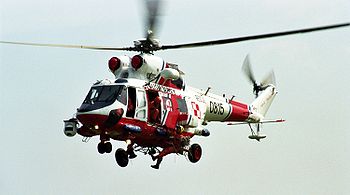 In Poland most search and rescue operations are undertaken by the airborne units of the Polish Armed Forces
. The Navy currently has the largest SAR fleet of helicopters and also operates a number of small vessels for the purpose of rescuing crewmen of stricken ships. There is also, however a semi-governmental organisation known as the 'Morska Służba Poszukiwania i Ratownictwa' (Maritime Search and Rescue Service) which provides the vast majority of seaborne services to vessels in distress; the service is currently (as of 2010) in the process of overhauling and replacing a large portion of its fleet of lifeboat
s.
Aviation and maritime incidents are the responsibility of the South African Search and Rescue Organization (SASAR). SASAR is a voluntary organization that functions under the auspices of the Department of Transport. Its main role is to search for, assist and carry out rescue operations for the survivors of aircraft or vessel accidents. Depending on the nature of the accident, the RCC's (ARCC or MRCC) coordinate the search and rescue missions. These operations are carried out by other government departments, non governmental organizations, commercial/private organizations and voluntary organizations.
Local resources:
is the main organization, and has overall responsibility for the maritime search and rescue, that also coordinates the SAR efforts with other agencies:
is responsible for maritime SAR in Swedish waters.
.jpg) REGA
REGA
(Schweizerische REttungsflugwacht / Garde Aérienne / Guardia Aerea) is the air rescue service which provides emergency medical assistance in Switzerland
, notably in mountains but also in cases of life-threatening emergencies elsewhere. They will also return a citizen to Switzerland from a foreign country if they are in need of urgent medical care. Rega was established on 27 April 1952 by Dr. Rudolf Bucher, who thought that the Swiss rescue organisation needed a specialised air sub-section.
search and rescue is conducted by the State Search and Rescue Aviation Service of the Ministry of Emergencies of Ukraine
Ukraviaposhuk.
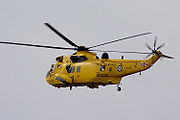
In the UK
, maritime search and rescue is coordinated by HM Coastguard
while aeronautical rescue is delegated through the UK Ministry of Defence to the Royal Air Force, and land-based operations are usually coordinated by the local Police
force. The operation itself is carried out with aircraft from the Royal Navy
, Royal Air Force
or Coastguard, RNLI
lifeboat
s and police, military or volunteer mountain rescue
or ALSAR
(Association of Lowland Search and Rescue) teams. Aeronautical rescue and associated aircraft coordination is carried out by the UK Aeronautical Rescue Coordination Centre (ARCC
) based at RAF Kinloss
in the north of Scotland. The centre is responsible for tasking and coordinating all of the UK's search and rescue helicopter and RAF mountain rescue teams.
In 2006, the government announced controversial plans to effectively privatise provision of search and rescue helicopters in order to replace the aging Sea King
s currently in use, although they have suggested that crews may, at least partially, still be made up of military personnel
. In February 2010, Soteria SAR was announced as the preferred bidder for the UK SAR programme.
Local resources include:
In January 2008, the United States Department of Homeland Security
(DHS) released the National Response Framework
which, serves as the guiding document for a federal response during a national emergency. Search and Rescue is divided into 4 primary elements, while assigning a federal agency with the lead role for each of the 4 elements.
In the US
SAR standards are developed primarily by ASTM International
and the US
NFPA
which are then used by organizations such as the Mountain Rescue Association (MRA), the US
National Association of Search and Rescue (NASAR), and the US
NFPA
to develop training that will meet or exceed those standards. Within ASTM International
, most standards of relevance to SAR are developed by Committee F32 on Search and Rescue. Formed in 1988, the committee had 85 current members and jurisdiction of 38 approved standards.
, the Department of Rescue is directly under the command of Ministry of Defence
. The Department of Rescue was established in 2004 with roles including search, rescue and disaster relief.
In addition, the Vietnam Firefighting Force is another rescue force which is responsible for rescuing people during fires. The force is under command of the Ministry of Public Security.
The general field of search and rescue includes many specialty sub-fields, mostly based upon terrain considerations. These include Mountain rescue
Mountain rescue
Mountain rescue refers to search and rescue activities that occur in a mountainous environment, although the term is sometimes also used to apply to search and rescue in other wilderness environments. The difficult and remote nature of the terrain in which mountain rescue often occurs has resulted...
; ground search and rescue, including the use of search and rescue dog
Search and rescue dog
The use of dogs in search and rescue is a valuable component in wilderness tracking, natural disasters, mass casualty events, and in locating missing people. Dedicated handlers and well-trained dogs are required for the use of dogs to be effective in search efforts...
s; urban search and rescue
Urban search and rescue
Urban search and rescue involves the location, extrication, and initial medical stabilization of victims trapped in confined spaces due to natural disasters, structural collapse, transportation accidents, mines and collapsed trenches.USAR teams in different countries may be organised in a...
in cities; combat search and rescue
Combat search and rescue
Combat search and rescue are search and rescue operations that are carried out during war that are within or near combat zones.A CSAR mission may be carried out by a task force of helicopters, ground-attack aircraft, tankers and an airborne command post...
on the battlefield and air-sea rescue
Air-sea rescue
Air-sea rescue is the coordinated search and rescue of the survivors of emergency water landings as well as people who have survived the loss of their sea-going vessel. ASR can involve a wide variety of resources including seaplanes, helicopters, submarines, rescue boats and ships...
over water.
Definitions
There are many different definitions of search and rescue, depending on the agency involved.- Canadian ForcesCanadian ForcesThe Canadian Forces , officially the Canadian Armed Forces , are the unified armed forces of Canada, as constituted by the National Defence Act, which states: "The Canadian Forces are the armed forces of Her Majesty raised by Canada and consist of one Service called the Canadian Armed Forces."...
: "Search and Rescue comprises the search for, and provision of aid to, persons, ships or other craft which are, or are feared to be, in distress or imminent danger."
- United States Coast GuardUnited States Coast GuardThe United States Coast Guard is a branch of the United States Armed Forces and one of the seven U.S. uniformed services. The Coast Guard is a maritime, military, multi-mission service unique among the military branches for having a maritime law enforcement mission and a federal regulatory agency...
: "The use of available resources to assist persons or property in potential or actual distress."
- United States Defense Department: A search is "an operation normally coordinated by a Rescue Coordination Center (RCC) or rescue sub-center, using available personnel and facilities to locate persons in distress" and rescue is "an operation to retrieve persons in distress, provide for their initial medical or other needs, and deliver them to a place of safety."
History
One of the world's earliest well documented SAR efforts ensued following the 1656 wreck of the DutchNetherlands
The Netherlands is a constituent country of the Kingdom of the Netherlands, located mainly in North-West Europe and with several islands in the Caribbean. Mainland Netherlands borders the North Sea to the north and west, Belgium to the south, and Germany to the east, and shares maritime borders...
merchant ship Vergulde Draeck
Vergulde Draeck
The Vergulde Draeck was a Dutch East India Company ship of the seventeenth century. She sailed from Texel bound for Batavia , under Pieter Albertsz and was carrying trade goods and eight chests of silver worth 78,6000 guilders...
off the west coast of Australia
Australia
Australia , officially the Commonwealth of Australia, is a country in the Southern Hemisphere comprising the mainland of the Australian continent, the island of Tasmania, and numerous smaller islands in the Indian and Pacific Oceans. It is the world's sixth-largest country by total area...
. Survivors sent for help, and in response three separate SAR missions were conducted, without success.
In 1983, Korean Air Lines Flight 007 with 269 occupants was shot down by a Soviet aircraft near Sakhalin. The Soviets sent SAR helicopters and boats to Soviet waters, while a search and rescue operation was initiated by U.S., South Korean, and Japanese ships and aircraft in international waters, but no survivors were found.
Mountain rescue
Mountain rescue relates to search and rescue operations specifically in rugged and mountainous terrain.Ground search and rescue
Ground search and rescue is the search for persons who are lost or in distress on land or inland waterways. Traditionally associated with wilderness zones, ground search and rescue services are increasingly required in urban and suburban areas to locate persons with Alzheimer's diseaseAlzheimer's disease
Alzheimer's disease also known in medical literature as Alzheimer disease is the most common form of dementia. There is no cure for the disease, which worsens as it progresses, and eventually leads to death...
, autism
Autism
Autism is a disorder of neural development characterized by impaired social interaction and communication, and by restricted and repetitive behavior. These signs all begin before a child is three years old. Autism affects information processing in the brain by altering how nerve cells and their...
, dementia
Dementia
Dementia is a serious loss of cognitive ability in a previously unimpaired person, beyond what might be expected from normal aging...
, or other conditions that lead to wandering behaviour. Ground search and rescue missions that occur in urban areas should not be confused with "Urban SAR", which in many jurisdictions refers to the location and extraction of people from collapsed buildings or other entrapments.
Some ground search teams also employ search and rescue dog
Search and rescue dog
The use of dogs in search and rescue is a valuable component in wilderness tracking, natural disasters, mass casualty events, and in locating missing people. Dedicated handlers and well-trained dogs are required for the use of dogs to be effective in search efforts...
s.
Urban search and rescue
Urban search and rescue (US&R), also referred to as Heavy Urban Search and Rescue (HUSAR), is the location and rescue of persons from collapsed buildings or other urban and industrial entrapments. Due to the specialized nature of the work, most teams are multi-disciplinary and include personnel from police, fire and emergency medical services. Unlike traditional ground search and rescue workers, most US&R responders also have basic training in structural collapse and the dangers associated with live electrical wires, broken natural gas lines and other hazards. While earthquakeEarthquake
An earthquake is the result of a sudden release of energy in the Earth's crust that creates seismic waves. The seismicity, seismism or seismic activity of an area refers to the frequency, type and size of earthquakes experienced over a period of time...
s have traditionally been the cause of US&R operations, terrorist attacks
Terrorism
Terrorism is the systematic use of terror, especially as a means of coercion. In the international community, however, terrorism has no universally agreed, legally binding, criminal law definition...
and extreme weather such as tornado
Tornado
A tornado is a violent, dangerous, rotating column of air that is in contact with both the surface of the earth and a cumulonimbus cloud or, in rare cases, the base of a cumulus cloud. They are often referred to as a twister or a cyclone, although the word cyclone is used in meteorology in a wider...
es and hurricanes have also resulted in the deployment these resources.
Combat search and rescue
Combat search and rescue is search and rescue operations that are carried out during war that are within or near combat zones.Air-sea rescue
Air-sea rescue (ASR) refers to the combined use of aircraft (such as flying boatFlying boat
A flying boat is a fixed-winged seaplane with a hull, allowing it to land on water. It differs from a float plane as it uses a purpose-designed fuselage which can float, granting the aircraft buoyancy. Flying boats may be stabilized by under-wing floats or by wing-like projections from the fuselage...
s, floatplane
Floatplane
A floatplane is a type of seaplane, with slender pontoons mounted under the fuselage; only the floats of a floatplane normally come into contact with water, with the fuselage remaining above water...
s, amphibious helicopter
Amphibious helicopter
An amphibious helicopter is a helicopter that is intended to rest and take off from either land or water. Amphibious helicopters are used for a variety of specialized purposes including air-sea rescue, marine salvage and oceanography, in addition to other tasks that can be accomplished with any...
s and non-amphibious helicopters equipped with hoists) and surface vessels to search for and recover survivors of aircraft downed at sea as well as sailors and passengers of sea vessels in distress.
International waters
International waters are divided into various regions according to the SOLASInternational Convention for the Safety of Life at Sea
The International Convention for the Safety of Life at Sea is an international maritime safety treaty. The SOLAS Convention in its successive forms is generally regarded as the most important of all international treaties concerning the safety of merchant ships.- History :The first version of the...
convention. In the Arctic
Arctic
The Arctic is a region located at the northern-most part of the Earth. The Arctic consists of the Arctic Ocean and parts of Canada, Russia, Greenland, the United States, Norway, Sweden, Finland, and Iceland. The Arctic region consists of a vast, ice-covered ocean, surrounded by treeless permafrost...
, SAR responsibilities are since May 2011 governed by the Arctic Search and Rescue Agreement
Arctic Search and Rescue Agreement
The Agreement on Cooperation on Aeronautical and Maritime Search and Rescue in the Arctic, or in short the Arctic Search and Rescue Agreement, is an international treaty concluded among the member states of the Arctic Council – Canada, Denmark, Finland, Iceland, Norway, Russia, Sweden and the...
.
United Nations
International Search and Rescue Advisory GroupInternational Search and Rescue Advisory Group
The International Search and Rescue Advisory Group is a network of disaster-prone and disaster-responding countries and organizations dedicated to urban search and rescue and operational field coordination...
(INSARAG) is a UN Organization that promotes the exchange of information between national Urban Search and Rescue Organizations.
Australia
- National
The Australian search and rescue service is provided by AusSAR, which is part of the Australian Maritime Safety Authority
Australian Maritime Safety Authority
Australian Maritime Safety Authority is responsible, on behalf of the Commonwealth Government of Australia, for the regulation and safety oversight of Australia's shipping fleet and management of Australia's international maritime obligations...
(AMSA).
AusSAR operates a 24 hour Rescue Coordination Centre (RCC) in Canberra
Canberra
Canberra is the capital city of Australia. With a population of over 345,000, it is Australia's largest inland city and the eighth-largest city overall. The city is located at the northern end of the Australian Capital Territory , south-west of Sydney, and north-east of Melbourne...
and is responsible for the national coordination of both maritime and aviation search and rescue. AusSAR is also responsible for the management and operation of the Australian ground segment of the Cospas-Sarsat
Cospas-Sarsat
Cospas-Sarsat is an international satellite-based search and rescue distress alert detection and information distribution system, established by Canada, France, the United States, and the former Soviet Union in 1979. It is best known as the system that detects and locates emergency beacons...
distress beacon detection system. AusSAR's jurisdiction spans Australia and as well as covering 52.8 million square kilometres of the Indian, Pacific and Southern Oceans.
AusSAR's RCC is staffed by SAR specialists who have a naval, merchant marine, air force, civil aviation
Civil aviation
Civil aviation is one of two major categories of flying, representing all non-military aviation, both private and commercial. Most of the countries in the world are members of the International Civil Aviation Organization and work together to establish common standards and recommended practices...
or police service background. The RCC also coordinates medical evacuations, broadcasts maritime safety information and operates the Australian Ship Reporting System (AUSREP).
In coordinating search and rescue missions, AusSAR will call on assistance from organisations as appropriate, such as the Defence forces, Border Protection Command, trained aviation organisations (Civil SAR Units), emergency medical helicopters, state Police services and trained Air Observers from the State Emergency Service
State Emergency Service
A State Emergency Service is an Australian volunteer organisation that provides emergency help during and after declared disasters. The SES is also the primary or secondary agency for emergencies, such as storm damage,flood damage, building damage, traffic hazards and road crash rescue...
.
There are also other organisations, such as the non-profit Westpac Life Saver Rescue Helicopter Service
Westpac Life Saver Rescue Helicopter Service
The Westpac Life Saver Rescue Helicopter Service was founded in 1973 by Surf Life Saving Australia. Since this time, the Service has carried out more than 50,000 flights ranging from patient transfers to search and rescue missions...
that is based at a number of sites around Australia.
- State
State police
State police are a type of sub-national territorial police force, particularly in Australia and the United States. Some other countries have analogous police forces, such as the provincial police in some Canadian provinces, while in other places, the same responsibilities are held by national...
in many states operate state-based search and rescue squads, such as the Victoria Police Search and Rescue Squad
Victoria Police Search and Rescue Squad
The Search and Rescue Squad is the Search and Rescue group of the Victoria Police that provides specialist expertise, advice and practical assistance in land search and rescue...
, which provides specialist expertise, advice and practical assistance in land search and rescue on most terrain including snow and vertical cliff search and rescue.
There are also state-based volunteer search and rescue groups such as the Bushwalkers Wilderness Rescue Squad
Bushwalkers Wilderness Rescue Squad
The Bushwalkers Wilderness Rescue Squad is a remote area search and rescue service in New South Wales, Australia. The Squad is made up of fit and experienced volunteers who donate their time as a service to the community. The B.W.R.S...
in New South Wales
New South Wales
New South Wales is a state of :Australia, located in the east of the country. It is bordered by Queensland, Victoria and South Australia to the north, south and west respectively. To the east, the state is bordered by the Tasman Sea, which forms part of the Pacific Ocean. New South Wales...
and Bush Search and Rescue Victoria in Victoria
Victoria (Australia)
Victoria is the second most populous state in Australia. Geographically the smallest mainland state, Victoria is bordered by New South Wales, South Australia, and Tasmania on Boundary Islet to the north, west and south respectively....
. These state-based groups draw searchers from bushwalking, mountaineering and specialist rescue clubs within their State. A few groups respond on horseback as mounted search and rescue
Mounted search and rescue
Mounted search and rescue is a specialty within search and rescue , using horses as search partners and for transportation to search for missing persons. SAR responders on horseback are primarily a search resource, but also can provide off-road logistics support and transportation...
.
The State Emergency Service
State Emergency Service
A State Emergency Service is an Australian volunteer organisation that provides emergency help during and after declared disasters. The SES is also the primary or secondary agency for emergencies, such as storm damage,flood damage, building damage, traffic hazards and road crash rescue...
is a collection of volunteer-based emergency organisations established in each state or territory which are responsible for many rescue efforts in urban and rural areas and in any rescue that results from flood or storm activity. In rural areas the SES conducts most bush search, vertical and road traffic rescues. In urban areas they assist the police and fire services with USAR.
Azerbaijan
Search and rescue operations in Azerbaijan are managed by the Ministry of Emergency SituationsMinistry of Emergency Situations (Azerbaijan)
Ministry of Emergency Situations of Azerbaijan Republic — is the central executive body within the cabinet of Azerbaijan Republic in charge of protecting the population from natural and manmade disasters...
onshore in cooperation with the State Civil Aviation Administration
State Civil Aviation Administration (Azerbaijan)
The State Civil Aviation Administration of the Republic of Azerbaijan is a governmental agency within the Cabinet of Azerbaijan in charge of regulating activities in the sphere of civil aviation in Azerbaijan Republic. The agency is headed by Arif Mammadov....
in air and the State Maritime Administration
State Maritime Administration (Azerbaijan)
The State Maritime Administration of Azerbaijan Republic is a governmental agency within the Cabinet of Azerbaijan in charge of regulating activities in the maritime sector of Azerbaijan Republic. The agency is headed by Gudrat Gurbanov.-History:...
offshore.
Belgium
Search and rescue duties along the Belgian part of the North SeaNorth Sea
In the southwest, beyond the Straits of Dover, the North Sea becomes the English Channel connecting to the Atlantic Ocean. In the east, it connects to the Baltic Sea via the Skagerrak and Kattegat, narrow straits that separate Denmark from Norway and Sweden respectively...
are executed by the Belgian Air Component. From its Koksijde Air Base
Koksijde Air Base
Koksijde Air Base is a Belgian Air Component facility in Koksijde, Belgium. 40 sqn operating 5 Westland Sea King Mk.48 helicopters for search and rescue duties. Also based at Koksijde Air Base are Aérospatiale Alouette III helicopters...
it operates 5 Westland Sea King Mk.48
Westland Sea King
The Westland WS-61 Sea King is a British licence-built version of the American Sikorsky S-61 helicopter of the same name, built by Westland Helicopters. The aircraft differs considerably from the American version, with Rolls-Royce Gnome engines , British made anti-submarine warfare systems and a...
helicopters.
Brazil
Search and rescue duties in BrazilBrazil
Brazil , officially the Federative Republic of Brazil , is the largest country in South America. It is the world's fifth largest country, both by geographical area and by population with over 192 million people...
are the responsibility of the Para-SAR
Para-SAR
The Esquadrão Aeroterrestre de Salvamento , known by its nickname Para-SAR, is a Brazilian Air Force airborne search and rescue squadron, based in the city of Rio de Janeiro....
, of the Brazilian Air Force
Brazilian Air Force
The Brazilian Air Force is the air branch of the Brazilian Armed Forces and one of the three national uniformed services. The FAB was formed when the Army and Navy air branch were merged into a single military force initially called "National Air Forces"...
.
Canada
Canadian Forces
The Canadian Forces , officially the Canadian Armed Forces , are the unified armed forces of Canada, as constituted by the National Defence Act, which states: "The Canadian Forces are the armed forces of Her Majesty raised by Canada and consist of one Service called the Canadian Armed Forces."...
and Canadian Coast Guard
Canadian Coast Guard
The Canadian Coast Guard is the coast guard of Canada. It is a federal agency responsible for providing maritime search and rescue , aids to navigation, marine pollution response, marine radio, and icebreaking...
in conjunction with provincial and municipal governments and private organizations. The Department of National Defence (DND) has overall responsibility for the coordinated search and rescue system. Authority for the provision of maritime SAR is assigned to the Minister of Fisheries and Oceans by the Canada Shipping Act and the Canada Oceans Act. The Royal Canadian Mounted Police (RCMP) and other police forces also coordinate ground search and rescue (GSAR) operations, often using volunteer GSAR teams operating in specific districts under provincial coordinating bodies.
The Canadian Forces has five assigned SAR squadrons:
- 103 Search and Rescue Squadron103 Search and Rescue Squadron103 Search and Rescue Squadron of the Royal Canadian Air Force is a search and rescue unit based at 9 Wing Gander on the Canadian island of Newfoundland. The squadron is responsible for a large area covering the offshore waters of Canada's Exclusive Economic Zone in the Atlantic ocean and inland...
, CFB GanderCFB GanderCanadian Forces Base Gander , is a Canadian Forces Base located in Gander, Newfoundland and Labrador. It is operated as an air force base by the Royal Canadian Air Force and is home to air/marine search and rescue operations that cover a vast swath of the western North Atlantic and southern Arctic...
, CH-149 CormorantCH-149 CormorantThe AgustaWestland CH-149 Cormorant is the Canadian Forces designation for the AgustaWestland AW101 , a helicopter used for air-sea rescue in Canada... - 413 Transport and Rescue SquadronNo. 413 Squadron RCAF413 Transport and Rescue Squadron is an air force squadron of the Canadian Forces. It was originally a flying boat squadron of the Royal Canadian Air Force during the Second World War...
, CFB GreenwoodCFB GreenwoodCanadian Forces Base Greenwood , commonly referred to as "14 Wing Greenwood" or CFB Greenwood, is a Canadian Forces Base located in Greenwood, Nova Scotia. It is primarily operated as an air force base by the Royal Canadian Air Force and is one of two bases in the country using the CP-140 Aurora...
, CH-149 CormorantCH-149 CormorantThe AgustaWestland CH-149 Cormorant is the Canadian Forces designation for the AgustaWestland AW101 , a helicopter used for air-sea rescue in Canada...
& CC-130 Hercules - 424 Transport and Rescue SquadronNo. 424 Squadron RCAF424 "City of Hamilton" Transport and Rescue Squadron is a search and rescue/transport squadron of the Canadian Forces and based out of 9 Hangar with 8 Wing CFB Trenton.-History:...
, CFB TrentonCFB TrentonCanadian Forces Base Trenton , is a Canadian Forces base located northeast of Trenton, Ontario. It is operated as an air force base by the Royal Canadian Air Force and is the hub for air transport operations in Canada and abroad...
, CH-146 GriffonCH-146 GriffonThe Bell CH-146 Griffon is the Canadian military variant of the Bell 412EP, a multi-use utility helicopter. The CH-146 is used in a wide variety of roles, including aerial firepower, reconnaissance, search and rescue and aero-mobility tasks....
& CC-130 Hercules - 435 Transport and Rescue SquadronNo. 435 Squadron RCAF435 Transport and Rescue Squadron is a unit of the Royal Canadian Air Force, based in Winnipeg, Manitoba, Canada.-Operations:The squadron flies the CC-130 Hercules H-model tanker/transport in the airlift and search and rescue roles...
, CFB WinnipegCFB WinnipegCanadian Forces Base Winnipeg , is a Canadian Forces Base located within the City of Winnipeg, Manitoba. Co-located at the Winnipeg James Armstrong Richardson International Airport, CFB Winnipeg is home to many flight operations support divisions, as well as several training schools...
, CC-130 Hercules - 442 Transport and Rescue SquadronNo. 442 Squadron RCAF442 Transport and Rescue Squadron is a unit of the Royal Canadian Air Force of the Canadian Forces. Based at CFB Comox on Vancouver Island it provides Search and Rescue coverage for the West Coast of Canada...
, CFB ComoxCFB ComoxCanadian Forces Base Comox , commonly referred to as CFB Comox, is a Canadian Forces Base located north northeast of Comox, British Columbia. It is primarily operated as an air force base by the Royal Canadian Air Force and is one of two bases in the country using the CP-140 Aurora...
, CH-149 CormorantCH-149 CormorantThe AgustaWestland CH-149 Cormorant is the Canadian Forces designation for the AgustaWestland AW101 , a helicopter used for air-sea rescue in Canada...
& CC-115 Buffalo
Plus three Combat Support Squadrons with SAR roles:
- 417 Combat Support SquadronNo. 417 Squadron RCAF417 Combat Support Squadron is an Air Force unit with the Canadian Forces. Based at CFB Cold Lake it provides helicopter support to the base operations. Since 1994, it has also provided Search and Rescue.-History:...
, CFB Cold LakeCFB Cold LakeCanadian Forces Base Cold Lake , commonly referred to as CFB Cold Lake, is a Canadian Forces Base located within the City of Cold Lake, Alberta. It is operated as an air force base by the Royal Canadian Air Force and is one of two bases in the country using the CF-18 Hornet fighter/interceptor...
, CH-146 GriffonCH-146 GriffonThe Bell CH-146 Griffon is the Canadian military variant of the Bell 412EP, a multi-use utility helicopter. The CH-146 is used in a wide variety of roles, including aerial firepower, reconnaissance, search and rescue and aero-mobility tasks.... - 439 Combat Support SquadronNo. 439 Squadron RCAFNo. 439 Squadron RCAF was a unit of the Royal Canadian Air Force, formed during World War II.439 Fighter Bomber Squadron was formed on December 31, 1943, at Wellingore, England, incorporating Aircraft and personnel from 123 Army Co-operation Squadron. They spent the war in England, France, Belgium,...
, CFB BagotvilleCFB BagotvilleCanadian Forces Base Bagotville , commonly referred to as CFB Bagotville, is a Canadian Forces Base located west of Bagotville in the city of Saguenay, Quebec. It is operated as an air force base by the Royal Canadian Air Force and is one of two bases in the country using the CF-18 Hornet...
, CH-146 GriffonCH-146 GriffonThe Bell CH-146 Griffon is the Canadian military variant of the Bell 412EP, a multi-use utility helicopter. The CH-146 is used in a wide variety of roles, including aerial firepower, reconnaissance, search and rescue and aero-mobility tasks.... - 444 Combat Support Squadron, CFB Goose BayCFB Goose BayCanadian Forces Base Goose Bay , is a Canadian Forces Base located in the town of Happy Valley-Goose Bay, Newfoundland and Labrador....
, CH-146 GriffonCH-146 GriffonThe Bell CH-146 Griffon is the Canadian military variant of the Bell 412EP, a multi-use utility helicopter. The CH-146 is used in a wide variety of roles, including aerial firepower, reconnaissance, search and rescue and aero-mobility tasks....
Some municipalities and provinces have their own SAR units:
- Halton Regional Police ServiceHalton Regional Police ServiceThe Halton Regional Police Service provides policing service for the Regional Municipality of Halton, which is located at the western end of the Greater Toronto Area , in Ontario, Canada. Halton Region encompasses the City of Burlington and the Towns of Oakville, Milton and Halton Hills...
Marine Unit - using marine craft on Lake OntarioLake OntarioLake Ontario is one of the five Great Lakes of North America. It is bounded on the north and southwest by the Canadian province of Ontario, and on the south by the American state of New York. Ontario, Canada's most populous province, was named for the lake. In the Wyandot language, ontarío means... - Toronto Police ServiceToronto Police ServiceThe Toronto Police Service , formerly the Metropolitan Toronto Police, is the police service for the city of Toronto, Ontario, Canada. It is the largest municipal police service in Canada and second largest police force in Canada after the Royal Canadian Mounted Police...
Marine Unit - using marine craft on Lake OntarioLake OntarioLake Ontario is one of the five Great Lakes of North America. It is bounded on the north and southwest by the Canadian province of Ontario, and on the south by the American state of New York. Ontario, Canada's most populous province, was named for the lake. In the Wyandot language, ontarío means... - Peel Regional PolicePeel Regional PolicePeel Regional Police provides police services for Peel Region in Ontario, Canada. It is the second largest municipal police service in Ontario after the Toronto Police Service and third largest municipal force in Canada with 1,900 uniformed members and close to 800 support staff.Peel Region...
Marine Unit - using marine craft on Lake OntarioLake OntarioLake Ontario is one of the five Great Lakes of North America. It is bounded on the north and southwest by the Canadian province of Ontario, and on the south by the American state of New York. Ontario, Canada's most populous province, was named for the lake. In the Wyandot language, ontarío means...
and rivers in Peel Region - Ontario Provincial PoliceOntario Provincial PoliceThe Ontario Provincial Police is the Provincial Police service for the province of Ontario, Canada.-Overview:The OPP is the the largest deployed police force in Ontario, and the second largest in Canada. The service is responsible for providing policing services throughout the province in areas...
Marine Unit - using marine craft on Great LakesGreat LakesThe Great Lakes are a collection of freshwater lakes located in northeastern North America, on the Canada – United States border. Consisting of Lakes Superior, Michigan, Huron, Erie, and Ontario, they form the largest group of freshwater lakes on Earth by total surface, coming in second by volume...
(excluding Lake Michigan) and Georgian BayGeorgian BayGeorgian Bay is a large bay of Lake Huron, located entirely within Ontario, Canada... - Durham Regional PoliceDurham Regional PoliceThe Durham Regional Police Service is the police service operated by and serving the Regional Municipality of Durham, Ontario, Canada. The force serves the following local municipalities, with a combined population of 589,850:* Pickering, Ontario...
Marine Unit - using marine craft on Lake OntarioLake OntarioLake Ontario is one of the five Great Lakes of North America. It is bounded on the north and southwest by the Canadian province of Ontario, and on the south by the American state of New York. Ontario, Canada's most populous province, was named for the lake. In the Wyandot language, ontarío means...
and lakes within Durham Region - York Regional PoliceYork Regional PoliceYork Regional Police is a law enforcement organization that serves over 1.1 million residents in the York Region, Ontario, Canada, located north of Toronto...
Marine Unit - using marine craft on Lake SimcoeLake SimcoeLake Simcoe is a lake in Southern Ontario, Canada, the fourth-largest lake wholly in the province, after Lake Nipigon, Lac Seul, and Lake Nipissing. At the time of the first European contact in the 17th century the lake was called Ouentironk by the Huron natives... - Niagara Regional Police Marine Unit - using marine craft on Niagara RiverNiagara RiverThe Niagara River flows north from Lake Erie to Lake Ontario. It forms part of the border between the Province of Ontario in Canada and New York State in the United States. There are differing theories as to the origin of the name of the river...
and Lake OntarioLake OntarioLake Ontario is one of the five Great Lakes of North America. It is bounded on the north and southwest by the Canadian province of Ontario, and on the south by the American state of New York. Ontario, Canada's most populous province, was named for the lake. In the Wyandot language, ontarío means... - Vancouver Police DepartmentVancouver Police DepartmentThe Vancouver Police Department is the police force for the City of Vancouver in British Columbia, Canada. It is one of several police departments within the Metro Vancouver Area and is the second largest police force in the province after RCMP "E" Division.VPD was the first Canadian police force...
- using marine craft on waterways around the City of Vancouver - Heavy Urban Search and Rescue (TorontoTorontoToronto is the provincial capital of Ontario and the largest city in Canada. It is located in Southern Ontario on the northwestern shore of Lake Ontario. A relatively modern city, Toronto's history dates back to the late-18th century, when its land was first purchased by the British monarchy from...
) - using land base equipment - Brockville Police ServiceBrockville Police ServiceThe Brockville Police Service provides policing services for Brockville, the community of the Thousand Islands region on the St. Lawrence River in Eastern Ontario, Canada. Known as the "City of the 1000 Islands", Brockville is located directly opposite Morristown, New York on the north shore of...
Marine Patrol Unit - using a boat on the St. Lawrence River
There are also volunteer non-profit associations that conduct SAR in Canada:
- Canada Task Force 2, AlbertaAlbertaAlberta is a province of Canada. It had an estimated population of 3.7 million in 2010 making it the most populous of Canada's three prairie provinces...
- Civil Air Search and Rescue AssociationCivil Air Search and Rescue AssociationThe Civil Air Search and Rescue Association or CASARA, is a Canada-wide volunteer aviation association dedicated to the promotion of aviation safety, and to the provision of air search support services to Canada's National Search and Rescue Program.*...
- Grande Prairie Technical Search and Rescue Association, AlbertaAlbertaAlberta is a province of Canada. It had an estimated population of 3.7 million in 2010 making it the most populous of Canada's three prairie provinces...
- North Shore RescueNorth Shore RescueNorth Shore Rescue is a non-profit organization dedicated to wilderness search and rescue around Vancouver, British Columbia, Canada. It consists of a team of approximately 40 volunteers who perform approximately 90 search and rescue operations each year, mostly in the rugged, steep, and thickly...
, British ColumbiaBritish ColumbiaBritish Columbia is the westernmost of Canada's provinces and is known for its natural beauty, as reflected in its Latin motto, Splendor sine occasu . Its name was chosen by Queen Victoria in 1858...
. - Québec Secours, QuébecQuebecQuebec or is a province in east-central Canada. It is the only Canadian province with a predominantly French-speaking population and the only one whose sole official language is French at the provincial level....
. - River Valley Ground Search and Rescue, New BrunswickNew BrunswickNew Brunswick is one of Canada's three Maritime provinces and is the only province in the federation that is constitutionally bilingual . The provincial capital is Fredericton and Saint John is the most populous city. Greater Moncton is the largest Census Metropolitan Area...
- Roberts Bank Lifeboat - Delta, BC
- Search and Rescue Global 1 - Ottawa, ON
- Search and Rescue Manitoba (SARMAN), ManitobaManitobaManitoba is a Canadian prairie province with an area of . The province has over 110,000 lakes and has a largely continental climate because of its flat topography. Agriculture, mostly concentrated in the fertile southern and western parts of the province, is vital to the province's economy; other...
- Vancouver Urban Search and Rescue (Canadian Task Force One), British ColumbiaBritish ColumbiaBritish Columbia is the westernmost of Canada's provinces and is known for its natural beauty, as reflected in its Latin motto, Splendor sine occasu . Its name was chosen by Queen Victoria in 1858...
- York Sunbury Search & Rescue - New BrunswickNew BrunswickNew Brunswick is one of Canada's three Maritime provinces and is the only province in the federation that is constitutionally bilingual . The provincial capital is Fredericton and Saint John is the most populous city. Greater Moncton is the largest Census Metropolitan Area...
Denmark
Denmark
Denmark is a Scandinavian country in Northern Europe. The countries of Denmark and Greenland, as well as the Faroe Islands, constitute the Kingdom of Denmark . It is the southernmost of the Nordic countries, southwest of Sweden and south of Norway, and bordered to the south by Germany. Denmark...
are primarily: Danish air force
Royal Danish Air Force
The Royal Danish Air Force is the air force of Denmark with the capability to undertake homeland defense and homeland security roles as well international operations.-History:...
Squadron 722, Danish navy air squadron, naval home guard and the Danish Maritime Safety Administration, coordinated by the Joint Rescue Coordination Centre, operated by the navy and air force in the Danish Naval Commands
Admiral Danish Fleet
Admiral Danish Fleet is two things:* The English name of Søværnets Operative Kommando , the operationally supreme organisation of the Danish navy.* ADMDANFLT as a person is a kontreadmiral who is the chief of naval operations in Denmark, and as such the...
facilities near Aarhus
Aarhus
Aarhus or Århus is the second-largest city in Denmark. The principal port of Denmark, Aarhus is on the east side of the peninsula of Jutland in the geographical center of Denmark...
. Internationally the Danish works mainly with Germany
Germany
Germany , officially the Federal Republic of Germany , is a federal parliamentary republic in Europe. The country consists of 16 states while the capital and largest city is Berlin. Germany covers an area of 357,021 km2 and has a largely temperate seasonal climate...
, Norway
Norway
Norway , officially the Kingdom of Norway, is a Nordic unitary constitutional monarchy whose territory comprises the western portion of the Scandinavian Peninsula, Jan Mayen, and the Arctic archipelago of Svalbard and Bouvet Island. Norway has a total area of and a population of about 4.9 million...
and Sweden
Sweden
Sweden , officially the Kingdom of Sweden , is a Nordic country on the Scandinavian Peninsula in Northern Europe. Sweden borders with Norway and Finland and is connected to Denmark by a bridge-tunnel across the Öresund....
. With the two latter, the annual exercises Baltic SAREX and
Scan-SAR are conducted.
SAR services in Denmark started in 1957 with seven Sikorsky S-55s. Their piston engines produced only 550 hp and they had limited fuel capacity, so their operational range was short. To increase the operational area, Pembroke
Percival Pembroke
-See also:-Bibliography:* The Illustrated Encyclopedia of Aircraft London: Orbis Publishing, 1985.* Jackson, A.J. British Civil Aircraft since 1919 . London: Putnam, 1974. ISBN 0-370-10014-X....
twin-engined fixed-wing aircraft were employed for search. These aircraft would localize the distressed person(s) and the S-55s would then rescue them. The SAR service was started for respond to fighter-plane crashes as 79 aircraft crashed, with 62 dead, in the period 1950-1955., but civilian SAR duties are also conducted.
In 1962 eight ship-based Aérospatiale Alouette III
Aérospatiale Alouette III
The Aérospatiale Alouette III is a single-engine, light utility helicopter developed by Sud Aviation. It was manufactured by Aérospatiale of France, and under licence by Hindustan Aeronautics Limited in India as Hal Chetak and Industria Aeronautică Română in Romania.The Alouette III is the...
s were received. These were primarily meant for the ships patrolling the North Atlantic, but also supported the S-55s. In 1964 - 1965 the seven S-55s were replaced with eight Sikorsky S-61A helicopters. This helicopter was originally designed for anti-submarine warfare
Anti-submarine warfare
Anti-submarine warfare is a branch of naval warfare that uses surface warships, aircraft, or other submarines to find, track and deter, damage or destroy enemy submarines....
, but the Danish variant had the heavy dipping sonar
Sonar
Sonar is a technique that uses sound propagation to navigate, communicate with or detect other vessels...
equipment removed and extra fuel tanks added, giving the helicopters longer range. In 1977 radar
Radar
Radar is an object-detection system which uses radio waves to determine the range, altitude, direction, or speed of objects. It can be used to detect aircraft, ships, spacecraft, guided missiles, motor vehicles, weather formations, and terrain. The radar dish or antenna transmits pulses of radio...
was installed and in 1990 FLIR was added. Further avionics
Avionics
Avionics are electronic systems used on aircraft, artificial satellites and spacecraft.Avionic systems include communications, navigation, the display and management of multiple systems and the hundreds of systems that are fitted to aircraft to meet individual roles...
and navigation systems, including GPS, have also been added over time.
In 1977 the naval air squadron was re-established as an independent squadron in the navy and had their Alouette IIIs replaced with Westland Lynx
Westland Lynx
The Westland Lynx is a British multi-purpose military helicopter designed and built by Westland Helicopters at its factory in Yeovil. Originally intended as a utility craft for both civil and naval usage, military interest led to the development of both battlefield and naval variants...
helicopters. Their primary operational area was still the North Atlantic, but they continued their support role, although this was reduced with the introduction of the S-61s. In 2006, the first of the S-61s was replaced by one of 14 new AgustaWestland EH101 Merlin helicopters.
In 2007 the Danish Defence held a public display in Horsens
Horsens
Horsens is a Danish city in east Jutland. It is the site of the council of Horsens municipality. The city's population is 53,807 and the Horsens municipality's population is 82,835 ....
, to raise awareness about rescue services and maritime safety. Maritime SAR is important because Denmark has a relative long coast line to its land mass.
In 2008 the SAR forces in Denmark were equipped with eight EH-101, one or two Lynx, 34 naval home guard vessels and 21 rescue vessels as well as the naval vessels at sea. The EH-101s operate from bases in Aalborg
Aalborg Airport
Aalborg Airport is a dual-use airport located in Nørresundby, Denmark, which is northwest of Aalborg. Aalborg Airport is the third largest airport in Denmark with approximately 1.4 million travellers per year.-Duty Free Shopping:...
, Skrydstrup and Roskilde
Roskilde Airport
Roskilde Airport , officially known as Copenhagen Airport, Roskilde , is located 4 nautical miles southeast of Roskilde near the town Tune. It was opened in 1973 as the first of three planned relief airports around Copenhagen. These plans were shelved shortly after, and the two other relief...
. When the sea water temperatures are low a helicopter is also deployed to the island of Bornholm in the Baltic Sea
Baltic Sea
The Baltic Sea is a brackish mediterranean sea located in Northern Europe, from 53°N to 66°N latitude and from 20°E to 26°E longitude. It is bounded by the Scandinavian Peninsula, the mainland of Europe, and the Danish islands. It drains into the Kattegat by way of the Øresund, the Great Belt and...
. The Lynx operates from Karup
Karup Airport
Karup Airport is an airport in Denmark.At the request of some middle-and West Jutland politicians airport, it was opened on 1 November 1965 when the first direct connection between Karup and Copenhagen was opened....
. Maritime vessels are spread out through the entire coastline and on islands. The S-61s and EH-101s have a crew of six: Two pilots
Aviator
An aviator is a person who flies an aircraft. The first recorded use of the term was in 1887, as a variation of 'aviation', from the Latin avis , coined in 1863 by G. de la Landelle in Aviation Ou Navigation Aérienne...
, a navigator
Navigator
A navigator is the person on board a ship or aircraft responsible for its navigation. The navigator's primary responsibility is to be aware of ship or aircraft position at all times. Responsibilities include planning the journey, advising the Captain or aircraft Commander of estimated timing to...
, a flight engineer
Flight engineer
Flight engineers work in three types of aircraft: fixed-wing , rotary wing , and space flight .As airplanes became even larger requiring more engines and complex systems to operate, the workload on the two pilots became excessive during certain critical parts of the flight regime, notably takeoffs...
, a physician
Physician
A physician is a health care provider who practices the profession of medicine, which is concerned with promoting, maintaining or restoring human health through the study, diagnosis, and treatment of disease, injury and other physical and mental impairments...
and a rescue swimmer.
Estonia
The Estonian Border Guard (PiirivalvePiirivalve
The Estonian Border Guard is the Estonian security authority responsible for the border security. It is a military organization, subordinate to the Ministry of the Interior. The Border Guard also assists with Search and Rescue missions. The Estonian Border Guard Aviation Corps provides air...
) is the Estonian security authority responsible for the border security. It is the main support organisation for search and rescue missions in Estonia, and operates a small fleet of SAR vessels and helicopters.
Finland
In Finland the responsible authority for land and inland water SAR is the Fire and the Crisis and the Frontier Guard in the maritime area. These organizations alert and decide on the most suitable response for the location and situation. The country also has several volunteer organizations such as the volunteer fire department (VPK), the Finnish Lifeboat Institution (SMPS) and the Red Cross Finland (SPR).Germany
Deutsche Gesellschaft zur Rettung Schiffbrüchiger
The Deutsche Gesellschaft zur Rettung Schiffbrüchiger or DGzRS is responsible for Search and Rescue in German territorial waters in the North Sea and the Baltic Sea, including the Exclusive Economic Zone.The headquarters and...
DGzRS (literally translated: German Society for the Saving of Shipwrecked, more common: German Maritime Rescue Service GMRS) with air support by the German Navy
German Navy
The German Navy is the navy of Germany and is part of the unified Bundeswehr .The German Navy traces its roots back to the Imperial Fleet of the revolutionary era of 1848 – 52 and more directly to the Prussian Navy, which later evolved into the Northern German Federal Navy...
and the German Air Force
Luftwaffe
Luftwaffe is a generic German term for an air force. It is also the official name for two of the four historic German air forces, the Wehrmacht air arm founded in 1935 and disbanded in 1946; and the current Bundeswehr air arm founded in 1956....
. All incoming requests are coordinated by the Maritime Rescue Coordination Center in Bremen
Bremen
The City Municipality of Bremen is a Hanseatic city in northwestern Germany. A commercial and industrial city with a major port on the river Weser, Bremen is part of the Bremen-Oldenburg metropolitan area . Bremen is the second most populous city in North Germany and tenth in Germany.Bremen is...
. The DGzRS is a non-governmental organization entirely supported by donations.
Besides the offshore Search And Rescue services, the German Air Force provides 8 SAR Command Posts on a 24/7 basis with the Bell UH-1D Huey
UH-1 Iroquois
The Bell UH-1 Iroquois is a military helicopter powered by a single, turboshaft engine, with a two-bladed main rotor and tail rotor. The helicopter was developed by Bell Helicopter to meet the United States Army's requirement for a medical evacuation and utility helicopter in 1952, and first flew...
.
Further, the Technisches Hilfswerk
Technisches Hilfswerk
The Bundesanstalt Technisches Hilfswerk is a civil protection organisation controlled by the German federal government...
is a key component of the German disaster relief framework. It is, among other things, regularly involved in urban search and rescue efforts abroad.
Hong Kong
SAR operations are conducted by the Government Flying Service (GFS) and before 1993 by the Royal Hong Kong Auxiliary Air ForceRoyal Hong Kong Auxiliary Air Force
The Royal Hong Kong Auxiliary Air Force was an auxiliary unit of the United Kingdom Royal Air Force, based in Hong Kong. In preparation for the transfer of sovereignty from the United Kingdom to the People's Republic of China, the unit was disbanded on 1 April 1993.Although technically an armed...
. The GFS conducts maritime SAR within the 400 nautical miles (740.8 km) radius of the Hong Kong Flight Information Region (FIR).
As of 2010, the GFS fleet consists of nine aircraft including:
- 2 BAe Jetstream 41
- 3 Eurocopter Super PumaEurocopter Super PumaThe Eurocopter AS332 Super Puma is a four-bladed, twin-engine, medium-size utility helicopter marketed for both civil and military use. Originally designed and built by Aérospatiale, it is an enlarged and re-engined version of the original Aérospatiale Puma...
(Super Puma L2) - 4 Eurocopter EC155 B1Eurocopter EC 155The Eurocopter EC155 is a long-range medium-lift passenger transport helicopter developed by Eurocopter from the Dauphin family for civil aviation use. It is a twin-engined aircraft and can carry up to 13 passengers along with 1 or 2 crew, depending on customer configuration...
Other civilian rescue units in Hong Kong include:
- Civil Aid ServiceCivil Aid ServiceThe Civil Aid Service or CAS in short is a civil organisation that assist in a variety of auxiliary emergency roles, including search and rescue operations in Hong Kong:...
- works in conjunction with the Hong Kong Fire Services Dept and the air support from the Government Flying Service - Hong Kong Fire Services/Hong Kong Marine PoliceHong Kong Marine PoliceThe Marine Region is a branch of the Hong Kong Police Force, more widely known as the Marine Police. The marine police patrol of waters within the territory of Hong Kong, including 263 islands. The Marine Region with about 3,000 officers, and a fleet of 142 in total, made up of 70 launches and 72...
- various vessels and rescue divers - with air support from the GFS - Mountain Search and Rescue Company of Civil Aid ServiceCivil Aid ServiceThe Civil Aid Service or CAS in short is a civil organisation that assist in a variety of auxiliary emergency roles, including search and rescue operations in Hong Kong:...
Hong Kong - Hong Kong Maritime Rescue Co-ordination CentreHong Kong Maritime Rescue Co-ordination CentreThe Hong Kong Maritime Rescue Co-ordination Centre is responsible for coordinating air-sea rescue in Hong Kong and an extensive area of the South China Sea...
is responsible for coordinating other civil agencies in regards to marine SAR operations in waters around Hong KongHong KongHong Kong is one of two Special Administrative Regions of the People's Republic of China , the other being Macau. A city-state situated on China's south coast and enclosed by the Pearl River Delta and South China Sea, it is renowned for its expansive skyline and deep natural harbour...
Iceland
Icelandic Coast Guard
The Icelandic Coast Guard is the service responsible for Iceland's coastal defense and maritime and aeronautical search and rescue. Origins of the Icelandic Coast Guard can be traced to 1859, when the corvette Ørnen started patrolling Icelandic waters...
operates Maritime surveillance aircraft, SAR helicopters and patrol vessels.
The Iceland Association for Search and Rescue is a volunteer organization with more than 100 rescue units which are located in almost every part of the country. All the units contain groups of specially trained individuals.
ICE-SAR
ICE-SAR
ICE-SAR is a special unit within the Icelandic Association for Search and Rescue. It is one of less than 15 teams worldwide that has received IEC Classification from INSARAG under the United Nations umbrella....
is a specialized rubble rescue squad and was the first rescue squad to arrive in Haiti
Haiti
Haiti , officially the Republic of Haiti , is a Caribbean country. It occupies the western, smaller portion of the island of Hispaniola, in the Greater Antillean archipelago, which it shares with the Dominican Republic. Ayiti was the indigenous Taíno or Amerindian name for the island...
following the earthquake of 2010.
Ireland
Irish Coast Guard
The Irish Coast Guard is part of the Department of Transport. The Irish Search and Rescue Region, which includes most of the Republic of Ireland and parts of Northern Ireland is the area over which the coast guard has authority. This area is bounded by the UK Search and Rescue Region...
. It has responsibility for the Irish Search and Rescue Region.
The Royal National Lifeboat Institution RNLI provide the waterborne element of Search and Rescue around the coast of Ireland from 43 lifeboat stations including inland stations at Enniskillen and Lough Derg. In addition, there are community rescue boats at eleven stations: Cahore, Tramore, Bunmahon, Bantry, Derrynane, Banna, Ballybunion, Kilkee, Schull, Limerick City, Corrib/Mask. The coastguard also has inshore rescue boats around the country.
Mountain Rescue in Ireland is provided by 12 voluntary teams based in different regions of the country.
The Irish Defence Forces
Irish Defence Forces
The armed forces of Ireland, known as the Defence Forces encompass the Army, Naval Service, Air Corps and Reserve Defence Force.The current Supreme Commander of the Irish Defence forces is His Excellency Michael D Higgins in his role as President of Ireland...
are assigned from time to time to carry out search and rescue operations. Ireland's special forces, the Army Ranger Wing have been used for search and rescue operations in difficult or dangerous operations on land and at sea. The Irish Naval Service
Irish Naval Service
The Naval Service is the navy of Ireland and is one of the three standing branches of the Irish Defence Forces. Its main base is in Haulbowline, County Cork....
frequently assists the other agencies in search and rescue. Its patrol ships at sea and the communications center at Haulbowline
Haulbowline
Haulbowline is the name of an island in Cork Harbour off the coast of Ireland. It is the main naval base and headquarters for the Irish Naval Service.-Etymology:...
maintain a 24 hour watch on all distress frequencies. The Irish Air Corps
Irish Air Corps
The Air Corps is the air component of the Defence Forces of Ireland providing support to the Army and Naval Service, together with non-military air services such as search and rescue and the Ministerial Air Transport Service...
are used for rescue and provide top cover for search and rescue over land or sea.
Israel
SAR in Israel is the responsibility of the IDFIsrael Defense Forces
The Israel Defense Forces , commonly known in Israel by the Hebrew acronym Tzahal , are the military forces of the State of Israel. They consist of the ground forces, air force and navy. It is the sole military wing of the Israeli security forces, and has no civilian jurisdiction within Israel...
Home Front Command Search and Rescue (SAR). The unit was established at its current strength in 1984, combining all the specialist units that were involved with SAR until that time.
The SAR unit is a rapid mobilization force and has an airborne transport and deployment capability for its personnel and equipment. The unit is composed of reserve personnel, with a regular cadre based at the Bahad 16
Bahad 16
Bahad 16 is a training base belonging to the Israel Defense Forces . Located in the Tzrifin container base, it is the training base and a base of operations for the IDF Home Front Command Search and Rescue unit...
Unit training facility. With a focus on urban SAR, the unit operates specialized equipment, including a locally developed device for locating persons trapped under rubble by detecting seismic and acoustic emissions given off by the victims. The SAR unit also uses Search and rescue dog
Search and rescue dog
The use of dogs in search and rescue is a valuable component in wilderness tracking, natural disasters, mass casualty events, and in locating missing people. Dedicated handlers and well-trained dogs are required for the use of dogs to be effective in search efforts...
s specially trained to locate people buried under debris.
Israeli SAR resources
- Israel Defense ForcesIsrael Defense ForcesThe Israel Defense Forces , commonly known in Israel by the Hebrew acronym Tzahal , are the military forces of the State of Israel. They consist of the ground forces, air force and navy. It is the sole military wing of the Israeli security forces, and has no civilian jurisdiction within Israel...
- Medical Corps (Israel)
- Home Front Command
- Bahad 16Bahad 16Bahad 16 is a training base belonging to the Israel Defense Forces . Located in the Tzrifin container base, it is the training base and a base of operations for the IDF Home Front Command Search and Rescue unit...
- Oketz Unit
- Israel PoliceIsrael PoliceThe Israel Police is the civilian police force of Israel. As with most other police forces in the world, its duties include crime fighting, traffic control, maintaining public safety, and counter-terrorism...
- IsraAidIsraAidThe Israel Forum for International Humanitarian Aid is an Israeli-based humanitarian organization that responds to emergencies all over the world with targeted help...
- Magen David AdomMagen David AdomThe Magen David Adom is Israel's national emergency medical, disaster, ambulance and blood bank service. The name means "Red Star of David"...
- ZAKAZAKAZAKA , is a series of voluntary community emergency response teams in Israel, each operating in a police district . These organizations are officially recognized by the government...
Italy
For Italy, the SAR operations are handled as well as the Body of Harbour - Guardia Costiera,. which performs with a comprehensive organizational network and a dedicated component of naval aviation, including Air Force, with 15 ° Stormo, the Cross Italian Red, the Corps of the national Alpine and Speleological Rescue, the national Corps of Firefighters and other organizations that, for each area of responsibility, operating nationwide with specialized personnel and equipment and trained constantly. Organizations mentioned above, responsible for coordination of operations, contribute to the Armed Forces and other Bodies of the State and the Civil Protection National System SUEM and 118Emergency medical services in Italy
Emergency medical services in Italy currently consist primarily of a combination of volunteer organizations providing ambulance service, supplemented by physicians and nurses who perform all advanced life support procedures...
with means and a complex system of Control Rooms and Secondary Coordination Centres, which are connected together, creating the National System for Search and Rescue (SAR).
Macau
Macau's maritime SAR is conducted by two units:The Macau Marine Department and responsible for maritime SAR within Macau's waterways. The Macau Search and Rescue Coordination Centre is under the Vessel Traffic Control Centre of Macao of the Maritime Administration of Macau.
Land and air based SAR is conducted by Macau's Corpo de Bombeiros de Macau
Corpo de Bombeiros de Macau
Corpo de Bombeiros de Macau or Macau Corps of Firefighters is responsible for fire and rescue services in Macau. The current civilian agency CDBM was formed in 1999, but fire brigades dates back to 1851. The department is organized under the Macau Security Force...
(fire services). Air rescue operations may involve private contractors like Sky Shuttle Helicopters.
Malta
The responsibility for SAR at sea in the Malta Search and Rescue Region falls under the Armed Forces of MaltaArmed Forces of Malta
The Armed Forces of Malta is the name given to the combined armed services of Malta. The AFM is a brigade sized organisation consisting of a headquarters and three separate battalions, with minimal air and naval forces.- Headquarters, AFM :...
(AFM). It is carried out by maritime patrol aircraft, helicopters and vessels under the co-ordination, command and control of the Rescue Co-ordination Centre.
The AFM, in close collaboration with the US Coast Guard, also runs a Search and Rescue Training Centre for International Students http://youtube.com/watch?v=fL7oPxdqvbM in Maritime SAR Mission Co-ordination and Planning. To date more than 30 foreign students from 15 countries including Albania, Cameroon, Croatia, Equatorial Guinea and Kenya have attended these courses.
Malta is also in talks with Libya
Libya
Libya is an African country in the Maghreb region of North Africa bordered by the Mediterranean Sea to the north, Egypt to the east, Sudan to the southeast, Chad and Niger to the south, and Algeria and Tunisia to the west....
about enhancing SAR cooperation between the two countries.
Netherlands
SAR responsibility in the Netherlands is held by the Royal Netherlands Coast Guard, carried out by vessels and aircraft from various organisations among which mostly the Koninklijke Nederlandse Redding MaatschappijKoninklijke Nederlandse Redding Maatschappij
The Royal Netherlands Sea Rescue Institution is the voluntary organization in the Netherlands tasked with saving lives at sea. For that purpose, it maintains 39 lifeboat stations along the Dutch coast of the North Sea and Wadden Sea and on the IJsselmeer...
with 40 fast rescue vessels and between 1824 til 2006 answered 36358 distress calls and rescued in that same periode about 79887 people out of distress situations, the Ministry of Transport, Public Works and Water Management and the Navy
Royal Netherlands Navy
The Koninklijke Marine is the navy of the Netherlands. In the mid-17th century the Dutch Navy was the most powerful navy in the world and it played an active role in the wars of the Dutch Republic and later those of the Batavian Republic and the Kingdom of the Netherlands...
and Air Force
Royal Netherlands Air Force
The Royal Netherlands Air Force , Dutch Koninklijke Luchtmacht , is the military aviation branch of the Netherlands Armed Forces. Its ancestor, the Luchtvaartafdeling of the Dutch Army was founded on 1 July 1913, with four pilots...
. The Navy has No. 7 Squadron which flies the SAR and utility version of the Lynx
Westland Lynx
The Westland Lynx is a British multi-purpose military helicopter designed and built by Westland Helicopters at its factory in Yeovil. Originally intended as a utility craft for both civil and naval usage, military interest led to the development of both battlefield and naval variants...
maritime helicopter. The RNLAF
Royal Netherlands Air Force
The Royal Netherlands Air Force , Dutch Koninklijke Luchtmacht , is the military aviation branch of the Netherlands Armed Forces. Its ancestor, the Luchtvaartafdeling of the Dutch Army was founded on 1 July 1913, with four pilots...
has a specialized SAR unit, 303 Squadron, which is equipped with Agusta-Bell AB 412s and based at RNLAF Leeuwarden.
New Zealand
New ZealandNew Zealand
New Zealand is an island country in the south-western Pacific Ocean comprising two main landmasses and numerous smaller islands. The country is situated some east of Australia across the Tasman Sea, and roughly south of the Pacific island nations of New Caledonia, Fiji, and Tonga...
's Search and Rescue Region extends from the South Pole
South Pole
The South Pole, also known as the Geographic South Pole or Terrestrial South Pole, is one of the two points where the Earth's axis of rotation intersects its surface. It is the southernmost point on the surface of the Earth and lies on the opposite side of the Earth from the North Pole...
to the southern border of the Honolulu region, including Norfolk, Tonga, Samoa, and Cook Islands
Cook Islands
The Cook Islands is a self-governing parliamentary democracy in the South Pacific Ocean in free association with New Zealand...
.
Smaller searches are controlled by the local police
New Zealand Police
The New Zealand Police is the national police force of New Zealand, responsible for enforcing criminal law, enhancing public safety, maintaining order and keeping the peace throughout New Zealand...
, who call on LandSAR for land-based operations, such as for lost hikers
Hiking
Hiking is an outdoor activity which consists of walking in natural environments, often in mountainous or other scenic terrain. People often hike on hiking trails. It is such a popular activity that there are numerous hiking organizations worldwide. The health benefits of different types of hiking...
, and the Royal New Zealand Coastguard
Royal New Zealand Coastguard
The Royal New Zealand Coastguard is the civilian volunteer coast guard of New Zealand, the primary search and rescue organisation for the nation's coastal waterways and major lakes...
for coastal maritime incidents. Larger maritime search and rescue events, as well as reports of overdue aircraft, fall under the control of the Rescue Coordination Centre New Zealand (RCCNZ), based in Avalon
Avalon, New Zealand
Avalon, a suburb of Lower Hutt in New Zealand, formed as a private residential development in the 1970s on land formerly occupied by market-gardens on the left bank of the Hutt River...
, which coordinates response from local coastguard, helicopter operators, merchant marine, air force and naval resources.
Other resources:
- Westpac Rescue Helicopter (New Zealand)Westpac Rescue Helicopter (New Zealand)The Auckland Westpac Rescue Helicopter is a New Zealand accident and emergency rescue and transport service operated by the Auckland Regional Rescue Helicopter Trust. The Trust operates two BK117-850 D2 helicopters on behalf of the helicopter owners - the greater Auckland community...
- charitable organization
Norway
Norsk Selskab til Skibbrudnes Redning
The Norwegian Society for Sea Rescue was founded on 9 July 1891...
, also called the Redningsselskapet (English: Norwegian Society for Sea Rescue (NSSR)), is Norway's maritime rescue service. They have 43 search and rescue boats based from Oslo in the south to Båtsfjord in the north. Thirteen of these boats are operated by volunteers.
The NSSR was founded on 9 July 1891, with a clearly defined goal – to save lives at sea. The NSSR is a humanitarian organization aiming at saving lives and recovering property at sea. Maintaining rescue services along the Norwegian coast, and neighbouring sea areas where such services may be necessary. The NSSR also runs an information service and educational programs designed to improve safety for boaters. The first rescue boats, the Colin Archer
Colin Archer
Colin Archer was a Norwegian naval architect and shipbuilder from Larvik, Norway. His parents emigrated from Scotland to Norway in 1825....
-class, were introduced in 1893. They were powered by only by sails and oars. NSSR’s boats and crew have saved over 6,200 people. More than 500,000 people have received assistance.
The search and rescue helicopters are operated by the Royal Norwegian Air Force
Royal Norwegian Air Force
The Royal Norwegian Air Force is the air force of Norway. It was established as a separate arm of the Norwegian armed forces on 10 November 1944. The RNoAF's peace force is approximately 1,430 employees . 600 personnel also serve their draft period in the RNoAF...
(RNoAF), who fly 12 Westland Sea King
Westland Sea King
The Westland WS-61 Sea King is a British licence-built version of the American Sikorsky S-61 helicopter of the same name, built by Westland Helicopters. The aircraft differs considerably from the American version, with Rolls-Royce Gnome engines , British made anti-submarine warfare systems and a...
s. The Sea Kings are due to be replaced within 2020
Portugal
Three different agencies are responsible for providing search and rescue in PortugalPortugal
Portugal , officially the Portuguese Republic is a country situated in southwestern Europe on the Iberian Peninsula. Portugal is the westernmost country of Europe, and is bordered by the Atlantic Ocean to the West and South and by Spain to the North and East. The Atlantic archipelagos of the...
. The Portuguese Navy
Portuguese Navy
The Portuguese Navy is the naval branch of the Portuguese Armed Forces which, in cooperation and integrated with the other branches of the Portuguese military, is charged with the military defence of Portugal....
is responsible for all sea rescues, the Portuguese Air Force
Portuguese Air Force
The Portuguese Air Force is the air force of Portugal. Formed on July 1, 1952, with the Aeronáutica Militar and Aviação Naval united in a single independent Air Force, it is one of the three branches of the Portuguese Armed Forces and its origins dates back to 1912, when the military aviation...
for all the rescues originating within the airspace, including aircraft crashes and the Autoridade Nacional de Protecção Civil (ANPC) for all inland rescues. All of the above coordinate closely with each other providing a comprehensive search and rescue service.
The Portuguese area of responsibility is the second largest in the world, only to Canada's. It compromises the Lisbon Flight Information Region
Flight Information Region
In aviation a flight information region is a region of airspace with specific dimensions, in which a flight information service and an alerting service are provided. It is the largest regular division of airspace in use in the world today....
(FIR) and Santa Maria FIR.
Poland
Polish Armed Forces
Siły Zbrojne Rzeczypospolitej Polskiej are the national defense forces of Poland...
. The Navy currently has the largest SAR fleet of helicopters and also operates a number of small vessels for the purpose of rescuing crewmen of stricken ships. There is also, however a semi-governmental organisation known as the 'Morska Służba Poszukiwania i Ratownictwa' (Maritime Search and Rescue Service) which provides the vast majority of seaborne services to vessels in distress; the service is currently (as of 2010) in the process of overhauling and replacing a large portion of its fleet of lifeboat
Lifeboat (rescue)
A rescue lifeboat is a boat rescue craft which is used to attend a vessel in distress, or its survivors, to rescue crewmen and passengers. It can be hand pulled, sail powered or powered by an engine...
s.
South Africa
Search and Rescue services are offered by various government departments, non governmental organizations, commercial/private organizations and voluntary organizations organisations in South Africa. There is no single organisation responsible for urban, wilderness, swift water, aviation or maritime/sea rescue.Aviation and maritime incidents are the responsibility of the South African Search and Rescue Organization (SASAR). SASAR is a voluntary organization that functions under the auspices of the Department of Transport. Its main role is to search for, assist and carry out rescue operations for the survivors of aircraft or vessel accidents. Depending on the nature of the accident, the RCC's (ARCC or MRCC) coordinate the search and rescue missions. These operations are carried out by other government departments, non governmental organizations, commercial/private organizations and voluntary organizations.
Local resources:
- National Sea Rescue Institute
- Wilderness Search and Rescue Cape TownCape TownCape Town is the second-most populous city in South Africa, and the provincial capital and primate city of the Western Cape. As the seat of the National Parliament, it is also the legislative capital of the country. It forms part of the City of Cape Town metropolitan municipality...
- VEMA High Angle Rescue Unit DurbanDurbanDurban is the largest city in the South African province of KwaZulu-Natal and the third largest city in South Africa. It forms part of the eThekwini metropolitan municipality. Durban is famous for being the busiest port in South Africa. It is also seen as one of the major centres of tourism...
- Mountain Club of South AfricaMountain Club of South AfricaThe Mountain Club of South Africa is the largest and oldest mountaineering club in South Africa. It facilitates and engages in mountaineering, climbing of all types, bouldering, hiking, international expeditions, mountain search and rescue, training, conservation of mountain areas, and procurement...
Search and Rescue - Off Road Rescue Unit
- Rescue South Africa
Spain
Search and rescue duties in Spain are the responsibility of the national government, in conjunction with regional and municipal governments. The Sociedad de Salvamento y Seguridad MarítimaSociedad de Salvamento y Seguridad Marítima
The Spanish Maritime Safety Agency, in spanish: Sociedad de Salvamento y Seguridad Marítima also known as SASEMAR or Salvamento Marítimo is a sea search and rescue organisation, that operates in Spain.Is the body in charge of maritime traffic control, safety and rescue operations, as well as...
is the main organization, and has overall responsibility for the maritime search and rescue, that also coordinates the SAR efforts with other agencies:
- Spanish NavySpanish NavyThe Spanish Navy is the maritime branch of the Spanish Armed Forces, one of the oldest active naval forces in the world. The Armada is responsible for notable achievements in world history such as the discovery of Americas, the first world circumnavigation, and the discovery of a maritime path...
- Spanish Air ForceSpanish Air Force-The early stages:Hot air balloons had been used with military purposes in Spain as far back as 1896. In 1905, with the help of Alfredo Kindelán, Leonardo Torres y Quevedo directed the construction of the first Spanish dirigible in the Army Military Aerostatics Service, created in 1896 and located...
- Servicio de Vigilancia AduaneraServicio de Vigilancia AduaneraThe Customs Surveillance Service is a Spanish law enforcement agency responsible for the investigation and prosecution of cases involving contraband, illegal drugs, financial evasion and violations, money laundering, surveillance for financial police purposes and the provision of judicial police...
- Servicio Marítimo de la Guardia Civil
- Instituto Social de la Marina
- Spanish Red Cross
Sweden
The Swedish Maritime AdministrationSwedish Maritime Administration
The Swedish Maritime Administration is the Swedish government agency which provides services to the transport sector by keeping the sea lanes open and safe...
is responsible for maritime SAR in Swedish waters.
Switzerland
Rega (air rescue)
The Rega is the air rescue service which provides emergency medical assistance in Switzerland, notably in mountains but also in cases of life-threatening emergencies elsewhere. They will also return a patron to Switzerland from a foreign country if they are in need of urgent medical care. Rega was...
(Schweizerische REttungsflugwacht / Garde Aérienne / Guardia Aerea) is the air rescue service which provides emergency medical assistance in Switzerland
Switzerland
Switzerland name of one of the Swiss cantons. ; ; ; or ), in its full name the Swiss Confederation , is a federal republic consisting of 26 cantons, with Bern as the seat of the federal authorities. The country is situated in Western Europe,Or Central Europe depending on the definition....
, notably in mountains but also in cases of life-threatening emergencies elsewhere. They will also return a citizen to Switzerland from a foreign country if they are in need of urgent medical care. Rega was established on 27 April 1952 by Dr. Rudolf Bucher, who thought that the Swiss rescue organisation needed a specialised air sub-section.
Ukraine
In UkraineUkraine
Ukraine is a country in Eastern Europe. It has an area of 603,628 km², making it the second largest contiguous country on the European continent, after Russia...
search and rescue is conducted by the State Search and Rescue Aviation Service of the Ministry of Emergencies of Ukraine
Ministry of Emergencies (Ukraine)
The Ministry of Emergencies of Ukraine is the main body in the system of central bodies of the executive power that provides realization of a state policy in a sphere of a civil defense, rescue, creation and functioning of the system of insurance fund documentation, utilization of radioactive...
Ukraviaposhuk.
United Kingdom
In the UK
United Kingdom
The United Kingdom of Great Britain and Northern IrelandIn the United Kingdom and Dependencies, other languages have been officially recognised as legitimate autochthonous languages under the European Charter for Regional or Minority Languages...
, maritime search and rescue is coordinated by HM Coastguard
Her Majesty's Coastguard
Her Majesty's Coastguard is the service of the government of the United Kingdom concerned with co-ordinating air-sea rescue.HM Coastguard is a section of the Maritime and Coastguard Agency responsible for the initiation and co-ordination of all civilian maritime Search and Rescue within the UK...
while aeronautical rescue is delegated through the UK Ministry of Defence to the Royal Air Force, and land-based operations are usually coordinated by the local Police
Policing in the United Kingdom
Law enforcement in the United Kingdom is organised separately in each of the legal systems of the United Kingdom: England & Wales, Northern Ireland and Scotland ....
force. The operation itself is carried out with aircraft from the Royal Navy
Royal Navy
The Royal Navy is the naval warfare service branch of the British Armed Forces. Founded in the 16th century, it is the oldest service branch and is known as the Senior Service...
, Royal Air Force
Royal Air Force
The Royal Air Force is the aerial warfare service branch of the British Armed Forces. Formed on 1 April 1918, it is the oldest independent air force in the world...
or Coastguard, RNLI
Royal National Lifeboat Institution
The Royal National Lifeboat Institution is a charity that saves lives at sea around the coasts of Great Britain, Ireland, the Channel Islands and the Isle of Man, as well as on selected inland waterways....
lifeboat
Lifeboat (rescue)
A rescue lifeboat is a boat rescue craft which is used to attend a vessel in distress, or its survivors, to rescue crewmen and passengers. It can be hand pulled, sail powered or powered by an engine...
s and police, military or volunteer mountain rescue
Mountain rescue
Mountain rescue refers to search and rescue activities that occur in a mountainous environment, although the term is sometimes also used to apply to search and rescue in other wilderness environments. The difficult and remote nature of the terrain in which mountain rescue often occurs has resulted...
or ALSAR
ALSAR
Association of Lowland Search And Rescue is a voluntary organisation in the UK which assists the emergency services in the search for missing persons. It is part of the UKSAR operators group appointed by the Department for Transport....
(Association of Lowland Search and Rescue) teams. Aeronautical rescue and associated aircraft coordination is carried out by the UK Aeronautical Rescue Coordination Centre (ARCC
ARCC
The United Kingdom's Aeronautical Rescue Coordination Centre is based at RAF Kinloss, near Forres in Moray.-Structure:The centre is responsible for coordinating all RAF, Royal Navy and Maritime and Coastguard Agency Search and Rescue helicopters, and also the Royal Air Force Mountain Rescue Service...
) based at RAF Kinloss
RAF Kinloss
RAF Kinloss is a Royal Air Force station near Kinloss, on the Moray Firth in the north of Scotland. It opened on 1 April 1939 and served as an RAF training establishment during the Second World War. After the war it was handed over to Coastal Command to watch over Russian ships and submarines in...
in the north of Scotland. The centre is responsible for tasking and coordinating all of the UK's search and rescue helicopter and RAF mountain rescue teams.
In 2006, the government announced controversial plans to effectively privatise provision of search and rescue helicopters in order to replace the aging Sea King
Westland Sea King
The Westland WS-61 Sea King is a British licence-built version of the American Sikorsky S-61 helicopter of the same name, built by Westland Helicopters. The aircraft differs considerably from the American version, with Rolls-Royce Gnome engines , British made anti-submarine warfare systems and a...
s currently in use, although they have suggested that crews may, at least partially, still be made up of military personnel
Soldier
A soldier is a member of the land component of national armed forces; whereas a soldier hired for service in a foreign army would be termed a mercenary...
. In February 2010, Soteria SAR was announced as the preferred bidder for the UK SAR programme.
Local resources include:
- Cardiff and Vale Rescue AssociationCardiff and Vale Rescue AssociationThe Cardiff and Vale Rescue Association is a voluntary search and rescue organisation, operating within the City of Cardiff and the Vale of Glamorgan.-Mission:...
- Langdale/Ambleside Mountain Rescue Team
- Lincolnshire Fire & Rescue - Urban Search & Rescue
- Mercia Inshore Search and RescueMercia Inshore Search and RescueMercia Inshore Search and Rescue , also known as Mercia Rescue, is a water rescue team operating from the marina in Upton-upon-Severn, Worcestershire, England....
- Scarborough and Ryedale mountain rescue teamScarborough and Ryedale mountain rescue teamThe Scarborough and Ryedale Mountain Rescue Team provides Search and Rescue services in and around the Scarborough and Ryedale areas of North Yorkshire, England...
- SURSAR
- SEBEV Search and RescueSEBEV Search and RescueBerkshire Lowland Search and Rescue is a registered charitable Lowland search and rescue team based in Berkshire, United Kingdom and provides support functions to Thames Valley Police and the Emergency Planning departments of various local authorities in Berkshire...
- Severn Area Rescue AssociationSevern Area Rescue AssociationThe Severn Area Rescue Association aka SARA or Severn Rescue is an Inshore Rescue boat and Land Search organisation covering the Severn Estuary and upper reaches of the River Severn. SARA is the largest independent lifeboat service in the UK, second only to the RNLI, with 12 operational boats and...
- South Lakes Search & Rescue
United States of America
In the US there are many organizations with SAR responsibilities at the national, state and local level.In January 2008, the United States Department of Homeland Security
United States Department of Homeland Security
The United States Department of Homeland Security is a cabinet department of the United States federal government, created in response to the September 11 attacks, and with the primary responsibilities of protecting the territory of the United States and protectorates from and responding to...
(DHS) released the National Response Framework
National Response Framework
The United States National Response Framework is part of the National Strategy for Homeland Security that presents the guiding principles enabling all levels of domestic response partners to prepare for and provide a unified national response to disasters and emergencies...
which, serves as the guiding document for a federal response during a national emergency. Search and Rescue is divided into 4 primary elements, while assigning a federal agency with the lead role for each of the 4 elements.
- Structural Collapse-USAR: Department of Homeland Security Federal Emergency Management AgencyFederal Emergency Management AgencyThe Federal Emergency Management Agency is an agency of the United States Department of Homeland Security, initially created by Presidential Reorganization Plan No. 1 of 1978 and implemented by two Executive Orders...
- Waterborne: United States Coast GuardUnited States Coast GuardThe United States Coast Guard is a branch of the United States Armed Forces and one of the seven U.S. uniformed services. The Coast Guard is a maritime, military, multi-mission service unique among the military branches for having a maritime law enforcement mission and a federal regulatory agency...
, United States Coast Guard AuxiliaryUnited States Coast Guard AuxiliaryThe United States Coast Guard Auxiliary is the uniformed volunteer component of the United States Coast Guard and was established on June 23, 1939 by an act of Congress as the United States Coast Guard Reserve, and was re-designated as the United States Coast Guard Auxiliary on February 19, 1941... - Inland-wilderness: United States Department of Interior, National Park ServiceNational Park ServiceThe National Park Service is the U.S. federal agency that manages all national parks, many national monuments, and other conservation and historical properties with various title designations...
- Aeronautical: United States Air ForceUnited States Air ForceThe United States Air Force is the aerial warfare service branch of the United States Armed Forces and one of the American uniformed services. Initially part of the United States Army, the USAF was formed as a separate branch of the military on September 18, 1947 under the National Security Act of...
Rescue Coordination CenterAir Force Rescue Coordination CenterAs the United States' inland search and rescue coordinator, the Air Force Rescue Coordination Center serves as the single agency responsible for coordinating on-land federal SAR activities in the United States, including Puerto Rico and U.S. Virgin Islands.Some of the AFRCC's more notable...
, Civil Air PatrolCivil Air PatrolCivil Air Patrol is a Congressionally chartered, federally supported, non-profit corporation that serves as the official civilian auxiliary of the United States Air Force . CAP is a volunteer organization with an aviation-minded membership that includes people from all backgrounds, lifestyles, and...
, United States Air ForceUnited States Air ForceThe United States Air Force is the aerial warfare service branch of the United States Armed Forces and one of the American uniformed services. Initially part of the United States Army, the USAF was formed as a separate branch of the military on September 18, 1947 under the National Security Act of...
Aerospace Rescue and Recovery ServiceAir Rescue ServiceThe Air Rescue Service is a disestablished organization in the United States Air Force. Previously a subcommand of the Military Air Transport Service , a USAF major command , ARS was redesignated as the Aerospace Rescue and Recovery Service on 1 Jan 1966 when MATS was redesignated as the Military...
, US Navy (secondary missions for helicopter squadrons)
In the US
United States
The United States of America is a federal constitutional republic comprising fifty states and a federal district...
SAR standards are developed primarily by ASTM International
ASTM International
ASTM International, known until 2001 as the American Society for Testing and Materials , is an international standards organization that develops and publishes voluntary consensus technical standards for a wide range of materials, products, systems, and services...
and the US
United States
The United States of America is a federal constitutional republic comprising fifty states and a federal district...
NFPA
National Fire Protection Association
The National Fire Protection Association is a United States trade association that creates and maintains private, copywrited, standards and codes for usage and adoption by local governments...
which are then used by organizations such as the Mountain Rescue Association (MRA), the US
United States
The United States of America is a federal constitutional republic comprising fifty states and a federal district...
National Association of Search and Rescue (NASAR), and the US
United States
The United States of America is a federal constitutional republic comprising fifty states and a federal district...
NFPA
National Fire Protection Association
The National Fire Protection Association is a United States trade association that creates and maintains private, copywrited, standards and codes for usage and adoption by local governments...
to develop training that will meet or exceed those standards. Within ASTM International
ASTM International
ASTM International, known until 2001 as the American Society for Testing and Materials , is an international standards organization that develops and publishes voluntary consensus technical standards for a wide range of materials, products, systems, and services...
, most standards of relevance to SAR are developed by Committee F32 on Search and Rescue. Formed in 1988, the committee had 85 current members and jurisdiction of 38 approved standards.
Vietnam
In VietnamVietnam
Vietnam – sometimes spelled Viet Nam , officially the Socialist Republic of Vietnam – is the easternmost country on the Indochina Peninsula in Southeast Asia. It is bordered by China to the north, Laos to the northwest, Cambodia to the southwest, and the South China Sea –...
, the Department of Rescue is directly under the command of Ministry of Defence
Ministry of Defence (Vietnam)
Ministry of Defence is the governmental ministry of the Socialist Republic of Vietnam that manages, coordinates and supervises military affairs, including all military units, paramilitary units, and similar agencies in the country. The major office of the Ministry of Defence is located within the...
. The Department of Rescue was established in 2004 with roles including search, rescue and disaster relief.
In addition, the Vietnam Firefighting Force is another rescue force which is responsible for rescuing people during fires. The force is under command of the Ministry of Public Security.
Aircraft
Rotary and fixed wing aircraft are used for air and sea rescue. A list of common aircraft used:- AgustaWestland AW109
- AgustaWestland AW139AgustaWestland AW139The AgustaWestland AW139 is a 15-seat medium sized twin-engined helicopter manufactured by AgustaWestland. Originally designed and developed jointly by Agusta and Bell Helicopters and marketed as the Agusta-Bell AB139, it was redesignated the AW139 when Bell withdrew from the project...
- AgustaWestland AW101
- AgustaWestland CH-149 Cormorant
- Bell UH-1 Iroquois
- Bell CH-146 Griffon
- Boeing Vertol CH-46 Sea Knight
- Boeing Vertol CH-113 Labrador and 113A Voyageur
- Eurocopter DauphinEurocopter DauphinThe Eurocopter SA 365/AS365 Dauphin 2 is a medium-weight multipurpose twin-engine helicopter manufactured by Eurocopter .-Design and development:...
- HH-65 DolphinHH-65 DolphinThe Eurocopter HH-65 Dolphin is a twin-engined, single main rotor, MEDEVAC-capable Search and Rescue helicopter operated by the United States Coast Guard...
- Eurocopter AS365 Dauphin
- HH-65 Dolphin
- Eurocopter Super PumaEurocopter Super PumaThe Eurocopter AS332 Super Puma is a four-bladed, twin-engine, medium-size utility helicopter marketed for both civil and military use. Originally designed and built by Aérospatiale, it is an enlarged and re-engined version of the original Aérospatiale Puma...
- Sikorsky S-61Sikorsky S-61The Sikorsky S-61L and S-61N are civil variants of the successful SH-3 Sea King helicopter. They are two of the most widely used airliner and oil rig support helicopters built.-Design and development:...
- Sikorsky S-70Sikorsky S-70The Sikorsky S-70 is a medium transport/utility helicopter family manufactured by Sikorsky Aircraft. It was developed for the U.S. Army in the 1970s, winning a competition to be designated the UH-60 Blackhawk and spawning a large family in U.S. military service...
- Sikorsky HH-60 Jayhawk
- Sikorsky HH-60 Pave Hawk
- Sikorsky S-76Sikorsky S-76The Sikorsky S-76 is an American medium-size commercial utility helicopter. The S-76 is powered by two turboshaft engines, which drive both the main and tail rotors, each with four blades...
- Sikorsky CH-148 Cyclone
- Westland Sea KingWestland Sea KingThe Westland WS-61 Sea King is a British licence-built version of the American Sikorsky S-61 helicopter of the same name, built by Westland Helicopters. The aircraft differs considerably from the American version, with Rolls-Royce Gnome engines , British made anti-submarine warfare systems and a...
See also
- Cave rescueCave rescueCave rescue is a highly specialized field of wilderness rescue in which injured, trapped or lost cave explorers are medically treated and extracted from various cave environments....
- Coast GuardCoast guardA coast guard or coastguard is a national organization responsible for various services at sea. However the term implies widely different responsibilities in different countries, from being a heavily armed military force with customs and security duties to being a volunteer organization tasked with...
- Cospas-SarsatCospas-SarsatCospas-Sarsat is an international satellite-based search and rescue distress alert detection and information distribution system, established by Canada, France, the United States, and the former Soviet Union in 1979. It is best known as the system that detects and locates emergency beacons...
- Emergency Position-Indicating Radio BeaconEmergency Position-Indicating Radio BeaconDistress radio beacons, also known as emergency beacons, ELT or EPIRB, are tracking transmitters which aid in the detection and location of boats, aircraft, and people in distress. Strictly, they are radiobeacons that interface with worldwide offered service of Cospas-Sarsat, the international...
(EPIRB) - International Search and Rescue CompetitionInternational Search and Rescue CompetitionThe International Search And Rescue Competition is an annual contest for search and rescue teams from the Canadian Coast Guard Auxiliary and United States Coast Guard Auxiliary. They compete for the ISAR trophy...
- Mining accidentMining accidentA mining accident is an accident that occurs during the process of mining minerals.Thousands of miners die from mining accidents each year, especially in the processes of coal mining and hard rock mining...
- Rescue robotRescue robotA rescue robot is a robot that has been designed for the purpose of aiding rescue workers. Common situations that employ rescue robots are mining accidents, urban disasters, hostage situations, and explosions. Rescue robots were used in the search for victims and survivors after the September 11...
- Search and Rescue Optimal Planning System (SAROPS)Search and Rescue Optimal Planning System (SAROPS)Search and Rescue Optimal Planning System is a comprehensive search and rescue planning system used by the United States Coast Guard in the planning and execution of almost all SAR cases in and around the United States and the Caribbean. SAROPS has three main components: The Graphical User...
- Shipwrecks
- Ski patrolSki patrolA Ski Patrol is an organization that provides Emergency Medical and rescue services to skiers and participants of other snow sports, either at a ski area or in a back country setting. Patrollers are trained in Basic or Advanced Life Support to stabilize and transport patients to definitive care,...
- SPOT Satellite MessengerSPOT Satellite MessengerThe SPOT Satellite GPS Messenger is a Satellite Emergency Notification Device or SEND, designed to be carried into remote locations where the user may require emergency assistance...
- US Navy
External links
- Rotary rescue Extract from Jane's Defence Weekly article (3 August 2006)
- InternetSAR.org Volunteer Project
- Norwegian Meteorological Institute -- Maritime Drift Models Handbook