


Innovation

Encyclopedia
Innovation is the creation of better or more effective product
s, processes
, technologies, or idea
s that are accepted by market
s, government
s, and society
. Innovation differs from invention
in that innovation refers to the use of a new idea or method, whereas invention refers more directly to the creation of the idea or method itself.
, business
, entrepreneurship
, design
, technology
, sociology
, and engineering
. In society, innovation aids in comfort
, convenience
, and efficiency
in everyday life. For instance, the benchmarks in railroad equipment and infrastructure
added to greater safety, maintenance, speed, and weight capacity for passenger services. These innovations included wood to steel cars, iron to steel rails, stove-heated to steam-heated cars, gas lighting to electric lighting, diesel-powered to electric-diesel locomotives. By mid-20th century, trains were making longer, more comfortable, and faster trips at lower costs for passengers. Other areas that add to everyday quality of life include: the innovations to the light bulb from incandescent to compact fluorescent and LED
s which offer longer-lasting, less energy-intensive, brighter technology; adoption of modem
s to cellular phones, paving the way to smartphone
s which meets anyone’s internet needs at any time or place; cathode-ray tube to flat-screen
LCD televisions and others.
s and comparative advantage
which focused on an area’s unique inputs are outmoded for today’s global economy
. Now, as Harvard economist Michael Porter
points out competitive advantage, or the productive use of any input
s, which requires continual innovation is paramount for any specialized firm to succeed. Economist Joseph Schumpeter
, who contributed greatly to the study of innovation
, argued that industries must incessantly revolutionize the economic structure from within, that is innovate with better or more effective processes and products, such as the shift from the craft shop to factory. He famously asserted that “creative destruction
is the essential fact about capitalism
.” In addition, entrepreneur
s continuously look for better ways to satisfy their consumer base with improved quality, durability, service, and price which come to fruition in innovation with advanced technologies and organizational strategies.
One prime example is the explosive boom of Silicon
startups out of the Stanford Industrial Park. In 1957, dissatisfied employees of Shockley Semiconductor, the company of Nobel laureate and co-inventor of the transistor
William Shockley
, left to form an independent firm, Fairchild Semiconductor
. After several years, Fairchild developed into a formidable presence in the sector. Eventually, these founders left to start their own companies based on their own, unique, latest ideas, and then leading employees started their own firms. Over the next 20 years, this snowball process launched the momentous startup company
explosion of information technology
firms. Essentially, Silicon Valley
began as 65 new enterprises born out of Shockley’s eight former employees.
, productivity
, quality, competitiveness
, market share
, and others. All organizations can innovate, including for example hospitals, universities, and local governments. For instance, former Mayor Martin O’Malley pushed the City of Baltimore to use CitiStat, a performance-measurement
data and management system that allows city officials to maintain statistics on crime trends to condition of potholes. This system aids in better evaluation of policies and procedures with accountability and efficiency in terms of time and money. In its first year, CitiStat saved the city $13.2 million. Even mass transit systems have innovated with hybrid
bus fleets to real-time tracking
at bus stands. In addition, the growing use of mobile data terminal
s in vehicles that serves as communication hubs between vehicles and control center automatically send data on location, passenger counts, engine performance, mileage and other information. This tool helps to deliver and manage transportation systems.
Still other innovative strategies include hospital
s digitizing medical information in electronic medical records; HUD’s HOPE VI
initiatives to eradicate city’s severely distressed public housing
to revitalized
, mixed income environments; the Harlem Children’s Zone that uses a community-based approach to educate local area children; and EPA’s brownfield grants
that aids in turning over brownfields for environmental protection
, green spaces
, community
and commercial development
.
In the simplest linear model of innovation
the traditionally recognized source is manufacturer innovation. This is where an agent (person or business) innovates in order to sell the innovation. Another source of innovation, only now becoming widely recognized, is end-user innovation. This is where an agent (person or company) develops an innovation for their own (personal or in-house) use because existing products do not meet their needs. MIT economist Eric von Hippel
has identified end-user innovation as, by far, the most important and critical in his classic book on the subject, Sources of Innovation.
In addition, the famous robotics engineer Joseph F. Engelberger asserts that innovations require only three things: 1. A recognized need, 2. Competent people with relevant technology, and 3. Financial support.
Innovation by businesses is achieved in many ways, with much attention now given to formal research and development
(R&D) for "breakthrough innovations." R&D help spur on patents and other scientific innovations that leads to productive growth in such areas as industry, medicine, engineering, and government. Yet, innovations can be developed by less formal on-the-job modifications of practice, through exchange and combination of professional experience and by many other routes. The more radical and revolutionary innovations tend to emerge from R&D, while more incremental innovations may emerge from practice – but there are many exceptions to each of these trends.
An important innovation factor includes customers buying products or using services. As a result, firms may incorporate users in focus groups (user centred approach), work closely with so called lead users (lead user approach) or users might adapt their products themselves. U-STIR, a project to innovate Europe
’s surface transportation system, employs such workshops. Regarding this user innovation
, a great deal of innovation is done by those actually implementing and using technologies and products as part of their normal activities. In most of the times user innovators have some personal record motivating them. Sometimes user-innovators may become entrepreneur
s, selling their product, they may choose to trade their innovation in exchange for other innovations, or they may be adopted by their suppliers. Nowadays, they may also choose to freely reveal their innovations, using methods like open source
. In such networks of innovation the users or communities of users can further develop technologies and reinvent their social meaning.
, or radically redesigns the delivery of value to focus on the customer, a real world experimentation approach increases the chances of market success. Potentially innovative business models and customer experiences can't be tested through traditional market research methods. Pilot programs for new innovations set the path in stone too early thus increasing the costs of failure. On the other hand, the good news is that recent years have seen considerable progress in identifying important key factors/principles or variables that affect the probability of success in innovation. Of course, building successful businesses is such a complicated process, involving subtle interdependencies among so many variables in dynamic systems, that it is unlikely to ever be made perfectly predictable. But the more business can master the variables and experiment, the more they will be able to create new companies, products, processes and services that achieve what they hope to achieve.
, and to market
competitive positioning
. One driver for innovation programs in corporations is to achieve growth objectives. As Davila et al. (2006) notes, "Companies cannot grow through cost reduction and reengineering alone... Innovation is the key element in providing aggressive top-line growth, and for increasing bottom-line results."
One survey across a large number of manufacturing and services organizations found, ranked in decreasing order of popularity, that systematic programs of organizational innovation are most frequently driven by: Improved quality, Creation of new market
s, Extension of the product
, range, Reduced labor costs, Improved production processes, Reduced material
s, Reduced environmental damage, Replacement of product
s/services, Reduced energy
consumption, Conformance to regulation
s.
These goals vary between improvements to products, processes and services and dispel a popular myth that innovation deals mainly with new product development. Most of the goals could apply to any organisation be it a manufacturing facility, marketing firm, hospital or local government. Whether innovation goals are successfully achieved or otherwise depends greatly on the environment prevailing in the firm.
Conversely, failure can develop in programs of innovations. The causes of failure have been widely researched and can vary considerably. Some causes will be external to the organization and outside its influence of control. Others will be internal and ultimately within the control of the organization. Internal causes of failure can be divided into causes associated with the cultural infrastructure and causes associated with the innovation process itself. Common causes of failure within the innovation process in most organisations can be distilled into five types: Poor goal definition, Poor alignment of actions to goals, Poor participation in teams, Poor monitoring of results, Poor communication and access to information.
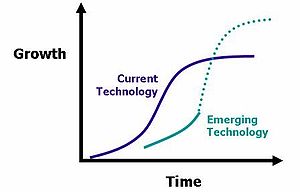
Once innovation occurs, innovations may be spread from the innovator to other individuals and groups. This process has been proposed that the life cycle of innovations can be described using the 's-curve
' or diffusion curve
. The s-curve maps growth of revenue or productivity against time. In the early stage of a particular innovation, growth is relatively slow as the new product establishes itself. At some point customers begin to demand and the product growth increases more rapidly. New incremental innovations or changes to the product allow growth to continue. Towards the end of its life cycle growth slows and may even begin to decline. In the later stages, no amount of new investment in that product will yield a normal rate of return.
The s-curve derives from an assumption that new products are likely to have "product Life". i.e. a start-up phase, a rapid increase in revenue and eventual decline. In fact the great majority of innovations never get off the bottom of the curve, and never produce normal returns.
Innovative companies will typically be working on new innovations that will eventually replace older ones. Successive s-curves will come along to replace older ones and continue to drive growth upwards. In the figure above the first curve shows a current technology. The second shows an emerging technology
that current yields lower growth but will eventually overtake current technology and lead to even greater levels of growth. The length of life will depend on many factors.
s which cover several aspects of innovation such as business measures related to finances, innovation process efficiency, employees' contribution and motivation, as well benefits for customers. Measured values will vary widely between businesses, covering for example new product revenue, spending in R&D, time to market, customer and employee perception & satisfaction, number of patents, additional sales resulting from past innovations.
complementary to the Frascati Manual
from 1963. The new Oslo manual from 2005 takes a wider perspective to innovation, and includes marketing and organizational innovation. These standards are used for example in the European Community Innovation Survey
s.
Other ways of measuring innovation have traditionally been expenditure, for example, investment in R&D (Research and Development) as percentage of GNP (Gross National Product). Whether this is a good measurement of innovation has been widely discussed and the Oslo Manual has incorporated some of the critique against earlier methods of measuring. The traditional methods of measuring still inform many policy decisions. The EU Lisbon Strategy
has set as a goal that their average expenditure on R&D should be 3% of GNP.
A common industry view (unsupported by empirical evidence) is that comparative cost-effectiveness
research (CER) is a form of price control which, by reducing returns to industry, limits R&D expenditure, stifles future innovation and compromises new products access to markets. Some academics claim the CER is a valuable value-based measure of innovation which accords truly significant advances in therapy (those that provide 'health gain') higher prices than free market mechanisms. Such value-based pricing has been viewed as a means of indicating to industry the type of innovation that should be rewarded from the public purse. The Australian academic Thomas Alured Faunce
has developed the case that national comparative cost-effectiveness
assessment systems should be viewed as measuring 'health innovation' as an evidence-based concept distinct from valuing innovation through the operation of competitive markets (a method which requires strong anti-trust laws to be effective) on the basis that both methods of assessing innovation in pharmaceuticals are mentioned in annex 2C.1 of the AUSFTA.
The report discusses not only country performance but also what companies are doing and should be doing to spur innovation. It looks at new policy indicators for innovation, including tax incentives and policies for immigration
, education
and intellectual property
.
The latest index was published in March 2009. To rank the countries, the study measured both innovation inputs and outputs. Innovation inputs included government and fiscal policy
, education policy
and the innovation environment. Outputs included patents, technology transfer
, and other R&D results; business performance, such as labor productivity
and total shareholder returns; and the impact of innovation on business migration and economic growth
. The following is a list of the twenty largest countries (as measured by GDP) by the International Innovation Index:
, quality of life
, and productive growth
, innovation is a key factor in society and economy. Consequently, policymakers are working to develop environments that will foster innovation and its resulting positive benefits. For instance, experts are advocating that the U.S. federal government launch a National Infrastructure Foundation, a nimble, collaborative strategic intervention organization that will house innovations programs from fragmented silos under one entity, inform federal officials on innovation performance metrics
, strengthen industry-university partnerships, and support innovation economic development
initiatives, especially to strengthen regional clusters
. Because clusters are the geographic incubators of innovative products and processes, a cluster development grant program would also be targeted for implementation. By focusing on innovating in such areas as precision manufacturing
, information technology
, and clean energy, other areas of national concern would be tackled including government debt
, carbon footprint
, and oil dependence. The U.S. Economic Development Administration
understand this reality in their continued Regional Innovation Clusters initiative. In addition, federal grants in R&D, a crucial driver of innovation and productive growth, should be expanded to levels similar to Japan
, Finland
, South Korea
, and Switzerland
in order to stay globally competitive. Also, such grants should be better procured to metropolitan areas
, the essential engines of the American economy.
Many countries recognize the importance of research and development as well as innovation including Japan’s Ministry of Education, Culture, Sports, Science and Technology (MEXT); Germany’s Federal Ministry of Education and Research; and the Ministry of Science and Technology
in the People’s Republic of China http://www.most.gov.cn/eng/. Furthermore, Russia’s innovation programme is the Medvedev modernisation programme
which aims at creating a diversified economy based on high technology and innovation. Also, the Government of Western Australia
has established a number of innovation incentives for government departments. Landgate
was the first Western Australian government agency to establish its Innovation Program.
Product (business)
In general, the product is defined as a "thing produced by labor or effort" or the "result of an act or a process", and stems from the verb produce, from the Latin prōdūce ' lead or bring forth'. Since 1575, the word "product" has referred to anything produced...
s, processes
Procedure (term)
A procedure is a sequence of actions or operations which have to be executed in the same manner in order to always obtain the same result under the same circumstances ....
, technologies, or idea
Idea
In the most narrow sense, an idea is just whatever is before the mind when one thinks. Very often, ideas are construed as representational images; i.e. images of some object. In other contexts, ideas are taken to be concepts, although abstract concepts do not necessarily appear as images...
s that are accepted by market
Market
A market is one of many varieties of systems, institutions, procedures, social relations and infrastructures whereby parties engage in exchange. While parties may exchange goods and services by barter, most markets rely on sellers offering their goods or services in exchange for money from buyers...
s, government
Government
Government refers to the legislators, administrators, and arbitrators in the administrative bureaucracy who control a state at a given time, and to the system of government by which they are organized...
s, and society
Society
A society, or a human society, is a group of people related to each other through persistent relations, or a large social grouping sharing the same geographical or virtual territory, subject to the same political authority and dominant cultural expectations...
. Innovation differs from invention
Invention
An invention is a novel composition, device, or process. An invention may be derived from a pre-existing model or idea, or it could be independently conceived, in which case it may be a radical breakthrough. In addition, there is cultural invention, which is an innovative set of useful social...
in that innovation refers to the use of a new idea or method, whereas invention refers more directly to the creation of the idea or method itself.
Etymology
The word innovation derives from the Latin word innovatus, which is the noun form of innovare "to renew or change," stemming from in—"into" + novus—"new". Diffusion of innovation research was first started in 1903 by seminal researcher Gabriel Tarde, who first plotted the S-shaped diffusion curve. Tarde (1903) defined the innovation-decision process as a series of steps that includes:- First knowledge
- Forming an attitude
- A decision to adopt or reject
- Implementation and use
- Confirmation of the decision
Society
Due to its widespread effect, innovation is an important topic in the study of economicsEconomics
Economics is the social science that analyzes the production, distribution, and consumption of goods and services. The term economics comes from the Ancient Greek from + , hence "rules of the house"...
, business
Business
A business is an organization engaged in the trade of goods, services, or both to consumers. Businesses are predominant in capitalist economies, where most of them are privately owned and administered to earn profit to increase the wealth of their owners. Businesses may also be not-for-profit...
, entrepreneurship
Entrepreneurship
Entrepreneurship is the act of being an entrepreneur, which can be defined as "one who undertakes innovations, finance and business acumen in an effort to transform innovations into economic goods". This may result in new organizations or may be part of revitalizing mature organizations in response...
, design
Design
Design as a noun informally refers to a plan or convention for the construction of an object or a system while “to design” refers to making this plan...
, technology
Technology
Technology is the making, usage, and knowledge of tools, machines, techniques, crafts, systems or methods of organization in order to solve a problem or perform a specific function. It can also refer to the collection of such tools, machinery, and procedures. The word technology comes ;...
, sociology
Sociology
Sociology is the study of society. It is a social science—a term with which it is sometimes synonymous—which uses various methods of empirical investigation and critical analysis to develop a body of knowledge about human social activity...
, and engineering
Engineering
Engineering is the discipline, art, skill and profession of acquiring and applying scientific, mathematical, economic, social, and practical knowledge, in order to design and build structures, machines, devices, systems, materials and processes that safely realize improvements to the lives of...
. In society, innovation aids in comfort
Comfort
Comfort may refer to:*Comfort , by the rock group Failure*Comfort *Comfort Air, German airline*Comfort food*Comfort noise, artificial background noise used in radio and wireless communications to fill the silent time in a transmission*Comfort object, an object used to provide psychological...
, convenience
Convenience
Convenience is anything that is intended to save resources or frustration. A convenience store at a petrol station, for example, sells items that have nothing to do with gasoline/petrol, but it saves the consumer from having to go to a grocery store."Convenience" is a very relative term and its...
, and efficiency
Efficiency
Efficiency in general describes the extent to which time or effort is well used for the intended task or purpose. It is often used with the specific purpose of relaying the capability of a specific application of effort to produce a specific outcome effectively with a minimum amount or quantity of...
in everyday life. For instance, the benchmarks in railroad equipment and infrastructure
Infrastructure
Infrastructure is basic physical and organizational structures needed for the operation of a society or enterprise, or the services and facilities necessary for an economy to function...
added to greater safety, maintenance, speed, and weight capacity for passenger services. These innovations included wood to steel cars, iron to steel rails, stove-heated to steam-heated cars, gas lighting to electric lighting, diesel-powered to electric-diesel locomotives. By mid-20th century, trains were making longer, more comfortable, and faster trips at lower costs for passengers. Other areas that add to everyday quality of life include: the innovations to the light bulb from incandescent to compact fluorescent and LED
LEd
LEd is a TeX/LaTeX editing software working under Microsoft Windows. It is a freeware product....
s which offer longer-lasting, less energy-intensive, brighter technology; adoption of modem
Modem
A modem is a device that modulates an analog carrier signal to encode digital information, and also demodulates such a carrier signal to decode the transmitted information. The goal is to produce a signal that can be transmitted easily and decoded to reproduce the original digital data...
s to cellular phones, paving the way to smartphone
Smartphone
A smartphone is a high-end mobile phone built on a mobile computing platform, with more advanced computing ability and connectivity than a contemporary feature phone. The first smartphones were devices that mainly combined the functions of a personal digital assistant and a mobile phone or camera...
s which meets anyone’s internet needs at any time or place; cathode-ray tube to flat-screen
Flat panel display
Flat panel displays encompass a growing number of electronic visual display technologies. They are far lighter and thinner than traditional television sets and video displays that use cathode ray tubes , and are usually less than thick...
LCD televisions and others.
Business and economics
In business and economics, innovation is the catalyst to growth. With rapid advancements in transportation and communications over the past few decades, the old world concepts of factor endowmentFactor endowment
In economics a country's factor endowment is commonly understood as the amount of land, labor, capital, and entrepreneurship that a country possesses and can exploit for manufacturing. Countries with a large endowment of resources tend to be more prosperous than those with a small endowment, all...
s and comparative advantage
Comparative advantage
In economics, the law of comparative advantage says that two countries will both gain from trade if, in the absence of trade, they have different relative costs for producing the same goods...
which focused on an area’s unique inputs are outmoded for today’s global economy
Globalization
Globalization refers to the increasingly global relationships of culture, people and economic activity. Most often, it refers to economics: the global distribution of the production of goods and services, through reduction of barriers to international trade such as tariffs, export fees, and import...
. Now, as Harvard economist Michael Porter
Michael Porter
Michael Eugene Porter is the Bishop William Lawrence University Professor at Harvard Business School. He is a leading authority on company strategy and the competitiveness of nations and regions. Michael Porter’s work is recognized in many governments, corporations and academic circles globally...
points out competitive advantage, or the productive use of any input
Input
Input is the term denoting either an entrance or changes which are inserted into a system and which activate/modify a process. It is an abstract concept, used in the modeling, system design and system exploitation...
s, which requires continual innovation is paramount for any specialized firm to succeed. Economist Joseph Schumpeter
Joseph Schumpeter
Joseph Alois Schumpeter was an Austrian-Hungarian-American economist and political scientist. He popularized the term "creative destruction" in economics.-Life:...
, who contributed greatly to the study of innovation
Innovation Economics
Innovation economics or economics of innovation is a growing economic doctrine that reformulates conventional economics theory so that knowledge, technology, entrepreneurship, and innovation are positioned at the center of the model rather than seen as independent forces that are largely unaffected...
, argued that industries must incessantly revolutionize the economic structure from within, that is innovate with better or more effective processes and products, such as the shift from the craft shop to factory. He famously asserted that “creative destruction
Creative destruction
Creative destruction is a term originally derived from Marxist economic theory which refers to the linked processes of the accumulation and annihilation of wealth under capitalism. These processes were first described in The Communist Manifesto and were expanded in Marx's Grundrisse and "Volume...
is the essential fact about capitalism
Capitalism
Capitalism is an economic system that became dominant in the Western world following the demise of feudalism. There is no consensus on the precise definition nor on how the term should be used as a historical category...
.” In addition, entrepreneur
Entrepreneur
An entrepreneur is an owner or manager of a business enterprise who makes money through risk and initiative.The term was originally a loanword from French and was first defined by the Irish-French economist Richard Cantillon. Entrepreneur in English is a term applied to a person who is willing to...
s continuously look for better ways to satisfy their consumer base with improved quality, durability, service, and price which come to fruition in innovation with advanced technologies and organizational strategies.
One prime example is the explosive boom of Silicon
Silicon
Silicon is a chemical element with the symbol Si and atomic number 14. A tetravalent metalloid, it is less reactive than its chemical analog carbon, the nonmetal directly above it in the periodic table, but more reactive than germanium, the metalloid directly below it in the table...
startups out of the Stanford Industrial Park. In 1957, dissatisfied employees of Shockley Semiconductor, the company of Nobel laureate and co-inventor of the transistor
Transistor
A transistor is a semiconductor device used to amplify and switch electronic signals and power. It is composed of a semiconductor material with at least three terminals for connection to an external circuit. A voltage or current applied to one pair of the transistor's terminals changes the current...
William Shockley
William Shockley
William Bradford Shockley Jr. was an American physicist and inventor. Along with John Bardeen and Walter Houser Brattain, Shockley co-invented the transistor, for which all three were awarded the 1956 Nobel Prize in Physics.Shockley's attempts to commercialize a new transistor design in the 1950s...
, left to form an independent firm, Fairchild Semiconductor
Fairchild Semiconductor
Fairchild Semiconductor International, Inc. is an American semiconductor company based in San Jose, California. Founded in 1957, it was a pioneer in transistor and integrated circuit manufacturing...
. After several years, Fairchild developed into a formidable presence in the sector. Eventually, these founders left to start their own companies based on their own, unique, latest ideas, and then leading employees started their own firms. Over the next 20 years, this snowball process launched the momentous startup company
Startup company
A startup company or startup is a company with a limited operating history. These companies, generally newly created, are in a phase of development and research for markets...
explosion of information technology
Information technology
Information technology is the acquisition, processing, storage and dissemination of vocal, pictorial, textual and numerical information by a microelectronics-based combination of computing and telecommunications...
firms. Essentially, Silicon Valley
Silicon Valley
Silicon Valley is a term which refers to the southern part of the San Francisco Bay Area in Northern California in the United States. The region is home to many of the world's largest technology corporations...
began as 65 new enterprises born out of Shockley’s eight former employees.
Organizations
In the organizational context, innovation may be linked to positive changes in efficiencyEfficiency
Efficiency in general describes the extent to which time or effort is well used for the intended task or purpose. It is often used with the specific purpose of relaying the capability of a specific application of effort to produce a specific outcome effectively with a minimum amount or quantity of...
, productivity
Productivity
Productivity is a measure of the efficiency of production. Productivity is a ratio of what is produced to what is required to produce it. Usually this ratio is in the form of an average, expressing the total output divided by the total input...
, quality, competitiveness
Competitiveness
Competitiveness is a comparative concept of the ability and performance of a firm, sub-sector or country to sell and supply goods and/or services in a given market...
, market share
Market share
Market share is the percentage of a market accounted for by a specific entity. In a survey of nearly 200 senior marketing managers, 67 percent responded that they found the "dollar market share" metric very useful, while 61% found "unit market share" very useful.Marketers need to be able to...
, and others. All organizations can innovate, including for example hospitals, universities, and local governments. For instance, former Mayor Martin O’Malley pushed the City of Baltimore to use CitiStat, a performance-measurement
Performance Measurement
Performance measurement with a process is the complement to process execution. Based on measured performance, the feedback control loop may be closed. The metrics to assess performance is set according to a determined econometric model...
data and management system that allows city officials to maintain statistics on crime trends to condition of potholes. This system aids in better evaluation of policies and procedures with accountability and efficiency in terms of time and money. In its first year, CitiStat saved the city $13.2 million. Even mass transit systems have innovated with hybrid
Hybrid vehicle
A hybrid vehicle is a vehicle that uses two or more distinct power sources to move the vehicle. The term most commonly refers to hybrid electric vehicles , which combine an internal combustion engine and one or more electric motors.-Power:...
bus fleets to real-time tracking
Real-time locating system
Real-time locating systems are a type of local positioning system that allow to track and identify the location of objects in real time. Using simple, inexpensive badges or tags attached to the objects, readers receive wireless signals from these tags to determine their locations...
at bus stands. In addition, the growing use of mobile data terminal
Mobile data terminal
A mobile data terminal is a computerized device used in public transit vehicles, taxicabs, courier vehicles, service trucks, commercial trucking fleets, military logistics, fishing fleets, warehouse inventory control, and emergency vehicles to communicate with a central dispatch office...
s in vehicles that serves as communication hubs between vehicles and control center automatically send data on location, passenger counts, engine performance, mileage and other information. This tool helps to deliver and manage transportation systems.
Still other innovative strategies include hospital
Hospital
A hospital is a health care institution providing patient treatment by specialized staff and equipment. Hospitals often, but not always, provide for inpatient care or longer-term patient stays....
s digitizing medical information in electronic medical records; HUD’s HOPE VI
HOPE VI
HOPE VI is a plan by the United States Department of Housing and Urban Development. It is meant to revitalize the worst public housing projects in the United States into mixed-income developments. Its philosophy is largely based on New Urbanism and the concept of Defensible space.The program began...
initiatives to eradicate city’s severely distressed public housing
Public housing
Public housing is a form of housing tenure in which the property is owned by a government authority, which may be central or local. Social housing is an umbrella term referring to rental housing which may be owned and managed by the state, by non-profit organizations, or by a combination of the...
to revitalized
Urban renewal
Urban renewal is a program of land redevelopment in areas of moderate to high density urban land use. Renewal has had both successes and failures. Its modern incarnation began in the late 19th century in developed nations and experienced an intense phase in the late 1940s – under the rubric of...
, mixed income environments; the Harlem Children’s Zone that uses a community-based approach to educate local area children; and EPA’s brownfield grants
Brownfield Regulation and Development
The United States Environmental Protection Agency defines brownfield land as property where the reuse may be complicated by the presence of hazardous materials....
that aids in turning over brownfields for environmental protection
Environmental protection
Environmental protection is a practice of protecting the environment, on individual, organizational or governmental level, for the benefit of the natural environment and humans. Due to the pressures of population and our technology the biophysical environment is being degraded, sometimes permanently...
, green spaces
Open space reserve
Open space reserve, open space preserve, and open space reservation, are planning and conservation ethics terms used to describe areas of protected or conserved land or water on which development is indefinitely set aside...
, community
Community development
Community development is a broad term applied to the practices and academic disciplines of civic leaders, activists, involved citizens and professionals to improve various aspects of local communities....
and commercial development
Commerce
While business refers to the value-creating activities of an organization for profit, commerce means the whole system of an economy that constitutes an environment for business. The system includes legal, economic, political, social, cultural, and technological systems that are in operation in any...
.
Sources of innovation
There are several sources of innovation. According to the Peter F. Drucker the general sources of innovations are different changes in industry structure, in market structure, in local and global demographics, in human perception, mood and meaning, in the amount of already available scientific knowledge, etc. Also, internet research, developing of people skills, language development, cultural background, skype, facebook, etc.In the simplest linear model of innovation
Linear model of innovation
The Linear Model of Innovation is an early model of innovation that suggests technical change happens in a linear fashion from Invention to Innovation to Diffusion....
the traditionally recognized source is manufacturer innovation. This is where an agent (person or business) innovates in order to sell the innovation. Another source of innovation, only now becoming widely recognized, is end-user innovation. This is where an agent (person or company) develops an innovation for their own (personal or in-house) use because existing products do not meet their needs. MIT economist Eric von Hippel
Eric von Hippel
Eric von Hippel is an economist and a professor at the MIT Sloan School of Management, specializing in the nature and economics of distributed and open innovation. He is best known for his work developing the concept of user innovation – that end-users, rather than manufacturers, are...
has identified end-user innovation as, by far, the most important and critical in his classic book on the subject, Sources of Innovation.
In addition, the famous robotics engineer Joseph F. Engelberger asserts that innovations require only three things: 1. A recognized need, 2. Competent people with relevant technology, and 3. Financial support.
Innovation by businesses is achieved in many ways, with much attention now given to formal research and development
Research and development
The phrase research and development , according to the Organization for Economic Co-operation and Development, refers to "creative work undertaken on a systematic basis in order to increase the stock of knowledge, including knowledge of man, culture and society, and the use of this stock of...
(R&D) for "breakthrough innovations." R&D help spur on patents and other scientific innovations that leads to productive growth in such areas as industry, medicine, engineering, and government. Yet, innovations can be developed by less formal on-the-job modifications of practice, through exchange and combination of professional experience and by many other routes. The more radical and revolutionary innovations tend to emerge from R&D, while more incremental innovations may emerge from practice – but there are many exceptions to each of these trends.
An important innovation factor includes customers buying products or using services. As a result, firms may incorporate users in focus groups (user centred approach), work closely with so called lead users (lead user approach) or users might adapt their products themselves. U-STIR, a project to innovate Europe
Europe
Europe is, by convention, one of the world's seven continents. Comprising the westernmost peninsula of Eurasia, Europe is generally 'divided' from Asia to its east by the watershed divides of the Ural and Caucasus Mountains, the Ural River, the Caspian and Black Seas, and the waterways connecting...
’s surface transportation system, employs such workshops. Regarding this user innovation
User innovation
User innovation refers to innovation by intermediate users or consumer users , rather than by suppliers ....
, a great deal of innovation is done by those actually implementing and using technologies and products as part of their normal activities. In most of the times user innovators have some personal record motivating them. Sometimes user-innovators may become entrepreneur
Entrepreneur
An entrepreneur is an owner or manager of a business enterprise who makes money through risk and initiative.The term was originally a loanword from French and was first defined by the Irish-French economist Richard Cantillon. Entrepreneur in English is a term applied to a person who is willing to...
s, selling their product, they may choose to trade their innovation in exchange for other innovations, or they may be adopted by their suppliers. Nowadays, they may also choose to freely reveal their innovations, using methods like open source
Open source
The term open source describes practices in production and development that promote access to the end product's source materials. Some consider open source a philosophy, others consider it a pragmatic methodology...
. In such networks of innovation the users or communities of users can further develop technologies and reinvent their social meaning.
Value of experimentation
When an innovative idea requires a better business modelBusiness model
A business model describes the rationale of how an organization creates, delivers, and captures value...
, or radically redesigns the delivery of value to focus on the customer, a real world experimentation approach increases the chances of market success. Potentially innovative business models and customer experiences can't be tested through traditional market research methods. Pilot programs for new innovations set the path in stone too early thus increasing the costs of failure. On the other hand, the good news is that recent years have seen considerable progress in identifying important key factors/principles or variables that affect the probability of success in innovation. Of course, building successful businesses is such a complicated process, involving subtle interdependencies among so many variables in dynamic systems, that it is unlikely to ever be made perfectly predictable. But the more business can master the variables and experiment, the more they will be able to create new companies, products, processes and services that achieve what they hope to achieve.
Goals/failures
Programs of organizational innovation are typically tightly linked to organizational goals and objectives, to the business planBusiness plan
A business plan is a formal statement of a set of business goals, the reasons why they are believed attainable, and the plan for reaching those goals. It may also contain background information about the organization or team attempting to reach those goals....
, and to market
Market
A market is one of many varieties of systems, institutions, procedures, social relations and infrastructures whereby parties engage in exchange. While parties may exchange goods and services by barter, most markets rely on sellers offering their goods or services in exchange for money from buyers...
competitive positioning
Competitiveness
Competitiveness is a comparative concept of the ability and performance of a firm, sub-sector or country to sell and supply goods and/or services in a given market...
. One driver for innovation programs in corporations is to achieve growth objectives. As Davila et al. (2006) notes, "Companies cannot grow through cost reduction and reengineering alone... Innovation is the key element in providing aggressive top-line growth, and for increasing bottom-line results."
One survey across a large number of manufacturing and services organizations found, ranked in decreasing order of popularity, that systematic programs of organizational innovation are most frequently driven by: Improved quality, Creation of new market
Market
A market is one of many varieties of systems, institutions, procedures, social relations and infrastructures whereby parties engage in exchange. While parties may exchange goods and services by barter, most markets rely on sellers offering their goods or services in exchange for money from buyers...
s, Extension of the product
Product
- Business :*Product , an item that ideally satisfies a market's want or need**Product , a deliverable or set of deliverables that contribute to a business solution**Nanoproduct, a product that has been enhanced with nanotechnology...
, range, Reduced labor costs, Improved production processes, Reduced material
Material
Material is anything made of matter, constituted of one or more substances. Wood, cement, hydrogen, air and water are all examples of materials. Sometimes the term "material" is used more narrowly to refer to substances or components with certain physical properties that are used as inputs to...
s, Reduced environmental damage, Replacement of product
Product
- Business :*Product , an item that ideally satisfies a market's want or need**Product , a deliverable or set of deliverables that contribute to a business solution**Nanoproduct, a product that has been enhanced with nanotechnology...
s/services, Reduced energy
Energy
In physics, energy is an indirectly observed quantity. It is often understood as the ability a physical system has to do work on other physical systems...
consumption, Conformance to regulation
Regulation
Regulation is administrative legislation that constitutes or constrains rights and allocates responsibilities. It can be distinguished from primary legislation on the one hand and judge-made law on the other...
s.
These goals vary between improvements to products, processes and services and dispel a popular myth that innovation deals mainly with new product development. Most of the goals could apply to any organisation be it a manufacturing facility, marketing firm, hospital or local government. Whether innovation goals are successfully achieved or otherwise depends greatly on the environment prevailing in the firm.
Conversely, failure can develop in programs of innovations. The causes of failure have been widely researched and can vary considerably. Some causes will be external to the organization and outside its influence of control. Others will be internal and ultimately within the control of the organization. Internal causes of failure can be divided into causes associated with the cultural infrastructure and causes associated with the innovation process itself. Common causes of failure within the innovation process in most organisations can be distilled into five types: Poor goal definition, Poor alignment of actions to goals, Poor participation in teams, Poor monitoring of results, Poor communication and access to information.
Diffusion
Once innovation occurs, innovations may be spread from the innovator to other individuals and groups. This process has been proposed that the life cycle of innovations can be described using the 's-curve
Sigmoid function
Many natural processes, including those of complex system learning curves, exhibit a progression from small beginnings that accelerates and approaches a climax over time. When a detailed description is lacking, a sigmoid function is often used. A sigmoid curve is produced by a mathematical...
' or diffusion curve
Diffusion of innovations
Diffusion of Innovations is a theory that seeks to explain how, why, and at what rate new ideas and technology spread through cultures. Everett Rogers, a professor of rural sociology, popularized the theory in his 1962 book Diffusion of Innovations...
. The s-curve maps growth of revenue or productivity against time. In the early stage of a particular innovation, growth is relatively slow as the new product establishes itself. At some point customers begin to demand and the product growth increases more rapidly. New incremental innovations or changes to the product allow growth to continue. Towards the end of its life cycle growth slows and may even begin to decline. In the later stages, no amount of new investment in that product will yield a normal rate of return.
The s-curve derives from an assumption that new products are likely to have "product Life". i.e. a start-up phase, a rapid increase in revenue and eventual decline. In fact the great majority of innovations never get off the bottom of the curve, and never produce normal returns.
Innovative companies will typically be working on new innovations that will eventually replace older ones. Successive s-curves will come along to replace older ones and continue to drive growth upwards. In the figure above the first curve shows a current technology. The second shows an emerging technology
Emerging technologies
In the history of technology, emerging technologies are contemporary advances and innovation in various fields of technology. Various converging technologies have emerged in the technological convergence of different systems evolving towards similar goals...
that current yields lower growth but will eventually overtake current technology and lead to even greater levels of growth. The length of life will depend on many factors.
Measures
There are two fundamentally different types of measures for innovation: the organizational level and the political level.Organizational level
The measure of innovation at the organizational level relates to individuals, team-level assessments, and private companies from the smallest to the largest. Measure of innovation for organizations can be conducted by surveys, workshops, consultants or internal benchmarking. There is today no established general way to measure organizational innovation. Corporate measurements are generally structured around balanced scorecardBalanced scorecard
The Balanced Scorecard is a strategic performance management tool - a semi-standard structured report, supported by proven design methods and automation tools, that can be used by managers to keep track of the execution of activities by the staff within their control and to monitor the...
s which cover several aspects of innovation such as business measures related to finances, innovation process efficiency, employees' contribution and motivation, as well benefits for customers. Measured values will vary widely between businesses, covering for example new product revenue, spending in R&D, time to market, customer and employee perception & satisfaction, number of patents, additional sales resulting from past innovations.
Political level
For the political level, measures of innovation are more focused on a country or region competitive advantage through innovation. In this context, organizational capabilities can be evaluated through various evaluation frameworks, such as those of the European Foundation for Quality Management. The OECD Oslo Manual (1995) suggests standard guidelines on measuring technological product and process innovation. Some people consider the Oslo ManualOslo Manual
The Organisation for Economic Co-Operation and Development's document "The Measurement of Scientific and Technological Activities, Proposed Guidelines for Collecting and Interpreting Technological Innovation Data", also known as the Oslo Manual, contains guidelines for collecting and using data on...
complementary to the Frascati Manual
Frascati Manual
The Frascati Manual is a document setting forth the methodology for collecting statistics about research and development. The Manual was prepared and published by the Organisation for Economic Co-operation and Development....
from 1963. The new Oslo manual from 2005 takes a wider perspective to innovation, and includes marketing and organizational innovation. These standards are used for example in the European Community Innovation Survey
Community Innovation Survey
The Community Innovation Surveys are a series of surveys executed by national statistical offices throughout the European Union and in Norway and Iceland. The harmonized surveys are designed to give information on the innovativity of different sectors and regions...
s.
Other ways of measuring innovation have traditionally been expenditure, for example, investment in R&D (Research and Development) as percentage of GNP (Gross National Product). Whether this is a good measurement of innovation has been widely discussed and the Oslo Manual has incorporated some of the critique against earlier methods of measuring. The traditional methods of measuring still inform many policy decisions. The EU Lisbon Strategy
Lisbon Strategy
The Lisbon Strategy, also known as the Lisbon Agenda or Lisbon Process, was an action and development plan devised in 2000, for the economy of the European Union between 2000 and 2010....
has set as a goal that their average expenditure on R&D should be 3% of GNP.
Indicators
Many scholars claim that there is a great bias towards the "science and technology mode" (S&T-mode or STI-mode), while the "learning by doing, using and interacting mode" (DUI-mode) is widely ignored. For an example, that means you can have the better high tech or software, but there are also crucial learning tasks important for innovation. But these measurements and research are rarely done.A common industry view (unsupported by empirical evidence) is that comparative cost-effectiveness
Cost-effectiveness
Cost-effectiveness analysis is a form of economic analysis that compares the relative costs and outcomes of two or more courses of action. Cost-effectiveness analysis is distinct from cost-benefit analysis, which assigns a monetary value to the measure of effect...
research (CER) is a form of price control which, by reducing returns to industry, limits R&D expenditure, stifles future innovation and compromises new products access to markets. Some academics claim the CER is a valuable value-based measure of innovation which accords truly significant advances in therapy (those that provide 'health gain') higher prices than free market mechanisms. Such value-based pricing has been viewed as a means of indicating to industry the type of innovation that should be rewarded from the public purse. The Australian academic Thomas Alured Faunce
Thomas Alured Faunce
Thomas Alured Faunce is an Associate Professor jointly in the College of Law and Medical School at the Australian National University at Canberra Australia...
has developed the case that national comparative cost-effectiveness
Cost-effectiveness
Cost-effectiveness analysis is a form of economic analysis that compares the relative costs and outcomes of two or more courses of action. Cost-effectiveness analysis is distinct from cost-benefit analysis, which assigns a monetary value to the measure of effect...
assessment systems should be viewed as measuring 'health innovation' as an evidence-based concept distinct from valuing innovation through the operation of competitive markets (a method which requires strong anti-trust laws to be effective) on the basis that both methods of assessing innovation in pharmaceuticals are mentioned in annex 2C.1 of the AUSFTA.
Measurement indices
Several indexes exist that attempt to measure innovation include:- The Innovation Index, developed by the Indiana Business Research CenterIndiana Business Research CenterIndiana Business Research CenterEstablished in 1925, the is a research unit in the Kelley School of Business at Indiana University. The IBRC provides and interprets economic information for the state’s business, government and nonprofit organizations, as well as users of such information...
, to measure innovation capacity at the county or regional level in the U.S. - The State Technology and Science Index, developed by the Milken InstituteMilken InstituteThe Milken Institute is an independent economic think tank based in Santa Monica, California that publishes research and hosts conferences that apply market-based principles and financial innovations to a variety of societal issues in the US and internationally.The mission of the Institute, founded...
is a U.S. wide benchmark to measure the science and technology capabilities that furnish high paying jobs based around key components.Technology and Science Index - The Oslo Manual is focused on North America, Europe, and other rich economies.
- The Bogota Manual, similar to the above, focuses on Latin America and the Caribbean countries.
- The Creative Class developed by Richard Florida
- The Innovation Capacity Index (ICI) published by a large number of international professors working in a collaborative fashion. The top scorers of ICI 2009–2010 being: 1. Sweden 82.2; 2. Finland 77.8; and 3. United States 77.5. http://www.innovationfordevelopmentreport.org/
- The Global Innovation Index is a global index measuring the level of innovation of a country, produced jointly by The Boston Consulting Group (BCG), the National Association of ManufacturersNational Association of ManufacturersThe National Association of Manufacturers is an advocacy group headquartered in Washington, D.C. with 10 additional offices across the country...
(NAM), and The Manufacturing Institute (MI), the NAM's nonpartisan research affiliate. NAM describes it as the "largest and most comprehensive global index of its kind".
Global innovation index
This international innovation index is part of a large research study that looks at both the business outcomes of innovation and government's ability to encourage and support innovation through public policy. The study comprised a survey of more than 1,000 senior executives from NAM member companies across all industries; in-depth interviews with 30 of the executives; and a comparison of the "innovation friendliness" of 110 countries and all 50 U.S. states. The findings are published in the report, "The Innovation Imperative in Manufacturing: How the United States Can Restore Its Edge."The report discusses not only country performance but also what companies are doing and should be doing to spur innovation. It looks at new policy indicators for innovation, including tax incentives and policies for immigration
Immigration
Immigration is the act of foreigners passing or coming into a country for the purpose of permanent residence...
, education
Education
Education in its broadest, general sense is the means through which the aims and habits of a group of people lives on from one generation to the next. Generally, it occurs through any experience that has a formative effect on the way one thinks, feels, or acts...
and intellectual property
Intellectual property
Intellectual property is a term referring to a number of distinct types of creations of the mind for which a set of exclusive rights are recognized—and the corresponding fields of law...
.
The latest index was published in March 2009. To rank the countries, the study measured both innovation inputs and outputs. Innovation inputs included government and fiscal policy
Fiscal policy
In economics and political science, fiscal policy is the use of government expenditure and revenue collection to influence the economy....
, education policy
Education policy
Education policy refers to the collection of laws and rules that govern the operation of education systems.Education occurs in many forms for many purposes through many institutions. Examples include early childhood education, kindergarten through to 12th grade, two and four year colleges or...
and the innovation environment. Outputs included patents, technology transfer
Technology transfer
Technology Transfer, also called Transfer of Technology and Technology Commercialisation, is the process of skill transferring, knowledge, technologies, methods of manufacturing, samples of manufacturing and facilities among governments or universities and other institutions to ensure that...
, and other R&D results; business performance, such as labor productivity
Labor productivity
Workforce productivity is the amount of goods and services that a worker produces in a given amount of time. It is one of several types of productivity that economists measure. Workforce productivity can be measured for a firm, a process, an industry, or a country...
and total shareholder returns; and the impact of innovation on business migration and economic growth
Economic growth
In economics, economic growth is defined as the increasing capacity of the economy to satisfy the wants of goods and services of the members of society. Economic growth is enabled by increases in productivity, which lowers the inputs for a given amount of output. Lowered costs increase demand...
. The following is a list of the twenty largest countries (as measured by GDP) by the International Innovation Index:
| Rank | Country | Overall | Innovation Inputs | Innovation Performance |
|---|---|---|---|---|
| 1 |  South Korea South Korea |
2.26 | 1.75 | 2.55 |
| 2 |  United States United States |
1.80 | 1.28 | 2.16 |
| 3 |  Japan Japan |
1.79 | 1.16 | 2.25 |
| 4 |  Sweden Sweden |
1.64 | 1.25 | 1.88 |
| 5 |  Netherlands Netherlands |
1.55 | 1.40 | 1.55 |
| 6 |  Canada Canada |
1.42 | 1.39 | 1.32 |
| 7 |  United Kingdom United Kingdom |
1.42 | 1.33 | 1.37 |
| 8 |  Germany Germany |
1.12 | 1.05 | 1.09 |
| 9 |  Early Modern France Early Modern France |
1.12 | 1.17 | 0.96 |
| 10 |  Australia Australia |
1.02 | 0.89 | 1.05 |
| 11 |  Spain Spain |
0.93 | 0.83 | 0.95 |
| 12 |  Belgium Belgium |
0.86 | 0.85 | 0.79 |
| 13 |  Mainland China Mainland China |
0.73 | 0.07 | 1.32 |
| 14 |  Italy Italy |
0.21 | 0.16 | 0.24 |
| 15 |  India India |
0.06 | 0.14 | −0.02 |
| 16 |  Russia Russia |
−0.09 | −0.02 | −0.16 |
| 17 |  Mexico Mexico |
−0.16 | 0.11 | −0.42 |
| 18 |  Turkey Turkey |
−0.21 | 0.15 | −0.55 |
| 19 |  Indonesia Indonesia |
−0.57 | −0.63 | −0.46 |
| 20 |  Brazil Brazil |
−0.59 | −0.62 | −0.51 |
Government policies
Given the noticeable effects on efficiencyEfficiency
Efficiency in general describes the extent to which time or effort is well used for the intended task or purpose. It is often used with the specific purpose of relaying the capability of a specific application of effort to produce a specific outcome effectively with a minimum amount or quantity of...
, quality of life
Quality of life
The term quality of life is used to evaluate the general well-being of individuals and societies. The term is used in a wide range of contexts, including the fields of international development, healthcare, and politics. Quality of life should not be confused with the concept of standard of...
, and productive growth
Productivity
Productivity is a measure of the efficiency of production. Productivity is a ratio of what is produced to what is required to produce it. Usually this ratio is in the form of an average, expressing the total output divided by the total input...
, innovation is a key factor in society and economy. Consequently, policymakers are working to develop environments that will foster innovation and its resulting positive benefits. For instance, experts are advocating that the U.S. federal government launch a National Infrastructure Foundation, a nimble, collaborative strategic intervention organization that will house innovations programs from fragmented silos under one entity, inform federal officials on innovation performance metrics
Performance Measurement
Performance measurement with a process is the complement to process execution. Based on measured performance, the feedback control loop may be closed. The metrics to assess performance is set according to a determined econometric model...
, strengthen industry-university partnerships, and support innovation economic development
Economic development
Economic development generally refers to the sustained, concerted actions of policymakers and communities that promote the standard of living and economic health of a specific area...
initiatives, especially to strengthen regional clusters
Business cluster
A business cluster is a geographic concentration of interconnected businesses, suppliers, and associated institutions in a particular field. Clusters are considered to increase the productivity with which companies can compete, nationally and globally. In urban studies, the term agglomeration is used...
. Because clusters are the geographic incubators of innovative products and processes, a cluster development grant program would also be targeted for implementation. By focusing on innovating in such areas as precision manufacturing
Manufacturing
Manufacturing is the use of machines, tools and labor to produce goods for use or sale. The term may refer to a range of human activity, from handicraft to high tech, but is most commonly applied to industrial production, in which raw materials are transformed into finished goods on a large scale...
, information technology
Information technology
Information technology is the acquisition, processing, storage and dissemination of vocal, pictorial, textual and numerical information by a microelectronics-based combination of computing and telecommunications...
, and clean energy, other areas of national concern would be tackled including government debt
Government debt
Government debt is money owed by a central government. In the US, "government debt" may also refer to the debt of a municipal or local government...
, carbon footprint
Carbon footprint
A carbon footprint has historically been defined as "the total set of greenhouse gas emissions caused by an organization, event, product or person.". However, calculating a carbon footprint which conforms to this definition is often impracticable due to the large amount of data required, which is...
, and oil dependence. The U.S. Economic Development Administration
Economic Development Administration
The Economic Development Administration is an agency in the United States Department of Commerce that provides grants to economically distressed communities to generate new employment, help retain existing jobs and stimulate industrial and commercial growth.-History:The EDA was established under...
understand this reality in their continued Regional Innovation Clusters initiative. In addition, federal grants in R&D, a crucial driver of innovation and productive growth, should be expanded to levels similar to Japan
Japan
Japan is an island nation in East Asia. Located in the Pacific Ocean, it lies to the east of the Sea of Japan, China, North Korea, South Korea and Russia, stretching from the Sea of Okhotsk in the north to the East China Sea and Taiwan in the south...
, Finland
Finland
Finland , officially the Republic of Finland, is a Nordic country situated in the Fennoscandian region of Northern Europe. It is bordered by Sweden in the west, Norway in the north and Russia in the east, while Estonia lies to its south across the Gulf of Finland.Around 5.4 million people reside...
, South Korea
South Korea
The Republic of Korea , , is a sovereign state in East Asia, located on the southern portion of the Korean Peninsula. It is neighbored by the People's Republic of China to the west, Japan to the east, North Korea to the north, and the East China Sea and Republic of China to the south...
, and Switzerland
Switzerland
Switzerland name of one of the Swiss cantons. ; ; ; or ), in its full name the Swiss Confederation , is a federal republic consisting of 26 cantons, with Bern as the seat of the federal authorities. The country is situated in Western Europe,Or Central Europe depending on the definition....
in order to stay globally competitive. Also, such grants should be better procured to metropolitan areas
Metropolitan economy
A metropolitan economy refers to the cohesive, naturally evolving concentration of industries, commerce, markets, firms, housing, human capital, infrastructure and other economic elements that are comprised in a particular metropolitan area...
, the essential engines of the American economy.
Many countries recognize the importance of research and development as well as innovation including Japan’s Ministry of Education, Culture, Sports, Science and Technology (MEXT); Germany’s Federal Ministry of Education and Research; and the Ministry of Science and Technology
Ministry of Science and Technology of the People's Republic of China
The Ministry of Science and Technology , formerly as State Science and Technology Commission , is a ministry of the government of the People's Republic of China which coordinates science and technology activities in the country....
in the People’s Republic of China http://www.most.gov.cn/eng/. Furthermore, Russia’s innovation programme is the Medvedev modernisation programme
Medvedev modernisation programme
The Medvedev modernisation programme is an initiative launched by President of Russia Dmitry Medvedev in 2009, which aims at modernising Russia's economy and society, decreasing the country's dependency on oil and gas revenues and creating a diversified economy based on high technology and innovation...
which aims at creating a diversified economy based on high technology and innovation. Also, the Government of Western Australia
Government of Western Australia
The formation of the Government of Western Australia is prescribed in its Constitution, which dates from 1890, although it has been amended many times since then...
has established a number of innovation incentives for government departments. Landgate
Landgate
Landgate, formerly the Department of Land Information , the Department of Land Administration and the Department of Lands and Surveys is the statutory authority responsible for Western Australia's property and land information.-Current activities:Landgate maintains the official register of land...
was the first Western Australian government agency to establish its Innovation Program.
See also
- Business clusterBusiness clusterA business cluster is a geographic concentration of interconnected businesses, suppliers, and associated institutions in a particular field. Clusters are considered to increase the productivity with which companies can compete, nationally and globally. In urban studies, the term agglomeration is used...
s - Communities of innovationCommunities of InnovationCommunities that support innovation have been referred to as Communities of Innovation , Communities for Innovation , Innovation Communities , Open Innovation Communities , Communities of Creation .- Origin :...
- Creative competitive intelligence
- Creative destructionCreative destructionCreative destruction is a term originally derived from Marxist economic theory which refers to the linked processes of the accumulation and annihilation of wealth under capitalism. These processes were first described in The Communist Manifesto and were expanded in Marx's Grundrisse and "Volume...
- Creative problem solvingCreative problem solvingCreative problem solving is the mental process of creating a solution to a problem. It is a special form of problem solving in which the solution is independently created rather than learned with assistance.Creative problem solving always involves creativity....
- Theories of technologyTheories of technologyThere are a number of theories attempting to address technology, which tend to be associated with the disciplines of science and technology studies and communication studies...
- Deployment
- Diffusion (anthropology)
- Ecoinnovation
- Emerging technologiesEmerging technologiesIn the history of technology, emerging technologies are contemporary advances and innovation in various fields of technology. Various converging technologies have emerged in the technological convergence of different systems evolving towards similar goals...
- List of countries by research and development spending
- List of emerging technologies
- List of Russian inventors
- Hype cycleHype cycleA hype cycle is a graphic representation of the maturity, adoption and social application of specific technologies. The term was coined by Gartner, Inc.-Rationale:...
- Individual capitalIndividual capitalIndividual capital, also known as human capital, comprises inalienable or personal traits of persons, tied to their bodies and available only through their own free will, such as skill, creativity, enterprise, courage, capacity for moral example, non-communicable wisdom, invention or empathy,...
- Induced innovationInduced innovationInduced innovation is a macroeconomic hypothesis first proposed in 1932 by J.R. Hicks in his work The Theory of Wages. He proposed that "a change in the relative prices of the factors of production is itself a spur to invention, and to invention of a particular kind—directed to economizing...
- Information revolution
- IngenuityIngenuityIngenuity refers to the process of applying ideas to solve problems or meet challenges. The process of figuring out how to cross a mountain stream using a fallen log, build an airplane from a sheet of paper, or start a new company in a foreign culture all involve the exercising of ingenuity...
- InventionInventionAn invention is a novel composition, device, or process. An invention may be derived from a pre-existing model or idea, or it could be independently conceived, in which case it may be a radical breakthrough. In addition, there is cultural invention, which is an innovative set of useful social...
- Innovation EconomicsInnovation EconomicsInnovation economics or economics of innovation is a growing economic doctrine that reformulates conventional economics theory so that knowledge, technology, entrepreneurship, and innovation are positioned at the center of the model rather than seen as independent forces that are largely unaffected...
- Innovation SaturationInnovation saturationInnovation Saturation was introduced by American economist and historian Tom Osenton in his 2004 book The Death of Demand: Finding Growth in a Saturated Global Economy . Innovation Saturation is a business cycle theory that posits that every company experiences two major growth trends during its...
- Innovation systemInnovation systemThe concept of the innovation system stresses that the flow of technology and information among people, enterprises and institutions is key to an innovative process...
- International Innovation Index (disambiguation)
- Knowledge economyKnowledge economyThe knowledge economy is a term that refers either to an economy of knowledge focused on the production and management of knowledge in the frame of economic constraints, or to a knowledge-based economy. In the second meaning, more frequently used, it refers to the use of knowledge technologies to...
- Metropolitan economyMetropolitan economyA metropolitan economy refers to the cohesive, naturally evolving concentration of industries, commerce, markets, firms, housing, human capital, infrastructure and other economic elements that are comprised in a particular metropolitan area...
- Open InnovationOpen InnovationAlthough the idea and discussion about some consequences date back at least to the 60s, open innovation is a term promoted by Henry Chesbrough, a professor and executive director at the Center for Open Innovation at the University of California, Berkeley, in his book Open Innovation: The new...
- PatentPatentA patent is a form of intellectual property. It consists of a set of exclusive rights granted by a sovereign state to an inventor or their assignee for a limited period of time in exchange for the public disclosure of an invention....
- Pro-innovation biasPro-innovation biasIn diffusion of innovation theory, a pro-innovation bias reflects a personal bias toward a new innovation that someone is trying to implement or diffuse among a population...
- Public domainPublic domainWorks are in the public domain if the intellectual property rights have expired, if the intellectual property rights are forfeited, or if they are not covered by intellectual property rights at all...
- ResearchResearchResearch can be defined as the scientific search for knowledge, or as any systematic investigation, to establish novel facts, solve new or existing problems, prove new ideas, or develop new theories, usually using a scientific method...
- Technology Life Cycle
- Technological innovation systemTechnological innovation systemThe Technological Innovation System is a concept developed within the scientific field of innovation studies which serves to explain the nature and rate of technological change...
- Timeline of historic inventions
- Toolkits for User InnovationToolkits for User InnovationToolkits for user innovation allow manufacturers to " abandon their attempts to understand user needs in detail in favor of transferring need-related aspects of product and service development to users along with an appropriate toolkit"...
- User innovationUser innovationUser innovation refers to innovation by intermediate users or consumer users , rather than by suppliers ....
- Value networkValue networkA value network is a business analysis perspective that describes social and technical resources within and between businesses. The nodes in a value network represent people . The nodes are connected by interactions that represent tangible and intangible deliverables. These deliverables take the...
External links
- Academic article on Being a Systems Innovator on SSRN
- "Communication on Innovation policy: updating the Union's approach in the context of the Lisbon strategy" – The European CommissionEuropean CommissionThe European Commission is the executive body of the European Union. The body is responsible for proposing legislation, implementing decisions, upholding the Union's treaties and the general day-to-day running of the Union....
. - Commission proposes 2009 to become European Year of Creativity and Innovation – The European CommissionEuropean CommissionThe European Commission is the executive body of the European Union. The body is responsible for proposing legislation, implementing decisions, upholding the Union's treaties and the general day-to-day running of the Union....
. - PRO-INNO Europe – Innovation policy analysis and development throughout Europe (Initiative of the European CommissionEuropean CommissionThe European Commission is the executive body of the European Union. The body is responsible for proposing legislation, implementing decisions, upholding the Union's treaties and the general day-to-day running of the Union....
). - 12 Innovations that Changed the World
- Ulrich Hottelet: Invented in Germany - made in Asia , Asia Pacific Times, October 2007