


Estates of the realm

Encyclopedia
Middle Ages
The Middle Ages is a periodization of European history from the 5th century to the 15th century. The Middle Ages follows the fall of the Western Roman Empire in 476 and precedes the Early Modern Era. It is the middle period of a three-period division of Western history: Classic, Medieval and Modern...
and Early Modern period
Early modern Europe
Early modern Europe is the term used by historians to refer to a period in the history of Europe which spanned the centuries between the end of the Middle Ages and the beginning of the Industrial Revolution, roughly the late 15th century to the late 18th century...
in Christian
Christianity
Christianity is a monotheistic religion based on the life and teachings of Jesus as presented in canonical gospels and other New Testament writings...
Europe
Europe
Europe is, by convention, one of the world's seven continents. Comprising the westernmost peninsula of Eurasia, Europe is generally 'divided' from Asia to its east by the watershed divides of the Ural and Caucasus Mountains, the Ural River, the Caspian and Black Seas, and the waterways connecting...
; they are sometimes distinguished as the three estates: the clergy
Clergy
Clergy is the generic term used to describe the formal religious leadership within a given religion. A clergyman, churchman or cleric is a member of the clergy, especially one who is a priest, preacher, pastor, or other religious professional....
, the nobility
Nobility
Nobility is a social class which possesses more acknowledged privileges or eminence than members of most other classes in a society, membership therein typically being hereditary. The privileges associated with nobility may constitute substantial advantages over or relative to non-nobles, or may be...
, and commoner
Commoner
In British law, a commoner is someone who is neither the Sovereign nor a peer. Therefore, any member of the Royal Family who is not a peer, such as Prince Harry of Wales or Anne, Princess Royal, is a commoner, as is any member of a peer's family, including someone who holds only a courtesy title,...
s, and are often referred to by medieval ranking of importance (as the hierarchy was ordained by God) as the First, Second, and Third Estates respectively. In the scheme, God ordained the ministry, which was necessary to ordain the royalty and nobility, who settled privileges on the more prestigious commoners, or burghers (bourgeoisie) ; hence the frequent references to the peasantry of Europe as the Fourth Estate—albeit one which was believed to be powerless in the theories of the others.
"Medieval political speculation is imbued to the marrow with the idea of a structure of society based upon distinct orders," Johan Huizinga
Johan Huizinga
Johan Huizinga , was a Dutch historian and one of the founders of modern cultural history.-Life:Born in Groningen as the son of Dirk Huizinga, a professor of physiology, and Jacoba Tonkens, who died two years after his birth, he started out as a student of Indo-Germanic languages, earning his...
observes. The virtually synonymous terms estate and order designated a great variety of social realities, not at all limited to a class, Huizinga concluded, but applied to every social function, every trade, every recognizable grouping.
There are, first of all, the estates of the realm, but there are also the trades, the state of matrimony and that of virginity, the state of sin. At court there are the 'four estates of the body and mouth': bread-masters, cup-bearers, carvers, and cooks. In the Church there are sacerdotal orders and monastic orders. Finally there are the different orders of chivalry.
This static view of society was predicated on inherited positions. Commoners were universally considered the lowest order. The higher estates' necessary dependency on the commoners' production, however, often further divided the otherwise equal common people into burghers
Bourgeoisie
In sociology and political science, bourgeoisie describes a range of groups across history. In the Western world, between the late 18th century and the present day, the bourgeoisie is a social class "characterized by their ownership of capital and their related culture." A member of the...
(also known as bourgeoisie
Bourgeoisie
In sociology and political science, bourgeoisie describes a range of groups across history. In the Western world, between the late 18th century and the present day, the bourgeoisie is a social class "characterized by their ownership of capital and their related culture." A member of the...
) of the realm's cities and towns, and the peasant
Peasant
A peasant is an agricultural worker who generally tend to be poor and homeless-Etymology:The word is derived from 15th century French païsant meaning one from the pays, or countryside, ultimately from the Latin pagus, or outlying administrative district.- Position in society :Peasants typically...
s and serf
Serfdom
Serfdom is the status of peasants under feudalism, specifically relating to Manorialism. It was a condition of bondage or modified slavery which developed primarily during the High Middle Ages in Europe and lasted to the mid-19th century...
s of the realm's surrounding lands and villages. A person's estate and position within it was usually inherited from the father and his occupation, and was similar to a caste
Caste
Caste is an elaborate and complex social system that combines elements of endogamy, occupation, culture, social class, tribal affiliation and political power. It should not be confused with race or social class, e.g. members of different castes in one society may belong to the same race, as in India...
within that system. In many regions and realms there also existed population groups born outside these specifically defined resident estates.
Legislative
Legislature
A legislature is a kind of deliberative assembly with the power to pass, amend, and repeal laws. The law created by a legislature is called legislation or statutory law. In addition to enacting laws, legislatures usually have exclusive authority to raise or lower taxes and adopt the budget and...
bodies or advisory bodies to a monarch
Monarchy
A monarchy is a form of government in which the office of head of state is usually held until death or abdication and is often hereditary and includes a royal house. In some cases, the monarch is elected...
were traditionally grouped along lines of these estates, with the monarch above all three estates. Meetings of the estates of the realm became early legislative and judicial parliament
Parliament
A parliament is a legislature, especially in those countries whose system of government is based on the Westminster system modeled after that of the United Kingdom. The name is derived from the French , the action of parler : a parlement is a discussion. The term came to mean a meeting at which...
s. Monarchs often sought to legitimize their power by requiring oaths of fealty from the estates.
Background
After the fall of the Western Roman EmpireWestern Roman Empire
The Western Roman Empire was the western half of the Roman Empire after its division by Diocletian in 285; the other half of the Roman Empire was the Eastern Roman Empire, commonly referred to today as the Byzantine Empire....
, numerous geographic and ethnic kingdoms developed among the endemic peoples of Europe, affecting their day-to-day secular lives; along with those, the growing influence of the Catholic Church and its Papacy affected the ethical, moral and religious lives and decisions of all. This led to mutual dependency between the secular and religious powers for guidance and protection, but over time and with the growing power of the kingdoms, competing secular realities increasingly diverged from religious idealism and Church decisions.
The new lords of the land identified themselves primarily as warriors, but because new technologies of warfare were expensive, and the fighting men required substantial material resources and considerable leisure to train, these needs had to be filled. The economic and political transformation of the countryside in the period were filled by a large growth in population, agricultural production, technological innovations and urban centers; movements of reform and renewal attempted to sharpen the distinction between clerical and lay status, and power, recognized by the Church also had their effect.
As a result of the Investiture Controversy
Investiture Controversy
The Investiture Controversy or Investiture Contest was the most significant conflict between Church and state in medieval Europe. In the 11th and 12th centuries, a series of Popes challenged the authority of European monarchies over control of appointments, or investitures, of church officials such...
of the late 11th and early 12th centuries, the powerful office of Holy Roman Emperor
Holy Roman Emperor
The Holy Roman Emperor is a term used by historians to denote a medieval ruler who, as German King, had also received the title of "Emperor of the Romans" from the Pope...
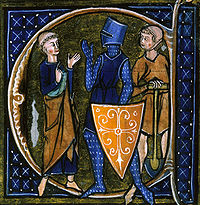
lost much of its religious character and retained a more nominal universal preeminence over other rulers, though it varied. The struggle over investiture and the reform movement also legitimized all secular authorities, partly on the grounds of their obligation to enforce discipline. In the 11th and 12th centuries thinkers argued that human society consisted of three orders: those who fight, those who pray, and those who labour. The structure of the second order, the clergy, was in place by 1200 and remained singly intact until the religious reformations
Reformation
- Movements :* Protestant Reformation, an attempt by Martin Luther to reform the Roman Catholic Church that resulted in a schism, and grew into a wider movement...
of the 16th century. The very general category of those who labour (specifically, those who were not knightly warriors or nobles) diversified rapidly after the 11th century into the lively and energetic worlds of peasants, skilled artisans, merchants, financiers, lay professionals, and entrepreneurs, which together drove the European economy to its greatest achievements. The first order, those who fight, was the rank of the politically powerful, ambitious, and dangerous. Kings took pains to ensure that it did not resist their authority. By the 12th century, most European political thinkers agreed that monarchy was the ideal form of governance. This was because it imitated on earth the model set by God for the universe; it was the form of government of the ancient Hebrews
Judaism
Judaism ) is the "religion, philosophy, and way of life" of the Jewish people...
and the Christian Biblical basis, the later Roman Empire, and also the peoples who succeeded Rome after the 4th century.
Estates in the Kingdom of France
France under the Ancien Régime (before the French RevolutionFrench Revolution
The French Revolution , sometimes distinguished as the 'Great French Revolution' , was a period of radical social and political upheaval in France and Europe. The absolute monarchy that had ruled France for centuries collapsed in three years...
) divided society into three estates: the First Estate (clergy
Clergy
Clergy is the generic term used to describe the formal religious leadership within a given religion. A clergyman, churchman or cleric is a member of the clergy, especially one who is a priest, preacher, pastor, or other religious professional....
); the Second Estate (nobility
French nobility
The French nobility was the privileged order of France in the Middle Ages and the Early Modern periods.In the political system of the Estates General, the nobility made up the Second Estate...
); and the Third Estate (commoner
Commoner
In British law, a commoner is someone who is neither the Sovereign nor a peer. Therefore, any member of the Royal Family who is not a peer, such as Prince Harry of Wales or Anne, Princess Royal, is a commoner, as is any member of a peer's family, including someone who holds only a courtesy title,...
s). The king was considered part of no estate.
First Estate
The First Estate comprised the entire clergy, traditionally divided into "higher" and "lower" clergy. Although there was no formal demarcation between the two categories, the upper clergy were, effectively, clerical nobility, from the families of the Second Estate. In the time of Louis XVI, every bishop in France was a nobleman, a situation that had not existed before the 18th century. At the other extreme, the "lower clergy" (about equally divided between parish priests and monks and nuns) constituted about 90 percent of the First Estate, which in 1789 numbered around 130,000 (about 0.5% of the population).Second Estate
The Second Estate (Fr. deuxieme état) was the French nobilityFrench nobility
The French nobility was the privileged order of France in the Middle Ages and the Early Modern periods.In the political system of the Estates General, the nobility made up the Second Estate...
and (technically, though not in common use) royalty
Royal family
A royal family is the extended family of a king or queen regnant. The term imperial family appropriately describes the extended family of an emperor or empress, while the terms "ducal family", "grand ducal family" or "princely family" are more appropriate to describe the relatives of a reigning...
, other than the monarch
Monarch
A monarch is the person who heads a monarchy. This is a form of government in which a state or polity is ruled or controlled by an individual who typically inherits the throne by birth and occasionally rules for life or until abdication...
himself, who stood outside of the system of estates.
The Second Estate is traditionally divided into "noblesse de robe" ("nobility of the robe"), the magisterial class that administered royal justice and civil government, and "noblesse d'épée" ("nobility of the sword").
The Second Estate constituted approximately 1.5% of France's population. Under the ancien régime, the Second Estate were exempt from the corvée
Corvée
Corvée is unfree labour, often unpaid, that is required of people of lower social standing and imposed on them by the state or a superior . The corvée was the earliest and most widespread form of taxation, which can be traced back to the beginning of civilization...
royale (forced labour on the roads) and from most other forms of taxation such as the gabelle
Gabelle
The gabelle was a very unpopular tax on salt in France before 1790. The term gabelle derives from the Italian gabella , itself from the Arabic qabala....
(salt tax) and most important, the taille
Taille
The taille was a direct land tax on the French peasantry and non-nobles in Ancien Régime France. The tax was imposed on each household and based on how much land it held.-History:Originally only an "exceptional" tax The taille was a direct land tax on the French peasantry and non-nobles in Ancien...
(the oldest form of direct taxation). This exemption from paying taxes led to their reluctance to reform.
Third Estate
The Third Estate comprised all those not members of the above and can be divided into two groups, urban and rural, together making up 97% of France's population. The urban included the bourgeoisieBourgeoisie
In sociology and political science, bourgeoisie describes a range of groups across history. In the Western world, between the late 18th century and the present day, the bourgeoisie is a social class "characterized by their ownership of capital and their related culture." A member of the...
, as well as wage-laborers (such as craftsmen). The rural had no wealth and yet were forced to pay disproportionately high taxes compared to the other Estates and were unhappy because they wanted more rights.The Third estate consist of common people. For example Peasants who worked on the country side, the producers who made the products and the merchants who sold the goods. The first and second estate lived off the labor of the “Third Estate”. “The first estate represented 100,000 clergy of the Catholic Church which owned about 10 percent of the land and collected its own taxes on peasants” The deputies of the second estate represented the nobility, about 400,000 men and women who owned about 25 percent of the land and collected seigniorial dues and rents from the peasant tenants"
The French Estates General
See main articles French Estates General, Estates General of 1789The first Estates General (not to be confused with a "class of citizen") was actually a general citizen assembly that was called by Philip IV
Philip IV of France
Philip the Fair was, as Philip IV, King of France from 1285 until his death. He was the husband of Joan I of Navarre, by virtue of which he was, as Philip I, King of Navarre and Count of Champagne from 1284 to 1305.-Youth:A member of the House of Capet, Philip was born at the Palace of...
in 1302.
In the period leading up to the Estates General of 1789, France was in the grip of an unmanageable public debt and terrible inflation and widespread food scarcity. This led to widespread popular discontent and produced a group of third estate representatives pressing a comparatively radical set of reforms — much of it in alignment with the goals of finance minister Jacques Necker
Jacques Necker
Jacques Necker was a French statesman of Swiss birth and finance minister of Louis XVI, a post he held in the lead-up to the French Revolution in 1789.-Early life:...
but very much against the wishes of Louis XVI's court
Louis XVI of France
Louis XVI was a Bourbon monarch who ruled as King of France and Navarre until 1791, and then as King of the French from 1791 to 1792, before being executed in 1793....
and many of the hereditary nobles forming his second estate allies—at least allies against taking more taxes upon themselves and keeping the unequal taxation on the commoners.
When he couldn't get them to rubber-stamp his 'ideal program', Louis XVI sought to dissolve the estates general after they refused to accept his agenda, but the third estate held out for their right to representation. The lower clergy (and some nobles and upper clergy) eventually sided with the third estate, and the king was forced to yield.
By June when continued impasses lead to further deterioration in relations, the States-General was reconstituted first as the National Assembly
National Assembly (French Revolution)
During the French Revolution, the National Assembly , which existed from June 17 to July 9, 1789, was a transitional body between the Estates-General and the National Constituent Assembly.-Background:...
(June 17, 1789) seeking a solution for the realm independent of the king's management of the meetings of the Estates General which occasionally continued to meet. These self-organized and managed separate meetings are today defined as the epoch event beginning the historical epoch (era) of French Revolution
French Revolution
The French Revolution , sometimes distinguished as the 'Great French Revolution' , was a period of radical social and political upheaval in France and Europe. The absolute monarchy that had ruled France for centuries collapsed in three years...
during which, after several further weeks of civil unrest the body assumed a new status as a revolutionary legislature, the National Constituent Assembly
National Constituent Assembly
The National Constituent Assembly was formed from the National Assembly on 9 July 1789, during the first stages of the French Revolution. It dissolved on 30 September 1791 and was succeeded by the Legislative Assembly.-Background:...
(July 9, 1789), a unitary body composed of the former representatives of the three estates stepping up to govern along with an emergency committee in the power vacuum existing after the Bourbon monarchy fled Paris.
The United Kingdom
Whilst the estates were never formulated in a way which prevented social mobility, the English (subsequently the British) parliament was long based along the classic estate lines being composed on the "Lords Spiritual and Temporal, and Commons". The tradition where the Lords Spiritual and Temporal sat separately from the Commons began during the reign of Edward III in the 14th century.Scotland
The members of the parliament of ScotlandScotland
Scotland is a country that is part of the United Kingdom. Occupying the northern third of the island of Great Britain, it shares a border with England to the south and is bounded by the North Sea to the east, the Atlantic Ocean to the north and west, and the North Channel and Irish Sea to the...
were collectively referred to as the Three Estates (Older Scots
Older Scots
Older Scots refers to the following periods in the History of the Scots language* Pre-literary Scots to 1375* Early Scots to 1450* Middle Scots to 1700...
: Thre Estaitis), also known as the community of the realm, and until 1690 composed of:
- the first estate of prelatePrelateA prelate is a high-ranking member of the clergy who is an ordinary or who ranks in precedence with ordinaries. The word derives from the Latin prælatus, the past participle of præferre, which means "carry before", "be set above or over" or "prefer"; hence, a prelate is one set over others.-Related...
s (bishopBishopA bishop is an ordained or consecrated member of the Christian clergy who is generally entrusted with a position of authority and oversight. Within the Catholic Church, Eastern Orthodox, Oriental Orthodox Churches, in the Assyrian Church of the East, in the Independent Catholic Churches, and in the...
s and abbotAbbotThe word abbot, meaning father, is a title given to the head of a monastery in various traditions, including Christianity. The office may also be given as an honorary title to a clergyman who is not actually the head of a monastery...
s) - the second estate of lairdLairdA Laird is a member of the gentry and is a heritable title in Scotland. In the non-peerage table of precedence, a Laird ranks below a Baron and above an Esquire.-Etymology:...
s (dukeDukeA duke or duchess is a member of the nobility, historically of highest rank below the monarch, and historically controlling a duchy...
s, earlEarlAn earl is a member of the nobility. The title is Anglo-Saxon, akin to the Scandinavian form jarl, and meant "chieftain", particularly a chieftain set to rule a territory in a king's stead. In Scandinavia, it became obsolete in the Middle Ages and was replaced with duke...
s, parliamentary peers (after 1437) and layLaityIn religious organizations, the laity comprises all people who are not in the clergy. A person who is a member of a religious order who is not ordained legitimate clergy is considered as a member of the laity, even though they are members of a religious order .In the past in Christian cultures, the...
tenants-in-chief) - the third estate of burgh commissioners (representatives chosen by the royal burghs)
The First Estate was overthrown during the Glorious Revolution
Glorious Revolution
The Glorious Revolution, also called the Revolution of 1688, is the overthrow of King James II of England by a union of English Parliamentarians with the Dutch stadtholder William III of Orange-Nassau...
and the accession of William II
William III of England
William III & II was a sovereign Prince of Orange of the House of Orange-Nassau by birth. From 1672 he governed as Stadtholder William III of Orange over Holland, Zeeland, Utrecht, Guelders, and Overijssel of the Dutch Republic. From 1689 he reigned as William III over England and Ireland...
. The Second Estate was then split into two to retain the division into three.
A Shire Commissioner was the closest equivalent of the English
England
England is a country that is part of the United Kingdom. It shares land borders with Scotland to the north and Wales to the west; the Irish Sea is to the north west, the Celtic Sea to the south west, with the North Sea to the east and the English Channel to the south separating it from continental...
office of Member of Parliament
Member of Parliament
A Member of Parliament is a representative of the voters to a :parliament. In many countries with bicameral parliaments, the term applies specifically to members of the lower house, as upper houses often have a different title, such as senate, and thus also have different titles for its members,...
, namely a commoner
Commoner
In British law, a commoner is someone who is neither the Sovereign nor a peer. Therefore, any member of the Royal Family who is not a peer, such as Prince Harry of Wales or Anne, Princess Royal, is a commoner, as is any member of a peer's family, including someone who holds only a courtesy title,...
or member of the lower nobility. Because the parliament of Scotland was unicameral, all members sat in the same chamber
Chambers of parliament
Many parliaments or other legislatures consist of two chambers : an elected lower house, and an upper house or Senate which may be appointed or elected by a different mechanism from the lower house. This style of two houses is called bicameral...
, as opposed to the separate English House of Lords
House of Lords
The House of Lords is the upper house of the Parliament of the United Kingdom. Like the House of Commons, it meets in the Palace of Westminster....
and House of Commons
British House of Commons
The House of Commons is the lower house of the Parliament of the United Kingdom, which also comprises the Sovereign and the House of Lords . Both Commons and Lords meet in the Palace of Westminster. The Commons is a democratically elected body, consisting of 650 members , who are known as Members...
.
The Parliament also had University constituencies
University constituency
A university constituency is a constituency, used in elections to a legislature, that represents a university rather than a geographical area. University constituencies may involve plural voting, in which eligible voters are permitted to vote in both a university constituency and a geographical...
(see Ancient universities of Scotland
Ancient universities of Scotland
The ancient universities of Scotland are medieval and renaissance universities which continue to exist until the present day. The majority of the ancient universities of the British Isles are located within Scotland, and have a number of distinctive features in common, being governed by a series of...
). The system was also adopted by the Parliament of England
Parliament of England
The Parliament of England was the legislature of the Kingdom of England. In 1066, William of Normandy introduced a feudal system, by which he sought the advice of a council of tenants-in-chief and ecclesiastics before making laws...
when James VI
James I of England
James VI and I was King of Scots as James VI from 24 July 1567 and King of England and Ireland as James I from the union of the English and Scottish crowns on 24 March 1603...
ascended to the English throne. It was believed that the universities were affected by the decisions of Parliament and ought therefore to have representation in it. This continued in the Parliament of Great Britain
Parliament of Great Britain
The Parliament of Great Britain was formed in 1707 following the ratification of the Acts of Union by both the Parliament of England and Parliament of Scotland...
after 1707
Acts of Union 1707
The Acts of Union were two Parliamentary Acts - the Union with Scotland Act passed in 1706 by the Parliament of England, and the Union with England Act passed in 1707 by the Parliament of Scotland - which put into effect the terms of the Treaty of Union that had been agreed on 22 July 1706,...
and the Parliament of the United Kingdom
Parliament of the United Kingdom
The Parliament of the United Kingdom of Great Britain and Northern Ireland is the supreme legislative body in the United Kingdom, British Crown dependencies and British overseas territories, located in London...
until 1950.
In Sweden and Finland
The Estates in SwedenSweden
Sweden , officially the Kingdom of Sweden , is a Nordic country on the Scandinavian Peninsula in Northern Europe. Sweden borders with Norway and Finland and is connected to Denmark by a bridge-tunnel across the Öresund....
(including Finland
Finland
Finland , officially the Republic of Finland, is a Nordic country situated in the Fennoscandian region of Northern Europe. It is bordered by Sweden in the west, Norway in the north and Russia in the east, while Estonia lies to its south across the Gulf of Finland.Around 5.4 million people reside...
) and later also the Finland
Grand Duchy of Finland
The Grand Duchy of Finland was the predecessor state of modern Finland. It existed 1809–1917 as part of the Russian Empire and was ruled by the Russian czar as Grand Prince.- History :...
were the two higher estates nobility
Nobility
Nobility is a social class which possesses more acknowledged privileges or eminence than members of most other classes in a society, membership therein typically being hereditary. The privileges associated with nobility may constitute substantial advantages over or relative to non-nobles, or may be...
, clergy
Clergy
Clergy is the generic term used to describe the formal religious leadership within a given religion. A clergyman, churchman or cleric is a member of the clergy, especially one who is a priest, preacher, pastor, or other religious professional....
and the two lower estates burghers
Bourgeoisie
In sociology and political science, bourgeoisie describes a range of groups across history. In the Western world, between the late 18th century and the present day, the bourgeoisie is a social class "characterized by their ownership of capital and their related culture." A member of the...
and land-owning peasants. Each were free men, and had specific rights and responsibilities, and the right to send representatives to the governing assembly, the Riksdag of the Estates
Riksdag of the Estates
The Riksdag of the Estates , was the name used for the Estates of the Swedish realm when they were assembled. Until its dissolution in 1866, the institution was the highest authority in Sweden next to the King...
in Sweden and Diet of Finland
Diet of Finland
The Diet of Finland , was the legislative assembly of the Grand Duchy of Finland from 1809 to 1906 and the recipient of the powers of the Swedish Riksdag of the Estates....
(after being conquered by Russia in 1809), respectively. Also, there was a population outside the estates; unlike in other areas, people had no "default" estate, and were not peasants unless they came from a land-owner's family. A summary of this division is:
- Nobility (see Finnish nobilityFinnish nobilityThe Finnish nobility was historically a privileged class in Finland, deriving from its period as part of Sweden and the Russian Empire. Noble families and their descendants are still a part of Finnish republican society today, but except for the titles themselves, no longer retain any specific or...
and Swedish nobilitySwedish nobilityThe Swedish nobility were historically a legally and/or socially privileged class in Sweden, part of the so-called frälse . Today, the nobility is still very much a part of Swedish society but they do not maintain many of their former privileges...
) was exempt from tax, had an inherited rank and the right to keep a fief, and had a tradition of military service and government. Nobility was established in 1279 with the Swedish king granted tax-free status (frälse) to peasants who could equip a cavalryman (or be one themselves) in the king's army. Initially, exemption from tax was not inherited, but it became hereditary in 1544. Following Axel OxenstiernaAxel OxenstiernaAxel Gustafsson Oxenstierna af Södermöre , Count of Södermöre, was a Swedish statesman. He became a member of the Swedish Privy Council in 1609 and served as Lord High Chancellor of Sweden from 1612 until his death. He was a confidant of first Gustavus Adolphus and then Queen Christina.Oxenstierna...
's reform, government positions were open only to nobles. However, the nobility still owned only their own property, not the peasants or their land as in much of EuropeSerfdomSerfdom is the status of peasants under feudalism, specifically relating to Manorialism. It was a condition of bondage or modified slavery which developed primarily during the High Middle Ages in Europe and lasted to the mid-19th century...
. Heads of the noble houses were hereditary members of the assembly of nobles. The Nobility is divided into titled nobility (countCountA count or countess is an aristocratic nobleman in European countries. The word count came into English from the French comte, itself from Latin comes—in its accusative comitem—meaning "companion", and later "companion of the emperor, delegate of the emperor". The adjective form of the word is...
s and baronBaronBaron is a title of nobility. The word baron comes from Old French baron, itself from Old High German and Latin baro meaning " man, warrior"; it merged with cognate Old English beorn meaning "nobleman"...
s) and lower nobility. Until the 18th century the lower nobility was in turn was divided into KnightKnightA knight was a member of a class of lower nobility in the High Middle Ages.By the Late Middle Ages, the rank had become associated with the ideals of chivalry, a code of conduct for the perfect courtly Christian warrior....
s and EsquireEsquireEsquire is a term of West European origin . Depending on the country, the term has different meanings...
s such that each of the three classes would first vote internally, giving one vote per class in the assembly. This resulted in great political influence for the higher nobility. - Clergy, or priests, were exempt from tax, and collected titheTitheA tithe is a one-tenth part of something, paid as a contribution to a religious organization or compulsory tax to government. Today, tithes are normally voluntary and paid in cash, cheques, or stocks, whereas historically tithes were required and paid in kind, such as agricultural products...
s for the church. After the ReformationProtestant ReformationThe Protestant Reformation was a 16th-century split within Western Christianity initiated by Martin Luther, John Calvin and other early Protestants. The efforts of the self-described "reformers", who objected to the doctrines, rituals and ecclesiastical structure of the Roman Catholic Church, led...
, the church became Lutheran. In later centuries, the estate included teachers of universities and certain state schools. The estate was governed by the state churchState churchState churches are organizational bodies within a Christian denomination which are given official status or operated by a state.State churches are not necessarily national churches in the ethnic sense of the term, but the two concepts may overlap in the case of a nation state where the state...
which consecrated its ministers and appointed them to positions with a vote in choosing diet representatives. - Burghers are city-dwellers, tradesmen and craftsmen. Trade was allowed only in the cities when the mercantilisticMercantilismMercantilism is the economic doctrine in which government control of foreign trade is of paramount importance for ensuring the prosperity and security of the state. In particular, it demands a positive balance of trade. Mercantilism dominated Western European economic policy and discourse from...
ideology had got the upper hand, and the burghers had the exclusive right to conduct commerce. Entry to this Estate is controlled by the autonomy of the towns themselves. Peasants were allowed to sell their produce within the city limits, but any further trade, particularly foreign trade, was allowed only for burghers. In order for a settlement to become a city, a royal charter granting market right was required, and foreign trade required royally chartered staple port rights. After the annexation of Finland into Imperial Russia in 1809, mill-owners and other proto-industrialists would gradually be included in this estate. - Peasants are land-owners of land-taxed farms and their families, which represented the majority in medieval times. Since most of the population were independent farmer families until 19th century, not serfs nor villeins, there is a remarkable difference in tradition compared to other European countries. Entry was controlled by ownership of farmland, which was not generally for sale but a hereditary property. After 1809, tenants renting a large enough farm (ten times larger than what was required of peasants owning their own farm) were included as well as non-nobility owning tax-exempt land.
- To no estate belonged propertyless cottagers, villeins, tenantsTenant farmerA tenant farmer is one who resides on and farms land owned by a landlord. Tenant farming is an agricultural production system in which landowners contribute their land and often a measure of operating capital and management; while tenant farmers contribute their labor along with at times varying...
of farms owned by others, farmhands, servants, some lower administrative workers, rural craftsmen, travelling salesmen, vagrants, and propertyless and unemployed people (who sometimes lived in strangers' houses). To reflect how the people belonging to the estates saw them, the Finnish word for "obscene", säädytön, has the literal meaning "estateless".
In Sweden, the Riksdag of the Estates existed until it was replaced with a bicameral Riksdag in 1866, which gave political rights to anyone with a certain income or property. Nevertheless, many of the leading politicians of the 19th century continued to be drawn from the old estates, in that they were either noblemen themselves, or represented agricultural and urban interests. Ennoblements continued even after the estates had lost their political importance, with the last ennoblement of explorer Sven Hedin
Sven Hedin
Sven Anders Hedin KNO1kl RVO was a Swedish geographer, topographer, explorer, photographer, and travel writer, as well as an illustrator of his own works...
taking place in 1902; this practice was formally abolished with the adoption of the new Constitution
Constitution of Sweden
The Swedish Constitution consists of four fundamental laws :* The 1810 Act of Succession * The 1949 Freedom of the Press Act * The 1974 Instrument of Government * The 1991 Fundamental Law on Freedom of Expression...
January 1, 1975, while the status of the House of Nobility continued to be regulated in law until 2003.
In Finland, this legal division existed until the modern age. However, at the start of the 20th century, most of the population did not belong to any Estate and had no political representation. A particularly large class were the rent farmers, who did not own the land they cultivated, but had to work in the land-owner's farm to pay their rent (unlike Russia, there were no slaves or serf
SERF
A spin exchange relaxation-free magnetometer is a type of magnetometer developed at Princeton University in the early 2000s. SERF magnetometers measure magnetic fields by using lasers to detect the interaction between alkali metal atoms in a vapor and the magnetic field.The name for the technique...
s.) Furthermore, the industrial workers living in the city were not represented by the four-estate system. The political system was reformed, and the last Diet was dissolved in 1905, to create the modern parliamentary system, ending the political privileges of the estates. The constitution of 1919 forbade giving new noble ranks, and all tax privileges were abolished in 1920. The privileges of the estates were officially and finally abolished in 1995, although in legal practice, the privileges had long been unenforceable. However, the nobility has never been officially abolished and records of nobility are still voluntarily maintained by the Finnish House of Nobility.
Nevertheless, the old traditions and in particular ownership of property changed slowly, and the rent-farmer problem became so severe that it was a major cause to the Finnish Civil War
Finnish Civil War
The Finnish Civil War was a part of the national, political and social turmoil caused by World War I in Europe. The Civil War concerned control and leadership of The Grand Duchy of Finland as it achieved independence from Russia after the October Revolution in Petrograd...
. Although the division became irrelevant following the establishment of a parliamentary democracy and political parties, industrialization and urbanization
Urbanization
Urbanization, urbanisation or urban drift is the physical growth of urban areas as a result of global change. The United Nations projected that half of the world's population would live in urban areas at the end of 2008....
, it might be possible to claim that their traditions live on in the political parties of Sweden and Finland, in the sense that there are parties that have traditionally represented upper-class and business interests (Moderate Party
Moderate Party
The Moderate Party is a centre-right, liberal conservative political party in Sweden. The party was founded in 1904 as the General Electoral League by a group of conservatives in the Swedish parliament...
and Coalition Party) and farmers (the Centre Parties of Sweden
Centre Party (Sweden)
The Centre Party is a centrist political party in Sweden. The party maintains close ties to rural Sweden and describes itself as "a green social liberal party". The ideology is sometimes called agrarian, but in a European context, the Centre Party can perhaps best be characterized as social...
and Finland
Centre Party (Finland)
The Centre Party is a centrist and Nordic agrarian political party in Finland. It is one of the four largest political parties in the country, along with the Social Democratic Party , the National Coalition Party and the True Finns , and currently has 35 seats in the Finnish Parliament...
).
In Finland, it is still illegal and punishable by jail time (up to one year) to defraud into marriage by declaring a false name or estate (Rikoslaki 18 luku § 1/Strafflagen 18 kap. § 1).
In the Netherlands
The NetherlandsNetherlands
The Netherlands is a constituent country of the Kingdom of the Netherlands, located mainly in North-West Europe and with several islands in the Caribbean. Mainland Netherlands borders the North Sea to the north and west, Belgium to the south, and Germany to the east, and shares maritime borders...
, which until the late sixteenth century consisted of several counties, prince bishoprics, duchies etc. in the area that is now modern Belgium
Belgium
Belgium , officially the Kingdom of Belgium, is a federal state in Western Europe. It is a founding member of the European Union and hosts the EU's headquarters, and those of several other major international organisations such as NATO.Belgium is also a member of, or affiliated to, many...
, Luxembourg
Luxembourg
Luxembourg , officially the Grand Duchy of Luxembourg , is a landlocked country in western Europe, bordered by Belgium, France, and Germany. It has two principal regions: the Oesling in the North as part of the Ardennes massif, and the Gutland in the south...
and the Netherlands, had no States General until 1464, when Duke Philip of Burgundy
Philip III, Duke of Burgundy
Philip the Good KG , also Philip III, Duke of Burgundy was Duke of Burgundy from 1419 until his death. He was a member of a cadet line of the Valois dynasty . During his reign Burgundy reached the height of its prosperity and prestige and became a leading center of the arts...
assembled the first States General in Bruges
Bruges
Bruges is the capital and largest city of the province of West Flanders in the Flemish Region of Belgium. It is located in the northwest of the country....
. Later in the 15th and 16th centuries Brussels
Brussels
Brussels , officially the Brussels Region or Brussels-Capital Region , is the capital of Belgium and the de facto capital of the European Union...
became the place where the States General assembled. On these occasions deputies from the states of the various provinces (as the counties, prince-bishoprics and duchies were called) asked for more liberties. For this reason, the States General were not assembled very often.
As a consequence of the Union of Utrecht
Union of Utrecht
The Union of Utrecht was a treaty signed on 23 January 1579 in Utrecht, the Netherlands, unifying the northern provinces of the Netherlands, until then under the control of Habsburg Spain....
in 1579 and the events that followed afterwards, the States General declared that they no longer obeyed King Philip II of Spain, who was also Lord of the Netherlands. After the conquest of the southern part of the Netherlands (i.e. Belgium and Luxemburg), the States General first assembled permanently in Middelburg, and in The Hague
The Hague
The Hague is the capital city of the province of South Holland in the Netherlands. With a population of 500,000 inhabitants , it is the third largest city of the Netherlands, after Amsterdam and Rotterdam...
from 1585 onwards. Without a king to rule the country, the States General became head of state. It was the government were all things were dealt with that were of concern to all the seven provinces that became part of the Republic of the United Netherlands.
During that time the States General were formed by members of the States (i.e. provincial parliaments) of the seven provinces. In each State sat representatives of the nobility, the peasantry, and the cities.
As government, the States General were abolished in 1795. A new parliament was created, called National Assembly (Nationale Vergadering). It no longer consisted of members of representatives of the states: all men were considered equal under the 1798 Constitition. Eventually, the Netherlands became part of the French Empire under Napoleon (1811: La Hollande est reunie à l'Empire).
After regaining independence in November 1813, the States General were invested once again in 1814 and consisted of members of the states, who were invested once again. In 1815, when the Netherlands were united with Belgium and Luxemburg, the States General were divided into two chambers: the First Chamber and the Second Chamber. The members of the First Chamber were elected by the King, while the members of the Second Chamber were elected by the members of the provincial parliaments (which were once again called Provincial States). The States General resided in The Hague and Brussels until 1830, when, as a result of Belgium's independence, The Hague became once again the sole residence of the States General.
In 1848, it was decided that the States General no longer consist of members of the states as they were abolished once again. From then on, the Constitution declares that members of the Second Chamber are elected by the people (in first instance only a limited portion of the male population, universal suffrage exists since 1919), while the members of the First chambers are chosen by the members of the Provincial parliaments (confusingly still called Provincial States). As a result the Second Chamber became the most important. The First Chamber is also called Senate. This however, is not a term used in the Constitution.
Occasionally the First and Second Chamber meet in a United Assembly, for instance on Prinsjesdag
Prinsjesdag
Prinsjesdag is the day on which the reigning monarch of the Netherlands addresses a joint session of the Dutch Senate and House of Representatives in the Ridderzaal or Hall of Knights in The Hague. The Speech from the Throne sets out the main features of government policy for the coming...
, the annual opening of the parliamentary year, and when a new king is invested.
In the Holy Roman Empire
The Holy Roman EmpireHoly Roman Empire
The Holy Roman Empire was a realm that existed from 962 to 1806 in Central Europe.It was ruled by the Holy Roman Emperor. Its character changed during the Middle Ages and the Early Modern period, when the power of the emperor gradually weakened in favour of the princes...
had the Imperial Diet
Reichstag (Holy Roman Empire)
The Imperial Diet was the Diet, or general assembly, of the Imperial Estates of the Holy Roman Empire.During the period of the Empire, which lasted formally until 1806, the Diet was not a parliament in today's sense; instead, it was an assembly of the various estates of the realm...
(Reichstag). The clergy was represented by the independent prince-bishop
Prince-Bishop
A Prince-Bishop is a bishop who is a territorial Prince of the Church on account of one or more secular principalities, usually pre-existent titles of nobility held concurrently with their inherent clerical office...
s, prince-archbishops and prince-abbot
Prince-abbot
A Prince-Abbot is a title for a cleric who is a Prince of the Church , in the sense of an ex officio temporal lord of a feudal entity, notably a State of the Holy Roman Empire. The secular territory ruled by the head of an abbey is known as Prince-Abbacy or Abbey-principality...
s of the many monasteries. The nobility consisted of independent aristocratic rulers: secular prince-elector
Prince-elector
The Prince-electors of the Holy Roman Empire were the members of the electoral college of the Holy Roman Empire, having the function of electing the Roman king or, from the middle of the 16th century onwards, directly the Holy Roman Emperor.The heir-apparent to a prince-elector was known as an...
s, kings, dukes, margraves, counts and others. Burghers consisted of representatives of the independent imperial cities
Free Imperial City
In the Holy Roman Empire, a free imperial city was a city formally ruled by the emperor only — as opposed to the majority of cities in the Empire, which were governed by one of the many princes of the Empire, such as dukes or prince-bishops...
. Many peoples whose territories within the Holy Roman Empire had been independent for centuries had no representatives in the Imperial Diet, and this included the Imperial Knight
Imperial Knight
The Free Imperial Knights, or the Knights of the Empire was an organisation of free nobles of the Holy Roman Empire, whose direct overlord was the Emperor, remnants of the medieval free nobility and the ministeriales...
s and independent villages. The power of the Imperial Diet was limited, despite efforts of centralization.
Large realms of the nobility or clergy had estates of their own that could wield great power in local affairs. Power struggles between ruler and estates were comparable to similar events in the history of the British and French parliaments.
The Swabian League
Swabian League
The Swabian League was an association of Imperial States - cities, prelates, principalities and knights - principally in the territory of the Early medieval stem duchy of Swabia, established in 1488 at the behest of Emperor Frederick III of Habsburg and supported as well by Bertold von...
, a significant regional power in its part of Germany during the 15th Century, also had its own kind of Estates, a governing Federal Council comprising three Colleges: those of Princes, Cities, and Knights.
In the Russian Empire
In late Russian EmpireRussian Empire
The Russian Empire was a state that existed from 1721 until the Russian Revolution of 1917. It was the successor to the Tsardom of Russia and the predecessor of the Soviet Union...
the estates were called sosloviyes. The four major estates were: nobility (dvoryanstvo), clergy
Clergy
Clergy is the generic term used to describe the formal religious leadership within a given religion. A clergyman, churchman or cleric is a member of the clergy, especially one who is a priest, preacher, pastor, or other religious professional....
, rural dwellers, and urban dwellers, with a more detailed stratification therein. The division in estates was of mixed nature: traditional, occupational, as well as formal: for example, voting in Duma
Duma
A Duma is any of various representative assemblies in modern Russia and Russian history. The State Duma in the Russian Empire and Russian Federation corresponds to the lower house of the parliament. Simply it is a form of Russian governmental institution, that was formed during the reign of the...
was carried out by estates. Russian Empire Census
Russian Empire Census
The Russian Imperial Census of 1897 was the first and the only census carried out in the Russian Empire . It recorded demographic data as of ....
recorded the reported estate of a person.
In Catalonia
The Parliament of Catalonia (Corts Catalanes) was established in 1283, according to American historian Thomas Bisson, and it has been considered by several historians as a model of medieval parliamentParliament
A parliament is a legislature, especially in those countries whose system of government is based on the Westminster system modeled after that of the United Kingdom. The name is derived from the French , the action of parler : a parlement is a discussion. The term came to mean a meeting at which...
. For instance, English historian of constitutionalism Charles Howard McIlwain
Charles Howard McIlwain
Charles Howard McIlwain was a highly regarded scholar of Anglo-American constitutional history, and won the 1924 Pulitzer Prize for History...
wrote that the Parliament of Catalonia, during the 14th century, had a more defined organization and met more regularly than the parliaments of England or France.
The roots of the parliament institution in Catalonia are in the Sanctuary and Truce Assemblies (assemblees de pau i treva) that started in the 11th century.
The members of the parliament of Catalonia were organized in the Three Estates (Catalan: Tres Braços):
- the "military estate" (braç militar) with representatives of the feudal nobility
- the "ecclesiastical estate" (braç eclesiàstic) with representatives of the religious hierarchy
- the "royal estate" (braç reial) with representatives of the free municipalities under royal privilege
The parliament institution was abolished in 1716, together with the rest of institutions of Catalonia, after the War of the Spanish Succession
War of the Spanish Succession
The War of the Spanish Succession was fought among several European powers, including a divided Spain, over the possible unification of the Kingdoms of Spain and France under one Bourbon monarch. As France and Spain were among the most powerful states of Europe, such a unification would have...
.
See also
- Ane Pleasant Satyre of the Thrie EstaitisAne Pleasant Satyre of the Thrie EstaitisA Satire of the Three Estates is a satirical morality play in Middle Scots, written by makar Sir David Lyndsay. The play was first performed outside in the playing field in June 1552 during the Midsummer holiday in Cupar, Fifeshire where the action took place under Castle Hill...
- What Is the Third Estate?What is the Third Estate?What Is the Third Estate? is a pamphlet written by French thinker and clergyman Abbé Emmanuel Joseph Sieyès in January 1789, shortly before the outbreak of the French Revolution...
- Communalism before 1800Communalism before 1800Communalism is a term used by the German historian Peter Blickle for a form of representative government in Europe before 1800. The concept is mainly based on Germany of the Holy Roman Empire where it describes the widespread communal institutionalization in villages and towns between the 14th and...
- Fifth EstateFifth EstateFifth Estate is a US periodical, originally based in Detroit, Michigan, but now produced in a variety of locations. Its editorial collective shares divergent views on the topics the magazine addresses but generally shares an anti-authoritarian outlook and a non-dogmatic, action-oriented approach...
- Fourth EstateFourth EstateThe concept of the Fourth Estate is a societal or political force or institution whose influence is not consistently or officially recognized. The Fourth Estate now most commonly refers to the news media; especially print journalism, referred to hereon as "The Press"...
- Social classSocial classSocial classes are economic or cultural arrangements of groups in society. Class is an essential object of analysis for sociologists, political scientists, economists, anthropologists and social historians. In the social sciences, social class is often discussed in terms of 'social stratification'...
- The StatesThe StatesThe States or the Estates signifies the assembly of the representatives of the estates of the realm, called together for purposes of legislation or deliberation...
- Third WorldThird WorldThe term Third World arose during the Cold War to define countries that remained non-aligned with either capitalism and NATO , or communism and the Soviet Union...
(coined by demograph Alfred SauvyAlfred SauvyAlfred Sauvy was a demographer, anthropologist and historian of the French economy. Sauvy coined the term Third World in reference to countries that were unaligned with either the Communist Soviet bloc or the Capitalist NATO bloc during the Cold War...
in 1952 in reference to the French Third Estate and Sieyès' famous saying) - The Canterbury TalesThe Canterbury TalesThe Canterbury Tales is a collection of stories written in Middle English by Geoffrey Chaucer at the end of the 14th century. The tales are told as part of a story-telling contest by a group of pilgrims as they travel together on a journey from Southwark to the shrine of Saint Thomas Becket at...
(the division of society into three estates is one of the key themes) - CasteCasteCaste is an elaborate and complex social system that combines elements of endogamy, occupation, culture, social class, tribal affiliation and political power. It should not be confused with race or social class, e.g. members of different castes in one society may belong to the same race, as in India...