

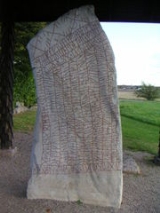
Runic alphabet

Encyclopedia
The runic alphabets are a set of related alphabet
s using letters
known as runes to write various Germanic languages
before the adoption of the Latin alphabet
and for specialized purposes thereafter. The Scandinavian variants are also known as futhark (or fuþark, derived from their first six letters of the alphabet: F, U, Þ
, A, R
, and K
); the Anglo-Saxon
variant is futhorc (due to sound changes undergone in Old English by the same six letters). Runology
is the study of the runic alphabets, runic inscriptions
, runestones, and their history. Runology forms a specialized branch of Germanic linguistics.
The earliest runic inscriptions date from around AD 150. The characters were generally replaced by the Latin alphabet
as the cultures that had used runes underwent Christianization
by around AD 700 in central Europe and by around AD 1100 in Northern Europe
. However, the use of runes persisted for specialized purposes in Northern Europe. Until the early 20th century runes were used in rural Sweden
for decoration purposes in Dalarna
and on Runic calendar
s.
The three best-known runic alphabets are the Elder Futhark
(around 150–800), the Anglo-Saxon Futhorc (400–1100), and the Younger Futhark
(800–1100). The Younger Futhark is further divided into the long-branch runes (also called Danish, although they were also used in Norway
and Sweden
), short-branch or Rök runes
(also called Swedish-Norwegian, although they were also used in Denmark
), and the stavesyle or Hälsinge runes (staveless runes
). The Younger Futhark developed further into the Marcomannic runes, the Medieval runes
(1100–1500), and the Dalecarlian
runes (around 1500–1800).
Historically, the runic alphabet is a derivation of the Old Italic alphabet
s of antiquity, with the addition of some innovations.
Which variant of the Old Italic family in particular gave rise to the runes is uncertain, suggestions including Raetic, Etruscan or Old Latin
candidates. All these scripts at the time had the same angular letter shapes suited for epigraphy
which would become characteristic of the runes.
The process of transmission of the script (the oldest inscriptions being found in Denmark and Northern Germany, not near Italy) is also unknown. A "West Germanic hypothesis" suggests transmission via Elbe Germanic
groups, while a "Gothic
hypothesis" assumes transmission via East Germanic expansion
.
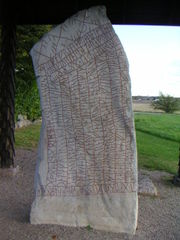
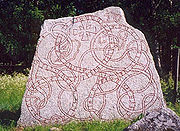 The runes were in use among the Germanic peoples from the 1st or 2nd century AD.
This period corresponds to the late Common Germanic stage linguistically, with a continuum of dialects not yet clearly separated into the three branches of later centuries; North Germanic, West Germanic, and East Germanic.
No distinction is made in surviving runic inscriptions between long and short vowels, although such a distinction was certainly present phonologically in the spoken languages of the time. Similarly, there are no signs for labiovelars in the Elder Futhark (such signs were introduced in both the Anglo-Saxon futhorc and the Gothic alphabet
as variants of p; see peorð
.)
The name runes contrasts with Latin or Greek letters. It is attested on a 6th century Alamanni
c runestaff as runa, and possibly as runo on the 4th century Einang stone
. The name is from a root run- (Gothic runa), meaning "secret" or "whisper". The root run- can also be found in the Baltic languages
meaning "speech". In Lithuanian
, runoti has two meanings: "to cut (with a knife)" or "to speak".
The debate on the development of the runic script concerns the question which of the Italic alphabets should be taken as their point of origin, and which, if any, signs should be considered original innovations added to the letters found in the Italic scripts. The historical context of the script's origin is the cultural contact between Germanic people, who often served as mercenaries
in the Roman army, and the Italic peninsula during the Roman imperial period
(1st c. BC to 5th c. AD).
The formation of the Elder Futhark was complete by the early 5th century, with the Kylver Stone
being the first evidence of the futhark ordering as well as of the p rune.
Specifically, the Raetic
alphabet of Bolzano, is often advanced as a candidate for the origin of the runes, with only five Elder Futhark runes ( e, ï, j, ŋ, p) having no counterpart in the Bolzano alphabet (Mees 2000).
Scandinavian scholars tend to favor derivation from the Latin alphabet
itself over Raetic candidates. A "North Etruscan" thesis is supported by the inscription on the Negau helmet
dating to the 2nd century BC This is in a northern Etruscan alphabet, but features a Germanic name, Harigast.
The angular shapes of the runes are shared with most contemporary alphabets of the period used for carving in wood or stone. A peculiarity of the runic alphabet is the absence of horizontal strokes, although this characteristic is also shared by other alphabets, such as the early form of the Latin alphabet
used for the Duenos inscription
, and it is not universal especially among early runic inscriptions, which frequently have variant rune shapes including horizontal strokes.
The "West Germanic hypothesis" speculates on an introduction by West Germanic tribes
. This hypothesis is based on claiming that the earliest inscriptions of the 2nd and 3rd centuries, found in bogs and graves around Jutland
(the Vimose inscriptions
), exhibit word endings that, being interpreted by Scandinavia
n scholars to be Proto-Norse, are considered unresolved and having been long the subject of discussion. Inscriptions like wagnija, niþijo, and harija are supposed to incarnate tribe names, tentatively proposed to be Vangiones
, the Nidensis and the Harii
, tribes located in the Rhineland
. Since names ending in -io reflect Germanic
morphology representing the Latin ending -ius, and the suffix -inius was reflected by Germanic -inio-, the question of the problematic ending -ijo in masculine Proto-Norse would be resolved by assuming Roman (Rhineland) influences, while "the awkward
ending -a of laguþewa (cf. Syrett 1994:44f.) can be solved by accepting the fact that the name may indeed be West Germanic;" however, it should be noted that in the early Runic period differences between Germanic languages are generally assumed to be small. Another theory assumes a Northwest Germanic
unity preceding the emergence of Proto-Norse proper from roughly the 5th century. An alternative suggestion explaining the impossibility to classify the earliest inscriptions as either North or West Germanic is forwarded by È. A. Makaev, who assumes a "special runic koine", an early "literary Germanic" employed by the entire Late Common Germanic linguistic community after the separation of Gothic (2nd to 5th centuries), while the spoken dialects may already have been more diverse.
 Runic inscriptions from the 400 year period of c. AD 150 to 550 are referred to as "Period I" inscriptions. These inscriptions are generally in Elder Futhark
, but the set of letter shapes and bindrunes employed is far from standardized. Notably the j, s
and ŋ runes undergo considerable modifications, while others, such as p and ï, remain unattested altogether prior the first full futhark row on the Kylver Stone
(c. AD 400).
Artifacts such as spear-mounts, shield-heads have been found which bear runic marking can be dated to 200 A.D., as evidenced by artifacts found across northern Europe in Schleswig (North Germany), Fyn, Sjaeland, Jylland (Denmark), and Skåne (Sweden). Earlier, but less reliable, artifacts have been found in Meldorf, Süderithmarschen, North Germany; these include brooches and comes found in graves, and are supposed to have the earliest markings resembling runic inscriptions.
Theories of the existence of separate Gothic
runes have been advanced, even identifying them as the original alphabet from which the Futhark were derived, but these have little support in actual findings (mainly the spearhead of Kovel, with its right-to-left inscription, its T-shaped tiwaz
and its rectangular dagaz
). If there ever were genuinely Gothic runes, they were soon replaced by the Gothic alphabet
. The letters of the Gothic alphabet, however, as given by the Alcuin
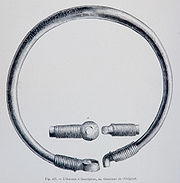
manuscript (9th century), are obviously related to the names of the Futhark. The names are clearly Gothic, but it is impossible to say whether they are as old as, or even older than, the letters themselves. A handful of Elder Futhark inscriptions were found in Gothic territory, such as the 3rd to 5th century Ring of Pietroassa
.
The Encyclopædia Britannica
even suggests the original development of the runes may have been due to the Goths.
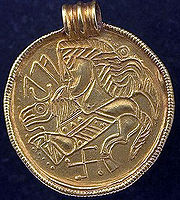
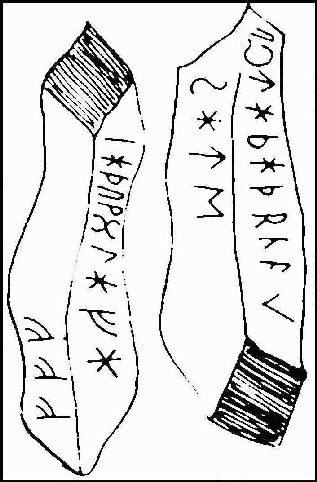
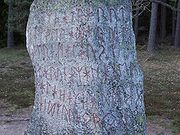 In stanza 157 of Hávamál
, the runes are attributed with the power to bring that which is dead to life. In this stanza, Odin
recounts a spell:
The earliest runic inscriptions found on artifacts give the name of either the craftsman or the proprietor, or, sometimes, remain a linguistic mystery. Due to this, it is possible that the early runes were not so much used as a simple writing system, but rather as magical
signs to be used for charms. Although some say the runes were used for divination
, there is no direct evidence to suggest they were ever used in this way. The name rune itself, taken to mean "secret, something hidden", seems to indicate that knowledge of the runes was originally considered esoteric, or restricted to an elite. The 6th century Björketorp Runestone
warns in Proto-Norse
using the word rune in both senses:
The same curse and use of the word rune is also found on the Stentoften Runestone
. There are also some inscriptions suggesting a medieval belief in the magical significance of runes, such as the Franks Casket
(700 AD) panel.
Charm words, such as auja, laþu, laukaR and most commonly, alu
, appear on a number of Migration period
Elder Futhark inscriptions as well as variants and abbreviations of them. Much speculation and study has been produced on the potential meaning of these inscriptions. Rhyming groups appear on some early bracteates that may also be magic in purpose, such as salusalu and luwatuwa. Further, an inscription on the Gummarp Runestone
(500 to 700 AD) gives a cryptic inscription describing the use of three runic letters followed by the Elder Futhark f-rune written three times in succession.
Nevertheless, it has proven difficult to find unambiguous traces of runic "oracles": Although Norse literature is full of references to runes, it nowhere contains specific instructions on divination. There are at least three sources on divination with rather vague descriptions that may or may not refer to runes: Tacitus
's 1st century Germania
, Snorri Sturluson
's 13th century Ynglinga saga
and Rimbert
's 9th century Vita Ansgari
.
The first source, Tacitus's Germania, describes "signs" chosen in groups of three and cut from "a nut-bearing tree," although the runes do not seem to have been in use at the time of Tacitus' writings. A second source is the Ynglinga saga, where Granmar
, the king of Södermanland
, goes to Uppsala
for the blót
. There, the "chips" fell in a way that said that he would not live long (Féll honum þá svo spánn sem hann mundi eigi lengi lifa). These "chips," however, are easily explainable as a blótspánn (sacrificial chip), which was "marked, possibly with sacrificial blood, shaken and thrown down like dice, and their positive or negative significance then decided."
The third source is Rimbert's Vita Ansgari, where there are three accounts of what some believe to be the use of runes for divination, but Rimbert calls it "drawing lots". One of these accounts is the description of how a renegade Swedish king Anund Uppsale
first brings a Danish fleet to Birka
, but then changes his mind and asks the Danes to "draw lots". According to the story, this "drawing of lots" was quite informative, telling them that attacking Birka
would bring bad luck and that they should attack a Slavic town instead. The tool in the "drawing of lots," however, is easily explainable as a hlautlein (lot-twig), which according to Foote and Wilson would be used in the same manner as a blótspánn.
The lack of extensive knowledge on historical usage of the runes has not stopped modern authors from extrapolating entire systems of divination from what few specifics exist, usually loosely based on the runes' reconstructed names and additional outside influence.
A recent study of runic magic suggests that runes were used to create magical objects such as amulets (MacLeod and Mees 2006), but not in a way that would indicate that runic writing was any more inherently magical than were other writing systems such as Latin or Greek.
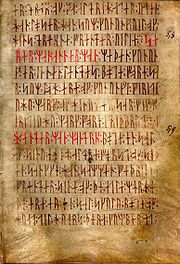 As Proto-Germanic evolved into its later language groups, the words assigned to the runes and the sounds represented by the runes themselves began to diverge somewhat, and each culture would either create new runes, rename or rearrange its rune names slightly, or even stop using obsolete runes completely, to accommodate these changes. Thus, the Anglo-Saxon futhorc has several runes peculiar to itself to represent diphthong
s unique to (or at least prevalent in) the Anglo-Saxon dialect.
Nevertheless, the fact that the Younger Futhark has 16 runes, while the Elder Futhark has 24, is not fully explained by the some 600 years of sound changes that had occurred in the North Germanic language group. The development here might seem rather astonishing, since the younger form of the alphabet came to use fewer different rune signs at the same time as the development of the language led to a greater number of different phonemes than had been present at the time of the older futhark. For example, voiced and unvoiced consonants merged in script, and so did many vowels, while the number of vowels in the spoken language increased. From about 1100, this disadvantage was eliminated in the medieval runes, which again increased the number of different signs to correspond with the number of phonemes in the language.
Some later runic finds are on monuments (runestones), which often contain solemn inscriptions about people who died or performed great deeds. For a long time it was assumed that this kind of grand inscription was the primary use of runes, and that their use was associated with a certain societal class of rune carvers.
In the mid-1950s, however, about 600 inscriptions known as the Bryggen inscriptions
were found in Bergen. These inscriptions were made on wood and bone, often in the shape of sticks of various sizes, and contained inscriptions of an everyday nature—ranging from name tags, prayers (often in Latin
), personal messages, business letters and expressions of affection to bawdy phrases of a profane and sometimes even vulgar nature. Following this find, it is nowadays commonly assumed that at least in late use, Runic was a widespread and common writing system.
In the later Middle Ages, runes were also used in the Clog almanacs
(sometimes called Runic staff, Prim or Scandinavian calendar) of Sweden and Estonia. The authenticity of some monuments bearing Runic inscriptions found in Northern America is disputed, but most of them date from modern times.
, the runic alphabet is attested to a divine origin (Old Norse
: reginkunnr). This is attested as early as on the Noleby Runestone
from around 600 AD that reads Runo fahi raginakundo toj[e'k]a..., meaning "I prepare the suitable divine rune ..." and in an attestation from the 9th century on the Sparlösa Runestone
which reads Ok rað runaR þaR rægi[n]kundu, meaning "And interpret the runes of divine origin". More notably, in the Poetic Edda
poem Hávamál
, Stanza 80, the runes are also described as reginkunnr:
The poem Hávamál explains that the originator of the runes was the major god Odin
. Stanza 138 describes how Odin received the runes through self-sacrifice:
In stanza 139, Odin continues:
This passage has been interpreted as a mythical representation of shamanic initial ritual in which the initiate must undergo a physical trial in order to receive mystic widsom.
In the Poetic Edda poem Rígsþula another origin is related of how the runic alphabet became known to man. The poem relates how Ríg, identified as Heimdall
in the introduction, sired three sons (Thrall
(slave), Churl
(freeman) and Jarl
(noble)) on human women. These sons became the ancestors of the three classes of men indicated by their names. When Jarl reached an age when he began to handle weapons and show other signs of nobility, Rig returned and, having claimed him as a son, taught him the runes. In 1555, the exiled Swedish archbishop Olaus Magnus
recorded a tradition that a man named Kettil Runske
had stolen three rune staffs from Odin and learned the runes and their magic.
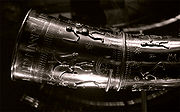
The Elder Futhark, used for writing Proto-Norse, consists of 24 runes that are often arranged in three groups of eight; each group is referred to as an Ætt. The earliest known sequential listing of the full set of 24 runes dates to around AD 400 and is found on the Kylver Stone
in Gotland
, Sweden.
Each rune most probably had a name, chosen to represent the sound of the rune itself. The names are, however, not directly attested for the Elder Futhark themselves. Reconstructed
names in Proto-Germanic have been produced, based on the names given for the runes in the later alphabets attested in the rune poem
s and the linked names of the letters of the Gothic alphabet
. The letter æ
was named from The Runic letter
 Called Ansuz. The asterisk before the rune names means that they are unattested reconstructions. The 24 Elder Futhark runes are:
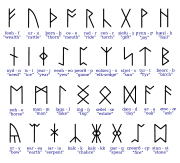 The futhorc are an extended alphabet, consisting of 29, and later even 33 characters. It was probably used from the 5th century onward. There are competing theories as to the origins of the Anglo-Saxon Fuþorc. One theory proposes that it was developed in Frisia
and later spread to England
. Another holds that runes were introduced by Scandinavians to England where the fuþorc was modified and exported to Frisia. Both theories have their inherent weaknesses and a definitive answer likely awaits more archaeological evidence. Futhorc inscriptions are found e.g. on the Thames scramasax, in the Vienna Codex, in Cotton
Otho B.x (Anglo-Saxon rune poem) and on the Ruthwell Cross
.
The Anglo-Saxon rune poem gives the following characters and names: feoh, ur, thorn, os, rad, cen, gyfu, wynn, haegl, nyd, is, ger, eoh, peordh, eolh, sigel, tir, beorc, eh, mann, lagu, ing, ethel, daeg, ac, aesc, yr, ior, ear.
The expanded alphabet features the additional letters cweorth, calc, cealc and stan- these additional letters have only been found in manuscripts. Feoh, þorn, and sigel stood for [f], [þ], and [s] in most environments, but voiced to [v], [ð], and [z] between vowels or voiced consonants. Gyfu and wynn stood for the letters yogh
and wynn
, which became [g] and [w] in Middle English
.
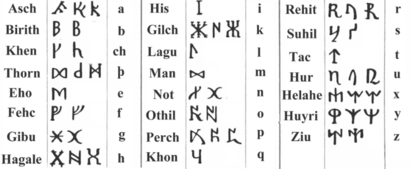 In a treatise called De Inventione Litterarum, preserved in 8th and 9th century manuscripts, mainly from the southern part of the Carolingian Empire
(Alemannia, Bavaria
), ascribed to Hrabanus Maurus, a runic alphabet consisting of a curious mixture of Elder Futhark with Anglo-Saxon futhorc is recorded. The manuscript text ascribes the runes to the Marcomanni, quos nos Nordmannos vocamus, and the alphabet is hence traditionally called "Marcomannic runes", but it has no connection with the Marcomanni
and is rather an attempt of Carolingian scholars to represent all letters of the Latin alphabets with runic equivalents.
Wilhelm Grimm
discussed these runes in 1821 (Ueber deutsche Runen, chapter 18, pp. 149–159).

 The Younger Futhark, also called Scandinavian Futhark, is a reduced form of the Elder Futhark
, consisting of only 16 characters. The reduction correlates with phonetic changes when Proto-Norse evolved into Old Norse. They are found in Scandinavia and Viking Age
settlements abroad, probably in use from the 9th century onward. They are divided into long-branch (Danish) and short-twig (Swedish and Norwegian) runes. The difference between the two versions has been a matter of controversy. A general opinion is that the difference was functional; i.e. the long-branch runes were used for documentation on stone, whereas the short-branch runes were in everyday use for private or official messages on wood.
 In the Middle Ages, the Younger Futhark in Scandinavia was expanded, so that it once more contained one sign for each phoneme of the Old Norse language. Dotted variants of voiceless
signs were introduced to denote the corresponding voiced
consonants, or vice versa, voiceless variants of voiced consonants, and several new runes also appeared for vowel sounds. Inscriptions in medieval Scandinavian runes show a large number of variant rune forms, and some letters, such as s, c and z, were often used interchangeably.
Medieval runes were in use until the 15th century. Of the total number of Norwegian runic inscriptions preserved today, most are medieval runes. Notably, more than 600 inscriptions using these runes have been discovered in Bergen since the 1950s, mostly on wooden sticks (the so-called Bryggen inscriptions
). This indicates that runes were in common use side by side with the Latin alphabet for several centuries. Indeed, some of the medieval runic inscriptions are actually in Latin language.
 According to Carl-Gustav Werner, "In the isolated province of Dalarna
in Sweden a mix of runes and Latin letters developed."(Werner 2004, p. 7) The Dalecarlian runes came into use in the early 16th century and remained in some use up to the 20th century. Some discussion remains on whether their use was an unbroken tradition throughout this period or whether people in the 19th and 20th centuries learned runes from books written on the subject. The character inventory was mainly used for transcribing Elfdalian.
(1568–1652). Bureus viewed runes as holy or magical in a kabbalistic
sense.
The study of runes was continued by Olof Rudbeck Sr (1630–1702) and presented in his collection Atlantica. Anders Celsius
(1701–44) further extended the science of runes and travelled around the whole of Sweden to examine the runstenar (runestones). From the "golden age of philology
" in the 19th century, runology formed a specialized branch of Germanic linguistics.
.jpg) The largest group of surviving Runic inscription are Viking Age
The largest group of surviving Runic inscription are Viking Age
Younger Futhark
runestones, most commonly found in Sweden. Another large group are medieval runes, most commonly found on small objects, often wooden sticks. The largest concentration of runic inscriptions are the Bryggen inscriptions
found in Bergen, more than 650 in total. Elder Futhark
inscriptions number around 350, about 260 of which are from Scandinavia, of which about half are on bracteate
s. Anglo-Saxon futhorc
inscriptions number around 100 items.
, in Scandinavian Romantic nationalism
(Gothicismus
) and Germanic occultism in the 19th century, and in the context of the Fantasy
genre and of Germanic Neopaganism
in the 20th.
 The pioneer of the Armanist branch of Ariosophy
and one of the more important figures in esotericism in Germany and Austria
in the late 19th and early 20th century was the Austria
n occultist, mysticist and völkisch author Guido von List
. In 1908, he published in Das Geheimnis der Runen
("The Secret of the Runes") a set of 18 so-called "Armanen runes
", based on the Younger Futhark and runes of List's own introduction, which were allegedly revealed to him in a state of temporary blindness after a cataract operation on both eyes in 1902.
The use of runes in Germanic mysticism
, notably List's "Armanen runes" and the derived "Wiligut runes
" by Karl Maria Wiligut
, played a certain role in Nazi symbolism
. The fascination with runic symbolism was mostly limited to Heinrich Himmler
, and not shared by the other members of the Nazi top echelon. Consequently, runes appear mostly in insignia associated with the Schutzstaffel
, the paramilitary organization led by Himmler. Wiligut is credited with designing the SS-Ehrenring
, which displays a number of "Wiligut runes".
, and to a lesser extent in other forms of Neopaganism
and New Age
esotericism. Various systems of Runic divination have been published since the 1980s, notably by Ralph Blum (1982), Stephen Flowers
(1984 etc.), Stephan Grundy
(1990) and Nigel Pennick
(1995).
The Uthark theory
was originally proposed as a scholarly hypothesis by Sigurd Agrell
in 1932.
In 2002, Swedish esotericist Thomas Karlsson
popularized this "Uthark" runic row, which he refers to as the "night side of the runes", in the context of modern occultism.
's novel The Hobbit
(1937), the Anglo-Saxon runes are used on a map to emphasize its connection to the Dwarves
. They were also used in the initial drafts of The Lord of the Rings
, but later were replaced by the Cirth
rune-like alphabet invented by Tolkien.
Following Tolkien, historical and fictional runes appear commonly in modern popular culture, particularly in fantasy literature
, but also in other forms of media such as video games. In the Netherlands
runes are used by the illustrator Hans Kresse (1921–1992) in his comic strip
Eric de Noorman.
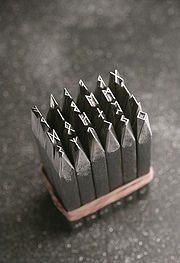 Runic alphabets were added to the Unicode
Standard in September, 1999 with the release of version 3.0.
for Runic alphabets is U+16A0–U+16FF. It is intended to encode all shapes of runic letters. Each letter is encoded only once, regardless of the number of alphabets in which it occurs.
The block contains 81 symbols: 75 runic letters (U+16A0–U+16EA), three punctuation marks
(Runic Single Punctuation U+16EB ᛫, Runic Multiple Punctuation U+16EC ᛬ and Runic Cross Punctuation U+16ED ᛭), and three runic symbols that are used in mediaeval calendar staves ("Golden number Runes", Runic Arlaug Symbol U+16EE ᛮ, Runic Tvimadur Symbol U+16EF ᛯ and Runic Belgthor Symbol U+16F0 ᛰ). Characters U+16F1–U+16FF are unassigned (as of Unicode Version 6.0).
, Free Mono
, and Caslon Roman
.
The following non-free Unicode fonts also support the runic block: Alphabetum
, Code2000
, Everson Mono
, Segoe UI Symbol, and TITUS Cyberbit Basic.
Segoe UI Symbol is included in Windows 7, meaning that the Runic alphabet is supported in that system.
Other scripts, reminiscent of, based on or related to runes:
Alphabet
An alphabet is a standard set of letters—basic written symbols or graphemes—each of which represents a phoneme in a spoken language, either as it exists now or as it was in the past. There are other systems, such as logographies, in which each character represents a word, morpheme, or semantic...
s using letters
Letter (alphabet)
A letter is a grapheme in an alphabetic system of writing, such as the Greek alphabet and its descendants. Letters compose phonemes and each phoneme represents a phone in the spoken form of the language....
known as runes to write various Germanic languages
Germanic languages
The Germanic languages constitute a sub-branch of the Indo-European language family. The common ancestor of all of the languages in this branch is called Proto-Germanic , which was spoken in approximately the mid-1st millennium BC in Iron Age northern Europe...
before the adoption of the Latin alphabet
Latin alphabet
The Latin alphabet, also called the Roman alphabet, is the most recognized alphabet used in the world today. It evolved from a western variety of the Greek alphabet called the Cumaean alphabet, which was adopted and modified by the Etruscans who ruled early Rome...
and for specialized purposes thereafter. The Scandinavian variants are also known as futhark (or fuþark, derived from their first six letters of the alphabet: F, U, Þ
Thurisaz
The Germanic rune is called Thurs in the Icelandic and Norwegian rune poems.-Rune poems:The Germanic rune ᚦ is mentioned in three rune poems:- Usage :...
, A, R
Raidô
Kate Thornton is an English journalist and television presenter. Early in her career, she was notable for her articles at the Daily Mirror and for her role as editor of Smash Hits magazine...
, and K
Kaunan
The k-rune is called Kaun in both the Norwegian and Icelandic rune poems, meaning "ulcer". The reconstructed Proto-Germanic name is *Kaunan. It is also known as Kenaz , based on its Anglo-Saxon name.The Elder Futhark shape is likely directly based on Old Italic c / Latin C...
); the Anglo-Saxon
Anglo-Saxons
Anglo-Saxon is a term used by historians to designate the Germanic tribes who invaded and settled the south and east of Great Britain beginning in the early 5th century AD, and the period from their creation of the English nation to the Norman conquest. The Anglo-Saxon Era denotes the period of...
variant is futhorc (due to sound changes undergone in Old English by the same six letters). Runology
Runology
Runology is the study of the Runic alphabets, Runic inscriptions and their history. Runology forms a specialized branch of Germanic linguistics.-History:...
is the study of the runic alphabets, runic inscriptions
Runic inscriptions
A runic inscription is an inscription made in one of the various runic alphabets. The body of runic inscriptions falls into the three categories of Elder Futhark , Anglo-Frisian Futhorc and Younger Futhark .The total 350 known inscriptions in the Elder...
, runestones, and their history. Runology forms a specialized branch of Germanic linguistics.
The earliest runic inscriptions date from around AD 150. The characters were generally replaced by the Latin alphabet
Latin alphabet
The Latin alphabet, also called the Roman alphabet, is the most recognized alphabet used in the world today. It evolved from a western variety of the Greek alphabet called the Cumaean alphabet, which was adopted and modified by the Etruscans who ruled early Rome...
as the cultures that had used runes underwent Christianization
Christianization
The historical phenomenon of Christianization is the conversion of individuals to Christianity or the conversion of entire peoples at once...
by around AD 700 in central Europe and by around AD 1100 in Northern Europe
Northern Europe
Northern Europe is the northern part or region of Europe. Northern Europe typically refers to the seven countries in the northern part of the European subcontinent which includes Denmark, Estonia, Latvia, Lithuania, Norway, Finland and Sweden...
. However, the use of runes persisted for specialized purposes in Northern Europe. Until the early 20th century runes were used in rural Sweden
Sweden
Sweden , officially the Kingdom of Sweden , is a Nordic country on the Scandinavian Peninsula in Northern Europe. Sweden borders with Norway and Finland and is connected to Denmark by a bridge-tunnel across the Öresund....
for decoration purposes in Dalarna
Dalarna
', English exonym: Dalecarlia, is a historical province or landskap in central Sweden. Another English language form established in literature is the Dales. Places involving the element Dalecarlia exist in the United States....
and on Runic calendar
Runic calendar
A Runic calendar is a perpetual calendar based on the 19 year long Metonic cycle of the Moon. Runic calendars were written on parchment or carved onto staves of wood, bone, or horn. The oldest one known, and the only one from the Middle Ages, is the Nyköping staff, believed to date from the 13th...
s.
The three best-known runic alphabets are the Elder Futhark
Elder Futhark
The Elder Futhark is the oldest form of the runic alphabet, used by Germanic tribes for Northwest Germanic and Migration period Germanic dialects of the 2nd to 8th centuries for inscriptions on artifacts such as jewellery, amulets, tools, weapons and runestones...
(around 150–800), the Anglo-Saxon Futhorc (400–1100), and the Younger Futhark
Younger Futhark
The Younger Futhark, also called Scandinavian runes, is a runic alphabet, a reduced form of the Elder Futhark, consisting of only 16 characters, in use from ca. 800 CE...
(800–1100). The Younger Futhark is further divided into the long-branch runes (also called Danish, although they were also used in Norway
Norway
Norway , officially the Kingdom of Norway, is a Nordic unitary constitutional monarchy whose territory comprises the western portion of the Scandinavian Peninsula, Jan Mayen, and the Arctic archipelago of Svalbard and Bouvet Island. Norway has a total area of and a population of about 4.9 million...
and Sweden
Sweden
Sweden , officially the Kingdom of Sweden , is a Nordic country on the Scandinavian Peninsula in Northern Europe. Sweden borders with Norway and Finland and is connected to Denmark by a bridge-tunnel across the Öresund....
), short-branch or Rök runes
Rök Runestone
The Rök Runestone is one of the most famous runestones, featuring the longest known runic inscription in stone. It can now be seen by the church in Rök , Östergötland, Sweden...
(also called Swedish-Norwegian, although they were also used in Denmark
Denmark
Denmark is a Scandinavian country in Northern Europe. The countries of Denmark and Greenland, as well as the Faroe Islands, constitute the Kingdom of Denmark . It is the southernmost of the Nordic countries, southwest of Sweden and south of Norway, and bordered to the south by Germany. Denmark...
), and the stavesyle or Hälsinge runes (staveless runes
Staveless runes
Staveless runes were the climax of the simplification process in the evolution of runic alphabets that had started when the Elder Futhark was superseded by the Younger Futhark. In order to create the staveless runes, vertical marks were dropped from individual letters...
). The Younger Futhark developed further into the Marcomannic runes, the Medieval runes
Medieval runes
The medieval runes, or the futhork, was a Scandinavian 27 letter runic alphabet that evolved from the Younger Futhark after the introduction of dotted runes at the end of the Viking Age and it was fully formed in the early 13th century...
(1100–1500), and the Dalecarlian
Dalecarlian
Dalecarlian is a group of dialects or unofficial languages spoken in Dalecarlia, Sweden. The most prominent is Elfdalian.The group is as follows:*Old Swedish**Dalecarlian***Dalecarlian Dalecarlian (Dalmål in vernacular and Swedish) is a group of dialects or unofficial languages spoken in...
runes (around 1500–1800).
Historically, the runic alphabet is a derivation of the Old Italic alphabet
Old Italic alphabet
Old Italic refers to several now extinct alphabet systems used on the Italian Peninsula in ancient times for various Indo-European languages and non-Indo-European languages...
s of antiquity, with the addition of some innovations.
Which variant of the Old Italic family in particular gave rise to the runes is uncertain, suggestions including Raetic, Etruscan or Old Latin
History of the Latin alphabet
The Latin alphabet is the main writing system in use in the Western world and is the most widely used alphabet writing system in the world. Being the standard script of the English language it is often referred to simply as "the alphabet" in English...
candidates. All these scripts at the time had the same angular letter shapes suited for epigraphy
Epigraphy
Epigraphy Epigraphy Epigraphy (from the , literally "on-writing", is the study of inscriptions or epigraphs as writing; that is, the science of identifying the graphemes and of classifying their use as to cultural context and date, elucidating their meaning and assessing what conclusions can be...
which would become characteristic of the runes.
The process of transmission of the script (the oldest inscriptions being found in Denmark and Northern Germany, not near Italy) is also unknown. A "West Germanic hypothesis" suggests transmission via Elbe Germanic
Irminones
The Irminones, also referred to as Herminones or Hermiones, were a group of early Germanic tribes settling in the Elbe watershed and by the 1st century AD expanding into Bavaria, Swabia and Bohemia...
groups, while a "Gothic
Goths
The Goths were an East Germanic tribe of Scandinavian origin whose two branches, the Visigoths and the Ostrogoths, played an important role in the fall of the Roman Empire and the emergence of Medieval Europe....
hypothesis" assumes transmission via East Germanic expansion
Chernyakhov culture
The Sântana de Mureș–Chernyakhiv culture is the name given to an archaeological culture which flourished between the 2nd and 5th centuries in a wide area of Eastern Europe, specifically in what today constitutes Ukraine, Romania, Moldova, and parts of Belarus...
.
History and usage
This period corresponds to the late Common Germanic stage linguistically, with a continuum of dialects not yet clearly separated into the three branches of later centuries; North Germanic, West Germanic, and East Germanic.
No distinction is made in surviving runic inscriptions between long and short vowels, although such a distinction was certainly present phonologically in the spoken languages of the time. Similarly, there are no signs for labiovelars in the Elder Futhark (such signs were introduced in both the Anglo-Saxon futhorc and the Gothic alphabet
Gothic alphabet
The Gothic alphabet is an alphabet for writing the Gothic language, created in the 4th century by Ulfilas for the purpose of translating the Christian Bible....
as variants of p; see peorð
Peorð
' is the rune denoting the sound p in the Elder Futhark runic alphabet, in the Anglo-Saxon rune poem named peorð. It does not appear in the Younger Futhark. In the poem, it is glossed with the enigmatic:...
.)
The name runes contrasts with Latin or Greek letters. It is attested on a 6th century Alamanni
Alamanni
The Alamanni, Allemanni, or Alemanni were originally an alliance of Germanic tribes located around the upper Rhine river . One of the earliest references to them is the cognomen Alamannicus assumed by Roman Emperor Caracalla, who ruled the Roman Empire from 211 to 217 and claimed thereby to be...
c runestaff as runa, and possibly as runo on the 4th century Einang stone
Einang stone
The Einang stone is a runestone located near Fagernes, Norway, notable for the age of its runic inscription.-Description:The Einang stone bears an Elder Futhark inscription in Proto-Norse that has been dated to the 4th century...
. The name is from a root run- (Gothic runa), meaning "secret" or "whisper". The root run- can also be found in the Baltic languages
Baltic languages
The Baltic languages are a group of related languages belonging to the Balto-Slavic branch of the Indo-European language family and spoken mainly in areas extending east and southeast of the Baltic Sea in Northern Europe...
meaning "speech". In Lithuanian
Lithuanian language
Lithuanian is the official state language of Lithuania and is recognized as one of the official languages of the European Union. There are about 2.96 million native Lithuanian speakers in Lithuania and about 170,000 abroad. Lithuanian is a Baltic language, closely related to Latvian, although they...
, runoti has two meanings: "to cut (with a knife)" or "to speak".
Origins
The runes developed centuries after the Old Italic alphabets from which they are historically derived.The debate on the development of the runic script concerns the question which of the Italic alphabets should be taken as their point of origin, and which, if any, signs should be considered original innovations added to the letters found in the Italic scripts. The historical context of the script's origin is the cultural contact between Germanic people, who often served as mercenaries
Mercenary
A mercenary, is a person who takes part in an armed conflict based on the promise of material compensation rather than having a direct interest in, or a legal obligation to, the conflict itself. A non-conscript professional member of a regular army is not considered to be a mercenary although he...
in the Roman army, and the Italic peninsula during the Roman imperial period
Roman Empire
The Roman Empire was the post-Republican period of the ancient Roman civilization, characterised by an autocratic form of government and large territorial holdings in Europe and around the Mediterranean....
(1st c. BC to 5th c. AD).
The formation of the Elder Futhark was complete by the early 5th century, with the Kylver Stone
Kylver Stone
The Kylver stone, listed in the Rundata catalog as runic inscription G 88, is a Swedish runestone which dates from about 400 CE notable for its listing of each of the runes in the elder futhark.-Description:...
being the first evidence of the futhark ordering as well as of the p rune.
Specifically, the Raetic
Raetic language
Raetic is an extinct language spoken in the ancient region of Raetia in the Eastern Alps in pre-Roman and Roman times. It is documented by a limited number of short inscriptions in two variants of the Etruscan alphabet...
alphabet of Bolzano, is often advanced as a candidate for the origin of the runes, with only five Elder Futhark runes ( e, ï, j, ŋ, p) having no counterpart in the Bolzano alphabet (Mees 2000).
Scandinavian scholars tend to favor derivation from the Latin alphabet
Latin alphabet
The Latin alphabet, also called the Roman alphabet, is the most recognized alphabet used in the world today. It evolved from a western variety of the Greek alphabet called the Cumaean alphabet, which was adopted and modified by the Etruscans who ruled early Rome...
itself over Raetic candidates. A "North Etruscan" thesis is supported by the inscription on the Negau helmet
Negau helmet
Negau helmet refers to one of 26 bronze helmets dating to ca. 450 till 350 BC, found in 1811 in a cache in Ženjak, near Negau, Duchy of Styria . The helmets are of typical Etruscan 'vetulonic' shape, sometimes described as of the Negau type. They were buried in ca...
dating to the 2nd century BC This is in a northern Etruscan alphabet, but features a Germanic name, Harigast.
The angular shapes of the runes are shared with most contemporary alphabets of the period used for carving in wood or stone. A peculiarity of the runic alphabet is the absence of horizontal strokes, although this characteristic is also shared by other alphabets, such as the early form of the Latin alphabet
Latin alphabet
The Latin alphabet, also called the Roman alphabet, is the most recognized alphabet used in the world today. It evolved from a western variety of the Greek alphabet called the Cumaean alphabet, which was adopted and modified by the Etruscans who ruled early Rome...
used for the Duenos inscription
Duenos Inscription
The Duenos Inscription is one of the earliest known Old Latin texts, dating from the 7th century BC. It is inscribed on the sides of a kernos, in this case a trio of small globular vases adjoined by three clay struts. It was found by Heinrich Dressel in 1880 on the Quirinal Hill in Rome. The kernos...
, and it is not universal especially among early runic inscriptions, which frequently have variant rune shapes including horizontal strokes.
The "West Germanic hypothesis" speculates on an introduction by West Germanic tribes
West Germanic tribes
The West Germanic tribes were Germanic peoples who spoke the branch of Germanic languages known as West Germanic languages.They appear to be derived from the Jastorf culture, a Pre-Roman Iron Age offshoot of the Nordic Bronze Age culture....
. This hypothesis is based on claiming that the earliest inscriptions of the 2nd and 3rd centuries, found in bogs and graves around Jutland
Jutland
Jutland , historically also called Cimbria, is the name of the peninsula that juts out in Northern Europe toward the rest of Scandinavia, forming the mainland part of Denmark. It has the North Sea to its west, Kattegat and Skagerrak to its north, the Baltic Sea to its east, and the Danish–German...
(the Vimose inscriptions
Vimose inscriptions
Finds from Vimose, Funen, Denmark, include some of the very oldest datable Elder Futhark runic inscriptions in late Proto-Germanic or early Proto-Norse from the 2nd to 3rd centuries AD....
), exhibit word endings that, being interpreted by Scandinavia
Scandinavia
Scandinavia is a cultural, historical and ethno-linguistic region in northern Europe that includes the three kingdoms of Denmark, Norway and Sweden, characterized by their common ethno-cultural heritage and language. Modern Norway and Sweden proper are situated on the Scandinavian Peninsula,...
n scholars to be Proto-Norse, are considered unresolved and having been long the subject of discussion. Inscriptions like wagnija, niþijo, and harija are supposed to incarnate tribe names, tentatively proposed to be Vangiones
Vangiones
The Vangiones appear first in history as an ancient Germanic tribe of unknown provenience. They threw in their lot with Ariovistus in his bid of 58 BC to invade Gaul through the Doubs river valley and lost to Julius Caesar in a battle probably near Belfort...
, the Nidensis and the Harii
Harii
The Harii were a Germanic people attested by Tacitus as being a tribe in his 1st-century-AD book Germania. He describes them as painting themselves and their shields black, and attacking at night as a ghostly army, much to the terror of their opponents...
, tribes located in the Rhineland
Rhineland
Historically, the Rhinelands refers to a loosely-defined region embracing the land on either bank of the River Rhine in central Europe....
. Since names ending in -io reflect Germanic
morphology representing the Latin ending -ius, and the suffix -inius was reflected by Germanic -inio-, the question of the problematic ending -ijo in masculine Proto-Norse would be resolved by assuming Roman (Rhineland) influences, while "the awkward
ending -a of laguþewa (cf. Syrett 1994:44f.) can be solved by accepting the fact that the name may indeed be West Germanic;" however, it should be noted that in the early Runic period differences between Germanic languages are generally assumed to be small. Another theory assumes a Northwest Germanic
Northwest Germanic
Northwest Germanic is a proposed grouping of the Germanic dialects, representing the current consensus among Germanic historical linguists. It does not challenge the late 19th-century tri-partite division of the Germanic dialects into North Germanic, West Germanic and East Germanic, but proposes...
unity preceding the emergence of Proto-Norse proper from roughly the 5th century. An alternative suggestion explaining the impossibility to classify the earliest inscriptions as either North or West Germanic is forwarded by È. A. Makaev, who assumes a "special runic koine", an early "literary Germanic" employed by the entire Late Common Germanic linguistic community after the separation of Gothic (2nd to 5th centuries), while the spoken dialects may already have been more diverse.
Early inscriptions
Elder Futhark
The Elder Futhark is the oldest form of the runic alphabet, used by Germanic tribes for Northwest Germanic and Migration period Germanic dialects of the 2nd to 8th centuries for inscriptions on artifacts such as jewellery, amulets, tools, weapons and runestones...
, but the set of letter shapes and bindrunes employed is far from standardized. Notably the j, s
Sowilo rune
*Sowilō or *sæwelō is the reconstructed Proto-Germanic name of the s-rune, meaning "sun". The name is attested for the same rune in all three rune poems...
and ŋ runes undergo considerable modifications, while others, such as p and ï, remain unattested altogether prior the first full futhark row on the Kylver Stone
Kylver Stone
The Kylver stone, listed in the Rundata catalog as runic inscription G 88, is a Swedish runestone which dates from about 400 CE notable for its listing of each of the runes in the elder futhark.-Description:...
(c. AD 400).
Artifacts such as spear-mounts, shield-heads have been found which bear runic marking can be dated to 200 A.D., as evidenced by artifacts found across northern Europe in Schleswig (North Germany), Fyn, Sjaeland, Jylland (Denmark), and Skåne (Sweden). Earlier, but less reliable, artifacts have been found in Meldorf, Süderithmarschen, North Germany; these include brooches and comes found in graves, and are supposed to have the earliest markings resembling runic inscriptions.
Theories of the existence of separate Gothic
Gothic language
Gothic is an extinct Germanic language that was spoken by the Goths. It is known primarily from the Codex Argenteus, a 6th-century copy of a 4th-century Bible translation, and is the only East Germanic language with a sizable Text corpus...
runes have been advanced, even identifying them as the original alphabet from which the Futhark were derived, but these have little support in actual findings (mainly the spearhead of Kovel, with its right-to-left inscription, its T-shaped tiwaz
Tiwaz rune
The t-rune is named after Týr, and was identified with this god. The reconstructed Proto-Germanic name is *Tîwaz or *Teiwaz.-Rune poems:Tiwaz is mentioned in all three rune poems...
and its rectangular dagaz
Dagaz
The d rune is called Daeg "day" in the Anglo-Saxon rune poem. The corresponding letter of the Gothic alphabet d is called dags. This rune stave is also part of the Elder Futhark, with a reconstructed Proto-Germanic name *dagaz....
). If there ever were genuinely Gothic runes, they were soon replaced by the Gothic alphabet
Gothic alphabet
The Gothic alphabet is an alphabet for writing the Gothic language, created in the 4th century by Ulfilas for the purpose of translating the Christian Bible....
. The letters of the Gothic alphabet, however, as given by the Alcuin
Alcuin
Alcuin of York or Ealhwine, nicknamed Albinus or Flaccus was an English scholar, ecclesiastic, poet and teacher from York, Northumbria. He was born around 735 and became the student of Archbishop Ecgbert at York...
manuscript (9th century), are obviously related to the names of the Futhark. The names are clearly Gothic, but it is impossible to say whether they are as old as, or even older than, the letters themselves. A handful of Elder Futhark inscriptions were found in Gothic territory, such as the 3rd to 5th century Ring of Pietroassa
Ring of Pietroassa
The Ring of Pietroassa is a gold Torc-like necklace found in a ring barrow in Pietroassa , Buzău County, southern Romania , in 1837. It formed part of a large gold Hoard dated to between 250 and 400 CE...
.
The Encyclopædia Britannica
Encyclopædia Britannica
The Encyclopædia Britannica , published by Encyclopædia Britannica, Inc., is a general knowledge English-language encyclopaedia that is available in print, as a DVD, and on the Internet. It is written and continuously updated by about 100 full-time editors and more than 4,000 expert...
even suggests the original development of the runes may have been due to the Goths.
Magical or divinatory use
Hávamál
Hávamál is presented as a single poem in the Poetic Edda, a collection of Old Norse poems from the Viking age. The poem, itself a combination of different poems, is largely gnomic, presenting advice for living, proper conduct and wisdom....
, the runes are attributed with the power to bring that which is dead to life. In this stanza, Odin
Odin
Odin is a major god in Norse mythology and the ruler of Asgard. Homologous with the Anglo-Saxon "Wōden" and the Old High German "Wotan", the name is descended from Proto-Germanic "*Wodanaz" or "*Wōđanaz"....
recounts a spell:
|
|
The earliest runic inscriptions found on artifacts give the name of either the craftsman or the proprietor, or, sometimes, remain a linguistic mystery. Due to this, it is possible that the early runes were not so much used as a simple writing system, but rather as magical
Magic (paranormal)
Magic is the claimed art of manipulating aspects of reality either by supernatural means or through knowledge of occult laws unknown to science. It is in contrast to science, in that science does not accept anything not subject to either direct or indirect observation, and subject to logical...
signs to be used for charms. Although some say the runes were used for divination
Divination
Divination is the attempt to gain insight into a question or situation by way of an occultic standardized process or ritual...
, there is no direct evidence to suggest they were ever used in this way. The name rune itself, taken to mean "secret, something hidden", seems to indicate that knowledge of the runes was originally considered esoteric, or restricted to an elite. The 6th century Björketorp Runestone
Björketorp Runestone
The Björketorp Runestone in Blekinge, Sweden, is part of a grave field which includes menhirs, both solitary and forming stone circles....
warns in Proto-Norse
Proto-Norse language
Proto-Norse was an Indo-European language spoken in Scandinavia that is thought to have evolved as a northern dialect of Proto-Germanic over the first centuries AD...
using the word rune in both senses:
Haidzruno runu, falahak haidera, ginnarunaz. Arageu haeramalausz uti az. Weladaude, sa'z þat barutz. Uþarba spa.
I, master of the runes(?) conceal here runes of power. Incessantly (plagued by) maleficence, (doomed to) insidious death (is) he who breaks this (monument). I prophesy destruction / prophecy of destruction.
The same curse and use of the word rune is also found on the Stentoften Runestone
Stentoften Runestone
The Stentoften Runestone, listed in the Rundata catalog as DR 357, is a runestone which contains a curse in Proto-Norse that was discovered in Stentoften, Blekinge, Sweden....
. There are also some inscriptions suggesting a medieval belief in the magical significance of runes, such as the Franks Casket
Franks Casket
The Franks Casket is a small Anglo-Saxon whalebone chest from the seventh century, now in the British Museum. The casket is densely decorated with knife-cut narrative scenes in flat two-dimensional low-relief and with inscriptions mostly in Anglo-Saxon runes...
(700 AD) panel.
Charm words, such as auja, laþu, laukaR and most commonly, alu
Alu (runic)
Alu is a Germanic charm word appearing on numerous Elder Futhark found in Central and Northern Europe dating from between 200 and 800 CE. The word – the most common of the early runic charm words – usually appears either alone or as part of an apparent formula...
, appear on a number of Migration period
Migration Period
The Migration Period, also called the Barbarian Invasions , was a period of intensified human migration in Europe that occurred from c. 400 to 800 CE. This period marked the transition from Late Antiquity to the Early Middle Ages...
Elder Futhark inscriptions as well as variants and abbreviations of them. Much speculation and study has been produced on the potential meaning of these inscriptions. Rhyming groups appear on some early bracteates that may also be magic in purpose, such as salusalu and luwatuwa. Further, an inscription on the Gummarp Runestone
Gummarp Runestone
The Gummarp Runestone, designated as DR 358, was a runestone from the Vendel era and which was located in the former village of Gummarp in the province of Blekinge, Sweden.-Description:...
(500 to 700 AD) gives a cryptic inscription describing the use of three runic letters followed by the Elder Futhark f-rune written three times in succession.
Nevertheless, it has proven difficult to find unambiguous traces of runic "oracles": Although Norse literature is full of references to runes, it nowhere contains specific instructions on divination. There are at least three sources on divination with rather vague descriptions that may or may not refer to runes: Tacitus
Tacitus
Publius Cornelius Tacitus was a senator and a historian of the Roman Empire. The surviving portions of his two major works—the Annals and the Histories—examine the reigns of the Roman Emperors Tiberius, Claudius, Nero and those who reigned in the Year of the Four Emperors...
's 1st century Germania
Germania (book)
The Germania , written by Gaius Cornelius Tacitus around 98, is an ethnographic work on the Germanic tribes outside the Roman Empire.-Contents:...
, Snorri Sturluson
Snorri Sturluson
Snorri Sturluson was an Icelandic historian, poet, and politician. He was twice elected lawspeaker at the Icelandic parliament, the Althing...
's 13th century Ynglinga saga
Ynglinga saga
Ynglinga saga is a legendary saga, originally written in Old Norse by the Icelandic poet Snorri Sturluson about 1225. It was first translated into English and published in 1844....
and Rimbert
Rimbert
Saint Rimbert was archbishop of Bremen-Hamburg from 865 until his death.A monk in Turholt , he shared a missionary trip to Scandinavia with his friend Ansgar, whom he later succeeded as archbishop in Hamburg-Bremen in 865...
's 9th century Vita Ansgari
Vita Ansgari
Vita Ansgari is the biography of Ansgar, written by Rimbert, his successor as archbishop in Hamburg-Bremen. Written in about 875 CE, the Vita is an important source in not only detailing Ansgar's missionary work in Scandinavia but in its descriptions of the everyday lives of people during the...
.
The first source, Tacitus's Germania, describes "signs" chosen in groups of three and cut from "a nut-bearing tree," although the runes do not seem to have been in use at the time of Tacitus' writings. A second source is the Ynglinga saga, where Granmar
Granmar
Granmar was a king of Södermanland, in Snorri Sturluson's Heimskringla. The same king also appears in the Volsunga saga.Granmar was married to Hilda, the daughter of the Geatish king Högne of East Götaland, and his son-in-law was the seaking Hjörvard of the Ylfings...
, the king of Södermanland
Södermanland
', sometimes referred to under its Latin form Sudermannia or Sudermania, is a historical province or landskap on the south eastern coast of Sweden. It borders Östergötland, Närke, Västmanland and Uppland. It is also bounded by lake Mälaren and the Baltic sea.In Swedish, the province name is...
, goes to Uppsala
Gamla Uppsala
Gamla Uppsala is a parish and a village outside Uppsala in Sweden. It had 16,231 inhabitants in 1991.As early as the 3rd century AD and the 4th century AD and onwards, it was an important religious, economic and political centre...
for the blót
Blót
The blót was Norse pagan sacrifice to the Norse gods and the spirits of the land. The sacrifice often took the form of a sacramental meal or feast. Related religious practices were performed by other Germanic peoples, such as the pagan Anglo-Saxons...
. There, the "chips" fell in a way that said that he would not live long (Féll honum þá svo spánn sem hann mundi eigi lengi lifa). These "chips," however, are easily explainable as a blótspánn (sacrificial chip), which was "marked, possibly with sacrificial blood, shaken and thrown down like dice, and their positive or negative significance then decided."
The third source is Rimbert's Vita Ansgari, where there are three accounts of what some believe to be the use of runes for divination, but Rimbert calls it "drawing lots". One of these accounts is the description of how a renegade Swedish king Anund Uppsale
Anund Uppsale
Anund Uppsale or Anoundus, English exonym: Anwynd of Upsala, ruled Sweden together with his brother Björn at Haugi, according to Rimbert and Hervarar saga...
first brings a Danish fleet to Birka
Birka
During the Viking Age, Birka , on the island of Björkö in Sweden, was an important trading center which handled goods from Scandinavia as well as Central and Eastern Europe and the Orient. Björkö is located in Lake Mälaren, 30 kilometers west of contemporary Stockholm, in the municipality of Ekerö...
, but then changes his mind and asks the Danes to "draw lots". According to the story, this "drawing of lots" was quite informative, telling them that attacking Birka
Birka
During the Viking Age, Birka , on the island of Björkö in Sweden, was an important trading center which handled goods from Scandinavia as well as Central and Eastern Europe and the Orient. Björkö is located in Lake Mälaren, 30 kilometers west of contemporary Stockholm, in the municipality of Ekerö...
would bring bad luck and that they should attack a Slavic town instead. The tool in the "drawing of lots," however, is easily explainable as a hlautlein (lot-twig), which according to Foote and Wilson would be used in the same manner as a blótspánn.
The lack of extensive knowledge on historical usage of the runes has not stopped modern authors from extrapolating entire systems of divination from what few specifics exist, usually loosely based on the runes' reconstructed names and additional outside influence.
A recent study of runic magic suggests that runes were used to create magical objects such as amulets (MacLeod and Mees 2006), but not in a way that would indicate that runic writing was any more inherently magical than were other writing systems such as Latin or Greek.
Medieval use
Diphthong
A diphthong , also known as a gliding vowel, refers to two adjacent vowel sounds occurring within the same syllable. Technically, a diphthong is a vowel with two different targets: That is, the tongue moves during the pronunciation of the vowel...
s unique to (or at least prevalent in) the Anglo-Saxon dialect.
Nevertheless, the fact that the Younger Futhark has 16 runes, while the Elder Futhark has 24, is not fully explained by the some 600 years of sound changes that had occurred in the North Germanic language group. The development here might seem rather astonishing, since the younger form of the alphabet came to use fewer different rune signs at the same time as the development of the language led to a greater number of different phonemes than had been present at the time of the older futhark. For example, voiced and unvoiced consonants merged in script, and so did many vowels, while the number of vowels in the spoken language increased. From about 1100, this disadvantage was eliminated in the medieval runes, which again increased the number of different signs to correspond with the number of phonemes in the language.
Some later runic finds are on monuments (runestones), which often contain solemn inscriptions about people who died or performed great deeds. For a long time it was assumed that this kind of grand inscription was the primary use of runes, and that their use was associated with a certain societal class of rune carvers.
In the mid-1950s, however, about 600 inscriptions known as the Bryggen inscriptions
Bryggen inscriptions
The Bryggen inscriptions are a find of some 670 medieval runic inscriptions on wood and bone found from 1955 and forth at Bryggen in Bergen, Norway. It has been called the most important runic find in the twentieth century...
were found in Bergen. These inscriptions were made on wood and bone, often in the shape of sticks of various sizes, and contained inscriptions of an everyday nature—ranging from name tags, prayers (often in Latin
Latin
Latin is an Italic language originally spoken in Latium and Ancient Rome. It, along with most European languages, is a descendant of the ancient Proto-Indo-European language. Although it is considered a dead language, a number of scholars and members of the Christian clergy speak it fluently, and...
), personal messages, business letters and expressions of affection to bawdy phrases of a profane and sometimes even vulgar nature. Following this find, it is nowadays commonly assumed that at least in late use, Runic was a widespread and common writing system.
In the later Middle Ages, runes were also used in the Clog almanacs
Runic calendar
A Runic calendar is a perpetual calendar based on the 19 year long Metonic cycle of the Moon. Runic calendars were written on parchment or carved onto staves of wood, bone, or horn. The oldest one known, and the only one from the Middle Ages, is the Nyköping staff, believed to date from the 13th...
(sometimes called Runic staff, Prim or Scandinavian calendar) of Sweden and Estonia. The authenticity of some monuments bearing Runic inscriptions found in Northern America is disputed, but most of them date from modern times.
Runes in Eddic lore
In Norse mythologyNorse mythology
Norse mythology, a subset of Germanic mythology, is the overall term for the myths, legends and beliefs about supernatural beings of Norse pagans. It flourished prior to the Christianization of Scandinavia, during the Early Middle Ages, and passed into Nordic folklore, with some aspects surviving...
, the runic alphabet is attested to a divine origin (Old Norse
Old Norse
Old Norse is a North Germanic language that was spoken by inhabitants of Scandinavia and inhabitants of their overseas settlements during the Viking Age, until about 1300....
: reginkunnr). This is attested as early as on the Noleby Runestone
Noleby Runestone
The Noleby Runestone, which is also known as the Fyrunga Runestone or Vg 63 for its Rundata catalog listing, is a runestone in Proto-Norse which is engraved with the Elder Futhark...
from around 600 AD that reads Runo fahi raginakundo toj[e'k]a..., meaning "I prepare the suitable divine rune ..." and in an attestation from the 9th century on the Sparlösa Runestone
Sparlösa Runestone
The Sparlösa Runestone, listed as Vg 119 in the Rundata catalog, is located in Västergötland and is the second most famous Swedish runestone after the Rök Runestone.-Description:...
which reads Ok rað runaR þaR rægi[n]kundu, meaning "And interpret the runes of divine origin". More notably, in the Poetic Edda
Poetic Edda
The Poetic Edda is a collection of Old Norse poems primarily preserved in the Icelandic mediaeval manuscript Codex Regius. Along with Snorri Sturluson's Prose Edda, the Poetic Edda is the most important extant source on Norse mythology and Germanic heroic legends, and from the early 19th century...
poem Hávamál
Hávamál
Hávamál is presented as a single poem in the Poetic Edda, a collection of Old Norse poems from the Viking age. The poem, itself a combination of different poems, is largely gnomic, presenting advice for living, proper conduct and wisdom....
, Stanza 80, the runes are also described as reginkunnr:
|
|
The poem Hávamál explains that the originator of the runes was the major god Odin
Odin
Odin is a major god in Norse mythology and the ruler of Asgard. Homologous with the Anglo-Saxon "Wōden" and the Old High German "Wotan", the name is descended from Proto-Germanic "*Wodanaz" or "*Wōđanaz"....
. Stanza 138 describes how Odin received the runes through self-sacrifice:
|
Numbers in Norse mythology The numbers three and nine are significant numbers in Norse mythology and paganism. Both numbers appear throughout surviving attestations of Norse paganism, in both mythology and cultic practice.... long nights, |
In stanza 139, Odin continues:
|
Drinking horn A drinking horn is the horn of a bovid used as a drinking vessel. Drinking horns are known from Classical Antiquity especially in Thrace and the Balkans, and remained in use for ceremonial purposes throughout the Middle Ages and the Early Modern period in some parts of Europe, notably in Germanic... , |
This passage has been interpreted as a mythical representation of shamanic initial ritual in which the initiate must undergo a physical trial in order to receive mystic widsom.
In the Poetic Edda poem Rígsþula another origin is related of how the runic alphabet became known to man. The poem relates how Ríg, identified as Heimdall
Heimdall
In Norse mythology, Heimdallr is a god who possesses the resounding horn Gjallarhorn, owns the golden-maned horse Gulltoppr, has gold teeth, and is the son of Nine Mothers...
in the introduction, sired three sons (Thrall
Thrall
Thrall was the term for a serf or unfree servant in Scandinavian culture during the Viking Age.Thralls were the lowest in the social order and usually provided unskilled labor during the Viking era.-Etymology:...
(slave), Churl
Churl
A churl , in its earliest Old English meaning, was simply "a man", but the word soon came to mean "a non-servile peasant", still spelt ċeorl, and denoting the lowest rank of freemen...
(freeman) and Jarl
Earl
An earl is a member of the nobility. The title is Anglo-Saxon, akin to the Scandinavian form jarl, and meant "chieftain", particularly a chieftain set to rule a territory in a king's stead. In Scandinavia, it became obsolete in the Middle Ages and was replaced with duke...
(noble)) on human women. These sons became the ancestors of the three classes of men indicated by their names. When Jarl reached an age when he began to handle weapons and show other signs of nobility, Rig returned and, having claimed him as a son, taught him the runes. In 1555, the exiled Swedish archbishop Olaus Magnus
Olaus Magnus
Olaus Magnus was a Swedish ecclesiastic and writer, who did pioneering work for the interest of Nordic people. He was reported as born in October 1490 in Östergötland, and died on August 1, 1557. Magnus, Latin for the Swedish Stor “great”, is a Latin family name taken personally, and not a...
recorded a tradition that a man named Kettil Runske
Kettil Runske
Kettil Runske was, according to Olaus Magnus' Historia de Gentibus Septentrionalibus , the man who brought runes to humankind, by stealing three rune staffs from Odin from which he learnt the runes. An apprentice named Gilbert defied Kettil, who punished him by throwing a rune staff at him whereby...
had stolen three rune staffs from Odin and learned the runes and their magic.
Elder Futhark (2nd to 8th c.)
The Elder Futhark, used for writing Proto-Norse, consists of 24 runes that are often arranged in three groups of eight; each group is referred to as an Ætt. The earliest known sequential listing of the full set of 24 runes dates to around AD 400 and is found on the Kylver Stone
Kylver Stone
The Kylver stone, listed in the Rundata catalog as runic inscription G 88, is a Swedish runestone which dates from about 400 CE notable for its listing of each of the runes in the elder futhark.-Description:...
in Gotland
Gotland
Gotland is a county, province, municipality and diocese of Sweden; it is Sweden's largest island and the largest island in the Baltic Sea. At 3,140 square kilometers in area, the region makes up less than one percent of Sweden's total land area...
, Sweden.
Each rune most probably had a name, chosen to represent the sound of the rune itself. The names are, however, not directly attested for the Elder Futhark themselves. Reconstructed
Linguistic reconstruction
Linguistic reconstruction is the practice of establishing the features of the unattested ancestor of one or more given languages. There are two kinds of reconstruction. Internal reconstruction uses irregularities in a single language to make inferences about an earlier stage of that language...
names in Proto-Germanic have been produced, based on the names given for the runes in the later alphabets attested in the rune poem
Rune poem
The Rune Poems are three poems that list the letters of runic alphabets while providing an explanatory poetic stanza for each letter. Three different poems have been preserved: the Anglo-Saxon Rune Poem, the Norwegian Rune Poem, and the Icelandic Rune Poem.The Icelandic and Norwegian poems list 16...
s and the linked names of the letters of the Gothic alphabet
Gothic alphabet
The Gothic alphabet is an alphabet for writing the Gothic language, created in the 4th century by Ulfilas for the purpose of translating the Christian Bible....
. The letter æ
Æ
Æ is a grapheme formed from the letters a and e. Originally a ligature representing a Latin diphthong, it has been promoted to the full status of a letter in the alphabets of some languages, including Danish, Faroese, Norwegian and Icelandic...
was named from The Runic letter
Alphabet
An alphabet is a standard set of letters—basic written symbols or graphemes—each of which represents a phoneme in a spoken language, either as it exists now or as it was in the past. There are other systems, such as logographies, in which each character represents a word, morpheme, or semantic...
Anglo-Frisian runes (5th to 11th c.)
Frisia
Frisia is a coastal region along the southeastern corner of the North Sea, i.e. the German Bight. Frisia is the traditional homeland of the Frisians, a Germanic people who speak Frisian, a language group closely related to the English language...
and later spread to England
England
England is a country that is part of the United Kingdom. It shares land borders with Scotland to the north and Wales to the west; the Irish Sea is to the north west, the Celtic Sea to the south west, with the North Sea to the east and the English Channel to the south separating it from continental...
. Another holds that runes were introduced by Scandinavians to England where the fuþorc was modified and exported to Frisia. Both theories have their inherent weaknesses and a definitive answer likely awaits more archaeological evidence. Futhorc inscriptions are found e.g. on the Thames scramasax, in the Vienna Codex, in Cotton
Cotton library
The Cotton or Cottonian library was collected privately by Sir Robert Bruce Cotton M.P. , an antiquarian and bibliophile, and was the basis of the British Library...
Otho B.x (Anglo-Saxon rune poem) and on the Ruthwell Cross
Ruthwell Cross
The Ruthwell Cross is a stone Anglo-Saxon cross probably dating from the 8th century, when Ruthwell was part of the Anglo-Saxon kingdom of Northumbria; it is now in Scotland. Anglo-Saxon crosses are closely related to the contemporary Irish high crosses, and both are part of the Insular art tradition...
.
The Anglo-Saxon rune poem gives the following characters and names: feoh, ur, thorn, os, rad, cen, gyfu, wynn, haegl, nyd, is, ger, eoh, peordh, eolh, sigel, tir, beorc, eh, mann, lagu, ing, ethel, daeg, ac, aesc, yr, ior, ear.
The expanded alphabet features the additional letters cweorth, calc, cealc and stan- these additional letters have only been found in manuscripts. Feoh, þorn, and sigel stood for [f], [þ], and [s] in most environments, but voiced to [v], [ð], and [z] between vowels or voiced consonants. Gyfu and wynn stood for the letters yogh
Yogh
The letter yogh , was used in Middle English and Older Scots, representing y and various velar phonemes. It was derived from the Old English form of the letter g.In Middle English writing, tailed z came to be indistinguishable from yogh....
and wynn
Wynn
Wynn is a letter of the Old English alphabet, where it is used to represent the sound ....
, which became [g] and [w] in Middle English
Middle English
Middle English is the stage in the history of the English language during the High and Late Middle Ages, or roughly during the four centuries between the late 11th and the late 15th century....
.
"Marcomannic runes" (8th to 9th c.)
Carolingian Empire
Carolingian Empire is a historiographical term which has been used to refer to the realm of the Franks under the Carolingian dynasty in the Early Middle Ages. This dynasty is seen as the founders of France and Germany, and its beginning date is based on the crowning of Charlemagne, or Charles the...
(Alemannia, Bavaria
Bavaria
Bavaria, formally the Free State of Bavaria is a state of Germany, located in the southeast of Germany. With an area of , it is the largest state by area, forming almost 20% of the total land area of Germany...
), ascribed to Hrabanus Maurus, a runic alphabet consisting of a curious mixture of Elder Futhark with Anglo-Saxon futhorc is recorded. The manuscript text ascribes the runes to the Marcomanni, quos nos Nordmannos vocamus, and the alphabet is hence traditionally called "Marcomannic runes", but it has no connection with the Marcomanni
Marcomanni
The Marcomanni were a Germanic tribe, probably related to the Buri, Suebi or Suevi.-Origin:Scholars believe their name derives possibly from Proto-Germanic forms of "march" and "men"....
and is rather an attempt of Carolingian scholars to represent all letters of the Latin alphabets with runic equivalents.
Wilhelm Grimm
Wilhelm Grimm
Wilhelm Carl Grimm was a German author, the younger of the Brothers Grimm.-Life and work:...
discussed these runes in 1821 (Ueber deutsche Runen, chapter 18, pp. 149–159).
Younger Futhark (9th to 11th c.)
Elder Futhark
The Elder Futhark is the oldest form of the runic alphabet, used by Germanic tribes for Northwest Germanic and Migration period Germanic dialects of the 2nd to 8th centuries for inscriptions on artifacts such as jewellery, amulets, tools, weapons and runestones...
, consisting of only 16 characters. The reduction correlates with phonetic changes when Proto-Norse evolved into Old Norse. They are found in Scandinavia and Viking Age
Viking Age
Viking Age is the term for the period in European history, especially Northern European and Scandinavian history, spanning the late 8th to 11th centuries. Scandinavian Vikings explored Europe by its oceans and rivers through trade and warfare. The Vikings also reached Iceland, Greenland,...
settlements abroad, probably in use from the 9th century onward. They are divided into long-branch (Danish) and short-twig (Swedish and Norwegian) runes. The difference between the two versions has been a matter of controversy. A general opinion is that the difference was functional; i.e. the long-branch runes were used for documentation on stone, whereas the short-branch runes were in everyday use for private or official messages on wood.
Medieval runes (12th to 15th c.)
Voiceless
In linguistics, voicelessness is the property of sounds being pronounced without the larynx vibrating. Phonologically, this is a type of phonation, which contrasts with other states of the larynx, but some object that the word "phonation" implies voicing, and that voicelessness is the lack of...
signs were introduced to denote the corresponding voiced
VOICED
Virtual Organization for Innovative Conceptual Engineering Design is a virtual organization that promotes innovation in engineering design. This project is the collaborative work of researchers at five universities across the United States, and is funded by the National Science Foundation...
consonants, or vice versa, voiceless variants of voiced consonants, and several new runes also appeared for vowel sounds. Inscriptions in medieval Scandinavian runes show a large number of variant rune forms, and some letters, such as s, c and z, were often used interchangeably.
Medieval runes were in use until the 15th century. Of the total number of Norwegian runic inscriptions preserved today, most are medieval runes. Notably, more than 600 inscriptions using these runes have been discovered in Bergen since the 1950s, mostly on wooden sticks (the so-called Bryggen inscriptions
Bryggen inscriptions
The Bryggen inscriptions are a find of some 670 medieval runic inscriptions on wood and bone found from 1955 and forth at Bryggen in Bergen, Norway. It has been called the most important runic find in the twentieth century...
). This indicates that runes were in common use side by side with the Latin alphabet for several centuries. Indeed, some of the medieval runic inscriptions are actually in Latin language.
Dalecarlian runes (16th to 19th c.)
Dalarna
', English exonym: Dalecarlia, is a historical province or landskap in central Sweden. Another English language form established in literature is the Dales. Places involving the element Dalecarlia exist in the United States....
in Sweden a mix of runes and Latin letters developed."(Werner 2004, p. 7) The Dalecarlian runes came into use in the early 16th century and remained in some use up to the 20th century. Some discussion remains on whether their use was an unbroken tradition throughout this period or whether people in the 19th and 20th centuries learned runes from books written on the subject. The character inventory was mainly used for transcribing Elfdalian.
Academic study
The modern study of runes was initiated in the Renaissance, by Johannes BureusJohannes Bureus
Johannes Thomae Bureus Agrivillensis was a Swedish antiquarian, polymath and mystic. He was royal librarian, tutor, and adviser of King Gustavus Adolphus of Sweden....
(1568–1652). Bureus viewed runes as holy or magical in a kabbalistic
Kabbalah
Kabbalah/Kabala is a discipline and school of thought concerned with the esoteric aspect of Rabbinic Judaism. It was systematized in 11th-13th century Hachmei Provence and Spain, and again after the Expulsion from Spain, in 16th century Ottoman Palestine...
sense.
The study of runes was continued by Olof Rudbeck Sr (1630–1702) and presented in his collection Atlantica. Anders Celsius
Anders Celsius
Anders Celsius was a Swedish astronomer. He was professor of astronomy at Uppsala University from 1730 to 1744, but traveled from 1732 to 1735 visiting notable observatories in Germany, Italy and France. He founded the Uppsala Astronomical Observatory in 1741, and in 1742 he proposed the Celsius...
(1701–44) further extended the science of runes and travelled around the whole of Sweden to examine the runstenar (runestones). From the "golden age of philology
Philology
Philology is the study of language in written historical sources; it is a combination of literary studies, history and linguistics.Classical philology is the philology of Greek and Classical Latin...
" in the 19th century, runology formed a specialized branch of Germanic linguistics.
Body of inscriptions
Viking Age
Viking Age is the term for the period in European history, especially Northern European and Scandinavian history, spanning the late 8th to 11th centuries. Scandinavian Vikings explored Europe by its oceans and rivers through trade and warfare. The Vikings also reached Iceland, Greenland,...
Younger Futhark
Younger Futhark
The Younger Futhark, also called Scandinavian runes, is a runic alphabet, a reduced form of the Elder Futhark, consisting of only 16 characters, in use from ca. 800 CE...
runestones, most commonly found in Sweden. Another large group are medieval runes, most commonly found on small objects, often wooden sticks. The largest concentration of runic inscriptions are the Bryggen inscriptions
Bryggen inscriptions
The Bryggen inscriptions are a find of some 670 medieval runic inscriptions on wood and bone found from 1955 and forth at Bryggen in Bergen, Norway. It has been called the most important runic find in the twentieth century...
found in Bergen, more than 650 in total. Elder Futhark
Elder Futhark
The Elder Futhark is the oldest form of the runic alphabet, used by Germanic tribes for Northwest Germanic and Migration period Germanic dialects of the 2nd to 8th centuries for inscriptions on artifacts such as jewellery, amulets, tools, weapons and runestones...
inscriptions number around 350, about 260 of which are from Scandinavia, of which about half are on bracteate
Bracteate
A bracteate is a flat, thin, single-sided gold medal worn as jewelry that was produced in Northern Europe predominantly during the Migration Period of the Germanic Iron Age...
s. Anglo-Saxon futhorc
Anglo-Saxon Futhorc
Futhorc , a runic alphabet used by the Anglo-Saxons, was descended from the Elder Futhark of 24 runes and contained between 26 and 33 characters. It was used probably from the fifth century onward, for recording Old English and Old Frisian....
inscriptions number around 100 items.
Modern use
Runic alphabets have seen numerous usages since the 18th century Viking revivalViking revival
Early modern publications dealing with Old Norse culture appeared in the 16th century, e.g. Historia de gentibus septentrionalibus and the first edition of the13th century Gesta Danorum , in 1514...
, in Scandinavian Romantic nationalism
Romantic nationalism
Romantic nationalism is the form of nationalism in which the state derives its political legitimacy as an organic consequence of the unity of those it governs...
(Gothicismus
Gothicismus
Gothicismus, Gothism, or Gothicism is the name given to what is considered to have been a cultural movement in Sweden, centered around the belief in the glory of the Swedish ancestors, originally considered to be the Geats, which were identified with the Goths. The founders of the movement were...
) and Germanic occultism in the 19th century, and in the context of the Fantasy
Fantasy
Fantasy is a genre of fiction that commonly uses magic and other supernatural phenomena as a primary element of plot, theme, or setting. Many works within the genre take place in imaginary worlds where magic is common...
genre and of Germanic Neopaganism
Germanic Neopaganism
Germanic neopaganism is the contemporary revival of historical Germanic paganism. Precursor movements appeared in the early 20th century in Germany and Austria. A second wave of revival began in the early 1970s...
in the 20th.
Germanic mysticism and Nazi symbolism
Ariosophy
Armanism and Ariosophy are the names of ideological systems of an esoteric nature, pioneered by Guido von List and Jörg Lanz von Liebenfels respectively, in Austria between 1890 and 1930. The term 'Ariosophy', meaning wisdom concerning the Aryans, was first coined by Lanz von Liebenfels in 1915 and...
and one of the more important figures in esotericism in Germany and Austria
Esotericism in Germany and Austria
This article gives an overview of esoteric movements in Germany and Austria between 1880 and 1945, presenting Theosophy, Anthroposophy and Ariosophy, among others, against the influences of earlier European esotericism.-Knights Templar and occultism:...
in the late 19th and early 20th century was the Austria
Austria
Austria , officially the Republic of Austria , is a landlocked country of roughly 8.4 million people in Central Europe. It is bordered by the Czech Republic and Germany to the north, Slovakia and Hungary to the east, Slovenia and Italy to the south, and Switzerland and Liechtenstein to the...
n occultist, mysticist and völkisch author Guido von List
Guido von List
Guido Karl Anton List, better known as Guido von List was an Austrian/German poet, journalist, writer, businessman and dealer of leather goods, mountaineer, hiker, dramatist, playwright, and rower, but was most notable as an occultist and völkisch author who is seen as one of the most important...
. In 1908, he published in Das Geheimnis der Runen
Das Geheimnis der Runen
Das Geheimnis der Runen is a book by Austrian mystic Guido von List, in which he presents his "Armanen Futharkh".It appeared as a periodical article in 1906, and as a standalone publication in 1908.-Contents:...
("The Secret of the Runes") a set of 18 so-called "Armanen runes
Armanen runes
The Armanen runes, or Armanen 'Futharkh' as Guido von List referred to them, are a row of 18 runes that are closely based in shape on the Younger Futhark...
", based on the Younger Futhark and runes of List's own introduction, which were allegedly revealed to him in a state of temporary blindness after a cataract operation on both eyes in 1902.
The use of runes in Germanic mysticism
Germanic mysticism
Germanic mysticism or Germanic occultism may refer to* Ariosophy* more generally, various schools of Esotericism in Germany and Austria* various modern systems of runic magic...
, notably List's "Armanen runes" and the derived "Wiligut runes
Wiligut runes
The Wiligut runes are a runic row developed by Karl Maria Wiligut in 1934. Wiligut rejected Guido von List's Armanen runes and his overall philosophy.Wiligut claimed to have been initiated into "runic lore" by his grandfather Karl Wiligut ....
" by Karl Maria Wiligut
Karl Maria Wiligut
Karl Maria Wiligut was an Austrian Ariosophist- Biography :...
, played a certain role in Nazi symbolism
Nazi symbolism
The twentieth century German Nazi Party was notable for its extensive use of graphic symbolism, most notably the Hakenkreuz , which it used as its principal symbol, and, in the form of the swastika flag, became the state flag of Nazi Germany....
. The fascination with runic symbolism was mostly limited to Heinrich Himmler
Heinrich Himmler
Heinrich Luitpold Himmler was Reichsführer of the SS, a military commander, and a leading member of the Nazi Party. As Chief of the German Police and the Minister of the Interior from 1943, Himmler oversaw all internal and external police and security forces, including the Gestapo...
, and not shared by the other members of the Nazi top echelon. Consequently, runes appear mostly in insignia associated with the Schutzstaffel
Schutzstaffel
The Schutzstaffel |Sig runes]]) was a major paramilitary organization under Adolf Hitler and the Nazi Party. Built upon the Nazi ideology, the SS under Heinrich Himmler's command was responsible for many of the crimes against humanity during World War II...
, the paramilitary organization led by Himmler. Wiligut is credited with designing the SS-Ehrenring
SS-Ehrenring
The SS-Ehrenring , unofficially called Totenkopfring , was an award of Heinrich Himmler's Schutzstaffel . It was not a state decoration, but rather a personal gift bestowed by Himmler...
, which displays a number of "Wiligut runes".
Modern Neopaganism and esotericism
Runes are popular in Germanic neopaganismGermanic neopaganism
Germanic neopaganism is the contemporary revival of historical Germanic paganism. Precursor movements appeared in the early 20th century in Germany and Austria. A second wave of revival began in the early 1970s...
, and to a lesser extent in other forms of Neopaganism
Neopaganism
Neopaganism is an umbrella term used to identify a wide variety of modern religious movements, particularly those influenced by or claiming to be derived from the various pagan beliefs of pre-modern Europe...
and New Age
New Age
The New Age movement is a Western spiritual movement that developed in the second half of the 20th century. Its central precepts have been described as "drawing on both Eastern and Western spiritual and metaphysical traditions and then infusing them with influences from self-help and motivational...
esotericism. Various systems of Runic divination have been published since the 1980s, notably by Ralph Blum (1982), Stephen Flowers
Stephen Flowers
Stephen Edred Flowers is an American Runologist and proponent of occultism and Germanic mysticism. The Bonham, Texas-born author has over two dozen published books and hundreds of published papers on a disparate range of subjects. He is also known by the pen-name Edred Thorsson...
(1984 etc.), Stephan Grundy
Stephan Grundy
Stephan Grundy is an American author best known for his modern adaptations of legendary sagas and also a non-fiction writer on Germanic mythology, Germanic paganism, and Germanic neopaganism, often under the pseudonym Kveldulf Gundarsson .Grundy grew up mainly in Dallas in the U.S...
(1990) and Nigel Pennick
Nigel Pennick
Nigel Campbell Pennick, born 1946 in Guildford, Surrey, England in the United Kingdom, an author publishing on occultism, magic, natural magic, divination, subterranea, rural folk customs, traditional performance and celtic art as well as runosophy....
(1995).
The Uthark theory
Uthark theory
In the occult study of the esoteric meaning of runes, the Uthark theory originated in the 1930s with the work of philologist Sigurd Agrell , a professor at Lund University, Sweden....
was originally proposed as a scholarly hypothesis by Sigurd Agrell
Sigurd Agrell
Sigurd Agrell was a Swedish poet, translator, runologist and professor of Slavic languages at Lund University.-Biography:...
in 1932.
In 2002, Swedish esotericist Thomas Karlsson
Thomas Karlsson
Thomas Karlsson is a Swedish occultist and an esoteric author. In the summer of 2007, he has held the first Swedish course ever in Western Esotericism.. He is an occultist with many years of experience. Founder and head of magical order of Dragon Rouge, a Left-Hand Path initiatory organization and...
popularized this "Uthark" runic row, which he refers to as the "night side of the runes", in the context of modern occultism.
J. R. R. Tolkien and contemporary fiction
In J. R. R. TolkienJ. R. R. Tolkien
John Ronald Reuel Tolkien, CBE was an English writer, poet, philologist, and university professor, best known as the author of the classic high fantasy works The Hobbit, The Lord of the Rings, and The Silmarillion.Tolkien was Rawlinson and Bosworth Professor of Anglo-Saxon at Pembroke College,...
's novel The Hobbit
The Hobbit
The Hobbit, or There and Back Again, better known by its abbreviated title The Hobbit, is a fantasy novel and children's book by J. R. R. Tolkien. It was published on 21 September 1937 to wide critical acclaim, being nominated for the Carnegie Medal and awarded a prize from the New York Herald...
(1937), the Anglo-Saxon runes are used on a map to emphasize its connection to the Dwarves
Dwarf (Middle-earth)
In the fiction of J. R. R. Tolkien, the Dwarves are a race inhabiting the world of Arda, a fictional prehistoric Earth which includes the continent Middle-earth....
. They were also used in the initial drafts of The Lord of the Rings
The Lord of the Rings
The Lord of the Rings is a high fantasy epic written by English philologist and University of Oxford professor J. R. R. Tolkien. The story began as a sequel to Tolkien's earlier, less complex children's fantasy novel The Hobbit , but eventually developed into a much larger work. It was written in...
, but later were replaced by the Cirth
Cirth
The Cirth are the letters of an semi-artificial script which was invented by J. R. R. Tolkien for the constructed languages he devised and used in his works. The initial C in Cirth is pronounced as a K, never as an S....
rune-like alphabet invented by Tolkien.
Following Tolkien, historical and fictional runes appear commonly in modern popular culture, particularly in fantasy literature
Fantasy literature
Fantasy literature is fantasy in written form. Historically speaking, literature has composed the majority of fantasy works. Since the 1950s however, a growing segment of the fantasy genre has taken the form of films, television programs, graphic novels, video games, music, painting, and other...
, but also in other forms of media such as video games. In the Netherlands
Netherlands
The Netherlands is a constituent country of the Kingdom of the Netherlands, located mainly in North-West Europe and with several islands in the Caribbean. Mainland Netherlands borders the North Sea to the north and west, Belgium to the south, and Germany to the east, and shares maritime borders...
runes are used by the illustrator Hans Kresse (1921–1992) in his comic strip
Comic strip
A comic strip is a sequence of drawings arranged in interrelated panels to display brief humor or form a narrative, often serialized, with text in balloons and captions....
Eric de Noorman.
Unicode
Unicode
Unicode is a computing industry standard for the consistent encoding, representation and handling of text expressed in most of the world's writing systems...
Standard in September, 1999 with the release of version 3.0.
Block
The Unicode blockMapping of Unicode characters
Unicode’s Universal Character Set has a potential capacity to support over 1 million characters. Each UCS character is mapped to a code point which is an integer between 0 and 1,114,111 used to represent each character within the internal logic of text processing software .As of Unicode 5.2.0,...
for Runic alphabets is U+16A0–U+16FF. It is intended to encode all shapes of runic letters. Each letter is encoded only once, regardless of the number of alphabets in which it occurs.
The block contains 81 symbols: 75 runic letters (U+16A0–U+16EA), three punctuation marks
(Runic Single Punctuation U+16EB ᛫, Runic Multiple Punctuation U+16EC ᛬ and Runic Cross Punctuation U+16ED ᛭), and three runic symbols that are used in mediaeval calendar staves ("Golden number Runes", Runic Arlaug Symbol U+16EE ᛮ, Runic Tvimadur Symbol U+16EF ᛯ and Runic Belgthor Symbol U+16F0 ᛰ). Characters U+16F1–U+16FF are unassigned (as of Unicode Version 6.0).
Letters
Table of runic letters (U+16A0–U+16EA):| 16A0 | ᚠ | fehu feoh fe f | 16B0 | ᚰ | on | 16C0 | ᛀ | dotted-n | 16D0 | ᛐ | short-twig-tyr t | 16E0 | ᛠ | ear |
| 16A1 | ᚡ | v | 16B1 | ᚱ | raido rad reid r | 16C1 | ᛁ | isaz is iss i | 16D1 | ᛑ | d | 16E1 | ᛡ | ior |
| 16A2 | ᚢ | uruz ur u | 16B2 | ᚲ | kauna | 16C2 | ᛂ | e | 16D2 | ᛒ | berkanan beorc bjarkan b | 16E2 | ᛢ | cweorth |
| 16A3 | ᚣ | yr | 16B3 | ᚳ | cen | 16C3 | ᛃ | jeran j | 16D3 | ᛓ | short-twig-bjarkan b | 16E3 | ᛣ | calc |
| 16A4 | ᚤ | y | 16B4 | ᚴ | kaun k | 16C4 | ᛄ | ger | 16D4 | ᛔ | dotted-p | 16E4 | ᛤ | cealc |
| 16A5 | ᚥ | w | 16B5 | ᚵ | g | 16C5 | ᛅ | long-branch-ar ae | 16D5 | ᛕ | open-p | 16E5 | ᛥ | stan |
| 16A6 | ᚦ | thurisaz thurs thorn | 16B6 | ᚶ | eng | 16C6 | ᛆ | short-twig-ar a | 16D6 | ᛖ | ehwaz eh e | 16E6 | ᛦ | long-branch-yr |
| 16A7 | ᚧ | eth | 16B7 | ᚷ | gebo gyfu g | 16C7 | ᛇ | iwaz eoh | 16D7 | ᛗ | mannaz man m | 16E7 | ᛧ | short-twig-yr |
| 16A8 | ᚨ | ansuz a | 16B8 | ᚸ | gar | 16C8 | ᛈ | pertho peorth p | 16D8 | ᛘ | long-branch-madr m | 16E8 | ᛨ | Icelandic-yr |
| 16A9 | ᚩ | os o | 16B9 | ᚹ | wunjo wynn w | 16C9 | ᛉ | algiz eolhx | 16D9 | ᛙ | short-twig-madr m | 16E9 | ᛩ | q |
| 16AA | ᚪ | ac a | 16BA | ᚺ | haglaz h | 16CA | ᛊ | sowilo s | 16DA | ᛚ | laukaz lagu logr l | 16EA | ᛪ | x |
| 16AB | ᚫ | aesc | 16BB | ᚻ | haegl h | 16CB | ᛋ | sigel long-branch-sol s | 16DB | ᛛ | dotted-l | 16EB | ᛫ | single punctuation |
| 16AC | ᚬ | long-branch-oss o | 16BC | ᚼ | long-branch-hagall h | 16CC | ᛌ | short-twig-sol s | 16DC | ᛜ | ingwaz | 16EC | ᛬ | multiple punctuation |
| 16AD | ᚭ | short-twig-oss o | 16BD | ᚽ | short-twig-hagall h | 16CD | ᛍ | c | 16DD | ᛝ | ing | 16ED | ᛭ | cross punctuation |
| 16AE | ᚮ | o | 16BE | ᚾ | naudiz nyd naud n | 16CE | ᛎ | z | 16DE | ᛞ | dagaz daeg d | 16EE | ᛮ | arlaug symbol |
| 16AF | ᚯ | oe | 16BF | ᚿ | short-twig-naud n | 16CF | ᛏ | tiwaz tir tyr t | 16DF | ᛟ | othalan ethel o | 16EF | ᛯ | tvimadur symbol |
| 16F0 | ᛰ | belgthor symbol |
Fonts
Unicode fonts that support the runic block include the following Free Unicode fonts: JunicodeJunicode
Junicode is a free old-style serif typeface developed by Peter S. Baker of the University of Virginia. The design is based on a 17th century typeface used in Oxford, England....
, Free Mono
Free UCS Outline Fonts
Free UCS Outline Fonts is a project that produces a family of free computer fonts collectively known as GNU FreeFont, which are high-quality outline fonts, containing as much of the Universal Character Set as possible...
, and Caslon Roman
Caslon Roman
Caslon Roman is a serif style Caslon family TrueType Unicode font, developed by George Williams. It is available free, under BSD-like license or SIL Open Font License.-Character Coverage:...
.
The following non-free Unicode fonts also support the runic block: Alphabetum
Alphabetum
Alphabetum is a commercial multilingual unicode font for ancient languages developed by Juan José Marcos.Alphabetum contains fonts for:*Aegean numerals*Anatolian scripts *Avestan*Brahmi...
, Code2000
Code2000
Code2000 is a pan-Unicode digital font, which includes characters and symbols from a very large range of writing systems. As of the current final version 1.171 released in 2008, Code2000 is designed and implemented by James Kass to include as much of the Unicode 5.2 standard as practical , and to...
, Everson Mono
Everson Mono
Everson Mono is a monospaced humanist sans serif Unicode font whose development by Michael Everson began in 1995. At first, Everson Mono was a collection of 8-bit fonts containing glyphs for tables in ISO/IEC 10646; at that time, it was not easy to edit cmaps to have true Unicode indices, and there...
, Segoe UI Symbol, and TITUS Cyberbit Basic.
Segoe UI Symbol is included in Windows 7, meaning that the Runic alphabet is supported in that system.
See also
- Codex RunicusCodex RunicusThe Codex Runicus is a codex of 202 pages written in medieval runes around the year 1300 which includes the oldest preserved Nordic provincial law, Scanian Law pertaining to the Danish land Scania . Codex Runicus is one of the few runic texts found on parchment. The manuscript's initials are...
- Computus RunicusComputus RunicusThe Computus Runicus refers to a runic calendar produced in 1328 and found on the Swedish island of Gotland. A transcription/description of the text - called Computus Runicus - was published in 1626 by the Danish physician and antiquarian Ole Worm .-References:...
- ErilazErilazErilaz is a Migration period Proto-Norse word attested on various Elder Futhark inscriptions, which has often been interpreted to mean "magician" or "rune master", viz. one who is capable of writing runes to magical effect...
- Icelandic magical stavesIcelandic magical stavesIcelandic magical staves are symbols credited with magical effect preserved in various grimoires dating from the 17th century and later...
, related to runic magic - RunamoRunamoRunamo is a cracked dolerite dike that was for centuries held to be a runic inscription and gave rise to a famous scholarly controversy in the 19th century. It is located 2.7 km from the church of Bräkne-Hoby in Blekinge, Sweden...
, a false runic inscription - RundataRundataThe Scandinavian Runic-text Data Base is a project involving the creation and maintenance of a database of runic inscriptions. The project's goal is to comprehensively catalog runestones in a machine-readable way for future research...
- Solomon and SaturnSolomon and SaturnSolomon and Saturn is a work in the corpus of Anglo-Saxon literature. The work is cast in the form of a dialogue full of riddles, in which Solomon, the wisest king of the land of Israel, and Saturn, the eldest of the elder gods of Roman mythology, though identified in the poem as a prince of the...
- Totenkopf Ring
Other scripts, reminiscent of, based on or related to runes:
- OghamOghamOgham is an Early Medieval alphabet used primarily to write the Old Irish language, and occasionally the Brythonic language. Ogham is sometimes called the "Celtic Tree Alphabet", based on a High Medieval Bríatharogam tradition ascribing names of trees to the individual letters.There are roughly...
, the early Irish monumental alphabet - Old Italic alphabetOld Italic alphabetOld Italic refers to several now extinct alphabet systems used on the Italian Peninsula in ancient times for various Indo-European languages and non-Indo-European languages...
- Orkhon scriptOrkhon scriptThe Old Turkic script is the alphabet used by the Göktürk and other early Turkic Khanates from at least the 7th century to record the Old Turkic language. It was later used by the Uyghur Empire...
and Old Hungarian scriptOld Hungarian scriptThe Old Hungarian script is an alphabetic writing system used by the Hungarians before the Middle Ages...
(sometimes referred to as Turkic and Hungarian runes) - Siglas PoveirasSiglas poveirasThe siglas poveiras is a proto-writing system that has been used by the local community of Póvoa de Varzim in Portugal for many generations. The siglas were primarily used as a signature for family coat-of-arms in order to mark family belongings...
- Slavic runes (unattested sign system postulated from medieval accounts)
- the "Armanen runesArmanen runesThe Armanen runes, or Armanen 'Futharkh' as Guido von List referred to them, are a row of 18 runes that are closely based in shape on the Younger Futhark...
", invented by Guido von ListGuido von ListGuido Karl Anton List, better known as Guido von List was an Austrian/German poet, journalist, writer, businessman and dealer of leather goods, mountaineer, hiker, dramatist, playwright, and rower, but was most notable as an occultist and völkisch author who is seen as one of the most important... - the CirthCirthThe Cirth are the letters of an semi-artificial script which was invented by J. R. R. Tolkien for the constructed languages he devised and used in his works. The initial C in Cirth is pronounced as a K, never as an S....
"runes", invented by J. R. R. TolkienJ. R. R. TolkienJohn Ronald Reuel Tolkien, CBE was an English writer, poet, philologist, and university professor, best known as the author of the classic high fantasy works The Hobbit, The Lord of the Rings, and The Silmarillion.Tolkien was Rawlinson and Bosworth Professor of Anglo-Saxon at Pembroke College,...