
|
|
|
|
United States Patent and Trademark Office
|
| |
|
| |
The United States Patent and Trademark Office (PTO or USPTO) is an agency in the United States Department of Commerce that issues patents to inventors and businesses for their inventions, and trademark registration for product and intellectual property identification.
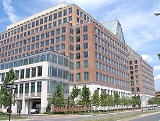
The USPTO is currently based in Alexandria, Virginia, after a 2006 move from the Crystal City area of Arlington, Virginia.

Discussion
Ask a question about 'United States Patent and Trademark Office'
Start a new discussion about 'United States Patent and Trademark Office'
Answer questions from other users
|
Recent Posts

Encyclopedia
The United States Patent and Trademark Office (PTO or USPTO) is an agency in the United States Department of Commerce that issues patents to inventors and businesses for their inventions, and trademark registration for product and intellectual property identification.
The USPTO is currently based in Alexandria, Virginia, after a 2006 move from the Crystal City area of Arlington, Virginia. A few offices remain in the Potomac Gateway complex at the southern end of Crystal City; these offices will move to Randolph Square, a brand new building in Shirlington Village, in 2009. Since 1991, the office has been fully funded by fees charged for processing patents and trademarks. The current head of the USPTO is John J. Doll, who acts as Director of the USPTO since the resignation of Jon W. Dudas. John Doll will serve in this capacity until further notice.
The USPTO cooperates with the European Patent Office (EPO) and the Japan Patent Office (JPO) as one of the Trilateral Patent Offices. The USPTO is also a Receiving Office, an International Searching Authority and an International Preliminary Examination Authority for international patent applications filed in accordance with the Patent Cooperation Treaty.
Mission
The mission of the PTO is to promote "industrial and technological progress in the United States and strengthen the national economy" by:
Structure
As of September 30 2007, the end of the U.S. government's fiscal year, the PTO had 8,913 employees, nearly all of whom are based at its huge five-building headquarters complex in Alexandria. Of those, 5,477 were patent examiners and 404 were trademark examining attorneys; the rest are support staff. The total employee count has risen from 8,189 at the end of fiscal year 2006; at the same time, there were 4,883 patent examiners and 413 trademark examiners. Patent examiners are generally scientists and engineers who do not necessarily hold law degrees, while all trademark examiners must be licensed attorneys. All examiners work under a strict quota system.
Decisions of patent examiners may be appealed to the Board of Patent Appeals and Interferences, an administrative law body of the USPTO. Decisions of the BPAI may further be appealed to the United States Court of Appeals for the Federal Circuit, or a civil suit may be brought against the Commissioner of Patents in the United States District Court for the District of Columbia. The United States Supreme Court may ultimately decide on a patent case. Similarly, decisions of trademark examiners may be appealed to the Trademark Trial and Appeal Board, with subsequent appeals directed to the Federal Circuit, or a civil action may also be brought.
In recent years, the USPTO has seen increasing delays between when a patent application is filed and when it issues. To address its workload challenges, the USPTO has undertaken an aggressive program of hiring and recruitment. In Fiscal Year 2006 (year ending September 30, 2006), the USPTO hired 1,193 new patent examiners, and 1,215 new examiners were hired in fiscal 2007. The USPTO expects to continue hiring patent examiners at a rate of approximately 1,200 per year from 2008 through 2012.
In 2006, USPTO also instituted a new training program for patent examiners called the "Patent Training Academy." It is an eight-month program designed to teach new patent examiners the fundamentals of patent law, practice and examination procedure in a college-style environment.
Fee diversion
Each year, Congress "diverts" about 10% of the fees that the USPTO has collected into the general treasury of the United States. In effect, this takes money collected from the patent system to use for the general budget. This fee diversion is generally opposed by patent practitioners (e.g patent attorneys and patent agents), inventors, and the USPTO. These stakeholders would rather use the funds to improve the patent office and patent system, such as by implementing the USPTO's 21st Century Strategic Plan.
Patents
* Each year, the PTO issues over 150,000 patents to companies and individuals worldwide. As of February 2008, the PTO has granted over 7,950,000 patents.
- The X-Patents (the first 10,280 issued between 1790 and 1836) were destroyed by a fire; fewer than 3,000 of those have been recovered and re-issued with numbers that include an "X". The X generally appears at the end of the numbers hand-written on full-page patent images; however, in patent collections and for search purposes, the X is considered to be the patent type -- analogous to the "D" of design patents -- and appears at the beginning of the number. The X distinguishes the patents from those issued after the fire, which began again with patent number 1.
Trademarks The USPTO examines applications for trademark registration. If approved, the trademarks are registered on either the Principal Register or the Supplemental Register, depending upon whether the mark meets the appropriate distinctiveness criteria. However, this function is declining in popularity as trademark applicants move to cheaper, more straightforward state-by-state registrations.
Representation The PTO only allows certain qualified persons to practice before the PTO. Practice includes filing of patent applications on behalf of inventors, prosecuting patent applications on behalf of inventors, and participating in administrative appeals and other proceedings before the PTO examiners and boards. The PTO sets its own standards for who may practice and requires that any person who practices become registered. A USPTO-registered non-attorney professional is called a patent agent and a USPTO-registered attorney is called a patent attorney.
In order to become registered to practice before the USPTO, an applicant must demonstrate to the USPTO's satisfaction certain scientific and technical competencies (such as having a science or engineering degree) and then pass a difficult USPTO-administered patent bar exam called the USPTO registration examination. This bar exam covers the voluminous regulations and procedures that govern USPTO practice. The registration process is managed by the USPTO's Office of Enrollment & Discipline (OED). The United States allows any citizen from any country to sit for the patent bar (if he/she has the requisite technical background). None of the world's countries reciprocates to U.S. citizens the right which the U.S. grants to their citizens; Canada is the only exception to this.
Individual inventors may file and prosecute patent applications by themselves by a process of pro se patent filing. The inventor is not required to be represented by a registered patent attorney or patent agent. If it appears to a patent examiner that an inventor filing a pro se application is not familiar with the proper procedures of the patent office, the examiner may suggest that it would be desirable for the inventor to obtain representation by a licensed patent attorney or agent. The patent examiner cannot recommend a patent attorney or agent, but the patent office does post a list of registered attorneys or agents.
It is not uncommon for individual inventors to file their own patents to potentially save thousands of dollars in agent/attorneys fees, since legal fees for the preparation and filing of a US patent application can total many thousands of dollars. While an inventor of a relatively simple-to-describe invention may well be able to produce an adequate specification and accompanying drawings for a utility application, the complexity lies in what is claimed, either in the particular claim language of a utility application, or in the manner in which drawings are presented in a design application. Moreover, although patent examiners make special efforts to help pro se inventors understand the process, failure to adequately understand or respond to an office action from the USPTO can endanger the inventor's rights, and may lead to abandonment of the application.
Patent agents can only act in a representative capacity in patent matters at the USPTO, and cannot represent an applicant for a trademark. Trademark applicants may be represented by any state bar licensed attorney sufficiently capable of handling trademark matters, governed by the rules of professional responsibility. There is no analogous "trademark agent" exam.
Electronic filing system The USPTO will accept patent applications filed in electronic form. As of March 2006, inventors or their patent agents/attorneys can file applications as Adobe PDF documents. The web page for submitting applications is [https://sportal.uspto.gov/secure/portal/efs-unregistered https://sportal.uspto.gov/secure/portal/efs-unregistered]. Filing fees can be paid by credit card or by a USPTO “deposit account”.
Electronic retrieval system The provides free electronic copies of issued patents and patent applications as single-page TIFF documents. The site also provides Boolean search and analysis tools.
The USPTO's free distribution service only distributes the patent documents as a set of single page files (see http://www.uspto.gov/patft/help/images.htm). Numerous free and commercial services provide patent documents in other formats, such as Adobe PDF and CPC.
Criticisms
The USPTO been criticized for granting patents for impossible or absurd, already known, or arguably obvious inventions.
Controversial patents
| last = Ball | first = Philip | date = November 10, 2005
| title = Antigravity craft slips past patent officers | journal = Nature | volume = 438 | issue = 7065 | pages = 139
| pmid = 16280998 | doi = 10.1038/438139a
}} The device comprises a particular electrically superconducting shield and elecromagnetic generating device. The examiner allowed the claims because the design of the shield and device was novel and not obvious. In situations such as this where a substantial question of patentability is raised after a patent issues, the Commissioner of the Patent Office can order a reexamination of the patent.
Controversial trademarks
, "Cloud Computing" for Dell, covering "custom manufacture of computer hardware for use in data centers and mega-scale computing environments for others", was allowed by a trademark attorney on July 8, 2008. Cloud computing is a generic term that could define technology infrastructure for years to come, which had been in general use at the time of the application. The application was rejected on 12 August 2008 as descriptive and generic.
, "Netbook" for Psion, covering "laptop computers" was registered on 21 November 2000. Although the company discontinued the netBook line in November 2003 and allowed the trademark to become genericized through use by journalists and vendors (products marketed as 'netbooks' include the Dell Inspiron Mini Series, Asus eeePC, HP Mini 1000, MSI Wind Netbook and others), USPTO subsequently rejected a number of trademarks citing a "likelihood of confusion" under section 2(d), including 'G NETBOOK' ( rejected 31 October 2008), MSI's 'WIND NETBOOK' and Coby Electronics' 'COBY NETBOOK' ( rejected 13 January 2009). Psion also delivered a batch of cease and desist letters on 23 December 2008 relating to the genericized trademark.
Slow patent examination and backlog
The USPTO has been criticized for taking an inordinate amount of time in examining patent applications. This is particularly true in the fast growing area of business method patents. As of 2005, patent examiners in the business method area were still examining patent applications filed in 2001.
The delay has been attributed by spokesmen for the Patent Office to a combination of a sudden increase in business method patent filings after the 1998 State Street Bank decision, the unfamiliarity of patent examiners with the business and financial arts (e.g. banking, insurance, stock trading etc.), and the issuance of a number of controversial patents (e.g. "Amazon one click patent") in the business method area.
Effective in August 2006, the USPTO introduced an accelerated patent examination procedure in an effort to allow inventors a speedy evaluation of an application with a final disposition within 12 months. The procedure requires additional information to be submitted with the application and also includes an interview with the examiner. The first accelerated patent was granted on March 15, 2007 with a 6 month issuance time.
As of the end of 2008, there were 1,208,076 patent applications pending at the Patent Office. At the end of 1997, the number of pending applications pending was 275,295. Therefore, over these 11 years there has been a 439% increase in the number of pending applications.
See also
External links
- USPTO
-
-
- search by trademark serial number or registration number
-
-
-
|
| |
|
|