

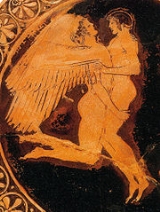
Homosexuality

Encyclopedia
Homosexuality is romantic or sexual attraction or behavior between members of the same sex
or gender
. As a sexual orientation
, homosexuality refers to "an enduring pattern of or disposition to experience sexual, affectional, or romantic attractions" primarily or exclusively to people of the same sex; "it also refers to an individual's sense of personal and social identity based on those attractions, behaviors expressing them, and membership in a community of others
who share them."
Homosexuality is one of the three main categories of sexual orientation, along with bisexuality
and heterosexuality
, within the heterosexual-homosexual continuum
(with asexuality
sometimes considered the fourth). Scientific and medical understanding is that sexual orientation is not a choice, but rather a complex interplay of biology
and environment. Although some religious sects hold the view that homosexual activity is sinful or dysfunctional behaviour, research and studies show that homosexuality is a normal and positive variant of human sexuality. Though homosexuality is not in itself a source of negative psychological effects, prejudice and discrimination against homosexual and bisexual people has been shown to cause psychological harm.
The most common terms for homosexual people are lesbian
for women and gay
for men, though gay is also used to refer generally to homosexual men and women. The number of people who identify as gay or lesbian—and the proportion of people who have same-sex sexual experiences—are difficult for researchers to estimate reliably for a variety of reasons. In the modern West
, according to major studies, 2% to 13% of the population is homosexual or has had some form of same-sex sexual contact within his or her lifetime. A 2006 study suggested that 20% of the population anonymously reported some homosexual feelings, although fewer participants in the study identified themselves as homosexual. Homosexual behavior is also widely observed in animals.
Many gay and lesbian people are in committed same-sex relationships, though only recently have census
forms and political conditions facilitated their visibility and enumeration. These relationships are equivalent to heterosexual relationships in essential psychological respects. Homosexual relationships and acts have been admired, as well as condemned, throughout recorded history, depending on the form they took and the culture in which they occurred. Since the end of the 19th century, there has been a movement towards increased visibility, recognition and legal rights
for homosexual people, including the rights to marriage and civil unions
, adoption and parenting
, employment
, military service
, and equal access to health care
.
 The word homosexual is a Greek
and Latin
hybrid with the first element derived from Greek ὁμός homos, 'same' (not related to the Latin homo, 'man', as in Homo sapiens), thus connoting sexual acts and affections between members of the same sex, including lesbianism. Gay generally refers to male homosexuality, but may be used in a broader sense to refer to all LGBT
people. In the context of sexuality, lesbian refers only to female homosexuality. The word "lesbian" is derived from the name of the Greek island Lesbos, where the poet Sappho
wrote largely about her emotional relationships with young women.
Many modern style guide
s in the U.S. recommend against using homosexual as a noun, instead using gay man or lesbian. Similarly, some recommend completely avoiding usage of homosexual as it has a negative, clinical history and because the word only refers to one's sexual behavior (as opposed to romantic feelings) and thus it has a negative connotation
. Gay and lesbian are the most common alternatives. The first letters are frequently combined to create the initialism
LGBT (sometimes written as GLBT), in which B and T refer to bisexual
and transgender
people.
The first known appearance of homosexual in print is found in an 1869 German pamphlet by the Austrian-born novelist Karl-Maria Kertbeny
, published anonymously, arguing against a Prussian
anti-sodomy law. In 1879, Gustav Jager
used Kertbeny's terms in his book, Discovery of the Soul (1880). In 1886, Richard von Krafft-Ebing
used the terms homosexual and heterosexual in his book Psychopathia Sexualis, probably borrowing them from Jager. Krafft-Ebing's book was so popular among both layman and doctors that the terms "heterosexual" and "homosexual" became the most widely accepted terms for sexual orientation.
As such, the current use of the term has its roots in the broader 19th-century tradition of personality taxonomy.
Although early writers also used the adjective homosexual to refer to any single-sex context (such as an all-girls' school), today the term is used exclusively in reference to sexual attraction, activity, and orientation. The term homosocial
is now used to describe single-sex contexts that are not specifically sexual. There is also a word referring to same-sex love, homophilia.
or MSM (used in the medical community when specifically discussing sexual activity) and homoerotic
(referring to works of art). Pejorative
terms in English include queer
, faggot, fairy
, poof, and homo. Beginning in the 1990s, some of these have been reclaimed as positive words by gay men and lesbians, as in the usage of queer studies
, queer theory
, and even the popular American television program Queer Eye for the Straight Guy. The word occurs in many other languages without the pejorative connotations it has in English. As with ethnic slurs and racial slurs, however, the misuse of these terms can still be highly offensive; the range of acceptable use depends on the context and speaker. Conversely, gay, a word originally embraced by homosexual men and women as a positive, affirmative term (as in gay liberation
and gay rights), has come into widespread pejorative use among young people.
, the American Psychiatric Association
, and the National Association of Social Workers
identify sexual orientation as "not merely a personal characteristic that can be defined in isolation. Rather, one's sexual orientation defines the universe of persons with whom one is likely to find the satisfying and fulfilling relationships":
According to Rosario, Schrimshaw, Hunter, Braun (2006), "the development of a lesbian, gay, or bisexual (LGB) sexual identity is a complex and often difficult process. Unlike members of other minority groups (e.g., ethnic and racial minorities), most LGB individuals are not raised in a community of similar others from whom they learn about their identity and who reinforce and support that identity. Rather, LGB individuals are often raised in communities that are either ignorant of or openly hostile toward homosexuality."
Outing
is the practice of publicly revealing the sexual orientation of a closeted person. Notable politicians, celebrities, military service people, and clergy members have been outed, with motives ranging from malice to political or moral beliefs. Many commentators oppose the practice altogether, while some encourage outing public figures who use their positions of influence to harm other gay people.
, Richard von Krafft-Ebing, Magnus Hirschfeld
, Havelock Ellis
, Carl Jung
and Sigmund Freud
, as well as many gender variant homosexual people themselves. However, this understanding of homosexuality as sexual inversion was disputed at the time, and through the second half of the 20th century, gender identity
came to be increasingly seen as a phenomenon distinct from sexual orientation.
Transgender and cisgender
people may be attracted to men, women or both, although the prevalence of different sexual orientations is quite different in these two populations (see sexual orientation of transwomen). An individual homosexual, heterosexual or bisexual person may be masculine, feminine, or androgynous
, and in addition, many members and supporters of lesbian and gay communities now see the "gender-conforming heterosexual" and the "gender-nonconforming homosexual" as negative stereotype
s. However, studies by J. Michael Bailey
and K.J. Zucker have found that a majority of gay men and lesbians report being gender-nonconforming during their childhood years. Richard C. Friedman
, in Male Homosexuality published in 1990, writing from a psychoanalytic perspective, argues that sexual desire begins later than the writings of Sigmund Freud
indicate, not in infancy but between the ages of 5 and 10 and is not focused on a parent figure but on peers. As a consequence, he reasons, homosexual men are not abnormal, never having been sexually attracted to their mothers anyway.
argued that homosexuality as an identity did not exist in the 18th century; that people instead spoke of "sodomy", which referred to sexual acts. Sodomy was a crime that was often ignored but sometimes punished severely (see sodomy law
).
The term homosexual is often used in European and American cultures to encompass a person's entire social identity, which includes self and personality. In Western cultures some people speak meaningfully of gay, lesbian, and bisexual identities and communities. In other cultures, homosexuality and heterosexual labels do not emphasize an entire social identity or indicate community affiliation based on sexual orientation. Some scholars, such as David Green, state that homosexuality is a modern Western social construct, and as such cannot be used in the context of non-Western male-male sexuality, nor in the pre-modern West.
, though some have sexual relationships with those of the opposite gender, bisexual relationships, or none at all (celibate). Research indicates that many lesbians and gay men want, and succeed in having, committed and durable relationships. For example, survey data indicate that between 40% and 60% of gay men and between 45% and 80% of lesbians are currently involved in a romantic relationship. Survey data also indicate that between 18% and 28% of gay couples and between 8% and 21% of lesbian couples in the U.S. have lived together ten or more years. Studies have found same-sex and opposite-sex couples to be equivalent to each other in measures of satisfaction and commitment in romantic relationships, that age and gender are more reliable than sexual orientation as a predictor of satisfaction and commitment to a romantic relationship, and that people who are heterosexual or homosexual share comparable expectations and ideals with regard to romantic relationships.
Measuring the prevalence of homosexuality may present difficulties. The research must measure some characteristic that may or may not be defining of sexual orientation. The class of people with same-sex desires may be larger than the class of people who act on those desires, which in turn may be larger than the class of people who self-identify as gay/lesbian/bisexual.
In 1948 and 1953, Alfred Kinsey
reported that nearly 46% of the male subjects had "reacted" sexually to persons of both sexes in the course of their adult lives, and 37% had had at least one homosexual experience. Kinsey's methodology was criticized.
A later study tried to eliminate the sample bias, but still reached similar conclusions.
Estimates of the occurrence of exclusive homosexuality range from one to twenty percent of the population, usually finding there are slightly more gay men than lesbians.
Estimates of the frequency of homosexual activity also vary from one country to another. A 1992 study reported that 6.1% of males in Britain had had a homosexual experience, while in France the number was 4.1%. According to a 2003 survey
, 12% of Norwegians
have had homosexual sex. In New Zealand
, a 2006 study suggested that 20% of the population anonymously reported some homosexual feelings, few of them identifying as homosexual. Percentage of persons identifying homosexual was 2–3%. According to a 2008 poll, while only 6% of Britons define their sexual orientation as homosexual or bisexual, more than twice that number (13%) of Britons have had some form of sexual contact with someone of the same sex.
In the United States
, according to exit poll
ing on 2008 Election Day for the 2008 Presidential elections
, 4% of electorate self-identified as gay, lesbian, or bisexual, the same percentage as in 2004." According to the 2000 United States Census
there were about 601,209 same-sex unmarried partner households.
In the UK, the UK Office for National Statistics
survey have come up with the figure that 1.5% are gay or bisexual, and suggest that this is in line with other surveys showing between 0.3% and 3%.
and psychiatric
circles, judging such behavior as indicative of a type of person with a defined and relatively stable sexual orientation. In the late 19th century and early 20th century, pathological models of homosexuality were standard.
The American Psychological Association, the American Psychiatric Association
, and the National Association of Social Workers
state:
The longstanding consensus of research and clinical literature demonstrates that same-sex sexual and romantic attractions, feelings, and behaviors are normal and positive variations of human sexuality. There is now a large body of research evidence that indicates that being gay, lesbian or bisexual is compatible with normal mental health and social adjustment. The World Health Organization
's ICD-9 (1977) listed homosexuality as a mental illness; it was removed from the ICD-10
, endorsed by the Forty-third World Health Assembly on May 17, 1990. Like the DSM-II, the ICD-10 added ego-dystonic sexual orientation
to the list, which refers to people who want to change their gender identities
or sexual orientation because of a psychological or behavioral disorder . The Chinese Society of Psychiatry
removed homosexuality from its Chinese Classification of Mental Disorders
in 2001 after five years of study by the association. According to the Royal College of Psychiatrists
"This unfortunate history demonstrates how marginalisation of a group of people who have a particular personality feature (in this case homosexuality) can lead to harmful medical practice and a basis for discrimination in society. There is now a large body of research evidence that indicates that being gay, lesbian or bisexual is compatible with normal mental health and social adjustment. However, the experiences of discrimination in society and possible rejection by friends, families and others, such as employers, means that some LGB people experience a greater than expected prevalence of mental health difficulties and substance misuse problems. Although there have been claims by conservative political groups in the USA that this higher prevalence of mental health difficulties is confirmation that homosexuality is itself a mental disorder, there is no evidence whatever to substantiate such a claim."
Most lesbian, gay, and bisexual people who seek psychotherapy do so for the same reasons as heterosexual people (stress, relationship difficulties, difficulty adjusting to social or work situations, etc.); their sexual orientation may be of primary, incidental, or no importance to their issues and treatment. Whatever the issue, there is a high risk for anti-gay bias in psychotherapy with lesbian, gay, and bisexual clients. Psychological research in this area has been relevant to counteracting prejudicial ("homophobic") attitudes and actions, and to the LGBT rights movement generally.
The appropriate application of affirmative psychotherapy is based on the following scientific facts:
, American Psychiatric Association
, and National Association of Social Workers
stated in 2006:
The Royal College of Psychiatrists
stated in 2007:
The American Academy of Pediatrics
stated in Pediatrics
in 2004:
The American Psychological Association states "there are probably many reasons for a person's sexual orientation and the reasons may be different for different people", and says most people's sexual orientation is determined at an early age. Research into how sexual orientation in males may be determined by genetic or other prenatal factors plays a role in political and social debates about homosexuality, and also raises fears about genetic profiling and prenatal testing.
Professor Michael King states: "The conclusion reached by scientists who have investigated the origins and stability of sexual orientation is that it is a human characteristic that is formed early in life, and is resistant to change. Scientific evidence on the origins of homosexuality is considered relevant to theological and social debate because it undermines suggestions that sexual orientation is a choice."
Innate bisexuality
(or predisposition to bisexuality) is a term introduced by Sigmund Freud
, based on work by his associate Wilhelm Fliess
, that expounds that all humans are born bisexual but through psychological development—which includes both external and internal factors—become monosexual, while the bisexuality remains in a latent state.
The authors of a 2008 study stated "there is considerable evidence that human sexual orientation is genetically influenced, so it is not known how homosexuality, which tends to lower reproductive success, is maintained in the population at a relatively high frequency". They hypothesized that "while genes predisposing to homosexuality reduce homosexuals' reproductive success, they may confer some advantage in heterosexuals who carry them". Their results suggested that "genes predisposing to homosexuality may confer a mating advantage in heterosexuals, which could help explain the evolution and maintenance of homosexuality in the population". A 2009 study also suggested a significant increase in fecundity in the females related to the homosexual people from the maternal line (but not in those related from the paternal one).
Garcia-Falgueras and Swaab state in the abstract of their 2010 study, "The fetal brain develops during the intrauterine period in the male direction through a direct action of testosterone on the developing nerve cells, or in the female direction through the absence of this hormone surge. In this way, our gender identity (the conviction of belonging to the male or female gender) and sexual orientation are programmed or organized into our brain structures when we are still in the womb. There is no indication that social environment after birth has an effect on gender identity or sexual orientation."
.
In a U.S.-based 1970s mail survey by Shere Hite
, lesbians self-reported their reasons for being lesbian. This is the only major piece of research into female sexuality that has looked at how women understand being homosexual since Kinsey in 1953. The research yielded information about women's general understanding of lesbian relationships and their sexual orientation.
Women talked about social conditioning, which made it "almost impossible for me to have a truly healthy sexual relationship with a man". Another woman stated that because of their conditioning "[ w] omen are much more sensitive to other people's needs", and so "[ s] ex is better with women physically and emotionally", stating she preferred the symmetries of power and aesthetic between women. Some talked about preferring women, "[ p] ersonally, I like girls better, they are more tender and loving", and some went into how they found that emotional relationships with women were more satisfying than those with men, with women making more creative and versatile lovers. One woman reported it was easier for her "to give myself emotionally to a woman". A woman who had been a lesbian for two years said she found that sexual relationships with women were more pleasurable on both psychological and physical levels than with men; this was "because the women I've had sex with have been my friends first, which was never the case with men. Being friends sets up a trust that I think is essential for satisfying physical intimacy. Relating to another woman physically seems to me like the most natural thing in the world. You've already got a head start on knowing how to give her pleasure. Gentleness seems to be the key, and is the main difference between relating to men and women.'" Women talked about women making better sexual partners and that was a dominant theme: "I find women better lovers; they know what a woman wants and most of all there is an emotional closeness that can never be matched with a man. More tenderness, more consideration and understanding of feelings, etc." This was because men were perceived as unliberated "sexually or emotionally or any other way", and lesbianism was perceived "as an alternative to abstinence" and to men generally. Men were perceived as usually juvenile, while a relationship with women was described as "more of a communion with self". Sex as well as relationships with women were seen as a way of achieving independence from men; "[ s] ex with a woman means independence from men." Male sexual performance was another problem, "[ t] wenty minutes for a man, at least an hour with a woman, usually more", as well as attention to the sexual needs of women who themselves "seem to have a more sustained energy level after orgasm, and are more likely to know and do something about it if I'm not satisfied". One understanding of the difference was that sex with women "is not an 'exchange' or a 'trade' or services", and not focused on orgasm, with "more kissing and holding" and "more concern for my pleasure", which was experienced as liberating. Sex with women was also seen as a political act; "I see lesbianism as putting all my energies (sexual, political social, etc.) into women. Sex is a form of comfort and to have sex indiscriminately with males is to give them comfort.".
Hite is more concerned with what respondents say than quantifiable data. She found the two most significant differences between respondents' experience with men and women were the focus on clitoral stimulation, and more emotional involvement and orgasmic responses. Since Hite carried out her study she has acknowledged that some women may have chosen the political identity of a lesbian. Julie Bindel
, a UK journalist, reaffirmed that "political lesbianism continues to make intrinsic sense because it reinforces the idea that sexuality is a choice, and we are not destined to a particular fate because of our chromosomes." as recently as 2009.
Some individuals and groups have promoted the idea of homosexuality as symptomatic of developmental defects or spiritual and moral failings and have argued that sexual orientation change efforts, including psychotherapy and religious efforts, could alter homosexual feelings and behaviors. Many of these individuals and groups appeared to be embedded within the larger context of conservative religious political movements that have supported the stigmatization of homosexuality on political or religious grounds.
No major mental health professional organization has sanctioned efforts to change sexual orientation and virtually all of them have adopted policy statements cautioning the profession and the public about treatments that purport to change sexual orientation. These include the American Psychiatric Association, American Psychological Association, American Counseling Association, National Association of Social Workers in the USA, the Royal College of Psychiatrists, and the Australian Psychological Society
. The American Psychological Association and the Royal College of Psychiatrists expressed concerns that the positions espoused by NARTH are not supported by the science and create an environment in which prejudice and discrimination can flourish.
The American Psychological Association "encourages mental health professionals to avoid misrepresenting the efficacy of sexual orientation change efforts by promoting or promising change in sexual orientation when providing assistance to individuals distressed by their own or others' sexual orientation and concludes that the benefits reported by participants in sexual orientation change efforts can be gained through approaches that do not attempt to change sexual orientation".
(APA) has stated "some people believe that sexual orientation is innate and fixed; however, sexual orientation develops across a person's lifetime". In a joint statement with other major American medical organizations, the APA says that "different people realize at different points in their lives that they are heterosexual, gay, lesbian, or bisexual". A report from the Centre for Addiction and Mental Health
states: "For some people, sexual orientation is continuous and fixed throughout their lives. For others, sexual orientation may be fluid and change over time". One study has suggested "considerable fluidity in bisexual, unlabeled, and lesbian women's attractions, behaviors, and identities".
" (WSW) refer to people who engage in sexual activity with others of the same sex regardless of how they identify themselves—as many choose not to accept social identities
as lesbian, gay and bisexual. These terms are often used in medical literature and social research
to describe such groups for study, without needing to consider the issues of sexual self-identity. The terms are seen as problematic, however, because it "obscures social dimensions of sexuality; undermines the self-labeling of lesbian, gay, and bisexual people; and does not sufficiently describe variations in sexual behavior". MSM and WSW are sexually active with each other for a variety of reasons with the main ones arguably sexual pleasure, intimacy and bonding. In contrast to its benefits, sexual behavior can be a disease vector. Safe sex
is a relevant harm reduction
philosophy. The United States currently prohibits men who have sex with men from donating blood
"because they are, as a group, at increased risk for HIV
, hepatitis B and certain other infections that can be transmitted by transfusion." The UK and many European countries have the same prohibition.
(STIs):
These safer sex recommendations are agreed upon by public health officials for men who have sex with men to avoid sexually transmitted infections:
, substance abuse
, and suicide. Although these issues exist among people who are non-heterosexual, discussion about their causes shifted after homosexuality was removed from the Diagnostic and Statistical Manual (DSM) in 1973. Instead, social ostracism, legal discrimination, internalization of negative stereotypes, and limited support structures indicate factors homosexual people face in Western societies that often adversely affect their mental health.
Stigma, prejudice, and discrimination stemming from negative societal attitudes toward homosexuality lead to a higher prevalence of mental health disorders among lesbians, gay men, and bisexuals compared to their heterosexual peers. Evidence indicates that the liberalization of these attitudes over the past few decades is associated with a decrease in such mental health risks among younger LGBT people.
Crisis centers in larger cities and information sites on the Internet have arisen to help youth and adults. The Trevor Helpline, a suicide prevention helpline for gay youth, was established following the 1998 airing on HBO of the Academy Award winning short film Trevor
.
In a detailed compilation of historical and ethnographic materials of Preindustrial Cultures
, "strong disapproval of homosexuality was reported for 41% of 42 cultures; it was accepted or ignored by 21%, and 12% reported no such concept. Of 70 ethnographies, 59% reported homosexuality absent or rare in frequency and 41% reported it present or not uncommon."
In cultures influenced by Abrahamic religions
, the law and the church established sodomy
as a transgression against divine law or a crime against nature
. The condemnation of anal sex
between males, however, predates Christian belief. It was frequent in ancient Greece; "unnatural" can be traced back to Plato
.
Many historical figures, including Socrates
, Lord Byron
, Edward II
, and Hadrian
, have had terms such as gay or bisexual applied to them; some scholars, such as Michel Foucault
, have regarded this as risking the anachronistic introduction of a contemporary construction of sexuality foreign to their times, though others challenge this.
A common thread of constructionist argument is that no one in antiquity or the Middle Ages experienced homosexuality as an exclusive, permanent, or defining mode of sexuality. John Boswell has countered this argument by citing ancient Greek writings by Plato, which describe individuals exhibiting exclusive homosexuality.
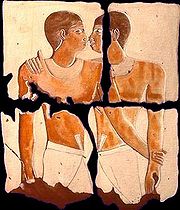
and Will Roscoe
reported that women in Lesotho
engaged in socially sanctioned "long term, erotic relationships" called motsoalle. E. E. Evans-Pritchard
also recorded that male Azande
warriors in the northern Congo
routinely took on young male lovers between the ages of twelve and twenty, who helped with household tasks and participated in intercrural sex
with their older husbands. The practice had died out by the early 20th century, after Europeans had gained control of African countries, but was recounted to Evans-Pritchard by the elders to whom he spoke.
The first record of possible homosexual couple in history is commonly regarded as Khnumhotep and Niankhkhnum
, an Egyptian male couple, who lived around the 2400 BCE. The pair are portrayed in a nose-kissing position, the most intimate pose in Egyptian art, surrounded by what appear to be their heirs.
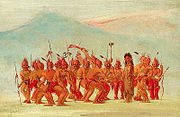 Among indigenous peoples of the Americas
prior to European colonization, a common form of same-sex sexuality centered around the figure of the Two-Spirit
individual. Typically this individual was recognized early in life, given a choice by the parents to follow the path and, if the child accepted the role, raised in the appropriate manner, learning the customs of the gender it had chosen. Two-Spirit individuals were commonly shamans
and were revered as having powers beyond those of ordinary shamans. Their sexual life was with the ordinary tribe members of the same sex.
Homosexual and transgender individuals were also common among other pre-conquest
civilizations in Latin America
, such as the Aztec
s, Mayans
, Quechuas
, Moche
s, Zapotecs
, and the Tupinambá of Brazil.
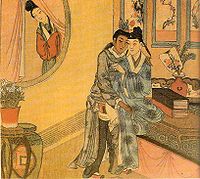 The Spanish conquerors were horrified to discover sodomy openly practiced among native peoples, and attempted to crush it out by subjecting the berdaches (as the Spanish called them) under their rule to severe penalties, including public execution, burning and being torn to pieces by dogs.
, same-sex love has been referred to since the earliest recorded history.
Homosexuality in China
, known as the pleasures of the bitten peach, the cut sleeve, or the southern custom, has been recorded since approximately 600 BCE. These euphemistic terms were used to describe behaviors, not identities (recently some fashionable young Chinese tend to euphemistically use the term "brokeback", 斷背 duanbei to refer to homosexual men, from the success of director Ang Lee
's film Brokeback Mountain
). Homosexuality was mentioned in Chinese literature. The instances of same-sex affection and sexual interactions described in the classical novel Dream of the Red Chamber
seem as familiar to observers in the present as do equivalent stories of romances between heterosexual people during the same period.
Homosexuality in Japan, variously known as shudo or nanshoku has been documented for over one thousand years and was an integral part of Buddhist
monastic life and the samurai
tradition. This same-sex love culture gave rise to strong traditions of painting
and literature documenting and celebrating such relationships.
Similarly, in Thailand
, Kathoey
, or "ladyboys", have been a feature of Thai society for many centuries, and Thai kings had male as well as female lovers. While Kathoey may encompass simple effeminacy
or transvestism, it most commonly is treated in Thai culture as a third gender
. They are generally accepted by society, and Thailand has never had legal prohibitions against homosexuality or homosexual behavior.
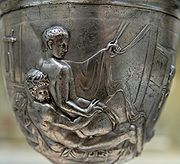 The earliest Western documents (in the form of literary works, art objects, and mythographic materials
) concerning same-sex relationships are derived from ancient Greece
.
In regard of male homosexuality such documents depict a world in which relationships with women and relationships with youths were the essential foundation of a normal man's love life. Same-sex relationship
s were a social institution variously constructed over time and from one city to another. The formal practice, an erotic yet often restrained relationship between a free adult male and a free adolescent, was valued for its pedagogic benefits and as a means of population control, though occasionally blamed for causing disorder. Plato
praised its benefits in his early writings but in his late works proposed its prohibition. In the Symposium (182B-D), Plato equates acceptance of homosexuality with democracy
, and its suppression with despotism
, saying that homosexuality "is shameful to barbarians because of their despotic governments, just as philosophy and athletics are, since it is apparently not in best interests of such rulers to have great ideas engendered in their subjects, or powerful friendships or physical unions, all of which love is particularly apt to produce". Aristotle
, in the Politics, dismissed Plato's ideas about abolishing homosexuality (2.4); he explains that barbarians like the Celts accorded it a special honor (2.6.6), while the Cretans used it to regulate the population (2.7.5).
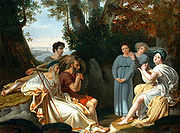 Little is known of female homosexuality in antiquity. Sappho
, born on the island of Lesbos, was included by later Greeks in the canonical list of nine lyric poets
. The adjectives deriving from her name and place of birth (Sapphic and Lesbian) came to be applied to female homosexuality beginning in the 19th century. Sappho's poetry centers on passion and love for various personages and both genders. The narrators of many of her poems speak of infatuation
s and love
(sometimes requited, sometimes not) for various females, but descriptions of physical acts between women are few and subject to debate.
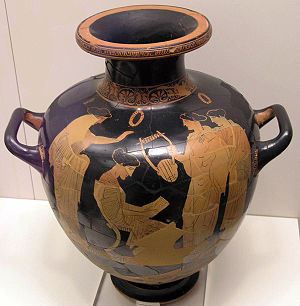 In Ancient Rome
the young male body remained a focus of male sexual attention, but relationships were between older free men and slaves or freed youths who took the receptive role in sex. All the emperors with the exception of Claudius
took male lovers. The Hellenophile emperor Hadrian
is renowned for his relationship with Antinous
, but the Christian emperor Theodosius I
decreed a law on August 6, 390, condemning passive males to be burned at the stake. Justinian
, towards the end of his reign, expanded the proscription to the active partner as well (in 558), warning that such conduct can lead to the destruction of cities through the "wrath of God". Notwithstanding these regulations, taxes on brothels of boys available for homosexual sex continued to be collected until the end of the reign of Anastasius I
in 518.
During the Renaissance
, wealthy cities in northern Italy
— Florence
and Venice
in particular — were renowned for their widespread practice of same-sex love, engaged in by a considerable part of the male population and constructed along the classical pattern of Greece and Rome. But even as many of the male population were engaging in same-sex relationships, the authorities, under the aegis
of the Officers of the Night court, were prosecuting, fining, and imprisoning a good portion of that population. From the second half of the 13th century, death was the punishment for male homosexuality in most of Europe. The eclipse of this period of relative artistic and erotic freedom was precipitated by the rise to power of the moralizing monk Girolamo Savonarola
. In northern Europe the artistic discourse on sodomy
was turned against its proponents by artists such as Rembrandt, who in his Rape of Ganymede no longer depicted Ganymede
as a willing youth, but as a squalling baby attacked by a rapacious bird of prey.
The relationships of socially prominent figures, such as King James I
and the Duke of Buckingham
, served to highlight the issue, including in anonymously authored street pamphlets: "The world is chang'd I know not how, For men Kiss Men, not Women now;...Of J. the First and Buckingham: He, true it is, his Wives Embraces fled, To slabber his lov'd Ganimede" (Mundus Foppensis, or The Fop Display'd, 1691).
Love Letters Between a Certain Late Nobleman and the Famous Mr. Wilson was published in 1723 in England and was presumed by some modern scholars to be a novel. The 1749 edition of John Cleland
's popular novel Fanny Hill
includes a homosexual scene, but this was removed in its 1750 edition. Also in 1749, the earliest extended and serious defense of homosexuality in English, Ancient and Modern Pederasty
Investigated and Exemplified, written by Thomas Cannon
, was published, but was suppressed almost immediately. It includes the passage, "Unnatural Desire is a Contradiction in Terms; downright Nonsense. Desire is an amatory Impulse of the inmost human Parts." Around 1785 Jeremy Bentham
wrote another defense, but this was not published until 1978. Executions for sodomy continued in the Netherlands
until 1803, and in England
until 1835.
Between 1864 and 1880 Karl Heinrich Ulrichs
published a series of twelve tracts, which he collectively titled Research on the Riddle of Man-Manly Love. In 1867, he became the first self-proclaimed homosexual person to speak out publicly in defense of homosexuality when he pleaded at the Congress of German Jurists in Munich
for a resolution urging the repeal of anti-homosexual laws. Sexual Inversion by Havelock Ellis
, published in 1896, challenged theories that homosexuality was abnormal, as well as stereotype
s, and insisted on the ubiquity of homosexuality and its association with intellectual and artistic achievement. Although medical texts like these (written partly in Latin to obscure the sexual details) were not widely read by the general public, they did lead to the rise of Magnus Hirschfeld
's Scientific Humanitarian Committee, which campaigned from 1897 to 1933 against anti-sodomy laws in Germany
, as well as a much more informal, unpublicized movement among British intellectuals and writers, led by such figures as Edward Carpenter
and John Addington Symonds
. Beginning in 1894 with Homogenic Love, Socialist activist and poet Edward Carpenter wrote a string of pro-homosexual articles and pamphlets, and "came out" in 1916 in his book My Days and Dreams. In 1900, Elisar von Kupffer
published an anthology of homosexual literature from antiquity to his own time, Lieblingminne und Freundesliebe in der Weltliteratur. His aim was to broaden the public perspective of homosexuality beyond its being viewed simply as a medical or biological issue, but also as an ethical and cultural one. In a backlash to this, the Third Reich specifically targeted LGBT
people in the Holocaust.
 Among many Middle East
ern Muslim
cultures egalitarian or age-structured homosexual practices were, and remain, widespread and thinly veiled. The prevailing pattern of same-sex relationships in the temperate and sub-tropical zone stretching from Northern India to the Western Sahara is one in which the relationships were—and are—either gender-structured or age-structured or both. In recent years, egalitarian relationships modeled on the western pattern have become more frequent, though they remain rare. Same-sex intercourse officially carries the death penalty in several Muslim nations: Saudi Arabia, Iran, Mauritania
, northern Nigeria
, Sudan
, and Yemen
.
Some scholars argue that there are examples of homosexual love in ancient literature, like in the Mesopotamian Epic of Gilgamesh
as well as in the Biblical story of David and Jonathan
. In the Epic of Gilgamesh, the relationship between the main protagonist Gilgamesh
and the character Enkidu
has been seen by some to be homosexual in nature. Similarly, David's love for Jonathan is "greater than the love of women." Admittedly, many of these examples are inherently problematic because of applying the modern category of "homosexuality" to a time when no such forms of identity existed.
A tradition of art and literature sprang up constructing Middle Eastern homosexuality. Muslim—often Sufi—poets in medieval Arab
lands and in Persia
wrote odes to the beautiful wine boys who served them in the taverns. In many areas the practice survived into modern times, as documented by Richard Francis Burton
, André Gide
, and others.
There are a handful of accounts by Arab travelers to Europe during the mid-1800s. Two of these travelers, Rifa'ah al-Tahtawi and Muhammad sl-Saffar, show their surprise that the French sometimes deliberately mis-translated love poetry about a young boy, instead referring to a young female, to maintain their social norms and morals.
In Persia homosexuality and homoerotic expressions were tolerated in numerous public places, from monasteries and seminaries to taverns, military camps, bathhouses, and coffee houses. In the early Safavid era (1501–1723), male houses of prostitution
(amrad khane) were legally recognized and paid taxes. Persian poets, such as Sa'di
(d. 1291), Hafez
(d. 1389), and Jami
(d. 1492), wrote poems replete with homoerotic allusions. The two most commonly documented forms were commercial sex with transgender young males or males enacting transgender roles exemplified by the köçek
s and the bacchá
s, and Sufi spiritual practices in which the practitioner admired the form of a beautiful boy in order to enter ecstatic states and glimpse the beauty of God.
Today, governments in the Middle East often ignore, deny the existence of, or criminalize homosexuality. Homosexuality is illegal in almost all Muslim countries. Iranian President Mahmoud Ahmadinejad, during his 2007 speech at Columbia University, asserted that there were no gay people in Iran. Gay people do live in Iran, but most keep their sexuality a secret for fear of government sanction or rejection by their families.
The Laws of Manu, the foundational work of Hindu law, mentions a "third sex", members of which may engage in nontraditional gender expression and homosexual activities.
, especially in Papua New Guinea
, same-sex relationships were an integral part of the culture until the middle of the last century. The Etoro
and Marind-anim
for example, even viewed heterosexuality as sinful and celebrated homosexuality instead. In many traditional Melanesian cultures a prepubertal boy would be paired with an older adolescent who would become his mentor and who would "inseminate" him (orally, anally, or topically, depending on the tribe) over a number of years in order for the younger to also reach puberty. Many Melanesian societies, however, have become hostile towards same-sex relationships since the introduction of Christianity
by European
missionaries.
. Some jurisdictions further recognize identical rights, protections, and privileges for the family structures of same-sex couples, including marriage
. Some nations mandate that all individuals restrict themselves to heterosexual relationships; that is, in some jurisdictions homosexual activity is illegal. Offenders can face the death penalty in some fundamentalist Muslim areas such as Iran
and parts of Nigeria
. There are, however, often significant differences between official policy and real-world enforcement.
See Violence against LGBT people.
Although homosexual acts were decriminalized in some parts of the Western world
, such as Poland
in 1932, Denmark
in 1933, Sweden
in 1944, and the United Kingdom
in 1967, it was not until the mid-1970s that the gay community
first began to achieve limited civil rights
in some developed countries. On July 2, 2009, homosexuality was decriminalized in India by a High Court ruling. A turning point was reached in 1973 when the American Psychiatric Association removed homosexuality from the Diagnostic and Statistical Manual of Mental Disorders
, thus negating its previous definition of homosexuality as a clinical mental disorder. In 1977, Quebec
became the first state-level jurisdiction in the world to prohibit discrimination
on the grounds of sexual orientation. During the 1980s and 1990s, most developed countries enacted laws decriminalizing homosexual behavior and prohibiting discrimination against lesbian and gay people in employment, housing, and services. On the other hand, many countries today in the Middle East and Africa, as well as several countries in Asia, the Caribbean and the South Pacific, outlaw homosexuality. In six countries, homosexual behavior is punishable by life imprisonment
; in ten others, it carries the death penalty.
In the European Union
discrimination of any type based on sexual orientation or gender identity is illegal under the Charter of Fundamental Rights of the European Union
.
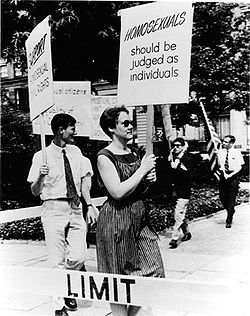 Since the 1960s, many LGBT people in the West, particularly those in major metropolitan areas, have developed a so-called gay culture. To many, gay culture is exemplified by the gay pride
movement, with annual parades and displays of rainbow flags. Yet not all LGBT people choose to participate in "queer culture", and many gay men and women specifically decline to do so. To some it seems to be a frivolous display, perpetuating gay stereotypes. To some others, the gay culture represents heterophobia
and is scorned as widening the gulf between gay and non-gay people.
With the outbreak of AIDS
in the early 1980s, many LGBT groups and individuals organized campaigns to promote efforts in AIDS education, prevention, research, patient support, and community outreach, as well as to demand government support for these programs. Gay Men's Health Crisis
, Project Inform, and ACT UP are some notable American examples of the LGBT community's response to the AIDS crisis.
The bewildering death toll wrought by the AIDS
epidemic at first seemed to slow the progress of the gay rights movement, but in time it galvanized some parts of the LGBT community into community service and political action, and challenged the heterosexual community to respond compassionately. Major American motion pictures from this period that dramatized the response of individuals and communities to the AIDS crisis include An Early Frost
(1985), Longtime Companion
(1990), And the Band Played On
(1993), Philadelphia
(1993), and Common Threads: Stories from the Quilt
(1989), the last referring to the NAMES Project AIDS Memorial Quilt
, last displayed in its entirety on the Mall
in Washington, D.C.
, in 1996.
Sex
In biology, sex is a process of combining and mixing genetic traits, often resulting in the specialization of organisms into a male or female variety . Sexual reproduction involves combining specialized cells to form offspring that inherit traits from both parents...
or gender
Gender
Gender is a range of characteristics used to distinguish between males and females, particularly in the cases of men and women and the masculine and feminine attributes assigned to them. Depending on the context, the discriminating characteristics vary from sex to social role to gender identity...
. As a sexual orientation
Sexual orientation
Sexual orientation describes a pattern of emotional, romantic, or sexual attractions to the opposite sex, the same sex, both, or neither, and the genders that accompany them. By the convention of organized researchers, these attractions are subsumed under heterosexuality, homosexuality,...
, homosexuality refers to "an enduring pattern of or disposition to experience sexual, affectional, or romantic attractions" primarily or exclusively to people of the same sex; "it also refers to an individual's sense of personal and social identity based on those attractions, behaviors expressing them, and membership in a community of others
LGBT social movements
Lesbian, gay, bisexual, and transgender social movements share inter-related goals of social acceptance of sexual and gender minorities. Lesbian, gay, bisexual, and transgender people and their allies have a long history of campaigning for what is generally called LGBT rights, also called gay...
who share them."
Homosexuality is one of the three main categories of sexual orientation, along with bisexuality
Bisexuality
Bisexuality is sexual behavior or an orientation involving physical or romantic attraction to both males and females, especially with regard to men and women. It is one of the three main classifications of sexual orientation, along with a heterosexual and a homosexual orientation, all a part of the...
and heterosexuality
Heterosexuality
Heterosexuality is romantic or sexual attraction or behavior between members of the opposite sex or gender. As a sexual orientation, heterosexuality refers to "an enduring pattern of or disposition to experience sexual, affectional, physical or romantic attractions to persons of the opposite sex";...
, within the heterosexual-homosexual continuum
Heterosexual-homosexual continuum
The concept of the heterosexual–homosexual continuum is a psychological and philosophical understanding of human sexuality that places sexual orientation on a continuum from heterosexuality to homosexuality...
(with asexuality
Asexuality
Asexuality , in its broadest sense, is the lack of sexual attraction and, in some cases, the lack of interest in sex. Sometimes, it is considered a lack of a sexual orientation...
sometimes considered the fourth). Scientific and medical understanding is that sexual orientation is not a choice, but rather a complex interplay of biology
Biology
Biology is a natural science concerned with the study of life and living organisms, including their structure, function, growth, origin, evolution, distribution, and taxonomy. Biology is a vast subject containing many subdivisions, topics, and disciplines...
and environment. Although some religious sects hold the view that homosexual activity is sinful or dysfunctional behaviour, research and studies show that homosexuality is a normal and positive variant of human sexuality. Though homosexuality is not in itself a source of negative psychological effects, prejudice and discrimination against homosexual and bisexual people has been shown to cause psychological harm.
The most common terms for homosexual people are lesbian
Lesbian
Lesbian is a term most widely used in the English language to describe sexual and romantic desire between females. The word may be used as a noun, to refer to women who identify themselves or who are characterized by others as having the primary attribute of female homosexuality, or as an...
for women and gay
Gay
Gay is a word that refers to a homosexual person, especially a homosexual male. For homosexual women the specific term is "lesbian"....
for men, though gay is also used to refer generally to homosexual men and women. The number of people who identify as gay or lesbian—and the proportion of people who have same-sex sexual experiences—are difficult for researchers to estimate reliably for a variety of reasons. In the modern West
Western world
The Western world, also known as the West and the Occident , is a term referring to the countries of Western Europe , the countries of the Americas, as well all countries of Northern and Central Europe, Australia and New Zealand...
, according to major studies, 2% to 13% of the population is homosexual or has had some form of same-sex sexual contact within his or her lifetime. A 2006 study suggested that 20% of the population anonymously reported some homosexual feelings, although fewer participants in the study identified themselves as homosexual. Homosexual behavior is also widely observed in animals.
Many gay and lesbian people are in committed same-sex relationships, though only recently have census
Census
A census is the procedure of systematically acquiring and recording information about the members of a given population. It is a regularly occurring and official count of a particular population. The term is used mostly in connection with national population and housing censuses; other common...
forms and political conditions facilitated their visibility and enumeration. These relationships are equivalent to heterosexual relationships in essential psychological respects. Homosexual relationships and acts have been admired, as well as condemned, throughout recorded history, depending on the form they took and the culture in which they occurred. Since the end of the 19th century, there has been a movement towards increased visibility, recognition and legal rights
LGBT social movements
Lesbian, gay, bisexual, and transgender social movements share inter-related goals of social acceptance of sexual and gender minorities. Lesbian, gay, bisexual, and transgender people and their allies have a long history of campaigning for what is generally called LGBT rights, also called gay...
for homosexual people, including the rights to marriage and civil unions
Same-sex marriage
Same-sex marriage is marriage between two persons of the same biological sex or social gender. Supporters of legal recognition for same-sex marriage typically refer to such recognition as marriage equality....
, adoption and parenting
LGBT parenting
LGBT parenting refers to lesbian, gay, bisexual, and transgender people parenting one or more children. This includes children raised by same-sex couples , children raised by single LGBT parents, and children raised by an opposite-sex couple where at least one partner is LGBT.LGBT people can...
, employment
Employment Non-Discrimination Act
The Employment Non-Discrimination Act is a proposed bill in the United States Congress that would prohibit discrimination against employees on the basis of sexual orientation or gender identity by civilian, nonreligious employers with at least 15 employees.ENDA has been introduced in every...
, military service
Sexual orientation and military service
The military forces of the world have differing approaches to the enlistment of homosexual and bisexual individuals. The armed forces of most developed countries have now removed policies excluding non-heterosexual individuals...
, and equal access to health care
Declaration of Montreal
The Declaration of Montreal on Lesbian, Gay, Bisexual, and Transgender Human Rights is a document adopted in Montreal, Quebec, Canada, on July 29, 2006, by the International Conference on LGBT Human Rights which formed part of the first World Outgames. The Declaration outlines a number of rights...
.
Etymology
Ancient Greek
Ancient Greek is the stage of the Greek language in the periods spanning the times c. 9th–6th centuries BC, , c. 5th–4th centuries BC , and the c. 3rd century BC – 6th century AD of ancient Greece and the ancient world; being predated in the 2nd millennium BC by Mycenaean Greek...
and Latin
Latin
Latin is an Italic language originally spoken in Latium and Ancient Rome. It, along with most European languages, is a descendant of the ancient Proto-Indo-European language. Although it is considered a dead language, a number of scholars and members of the Christian clergy speak it fluently, and...
hybrid with the first element derived from Greek ὁμός homos, 'same' (not related to the Latin homo, 'man', as in Homo sapiens), thus connoting sexual acts and affections between members of the same sex, including lesbianism. Gay generally refers to male homosexuality, but may be used in a broader sense to refer to all LGBT
LGBT
LGBT is an initialism that collectively refers to "lesbian, gay, bisexual, and transgender" people. In use since the 1990s, the term "LGBT" is an adaptation of the initialism "LGB", which itself started replacing the phrase "gay community" beginning in the mid-to-late 1980s, which many within the...
people. In the context of sexuality, lesbian refers only to female homosexuality. The word "lesbian" is derived from the name of the Greek island Lesbos, where the poet Sappho
Sappho
Sappho was an Ancient Greek poet, born on the island of Lesbos. Later Greeks included her in the list of nine lyric poets. Her birth was sometime between 630 and 612 BC, and it is said that she died around 570 BC, but little is known for certain about her life...
wrote largely about her emotional relationships with young women.
Many modern style guide
Style guide
A style guide or style manual is a set of standards for the writing and design of documents, either for general use or for a specific publication, organization or field...
s in the U.S. recommend against using homosexual as a noun, instead using gay man or lesbian. Similarly, some recommend completely avoiding usage of homosexual as it has a negative, clinical history and because the word only refers to one's sexual behavior (as opposed to romantic feelings) and thus it has a negative connotation
Connotation
A connotation is a commonly understood subjective cultural or emotional association that some word or phrase carries, in addition to the word's or phrase's explicit or literal meaning, which is its denotation....
. Gay and lesbian are the most common alternatives. The first letters are frequently combined to create the initialism
Acronym and initialism
Acronyms and initialisms are abbreviations formed from the initial components in a phrase or a word. These components may be individual letters or parts of words . There is no universal agreement on the precise definition of the various terms , nor on written usage...
LGBT (sometimes written as GLBT), in which B and T refer to bisexual
Bisexuality
Bisexuality is sexual behavior or an orientation involving physical or romantic attraction to both males and females, especially with regard to men and women. It is one of the three main classifications of sexual orientation, along with a heterosexual and a homosexual orientation, all a part of the...
and transgender
Transgender
Transgender is a general term applied to a variety of individuals, behaviors, and groups involving tendencies to vary from culturally conventional gender roles....
people.
The first known appearance of homosexual in print is found in an 1869 German pamphlet by the Austrian-born novelist Karl-Maria Kertbeny
Karl-Maria Kertbeny
Karl-Maria Kertbeny or Károly Mária Kertbeny was an Austrian-born Hungarian journalist, memoirist, and human rights campaigner...
, published anonymously, arguing against a Prussian
Kingdom of Prussia
The Kingdom of Prussia was a German kingdom from 1701 to 1918. Until the defeat of Germany in World War I, it comprised almost two-thirds of the area of the German Empire...
anti-sodomy law. In 1879, Gustav Jager
Gustav Jäger
Gustav Jäger was a German naturalist and hygienist.He was born at the historic Pfarrhaus of the village of Bürg, Neuenstadt am Kocher, in Württemberg. After studying medicine at Tübingen he became a teacher of zoology at Vienna...
used Kertbeny's terms in his book, Discovery of the Soul (1880). In 1886, Richard von Krafft-Ebing
Richard Freiherr von Krafft-Ebing
-Bibliography :* Heinrich Ammerer: Am Anfang war die Perversion. Richard von Krafft-Ebing, Psychiater und Pionier der modernen Sexualkunde. Styria premium 2011 in der Verlagsgruppe Styria GmbH & Co KG, Wien-Graz-Klagenfurt, ISBN 978-3-222-13321-3....
used the terms homosexual and heterosexual in his book Psychopathia Sexualis, probably borrowing them from Jager. Krafft-Ebing's book was so popular among both layman and doctors that the terms "heterosexual" and "homosexual" became the most widely accepted terms for sexual orientation.
As such, the current use of the term has its roots in the broader 19th-century tradition of personality taxonomy.
Although early writers also used the adjective homosexual to refer to any single-sex context (such as an all-girls' school), today the term is used exclusively in reference to sexual attraction, activity, and orientation. The term homosocial
Homosocial
In sociology, homosociality describes same-sex relationships that are not of a romantic or sexual nature, such as friendship, mentorship, or others. The opposite of homosocial is heterosocial, preferring non-sexual relations with the opposite sex...
is now used to describe single-sex contexts that are not specifically sexual. There is also a word referring to same-sex love, homophilia.
Synonyms
Some synonyms include men who have sex with menMen who have sex with men
Men who have sex with men are male persons who engage in sexual activity with members of the same sex, regardless of how they identify themselves; many men choose not to accept sexual identities of homosexual or bisexual...
or MSM (used in the medical community when specifically discussing sexual activity) and homoerotic
Homoeroticism
Homoeroticism refers to the erotic attraction between members of the same sex, either male–male or female–female , most especially as it is depicted or manifested in the visual arts and literature. It can also be found in performative forms; from theatre to the theatricality of uniformed movements...
(referring to works of art). Pejorative
Pejorative
Pejoratives , including name slurs, are words or grammatical forms that connote negativity and express contempt or distaste. A term can be regarded as pejorative in some social groups but not in others, e.g., hacker is a term used for computer criminals as well as quick and clever computer experts...
terms in English include queer
Queer
Queer is an umbrella term for sexual minorities that are not heterosexual, heteronormative, or gender-binary. In the context of Western identity politics the term also acts as a label setting queer-identifying people apart from discourse, ideologies, and lifestyles that typify mainstream LGBT ...
, faggot, fairy
Fairy
A fairy is a type of mythical being or legendary creature, a form of spirit, often described as metaphysical, supernatural or preternatural.Fairies resemble various beings of other mythologies, though even folklore that uses the term...
, poof, and homo. Beginning in the 1990s, some of these have been reclaimed as positive words by gay men and lesbians, as in the usage of queer studies
Queer studies
Queer studies is the critical theory based study of issues relating to sexual orientation and gender identity usually focusing on lesbian, gay, bisexual, transgender and intersex people and cultures. Universities have also labeled this area of analysis Sexual Diversity Studies, Sexualities...
, queer theory
Queer theory
Queer theory is a field of critical theory that emerged in the early 1990s out of the fields of LGBT studies and feminist studies. Queer theory includes both queer readings of texts and the theorisation of 'queerness' itself...
, and even the popular American television program Queer Eye for the Straight Guy. The word occurs in many other languages without the pejorative connotations it has in English. As with ethnic slurs and racial slurs, however, the misuse of these terms can still be highly offensive; the range of acceptable use depends on the context and speaker. Conversely, gay, a word originally embraced by homosexual men and women as a positive, affirmative term (as in gay liberation
Gay Liberation
Gay liberation is the name used to describe the lesbian, gay, bisexual and transgender movement of the late 1960s and early to mid 1970s in North America, Western Europe, and Australia and New Zealand...
and gay rights), has come into widespread pejorative use among young people.
Kinsey scale
The Kinsey scale attempts to describe a person's sexual history or episodes of their sexual activity at a given time. It uses a scale from 0, meaning exclusively heterosexual, to 6, meaning exclusively homosexual.Sexual orientation, identity, behavior
The American Psychological AssociationAmerican Psychological Association
The American Psychological Association is the largest scientific and professional organization of psychologists in the United States. It is the world's largest association of psychologists with around 154,000 members including scientists, educators, clinicians, consultants and students. The APA...
, the American Psychiatric Association
American Psychiatric Association
The American Psychiatric Association is the main professional organization of psychiatrists and trainee psychiatrists in the United States, and the most influential worldwide. Its some 38,000 members are mainly American but some are international...
, and the National Association of Social Workers
National Association of Social Workers
The National Association of Social Workers is a professional organization of social workers in the United States. It had over 150,000 members as of January 2008 and provides guidance, research, up to date information, advocacy, and other resources for its members and for social workers in general...
identify sexual orientation as "not merely a personal characteristic that can be defined in isolation. Rather, one's sexual orientation defines the universe of persons with whom one is likely to find the satisfying and fulfilling relationships":
Sexual identity development: "coming-out process"
Many people who feel attracted to members of their own sex have a so-called "coming out" at some point in their lives. Generally, coming out is described in three phases. The first phase is the phase of "knowing oneself", and the realization emerges that one is open to same-sex relations. This is often described as an internal coming out. The second phase involves one's decision to come out to others, e.g. family, friends, or colleagues. The third phase more generally involves living openly as an LGBT person. In the United States today, people often come out during high school or college age. At this age, they may not trust or ask for help from others, especially when their orientation is not accepted in society. Sometimes their own families are not even informed.According to Rosario, Schrimshaw, Hunter, Braun (2006), "the development of a lesbian, gay, or bisexual (LGB) sexual identity is a complex and often difficult process. Unlike members of other minority groups (e.g., ethnic and racial minorities), most LGB individuals are not raised in a community of similar others from whom they learn about their identity and who reinforce and support that identity. Rather, LGB individuals are often raised in communities that are either ignorant of or openly hostile toward homosexuality."
Outing
Outing
Outing is the act of disclosing a gay, lesbian, bisexual or transgender person's true sexual orientation or gender identity without that person's consent. Outing gives rise to issues of privacy, choice, hypocrisy, and harm in addition to sparking debate on what constitutes common good in efforts...
is the practice of publicly revealing the sexual orientation of a closeted person. Notable politicians, celebrities, military service people, and clergy members have been outed, with motives ranging from malice to political or moral beliefs. Many commentators oppose the practice altogether, while some encourage outing public figures who use their positions of influence to harm other gay people.
Gender identity
The earliest writers on a homosexual orientation usually understood it to be intrinsically linked to the subject's own sex. For example, it was thought that a typical female-bodied person who is attracted to female-bodied persons would have masculine attributes, and vice versa. This understanding was shared by most of the significant theorists of homosexuality from the mid-19th century to early 20th century, such as Karl Heinrich UlrichsKarl Heinrich Ulrichs
for the periodical directory, see Ulrich's Periodicals DirectoryKarl-Heinrich Ulrichs , is seen today as the pioneer of the modern gay rights movement.-Early life:...
, Richard von Krafft-Ebing, Magnus Hirschfeld
Magnus Hirschfeld
Magnus Hirschfeld was a German physician and sexologist. An outspoken advocate for sexual minorities, Hirschfeld founded the Scientific Humanitarian Committee, which Dustin Goltz called "the first advocacy for homosexual and transgender rights."-Early life:Hirschfeld was born in Kolberg in a...
, Havelock Ellis
Havelock Ellis
Henry Havelock Ellis, known as Havelock Ellis , was a British physician and psychologist, writer, and social reformer who studied human sexuality. He was co-author of the first medical textbook in English on homosexuality in 1897, and also published works on a variety of sexual practices and...
, Carl Jung
Carl Jung
Carl Gustav Jung was a Swiss psychiatrist and the founder of Analytical Psychology. Jung is considered the first modern psychiatrist to view the human psyche as "by nature religious" and make it the focus of exploration. Jung is one of the best known researchers in the field of dream analysis and...
and Sigmund Freud
Sigmund Freud
Sigmund Freud , born Sigismund Schlomo Freud , was an Austrian neurologist who founded the discipline of psychoanalysis...
, as well as many gender variant homosexual people themselves. However, this understanding of homosexuality as sexual inversion was disputed at the time, and through the second half of the 20th century, gender identity
Gender identity
A gender identity is the way in which an individual self-identifies with a gender category, for example, as being either a man or a woman, or in some cases being neither, which can be distinct from biological sex. Basic gender identity is usually formed by age three and is extremely difficult to...
came to be increasingly seen as a phenomenon distinct from sexual orientation.
Transgender and cisgender
Cisgender
Cisgender is an adjective used in the context of gender issues and counselling to refer to a class of gender identities formed by a match between an individual's gender identity and the behavior or role considered appropriate for one's sex.Kristen Schilt and Laurel Westbrook defined "cisgender"...
people may be attracted to men, women or both, although the prevalence of different sexual orientations is quite different in these two populations (see sexual orientation of transwomen). An individual homosexual, heterosexual or bisexual person may be masculine, feminine, or androgynous
Androgyny
Androgyny is a term derived from the Greek words ανήρ, stem ανδρ- and γυνή , referring to the combination of masculine and feminine characteristics...
, and in addition, many members and supporters of lesbian and gay communities now see the "gender-conforming heterosexual" and the "gender-nonconforming homosexual" as negative stereotype
Stereotype
A stereotype is a popular belief about specific social groups or types of individuals. The concepts of "stereotype" and "prejudice" are often confused with many other different meanings...
s. However, studies by J. Michael Bailey
J. Michael Bailey
John Michael Bailey is an American psychologist and professor at Northwestern University. He is best known among scientists for his work on the etiology of sexual orientation, from which he concluded that homosexuality is substantially inherited...
and K.J. Zucker have found that a majority of gay men and lesbians report being gender-nonconforming during their childhood years. Richard C. Friedman
Richard C. Friedman
Richard C. Friedman, MD, is an academic psychiatrist, currently the Clinical Professor of Psychiatry at Weill Cornell Medical College and a faculty member at Columbia University...
, in Male Homosexuality published in 1990, writing from a psychoanalytic perspective, argues that sexual desire begins later than the writings of Sigmund Freud
Sigmund Freud
Sigmund Freud , born Sigismund Schlomo Freud , was an Austrian neurologist who founded the discipline of psychoanalysis...
indicate, not in infancy but between the ages of 5 and 10 and is not focused on a parent figure but on peers. As a consequence, he reasons, homosexual men are not abnormal, never having been sexually attracted to their mothers anyway.
Social construct
Because a homosexual orientation is complex and multi-dimensional, some academics and researchers, especially in Queer studies, have argued that it is a historical and social construction. In 1976 the historian Michel FoucaultMichel Foucault
Michel Foucault , born Paul-Michel Foucault , was a French philosopher, social theorist and historian of ideas...
argued that homosexuality as an identity did not exist in the 18th century; that people instead spoke of "sodomy", which referred to sexual acts. Sodomy was a crime that was often ignored but sometimes punished severely (see sodomy law
Sodomy law
A sodomy law is a law that defines certain sexual acts as crimes. The precise sexual acts meant by the term sodomy are rarely spelled out in the law, but are typically understood by courts to include any sexual act deemed unnatural. It also has a range of similar euphemisms...
).
The term homosexual is often used in European and American cultures to encompass a person's entire social identity, which includes self and personality. In Western cultures some people speak meaningfully of gay, lesbian, and bisexual identities and communities. In other cultures, homosexuality and heterosexual labels do not emphasize an entire social identity or indicate community affiliation based on sexual orientation. Some scholars, such as David Green, state that homosexuality is a modern Western social construct, and as such cannot be used in the context of non-Western male-male sexuality, nor in the pre-modern West.
Same-sex romance and relationships
People with a homosexual orientation can express their sexuality in a variety of ways, and may or may not express it in their behaviors. Many have sexual relationships predominately with people of their own gender identityGender identity
A gender identity is the way in which an individual self-identifies with a gender category, for example, as being either a man or a woman, or in some cases being neither, which can be distinct from biological sex. Basic gender identity is usually formed by age three and is extremely difficult to...
, though some have sexual relationships with those of the opposite gender, bisexual relationships, or none at all (celibate). Research indicates that many lesbians and gay men want, and succeed in having, committed and durable relationships. For example, survey data indicate that between 40% and 60% of gay men and between 45% and 80% of lesbians are currently involved in a romantic relationship. Survey data also indicate that between 18% and 28% of gay couples and between 8% and 21% of lesbian couples in the U.S. have lived together ten or more years. Studies have found same-sex and opposite-sex couples to be equivalent to each other in measures of satisfaction and commitment in romantic relationships, that age and gender are more reliable than sexual orientation as a predictor of satisfaction and commitment to a romantic relationship, and that people who are heterosexual or homosexual share comparable expectations and ideals with regard to romantic relationships.
Demographics
Reliable data as to the size of the gay and lesbian population are of value in informing public policy. For example, demographics would help in calculating the costs and benefits of domestic partnership benefits, of the impact of legalizing gay adoption, and of the impact of the U.S. military's Don't Ask Don't Tell policy. Further, knowledge of the size of the "gay and lesbian population holds promise for helping social scientists understand a wide array of important questions—questions about the general nature of labor market choices, accumulation of human capital, specialization within households, discrimination, and decisions about geographic location."Measuring the prevalence of homosexuality may present difficulties. The research must measure some characteristic that may or may not be defining of sexual orientation. The class of people with same-sex desires may be larger than the class of people who act on those desires, which in turn may be larger than the class of people who self-identify as gay/lesbian/bisexual.
In 1948 and 1953, Alfred Kinsey
Alfred Kinsey
Alfred Charles Kinsey was an American biologist and professor of entomology and zoology, who in 1947 founded the Institute for Sex Research at Indiana University, now known as the Kinsey Institute for Research in Sex, Gender, and Reproduction, as well as producing the Kinsey Reports and the Kinsey...
reported that nearly 46% of the male subjects had "reacted" sexually to persons of both sexes in the course of their adult lives, and 37% had had at least one homosexual experience. Kinsey's methodology was criticized.
A later study tried to eliminate the sample bias, but still reached similar conclusions.
Estimates of the occurrence of exclusive homosexuality range from one to twenty percent of the population, usually finding there are slightly more gay men than lesbians.
Estimates of the frequency of homosexual activity also vary from one country to another. A 1992 study reported that 6.1% of males in Britain had had a homosexual experience, while in France the number was 4.1%. According to a 2003 survey
Opinion poll
An opinion poll, sometimes simply referred to as a poll is a survey of public opinion from a particular sample. Opinion polls are usually designed to represent the opinions of a population by conducting a series of questions and then extrapolating generalities in ratio or within confidence...
, 12% of Norwegians
Norwegians
Norwegians constitute both a nation and an ethnic group native to Norway. They share a common culture and speak the Norwegian language. Norwegian people and their descendants are found in migrant communities worldwide, notably in United States, Canada and Brazil.-History:Towards the end of the 3rd...
have had homosexual sex. In New Zealand
New Zealand
New Zealand is an island country in the south-western Pacific Ocean comprising two main landmasses and numerous smaller islands. The country is situated some east of Australia across the Tasman Sea, and roughly south of the Pacific island nations of New Caledonia, Fiji, and Tonga...
, a 2006 study suggested that 20% of the population anonymously reported some homosexual feelings, few of them identifying as homosexual. Percentage of persons identifying homosexual was 2–3%. According to a 2008 poll, while only 6% of Britons define their sexual orientation as homosexual or bisexual, more than twice that number (13%) of Britons have had some form of sexual contact with someone of the same sex.
In the United States
United States
The United States of America is a federal constitutional republic comprising fifty states and a federal district...
, according to exit poll
Exit poll
An election exit poll is a poll of voters taken immediately after they have exited the polling stations. Unlike an opinion poll, which asks whom the voter plans to vote for or some similar formulation, an exit poll asks whom the voter actually voted for. A similar poll conducted before actual...
ing on 2008 Election Day for the 2008 Presidential elections
United States presidential election, 2008
The United States presidential election of 2008 was the 56th quadrennial presidential election. It was held on November 4, 2008. Democrat Barack Obama, then the junior United States Senator from Illinois, defeated Republican John McCain, the senior U.S. Senator from Arizona. Obama received 365...
, 4% of electorate self-identified as gay, lesbian, or bisexual, the same percentage as in 2004." According to the 2000 United States Census
United States Census
The United States Census is a decennial census mandated by the United States Constitution. The population is enumerated every 10 years and the results are used to allocate Congressional seats , electoral votes, and government program funding. The United States Census Bureau The United States Census...
there were about 601,209 same-sex unmarried partner households.
In the UK, the UK Office for National Statistics
Office for National Statistics
The Office for National Statistics is the executive office of the UK Statistics Authority, a non-ministerial department which reports directly to the Parliament of the United Kingdom.- Overview :...
survey have come up with the figure that 1.5% are gay or bisexual, and suggest that this is in line with other surveys showing between 0.3% and 3%.
Psychology
Psychology was one of the first disciplines to study a homosexual orientation as a discrete phenomenon. The first attempts to classify homosexuality as a disease were made by the fledgling European sexologist movement in the late 19th century. In 1886 noted sexologist Richard von Krafft-Ebing listed homosexuality along with 200 other case studies of deviant sexual practices in his definitive work, Psychopathia Sexualis. Krafft-Ebing proposed that homosexuality was caused by either "congenital [during birth] inversion" or an "acquired inversion". In the last two decades of the 19th century, a different view began to predominate in medicalMedicine
Medicine is the science and art of healing. It encompasses a variety of health care practices evolved to maintain and restore health by the prevention and treatment of illness....
and psychiatric
Psychiatry
Psychiatry is the medical specialty devoted to the study and treatment of mental disorders. These mental disorders include various affective, behavioural, cognitive and perceptual abnormalities...
circles, judging such behavior as indicative of a type of person with a defined and relatively stable sexual orientation. In the late 19th century and early 20th century, pathological models of homosexuality were standard.
The American Psychological Association, the American Psychiatric Association
American Psychiatric Association
The American Psychiatric Association is the main professional organization of psychiatrists and trainee psychiatrists in the United States, and the most influential worldwide. Its some 38,000 members are mainly American but some are international...
, and the National Association of Social Workers
National Association of Social Workers
The National Association of Social Workers is a professional organization of social workers in the United States. It had over 150,000 members as of January 2008 and provides guidance, research, up to date information, advocacy, and other resources for its members and for social workers in general...
state:
The longstanding consensus of research and clinical literature demonstrates that same-sex sexual and romantic attractions, feelings, and behaviors are normal and positive variations of human sexuality. There is now a large body of research evidence that indicates that being gay, lesbian or bisexual is compatible with normal mental health and social adjustment. The World Health Organization
World Health Organization
The World Health Organization is a specialized agency of the United Nations that acts as a coordinating authority on international public health. Established on 7 April 1948, with headquarters in Geneva, Switzerland, the agency inherited the mandate and resources of its predecessor, the Health...
's ICD-9 (1977) listed homosexuality as a mental illness; it was removed from the ICD-10
ICD-10
The International Statistical Classification of Diseases and Related Health Problems, 10th Revision is a medical classification list for the coding of diseases, signs and symptoms, abnormal findings, complaints, social circumstances, and external causes of injury or diseases, as maintained by the...
, endorsed by the Forty-third World Health Assembly on May 17, 1990. Like the DSM-II, the ICD-10 added ego-dystonic sexual orientation
Ego-dystonic sexual orientation
Ego-dystonic sexual orientation is an ego-dystonic condition characterized by having a sexual orientation or an attraction that is at odds with one's idealized self-image, causing anxiety and a desire to change one's orientation or become more comfortable with one's sexual...
to the list, which refers to people who want to change their gender identities
Gender identity
A gender identity is the way in which an individual self-identifies with a gender category, for example, as being either a man or a woman, or in some cases being neither, which can be distinct from biological sex. Basic gender identity is usually formed by age three and is extremely difficult to...
or sexual orientation because of a psychological or behavioral disorder . The Chinese Society of Psychiatry
Chinese Society of Psychiatry
The Chinese Society of Psychiatry is the largest organization for psychiatrists in China. It publishes the Chinese Classification of Mental Disorders...
removed homosexuality from its Chinese Classification of Mental Disorders
Chinese Classification of Mental Disorders
The Chinese Classification of Mental Disorders , published by the Chinese Society of Psychiatry , is a clinical guide used in China for the diagnosis of mental disorders. It is currently on a third version, the CCMD-3, written in Chinese and English...
in 2001 after five years of study by the association. According to the Royal College of Psychiatrists
Royal College of Psychiatrists
The Royal College of Psychiatrists is the main professional organisation of psychiatrists in the United Kingdom responsible for representing psychiatrists, psychiatric research and providing public information about mental health problems...
"This unfortunate history demonstrates how marginalisation of a group of people who have a particular personality feature (in this case homosexuality) can lead to harmful medical practice and a basis for discrimination in society. There is now a large body of research evidence that indicates that being gay, lesbian or bisexual is compatible with normal mental health and social adjustment. However, the experiences of discrimination in society and possible rejection by friends, families and others, such as employers, means that some LGB people experience a greater than expected prevalence of mental health difficulties and substance misuse problems. Although there have been claims by conservative political groups in the USA that this higher prevalence of mental health difficulties is confirmation that homosexuality is itself a mental disorder, there is no evidence whatever to substantiate such a claim."
Most lesbian, gay, and bisexual people who seek psychotherapy do so for the same reasons as heterosexual people (stress, relationship difficulties, difficulty adjusting to social or work situations, etc.); their sexual orientation may be of primary, incidental, or no importance to their issues and treatment. Whatever the issue, there is a high risk for anti-gay bias in psychotherapy with lesbian, gay, and bisexual clients. Psychological research in this area has been relevant to counteracting prejudicial ("homophobic") attitudes and actions, and to the LGBT rights movement generally.
The appropriate application of affirmative psychotherapy is based on the following scientific facts:
- Same-sex sexual attractions, behavior, and orientations per se are normal and positive variants of human sexuality; in other words, they are not indicators of mental or developmental disorders.
- Homosexuality and bisexuality are stigmatized, and this stigma can have a variety of negative consequences (e.g., Minority StressMinority stressMinority stress describes chronically high levels of stress faced by members of stigmatized minority groups. It may be caused by a number of factors, including poor social support and low socioeconomic status, but the most well understood causes of minority stress are interpersonal prejudice and...
) throughout the life span (D'Augelli & Patterson, 1995; DiPlacido, 1998; Herek & Garnets, 2007; Meyer, 1995, 2003). - Same-sex sexual attractions and behavior can occur in the context of a variety of sexual orientations and sexual orientation identities (Diamond, 2006; Hoburg et al., 2004; Rust, 1996; Savin-Williams, 2005).
- Gay men, lesbians, and bisexual individuals can live satisfying lives as well as form stable, committed relationships and families that are equivalent to heterosexual relationships in essential respects (APA, 2005c; Kurdek, 2001, 2003, 2004; Peplau & Fingerhut, 2007).
- There are no empirical studies or peer-reviewed research that support theories attributing same-sex sexual orientation to family dysfunction or trauma (Bell et al., 1981; Bene, 1965; Freund & Blanchard, 1983; Freund & Pinkava, 1961; Hooker, 1969; McCord et al., 1962; D. K. Peters & Cantrell, 1991; Siegelman, 1974, 1981; Townes et al., 1976).
Etiology
The American Psychological AssociationAmerican Psychological Association
The American Psychological Association is the largest scientific and professional organization of psychologists in the United States. It is the world's largest association of psychologists with around 154,000 members including scientists, educators, clinicians, consultants and students. The APA...
, American Psychiatric Association
American Psychiatric Association
The American Psychiatric Association is the main professional organization of psychiatrists and trainee psychiatrists in the United States, and the most influential worldwide. Its some 38,000 members are mainly American but some are international...
, and National Association of Social Workers
National Association of Social Workers
The National Association of Social Workers is a professional organization of social workers in the United States. It had over 150,000 members as of January 2008 and provides guidance, research, up to date information, advocacy, and other resources for its members and for social workers in general...
stated in 2006:
The Royal College of Psychiatrists
Royal College of Psychiatrists
The Royal College of Psychiatrists is the main professional organisation of psychiatrists in the United Kingdom responsible for representing psychiatrists, psychiatric research and providing public information about mental health problems...
stated in 2007:
The American Academy of Pediatrics
American Academy of Pediatrics
The American Academy of Pediatrics is the major professional association of pediatricians in the United States. The AAP was founded in 1930 by 35 pediatricians to address pediatric healthcare standards. It currently has 60,000 members in primary care and sub-specialist areas...
stated in Pediatrics
Pediatrics (journal)
Pediatrics is an official peer-reviewed journal of the American Academy of Pediatrics. In the inaugural January 1948 issue, the journal's first editor, Hugh McCulloch, articulated the journal's vision: "The content of the journal is... intended to encompass the needs of the whole child in his...
in 2004:
The American Psychological Association states "there are probably many reasons for a person's sexual orientation and the reasons may be different for different people", and says most people's sexual orientation is determined at an early age. Research into how sexual orientation in males may be determined by genetic or other prenatal factors plays a role in political and social debates about homosexuality, and also raises fears about genetic profiling and prenatal testing.
Professor Michael King states: "The conclusion reached by scientists who have investigated the origins and stability of sexual orientation is that it is a human characteristic that is formed early in life, and is resistant to change. Scientific evidence on the origins of homosexuality is considered relevant to theological and social debate because it undermines suggestions that sexual orientation is a choice."
Innate bisexuality
Innate bisexuality
Innate bisexuality is a term introduced by Sigmund Freud , that expounds all humans are born bisexual but through psychological development become monosexual while the bisexuality remains in a latent state.There is no modern scientific consensus as to...
(or predisposition to bisexuality) is a term introduced by Sigmund Freud
Sigmund Freud
Sigmund Freud , born Sigismund Schlomo Freud , was an Austrian neurologist who founded the discipline of psychoanalysis...
, based on work by his associate Wilhelm Fliess
Wilhelm Fliess
Wilhelm Fliess was a German Jewish otolaryngologist who practised in Berlin. On Josef Breuer's suggestion, Fliess attended several "conferences" with Sigmund Freud beginning in 1887 in Vienna, and the two soon formed a strong friendship...
, that expounds that all humans are born bisexual but through psychological development—which includes both external and internal factors—become monosexual, while the bisexuality remains in a latent state.
The authors of a 2008 study stated "there is considerable evidence that human sexual orientation is genetically influenced, so it is not known how homosexuality, which tends to lower reproductive success, is maintained in the population at a relatively high frequency". They hypothesized that "while genes predisposing to homosexuality reduce homosexuals' reproductive success, they may confer some advantage in heterosexuals who carry them". Their results suggested that "genes predisposing to homosexuality may confer a mating advantage in heterosexuals, which could help explain the evolution and maintenance of homosexuality in the population". A 2009 study also suggested a significant increase in fecundity in the females related to the homosexual people from the maternal line (but not in those related from the paternal one).
Garcia-Falgueras and Swaab state in the abstract of their 2010 study, "The fetal brain develops during the intrauterine period in the male direction through a direct action of testosterone on the developing nerve cells, or in the female direction through the absence of this hormone surge. In this way, our gender identity (the conviction of belonging to the male or female gender) and sexual orientation are programmed or organized into our brain structures when we are still in the womb. There is no indication that social environment after birth has an effect on gender identity or sexual orientation."
Lesbian narratives and awareness of their sexual orientation
Lesbians often experience their sexuality differently from gay men, and have different understandings about etiology from those derived from studies focused mostly on men. For information specific to female homosexuality, see LesbianLesbian
Lesbian is a term most widely used in the English language to describe sexual and romantic desire between females. The word may be used as a noun, to refer to women who identify themselves or who are characterized by others as having the primary attribute of female homosexuality, or as an...
.
In a U.S.-based 1970s mail survey by Shere Hite
Shere Hite
Shere Hite is an American-born German sex educator and feminist. Her sexological work has focused primarily on female sexuality. Hite builds upon biological studies of sex by Masters and Johnson and by Alfred Kinsey...
, lesbians self-reported their reasons for being lesbian. This is the only major piece of research into female sexuality that has looked at how women understand being homosexual since Kinsey in 1953. The research yielded information about women's general understanding of lesbian relationships and their sexual orientation.
Women talked about social conditioning, which made it "almost impossible for me to have a truly healthy sexual relationship with a man". Another woman stated that because of their conditioning "
Hite is more concerned with what respondents say than quantifiable data. She found the two most significant differences between respondents' experience with men and women were the focus on clitoral stimulation, and more emotional involvement and orgasmic responses. Since Hite carried out her study she has acknowledged that some women may have chosen the political identity of a lesbian. Julie Bindel
Julie Bindel
Julie Bindel is an English writer, feminist and co-founder of the group Justice For Women, which opposes violence against women from a feminist viewpoint....
, a UK journalist, reaffirmed that "political lesbianism continues to make intrinsic sense because it reinforces the idea that sexuality is a choice, and we are not destined to a particular fate because of our chromosomes." as recently as 2009.
Sexual orientation change efforts
There are no studies of adequate scientific rigor to conclude whether recent sexual orientation change efforts do work to change a person's sexual orientation. Those efforts has been controversial due to tensions between the values held by some faith-based organizations, on the one hand, and those held by lesbian, gay, and bisexual rights organizations and professional and scientific organizations, on the other. The longstanding consensus of the behavioral and social sciences and the health and mental health professions is that homosexuality per se is a normal and positive variation of human sexual orientation. The American Psychological Association says that "most people experience little or no sense of choice about their sexual orientation".Some individuals and groups have promoted the idea of homosexuality as symptomatic of developmental defects or spiritual and moral failings and have argued that sexual orientation change efforts, including psychotherapy and religious efforts, could alter homosexual feelings and behaviors. Many of these individuals and groups appeared to be embedded within the larger context of conservative religious political movements that have supported the stigmatization of homosexuality on political or religious grounds.
No major mental health professional organization has sanctioned efforts to change sexual orientation and virtually all of them have adopted policy statements cautioning the profession and the public about treatments that purport to change sexual orientation. These include the American Psychiatric Association, American Psychological Association, American Counseling Association, National Association of Social Workers in the USA, the Royal College of Psychiatrists, and the Australian Psychological Society
Australian Psychological Society
The Australian Psychological Society is a professional association established to represent psychologists in Australia. The APS has more than 18,500 members, making it the largest professional body representing psychologists in Australia...
. The American Psychological Association and the Royal College of Psychiatrists expressed concerns that the positions espoused by NARTH are not supported by the science and create an environment in which prejudice and discrimination can flourish.
The American Psychological Association "encourages mental health professionals to avoid misrepresenting the efficacy of sexual orientation change efforts by promoting or promising change in sexual orientation when providing assistance to individuals distressed by their own or others' sexual orientation and concludes that the benefits reported by participants in sexual orientation change efforts can be gained through approaches that do not attempt to change sexual orientation".
Fluidity of orientation
The American Psychiatric AssociationAmerican Psychiatric Association
The American Psychiatric Association is the main professional organization of psychiatrists and trainee psychiatrists in the United States, and the most influential worldwide. Its some 38,000 members are mainly American but some are international...
(APA) has stated "some people believe that sexual orientation is innate and fixed; however, sexual orientation develops across a person's lifetime". In a joint statement with other major American medical organizations, the APA says that "different people realize at different points in their lives that they are heterosexual, gay, lesbian, or bisexual". A report from the Centre for Addiction and Mental Health
Centre for Addiction and Mental Health
The Centre for Addiction and Mental Health is a consortium of mental health clinics at several sites in Toronto, Ontario, Canada. Its name in French is Centre de toxicomanie et de santé mentale...
states: "For some people, sexual orientation is continuous and fixed throughout their lives. For others, sexual orientation may be fluid and change over time". One study has suggested "considerable fluidity in bisexual, unlabeled, and lesbian women's attractions, behaviors, and identities".
Gender and fluidity
In a 2004 study, the female subjects (both gay and straight women) became sexually aroused when they viewed heterosexual as well as lesbian erotic films. Among the male subjects, however, the straight men were turned on only by erotic films with women, the gay ones by those with men. The study's senior researcher said that women's sexual desire is less rigidly directed toward a particular sex, as compared with men's, and it's more changeable over time.Parenting
Scientific research has been consistent in showing that lesbian and gay parents are as fit and capable as heterosexual parents, and their children are as psychologically healthy and well-adjusted as children reared by heterosexual parents. According to scientific literature reviews, there is no evidence to the contrary.Physical
The terms "Men who have sex with men" (MSM) and "women who have sex with womenWomen who have sex with women
Women who have sex with women is a term used to identify women who engage in sexual activities with other women, whether or not they identify themselves as lesbian or bisexual...
" (WSW) refer to people who engage in sexual activity with others of the same sex regardless of how they identify themselves—as many choose not to accept social identities
Identity (social science)
Identity is a term used to describe a person's conception and expression of their individuality or group affiliations . The term is used more specifically in psychology and sociology, and is given a great deal of attention in social psychology...
as lesbian, gay and bisexual. These terms are often used in medical literature and social research
Social research
Social research refers to research conducted by social scientists. Social research methods may be divided into two broad categories:* Quantitative designs approach social phenomena through quantifiable evidence, and often rely on statistical analysis of many cases to create valid and reliable...
to describe such groups for study, without needing to consider the issues of sexual self-identity. The terms are seen as problematic, however, because it "obscures social dimensions of sexuality; undermines the self-labeling of lesbian, gay, and bisexual people; and does not sufficiently describe variations in sexual behavior". MSM and WSW are sexually active with each other for a variety of reasons with the main ones arguably sexual pleasure, intimacy and bonding. In contrast to its benefits, sexual behavior can be a disease vector. Safe sex
Safe sex
Safe sex is sexual activity engaged in by people who have taken precautions to protect themselves against sexually transmitted diseases such as AIDS. It is also referred to as safer sex or protected sex, while unsafe or unprotected sex is sexual activity engaged in without precautions...
is a relevant harm reduction
Harm reduction
Harm reduction refers to a range of public health policies designed to reduce the harmful consequences associated with recreational drug use and other high risk activities...
philosophy. The United States currently prohibits men who have sex with men from donating blood
MSM blood donor controversy
The Men who have sex with men blood donor controversy is a dispute over prohibitions on donations of blood or tissue for transplantation. MSM is a classification of men who engage in sex with other men, regardless of whether they identify themselves as homosexual, bisexual or heterosexual...
"because they are, as a group, at increased risk for HIV
HIV
Human immunodeficiency virus is a lentivirus that causes acquired immunodeficiency syndrome , a condition in humans in which progressive failure of the immune system allows life-threatening opportunistic infections and cancers to thrive...
, hepatitis B and certain other infections that can be transmitted by transfusion." The UK and many European countries have the same prohibition.
Public health
These safer sex recommendations are agreed upon by public health officials for women who have sex with women to avoid sexually transmitted infectionsSexually transmitted disease
Sexually transmitted disease , also known as a sexually transmitted infection or venereal disease , is an illness that has a significant probability of transmission between humans by means of human sexual behavior, including vaginal intercourse, oral sex, and anal sex...
(STIs):
- Avoid contact with a partner’s menstrual blood and with any visible genital lesions.
- Cover sex toys that penetrate more than one person's vagina or anus with a new condomCondomA condom is a barrier device most commonly used during sexual intercourse to reduce the probability of pregnancy and spreading sexually transmitted diseases . It is put on a man's erect penis and physically blocks ejaculated semen from entering the body of a sexual partner...
for each person; consider using different toys for each person. - Use a barrier (e.g., latex sheet, dental damDental damA dental dam or rubber dam is a rectangular sheet of latex used in dentistry, in particular endodontic therapy, to reduce contamination, and where dental composite are being placed, due to the need for the area to remain dry during filling placement...
, cut-open condom, plastic wrap) during oral sex. - Use latex or vinyl gloves and lubricant for any manual sex that might cause bleeding.
These safer sex recommendations are agreed upon by public health officials for men who have sex with men to avoid sexually transmitted infections:
- Avoid contact with a partner's bodily fluids and with any visible genital lesions.
- Use condomCondomA condom is a barrier device most commonly used during sexual intercourse to reduce the probability of pregnancy and spreading sexually transmitted diseases . It is put on a man's erect penis and physically blocks ejaculated semen from entering the body of a sexual partner...
s for anal and oral sexOral sexOral sex is sexual activity involving the stimulation of the genitalia of a sex partner by the use of the mouth, tongue, teeth or throat. Cunnilingus refers to oral sex performed on females while fellatio refer to oral sex performed on males. Anilingus refers to oral stimulation of a person's anus...
. - Use a barrier (e.g., latex sheet, dental damDental damA dental dam or rubber dam is a rectangular sheet of latex used in dentistry, in particular endodontic therapy, to reduce contamination, and where dental composite are being placed, due to the need for the area to remain dry during filling placement...
, cut-open condom) during anal–oral sexAnal–oral sexAnilingus Anilingus Anilingus (from anus + lingus (Latin Lingere: to lick), also spelled analingus, also referred to or described as anal–oral contact or anal–oral sex, is a form of oral sex involving contact between the anus or perineum of one person and the mouth (lips) or tongue of another....
. - Cover sex toys that penetrate more than one person with a new condom for each person; consider using different toys for each person and use latex or vinyl gloves and lubricant for any sex that might cause bleeding.
Mental
When it was first described in medical literature, homosexuality was often approached from a view that sought to find an inherent psychopathology as its root cause. Much literature on mental health and homosexual patients centered on their depressionClinical depression
Major depressive disorder is a mental disorder characterized by an all-encompassing low mood accompanied by low self-esteem, and by loss of interest or pleasure in normally enjoyable activities...
, substance abuse
Substance abuse
A substance-related disorder is an umbrella term used to describe several different conditions associated with several different substances .A substance related disorder is a condition in which an individual uses or abuses a...
, and suicide. Although these issues exist among people who are non-heterosexual, discussion about their causes shifted after homosexuality was removed from the Diagnostic and Statistical Manual (DSM) in 1973. Instead, social ostracism, legal discrimination, internalization of negative stereotypes, and limited support structures indicate factors homosexual people face in Western societies that often adversely affect their mental health.
Stigma, prejudice, and discrimination stemming from negative societal attitudes toward homosexuality lead to a higher prevalence of mental health disorders among lesbians, gay men, and bisexuals compared to their heterosexual peers. Evidence indicates that the liberalization of these attitudes over the past few decades is associated with a decrease in such mental health risks among younger LGBT people.
Gay and lesbian youth
Gay and lesbian youth bear an increased risk of suicide, substance abuse, school problems, and isolation because of a "hostile and condemning environment, verbal and physical abuse, rejection and isolation from family and peers". Further, LGBT youths are more likely to report psychological and physical abuse by parents or caretakers, and more sexual abuse. Suggested reasons for this disparity are that (1) LGBT youths may be specifically targeted on the basis of their perceived sexual orientation or gender non-conforming appearance, and (2) that "risk factors associated with sexual minority status, including discrimination, invisibility, and rejection by family members...may lead to an increase in behaviors that are associated with risk for victimization, such as substance abuse, sex with multiple partners, or running away from home as a teenager." A 2008 study showed a correlation between the degree of rejecting behavior by parents of LGB adolescents and negative health problems in the teenagers studied:Crisis centers in larger cities and information sites on the Internet have arisen to help youth and adults. The Trevor Helpline, a suicide prevention helpline for gay youth, was established following the 1998 airing on HBO of the Academy Award winning short film Trevor
Trevor (film)
Trevor is a 1994 American short comedy film directed by Peggy Rajski about a gay 13-year-old boy who, when rejected by friends because of his sexuality, makes an attempt to take his life....
.
History
Societal attitudes towards same-sex relationships have varied over time and place, from expecting all males to engage in same-sex relationships, to casual integration, through acceptance, to seeing the practice as a minor sin, repressing it through law enforcement and judicial mechanisms, and to proscribing it under penalty of death.In a detailed compilation of historical and ethnographic materials of Preindustrial Cultures
Pre-industrial society
Pre-industrial society refers to specific social attributes and forms of political and cultural organization that were prevalent before the advent of the Industrial Revolution. It is followed by the industrial society....
, "strong disapproval of homosexuality was reported for 41% of 42 cultures; it was accepted or ignored by 21%, and 12% reported no such concept. Of 70 ethnographies, 59% reported homosexuality absent or rare in frequency and 41% reported it present or not uncommon."
In cultures influenced by Abrahamic religions
Abrahamic religions
Abrahamic religions are the monotheistic faiths emphasizing and tracing their common origin to Abraham or recognizing a spiritual tradition identified with him...
, the law and the church established sodomy
Sodomy
Sodomy is an anal or other copulation-like act, especially between male persons or between a man and animal, and one who practices sodomy is a "sodomite"...
as a transgression against divine law or a crime against nature
Crime against nature
Crime against nature is a legal term used in published cases in the United States since 1814 and normally defined as a form of sexual behavior that is not considered natural and is seen as a punishable offense in dozens of countries and several U.S. states...
. The condemnation of anal sex
Anal sex
Anal sex is the sex act in which the penis is inserted into the anus of a sexual partner. The term can also include other sexual acts involving the anus, including pegging, anilingus , fingering, and object insertion.Common misconception describes anal sex as practiced almost exclusively by gay men...
between males, however, predates Christian belief. It was frequent in ancient Greece; "unnatural" can be traced back to Plato
Plato
Plato , was a Classical Greek philosopher, mathematician, student of Socrates, writer of philosophical dialogues, and founder of the Academy in Athens, the first institution of higher learning in the Western world. Along with his mentor, Socrates, and his student, Aristotle, Plato helped to lay the...
.
Many historical figures, including Socrates
Socrates
Socrates was a classical Greek Athenian philosopher. Credited as one of the founders of Western philosophy, he is an enigmatic figure known chiefly through the accounts of later classical writers, especially the writings of his students Plato and Xenophon, and the plays of his contemporary ...
, Lord Byron
George Gordon Byron, 6th Baron Byron
George Gordon Byron, 6th Baron Byron, later George Gordon Noel, 6th Baron Byron, FRS , commonly known simply as Lord Byron, was a British poet and a leading figure in the Romantic movement...
, Edward II
Edward II of England
Edward II , called Edward of Caernarfon, was King of England from 1307 until he was deposed by his wife Isabella in January 1327. He was the sixth Plantagenet king, in a line that began with the reign of Henry II...
, and Hadrian
Hadrian
Hadrian , was Roman Emperor from 117 to 138. He is best known for building Hadrian's Wall, which marked the northern limit of Roman Britain. In Rome, he re-built the Pantheon and constructed the Temple of Venus and Roma. In addition to being emperor, Hadrian was a humanist and was philhellene in...
, have had terms such as gay or bisexual applied to them; some scholars, such as Michel Foucault
Michel Foucault
Michel Foucault , born Paul-Michel Foucault , was a French philosopher, social theorist and historian of ideas...
, have regarded this as risking the anachronistic introduction of a contemporary construction of sexuality foreign to their times, though others challenge this.
A common thread of constructionist argument is that no one in antiquity or the Middle Ages experienced homosexuality as an exclusive, permanent, or defining mode of sexuality. John Boswell has countered this argument by citing ancient Greek writings by Plato, which describe individuals exhibiting exclusive homosexuality.
Africa
Though often ignored or suppressed by European explorers and colonialists, homosexual expression in native Africa was also present and took a variety of forms. Anthropologists Stephen MurrayStephen O. Murray
Stephen O. Murray , is a gay sociologist, anthropologist, and independent scholar based in San Francisco, California. A member of the second class at James Madison College within Michigan State University, he had an undergraduate double major in social psychology and in Justice, Morality, and...
and Will Roscoe
Will Roscoe
Will Roscoe is an American scholar, activist, and author based in San Francisco, California. He grew up in Missoula, Montana and helped found the Lambda Alliance at the University of Montana, that state's first LGBT organization in 1975, although he is heterosexual - Roscoe was inspired to...
reported that women in Lesotho
Lesotho
Lesotho , officially the Kingdom of Lesotho, is a landlocked country and enclave, surrounded by the Republic of South Africa. It is just over in size with a population of approximately 2,067,000. Its capital and largest city is Maseru. Lesotho is a member of the Commonwealth of Nations. The name...
engaged in socially sanctioned "long term, erotic relationships" called motsoalle. E. E. Evans-Pritchard
E. E. Evans-Pritchard
Sir Edward Evan Evans-Pritchard was an English anthropologist who was instrumental in the development of social anthropology...
also recorded that male Azande
Azande
The Azande are a tribe of north Central Africa. Their number is estimated by various sources at between 1 and 4 million....
warriors in the northern Congo
Democratic Republic of the Congo
The Democratic Republic of the Congo is a state located in Central Africa. It is the second largest country in Africa by area and the eleventh largest in the world...
routinely took on young male lovers between the ages of twelve and twenty, who helped with household tasks and participated in intercrural sex
Intercrural sex
Intercrural sex , also known as femoral/interfemoral sex/intercourse, is a type of non-penetrative sex, in which a male places his penis between his partner's thighs , and thrusts to create friction.-Heterosexuality:The sex education and sexual experimentation of adolescents may feature intercrural...
with their older husbands. The practice had died out by the early 20th century, after Europeans had gained control of African countries, but was recounted to Evans-Pritchard by the elders to whom he spoke.
The first record of possible homosexual couple in history is commonly regarded as Khnumhotep and Niankhkhnum
Khnumhotep & Niankhkhnum
Khnumhotep and Niankhkhnum were ancient Egyptian royal servants. They shared the title of Overseer of the Manicurists in the Palace of King Niuserre during the Fifth Dynasty of Egyptian pharaohs, circa 2400 BCE, and are listed as "royal confidants" in their joint tomb.-Family:Khnumhotep and...
, an Egyptian male couple, who lived around the 2400 BCE. The pair are portrayed in a nose-kissing position, the most intimate pose in Egyptian art, surrounded by what appear to be their heirs.
Americas
Indigenous peoples of the Americas
The indigenous peoples of the Americas are the pre-Columbian inhabitants of North and South America, their descendants and other ethnic groups who are identified with those peoples. Indigenous peoples are known in Canada as Aboriginal peoples, and in the United States as Native Americans...
prior to European colonization, a common form of same-sex sexuality centered around the figure of the Two-Spirit
Two-Spirit
Two-Spirit People , is an English term that emerged in 1990 out of the third annual inter-tribal Native American/First Nations gay/lesbian American conference in Winnipeg. It describes Indigenous North Americans who fulfill one of many mixed gender roles found traditionally among many Native...
individual. Typically this individual was recognized early in life, given a choice by the parents to follow the path and, if the child accepted the role, raised in the appropriate manner, learning the customs of the gender it had chosen. Two-Spirit individuals were commonly shamans
Shamanism
Shamanism is an anthropological term referencing a range of beliefs and practices regarding communication with the spiritual world. To quote Eliade: "A first definition of this complex phenomenon, and perhaps the least hazardous, will be: shamanism = technique of ecstasy." Shamanism encompasses the...
and were revered as having powers beyond those of ordinary shamans. Their sexual life was with the ordinary tribe members of the same sex.
Homosexual and transgender individuals were also common among other pre-conquest
Spanish colonization of the Americas
Colonial expansion under the Spanish Empire was initiated by the Spanish conquistadores and developed by the Monarchy of Spain through its administrators and missionaries. The motivations for colonial expansion were trade and the spread of the Christian faith through indigenous conversions...
civilizations in Latin America
Latin America
Latin America is a region of the Americas where Romance languages – particularly Spanish and Portuguese, and variably French – are primarily spoken. Latin America has an area of approximately 21,069,500 km² , almost 3.9% of the Earth's surface or 14.1% of its land surface area...
, such as the Aztec
Aztec
The Aztec people were certain ethnic groups of central Mexico, particularly those groups who spoke the Nahuatl language and who dominated large parts of Mesoamerica in the 14th, 15th and 16th centuries, a period referred to as the late post-classic period in Mesoamerican chronology.Aztec is the...
s, Mayans
Maya civilization
The Maya is a Mesoamerican civilization, noted for the only known fully developed written language of the pre-Columbian Americas, as well as for its art, architecture, and mathematical and astronomical systems. Initially established during the Pre-Classic period The Maya is a Mesoamerican...
, Quechuas
Quechuas
Quechuas is the collective term for several indigenous ethnic groups in South America who speak a Quechua language , belonging to several ethnic groups in South America, especially in Peru, Ecuador, Bolivia, Chile, Colombia and Argentina.The Quechuas of Ecuador call themselves as well as their...
, Moche
Moche
'The Moche civilization flourished in northern Peru from about 100 AD to 800 AD, during the Regional Development Epoch. While this issue is the subject of some debate, many scholars contend that the Moche were not politically organized as a monolithic empire or state...
s, Zapotecs
Zapotec civilization
The Zapotec civilization was an indigenous pre-Columbian civilization that flourished in the Valley of Oaxaca of southern Mesoamerica. Archaeological evidence shows their culture goes back at least 2500 years...
, and the Tupinambá of Brazil.
East Asia
In East AsiaEast Asia
East Asia or Eastern Asia is a subregion of Asia that can be defined in either geographical or cultural terms...
, same-sex love has been referred to since the earliest recorded history.
Homosexuality in China
Homosexuality in China
Homosexuality in China refers to homosexuality in Chinese culture; which, as a term, is relatively ambiguous in the contemporary context, although many instances have been recorded in the dynastic histories.-Terminology in China:...
, known as the pleasures of the bitten peach, the cut sleeve, or the southern custom, has been recorded since approximately 600 BCE. These euphemistic terms were used to describe behaviors, not identities (recently some fashionable young Chinese tend to euphemistically use the term "brokeback", 斷背 duanbei to refer to homosexual men, from the success of director Ang Lee
Ang Lee
Ang Lee is a Taiwanese film director. Lee has directed a diverse set of films such as Eat Drink Man Woman , Sense and Sensibility , Crouching Tiger, Hidden Dragon , Hulk , and Brokeback Mountain , for which he won an Academy...
's film Brokeback Mountain
Brokeback Mountain
Brokeback Mountain is a 2005 romantic drama film directed by Ang Lee. It is a film adaptation of the 1997 short story of the same name by Annie Proulx with the screenplay written by Diana Ossana and Larry McMurtry...
). Homosexuality was mentioned in Chinese literature. The instances of same-sex affection and sexual interactions described in the classical novel Dream of the Red Chamber
Dream of the Red Chamber
Dream of the Red Chamber , composed by Cao Xueqin, is one of China's Four Great Classical Novels. It was composed in the middle of the 18th century during the Qing Dynasty. It is considered to be a masterpiece of Chinese vernacular literature and is generally acknowledged to be a pinnacle of...
seem as familiar to observers in the present as do equivalent stories of romances between heterosexual people during the same period.
Homosexuality in Japan, variously known as shudo or nanshoku has been documented for over one thousand years and was an integral part of Buddhist
Buddhism
Buddhism is a religion and philosophy encompassing a variety of traditions, beliefs and practices, largely based on teachings attributed to Siddhartha Gautama, commonly known as the Buddha . The Buddha lived and taught in the northeastern Indian subcontinent some time between the 6th and 4th...
monastic life and the samurai
Samurai
is the term for the military nobility of pre-industrial Japan. According to translator William Scott Wilson: "In Chinese, the character 侍 was originally a verb meaning to wait upon or accompany a person in the upper ranks of society, and this is also true of the original term in Japanese, saburau...
tradition. This same-sex love culture gave rise to strong traditions of painting
Ukiyo-e
' is a genre of Japanese woodblock prints and paintings produced between the 17th and the 20th centuries, featuring motifs of landscapes, tales from history, the theatre, and pleasure quarters...
and literature documenting and celebrating such relationships.
Similarly, in Thailand
Thailand
Thailand , officially the Kingdom of Thailand , formerly known as Siam , is a country located at the centre of the Indochina peninsula and Southeast Asia. It is bordered to the north by Burma and Laos, to the east by Laos and Cambodia, to the south by the Gulf of Thailand and Malaysia, and to the...
, Kathoey
Kathoey
Kathoey or katoey is a male-to-female transgender person or an effeminate gay male in Thailand. Related phrases include sao praphet song , or phet thi sam . The word kathoey is thought to be of Khmer origin...
, or "ladyboys", have been a feature of Thai society for many centuries, and Thai kings had male as well as female lovers. While Kathoey may encompass simple effeminacy
Effeminacy
Effeminacy describes traits in a human male, that are more often associated with traditional feminine nature, behaviour, mannerisms, style or gender roles rather than masculine nature, behaviour, mannerisms, style or roles....
or transvestism, it most commonly is treated in Thai culture as a third gender
Third gender
The terms third gender and third sex describe individuals who are categorized as neither man nor woman, as well as the social category present in those societies who recognize three or more genders...
. They are generally accepted by society, and Thailand has never had legal prohibitions against homosexuality or homosexual behavior.
Europe
Greek mythology
Greek mythology is the body of myths and legends belonging to the ancient Greeks, concerning their gods and heroes, the nature of the world, and the origins and significance of their own cult and ritual practices. They were a part of religion in ancient Greece...
) concerning same-sex relationships are derived from ancient Greece
Pederasty in ancient Greece
Pederasty in ancient Greece was a socially acknowledged relationship between an adult and a younger male usually in his teens. It was characteristic of the Archaic and Classical periods...
.
In regard of male homosexuality such documents depict a world in which relationships with women and relationships with youths were the essential foundation of a normal man's love life. Same-sex relationship
Same-sex relationship
A same-sex relationship is a relationship between two persons of the same sex and can take many forms, from romantic and sexual, to non-romantic close relationships. The term is mainly associated with gay and lesbian people...
s were a social institution variously constructed over time and from one city to another. The formal practice, an erotic yet often restrained relationship between a free adult male and a free adolescent, was valued for its pedagogic benefits and as a means of population control, though occasionally blamed for causing disorder. Plato
Plato
Plato , was a Classical Greek philosopher, mathematician, student of Socrates, writer of philosophical dialogues, and founder of the Academy in Athens, the first institution of higher learning in the Western world. Along with his mentor, Socrates, and his student, Aristotle, Plato helped to lay the...
praised its benefits in his early writings but in his late works proposed its prohibition. In the Symposium (182B-D), Plato equates acceptance of homosexuality with democracy
Democracy
Democracy is generally defined as a form of government in which all adult citizens have an equal say in the decisions that affect their lives. Ideally, this includes equal participation in the proposal, development and passage of legislation into law...
, and its suppression with despotism
Despotism
Despotism is a form of government in which a single entity rules with absolute power. That entity may be an individual, as in an autocracy, or it may be a group, as in an oligarchy...
, saying that homosexuality "is shameful to barbarians because of their despotic governments, just as philosophy and athletics are, since it is apparently not in best interests of such rulers to have great ideas engendered in their subjects, or powerful friendships or physical unions, all of which love is particularly apt to produce". Aristotle
Aristotle
Aristotle was a Greek philosopher and polymath, a student of Plato and teacher of Alexander the Great. His writings cover many subjects, including physics, metaphysics, poetry, theater, music, logic, rhetoric, linguistics, politics, government, ethics, biology, and zoology...
, in the Politics, dismissed Plato's ideas about abolishing homosexuality (2.4); he explains that barbarians like the Celts accorded it a special honor (2.6.6), while the Cretans used it to regulate the population (2.7.5).
Sappho
Sappho was an Ancient Greek poet, born on the island of Lesbos. Later Greeks included her in the list of nine lyric poets. Her birth was sometime between 630 and 612 BC, and it is said that she died around 570 BC, but little is known for certain about her life...
, born on the island of Lesbos, was included by later Greeks in the canonical list of nine lyric poets
Nine lyric poets
The nine lyric poets were a canon of archaic Greek composers esteemed by the scholars of Hellenistic Alexandria as worthy of critical study.They were:*Alcman of Sparta...
. The adjectives deriving from her name and place of birth (Sapphic and Lesbian) came to be applied to female homosexuality beginning in the 19th century. Sappho's poetry centers on passion and love for various personages and both genders. The narrators of many of her poems speak of infatuation
Infatuation
Infatuation is the state of being completely carried away by unreasoned passion or love: 'expresses the headlong libidinal attraction' of addictive love...
s and love
Love
Love is an emotion of strong affection and personal attachment. In philosophical context, love is a virtue representing all of human kindness, compassion, and affection. Love is central to many religions, as in the Christian phrase, "God is love" or Agape in the Canonical gospels...
(sometimes requited, sometimes not) for various females, but descriptions of physical acts between women are few and subject to debate.
Ancient Rome
Ancient Rome was a thriving civilization that grew on the Italian Peninsula as early as the 8th century BC. Located along the Mediterranean Sea and centered on the city of Rome, it expanded to one of the largest empires in the ancient world....
the young male body remained a focus of male sexual attention, but relationships were between older free men and slaves or freed youths who took the receptive role in sex. All the emperors with the exception of Claudius
Claudius
Claudius , was Roman Emperor from 41 to 54. A member of the Julio-Claudian dynasty, he was the son of Drusus and Antonia Minor. He was born at Lugdunum in Gaul and was the first Roman Emperor to be born outside Italy...
took male lovers. The Hellenophile emperor Hadrian
Hadrian
Hadrian , was Roman Emperor from 117 to 138. He is best known for building Hadrian's Wall, which marked the northern limit of Roman Britain. In Rome, he re-built the Pantheon and constructed the Temple of Venus and Roma. In addition to being emperor, Hadrian was a humanist and was philhellene in...
is renowned for his relationship with Antinous
Antinous
Antinoüs or Antinoös was a beautiful Bithynian youth and the favourite of the Roman emperor Hadrian...
, but the Christian emperor Theodosius I
Theodosius I
Theodosius I , also known as Theodosius the Great, was Roman Emperor from 379 to 395. Theodosius was the last emperor to rule over both the eastern and the western halves of the Roman Empire. During his reign, the Goths secured control of Illyricum after the Gothic War, establishing their homeland...
decreed a law on August 6, 390, condemning passive males to be burned at the stake. Justinian
Justinian I
Justinian I ; , ; 483– 13 or 14 November 565), commonly known as Justinian the Great, was Byzantine Emperor from 527 to 565. During his reign, Justinian sought to revive the Empire's greatness and reconquer the lost western half of the classical Roman Empire.One of the most important figures of...
, towards the end of his reign, expanded the proscription to the active partner as well (in 558), warning that such conduct can lead to the destruction of cities through the "wrath of God". Notwithstanding these regulations, taxes on brothels of boys available for homosexual sex continued to be collected until the end of the reign of Anastasius I
Anastasius I (emperor)
Anastasius I was Byzantine Emperor from 491 to 518. During his reign the Roman eastern frontier underwent extensive re-fortification, including the construction of Dara, a stronghold intended to counter the Persian fortress of Nisibis....
in 518.
During the Renaissance
Renaissance
The Renaissance was a cultural movement that spanned roughly the 14th to the 17th century, beginning in Italy in the Late Middle Ages and later spreading to the rest of Europe. The term is also used more loosely to refer to the historical era, but since the changes of the Renaissance were not...
, wealthy cities in northern Italy
Italy
Italy , officially the Italian Republic languages]] under the European Charter for Regional or Minority Languages. In each of these, Italy's official name is as follows:;;;;;;;;), is a unitary parliamentary republic in South-Central Europe. To the north it borders France, Switzerland, Austria and...
— Florence
Florence
Florence is the capital city of the Italian region of Tuscany and of the province of Florence. It is the most populous city in Tuscany, with approximately 370,000 inhabitants, expanding to over 1.5 million in the metropolitan area....
and Venice
Venice
Venice is a city in northern Italy which is renowned for the beauty of its setting, its architecture and its artworks. It is the capital of the Veneto region...
in particular — were renowned for their widespread practice of same-sex love, engaged in by a considerable part of the male population and constructed along the classical pattern of Greece and Rome. But even as many of the male population were engaging in same-sex relationships, the authorities, under the aegis
Aegis
An aegis is a large collar or cape worn in ancient times to display the protection provided by a high religious authority or the holder of a protective shield signifying the same, such as a bag-like garment that contained a shield. Sometimes the garment and the shield are merged, with a small...
of the Officers of the Night court, were prosecuting, fining, and imprisoning a good portion of that population. From the second half of the 13th century, death was the punishment for male homosexuality in most of Europe. The eclipse of this period of relative artistic and erotic freedom was precipitated by the rise to power of the moralizing monk Girolamo Savonarola
Girolamo Savonarola
Girolamo Savonarola was an Italian Dominican friar, Scholastic, and an influential contributor to the politics of Florence from 1494 until his execution in 1498. He was known for his book burning, destruction of what he considered immoral art, and what he thought the Renaissance—which began in his...
. In northern Europe the artistic discourse on sodomy
Sodomy
Sodomy is an anal or other copulation-like act, especially between male persons or between a man and animal, and one who practices sodomy is a "sodomite"...
was turned against its proponents by artists such as Rembrandt, who in his Rape of Ganymede no longer depicted Ganymede
Ganymede (mythology)
In Greek mythology, Ganymede is a divine hero whose homeland was Troy. Homer describes Ganymede as the most beautiful of mortals. In the best-known myth, he is abducted by Zeus, in the form of an eagle, to serve as cup-bearer in Olympus. Some interpretations of the myth treat it as an allegory of...
as a willing youth, but as a squalling baby attacked by a rapacious bird of prey.
The relationships of socially prominent figures, such as King James I
Personal relationships of James I of England
The personal relationships of James I of England included relationships with his male courtiers and his marriage to Anne of Denmark, with whom he fathered children. The influence his favourites had on politics, and the resentment at the wealth they acquired, became major political issues during...
and the Duke of Buckingham
George Villiers, 1st Duke of Buckingham
George Villiers, 1st Duke of Buckingham KG was the favourite, claimed by some to be the lover, of King James I of England. Despite a very patchy political and military record, he remained at the height of royal favour for the first two years of the reign of Charles I, until he was assassinated...
, served to highlight the issue, including in anonymously authored street pamphlets: "The world is chang'd I know not how, For men Kiss Men, not Women now;...Of J. the First and Buckingham: He, true it is, his Wives Embraces fled, To slabber his lov'd Ganimede" (Mundus Foppensis, or The Fop Display'd, 1691).
Love Letters Between a Certain Late Nobleman and the Famous Mr. Wilson was published in 1723 in England and was presumed by some modern scholars to be a novel. The 1749 edition of John Cleland
John Cleland
John Cleland was an English novelist most famous and infamous as the author of Fanny Hill: or, the Memoirs of a Woman of Pleasure....
's popular novel Fanny Hill
Fanny Hill
Memoirs of a Woman of Pleasure is an erotic novel by John Cleland first published in England in 1748...
includes a homosexual scene, but this was removed in its 1750 edition. Also in 1749, the earliest extended and serious defense of homosexuality in English, Ancient and Modern Pederasty
Pederasty
Pederasty or paederasty is an intimate relationship between an adult and an adolescent boy outside his immediate family. The word pederasty derives from Greek "love of boys", a compound derived from "child, boy" and "lover".Historically, pederasty has existed as a variety of customs and...
Investigated and Exemplified, written by Thomas Cannon
Thomas Cannon
Thomas Cannon was an English author of the 18th century. He wrote what may be the earliest published defence of homosexuality in English, Ancient and Modern Pederasty Investigated and Exemplify'd and may also have collaborated with John Cleland, author of Fanny Hill.A son of Robert Cannon, Dean...
, was published, but was suppressed almost immediately. It includes the passage, "Unnatural Desire is a Contradiction in Terms; downright Nonsense. Desire is an amatory Impulse of the inmost human Parts." Around 1785 Jeremy Bentham
Jeremy Bentham
Jeremy Bentham was an English jurist, philosopher, and legal and social reformer. He became a leading theorist in Anglo-American philosophy of law, and a political radical whose ideas influenced the development of welfarism...
wrote another defense, but this was not published until 1978. Executions for sodomy continued in the Netherlands
Netherlands
The Netherlands is a constituent country of the Kingdom of the Netherlands, located mainly in North-West Europe and with several islands in the Caribbean. Mainland Netherlands borders the North Sea to the north and west, Belgium to the south, and Germany to the east, and shares maritime borders...
until 1803, and in England
England
England is a country that is part of the United Kingdom. It shares land borders with Scotland to the north and Wales to the west; the Irish Sea is to the north west, the Celtic Sea to the south west, with the North Sea to the east and the English Channel to the south separating it from continental...
until 1835.
Between 1864 and 1880 Karl Heinrich Ulrichs
Karl Heinrich Ulrichs
for the periodical directory, see Ulrich's Periodicals DirectoryKarl-Heinrich Ulrichs , is seen today as the pioneer of the modern gay rights movement.-Early life:...
published a series of twelve tracts, which he collectively titled Research on the Riddle of Man-Manly Love. In 1867, he became the first self-proclaimed homosexual person to speak out publicly in defense of homosexuality when he pleaded at the Congress of German Jurists in Munich
Munich
Munich The city's motto is "" . Before 2006, it was "Weltstadt mit Herz" . Its native name, , is derived from the Old High German Munichen, meaning "by the monks' place". The city's name derives from the monks of the Benedictine order who founded the city; hence the monk depicted on the city's coat...
for a resolution urging the repeal of anti-homosexual laws. Sexual Inversion by Havelock Ellis
Havelock Ellis
Henry Havelock Ellis, known as Havelock Ellis , was a British physician and psychologist, writer, and social reformer who studied human sexuality. He was co-author of the first medical textbook in English on homosexuality in 1897, and also published works on a variety of sexual practices and...
, published in 1896, challenged theories that homosexuality was abnormal, as well as stereotype
Stereotype
A stereotype is a popular belief about specific social groups or types of individuals. The concepts of "stereotype" and "prejudice" are often confused with many other different meanings...
s, and insisted on the ubiquity of homosexuality and its association with intellectual and artistic achievement. Although medical texts like these (written partly in Latin to obscure the sexual details) were not widely read by the general public, they did lead to the rise of Magnus Hirschfeld
Magnus Hirschfeld
Magnus Hirschfeld was a German physician and sexologist. An outspoken advocate for sexual minorities, Hirschfeld founded the Scientific Humanitarian Committee, which Dustin Goltz called "the first advocacy for homosexual and transgender rights."-Early life:Hirschfeld was born in Kolberg in a...
's Scientific Humanitarian Committee, which campaigned from 1897 to 1933 against anti-sodomy laws in Germany
Paragraph 175
Paragraph 175 was a provision of the German Criminal Code from 15 May 1871 to 10 March 1994. It made homosexual acts between males a crime, and in early revisions the provision also criminalized bestiality. All in all, around 140,000 men were convicted under the law.The statute was amended several...
, as well as a much more informal, unpublicized movement among British intellectuals and writers, led by such figures as Edward Carpenter
Edward Carpenter
Edward Carpenter was an English socialist poet, socialist philosopher, anthologist, and early gay activist....
and John Addington Symonds
John Addington Symonds
John Addington Symonds was an English poet and literary critic. Although he married and had a family, he was an early advocate of male love , which he believed could include pederastic as well as egalitarian relationships. He referred to it as l'amour de l'impossible...
. Beginning in 1894 with Homogenic Love, Socialist activist and poet Edward Carpenter wrote a string of pro-homosexual articles and pamphlets, and "came out" in 1916 in his book My Days and Dreams. In 1900, Elisar von Kupffer
Elisar von Kupffer
Elisar von Kupffer was an artist, anthologist, poet, historian, translator, and playwright. He used the pseudonym 'Elisarion' for much of his writing.He studied at St. Petersburg and then Berlin...
published an anthology of homosexual literature from antiquity to his own time, Lieblingminne und Freundesliebe in der Weltliteratur. His aim was to broaden the public perspective of homosexuality beyond its being viewed simply as a medical or biological issue, but also as an ethical and cultural one. In a backlash to this, the Third Reich specifically targeted LGBT
LGBT
LGBT is an initialism that collectively refers to "lesbian, gay, bisexual, and transgender" people. In use since the 1990s, the term "LGBT" is an adaptation of the initialism "LGB", which itself started replacing the phrase "gay community" beginning in the mid-to-late 1980s, which many within the...
people in the Holocaust.
Middle East, South and Central Asia
Middle East
The Middle East is a region that encompasses Western Asia and Northern Africa. It is often used as a synonym for Near East, in opposition to Far East...
ern Muslim
Muslim
A Muslim, also spelled Moslem, is an adherent of Islam, a monotheistic, Abrahamic religion based on the Quran, which Muslims consider the verbatim word of God as revealed to prophet Muhammad. "Muslim" is the Arabic term for "submitter" .Muslims believe that God is one and incomparable...
cultures egalitarian or age-structured homosexual practices were, and remain, widespread and thinly veiled. The prevailing pattern of same-sex relationships in the temperate and sub-tropical zone stretching from Northern India to the Western Sahara is one in which the relationships were—and are—either gender-structured or age-structured or both. In recent years, egalitarian relationships modeled on the western pattern have become more frequent, though they remain rare. Same-sex intercourse officially carries the death penalty in several Muslim nations: Saudi Arabia, Iran, Mauritania
Mauritania
Mauritania is a country in the Maghreb and West Africa. It is bordered by the Atlantic Ocean in the west, by Western Sahara in the north, by Algeria in the northeast, by Mali in the east and southeast, and by Senegal in the southwest...
, northern Nigeria
Nigeria
Nigeria , officially the Federal Republic of Nigeria, is a federal constitutional republic comprising 36 states and its Federal Capital Territory, Abuja. The country is located in West Africa and shares land borders with the Republic of Benin in the west, Chad and Cameroon in the east, and Niger in...
, Sudan
Sudan
Sudan , officially the Republic of the Sudan , is a country in North Africa, sometimes considered part of the Middle East politically. It is bordered by Egypt to the north, the Red Sea to the northeast, Eritrea and Ethiopia to the east, South Sudan to the south, the Central African Republic to the...
, and Yemen
Yemen
The Republic of Yemen , commonly known as Yemen , is a country located in the Middle East, occupying the southwestern to southern end of the Arabian Peninsula. It is bordered by Saudi Arabia to the north, the Red Sea to the west, and Oman to the east....
.
Some scholars argue that there are examples of homosexual love in ancient literature, like in the Mesopotamian Epic of Gilgamesh
Epic of Gilgamesh
Epic of Gilgamesh is an epic poem from Mesopotamia and is among the earliest known works of literature. Scholars believe that it originated as a series of Sumerian legends and poems about the protagonist of the story, Gilgamesh king of Uruk, which were fashioned into a longer Akkadian epic much...
as well as in the Biblical story of David and Jonathan
David and Jonathan
David and Jonathan were heroic figures of the Kingdom of Israel, whose covenant was recorded favourably in the books of Samuel. Jonathan was the son of Saul, king of Israel, of the tribe of Benjamin, and David was the son of Jesse of Bethlehem and Jonathan's presumed rival for the crown...
. In the Epic of Gilgamesh, the relationship between the main protagonist Gilgamesh
Gilgamesh
Gilgamesh was the fifth king of Uruk, modern day Iraq , placing his reign ca. 2500 BC. According to the Sumerian king list he reigned for 126 years. In the Tummal Inscription, Gilgamesh, and his son Urlugal, rebuilt the sanctuary of the goddess Ninlil, in Tummal, a sacred quarter in her city of...
and the character Enkidu
Enkidu
Enkidu is a central figure in the Ancient Mesopotamian Epic of Gilgamesh. Enkidu was first created by Anu, the sky god, to rid Gilgamesh of his arrogance. In the story he is a wild-man raised by animals and ignorant of human society until he is bedded by Shamhat...
has been seen by some to be homosexual in nature. Similarly, David's love for Jonathan is "greater than the love of women." Admittedly, many of these examples are inherently problematic because of applying the modern category of "homosexuality" to a time when no such forms of identity existed.
A tradition of art and literature sprang up constructing Middle Eastern homosexuality. Muslim—often Sufi—poets in medieval Arab
Arab
Arab people, also known as Arabs , are a panethnicity primarily living in the Arab world, which is located in Western Asia and North Africa. They are identified as such on one or more of genealogical, linguistic, or cultural grounds, with tribal affiliations, and intra-tribal relationships playing...
lands and in Persia
Iran
Iran , officially the Islamic Republic of Iran , is a country in Southern and Western Asia. The name "Iran" has been in use natively since the Sassanian era and came into use internationally in 1935, before which the country was known to the Western world as Persia...
wrote odes to the beautiful wine boys who served them in the taverns. In many areas the practice survived into modern times, as documented by Richard Francis Burton
Richard Francis Burton
Captain Sir Richard Francis Burton KCMG FRGS was a British geographer, explorer, translator, writer, soldier, orientalist, cartographer, ethnologist, spy, linguist, poet, fencer and diplomat. He was known for his travels and explorations within Asia, Africa and the Americas as well as his...
, André Gide
André Gide
André Paul Guillaume Gide was a French author and winner of the Nobel Prize in literature in 1947. Gide's career ranged from its beginnings in the symbolist movement, to the advent of anticolonialism between the two World Wars.Known for his fiction as well as his autobiographical works, Gide...
, and others.
There are a handful of accounts by Arab travelers to Europe during the mid-1800s. Two of these travelers, Rifa'ah al-Tahtawi and Muhammad sl-Saffar, show their surprise that the French sometimes deliberately mis-translated love poetry about a young boy, instead referring to a young female, to maintain their social norms and morals.
In Persia homosexuality and homoerotic expressions were tolerated in numerous public places, from monasteries and seminaries to taverns, military camps, bathhouses, and coffee houses. In the early Safavid era (1501–1723), male houses of prostitution
Prostitution
Prostitution is the act or practice of providing sexual services to another person in return for payment. The person who receives payment for sexual services is called a prostitute and the person who receives such services is known by a multitude of terms, including a "john". Prostitution is one of...
(amrad khane) were legally recognized and paid taxes. Persian poets, such as Sa'di
Saadi (poet)
Abū-Muḥammad Muṣliḥ al-Dīn bin Abdallāh Shīrāzī better known by his pen-name as Saʿdī or, simply, Saadi, was one of the major Persian poets of the medieval period. He is not only famous in Persian-speaking countries, but he has also been quoted in western sources...
(d. 1291), Hafez
Hafez
Khwāja Shamsu d-Dīn Muhammad Hāfez-e Shīrāzī , known by his pen name Hāfez , was a Persian lyric poet. His collected works composed of series of Persian poetry are to be found in the homes of most Iranians, who learn his poems by heart and use them as proverbs and sayings to this day...
(d. 1389), and Jami
Jami
Nur ad-Dīn Abd ar-Rahmān Jāmī also known as DJāmī, Mawlanā Nūr al-Dīn 'Abd al-Rahmān or Abd-Al-Rahmān Nur-Al-Din Muhammad Dashti who is commonly known as Jami , is known for his achievements as a scholar, mystic, writer, composer of numerous lyrics and idylls, historian, and one of the greatest...
(d. 1492), wrote poems replete with homoerotic allusions. The two most commonly documented forms were commercial sex with transgender young males or males enacting transgender roles exemplified by the köçek
Köçek
The köçek phenomenon is one of the significant features of Ottoman Empire culture...
s and the bacchá
Bacchá
Bacha Bazi , also known as bacchá or bacha bereesh is sexual slavery and child prostitution in which prepubescent and adolescent boys are sold to wealthy or powerful men for entertainment...
s, and Sufi spiritual practices in which the practitioner admired the form of a beautiful boy in order to enter ecstatic states and glimpse the beauty of God.
Today, governments in the Middle East often ignore, deny the existence of, or criminalize homosexuality. Homosexuality is illegal in almost all Muslim countries. Iranian President Mahmoud Ahmadinejad, during his 2007 speech at Columbia University, asserted that there were no gay people in Iran. Gay people do live in Iran, but most keep their sexuality a secret for fear of government sanction or rejection by their families.
The Laws of Manu, the foundational work of Hindu law, mentions a "third sex", members of which may engage in nontraditional gender expression and homosexual activities.
South Pacific
In many societies of MelanesiaMelanesia
Melanesia is a subregion of Oceania extending from the western end of the Pacific Ocean to the Arafura Sea, and eastward to Fiji. The region comprises most of the islands immediately north and northeast of Australia...
, especially in Papua New Guinea
Papua New Guinea
Papua New Guinea , officially the Independent State of Papua New Guinea, is a country in Oceania, occupying the eastern half of the island of New Guinea and numerous offshore islands...
, same-sex relationships were an integral part of the culture until the middle of the last century. The Etoro
Etoro tribe
The Etoro, or Edolo, are a tribe and ethnic group of Papua New Guinea. Their territory comprises the southern slopes of Mt. Sisa, along the southern edge of the central mountain range of New Guinea, near the Papuan Plateau. They are well known among anthropologists because of ritual homosexual...
and Marind-anim
Marind-anim
Marind-anim are a people living in South New Guinea, south of the lower parts of river Digul, east of Yos Sudarso Island, mainly west of Maro River . Today the area inhabited by Marind-anim is contained by Papua province of Indonesia.In the past, they were famed because of headhunting...
for example, even viewed heterosexuality as sinful and celebrated homosexuality instead. In many traditional Melanesian cultures a prepubertal boy would be paired with an older adolescent who would become his mentor and who would "inseminate" him (orally, anally, or topically, depending on the tribe) over a number of years in order for the younger to also reach puberty. Many Melanesian societies, however, have become hostile towards same-sex relationships since the introduction of Christianity
Christianity
Christianity is a monotheistic religion based on the life and teachings of Jesus as presented in canonical gospels and other New Testament writings...
by European
European ethnic groups
The ethnic groups in Europe are the various ethnic groups that reside in the nations of Europe. European ethnology is the field of anthropology focusing on Europe....
missionaries.
Legality
Most nations do not impede consensual sex between unrelated persons above the local age of consentAge of consent
While the phrase age of consent typically does not appear in legal statutes, when used in relation to sexual activity, the age of consent is the minimum age at which a person is considered to be legally competent to consent to sexual acts. The European Union calls it the legal age for sexual...
. Some jurisdictions further recognize identical rights, protections, and privileges for the family structures of same-sex couples, including marriage
Same-sex marriage
Same-sex marriage is marriage between two persons of the same biological sex or social gender. Supporters of legal recognition for same-sex marriage typically refer to such recognition as marriage equality....
. Some nations mandate that all individuals restrict themselves to heterosexual relationships; that is, in some jurisdictions homosexual activity is illegal. Offenders can face the death penalty in some fundamentalist Muslim areas such as Iran
Iran
Iran , officially the Islamic Republic of Iran , is a country in Southern and Western Asia. The name "Iran" has been in use natively since the Sassanian era and came into use internationally in 1935, before which the country was known to the Western world as Persia...
and parts of Nigeria
Nigeria
Nigeria , officially the Federal Republic of Nigeria, is a federal constitutional republic comprising 36 states and its Federal Capital Territory, Abuja. The country is located in West Africa and shares land borders with the Republic of Benin in the west, Chad and Cameroon in the east, and Niger in...
. There are, however, often significant differences between official policy and real-world enforcement.
See Violence against LGBT people.
Although homosexual acts were decriminalized in some parts of the Western world
Western world
The Western world, also known as the West and the Occident , is a term referring to the countries of Western Europe , the countries of the Americas, as well all countries of Northern and Central Europe, Australia and New Zealand...
, such as Poland
Gay rights in Poland
Lesbian, gay, bisexual, and transgender persons in Poland may face legal challenges not experienced by non-LGBT residents. Both male and female same-sex sexual activity are legal in Poland, but same-sex couples and households headed by same-sex couples are not eligible for the same legal...
in 1932, Denmark
Gay rights in Denmark
Lesbian, gay, bisexual, transgender rights in Denmark are generally extensive, and Danish society is very tolerant of homosexuality.-Law regarding same-sex sexual activity:...
in 1933, Sweden
Gay rights in Sweden
Sweden became the first country in the world to remove homosexuality as an illness and is considered to be one of the most gay-friendly countries in Europe and the world when it comes to laws surrounding homosexuality. Due to the strong sense of secularism dominating in most of the country and...
in 1944, and the United Kingdom
Gay rights in the United Kingdom
The rights of LGBT people in the United Kingdom have evolved over time. LGBT rights were non-existent at the time of the formation of the United Kingdom, but have increasingly strengthened in support since the decriminalisation of same-sex sexual activity between the middle to late 20th...
in 1967, it was not until the mid-1970s that the gay community
Gay community
The gay community, or LGBT community, is a loosely defined grouping of LGBT and LGBT-supportive people, organizations and subcultures, united by a common culture and civil rights movements. These communities generally celebrate pride, diversity, individuality, and sexuality...
first began to achieve limited civil rights
Civil rights
Civil and political rights are a class of rights that protect individuals' freedom from unwarranted infringement by governments and private organizations, and ensure one's ability to participate in the civil and political life of the state without discrimination or repression.Civil rights include...
in some developed countries. On July 2, 2009, homosexuality was decriminalized in India by a High Court ruling. A turning point was reached in 1973 when the American Psychiatric Association removed homosexuality from the Diagnostic and Statistical Manual of Mental Disorders
Diagnostic and Statistical Manual of Mental Disorders
The Diagnostic and Statistical Manual of Mental Disorders is published by the American Psychiatric Association and provides a common language and standard criteria for the classification of mental disorders...
, thus negating its previous definition of homosexuality as a clinical mental disorder. In 1977, Quebec
Quebec
Quebec or is a province in east-central Canada. It is the only Canadian province with a predominantly French-speaking population and the only one whose sole official language is French at the provincial level....
became the first state-level jurisdiction in the world to prohibit discrimination
Discrimination
Discrimination is the prejudicial treatment of an individual based on their membership in a certain group or category. It involves the actual behaviors towards groups such as excluding or restricting members of one group from opportunities that are available to another group. The term began to be...
on the grounds of sexual orientation. During the 1980s and 1990s, most developed countries enacted laws decriminalizing homosexual behavior and prohibiting discrimination against lesbian and gay people in employment, housing, and services. On the other hand, many countries today in the Middle East and Africa, as well as several countries in Asia, the Caribbean and the South Pacific, outlaw homosexuality. In six countries, homosexual behavior is punishable by life imprisonment
Life imprisonment
Life imprisonment is a sentence of imprisonment for a serious crime under which the convicted person is to remain in jail for the rest of his or her life...
; in ten others, it carries the death penalty.
United States
- Employment discriminationEmployment discriminationEmployment discrimination is discrimination in hiring, promotion, job assignment, termination, and compensation. It includes various types of harassment....
refers to discriminatory employment practices such as bias in hiring, promotion, job assignment, termination, and compensation, and various types of harassment. In the United StatesEmployment discrimination law in the United StatesIn the United States, employment discrimination is prohibited by a collection of state and federal laws, as well as by ordinances of counties and municipalities. Only discrimination based on certain characteristics is illegal....
there is "very little statutory, common law, and case law establishing employment discrimination based upon sexual orientation as a legal wrong." Some exceptions and alternative legal strategies are available. President Bill ClintonBill ClintonWilliam Jefferson "Bill" Clinton is an American politician who served as the 42nd President of the United States from 1993 to 2001. Inaugurated at age 46, he was the third-youngest president. He took office at the end of the Cold War, and was the first president of the baby boomer generation...
's Executive Order 13087Executive Order 13087Executive Order 13087 was signed by U.S. President Bill Clinton on May 28, 1998, amending Executive Order 11478 to prohibit discrimination based on sexual orientation in the competitive service of the federal civilian workforce. The order also applies to employees of the government of the District...
(1998) prohibits discrimination based on sexual orientation in the competitive service of the federal civilian workforce, and federal non-civil service employees may have recourse under the due process clause of the U.S. Constitution. Private sector workers may have a Title VII action under a quid pro quo sexual harassmentSexual harassmentSexual harassment, is intimidation, bullying or coercion of a sexual nature, or the unwelcome or inappropriate promise of rewards in exchange for sexual favors. In some contexts or circumstances, sexual harassment is illegal. It includes a range of behavior from seemingly mild transgressions and...
theory, a "hostile work environment" theory, a sexual stereotyping theory, or others. - Housing discrimination refers to discrimination against potential or current tenants by landlords. In the United States, there is no federal law against such discrimination on the basis of sexual orientation or gender identity, but at least thirteen states and many major cities have enacted laws prohibiting it.
- Hate crimes (also known as bias crimes) are crimes motivated by bias against an identifiable social group, usually groups defined by race (classification of human beings), religionReligionReligion is a collection of cultural systems, belief systems, and worldviews that establishes symbols that relate humanity to spirituality and, sometimes, to moral values. Many religions have narratives, symbols, traditions and sacred histories that are intended to give meaning to life or to...
, sexual orientation, disabilityDisabilityA disability may be physical, cognitive, mental, sensory, emotional, developmental or some combination of these.Many people would rather be referred to as a person with a disability instead of handicapped...
, ethnicity, nationalityNationalityNationality is membership of a nation or sovereign state, usually determined by their citizenship, but sometimes by ethnicity or place of residence, or based on their sense of national identity....
, age, genderGenderGender is a range of characteristics used to distinguish between males and females, particularly in the cases of men and women and the masculine and feminine attributes assigned to them. Depending on the context, the discriminating characteristics vary from sex to social role to gender identity...
, gender identityGender identityA gender identity is the way in which an individual self-identifies with a gender category, for example, as being either a man or a woman, or in some cases being neither, which can be distinct from biological sex. Basic gender identity is usually formed by age three and is extremely difficult to...
, or political affiliation. In the United States, 45 states and the District of Columbia have statutes criminalizing various types of bias-motivated violence or intimidation (the exceptions are AZArizonaArizona ; is a state located in the southwestern region of the United States. It is also part of the western United States and the mountain west. The capital and largest city is Phoenix...
, GAGeorgia (U.S. state)Georgia is a state located in the southeastern United States. It was established in 1732, the last of the original Thirteen Colonies. The state is named after King George II of Great Britain. Georgia was the fourth state to ratify the United States Constitution, on January 2, 1788...
, INIndianaIndiana is a US state, admitted to the United States as the 19th on December 11, 1816. It is located in the Midwestern United States and Great Lakes Region. With 6,483,802 residents, the state is ranked 15th in population and 16th in population density. Indiana is ranked 38th in land area and is...
, SCSouth CarolinaSouth Carolina is a state in the Deep South of the United States that borders Georgia to the south, North Carolina to the north, and the Atlantic Ocean to the east. Originally part of the Province of Carolina, the Province of South Carolina was one of the 13 colonies that declared independence...
, and WYWyomingWyoming is a state in the mountain region of the Western United States. The western two thirds of the state is covered mostly with the mountain ranges and rangelands in the foothills of the Eastern Rocky Mountains, while the eastern third of the state is high elevation prairie known as the High...
). Each of these statutes covers bias on the basis of race, religion, and ethnicity; 32 of them cover sexual orientation, 28 cover gender, and 11 cover transgender/gender-identity. In October 2009, the Matthew Shepard and James Byrd, Jr. Hate Crimes Prevention Act, which "...gives the Justice Department the power to investigate and prosecute bias-motivated violence where the perpetrator has selected the victim because of the person's actual or perceived race, color, religion, national origin, gender, sexual orientation, gender identity or disability", was signed into law and makes hate crime based on sexual orientation, amongst other offenses, a federal crime in the United States.
European Union
In the European Union
European Union
The European Union is an economic and political union of 27 independent member states which are located primarily in Europe. The EU traces its origins from the European Coal and Steel Community and the European Economic Community , formed by six countries in 1958...
discrimination of any type based on sexual orientation or gender identity is illegal under the Charter of Fundamental Rights of the European Union
Charter of Fundamental Rights of the European Union
The Charter of Fundamental Rights of the European Union enshrines certain political, social, and economic rights for European Union citizens and residents, into EU law. It was drafted by the European Convention and solemnly proclaimed on 7 December 2000 by the European Parliament, the Council of...
.
Political activism
Gay pride
LGBT pride or gay pride is the concept that lesbian, gay, bisexual, and transgender people should be proud of their sexual orientation and gender identity...
movement, with annual parades and displays of rainbow flags. Yet not all LGBT people choose to participate in "queer culture", and many gay men and women specifically decline to do so. To some it seems to be a frivolous display, perpetuating gay stereotypes. To some others, the gay culture represents heterophobia
Heterophobia
Heterophobia describes reverse discrimination based on sexual orientation and implies an irrational fear of, aversion toward, or discrimination againist heterosexual people and institutions...
and is scorned as widening the gulf between gay and non-gay people.
With the outbreak of AIDS
AIDS
Acquired immune deficiency syndrome or acquired immunodeficiency syndrome is a disease of the human immune system caused by the human immunodeficiency virus...
in the early 1980s, many LGBT groups and individuals organized campaigns to promote efforts in AIDS education, prevention, research, patient support, and community outreach, as well as to demand government support for these programs. Gay Men's Health Crisis
Gay Men's Health Crisis
The Gay Men's Health Crisis is a New York City-based non-profit, volunteer-supported and community-based AIDS service organization that has led the United States in the fight against AIDS.-1980s:...
, Project Inform, and ACT UP are some notable American examples of the LGBT community's response to the AIDS crisis.
The bewildering death toll wrought by the AIDS
AIDS
Acquired immune deficiency syndrome or acquired immunodeficiency syndrome is a disease of the human immune system caused by the human immunodeficiency virus...
epidemic at first seemed to slow the progress of the gay rights movement, but in time it galvanized some parts of the LGBT community into community service and political action, and challenged the heterosexual community to respond compassionately. Major American motion pictures from this period that dramatized the response of individuals and communities to the AIDS crisis include An Early Frost
An Early Frost
An Early Frost was a 1985 TV movie, and the first major film to deal with the topic of HIV/AIDS. It was first broadcast on the NBC television network on November 11, 1985...
(1985), Longtime Companion
Longtime Companion
Longtime Companion is a 1989 film with Bruce Davison, Campbell Scott, Patrick Cassidy, and Mary-Louise Parker. The first wide-release theatrical film to deal with the subject of AIDS, the film takes its title from the words The New York Times used to describe the surviving same-sex partner of...
(1990), And the Band Played On
And the Band Played On
And the Band Played On: Politics, People, and the AIDS Epidemic is a nonfiction book written by San Francisco Chronicle journalist Randy Shilts, published in 1987...
(1993), Philadelphia
Philadelphia (film)
Philadelphia is a 1993 American drama film that was one of the first mainstream Hollywood films to acknowledge HIV/AIDS, homosexuality and homophobia. It was written by Ron Nyswaner and directed by Jonathan Demme. The film stars Tom Hanks and Denzel Washington...
(1993), and Common Threads: Stories from the Quilt
Common Threads: Stories from the Quilt
Common Threads: Stories from the Quilt is a 1989 documentary film that tells the story of the NAMES Project AIDS Memorial Quilt. Narrated by Dustin Hoffman with a musical score written and performed by Bobby McFerrin, the film focuses on several people who are represented by panels in the Quilt,...
(1989), the last referring to the NAMES Project AIDS Memorial Quilt
NAMES Project AIDS Memorial Quilt
The NAMES Project AIDS Memorial Quilt, often abbreviated to AIDS Memorial Quilt, is an enormous quilt made as a memorial to and celebration of the lives of people who have died of AIDS-related causes...
, last displayed in its entirety on the Mall
National Mall
The National Mall is an open-area national park in downtown Washington, D.C., the capital of the United States. The National Mall is a unit of the National Park Service , and is administered by the National Mall and Memorial Parks unit...
in Washington, D.C.
Washington, D.C.
Washington, D.C., formally the District of Columbia and commonly referred to as Washington, "the District", or simply D.C., is the capital of the United States. On July 16, 1790, the United States Congress approved the creation of a permanent national capital as permitted by the U.S. Constitution....
, in 1996.