

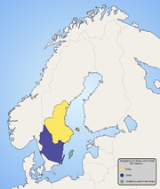
Geat

Encyclopedia
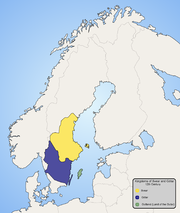
Goths
The Goths were an East Germanic tribe of Scandinavian origin whose two branches, the Visigoths and the Ostrogoths, played an important role in the fall of the Roman Empire and the emergence of Medieval Europe....
) were a North Germanic tribe inhabiting what is now Götaland
Götaland
Götaland , Gothia, Gothland, Gothenland, Gautland or Geatland is one of three lands of Sweden and comprises provinces...
("land of the Geats") in modern Sweden
Sweden
Sweden , officially the Kingdom of Sweden , is a Nordic country on the Scandinavian Peninsula in Northern Europe. Sweden borders with Norway and Finland and is connected to Denmark by a bridge-tunnel across the Öresund....
. The name of the Geats also lives on in the Swedish provinces
Provinces of Sweden
The provinces of Sweden, landskap, are historical, geographical and cultural regions. Sweden has 25 provinces and they have no administrative function, but remain historical legacies and the means of cultural identification....
of Västergötland
Västergötland
', English exonym: West Gothland, is one of the 25 traditional non-administrative provinces of Sweden , situated in the southwest of Sweden. In older English literature one may also encounter the Latinized version Westrogothia....
and Östergötland
Östergötland
Östergötland, English exonym: East Gothland, is one of the traditional provinces of Sweden in the south of Sweden. It borders Småland, Västergötland, Närke, Södermanland, and the Baltic Sea. In older English literature, one might also encounter the Latinized version, Ostrogothia...
, the Western and Eastern lands of the Geats, and in many other toponyms.
Earliest mentioned in history
The earliest mention of the Geats may appear in PtolemyPtolemy
Claudius Ptolemy , was a Roman citizen of Egypt who wrote in Greek. He was a mathematician, astronomer, geographer, astrologer, and poet of a single epigram in the Greek Anthology. He lived in Egypt under Roman rule, and is believed to have been born in the town of Ptolemais Hermiou in the...
(2nd century A.D.), where they are referred to as Goutai. In the 6th century, they were referred to as Gautigoths and Ostrogoths (the Ostrogoths of Scandza
Scandza
Scandza was the name given to Scandinavia by the Roman historian Jordanes in his work Getica, written while in Constantinople around AD 551. He described the area to set the stage for his treatment of the Goths' migration from southern Sweden to Gothiscandza...
) by Jordanes
Jordanes
Jordanes, also written Jordanis or Jornandes, was a 6th century Roman bureaucrat, who turned his hand to history later in life....
and as Gautoi by Procopius
Procopius
Procopius of Caesarea was a prominent Byzantine scholar from Palestine. Accompanying the general Belisarius in the wars of the Emperor Justinian I, he became the principal historian of the 6th century, writing the Wars of Justinian, the Buildings of Justinian and the celebrated Secret History...
. In the Norse Sagas
Sagàs
Sagàs is a small town and municipality located in Catalonia, in the comarca of Berguedà. It is located in the geographical area of the pre-Pyrenees.-Population:...
they are referred to as Gautar, and in Beowulf
Beowulf
Beowulf , but modern scholars agree in naming it after the hero whose life is its subject." of an Old English heroic epic poem consisting of 3182 alliterative long lines, set in Scandinavia, commonly cited as one of the most important works of Anglo-Saxon literature.It survives in a single...
and Widsith
Widsith
Widsith is an Old English poem of 144 lines that appears to date from the 9th century, drawing on earlier oral traditions of Anglo-Saxon tale singing. The only text of the fragment is copied in the Exeter Book, a manuscript of Old English poetry compiled in the late 10th century containing...
as Gēatas. Geats should not be confused with the Thracian
Thracians
The ancient Thracians were a group of Indo-European tribes inhabiting areas including Thrace in Southeastern Europe. They spoke the Thracian language – a scarcely attested branch of the Indo-European language family...
Getae
Getae
The Getae was the name given by the Greeks to several Thracian tribes that occupied the regions south of the Lower Danube, in what is today northern Bulgaria, and north of the Lower Danube, in Romania...
, a connection long made by some, such as the authors of the medieval Swedish Chronicle
Swedish Chronicle
The Swedish Chronicle is a mid-15th century chronicle on a nation called Getae , Goths , Geats and eventually Swedes...
or early-modern Swedish historian Carolus Lundius.
Etymology
The tribal name Geat (from the Proto-Germanic *Gautaz, plural *Gautōz) is related, although not identical, to the etymology of the name tribal Goth (*Gutaniz) and they are both derived (specifically they are two ablautIndo-European ablaut
In linguistics, ablaut is a system of apophony in Proto-Indo-European and its far-reaching consequences in all of the modern Indo-European languages...
grades) from the Proto-Germanic word *geutan, meaning "to pour". This means according to the mainly accepted etymology "men", a heiti
Heiti
A heiti is a synonym used in Old Norse poetry in place of the normal word for something...
of the men in the tribe, see further in Goths (etymology). It could also allude to watercourses in the land where they were living.
A more specific theory about the word Gautigoths is that it means the goths who live near the river Gaut, today's Göta älv
Göta älv
The Göta is a river that drains lake Vänern into the Kattegat at the city of Gothenburg on the western coast of Sweden. It is located in Götaland, with the river itself being a site of early Geatish settlement. The length is 93 km. Often the combination of Göta älv and Klarälven is mentioned...
(Icelandic and early Swedish: Gautelfr). It might also have been a conflation of the word Gauti with a gloss
Gloss
A gloss is a brief notation of the meaning of a word or wording in a text. It may be in the language of the text, or in the reader's language if that is different....
Goths. In the 17th century the name Göta älv, "River of the Geats", was introduced instead of the earlier names Götälven and Gautelfr. The etymology of the word Gaut is as mentioned derived from the Proto-Germanic word *geutan, and the extended meaning of "to pour" is "flow, stream, waterfall" and this could aim at the Trollhättan Falls
Trollhättan Falls
Trollhättan Falls is a waterfall of Göta älv in Sweden. The falls starts at Malgö Bridge in central Trollhättan, and has a total height of 32 meters, making up a large part of the 44 meter total fall of the river from Vänern to Kattegat...
or at the river itself.
The short form of Gautigoths was Old Norse
Old Norse
Old Norse is a North Germanic language that was spoken by inhabitants of Scandinavia and inhabitants of their overseas settlements during the Viking Age, until about 1300....
Gautar and this referred at first and still in some Icelandic sagas to just the inhabitants of Västergötland, or the western parts of today's Götaland.
Early history
Beowulf and the Norse sagaNorse saga
The sagas are stories about ancient Scandinavian and Germanic history, about early Viking voyages, the battles that took place during the voyages, about migration to Iceland and of feuds between Icelandic families...
s name several Geatish kings, but only Hygelac
Hygelac
Hygelac was a king of the Geats according to the poem Beowulf. He was the son of Hrethel and had brothers Herebeald and Hæthcyn. His sister was married to Ecgtheow and had the son Beowulf. Hygelac was married to Hygd and they had the son Heardred, and an unnamed daughter who married Eofor...
finds confirmation in Liber Monstrorum where he is referred to as Rex Getarum and in a copy of Historiae Francorum where he is called Rege Gotorum. These sources concern a raid into Frisia
Frisia
Frisia is a coastal region along the southeastern corner of the North Sea, i.e. the German Bight. Frisia is the traditional homeland of the Frisians, a Germanic people who speak Frisian, a language group closely related to the English language...
, ca 516, which is also described in Beowulf. Some decades after the events related in this epic, Jordanes described the Geats as a nation which was "bold, and quick to engage in war".
Before the consolidation of Sweden
Consolidation of Sweden
The consolidation of Sweden was a long process during which the loosely organized social system consolidated under the power of the king. The actual age of the Swedish kingdom is unknown...
, the Geats were politically independent of the Swedes or Svear, whose old name was Sweonas in Old English. When written sources emerge (approximately at the end of the 10th century), the Geatish lands are described as part of the still very shaky Swedish kingdom, but the manner of their unification with the Swedes is a matter of much debate.
Based on the lack of early medieval sources, and the fact that the Geats were later part of the kingdom of Sweden, traditional accounts assume a forceful incorporation by the Swedes, but the only surviving traditions which deal with Swedish-Geatish wars
Swedish-Geatish wars
The Swedish-Geatish wars refer to semi-legendary 6th century battles between Swedes and Geats that are described in the Anglo-Saxon epic Beowulf...
are of semi-legend
Legend
A legend is a narrative of human actions that are perceived both by teller and listeners to take place within human history and to possess certain qualities that give the tale verisimilitude...
ary nature and found in Beowulf
Beowulf
Beowulf , but modern scholars agree in naming it after the hero whose life is its subject." of an Old English heroic epic poem consisting of 3182 alliterative long lines, set in Scandinavia, commonly cited as one of the most important works of Anglo-Saxon literature.It survives in a single...
. The actual story in Beowulf, however, is that the Geatish king helps a Swede to gain the throne. What historians today think is that this realm could just as well be the force behind the creation of the medieval kingdom of Sweden. The historians make a distinction between political history and the emergence of a common Swedish ethnicity. The, so far more or less imagined, Swedish invasion of Geatish lands has been explained with Geatish involvement in the Gothic wars in southern Europe, which brought a great deal of Roman gold to Götaland, but also naturally depleted their numbers (see Nordisk familjebok
Nordisk familjebok
Nordisk familjebok is a Swedish encyclopedia, published between 1876 and 1957.- History :The first edition was published in 20 volumes between 1876 and 1899. The first edition is known as the "Iðunn edition" because of the picture of Iðunn on the cover...
). The Hervarar saga
Hervarar saga
Hervarar saga ok Heiðreks is a legendary saga from the 13th century combining matter from several older sagas. It is a valuable saga for several different reasons beside its literary qualities. It contains traditions of wars between Goths and Huns, from the 4th century, and the last part is used as...
is believed to contain such traditions handed down from the 4th century. It relates that when the Hunnish Horde
Horde
Horde may refer to:* Ordo * a clan or army of steppe nomads . See Orda * the Blue and White Horde, formed 1226, 1227* the Golden Horde, a Turkic-Mongol state established in the 1240s...
invaded the land of the Goths and the Gothic king Angantyr
Angantyr
Angantyr was the name of three characters from the same line in Norse mythology, and who appear in Hervarar saga, in Gesta Danorum and Faroese ballads....
desperately tried to marshal the defenses, it was the Geatish king Gizur
Gizur
Gizur, Gizurr or Gissur was a King of the Geats. He appears in The Battle of the Goths and Huns, which is included in the Hervarar saga and in editions of the Poetic Edda...
who answered his call. In fact, no explanation is needed, because there is no actual evidence of any successful invasion.
Today, historians believe that the medieval kingdom of Sweden was created as a union to oppose foreign forces, mainly the Danes, where the mainly inland Västergötland was easier to defend and be protected in than in the coastal areas. According to Curt Weibull
Curt Weibull
Curt Weibull was a Swedish historian, educator and author.-Biography:Curt Hugo Johannes Weibull was born in Lund, Sweden. He was a member of the noted Swedish Weibull family. He was the son of history professor Martin Weibull and the brother of Lauritz Weibull, Alexander Weibull, Julius Oscar...
, the Geats would have been finally integrated in the Swedish kingdom c. 1000, but according to others, it most likely took place before the 9th century, and probably as early as the 6th century. The fact that some sources are silent about the Geats indicates that any independent Geatish kingdom no longer existed in the 9th century. In Rimbert
Rimbert
Saint Rimbert was archbishop of Bremen-Hamburg from 865 until his death.A monk in Turholt , he shared a missionary trip to Scandinavia with his friend Ansgar, whom he later succeeded as archbishop in Hamburg-Bremen in 865...
's account of Ansgar
Ansgar
Saint Ansgar, Anskar or Oscar, was an Archbishop of Hamburg-Bremen. The see of Hamburg was designated a "Mission to bring Christianity to the North", and Ansgar became known as the "Apostle of the North".-Life:After his mother’s early death Ansgar was brought up in Corbie Abbey, and made rapid...
's missionary work, the Swedish king is the sole sovereign in the region and he has close connections not only with the king of the Danes
Daner
The Danes were a North Germanic tribe residing in modern day Denmark. They are mentioned in the 6th century in Jordanes' Getica, by Procopius, and by Gregory of Tours....
but also with the king of the Franks
Franks
The Franks were a confederation of Germanic tribes first attested in the third century AD as living north and east of the Lower Rhine River. From the third to fifth centuries some Franks raided Roman territory while other Franks joined the Roman troops in Gaul. Only the Salian Franks formed a...
. However, the oldest medieval Swedish sources present the Swedish kingdom as having remaining legal differences between Swedes and Geats for example in weights and measurements in miles, marks etc. They also tell us that there were kings, ruling by the title of Rex Gothorum as late as in the 12th century, and that one of those kings went on to become king of a united realm. Furthermore, that some sources do not mention Geatish kings in the 9th century, is not so very interesting. It is quite possible that kings were not part of the Geatish political system at the time.
Viking Age
In the HeimskringlaHeimskringla
Heimskringla is the best known of the Old Norse kings' sagas. It was written in Old Norse in Iceland by the poet and historian Snorri Sturluson ca. 1230...
, Snorri Sturluson
Snorri Sturluson
Snorri Sturluson was an Icelandic historian, poet, and politician. He was twice elected lawspeaker at the Icelandic parliament, the Althing...
writes about several battles between Norwegians
Norwegians
Norwegians constitute both a nation and an ethnic group native to Norway. They share a common culture and speak the Norwegian language. Norwegian people and their descendants are found in migrant communities worldwide, notably in United States, Canada and Brazil.-History:Towards the end of the 3rd...
and Geats. He wrote that in the 9th century, there were battles between the Geats and the Norwegian king Harald Fairhair, during Harald Fairhair's campaign in Götaland
Harald Fairhair's campaign in Götaland
Harald Fairhair's campaign in Götaland was an attack that took place in the 870's.Snorri Sturluson writes in Harald Fairhair's saga that Harald Fairhair disputed the Swedish king Eric Eymundsson's hegemony in what is today southern Norway....
, a war the Geats had to fight without the assistance of the Swedish king Erik Emundsson. He also wrote about Haakon I of Norway
Haakon I of Norway
Haakon I , , given the byname the Good, was the third king of Norway and the youngest son of Harald Fairhair and Thora Mosterstang.-Early life:...
's expedition into Götaland and Harold I of Denmark's battle against Jarl Ottar
Jarl Ottar
Jarl Ottar or Ottar Jarl was a jarl of Götaland who appears in the Heimskringla and in the Jomsvikinga Saga....
of Östergötland
Östergötland
Östergötland, English exonym: East Gothland, is one of the traditional provinces of Sweden in the south of Sweden. It borders Småland, Västergötland, Närke, Södermanland, and the Baltic Sea. In older English literature, one might also encounter the Latinized version, Ostrogothia...
, and about Olaf the Holy's battles with the Geats during his war with Olof Skötkonung.
Middle Ages
The Geats were traditionally divided into several petty kingdomPetty kingdom
A petty kingdom is one of a number of small kingdoms, described as minor or "petty" by contrast to an empire or unified kingdom that either preceded or succeeded it...
s, or districts, which had their own thing
Thing (assembly)
A thing was the governing assembly in Germanic and introduced into some Celtic societies, made up of the free people of the community and presided by lawspeakers, meeting in a place called a thingstead...
s (popular assemblies) and laws. The largest one of these districts was Västergötland
Västergötland
', English exonym: West Gothland, is one of the 25 traditional non-administrative provinces of Sweden , situated in the southwest of Sweden. In older English literature one may also encounter the Latinized version Westrogothia....
(West Geatland), and it was in Västergötland that the Thing of all Geats
Thing of all Geats
The Thing of all Geats was the thing which was held from pre-historic times to the Middle Ages in Skara, Västergötland. Although its name suggests that it comprised all Geats, it concerned those living in Västergötland and Dalsland, and it is described in the Westrogothic law...
was held every year, in the vicinity of Skara
Skara
Skara is a locality and the seat of Skara Municipality, Västra Götaland County, Sweden with 18595 inhabitants in 2005. Despite its small size, it has a long educational and ecclesiastical history. One of Sweden's oldest high schools, Katedralskolan , is situated in Skara...
.
Unlike the Swedes, who used the division hundare
Hundred (division)
A hundred is a geographic division formerly used in England, Wales, Denmark, South Australia, some parts of the United States, Germany , Sweden, Finland and Norway, which historically was used to divide a larger region into smaller administrative divisions...
, the Geats used hærrad, like the Norwegians and the Danes. Surprisingly, it would be the Geatish name that became the common term in the Swedish kingdom. This is possibly related to the fact that several of the medieval Swedish kings were of Geatish extraction and often resided primarily in Götaland.
In the 11th century, the Swedish House of Munsö
House of Munsö
The House of Munsö is one of the names of a protohistoric Swedish dynasty. Its early members of the 8th or 9th century are legendary or semi-legendary, while its later scions of the 10th to 11th centuries are historical....
became extinct with the death of Emund the Old. Stenkil, a Geat, was elected king of Sweden, and the Geats would be influential in the shaping of Sweden as a Christian
Christian
A Christian is a person who adheres to Christianity, an Abrahamic, monotheistic religion based on the life and teachings of Jesus of Nazareth as recorded in the Canonical gospels and the letters of the New Testament...
kingdom. However, this election also ushered in a long period of civil unrest between Christians and pagans and between Geats and Swedes. The Geats tended to be more Christian, and the Swedes more pagan, which was why the Christian Swedish king Inge the Elder
Inge I of Sweden
Inge the Elder was a King of Sweden.-Biography:Inge was the son of the former King Stenkil and a Swedish princess. Inge shared the rule of the kingdom with his probably elder brother Halsten Stenkilsson, but little is known with certainty of Inge's reign...
fled to Västergötland
Västergötland
', English exonym: West Gothland, is one of the 25 traditional non-administrative provinces of Sweden , situated in the southwest of Sweden. In older English literature one may also encounter the Latinized version Westrogothia....
when deposed in favour of Blot-Sweyn
Blot-Sweyn
Sweyn was a Swedish king c. 1080, who replaced his Christian brother-in-law Inge as King of Sweden, when Inge had refused to administer the blóts at the Temple at Uppsala. There is no mention of Sweyn in the regnal list of the Westrogothic law, which suggests that his rule did not reach...
, a king more favourable towards Norse paganism
Norse paganism
Norse paganism is the religious traditions of the Norsemen, a Germanic people living in the Nordic countries. Norse paganism is therefore a subset of Germanic paganism, which was practiced in the lands inhabited by the Germanic tribes across most of Northern and Central Europe in the Viking Age...
, in the 1080s. Inge would retake the throne and rule until his death c. 1100.

Gesta Danorum
Gesta Danorum is a patriotic work of Danish history, by the 12th century author Saxo Grammaticus . It is the most ambitious literary undertaking of medieval Denmark and is an essential source for the nation's early history...
(book 13), the Danish 12th century chronicler Saxo Grammaticus
Saxo Grammaticus
Saxo Grammaticus also known as Saxo cognomine Longus was a Danish historian, thought to have been a secular clerk or secretary to Absalon, Archbishop of Lund, foremost advisor to Valdemar I of Denmark. He is the author of the first full history of Denmark.- Life :The Jutland Chronicle gives...
noted that the Geats had no say in the election of the king, only the Swedes, but Saxo did not know how kings were chosen in Sweden around 1120. When in the 13th century, the West Geatish law or Westrogothic law was put to paper, it reminded the Geats that they had to accept the election of the Swedes: Sveær egho konong at taka ok sva vrækæ meaning "It is the Swedes who have the right of choosing ["taking"] and also deposing the king" and then he rode Eriksgata
Eriksgata
Eriksgata is the name of the traditional journey of the newly elected medieval Swedish kings through the important provinces to have their election confirmed by the local assemblies...
n "mæÞ gislum ofvan" – "with hostages from above [the realm]" through Södermanland
Södermanland
', sometimes referred to under its Latin form Sudermannia or Sudermania, is a historical province or landskap on the south eastern coast of Sweden. It borders Östergötland, Närke, Västmanland and Uppland. It is also bounded by lake Mälaren and the Baltic sea.In Swedish, the province name is...
, the Geatish provinces and then through Närke
Närke
' is a Swedish traditional province, or landskap, situated in Svealand in south central Sweden. It is bordered by Västmanland to the north, Södermanland to the east, Östergötland to the southeast, Västergötland to the southwest, and Värmland to the northwest...
and Västmanland
Västmanland
' is a historical Swedish province, or landskap, in middle Sweden. It borders Södermanland, Närke, Värmland, Dalarna and Uppland.The name comes from "West men", referring to the people west of Uppland, the core province of early Sweden.- Administration :...
to be judged to be the lawful king by the lawspeaker
Lawspeaker
A lawspeaker is a unique Scandinavian legal office. It has its basis in a common Germanic oral tradition, where wise men were asked to recite the law, but it was only in Scandinavia that the function evolved into an office...
s of their respective things. The king was "taken" by the first thing possibly similar to the customs in early medieval Norway where the king was chosen by acclamation (see about this custom called konungstekja ("choosing king") and also the section Coronation, in the article Monarchy of Norway). The way to become king in Sweden could however also be to defeat opponents in battle and not only to be elected by the formal procedure.
One of these Swedish kings was Ragnvald Knaphövde
Ragnvald Knaphövde
Ragnvald Knaphövde was a King of Sweden whose reign is estimated to the mid-1120s or c. 1130. His cognomen Knaphövde is explained as referring to a drinking vessel, the size of a man's head or meaning "round head" and referring to his being foolish...
, who in 1125 was riding with his retinue in order to be accepted as king by the Geats of Västergötland
Västergötland
', English exonym: West Gothland, is one of the 25 traditional non-administrative provinces of Sweden , situated in the southwest of Sweden. In older English literature one may also encounter the Latinized version Westrogothia....
. As he despised the Geats, he decided not to demand hostages from their prominent clans
Norse clans
The Scandinavian clan or ætt was a social group based on common descent or on the formal acceptance into the group at a þing.-History:...
. He was slain near Falköping
Falköping
Falköping is a locality and the seat of Falköping Municipality, Västra Götaland County, Sweden. It had 15,821 inhabitants in 2005.-History:The city of Falköping most likely emerged during the 15th century but earlier the town was an important site of pilgrimage due to its 12th century church...
.
In a new general law of Sweden that was issued by Magnus Eriksson
Magnus Eriksson
Magnus Eriksson may refer to:* Magnus Eriksson * Magnus IV of Sweden...
in the 1350s, it was stated that twelve men from each province, chosen by their things, should be present at the Stone of Mora when a new king was elected.
The distinction between Swedes and Geats lasted during the Middle Ages, but the Geats became increasingly important for Swedish national claims of greatness due to the Geats' old connection with the Goths. They argued that since the Goths and the Geats were the same nation, and the Geats were part of the kingdom of Sweden, this meant that the Swedes had defeated the Roman empire. The earliest attestation of this claim comes from the Council of Basel, 1434, during which the Swedish delegation argued with the Spanish about who among them were the true Goths. The Spaniards argued that it was better to be descended from the heroic Visigoths than from stay-at-homers. This cultural movement, which was not restricted to Sweden went by the name Gothicismus
Gothicismus
Gothicismus, Gothism, or Gothicism is the name given to what is considered to have been a cultural movement in Sweden, centered around the belief in the glory of the Swedish ancestors, originally considered to be the Geats, which were identified with the Goths. The founders of the movement were...
or in Swedish Göticism, i.e. Geaticism, as Geat and Goth were considered synonymous back then.
Modern times
After the 15th century and the Kalmar UnionKalmar Union
The Kalmar Union is a historiographical term meaning a series of personal unions that united the three kingdoms of Denmark, Norway , and Sweden under a single monarch, though intermittently and with a population...
, the Swedes and the Geats appear to have begun to perceive themselves as one nation, which is reflected in the evolution of svensk into a common ethnonym. It was originally an adjective referring to those belonging to the Swedish tribe, who are called svear in Swedish. As early as the 9th century, svear had been vague, both referring to the Swedish tribe and being a collective term including the Geats, and this is the case in Adam of Bremen
Adam of Bremen
Adam of Bremen was a German medieval chronicler. He lived and worked in the second half of the eleventh century. He is most famous for his chronicle Gesta Hammaburgensis Ecclesiae Pontificum .-Background:Little is known of his life other than hints from his own chronicles...
's work where the Geats (Goths) appear both as a proper nation and as part of the Sueones. The merging/assimilation of the two nations took a long time, however. In the early 20th century, Nordisk familjebok
Nordisk familjebok
Nordisk familjebok is a Swedish encyclopedia, published between 1876 and 1957.- History :The first edition was published in 20 volumes between 1876 and 1899. The first edition is known as the "Iðunn edition" because of the picture of Iðunn on the cover...
noted that svensk had almost replaced svear as a name for the Swedish people.
Today, the merger of the two nations is complete, as there is no longer any tangible identification in Götaland
Götaland
Götaland , Gothia, Gothland, Gothenland, Gautland or Geatland is one of three lands of Sweden and comprises provinces...
with a Geatish identity, apart from the common tendency of people living in those areas to refer to themselves as västgötar (West Geats) and östgötar (East Geats), that is to say, residents of the provinces
Provinces of Sweden
The provinces of Sweden, landskap, are historical, geographical and cultural regions. Sweden has 25 provinces and they have no administrative function, but remain historical legacies and the means of cultural identification....
of Västergötland
Västergötland
', English exonym: West Gothland, is one of the 25 traditional non-administrative provinces of Sweden , situated in the southwest of Sweden. In older English literature one may also encounter the Latinized version Westrogothia....
and Östergötland
Östergötland
Östergötland, English exonym: East Gothland, is one of the traditional provinces of Sweden in the south of Sweden. It borders Småland, Västergötland, Närke, Södermanland, and the Baltic Sea. In older English literature, one might also encounter the Latinized version, Ostrogothia...
. The city Göteborg, known in English as Gothenburg
Gothenburg
Gothenburg is the second-largest city in Sweden and the fifth-largest in the Nordic countries. Situated on the west coast of Sweden, the city proper has a population of 519,399, with 549,839 in the urban area and total of 937,015 inhabitants in the metropolitan area...
, was named after the Geats (Geatsburg or fortress of the Geats), when it was founded in 1621.
Until 1973 the official title of the Swedish king was King of Sweden (earlier: of the Swedes), the Geats/Goths and the Wends
Wends
Wends is a historic name for West Slavs living near Germanic settlement areas. It does not refer to a homogeneous people, but to various peoples, tribes or groups depending on where and when it is used...
(with the formula "Sveriges, Götes och Vendes konung"). The title "King of the Wends" was copied from the Danish title, while the Danish kings called themselves "King of the Gotlanders" (which, like "Geats", was translated into "Goths" in latin) were also used by Danish royalty. The Wends is a term normally used to describe the Slavic peoples who inhabited large areas of modern east Germany and Pomerania. See further in the Wikipedia articles King of the Goths
King of the Goths
The title of King of the Goths was for many centuries borne by both the Kings of Sweden and the Kings of Denmark, denoting sovereignty or claimed sovereignty over the antique people of the Goths....
and King of the Wends
King of the Wends
The title of King of the Wends denoted sovereignty or claims over once-Slavic lands of southern coasts of the Baltic Sea, those otherwise called Mecklenburg, Holstein and Pomerania, and was used from 12th century to 1972 by Kings of Denmark and from ca 1540 to 1973 by the Kings of Sweden.The...
.
The titles, however, changed when the new king Carl XVI Gustaf in 1973 decided that his royal title should simply be King of Sweden. The disappearance of the old title was a decision made entirely by the king. The old title in Latin was "N.N. Dei Gratia, Suecorum, Gothorum et Vandalorum Rex."
Goths
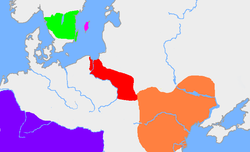
It is a long-standing controversy whether the Goths
Goths
The Goths were an East Germanic tribe of Scandinavian origin whose two branches, the Visigoths and the Ostrogoths, played an important role in the fall of the Roman Empire and the emergence of Medieval Europe....
were Geats. Both Old Icelandic and Old English literary sources clearly separate the Geats on one hand (Isl. Gautar, OEng Geatas) from the Goths/Gutar (Isl. Gotar, OEng. Gotenas); on the other, however, the Gothic historian Jordanes
Jordanes
Jordanes, also written Jordanis or Jornandes, was a 6th century Roman bureaucrat, who turned his hand to history later in life....
wrote that the Goths
Goths
The Goths were an East Germanic tribe of Scandinavian origin whose two branches, the Visigoths and the Ostrogoths, played an important role in the fall of the Roman Empire and the emergence of Medieval Europe....
came from the island of Scandza
Scandza
Scandza was the name given to Scandinavia by the Roman historian Jordanes in his work Getica, written while in Constantinople around AD 551. He described the area to set the stage for his treatment of the Goths' migration from southern Sweden to Gothiscandza...
. Moreover, he described that on this island there were three tribes called the Gautigoths (cf. Geat/Gaut), the Ostrogoths (cf. the Swedish province of Östergötland
Östergötland
Östergötland, English exonym: East Gothland, is one of the traditional provinces of Sweden in the south of Sweden. It borders Småland, Västergötland, Närke, Södermanland, and the Baltic Sea. In older English literature, one might also encounter the Latinized version, Ostrogothia...
) and Vagoths (Gutar?) - this implies that the Geats were Goths rather than vice versa. The word Goth is also a term used by the Romans to describe related, culturally linked tribes like the Tervingi and the Greuthungs, so it may be correct to label Geats as Goths.
Scandinavian burial customs, such as the stone circles
Stone circle (Iron Age)
The stone circles of the Iron Age were a characteristic burial custom of southern Scandinavia, especially on Gotland and in Götaland during the Pre-Roman Iron Age and the Roman Iron Age. In Sweden, they are called Domarringar , Domkretsar or Domarsäten...
(domarringar), which are most common in Götaland
Götaland
Götaland , Gothia, Gothland, Gothenland, Gautland or Geatland is one of three lands of Sweden and comprises provinces...
and Gotland
Gotland
Gotland is a county, province, municipality and diocese of Sweden; it is Sweden's largest island and the largest island in the Baltic Sea. At 3,140 square kilometers in area, the region makes up less than one percent of Sweden's total land area...
, and stelae (bautastenar) appeared in what is now northern Poland in the 1st century AD, suggesting an influx of Scandinavians during the formation of the Gothic Wielbark culture. Moreover, in Östergötland
Östergötland
Östergötland, English exonym: East Gothland, is one of the traditional provinces of Sweden in the south of Sweden. It borders Småland, Västergötland, Närke, Södermanland, and the Baltic Sea. In older English literature, one might also encounter the Latinized version, Ostrogothia...
, in Sweden, there is a sudden disappearance of villages during this period.
Jutish hypothesis
There is a hypothesis that the JutesJutes
The Jutes, Iuti, or Iutæ were a Germanic people who, according to Bede, were one of the three most powerful Germanic peoples of their time, the other two being the Saxons and the Angles...
also were Geats, and which was proposed by Pontus Fahlbeck in 1884. According to this hypothesis the Geats would have not only resided in southern Sweden but also in Jutland
Jutland
Jutland , historically also called Cimbria, is the name of the peninsula that juts out in Northern Europe toward the rest of Scandinavia, forming the mainland part of Denmark. It has the North Sea to its west, Kattegat and Skagerrak to its north, the Baltic Sea to its east, and the Danish–German...
, where Beowulf
Beowulf
Beowulf , but modern scholars agree in naming it after the hero whose life is its subject." of an Old English heroic epic poem consisting of 3182 alliterative long lines, set in Scandinavia, commonly cited as one of the most important works of Anglo-Saxon literature.It survives in a single...
would have lived.
The generally accepted identification of Old English Gēatas as the same ethnonym as Swedish götar and Old Norse gautar is based on the observation that the ö monophthong of modern Swedish and the au diphthong of Old Norse
Old Norse
Old Norse is a North Germanic language that was spoken by inhabitants of Scandinavia and inhabitants of their overseas settlements during the Viking Age, until about 1300....
correspond to the ēa diphthong of Old English
Old English language
Old English or Anglo-Saxon is an early form of the English language that was spoken and written by the Anglo-Saxons and their descendants in parts of what are now England and southeastern Scotland between at least the mid-5th century and the mid-12th century...
.
| Old Norse Old Norse Old Norse is a North Germanic language that was spoken by inhabitants of Scandinavia and inhabitants of their overseas settlements during the Viking Age, until about 1300.... |
Swedish Swedish language Swedish is a North Germanic language, spoken by approximately 10 million people, predominantly in Sweden and parts of Finland, especially along its coast and on the Åland islands. It is largely mutually intelligible with Norwegian and Danish... |
Old English Old English language Old English or Anglo-Saxon is an early form of the English language that was spoken and written by the Anglo-Saxons and their descendants in parts of what are now England and southeastern Scotland between at least the mid-5th century and the mid-12th century... |
brauð laukr lauf austr draumr dauðr rauðr |
bröd lök löv öst dröm död röd |
brēad lēac (onion, cf. leek) lēaf ēast drēam dēað rēad (red) |
etc.
Thus, Gēatas is the Old English
Old English language
Old English or Anglo-Saxon is an early form of the English language that was spoken and written by the Anglo-Saxons and their descendants in parts of what are now England and southeastern Scotland between at least the mid-5th century and the mid-12th century...
form of Old Norse
Old Norse
Old Norse is a North Germanic language that was spoken by inhabitants of Scandinavia and inhabitants of their overseas settlements during the Viking Age, until about 1300....
Gautar and modern Swedish Götar. This correspondence seems to tip the balance for most scholars. It is also based on the fact that in Beowulf
Beowulf
Beowulf , but modern scholars agree in naming it after the hero whose life is its subject." of an Old English heroic epic poem consisting of 3182 alliterative long lines, set in Scandinavia, commonly cited as one of the most important works of Anglo-Saxon literature.It survives in a single...
, the Gēatas live east of the Dene
Daner
The Danes were a North Germanic tribe residing in modern day Denmark. They are mentioned in the 6th century in Jordanes' Getica, by Procopius, and by Gregory of Tours....
(across the sea) and in close contact with the Sweon, which fits the historical position of the Geats between the Danes and the Swedes. Moreover, the story of Beowulf, who leaves Geatland and arrives at the Danish
Daner
The Danes were a North Germanic tribe residing in modern day Denmark. They are mentioned in the 6th century in Jordanes' Getica, by Procopius, and by Gregory of Tours....
court after a naval voyage, where he kills a beast, finds a parallel in Hrólf Kraki's saga
Hrolf Kraki's Saga
Hrolf Kraki's Saga is a fantasy novel by Poul Anderson. It was first published by Ballantine Books as the sixty-second volume of the celebrated Ballantine Adult Fantasy series in October, 1973, and has been reprinted a number of times since...
. In this saga, Bödvar Bjarki
Bödvar Bjarki
Bödvar Bjarki , meaning 'Warlike Little-Bear', is the hero appearing in tales of Hrólf Kraki in the Saga of Hrólf Kraki, in the Latin epitome to the lost Skjöldunga saga, and as Biarco in Saxo Grammaticus' Gesta Danorum...
leaves Gautland and arrives at the Danish
Daner
The Danes were a North Germanic tribe residing in modern day Denmark. They are mentioned in the 6th century in Jordanes' Getica, by Procopius, and by Gregory of Tours....
court after a naval voyage and kills a beast that has been terrorizing the Danes for two years (see also Origins for Beowulf and Hrólf Kraki
Origins for Beowulf and Hrólf Kraki
Beowulf and Hrólf Kraki are two well-known characters in the myths and sagas of ancient England and Scandinavia respectively.Both are supposed to have lived sometime around 450–550 AD, and much has been discussed over the years regarding their origins....
).
The Geats and the Jutes are mentioned in Beowulf as different tribes, and whereas the Geats are called gēatas, the Jutes are called ēotena (genitive) or ēotenum (dative). Moreover, the Old English poem Widsith
Widsith
Widsith is an Old English poem of 144 lines that appears to date from the 9th century, drawing on earlier oral traditions of Anglo-Saxon tale singing. The only text of the fragment is copied in the Exeter Book, a manuscript of Old English poetry compiled in the late 10th century containing...
also mentions both Geats and Jutes, and it calls the latter ȳtum. However, Fahlbeck proposed in 1884 that the Gēatas of Beowulf referred to Jutes and he proposed that the Jutes originally also were Geats like those of southern Sweden. This theory was based on an Old English translation of Venerable Bede's Ecclesiastical History of the English People attributed to Alfred the Great
Alfred the Great
Alfred the Great was King of Wessex from 871 to 899.Alfred is noted for his defence of the Anglo-Saxon kingdoms of southern England against the Vikings, becoming the only English monarch still to be accorded the epithet "the Great". Alfred was the first King of the West Saxons to style himself...
where the Jutes (iutarum, iutis) once are rendered as gēata (genitive) and twice as gēatum (dative) (see e.g. the OED
Oxford English Dictionary
The Oxford English Dictionary , published by the Oxford University Press, is the self-styled premier dictionary of the English language. Two fully bound print editions of the OED have been published under its current name, in 1928 and 1989. The first edition was published in twelve volumes , and...
which identifies the Geats through Eotas, Iótas, Iútan and Geátas). Fahlbeck did not, however, propose an etymology for how the two ethnonyms could be related.
Fahlbeck's theory was refuted by Schück who in 1907 noted that another Old English source, the Anglo-Saxon Chronicle
Anglo-Saxon Chronicle
The Anglo-Saxon Chronicle is a collection of annals in Old English chronicling the history of the Anglo-Saxons. The original manuscript of the Chronicle was created late in the 9th century, probably in Wessex, during the reign of Alfred the Great...
, called the Jutes īutna, īotum or īutum. Moreoever, Schück pointed out that when Alfred the Great's translation mentions the Jutes for the second time (book IV, ch. 14(16)) it calls them ēota and in one manuscript ȳtena. Björkman proposed in 1908 that Alfred the Great's translation of Jutes as Geats was based on a confusion between the West Saxon form Geotas ("Jutes") and Gēatas ("Geats").
As for the origins of the ethnonym Jute, it may be a secondary formation of the toponym Jutland
Jutland
Jutland , historically also called Cimbria, is the name of the peninsula that juts out in Northern Europe toward the rest of Scandinavia, forming the mainland part of Denmark. It has the North Sea to its west, Kattegat and Skagerrak to its north, the Baltic Sea to its east, and the Danish–German...
, where jut is derived from a Proto-Indo-European
Proto-Indo-European language
The Proto-Indo-European language is the reconstructed common ancestor of the Indo-European languages, spoken by the Proto-Indo-Europeans...
root *eud meaning "water".
Gutnish hypothesis
Since the 19th century, there has also been a suggestion that Beowulf's people were Gutes (from the island of GotlandGotland
Gotland is a county, province, municipality and diocese of Sweden; it is Sweden's largest island and the largest island in the Baltic Sea. At 3,140 square kilometers in area, the region makes up less than one percent of Sweden's total land area...
in Sweden
Sweden
Sweden , officially the Kingdom of Sweden , is a Nordic country on the Scandinavian Peninsula in Northern Europe. Sweden borders with Norway and Finland and is connected to Denmark by a bridge-tunnel across the Öresund....
). According to the poem, the weather-geats or sea-geats, as they are called are supposed to have lived east of the Danes and be separated from the Swedes by wide waters. Some researchers have found it a little far-fetched that wide waters relates to Lake Vänern in Västergötland
Västergötland
', English exonym: West Gothland, is one of the 25 traditional non-administrative provinces of Sweden , situated in the southwest of Sweden. In older English literature one may also encounter the Latinized version Westrogothia....
or Mälaren
Mälaren
Lake Mälaren is the third-largest lake in Sweden, after Lakes Vänern and Vättern. Its area is 1,140 km² and its greatest depth is 64 m. Mälaren spans 120 kilometers from east to west...
. The weather in weather-geats, and sea-geats marks a people living at a windy, stormy coast by the sea. The Geats of Västergötland
Västergötland
', English exonym: West Gothland, is one of the 25 traditional non-administrative provinces of Sweden , situated in the southwest of Sweden. In older English literature one may also encounter the Latinized version Westrogothia....
was historically an inland people, making an epithet such as weather- or sea- a little strange. Moreover, when Beowulf dies he is buried in a mound at a place called Hrones-naesse, meaning "the cape of whales". Whales have for obvious reasons never lived in Vänern, where, according to Birger Nerman
Birger Nerman
Birger Nerman was a Swedish archaeologist, professor, and author.-Background:Birger Nerman belonged to a bourgeois family Nerman from Vimmerby. He was the son of Janne Nerman , the bookseller in Norrköping, and his wife Anna Ida Nordberg...
, Beowulf is buried. However, an expanse of water separates the island of Gotland
Gotland
Gotland is a county, province, municipality and diocese of Sweden; it is Sweden's largest island and the largest island in the Baltic Sea. At 3,140 square kilometers in area, the region makes up less than one percent of Sweden's total land area...
from the Swedes. The island lies east of Denmark and whales were once common in the Baltic Sea where Gotland is situated. The name of the Gutes in Swedish, Gutar, is an ablaut-grade of the same name as that of the Geats in Beowulf. These facts made the archaeologist Gad Rausing
Gad Rausing
Dr. Gad Rausing was a notable Swedish industrialist and archaeologist. Together with his brother Hans he co-inherited Swedish packaging company Tetra Pak , founded by their father Ruben Rausing and currently the largest food packaging company in the world...
come to the conclusion that the weather-Geats may have been Gutes. This was supported by another Swedish archaeologist Bo Gräslund. According to Rausing, Beowulf may be buried in a place called Rone on Gotland, a name corresponding to the Hrones in Hrones-naesse. Not far from there lies a place called Arnkull corresponding to the Earnar-naesse in Beowulf, which according to the poem was situated closely to Hrones-naesse.
This theory does not exclude the ancient population of Västergötland and Östergötland from being Geats, but rather holds that the Anglo-Saxon name Geat could refer to West-geats (Västergötland), East-geats (Östergötland) as well as weather-geats (Gotland), in accordance with Jordanes account of the Scandinanian tribes Gautigoth, Ostrogoth and Vagoth.
See also
- BlendaBlendaBlenda is the heroine of a Swedish legend from Småland. Blenda led the rural women of Värend in an attack on a pillaging Danish army and annihilated the invaders.-Legend:...
- Geatish SocietyGeatish SocietyThe Geatish Society, or Gothic League was created by a number of Swedish poets and authors in 1811, as a social club for literary studies among academics in Sweden with a view to raising the moral tone of society through contemplating Scandinavian antiquity...
- GötaGötaGöta is a Swedish female name. The name is the female form of Göte, and it was a popular name during the first half of the 20th century.See also: Götaland, Göta älv, Götar, Svea...
- GötavirkeGötavirkeGötavirke are the remains of two parallel defensive walls going from north to south between the villages of Västra Husby and Hylinge in Östergötland, Sweden. The walls cover the distance between the lakes Asplången and Lillsjön . North of Asplången there are remains of several ancient hill...
(Geatish Dyke) - Gutes
- Trial by combatTrial by combatTrial by combat was a method of Germanic law to settle accusations in the absence of witnesses or a confession, in which two parties in dispute fought in single combat; the winner of the fight was proclaimed to be right. In essence, it is a judicially sanctioned duel...
- Trial by ordealTrial by ordealTrial by ordeal is a judicial practice by which the guilt or innocence of the accused is determined by subjecting them to an unpleasant, usually dangerous experience...
- Varangian
- VikingVikingThe term Viking is customarily used to refer to the Norse explorers, warriors, merchants, and pirates who raided, traded, explored and settled in wide areas of Europe, Asia and the North Atlantic islands from the late 8th to the mid-11th century.These Norsemen used their famed longships to...