

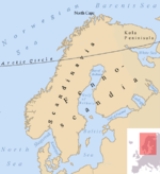
Scandinavian Peninsula

Encyclopedia
The Scandinavian Peninsula is a peninsula
in Northern Europe
, which today covers Norway
, Sweden
, and most of northern Finland
. Prior to the 17th and 18th centuries, large parts of the southern peninsula—including the core region of Scania
from which the peninsula takes its name—were part of Denmark
.
The name of the peninsula is derived from the term Scandinavia
, the cultural region of Denmark, Norway, and Sweden. That cultural name is in turn derived from the name of Scania, the region at the southern extremity of the peninsula that was formerly part of Denmark, that is the ancestral home of the Danes
, and that is now part of Sweden. The derived term "Scandinavian" also refers to the North Germanic peoples who speak Scandinavian languages, considered to be a dialect continuum
derived from Old Norse
. These languages are Danish
, Swedish
, Norwegian
, Faroese
, and Icelandic
, with the latter two being closest to Old Norse.
The Scandinavian Peninsula can be said to be the largest peninsula of Europe, a continent that is itself a large peninsula of Eurasia
. However, Europe contains several large peninsulas, including the Balkan Peninsula, Greece, Italy and the Iberian Peninsula
; during the Ice Ages, Great Britain and Ireland were another single peninsula extending from the body of the continent. Hence, the question of which is the largest peninsula in Europe is a debatable one, depending on arbitrary human definitions of where the peninsulas begin - and on which century one chooses to consider: sometimes, Scandinavia as a peninsula has not existed. During the Ice Ages, the sea level of the Atlantic Ocean dropped so much that the Baltic Sea
, the Gulf of Bothnia
, and the Gulf of Finland
disappeared, and the countries now surrounding them, including Germany, Poland, the other Baltic countries and Scandinavia, were directly joined by land.
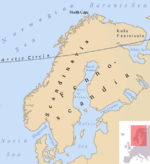 Arguably the largest peninsula in Europe, the Scandinavian Peninsula is approximately 1850 kilometres (1,149.5 mi) long with a width varying approximately from 370 to 805 kilometers (230 to 500 miles). The Scandinavian mountain range generally defines the border between Norway and Sweden. The peninsula is bordered by several bodies of water including:
Its highest elevation was Glittertinden in Norway at 2,470 m (8,104 ft) above sea level, but since the glacier at its summit partially melted , the highest elevation is at 2,469 m (8,101 ft) at Galdhøpiggen
, also in Norway. These mountains also have the largest glacier
on the mainland of Europe, Jostedalsbreen
.
About one quarter of the Scandinavian Peninsula lies north of the Arctic Circle
, its northernmost point being at Cape Nordkyn (North Cape), near the town of Hammerfest, Norway
.
The climate across Scandinavia varies from tundra (Köppen
: ET) and subarctic (Dfc) in the north, with cool marine west coast climate (Cfc) in northwestern coastal areas reaching just north of Lofoten
, to humid continental (Dfb) in the central portion, and marine west coast (Cfb) in the south and southwest.
The region is rich in timber, iron and copper with the best farmland in southern Sweden. Large petroleum and natural-gas deposits have been found off Norway's coast in the North Sea and the Atlantic Ocean.
Much of the population of the Scandinavian Peninsula is naturally concentrated in its southern part, which is also its agricultural region. The largest cities of the peninsula are Stockholm
and Gothenburg
, Sweden, and Oslo
and Bergen
, Norway .
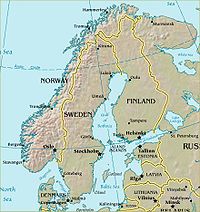 The Scandinavian Peninsula occupies part of the Baltic Shield
, a stable and large crust segment formed of very old, crystalline metamorphic rock
s. Most of the soil covering this substrate was scraped by glaciers during the Ice Age
s of antiquity, especially in northern Scandinavia, where the Baltic Shield is closest to the surface of the land. As a consequence of this scouring, the elevation
of the land, and the cool-to-cold climate
, a relatively small percentage of its land is arable
.
The glaciation during the Ice Ages also deepened many of the river valleys, which were invaded by the sea when the ice melted, creating the noteworthy fjords of Norway. In the southern part of the peninsula, the glaciers deposited vast numbers of terminal moraine
s, configuring a very chaotic landscape. These terminal moraines covered all of what is now Denmark.
Although the Baltic Shield is mostly geologically
stable and hence resistant to the influences of other neighboring tectonic formations, the weight of nearly four kilometers of ice during the Ice Ages caused all of the Scandinavian terrain to sink. When the ice sheet disappeared, the shield rose again, a tendency that continues to this day at a rate of about one meter per century. Conversely, the southern part has tended to sink to compensate, causing flooding of the Low Countries
and Denmark.
The crystalline substrate of the land and absence of soil in many places have exposed mineral deposits of metal ore
s, such as those of iron
, copper
, nickel
, zinc
, silver
, and gold
. The very most valuable of these have been the deposits of iron ore in northwestern Sweden. In the 19th century these deposits prompted the building of a railroad from northwestern Sweden to the Norwegian seaport of Narvik
so that the iron ore could be exported by ship to places like southern Sweden, Germany, Great Britain, and Belgium for smelting into iron and steel
. This railroad is in a region of Norway and Sweden that otherwise do not have any railroads because of the very rugged terrain, mountains, and fjord
s of that part of Scandinavia.
biome
that attracted reindeer
hunters. The climate warmed up gradually, favoring the growth of evergreen trees first, and then deciduous
forest which brought animals like aurochs
. Groups of hunters-fishers-gatherers started to inhabit the area from the Mesolithic
(8200 BC), up to the advent of agriculture in the Neolithic
(3200 BC).
The northern and central part of the peninsula is partially inhabited by the Sami
, often referred to as "Lapps" or "Laplanders". In the earliest recorded periods they occupied the arctic
and subarctic
regions as well as the central part of the peninsula as far south as Dalarna
, Sweden. They speak the Sami language
, a non-Indo-European language of the Uralic
family which is related to Finnish
and Estonian
. The other inhabitants of the peninsula, according to ninth century records, were the Norwegians on the west coast of Norway, the Danes in what is now southern and western Sweden and southeastern Norway, the Svear in the region around Mälaren
as well as a large portion of the present day eastern seacoast of Sweden and the Geat
s in Västergötland
and Östergötland
. These peoples spoke closely related dialect
s of an Indo-European language, Old Norse
. Although political boundaries have shifted, descendants of these peoples still are the dominant populations in the peninsula in the early 21st century.
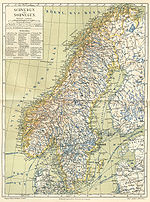
Although the Nordic countries
look back on more than 1000 years of history as distinct political entities, the international boundaries came late and emerged gradually. It was not until the middle of the 17th century that Sweden had a secure outlet on the Kattegat
and control of the south Baltic coast. The Swedish and Norwegian boundaries were finally agreed and marked out in 1751. The Finnish-Norwegian border on the peninsula was established after extensive negotiation in 1809, and the common Norwegian-Russian districts were not partitioned until 1826. Even then the borders were still fluid, with Finland gaining access to the Barents Sea
in 1920, but ceding this territory to Russia in 1944.
Denmark, Sweden, and the Russian Empire
dominated the political relationship
s on the Scandinavian Peninsula for centuries, with Iceland
, Finland, and Norway only gaining their full independence during the 20th century. Norway declared its full independence from Sweden in 1905, when the Kingdom of Norway was founded. Iceland declared its independence from Denmark in 1944, while Denmark was under the occupation of Nazi Germany
. Iceland was encouraged to do this by the British and American armed forces that were defending Iceland from Nazi invasion. Finland was long under the domination of first the Russian Empire and then the Soviet Union.
The German Army
and the German Kriegsmarine
invaded Norway in 1940 and the German Army occupied all of Norway until May 1945. With the acquiescence of the Kingdom of Sweden, German troops moved from northern Norway, across northern Sweden, into Finland, which had become an ally of Nazi Germany. Then, in the spring of 1941, the German Army and the Finnish Army
invaded the Soviet Union together. The Republic of Finland had a grievance against the Soviet Union because the Red Army
had invaded southeastern Finland in the Winter War
and had taken a large area of territory away from Finland.
Sweden remained a neutral country
during World War I, World War II, the Korean War
, and the Cold War
, and it continues its neutral policies as of 2011.
In 1945, Norway, Denmark, and Iceland were founding members of the United Nations
. Sweden joined the U.N. soon after. Finland joined during the 1950s. The first Secretary General of the United Nations, Trygve Lie
, was a Norwegian citizen. The second Secretary General of the United Nations, Dag Hammarskjöld
, was a Swedish citizen. Thus the people of the Scandinavian Peninsula had a strong influence in international affairs during the 20th century.
In 1949, Norway, Denmark, and Iceland became founding members of the North Atlantic Treaty Organization for their defense against Germany, the Soviet Union, and all other potential invaders, and these three countries remain members as of 2011.
Sweden and Finland joined the European Union
in 1995. Norway, however, remains outside the Union.
Peninsula
A peninsula is a piece of land that is bordered by water on three sides but connected to mainland. In many Germanic and Celtic languages and also in Baltic, Slavic and Hungarian, peninsulas are called "half-islands"....
in Northern Europe
Northern Europe
Northern Europe is the northern part or region of Europe. Northern Europe typically refers to the seven countries in the northern part of the European subcontinent which includes Denmark, Estonia, Latvia, Lithuania, Norway, Finland and Sweden...
, which today covers Norway
Norway
Norway , officially the Kingdom of Norway, is a Nordic unitary constitutional monarchy whose territory comprises the western portion of the Scandinavian Peninsula, Jan Mayen, and the Arctic archipelago of Svalbard and Bouvet Island. Norway has a total area of and a population of about 4.9 million...
, Sweden
Sweden
Sweden , officially the Kingdom of Sweden , is a Nordic country on the Scandinavian Peninsula in Northern Europe. Sweden borders with Norway and Finland and is connected to Denmark by a bridge-tunnel across the Öresund....
, and most of northern Finland
Finland
Finland , officially the Republic of Finland, is a Nordic country situated in the Fennoscandian region of Northern Europe. It is bordered by Sweden in the west, Norway in the north and Russia in the east, while Estonia lies to its south across the Gulf of Finland.Around 5.4 million people reside...
. Prior to the 17th and 18th centuries, large parts of the southern peninsula—including the core region of Scania
Scania
Scania is the southernmost of the 25 traditional non-administrative provinces of Sweden, constituting a peninsula on the southern tip of the Scandinavian peninsula, and some adjacent islands. The modern administrative subdivision Skåne County is almost, but not totally, congruent with the...
from which the peninsula takes its name—were part of Denmark
Denmark
Denmark is a Scandinavian country in Northern Europe. The countries of Denmark and Greenland, as well as the Faroe Islands, constitute the Kingdom of Denmark . It is the southernmost of the Nordic countries, southwest of Sweden and south of Norway, and bordered to the south by Germany. Denmark...
.
The name of the peninsula is derived from the term Scandinavia
Scandinavia
Scandinavia is a cultural, historical and ethno-linguistic region in northern Europe that includes the three kingdoms of Denmark, Norway and Sweden, characterized by their common ethno-cultural heritage and language. Modern Norway and Sweden proper are situated on the Scandinavian Peninsula,...
, the cultural region of Denmark, Norway, and Sweden. That cultural name is in turn derived from the name of Scania, the region at the southern extremity of the peninsula that was formerly part of Denmark, that is the ancestral home of the Danes
Danes
Danish people or Danes are the nation and ethnic group that is native to Denmark, and who speak Danish.The first mention of Danes within the Danish territory is on the Jelling Rune Stone which mentions how Harald Bluetooth converted the Danes to Christianity in the 10th century...
, and that is now part of Sweden. The derived term "Scandinavian" also refers to the North Germanic peoples who speak Scandinavian languages, considered to be a dialect continuum
Dialect continuum
A dialect continuum, or dialect area, was defined by Leonard Bloomfield as a range of dialects spoken across some geographical area that differ only slightly between neighboring areas, but as one travels in any direction, these differences accumulate such that speakers from opposite ends of the...
derived from Old Norse
Old Norse
Old Norse is a North Germanic language that was spoken by inhabitants of Scandinavia and inhabitants of their overseas settlements during the Viking Age, until about 1300....
. These languages are Danish
Danish language
Danish is a North Germanic language spoken by around six million people, principally in the country of Denmark. It is also spoken by 50,000 Germans of Danish ethnicity in the northern parts of Schleswig-Holstein, Germany, where it holds the status of minority language...
, Swedish
Swedish language
Swedish is a North Germanic language, spoken by approximately 10 million people, predominantly in Sweden and parts of Finland, especially along its coast and on the Åland islands. It is largely mutually intelligible with Norwegian and Danish...
, Norwegian
Norwegian language
Norwegian is a North Germanic language spoken primarily in Norway, where it is the official language. Together with Swedish and Danish, Norwegian forms a continuum of more or less mutually intelligible local and regional variants .These Scandinavian languages together with the Faroese language...
, Faroese
Faroese language
Faroese , is an Insular Nordic language spoken by 48,000 people in the Faroe Islands and about 25,000 Faroese people in Denmark and elsewhere...
, and Icelandic
Icelandic language
Icelandic is a North Germanic language, the main language of Iceland. Its closest relative is Faroese.Icelandic is an Indo-European language belonging to the North Germanic or Nordic branch of the Germanic languages. Historically, it was the westernmost of the Indo-European languages prior to the...
, with the latter two being closest to Old Norse.
The Scandinavian Peninsula can be said to be the largest peninsula of Europe, a continent that is itself a large peninsula of Eurasia
Eurasia
Eurasia is a continent or supercontinent comprising the traditional continents of Europe and Asia ; covering about 52,990,000 km2 or about 10.6% of the Earth's surface located primarily in the eastern and northern hemispheres...
. However, Europe contains several large peninsulas, including the Balkan Peninsula, Greece, Italy and the Iberian Peninsula
Iberian Peninsula
The Iberian Peninsula , sometimes called Iberia, is located in the extreme southwest of Europe and includes the modern-day sovereign states of Spain, Portugal and Andorra, as well as the British Overseas Territory of Gibraltar...
; during the Ice Ages, Great Britain and Ireland were another single peninsula extending from the body of the continent. Hence, the question of which is the largest peninsula in Europe is a debatable one, depending on arbitrary human definitions of where the peninsulas begin - and on which century one chooses to consider: sometimes, Scandinavia as a peninsula has not existed. During the Ice Ages, the sea level of the Atlantic Ocean dropped so much that the Baltic Sea
Baltic Sea
The Baltic Sea is a brackish mediterranean sea located in Northern Europe, from 53°N to 66°N latitude and from 20°E to 26°E longitude. It is bounded by the Scandinavian Peninsula, the mainland of Europe, and the Danish islands. It drains into the Kattegat by way of the Øresund, the Great Belt and...
, the Gulf of Bothnia
Gulf of Bothnia
The Gulf of Bothnia is the northernmost arm of the Baltic Sea. It is situated between Finland's west coast and Sweden's east coast. In the south of the gulf lie the Åland Islands, between the Sea of Åland and the Archipelago Sea.-Name:...
, and the Gulf of Finland
Gulf of Finland
The Gulf of Finland is the easternmost arm of the Baltic Sea. It extends between Finland and Estonia all the way to Saint Petersburg in Russia, where the river Neva drains into it. Other major cities around the gulf include Helsinki and Tallinn...
disappeared, and the countries now surrounding them, including Germany, Poland, the other Baltic countries and Scandinavia, were directly joined by land.
The geography of Scandinavia
- the Baltic SeaBaltic SeaThe Baltic Sea is a brackish mediterranean sea located in Northern Europe, from 53°N to 66°N latitude and from 20°E to 26°E longitude. It is bounded by the Scandinavian Peninsula, the mainland of Europe, and the Danish islands. It drains into the Kattegat by way of the Øresund, the Great Belt and...
(including the Gulf of BothniaGulf of BothniaThe Gulf of Bothnia is the northernmost arm of the Baltic Sea. It is situated between Finland's west coast and Sweden's east coast. In the south of the gulf lie the Åland Islands, between the Sea of Åland and the Archipelago Sea.-Name:...
) to the east, with the autonomous Åland islands between Sweden and Finland, and GotlandGotlandGotland is a county, province, municipality and diocese of Sweden; it is Sweden's largest island and the largest island in the Baltic Sea. At 3,140 square kilometers in area, the region makes up less than one percent of Sweden's total land area...
. - the North SeaNorth SeaIn the southwest, beyond the Straits of Dover, the North Sea becomes the English Channel connecting to the Atlantic Ocean. In the east, it connects to the Baltic Sea via the Skagerrak and Kattegat, narrow straits that separate Denmark from Norway and Sweden respectively...
(including the KattegatKattegatThe Kattegat , or Kattegatt is a sea area bounded by the Jutland peninsula and the Straits islands of Denmark on the west and south, and the provinces of Västergötland, Scania, Halland and Bohuslän in Sweden on the east. The Baltic Sea drains into the Kattegat through the Øresund and the Danish...
and SkagerrakSkagerrakThe Skagerrak is a strait running between Norway and the southwest coast of Sweden and the Jutland peninsula of Denmark, connecting the North Sea and the Kattegat sea area, which leads to the Baltic Sea.-Name:...
) to the west and southwest - the Norwegian SeaNorwegian SeaThe Norwegian Sea is a marginal sea in the North Atlantic Ocean, northwest of Norway. It is located between the North Sea and the Greenland Sea and adjoins the North Atlantic Ocean to the west and the Barents Sea to the northeast. In the southwest, it is separated from the Atlantic Ocean by a...
to the west - the Barents SeaBarents SeaThe Barents Sea is a marginal sea of the Arctic Ocean, located north of Norway and Russia. Known in the Middle Ages as the Murman Sea, the sea takes its current name from the Dutch navigator Willem Barents...
to the north
Its highest elevation was Glittertinden in Norway at 2,470 m (8,104 ft) above sea level, but since the glacier at its summit partially melted , the highest elevation is at 2,469 m (8,101 ft) at Galdhøpiggen
Galdhøpiggen
Galdhøpiggen is the highest mountain in Norway, Scandinavia and Northern Europe, at 2,469 m above sea level...
, also in Norway. These mountains also have the largest glacier
Glacier
A glacier is a large persistent body of ice that forms where the accumulation of snow exceeds its ablation over many years, often centuries. At least 0.1 km² in area and 50 m thick, but often much larger, a glacier slowly deforms and flows due to stresses induced by its weight...
on the mainland of Europe, Jostedalsbreen
Jostedalsbreen
Jostedalsbreen is the largest glacier in continental Europe. It is situated in Sogn og Fjordane county in Western Norway. Jostedalsbreen lies in the municipalities of Luster, Balestrand, Jølster, and Stryn. The highest peak in the area is Lodalskåpa at a height of .Jostedalsbreen has a total area...
.
About one quarter of the Scandinavian Peninsula lies north of the Arctic Circle
Arctic Circle
The Arctic Circle is one of the five major circles of latitude that mark maps of the Earth. For Epoch 2011, it is the parallel of latitude that runs north of the Equator....
, its northernmost point being at Cape Nordkyn (North Cape), near the town of Hammerfest, Norway
Hammerfest
is a city and municipality in Finnmark county, Norway. The municipality encompasses parts of three islands: Kvaløya, Sørøya, and Seiland. Hammerfest was established as a municipality on 1 January 1838...
.
The climate across Scandinavia varies from tundra (Köppen
Köppen climate classification
The Köppen climate classification is one of the most widely used climate classification systems. It was first published by Crimea German climatologist Wladimir Köppen in 1884, with several later modifications by Köppen himself, notably in 1918 and 1936...
: ET) and subarctic (Dfc) in the north, with cool marine west coast climate (Cfc) in northwestern coastal areas reaching just north of Lofoten
Lofoten
Lofoten is an archipelago and a traditional district in the county of Nordland, Norway. Though lying within the Arctic Circle, the archipelago experiences one of the world's largest elevated temperature anomalies relative to its high latitude.-Etymology:...
, to humid continental (Dfb) in the central portion, and marine west coast (Cfb) in the south and southwest.
The region is rich in timber, iron and copper with the best farmland in southern Sweden. Large petroleum and natural-gas deposits have been found off Norway's coast in the North Sea and the Atlantic Ocean.
Much of the population of the Scandinavian Peninsula is naturally concentrated in its southern part, which is also its agricultural region. The largest cities of the peninsula are Stockholm
Stockholm
Stockholm is the capital and the largest city of Sweden and constitutes the most populated urban area in Scandinavia. Stockholm is the most populous city in Sweden, with a population of 851,155 in the municipality , 1.37 million in the urban area , and around 2.1 million in the metropolitan area...
and Gothenburg
Gothenburg
Gothenburg is the second-largest city in Sweden and the fifth-largest in the Nordic countries. Situated on the west coast of Sweden, the city proper has a population of 519,399, with 549,839 in the urban area and total of 937,015 inhabitants in the metropolitan area...
, Sweden, and Oslo
Oslo
Oslo is a municipality, as well as the capital and most populous city in Norway. As a municipality , it was established on 1 January 1838. Founded around 1048 by King Harald III of Norway, the city was largely destroyed by fire in 1624. The city was moved under the reign of Denmark–Norway's King...
and Bergen
Bergen
Bergen is the second largest city in Norway with a population of as of , . Bergen is the administrative centre of Hordaland county. Greater Bergen or Bergen Metropolitan Area as defined by Statistics Norway, has a population of as of , ....
, Norway .
Geology
Baltic Shield
The Baltic Shield is located in Fennoscandia , northwest Russia and under the Baltic Sea. The Baltic Shield is defined as the exposed Precambrian northwest segment of the East European Craton...
, a stable and large crust segment formed of very old, crystalline metamorphic rock
Metamorphic rock
Metamorphic rock is the transformation of an existing rock type, the protolith, in a process called metamorphism, which means "change in form". The protolith is subjected to heat and pressure causing profound physical and/or chemical change...
s. Most of the soil covering this substrate was scraped by glaciers during the Ice Age
Ice age
An ice age or, more precisely, glacial age, is a generic geological period of long-term reduction in the temperature of the Earth's surface and atmosphere, resulting in the presence or expansion of continental ice sheets, polar ice sheets and alpine glaciers...
s of antiquity, especially in northern Scandinavia, where the Baltic Shield is closest to the surface of the land. As a consequence of this scouring, the elevation
Elevation
The elevation of a geographic location is its height above a fixed reference point, most commonly a reference geoid, a mathematical model of the Earth's sea level as an equipotential gravitational surface ....
of the land, and the cool-to-cold climate
Climate
Climate encompasses the statistics of temperature, humidity, atmospheric pressure, wind, rainfall, atmospheric particle count and other meteorological elemental measurements in a given region over long periods...
, a relatively small percentage of its land is arable
Arable land
In geography and agriculture, arable land is land that can be used for growing crops. It includes all land under temporary crops , temporary meadows for mowing or pasture, land under market and kitchen gardens and land temporarily fallow...
.
The glaciation during the Ice Ages also deepened many of the river valleys, which were invaded by the sea when the ice melted, creating the noteworthy fjords of Norway. In the southern part of the peninsula, the glaciers deposited vast numbers of terminal moraine
Terminal moraine
A terminal moraine, also called end moraine, is a moraine that forms at the end of the glacier called the snout.Terminal moraines mark the maximum advance of the glacier. An end moraine is at the present boundary of the glacier....
s, configuring a very chaotic landscape. These terminal moraines covered all of what is now Denmark.
Although the Baltic Shield is mostly geologically
Geology
Geology is the science comprising the study of solid Earth, the rocks of which it is composed, and the processes by which it evolves. Geology gives insight into the history of the Earth, as it provides the primary evidence for plate tectonics, the evolutionary history of life, and past climates...
stable and hence resistant to the influences of other neighboring tectonic formations, the weight of nearly four kilometers of ice during the Ice Ages caused all of the Scandinavian terrain to sink. When the ice sheet disappeared, the shield rose again, a tendency that continues to this day at a rate of about one meter per century. Conversely, the southern part has tended to sink to compensate, causing flooding of the Low Countries
Low Countries
The Low Countries are the historical lands around the low-lying delta of the Rhine, Scheldt, and Meuse rivers, including the modern countries of Belgium, the Netherlands, Luxembourg and parts of northern France and western Germany....
and Denmark.
The crystalline substrate of the land and absence of soil in many places have exposed mineral deposits of metal ore
Ore
An ore is a type of rock that contains minerals with important elements including metals. The ores are extracted through mining; these are then refined to extract the valuable element....
s, such as those of iron
Iron
Iron is a chemical element with the symbol Fe and atomic number 26. It is a metal in the first transition series. It is the most common element forming the planet Earth as a whole, forming much of Earth's outer and inner core. It is the fourth most common element in the Earth's crust...
, copper
Copper
Copper is a chemical element with the symbol Cu and atomic number 29. It is a ductile metal with very high thermal and electrical conductivity. Pure copper is soft and malleable; an exposed surface has a reddish-orange tarnish...
, nickel
Nickel
Nickel is a chemical element with the chemical symbol Ni and atomic number 28. It is a silvery-white lustrous metal with a slight golden tinge. Nickel belongs to the transition metals and is hard and ductile...
, zinc
Zinc
Zinc , or spelter , is a metallic chemical element; it has the symbol Zn and atomic number 30. It is the first element in group 12 of the periodic table. Zinc is, in some respects, chemically similar to magnesium, because its ion is of similar size and its only common oxidation state is +2...
, silver
Silver
Silver is a metallic chemical element with the chemical symbol Ag and atomic number 47. A soft, white, lustrous transition metal, it has the highest electrical conductivity of any element and the highest thermal conductivity of any metal...
, and gold
Gold
Gold is a chemical element with the symbol Au and an atomic number of 79. Gold is a dense, soft, shiny, malleable and ductile metal. Pure gold has a bright yellow color and luster traditionally considered attractive, which it maintains without oxidizing in air or water. Chemically, gold is a...
. The very most valuable of these have been the deposits of iron ore in northwestern Sweden. In the 19th century these deposits prompted the building of a railroad from northwestern Sweden to the Norwegian seaport of Narvik
Narvik
is the third largest city and municipality in Nordland county, Norway by population. Narvik is located on the shores of the Narvik Fjord . The municipality is part of the Ofoten traditional region of North Norway, inside the arctic circle...
so that the iron ore could be exported by ship to places like southern Sweden, Germany, Great Britain, and Belgium for smelting into iron and steel
Steel
Steel is an alloy that consists mostly of iron and has a carbon content between 0.2% and 2.1% by weight, depending on the grade. Carbon is the most common alloying material for iron, but various other alloying elements are used, such as manganese, chromium, vanadium, and tungsten...
. This railroad is in a region of Norway and Sweden that otherwise do not have any railroads because of the very rugged terrain, mountains, and fjord
Fjord
Geologically, a fjord is a long, narrow inlet with steep sides or cliffs, created in a valley carved by glacial activity.-Formation:A fjord is formed when a glacier cuts a U-shaped valley by abrasion of the surrounding bedrock. Glacial melting is accompanied by rebound of Earth's crust as the ice...
s of that part of Scandinavia.
People
The first recorded human presence in the southern area of the peninsula and Denmark dates from 12,000 years ago. As the ice sheets from the glaciation retreated, the climate allowed a tundraTundra
In physical geography, tundra is a biome where the tree growth is hindered by low temperatures and short growing seasons. The term tundra comes through Russian тундра from the Kildin Sami word tūndâr "uplands," "treeless mountain tract." There are three types of tundra: Arctic tundra, alpine...
biome
Biome
Biomes are climatically and geographically defined as similar climatic conditions on the Earth, such as communities of plants, animals, and soil organisms, and are often referred to as ecosystems. Some parts of the earth have more or less the same kind of abiotic and biotic factors spread over a...
that attracted reindeer
Reindeer
The reindeer , also known as the caribou in North America, is a deer from the Arctic and Subarctic, including both resident and migratory populations. While overall widespread and numerous, some of its subspecies are rare and one has already gone extinct.Reindeer vary considerably in color and size...
hunters. The climate warmed up gradually, favoring the growth of evergreen trees first, and then deciduous
Deciduous
Deciduous means "falling off at maturity" or "tending to fall off", and is typically used in reference to trees or shrubs that lose their leaves seasonally, and to the shedding of other plant structures such as petals after flowering or fruit when ripe...
forest which brought animals like aurochs
Aurochs
The aurochs , the ancestor of domestic cattle, were a type of large wild cattle which inhabited Europe, Asia and North Africa, but is now extinct; it survived in Europe until 1627....
. Groups of hunters-fishers-gatherers started to inhabit the area from the Mesolithic
Mesolithic
The Mesolithic is an archaeological concept used to refer to certain groups of archaeological cultures defined as falling between the Paleolithic and the Neolithic....
(8200 BC), up to the advent of agriculture in the Neolithic
Neolithic
The Neolithic Age, Era, or Period, or New Stone Age, was a period in the development of human technology, beginning about 9500 BC in some parts of the Middle East, and later in other parts of the world. It is traditionally considered as the last part of the Stone Age...
(3200 BC).
The northern and central part of the peninsula is partially inhabited by the Sami
Sami people
The Sami people, also spelled Sámi, or Saami, are the arctic indigenous people inhabiting Sápmi, which today encompasses parts of far northern Sweden, Norway, Finland, the Kola Peninsula of Russia, and the border area between south and middle Sweden and Norway. The Sámi are Europe’s northernmost...
, often referred to as "Lapps" or "Laplanders". In the earliest recorded periods they occupied the arctic
Arctic
The Arctic is a region located at the northern-most part of the Earth. The Arctic consists of the Arctic Ocean and parts of Canada, Russia, Greenland, the United States, Norway, Sweden, Finland, and Iceland. The Arctic region consists of a vast, ice-covered ocean, surrounded by treeless permafrost...
and subarctic
Subarctic
The Subarctic is a region in the Northern Hemisphere immediately south of the true Arctic and covering much of Alaska, Canada, the north of Scandinavia, Siberia, and northern Mongolia...
regions as well as the central part of the peninsula as far south as Dalarna
Dalarna
', English exonym: Dalecarlia, is a historical province or landskap in central Sweden. Another English language form established in literature is the Dales. Places involving the element Dalecarlia exist in the United States....
, Sweden. They speak the Sami language
Sami languages
Sami or Saami is a general name for a group of Uralic languages spoken by the Sami people in parts of northern Finland, Norway, Sweden and extreme northwestern Russia, in Northern Europe. Sami is frequently and erroneously believed to be a single language. Several names are used for the Sami...
, a non-Indo-European language of the Uralic
Uralic languages
The Uralic languages constitute a language family of some three dozen languages spoken by approximately 25 million people. The healthiest Uralic languages in terms of the number of native speakers are Hungarian, Finnish, Estonian, Mari and Udmurt...
family which is related to Finnish
Finnish language
Finnish is the language spoken by the majority of the population in Finland Primarily for use by restaurant menus and by ethnic Finns outside Finland. It is one of the two official languages of Finland and an official minority language in Sweden. In Sweden, both standard Finnish and Meänkieli, a...
and Estonian
Estonian language
Estonian is the official language of Estonia, spoken by about 1.1 million people in Estonia and tens of thousands in various émigré communities...
. The other inhabitants of the peninsula, according to ninth century records, were the Norwegians on the west coast of Norway, the Danes in what is now southern and western Sweden and southeastern Norway, the Svear in the region around Mälaren
Mälaren
Lake Mälaren is the third-largest lake in Sweden, after Lakes Vänern and Vättern. Its area is 1,140 km² and its greatest depth is 64 m. Mälaren spans 120 kilometers from east to west...
as well as a large portion of the present day eastern seacoast of Sweden and the Geat
Geat
Geats , and sometimes Goths) were a North Germanic tribe inhabiting what is now Götaland in modern Sweden...
s in Västergötland
Västergötland
', English exonym: West Gothland, is one of the 25 traditional non-administrative provinces of Sweden , situated in the southwest of Sweden. In older English literature one may also encounter the Latinized version Westrogothia....
and Östergötland
Östergötland
Östergötland, English exonym: East Gothland, is one of the traditional provinces of Sweden in the south of Sweden. It borders Småland, Västergötland, Närke, Södermanland, and the Baltic Sea. In older English literature, one might also encounter the Latinized version, Ostrogothia...
. These peoples spoke closely related dialect
Dialect
The term dialect is used in two distinct ways, even by linguists. One usage refers to a variety of a language that is a characteristic of a particular group of the language's speakers. The term is applied most often to regional speech patterns, but a dialect may also be defined by other factors,...
s of an Indo-European language, Old Norse
Old Norse
Old Norse is a North Germanic language that was spoken by inhabitants of Scandinavia and inhabitants of their overseas settlements during the Viking Age, until about 1300....
. Although political boundaries have shifted, descendants of these peoples still are the dominant populations in the peninsula in the early 21st century.
Political development
Although the Nordic countries
Nordic countries
The Nordic countries make up a region in Northern Europe and the North Atlantic which consists of Denmark, Finland, Iceland, Norway and Sweden and their associated territories, the Faroe Islands, Greenland and Åland...
look back on more than 1000 years of history as distinct political entities, the international boundaries came late and emerged gradually. It was not until the middle of the 17th century that Sweden had a secure outlet on the Kattegat
Kattegat
The Kattegat , or Kattegatt is a sea area bounded by the Jutland peninsula and the Straits islands of Denmark on the west and south, and the provinces of Västergötland, Scania, Halland and Bohuslän in Sweden on the east. The Baltic Sea drains into the Kattegat through the Øresund and the Danish...
and control of the south Baltic coast. The Swedish and Norwegian boundaries were finally agreed and marked out in 1751. The Finnish-Norwegian border on the peninsula was established after extensive negotiation in 1809, and the common Norwegian-Russian districts were not partitioned until 1826. Even then the borders were still fluid, with Finland gaining access to the Barents Sea
Barents Sea
The Barents Sea is a marginal sea of the Arctic Ocean, located north of Norway and Russia. Known in the Middle Ages as the Murman Sea, the sea takes its current name from the Dutch navigator Willem Barents...
in 1920, but ceding this territory to Russia in 1944.
Denmark, Sweden, and the Russian Empire
Russian Empire
The Russian Empire was a state that existed from 1721 until the Russian Revolution of 1917. It was the successor to the Tsardom of Russia and the predecessor of the Soviet Union...
dominated the political relationship
Political science
Political Science is a social science discipline concerned with the study of the state, government and politics. Aristotle defined it as the study of the state. It deals extensively with the theory and practice of politics, and the analysis of political systems and political behavior...
s on the Scandinavian Peninsula for centuries, with Iceland
Iceland
Iceland , described as the Republic of Iceland, is a Nordic and European island country in the North Atlantic Ocean, on the Mid-Atlantic Ridge. Iceland also refers to the main island of the country, which contains almost all the population and almost all the land area. The country has a population...
, Finland, and Norway only gaining their full independence during the 20th century. Norway declared its full independence from Sweden in 1905, when the Kingdom of Norway was founded. Iceland declared its independence from Denmark in 1944, while Denmark was under the occupation of Nazi Germany
Nazi Germany
Nazi Germany , also known as the Third Reich , but officially called German Reich from 1933 to 1943 and Greater German Reich from 26 June 1943 onward, is the name commonly used to refer to the state of Germany from 1933 to 1945, when it was a totalitarian dictatorship ruled by...
. Iceland was encouraged to do this by the British and American armed forces that were defending Iceland from Nazi invasion. Finland was long under the domination of first the Russian Empire and then the Soviet Union.
The German Army
German Army
The German Army is the land component of the armed forces of the Federal Republic of Germany. Following the disbanding of the Wehrmacht after World War II, it was re-established in 1955 as the Bundesheer, part of the newly formed West German Bundeswehr along with the Navy and the Air Force...
and the German Kriegsmarine
Kriegsmarine
The Kriegsmarine was the name of the German Navy during the Nazi regime . It superseded the Kaiserliche Marine of World War I and the post-war Reichsmarine. The Kriegsmarine was one of three official branches of the Wehrmacht, the unified armed forces of Nazi Germany.The Kriegsmarine grew rapidly...
invaded Norway in 1940 and the German Army occupied all of Norway until May 1945. With the acquiescence of the Kingdom of Sweden, German troops moved from northern Norway, across northern Sweden, into Finland, which had become an ally of Nazi Germany. Then, in the spring of 1941, the German Army and the Finnish Army
Finnish Army
The Finnish Army is the land forces branch of the Finnish Defence Forces.Today's Army is divided into six branches: the infantry , field artillery, anti-aircraft artillery, engineers, signals, and materiel troops.-History of the Finnish Army:Between 1809 and 1917 Finland was an autonomous part of...
invaded the Soviet Union together. The Republic of Finland had a grievance against the Soviet Union because the Red Army
Red Army
The Workers' and Peasants' Red Army started out as the Soviet Union's revolutionary communist combat groups during the Russian Civil War of 1918-1922. It grew into the national army of the Soviet Union. By the 1930s the Red Army was among the largest armies in history.The "Red Army" name refers to...
had invaded southeastern Finland in the Winter War
Winter War
The Winter War was a military conflict between the Soviet Union and Finland. It began with a Soviet offensive on 30 November 1939 – three months after the start of World War II and the Soviet invasion of Poland – and ended on 13 March 1940 with the Moscow Peace Treaty...
and had taken a large area of territory away from Finland.
Sweden remained a neutral country
Neutral country
A neutral power in a particular war is a sovereign state which declares itself to be neutral towards the belligerents. A non-belligerent state does not need to be neutral. The rights and duties of a neutral power are defined in Sections 5 and 13 of the Hague Convention of 1907...
during World War I, World War II, the Korean War
Korean War
The Korean War was a conventional war between South Korea, supported by the United Nations, and North Korea, supported by the People's Republic of China , with military material aid from the Soviet Union...
, and the Cold War
Cold War
The Cold War was the continuing state from roughly 1946 to 1991 of political conflict, military tension, proxy wars, and economic competition between the Communist World—primarily the Soviet Union and its satellite states and allies—and the powers of the Western world, primarily the United States...
, and it continues its neutral policies as of 2011.
In 1945, Norway, Denmark, and Iceland were founding members of the United Nations
United Nations
The United Nations is an international organization whose stated aims are facilitating cooperation in international law, international security, economic development, social progress, human rights, and achievement of world peace...
. Sweden joined the U.N. soon after. Finland joined during the 1950s. The first Secretary General of the United Nations, Trygve Lie
Trygve Lie
Trygve Halvdan Lie was a Norwegian politician, labour leader, government official and author. He served as Norwegian Foreign minister during the critical years of the Norwegian government in exile in London from 1940 to 1945. From 1946 to 1952 he was the first Secretary-General of the United...
, was a Norwegian citizen. The second Secretary General of the United Nations, Dag Hammarskjöld
Dag Hammarskjöld
Dag Hjalmar Agne Carl Hammarskjöld was a Swedish diplomat, economist, and author. An early Secretary-General of the United Nations, he served from April 1953 until his death in a plane crash in September 1961. He is the only person to have been awarded a posthumous Nobel Peace Prize. Hammarskjöld...
, was a Swedish citizen. Thus the people of the Scandinavian Peninsula had a strong influence in international affairs during the 20th century.
In 1949, Norway, Denmark, and Iceland became founding members of the North Atlantic Treaty Organization for their defense against Germany, the Soviet Union, and all other potential invaders, and these three countries remain members as of 2011.
Sweden and Finland joined the European Union
European Union
The European Union is an economic and political union of 27 independent member states which are located primarily in Europe. The EU traces its origins from the European Coal and Steel Community and the European Economic Community , formed by six countries in 1958...
in 1995. Norway, however, remains outside the Union.