


Baroque architecture

Encyclopedia
Baroque
The Baroque is a period and the style that used exaggerated motion and clear, easily interpreted detail to produce drama, tension, exuberance, and grandeur in sculpture, painting, literature, dance, and music...
, begun in late sixteenth century Italy, that took the Roman
Roman architecture
Ancient Roman architecture adopted certain aspects of Ancient Greek architecture, creating a new architectural style. The Romans were indebted to their Etruscan neighbors and forefathers who supplied them with a wealth of knowledge essential for future architectural solutions, such as hydraulics...
vocabulary of Renaissance architecture
Renaissance architecture
Renaissance architecture is the architecture of the period between the early 15th and early 17th centuries in different regions of Europe, demonstrating a conscious revival and development of certain elements of ancient Greek and Roman thought and material culture. Stylistically, Renaissance...
and used it in a new rhetorical and theatrical fashion, often to express the triumph of the Catholic Church and the absolutist state. It was characterized by new explorations of form, light and shadow and dramatic intensity.
Whereas the Renaissance drew on the wealth and power of the Italian courts and was a blend of secular and religious forces, the Baroque was, initially at least, directly linked to the Counter-Reformation, a movement within the Catholic Church to reform itself in response to the Protestant Reformation
Protestant Reformation
The Protestant Reformation was a 16th-century split within Western Christianity initiated by Martin Luther, John Calvin and other early Protestants. The efforts of the self-described "reformers", who objected to the doctrines, rituals and ecclesiastical structure of the Roman Catholic Church, led...
. Baroque architecture and its embellishments were on the one hand more accessible to the emotions and on the other hand, a visible statement of the wealth and power of the Church. The new style manifested itself in particular in the context of the new religious orders, like the Theatines
Theatines
The Theatines or the Congregation of Clerks Regular of the Divine Providence are a male religious order of the Catholic Church, with the post-nominal initials "C.R."-Foundation:...
and the Jesuits who aimed to improve popular piety.
The architecture of the High Roman Baroque can be assigned to the papal reigns of Urban VIII, Innocent X and Alexander VII, spanning from 1623 to 1667. The three principal architects of this period were the sculptor Gianlorenzo Bernini, Francesco Borromini
Francesco Borromini
Francesco Borromini, byname of Francesco Castelli was an architect from Ticino who, with his contemporaries, Gian Lorenzo Bernini and Pietro da Cortona, was a leading figure in the emergence of Roman Baroque architecture.A keen student of the architecture of Michelangelo and the ruins of...
and the painter Pietro da Cortona
Pietro da Cortona
Pietro da Cortona, by the name of Pietro Berrettini, born Pietro Berrettini da Cortona, was the leading Italian Baroque painter of his time and also one of the key architects in the emergence of Roman Baroque architecture. He was also an important decorator...
and each evolved their own distinctively individual architectural expression.
Dissemination of Baroque architecture to the south of Italy resulted in regional variations such as Sicilian Baroque
Sicilian Baroque
Sicilian Baroque is the distinctive form of Baroque architecture that took hold on the island of Sicily, off the southern coast of Italy, in the 17th and 18th centuries...
architecture or that of Naples
Naples
Naples is a city in Southern Italy, situated on the country's west coast by the Gulf of Naples. Lying between two notable volcanic regions, Mount Vesuvius and the Phlegraean Fields, it is the capital of the region of Campania and of the province of Naples...
and Lecce
Lecce
Lecce is a historic city of 95,200 inhabitants in southern Italy, the capital of the province of Lecce, the second province in the region by population, as well as one of the most important cities of Puglia...
. To the north, the Theatine architect Camillo-Guarino Guarini
Camillo-Guarino Guarini
thumb|300px|The [[Carignano Palace]] in Turin.Camillo-Guarino Guarini was an Italian architect of the Piedmontese Baroque, active in Turin as well as Sicily, France, and Portugal. He was a Theatine priest, mathematician, and writer.-Biography:Guarini was born in Modena...
, Bernardo Vittone
Bernardo Vittone
Bernardo Antonio Vittone was an Italian architect and writer. He was one of the three most important Baroque architects active in the Piedmont region of Northern Italy; the other two were Filippo Juvarra and Guarino Guarini. The youngest of the three, Vittone was the only one who was born in the...
and Sicilian born Filippo Juvarra
Filippo Juvarra
Filippo Juvarra was an Italian architect and stage set designer.-Biography:Filippo Juvarra was an Italian Baroque architect working in the early part of the eighteenth century. He was born in Messina, Sicily, to a family of goldsmiths and engravers...
contributed Baroque buildings to the city of Turin
Turin
Turin is a city and major business and cultural centre in northern Italy, capital of the Piedmont region, located mainly on the left bank of the Po River and surrounded by the Alpine arch. The population of the city proper is 909,193 while the population of the urban area is estimated by Eurostat...
and the Piedmont
Piedmont
Piedmont is one of the 20 regions of Italy. It has an area of 25,402 square kilometres and a population of about 4.4 million. The capital of Piedmont is Turin. The main local language is Piedmontese. Occitan is also spoken by a minority in the Occitan Valleys situated in the Provinces of...
region.
A synthesis of Bernini, Borromini and Cortona’s architecture can be seen in the late Baroque architecture of northern Europe which paved the way for the more decorative Rococo
Rococo
Rococo , also referred to as "Late Baroque", is an 18th-century style which developed as Baroque artists gave up their symmetry and became increasingly ornate, florid, and playful...
style.
By the middle of the seventeenth century, the Baroque style had found its secular expression in the form of grand palaces, first in France—with the Château de Maisons
Château de Maisons
The Château de Maisons , designed by François Mansart from 1630 to 1651, is a prime example of French baroque architecture and a reference point in the history of French architecture...
(1642) near Paris by François Mansart
François Mansart
François Mansart was a French architect credited with introducing classicism into Baroque architecture of France...
—and then throughout Europe.
During the seventeenth century, Baroque architecture spread through Europe and Latin America, where it was particularly promoted by the Jesuits.
Precursors and features of Baroque architecture
MichelangeloMichelangelo
Michelangelo di Lodovico Buonarroti Simoni , commonly known as Michelangelo, was an Italian Renaissance painter, sculptor, architect, poet, and engineer who exerted an unparalleled influence on the development of Western art...
's late Roman buildings, particularly St. Peter's Basilica
St. Peter's Basilica
The Papal Basilica of Saint Peter , officially known in Italian as ' and commonly known as Saint Peter's Basilica, is a Late Renaissance church located within the Vatican City. Saint Peter's Basilica has the largest interior of any Christian church in the world...
, may be considered precursors to Baroque architecture. His pupil Giacomo della Porta
Giacomo della Porta
Giacomo della Porta was an Italian architect and sculptor, who worked on many important buildings in Rome, including St. Peter's Basilica. He was born at Porlezza, Lombardy and died in Rome.-Biography:...
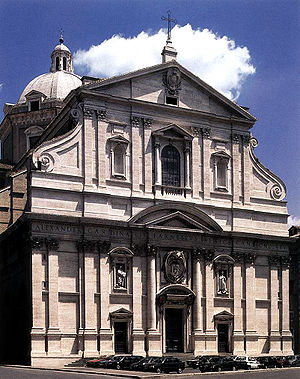
continued this work in Rome, particularly in the façade of the Jesuit church Il Gesù, which leads directly to the most important church façade of the early Baroque, Santa Susanna
Santa Susanna
The Church of Saint Susanna at the baths of Diocletian is a Roman Catholic parish church on the Quirinal Hill in Rome, with a titulus associated to its site that dates back to about 280...
(1603), by Carlo Maderno
Carlo Maderno
Carlo Maderno was a Swiss-Italian architect, born in Ticino, who is remembered as one of the fathers of Baroque architecture. His façades of Santa Susanna, St. Peter's Basilica and Sant'Andrea della Valle were of key importance in the evolution of the Italian Baroque...
Distinctive features of Baroque architecture can include:
- In churches, broader naves and sometimes given oval forms
- Fragmentary or deliberately incomplete architectural elements
- dramatic use of light; either strong light-and-shade contrasts (chiaroscuroChiaroscuroChiaroscuro in art is "an Italian term which literally means 'light-dark'. In paintings the description refers to clear tonal contrasts which are often used to suggest the volume and modelling of the subjects depicted"....
effects) as at the church of Weltenburg AbbeyWeltenburg AbbeyWeltenburg Abbey is a Benedictine monastery in Weltenburg in Kelheim on the Danube in Bavaria, Germany.-First foundation:...
, or uniform lighting by means of several windows (e.g. church of Weingarten AbbeyWeingarten AbbeyWeingarten Abbey or St. Martin's Abbey is a Benedictine monastery on the Martinsberg in Weingarten near Ravensburg in Baden-Württemberg .-First foundation:...
) - opulent use of colour and ornaments (putti or figures made of wood (often gilded), plaster or stucco, marble or faux finishing)
- large-scale ceiling frescoes
- an external façade often characterized by a dramatic central projection
- the interior is a shell for painting, sculpture and stucco (especially in the late Baroque)
- illusory effects like trompe l'oeilTrompe l'oeilTrompe-l'œil, which can also be spelled without the hyphen in English as trompe l'oeil, is an art technique involving extremely realistic imagery in order to create the optical illusion that the depicted objects appear in three dimensions.-History in painting:Although the phrase has its origin in...
(is an art technique involving extremely realistic imagery in order to create the optical illusion that the depicted objects appear in three dimensions.) and the blending of paintingPaintingPainting is the practice of applying paint, pigment, color or other medium to a surface . The application of the medium is commonly applied to the base with a brush but other objects can be used. In art, the term painting describes both the act and the result of the action. However, painting is...
and architectureArchitectureArchitecture is both the process and product of planning, designing and construction. Architectural works, in the material form of buildings, are often perceived as cultural and political symbols and as works of art... - pear-shaped domes in the BavarianBavariaBavaria, formally the Free State of Bavaria is a state of Germany, located in the southeast of Germany. With an area of , it is the largest state by area, forming almost 20% of the total land area of Germany...
, CzechCzech peopleCzechs, or Czech people are a western Slavic people of Central Europe, living predominantly in the Czech Republic. Small populations of Czechs also live in Slovakia, Austria, the United States, the United Kingdom, Chile, Argentina, Canada, Germany, Russia and other countries...
, PolishPolandPoland , officially the Republic of Poland , is a country in Central Europe bordered by Germany to the west; the Czech Republic and Slovakia to the south; Ukraine, Belarus and Lithuania to the east; and the Baltic Sea and Kaliningrad Oblast, a Russian exclave, to the north...
, and Ukrainian BaroqueUkrainian BaroqueUkrainian Baroque or Cossack Baroque is an architectural style that emerged in Ukraine during the Hetmanate era, in the 17th and 18th centuries.... - Marian and Holy Trinity columnsMarian and Holy Trinity columnsMarian columns are religious monuments built in honour of the Virgin Mary, often in thanksgiving for the ending of a plague or for some other help. The purpose of the Holy Trinity columns was usually simply to celebrate the church and the faith. However, the plague motif could sometimes play its...
erected in Catholic countries, often in thanksgiving for ending a plague
The Baroque and colonialism
Though the tendency has been to see Baroque architecture as a European phenomenon, it coincided with, and is integrally enmeshed with, the rise of European colonialismColonialism
Colonialism is the establishment, maintenance, acquisition and expansion of colonies in one territory by people from another territory. It is a process whereby the metropole claims sovereignty over the colony and the social structure, government, and economics of the colony are changed by...
. Colonialism required the development of centralized and powerful governments with Spain and France, the first to move in this direction. Colonialism brought in huge amounts of wealth, not only in the silver that was extracted from the mines in Bolivia, Mexico and elsewhere, but also in the resultant trade in commodities, such as sugar and tobacco. The need to control trade routes, monopolies, and slavery, which lay primarily in the hands of the French during the 17th century, created an almost endless cycle of wars between the colonial powers: the French religious wars, the Thirty Years' War
Thirty Years' War
The Thirty Years' War was fought primarily in what is now Germany, and at various points involved most countries in Europe. It was one of the most destructive conflicts in European history....
(1618 and 1648), Franco–Spanish War (1653), the Franco-Dutch War
Franco-Dutch War
The Franco-Dutch War, often called simply the Dutch War was a war fought by France, Sweden, the Bishopric of Münster, the Archbishopric of Cologne and England against the United Netherlands, which were later joined by the Austrian Habsburg lands, Brandenburg and Spain to form a quadruple alliance...
(1672–1678), and so on. The initial mismanagement of colonial wealth by the Spaniards bankrupted them in the 16th century (1557 and 1560), recovering only slowly in the following century. This explains why the Baroque style, though enthusiastically developed in Spain, was to a large extent, in Spain, an architecture of surfaces and façades, unlike in France and Austria where we see the construction of numerous huge palaces and monasteries. In contrast to Spain, the French, under Jean-Baptiste Colbert
Jean-Baptiste Colbert
Jean-Baptiste Colbert was a French politician who served as the Minister of Finances of France from 1665 to 1683 under the rule of King Louis XIV. His relentless hard work and thrift made him an esteemed minister. He achieved a reputation for his work of improving the state of French manufacturing...
(1619–1683), the minister of finance, had begun to industrialize their economy, and thus, were able to become, initially at least, the benefactors of the flow of wealth. While this was good for the building industries and the arts, the new wealth created an inflation, the likes of which had never been experienced before. Basically, the rich became richer and the poor became poorer. Rome was known just as much for its new sumptuous churches as for its vagabonds.
Rome and Southern Italy
A number of ecclesiastical buildings of the Baroque period in Rome had plans based on the Italian paradigm of the basilica with a crossed dome and nave, but the treatment of the architecture was very different to what had been carried out previously. One of the first Roman structures to break with the Mannerist conventions exemplified in the Gesù, was the church of Santa Susanna, designed by Carlo Maderno. The dynamic rhythm of columns and pilasters, central massing, and the protrusion and condensed central decoration add complexity to the structure. There is an incipient playfulness with the rules of classic design, but it still maintains rigor.The same concerns with plasticity, massing, dramatic effects and shadow and light is evident in the architectural work of Pietro da Cortona
Pietro da Cortona
Pietro da Cortona, by the name of Pietro Berrettini, born Pietro Berrettini da Cortona, was the leading Italian Baroque painter of his time and also one of the key architects in the emergence of Roman Baroque architecture. He was also an important decorator...
, illustrated by his design of Santi Luca e Martina
Santi Luca e Martina
Santi Luca e Martina is a church in Rome, Italy, situated between the Roman Forum and the Forum of Caesar and close to the Arch of Septimus Severus.-History:...
(construction began in 1635) with what was probably the first curved Baroque church facade in Rome. These concerns are even more evident in his reworking of Santa Maria della Pace
Santa Maria della Pace
Santa Maria della Pace is a church in Rome, central Italy, not far from Piazza Navona.The current building was built on the foundations of the pre-existing church of Sant'Andrea de Aquarizariis in 1482, commissioned by Pope Sixtus IV. The church was rededicated to the Virgin Mary to remember a...
(1656-8). The facade with its chiaroscuro
Chiaroscuro
Chiaroscuro in art is "an Italian term which literally means 'light-dark'. In paintings the description refers to clear tonal contrasts which are often used to suggest the volume and modelling of the subjects depicted"....
half-domed portico and concave side wings, closely resembles a theatrical stage set and the church facade projects forward so that it substantially fills the tiny trapezoidal piazza. Other Roman ensembles of the Baroque and Late Baroque period are likewise suffused with theatricality and, as urban theatres, provide points of focus within their locality in the surrounding cityscape.
Probably the most well known example of such an approach is Saint Peter's Square
Saint Peter's Square
Saint Peter's Square is located directly in front of St. Peter's Basilica in Vatican City, the papal enclave within Rome .-History of St...
, which has been praised as a masterstroke of Baroque theatre. The piazza, designed by Gian Lorenzo Bernini, is formed principally by two colonnades of free standing columns centred on an Egyptian obelisk
Obelisk
An obelisk is a tall, four-sided, narrow tapering monument which ends in a pyramid-like shape at the top, and is said to resemble a petrified ray of the sun-disk. A pair of obelisks usually stood in front of a pylon...
. Bernini's own favourite design was his oval church of Sant'Andrea al Quirinale
Sant'Andrea al Quirinale
The Church of Saint Andrew's at the Quirinal is a Roman Catholic titular church in Rome, built for of the Jesuit seminary on the Quirinal Hill....
decorated with polychome marbles and an ornate gold dome. His secular architecture included the Palazzo Barberini
Palazzo Barberini
Palazzo Barberini is a palace in Rome, facing the piazza of the same name in Rione Trevi and is home to the Galleria Nazionale d'Arte Antica.-History:...
based on plans by Maderno and the Palazzo Chigi-Odescalchi (1664), both in Rome.

Francesco Borromini
Francesco Borromini, byname of Francesco Castelli was an architect from Ticino who, with his contemporaries, Gian Lorenzo Bernini and Pietro da Cortona, was a leading figure in the emergence of Roman Baroque architecture.A keen student of the architecture of Michelangelo and the ruins of...
, produced designs that deviated dramatically from the regular compositions of the ancient world and Renaissance. His building plans were based on complex geometric figures, his architectural forms were unusual and inventive and he employed multi-layered symbolism in his architectural designs. Borromini's architectural spaces seem to expand and contract when needed, showing some affinity with the late style of Michelangelo. His iconic masterpiece is the diminutive church of San Carlo alle Quattro Fontane
San Carlo alle Quattro Fontane
The Church of Saint Charles at the Four Fountains is a Roman Catholic church in Rome, Italy. Designed by the architect Francesco Borromini, it was his first independent commission. It is an iconic masterpiece of Baroque architecture, built as part of a complex of monastic buildings on the Quirinal...
, distinguished by a complicated plan arrangement that is partly oval and partly a cross and so has complex convex-concave wall rhythms. A later work, the church of Sant'Ivo alla Sapienza
Sant'Ivo alla Sapienza
The Church of Saint Yves at La Sapienza is a Roman Catholic church in Rome. The church is considered a masterpiece of Roman Baroque church architecture, built in 1642-1660 by the architect Francesco Borromini.- History :...
, displays the same playful inventiveness and antipathy to the flat surface, epitomized by an unusual “corkscrew” lantern above the dome.
Following the death of Bernini in 1680, Carlo Fontana
Carlo Fontana
Carlo Fontana was an Italian architect, who was in part responsible for the classicizing direction taken by Late Baroque Roman architecture.-Biography:...
emerged as the most influential architect working in Rome. His early style is exemplified by the slightly concave façade of San Marcello al Corso
San Marcello al Corso
San Marcello al Corso is a church in Rome, Italy, devoted to Pope Marcellus I. It is located in via del Corso, the ancient via Lata, connecting Piazza Venezia to Piazza del Popolo....
. Fontana's academic approach, though lacking the dazzling inventiveness of his Roman predecessors, exerted substantial influence on Baroque architecture both through his prolific writings and through a number of architects he trained, who would disseminate the Baroque idioms throughout eighteenth century Europe.
The eighteenth century saw the capital of Europe's architectural world transferred from Rome to Paris. The Italian Rococo
Rococo
Rococo , also referred to as "Late Baroque", is an 18th-century style which developed as Baroque artists gave up their symmetry and became increasingly ornate, florid, and playful...
, which flourished in Rome from the 1720s onward, was profoundly influenced by the ideas of Borromini. The most talented architects active in Rome—Francesco de Sanctis
Francesco de Sanctis (architect)
Francesco De Sanctis was a late Baroque Italian architect, most notable for his design of the Spanish Steps in Rome in collaboration with Alessandro Specchi...
(Spanish Steps
Spanish Steps
The Spanish Steps are a set of steps in Rome, Italy, climbing a steep slope between the Piazza di Spagna at the base and Piazza Trinità dei Monti, dominated by the Trinità dei Monti church at the top. The Scalinata is the widest staircase in Europe...
, 1723) and Filippo Raguzzini
Filippo Raguzzini
Filippo Raguzzini was an Italian architect best known for a range of buildings constructed during the reign of Benedict XIII.-Biography:...
(Piazza Sant'Ignazio, 1727)—had little influence outside their native country, as did numerous practitioners of the Sicilian Baroque
Sicilian Baroque
Sicilian Baroque is the distinctive form of Baroque architecture that took hold on the island of Sicily, off the southern coast of Italy, in the 17th and 18th centuries...
, including Giovanni Battista Vaccarini
Giovanni Battista Vaccarini
Giovanni Battista Vaccarini was an Italian architect, notable for his work in the Sicilian Baroque style in his homeland during the period of massive rebuilding following the earthquake of 1693. Many of his principal works can be found in the area in and around Catania.- Biography :Vaccarini was...
, Andrea Palma
Andrea Palma
Andrea Palma was an 18th century Sicilian architect, working in the Baroque style. He is credited with being one of the most notable architects of the Sicilian Baroque movement....
, and Giuseppe Venanzio Marvuglia
Giuseppe Venanzio Marvuglia
Giuseppe Venanzio Marvuglia was an Italian architect.He received his first training in his native Palermo. This was followed by a period in Rome from 1747 to 1759...
.
Luigi Vanvitelli
Luigi Vanvitelli was an Italian engineer and architect. The most prominent 18th-century architect of Italy, he practiced a sober classicizing academic Late Baroque style that made an easy transition to Neoclassicism.-Biography:Vanvitelli was born at Naples, the son of a Dutch painter of land and...
's Caserta Palace
Caserta Palace
The Royal Palace of Caserta is a former royal residence in Caserta, southern Italy, constructed for the Bourbon kings of Naples. It was the largest palace and one of the largest buildings erected in Europe during the 18th century...
, reputedly the largest building erected in Europe in the 18th century. Indebted to contemporary French and Spanish models, the palace is skillfully related to the landscape. At Naples and Caserta, Vanvitelli practiced a sober and classicizing academic style, with equal attention to aesthetics
Aesthetics
Aesthetics is a branch of philosophy dealing with the nature of beauty, art, and taste, and with the creation and appreciation of beauty. It is more scientifically defined as the study of sensory or sensori-emotional values, sometimes called judgments of sentiment and taste...
and engineering, a style that would make an easy transition to Neoclassicism
Neoclassicism
Neoclassicism is the name given to Western movements in the decorative and visual arts, literature, theatre, music, and architecture that draw inspiration from the "classical" art and culture of Ancient Greece or Ancient Rome...
.
Northern Italy
In the north of Italy, the monarchs from the House of SavoyHouse of Savoy
The House of Savoy was formed in the early 11th century in the historical Savoy region. Through gradual expansion, it grew from ruling a small county in that region to eventually rule the Kingdom of Italy from 1861 until the end of World War II, king of Croatia and King of Armenia...
were particularly receptive to the new style. They employed a brilliant triad of architects—Guarino Guarini, Filippo Juvarra
Filippo Juvarra
Filippo Juvarra was an Italian architect and stage set designer.-Biography:Filippo Juvarra was an Italian Baroque architect working in the early part of the eighteenth century. He was born in Messina, Sicily, to a family of goldsmiths and engravers...
, and Bernardo Vittone
Bernardo Vittone
Bernardo Antonio Vittone was an Italian architect and writer. He was one of the three most important Baroque architects active in the Piedmont region of Northern Italy; the other two were Filippo Juvarra and Guarino Guarini. The youngest of the three, Vittone was the only one who was born in the...
—to illustrate the grandiose political ambitions and the newly acquired royal status of their dynasty.
Guarini was a peripatetic monk who combined many traditions (including that of Gothic architecture
Gothic architecture
Gothic architecture is a style of architecture that flourished during the high and late medieval period. It evolved from Romanesque architecture and was succeeded by Renaissance architecture....
) to create irregular structures remarkable for their oval columns and unconventional façades. Building upon the findings of contemporary geometry and stereometry
Solid geometry
In mathematics, solid geometry was the traditional name for the geometry of three-dimensional Euclidean space — for practical purposes the kind of space we live in. It was developed following the development of plane geometry...
, Guarini elaborated the concept of architectura obliqua, which approximated Borromini's style in both theoretical and structural audacity. Guarini's Palazzo Carignano
Palazzo Carignano
The Palazzo Carignano is a historical building in the centre of Turin, Italy, which currently houses the Museum of the Risorgimento. It was once a private residence of the Princes of Carignano, after whom it is named. It is famous for its unique rounded façade...
(1679) may have been the most flamboyant application of the Baroque style to the design of a private house in the 17th century.
Fluid forms, weightless details, and the airy prospects of Juvarra's architecture anticipated the art of Rococo
Rococo
Rococo , also referred to as "Late Baroque", is an 18th-century style which developed as Baroque artists gave up their symmetry and became increasingly ornate, florid, and playful...
. Although his practice ranged well beyond Turin
Turin
Turin is a city and major business and cultural centre in northern Italy, capital of the Piedmont region, located mainly on the left bank of the Po River and surrounded by the Alpine arch. The population of the city proper is 909,193 while the population of the urban area is estimated by Eurostat...
, Juvarra's most arresting designs were created for Victor Amadeus II of Sardinia
Victor Amadeus II of Sardinia
Victor Amadeus II was Duke of Savoy from 1675 to 1730. He also held the titles of marquis of Saluzzo, duke of Montferrat, prince of Piedmont, count of Aosta, Moriana and Nizza. Louis XIV organised his marriage in order to maintain French influence in the Duchy but Victor Amadeus soon broke away...
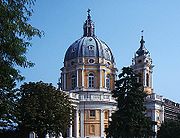
. The visual impact of his Basilica di Superga (1717) derives from its soaring roof-line and masterful placement on a hill above Turin. The rustic ambiance encouraged a freer articulation of architectural form at the royal hunting lodge of the Palazzina di Stupinigi (1729). Juvarra finished his short but eventful career in Madrid, where he worked on the royal palaces at La Granja
La Granja (palace)
The Royal Palace of La Granja de San Ildefonso is an 18th century palace in the small town of San Ildefonso in the hills near Segovia, 80 km north of Madrid, central Spain, formerly the summer residence of the Kings of Spain since the reign of Philip V...
and Aranjuez
Palacio Real de Aranjuez
The Royal Palace of Aranjuez is a residence of the King of Spain, located in the town of Aranjuez, Community of Madrid, Spain. The palace is open to the public as one of the Spanish royal sites....
.
Among the many who were profoundly influenced by the brilliance and diversity of Juvarra and Guarini, none was more important than Bernardo Vittone
Bernardo Vittone
Bernardo Antonio Vittone was an Italian architect and writer. He was one of the three most important Baroque architects active in the Piedmont region of Northern Italy; the other two were Filippo Juvarra and Guarino Guarini. The youngest of the three, Vittone was the only one who was born in the...
. This Piedmontese architect is remembered for an outcrop of flamboyant Rococo
Rococo
Rococo , also referred to as "Late Baroque", is an 18th-century style which developed as Baroque artists gave up their symmetry and became increasingly ornate, florid, and playful...
churches, quatrefoil in plan and delicate in detailing. His sophisticated designs often feature multiple vaults, structures within structures and domes within domes.
Malta
The island of MaltaMalta
Malta , officially known as the Republic of Malta , is a Southern European country consisting of an archipelago situated in the centre of the Mediterranean, south of Sicily, east of Tunisia and north of Libya, with Gibraltar to the west and Alexandria to the east.Malta covers just over in...
contains a variety of Baroque architecture, most importantly the capital city of Valletta
Valletta
Valletta is the capital of Malta, colloquially known as Il-Belt in Maltese. It is located in the central-eastern portion of the island of Malta, and the historical city has a population of 6,098. The name "Valletta" is traditionally reserved for the historic walled citadel that serves as Malta's...
. It was laid out in 1566 to fortify the Knights of Rhodes
Knights Hospitaller
The Sovereign Military Hospitaller Order of Saint John of Jerusalem of Rhodes and of Malta , also known as the Sovereign Military Order of Malta , Order of Malta or Knights of Malta, is a Roman Catholic lay religious order, traditionally of military, chivalrous, noble nature. It is the world's...
, who had taken over the island when they were driven from Rhodes by Islamic armies. The city, designed by Francesco Laparelli on a grid plan, and built up over the next century, remains a particularly coherent example of Baroque urbanism. Its massive fortifications, which were considered state of the art until the modern age, are also largely intact. Valletta became a UNESCO World Heritage Site in 1980.
Spain
As Italian Baroque influences penetrated across the PyreneesPyrenees
The Pyrenees is a range of mountains in southwest Europe that forms a natural border between France and Spain...
, they gradually superseded in popularity the restrained classicizing approach of Juan de Herrera
Juan de Herrera
Juan de Herrera was a Spanish architect, mathematician and geometrician.One of the most outstanding Spanish architects in the 16th century, Herrera represents the peak of the Renaissance in Spain. His sober style was fully developed in buildings like the Monastery of San Lorenzo de El Escorial...
, which had been in vogue since the late 16th century. As early as 1667, the façades of Granada Cathedral
Granada Cathedral
Granada Cathedral is the cathedral in the city of Granada, capital of the province of the same name in the Autonomous Region of Andalusia, Spain.-History:...
(by Alonso Cano) and Jaén Cathedral
Jaén, Spain
Jaén is a city in south-central Spain, the name is derived from the Arabic word Jayyan, . It is the capital of the province of Jaén. It is located in the autonomous community of Andalusia....
(by Eufrasio López de Rojas) suggest the artists' fluency in interpreting traditional motifs of Spanish cathedral architecture in the Baroque aesthetic idiom.
Churriguera
The Churriguera family consisted of at least two generations of Spanish sculptors and architects, originally from Barcelona, but who had their greatest impact in Salamanca...
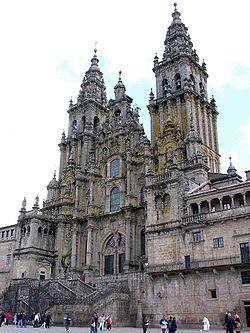
family, which specialized in designing altars and retables, revolted against the sobriety of the Herreresque classicism and promoted an intricate, exaggerated, almost capricious style of surface decoration known as the Churrigueresque
Churrigueresque
Churrigueresque refers to a Spanish Baroque style of elaborate sculptural architectural ornament which emerged as a manner of stucco decoration in Spain in the late 17th century and was used up to about 1750, marked by extreme, expressive and florid decorative detailing, normally found above the...
. Within half a century, they transformed Salamanca
Salamanca
Salamanca is a city in western Spain, in the community of Castile and León. Because it is known for its beautiful buildings and urban environment, the Old City was declared a UNESCO World Heritage Site in 1988. It is the most important university city in Spain and is known for its contributions to...
into an exemplary Churrigueresque city. Among the highlights of the style, the interiors of the Granada Charterhouse
Granada Charterhouse
Granada Charterhouse is a Carthusian monastery in Granada, Spain. It is one of the finest examples of Spanish Baroque architecture.The charterhouse was founded in 1506; construction started ten years later, and continued for the following 300 years. While the exterior is a tame ember in...
offer some of the most impressive combinations of space and light in 18th-century Europe. Integrating sculpture and architecture even more radically, Narciso Tomé achieved striking chiaroscuro
Chiaroscuro
Chiaroscuro in art is "an Italian term which literally means 'light-dark'. In paintings the description refers to clear tonal contrasts which are often used to suggest the volume and modelling of the subjects depicted"....
effects in his Transparente for the Toledo Cathedral.
The development of the style passed through three phases. Between 1680 and 1720, the Churriguera popularized Guarini's blend of Solomonic column
Solomonic column
The Solomonic column, also called Barley-sugar column, is a helical column, characterized by a spiraling twisting shaft like a corkscrew...
s and composite order
Composite order
The composite order is a mixed order, combining the volutes of the Ionic order capital with the acanthus leaves of the Corinthian order. The composite order volutes are larger, however, and the composite order also has echinus molding with egg-and-dart ornamentation between the volutes...
, known as the "supreme order". Between 1720 and 1760, the Churrigueresque column, or estipite, in the shape of an inverted cone or obelisk, was established as a central element of ornamental decoration. The years from 1760 to 1780 saw a gradual shift of interest away from twisted movement and excessive ornamentation toward a neoclassical balance and sobriety.
Two of the most eye-catching creations of Spanish Baroque are the energetic façades of the University of Valladolid
University of Valladolid
The University of Valladolid is a public university in the city of Valladolid, province of Valladolid, in the autonomous region of Castile-Leon, Spain...
(Diego Tomé, 1719) and Hospicio de San Fernando in Madrid
Madrid
Madrid is the capital and largest city of Spain. The population of the city is roughly 3.3 million and the entire population of the Madrid metropolitan area is calculated to be 6.271 million. It is the third largest city in the European Union, after London and Berlin, and its metropolitan...
(Pedro de Ribera, 1722), whose curvilinear extravagance seems to herald Antonio Gaudí and Art Nouveau
Art Nouveau
Art Nouveau is an international philosophy and style of art, architecture and applied art—especially the decorative arts—that were most popular during 1890–1910. The name "Art Nouveau" is French for "new art"...
. In this case as in many others, the design involves a play of tectonic and decorative elements with little relation to structure and function. The focus of the florid ornamentation is an elaborately sculptured surround to a main doorway. If we remove the intricate maze of broken pediments, undulating cornices, stucco shells, inverted tapers, and garlands from the rather plain wall it is set against, the building's form would not be affected in the slightest.
Spanish America and the Philippines
Cusco
Cusco , often spelled Cuzco , is a city in southeastern Peru, near the Urubamba Valley of the Andes mountain range. It is the capital of the Cusco Region as well as the Cuzco Province. In 2007, the city had a population of 358,935 which was triple the figure of 20 years ago...
was built. Even then, the new style hardly affected the structure of churches.
To the north, the richest province of 18th-century New Spain
New Spain
New Spain, formally called the Viceroyalty of New Spain , was a viceroyalty of the Spanish colonial empire, comprising primarily territories in what was known then as 'América Septentrional' or North America. Its capital was Mexico City, formerly Tenochtitlan, capital of the Aztec Empire...
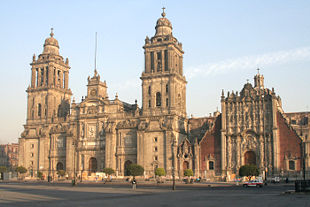
—Mexico—produced some fantastically extravagant and visually frenetic architecture known as Mexican Churrigueresque. This ultra-Baroque approach culminates in the works of Lorenzo Rodriguez, whose masterpiece is the Sagrario Metropolitano in Mexico City
Mexico City
Mexico City is the Federal District , capital of Mexico and seat of the federal powers of the Mexican Union. It is a federal entity within Mexico which is not part of any one of the 31 Mexican states but belongs to the federation as a whole...
. Other fine examples of the style may be found in remote silver-mining towns. For instance, the Sanctuary at Ocotlán
Ocotlán, Tlaxcala
Ocotlán is a city in the Mexican state of Tlaxcala, located in the centre of that state within the conurbation of the state capital, Tlaxcala de Xicohténcatl....
(begun in 1745) is a top-notch Baroque cathedral surfaced in bright red tiles, which contrast delightfully with a plethora of compressed ornament lavishly applied to the main entrance and the slender flanking towers.
The true capital of Mexican Baroque is Puebla
Puebla, Puebla
The city and municipality of Puebla is the capital of the state of Puebla, and one of the five most important colonial cities in Mexico. Being a planned city, it is located to the east of Mexico City and west of Mexico's main port, Veracruz, on the main route between the two.The city was founded...
, where a ready supply of hand-painted ceramics (talavera
Talavera (pottery)
Talavera pottery of Puebla, Mexico is a type of majolica pottery, which is distinguished by a milky-white glaze. Authentic Talavera pottery only comes from the city of Puebla and the nearby communities of Atlixco, Cholula, and Tecali, because of the quality of the natural clay found there and the...
) and vernacular gray stone led to its evolving further into a personalised and highly localised art form with a pronounced Indian flavour. There are about sixty churches whose façades and domes display glazed tiles of many colours, often arranged in Arabic designs. The interiors are densely saturated with elaborate gold leaf ornamentation. In the 18th century, local artisans developed a distinctive brand of white stucco decoration, named "alfenique" after a Pueblan candy made from egg whites and sugar.
The Peruvian Baroque was particularly lavish, as evidenced by the monastery of San Francisco at Lima
Lima
Lima is the capital and the largest city of Peru. It is located in the valleys of the Chillón, Rímac and Lurín rivers, in the central part of the country, on a desert coast overlooking the Pacific Ocean. Together with the seaport of Callao, it forms a contiguous urban area known as the Lima...
(1673). While the rural Baroque of the Jesuit Block and Estancias of Córdoba
Jesuit Block and Estancias of Córdoba
The Jesuit Block and Estancias of Córdoba are a former Jesuit reduction built by missionaries in the province of Córdoba, Argentina, named a World Heritage Site in 2000....
in Córdoba, Argentina
Córdoba, Argentina
Córdoba is a city located near the geographical center of Argentina, in the foothills of the Sierras Chicas on the Suquía River, about northwest of Buenos Aires. It is the capital of Córdoba Province. Córdoba is the second-largest city in Argentina after the federal capital Buenos Aires, with...
, followed the model of Il Gesu, provincial "mestizo" (crossbred) styles emerged in Arequipa
Arequipa
Arequipa is the capital city of the Arequipa Region in southern Peru. With a population of 836,859 it is the second most populous city of the country...
, Potosí
Potosí
Potosí is a city and the capital of the department of Potosí in Bolivia. It is one of the highest cities in the world by elevation at a nominal . and it was the location of the Spanish colonial mint, now the National Mint of Bolivia...
, and La Paz
La Paz
Nuestra Señora de La Paz is the administrative capital of Bolivia, as well as the departmental capital of the La Paz Department, and the second largest city in the country after Santa Cruz de la Sierra...
. In the 18th century, architects of the region turned for inspiration to the Mudéjar
Mudéjar
Mudéjar is the name given to individual Moors or Muslims of Al-Andalus who remained in Iberia after the Christian Reconquista but were not converted to Christianity...
art of medieval Spain. The late Baroque type of Peruvian façade first appears in the Church of Our Lady of La Merced in Lima. Similarly, the Church of La Compañia, (Quito
Quito
San Francisco de Quito, most often called Quito , is the capital city of Ecuador in northwestern South America. It is located in north-central Ecuador in the Guayllabamba river basin, on the eastern slopes of Pichincha, an active stratovolcano in the Andes mountains...
) suggests a carved altarpiece with its richly sculpted façade and a surfeit of spiral salomónica.
Portugal and Portuguese Empire
.jpg)

Madrid
Madrid is the capital and largest city of Spain. The population of the city is roughly 3.3 million and the entire population of the Madrid metropolitan area is calculated to be 6.271 million. It is the third largest city in the European Union, after London and Berlin, and its metropolitan...
and Lisbon
Lisbon
Lisbon is the capital city and largest city of Portugal with a population of 545,245 within its administrative limits on a land area of . The urban area of Lisbon extends beyond the administrative city limits with a population of 3 million on an area of , making it the 9th most populous urban...
generally favoured a more sober architectural vocabulary distilled from 17th-century Italy. The royal palaces of Madrid
Royal Palace of Madrid
The Palacio Real de Madrid is the official residence of the King of Spain in the city of Madrid, but it is only used for state ceremonies. King Juan Carlos and the Royal Family do not reside in the palace, choosing instead the more modest Palacio de la Zarzuela on the outskirts of Madrid...
—La Granja
La Granja (palace)
The Royal Palace of La Granja de San Ildefonso is an 18th century palace in the small town of San Ildefonso in the hills near Segovia, 80 km north of Madrid, central Spain, formerly the summer residence of the Kings of Spain since the reign of Philip V...
, Aranjuez
Palacio Real de Aranjuez
The Royal Palace of Aranjuez is a residence of the King of Spain, located in the town of Aranjuez, Community of Madrid, Spain. The palace is open to the public as one of the Spanish royal sites....
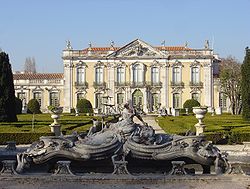
, Mafra, and Queluz—were designed by architects under strong influence of Bernini and Juvarra. In the realm of church architecture, Guarini's design for Santa Maria della Divina Providenza in Lisbon was a pace-setter for structural audacity in the region (even though it was never built).
In Portugal, the first fully Baroque church was the Church of Santa Engrácia
Church of Santa Engrácia
The Church of Santa Engrácia is a 17th century monument of the city of Lisbon, in Portugal. In the 20th century the church has been converted into the National Pantheon , in which important Portuguese personalities are buried...
, in Lisbon, designed by royal architect João Antunes
João Antunes
João Antunes was a Portuguese architect, considered one of the most important Baroque architects of Portugal.As royal architect, Antunes' main work is the Church of Santa Engrácia in Lisbon, a Greek cross building with curved façades typical of the Baroque architecture of Borromini...
, which has a Greek cross floorplan and curved facades. Antunes also designed churches in which the inner space is rectangular but with curved corners (like the Menino de Deus Church in Lisbon), a scheme that is found in several 18th century churches in Portugal and Brazil. The court of John V, on the other hand, favoured Roman baroque models, as attested by the work of royal architect Ludovice
Ludovice
Johann Friedrich Ludwig , known in Portugal as João Frederico Ludovice, was a German born architect and goldsmith.Ludovice was born in Hohenhart. In 1698 he went to Italy, where he married and converted to Catholicism, changing his name to Ludovici...
, a German who designed the Royal Palace of Mafra, built after 1715.
By the mid-18th century, northern Portuguese architects had absorbed the concepts of Italian Baroque to revel in the plasticity of local granite in such projects as the surging 75-metre-high Torre dos Clérigos in Porto
Porto
Porto , also known as Oporto in English, is the second largest city in Portugal and one of the major urban areas in the Iberian Peninsula. Its administrative limits include a population of 237,559 inhabitants distributed within 15 civil parishes...
. The foremost centre of the national Baroque tradition was Braga
Braga
Braga , a city in the Braga Municipality in northwestern Portugal, is the capital of the Braga District, the oldest archdiocese and the third major city of the country. Braga is the oldest Portuguese city and one of the oldest Christian cities in the World...
, whose buildings encompass virtually every important feature of Portuguese architecture and design. The Baroque shrines and palaces of Braga are noted for polychrome ornamental patterns, undulating roof-lines, and irregularly shaped window surrounds.
Brazilian architects also explored plasticity in form and decoration, though they rarely surpassed their continental peers in ostentation. The churches of Mariana and the Rosario at Ouro Preto are based on Borromini's vision of interlocking elliptical spaces. At São Pedro dos Clérigos, Recife), a conventional stucco-and-stone façade is enlivened by "a high scrolled gable squeezed tightly between the towers".[8]
Even after the Baroque conventions passed out of fashion in Europe, the style was long practised in Brazil by Aleijadinho, a brilliant and prolific architect in whose designs hints of Rococo could be discerned. His church of Bom Jesus de Matozinhos at Congonhas is distinguished by a picturesque silhouette and dark ornamental detail on a light stuccoed façade. Although Aleijadinho was originally commissioned to design São Francisco de Assis at São João del Rei, his designs were rejected, and were displaced to the church of São Francisco in Ouro Preto instead.
France
Salomon de Brosse
Salomon de Brosse was the most influential early 17th-century French architect, a major influence on François Mansart. Salomon was from a prominent Huguenot family, the grandson through his mother of the designer Jacques I Androuet du Cerceau and the son of the architect Jean de Brosse...
that determined the sober and classicizing direction that French Baroque architecture was to take. For the first time, the corps de logis
Corps de logis
Corps de logis is the architectural term which refers to the principal block of a large, usually classical, mansion or palace. It contains the principal rooms, state apartments and an entry. The grandest and finest rooms are often on the first floor above the ground level: this floor is the...
was emphasized as the representative main part of the building, while the side wings were treated as hierarchically inferior and appropriately scaled down. The medieval tower has been completely replaced by the central projection in the shape of a monumental three-storey gateway.
De Brosse's melding of traditional French elements (e.g. lofty mansard roof
Mansard roof
A mansard or mansard roof is a four-sided gambrel-style hip roof characterized by two slopes on each of its sides with the lower slope at a steeper angle than the upper that is punctured by dormer windows. The roof creates an additional floor of habitable space, such as a garret...
s and a complex roof-line) with extensive Italianate quotations (e.g. ubiquitous rustication, derived from Palazzo Pitti
Palazzo Pitti
The Palazzo Pitti , in English sometimes called the Pitti Palace, is a vast mainly Renaissance palace in Florence, Italy. It is situated on the south side of the River Arno, a short distance from the Ponte Vecchio...
in Florence
Florence
Florence is the capital city of the Italian region of Tuscany and of the province of Florence. It is the most populous city in Tuscany, with approximately 370,000 inhabitants, expanding to over 1.5 million in the metropolitan area....
) came to characterize the Louis XIII style
Louis XIII style
The Louis XIII style or Louis Treize was a fashion in French art and architecture, especially effecting the visual and decorative arts. Its distinctness as a period in the history of French art has much to do with the regency under which Louis XIII began his reign...
. Probably the most accomplished formulator of the new manner was François Mansart
François Mansart
François Mansart was a French architect credited with introducing classicism into Baroque architecture of France...
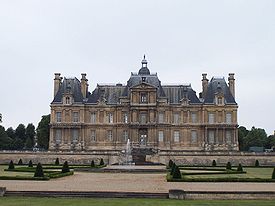
, a tireless perfectionist credited with introducing the full Baroque to France. In his design for Château de Maisons
Château de Maisons
The Château de Maisons , designed by François Mansart from 1630 to 1651, is a prime example of French baroque architecture and a reference point in the history of French architecture...
(1642), Mansart succeeded in reconciling academic and Baroque approaches, while demonstrating respect for the gothic-inherited idiosyncrasies of the French tradition.
Château
A château is a manor house or residence of the lord of the manor or a country house of nobility or gentry, with or without fortifications, originally—and still most frequently—in French-speaking regions...
x of the 16th century to the villa-like country houses of the 18th. The structure is strictly symmetrical, with an order applied to each storey, mostly in pilaster
Pilaster
A pilaster is a slightly-projecting column built into or applied to the face of a wall. Most commonly flattened or rectangular in form, pilasters can also take a half-round form or the shape of any type of column, including tortile....
form. The frontispiece, crowned with a separate aggrandized roof, is infused with remarkable plasticity and the ensemble reads like a three-dimensional whole. Mansart's structures are stripped of overblown decorative effects, so typical of contemporary Rome. Italian Baroque influence is muted and relegated to the field of decorative ornamentation.
The next step in the development of European residential architecture involved the integration of the gardens in the composition of the palace, as is exemplified by Vaux-le-Vicomte
Vaux-le-Vicomte
The Château de Vaux-le-Vicomte is a baroque French château located in Maincy, near Melun, 55 km southeast of Paris in the Seine-et-Marne département of France...
), where the architect Louis Le Vau
Louis Le Vau
Louis Le Vau was a French Classical architect who worked for Louis XIV of France. He was born and died in Paris.He was responsible, with André Le Nôtre and Charles Le Brun, for the redesign of the château of Vaux-le-Vicomte. His later works included the Palace of Versailles and his collaboration...
, the designer Charles Le Brun
Charles Le Brun
Charles Le Brun , a French painter and art theorist, became the all-powerful, peerless master of 17th-century French art.-Biography:-Early life and training:...
and the gardener André Le Nôtre
André Le Nôtre
André Le Nôtre was a French landscape architect and the principal gardener of King Louis XIV of France...
complemented one another. From the main cornice to a low plinth, the miniature palace is clothed in the so-called "colossal order", which makes the structure look more impressive. The creative collaboration of Le Vau and Le Nôtre marked the arrival of the "Magnificent Manner" which allowed to extend Baroque architecture outside the palace walls and transform the surrounding landscape into an immaculate mosaic of expansive vistas.
The same three artists scaled this concept to monumental proportions in the royal hunting lodge and later main residence at Versailles
Palace of Versailles
The Palace of Versailles , or simply Versailles, is a royal château in Versailles in the Île-de-France region of France. In French it is the Château de Versailles....
. On a far grander scale, the palace is an exaggerated and somewhat repetitive version of Vaux-le-Vicomte. It was both the most grandiose and the most imitated residential building of the 17th century. Mannheim
Mannheim
Mannheim is a city in southwestern Germany. With about 315,000 inhabitants, Mannheim is the second-largest city in the Bundesland of Baden-Württemberg, following the capital city of Stuttgart....
, Nordkirchen
Nordkirchen
Nordkirchen is a municipality in the district of Coesfeld, in North Rhine-Westphalia, Germany. Nordkirchen's most famous site is Schloss Nordkirchen, built in the 18th century for a local bishop and known as the Versailles of Westphalia, as it is the largest residence in that part of Germany...
and Drottningholm
Drottningholm Palace
The Drottningholm Palace is the private residence of the Swedish royal family. It is located in Drottningholm. It is built on the island Lovön , and is one of Sweden's Royal Palaces. It was originally built in the late 16th century. It served as a residence of the Swedish royal court for most of...
were among many foreign residences for which Versailles provided a model.
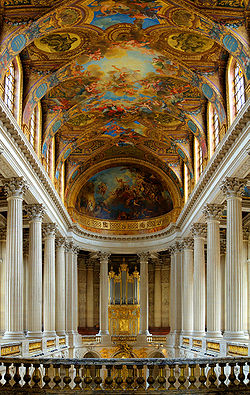
The final expansion of Versailles was superintended by Jules Hardouin-Mansart, whose key design is the Dome des Invalides), generally regarded as the most important French church of the century. Hardouin-Mansart profited from his uncle's instruction and plans to instill the edifice with an imperial grandeur unprecedented in the countries north of Italy. The majestic hemispherical dome balances the vigorous vertical thrust of the orders, which do not accurately convey the structure of the interior. The younger architect not only revived the harmony and balance associated with the work of the elder Mansart but also set the tone for Late Baroque French architecture, with its grand ponderousness and increasing concessions to academicism.
The reign of Louis XV saw a reaction against the official Louis XIV Style in the shape of a more delicate and intimate manner, known as Rococo
Rococo
Rococo , also referred to as "Late Baroque", is an 18th-century style which developed as Baroque artists gave up their symmetry and became increasingly ornate, florid, and playful...
. The style was pioneered by Nicolas Pineau
Nicolas Pineau
Nicolas Pineau was a French carver and ornamental designer, one of the leaders who initiated the exuberant asymmetrical phase of the high Rococo. He worked in St...
, who collaborated with Hardouin-Mansart on the interiors of the royal Château de Marly
Château de Marly
The Château de Marly was a relatively small French royal residence located in what has become Marly-le-Roi, the commune that existed at the edge of the royal park. The town that originally grew up to service the château is now a dormitory community for Paris....
. Further elaborated by Pierre Le Pautre and Juste-Aurèle Meissonier, the "genre pittoresque" culminated in the interiors of the Petit Château at Chantilly
Château de Chantilly
The Château de Chantilly is a historic château located in the town of Chantilly, France. It comprises two attached buildings; the Grand Château, destroyed during the French Revolution and rebuilt in the 1870s, and the Petit Château which was built around 1560 for Anne de Montmorency...
(c. 1722) and Hôtel de Soubise
Hôtel de Soubise
The Hôtel de Soubise is a city mansion entre cour et jardin , located at 60 rue des Francs-Bourgeois, in the IIIe arrondissement of Paris....
in Paris (c. 1732), where a fashionable emphasis on the curvilinear went beyond all reasonable measure, while sculpture, paintings, furniture, and porcelain tended to overshadow architectural divisions of the interior.
Southern Netherlands
Baroque architecture in the Southern NetherlandsSouthern Netherlands
Southern Netherlands were a part of the Low Countries controlled by Spain , Austria and annexed by France...
developed rather differently than in the Protestant North. After the Twelve Years' Truce
Twelve Years' Truce
The Twelve Years' Truce was the name given to the cessation of hostilities between the Habsburg rulers of Spain and the Southern Netherlands and the Dutch Republic as agreed in Antwerp on 9 April 1609. It was a watershed in the Eighty Years' War, marking the point from which the independence of the...
, the Southern Netherlands remained in Catholic hands, ruled by the Spanish Habsburg
Habsburg
The House of Habsburg , also found as Hapsburg, and also known as House of Austria is one of the most important royal houses of Europe and is best known for being an origin of all of the formally elected Holy Roman Emperors between 1438 and 1740, as well as rulers of the Austrian Empire and...
Kings. Important architectural projects were set up in the spirit of the Counter-Reformation
Counter-Reformation
The Counter-Reformation was the period of Catholic revival beginning with the Council of Trent and ending at the close of the Thirty Years' War, 1648 as a response to the Protestant Reformation.The Counter-Reformation was a comprehensive effort, composed of four major elements:#Ecclesiastical or...
. In them, florid decorative detailing was more tightly knit to the structure, thus precluding concerns of superfluity. A remarkable convergence of Spanish, French, and Dutch Baroque aesthetics may be seen in the Abbey of Averbode (1667). Another characteristic example is the Church of St. Michel at Louvain
Leuven
Leuven is the capital of the province of Flemish Brabant in the Flemish Region, Belgium...
, with its exuberant two-storey façade, clusters of half-columns, and the complex aggregation of French-inspired sculptural detailing.
Six decades later, a Flemish
Flanders
Flanders is the community of the Flemings but also one of the institutions in Belgium, and a geographical region located in parts of present-day Belgium, France and the Netherlands. "Flanders" can also refer to the northern part of Belgium that contains Brussels, Bruges, Ghent and Antwerp...
architect, Jaime Borty Milia, was the first to introduce Rococo
Rococo
Rococo , also referred to as "Late Baroque", is an 18th-century style which developed as Baroque artists gave up their symmetry and became increasingly ornate, florid, and playful...
to Spain (Cathedral of Murcia
Cathedral of Murcia
The Cathedral Church of Saint Mary in Murcia , commonly called the Cathedral of Murcia, is a church the city of Murcia, Spain...
, west façade, 1733). The greatest practitioner of the Spanish Rococo style was a native master, Ventura Rodríguez
Ventura Rodríguez
Ventura Rodríguez Tizón was a Spanish architect and artist. Born at Ciempozuelos, Rodríguez was the son of a bricklayer. In 1727, he collaborated with his father in the work at the Royal Palace of Aranjuez.-Major works:...
, responsible for the dazzling interior of the Basilica of Our Lady of the Pillar
Basilica of Our Lady of the Pillar
The Basilica-Cathedral of Our Lady of the Pillar is a Roman Catholic church in the city of Zaragoza, Aragon, Spain. The Basilica venerates Blessed Virgin Mary, under her title Our Lady of the Pillar praised as Mother of the Hispanic Peoples by Pope John Paul II...
in Zaragoza
Zaragoza
Zaragoza , also called Saragossa in English, is the capital city of the Zaragoza Province and of the autonomous community of Aragon, Spain...
(1750).
Some Flemish architects such as Wenceslas Cobergher
Wenceslas Cobergher
Wenceslas Cobergher , sometimes called Wenzel Coebergher, was a Flemish Renaissance architect, engineer, painter, antiquarian, numismatist and economist. Faded somewhat into the background as a painter, he is chiefly remembered today as the man responsible for the draining of the Moëres on the...
were trained in Italy and their works were inspired by architects such as Jacopo Barozzi da Vignola and Giacomo della Porta
Giacomo della Porta
Giacomo della Porta was an Italian architect and sculptor, who worked on many important buildings in Rome, including St. Peter's Basilica. He was born at Porlezza, Lombardy and died in Rome.-Biography:...
. Cobergher's most major project was the Basilica of Our Lady of Scherpenheuvel
Scherpenheuvel-Zichem
Scherpenheuvel-Zichem is a municipality located in the province of Flemish Brabant, Flemish Region, Belgium, encompassing the towns of Averbode, Messelbroek, Okselaar, Scherpenheuvel, Schoonderbuken, Keiberg, Kaggevinne, Testelt and Zichem . On January 1, 2006 Scherpenheuvel-Zichem had a total...
which he designed as the center of a new town in the form of a heptagon.
The influence of the painter Pieter Paul Rubens on architecture was very important. With his book "I Palazzi di Genova" he introduced novel Italian models for the conception of profane buildings and decoration in the Southern Netherlands. The courtyard and portico of his own house in Antwerp (Rubenshuis
Rubenshuis
The Rubenshuis is the former home and studio of Peter Paul Rubens in Antwerp. It is now a museum.- Rubens's house during his lifetime :...
) are good examples of his architectural activity. He also took part in the decoration of the Antwerp Jesuit Church (now Carolus-Borromeuskerk) where he introduced a lavish Baroque decoration, integrating sculpture and painting in the architectural program.
Northern Netherlands
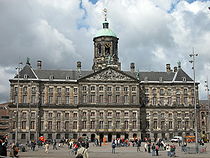
Jacob van Campen
Jacob van Campen , was a Dutch artist and architect of the Golden Age.-Life:He was born into a wealthy family at Haarlem, and spent his youth in his home town. Being of noble birth and with time on his hands, he took up painting mainly as a pastime...
and Pieter Post
Pieter Post
Pieter Jansz Post was a Dutch Golden Age architect, painter and printmaker.-Biography:...
, used such eclectic elements as giant-order pilasters, gable roofs, central pediments, and vigorous steeples in a coherent combination that anticipated Wren's Classicism.
The most ambitious constructions of the period included the seats of self-government in Amsterdam
Amsterdam
Amsterdam is the largest city and the capital of the Netherlands. The current position of Amsterdam as capital city of the Kingdom of the Netherlands is governed by the constitution of August 24, 1815 and its successors. Amsterdam has a population of 783,364 within city limits, an urban population...
(1646) and Maastricht
Maastricht
Maastricht is situated on both sides of the Meuse river in the south-eastern part of the Netherlands, on the Belgian border and near the German border...
(1658), designed by Campen and Post, respectively. On the other hand, the residences of the House of Orange are closer to a typical burgher mansion than to a royal palace. Two of these, Huis ten Bosch
Huis ten Bosch
Huis ten Bosch is one of the three official residences of the Dutch Royal Family, located in The Hague in the Netherlands. It has been home to Queen Beatrix since 1981. The other Royal palace in The Hague, Noordeinde Palace, is used for work-related purposes...
and Mauritshuis
Mauritshuis
The Royal Picture Gallery Mauritshuis is an art museum in The Hague, the Netherlands. Previously the residence of count John Maurice of Nassau, it now has a large art collection, including paintings by Dutch painters such as Johannes Vermeer, Rembrandt van Rijn, Jan Steen, Paulus Potter and Frans...
, are symmetrical blocks with large windows, stripped of ostentatious Baroque flourishes and mannerisms. The same austerely geometrical effect is achieved without great cost or pretentious effects at the Stadholder's summer residence of Het Loo
Het Loo
Het Loo Palace is a palace in Apeldoorn, Netherlands. The symmetrical Dutch Baroque building was designed by Jacob Roman and Johan van Swieten and was built between 1684 and 1686 for stadtholder-king William III and Mary II of England...
.
The Dutch Republic
Dutch Republic
The Dutch Republic — officially known as the Republic of the Seven United Netherlands , the Republic of the United Netherlands, or the Republic of the Seven United Provinces — was a republic in Europe existing from 1581 to 1795, preceding the Batavian Republic and ultimately...
was one of the great powers of 17th-century Europe and its influence on European architecture was by no means negligible. Dutch architects were employed on important projects in Northern Germany, Scandinavia and Russia, disseminating their ideas in those countries. The Dutch colonial architecture, once flourishing in the Hudson River
Hudson River
The Hudson is a river that flows from north to south through eastern New York. The highest official source is at Lake Tear of the Clouds, on the slopes of Mount Marcy in the Adirondack Mountains. The river itself officially begins in Henderson Lake in Newcomb, New York...
Valley and associated primarily with red-brick gabled houses, may still be seen in Willemstad, Netherlands Antilles
Willemstad, Netherlands Antilles
Willemstad is the capital city of Curaçao, an island in the southern Caribbean Sea that forms a constituent country of the Kingdom of the Netherlands. Formerly the capital of the Netherlands Antilles prior to its dissolution in 2010, it has an estimated population of 140,000. The historic centre of...
.
England
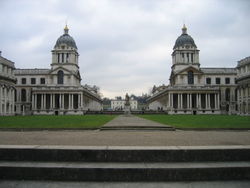
The Protectorate
In British history, the Protectorate was the period 1653–1659 during which the Commonwealth of England was governed by a Lord Protector.-Background:...
and the first Restoration years
English Restoration
The Restoration of the English monarchy began in 1660 when the English, Scottish and Irish monarchies were all restored under Charles II after the Interregnum that followed the Wars of the Three Kingdoms...
. For a decade between the death of Inigo Jones
Inigo Jones
Inigo Jones is the first significant British architect of the modern period, and the first to bring Italianate Renaissance architecture to England...
in 1652 and Christopher Wren
Christopher Wren
Sir Christopher Wren FRS is one of the most highly acclaimed English architects in history.He used to be accorded responsibility for rebuilding 51 churches in the City of London after the Great Fire in 1666, including his masterpiece, St. Paul's Cathedral, on Ludgate Hill, completed in 1710...
's visit to Paris in 1665 there was no English architect of the accepted premier class. Unsurprisingly, general interest in European architectural developments was slight.
It was Wren who presided over the genesis of the English Baroque manner, which differed from the continental models by a clarity of design and a subtle taste for classicism. Following the Great Fire of London
Great Fire of London
The Great Fire of London was a major conflagration that swept through the central parts of the English city of London, from Sunday, 2 September to Wednesday, 5 September 1666. The fire gutted the medieval City of London inside the old Roman City Wall...
, Wren rebuilt fifty-three churches, where Baroque aesthetics are apparent primarily in dynamic structure and multiple changing views. His most ambitious work was St Paul's Cathedral
St Paul's Cathedral
St Paul's Cathedral, London, is a Church of England cathedral and seat of the Bishop of London. Its dedication to Paul the Apostle dates back to the original church on this site, founded in AD 604. St Paul's sits at the top of Ludgate Hill, the highest point in the City of London, and is the mother...
, which bears comparison with the most effulgent domed churches of Italy and France. In this majestically proportioned edifice, the Palladian tradition of Inigo Jones is fused with contemporary continental sensibilities in masterly equilibrium. Less influential were straightforward attempts to engraft the Berniniesque vision onto British church architecture (e.g. by Thomas Archer
Thomas Archer
Thomas Archer was an English Baroque architect, whose work is somewhat overshadowed by that of his contemporaries Sir John Vanbrugh and Nicholas Hawksmoor. Archer was born at Umberslade Hall in Tanworth-in-Arden in Warwickshire, the youngest son of Thomas Archer, a country gentleman, Parliamentary...
in St. John's, Smith Square
St. John's, Smith Square
St John's, Smith Square is a church in the middle of Smith Square, Westminster, London. Sold to a charitable Trust as a ruin following firebombing in the Second World War, it was restored, the internal layout altered somewhat, and is now used as a concert hall....
, 1728).
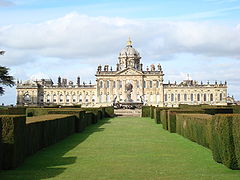
William Talman (architect)
William Talman was an English architect and landscape designer. A pupil of Sir Christopher Wren, in 1678 he and Thomas Apprice gained the office of King's Waiter in the Port of London...
at Chatsworth
Chatsworth House
Chatsworth House is a stately home in North Derbyshire, England, northeast of Bakewell and west of Chesterfield . It is the seat of the Duke of Devonshire, and has been home to his family, the Cavendish family, since Bess of Hardwick settled at Chatsworth in 1549.Standing on the east bank of the...
, starting in 1687. The culmination of Baroque architectural forms comes with Sir John Vanbrugh
John Vanbrugh
Sir John Vanbrugh – 26 March 1726) was an English architect and dramatist, perhaps best known as the designer of Blenheim Palace and Castle Howard. He wrote two argumentative and outspoken Restoration comedies, The Relapse and The Provoked Wife , which have become enduring stage favourites...
and Nicholas Hawksmoor
Nicholas Hawksmoor
Nicholas Hawksmoor was a British architect born in Nottinghamshire, probably in East Drayton.-Life:Hawksmoor was born in Nottinghamshire in 1661, into a yeoman farming family, almost certainly in East Drayton, Nottinghamshire. On his death he was to leave property at nearby Ragnall, Dunham and a...
. Each was capable of a fully developed architectural statement, yet they preferred to work in tandem, most notably at Castle Howard
Castle Howard
Castle Howard is a stately home in North Yorkshire, England, north of York. One of the grandest private residences in Britain, most of it was built between 1699 and 1712 for the 3rd Earl of Carlisle, to a design by Sir John Vanbrugh...
(1699) and Blenheim Palace
Blenheim Palace
Blenheim Palace is a monumental country house situated in Woodstock, Oxfordshire, England, residence of the dukes of Marlborough. It is the only non-royal non-episcopal country house in England to hold the title of palace. The palace, one of England's largest houses, was built between...
(1705).
Although these two palaces may appear somewhat ponderous or turgid to Italian eyes, their heavy embellishment and overpowering mass captivated the British public, albeit for a short while. Castle Howard is a flamboyant assembly of restless masses dominated by a cylindrical domed tower which would not be out of place in Dresden
Dresden
Dresden is the capital city of the Free State of Saxony in Germany. It is situated in a valley on the River Elbe, near the Czech border. The Dresden conurbation is part of the Saxon Triangle metropolitan area....
or Munich
Munich
Munich The city's motto is "" . Before 2006, it was "Weltstadt mit Herz" . Its native name, , is derived from the Old High German Munichen, meaning "by the monks' place". The city's name derives from the monks of the Benedictine order who founded the city; hence the monk depicted on the city's coat...
. Blenheim is a more solid construction, where the massed stone of the arched gates and the huge solid portico becomes the main ornament. Vanbrugh's final work was Seaton Delaval Hall
Seaton Delaval Hall
Seaton Delaval Hall is a Grade I listed country house in Northumberland, England. It is near the coast just north of Newcastle upon Tyne. Located between Seaton Sluice and Seaton Delaval, it was designed by Sir John Vanbrugh in 1718 for Admiral George Delaval and is now owned by the National...
(1718), a comparatively modest mansion yet unique in the structural audacity of its style. It was at Seaton Delaval that Vanbrugh, a skillful playwright, achieved the peak of Restoration drama, once again highlighting a parallel between Baroque architecture and contemporary theatre. Despite his efforts, Baroque was never truly to the English taste and well before his death in 1724, the style had lost currency in Britain.
Holy Roman Empire
In the Holy Roman EmpireHoly Roman Empire
The Holy Roman Empire was a realm that existed from 962 to 1806 in Central Europe.It was ruled by the Holy Roman Emperor. Its character changed during the Middle Ages and the Early Modern period, when the power of the emperor gradually weakened in favour of the princes...
, the Baroque period began somewhat later. Although the Augsburg
Augsburg
Augsburg is a city in the south-west of Bavaria, Germany. It is a university town and home of the Regierungsbezirk Schwaben and the Bezirk Schwaben. Augsburg is an urban district and home to the institutions of the Landkreis Augsburg. It is, as of 2008, the third-largest city in Bavaria with a...
architect Elias Holl
Elias Holl
Elias Holl was the most important architect of early German Baroque architecture.-Life:...
(1573–1646) and some theoretists, including Joseph Furttenbach the Elder already practiced the Baroque style, they remained without successors due to the ravages of the Thirty Years' War
Thirty Years' War
The Thirty Years' War was fought primarily in what is now Germany, and at various points involved most countries in Europe. It was one of the most destructive conflicts in European history....
. From about 1650 on, construction work resumes, and secular and ecclesiastical architecture are of equal importance. During an initial phase, master-masons from southern Switzerland and northern Italy, the so-called magistri Grigioni and the Lombard master-masons, particularly the Carlone family from Val d'Intelvi, dominated the field. However, Austria came soon to develop its own characteristic Baroque style during the last third of the 17th century. Johann Bernhard Fischer von Erlach
Johann Bernhard Fischer von Erlach
----Johann Bernhard Fischer von Erlach, born Johann Bernhard Fischer was probably the most influential Austrian architect of the Baroque period....
was impressed by Bernini. He forged a new Imperial style by compiling architectural motifs from the entire history, most prominently seen in his church of St. Charles Borromeo
Karlskirche
The St. Charles's Church is a church situated on the south side of Karlsplatz, Vienna. It is located on the edge of the 1st district, 200 metres outside the Ringstraße...
in Vienna. Johann Lucas von Hildebrandt also had an Italian training. He developed a highly decorative style, particularly in façade architecture, which exerted strong influences on southern Germany.
Frequently, the Southern German Baroque is distinguished from the Northern German Baroque, which is more properly the distinction between the Catholic and the Protestant Baroque. In the Catholic South, the Jesuit church of St. Michael
St. Michael's Church, Munich
St Michael is a Jesuit church in Munich, southern Germany, the largest Renaissance church north of the Alps. The style of the building had an enormous influence on Southern German early Baroque architecture.-Architecture:...
in Munich
Munich
Munich The city's motto is "" . Before 2006, it was "Weltstadt mit Herz" . Its native name, , is derived from the Old High German Munichen, meaning "by the monks' place". The city's name derives from the monks of the Benedictine order who founded the city; hence the monk depicted on the city's coat...
was the first to bring Italian style across the Alps. However, its influence on the further development of church architecture was rather limited. A much more practical and more adaptable model of church architecture was provided by the Jesuit church in Dillingen): the wall-pillar church, a barrel-vaulted nave accompanied by large open chapels separated by wall-pillars. As opposed to St. Michael's in Munich, the chapels almost reach the height of the nave in the wall-pillar church, and their vault (usually transverse barrel-vaults) springs from the same level as the main vault of the nave. The chapels provide ample lighting; seen from the entrance of the church, the wall-pillars form a theatrical setting for the side altars. The wall-pillar church was further developed by the Vorarlberg
Vorarlberg
Vorarlberg is the westernmost federal-state of Austria. Although it is the second smallest in terms of area and population , it borders three countries: Germany , Switzerland and Liechtenstein...
school, as well as the master-masons of Bavaria
Bavaria
Bavaria, formally the Free State of Bavaria is a state of Germany, located in the southeast of Germany. With an area of , it is the largest state by area, forming almost 20% of the total land area of Germany...
. This new church also integrated well with the hall church
Hall church
A hall church is a church with nave and side aisles of approximately equal height, often united under a single immense roof. The term was first coined in the mid-19th century by the pioneering German art historian Wilhelm Lübke....
model of the German late Gothic age. The wall-pillar church continued to be used throughout the 18th century (e.g. even in the early neo-classical church of Rot an der Rot Abbey
Rot an der Rot Abbey
Rot an der Rot Abbey was a Premonstratensian monastery in Rot an der Rot in Upper Swabia, Baden-Württemberg, Germany. It was the first Premonstratensian monastery in the whole of Swabia...
), and early wall-pillar churches could easily be refurbished by re-decoration without any structural changes, such as the church at Dillingen.
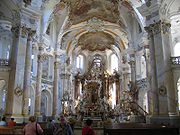
Bohemia
Bohemia is a historical region in central Europe, occupying the western two-thirds of the traditional Czech Lands. It is located in the contemporary Czech Republic with its capital in Prague...
. The radical Baroque of Christoph Dientzenhofer and his son Kilian Ignaz Dientzenhofer, both residing at Prague
Prague
Prague is the capital and largest city of the Czech Republic. Situated in the north-west of the country on the Vltava river, the city is home to about 1.3 million people, while its metropolitan area is estimated to have a population of over 2.3 million...
, was inspired by examples from northern Italy, particularly by the works of Guarino Guarini. It is characterized by the curvature of walls and intersection of oval spaces. While some Bohemian influence is visible in Bavaria's most prominent architect of the period, Johann Michael Fischer
Johann Michael Fischer
Johann Michael Fischer was a German architect in the late Baroque period....
(the curved balconies of some of his earlier wall-pillar churches), the works of Balthasar Neumann
Balthasar Neumann
Johann Balthasar Neumann , also known as Balthasar Neumann, was a [German] military artillery engineer and architect who developed a refined brand of Baroque architecture, fusing Austrian, Bohemian, Italian, and French elements to design some of the most impressive buildings of the period,...
, in particular the Basilica of the Vierzehnheiligen, are generally considered to be the final synthesis of Bohemian and German traditions.
Protestant sacred architecture was of lesser importance during the Baroque, and produced only a few works of prime importance, particularly the Frauenkirche
Dresden Frauenkirche
The Dresden Frauenkirche is a Lutheran church in Dresden, eastern Germany.Built in the 18th century, the church was destroyed in the firebombing of Dresden during World War II. It has been reconstructed as a landmark symbol of reconciliation between former warring enemies...
in Dresden
Dresden
Dresden is the capital city of the Free State of Saxony in Germany. It is situated in a valley on the River Elbe, near the Czech border. The Dresden conurbation is part of the Saxon Triangle metropolitan area....
. Architectural theory was more lively in the north than in the south of Germany, with Leonhard Christoph Sturm's edition of Nikolaus Goldmann, but Sturm's theoretical considerations (e.g. on Protestant church architecture) never really made it to practical application. In the south, theory essentially reduced to the use of buildings and elements from illustrated books and engravings as a prototype.
Palace architecture was equally important both in the Catholic South and the Protestant North. After an initial phase when Italian architects and influences dominated (Vienna
Vienna
Vienna is the capital and largest city of the Republic of Austria and one of the nine states of Austria. Vienna is Austria's primary city, with a population of about 1.723 million , and is by far the largest city in Austria, as well as its cultural, economic, and political centre...
, Rastatt
Rastatt
Rastatt is a city and baroque residence in the District of Rastatt, Baden-Württemberg, Germany. It is located on the Murg river, above its junction with the Rhine and has a population of around 50'000...
), French influence prevailed from the second decade of the 18th century onwards. The French model is characterized by the horseshoe-like layout enclosing a cour d'honneur (courtyard) on the town side (chateau entre cour et jardin), whereas the Italian (and also Austrian) scheme presents a block-like villa. The principal achievements of German Palace architecture, often worked out in close collaboration of several architects, provide a synthesis of Austro-Italian and French models. The most outstanding palace which blends Austro-Italian and French influences into a completely new type of building is the Würzburg Residence
Würzburg Residence
The Würzburg Residence is a palace in Würzburg, southern Germany. Johann Lukas von Hildebrandt and Maximilian von Welsch, representants of the Austrian/South German Baroque were involved in the construction, as well as Robert de Cotte and Germain Boffrand, who were followers of the French Style...
. While its general layout is the horseshoe-like French plan, it encloses interior courtyards. Its façades combine Lucas von Hildebrandt's love of decoration with French-style classical orders in two superimposed stories; its interior features the famous Austrian "imperial staircase", but also a French-type enfilade
Enfilade (architecture)
In architecture, an enfilade is a suite of rooms formally aligned with each other. This was a common feature in grand European architecture from the Baroque period onwards, although there are earlier examples, such as the Vatican stanze...
of rooms on the garden side, inspired by the "apartement semi-double" layout of French castles.
Polish–Lithuanian Commonwealth
The first Baroque church in the Polish–Lithuanian Commonwealth was the Corpus Christi Church in Niasvizh, BelarusBelarus
Belarus , officially the Republic of Belarus, is a landlocked country in Eastern Europe, bordered clockwise by Russia to the northeast, Ukraine to the south, Poland to the west, and Lithuania and Latvia to the northwest. Its capital is Minsk; other major cities include Brest, Grodno , Gomel ,...
(1586–1593). It also holds a distinction of being the first domed basilica with Baroque façade in the Commonwealth and the first Baroque piece of art in Eastern Europe.
In the early 17th century, the Baroque style spread over the Commonwealth. Important Baroque churches include the SS. Peter and Paul (1597–1619) constructed in the early Baroque style following the pattern of the Vignola's il Gesù
Church of the Gesu
The Church of the Gesù is the mother church of the Society of Jesus, a Roman Catholic religious order also known as the Jesuits. Officially named , its facade is "the first truly baroque façade", introducing the baroque style into architecture ,. The church served as model for innumerable Jesuit...
, the Vasa Chapel (1644–1676) of the Wawel Cathedral
Wawel Cathedral
The Wawel Cathedral, also known as the Cathedral Basilica of Sts. Stanisław and Vaclav, is a church located on Wawel Hill in Kraków–Poland's national sanctuary. It has a 1,000-year history and was the traditional coronation site of Polish monarchs. It is the Cathedral of the Archdiocese of Kraków...
, Baroque equivalent to neighbouring renaissance Sigismund's Chapel
Sigismund's Chapel
"Sigismund's Chapel" of the Wawel Cathedral is one of the most notable pieces of architecture in Kraków. Built as a funerary chapel for the last Jagiellons, it has been hailed by many art historians as "the most beautiful example of the Tuscan Renaissance north of the Alps"...
, St. Anne
Church of St. Anne, Kraków
The Church of St. Anne located at ulica św. Anny 11 street in the historic centre of Kraków, Poland, is one of the leading examples of Polish Baroque architecture. The church's history dates back to 14th century.- History :...
(1689–1703) and the Visitationist Church (1692–1695) in Kraków
Kraków
Kraków also Krakow, or Cracow , is the second largest and one of the oldest cities in Poland. Situated on the Vistula River in the Lesser Poland region, the city dates back to the 7th century. Kraków has traditionally been one of the leading centres of Polish academic, cultural, and artistic life...
, St. Casimir's Chapel
Vilnius Cathedral
The Cathedral of Vilnius is the main Roman Catholic Cathedral of Lithuania.It is situated in Vilnius Old Town, just off of Cathedral Square. It is the heart of Lithuania's Catholic spiritual life....
(1623–1636) of the Vilnius Cathedral
Vilnius Cathedral
The Cathedral of Vilnius is the main Roman Catholic Cathedral of Lithuania.It is situated in Vilnius Old Town, just off of Cathedral Square. It is the heart of Lithuania's Catholic spiritual life....
, another inspiration of Wawel's Sigismund's Chapel, SS. Peter and Paul Church (1668–1676) and St. Casimir's Church (1604–1618, 1750–1755) in Vilnius
Vilnius
Vilnius is the capital of Lithuania, and its largest city, with a population of 560,190 as of 2010. It is the seat of the Vilnius city municipality and of the Vilnius district municipality. It is also the capital of Vilnius County...
, Pažaislis monastery
Pažaislis Monastery
Pažaislis monastery and church form the largest monastery complex in Lithuania, and the most magnificent example of Italian baroque architecture in the country...
(1667–1712) in Kaunas
Kaunas
Kaunas is the second-largest city in Lithuania and has historically been a leading centre of Lithuanian economic, academic, and cultural life. Kaunas was the biggest city and the center of a powiat in Trakai Voivodeship of the Grand Duchy of Lithuania since 1413. During Russian Empire occupation...
inspired by examples from northern Italy, the Dominican Church
Dominican Church, Lviv
The Dominican church and monastery in Lviv, Ukraine is located in the city's Old Town, east of the market square. It was originally built as the Roman Catholic church of Corpus Christi, and today serves as the Greek Catholic church of the Holy Eucharist....
(1744–1769) modelled after St. Charles's Church in Vienna
Vienna
Vienna is the capital and largest city of the Republic of Austria and one of the nine states of Austria. Vienna is Austria's primary city, with a population of about 1.723 million , and is by far the largest city in Austria, as well as its cultural, economic, and political centre...
and St. George's Church
St. George's Cathedral, Lviv
St. George's Cathedral is a baroque-rococo cathedral located in the city of Lviv, the historic capital of western Ukraine. It was constructed between 1744-1760 on a hill overlooking the city. This is the third manifestation of a church to inhabit the site since the 13th century, and its prominence...
(1746–1762) in Lviv
Lviv
Lviv is a city in western Ukraine. The city is regarded as one of the main cultural centres of today's Ukraine and historically has also been a major Polish and Jewish cultural center, as Poles and Jews were the two main ethnicities of the city until the outbreak of World War II and the following...
. Others significant examples include profusly decorated Jesuit Church in Poznań
Poznan
Poznań is a city on the Warta river in west-central Poland, with a population of 556,022 in June 2009. It is among the oldest cities in Poland, and was one of the most important centres in the early Polish state, whose first rulers were buried at Poznań's cathedral. It is sometimes claimed to be...
(1651–1701) with almost theatrical decoration inside, the Xavier Cathedral in Hrodna
Hrodna
Grodno or Hrodna , is a city in Belarus. It is located on the Neman River , close to the borders of Poland and Lithuania . It has 327,540 inhabitants...
(1678–1705), the Royal Chapel
St. Mary's Church, Gdansk
St. Mary's Church or, properly, Basilica of the Assumption of the Blessed Virgin Mary is a Roman Catholic church in Gdańsk, Poland, which is the largest brick church in the world. It was begun in 1379. St. Mary's Church (Polish: Bazylika Mariacka, German: Marienkirche) or, properly, Basilica of...
(1678–1681) in Gdańsk
Gdansk
Gdańsk is a Polish city on the Baltic coast, at the centre of the country's fourth-largest metropolitan area.The city lies on the southern edge of Gdańsk Bay , in a conurbation with the city of Gdynia, spa town of Sopot, and suburban communities, which together form a metropolitan area called the...
, a mixture of Dutch and Polish patterns and Święta Lipka
Swieta Lipka
Święta Lipka is a village in the administrative district of Gmina Reszel, within Kętrzyn County, Warmian-Masurian Voivodeship, in northern Poland. It lies approximately south-east of Reszel, south-west of Kętrzyn, and north-east of the regional capital Olsztyn...
in Masuria
Masuria
Masuria is an area in northeastern Poland famous for its 2,000 lakes. Geographically, Masuria is part of two adjacent lakeland districts, the Masurian Lake District and the Iława Lake District...
(1681–1693), the northernmost Tyrolean
County of Tyrol
The County of Tyrol, Princely County from 1504, was a State of the Holy Roman Empire, from 1814 a province of the Austrian Empire and from 1867 a Cisleithanian crown land of Austria-Hungary...
Baroque building. In Warsaw, which before World War II
World War II
World War II, or the Second World War , was a global conflict lasting from 1939 to 1945, involving most of the world's nations—including all of the great powers—eventually forming two opposing military alliances: the Allies and the Axis...
was filled with Baroque residences, churches, and houses, and where Tylman van Gameren
Tylman van Gameren
Tylman van Gameren was a Dutch-born Polish architect and engineer who, at the age of 28, settled in Poland and worked for Queen Maria Kazimiera, wife of Poland's King Jan III Sobieski...
was active, survived few important buildings— Wilanów Palace
Wilanów Palace
Wilanów Palace is a royal palace located in the Wilanów district, Warsaw. Wilanów Palace survived the time of Poland's partitions and both World Wars and has preserved its authentic historical qualities, also is one of the most important monuments of Polish culture.The palace and park in Wilanów...
(1677–1696), Krasiński Palace (1677–1683), Bernardines Church in Czerniaków
Czerniaków
Czerniaków is a neighbourhood of the city of Warsaw, located within the borough of Mokotów, between the escarpment of the Vistula river and the river itself....
(1690–1693) as well as late-baroque Visitationist Church
Visitationist Church
Church of St. Joseph of the Visitationists commonly known as the Visitationist Church is a Roman Catholic church in Warsaw, Poland, situated at Krakowskie Przedmieście 34...
(1664–1761), Holy Cross Church
Holy Cross Church, Warsaw
The Church of the Holy Cross is a Roman Catholic house of worship in downtown Warsaw, Poland. Located on Krakowskie Przedmieście opposite the main Warsaw University campus, it is one of the most notable Baroque churches in Poland's capital....
(1682–1757) and St. Kazimierz Church (1688–1692).
The magnates throughout the country competed with the kings. The monumental castle Krzyżtopór
Krzyztopór
Krzyżtopór is a castle located in the village of Ujazd, Iwaniska commune, Opatów County, Świętokrzyskie Voivodeship, in southern Poland. It was originally built by a Polish nobleman and Voivode of Sandomierz, Krzysztof Ossoliński...
, built in the style palazzo in fortezza between 1627 and 1644, had several courtyards surrounded by fortifications. Late baroque fascination with the culture and art of the "central nation
China
Chinese civilization may refer to:* China for more general discussion of the country.* Chinese culture* Greater China, the transnational community of ethnic Chinese.* History of China* Sinosphere, the area historically affected by Chinese culture...
" is reflected in Queen Masysieńka
Marie Casimire Louise de la Grange d'Arquien
Marie Casimire Louise de La Grange d'Arquien, in Polish: Maria Kazimiera, known also by the diminutive form "Marysieńka" was consort to King John III Sobieski, from 1674 to 1696.-Biography:...
's Chinese Palace
Zolochiv Castle
Zolochiv Castle was a residence of the Sobieski noble family on a hill at the confluence of two small rivers in the south-eastern part of Zolochiv, Galicia ....
in Zolochiv
Zolochiv
Zolochiv is a town located in the Lviv Oblast of western Ukraine. It is the administrative center of the Zolochiv Raion ....
. 18th century magnate palaces represents the characteristic type of baroque
Baroque
The Baroque is a period and the style that used exaggerated motion and clear, easily interpreted detail to produce drama, tension, exuberance, and grandeur in sculpture, painting, literature, dance, and music...
suburban residence built entre cour et jardin
Cour d'Honneur
Cour d'Honneur is the architectural term for defining a three-sided courtyard, created when the main central block, or corps de logis, is flanked by symmetrical advancing secondary wings, containing minor rooms...
(between the entrance court and the garden). Its architecture, a merger of European art with old Commonwealth building traditions, is visible in Wilanów Palace, Branicki Palace in Białystok and in Warsaw, Potocki Palace in Radzyń Podlaski
Radzyn Podlaski
Radzyń Podlaski is a town in eastern Poland, about 60 km north of Lublin, with 16,140 inhabitants . Situated in the Lublin Voivodeship , previously in Biała Podlaska Voivodeship . It is the capital of Radzyń Podlaski County.The town was founded in 1468. The most important landmark is the...
, Raczyński Palace in Rogalin
Rogalin
Rogalin is a village in western Poland, situated on the Warta river. It lies approximately east of the town of Mosina, and south of the city of Poznań....
and Wiśniowiecki Palace in Vyshnivets
Vyshnivets
Vyshnivets is a small town in the Zbarazkyi Raion of the Ternopil Oblast of western Ukraine. The town is located on the Horyn River, a right tributary of the Prypiat. The population of the town is 3,469...
. Architects such as Johann Christoph Glaubitz
Johann Christoph Glaubitz
Johann Christoph Glaubitz was an architect of German descent who is generally considered to be the most prominent Baroque architect in the lands of the former Grand Duchy of Lithuania....
were instrumental in forming the so-called distinctive Vilnius Baroque style, which spread throughout the region.
By the end of the century, Polish Baroque influences crossed the Dnieper into the Cossack Hetmanate
Cossack Hetmanate
The Hetmanate or Zaporizhian Host was the Ruthenian Cossack state in the Central Ukraine between 1649 and 1782.The Hetmanate was founded by first Ukrainian hetman Bohdan Khmelnytsky during the Khmelnytsky Uprising . In 1654 it pledged its allegiance to Muscovy during the Council of Pereyaslav,...
, where they gave birth to a particular style of Orthodox architecture, known as the Cossack Baroque. Such was its popular appeal that every medieval church in Kiev
Kiev
Kiev or Kyiv is the capital and the largest city of Ukraine, located in the north central part of the country on the Dnieper River. The population as of the 2001 census was 2,611,300. However, higher numbers have been cited in the press....
and the Left-Bank Ukraine
Left-bank Ukraine
Left-bank Ukraine is a historic name of the part of Ukraine on the left bank of the Dnieper River, comprising the modern-day oblasts of Chernihiv, Poltava and Sumy as well as the eastern parts of the Kiev and Cherkasy....
was redesigned according to the newest fashion.
A notable style of baroque arhitecture emerged in XVIII century with work of Johann Christoph Glaubitz
Johann Christoph Glaubitz
Johann Christoph Glaubitz was an architect of German descent who is generally considered to be the most prominent Baroque architect in the lands of the former Grand Duchy of Lithuania....
who was assigned to rebuild the Commonwealth capital city of Vilnius. The style was therefore named Vilnian Baroque and Old Vilnius was named the "City of Baroque". The most notable buildings by Glaubitz in Vilnius are the Church of St. Catherine (1743), the Church of the Ascension (1750), the Church of St. John, the monastery gate and the towers of the Church of the Holy Trinity. The magnificent and dynamic Baroque facade of the formerly Gothic
Gothic architecture
Gothic architecture is a style of architecture that flourished during the high and late medieval period. It evolved from Romanesque architecture and was succeeded by Renaissance architecture....
Church of St. Johns (1749) is mentioned among his best works. Many church interiors including the one of the Great Synagogue of Vilna
Great Synagogue of Vilna
The Great Synagogue of Vilna which once stood at the end of Jewish Street , Vilna, Lithuania, was built between 1630-1633 after permission was granted to construct a synagogue from stone...
were reconstructed by Glaubitz as well as the Town Hall in 1769.
Notable buildings of Vilnian Baroque in other places are Saint Sophia Cathedral in Polotsk
Saint Sophia Cathedral in Polotsk
The Cathedral of Holy Wisdom in Polotsk was built by Prince Vseslav Briacheslavich between 1044 and 1066...
, Belarus
Belarus
Belarus , officially the Republic of Belarus, is a landlocked country in Eastern Europe, bordered clockwise by Russia to the northeast, Ukraine to the south, Poland to the west, and Lithuania and Latvia to the northwest. Its capital is Minsk; other major cities include Brest, Grodno , Gomel ,...
(rebuilt in 1738-1765), Carmelite church in Hlybokaye
Hlybokaye
Hlybokaye is a town in Vitebsk Oblast, Belarus, the capital of the Hlybokaye Raion . The first records about the settlement are dated 1514....
, Belarus
Belarus
Belarus , officially the Republic of Belarus, is a landlocked country in Eastern Europe, bordered clockwise by Russia to the northeast, Ukraine to the south, Poland to the west, and Lithuania and Latvia to the northwest. Its capital is Minsk; other major cities include Brest, Grodno , Gomel ,...
(1735) and the Church of St. Peter and St. Paul in Berezovichi, Belarus
Belarus
Belarus , officially the Republic of Belarus, is a landlocked country in Eastern Europe, bordered clockwise by Russia to the northeast, Ukraine to the south, Poland to the west, and Lithuania and Latvia to the northwest. Its capital is Minsk; other major cities include Brest, Grodno , Gomel ,...
(built in 1776, the 1960s and 1970s), its replica was constructed in Białystok in the 1990s.
Russia
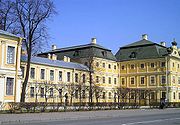
Naryshkin Baroque
Naryshkin Baroque, also called Moscow Baroque, or Muscovite Baroque, is the name given to a particular style of Baroque architecture and decoration which was fashionable in Moscow from the turn of the 17th into the early 18th centuries.-Style:...
, with elegant white decorations on red-brick walls of rather traditional churches, the mature Petrine Baroque
Petrine Baroque
Petrine Baroque is a name applied by art historians to a style of Baroque architecture and decoration favoured by Peter the Great and employed to design buildings in the newly-founded Russian capital, Saint Petersburg, under this monarch and his immediate successors.Unlike contemporaneous Naryshkin...
, mostly imported from the Low Countries, and the late Rastrelliesque Baroque, which was, in the words of William Brumfield, "extravagant in design and execution, yet ordered by the rhythmic insistence of massed columns and Baroque statuary."
The first baroque churches were built in the estates of the Naryshkin
Naryshkin
Naryshkin is a Russian surname and may refer to:* Members of the Naryshkin family* Sergey Naryshkin , a politician* Two men of the name Kirill Naryshkin...
family of Moscow boyar
Boyar
A boyar, or bolyar , was a member of the highest rank of the feudal Moscovian, Kievan Rus'ian, Bulgarian, Wallachian, and Moldavian aristocracies, second only to the ruling princes , from the 10th century through the 17th century....
s. It was the family of Natalia Naryshkina, Peter the Great
Peter I of Russia
Peter the Great, Peter I or Pyotr Alexeyevich Romanov Dates indicated by the letters "O.S." are Old Style. All other dates in this article are New Style. ruled the Tsardom of Russia and later the Russian Empire from until his death, jointly ruling before 1696 with his half-brother, Ivan V...
's mother. Most notable in this category of small suburban churches were the Intercession in Fili
Church of the Intercession at Fili
The Church of the Intercession at Fili is a Naryshkin baroque church commissioned by the boyar Lev Naryshkin in his suburban estate Fili; the territory has belonged to City of Moscow since 1935...
(1693–96), the Holy Tritity church in Troitse-Lykovo (1690-1695) and the Saviour in Ubory (1694–97). They were built in red brick
Brick
A brick is a block of ceramic material used in masonry construction, usually laid using various kinds of mortar. It has been regarded as one of the longest lasting and strongest building materials used throughout history.-History:...
with profuse detailed decoration in white stone. The belfry
Bell tower
A bell tower is a tower which contains one or more bells, or which is designed to hold bells, even if it has none. In the European tradition, such a tower most commonly serves as part of a church and contains church bells. When attached to a city hall or other civic building, especially in...
was not any more placed beside the church as was common in the 17th century, but on the facade
Facade
A facade or façade is generally one exterior side of a building, usually, but not always, the front. The word comes from the French language, literally meaning "frontage" or "face"....
itself, usually surmounting the octagonal central church and producing daring vertical compositions. As the style gradually spread around Russia
Russia
Russia or , officially known as both Russia and the Russian Federation , is a country in northern Eurasia. It is a federal semi-presidential republic, comprising 83 federal subjects...
, many monasteries were remodeled after the latest fashion. The most delightful of these were the Novodevichy Convent
Novodevichy Convent
Novodevichy Convent, also known as Bogoroditse-Smolensky Monastery is probably the best-known cloister of Moscow. Its name, sometimes translated as the New Maidens' Monastery, was devised to differ from an ancient maidens' convent within the Moscow Kremlin. Unlike other Moscow cloisters, it has...
and the Donskoy Monastery
Donskoy Monastery
Donskoy Monastery is a major monastery in Moscow, founded in 1591 in commemoration of Moscow's deliverance from an imminent threat of Khan Kazy-Girey’s invasion...
in Moscow, as well as Krutitsy
Krutitsy
Krutitsy Metochion , full name: Krutitsy Patriarchal Metochion is an operating ecclesiastical estate of Russian Orthodox Church, located in Tagansky District of Moscow, Russia, 3 kilometers south-east from the Kremlin. The name Krutitsy , i.e. steep river banks, originally meant the hills...
metochion
Metochion
In Eastern Orthodoxy, a metochion is an ecclesiastical embassy church, usually from one autocephalous or autonomous church to another. The term is also used to refer to a parish representation of a monastery or a patriarch....
and Solotcha Cloister near Riazan. Civic architecture also sought to conform to the baroque aesthetics, e.g., the Sukharev Tower
Sukharev Tower
The Sukharev Tower was one of the best known landmarks and symbols of Moscow until its destruction by the Soviet authorities in 1934. The tower was built in the Moscow baroque style at the intersection of the Garden Ring with the Sretenka street in 1692-1695.Tsar Peter the Great ordered the...
in Moscow
Moscow
Moscow is the capital, the most populous city, and the most populous federal subject of Russia. The city is a major political, economic, cultural, scientific, religious, financial, educational, and transportation centre of Russia and the continent...
and there is also a neo-form of this style like the Principal Medicine Store
State Historical Museum
The State Historical Museum of Russia is a museum of Russian history wedged between Red Square and Manege Square in Moscow. Its exhibitions range from relics of the prehistoric tribes inhabiting present-day Russia, through priceless artworks acquired by members of the Romanov dynasty...
on Red Square
Red Square
Red Square is a city square in Moscow, Russia. The square separates the Kremlin, the former royal citadel and currently the official residence of the President of Russia, from a historic merchant quarter known as Kitai-gorod...
. The most important architects associated with the Naryshkin Baroque were Yakov Bukhvostov
Yakov Bukhvostov
Yakov Grigoryevich Bukhvostov was a Russian architect, associated with the Naryshkin Baroque style. It has been documented that he constructed a number of buildings, in and around Moscow and one in Ryazan, of red brick with rich external white-stone decoration.-Career:The biography of Bukhvostov...
and Peter Potapov.
Petrine Baroque
Petrine Baroque
Petrine Baroque is a name applied by art historians to a style of Baroque architecture and decoration favoured by Peter the Great and employed to design buildings in the newly-founded Russian capital, Saint Petersburg, under this monarch and his immediate successors.Unlike contemporaneous Naryshkin...
is a name applied by art historians to a style of Baroque architecture and decoration favoured by Peter the Great and employed to design buildings in the newly-founded Russian capital, Saint Petersburg
Saint Petersburg
Saint Petersburg is a city and a federal subject of Russia located on the Neva River at the head of the Gulf of Finland on the Baltic Sea...
, under this monarch and his immediate successors. Unlike contemporaneous Naryshkin Baroque
Naryshkin Baroque
Naryshkin Baroque, also called Moscow Baroque, or Muscovite Baroque, is the name given to a particular style of Baroque architecture and decoration which was fashionable in Moscow from the turn of the 17th into the early 18th centuries.-Style:...
, favoured in Moscow
Moscow
Moscow is the capital, the most populous city, and the most populous federal subject of Russia. The city is a major political, economic, cultural, scientific, religious, financial, educational, and transportation centre of Russia and the continent...
, the Petrine Baroque represented a drastic rupture with Byzantine traditions that had dominated Russian architecture
Russian architecture
Russian architecture follows a tradition whose roots were established in the Eastern Slavic state of Kievan Rus'. After the fall of Kiev, Russian architectural history continued in the principalities of Vladimir-Suzdal, Novgorod, the succeeding states of the Tsardom of Russia, the Russian Empire,...
for almost a millennium. Its chief practitioners – Domenico Trezzini
Domenico Trezzini
Domenico Trezzini was a Swiss Italian architect who elaborated the Petrine Baroque style of Russian architecture.Domenico was born in Astano, near Lugano, in the Italian-speaking Ticino . He probably studied in Rome...
, Andreas Schlüter
Andreas Schlüter
Andreas Schlüter was a German baroque sculptor and architect associated with the Petrine Baroque style of architecture and decoration.-Biography:...
, and Mikhail Zemtsov
Mikhail Zemtsov
Mikhail Grigorievich Zemtsov was a Russian architect who practiced a sober, restrained Petrine Baroque style, which he learned from his peer Domenico Tresini...
– drew inspiration from a rather modest Dutch, Danish, and Swedish architecture of the time. Extant examples of the style in St Petersburg are the Peter and Paul Cathedral
Peter and Paul Cathedral
The Peter and Paul Cathedral is a Russian Orthodox cathedral located inside the Peter and Paul Fortress in St. Petersburg, Russia. It is the first and oldest landmark in St. Petersburg, built between 1712 and 1733 on Zayachy Island along the Neva River. Both the cathedral and the fortress were...
, the Twelve Colleges, the Kunstkamera
Kunstkamera
The Kunstkamera was the first museum in Russia. Established by Peter the Great and completed in 1727, the Kunstkammer Building hosts the Peter the Great Museum of Anthropology and Ethnography, with a collection of almost 2,000,000 items...
, Kikin Hall and Menshikov Palace
Menshikov Palace
The Menshikov Palace is a Petrine Baroque edifice in Saint Petersburg, situated on Universitetskaya Embankment of the Bolshaya Neva on Vasilyevsky Island. It was the first stone building in the city...
.The Petrine Baroque structures outside St Petersburg are scarce; they include the Menshikov Tower
Menshikov Tower
Menshikov Tower , the Church of Archangel Gabriel is a Baroque Russian Orthodox Church in Basmanny District of Moscow, within the Boulevard Ring. The church was initially built in 1707 to order of Alexander Menshikov by Ivan Zarudny assisted by Domenico Trezzini, a team of Italian-Swiss craftsmen...
in Moscow
Moscow
Moscow is the capital, the most populous city, and the most populous federal subject of Russia. The city is a major political, economic, cultural, scientific, religious, financial, educational, and transportation centre of Russia and the continent...
and the Kadriorg Palace
Kadriorg Palace
Catherinethal is a Petrine Baroque palace of Catherine I of Russia in Tallinn, Estonia. It was built after the Great Northern War to Nicola Michetti's designs by Gaetano Chiaveri and Mikhail Zemtsov. In the 20th century the Estonian version of the name, Kadriorg, gained currency and came to be...
in Tallinn
Tallinn
Tallinn is the capital and largest city of Estonia. It occupies an area of with a population of 414,940. It is situated on the northern coast of the country, on the banks of the Gulf of Finland, south of Helsinki, east of Stockholm and west of Saint Petersburg. Tallinn's Old Town is in the list...
.
Ukraine
.jpg)
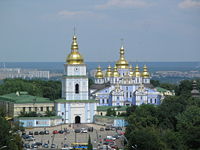
Ukrainian Baroque
Ukrainian Baroque or Cossack Baroque is an architectural style that emerged in Ukraine during the Hetmanate era, in the 17th and 18th centuries....
is an architectural style that emerged in Ukraine during the Hetmanate
Cossack Hetmanate
The Hetmanate or Zaporizhian Host was the Ruthenian Cossack state in the Central Ukraine between 1649 and 1782.The Hetmanate was founded by first Ukrainian hetman Bohdan Khmelnytsky during the Khmelnytsky Uprising . In 1654 it pledged its allegiance to Muscovy during the Council of Pereyaslav,...
era, in the 17th and 18th centuries. Ukrainian Baroque is distinct from the Western European Baroque in having more moderate ornamentation and simpler forms, and as such was considered more constructivist. One of the unique features of the Ukrainian baroque, were bud and pear-shaped domes
Onion dome
An onion dome is a dome whose shape resembles the onion, after which they are named. Such domes are often larger in diameter than the drum upon which they are set, and their height usually exceeds their width...
, that were later borrowed by the similar Naryshkin baroque
Naryshkin Baroque
Naryshkin Baroque, also called Moscow Baroque, or Muscovite Baroque, is the name given to a particular style of Baroque architecture and decoration which was fashionable in Moscow from the turn of the 17th into the early 18th centuries.-Style:...
. Many Ukrainian Baroque buildings have been preserved, including several buildings in Kiev Pechersk Lavra
Kiev Pechersk Lavra
Kiev Pechersk Lavra or Kyiv Pechersk Lavra , also known as the Kiev Monastery of the Caves, is a historic Orthodox Christian monastery which gave its name to one of the city districts where it is located in Kiev, the capital of Ukraine....
and the Vydubychi Monastery
Vydubychi Monastery
Vydubychi Monastery is an historic monastery in the Ukrainian capital Kiev.The monastery was established between 1070 and 1077 by Vsevolod, son of Yaroslav the Wise...
.
The best examples of Baroque painting are the church paintings in the Holy Trinity Church of the Kiev Pechersk Lavra. Rapid development in engraving techniques occurred during the Ukrainian Baroque period. Advances utilized a complex system of symbol
Symbol
A symbol is something which represents an idea, a physical entity or a process but is distinct from it. The purpose of a symbol is to communicate meaning. For example, a red octagon may be a symbol for "STOP". On a map, a picture of a tent might represent a campsite. Numerals are symbols for...
ism, allegories, heraldic signs, and sumptuous ornamentation.
Scandinavia

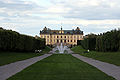
Swedish Empire
The Swedish Empire refers to the Kingdom of Sweden between 1561 and 1721 . During this time, Sweden was one of the great European powers. In Swedish, the period is called Stormaktstiden, literally meaning "the Great Power Era"...
, the architecture of Nordic countries was dominated by the Swedish court architect Nicodemus Tessin the Elder
Nicodemus Tessin the Elder
Nicodemus Tessin the Elder was an important Swedish architect.-Biography:Nicodemus Tessin was born in Stralsund in Pomerania and came to Sweden as a young man. There he met and worked with the architect Simon de la Vallée...
and his son Nicodemus Tessin the Younger
Nicodemus Tessin the Younger
Count Nicodemus Tessin the Younger was a Swedish Baroque architect, city planner, and administrator.The son of Nicodemus Tessin the Elder and the father of Carl Gustaf Tessin, Tessin the Younger was the middle-most generation of the brief Tessin dynasty, which have had a lasting influence on...
. Their aesthetic was readily adopted across the Baltic, in Copenhagen
Copenhagen
Copenhagen is the capital and largest city of Denmark, with an urban population of 1,199,224 and a metropolitan population of 1,930,260 . With the completion of the transnational Øresund Bridge in 2000, Copenhagen has become the centre of the increasingly integrating Øresund Region...
and Saint Petersburg
Saint Petersburg
Saint Petersburg is a city and a federal subject of Russia located on the Neva River at the head of the Gulf of Finland on the Baltic Sea...
.
Born in Germany, Tessin the Elder endowed Sweden with a truly national style, a well-balanced mixture of contemporary French and medieval Hanseatic elements. His designs for the royal manor of Drottningholm
Drottningholm Palace
The Drottningholm Palace is the private residence of the Swedish royal family. It is located in Drottningholm. It is built on the island Lovön , and is one of Sweden's Royal Palaces. It was originally built in the late 16th century. It served as a residence of the Swedish royal court for most of...
seasoned French prototypes with Italian elements, while retaining some peculiarly Nordic features, such as the hipped roof
Hip roof
A hip roof, or hipped roof, is a type of roof where all sides slope downwards to the walls, usually with a fairly gentle slope. Thus it is a house with no gables or other vertical sides to the roof. A square hip roof is shaped like a pyramid. Hip roofs on the houses could have two triangular side...
(säteritak).
Tessin the Younger shared his father's enthusiasm for discrete palace façades. His design for the Stockholm Palace
Stockholm Palace
The Stockholm Palace is the official residence and major royal palace of the Swedish monarch. . Stockholm Palace is located on Stadsholmen , in Gamla Stan in the capital, Stockholm...
draws so heavily on Bernini's unexecuted plans for the Louvre
Louvre
The Musée du Louvre – in English, the Louvre Museum or simply the Louvre – is one of the world's largest museums, the most visited art museum in the world and a historic monument. A central landmark of Paris, it is located on the Right Bank of the Seine in the 1st arrondissement...
that one could well imagine it standing in Naples, Vienna, or Saint Petersburg. Another example of the so-called International Baroque, based on Roman models with little concern for national specifics, is the Royal Palace of Madrid
Royal Palace of Madrid
The Palacio Real de Madrid is the official residence of the King of Spain in the city of Madrid, but it is only used for state ceremonies. King Juan Carlos and the Royal Family do not reside in the palace, choosing instead the more modest Palacio de la Zarzuela on the outskirts of Madrid...
. The same approach is manifested is Tessin's polychrome domeless Kalmar Cathedral, a skillful pastiche of early Italian Baroque, clothed in a giant order of paired Ionic pilasters.
It was not until the mid-18th century that Danish and Russian architecture were emancipated from Swedish influence. A milestone of this late period is Nicolai Eigtved
Nicolai Eigtved
Nicolai Eigtved, also known as Niels Eigtved, , Danish architect, introduced and was the leading proponent of the French rococo style in Danish architecture during the 1730s-1740s. He designed and built some of the most prominent buildings of his time, a number of which still stand to this day...
's design for a new district of Copenhagen
Copenhagen
Copenhagen is the capital and largest city of Denmark, with an urban population of 1,199,224 and a metropolitan population of 1,930,260 . With the completion of the transnational Øresund Bridge in 2000, Copenhagen has become the centre of the increasingly integrating Øresund Region...
centred on the Amalienborg Palace
Amalienborg Palace
Amalienborg Palace is the winter home of the Danish royal family, and is located in Copenhagen, Denmark. It consists of four identical classicizing palace façades with rococo interiors around an octagonal courtyard ; in the centre of the square is a monumental equestrian statue of Amalienborg's...
. The palace is composed of four rectangular mansions for the four greatest nobles of the kingdom, arranged across the angles of an octagonal square. The restrained façades of the mansions hark back to French antecedents, while their interiors contain some of the finest Rococo decoration in Northern Europe.
Hungary and Romania

Kingdom of Hungary
The Kingdom of Hungary comprised present-day Hungary, Slovakia and Croatia , Transylvania , Carpatho Ruthenia , Vojvodina , Burgenland , and other smaller territories surrounding present-day Hungary's borders...
, the first great Baroque building was the Jesuit Church of Trnava
Trnava
Trnava is a city in western Slovakia, 47 km to the north-east of Bratislava, on the Trnávka river. It is the capital of a kraj and of an okres . It was the seat of a Roman Catholic archbishopric . The city has a historic center...
built by Pietro Spozzo in 1629–37, modelling the Church of the Gesu
Church of the Gesu
The Church of the Gesù is the mother church of the Society of Jesus, a Roman Catholic religious order also known as the Jesuits. Officially named , its facade is "the first truly baroque façade", introducing the baroque style into architecture ,. The church served as model for innumerable Jesuit...
in Rome. Jesuits were the main propagators of the new style with their churches in Győr
Gyor
-Climate:-Main sights:The ancient core of the city is Káptalan Hill at the confluence of three rivers: the Danube, Rába and Rábca. Püspökvár, the residence of Győr’s bishops can be easily recognised by its incomplete tower. Győr’s oldest buildings are the 13th-century dwelling tower and the...
(1634–1641), [Košice] (1671–1684), Eger
Eger
Eger is the second largest city in Northern Hungary, the county seat of Heves, east of the Mátra Mountains. Eger is best known for its castle, thermal baths, historic buildings , and red and white wines.- Name :...
(1731–1733) and Székesfehérvár
Székesfehérvár
Székesfehérvár is a city in central Hungary and is the 9th largest in the country. Located around southwest of Budapest. It is inhabited by 101,973 people , with 136,995 in the Székesfehérvár Subregion. The city is the centre of Fejér county and the regional centre of Central Transdanubia...
(1745–1751). The reconstruction of the territories devastated by the Ottomans was carried out in Baroque style in 18th century. Intact Baroque townscapes can be found in Győr
Gyor
-Climate:-Main sights:The ancient core of the city is Káptalan Hill at the confluence of three rivers: the Danube, Rába and Rábca. Püspökvár, the residence of Győr’s bishops can be easily recognised by its incomplete tower. Győr’s oldest buildings are the 13th-century dwelling tower and the...
, Székesfehérvár
Székesfehérvár
Székesfehérvár is a city in central Hungary and is the 9th largest in the country. Located around southwest of Budapest. It is inhabited by 101,973 people , with 136,995 in the Székesfehérvár Subregion. The city is the centre of Fejér county and the regional centre of Central Transdanubia...
, Eger
Eger
Eger is the second largest city in Northern Hungary, the county seat of Heves, east of the Mátra Mountains. Eger is best known for its castle, thermal baths, historic buildings , and red and white wines.- Name :...
, Veszprém
Veszprém
Veszprém is one of the oldest urban areas in Hungary, and a city with county rights. It lies approximately north of the Lake Balaton. It is the administrative center of the county of the same name.-Location:...
, Esztergom
Esztergom
Esztergom , is a city in northern Hungary, 46 km north-west of the capital Budapest. It lies in Komárom-Esztergom county, on the right bank of the river Danube, which forms the border with Slovakia there....
and the Castle District of Buda
Buda
For detailed information see: History of Buda CastleBuda is the western part of the Hungarian capital Budapest on the west bank of the Danube. The name Buda takes its name from the name of Bleda the Hun ruler, whose name is also Buda in Hungarian.Buda comprises about one-third of Budapest's...
. The most important Baroque palaces in Hungary were the Royal Palace
Buda Castle
Buda Castle is the historical castle and palace complex of the Hungarian kings in Budapest, first completed in 1265. In the past, it was also called Royal Palace and Royal Castle ....
in Buda, Grassalkovich Castle in Gödöllő
Gödöllo
Gödöllő is a town situated in Pest county, Budapest metropolitan area, Hungary, about northeast from the outskirts of Budapest. Its population is about 31,000 according to the 2001 census. It can be easily reached from Budapest with the suburban railway . Gödöllő is home to the Szent István...
, and Esterházy Castle in Fertőd
Fertod
Fertőd is a town located in the Győr-Moson-Sopron county of Hungary, not far from Austria. Fertőd was formed when the towns of Eszterháza and Süttör were unified, in 1950....
. Smaller Baroque castles of the Hungarian aristocracy are scattered all over the country. Hungarian Baroque shows the double influence of Austrian and Italian artistic tendencies as many German and Italian architects worked in the country. The main characteristics of the local version of the style were modesty, lack of excessive decoration, and some "rural" flavour, especially in the works of the local masters. Important architects of the Hungarian Baroque were András Mayerhoffer, Ignác Oraschek and Márton Wittwer. Franz Anton Pilgram also worked in the Kingdom of Hungary, for example on the great Premonstratensian
Premonstratensian
The Order of Canons Regular of Prémontré, also known as the Premonstratensians, the Norbertines, or in Britain and Ireland as the White Canons , are a Catholic religious order of canons regular founded at Prémontré near Laon in 1120 by Saint Norbert, who later became Archbishop of Magdeburg...
monastery of Jászó. In the last decades of the 18th century Neo-Classical tendencies became dominant. The two most important architects of that period were Menyhért Hefele and Jakab Fellner
Jakab Fellner
Jakab Fellner was the most important Baroque architect of his generation in Hungary.-Life:...
.
Some representative Baroque structures in Transylvania
Transylvania
Transylvania is a historical region in the central part of Romania. Bounded on the east and south by the Carpathian mountain range, historical Transylvania extended in the west to the Apuseni Mountains; however, the term sometimes encompasses not only Transylvania proper, but also the historical...
(Romania
Romania
Romania is a country located at the crossroads of Central and Southeastern Europe, on the Lower Danube, within and outside the Carpathian arch, bordering on the Black Sea...
) are the Bánffy Palace
Banffy Palace
Bánffy Castle is a baroque building of the 18th century in Cluj-Napoca, designed by the German architect Johann Eberhard Blaumann. Built between 1774 and 1775 it is considered the most representative for the baroque style of Transylvania...
in Cluj
Cluj-Napoca
Cluj-Napoca , commonly known as Cluj, is the fourth most populous city in Romania and the seat of Cluj County in the northwestern part of the country. Geographically, it is roughly equidistant from Bucharest , Budapest and Belgrade...
, the Brukenthal Palace
Brukenthal National Museum
The Brukenthal National Museum is a museum, erected in the late of 15th century in Sibiu, Romania, housed in the palace of Samuel von Brukenthal — who was Habsburg governor of Transylvania and who established its first collections around 1790...
in Sibiu
Sibiu
Sibiu is a city in Transylvania, Romania with a population of 154,548. Located some 282 km north-west of Bucharest, the city straddles the Cibin River, a tributary of the river Olt...
and the Bishopric Palace
Baroque Palace of Oradea
The Episcopal palace of the city of Oradea in Bihor county, Romania dates to the Baroque times.- History :It was founded in 1762 by the Baron Bishop Adam Patachich, as bishopric palace of the Roman Catholic Diocese of Magnovaradimum...
in Oradea
Oradea
Oradea is the capital city of Bihor County, in the Crișana region of north-western Romania. The city has a population of 204,477, according to the 2009 estimates. The wider Oradea metropolitan area has a total population of 245,832.-Geography:...
. Besides, almost every Transylvanian town has at least a Baroque church, the most representatives of which being St. George's Cathedral
St. George's Cathedral, Timisoara
The St. George's Cathedral, Timişoara or The Dome is located in Timişoara, Romania, at Piaţa Unirii, in the centre of town.-History:...
of Timişoara
Timisoara
Timișoara is the capital city of Timiș County, in western Romania. One of the largest Romanian cities, with an estimated population of 311,586 inhabitants , and considered the informal capital city of the historical region of Banat, Timișoara is the main social, economic and cultural center in the...
, Saint John the Baptist Church
Saint John the Baptist Church, Târgu Mureş
Saint John the Baptist Church is a baroque parish style church in the city center of Târgu Mureș.- History :Transylvania fulfilled all the requirements for the development of this new architectural style by the beginning of the 18th century, when it became part of the Habsburg Empire. Ignatius of...
of Târgu Mureş, the Holy Trinity Cathedral
Holy Trinity Cathedral, Blaj
The Holy Trinity Cathedral in Blaj, Romania is a Romanian Greek Catholic cathedral commissioned by bishop Inocențiu Micu-Klein in 1738. The church was built by Viennese architects Anton Erhard Martinelli and Johann Baptist Martinelli, being completed in 1749....
of Blaj
Blaj
Blaj is a city in Alba County, Transylvania, Romania. It has a population of 20,758 inhabitants.The landmark of the city is the fact that it was the principal religious and cultural center of the Romanian Greek-Catholic Church in Transylvania....
and the Piarist Church of Cluj
Cluj-Napoca
Cluj-Napoca , commonly known as Cluj, is the fourth most populous city in Romania and the seat of Cluj County in the northwestern part of the country. Geographically, it is roughly equidistant from Bucharest , Budapest and Belgrade...
.
Turkey
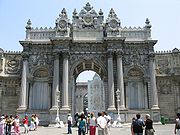
Istanbul
Istanbul , historically known as Byzantium and Constantinople , is the largest city of Turkey. Istanbul metropolitan province had 13.26 million people living in it as of December, 2010, which is 18% of Turkey's population and the 3rd largest metropolitan area in Europe after London and...
, once the center of the Ottoman Empire
Ottoman Empire
The Ottoman EmpireIt was usually referred to as the "Ottoman Empire", the "Turkish Empire", the "Ottoman Caliphate" or more commonly "Turkey" by its contemporaries...
, hosts many different varieties of Baroque architecture.
As reforms and innovations to modernize the country came out in 18th and 19th century, various architecture styles were used in Turkey, one of them was the Baroque Style. As Turkish architecture (which is also a combination of Islamic and Byzantine architecture) combined with Baroque, a new style called Ottoman Baroque appeared.
Baroque architecture is mostly seen in mosques and palaces built in this centuries. The Ortaköy Mosque
Ortaköy Mosque
Ortaköy Mosque , officially the Büyük Mecidiye Camii of Sultan Abdülmecid) in Beşiktaş, Istanbul, Turkey, is situated at the waterside of the Ortaköy pier square, one of the most popular locations on the Bosphorus....
, is one of the best examples of Ottoman Baroque Architecture.
The Tanzimat
Tanzimat
The Tanzimât , meaning reorganization of the Ottoman Empire, was a period of reformation that began in 1839 and ended with the First Constitutional Era in 1876. The Tanzimât reform era was characterized by various attempts to modernize the Ottoman Empire, to secure its territorial integrity against...
Era caused more architectural development. The architectural change continued with Sultan Mahmud II, one of the most reformist sultans in Turkish History. One of his sons, Sultan Abdülmecid and his family left the Topkapı Palace
Topkapi Palace
The Topkapı Palace is a large palace in Istanbul, Turkey, that was the primary residence of the Ottoman Sultans for approximately 400 years of their 624-year reign....
and moved to the Dolmabahçe Palace
Dolmabahçe Palace
Dolmabahçe Palace located in the Beşiktaş district of Istanbul, Turkey, on the European coastline of the Bosphorus strait, served as the main administrative center of the Ottoman Empire from 1856 to 1922, apart from a 22-year interval in which Yıldız Palace was used.- History :Dolmabahçe Palace...
which is the first European-style palace in the country.
Baroque architecture in Istanbul was mostly used in palaces near the Bosphorus and Golden Horn
Golden Horn
The Golden Horn is a historic inlet of the Bosphorus dividing the city of Istanbul and forming the natural harbor that has sheltered Greek, Roman, Byzantine, Ottoman and other ships for thousands of...
. Beyoğlu
Beyoglu
Beyoğlu is a district located on the European side of İstanbul, Turkey, separated from the old city by the Golden Horn...
was one of the places that Baroque and other European style architecture buildings were largely used. The famous streets called Istiklal Avenue
Istiklal Avenue
İstiklal Avenue or Istiklal Street is one of the most famous avenues in Istanbul, Turkey, visited by nearly 3 million people in a single day over the course of weekends...
, Nişantaşı
Nisantasi
Nişantaşı is a quarter of Istanbul, Turkey, comprising neighbourhoods like Teşvikiye, Osmanbey, Maçka and Pangaltı. It includes the stores of world famous brands and has many popular cafés, pubs, restaurants and night clubs. It is a part of the Şişli district...
, Bankalar Caddesi
Bankalar Caddesi
Bankalar Caddesi , alternatively known as the Voyvoda Caddesi , located in the historic Galata quarter within the district of Beyoğlu in Istanbul, Turkey, was the financial center of the Ottoman Empire...
consist of these architecture style apartments.
The arabesque and Ottoman flavour gives it its unique atmosphere, which also distinguishes it from the later "colonial" Baroque styles, largely used in the Middle East, especially Lebanon
Lebanon
Lebanon , officially the Republic of LebanonRepublic of Lebanon is the most common term used by Lebanese government agencies. The term Lebanese Republic, a literal translation of the official Arabic and French names that is not used in today's world. Arabic is the most common language spoken among...
.
Later and more mature Baroque forms in Istanbul can be found in the gates of the Dolmabahçe Palace
Dolmabahçe Palace
Dolmabahçe Palace located in the Beşiktaş district of Istanbul, Turkey, on the European coastline of the Bosphorus strait, served as the main administrative center of the Ottoman Empire from 1856 to 1922, apart from a 22-year interval in which Yıldız Palace was used.- History :Dolmabahçe Palace...
, built by the famous Turkish-Armenian Balyan family
Balyan family
The Balyan family was a dynasty of famous Ottoman imperial architects. They were of Armenian ethnicity. For five generations in the 18th and 19th centuries, they designed and constructed numerous major buildings, including palaces, kiosks, mosques, churches and various public buildings, mostly in...
, which also has a very "eastern" flavour, combining Baroque, Romantic, and Oriental architecture.
See also
- BaroqueBaroqueThe Baroque is a period and the style that used exaggerated motion and clear, easily interpreted detail to produce drama, tension, exuberance, and grandeur in sculpture, painting, literature, dance, and music...
- List of Baroque architecture
- Baroque musicBaroque musicBaroque music describes a style of Western Classical music approximately extending from 1600 to 1760. This era follows the Renaissance and was followed in turn by the Classical era...
- Earthquake BaroqueEarthquake BaroqueEarthquake Baroque is a style of Baroque architecture found in places like the Philippines and Guatemala, which suffered destructive earthquakes during the 17th century and 18th century, where large public buildings, such as churches were rebuilt in a Baroque style...
- Architecture of PortugalArchitecture of PortugalArchitecture of Portugal refers to the architecture practised in the territory of present-day Portugal since before the foundation of the country in the 12th century...
- Church of St. Anne, TalaulimChurch of St. Anne, TalaulimThe Church of St. Anne is a religious monument located in Santana, Goa, India. It is an example of baroque architecture.Majestically nestled in the verdant hills of Santana, Talaulim, the Church of Anne was declared a "national monument" during the Portuguese era per Government Portario No. 1360 of...
- Mafra National PalaceMafra National PalaceThe Mafra National Palace is a monumental Baroque and Italianized Neoclassical palace-monastery located in Mafra, Portugal, some 28 kilometres from Lisbon. Its dimensions are so huge that it dwarfs the city...
- Águas Livres AqueductÁguas Livres AqueductThe Águas Livres Aqueduct is a historic aqueduct in the city of Lisbon, Portugal. It is one of the most remarkable examples of 18th-century Portuguese engineering...