

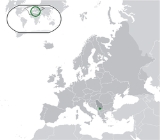
Kosovo

Encyclopedia
Kosovo (ˈkɒsəvoʊ, ˈkoʊsəvoʊ; ; ) is a region in southeastern Europe. Part of the Ottoman Empire
for more than five centuries, later the Autonomous Province of Kosovo and Metohija (Serbian: Autonomna Pokrajina Kosovo i Metohija
) within Serbia
(Serbia then being one of the constituent republics of Yugoslavia). Long-term severe ethnic tensions between Kosovo's ethnic Albanian and Serb populations have left Kosovo ethnically disunified, resulting in inter-ethnic violence, including the Kosovo War
of 1999. Following the Kosovo War, the Federal Republic of Yugoslavia
(FRY) relinquished governance of this territory, whose governance was taken over by the United Nations, Kosovo remained legally the sovereign territory of the FRY after the transfer of authority. The partially recognised Republic of Kosovo
(Albanian: Republika e Kosovës; Serbian: Република Косово, Republika Kosovo), a self-declared independent state, has de facto control over most of the territory, with North Kosovo
, the largest Kosovo Serb enclave, is under the control of institutions of the Republic of Serbia. Serbia
does not recognise the unilateral secession of Kosovo and considers it a UN-governed entity within its sovereign territory
.
to the south, Albania
to the west and Montenegro
to the northwest. The remaining frontier belt is with the Central Serbia
n region which is the source of international dispute. The largest city and the capital of Kosovo is Pristina
(alternatively spelled Prishtina or Priština), while other cities include Peć
(Albanian: Peja), Prizren
, Đakovica (Gjakova), and Kosovska Mitrovica
(Mitrovica). Nominally, the name of Kosovo has come to represent a number of different entities over the centuries and its borders have subsequently altered. There have also been periods when no political entity has existed with the name of Kosovo. Today's outline dates back to 1946.
During classical antiquity
, the territory roughly corresponding to present-day Kosovo was part of several tribal alliances, including that formed by the Dardani
. Upon conquest, the Romans
dissolved existing tribal alliances and re-integrated communities centred on Roman civitates as part of the Roman province of Moesia Superior. Subdivisions in Late Roman times created the region of "Dardania". After the collapse of Roman control, the region was contested between Avars
, Sklavenes and Byzantines
, and later between the Byzantines, Bulgarians
and Serbs.
The name and the region Kosovo first appears as part of a newly created region within an expanded Serbian medieval state, and soon became its ecclesiastical and secular centre; the region was subsequently enshrined by Serbs as the cradle of their national identity. Following the Battle of Kosovo
in 1389, it became part of the Ottoman Empire
, while some parts of it remained in the Albanian Principality of Dukagjini
, until the middle 15th century. During the Ottoman period the region came into close contact with the Ottoman culture. Islam
was introduced to the population. During the late 19th century, Kosovo was the centre of the Albanian national awakening and the battlefield of the Albanian revolts of 1843–44
, 1910
and 1912
. In 1912, the Ottoman province
was divided between Montenegro
and Serbia
, both of which became part of Yugoslavia
in 1918. During World War II
, the majority of Kosovo was part of Italian-occupied Albania
, followed by a Nazi German Occupation
before becoming an autonomous province
of the SR Serbia under the Constitution of the Socialist Federal Republic of Yugoslavia
.
After the Kosovo War
and the 1999 NATO bombing of Yugoslavia, the territory came under the interim administration of the United Nations Mission in Kosovo (UNMIK), most of whose roles were assumed by the European Union Rule of Law
Mission in Kosovo (EULEX
) in December 2008. In February 2008 individual members of the Assembly of Kosovo
(acting in personal capacity and not binding the Assembly itself) declared Kosovo's independence as the Republic of Kosovo. Its independence is recognised
by and the Republic of China
(Taiwan). On 8 October 2008, upon request of Serbia, the UN General Assembly
adopted a resolution asking the International Court of Justice
for an advisory opinion on the issue of Kosovo's declaration of independence
. On 22 July 2010, the ICJ ruled that Kosovo's declaration of independence did not violate international law, which its president said contains no "prohibitions on declarations of independence".
of kos (кос) "blackbird", an ellipsis
for Kosovo Polje, 'blackbird field', the site
of the 1389 Battle of Kosovo Field
. The name of the field was applied to an Ottoman province
created in 1864.
The region currently known as "Kosovo" became an administrative region
in 1946, as the Autonomous Province of Kosovo and Metohija
. In 1974, the compositional "Kosovo and Metohija
" was reduced to simple "Kosovo" in the name of the Socialist Autonomous Province of Kosovo
, but in 1990 was renamed back to Autonomous Province of Kosovo and Metohija.
The entire region is commonly referred to in English simply as Kosovo and in Albanian
as (definite form, kɔˈsɔ:va) or ("indefinite" form, kɔˈsɔːv). In Serbia, a distinction is made between the eastern and western areas; the term is used for the eastern part, while the western part is called Metohija
.
of 1998 to 1999, but it is suffused with issues dating back to the rise of nationalism in the Balkans during the last part of Ottoman rule
in the 19th century. The Kosovo Albanians claim that the Illyrians, whom they claim as their direct ancestors, were the majority population in the region, and continued to be so throughout history despite failing to create any 'national institutions' in Kosovo until modern times and despite encroachments on their native territories. The Serbians deny this claim. Moreoever, they argue that, even if there is some linguistic connection between the pre-Slavic population of "Dardania" and modern Albanians, this cannot be used to justify modern territorial aspirations since it relies on territorial claims from pre-Migration Age Europe, at a time where there were no states or nations as we know them today. Serbian claims to Kosovo extend even farther than the migrations dated to c. 6–7th century, on the account of admixture with preexisting "Illyrians" and Roman populations and their preservation of certain of their customs. Moreover, in line with the consensus historical viewpoint, they see modern Albanians to have emerged in the Middle Ages after significant admixture with various other ethno-linguistic groups, including Slavs. Finally, Serbs claim that Kosovo very rapidly became the 'heart of Serbia' in the Middle Ages, and revere the Battle of Kosovo
, eponymous with the Kosovo region.
 During antiquity, the area which now makes up Kosovo was inhabited by various tribal ethnes, who were liable to move, englarge, fuse and fissure with neighbouring groups. As such, it is difficult to locate any such group with precision. The Dardani, whose exact ethno-linguistic affilitation is difficult to determine, were a prominent group in the region during the late Hellenistic and early Roman eras.
The area was then conquered by Rome in the 160s BC, and incorporated into the Roman province
of Illyricum
in 59 BC. Subsequently, it became part of Moesia Superior in AD 87. The region was exposed to an increasing number of 'barbarian' raids from the fourth century C.E. onwards, culminating with the so-called Slavic migrations of the 6th to 7th centuries. Archaeologically, the early Middle Ages represent a hiatus in the material record, and whatever was left of the native provincial population fused with the Sklavene colonists.
The subsequent political and demographic history of Kosovo
is not known with absolute certainty until c. 13th century C.E. Archaeological findings suggest that there was steady population recovery and progression of the Slavic culture seen elsewhere throughout the Balkans. The region was absorbed into the Bulgarian Empire
in the 850s, where Christianity and a Byzantine-Slavic culture was cemented in the region. It was re-taken by the Byzantines after 1018, and became part of the newly established Theme of Bulgaria. As the centre of Slavic resistance to Constantinople in the region, the region often switched between Serbian and Bulgarian rule on one hand and Byzantine on the other until the Serb principality of Rascia
conquered it definitively by the end of the 12th century. An insight into the region is provided by the Byzantine historian-princess, Anna Comnena, who wrote of "Serbs" being the main inhabitants of the region (referring to it as "eastern Dalmatia" and the "former Moesia Superior"). The earliest references to an Albanian population is derived from late eleventh century Byzantine chroniclers, who consistently located the Arber around the hinterland districts of Dyrrachium, modern Durrës.
The zenith of Serbian power was reached in 1346, with the formation of the Serbian Empire
. During the 13th and 14th centuries, Kosovo became a political and spiritual centre of the Serbian Kingdom. In the late 13th century, the seat of the Serbian Archbishopric was moved to Pec, and rulers centred themselves between Prizren and Skopje, during which time thousands of Christian monasteries and feudal-style forts and castles were erected. When the Serbian Empire fragmented into a conglomeration of principalities in 1371, Kosovo became the hereditary land of the House of Branković
. In the late 14th and the 15th century parts of Kosovo, the easternmost area of which was located near Pristina, were part of the Principality of Dukagjini
, which was later incorporated an anti-Ottoman federation of all Albanian principalities, the League of Lezhë
.
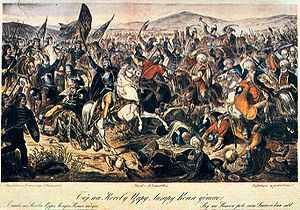
In the 1389 Battle of Kosovo
, Ottoman forces defeated a coalition of Serbs, Albanians, and Bosnians led by the Tsar Lazar Hrebeljanović
. Soon after, parts of Serbia accepted Turkish vassalage and Lazar's daughter was married to the Sultan to seal the peace.
By 1455, it was finally and fully conquered by the Ottoman Empire.
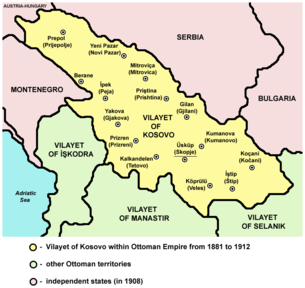
from 1455 to 1912, at first as part of the eyalet
of Rumelia
, and from 1864 as a separate province
(vilayet). During this time, Islam
was introduced to the population. The Vilayet of Kosovo was an area much larger than today's Kosovo; it included all today's Kosovo territory, sections of the Sandžak
region cutting into present-day Central Serbia
and Montenegro
along with the Kukës
municipality, the surrounding region in present-day northern Albania
and also parts of north-western Macedonia
with the city of Skopje
(then Üsküp), as its capital. Between 1881 and 1912 (its final phase), it was internally expanded to include other regions of present-day Republic of Macedonia
, including larger urban settlements such as Štip
(İştip), Kumanovo
(Kumanova) and Kratovo (Kratova).
 The Serbian position is that archives reveal an overwhelming Serbian demographic majority in Kosovo, which was reversed by the end of Ottoman rule, as Banac summarised: "Ottoman raids, plunder, slaving forays, as well as the general devastation caused by constant wars uprooted large numbers of Serbs even before the 'Great Serb Migration'". This was followed by the transplantation of Albanian pastoralists from the highlands of Albania to the fertile valleys of Kosovo. However, Anscombe highlights that the most common archives – those derived from the Ottomans – do not clarify unequivocally the 'ethnic' character of the region's inhabitants, because the Ottomans classified their subjects along religious lines (millets). Anscombe suggests that records show that the demography of Kosovo was very much mixed and that both Serbian and Albanian ethnic groups dominated. Moreover, they seem to indicate more cases of Albanians rebelling than any other ethnicity in the region. However, mainstream historiography clarifies that "there is no conclusive evidence that a people unambiguously identifiable as "Albanian" constituted the majority of the population in Kosovo prior to the Ottoman occupation". Even the relatively "pro-Albanian" history written by Noel Malcolm concedes that "the region probably had a predominantly Orthodox Christian and Slavic population from the eight to the mid-nineteenth centuries". Allowing for the possibility of some connection between the regions inhabitants prior to successive Slavic/ Serbian inflows, the Albanians who 'returned' to Kosovo in modern times were certainly not the same people, having interbred extensively with Vlachs, Slavs, Greeks and Turks. Whilst there is little evidence of ethnic Albanian institutional presence in medieval Kosovo, this might be because they were often baptised into Orthodox Christianity and subjected to a process of "Serbianisation". Prior to Islamification, the Albanians might have existed as transhumance pastoralists inhabiting Balkan highland areas, like the Vlachs
, engaging in a symbiotic existence with the predominantly agricultural Slavs who inhabited the valleys and plains.
Kosovo, like Serbia, was occupied by Austrian forces during the Great War of 1683–1699, but the Ottomans re-established their rule of the region. Such acts of assistance by the Austrian Empire (then arch-rivals of the Ottoman Empire), or Russia, were always abortive or temporary at best. In 1690, the Serbian Patriarch of Peć Arsenije III
apparently led a group of 37, 000 families from Kosovo to the Christian north, although, this might have been around 30 – 40, 0000 individuals. In 1766, the Ottomans abolished the Patriarchate of Peć
and the position of Christians in Kosovo further deteriorated, including full imposition of jizya
(taxation of non-Muslims).
Although initially stout opponents of the advancing Turks, Albanian chiefs ultimately came to accept the Ottomans as sovereigns. The resulting alliance facilitated the mass conversion of Albanians to Islam. Given that the Ottoman Empire's subjects were divided along religious (rather than ethnic) lines, Islamicisation greatly elevated the status of Albanian chiefs. Prior to this, they were organised along simple tribal lines, living in the mountainous areas of modern Albania (from Kruje to the Sar range). Soon, they expanded into a depopulated Kosovo, as well as northwestern Macedonia, although some might have been autochthonous to the region. However, Banac favours the idea that the main settlers of the time were Vlachs.
Many Albanians gained prominent positions in the Ottoman government, no fewer than 42 Grand Vizier
s of the Empire were Albanian in origin, including Mehmet Akif Ersoy
(1873–1936) an Albanian from Peć
who composed the Turkish National Anthem
in 1921, "İstiklâl Marşı" (The Independence March). As Hupchik states, "Albanians had little cause of unrest" and "if anything, grew important in Ottoman internal affairs", and sometimes persecuted Christians harshly on behalf of their Turkish masters. According to the Serbian viewpoint, the most numerous Albanian migrations occurred during the eighteenth century. These Albanians were almost all of the Muslim faith, and their settlement was defended by the Ottomans, amounting to a mass-colonisation of Kosovo by Albanians and the genocide of Serbian inhabitants. According to the Albanian perspective, this was merely a consolidation of previously held territory.
In the 19th century, there was an awakening
of ethnic nationalism
throughout the Balkans. This systematised the underlying ethnic tensions into a broader struggle of Christian Serbs against Muslim Albanians. The ethnic Albanian nationalism movement was centred in Kosovo. In 1878 the League of Prizren
was formed. This was a political organisation
which aimed to unify all the Albanians
of the Ottoman Empire in a common struggle for autonomy and greater cultural rights
, although they generally desired the continuation of the Ottoman Empire. The League was dis-established in 1881 but nevertheless enabled the awakening of a national identity
amongst Albanians. It would be clear that Albanian ambitions were at odds with Serbian aims. The Kingdom of Serbia wished to incorporate this land formerly within its empire.
. The movement supported a centralised form of government and opposed any sort of autonomy desired by the various nationalities of the Ottoman Empire. An allegiance to Ottomanism was promoted instead. An Albanian uprising in 1912 exposed the Empires Northern territories in Kosovo and Novi Pazar
which led to an invasion by the Kingdom of Montenegro
. The Ottomans
suffered a serious defeat at the hands of Albanians in 1912, culminating in the Ottoman loss of most of its Albanian inhabited lands. The Albanians threatened to march all the way to Salonika and reimpose Abdul Hamid.
A wave of Albanians in the Ottoman army
ranks also deserted during this period, refusing to fight their own kin. Two months later in September of the same year, a joint Balkan force made up of Serbian, Montenegrin, Bulgarian and Greek forces drove the Ottomans out of most of their European possessions.
The rise of Nationalism unfortunately hampered relations between Albanians and Serbs in Kosovo, due to influence from Russians
, Austrians
and Ottomans. Kosovo's status within Serbia was finalised the following year at the Treaty of London. Soon, there were concerted Serbian colonisation efforts in Kosovo during various periods between Serbia's 1912 takeover of the province and World War II
. So the population of Serbs in Kosovo fell after World War II, but it had increased considerably before then.
An exodus of the local Albanian population occurred. Serbian authorities promoted creating new Serb settlements in Kosovo as well as the assimilation of Albanians into Serbian society. Numerous colonist Serb families moved into Kosovo, equalising the demographic balance between Albanians and Serbs.
, Kosovo saw the retreat of the Serbian army as Kosovo was occupied by Bulgaria
and Austria-Hungary.
In 1918, the Serbian Army pushed the Central Powers
out of Kosovo. After World War I ended, the Monarchy was then transformed into the Kingdom of Serbs, Croats and Slovenians
on 1 December 1918.
Kosovo was split into four counties, three being a part of Serbia (Zvečan
, Kosovo and southern Metohija
) and one of Montenegro (northern Metohija). However, the new administration system since 26 April 1922 split Kosovo among three Areas of the Kingdom: Kosovo, Raška
and Zeta
. In 1929, the Kingdom was transformed into the Kingdom of Yugoslavia
and the territories of Kosovo were reorganised among the Banate of Zeta
, the Banate of Morava
and the Banate of Vardar
.
In order to change the ethnic composition of Kosovo, between 1912 and 1941 a large-scale Serbian re-colonisation of Kosovo was undertaken by the Belgrade government. Meanwhile, Kosovar Albanians' right to receive education in their own language was denied alongside other non-Slavic or unrecognised Slavic nations
of Yugoslavia, as the kingdom only recognised the Slavic Croat, Serb, and Slovene nations as constituent nations
of Yugoslavia, while other Slavs had to identify as one of the three official Slavic nations while non-Slav nations were only deemed as minorities.
Albanians and other Muslims were forced to emigrate, mainly with the land reform
which struck Albanian landowners in 1919, but also with direct violent measures. In 1935 and 1938 two agreements between the Kingdom of Yugoslavia and Turkey
were signed on the expatriation of 240,000 Albanians to Turkey, which was not completed because of the outbreak of World War II
.
after the Axis powers
invaded Yugoslavia in 1941. Large parts of Kosovo became a part of Italian-controlled Albania
, other parts went to Bulgaria and German
-occupied Military Administration of Serbia. The Italian Fascist regime of Benito Mussolini
with its expansionist and irredentist
aims on both Albania and Yugoslavia exploited the nationalist sentiment amongst Albanians to gain favour of the Albanian population for the Italian-run protectorate which ruled Albania, and thus encouraged the establishment of a Greater Albania
which included large portions of Kosovo which was achieved in the Second World War.
At the 1944 wartime Bujan
conference the Kosovar communist resistance leaders passed a resolution on the postwar assignment of Kosovo to Albania, but their opinion was later disregarded. After numerous uprisings of Partisans
led by Fadil Hoxha
, Kosovo was liberated after 1944 with the help of the Albanian partisans of the Comintern
and became a province of Serbia
within the Democratic Federal Yugoslavia
.
 The province as in its outline today first took shape in 1945 as the Autonomous Kosovo-Metohian Area. Until World War II, the only entity bearing the name of Kosovo had been a political unit carved from the former vilayet which bore no special significance to its internal population. In the Ottoman Empire
(which previously controlled the territory), it had been a vilayet with its borders having been revised on several occasions. When the Ottoman province
had last existed, it included areas which were by now either ceded to Albania
, or found themselves within the newly created Yugoslav republics of Montenegro, or Macedonia (including its previous capital, Skopje
) with another part in the Sandžak
region of Central Serbia
.
Tensions between ethnic Albanians and the Yugoslav government were significant, not only due to national tensions but also due to political ideological concerns, especially regarding relations with neighbouring Albania. Harsh repressive measures were imposed on Kosovo Albanians due to suspicions that they there were Kosovo Albanian sympathisers of the Stalinist
regime of Enver Hoxha
of Albania. In 1956, a show trial in Pristina was held in which multiple Albanian Communists of Kosovo were convicted of being infiltrators from Albania and were given long prison sentences. High-ranking Serbian communist official Aleksandar Ranković
sought to secure the position of the Serbs in Kosovo and gave them dominance in Kosovo's nomenklatura
.
Islam
in Kosovo at this time was repressed and both Albanians and Muslim Slavs were encouraged to declare themselves to be Turkish and emigrate to Turkey. At the same time Serbs
and Montenegrins dominated the government, security forces, and industrial employment in Kosovo. Albanians resented these conditions and protested against them in the late 1960s, accusing the actions taken by authorities in Kosovo as being colonialist
, as well as demanding that Kosovo be made a republic, or declaring support for Albania.
After the ouster of Ranković in 1966, the agenda of pro-decentralisation reformers in Yugoslavia, especially from Slovenia and Croatia succeeded in the late 1960s in attaining substantial decentralisation of powers, creating substantial autonomy in Kosovo and Vojvodina, and recognising a Muslim Yugoslav
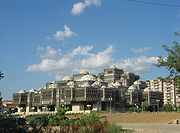
nationality. As a result of these reforms, there was a massive overhaul of Kosovo's nomenklatura and police, that shifted from being Serb-dominated to ethnic Albanian-dominated through firing Serbs in large scale. Further concessions were made to the ethnic Albanians of Kosovo in response to unrest, including the creation of the University of Pristina as an Albanian language
institution. These changes created widespread fear amongst Serbs that they were being made second-class citizen
s in Yugoslavia by these changes. In the 1974 Constitution of Yugoslavia, Kosovo was granted major autonomy, allowing it to have its own administration, assembly, and judiciary; as well as having a membership in the collective presidency and the Yugoslav parliament, in which it held veto power.
In the aftermath of the 1974 constitution, concerns over the rise of Albanian nationalism in Kosovo rose with the widespread celebrations in 1978 of the 100th anniversary of the founding of the League of Prizren
. Albanians felt that their status as a "minority" in Yugoslavia had made them second-class citizens in comparison with the "nations" of Yugoslavia and demanded that Kosovo be a constituent republic
, alongside the other republics of Yugoslavia. Protests by Albanians in 1981 over the status of Kosovo resulted in Yugoslav territorial defence units being brought into Kosovo and a state of emergency being declared resulting in violence and the protests being crushed. In the aftermath of the 1981 protests, purges took place in the Communist Party, and rights that had been recently granted to Albanians were rescinded – including ending the provision of Albanian professors and Albanian language textbooks in the education system.
Due to very high birth rate
s, the number of Albanians increased from 75% to over 90%. In contrast, the number of Serbs barely increased, and in fact dropped from 15% to 8% of the total population, since many Serbs departed from Kosovo as a response to the tight economic climate and increased incidents of alleged harassment from their Albanian neighbours. While there was tension, charges of "genocide" and planned harassments have been debunked as an excuse to revoke Kosovo's autonomy. For example in 1986 the Serbian Orthodox Church
published an official claim that Kosovo Serbs were being subjected to an Albanian program of 'Genocide'.
Even though they were disproved by police statistics, they received wide play in the Serbian press and that led to further ethnic problems and eventual removal of Kosovo's status. Beginning in March 1981, Kosovar Albanian students of the University of Pristina organised protests seeking that Kosovo become a republic within Yugoslavia along with human rights
. The protests were brutally suppressed by the police and army, with many protesters arrested. During the 1980s, ethnic tensions continued with frequent violent outbreaks against Yugoslav state authorities resulting in a further increase in emigration of Kosovo Serbs and other ethnic group
s. The Yugoslav leadership tried to suppress protests of Kosovo Serbs seeking protection from ethnic discrimination
and violence.
The 1986 Memorandum of the Serbian Academy warned that Yugoslavia was suffering from ethnic strife and the disintegration of the Yugoslav economy into separate economic sectors
and territories, which was transforming the federal state into a loose confederation.
On 28 June 1989, Slobodan Milošević
delivered the Gazimestan speech
in front of a large number of Serb citizens at the main celebration marking the 600th anniversary of the Battle of Kosovo
. Many think that this speech helped Milošević consolidate his authority in Serbia.
In 1989, Milošević, employing a mix of intimidation and political manoeuvring, drastically reduced Kosovo's special autonomous status within Serbia and started cultural oppression of the ethnic Albanian population. Kosovo Albanians responded with a non-violent
separatist movement, employing widespread civil disobedience
and creation of parallel structures in education, medical
care, and taxation, with the ultimate goal of achieving the independence of Kosovo.
On July 2, 1990, the self declared Kosovo parliament declared Kosovo an republic in Yugoslavia and on 22 September 1991 declared Kosovo an independent country, the Republic of Kosova. In May 1992, Ibrahim Rugova
was elected president. During its lifetime, the Republic of Kosova was only recognised
by Albania
; it was formally disbanded in 2000, after the Kosovo War, when its institutions were replaced by the Joint Interim Administrative Structure
established by the United Nations Interim Administration Mission in Kosovo
(UNMIK).
ended the Bosnian War
, drawing considerable international attention. However, despite the hopes of Kosovar Albanians, the situation in Kosovo remained largely unaddressed by the international community
, and by 1996 the Kosovo Liberation Army
(KLA), an ethnic Albanian
guerilla group, had prevailed over the non-violent resistance
movement and had started offering armed resistance to Serbian
and Yugoslav
security forces, resulting in early stages of the Kosovo War
.
By 1998, as the violence had worsened and displaced scores of Albanians, Western interest had increased. The Serbian authorities were compelled to sign a ceasefire
and partial retreat, monitored by OSCE observers according to an agreement negotiated by Richard Holbrooke
. However, the ceasefire did not hold and fighting resumed in December 1998. The Račak massacre in January 1999 in particular brought new international attention to the conflict. Within weeks, a multilateral international conference was convened and by March had prepared a draft agreement known as the Rambouillet Accords, calling for restoration of Kosovo's autonomy and deployment of NATO peacekeeping forces
. The Serbian party found the terms unacceptable and refused to sign the draft.
Between 24 March and 10 June 1999, NATO intervened
by bombing Yugoslavia aimed to force Milošević to withdraw his forces from Kosovo. This military action was not authorised by the Security Council of the United Nations and was therefore contrary to the provisions of the United Nations Charter. Combined with continued skirmishes between Albanian guerrillas and Yugoslav forces the conflict resulted in a further massive displacement of population in Kosovo.
During the conflict, roughly a million ethnic Albanians fled or were forcefully driven from Kosovo. Altogether, more than 11,000 deaths have been reported to Carla Del Ponte
by her prosecutors. Some 3,000 people are still missing, of which 2,500 are Albanian, 400 Serbs and 100 Roma. Ultimately by June, Milošević had agreed to a foreign military presence within Kosovo and withdrawal of his troops.
Since May 1999, the International Criminal Tribunal for the former Yugoslavia
has prosecuted crimes committed during the Kosovo War. Nine Serbian and Yugoslavian commanders have been indicted so far for crimes against humanity
and violations of the laws or customs of war
in Kosovo in 1999: Yugoslavian President Slobodan Milošević
, Serbian President Milan Milutinović
, Yugoslavian Deputy Prime Minister
Nikola Šainović
, Yugoslavian Chief of the General Staff Gen. Dragoljub Ojdanić
, Serbian Interior Minister Vlajko Stojiljković
, Gen. Nebojša Pavković
, Gen. Vladimir Lazarević, Deputy Interior Minister of Serbia Vlastimir Đorđević and Chief of the Interior for Kosovo Sreten Lukić
. Stojiljković killed himself while at large in 2002 and Milošević died in custody during the trial in 2006. No final judgement concerning the other defendants has been produced so far. The indictment against the nine has alleged that they directed, encouraged or supported a campaign of terror and violence directed at Kosovo Albanian civilians and aimed at the expulsion of a substantial portion of them from Kosovo. It has been alleged that about 800,000 Albanians were expelled as a result. In particular, in the last indictment as of June 2006, the accused were charged with murder of 919 identified Kosovo Albanian civilians aged from one to 93, both male and female.
Six KLA commanders were indicted in two cases: Fatmir Limaj
, Isak Musliu
and Haradin Bala
, as well as Ramush Haradinaj
, Idriz Balaj and Lahi Brahimaj. They were charged with crimes against humanity and violations of the laws and customs of war in Kosovo in 1998, consisting in persecutions, cruel treatment, torture, murders and rape of several dozens of the local Serbs, Albanians and other civilians perceived unloyal to the KLA. In particular, Limaj, Musliu and Bala were accused of murder of 22 identified detainees at or near the Lapušnik Prison Camp. In 2005 Limaj and Musliu were found not guilty on all charges, Bala was found guilty of persecutions, cruel treatment, murders and rape and sentenced to 13 years. The appeal chamber affirmed the judgements in 2007. In 2008 Ramush Haradinaj and Idriz Balaj were acquitted, whereas Lahi Brahimaj was found guilty of cruel treatment and torture and sentenced to six years. Notices of appeal are currently being considered.
 On 10 June 1999, the UN Security Council passed UN Security Council Resolution 1244, which placed Kosovo under transitional UN administration (UNMIK) and authorised KFOR, a NATO-led peacekeeping force. Resolution 1244 provided that Kosovo would have autonomy within the Federal Republic of Yugoslavia, and affirmed the territorial integrity
of Yugoslavia, which has been legally succeeded by the Republic of Serbia.
Some 200,000–280,000, representing the majority of the Serb population, left when the Serbian forces left. There was also some looting of Serb properties and even violence against some of those Serbs and Roma who remained. The current number of internally displaced person
s is disputed, with estimates ranging from 65,000 to 250,000. Many displaced Serbs are afraid to return to their homes, even with UNMIK protection. Around 120,000–150,000 Serbs remain in Kosovo, but are subject to ongoing harassment and discrimination due to physical threats for their safety.
International negotiations began in 2006 to determine the final status of Kosovo, as envisaged under UN Security Council Resolution 1244. The UN-backed talks, led by UN Special Envoy
Martti Ahtisaari
, began in February 2006. Whilst progress was made on technical matters, both parties remained diametrically opposed on the question of status itself.
In February 2007, Ahtisaari delivered a draft status settlement proposal to leaders in Belgrade and Pristina, the basis for a draft UN Security Council Resolution
which proposes 'supervised independence' for the province. A draft resolution, backed by the United States, the United Kingdom and other European members of the Security Council, was presented and rewritten four times to try to accommodate Russian concerns that such a resolution would undermine the principle of state sovereignty.
Russia, which holds a veto in the Security Council as one of five permanent members, had stated that it would not support any resolution which was not acceptable to both Belgrade and Kosovo Albanians. Whilst most observers had, at the beginning of the talks, anticipated independence as the most likely outcome, others have suggested that a rapid resolution might not be preferable.
After many weeks of discussions at the UN, the United States, United Kingdom and other European members of the Security Council formally 'discarded' a draft resolution backing Ahtisaari's proposal on 20 July 2007, having failed to secure Russian backing. Beginning in August, a "Troika
" consisting of negotiators from the European Union
(Wolfgang Ischinger
), the United States (Frank G. Wisner
) and Russia
(Alexander Botsan-Kharchenko) launched a new effort to reach a status outcome acceptable to both Belgrade and Pristina. Despite Russian disapproval, the US, the United Kingdom, and France appeared likely to recognise Kosovar independence.
According to the Constitutional Framework
, Kosovo shall have a 120-member Kosovo Assembly. The Assembly includes twenty reserved seats: ten for Kosovo Serbs and ten for non-Serb minorities (Bosniaks, Roma, etc.). The Kosovo Assembly is responsible for electing a President and Prime Minister of Kosovo.
as President and Bajram Rexhepi
(PDK) as Prime Minister. After Kosovo-wide elections in October 2004, the LDK and AAK formed a new governing coalition that did not include PDK and Ora. This coalition agreement resulted in Ramush Haradinaj
(AAK) becoming Prime Minister, while Ibrahim Rugova retained the position of President. PDK and Ora were critical of the coalition agreement and have since frequently accused the current government of corruption.
Parliamentary elections
were held on 17 November 2007. After early results, Hashim Thaçi
who was on course to gain 35 per cent of the vote, claimed victory for PDK, the Democratic Party of Kosovo
, and stated his intention to declare independence. Thaçi formed a coalition with current President Fatmir Sejdiu
's Democratic League
which was in second place with 22 percent of the vote. The turnout at the election was particularly low. Most members of the Serb minority refused to vote.
However, since 1999, the Serb-inhabited areas of Kosovo, such as North Kosovo
have remained de facto independent from the Albanian-dominated government in Pristina
. Local politics
in the Serb areas are dominated by the Serbian List for Kosovo and Metohija
. The Serbian List is led by Oliver Ivanović, an engineer from Mitrovica. Within Serbia, Kosovo is the concern of the Ministry for Kosovo and Metohija, currently led by minister Goran Bogdanović
.

 Republic of Kosovo
declared independence on 17 February 2008 and over the following days, a number of states
(the United States, Turkey, Albania
, Austria, Croatia
, Germany, Italy
, France, the United Kingdom, the Republic of China (Taiwan)
, Australia, Poland and others) announced their recognition, despite protests by Russia
and others in the UN. recognise the independence of Kosovo and it has become a member country of the IMF
and World Bank
as the Republic of Kosovo.
The UN Security Council remains divided on the question . Of the five members with veto power
, US, UK, and France recognised the declaration of independence, and the People's Republic of China has expressed concern, while Russia considers it illegal. , no member-country of CIS
, CSTO
or SCO has recognised Kosovo as independent. Kosovo has not made a formal application for UN membership yet in view of a possible veto from Russia and China.
The European Union
has no official position towards Kosovo's status, but has decided to deploy the European Union Rule of Law Mission in Kosovo
to ensure a continuation of international civil presence in Kosovo. , most of the member-countries of NATO, EU, WEU
and OECD have recognised Kosovo as independent.
, all of Kosovo's immediate neighbours except Serbia
have recognised the declaration of independence. Montenegro
and Macedonia
announced their recognition of Kosovo on 9 October 2008. Albania, Croatia
, Bulgaria and Hungary
have also recognised the independence of Kosovo.
The Serb minority of Kosovo, which largely opposes the declaration of independence, has formed the Community Assembly of Kosovo and Metohija
in response. The creation of the assembly was condemned by Kosovo's president Fatmir Sejdiu, while UNMIK has said the assembly is not a serious issue because it will not have an operative role.
On 8 October 2008, the UN General Assembly resolved to request the International Court of Justice
to render an advisory opinion on the legality of Kosovo's declaration of independence from Serbia. The advisory opinion, which is legally non-binding but had been expected to carry "moral" weight, was rendered on 22 July 2010, holding that Kosovo's declaration of independence was not in violation of international law.
and 44° N
, and longitudes 20°
and 22° E
. The border of Kosovo is approximately 602.09 kilometers long.
Its climate is continental
, with warm summers and cold and snowy winters. Most of Kosovo's terrain is mountainous, the highest peak is Đeravica (2656 m (8,714 ft)). There are two main plain regions, the Metohija
basin is located in the western part of the Kosovo, and the Plain of Kosovo
occupies the eastern part. The main rivers of the region are the White Drin, running towards the Adriatic Sea
, with the Erenik
among its tributaries
), the Sitnica
, the South Morava in the Goljak
area, and Ibar
in the north. The biggest lakes are Gazivoda
, Radonjić, Batlava
and Badovac
.
39.1% of Kosovo is forested, about 52% is classified as agricultural land, 31% of which is covered by pastures and 69% is arable. Phytogeographically
, Kosovo belongs to the Illyrian province of the Circumboreal Region
within the Boreal Kingdom
. According to the WWF
and Digital Map of European Ecological Regions by the European Environment Agency
, the territory of Kosovo belongs to the ecoregion of Balkan mixed forests
.Currently, the 39,000 ha Šar Mountains National Park, established in 1986 in the Šar Mountains along the border with the Republic of Macedonia, is the only national park
in Kosovo, although the Balkan Peace Park in the Prokletije
along the border with Montenegro has been proposed as another one.
The largest cities are Pristina
, the capital, with an estimated 198,000 inhabitants. The old city of Prizren
is towards the south west, with a population of 178,000. Peć
in the west has 95,000 inhabitants with Uroševac
in the south at around 108,000.
North or Northern Kosovo is a region in the northern part of Kosovo with an ethnic Serb
majority that functions largely autonomously from the remainder of Kosovo. Ibarian Kolashin, a toponym that predates the political partition, is also used to refer to the area.
North Kosovo is by far the largest of the Serb-dominated areas within Kosovo
, and unlike the others, directly borders Central Serbia
. This has facilitated its ability to govern itself almost completely independently of the Kosovo institutions in a de facto state of partition
. Although the Kosovo status process had repeatedly ruled out formalising this partition as a permanent solution, it has been increasingly mooted amidst continued deadlock.
. In Kosovo there are lots of reserves of lead, zinc
, silver, nickel, cobalt
, copper, iron and bauxite
. There is also believed to be around 14,000 billion tonnes of lignite
. Canadian company Avrupa Minerals Ltd has achieved the rights to a three year mining programme, which is expected to start in summer 2011. In 2005 the Directorate for Mines and Minerals and the World Bank
estimated that Kosovo had €13.5 billion worth of minerals.
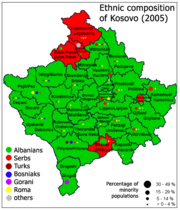
 According to the Kosovo in Figures 2005 Survey of the Statistical Office of Kosovo, Kosovo's total population is estimated between 1.9 and 2.2 million with the following ethnic composition: Albanians
92%, Serbs
4%, Bosniaks
and Gorans 2%, Turks
1%, Roma 1%. CIA World Factbook
estimates the following ratio: 88% Albanians
, 8% Kosovo Serbs
and 4% other ethnic groups.
According to latest CIA The World Factbook
estimated data, as of July 2009, Kosovo's population stands at 1,804,838 persons. It stated that ethnic composition is "Albanians 88%, Serbs 7%, other 5% (Bosniak, Gorani, Roma, Turk, Ashkali, Egyptian, Janjevci – Croats
)"
Albanians, steadily increasing in number, have constituted a majority in Kosovo since the 19th century, the earlier ethnic composition being disputed. Kosovo's political boundaries do not quite coincide with the ethnic boundary by which Albanians compose an absolute majority in every municipality; for example, Serbs form a local majority in North Kosovo
and two other municipalities
, while there are large areas with an Albanian majority outside of Kosovo, namely in the neighbouring regions of former Yugoslavia: the north-west of Macedonia
, and in the Preševo Valley
in Central Serbia
.
At 1.3% per year, ethnic Albanians in Kosovo
have the fastest rate of growth in population in Europe. Over an 82-year period (1921–2003) the population of Kosovo grew to 460% of its original size. If growth continues at such a pace, the population will reach 4.5 million by 2050. However, this is unlikely to happen; until about 1990, Kosovo Albanians had very high birth rates of about 4 children per woman, similar to many poor developing countries, but this has fallen down to about two since then and will likely sink below replacement eventually, as it has in Albania
itself. In addition, Kosovo has a high emigration rate now which it did not have before 1990.
By contrast, from 1948 to 1991, the Serb population of Kosovo increased by a mere 12% (one third the growth of the population in Central Serbia). In addition, in the same period, hundreds of thousands have left to settle in more prosperous Central Serbia
or Western Europe. 60% of Kosovo's pre-1999 Serbian population resides in Serbia proper following the ethnic cleansing
campaign in 1999. The population of Albanians in Kosovo increased by 300% in the same period a rate of growth twenty-five times that of the Serbs in Kosovo. Serbs, similar to most other Eastern European Christian ethnic groups, since about 1990 have had very low birth rates (about 1.5 children per woman) and more deaths than births. This ensures a continued dwindling of the Serb minority as a percentage of the population, even with the dropping births among the Albanians.
, the first language of 88 - 92% of the population. The native dialect of the Kosovar Albanian population is Gheg Albanian
, although Standard Albanian
is now widely used as an official language. Serbian
is the next most common, spoken as a first language by 5-7% of the population. According to the draft Constitution of Kosovo
, Serbian
is also an official language
. Other minority languages in Kosovo include Turkish
, Gorani and the other Serbo-Croatian languages.
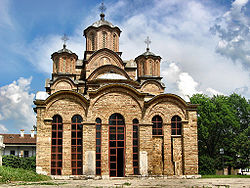 The two main religions of Kosovo are Islam and Christianity. Muslims make up 90% of Kosovo's population, and followers are mostly Sunni, with a Bektashi Islam
minority. If considered an independent state, Kosovo would be one of three Muslim-dominated countries which lie exclusively within Europe - next to Bosnia and Herzegovina
and Albania - and the most Muslim of them all by proportion of population. Islam was brought into the region with the Ottoman conquest
in the 15th century and now nominally professed by most of the ethnic Albanians, by the Bosniak, Gorani, and Turkish communities, and by some of the Roma/Ashkali
-"Egyptian
" community. Islam, however, does not dominate the Kosovar society, which remains largely secular. About three percent of ethnic Albanians in Kosovo remain Roman Catholic despite centuries of the Ottoman rule. There are an estimated 65,000 Catholics in Kosovo and another 60,000 Kosovar born Catholics outside of Kosovo. The Serb population, estimated at 100,000 to 120,000 persons, is largely Serbian Orthodox. Kosovo is densely covered by numerous Serb Orthodox churches and monasteries. Some 140 churches are reported to have been destroyed and partly looted for the black market in the 1999 to 2004 period, of these 30 in a single outburst of violence in March 2004
.
There is also a small number of evangelical Protestants, whose tradition dates back to the Methodist missionaries' work centred in Bitola
in the late 1800s. They are represented by the Kosovo Protestant Evangelical Church (KPEC).
According to the governments of the Republic of Kosovo and the Republic of Serbia, there is no official or state religion of Kosovo.
The two haplogroups most strongly associated with Albanian people (E-V13 and J2b
) are often considered to have arrived in Europe from the Near East
with the Neolithic
revolution or late Mesolithic
, early in the Holocene
epoch. From here in the Balkans, it is thought, they spread to the rest of Europe.

Common in the Balkans but not specifically associated with Albania and the Albanian language are I-M423 and R1a-M17:
period however, Serbs and Albanians within Kosovo enjoyed good-neighbourly relations, working together to oppose foreign meddling in the territory on many occasions During the Tito-era of communist rule in Yugoslavia, the ethnic Albanian and Serb populations of Kosovo were strongly irreconcilable with sociological studies during the Tito-era indicating that ethnic Albanian and Serb peoples in Kosovo rarely accepted each other as neighbours or friends and few held interethnic marriages. Ethnic prejudices, stereotypes and mutual distrust between ethnic Albanians and Serbs have remained common for decades. The level of intolerance and separation between the ethnic Albanian and Serb communities during the Tito-period was reported by sociologists to be worse than that of Croat and Serb communities in Yugoslavia which also had tensions but held some closer relations between each other.
report that Romani people encounter hostility by Albanians outside their local areas. The report adds:
(see World Music
) and Serbian music do still exist. Albanian music is characterised by the use of the çiftelia
(an authentic Albanian instrument), mandolin, mandola and percussion. Classical music is also well known in Kosovo and has been taught at several music schools and universities (at the University of Prishtina Faculty of Arts in Pristina
and the University of Priština Faculty of Arts at Kosovska Mitrovica
).
s. At present only some of the sports federations established have gained international recognition.
, due to the many weapons in the hands of civilians, law enforcement inefficiencies, and widespread devastation, both revenge killings
and ethnic violence
surged tremendously. The number of reported murders rose 80% from 136 in 2000 to 245 in 2001. The number of reported arsons rose 140% from 218 to 523 over the same period. UNMIK pointed out that the rise in reported incidents might simply correspond to an increased confidence in the police force (i.e., more reports) rather than more actual crime. According to the UNODC, by 2008, murder rates in Kosovo had dropped by 75% in five years.
Although the number of noted serious crimes increased between 1999 and 2000, since then it has been "starting to resemble the same patterns of other European cities". According to Amnesty International
, the aftermath of the war resulted in an increase in the trafficking of women for sexual exploitation. According to the IOM
data, in 2000–2004, Kosovo was consistently ranked fourth or fifth among the countries of Southeastern Europe by number of human trafficking
victims, after Albania, Moldova
, Romania and sometimes Bulgaria
.
Residual landmines and other unexploded ordnance
remain in Kosovo, although all roads and tracks have been cleared. Caution when travelling in remote areas is advisable.
Kosovo is extremely vulnerable to organised crime and thus to money laundering
. In 2000, international agencies estimated that Kosovo was supplying up to 40% of the heroin sold in Europe and North America. Due to the 1997 unrest in Albania
and the Kosovo War
in 1998–1999 ethnic Albanian traffickers enjoyed a competitive advantage, which has been eroding as the region stabilises. However, according to a 2008 report by the United Nations Office on Drugs and Crime
, overall, ethnic Albanians, not only from Kosovo, supply 10 to 20% of the heroin in Western Europe, and the traffic has been declining.
In 2010, a report by Swiss MP Dick Marty
claimed to have evidence that a criminal network tied to the Kosovo Liberation Army
and the Prime Minister, Hashim Thaci
, executed prisoners and harvested their kidneys for organ transplantation. The Kosovo government rejected the allegation. On 25 January 2011, the Council of Europe
endorsed the report and called for a full and serious investigation into its contents.
has always historically produced in Kosovo, both red and white. Currently the wine industry is successful and growing after the war in the 1990s. The main heartland of Kosovo's wine industry is in Orahovac (Rahoveci)
where millions of litres of wine is produced. The main wines produced in Kosovo include Pinot Noir
, Merlot
and Chardonnay
. Kosovo has recently been exporting wines to Germany
and the United States
.
Ottoman Empire
The Ottoman EmpireIt was usually referred to as the "Ottoman Empire", the "Turkish Empire", the "Ottoman Caliphate" or more commonly "Turkey" by its contemporaries...
for more than five centuries, later the Autonomous Province of Kosovo and Metohija (Serbian: Autonomna Pokrajina Kosovo i Metohija
Metohija
Metohija , is a large basin and the name of the region covering the southwestern part of Kosovo.It encompasses three of the seven districts of Kosovo, namely the historical :* District of Peć * District of Đakovica * District of Prizren...
) within Serbia
Serbia
Serbia , officially the Republic of Serbia , is a landlocked country located at the crossroads of Central and Southeast Europe, covering the southern part of the Carpathian basin and the central part of the Balkans...
(Serbia then being one of the constituent republics of Yugoslavia). Long-term severe ethnic tensions between Kosovo's ethnic Albanian and Serb populations have left Kosovo ethnically disunified, resulting in inter-ethnic violence, including the Kosovo War
Kosovo War
The term Kosovo War or Kosovo conflict was two sequential, and at times parallel, armed conflicts in Kosovo province, then part of FR Yugoslav Republic of Serbia; from early 1998 to 1999, there was an armed conflict initiated by the ethnic Albanian "Kosovo Liberation Army" , who sought independence...
of 1999. Following the Kosovo War, the Federal Republic of Yugoslavia
Serbia and Montenegro
Serbia and Montenegro was a country in southeastern Europe, formed from two former republics of the Socialist Federal Republic of Yugoslavia : Serbia and Montenegro. Following the breakup of Yugoslavia, it was established in 1992 as a federation called the Federal Republic of Yugoslavia...
(FRY) relinquished governance of this territory, whose governance was taken over by the United Nations, Kosovo remained legally the sovereign territory of the FRY after the transfer of authority. The partially recognised Republic of Kosovo
Republic of Kosovo
Kosovo , officially the Republic of Kosovo is a partially recognised state and a disputed territory in the Balkans...
(Albanian: Republika e Kosovës; Serbian: Република Косово, Republika Kosovo), a self-declared independent state, has de facto control over most of the territory, with North Kosovo
North Kosovo
North or Northern Kosovo refers to a region in the northern part of Kosovo with an ethnic Serb majority that functions largely autonomously from the remainder of the disputed territory, which has an ethnic Albanian majority. Ibarian Kolashin , a toponym that pre-dates the political partition, is...
, the largest Kosovo Serb enclave, is under the control of institutions of the Republic of Serbia. Serbia
Serbia
Serbia , officially the Republic of Serbia , is a landlocked country located at the crossroads of Central and Southeast Europe, covering the southern part of the Carpathian basin and the central part of the Balkans...
does not recognise the unilateral secession of Kosovo and considers it a UN-governed entity within its sovereign territory
Sovereignty
Sovereignty is the quality of having supreme, independent authority over a geographic area, such as a territory. It can be found in a power to rule and make law that rests on a political fact for which no purely legal explanation can be provided...
.
Background
Kosovo is landlocked and borders the Republic of MacedoniaRepublic of Macedonia
Macedonia , officially the Republic of Macedonia , is a country located in the central Balkan peninsula in Southeast Europe. It is one of the successor states of the former Yugoslavia, from which it declared independence in 1991...
to the south, Albania
Albania
Albania , officially known as the Republic of Albania , is a country in Southeastern Europe, in the Balkans region. It is bordered by Montenegro to the northwest, Kosovo to the northeast, the Republic of Macedonia to the east and Greece to the south and southeast. It has a coast on the Adriatic Sea...
to the west and Montenegro
Montenegro
Montenegro Montenegrin: Crna Gora Црна Гора , meaning "Black Mountain") is a country located in Southeastern Europe. It has a coast on the Adriatic Sea to the south-west and is bordered by Croatia to the west, Bosnia and Herzegovina to the northwest, Serbia to the northeast and Albania to the...
to the northwest. The remaining frontier belt is with the Central Serbia
Central Serbia
Central Serbia , also referred to as Serbia proper , was the region of Serbia from 1945 to 2009. It included central parts of Serbia outside of the autonomous provinces of Kosovo and Vojvodina. The region of Central Serbia was not an administrative division of Serbia as such; it was under the...
n region which is the source of international dispute. The largest city and the capital of Kosovo is Pristina
Pristina
Pristina, also spelled Prishtina and Priština is the capital and largest city of Kosovo. It is the administrative centre of the homonymous municipality and district....
(alternatively spelled Prishtina or Priština), while other cities include Peć
Pec
Peć or Pejë is a city and municipality in north-western Kosovo and Metohija - Serbia, and the administrative centre of the homonymous district. Governor of city is Ali Berisha....
(Albanian: Peja), Prizren
Prizren
Prizren is a historical city located in southern Kosovo. It is the administrative center of the eponymous municipality and district.The city has a population of around 131,247 , mostly Albanians...
, Đakovica (Gjakova), and Kosovska Mitrovica
Kosovska Mitrovica
Kosovska Mitrovica , is a city and municipality in northern Kosovo. It is the administrative centre of the homonymous district....
(Mitrovica). Nominally, the name of Kosovo has come to represent a number of different entities over the centuries and its borders have subsequently altered. There have also been periods when no political entity has existed with the name of Kosovo. Today's outline dates back to 1946.
During classical antiquity
Classical antiquity
Classical antiquity is a broad term for a long period of cultural history centered on the Mediterranean Sea, comprising the interlocking civilizations of ancient Greece and ancient Rome, collectively known as the Greco-Roman world...
, the territory roughly corresponding to present-day Kosovo was part of several tribal alliances, including that formed by the Dardani
Dardani
Dardania was the region of the Dardani .Located at the Thraco-Illyrian contact zone, their identification as either an Illyrian or Thracian tribe is uncertain. Their territory itself was not considered part of Illyria by Strabo. The term used for their territory was , while for other tribes had...
. Upon conquest, the Romans
Ancient Rome
Ancient Rome was a thriving civilization that grew on the Italian Peninsula as early as the 8th century BC. Located along the Mediterranean Sea and centered on the city of Rome, it expanded to one of the largest empires in the ancient world....
dissolved existing tribal alliances and re-integrated communities centred on Roman civitates as part of the Roman province of Moesia Superior. Subdivisions in Late Roman times created the region of "Dardania". After the collapse of Roman control, the region was contested between Avars
Avars
Avar or Avars may refer to:* Eurasian Avars, a nomadic people that conquered the Hungarian Steppe in the early Middle Ages* Uar * Caucasian Avars, a modern people of the Caucasus** Avar language, the language of the Caucasian Avars...
, Sklavenes and Byzantines
Byzantine Empire
The Byzantine Empire was the Eastern Roman Empire during the periods of Late Antiquity and the Middle Ages, centred on the capital of Constantinople. Known simply as the Roman Empire or Romania to its inhabitants and neighbours, the Empire was the direct continuation of the Ancient Roman State...
, and later between the Byzantines, Bulgarians
Bulgarian Empire
Bulgarian Empire is a term used to describe two periods in the medieval history of Bulgaria, during which it acted as a key regional power in Europe in general and in Southeastern Europe in particular, rivalling Byzantium...
and Serbs.
The name and the region Kosovo first appears as part of a newly created region within an expanded Serbian medieval state, and soon became its ecclesiastical and secular centre; the region was subsequently enshrined by Serbs as the cradle of their national identity. Following the Battle of Kosovo
Battle of Kosovo
The Battle of Kosovo took place on St. Vitus' Day, June 15, 1389, between the army led by Serbian Prince Lazar Hrebeljanović, and the invading army of the Ottoman Empire under the leadership of Sultan Murad I...
in 1389, it became part of the Ottoman Empire
Ottoman Empire
The Ottoman EmpireIt was usually referred to as the "Ottoman Empire", the "Turkish Empire", the "Ottoman Caliphate" or more commonly "Turkey" by its contemporaries...
, while some parts of it remained in the Albanian Principality of Dukagjini
Principality of Dukagjini
Principality of Dukagjini was a principality in Medieval Albania. It was created by brothers Pal and Leka I Dukagjini and then ruled by Pal's descendants, Tanush Dukagjini, Pal II Dukagjini, who took part in the League of Lezha...
, until the middle 15th century. During the Ottoman period the region came into close contact with the Ottoman culture. Islam
Islam
Islam . The most common are and . : Arabic pronunciation varies regionally. The first vowel ranges from ~~. The second vowel ranges from ~~~...
was introduced to the population. During the late 19th century, Kosovo was the centre of the Albanian national awakening and the battlefield of the Albanian revolts of 1843–44
Albanian Revolt of 1843–1844
The Albanian Revolt of 1843–1844, variously also known as the Revolt of 1844 or the Uprising of Dervish Cara , was a 19th-century uprising in northern Ottoman Albania directed against the Ottoman Tanzimat reforms which started in 1839 and were gradually being put in action in the regions of Albania...
, 1910
Albanian Revolt of 1910
The Albanian Revolt of 1910 was a reaction to the new centralization policies of the Young Turk Ottoman government in Albania. It was the first of a series of major uprisings which led to the Albanian Declaration of Independence in 1912...
and 1912
Albanian Revolt of 1912
The Albanian Revolt of 1912 was one of many Albanian revolts in the Ottoman Empire and lasted from January until August 1912. After a series of successes, Albanian revolutionaries managed to capture the city of Skopje, the administrative centre of Kosovo vilayet within the Ottoman rule...
. In 1912, the Ottoman province
Kosovo Province, Ottoman Empire
The Vilayet of Kosovo was a vilayet of the Ottoman Empire in the Balkan Peninsula which included the current territory of Kosovo and the western part of the Republic of Macedonia...
was divided between Montenegro
Kingdom of Montenegro
The Kingdom of Montenegro was a monarchy in southeastern Europe during the tumultuous years on the Balkan Peninsula leading up to and during World War I. Legally it was a constitutional monarchy, but absolutist in practice...
and Serbia
Kingdom of Serbia
The Kingdom of Serbia was created when Prince Milan Obrenović, ruler of the Principality of Serbia, was crowned King in 1882. The Principality of Serbia was ruled by the Karađorđevic dynasty from 1817 onwards . The Principality, suzerain to the Porte, had expelled all Ottoman troops by 1867, de...
, both of which became part of Yugoslavia
Yugoslavia
Yugoslavia refers to three political entities that existed successively on the western part of the Balkans during most of the 20th century....
in 1918. During World War II
World War II
World War II, or the Second World War , was a global conflict lasting from 1939 to 1945, involving most of the world's nations—including all of the great powers—eventually forming two opposing military alliances: the Allies and the Axis...
, the majority of Kosovo was part of Italian-occupied Albania
Albania under Italy
The Albanian Kingdom existed as a protectorate of the Kingdom of Italy. It was practically a union between Italy and Albania, officially led by Italy's King Victor Emmanuel III and its government: Albania was led by Italian governors, after being militarily occupied by Italy, from 1939 until 1943...
, followed by a Nazi German Occupation
Albania under Nazi Germany
The Albanian Kingdom existed as a de jure independent country, between 1943 and 1944. The usual de facto name in most of the historic German literature and documents is Großalbanien, sometimes Gross-Albanien...
before becoming an autonomous province
Autonomous Province of Kosovo and Metohija (1946-1974)
The Autonomous Province of Kosovo and Metohija was an autonomous province of Serbia, within the larger federation of Yugoslavia from 1963 to 1974, when it was replaced by the Socialist Autonomous Province of Kosovo...
of the SR Serbia under the Constitution of the Socialist Federal Republic of Yugoslavia
Constitution of the Socialist Federal Republic of Yugoslavia
The Constitution of the Socialist Federal Republic of Yugoslavia was the supreme law of S.F.R. Yugoslavia and its predecessor, the Federal People's Republic of Yugoslavia .-Federal constitutions:...
.
After the Kosovo War
Kosovo War
The term Kosovo War or Kosovo conflict was two sequential, and at times parallel, armed conflicts in Kosovo province, then part of FR Yugoslav Republic of Serbia; from early 1998 to 1999, there was an armed conflict initiated by the ethnic Albanian "Kosovo Liberation Army" , who sought independence...
and the 1999 NATO bombing of Yugoslavia, the territory came under the interim administration of the United Nations Mission in Kosovo (UNMIK), most of whose roles were assumed by the European Union Rule of Law
Rule of law
The rule of law, sometimes called supremacy of law, is a legal maxim that says that governmental decisions should be made by applying known principles or laws with minimal discretion in their application...
Mission in Kosovo (EULEX
European Union Rule of Law Mission in Kosovo
The European Union Rule of Law Mission in Kosovo, EULEX Kosovo, is a deployment of European Union police and civilian resources to Kosovo...
) in December 2008. In February 2008 individual members of the Assembly of Kosovo
Assembly of Kosovo
The Assembly of Kosovo was originally established by the United Nations Interim Administration Mission in Kosovo in 2001 to provide 'provisional, democratic self-government'....
(acting in personal capacity and not binding the Assembly itself) declared Kosovo's independence as the Republic of Kosovo. Its independence is recognised
Diplomatic recognition
Diplomatic recognition in international law is a unilateral political act with domestic and international legal consequences, whereby a state acknowledges an act or status of another state or government in control of a state...
by and the Republic of China
Republic of China
The Republic of China , commonly known as Taiwan , is a unitary sovereign state located in East Asia. Originally based in mainland China, the Republic of China currently governs the island of Taiwan , which forms over 99% of its current territory, as well as Penghu, Kinmen, Matsu and other minor...
(Taiwan). On 8 October 2008, upon request of Serbia, the UN General Assembly
United Nations General Assembly
For two articles dealing with membership in the General Assembly, see:* General Assembly members* General Assembly observersThe United Nations General Assembly is one of the five principal organs of the United Nations and the only one in which all member nations have equal representation...
adopted a resolution asking the International Court of Justice
International Court of Justice
The International Court of Justice is the primary judicial organ of the United Nations. It is based in the Peace Palace in The Hague, Netherlands...
for an advisory opinion on the issue of Kosovo's declaration of independence
2008 Kosovo declaration of independence
The 2008 Kosovo declaration of independence was adopted on 17 February 2008 by individual members of the Assembly of Kosovo acting in personal capacity and not binding to the Assembly itself...
. On 22 July 2010, the ICJ ruled that Kosovo's declaration of independence did not violate international law, which its president said contains no "prohibitions on declarations of independence".
Name
Kosovo is the Serbian neuter possessive adjectivePossessive adjective
Possessive adjectives, also known as possessive determiners, are a part of speech that modifies a noun by attributing possession to someone or something...
of kos (кос) "blackbird", an ellipsis
Ellipsis (linguistics)
In linguistics, ellipsis or elliptical construction refers to the omission from a clause of one or more words that would otherwise be required by the remaining elements.-Overview:...
for Kosovo Polje, 'blackbird field', the site
Gazimestan
Gazimestan is the name of a monument commemorating the historical Battle of Kosovo, situated about 6-7 kilometres north-northeast of the actual battlefield, known as Kosovo Field , or in Albanian: "Fushë Kosovë/Fushë Kosova"...
of the 1389 Battle of Kosovo Field
Battle of Kosovo
The Battle of Kosovo took place on St. Vitus' Day, June 15, 1389, between the army led by Serbian Prince Lazar Hrebeljanović, and the invading army of the Ottoman Empire under the leadership of Sultan Murad I...
. The name of the field was applied to an Ottoman province
Kosovo Province, Ottoman Empire
The Vilayet of Kosovo was a vilayet of the Ottoman Empire in the Balkan Peninsula which included the current territory of Kosovo and the western part of the Republic of Macedonia...
created in 1864.
The region currently known as "Kosovo" became an administrative region
Region
Region is most commonly found as a term used in terrestrial and astrophysics sciences also an area, notably among the different sub-disciplines of geography, studied by regional geographers. Regions consist of subregions that contain clusters of like areas that are distinctive by their uniformity...
in 1946, as the Autonomous Province of Kosovo and Metohija
Autonomous Province of Kosovo and Metohija (1946-1974)
The Autonomous Province of Kosovo and Metohija was an autonomous province of Serbia, within the larger federation of Yugoslavia from 1963 to 1974, when it was replaced by the Socialist Autonomous Province of Kosovo...
. In 1974, the compositional "Kosovo and Metohija
Metohija
Metohija , is a large basin and the name of the region covering the southwestern part of Kosovo.It encompasses three of the seven districts of Kosovo, namely the historical :* District of Peć * District of Đakovica * District of Prizren...
" was reduced to simple "Kosovo" in the name of the Socialist Autonomous Province of Kosovo
Socialist Autonomous Province of Kosovo
Socialist Autonomous Province of Kosovo was one of the two socialist autonomous areas of the Socialist Republic of Serbia incorporated into the Socialist Federal Republic of Yugoslavia from 1974 until 1990...
, but in 1990 was renamed back to Autonomous Province of Kosovo and Metohija.
The entire region is commonly referred to in English simply as Kosovo and in Albanian
Albanian language
Albanian is an Indo-European language spoken by approximately 7.6 million people, primarily in Albania and Kosovo but also in other areas of the Balkans in which there is an Albanian population, including western Macedonia, southern Montenegro, southern Serbia and northwestern Greece...
as (definite form, kɔˈsɔ:va) or ("indefinite" form, kɔˈsɔːv). In Serbia, a distinction is made between the eastern and western areas; the term is used for the eastern part, while the western part is called Metohija
Metohija
Metohija , is a large basin and the name of the region covering the southwestern part of Kosovo.It encompasses three of the seven districts of Kosovo, namely the historical :* District of Peć * District of Đakovica * District of Prizren...
.
History
Kosovo's current status is the result of the turmoil of the breakup of Yugoslavia, particularly the Kosovo WarKosovo War
The term Kosovo War or Kosovo conflict was two sequential, and at times parallel, armed conflicts in Kosovo province, then part of FR Yugoslav Republic of Serbia; from early 1998 to 1999, there was an armed conflict initiated by the ethnic Albanian "Kosovo Liberation Army" , who sought independence...
of 1998 to 1999, but it is suffused with issues dating back to the rise of nationalism in the Balkans during the last part of Ottoman rule
Ottoman Empire
The Ottoman EmpireIt was usually referred to as the "Ottoman Empire", the "Turkish Empire", the "Ottoman Caliphate" or more commonly "Turkey" by its contemporaries...
in the 19th century. The Kosovo Albanians claim that the Illyrians, whom they claim as their direct ancestors, were the majority population in the region, and continued to be so throughout history despite failing to create any 'national institutions' in Kosovo until modern times and despite encroachments on their native territories. The Serbians deny this claim. Moreoever, they argue that, even if there is some linguistic connection between the pre-Slavic population of "Dardania" and modern Albanians, this cannot be used to justify modern territorial aspirations since it relies on territorial claims from pre-Migration Age Europe, at a time where there were no states or nations as we know them today. Serbian claims to Kosovo extend even farther than the migrations dated to c. 6–7th century, on the account of admixture with preexisting "Illyrians" and Roman populations and their preservation of certain of their customs. Moreover, in line with the consensus historical viewpoint, they see modern Albanians to have emerged in the Middle Ages after significant admixture with various other ethno-linguistic groups, including Slavs. Finally, Serbs claim that Kosovo very rapidly became the 'heart of Serbia' in the Middle Ages, and revere the Battle of Kosovo
Battle of Kosovo
The Battle of Kosovo took place on St. Vitus' Day, June 15, 1389, between the army led by Serbian Prince Lazar Hrebeljanović, and the invading army of the Ottoman Empire under the leadership of Sultan Murad I...
, eponymous with the Kosovo region.
Early history
The area was then conquered by Rome in the 160s BC, and incorporated into the Roman province
Roman province
In Ancient Rome, a province was the basic, and, until the Tetrarchy , largest territorial and administrative unit of the empire's territorial possessions outside of Italy...
of Illyricum
Illyricum (Roman province)
The Roman province of Illyricum or Illyris Romana or Illyris Barbara or Illyria Barbara replaced most of the region of Illyria. It stretched from the Drilon river in modern north Albania to Istria in the west and to the Sava river in the north. Salona functioned as its capital...
in 59 BC. Subsequently, it became part of Moesia Superior in AD 87. The region was exposed to an increasing number of 'barbarian' raids from the fourth century C.E. onwards, culminating with the so-called Slavic migrations of the 6th to 7th centuries. Archaeologically, the early Middle Ages represent a hiatus in the material record, and whatever was left of the native provincial population fused with the Sklavene colonists.
The subsequent political and demographic history of Kosovo
Demographic history of Kosovo
The demographic features of the population of Kosovo, includes various factors such as population density, ethnicity, education level, health of the populace, economic status, religious affiliations and other aspects of the population....
is not known with absolute certainty until c. 13th century C.E. Archaeological findings suggest that there was steady population recovery and progression of the Slavic culture seen elsewhere throughout the Balkans. The region was absorbed into the Bulgarian Empire
First Bulgarian Empire
The First Bulgarian Empire was a medieval Bulgarian state founded in the north-eastern Balkans in c. 680 by the Bulgars, uniting with seven South Slavic tribes...
in the 850s, where Christianity and a Byzantine-Slavic culture was cemented in the region. It was re-taken by the Byzantines after 1018, and became part of the newly established Theme of Bulgaria. As the centre of Slavic resistance to Constantinople in the region, the region often switched between Serbian and Bulgarian rule on one hand and Byzantine on the other until the Serb principality of Rascia
Rascia
Rascia was a medieval region that served as the principal province of the Serbian realm. It was an administrative division under the direct rule of the monarch and sometimes as an appanage. The term has been used to refer to various Serbian states throughout the Middle Ages...
conquered it definitively by the end of the 12th century. An insight into the region is provided by the Byzantine historian-princess, Anna Comnena, who wrote of "Serbs" being the main inhabitants of the region (referring to it as "eastern Dalmatia" and the "former Moesia Superior"). The earliest references to an Albanian population is derived from late eleventh century Byzantine chroniclers, who consistently located the Arber around the hinterland districts of Dyrrachium, modern Durrës.
The zenith of Serbian power was reached in 1346, with the formation of the Serbian Empire
Serbian Empire
The Serbian Empire was a short-lived medieval empire in the Balkans that emerged from the Serbian Kingdom. Stephen Uroš IV Dušan was crowned Emperor of Serbs and Greeks on 16 April, 1346, a title signifying a successorship to the Eastern Roman Empire...
. During the 13th and 14th centuries, Kosovo became a political and spiritual centre of the Serbian Kingdom. In the late 13th century, the seat of the Serbian Archbishopric was moved to Pec, and rulers centred themselves between Prizren and Skopje, during which time thousands of Christian monasteries and feudal-style forts and castles were erected. When the Serbian Empire fragmented into a conglomeration of principalities in 1371, Kosovo became the hereditary land of the House of Branković
House of Brankovic
House of Branković or Brankovići was a noble Serbian medieval dynasty. The family descent via female line through marriage from the Royal House of Nemanjić. The families rise to prominence during the time of disintegration of Serbian Empire under the last ruler of House of Nemanjić...
. In the late 14th and the 15th century parts of Kosovo, the easternmost area of which was located near Pristina, were part of the Principality of Dukagjini
Principality of Dukagjini
Principality of Dukagjini was a principality in Medieval Albania. It was created by brothers Pal and Leka I Dukagjini and then ruled by Pal's descendants, Tanush Dukagjini, Pal II Dukagjini, who took part in the League of Lezha...
, which was later incorporated an anti-Ottoman federation of all Albanian principalities, the League of Lezhë
League of Lezhë
The League of Lezhë was an alliance of Albanian Principalities forged in Lezhë on the 2nd of March 1444. It was initiated and organised by Skanderbeg with the aim of uniting the Albanian principalities that had been founded in the 12th - 14th centuries, to fight the Ottoman Armies...
.
In the 1389 Battle of Kosovo
Battle of Kosovo
The Battle of Kosovo took place on St. Vitus' Day, June 15, 1389, between the army led by Serbian Prince Lazar Hrebeljanović, and the invading army of the Ottoman Empire under the leadership of Sultan Murad I...
, Ottoman forces defeated a coalition of Serbs, Albanians, and Bosnians led by the Tsar Lazar Hrebeljanović
Lazar of Serbia
Lazar Hrebeljanović , was a medieval nobleman that emerged as the most powerful Serbian ruler after the death of the previous, childless, Emperor Uroš the Weak, which resulted in years of instability in the Serbian realm. As Stefan Lazar, he was Prince of Serbia from 1371 to 1389, ruling what is...
. Soon after, parts of Serbia accepted Turkish vassalage and Lazar's daughter was married to the Sultan to seal the peace.
By 1455, it was finally and fully conquered by the Ottoman Empire.
Ottoman Kosovo (1455–1912)
Kosovo was part of the Ottoman EmpireOttoman Empire
The Ottoman EmpireIt was usually referred to as the "Ottoman Empire", the "Turkish Empire", the "Ottoman Caliphate" or more commonly "Turkey" by its contemporaries...
from 1455 to 1912, at first as part of the eyalet
Subdivisions of the Ottoman Empire
The subdivisions of the Ottoman Empire were administrative divisions of the state organisation of the Ottoman Empire. Outside this system were various types of vassal and tributary states....
of Rumelia
Rumelia
Rumelia was an historical region comprising the territories of the Ottoman Empire in Europe...
, and from 1864 as a separate province
Kosovo Province, Ottoman Empire
The Vilayet of Kosovo was a vilayet of the Ottoman Empire in the Balkan Peninsula which included the current territory of Kosovo and the western part of the Republic of Macedonia...
(vilayet). During this time, Islam
Islam
Islam . The most common are and . : Arabic pronunciation varies regionally. The first vowel ranges from ~~. The second vowel ranges from ~~~...
was introduced to the population. The Vilayet of Kosovo was an area much larger than today's Kosovo; it included all today's Kosovo territory, sections of the Sandžak
Sandžak
Sandžak also known as Raška is a historical region lying along the border between Serbia and Montenegro...
region cutting into present-day Central Serbia
Central Serbia
Central Serbia , also referred to as Serbia proper , was the region of Serbia from 1945 to 2009. It included central parts of Serbia outside of the autonomous provinces of Kosovo and Vojvodina. The region of Central Serbia was not an administrative division of Serbia as such; it was under the...
and Montenegro
Montenegro
Montenegro Montenegrin: Crna Gora Црна Гора , meaning "Black Mountain") is a country located in Southeastern Europe. It has a coast on the Adriatic Sea to the south-west and is bordered by Croatia to the west, Bosnia and Herzegovina to the northwest, Serbia to the northeast and Albania to the...
along with the Kukës
Kukës
Kukës is a town in Albania located at 42.09°N, 20.43°E in the district and county with the same name. It has a population of about 16,000 . The town is set among the mountains of northern Albania. It is famous for its role during the Kosovo conflict for taking in 450,000 refugees from Kosovo...
municipality, the surrounding region in present-day northern Albania
Albania
Albania , officially known as the Republic of Albania , is a country in Southeastern Europe, in the Balkans region. It is bordered by Montenegro to the northwest, Kosovo to the northeast, the Republic of Macedonia to the east and Greece to the south and southeast. It has a coast on the Adriatic Sea...
and also parts of north-western Macedonia
Republic of Macedonia
Macedonia , officially the Republic of Macedonia , is a country located in the central Balkan peninsula in Southeast Europe. It is one of the successor states of the former Yugoslavia, from which it declared independence in 1991...
with the city of Skopje
Skopje
Skopje is the capital and largest city of the Republic of Macedonia with about a third of the total population. It is the country's political, cultural, economic, and academic centre...
(then Üsküp), as its capital. Between 1881 and 1912 (its final phase), it was internally expanded to include other regions of present-day Republic of Macedonia
Republic of Macedonia
Macedonia , officially the Republic of Macedonia , is a country located in the central Balkan peninsula in Southeast Europe. It is one of the successor states of the former Yugoslavia, from which it declared independence in 1991...
, including larger urban settlements such as Štip
Štip
Štip is the largest urban agglomeration in the eastern part of the Republic of Macedonia, serving as the economic, industrial, entertainment and educational focal point for the surrounding municipalities. As of the 2002 census, the Štip municipality alone had a population of about 47,796...
(İştip), Kumanovo
Kumanovo
Kumanovo is a city in the Republic of Macedonia and is the seat of Kumanovo Municipality which is the largest municipality in the country. Municipal institutions include a city council, mayor and other administrative bodies.-Name:...
(Kumanova) and Kratovo (Kratova).
Vlachs
Vlach is a blanket term covering several modern Latin peoples descending from the Latinised population in Central, Eastern and Southeastern Europe. English variations on the name include: Walla, Wlachs, Wallachs, Vlahs, Olahs or Ulahs...
, engaging in a symbiotic existence with the predominantly agricultural Slavs who inhabited the valleys and plains.
Kosovo, like Serbia, was occupied by Austrian forces during the Great War of 1683–1699, but the Ottomans re-established their rule of the region. Such acts of assistance by the Austrian Empire (then arch-rivals of the Ottoman Empire), or Russia, were always abortive or temporary at best. In 1690, the Serbian Patriarch of Peć Arsenije III
Arsenije III Carnojevic
Arsenije III Čarnojević was the Archbishop of Peć and Patriarch of Serbs from 1674 to 1691 and Metropolitan of Szentendre from 1691 to his death in 1706.-Family:Arsenije was born to the Cetinje clan of Old Montenegro...
apparently led a group of 37, 000 families from Kosovo to the Christian north, although, this might have been around 30 – 40, 0000 individuals. In 1766, the Ottomans abolished the Patriarchate of Peć
Patriarchate of Pec
The Patriarchate of Peć is a Serbian Orthodox monastery located near Peć. The complex of churches is the spiritual seat and mausoleum of the Serbian archbishops and patriarchs....
and the position of Christians in Kosovo further deteriorated, including full imposition of jizya
Jizya
Under Islamic law, jizya or jizyah is a per capita tax levied on a section of an Islamic state's non-Muslim citizens, who meet certain criteria...
(taxation of non-Muslims).
Although initially stout opponents of the advancing Turks, Albanian chiefs ultimately came to accept the Ottomans as sovereigns. The resulting alliance facilitated the mass conversion of Albanians to Islam. Given that the Ottoman Empire's subjects were divided along religious (rather than ethnic) lines, Islamicisation greatly elevated the status of Albanian chiefs. Prior to this, they were organised along simple tribal lines, living in the mountainous areas of modern Albania (from Kruje to the Sar range). Soon, they expanded into a depopulated Kosovo, as well as northwestern Macedonia, although some might have been autochthonous to the region. However, Banac favours the idea that the main settlers of the time were Vlachs.
Many Albanians gained prominent positions in the Ottoman government, no fewer than 42 Grand Vizier
Grand Vizier
Grand Vizier, in Turkish Vezir-i Azam or Sadr-ı Azam , deriving from the Arabic word vizier , was the greatest minister of the Sultan, with absolute power of attorney and, in principle, dismissable only by the Sultan himself...
s of the Empire were Albanian in origin, including Mehmet Akif Ersoy
Mehmet Akif Ersoy
Mehmet Âkif Ersoy was a Turkish poet, author, academic, member of parliament, and the poet of the Turkish National Anthem....
(1873–1936) an Albanian from Peć
Pec
Peć or Pejë is a city and municipality in north-western Kosovo and Metohija - Serbia, and the administrative centre of the homonymous district. Governor of city is Ali Berisha....
who composed the Turkish National Anthem
Istiklâl Marsi
The İstiklâl Marşı is the National Anthem of Turkey and Turkish Republic of Northern Cyprus, officially adopted on 12 March 1921 - two and a half years before the 29 October 1923 establishment of the Republic of Turkey, both as a motivational musical saga for the troops fighting in the Turkish War...
in 1921, "İstiklâl Marşı" (The Independence March). As Hupchik states, "Albanians had little cause of unrest" and "if anything, grew important in Ottoman internal affairs", and sometimes persecuted Christians harshly on behalf of their Turkish masters. According to the Serbian viewpoint, the most numerous Albanian migrations occurred during the eighteenth century. These Albanians were almost all of the Muslim faith, and their settlement was defended by the Ottomans, amounting to a mass-colonisation of Kosovo by Albanians and the genocide of Serbian inhabitants. According to the Albanian perspective, this was merely a consolidation of previously held territory.
In the 19th century, there was an awakening
Rise of nationalism under the Ottoman Empire
The rise of the Western notion of nationalism under the Ottoman Empire eventually caused the break-down of the Ottoman millet concept...
of ethnic nationalism
Ethnic nationalism
Ethnic nationalism is a form of nationalism wherein the "nation" is defined in terms of ethnicity. Whatever specific ethnicity is involved, ethnic nationalism always includes some element of descent from previous generations and the implied claim of ethnic essentialism, i.e...
throughout the Balkans. This systematised the underlying ethnic tensions into a broader struggle of Christian Serbs against Muslim Albanians. The ethnic Albanian nationalism movement was centred in Kosovo. In 1878 the League of Prizren
League of Prizren
The League for the Defense of the Rights of the Albanian Nation commonly known as the League of Prizren was an Albanian political organization founded on 10 June 1878 in Prizren, in the Kosovo province of the Ottoman Empire....
was formed. This was a political organisation
Political organisation
A political organization is an organization that involves itself in the political process. In a broader sense, a political organization can also be viewed as a political system, as long as it includes the entire system and body of government...
which aimed to unify all the Albanians
Albanians
Albanians are a nation and ethnic group native to Albania and neighbouring countries. They speak the Albanian language. More than half of all Albanians live in Albania and Kosovo...
of the Ottoman Empire in a common struggle for autonomy and greater cultural rights
Cultural rights
The cultural rights movement has provoked attention to protect the rights of groups of people, or their culture, in similar fashion to the manner in which the human rights movement has brought attention to the needs of individuals throughout the world....
, although they generally desired the continuation of the Ottoman Empire. The League was dis-established in 1881 but nevertheless enabled the awakening of a national identity
Nation
A nation may refer to a community of people who share a common language, culture, ethnicity, descent, and/or history. In this definition, a nation has no physical borders. However, it can also refer to people who share a common territory and government irrespective of their ethnic make-up...
amongst Albanians. It would be clear that Albanian ambitions were at odds with Serbian aims. The Kingdom of Serbia wished to incorporate this land formerly within its empire.
Balkan Wars
The Young Turk movement took control of the Ottoman Empire after a coup in 1912 which disposed of Sultan Abdul Hamid IIAbdul Hamid II
His Imperial Majesty, The Sultan Abdülhamid II, Emperor of the Ottomans, Caliph of the Faithful was the 34th sultan of the Ottoman Empire...
. The movement supported a centralised form of government and opposed any sort of autonomy desired by the various nationalities of the Ottoman Empire. An allegiance to Ottomanism was promoted instead. An Albanian uprising in 1912 exposed the Empires Northern territories in Kosovo and Novi Pazar
Novi Pazar
Novi Pazar is a city and municipality located in southwest Serbia, in the Raška District. According to the official census in 2011, number of inhabitants of municipality is 92,776, while the city itself has a population of 60,638...
which led to an invasion by the Kingdom of Montenegro
History of Montenegro
The History of Montenegro begins in the early Middle Ages, into the former Roman province of Dalmatia that forms present-day Montenegro.-Illyria:...
. The Ottomans
Ottoman Dynasty
The Ottoman Dynasty ruled the Ottoman Empire from 1299 to 1922, beginning with Osman I , though the dynasty was not proclaimed until Orhan Bey declared himself sultan...
suffered a serious defeat at the hands of Albanians in 1912, culminating in the Ottoman loss of most of its Albanian inhabited lands. The Albanians threatened to march all the way to Salonika and reimpose Abdul Hamid.
A wave of Albanians in the Ottoman army
Military of the Ottoman Empire
The history of military of the Ottoman Empire can be divided in five main periods. The foundation era covers the years between 1300 and 1453 , the classical period covers the years between 1451 and 1606 , the reformation period covers the years between 1606 and 1826 ,...
ranks also deserted during this period, refusing to fight their own kin. Two months later in September of the same year, a joint Balkan force made up of Serbian, Montenegrin, Bulgarian and Greek forces drove the Ottomans out of most of their European possessions.
The rise of Nationalism unfortunately hampered relations between Albanians and Serbs in Kosovo, due to influence from Russians
Russians
The Russian people are an East Slavic ethnic group native to Russia, speaking the Russian language and primarily living in Russia and neighboring countries....
, Austrians
Austrians
Austrians are a nation and ethnic group, consisting of the population of the Republic of Austria and its historical predecessor states who share a common Austrian culture and Austrian descent....
and Ottomans. Kosovo's status within Serbia was finalised the following year at the Treaty of London. Soon, there were concerted Serbian colonisation efforts in Kosovo during various periods between Serbia's 1912 takeover of the province and World War II
World War II
World War II, or the Second World War , was a global conflict lasting from 1939 to 1945, involving most of the world's nations—including all of the great powers—eventually forming two opposing military alliances: the Allies and the Axis...
. So the population of Serbs in Kosovo fell after World War II, but it had increased considerably before then.
An exodus of the local Albanian population occurred. Serbian authorities promoted creating new Serb settlements in Kosovo as well as the assimilation of Albanians into Serbian society. Numerous colonist Serb families moved into Kosovo, equalising the demographic balance between Albanians and Serbs.
First World War and birth of Kingdom of Yugoslavia
In the winter of 1915–16, during World War IWorld War I
World War I , which was predominantly called the World War or the Great War from its occurrence until 1939, and the First World War or World War I thereafter, was a major war centred in Europe that began on 28 July 1914 and lasted until 11 November 1918...
, Kosovo saw the retreat of the Serbian army as Kosovo was occupied by Bulgaria
Bulgaria
Bulgaria , officially the Republic of Bulgaria , is a parliamentary democracy within a unitary constitutional republic in Southeast Europe. The country borders Romania to the north, Serbia and Macedonia to the west, Greece and Turkey to the south, as well as the Black Sea to the east...
and Austria-Hungary.
In 1918, the Serbian Army pushed the Central Powers
Central Powers
The Central Powers were one of the two warring factions in World War I , composed of the German Empire, the Austro-Hungarian Empire, the Ottoman Empire, and the Kingdom of Bulgaria...
out of Kosovo. After World War I ended, the Monarchy was then transformed into the Kingdom of Serbs, Croats and Slovenians
Kingdom of Yugoslavia
The Kingdom of Yugoslavia was a state stretching from the Western Balkans to Central Europe which existed during the often-tumultuous interwar era of 1918–1941...
on 1 December 1918.
Kosovo was split into four counties, three being a part of Serbia (Zvečan
Zvecan
Zvečan is a town and municipality in the Kosovska Mitrovica district of Kosovo. It is a part of North Kosovo, a region with an ethnic Serb majority that functions largely autonomously from the remainder of the ethnic-Albanian-majority Kosovo and Metohija. The municipality covers an area of , and...
, Kosovo and southern Metohija
Metohija
Metohija , is a large basin and the name of the region covering the southwestern part of Kosovo.It encompasses three of the seven districts of Kosovo, namely the historical :* District of Peć * District of Đakovica * District of Prizren...
) and one of Montenegro (northern Metohija). However, the new administration system since 26 April 1922 split Kosovo among three Areas of the Kingdom: Kosovo, Raška
Raška
-Places:* Serbian Principality or Raška, a medieval Serbian state 610-960* Catepanate of Rascia, a Byzantine province 969-976* Grand Principality of Serbia or Raška, a medieval Serbian state 1101-1217...
and Zeta
Zeta
-Science:* Zeta functions, in mathematics** Riemann zeta function* Zeta potential, the electrokinetic potential of a colloidal system* Tropical Storm Zeta , formed in December 2005 and lasting through January 2006* Z-pinch, in fusion power...
. In 1929, the Kingdom was transformed into the Kingdom of Yugoslavia
Kingdom of Yugoslavia
The Kingdom of Yugoslavia was a state stretching from the Western Balkans to Central Europe which existed during the often-tumultuous interwar era of 1918–1941...
and the territories of Kosovo were reorganised among the Banate of Zeta
Zeta Banovina
The Zeta Banovina or Zeta Banate was a province of the Kingdom of Yugoslavia between 1929 and 1941. This province consisted of all of the present-day Montenegro as well as adjacent parts of Central Serbia, Kosovo, Croatia, and Bosnia and Herzegovina...
, the Banate of Morava
Morava Banovina
The Morava Banovina or Morava Banate was a province of the Kingdom of Yugoslavia between 1929 and 1941. This province consisted of parts of present-day Central Serbia and it was named for the Morava Rivers...
and the Banate of Vardar
Vardar Banovina
The Vardar Banovina or Vardar Banate or Vardarska Banovina was a province of the Kingdom of Yugoslavia between 1929 and 1941. It was located in the southernmost part of the country, encompassing the whole of today's Republic of Macedonia, southern parts of Central Serbia and southeastern parts of...
.
In order to change the ethnic composition of Kosovo, between 1912 and 1941 a large-scale Serbian re-colonisation of Kosovo was undertaken by the Belgrade government. Meanwhile, Kosovar Albanians' right to receive education in their own language was denied alongside other non-Slavic or unrecognised Slavic nations
Slavic peoples
The Slavic people are an Indo-European panethnicity living in Eastern Europe, Southeast Europe, North Asia and Central Asia. The term Slavic represents a broad ethno-linguistic group of people, who speak languages belonging to the Slavic language family and share, to varying degrees, certain...
of Yugoslavia, as the kingdom only recognised the Slavic Croat, Serb, and Slovene nations as constituent nations
Constituent country
Constituent country is a phrase sometimes used in contexts in which a country makes up a part of a larger entity. The term constituent country does not have any defined legal meaning, and is used simply to refer to a country which is a part Constituent country is a phrase sometimes used in contexts...
of Yugoslavia, while other Slavs had to identify as one of the three official Slavic nations while non-Slav nations were only deemed as minorities.
Albanians and other Muslims were forced to emigrate, mainly with the land reform
Land reform
[Image:Jakarta farmers protest23.jpg|300px|thumb|right|Farmers protesting for Land Reform in Indonesia]Land reform involves the changing of laws, regulations or customs regarding land ownership. Land reform may consist of a government-initiated or government-backed property redistribution,...
which struck Albanian landowners in 1919, but also with direct violent measures. In 1935 and 1938 two agreements between the Kingdom of Yugoslavia and Turkey
Turkey
Turkey , known officially as the Republic of Turkey , is a Eurasian country located in Western Asia and in East Thrace in Southeastern Europe...
were signed on the expatriation of 240,000 Albanians to Turkey, which was not completed because of the outbreak of World War II
World War II
World War II, or the Second World War , was a global conflict lasting from 1939 to 1945, involving most of the world's nations—including all of the great powers—eventually forming two opposing military alliances: the Allies and the Axis...
.
Second World War
In 1941, Kosovo and Yugoslavia became involved in World War IIWorld War II
World War II, or the Second World War , was a global conflict lasting from 1939 to 1945, involving most of the world's nations—including all of the great powers—eventually forming two opposing military alliances: the Allies and the Axis...
after the Axis powers
Axis Powers
The Axis powers , also known as the Axis alliance, Axis nations, Axis countries, or just the Axis, was an alignment of great powers during the mid-20th century that fought World War II against the Allies. It began in 1936 with treaties of friendship between Germany and Italy and between Germany and...
invaded Yugoslavia in 1941. Large parts of Kosovo became a part of Italian-controlled Albania
Albania under Italy
The Albanian Kingdom existed as a protectorate of the Kingdom of Italy. It was practically a union between Italy and Albania, officially led by Italy's King Victor Emmanuel III and its government: Albania was led by Italian governors, after being militarily occupied by Italy, from 1939 until 1943...
, other parts went to Bulgaria and German
Nazi Germany
Nazi Germany , also known as the Third Reich , but officially called German Reich from 1933 to 1943 and Greater German Reich from 26 June 1943 onward, is the name commonly used to refer to the state of Germany from 1933 to 1945, when it was a totalitarian dictatorship ruled by...
-occupied Military Administration of Serbia. The Italian Fascist regime of Benito Mussolini
Benito Mussolini
Benito Amilcare Andrea Mussolini was an Italian politician who led the National Fascist Party and is credited with being one of the key figures in the creation of Fascism....
with its expansionist and irredentist
Irredentism
Irredentism is any position advocating annexation of territories administered by another state on the grounds of common ethnicity or prior historical possession, actual or alleged. Some of these movements are also called pan-nationalist movements. It is a feature of identity politics and cultural...
aims on both Albania and Yugoslavia exploited the nationalist sentiment amongst Albanians to gain favour of the Albanian population for the Italian-run protectorate which ruled Albania, and thus encouraged the establishment of a Greater Albania
Greater Albania
Greater Albania or Ethnic Albania is an irredentist concept of lands outside the borders of the Republic of Albania that are considered part of a greater national homeland by most Albanians, based on the present-day or historical presence of Albanian populations in those areas...
which included large portions of Kosovo which was achieved in the Second World War.
At the 1944 wartime Bujan
Bujan
Bujan is a municipality in the Tropojë District, Kukës County, northern Albania. It is known for hosting the 1943 Bujan Conference....
conference the Kosovar communist resistance leaders passed a resolution on the postwar assignment of Kosovo to Albania, but their opinion was later disregarded. After numerous uprisings of Partisans
Partisan (military)
A partisan is a member of an irregular military force formed to oppose control of an area by a foreign power or by an army of occupation by some kind of insurgent activity...
led by Fadil Hoxha
Fadil Hoxha
Fadil Hoxha was an Albanian politician.-Early life:...
, Kosovo was liberated after 1944 with the help of the Albanian partisans of the Comintern
Comintern
The Communist International, abbreviated as Comintern, also known as the Third International, was an international communist organization initiated in Moscow during March 1919...
and became a province of Serbia
Serbia
Serbia , officially the Republic of Serbia , is a landlocked country located at the crossroads of Central and Southeast Europe, covering the southern part of the Carpathian basin and the central part of the Balkans...
within the Democratic Federal Yugoslavia
Yugoslavia
Yugoslavia refers to three political entities that existed successively on the western part of the Balkans during most of the 20th century....
.
Kosovo in Communist Yugoslavia
Ottoman Empire
The Ottoman EmpireIt was usually referred to as the "Ottoman Empire", the "Turkish Empire", the "Ottoman Caliphate" or more commonly "Turkey" by its contemporaries...
(which previously controlled the territory), it had been a vilayet with its borders having been revised on several occasions. When the Ottoman province
Kosovo Province, Ottoman Empire
The Vilayet of Kosovo was a vilayet of the Ottoman Empire in the Balkan Peninsula which included the current territory of Kosovo and the western part of the Republic of Macedonia...
had last existed, it included areas which were by now either ceded to Albania
Albania
Albania , officially known as the Republic of Albania , is a country in Southeastern Europe, in the Balkans region. It is bordered by Montenegro to the northwest, Kosovo to the northeast, the Republic of Macedonia to the east and Greece to the south and southeast. It has a coast on the Adriatic Sea...
, or found themselves within the newly created Yugoslav republics of Montenegro, or Macedonia (including its previous capital, Skopje
Skopje
Skopje is the capital and largest city of the Republic of Macedonia with about a third of the total population. It is the country's political, cultural, economic, and academic centre...
) with another part in the Sandžak
Sandžak
Sandžak also known as Raška is a historical region lying along the border between Serbia and Montenegro...
region of Central Serbia
Central Serbia
Central Serbia , also referred to as Serbia proper , was the region of Serbia from 1945 to 2009. It included central parts of Serbia outside of the autonomous provinces of Kosovo and Vojvodina. The region of Central Serbia was not an administrative division of Serbia as such; it was under the...
.
Tensions between ethnic Albanians and the Yugoslav government were significant, not only due to national tensions but also due to political ideological concerns, especially regarding relations with neighbouring Albania. Harsh repressive measures were imposed on Kosovo Albanians due to suspicions that they there were Kosovo Albanian sympathisers of the Stalinist
Stalinism
Stalinism refers to the ideology that Joseph Stalin conceived and implemented in the Soviet Union, and is generally considered a branch of Marxist–Leninist ideology but considered by some historians to be a significant deviation from this philosophy...
regime of Enver Hoxha
Enver Hoxha
Enver Halil Hoxha was a Marxist–Leninist revolutionary andthe leader of Albania from the end of World War II until his death in 1985, as the First Secretary of the Party of Labour of Albania...
of Albania. In 1956, a show trial in Pristina was held in which multiple Albanian Communists of Kosovo were convicted of being infiltrators from Albania and were given long prison sentences. High-ranking Serbian communist official Aleksandar Ranković
Aleksandar Rankovic
Aleksandar "Leka" Ranković was a Yugoslav communist politician of Serbian origin considered to be the third most powerful man in Yugoslavia after Josip Broz Tito and Edvard Kardelj....
sought to secure the position of the Serbs in Kosovo and gave them dominance in Kosovo's nomenklatura
Nomenklatura
The nomenklatura were a category of people within the Soviet Union and other Eastern Bloc countries who held various key administrative positions in all spheres of those countries' activity: government, industry, agriculture, education, etc., whose positions were granted only with approval by the...
.
Islam
Islam
Islam . The most common are and . : Arabic pronunciation varies regionally. The first vowel ranges from ~~. The second vowel ranges from ~~~...
in Kosovo at this time was repressed and both Albanians and Muslim Slavs were encouraged to declare themselves to be Turkish and emigrate to Turkey. At the same time Serbs
Serbs
The Serbs are a South Slavic ethnic group of the Balkans and southern Central Europe. Serbs are located mainly in Serbia, Montenegro and Bosnia and Herzegovina, and form a sizable minority in Croatia, the Republic of Macedonia and Slovenia. Likewise, Serbs are an officially recognized minority in...
and Montenegrins dominated the government, security forces, and industrial employment in Kosovo. Albanians resented these conditions and protested against them in the late 1960s, accusing the actions taken by authorities in Kosovo as being colonialist
Colonialism
Colonialism is the establishment, maintenance, acquisition and expansion of colonies in one territory by people from another territory. It is a process whereby the metropole claims sovereignty over the colony and the social structure, government, and economics of the colony are changed by...
, as well as demanding that Kosovo be made a republic, or declaring support for Albania.
After the ouster of Ranković in 1966, the agenda of pro-decentralisation reformers in Yugoslavia, especially from Slovenia and Croatia succeeded in the late 1960s in attaining substantial decentralisation of powers, creating substantial autonomy in Kosovo and Vojvodina, and recognising a Muslim Yugoslav
Bosniaks
The Bosniaks or Bosniacs are a South Slavic ethnic group, living mainly in Bosnia and Herzegovina, with a smaller minority also present in other lands of the Balkan Peninsula especially in Serbia, Montenegro and Croatia...
nationality. As a result of these reforms, there was a massive overhaul of Kosovo's nomenklatura and police, that shifted from being Serb-dominated to ethnic Albanian-dominated through firing Serbs in large scale. Further concessions were made to the ethnic Albanians of Kosovo in response to unrest, including the creation of the University of Pristina as an Albanian language
Albanian language
Albanian is an Indo-European language spoken by approximately 7.6 million people, primarily in Albania and Kosovo but also in other areas of the Balkans in which there is an Albanian population, including western Macedonia, southern Montenegro, southern Serbia and northwestern Greece...
institution. These changes created widespread fear amongst Serbs that they were being made second-class citizen
Second-class citizen
Second-class citizen is an informal term used to describe a person who is systematically discriminated against within a state or other political jurisdiction, despite their nominal status as a citizen or legal resident there...
s in Yugoslavia by these changes. In the 1974 Constitution of Yugoslavia, Kosovo was granted major autonomy, allowing it to have its own administration, assembly, and judiciary; as well as having a membership in the collective presidency and the Yugoslav parliament, in which it held veto power.
In the aftermath of the 1974 constitution, concerns over the rise of Albanian nationalism in Kosovo rose with the widespread celebrations in 1978 of the 100th anniversary of the founding of the League of Prizren
League of Prizren
The League for the Defense of the Rights of the Albanian Nation commonly known as the League of Prizren was an Albanian political organization founded on 10 June 1878 in Prizren, in the Kosovo province of the Ottoman Empire....
. Albanians felt that their status as a "minority" in Yugoslavia had made them second-class citizens in comparison with the "nations" of Yugoslavia and demanded that Kosovo be a constituent republic
Constituent state
A constituent state, constituent entity, or constituent part, is a territorial and constitutional entity forming part of a sovereign state...
, alongside the other republics of Yugoslavia. Protests by Albanians in 1981 over the status of Kosovo resulted in Yugoslav territorial defence units being brought into Kosovo and a state of emergency being declared resulting in violence and the protests being crushed. In the aftermath of the 1981 protests, purges took place in the Communist Party, and rights that had been recently granted to Albanians were rescinded – including ending the provision of Albanian professors and Albanian language textbooks in the education system.
Due to very high birth rate
Birth rate
Crude birth rate is the nativity or childbirths per 1,000 people per year . Another word used interchangeably with "birth rate" is "natality". When the crude birth rate is subtracted from the crude death rate, it reveals the rate of natural increase...
s, the number of Albanians increased from 75% to over 90%. In contrast, the number of Serbs barely increased, and in fact dropped from 15% to 8% of the total population, since many Serbs departed from Kosovo as a response to the tight economic climate and increased incidents of alleged harassment from their Albanian neighbours. While there was tension, charges of "genocide" and planned harassments have been debunked as an excuse to revoke Kosovo's autonomy. For example in 1986 the Serbian Orthodox Church
Serbian Orthodox Church
The Serbian Orthodox Church is one of the autocephalous Orthodox Christian churches, ranking sixth in order of seniority after Constantinople, Alexandria, Antioch, Jerusalem, and Russia...
published an official claim that Kosovo Serbs were being subjected to an Albanian program of 'Genocide'.
Even though they were disproved by police statistics, they received wide play in the Serbian press and that led to further ethnic problems and eventual removal of Kosovo's status. Beginning in March 1981, Kosovar Albanian students of the University of Pristina organised protests seeking that Kosovo become a republic within Yugoslavia along with human rights
Human rights
Human rights are "commonly understood as inalienable fundamental rights to which a person is inherently entitled simply because she or he is a human being." Human rights are thus conceived as universal and egalitarian . These rights may exist as natural rights or as legal rights, in both national...
. The protests were brutally suppressed by the police and army, with many protesters arrested. During the 1980s, ethnic tensions continued with frequent violent outbreaks against Yugoslav state authorities resulting in a further increase in emigration of Kosovo Serbs and other ethnic group
Ethnic group
An ethnic group is a group of people whose members identify with each other, through a common heritage, often consisting of a common language, a common culture and/or an ideology that stresses common ancestry or endogamy...
s. The Yugoslav leadership tried to suppress protests of Kosovo Serbs seeking protection from ethnic discrimination
Racism
Racism is the belief that inherent different traits in human racial groups justify discrimination. In the modern English language, the term "racism" is used predominantly as a pejorative epithet. It is applied especially to the practice or advocacy of racial discrimination of a pernicious nature...
and violence.
Disintegration of Yugoslavia
Inter-ethnic tensions continued to worsen in Kosovo throughout the 1980s.The 1986 Memorandum of the Serbian Academy warned that Yugoslavia was suffering from ethnic strife and the disintegration of the Yugoslav economy into separate economic sectors
Economy
An economy consists of the economic system of a country or other area; the labor, capital and land resources; and the manufacturing, trade, distribution, and consumption of goods and services of that area...
and territories, which was transforming the federal state into a loose confederation.
On 28 June 1989, Slobodan Milošević
Slobodan Milošević
Slobodan Milošević was President of Serbia and Yugoslavia. He served as the President of Socialist Republic of Serbia and Republic of Serbia from 1989 until 1997 in three terms and as President of the Federal Republic of Yugoslavia from 1997 to 2000...
delivered the Gazimestan speech
Gazimestan speech
The Gazimestan speech was a speech given on 28 June 1989 by Slobodan Milošević, then President of Serbia. It was the centrepiece of a day-long event to mark the 600th anniversary of the Battle of Kosovo, which spelled the defeat of the medieval Serbian kingdom at the hands of the Ottoman Empire, as...
in front of a large number of Serb citizens at the main celebration marking the 600th anniversary of the Battle of Kosovo
Battle of Kosovo
The Battle of Kosovo took place on St. Vitus' Day, June 15, 1389, between the army led by Serbian Prince Lazar Hrebeljanović, and the invading army of the Ottoman Empire under the leadership of Sultan Murad I...
. Many think that this speech helped Milošević consolidate his authority in Serbia.
In 1989, Milošević, employing a mix of intimidation and political manoeuvring, drastically reduced Kosovo's special autonomous status within Serbia and started cultural oppression of the ethnic Albanian population. Kosovo Albanians responded with a non-violent
Nonviolence
Nonviolence has two meanings. It can refer, first, to a general philosophy of abstention from violence because of moral or religious principle It can refer to the behaviour of people using nonviolent action Nonviolence has two (closely related) meanings. (1) It can refer, first, to a general...
separatist movement, employing widespread civil disobedience
Civil disobedience
Civil disobedience is the active, professed refusal to obey certain laws, demands, and commands of a government, or of an occupying international power. Civil disobedience is commonly, though not always, defined as being nonviolent resistance. It is one form of civil resistance...
and creation of parallel structures in education, medical
Medical school
A medical school is a tertiary educational institution—or part of such an institution—that teaches medicine. Degree programs offered at medical schools often include Doctor of Osteopathic Medicine, Bachelor/Doctor of Medicine, Doctor of Philosophy, master's degree, or other post-secondary...
care, and taxation, with the ultimate goal of achieving the independence of Kosovo.
On July 2, 1990, the self declared Kosovo parliament declared Kosovo an republic in Yugoslavia and on 22 September 1991 declared Kosovo an independent country, the Republic of Kosova. In May 1992, Ibrahim Rugova
Ibrahim Rugova
Ibrahim Rugova was an Albanian politician who was the first President of Kosovo and of its leading political party, the Democratic League of Kosovo ....
was elected president. During its lifetime, the Republic of Kosova was only recognised
Diplomatic recognition
Diplomatic recognition in international law is a unilateral political act with domestic and international legal consequences, whereby a state acknowledges an act or status of another state or government in control of a state...
by Albania
Albania
Albania , officially known as the Republic of Albania , is a country in Southeastern Europe, in the Balkans region. It is bordered by Montenegro to the northwest, Kosovo to the northeast, the Republic of Macedonia to the east and Greece to the south and southeast. It has a coast on the Adriatic Sea...
; it was formally disbanded in 2000, after the Kosovo War, when its institutions were replaced by the Joint Interim Administrative Structure
Joint Interim Administrative Structure
The Joint Interim Administrative Structure was an interim administrative body in Kosovo, established in May 2000 by the United Nations Interim Administration Mission in Kosovo...
established by the United Nations Interim Administration Mission in Kosovo
United Nations Interim Administration Mission in Kosovo
The United Nations Interim Administration Mission in Kosovo or UNMIK is the interim civilian administration in Kosovo, under the authority of the United Nations. The mission was established on 10 June 1999 by Security Council Resolution 1244...
(UNMIK).
Kosovo War
In 1995 the Dayton AgreementDayton Agreement
The General Framework Agreement for Peace in Bosnia and Herzegovina, also known as the Dayton Agreement, Dayton Accords, Paris Protocol or Dayton-Paris Agreement, is the peace agreement reached at Wright-Patterson Air Force Base near Dayton, Ohio in November 1995, and formally signed in Paris on...
ended the Bosnian War
Bosnian War
The Bosnian War or the War in Bosnia and Herzegovina was an international armed conflict that took place in Bosnia and Herzegovina between April 1992 and December 1995. The war involved several sides...
, drawing considerable international attention. However, despite the hopes of Kosovar Albanians, the situation in Kosovo remained largely unaddressed by the international community
International community
The international community is a term used in international relations to refer to all peoples, cultures and governments of the world or to a group of them. The term is used to imply the existence of common duties and obligations between them...
, and by 1996 the Kosovo Liberation Army
Kosovo Liberation Army
The Kosovo Liberation Army or KLA was a Kosovar Albanian paramilitary organization which sought the separation of Kosovo from Federal Republic of Yugoslavia in the 1990s....
(KLA), an ethnic Albanian
Albanians
Albanians are a nation and ethnic group native to Albania and neighbouring countries. They speak the Albanian language. More than half of all Albanians live in Albania and Kosovo...
guerilla group, had prevailed over the non-violent resistance
Nonviolent resistance
Nonviolent resistance is the practice of achieving goals through symbolic protests, civil disobedience, economic or political noncooperation, and other methods, without using violence. It is largely synonymous with civil resistance...
movement and had started offering armed resistance to Serbian
Serbs
The Serbs are a South Slavic ethnic group of the Balkans and southern Central Europe. Serbs are located mainly in Serbia, Montenegro and Bosnia and Herzegovina, and form a sizable minority in Croatia, the Republic of Macedonia and Slovenia. Likewise, Serbs are an officially recognized minority in...
and Yugoslav
Yugoslavia
Yugoslavia refers to three political entities that existed successively on the western part of the Balkans during most of the 20th century....
security forces, resulting in early stages of the Kosovo War
Kosovo War
The term Kosovo War or Kosovo conflict was two sequential, and at times parallel, armed conflicts in Kosovo province, then part of FR Yugoslav Republic of Serbia; from early 1998 to 1999, there was an armed conflict initiated by the ethnic Albanian "Kosovo Liberation Army" , who sought independence...
.
By 1998, as the violence had worsened and displaced scores of Albanians, Western interest had increased. The Serbian authorities were compelled to sign a ceasefire
Ceasefire
A ceasefire is a temporary stoppage of a war in which each side agrees with the other to suspend aggressive actions. Ceasefires may be declared as part of a formal treaty, but they have also been called as part of an informal understanding between opposing forces...
and partial retreat, monitored by OSCE observers according to an agreement negotiated by Richard Holbrooke
Richard Holbrooke
Richard Charles Albert Holbrooke was an American diplomat, magazine editor, author, professor, Peace Corps official, and investment banker....
. However, the ceasefire did not hold and fighting resumed in December 1998. The Račak massacre in January 1999 in particular brought new international attention to the conflict. Within weeks, a multilateral international conference was convened and by March had prepared a draft agreement known as the Rambouillet Accords, calling for restoration of Kosovo's autonomy and deployment of NATO peacekeeping forces
Peacekeeping
Peacekeeping is an activity that aims to create the conditions for lasting peace. It is distinguished from both peacebuilding and peacemaking....
. The Serbian party found the terms unacceptable and refused to sign the draft.
Between 24 March and 10 June 1999, NATO intervened
1999 NATO bombing of Yugoslavia
The NATO bombing of Yugoslavia was NATO's military operation against the Federal Republic of Yugoslavia during the Kosovo War. The strikes lasted from March 24, 1999 to June 10, 1999...
by bombing Yugoslavia aimed to force Milošević to withdraw his forces from Kosovo. This military action was not authorised by the Security Council of the United Nations and was therefore contrary to the provisions of the United Nations Charter. Combined with continued skirmishes between Albanian guerrillas and Yugoslav forces the conflict resulted in a further massive displacement of population in Kosovo.
During the conflict, roughly a million ethnic Albanians fled or were forcefully driven from Kosovo. Altogether, more than 11,000 deaths have been reported to Carla Del Ponte
Carla Del Ponte
Carla Del Ponte is a former Chief Prosecutor of two United Nations international criminal law tribunals. A former Swiss attorney general, she was appointed prosecutor for the International Criminal Tribunal for the former Yugoslavia and the International Criminal Tribunal for Rwanda in August...
by her prosecutors. Some 3,000 people are still missing, of which 2,500 are Albanian, 400 Serbs and 100 Roma. Ultimately by June, Milošević had agreed to a foreign military presence within Kosovo and withdrawal of his troops.
Since May 1999, the International Criminal Tribunal for the former Yugoslavia
International Criminal Tribunal for the former Yugoslavia
The International Tribunal for the Prosecution of Persons Responsible for Serious Violations of International Humanitarian Law Committed in the Territory of the Former Yugoslavia since 1991, more commonly referred to as the International Criminal Tribunal for the former Yugoslavia or ICTY, is a...
has prosecuted crimes committed during the Kosovo War. Nine Serbian and Yugoslavian commanders have been indicted so far for crimes against humanity
Crime against humanity
Crimes against humanity, as defined by the Rome Statute of the International Criminal Court Explanatory Memorandum, "are particularly odious offenses in that they constitute a serious attack on human dignity or grave humiliation or a degradation of one or more human beings...
and violations of the laws or customs of war
Laws of war
The law of war is a body of law concerning acceptable justifications to engage in war and the limits to acceptable wartime conduct...
in Kosovo in 1999: Yugoslavian President Slobodan Milošević
Slobodan Milošević
Slobodan Milošević was President of Serbia and Yugoslavia. He served as the President of Socialist Republic of Serbia and Republic of Serbia from 1989 until 1997 in three terms and as President of the Federal Republic of Yugoslavia from 1997 to 2000...
, Serbian President Milan Milutinović
Milan Milutinovic
Milan Milutinović is a former President of Serbia. He served as Director of the National Library of Serbia , Ambassador of the Federal Republic of Yugoslavia to Greece, Yugoslavia's Federal Minister of Foreign Affairs , and as President of Serbia from 1997 until 2002.After his presidential term...
, Yugoslavian Deputy Prime Minister
Deputy Prime Minister
A deputy prime minister or vice prime minister is, in some counties, a government minister who can take the position of acting prime minister when the prime minister is temporarily absent. The position is often likened to that of a vice president, but is significantly different, though both...
Nikola Šainović
Nikola Šainovic
Nikola Šainović , born 7 December 1948 in Bor, Serbia, Yugoslavia) is a former Prime Minister of Serbia of Montenegrin descent...
, Yugoslavian Chief of the General Staff Gen. Dragoljub Ojdanić
Dragoljub Ojdanic
Dragoljub Ojdanić was former Chief of the General Staff and Defence minister of Yugoslavia...
, Serbian Interior Minister Vlajko Stojiljković
Vlajko Stojiljkovic
Vlajko Stojiljkovic was Yugoslavia's Minister of Internal Affairs from 1997 until the deposal of Slobodan Milosevic....
, Gen. Nebojša Pavković
Nebojša Pavkovic
Nebojša Pavković was Chief of the General Staff of the Federal Republic of Yugoslavia....
, Gen. Vladimir Lazarević, Deputy Interior Minister of Serbia Vlastimir Đorđević and Chief of the Interior for Kosovo Sreten Lukić
Sreten Lukić
Sreten Lukić, born on 28 March 1955 in Višegrad, Bosnia and Herzegovina, is the former head of the Serbian police in Kosovo during the 1998-99 Kosovo and subsequently Serbian deputy interior minister from 2001 to 2004...
. Stojiljković killed himself while at large in 2002 and Milošević died in custody during the trial in 2006. No final judgement concerning the other defendants has been produced so far. The indictment against the nine has alleged that they directed, encouraged or supported a campaign of terror and violence directed at Kosovo Albanian civilians and aimed at the expulsion of a substantial portion of them from Kosovo. It has been alleged that about 800,000 Albanians were expelled as a result. In particular, in the last indictment as of June 2006, the accused were charged with murder of 919 identified Kosovo Albanian civilians aged from one to 93, both male and female.
Six KLA commanders were indicted in two cases: Fatmir Limaj
Fatmir Limaj
Fatmir Limaj is a politician from Kosovo. He is a member of the Democratic Party of Kosovo and is considered to be Hashim Thaçi's right hand and close political partner...
, Isak Musliu
Isak Musliu
Isak Musliu was charged by the International Criminal Tribunal for the former Yugoslavia with a series of beatings and murders in a Kosovo Liberation Army prison camp in a family compound in Lapušnik to deal with Serbs and suspected Albanians opposed to the KLA between May and July 1998 during...
and Haradin Bala
Haradin Bala
Haradin Bala is an Albanian-Kosovar commander of the Kosovo Liberation Army , found guilty of crimes against humanity and violations of the customs of war by the International Criminal Tribunal for the former Yugoslavia...
, as well as Ramush Haradinaj
Ramush Haradinaj
Ramush Haradinaj is a former leader of the Kosovo Liberation Army and former prime minister of Kosovo. He leads the Alliance for the Future of Kosovo and is among former KLA officers charged of war crimes during the 1999 Kosovo War by the International Criminal Tribunal for the former Yugoslavia...
, Idriz Balaj and Lahi Brahimaj. They were charged with crimes against humanity and violations of the laws and customs of war in Kosovo in 1998, consisting in persecutions, cruel treatment, torture, murders and rape of several dozens of the local Serbs, Albanians and other civilians perceived unloyal to the KLA. In particular, Limaj, Musliu and Bala were accused of murder of 22 identified detainees at or near the Lapušnik Prison Camp. In 2005 Limaj and Musliu were found not guilty on all charges, Bala was found guilty of persecutions, cruel treatment, murders and rape and sentenced to 13 years. The appeal chamber affirmed the judgements in 2007. In 2008 Ramush Haradinaj and Idriz Balaj were acquitted, whereas Lahi Brahimaj was found guilty of cruel treatment and torture and sentenced to six years. Notices of appeal are currently being considered.
UN administration period
Territorial integrity
Territorial integrity is the principle under international law that nation-states should not attempt to promote secessionist movements or to promote border changes in other nation-states...
of Yugoslavia, which has been legally succeeded by the Republic of Serbia.
Some 200,000–280,000, representing the majority of the Serb population, left when the Serbian forces left. There was also some looting of Serb properties and even violence against some of those Serbs and Roma who remained. The current number of internally displaced person
Internally displaced person
An internally displaced person is someone who is forced to flee his or her home but who remains within his or her country's borders. They are often referred to as refugees, although they do not fall within the current legal definition of a refugee. At the end of 2006 it was estimated there were...
s is disputed, with estimates ranging from 65,000 to 250,000. Many displaced Serbs are afraid to return to their homes, even with UNMIK protection. Around 120,000–150,000 Serbs remain in Kosovo, but are subject to ongoing harassment and discrimination due to physical threats for their safety.
International negotiations began in 2006 to determine the final status of Kosovo, as envisaged under UN Security Council Resolution 1244. The UN-backed talks, led by UN Special Envoy
Diplomatic rank
Diplomatic rank is the system of professional and social rank used in the world of diplomacy and international relations. Over time it has been formalized on an international basis.-Ranks:...
Martti Ahtisaari
Martti Ahtisaari
Martti Oiva Kalevi Ahtisaari is a Finnish politician, the tenth President of Finland , Nobel Peace Prize laureate and United Nations diplomat and mediator, noted for his international peace work....
, began in February 2006. Whilst progress was made on technical matters, both parties remained diametrically opposed on the question of status itself.
In February 2007, Ahtisaari delivered a draft status settlement proposal to leaders in Belgrade and Pristina, the basis for a draft UN Security Council Resolution
United Nations Security Council Resolution
A United Nations Security Council resolution is a UN resolution adopted by the fifteen members of the Security Council; the UN body charged with "primary responsibility for the maintenance of international peace and security"....
which proposes 'supervised independence' for the province. A draft resolution, backed by the United States, the United Kingdom and other European members of the Security Council, was presented and rewritten four times to try to accommodate Russian concerns that such a resolution would undermine the principle of state sovereignty.
Russia, which holds a veto in the Security Council as one of five permanent members, had stated that it would not support any resolution which was not acceptable to both Belgrade and Kosovo Albanians. Whilst most observers had, at the beginning of the talks, anticipated independence as the most likely outcome, others have suggested that a rapid resolution might not be preferable.
After many weeks of discussions at the UN, the United States, United Kingdom and other European members of the Security Council formally 'discarded' a draft resolution backing Ahtisaari's proposal on 20 July 2007, having failed to secure Russian backing. Beginning in August, a "Troika
Troika (triumvirate)
Troika is a committee consisting of three members. The origin of "troika" comes from the term in Russian used to describe three-horse harnessed carriage, or more often, horse-drawn sledge.- Communist states :...
" consisting of negotiators from the European Union
European Union
The European Union is an economic and political union of 27 independent member states which are located primarily in Europe. The EU traces its origins from the European Coal and Steel Community and the European Economic Community , formed by six countries in 1958...
(Wolfgang Ischinger
Wolfgang Ischinger
Wolfgang Friedrich Ischinger is a German diplomat. He was Germany's ambassador to the Court of St. James's from 2006 to May, 2008...
), the United States (Frank G. Wisner
Frank G. Wisner
Frank George Wisner II is an American businessman and former diplomat. He is the son of Frank Wisner . On 31 January 2011, he was sent to Egypt by President Barack Obama to negotiate a resolution to the popular protests against the regime that have swept the country...
) and Russia
Russia
Russia or , officially known as both Russia and the Russian Federation , is a country in northern Eurasia. It is a federal semi-presidential republic, comprising 83 federal subjects...
(Alexander Botsan-Kharchenko) launched a new effort to reach a status outcome acceptable to both Belgrade and Pristina. Despite Russian disapproval, the US, the United Kingdom, and France appeared likely to recognise Kosovar independence.
UN administration 1999–present
On 10 June 1999, the UN Security Council passed UN Security Council Resolution 1244, which placed Kosovo under transitional UN administration (UNMIK) and authorised KFOR, a NATO-led peacekeeping force. Resolution 1244 provided that Kosovo would have autonomy within the Federal Republic of Yugoslavia, and affirmed the territorial integrity of Yugoslavia, which has been legally succeeded by the Republic of Serbia.According to the Constitutional Framework
Constitution
A constitution is a set of fundamental principles or established precedents according to which a state or other organization is governed. These rules together make up, i.e. constitute, what the entity is...
, Kosovo shall have a 120-member Kosovo Assembly. The Assembly includes twenty reserved seats: ten for Kosovo Serbs and ten for non-Serb minorities (Bosniaks, Roma, etc.). The Kosovo Assembly is responsible for electing a President and Prime Minister of Kosovo.
Provisional Institutions of Self-Government
In November 2001, the OSCE supervised the first elections for the Kosovo Assembly. After that election, Kosovo's political parties formed an all-party unity coalition and elected Ibrahim RugovaIbrahim Rugova
Ibrahim Rugova was an Albanian politician who was the first President of Kosovo and of its leading political party, the Democratic League of Kosovo ....
as President and Bajram Rexhepi
Bajram Rexhepi
Bajram Rexhepi is a politician. He is currently Interior Minister of the Republic of Kosovo and a member of the Kosovo Assembly. He was also the first elected post-war Prime Minister of Kosovo...
(PDK) as Prime Minister. After Kosovo-wide elections in October 2004, the LDK and AAK formed a new governing coalition that did not include PDK and Ora. This coalition agreement resulted in Ramush Haradinaj
Ramush Haradinaj
Ramush Haradinaj is a former leader of the Kosovo Liberation Army and former prime minister of Kosovo. He leads the Alliance for the Future of Kosovo and is among former KLA officers charged of war crimes during the 1999 Kosovo War by the International Criminal Tribunal for the former Yugoslavia...
(AAK) becoming Prime Minister, while Ibrahim Rugova retained the position of President. PDK and Ora were critical of the coalition agreement and have since frequently accused the current government of corruption.
Parliamentary elections
Kosovan parliamentary election, 2007
Parliamentary elections to the unicameral Assembly of Kosovo were held on 17 November 2007, together with municipal elections. The Assembly of Kosovo is the legislative branch of the Provisional Institutions of Self-Government that the United Nations Interim Administration Mission in Kosovo ...
were held on 17 November 2007. After early results, Hashim Thaçi
Hashim Thaci
Hashim Thaçi is the Prime Minister of Republic of Kosovo, the leader of the Democratic Party of Kosovo , and former political leader of the Kosovo Liberation Army .-Early life and education:...
who was on course to gain 35 per cent of the vote, claimed victory for PDK, the Democratic Party of Kosovo
Democratic Party of Kosovo
The Democratic Party of Kosovo is the largest political party in Kosovo . It is a social democratic party and the main leftist party in Kosovo....
, and stated his intention to declare independence. Thaçi formed a coalition with current President Fatmir Sejdiu
Fatmir Sejdiu
Fatmir Sejdiu is a politician from Kosovo. He was the leader of the Democratic League of Kosovo and was the first President of the Republic of Kosovo.-Early life and education:...
's Democratic League
Democratic League of Kosovo
The Democratic League of Kosovo is the second largest political party in Kosovo. It is a conservative and liberal conservative party; the main right-wing party in Kosovo....
which was in second place with 22 percent of the vote. The turnout at the election was particularly low. Most members of the Serb minority refused to vote.
However, since 1999, the Serb-inhabited areas of Kosovo, such as North Kosovo
North Kosovo
North or Northern Kosovo refers to a region in the northern part of Kosovo with an ethnic Serb majority that functions largely autonomously from the remainder of the disputed territory, which has an ethnic Albanian majority. Ibarian Kolashin , a toponym that pre-dates the political partition, is...
have remained de facto independent from the Albanian-dominated government in Pristina
Pristina
Pristina, also spelled Prishtina and Priština is the capital and largest city of Kosovo. It is the administrative centre of the homonymous municipality and district....
. Local politics
Local government
Local government refers collectively to administrative authorities over areas that are smaller than a state.The term is used to contrast with offices at nation-state level, which are referred to as the central government, national government, or federal government...
in the Serb areas are dominated by the Serbian List for Kosovo and Metohija
Serbian List for Kosovo and Metohija
The Serbian List for Kosovo and Metohija is a Serbian political party in Kosovo....
. The Serbian List is led by Oliver Ivanović, an engineer from Mitrovica. Within Serbia, Kosovo is the concern of the Ministry for Kosovo and Metohija, currently led by minister Goran Bogdanović
Goran Bogdanovic
Goran Bogdanović is a Serbian politician and current Minister for Kosovo and Metohija in the cabinet of Mirko Cvetković.He was born in 1963 in Raška and holds a degree from the University of Belgrade Faculty of Agriculture. From 1992 to 1996, he was manager of JUKO in Srbica...
.
Declaration of independence
Republic of Kosovo
Kosovo , officially the Republic of Kosovo is a partially recognised state and a disputed territory in the Balkans...
declared independence on 17 February 2008 and over the following days, a number of states
Sovereign state
A sovereign state, or simply, state, is a state with a defined territory on which it exercises internal and external sovereignty, a permanent population, a government, and the capacity to enter into relations with other sovereign states. It is also normally understood to be a state which is neither...
(the United States, Turkey, Albania
Albania
Albania , officially known as the Republic of Albania , is a country in Southeastern Europe, in the Balkans region. It is bordered by Montenegro to the northwest, Kosovo to the northeast, the Republic of Macedonia to the east and Greece to the south and southeast. It has a coast on the Adriatic Sea...
, Austria, Croatia
Croatia
Croatia , officially the Republic of Croatia , is a unitary democratic parliamentary republic in Europe at the crossroads of the Mitteleuropa, the Balkans, and the Mediterranean. Its capital and largest city is Zagreb. The country is divided into 20 counties and the city of Zagreb. Croatia covers ...
, Germany, Italy
Italy
Italy , officially the Italian Republic languages]] under the European Charter for Regional or Minority Languages. In each of these, Italy's official name is as follows:;;;;;;;;), is a unitary parliamentary republic in South-Central Europe. To the north it borders France, Switzerland, Austria and...
, France, the United Kingdom, the Republic of China (Taiwan)
Republic of China
The Republic of China , commonly known as Taiwan , is a unitary sovereign state located in East Asia. Originally based in mainland China, the Republic of China currently governs the island of Taiwan , which forms over 99% of its current territory, as well as Penghu, Kinmen, Matsu and other minor...
, Australia, Poland and others) announced their recognition, despite protests by Russia
Russia
Russia or , officially known as both Russia and the Russian Federation , is a country in northern Eurasia. It is a federal semi-presidential republic, comprising 83 federal subjects...
and others in the UN. recognise the independence of Kosovo and it has become a member country of the IMF
International Monetary Fund
The International Monetary Fund is an organization of 187 countries, working to foster global monetary cooperation, secure financial stability, facilitate international trade, promote high employment and sustainable economic growth, and reduce poverty around the world...
and World Bank
World Bank
The World Bank is an international financial institution that provides loans to developing countries for capital programmes.The World Bank's official goal is the reduction of poverty...
as the Republic of Kosovo.
The UN Security Council remains divided on the question . Of the five members with veto power
United Nations Security Council veto power
The United Nations Security Council "power of veto" refers to the veto power wielded solely by the five permanent members of the United Nations Security Council , enabling them to prevent the adoption of any "substantive" draft Council resolution, regardless of the level of international support...
, US, UK, and France recognised the declaration of independence, and the People's Republic of China has expressed concern, while Russia considers it illegal. , no member-country of CIS
Commonwealth of Independent States
The Commonwealth of Independent States is a regional organization whose participating countries are former Soviet Republics, formed during the breakup of the Soviet Union....
, CSTO
Collective Security Treaty Organisation
The Collective Security Treaty Organization is an intergovernmental military alliance which was signed on 15 May 1992. On 7 October 2002, the Presidents of Armenia, Belarus, Kazakhstan, Kyrgyzstan, Russia and Tajikistan signed a charter in Tashkent founding the CSTO.Nikolai Bordyuzha was appointed...
or SCO has recognised Kosovo as independent. Kosovo has not made a formal application for UN membership yet in view of a possible veto from Russia and China.
The European Union
European Union
The European Union is an economic and political union of 27 independent member states which are located primarily in Europe. The EU traces its origins from the European Coal and Steel Community and the European Economic Community , formed by six countries in 1958...
has no official position towards Kosovo's status, but has decided to deploy the European Union Rule of Law Mission in Kosovo
European Union Rule of Law Mission in Kosovo
The European Union Rule of Law Mission in Kosovo, EULEX Kosovo, is a deployment of European Union police and civilian resources to Kosovo...
to ensure a continuation of international civil presence in Kosovo. , most of the member-countries of NATO, EU, WEU
Western European Union
The Western European Union was an international organisation tasked with implementing the Modified Treaty of Brussels , an amended version of the original 1948 Treaty of Brussels...
and OECD have recognised Kosovo as independent.
, all of Kosovo's immediate neighbours except Serbia
Serbia
Serbia , officially the Republic of Serbia , is a landlocked country located at the crossroads of Central and Southeast Europe, covering the southern part of the Carpathian basin and the central part of the Balkans...
have recognised the declaration of independence. Montenegro
Montenegro
Montenegro Montenegrin: Crna Gora Црна Гора , meaning "Black Mountain") is a country located in Southeastern Europe. It has a coast on the Adriatic Sea to the south-west and is bordered by Croatia to the west, Bosnia and Herzegovina to the northwest, Serbia to the northeast and Albania to the...
and Macedonia
Republic of Macedonia
Macedonia , officially the Republic of Macedonia , is a country located in the central Balkan peninsula in Southeast Europe. It is one of the successor states of the former Yugoslavia, from which it declared independence in 1991...
announced their recognition of Kosovo on 9 October 2008. Albania, Croatia
Croatia
Croatia , officially the Republic of Croatia , is a unitary democratic parliamentary republic in Europe at the crossroads of the Mitteleuropa, the Balkans, and the Mediterranean. Its capital and largest city is Zagreb. The country is divided into 20 counties and the city of Zagreb. Croatia covers ...
, Bulgaria and Hungary
Hungary
Hungary , officially the Republic of Hungary , is a landlocked country in Central Europe. It is situated in the Carpathian Basin and is bordered by Slovakia to the north, Ukraine and Romania to the east, Serbia and Croatia to the south, Slovenia to the southwest and Austria to the west. The...
have also recognised the independence of Kosovo.
The Serb minority of Kosovo, which largely opposes the declaration of independence, has formed the Community Assembly of Kosovo and Metohija
Community Assembly of Kosovo and Metohija
The Assembly of the Community of Municipalities of the Autonomous Province of Kosovo and Metohija , is the assembly of the association of local governments created by the municipal authorities in Kosovo elected in the May 11, 2008 municipal elections called by the Government of Serbia...
in response. The creation of the assembly was condemned by Kosovo's president Fatmir Sejdiu, while UNMIK has said the assembly is not a serious issue because it will not have an operative role.
On 8 October 2008, the UN General Assembly resolved to request the International Court of Justice
International Court of Justice
The International Court of Justice is the primary judicial organ of the United Nations. It is based in the Peace Palace in The Hague, Netherlands...
to render an advisory opinion on the legality of Kosovo's declaration of independence from Serbia. The advisory opinion, which is legally non-binding but had been expected to carry "moral" weight, was rendered on 22 July 2010, holding that Kosovo's declaration of independence was not in violation of international law.
Geography
Kosovo represents an important link between central and southern Europe and the Adriatic and Black Seas. Kosovo has an area of 10,908 square km. It lies between latitudes 41°41st parallel north
The 41st parallel north is a circle of latitude that is 41 degrees north of the Earth's equatorial plane. It crosses Europe, the Mediterranean Sea, Asia, the Pacific Ocean, North America, and the Atlantic Ocean....
and 44° N
44th parallel north
The 44th parallel north is a circle of latitude that is 44 degrees north of the Earth's equatorial plane. It crosses Europe, the Mediterranean Sea, Asia, the Pacific Ocean, North America, and the Atlantic Ocean....
, and longitudes 20°
20th meridian east
The meridian 20° east of Greenwich is a line of longitude that extends from the North Pole across the Arctic Ocean, Europe, Africa, the Atlantic and Indian oceans, the Southern Ocean, and Antarctica to the South Pole....
and 22° E
22nd meridian east
The meridian 22° east of Greenwich is a line of longitude that extends from the North Pole across the Arctic Ocean, the Atlantic Ocean, Europe, Africa, the Indian Ocean, the Southern Ocean, and Antarctica to the South Pole....
. The border of Kosovo is approximately 602.09 kilometers long.
Its climate is continental
Continental climate
Continental climate is a climate characterized by important annual variation in temperature due to the lack of significant bodies of water nearby...
, with warm summers and cold and snowy winters. Most of Kosovo's terrain is mountainous, the highest peak is Đeravica (2656 m (8,714 ft)). There are two main plain regions, the Metohija
Metohija
Metohija , is a large basin and the name of the region covering the southwestern part of Kosovo.It encompasses three of the seven districts of Kosovo, namely the historical :* District of Peć * District of Đakovica * District of Prizren...
basin is located in the western part of the Kosovo, and the Plain of Kosovo
Plain of Kosovo
The plain of Kosovo is a plain which lies in the eastern part of Kosovo....
occupies the eastern part. The main rivers of the region are the White Drin, running towards the Adriatic Sea
Adriatic Sea
The Adriatic Sea is a body of water separating the Italian Peninsula from the Balkan peninsula, and the system of the Apennine Mountains from that of the Dinaric Alps and adjacent ranges...
, with the Erenik
Erenik
The Erenik is a river in Kosovo. Located in the western Kosovo, it's a -long right tributary to the White Drin river.The Erenik originates near the Albanian border, in the northern slopes of the Junik mountain, a part of the Prokletije massif, under the Đeravica peak , the highest in Kosovo. Its...
among its tributaries
Tributary
A tributary or affluent is a stream or river that flows into a main stem river or a lake. A tributary does not flow directly into a sea or ocean...
), the Sitnica
Sitnica
The Sitnica , is a long river in Kosovo. It flows into the Ibar River at Kosovska Mitrovica, and it's the longest river that flows completely within Kosovo's borders.- History :...
, the South Morava in the Goljak
Goljak
Goljak are mountains in the eastern part of Kosovo, bordering the Lab region to the west and Central Serbia to the east. The cities of Pristina and Gnjilane in Kosovo, and Sijarinska Banja in Central Serbia are located by the mountains...
area, and Ibar
Ibar River
The Ibar is a river that flows through eastern Montenegro and Serbia, with a total length of . The river begins in the Hajla mountain, eastern Montenegro, passes through Kosovo and flows into the West Morava river, Central Serbia, near Kraljevo....
in the north. The biggest lakes are Gazivoda
Gazivoda Lake
Gazivoda Lake is an artificial lake in North Kosovo, Serbia. It is the largest lake in Kosovo. Gazivoda Lake has an area of , of which belong to Kosovo and belong to Central Serbia. The lake is formed by the damming of the Ibar River, which flows into the lake.-Notes and...
, Radonjić, Batlava
Lake Batlava
Batlava Lake refers to both a lake and resort located in Kosovo.-History:The local village of Batlava was founded by Serbian workers in electrodistribution. Until 1932, the Ristić family was the only family to have lived in the village. They eventually relocated elsewhere in Serbia due to the...
and Badovac
Badovac Lake
Badovac Lake or Badovc Lake is a lake in Kosovo. It is located south-east of the capital city of Pristina in the Goljak mountains and in the Kosovo Plain. It provides Pristina and the surrounding towns with water. In the summer, the lake is used for water activities. Badovac Lake is fed by the...
.
39.1% of Kosovo is forested, about 52% is classified as agricultural land, 31% of which is covered by pastures and 69% is arable. Phytogeographically
Phytogeography
Phytogeography , also called geobotany, is the branch of biogeography that is concerned with the geographic distribution of plant species...
, Kosovo belongs to the Illyrian province of the Circumboreal Region
Circumboreal Region
The Circumboreal Region is a floristic region within the Holarctic Kingdom in Eurasia and North America, as delineated by such geobotanists as Josias Braun-Blanquet and Armen Takhtajan....
within the Boreal Kingdom
Boreal Kingdom
The Boreal Kingdom or Holarctic Kingdom is a floristic kingdom identified by botanist Ronald Good , which includes the temperate to Arctic portions of North America and Eurasia. Its flora is inherited from the ancient supercontinent of Laurasia...
. According to the WWF
World Wide Fund for Nature
The World Wide Fund for Nature is an international non-governmental organization working on issues regarding the conservation, research and restoration of the environment, formerly named the World Wildlife Fund, which remains its official name in Canada and the United States...
and Digital Map of European Ecological Regions by the European Environment Agency
European Environment Agency
European Environment Agency is an agency of the European Union. Its task is to provide sound, independent information on the environment. It is a major information source for those involved in developing, adopting, implementing and evaluating environmental policy, and also the general public...
, the territory of Kosovo belongs to the ecoregion of Balkan mixed forests
Balkan mixed forests
The Balkan mixed forests constitute a terrestrial ecoregion of Europe according to both the WWF and Digital Map of European Ecological Regions by the European Environment Agency...
.Currently, the 39,000 ha Šar Mountains National Park, established in 1986 in the Šar Mountains along the border with the Republic of Macedonia, is the only national park
National park
A national park is a reserve of natural, semi-natural, or developed land that a sovereign state declares or owns. Although individual nations designate their own national parks differently A national park is a reserve of natural, semi-natural, or developed land that a sovereign state declares or...
in Kosovo, although the Balkan Peace Park in the Prokletije
Prokletije
Prokletije or Albanian Alps is a mountain range in the Balkans that extends from northern Albania, to southwestern Serbia and eastern Montenegro. Its highest point, Jezercë in Albania at , is the tallest peak in the entire Dinaric Alps...
along the border with Montenegro has been proposed as another one.
The largest cities are Pristina
Pristina
Pristina, also spelled Prishtina and Priština is the capital and largest city of Kosovo. It is the administrative centre of the homonymous municipality and district....
, the capital, with an estimated 198,000 inhabitants. The old city of Prizren
Prizren
Prizren is a historical city located in southern Kosovo. It is the administrative center of the eponymous municipality and district.The city has a population of around 131,247 , mostly Albanians...
is towards the south west, with a population of 178,000. Peć
Pec
Peć or Pejë is a city and municipality in north-western Kosovo and Metohija - Serbia, and the administrative centre of the homonymous district. Governor of city is Ali Berisha....
in the west has 95,000 inhabitants with Uroševac
Uroševac
Ferizaj or Uroševac is a city and municipality in southern Kosovo, located some south of the capital Pristina.Uroševac is the third most populous city in Kosovo, after Pristina and Prizren.It is the administrative centre of the homonymous district...
in the south at around 108,000.
North or Northern Kosovo is a region in the northern part of Kosovo with an ethnic Serb
Serbs
The Serbs are a South Slavic ethnic group of the Balkans and southern Central Europe. Serbs are located mainly in Serbia, Montenegro and Bosnia and Herzegovina, and form a sizable minority in Croatia, the Republic of Macedonia and Slovenia. Likewise, Serbs are an officially recognized minority in...
majority that functions largely autonomously from the remainder of Kosovo. Ibarian Kolashin, a toponym that predates the political partition, is also used to refer to the area.
North Kosovo is by far the largest of the Serb-dominated areas within Kosovo
Kosovo Serb enclaves
Kosovo Serb Enclaves are the areas of Kosovo where Serbs form a majority, except for North Kosovo. While North Kosovo is connected to the rest of Serbia and mostly functions as a part of it, the enclaves are surrounded with areas of Albanian majority....
, and unlike the others, directly borders Central Serbia
Central Serbia
Central Serbia , also referred to as Serbia proper , was the region of Serbia from 1945 to 2009. It included central parts of Serbia outside of the autonomous provinces of Kosovo and Vojvodina. The region of Central Serbia was not an administrative division of Serbia as such; it was under the...
. This has facilitated its ability to govern itself almost completely independently of the Kosovo institutions in a de facto state of partition
Partition of Kosovo
Partition of Kosovo is hypothetical future partition of the territory of Kosovo between Republic of Serbia and Republic of Kosovo. Partition was proposed several times, as the final solution for Kosovo status process...
. Although the Kosovo status process had repeatedly ruled out formalising this partition as a permanent solution, it has been increasingly mooted amidst continued deadlock.
Natural resources
Kosovo is rich in natural resourcesNatural Resources
Natural Resources is a soul album released by Motown girl group Martha Reeves and the Vandellas in 1970 on the Gordy label. The album is significant for the Vietnam War ballad "I Should Be Proud" and the slow jam, "Love Guess Who"...
. In Kosovo there are lots of reserves of lead, zinc
Zinc
Zinc , or spelter , is a metallic chemical element; it has the symbol Zn and atomic number 30. It is the first element in group 12 of the periodic table. Zinc is, in some respects, chemically similar to magnesium, because its ion is of similar size and its only common oxidation state is +2...
, silver, nickel, cobalt
Cobalt
Cobalt is a chemical element with symbol Co and atomic number 27. It is found naturally only in chemically combined form. The free element, produced by reductive smelting, is a hard, lustrous, silver-gray metal....
, copper, iron and bauxite
Bauxite
Bauxite is an aluminium ore and is the main source of aluminium. This form of rock consists mostly of the minerals gibbsite Al3, boehmite γ-AlO, and diaspore α-AlO, in a mixture with the two iron oxides goethite and hematite, the clay mineral kaolinite, and small amounts of anatase TiO2...
. There is also believed to be around 14,000 billion tonnes of lignite
Lignite
Lignite, often referred to as brown coal, or Rosebud coal by Northern Pacific Railroad,is a soft brown fuel with characteristics that put it somewhere between coal and peat...
. Canadian company Avrupa Minerals Ltd has achieved the rights to a three year mining programme, which is expected to start in summer 2011. In 2005 the Directorate for Mines and Minerals and the World Bank
World Bank
The World Bank is an international financial institution that provides loans to developing countries for capital programmes.The World Bank's official goal is the reduction of poverty...
estimated that Kosovo had €13.5 billion worth of minerals.
Demographics
Albanians
Albanians are a nation and ethnic group native to Albania and neighbouring countries. They speak the Albanian language. More than half of all Albanians live in Albania and Kosovo...
92%, Serbs
Serbs
The Serbs are a South Slavic ethnic group of the Balkans and southern Central Europe. Serbs are located mainly in Serbia, Montenegro and Bosnia and Herzegovina, and form a sizable minority in Croatia, the Republic of Macedonia and Slovenia. Likewise, Serbs are an officially recognized minority in...
4%, Bosniaks
Bosniaks
The Bosniaks or Bosniacs are a South Slavic ethnic group, living mainly in Bosnia and Herzegovina, with a smaller minority also present in other lands of the Balkan Peninsula especially in Serbia, Montenegro and Croatia...
and Gorans 2%, Turks
Turkish people
Turkish people, also known as the "Turks" , are an ethnic group primarily living in Turkey and in the former lands of the Ottoman Empire where Turkish minorities had been established in Bulgaria, Cyprus, Bosnia and Herzegovina, Georgia, Greece, Kosovo, Macedonia, and Romania...
1%, Roma 1%. CIA World Factbook
The World Factbook
The World Factbook is a reference resource produced by the Central Intelligence Agency of the United States with almanac-style information about the countries of the world. The official paper copy version is available from the National Technical Information Service and the Government Printing Office...
estimates the following ratio: 88% Albanians
Albanians
Albanians are a nation and ethnic group native to Albania and neighbouring countries. They speak the Albanian language. More than half of all Albanians live in Albania and Kosovo...
, 8% Kosovo Serbs
Serbs of Kosovo
Kosovo Serbs are the second largest ethnic group in Kosovo. By the 12th century, the cultural, diplomatic and religious core of the Serbian Kingdom was located in Kosovo. This became essential to the Serbian Empire of the 14th century....
and 4% other ethnic groups.
According to latest CIA The World Factbook
The World Factbook
The World Factbook is a reference resource produced by the Central Intelligence Agency of the United States with almanac-style information about the countries of the world. The official paper copy version is available from the National Technical Information Service and the Government Printing Office...
estimated data, as of July 2009, Kosovo's population stands at 1,804,838 persons. It stated that ethnic composition is "Albanians 88%, Serbs 7%, other 5% (Bosniak, Gorani, Roma, Turk, Ashkali, Egyptian, Janjevci – Croats
Janjevci
Janjevci are Croatian inhabitants of the Kosovo town of Janjevo and surrounding villages, located near Pristina as well as villages centered on Letnica near Vitina ....
)"
Albanians, steadily increasing in number, have constituted a majority in Kosovo since the 19th century, the earlier ethnic composition being disputed. Kosovo's political boundaries do not quite coincide with the ethnic boundary by which Albanians compose an absolute majority in every municipality; for example, Serbs form a local majority in North Kosovo
North Kosovo
North or Northern Kosovo refers to a region in the northern part of Kosovo with an ethnic Serb majority that functions largely autonomously from the remainder of the disputed territory, which has an ethnic Albanian majority. Ibarian Kolashin , a toponym that pre-dates the political partition, is...
and two other municipalities
Kosovo Serb enclaves
Kosovo Serb Enclaves are the areas of Kosovo where Serbs form a majority, except for North Kosovo. While North Kosovo is connected to the rest of Serbia and mostly functions as a part of it, the enclaves are surrounded with areas of Albanian majority....
, while there are large areas with an Albanian majority outside of Kosovo, namely in the neighbouring regions of former Yugoslavia: the north-west of Macedonia
Republic of Macedonia
Macedonia , officially the Republic of Macedonia , is a country located in the central Balkan peninsula in Southeast Europe. It is one of the successor states of the former Yugoslavia, from which it declared independence in 1991...
, and in the Preševo Valley
Preševo Valley
The Preševo Valley , is an Albanian political catchphrase used to describe the two south Serbian municipalities of Bujanovac and Preševo, which have a majority ethnic Albanian population. Medvedja municipality is sometimes also included under this term, although it has a majority Serbian population...
in Central Serbia
Central Serbia
Central Serbia , also referred to as Serbia proper , was the region of Serbia from 1945 to 2009. It included central parts of Serbia outside of the autonomous provinces of Kosovo and Vojvodina. The region of Central Serbia was not an administrative division of Serbia as such; it was under the...
.
At 1.3% per year, ethnic Albanians in Kosovo
Albanians in Kosovo
Albanians are the largest ethnic group in Kosovo . According to the 1991 Serbian census, boycotted by Albanians, there were 1,596,072 ethnic Albanians in Kosovo or 81.6% of population...
have the fastest rate of growth in population in Europe. Over an 82-year period (1921–2003) the population of Kosovo grew to 460% of its original size. If growth continues at such a pace, the population will reach 4.5 million by 2050. However, this is unlikely to happen; until about 1990, Kosovo Albanians had very high birth rates of about 4 children per woman, similar to many poor developing countries, but this has fallen down to about two since then and will likely sink below replacement eventually, as it has in Albania
Albania
Albania , officially known as the Republic of Albania , is a country in Southeastern Europe, in the Balkans region. It is bordered by Montenegro to the northwest, Kosovo to the northeast, the Republic of Macedonia to the east and Greece to the south and southeast. It has a coast on the Adriatic Sea...
itself. In addition, Kosovo has a high emigration rate now which it did not have before 1990.
By contrast, from 1948 to 1991, the Serb population of Kosovo increased by a mere 12% (one third the growth of the population in Central Serbia). In addition, in the same period, hundreds of thousands have left to settle in more prosperous Central Serbia
Central Serbia
Central Serbia , also referred to as Serbia proper , was the region of Serbia from 1945 to 2009. It included central parts of Serbia outside of the autonomous provinces of Kosovo and Vojvodina. The region of Central Serbia was not an administrative division of Serbia as such; it was under the...
or Western Europe. 60% of Kosovo's pre-1999 Serbian population resides in Serbia proper following the ethnic cleansing
Ethnic cleansing
Ethnic cleansing is a purposeful policy designed by one ethnic or religious group to remove by violent and terror-inspiring means the civilian population of another ethnic orreligious group from certain geographic areas....
campaign in 1999. The population of Albanians in Kosovo increased by 300% in the same period a rate of growth twenty-five times that of the Serbs in Kosovo. Serbs, similar to most other Eastern European Christian ethnic groups, since about 1990 have had very low birth rates (about 1.5 children per woman) and more deaths than births. This ensures a continued dwindling of the Serb minority as a percentage of the population, even with the dropping births among the Albanians.
Languages
The most common language of Kosovo is AlbanianAlbanian language
Albanian is an Indo-European language spoken by approximately 7.6 million people, primarily in Albania and Kosovo but also in other areas of the Balkans in which there is an Albanian population, including western Macedonia, southern Montenegro, southern Serbia and northwestern Greece...
, the first language of 88 - 92% of the population. The native dialect of the Kosovar Albanian population is Gheg Albanian
Gheg Albanian
Gheg is one of the two major varieties of Albanian. The other one is Tosk, on which standard Albanian is based. The dividing line between these two varieties is the Shkumbin River, which winds its way through central Albania....
, although Standard Albanian
Albanian language
Albanian is an Indo-European language spoken by approximately 7.6 million people, primarily in Albania and Kosovo but also in other areas of the Balkans in which there is an Albanian population, including western Macedonia, southern Montenegro, southern Serbia and northwestern Greece...
is now widely used as an official language. Serbian
Serbian language
Serbian is a form of Serbo-Croatian, a South Slavic language, spoken by Serbs in Serbia, Bosnia and Herzegovina, Montenegro, Croatia and neighbouring countries....
is the next most common, spoken as a first language by 5-7% of the population. According to the draft Constitution of Kosovo
Constitution of Kosovo
The Constitution of Kosovo currently refers either to the Constitution of the Republic of Kosovo or to the Constitutional Framework for the Provisional Self-Government of Kosovo....
, Serbian
Serbian language
Serbian is a form of Serbo-Croatian, a South Slavic language, spoken by Serbs in Serbia, Bosnia and Herzegovina, Montenegro, Croatia and neighbouring countries....
is also an official language
Official language
An official language is a language that is given a special legal status in a particular country, state, or other jurisdiction. Typically a nation's official language will be the one used in that nation's courts, parliament and administration. However, official status can also be used to give a...
. Other minority languages in Kosovo include Turkish
Turkish language
Turkish is a language spoken as a native language by over 83 million people worldwide, making it the most commonly spoken of the Turkic languages. Its speakers are located predominantly in Turkey and Northern Cyprus with smaller groups in Iraq, Greece, Bulgaria, the Republic of Macedonia, Kosovo,...
, Gorani and the other Serbo-Croatian languages.
Religion
Bektashi
Bektashi Order or Bektashism is an Islamic Sufi order founded in the 13th century by the Persian saint Haji Bektash Veli. In addition to the spiritual teachings of Haji Bektash Veli the order was significantly influenced during its formative period by both the Hurufis as well as the...
minority. If considered an independent state, Kosovo would be one of three Muslim-dominated countries which lie exclusively within Europe - next to Bosnia and Herzegovina
Bosnia and Herzegovina
Bosnia and Herzegovina , sometimes called Bosnia-Herzegovina or simply Bosnia, is a country in Southern Europe, on the Balkan Peninsula. Bordered by Croatia to the north, west and south, Serbia to the east, and Montenegro to the southeast, Bosnia and Herzegovina is almost landlocked, except for the...
and Albania - and the most Muslim of them all by proportion of population. Islam was brought into the region with the Ottoman conquest
History of Ottoman Kosovo
Kosovo was part of the Ottoman Empire from 1455 to 1912, at first as part of the eyalet of Rumelia, and from 1864 as a separate Kosovo Vilayet....
in the 15th century and now nominally professed by most of the ethnic Albanians, by the Bosniak, Gorani, and Turkish communities, and by some of the Roma/Ashkali
Ashkali
In the Balkans, the Ashkali and Egyptians are Albanian-speaking ethnic minorities of Kosovo and Albania. Observers consider them Albanized Romanies, but they do not self-identify as such...
-"Egyptian
Ashkali
In the Balkans, the Ashkali and Egyptians are Albanian-speaking ethnic minorities of Kosovo and Albania. Observers consider them Albanized Romanies, but they do not self-identify as such...
" community. Islam, however, does not dominate the Kosovar society, which remains largely secular. About three percent of ethnic Albanians in Kosovo remain Roman Catholic despite centuries of the Ottoman rule. There are an estimated 65,000 Catholics in Kosovo and another 60,000 Kosovar born Catholics outside of Kosovo. The Serb population, estimated at 100,000 to 120,000 persons, is largely Serbian Orthodox. Kosovo is densely covered by numerous Serb Orthodox churches and monasteries. Some 140 churches are reported to have been destroyed and partly looted for the black market in the 1999 to 2004 period, of these 30 in a single outburst of violence in March 2004
2004 unrest in Kosovo
Violent unrest in Kosovo, which at the time was under United Nations administration, broke out on 17 March 2004. Kosovo Albanians, numbering over 50,000, took part in widescale attacks on the Serbian people, compared by the then Serbian Prime Minister Vojislav Koštunica to ethnic cleansing but not...
.
There is also a small number of evangelical Protestants, whose tradition dates back to the Methodist missionaries' work centred in Bitola
Bitola
Bitola is a city in the southwestern part of the Republic of Macedonia. The city is an administrative, cultural, industrial, commercial, and educational centre. It is located in the southern part of the Pelagonia valley, surrounded by the Baba and Nidže mountains, 14 km north of the...
in the late 1800s. They are represented by the Kosovo Protestant Evangelical Church (KPEC).
According to the governments of the Republic of Kosovo and the Republic of Serbia, there is no official or state religion of Kosovo.
Genetics
A study by Peričić et al. in 2005 found the following Y-Dna haplogroup frequencies in Albanians from Kosovo with Y haplogroup E1b1b (E-M35) and its subclades (mostly E-V13) representing 47.4% of the total:| N | E-M78* | E-V13 | E-M81 | E-M123 | J2 | I | R1b | R1a | P |
| 114 | 1.75% | 43.85% | 0.90% | 0.90% | 16.70% | 7.96% | 21.10% | 4.42% | 1.77% |
The two haplogroups most strongly associated with Albanian people (E-V13 and J2b
Haplogroup J2 (Y-DNA)
In human genetics, Haplogroup J2 is a Y-chromosome haplogroup which is a subdivision of haplogroup J. It is further divided into two complementary clades, J2a-M410 and J2b-M12.-Origins:...
) are often considered to have arrived in Europe from the Near East
Near East
The Near East is a geographical term that covers different countries for geographers, archeologists, and historians, on the one hand, and for political scientists, economists, and journalists, on the other...
with the Neolithic
Neolithic
The Neolithic Age, Era, or Period, or New Stone Age, was a period in the development of human technology, beginning about 9500 BC in some parts of the Middle East, and later in other parts of the world. It is traditionally considered as the last part of the Stone Age...
revolution or late Mesolithic
Mesolithic
The Mesolithic is an archaeological concept used to refer to certain groups of archaeological cultures defined as falling between the Paleolithic and the Neolithic....
, early in the Holocene
Holocene
The Holocene is a geological epoch which began at the end of the Pleistocene and continues to the present. The Holocene is part of the Quaternary period. Its name comes from the Greek words and , meaning "entirely recent"...
epoch. From here in the Balkans, it is thought, they spread to the rest of Europe.
- Y haplogroup E1b1b (E-M35) in the modern Balkan population is dominated by its sub-clade E1b1b1a (E-M78) and specifically by the most common European sub-clade of E-M78, E-V13. Most E-V13 in Europe and elsewhere descend from a common ancestor who lived in the late Mesolithic or Neolithic, possibly in the Balkans. The current distribution of this lineage might be the result of several demographic expansions from the Balkans, such as that associated with the Neolithic revolution, the Balkan Bronze Age, and more recently, during the Roman era during the so-called "rise of Illyrican soldiery".
- Y haplogroup JHaplogroup J (Y-DNA)In human genetics, Haplogroup J is a Y-chromosome DNA haplogroup. It is one of the major male lines of all living men...
in the modern Balkans is mainly represented by the sub-clade J2b (also known as J-M12 or J-M102 for example). Like E-V13, this clade is spread throughout Europe with a seeming centre and origin near Albania.
Common in the Balkans but not specifically associated with Albania and the Albanian language are I-M423 and R1a-M17:
- Y haplogroup IHaplogroup I (Y-DNA)In human genetics, Haplogroup I is a Y-chromosome DNA haplogroup, a subgroup of haplogroup IJ, itself a derivative of Haplogroup IJK....
is only found in Europe, and may have been there since before the LGMLast Glacial MaximumThe Last Glacial Maximum refers to a period in the Earth's climate history when ice sheets were at their maximum extension, between 26,500 and 19,000–20,000 years ago, marking the peak of the last glacial period. During this time, vast ice sheets covered much of North America, northern Europe and...
. Several of its sub-clades are found in significant amounts in the Balkans. The specific I sub-clade which has attracted most discussion in Balkan studies currently referred to as I2a2, defined by SNP M423 This clade has higher frequencies to the north of the Albanophone area, in Dalmatia and Bosnia.
- HaplogroupHaplogroupIn the study of molecular evolution, a haplogroup is a group of similar haplotypes that share a common ancestor having the same single nucleotide polymorphism mutation in both haplotypes. Because a haplogroup consists of similar haplotypes, this is what makes it possible to predict a haplogroup...
R1aHaplogroup R1a (Y-DNA)Haplogroup R1a is the phylogenetic name of a major clade of Human Y-chromosome DNA haplogroups. In other words, it is a way of grouping a significant part of all modern men according to a shared male-line ancestor. It is common in many parts of Eurasia and is frequently discussed in human...
is common in CentralCentral EuropeCentral Europe or alternatively Middle Europe is a region of the European continent lying between the variously defined areas of Eastern and Western Europe...
and Eastern EuropeEastern EuropeEastern Europe is the eastern part of Europe. The term has widely disparate geopolitical, geographical, cultural and socioeconomic readings, which makes it highly context-dependent and even volatile, and there are "almost as many definitions of Eastern Europe as there are scholars of the region"...
(and is also common in Central AsiaCentral AsiaCentral Asia is a core region of the Asian continent from the Caspian Sea in the west, China in the east, Afghanistan in the south, and Russia in the north...
and the Indian subcontinentSouth AsiaSouth Asia, also known as Southern Asia, is the southern region of the Asian continent, which comprises the sub-Himalayan countries and, for some authorities , also includes the adjoining countries to the west and the east...
). In the Balkans, it is strongly associated with SlavicSlavic peoplesThe Slavic people are an Indo-European panethnicity living in Eastern Europe, Southeast Europe, North Asia and Central Asia. The term Slavic represents a broad ethno-linguistic group of people, who speak languages belonging to the Slavic language family and share, to varying degrees, certain...
areas.
- HaplogroupHaplogroupIn the study of molecular evolution, a haplogroup is a group of similar haplotypes that share a common ancestor having the same single nucleotide polymorphism mutation in both haplotypes. Because a haplogroup consists of similar haplotypes, this is what makes it possible to predict a haplogroup...
R1bHaplogroup R1b (Y-DNA)The point of origin of R1b is thought to lie in Eurasia, most likely in Western Asia. T. Karafet et al. estimated the age of R1, the parent of R1b, as 18,500 years before present....
is common all over Europe but especially common on the western Atlantic coast of EuropeAtlantic EuropeAtlantic Europe is a geographical and anthropological term for the western portion of Europe which borders the Atlantic Ocean. The term may refer to the idea of Atlantic Europe as a cultural unit and/or as an biogeographical region....
, and is also found in the Middle East and some parts of Africa. In Europe including the Balkans, it tends to be less common in Slavic speaking areas, where R1a is often the most common haplogroup. It shows similar frequencies among Albanians and Greeks at around 20% of the male population, but is much less common in Serbia and Bosnia.
Relations between Albanian and Serb communities
The relations between Kosovo's ethnic Albanian and Serb populations have been hostile since the rise of nationalism in the Balkans during the 19th century, rivalry which became strong after Serbia gained Kosovo from the Ottoman Empire in 1913 and after Albania became independent in the same year. During the OttomanOttoman Empire
The Ottoman EmpireIt was usually referred to as the "Ottoman Empire", the "Turkish Empire", the "Ottoman Caliphate" or more commonly "Turkey" by its contemporaries...
period however, Serbs and Albanians within Kosovo enjoyed good-neighbourly relations, working together to oppose foreign meddling in the territory on many occasions During the Tito-era of communist rule in Yugoslavia, the ethnic Albanian and Serb populations of Kosovo were strongly irreconcilable with sociological studies during the Tito-era indicating that ethnic Albanian and Serb peoples in Kosovo rarely accepted each other as neighbours or friends and few held interethnic marriages. Ethnic prejudices, stereotypes and mutual distrust between ethnic Albanians and Serbs have remained common for decades. The level of intolerance and separation between the ethnic Albanian and Serb communities during the Tito-period was reported by sociologists to be worse than that of Croat and Serb communities in Yugoslavia which also had tensions but held some closer relations between each other.
The Roma and other minorities
Despite their planned integration into the Kosovar society and their recognition in the Kosovar constitution, Romani and other minorities (i.e. Ashkali and Egyptian communities) continue to face many difficulties, such as segregation and discrimination, in housing, education, health, employment and social welfare. Many camps around Kosovo continue to house thousands of Internally Displaced People, all of which are from minority groups and communities. Because many of the Roma are believed to have sided with the Serbs during the conflict, taking part in the widespread looting and destruction of Albanian property, Minority Rights Group InternationalMinority Rights Group International
Minority Rights Group International is an organisation founded with the objective of promoting respect for the human rights of ethnic, religious and linguistic minorities and indigenous peoples around the world...
report that Romani people encounter hostility by Albanians outside their local areas. The report adds:
Culture and media
Although in Kosovo the music is diverse, authentic Albanian musicMusic of Albania
Albanian music displays a variety of influences. Albanian folk music traditions differ by region, with major stylistic differences between the traditional music of the Ghegs in the north and Tosks in the south. Modern popular music has developed around the centers of Korça, Shkodër and Tirana....
(see World Music
World music
World music is a term with widely varying definitions, often encompassing music which is primarily identified as another genre. This is evidenced by world music definitions such as "all of the music in the world" or "somebody else's local music"...
) and Serbian music do still exist. Albanian music is characterised by the use of the çiftelia
Çiftelia
The Çifteli is an Albanian wooden, largely acoustic string instrument, with only two strings .The çifteli is commonly used by Albanian folk musicians as well as other modern musicians and is played by Albanians at weddings, concerts, national events, and other occasions...
(an authentic Albanian instrument), mandolin, mandola and percussion. Classical music is also well known in Kosovo and has been taught at several music schools and universities (at the University of Prishtina Faculty of Arts in Pristina
Pristina
Pristina, also spelled Prishtina and Priština is the capital and largest city of Kosovo. It is the administrative centre of the homonymous municipality and district....
and the University of Priština Faculty of Arts at Kosovska Mitrovica
Kosovska Mitrovica
Kosovska Mitrovica , is a city and municipality in northern Kosovo. It is the administrative centre of the homonymous district....
).
Sports
Several sports federations have been formed in Kosovo within the framework of Law No. 2003/24 "Law on Sport" passed by the Assembly of Kosovo in 2003. The law formally established a national Olympic Committee, regulated the establishment of sports federations and established guidelines for sports clubSports club
A sports club or sport club, sometimes athletics club or sports association is a club for the purpose of playing one or more sports...
s. At present only some of the sports federations established have gained international recognition.
Rule of law
Following the Kosovo WarKosovo War
The term Kosovo War or Kosovo conflict was two sequential, and at times parallel, armed conflicts in Kosovo province, then part of FR Yugoslav Republic of Serbia; from early 1998 to 1999, there was an armed conflict initiated by the ethnic Albanian "Kosovo Liberation Army" , who sought independence...
, due to the many weapons in the hands of civilians, law enforcement inefficiencies, and widespread devastation, both revenge killings
Gjakmarrja
In line with Albania's social code known as Kanuni i Lekë Dukagjinit or simply Kanun , someone is allowed to kill another person to avenge an earlier murder or moral humiliation. Gjakmarrja In line with Albania's social code known as Kanuni i Lekë Dukagjinit or simply Kanun , someone is allowed to...
and ethnic violence
Ethnic violence
Ethnic violence refers to violence expressly motivated by ethnic hatred...
surged tremendously. The number of reported murders rose 80% from 136 in 2000 to 245 in 2001. The number of reported arsons rose 140% from 218 to 523 over the same period. UNMIK pointed out that the rise in reported incidents might simply correspond to an increased confidence in the police force (i.e., more reports) rather than more actual crime. According to the UNODC, by 2008, murder rates in Kosovo had dropped by 75% in five years.
Although the number of noted serious crimes increased between 1999 and 2000, since then it has been "starting to resemble the same patterns of other European cities". According to Amnesty International
Amnesty International
Amnesty International is an international non-governmental organisation whose stated mission is "to conduct research and generate action to prevent and end grave abuses of human rights, and to demand justice for those whose rights have been violated."Following a publication of Peter Benenson's...
, the aftermath of the war resulted in an increase in the trafficking of women for sexual exploitation. According to the IOM
International Organization for Migration
The International Organization for Migration is an intergovernmental organization. It was initially established in 1951 as the Intergovernmental Committee for European Migration to help resettle people displaced by World War II....
data, in 2000–2004, Kosovo was consistently ranked fourth or fifth among the countries of Southeastern Europe by number of human trafficking
Human trafficking
Human trafficking is the illegal trade of human beings for the purposes of reproductive slavery, commercial sexual exploitation, forced labor, or a modern-day form of slavery...
victims, after Albania, Moldova
Moldova
Moldova , officially the Republic of Moldova is a landlocked state in Eastern Europe, located between Romania to the West and Ukraine to the North, East and South. It declared itself an independent state with the same boundaries as the preceding Moldavian Soviet Socialist Republic in 1991, as part...
, Romania and sometimes Bulgaria
Bulgaria
Bulgaria , officially the Republic of Bulgaria , is a parliamentary democracy within a unitary constitutional republic in Southeast Europe. The country borders Romania to the north, Serbia and Macedonia to the west, Greece and Turkey to the south, as well as the Black Sea to the east...
.
Residual landmines and other unexploded ordnance
Unexploded ordnance
Unexploded ordnance are explosive weapons that did not explode when they were employed and still pose a risk of detonation, potentially many decades after they were used or discarded.While "UXO" is widely and informally used, munitions and explosives of...
remain in Kosovo, although all roads and tracks have been cleared. Caution when travelling in remote areas is advisable.
Kosovo is extremely vulnerable to organised crime and thus to money laundering
Money laundering
Money laundering is the process of disguising illegal sources of money so that it looks like it came from legal sources. The methods by which money may be laundered are varied and can range in sophistication. Many regulatory and governmental authorities quote estimates each year for the amount...
. In 2000, international agencies estimated that Kosovo was supplying up to 40% of the heroin sold in Europe and North America. Due to the 1997 unrest in Albania
1997 rebellion in Albania
The 1997 unrest in Albania, also known as the Lottery Uprising or Anarchy in Albania, was an uprising sparked by Ponzi scheme failures...
and the Kosovo War
Kosovo War
The term Kosovo War or Kosovo conflict was two sequential, and at times parallel, armed conflicts in Kosovo province, then part of FR Yugoslav Republic of Serbia; from early 1998 to 1999, there was an armed conflict initiated by the ethnic Albanian "Kosovo Liberation Army" , who sought independence...
in 1998–1999 ethnic Albanian traffickers enjoyed a competitive advantage, which has been eroding as the region stabilises. However, according to a 2008 report by the United Nations Office on Drugs and Crime
United Nations Office on Drugs and Crime
The United Nations Office on Drugs and Crime is a United Nations agency that was established in 1997 as the Office for Drug Control and Crime Prevention by combining the United Nations International Drug Control Program and the Crime Prevention and Criminal Justice Division in the United Nations...
, overall, ethnic Albanians, not only from Kosovo, supply 10 to 20% of the heroin in Western Europe, and the traffic has been declining.
In 2010, a report by Swiss MP Dick Marty
Dick Marty
Dick Marty is a Swiss politician and former state prosecutor of the canton of Ticino. He is a member of the Swiss Council of States , and a member of the Parliamentary Assembly of the Council of Europe.-Education:Marty holds a doctorate in law from the University of Neuchâtel with the thesis:...
claimed to have evidence that a criminal network tied to the Kosovo Liberation Army
Kosovo Liberation Army
The Kosovo Liberation Army or KLA was a Kosovar Albanian paramilitary organization which sought the separation of Kosovo from Federal Republic of Yugoslavia in the 1990s....
and the Prime Minister, Hashim Thaci
Hashim Thaci
Hashim Thaçi is the Prime Minister of Republic of Kosovo, the leader of the Democratic Party of Kosovo , and former political leader of the Kosovo Liberation Army .-Early life and education:...
, executed prisoners and harvested their kidneys for organ transplantation. The Kosovo government rejected the allegation. On 25 January 2011, the Council of Europe
Council of Europe
The Council of Europe is an international organisation promoting co-operation between all countries of Europe in the areas of legal standards, human rights, democratic development, the rule of law and cultural co-operation...
endorsed the report and called for a full and serious investigation into its contents.
Wines
WineWine
Wine is an alcoholic beverage, made of fermented fruit juice, usually from grapes. The natural chemical balance of grapes lets them ferment without the addition of sugars, acids, enzymes, or other nutrients. Grape wine is produced by fermenting crushed grapes using various types of yeast. Yeast...
has always historically produced in Kosovo, both red and white. Currently the wine industry is successful and growing after the war in the 1990s. The main heartland of Kosovo's wine industry is in Orahovac (Rahoveci)
Orahovac
Orahovac is a town and municipality in western Kosovo, in the District of Đakovica.-Name:Its Serbian name stems from the Serbian word orah , meaning "walnut"....
where millions of litres of wine is produced. The main wines produced in Kosovo include Pinot Noir
Pinot Noir
Pinot noir is a black wine grape variety of the species Vitis vinifera. The name may also refer to wines created predominantly from Pinot noir grapes...
, Merlot
Merlot
Merlot is a darkly blue-coloured wine grape, that is used as both a blending grape and for varietal wines. The name Merlot is thought to derive from the Old French word for young blackbird, merlot, a diminutive of merle, the blackbird , probably from the color of the grape. Merlot-based wines...
and Chardonnay
Chardonnay
Chardonnay is a green-skinned grape variety used to make white wine. It is originated from the Burgundy wine region of eastern France but is now grown wherever wine is produced, from England to New Zealand...
. Kosovo has recently been exporting wines to Germany
Germany
Germany , officially the Federal Republic of Germany , is a federal parliamentary republic in Europe. The country consists of 16 states while the capital and largest city is Berlin. Germany covers an area of 357,021 km2 and has a largely temperate seasonal climate...
and the United States
United States
The United States of America is a federal constitutional republic comprising fifty states and a federal district...
.