


Nobel Prize in Literature

Encyclopedia

Alfred Nobel
Alfred Bernhard Nobel was a Swedish chemist, engineer, innovator, and armaments manufacturer. He is the inventor of dynamite. Nobel also owned Bofors, which he had redirected from its previous role as primarily an iron and steel producer to a major manufacturer of cannon and other armaments...
, produced "in the field of literature the most outstanding work in an ideal direction" (original Swedish: den som inom litteraturen har producerat det utmärktaste i idealisk riktning). Though individual works are sometimes cited as being particularly noteworthy, here "Work" refers to an author's work as a whole. The Swedish Academy
Swedish Academy
The Swedish Academy , founded in 1786 by King Gustav III, is one of the Royal Academies of Sweden.-History:The Swedish Academy was founded in 1786 by King Gustav III. Modelled after the Académie française, it has 18 members. The motto of the Academy is "Talent and Taste"...
decides who, if anyone, will receive the prize in any given year. The academy announces the name of the chosen laureate in early October. It is one of the five Nobel Prize
Nobel Prize
The Nobel Prizes are annual international awards bestowed by Scandinavian committees in recognition of cultural and scientific advances. The will of the Swedish chemist Alfred Nobel, the inventor of dynamite, established the prizes in 1895...
s established by the will of Alfred Nobel in 1895; the others are the Nobel Prize in Chemistry
Nobel Prize in Chemistry
The Nobel Prize in Chemistry is awarded annually by the Royal Swedish Academy of Sciences to scientists in the various fields of chemistry. It is one of the five Nobel Prizes established by the will of Alfred Nobel in 1895, awarded for outstanding contributions in chemistry, physics, literature,...
, Nobel Prize in Physics
Nobel Prize in Physics
The Nobel Prize in Physics is awarded once a year by the Royal Swedish Academy of Sciences. It is one of the five Nobel Prizes established by the will of Alfred Nobel in 1895 and awarded since 1901; the others are the Nobel Prize in Chemistry, Nobel Prize in Literature, Nobel Peace Prize, and...
, Nobel Peace Prize
Nobel Peace Prize
The Nobel Peace Prize is one of the five Nobel Prizes bequeathed by the Swedish industrialist and inventor Alfred Nobel.-Background:According to Nobel's will, the Peace Prize shall be awarded to the person who...
, and Nobel Prize in Physiology or Medicine
Nobel Prize in Physiology or Medicine
The Nobel Prize in Physiology or Medicine administered by the Nobel Foundation, is awarded once a year for outstanding discoveries in the field of life science and medicine. It is one of five Nobel Prizes established in 1895 by Swedish chemist Alfred Nobel, the inventor of dynamite, in his will...
.
Nobel's choice of emphasis on "idealistic" or "ideal" (English translation) in his criteria for the Nobel Prize in Literature has led to recurrent controversy. In the original Swedish, the word idealisk translates as either "idealistic" or "ideal". In the early twentieth century, the Nobel Committee
Nobel Committee
A Nobel Committee is the working body responsible for the most of the work involved in selecting Nobel Prize laureates. There are five Nobel Committees, one for each Nobel Prize....
interpreted the intent of the will strictly. For this reason, they did not award certain world-renowned authors of the time such as James Joyce
James Joyce
James Augustine Aloysius Joyce was an Irish novelist and poet, considered to be one of the most influential writers in the modernist avant-garde of the early 20th century...
, Leo Tolstoy
Leo Tolstoy
Lev Nikolayevich Tolstoy was a Russian writer who primarily wrote novels and short stories. Later in life, he also wrote plays and essays. His two most famous works, the novels War and Peace and Anna Karenina, are acknowledged as two of the greatest novels of all time and a pinnacle of realist...
, Anton Chekhov
Anton Chekhov
Anton Pavlovich Chekhov was a Russian physician, dramatist and author who is considered to be among the greatest writers of short stories in history. His career as a dramatist produced four classics and his best short stories are held in high esteem by writers and critics...
, Marcel Proust
Marcel Proust
Valentin Louis Georges Eugène Marcel Proust was a French novelist, critic, and essayist best known for his monumental À la recherche du temps perdu...
, Henrik Ibsen
Henrik Ibsen
Henrik Ibsen was a major 19th-century Norwegian playwright, theatre director, and poet. He is often referred to as "the father of prose drama" and is one of the founders of Modernism in the theatre...
, and Henry James
Henry James
Henry James, OM was an American-born writer, regarded as one of the key figures of 19th-century literary realism. He was the son of Henry James, Sr., a clergyman, and the brother of philosopher and psychologist William James and diarist Alice James....
. More recently, the wording has been more liberally interpreted. Thus, the Prize is now awarded both for lasting literary merit and for evidence of consistent idealism on some significant level. In recent years, this means a kind of idealism championing human rights on a broad scale. Hence the award is now arguably more political.
"The highlight of the Nobel Prize Award Ceremony in Stockholm is when each Nobel Laureate steps forward to receive the prize from the hands of His Majesty the King of Sweden. ... Under the eyes of a watching world, the Nobel Laureate receives three things: a diploma, a medal, and a document confirming the prize amount".
The Swedish Academy has attracted significant criticism in recent years. Some critics contend that many well-known writers have not been awarded the prize or even been nominated, whereas others contend that some well-known recipients do not deserve it. There have also been controversies involving alleged political interests relating to the nomination process and ultimate selection of some of the recent literary Laureates.
Background
Alfred NobelAlfred Nobel
Alfred Bernhard Nobel was a Swedish chemist, engineer, innovator, and armaments manufacturer. He is the inventor of dynamite. Nobel also owned Bofors, which he had redirected from its previous role as primarily an iron and steel producer to a major manufacturer of cannon and other armaments...
stipulated in his last will and testament that his money be used to create a series of prizes for those who confer the "greatest benefit on mankind" in physics
Physics
Physics is a natural science that involves the study of matter and its motion through spacetime, along with related concepts such as energy and force. More broadly, it is the general analysis of nature, conducted in order to understand how the universe behaves.Physics is one of the oldest academic...
, chemistry
Chemistry
Chemistry is the science of matter, especially its chemical reactions, but also its composition, structure and properties. Chemistry is concerned with atoms and their interactions with other atoms, and particularly with the properties of chemical bonds....
, peace
Peace
Peace is a state of harmony characterized by the lack of violent conflict. Commonly understood as the absence of hostility, peace also suggests the existence of healthy or newly healed interpersonal or international relationships, prosperity in matters of social or economic welfare, the...
, physiology
Physiology
Physiology is the science of the function of living systems. This includes how organisms, organ systems, organs, cells, and bio-molecules carry out the chemical or physical functions that exist in a living system. The highest honor awarded in physiology is the Nobel Prize in Physiology or...
or medicine
Medicine
Medicine is the science and art of healing. It encompasses a variety of health care practices evolved to maintain and restore health by the prevention and treatment of illness....
, and literature
Literature
Literature is the art of written works, and is not bound to published sources...
. Though Nobel wrote several wills during his lifetime, the last was written a little over a year before he died, and signed at the Swedish-Norwegian Club in Paris
Paris
Paris is the capital and largest city in France, situated on the river Seine, in northern France, at the heart of the Île-de-France region...
on 27 November 1895. Nobel bequeathed 94% of his total assets, 31 million Swedish kronor
Swedish krona
The krona has been the currency of Sweden since 1873. Both the ISO code "SEK" and currency sign "kr" are in common use; the former precedes or follows the value, the latter usually follows it, but especially in the past, it sometimes preceded the value...
(US$186 million, €135 million in 2008), to establish and endow the five Nobel Prizes. Due to the level of scepticism surrounding the will it was not until April 26, 1897 that the Storting (Norwegian Parliament) approved it. The executors of his will were Ragnar Sohlman
Ragnar Sohlman
Ragnar Sohlman was a Swedish chemical engineer, manager, civil servant, and creator of the Nobel Foundation.- Biography :...
and Rudolf Lilljequist, who formed the Nobel Foundation to take care of Nobel's fortune and organize the prizes.
The members of the Norwegian Nobel Committee that were to award the Peace Prize were appointed shortly after the will was approved. The prize-awarding organisations followed: the Karolinska Institutet on June 7, the Swedish Academy on June 9, and the Royal Swedish Academy of Sciences on June 11. The Nobel Foundation then reached an agreement on guidelines for how the Nobel Prize should be awarded. In 1900, the Nobel Foundation's newly created statute
Statute
A statute is a formal written enactment of a legislative authority that governs a state, city, or county. Typically, statutes command or prohibit something, or declare policy. The word is often used to distinguish law made by legislative bodies from case law, decided by courts, and regulations...
s were promulgated by King Oscar II
Oscar II of Sweden
Oscar II , baptised Oscar Fredrik was King of Sweden from 1872 until his death and King of Norway from 1872 until 1905. The third son of King Oscar I of Sweden and Josephine of Leuchtenberg, he was a descendant of Gustav I of Sweden through his mother.-Early life:At his birth in Stockholm, Oscar...
. According to Nobel's will, the Royal Swedish Academy were to award the Prize in Literature.
Nomination procedure
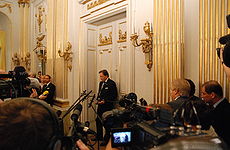
Swedish Academy
The Swedish Academy , founded in 1786 by King Gustav III, is one of the Royal Academies of Sweden.-History:The Swedish Academy was founded in 1786 by King Gustav III. Modelled after the Académie française, it has 18 members. The motto of the Academy is "Talent and Taste"...
sends out requests for nominations of candidates for the Nobel Prize in Literature
Literature
Literature is the art of written works, and is not bound to published sources...
. Members of the Academy, members of literature academies and societies, professors of literature and language, former Nobel literature laureates, and the presidents of writers' organizations are all allowed to nominate a candidate. However, it is not permitted to nominate oneself.
Thousands of requests are sent out each year, and about fifty proposals are returned. These proposals must be received by the Academy by 1 February, after which they are examined by the Nobel Committee.
By April, the Academy narrows the field to around twenty candidates, and by summer the list is reduced further to some five names. The subsequent months are then spent in reviewing the works of eligible candidates. In October members of the Academy vote and the candidate who receives more than half of the votes is named the Nobel Laureate in Literature. The process is similar to that of other Nobel Prizes.
The prize money of the Nobel Prize has been fluctuating since its inauguration but at present stands at ten million Swedish kronor. (About 1,356,610 USD or 1,067,950 Euros.) The winner also receives a gold medal and a Nobel diploma and is invited to give a lecture during "Nobel Week" in Stockholm
Stockholm
Stockholm is the capital and the largest city of Sweden and constitutes the most populated urban area in Scandinavia. Stockholm is the most populous city in Sweden, with a population of 851,155 in the municipality , 1.37 million in the urban area , and around 2.1 million in the metropolitan area...
; the highlight is the prize-giving ceremony and banquet on December 10.
Prizes
A Literature Nobel Prize laureate earns a gold medalGold medal
A gold medal is typically the medal awarded for highest achievement in a non-military field. Its name derives from the use of at least a fraction of gold in form of plating or alloying in its manufacture...
, a diploma
Diploma
A diploma is a certificate or deed issued by an educational institution, such as a university, that testifies that the recipient has successfully completed a particular course of study or confers an academic degree. In countries such as the United Kingdom and Australia, the word diploma refers to...
bearing a citation
Citation
Broadly, a citation is a reference to a published or unpublished source . More precisely, a citation is an abbreviated alphanumeric expression Broadly, a citation is a reference to a published or unpublished source (not always the original source). More precisely, a citation is an abbreviated...
, and a sum of money. The amount of money awarded depends on the income of the Nobel Foundation that year. If a prize is awarded to more than one laureate, the money is either split evenly among them or, for three laureates, it may be divided into a half and two quarters. If a prize is awarded jointly to two or more laureates the money is split among them. It is the richest literary prize in the world by a large margin.
Nobel Prize Medals
The Nobel Prize medals, minted by MyntverketMyntverket
Myntverket is a private Swedish company that produces coins and medals, most notably the Swedish national coins and the Nobel Prize medals. As of 2008, Swedish coins are now minted by Myntverket's parent company, Mint of Finland Ltd in Helsinki, Finland, ending a 1012 year history of minting...
in Sweden and the Mint of Norway since 1902, are registered trademarks of the Nobel Foundation. Each medal features an image of Alfred Nobel in left profile on the obverse (front side of the medal). The Nobel Prize medals for Physics, Chemistry, Physiology or Medicine, and Literature have identical obverses, showing the image of Alfred Nobel and the years of his birth and death (1833–1896). Nobel's portrait also appears on the obverse of the Nobel Peace Prize medal and the Medal for the Prize in Economics, but with a slightly different design. The image on the reverse of a medal varies according to the institution awarding the prize. The reverse sides of the Nobel Prize medals for Chemistry and Physics share the same design.
Nobel Prize Diplomas
Nobel laureates receive a Diploma directly from the hands of the King of Sweden. Each Diploma is uniquely designed by the prize-awarding institutions for the laureate that receives it. The Diploma contains a picture and text which states the name of the laureate and normally a citation of why they received the prize.Controversies about Nobel Laureate selections
Leo Tolstoy
Lev Nikolayevich Tolstoy was a Russian writer who primarily wrote novels and short stories. Later in life, he also wrote plays and essays. His two most famous works, the novels War and Peace and Anna Karenina, are acknowledged as two of the greatest novels of all time and a pinnacle of realist...
, Henrik Ibsen
Henrik Ibsen
Henrik Ibsen was a major 19th-century Norwegian playwright, theatre director, and poet. He is often referred to as "the father of prose drama" and is one of the founders of Modernism in the theatre...
, Émile Zola
Émile Zola
Émile François Zola was a French writer, the most important exemplar of the literary school of naturalism and an important contributor to the development of theatrical naturalism...
and Mark Twain
Mark Twain
Samuel Langhorne Clemens , better known by his pen name Mark Twain, was an American author and humorist...
to be rejected. Also, many believe Sweden's historic antipathy towards Russia is the reason neither Tolstoy
Tolstoy
Tolstoy, or Tolstoi is a prominent family of Russian nobility, descending from Andrey Kharitonovich Tolstoy who served under Vasily II of Moscow...
nor Anton Chekhov
Anton Chekhov
Anton Pavlovich Chekhov was a Russian physician, dramatist and author who is considered to be among the greatest writers of short stories in history. His career as a dramatist produced four classics and his best short stories are held in high esteem by writers and critics...
was awarded the prize. During World War I and its immediate aftermath, the committee adopted a policy of neutrality, favouring writers from non-combatant countries. August Strindberg
August Strindberg
Johan August Strindberg was a Swedish playwright, novelist, poet, essayist and painter. A prolific writer who often drew directly on his personal experience, Strindberg's career spanned four decades, during which time he wrote over 60 plays and more than 30 works of fiction, autobiography,...
was repeatedly bypassed by the committee, but holds the singular distinction of being awarded an Anti-Nobel Prize, conferred by popular acclaim and national subscription and presented to him in 1912 by future prime minister Hjalmar Branting
Hjalmar Branting
was a Swedish politician. He was the leader of the Swedish Social Democratic Party , and Prime Minister during three separate periods . When Branting came to power in 1920, he was the first Social Democratic Prime Minister of Sweden...
.
The academy considered Czech writer Karel Čapek
Karel Capek
Karel Čapek was Czech writer of the 20th century.-Biography:Born in 1890 in the Bohemian mountain village of Malé Svatoňovice to an overbearing, emotional mother and a distant yet adored father, Čapek was the youngest of three siblings...
's "War With the Newts
War with the Newts
War with the Newts , also translated as War with the Salamanders, is a 1936 satirical science fiction story by Czech author Karel Čapek. It concerns the discovery in the Pacific of a sea-dwelling race, an intelligent breed of newts, who are initially enslaved and exploited...
" too offensive to the German government. He also declined to suggest some noncontroversial publication that could be cited as an example of his work, stating "Thank you for the good will, but I have already written my doctoral dissertation". He was thus denied the prize.
According to Swedish Academy
Swedish Academy
The Swedish Academy , founded in 1786 by King Gustav III, is one of the Royal Academies of Sweden.-History:The Swedish Academy was founded in 1786 by King Gustav III. Modelled after the Académie française, it has 18 members. The motto of the Academy is "Talent and Taste"...
archives studied by the newspaper Le Monde
Le Monde
Le Monde is a French daily evening newspaper owned by La Vie-Le Monde Group and edited in Paris. It is one of two French newspapers of record, and has generally been well respected since its first edition under founder Hubert Beuve-Méry on 19 December 1944...
on their opening in 2008, French novelist and intellectual André Malraux
André Malraux
André Malraux DSO was a French adventurer, award-winning author, and statesman. Having traveled extensively in Indochina and China, Malraux was noted especially for his novel entitled La Condition Humaine , which won the Prix Goncourt...
was seriously considered for the prize in the 1950s. Malraux was competing with Albert Camus
Albert Camus
Albert Camus was a French author, journalist, and key philosopher of the 20th century. In 1949, Camus founded the Group for International Liaisons within the Revolutionary Union Movement, which was opposed to some tendencies of the Surrealist movement of André Breton.Camus was awarded the 1957...
, but was rejected several times, especially in 1954 and 1955, "so long as he does not come back to novel". Thus, Camus won the prize in 1957.
Some attribute W. H. Auden
W. H. Auden
Wystan Hugh Auden , who published as W. H. Auden, was an Anglo-American poet,The first definition of "Anglo-American" in the OED is: "Of, belonging to, or involving both England and America." See also the definition "English in origin or birth, American by settlement or citizenship" in See also...
's not being awarded the Nobel Prize in Literature to errors in his translation of 1961 Peace Prize
Nobel Peace Prize
The Nobel Peace Prize is one of the five Nobel Prizes bequeathed by the Swedish industrialist and inventor Alfred Nobel.-Background:According to Nobel's will, the Peace Prize shall be awarded to the person who...
winner Dag Hammarskjöld
Dag Hammarskjöld
Dag Hjalmar Agne Carl Hammarskjöld was a Swedish diplomat, economist, and author. An early Secretary-General of the United Nations, he served from April 1953 until his death in a plane crash in September 1961. He is the only person to have been awarded a posthumous Nobel Peace Prize. Hammarskjöld...
's Vägmärken (Markings) and to statements that Auden made during a Scandinavian lecture tour suggesting that Hammarskjöld was, like Auden, homosexual
Homosexuality
Homosexuality is romantic or sexual attraction or behavior between members of the same sex or gender. As a sexual orientation, homosexuality refers to "an enduring pattern of or disposition to experience sexual, affectional, or romantic attractions" primarily or exclusively to people of the same...
.
In 1964 Jean-Paul Sartre
Jean-Paul Sartre
Jean-Paul Charles Aymard Sartre was a French existentialist philosopher, playwright, novelist, screenwriter, political activist, biographer, and literary critic. He was one of the leading figures in 20th century French philosophy, particularly Marxism, and was one of the key figures in literary...
was awarded the Nobel Prize in Literature, but he declined it, stating that "It is not the same thing if I sign Jean-Paul Sartre or if I sign Jean-Paul Sartre, Nobel Prize winner. A writer must refuse to allow himself to be transformed into an institution, even if it takes place in the most honorable form."
Soviet dissident writer Aleksandr Solzhenitsyn
Aleksandr Solzhenitsyn
Aleksandr Isayevich Solzhenitsyn was aRussian and Soviet novelist, dramatist, and historian. Through his often-suppressed writings, he helped to raise global awareness of the Gulag, the Soviet Union's forced labor camp system – particularly in The Gulag Archipelago and One Day in the Life of...
, the 1970 prize winner, did not attend the Nobel Prize ceremony in Stockholm for fear that the U.S.S.R. would prevent his return afterwards (his works there were circulated in samizdat
Samizdat
Samizdat was a key form of dissident activity across the Soviet bloc in which individuals reproduced censored publications by hand and passed the documents from reader to reader...
—clandestine form). After the Swedish government refused to honor Solzhenitsyn with a public award ceremony and lecture at its Moscow embassy, Solzhenitsyn refused the award altogether, commenting that the conditions set by the Swedes
(who preferred a private ceremony) were "an insult to the Nobel Prize itself." Solzhenitsyn did not accept the award, and prize money, until 10 December 1974, after he was deported from the Soviet Union.
In 1974 Graham Greene
Graham Greene
Henry Graham Greene, OM, CH was an English author, playwright and literary critic. His works explore the ambivalent moral and political issues of the modern world...
, Vladimir Nabokov
Vladimir Nabokov
Vladimir Vladimirovich Nabokov was a multilingual Russian novelist and short story writer. Nabokov wrote his first nine novels in Russian, then rose to international prominence as a master English prose stylist...
, and Saul Bellow
Saul Bellow
Saul Bellow was a Canadian-born Jewish American writer. For his literary contributions, Bellow was awarded the Pulitzer Prize, the Nobel Prize for Literature, and the National Medal of Arts...
were considered but rejected in favor of a joint award for Swedish authors Eyvind Johnson
Eyvind Johnson
Eyvind Johnson, was a Swedish writer and author. He became a member of the Swedish Academy in 1957 and shared the Nobel Prize in Literature with Harry Martinson in 1974 with the citation: for a narrative art, far-seeing in lands and ages, in the service of freedom.Johnson was born Olof Edvin...
and Harry Martinson
Harry Martinson
Harry Martinson was a Swedish sailor, author and poet. In 1949 he was elected into the Swedish Academy. He was awarded a joint Nobel Prize in Literature in 1974 together with fellow Swede Eyvind Johnson. The choice for Eyvind Johnson and Harry Martinson was very controversial as both were on the...
, both Nobel judges themselves, and unknown outside their home country. Bellow would win the Nobel Prize in Literature in 1976; neither Greene nor Nabokov was awarded the Prize.
Argentine writer Jorge Luis Borges
Jorge Luis Borges
Jorge Francisco Isidoro Luis Borges Acevedo , known as Jorge Luis Borges , was an Argentine writer, essayist, poet and translator born in Buenos Aires. In 1914 his family moved to Switzerland where he attended school, receiving his baccalauréat from the Collège de Genève in 1918. The family...
was nominated for the Prize several times but, as Edwin Williamson, Borges's biographer, states, the Academy did not award it to him, most likely because of his support of certain Argentine and Chilean right-wing military dictators, including Pinochet, which, according to Tóibín's review of Williamson's Borges: A Life, had complex social and personal contexts. Borges' failure to win the Nobel Prize for his support of these right-wing dictators contrasts with the Committee honoring writers who openly supported controversial left-wing dictatorships, including Joseph Stalin
Joseph Stalin
Joseph Vissarionovich Stalin was the Premier of the Soviet Union from 6 May 1941 to 5 March 1953. He was among the Bolshevik revolutionaries who brought about the October Revolution and had held the position of first General Secretary of the Communist Party of the Soviet Union's Central Committee...
, in the case of Sartre and Neruda
Pablo Neruda
Pablo Neruda was the pen name and, later, legal name of the Chilean poet, diplomat and politician Neftalí Ricardo Reyes Basoalto. He chose his pen name after Czech poet Jan Neruda....
.
The award to Italian performance artist Dario Fo
Dario Fo
Dario Fo is an Italian satirist, playwright, theater director, actor and composer. His dramatic work employs comedic methods of the ancient Italian commedia dell'arte, a theatrical style popular with the working classes. He currently owns and operates a theatre company with his wife, actress...
in 1997 was initially considered "rather lightweight" by some critics, as he was seen primarily as a performer and had previously been censured by the Roman Catholic Church
Roman Catholic Church
The Catholic Church, also known as the Roman Catholic Church, is the world's largest Christian church, with over a billion members. Led by the Pope, it defines its mission as spreading the gospel of Jesus Christ, administering the sacraments and exercising charity...
. Salman Rushdie and Arthur Miller
Arthur Miller
Arthur Asher Miller was an American playwright and essayist. He was a prominent figure in American theatre, writing dramas that include plays such as All My Sons , Death of a Salesman , The Crucible , and A View from the Bridge .Miller was often in the public eye,...
had been strongly favoured to receive the Prize, but the Nobel organisers were later quoted as saying that they would have been "too predictable, too popular."
There was also criticism of the academy's refusal to express support for Salman Rushdie in 1989, after Ayatollah
Ayatollah
Ayatollah is a high ranking title given to Usuli Twelver Shī‘ah clerics. Those who carry the title are experts in Islamic studies such as jurisprudence, ethics, and philosophy and usually teach in Islamic seminaries. The next lower clerical rank is Hojatoleslam wal-muslemin...
Ruhollah Khomeini
Ruhollah Khomeini
Grand Ayatollah Sayyed Ruhollah Musavi Khomeini was an Iranian religious leader and politician, and leader of the 1979 Iranian Revolution which saw the overthrow of Mohammad Reza Pahlavi, the Shah of Iran...
issued a fatwa
Fatwa
A fatwā in the Islamic faith is a juristic ruling concerning Islamic law issued by an Islamic scholar. In Sunni Islam any fatwā is non-binding, whereas in Shia Islam it could be considered by an individual as binding, depending on his or her relation to the scholar. The person who issues a fatwā...
calling for Rushdie to be killed. Two members of the Academy even resigned over its refusal to support Rushdie.
The choice of the 2004 winner, Elfriede Jelinek
Elfriede Jelinek
Elfriede Jelinek is an Austrian playwright and novelist. She was awarded the Nobel Prize in Literature in 2004 for her "musical flow of voices and counter-voices in novels and plays that, with extraordinary linguistic zeal, reveal the absurdity of society's clichés and their subjugating power."-...
, was protested by a member of the Swedish Academy, Knut Ahnlund
Knut Ahnlund
Knut Emil Ahnlund is a Swedish literary historian, writer, and member of the Swedish Academy.Ahnlund is an expert on 19th and 20th century Nordic, especially Danish, literature. He wrote his doctoral dissertation on Henrik Pontoppidan, and has later written on Gustav Wied and Sven Lidman, among...
, who had not played an active role in the Academy since 1996; Ahnlund resigned, alleging that selecting Jelinek had caused "irreparable damage" to the reputation of the award.
The selection of Harold Pinter
Harold Pinter
Harold Pinter, CH, CBE was a Nobel Prize–winning English playwright and screenwriter. One of the most influential modern British dramatists, his writing career spanned more than 50 years. His best-known plays include The Birthday Party , The Homecoming , and Betrayal , each of which he adapted to...
for the Prize in 2005 was delayed for a couple of days, apparently due to Ahnlund's resignation, and led to renewed speculations about there being a "political element" in the Swedish Academy's awarding of the Prize. Although Pinter was unable to give his controversial Nobel Lecture in person because of ill health, he delivered it from a television studio on video projected on screens to an audience at the Swedish Academy
Swedish Academy
The Swedish Academy , founded in 1786 by King Gustav III, is one of the Royal Academies of Sweden.-History:The Swedish Academy was founded in 1786 by King Gustav III. Modelled after the Académie française, it has 18 members. The motto of the Academy is "Talent and Taste"...
, in Stockholm
Stockholm
Stockholm is the capital and the largest city of Sweden and constitutes the most populated urban area in Scandinavia. Stockholm is the most populous city in Sweden, with a population of 851,155 in the municipality , 1.37 million in the urban area , and around 2.1 million in the metropolitan area...
. His comments have been the source of much commentary and debate. The issue of their "political stance" was also raised in response to the awards of the Nobel Prize in Literature to Orhan Pamuk
Orhan Pamuk
Ferit Orhan Pamuk , generally known simply as Orhan Pamuk, is a Turkish novelist. He is also the Robert Yik-Fong Tam Professor in the Humanities at Columbia University, where he teaches comparative literature and writing....
and Doris Lessing
Doris Lessing
Doris May Lessing CH is a British writer. Her novels include The Grass is Singing, The Golden Notebook, and five novels collectively known as Canopus in Argos....
in 2006 and 2007, respectively.
The heavy focus on European authors, and authors from Sweden in particular, has been the subject of mounting criticism, even from major Swedish newspapers. The absolute majority of the laureates have been European, with Sweden itself receiving more prizes than all of Asia, as well as all of Latin America. In 2008, Horace Engdahl
Horace Engdahl
Horace Oscar Axel Engdahl is a Swedish literary historian and critic, and has been a member of the Swedish Academy since 1997. He was the permanent secretary of the Swedish Academy, i.e. its spokesman, from 1999 to June 2009, when he was succeeded by historian Peter Englund.-Biography:Engdahl was...
, then the permanent secretary of the Academy, declared that "Europe still is the center of the literary world" and that "the US is too isolated, too insular. They don't translate enough and don't really participate in the big dialogue of literature." In 2009, Engdahl's replacement, Peter Englund
Peter Englund
Peter Englund is a Swedish author and historian, and the permanent secretary of the Swedish Academy since 1 June 2009.-Biography:...
, rejected this sentiment ("In most language areas ... there are authors that really deserve and could get the Nobel Prize and that goes for the United States and the Americas, as well") and acknowledged the Eurocentric nature of the award, saying that, "I think that is a problem. We tend to relate more easily to literature written in Europe and in the European tradition." The 2009 award to Herta Müller
Herta Müller
Herta Müller is a Romanian-born German novelist, poet and essayist noted for her works depicting the effects of violence, cruelty and terror, usually in the setting of Communist Romania under the repressive Nicolae Ceauşescu regime which she experienced herself...
, previously little-known outside Germany but many times named favorite for the Nobel Prize, has re-ignited criticism that the award committee is biased and Eurocentric. However, the 2010 prize was awarded to Mario Vargas Llosa
Mario Vargas Llosa
Jorge Mario Pedro Vargas Llosa, 1st Marquis of Vargas Llosa is a Peruvian-Spanish writer, politician, journalist, essayist, and Nobel Prize laureate. Vargas Llosa is one of Latin America's most significant novelists and essayists, and one of the leading authors of his generation...
, a native of Peru
Peru
Peru , officially the Republic of Peru , is a country in western South America. It is bordered on the north by Ecuador and Colombia, on the east by Brazil, on the southeast by Bolivia, on the south by Chile, and on the west by the Pacific Ocean....
in South America
South America
South America is a continent situated in the Western Hemisphere, mostly in the Southern Hemisphere, with a relatively small portion in the Northern Hemisphere. The continent is also considered a subcontinent of the Americas. It is bordered on the west by the Pacific Ocean and on the north and east...
. After the 2011 award was awarded to Swedish poet Tomas Tranströmer
Tomas Tranströmer
Tomas Gösta Tranströmer is a Swedish writer, poet and translator, whose poetry has been translated into over 60 languages. Tranströmer is acclaimed as one of the most important Scandinavian writers since the Second World War...
in the year of the Arab Spring
Arab Spring
The Arab Spring , otherwise known as the Arab Awakening, is a revolutionary wave of demonstrations and protests occurring in the Arab world that began on Saturday, 18 December 2010...
, permanent secretary of the Swedish Academy Peter Englund
Peter Englund
Peter Englund is a Swedish author and historian, and the permanent secretary of the Swedish Academy since 1 June 2009.-Biography:...
said it was not awarded based on politics, describing such a notion as “literature for dummies”.
See also
- List of Nobel laureates in Literature
- List of literary awards
- Nobel LibraryNobel LibraryThe Nobel Library is the public library of the Swedish academy instituted to assist the evaluation of Nobel laureates to the Prize in Literature and other awards granted by the academy...
External links
- "All Nobel Laureates in Literature" – Index page on the official site of the Nobel Foundation.
- "The Nobel Prize Award Ceremonies" – Official hyperlinked webpage of the Nobel Foundation.
- "The Nobel Prize Medal for Literature" – Official webpage of the Nobel Foundation.
- Graphics: National LiteratureLiteratureLiterature is the art of written works, and is not bound to published sources...
Nobel Prize shares 1901-2009 by citizenship at the time of the award and by country of birth. From J. SchmidhuberJürgen SchmidhuberJürgen Schmidhuber is a computer scientist and artist known for his work on machine learning, universal Artificial Intelligence , artificial neural networks, digital physics, and low-complexity art. His contributions also include generalizations of Kolmogorov complexity and the Speed Prior...
(2010), Evolution of National Nobel Prize Shares in the 20th Century at arXiv:1009.2634v1 - "The Nobel Prize Medals and the Medal for the Prize in Economics" – By Birgitta Lemmel; an article on the history of the design of the medals featured on the official site.
- "What the Nobel Laureates Receive" – Featured link in "The Nobel Prize Award Ceremonies" on the official site of the Nobel Foundation.
- "How the Academy Rejected the Women" - Article (in Swedish, based on documents in the Nobel Archive) about the women writers, that were nominated from 1901 to 1950/1959 (due to secrecy rules, 50 years); in all, 44 women writers were nominated 124 times, among whom only five were awarded the prize (Lagerlöf 1909, Deledda 1926, Undset 1928, Buck 1938, Mistral 1945).
- "The Translator Puts Stamp on the Nobel Prize" - Article (in Swedish, based on documents in the Nobel Archive) about the 'translation-problem' in the context of the Nobel Prize in Literature.
- "The rise of the Prize" - Article by Nilanjana S. RoyNilanjana S. RoyNilanjana S. Roy is a well-known Indian journalist and literary critic. She currently writes a regular column for the Business Standard. She used to write a notorious literary blog called under the pseudonym Hurree Babu. She is married to Devangshu Datta, a stock market columnist and a consultant...
dealing with the history of the award by decade, from the 1900s to the 2000s.