


History of science

Encyclopedia
The history of science is the study of the historical development of human understandings of the natural world
and the domains of the social sciences. (The history of Arts and humanities are termed History of scholarship
). Until the late 20th century the history of science, especially of the physical and biological sciences, was seen as a narrative celebrating the triumph of true theories over false. Science was portrayed as a major dimension of the progress of civilization. In recent decades, postmodern views, especially influenced by Thomas Kuhn
, The Structure of Scientific Revolutions
(1962), the history is seen in terms of competing paradigms or conceptual systems battling for intellectual supremacy in a wider matrix that includes intellectual, cultural, economic and political themes outside pure science. New attention is paid to science outside the context of Western Europe
.
According to Kuhn each new paradigm re-writes the history of its science to present by selection and distortions the former paradigm as its forerunner. The description of the history of economic theory below is a good example.
Science
is a body of empirical, theoretical
, and practical
knowledge about the natural world
, produced by researchers making use of scientific method
s, which emphasize the observation, explanation, and prediction of real world phenomena
by experiment
. Given the dual status of science as objective
knowledge and as a human construct, good historiography
of science draws on the historical method
s of both intellectual history
and social history
.
Tracing the exact origins of modern science is possible through the many important texts which have survived from the classical world. However, the word scientist is relatively recent—first coined by William Whewell
in the 19th century. Previously, people investigating nature called themselves natural philosophers.
While empirical
investigations
of the natural world have been described since classical antiquity
(for example, by Thales
, Aristotle
, and others), and scientific method
s have been employed since the Middle Ages
(for example, by Ibn al-Haytham, Abū Rayhān al-Bīrūnī and Roger Bacon
), the dawn of modern science is generally traced back to the early modern period
, during what is known as the Scientific Revolution
that took place in 16th and 17th century Europe.
Scientific methods are considered to be so fundamental to modern science that some — especially philosophers of science
and practicing scientists — consider earlier inquiries into nature to be pre-scientific. Traditionally, historians of science have defined science sufficiently broadly to include those inquiries.
. For example, the domestication of maize for agriculture has been dated to about 9,000 years ago in southern Mexico, before the development of writing system
s. Similarly, archaeological evidence indicates the development of astronomical knowledge in preliterate societies.
The development of writing enabled knowledge to be stored and communicated across generations with much greater fidelity. Combined with the development of agriculture, which allowed for a surplus of food, it became possible for early civilizations to develop, because more time could be devoted to tasks other than survival.
Many ancient civilizations collected astronomical information in a systematic manner through simple observation. Though they had no knowledge of the real physical structure of the planets and stars, many theoretical explanations were proposed. Basic facts about human physiology were known in some places, and alchemy
was practiced in several civilizations. Considerable observation of macrobiotic flora and fauna was also performed.
(now Iraq
) around 3500 BC, the Mesopotamia
n peoples began to attempt to record some observation
s of the world with extremely thorough numerical data
. But their observations and measurements were seemingly taken for purposes other than for scientific law
s. A concrete instance of Pythagoras' law
was recorded, as early as the 18th century BC: the Mesopotamian cuneiform tablet Plimpton 322
records a number of Pythagorean triple
ts (3,4,5) (5,12,13). ..., dated 1900 BC, possibly millennia before Pythagoras, http://www.angelfire.com/nt/Gilgamesh/achieve.html but an abstract formulation of the Pythagorean theorem was not.
In Babylonian astronomy, the vigorous notings of the motions of the star
s, planet
s, and the moon
are left on thousands of clay tablet
s created by scribe
s. Even today, astronomical periods identified by Mesopotamian scientists are still widely used in Western calendars such as the solar year and the lunar month
. Using these data they developed arithmetical methods to compute the changing length of daylight in the course of the year and to predict the appearances and disappearances of the Moon and planets and eclipses of the Sun and Moon. Only a few astronomers' names are known, such as that of Kidinnu
, a Chaldean astronomer and mathematician. Kiddinu's value for the solar year is in use for today's calendars. Babylonian astronomy was "the first and highly successful attempt at giving a refined mathematical description of astronomical phenomena." According to the historian A. Aaboe, "all subsequent varieties of scientific astronomy, in the Hellenistic world, in India, in Islam, and in the West - if not indeed all subsequent endeavour in the exact sciences - depend upon Babylonian astronomy in decisive and fundamental ways."
Ancient Egypt
made significant advances in astronomy, mathematics and medicine. Their development of geometry
was a necessary outgrowth of surveying
to preserve the layout and ownership of farmland, which was flooded annually by the Nile river. The 3-4-5 right triangle
and other rules of thumb were used to build rectilinear structures, and the post and lintel architecture of Egypt. Egypt was also a center of alchemy research for much of the Mediterranean
.
The Edwin Smith papyrus
is one of the first medical documents still extant, and perhaps the earliest document that attempts to describe and analyse the brain: it might be seen as the very beginnings of modern neuroscience
. However, while Egyptian medicine had some effective practices, it was not without its ineffective and sometimes harmful practices. Medical historians believe that ancient Egyptian pharmacology, for example, was largely ineffective. Nevertheless, it applies the following components to the treatment of disease: examination, diagnosis, treatment, and prognosis,http://www.britannica.com/eb/article?tocId=9032043&query=Edwin%20Smith%20papyrus&ct= which display strong parallels to the basic empirical method
of science and according to G. E. R. Lloyd played a significant role in the development of this methodology. The Ebers papyrus
(circa 1550 BC
) also contains evidence of traditional empiricism
.
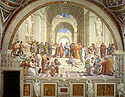 In Classical Antiquity
, the inquiry into the workings of the universe took place both in investigations aimed at such practical goals as establishing a reliable calendar or determining how to cure a variety of illnesses and in those abstract investigations known as natural philosophy
. The ancient people who are considered the first scientists may have thought of themselves as natural philosophers, as practitioners of a skilled profession (for example, physicians), or as followers of a religious tradition (for example, temple healers).
The earliest Greek philosophers, known as the pre-Socratics, provided competing answers to the question found in the myths of their neighbors: "How did the ordered cosmos
in which we live come to be?" The pre-Socratic philosopher Thales
(640-546 BC), dubbed the "father of science", was the first to postulate non-supernatural explanations for natural phenomena: "all things are water". Thales' student Pythagoras
of Samos
founded the Pythagorean school
, which investigated mathematics for its own sake, and was the first to postulate that the Earth
is spherical in shape. Leucippus
(5th century BC) introduced atomism
, the theory that all matter is made of indivisible, imperishable units called atoms. This was greatly expanded by his pupil Democritus
.
Subsequently, Plato
and Aristotle
produced the first systematic discussions of natural philosophy, which did much to shape later investigations of nature. Their development of deductive reasoning
was of particular importance and usefulness to later scientific inquiry. Plato founded the Platonic Academy
in 387 BC, whose motto was "Let none unversed in geometry enter here", and turned out many notable philosophers. Plato's student Aristotle introduced empiricism
and the notion that universal truths can be arrived at via observation and induction, thereby laying the foundations of the scientific method. Aristotle also produced many biological writings that were empirical in nature, focusing on biological causation and the diversity of life. He made countless observations of nature, especially the habits and attributes of plants and animals in the world around him, classified more than 540 animal species, and dissected at least 50. Aristotle's writings profoundly influenced subsequent Islamic and European scholarship, though they were eventually superseded in the Scientific Revolution
.
 The important legacy of this period included substantial advances in factual knowledge, especially in anatomy
, zoology
, botany
, mineralogy
, geography
, mathematics
and astronomy
; an awareness of the importance of certain scientific problems, especially those related to the problem of change and its causes; and a recognition of the methodological importance of applying mathematics to natural phenomena and of undertaking empirical research. In the Hellenistic age scholars frequently employed the principles developed in earlier Greek thought: the application of mathematics
and deliberate empirical research, in their scientific investigations. Thus, clear unbroken lines of influence lead from ancient Greek
and Hellenistic philosophers
, to medieval Muslim philosophers
and scientists
, to the Europe
an Renaissance
and Enlightenment
, to the secular science
s of the modern day.
Neither reason nor inquiry began with the Ancient Greeks, but the Socratic method
did, along with the idea of Forms, great advances in geometry
, logic
, and the natural sciences. According to Benjamin Farrington
, former Professor of Classics
at Swansea University
:
and again:

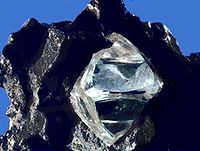 The astronomer Aristarchus of Samos
was the first known person to propose a heliocentric model of the solar system, while the geographer Eratosthenes
accurately calculated the circumference of the Earth. Hipparchus
(ca. 190 – ca. 120 BC) produced the first systematic star catalog
. The level of achievement in Hellenistic astronomy
and engineering
is impressively shown by the Antikythera mechanism
(150-100 BC), an analog computer
for calculating the position of planets. Technological artifacts of similar complexity did not reappear until the 14th century, when mechanical astronomical clock
s appeared in Europe
.
In medicine
, Hippocrates
(ca. 460 BC – ca. 370 BC) and his followers were the first to describe many diseases and medical conditions and developed the Hippocratic Oath
for physicians, still relevant and in use today. Herophilos
(335 - 280 BC) was the first to base his conclusions on dissection of the human body and to describe the nervous system
. Galen
(129 – ca. 200 AD) performed many audacious operations—including brain and eye surgeries
— that were not tried again for almost two millennia.
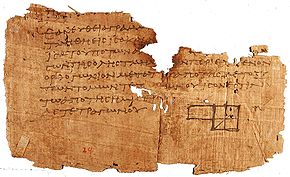 The mathematician Euclid
laid down the foundations of mathematical rigor and introduced the concepts of definition, axiom, theorem and proof still in use today in his Elements
, considered the most influential textbook ever written. Archimedes
, considered one of the greatest mathematicians of all time, is credited with using the method of exhaustion
to calculate the area
under the arc of a parabola
with the summation of an infinite series
, and gave a remarkably accurate approximation of Pi
. He is also known in physics
for laying the foundations of hydrostatics
, statics
, and the explanation of the principle of the lever
.
Theophrastus
wrote some of the earliest descriptions of plants and animals, establishing the first taxonomy
and looking at minerals in terms of their properties such as hardness. Pliny the Elder
produced what is one of the largest encyclopedia
s of the natural world in 77 AD, and must be regarded as the rightful successor to Theophrastus. For example, he accurately describes the octahedral shape of the diamond
, and proceeds to mention that diamond dust is used by engravers to cut and polish other gems owing to its great hardness. His recognition of the importance of crystal
shape is a precursor to modern crystallography
, while mention of numerous other minerals presages mineralogy
. He also recognises that other minerals have characteristic crystal shapes, but in one example, confuses the crystal habit
with the work of lapidaries. He was also the first to recognise that amber
was a fossilized resin from pine trees because he had seen samples with trapped insects within them.
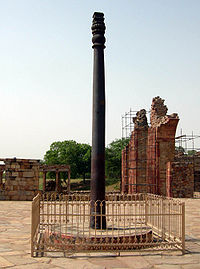 Mathematics: The earliest traces of mathematical knowledge in the Indian subcontinent appear with the Indus Valley Civilization
(c. 4th millennium BC ~ c. 3rd millennium BC). The people of this civilization made bricks whose dimensions were in the proportion 4:2:1, considered favorable for the stability of a brick structure. They also tried to standardize measurement of length to a high degree of accuracy. They designed a ruler—the Mohenjo-daro ruler—whose unit of length (approximately 1.32 inches or 3.4 centimetres) was divided into ten equal parts. Bricks manufactured in ancient Mohenjo-daro often had dimensions that were integral multiples of this unit of length.
Indian astronomer and mathematician Aryabhata
(476-550), in his Aryabhatiya
(499) introduced a number of trigonometric functions (including sine
, versine
, cosine and inverse sine), trigonometric
tables
, and techniques and algorithm
s of algebra
. In 628 AD, Brahmagupta
suggested that gravity was a force of attraction. He also lucidly explained the use of zero
as both a placeholder and a decimal digit, along with the Hindu-Arabic numeral system
now used universally throughout the world. Arabic translations of the two astronomers' texts were soon available in the Islamic world
, introducing what would become Arabic numerals
to the Islamic World by the 9th century. During the 14th-16th centuries, the Kerala school of astronomy and mathematics made significant advances in astronomy and especially mathematics, including fields such as trigonometry
and analysis
. In particular, Madhava of Sangamagrama
is considered the "founder of mathematical analysis
".
Astronomy: The first textual mention of astronomical concepts comes from the Vedas, religious literature of India. According to Sarma (2008): "One finds in the Rigveda
intelligent speculations about the genesis of the universe from nonexistence, the configuration of the universe, the spherical self-supporting earth
, and the year of 360 days divided into 12 equal parts of 30 days each with a periodical intercalary month.". The first 12 chapters of the Siddhanta Shiromani, written by Bhāskara in the 12th century, cover topics such as: mean longitudes of the planets; true longitudes of the planets; the three problems of diurnal rotation; syzygies; lunar eclipses; solar eclipses; latitudes of the planets; risings and settings; the moon's crescent; conjunctions of the planets with each other; conjunctions of the planets with the fixed stars; and the patas of the sun and moon. The 13 chapters of the second part cover the nature of the sphere, as well as significant astronomical and trigonometric calculations based on it.
Linguistics: Some of the earliest linguistic activities can be found in Iron Age India
(1st. millennium BC) with the analysis of Sanskrit
for the purpose of the correct recitation and interpretation of Vedic
texts. The most notable grammarian of Sanskrit
was (c. 520 – 460 BC), whose grammar formulates close to 4,000 rules which together form a compact generative grammar
of Sanskrit. Inherent in his analytic approach are the concepts of the phoneme
, the morpheme
and the root
.
Medicine: Findings from Neolithic
graveyards in what is now Pakistan
show evidence of proto-dentistry among an early farming culture. Ayurveda
is a system of traditional medicine that originated in ancient India before 2500 BC, and is now practiced as a form of alternative medicine
in other parts of the world. Its most famous text is the Suśrutasamhitā
of Suśruta, which is notable for describing procedures on various forms of surgery
, including rhinoplasty
, the repair of torn ear lobes, perineal lithotomy
, cataract surgery, and several other excisions and other surgical procedures.
Metallurgy: The wootz
, crucible
and stainless
steels were discovered in India, and were widely exported in Classic Mediterranean world. It was known from Pliny the Elder
as ferrum indicum. Indian Wootz steel was held in high regard in Roman Empire, was often considered to be the best. After in Middle Age it was imported in Syria to produce with special techniques the "Damascus steel
" by the year 1000.
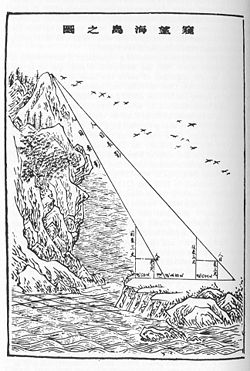 Mathematics: From the earliest the Chinese used a positional decimal system on counting boards in order to calculate. To express 10, a single rod is placed in the second box from the right. The spoken language uses a similar system to English: e.g. four thousand two hundred seven. No symbol was used for zero. By the first century BC, negative numbers and decimal fractions were in use and The Nine Chapters on the Mathematical Art
included methods for extracting higher order roots by Horner's method and solving linear equations and by Pythagoras' theorem
. Cubic equations were solved in the Tang dynasty
and solutions of equations of order higher than 3 appeared in print in 1245 by Ch'in Chiu-shao
. Pascal's triangle
for binomial coefficients was described around 1100 by Jia Xian
.
Although the first attempts at an axiomatisation of geometry appear in the Mohist canon in 330 BC, Liu Hui
developed algebraic methods in geometry in the 3rd century and also calculated pi
to 5 significant figures. In 480, Zu Chongzhi
improved this by discovering the ratio which remained the most accurate value for 1200 years.
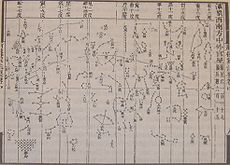 Astronomy: Astronomical observations from China constitute the longest continuous sequence from any civilisation and include records of sunspots (112 records from 364 BC), supernovas (1054), lunar and solar eclipses. By the 12th century, they could reasonably accurately make predictions of eclipses, but the knowledge of this was lost during the Ming dynasty, so that the Jesuit Matteo Ricci
gained much favour in 1601 by his predictions.
By 635 Chinese astronomers had observed that the tails of comets always point away from the sun.
From antiquity, the Chinese used an equatorial system for describing the skies and a star map from 940 was drawn using a cylindrical (Mercator
) projection. The use of an armillary sphere
is recorded from the 4th century BC and a sphere permanently mounted in equatorial axis from 52 BC. In 125 AD Zhang Heng
used water power to rotate the sphere in real time. This included rings for the meridian and ecliptic. By 1270 they had incorporated the principles of the Arab torquetum
.
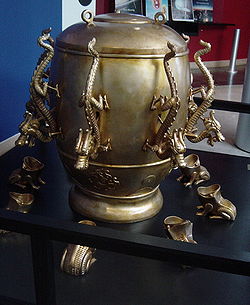 Seismology: To better prepare for calamities, Zhang Heng invented a seismometer
in 132 CE which provided instant alert to authorities in the capital Luoyang that an earthquake had occurred in a location indicated by a specific cardinal or ordinal direction
. Although no tremors could be felt in the capital when Zhang told the court that an earthquake had just occurred in the northwest, a message came soon afterwards that an earthquake had indeed struck 400 km (248 mi) to 500 km (310 mi) northwest of Luoyang (in what is now modern Gansu
). Zhang called his device the 'instrument for measuring the seasonal winds and the movements of the Earth' (Houfeng didong yi 候风地动仪), so-named because he and others thought that earthquakes were most likely caused by the enormous compression of trapped air. See Zhang's seismometer for further details.
There are many notable contributors to the field of Chinese science throughout the ages. One of the best examples would be Shen Kuo
(1031–1095), a polymath
scientist and statesman who was the first to describe the magnetic-needle compass
used for navigation
, discovered the concept of true north
, improved the design of the astronomical gnomon
, armillary sphere
, sight tube, and clepsydra
, and described the use of drydocks to repair boats. After observing the natural process of the inundation of silt
and the find of marine
fossil
s in the Taihang Mountains
(hundreds of miles from the Pacific Ocean
), Shen Kuo devised a theory of land formation, or geomorphology
. He also adopted a theory of gradual climate change
in regions over time, after observing petrified bamboo
found underground at Yan'an
, Shaanxi
province. If not for Shen Kuo's writing, the architectural works of Yu Hao
would be little known, along with the inventor of movable type
printing
, Bi Sheng
(990-1051). Shen's contemporary Su Song
(1020–1101) was also a brilliant polymath, an astronomer who created a celestial atlas of star maps, wrote a pharmaceutical treatise with related subjects of botany
, zoology
, mineralogy
, and metallurgy
, and had erected a large astronomical clocktower in Kaifeng
city in 1088. To operate the crowning armillary sphere
, his clocktower featured an escapement
mechanism and the world's oldest known use of an endless power-transmitting chain drive
.
The Jesuit China missions
of the 16th and 17th centuries "learned to appreciate the scientific achievements of this ancient culture and made them known in Europe. Through their correspondence European scientists first learned about the Chinese science and culture." Western academic thought on the history of Chinese technology and science was galvanized by the work of Joseph Needham
and the Needham Research Institute. Among the technological accomplishments of China were, according to the British scholar Needham, early seismological
detectors (Zhang Heng
in the 2nd century), the water-powered
celestial globe (Zhang Heng), match
es, the independent invention of the decimal system
, dry docks, sliding calipers, the double-action piston pump
, cast iron
, the blast furnace
, the iron
plough
, the multi-tube seed drill
, the wheelbarrow
, the suspension bridge
, the winnowing machine, the rotary fan
, the parachute
, natural gas
as fuel, the raised-relief map
, the propeller
, the crossbow
, and a solid fuel rocket
, the multistage rocket
, the horse collar
, along with contributions in logic
, astronomy
, medicine
, and other fields.
However, cultural factors prevented these Chinese achievements from developing into what we might call "modern science". According to Needham, it may have been the religious and philosophical framework of Chinese intellectuals which made them unable to accept the ideas of laws of nature:
lost contact with much of its past. The Library of Alexandria
, which had suffered since it fell under Roman rule, had been destroyed by 642, shortly after the Arab conquest of Egypt
. While the Byzantine Empire
still held learning centers such as Constantinople
, Western Europe's knowledge was concentrated in monasteries
until the development of medieval universities
in the 12th and 13th centuries. The curriculum of monastic schools included the study of the few available ancient texts and of new works on practical subjects like medicine and timekeeping.
Meanwhile, in the Middle East, Greek philosophy
was able to find some support under the newly created Arab Empire
. With the spread of Islam
in the 7th and 8th centuries, a period of Muslim
scholarship, known as the Islamic Golden Age
, lasted until the 13th century. This scholarship was aided by several factors. The use of a single language, Arabic
, allowed communication without need of a translator. Access to Greek
and Latin
texts from the Byzantine Empire
along with Indian
sources of learning provided Muslim scholars a knowledge base to build upon.
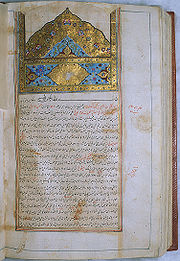 Muslim scientists placed far greater emphasis on experiment
than had the Greeks
. This led to an early scientific method
being developed in the Muslim world, where significant progress in methodology was made, beginning with the experiments of Ibn al-Haytham (Alhazen) on optics
from circa 1000, in his Book of Optics
. The law of refraction of light
was known to the Persians. The most important development of the scientific method was the use of experiments to distinguish between competing scientific theories set within a generally empirical
orientation, which began among Muslim scientists. Ibn al-Haytham is also regarded as the father of optics, especially for his empirical proof of the intromission theory of light. Some have also described Ibn al-Haytham as the "first scientist" for his development of the modern scientific method.
Rosanna Gorini writes:
In mathematics
, the Persian
mathematician Muhammad ibn Musa al-Khwarizmi
gave his name to the concept of the algorithm
, while the term algebra
is derived from al-jabr, the beginning of the title of one of his publications. What is now known as Arabic numerals
originally came from India, but Muslim mathematicians did make several refinements to the number system, such as the introduction of decimal point
notation. Sabian
mathematician Al-Battani
(850-929) contributed to astronomy and mathematics, while Persian
scholar Al-Razi
contributed to chemistry and medicine.
In astronomy
, Al-Battani
improved the measurements of Hipparchus
, preserved in the translation of Ptolemy
's Hè Megalè Syntaxis (The great treatise) translated as Almagest
. Al-Battani also improved the precision of the measurement of the precession of the Earth's axis. The corrections made to the geocentric model
by al-Battani, Ibn al-Haytham, Averroes
and the Maragha astronomers
such as Nasir al-Din al-Tusi
, Mo'ayyeduddin Urdi
and Ibn al-Shatir
are similar to Copernican heliocentric
model. Heliocentric
theories may have also been discussed by several other Muslim astronomers such as Ja'far ibn Muhammad Abu Ma'shar al-Balkhi
, Abu-Rayhan Biruni, Abu Said al-Sijzi
, Qutb al-Din al-Shirazi
, and Najm al-Dīn al-Qazwīnī al-Kātibī
.
Muslim chemists and alchemists played an important role in the foundation of modern chemistry
. Scholars such as Will Durant
and Fielding H. Garrison
considered Muslim chemists to be the founders of chemistry. In particular, Jābir ibn Hayyān is "considered by many to be the father of chemistry". The works of Arabic scientists influenced Roger Bacon
(who introduced the empirical method to Europe, strongly influenced by his reading of Persians writers), and later Isaac Newton
.
Ibn Sina (Avicenna
) is regarded as the most influential scientist and philosopher in Islam. He pioneered the science of experimental medicine and was the first physician to conduct clinical trials. His two most notable works in medicine are the Kitāb al-shifāʾ (“Book of Healing”) and The Canon of Medicine
, both of which were used as standard medicinal texts in both the Muslim world and in Europe well into the 17th century. Amongst his many contributions are the discovery of the contagious nature of infectious diseases, and the introduction of clinical pharmacology.
Some of the other famous scientists from the Islamic world include al-Farabi
(polymath
), Abu al-Qasim
(pioneer of surgery
), Abū Rayhān al-Bīrūnī (pioneer of Indology
, geodesy
and anthropology
), Nasīr al-Dīn al-Tūsī
(polymath), and Ibn Khaldun
(forerunner of social sciences
such as demography
, cultural history
, historiography
, philosophy of history
and sociology
), among many others.
Islamic science began its decline in the 12th or 13th century, in conjunction with the Renaissance
in Europe, and due in part to the 11th- 13th century Mongol Conquests
, during which libraries, observatories, hospitals and universities were destroyed. The end of the Islamic Golden Age
is marked by the destruction of the intellectual center of Baghdad
, the capital of the Abbasid caliphate in 1258.
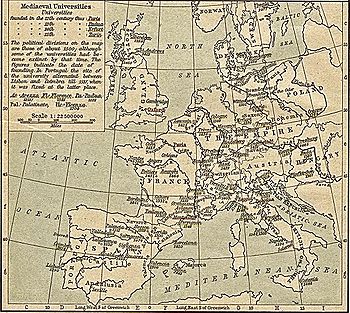 An intellectual revitalization of Europe started with the birth of medieval universities
in the 12th century. The contact with the Islamic world in Spain
and Sicily
, and during the Reconquista
and the Crusades
, allowed Europeans access to scientific Greek
and Arabic
texts, including the works of Aristotle
, Ptolemy
, Jābir ibn Hayyān, al-Khwarizmi
, Alhazen, Avicenna
, and Averroes
. European scholars had access to the translation programs of Raymond of Toledo, who sponsored the 12th century Toledo School of Translators
from Arabic to Latin. Later translators like Michael Scotus would learn Arabic in order to study these texts directly. The European universities aided materially in the translation and propagation of these texts and started a new infrastructure which was needed for scientific communities. In fact, European university put many works about the natural world and the study of nature at the center of its curriculum, with the result that the "medieval university laid far greater emphasis on science than does its modern counterpart and descendent."
As well as this, Europeans began to venture further and further east (most notably, perhaps, Marco Polo
) as a result of the Pax Mongolica
. This led to the increased influence of Indian and even Chinese science on the European tradition. Technological advances were also made, such as the early flight of Eilmer of Malmesbury
(who had studied Mathematics in 11th century England
), and the metallurgical
achievements of the Cistercian blast furnace
at Laskill
.
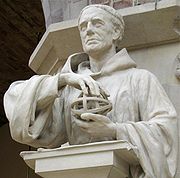 At the beginning of the 13th century there were reasonably accurate Latin translations of the main works of almost all the intellectually crucial ancient authors, allowing a sound transfer of scientific ideas via both the universities and the monasteries. By then, the natural philosophy contained in these texts began to be extended by notable scholastics
such as Robert Grosseteste
, Roger Bacon
, Albertus Magnus
and Duns Scotus
. Precursors of the modern scientific method, influenced by earlier contributions of the Islamic world, can be seen already in Grosseteste's emphasis on mathematics as a way to understand nature, and in the empirical approach admired by Bacon, particularly in his Opus Majus
. Pierre Duhem
's provocative thesis of the Catholic Church's Condemnation of 1277 led to the study of medieval science as a serious discipline, "but no one in the field any longer endorses his view that modern science started in 1277".
The first half of the 14th century saw much important scientific work being done, largely within the framework of scholastic
commentaries on Aristotle's scientific writings. William of Ockham
introduced the principle of parsimony
: natural philosophers should not postulate unnecessary entities, so that motion is not a distinct thing but is only the moving object and an intermediary "sensible species" is not needed to transmit an image of an object to the eye. Scholars such as Jean Buridan
and Nicole Oresme started to reinterpret elements of Aristotle's mechanics. In particular, Buridan developed the theory that impetus was the cause of the motion of projectiles, which was a first step towards the modern concept of inertia
. The Oxford Calculators
began to mathematically analyze the kinematics
of motion, making this analysis without considering the causes of motion.
In 1348, the Black Death
and other disasters sealed a sudden end to the previous period of massive philosophic and scientific development. Yet, the rediscovery of ancient texts was improved after the Fall of Constantinople
in 1453, when many Byzantine
scholars had to seek refuge in the West. Meanwhile, the introduction of printing was to have great effect on European society. The facilitated dissemination of the printed word democratized learning and allowed a faster propagation of new ideas. New ideas also helped to influence the development of European science at this point: not least the introduction of Algebra
. These developments paved the way for the Scientific Revolution
, which may also be understood as a resumption of the process of scientific change, halted at the start of the Black Death.
 The renewal of learning in Europe, that began with 12th century Scholasticism
, came to an end about the time of the Black Death, and the initial period of the subsequent Italian Renaissance
is sometimes seen as a lull in scientific activity. The Northern Renaissance
, on the other hand, showed a decisive shift in focus from Aristoteleian natural philosophy to chemistry and the biological sciences (botany, anatomy, and medicine). Thus modern science in Europe was resumed in a period of great upheaval: the Protestant Reformation
and Catholic
Counter-Reformation
; the discovery of the Americas by Christopher Columbus
; the Fall of Constantinople
; but also the re-discovery of Aristotle during the Scholastic period presaged large social and political changes. Thus, a suitable environment was created in which it became possible to question scientific doctrine, in much the same way that Martin Luther
and John Calvin
questioned religious doctrine. The works of Ptolemy
(astronomy) and Galen
(medicine) were found not always to match everyday observations. Work by Vesalius
on human cadavers found problems with the Galenic view of anatomy.
The willingness to question previously held truths and search for new answers resulted in a period of major scientific advancements, now known as the Scientific Revolution
. The Scientific Revolution is traditionally held by most historians to have begun in 1543, when the books De humani corporis fabrica
(On the Workings of the Human Body) by Andreas Vesalius, and also De Revolutionibus
, by the astronomer Nicolaus Copernicus
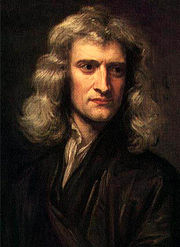
, were first printed. The thesis of Copernicus' book was that the Earth moved around the Sun. The period culminated with the publication of the Philosophiæ Naturalis Principia Mathematica in 1687 by Isaac Newton
, representative of the unprecedented growth of scientific publications
throughout Europe.
Other significant scientific advances were made during this time by Galileo Galilei
, Edmond Halley
, Robert Hooke
, Christiaan Huygens, Tycho Brahe
, Johannes Kepler
, Gottfried Leibniz
, and Blaise Pascal
. In philosophy, major contributions were made by Francis Bacon, Sir Thomas Browne
, René Descartes
, and Thomas Hobbes
. The scientific method was also better developed as the modern way of thinking emphasized experimentation and reason over traditional considerations.
, Descartes, Pascal
and Leibniz
, the way was now clear to the development of modern mathematics
, physics
and technology
by the generation of Benjamin Franklin
(1706–1790), Leonhard Euler
(1707–1783), Mikhail Lomonosov
(1711–1765) and Jean le Rond d'Alembert
(1717–1783), epitomized in the appearance of Denis Diderot
's Encyclopédie
between 1751 and 1772. The impact of this process was not limited to science and technology, but affected philosophy
(Immanuel Kant
, David Hume
), religion (notably with the appearance of positive atheism
, and the increasingly significant impact of science upon religion
), and society and politics in general (Adam Smith
, Voltaire
), the French Revolution
of 1789 setting a bloody cesura indicating the beginning of political modernity. The early modern period
is seen as a flowering of the European Renaissance, in what is often known as the Scientific Revolution
, viewed as a foundation of modern science.
 The Scientific Revolution established science as a source for the growth of knowledge. During the 19th century, the practice of science became professionalized and institutionalized in ways that continued through the 20th century. As the role of scientific knowledge grew in society, it became incorporated with many aspects of the functioning of nation-states.
The history of science is marked by a chain of advances in technology
and knowledge that have always complemented each other. Technological innovations bring about new discoveries
and are bred by other discoveries, which inspire new possibilities and approaches to longstanding science issues.
revived the heliocentric
model of the solar system described by Aristarchus of Samos
. This was followed by the first known model of planetary motion given by Kepler
in the early 17th century, which proposed that the planets follow elliptical
orbits, with the Sun at one focus of the ellipse. Galileo
("Father of Modern Physics") also made use of experiments to validate physical theories, a key element of the scientific method.
In 1687, Isaac Newton
published the Principia Mathematica, detailing two comprehensive and successful physical theories: Newton's laws of motion
, which led to classical mechanics; and Newton's Law of Gravitation, which describes the fundamental force of gravity. The behavior of electricity and magnetism was studied by Faraday
, Ohm
, and others during the early 19th century. These studies led to the unification of the two phenomena into a single theory of electromagnetism
, by Maxwell
(known as Maxwell's equations
).
 The beginning of the 20th century brought the start of a revolution in physics. The long-held theories of Newton were shown not to be correct in all circumstances. Beginning in 1900, Max Planck
, Albert Einstein
, Niels Bohr
and others developed quantum theories to explain various anomalous experimental results, by introducing discrete energy levels. Not only did quantum mechanics show that the laws of motion did not hold on small scales, but even more disturbingly, the theory of general relativity
, proposed by Einstein in 1915, showed that the fixed background of spacetime
, on which both Newtonian mechanics and special relativity
depended, could not exist. In 1925, Werner Heisenberg
and Erwin Schrödinger
formulated quantum mechanics
, which explained the preceding quantum theories. The observation by Edwin Hubble
in 1929 that the speed at which galaxies recede positively correlates with their distance, led to the understanding that the universe is expanding, and the formulation of the Big Bang
theory by Georges Lemaître
.
Further developments took place during World War II, which led to the practical application of radar
and the development and use of the atomic bomb. Though the process had begun with the invention of the cyclotron
by Ernest O. Lawrence in the 1930s, physics in the postwar period entered into a phase of what historians have called "Big Science
", requiring massive machines, budgets, and laboratories in order to test their theories and move into new frontiers. The primary patron of physics became state governments, who recognized that the support of "basic" research could often lead to technologies useful to both military and industrial applications. Currently, general relativity and quantum mechanics are inconsistent with each other, and efforts are underway to unify the two.
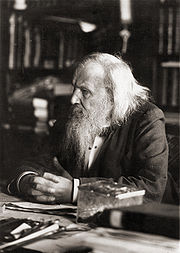 The history of modern chemistry can be taken to begin with the distinction of chemistry from alchemy
by Robert Boyle
in his work The Sceptical Chymist, in 1661 (although the alchemical tradition continued for some time after this) and the gravimetric experimental practices of medical chemists like William Cullen
, Joseph Black
, Torbern Bergman
and Pierre Macquer
. Another important step was made by Antoine Lavoisier
(Father of Modern Chemistry) through his recognition of oxygen
and the law of conservation of mass
, which refuted phlogiston theory
. The theory that all matter is made of atoms, which are the smallest constituents of matter that cannot be broken down without losing the basic chemical and physical properties of that matter, was provided by John Dalton
in 1803, although the question took a hundred years to settle as proven. Dalton also formulated the law of mass relationships. In 1869, Dmitri Mendeleev
composed his periodic table
of elements on the basis of Dalton's discoveries.
The synthesis of urea
by Friedrich Wöhler
opened a new research field, organic chemistry
, and by the end of the 19th century, scientists were able to synthesize hundreds of organic compounds. The later part of the 19th century saw the exploitation of the Earth's petrochemicals, after the exhaustion of the oil supply from whaling
. By the 20th century, systematic production of refined materials provided a ready supply of products which provided not only energy, but also synthetic materials for clothing, medicine, and everyday disposable resources. Application of the techniques of organic chemistry to living organisms resulted in physiological chemistry
, the precursor to biochemistry
. The 20th century also saw the integration of physics and chemistry, with chemical properties explained as the result of the electronic structure of the atom. Linus Pauling
's book on The Nature of the Chemical Bond used the principles of quantum mechanics to deduce bond angles in ever-more complicated molecules. Pauling's work culminated in the physical modelling of DNA
, the secret of life (in the words of Francis Crick
, 1953). In the same year, the Miller-Urey experiment
demonstrated in a simulation of primordial processes, that basic constituents of proteins, simple amino acid
s, could themselves be built up from simpler molecules.
' work on rocks Peri lithōn remained authoritative for millennia: its interpretation of fossils was not overturned until after the Scientific Revolution. Chinese polymath Shen Kua (1031–1095) was the first to formulate hypotheses for the process of land formation. Based on his observation of fossils in a geological stratum
in a mountain hundreds of miles from the ocean, he deduced that the land was formed by erosion of the mountains and by deposition of silt.
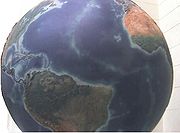 Geology was not systematically restructured during the Scientific Revolution
, but individual theorists made important contributions. Robert Hooke
, for example, formulated theory of earthquakes, and Nicholas Steno developed the theory of superposition
and argued that fossils were the remains of once-living creatures. Beginning with Thomas Burnet
's Sacred Theory of the Earth in 1681, natural philosophers began to explore the idea that the Earth had changed over time. Burnet and his contemporaries interpreted Earth's past in terms of events described in the Bible, but their work laid the intellectual foundations for secular interpretations of Earth history.
Modern geology, like modern chemistry, gradually evolved during the 18th and early 19th centuries. Benoît de Maillet
and the Comte de Buffon
argued that Earth was much older than the 6,000 years envisioned by biblical scholars. Jean-Étienne Guettard
and Nicolas Desmarest
hiked central France and recorded their observations on some of the first geological maps. Abraham Werner created a systematic classification scheme for rocks and minerals—an achievement as significant for geology as that of Linnaeus was for biology. Werner also proposed a generalized interpretation of Earth history, as did contemporary Scottish polymath James Hutton
. Georges Cuvier
and Alexandre Brongniart
, expanding on the work of Steno
, argued that layers of rock could be dated by the fossils they contained: a principle first applied to the geology of the Paris Basin. The use of index fossils became a powerful tool for making geological maps, because it allowed geologists to correlate the rocks in one locality with those of similar age in other, distant localities. Over the first half of the 19th century, geologists such as Charles Lyell
, Adam Sedgwick
, and Roderick Murchison
applied the new technique to rocks throughout Europe and eastern North America, setting the stage for more detailed, government-funded mapping projects in later decades.
Midway through the 19th century, the focus of geology shifted from description and classification to attempts to understand how the surface of the Earth changed. The first comprehensive theories of mountain building were proposed during this period, as were the first modern theories of earthquakes and volcanoes. Louis Agassiz
and others established the reality of continent-covering ice age
s, and "fluvialists" like Andrew Crombie Ramsay argued that river valleys were formed, over millions of years by the rivers that flow through them. After the discovery of radioactivity, radiometric dating
methods were developed, starting in the 20th century. Alfred Wegener
's theory of "continental drift" was widely dismissed when it was proposed in the 1910s, but new data gathered in the 1950s and 1960s led to the theory of plate tectonics
, which provided a plausible mechanism for it. Plate tectonics
also provided a unified explanation for a wide range of seemingly unrelated geological phenomena. Since 1970 it has been the unifying principle in geology.
Geologists' embrace of plate tectonics
was part of a broadening of the field from a study of rocks into a study of the Earth as a planet. Other elements of this transformation include: geophysical studies of the interior of the Earth, the grouping of geology with meteorology
and oceanography
as one of the "earth sciences", and comparisons of Earth and the solar system's other rocky planets.
published work
on how to determine the sizes and distances of the Sun and the Moon, and Eratosthenes
used this work to figure the size of the Earth. Hipparchus
later discovered the precession of the Earth.
Advances in astronomy and in optical systems in the 19th century resulted in the first observation of an asteroid
(1 Ceres) in 1801, and the discovery of Neptune
in 1846.
George Gamow
, Ralph Alpher, and Robert Hermann had calculated that there should be evidence for a Big Bang in the background temperature of the universe. In 1964, Arno Penzias and Robert Wilson
discovered a 3° Kelvin background hiss in their Bell Labs
radiotelescope, which was evidence for this hypothesis, and formed the basis for a number of results that helped determine the age of the universe
.
Supernova SN1987A was observed by astronomers on Earth both visually, and in a triumph for neutrino astronomy
, by the solar neutrino detectors at Kamiokande. But the solar neutrino flux was a fraction of its theoretically expected value
. This discrepancy forced a change in some values in the standard model
for particle physics
.
 In 1847, Hungarian physician Ignác Fülöp Semmelweis
dramatically reduced the occurrency of puerperal fever
by simply requiring physicians to wash their hands before attending to women in childbirth. This discovery predated the germ theory of disease
. However, Semmelweis' findings were not appreciated by his contemporaries and came into use only with discoveries by British surgeon Joseph Lister
, who in 1865 proved the principles of antisepsis. Lister's work was based on the important findings by French biologist Louis Pasteur
. Pasteur was able to link microorganisms with disease, revolutionizing medicine. He also devised one of the most important methods in preventive medicine
, when in 1880 he produced a vaccine
against rabies
. Pasteur invented the process of pasteurization
, to help prevent the spread of disease through milk and other foods.
Perhaps the most prominent, controversial and far-reaching theory in all of science has been the theory of evolution
by natural selection
put forward by the British naturalist Charles Darwin
in his book On the Origin of Species in 1859. Darwin proposed that the features of all living things, including humans, were shaped by natural processes over long periods of time. Implications of evolution on fields outside of pure science have led to both opposition and support
from different parts of society, and profoundly influenced the popular understanding of "man's place in the universe". However, Darwinian evolutionary models do not directly impact the study of genetics. In the early 20th century, the study of heredity became a major investigation after the rediscovery in 1900 of the laws of inheritance developed by the Moravia
n monk Gregor Mendel
in 1866. Mendel's laws provided the beginnings of the study of genetics
, which became a major field of research for both scientific and industrial research. By 1953, James D. Watson
, Francis Crick
and Maurice Wilkins
clarified the basic structure of DNA, the genetic material for expressing life in all its forms. In the late 20th century, the possibilities of genetic engineering
became practical for the first time, and a massive international effort began in 1990 to map out an entire human genome
(the Human Genome Project
).
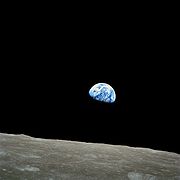 The discipline of ecology
typically traces its origin to the synthesis of Darwinian evolution
and Humboldtian
biogeography
, in the late 19th and early 20th centuries. Equally important in the rise of ecology, however, were microbiology
and soil science
—particularly the cycle of life
concept, prominent in the work Louis Pasteur
and Ferdinand Cohn
. The word ecology was coined by Ernst Haeckel
, whose particularly holistic view of nature in general (and Darwin's theory in particular) was important in the spread of ecological thinking. In the 1930s, Arthur Tansley
and others began developing the field of ecosystem ecology
, which combined experimental soil science with physiological concepts of energy and the techniques of field biology
. The history of ecology in the 20th century is closely tied to that of environmentalism
; the Gaia hypothesis
, first formulated in the 1960s, and spreading in the 1970s, and more recently the scientific-religious movement of Deep Ecology
have brought the two closer together.
on statecraft
, economic
policy and military strategy
which identifies its author by the names Kautilya and , who are traditionally identified with Byers, Nina and Gary Williams, ed. (2006) Out of the Shadows: Contributions of 20th Century Women to Physics, Cambridge University Press ISBN 0-5218-2197-1
Herzenberg, Caroline L. 1986. Women Scientists from Antiquity to the Present Locust Hill Press ISBN 0-933951-01-9 (3rd ed.)
Kumar, Deepak
(2006). Science and the Raj: A Study of British India, 2nd edition. Oxford University Press. ISBN 0-19-568003-0
Lakatos, Imre
History of Science and its Rational Reconstructions published in The Methodology of Scientific Research Programmes: Philosophical Papers Volume 1. Cambridge: Cambridge University Press 1978
Levere, Trevor Harvey. Transforming Matter: A History of Chemistry from Alchemy to the Buckyball (2001)
Lindberg, David C. ed. Cambridge History of Science: The Middle Ages (2010)
Margolis, Howard (2002). It Started with Copernicus. New York: McGraw-Hill
. ISBN 0-07-138507-X
Mayr, DErnst. The Growth of Biological Thought: Diversity, Evolution, and Inheritance (1985)
Needham, Joseph
. Science and Civilisation in China. Multiple volumes (1954–2004).
}
}
Indian Ancient Sciences : Archaeology Based, ISBN -978-3-8383-9027-7, Lap Lambert-Germany.
Nature
Nature, in the broadest sense, is equivalent to the natural world, physical world, or material world. "Nature" refers to the phenomena of the physical world, and also to life in general...
and the domains of the social sciences. (The history of Arts and humanities are termed History of scholarship
History of scholarship
The history of scholarship is the historical study of fields of study which are not covered by the English term "science" , but are covered by, for example, the German term "Wissenschaft"...
). Until the late 20th century the history of science, especially of the physical and biological sciences, was seen as a narrative celebrating the triumph of true theories over false. Science was portrayed as a major dimension of the progress of civilization. In recent decades, postmodern views, especially influenced by Thomas Kuhn
Thomas Kuhn
Thomas Samuel Kuhn was an American historian and philosopher of science whose controversial 1962 book The Structure of Scientific Revolutions was deeply influential in both academic and popular circles, introducing the term "paradigm shift," which has since become an English-language staple.Kuhn...
, The Structure of Scientific Revolutions
The Structure of Scientific Revolutions
The Structure of Scientific Revolutions , by Thomas Kuhn, is an analysis of the history of science. Its publication was a landmark event in the history, philosophy, and sociology of scientific knowledge and it triggered an ongoing worldwide assessment and reaction in — and beyond — those scholarly...
(1962), the history is seen in terms of competing paradigms or conceptual systems battling for intellectual supremacy in a wider matrix that includes intellectual, cultural, economic and political themes outside pure science. New attention is paid to science outside the context of Western Europe
Western Europe
Western Europe is a loose term for the collection of countries in the western most region of the European continents, though this definition is context-dependent and carries cultural and political connotations. One definition describes Western Europe as a geographic entity—the region lying in the...
.
According to Kuhn each new paradigm re-writes the history of its science to present by selection and distortions the former paradigm as its forerunner. The description of the history of economic theory below is a good example.
Science
Science
Science is a systematic enterprise that builds and organizes knowledge in the form of testable explanations and predictions about the universe...
is a body of empirical, theoretical
Theory
The English word theory was derived from a technical term in Ancient Greek philosophy. The word theoria, , meant "a looking at, viewing, beholding", and referring to contemplation or speculation, as opposed to action...
, and practical
Procedural knowledge
Procedural knowledge, also known as imperative knowledge, is the knowledge exercised in the performance of some task. See below for the specific meaning of this term in cognitive psychology and intellectual property law....
knowledge about the natural world
Nature
Nature, in the broadest sense, is equivalent to the natural world, physical world, or material world. "Nature" refers to the phenomena of the physical world, and also to life in general...
, produced by researchers making use of scientific method
Scientific method
Scientific method refers to a body of techniques for investigating phenomena, acquiring new knowledge, or correcting and integrating previous knowledge. To be termed scientific, a method of inquiry must be based on gathering empirical and measurable evidence subject to specific principles of...
s, which emphasize the observation, explanation, and prediction of real world phenomena
Phenomenon
A phenomenon , plural phenomena, is any observable occurrence. Phenomena are often, but not always, understood as 'appearances' or 'experiences'...
by experiment
Experiment
An experiment is a methodical procedure carried out with the goal of verifying, falsifying, or establishing the validity of a hypothesis. Experiments vary greatly in their goal and scale, but always rely on repeatable procedure and logical analysis of the results...
. Given the dual status of science as objective
Objectivity (science)
Objectivity in science is a value that informs how science is practiced and how scientific truths are created. It is the idea that scientists, in attempting to uncover truths about the natural world, must aspire to eliminate personal biases, a priori commitments, emotional involvement, etc...
knowledge and as a human construct, good historiography
Historiography
Historiography refers either to the study of the history and methodology of history as a discipline, or to a body of historical work on a specialized topic...
of science draws on the historical method
Historical method
Historical method comprises the techniques and guidelines by which historians use primary sources and other evidence to research and then to write histories in the form of accounts of the past. The question of the nature, and even the possibility, of a sound historical method is raised in the...
s of both intellectual history
Intellectual history
Note: this article concerns the discipline of intellectual history, and not its object, the whole span of human thought since the invention of writing. For clarifications about the latter topic, please consult the writings of the intellectual historians listed here and entries on individual...
and social history
Social history
Social history, often called the new social history, is a branch of History that includes history of ordinary people and their strategies of coping with life. In its "golden age" it was a major growth field in the 1960s and 1970s among scholars, and still is well represented in history departments...
.
Tracing the exact origins of modern science is possible through the many important texts which have survived from the classical world. However, the word scientist is relatively recent—first coined by William Whewell
William Whewell
William Whewell was an English polymath, scientist, Anglican priest, philosopher, theologian, and historian of science. He was Master of Trinity College, Cambridge.-Life and career:Whewell was born in Lancaster...
in the 19th century. Previously, people investigating nature called themselves natural philosophers.
While empirical
Empirical
The word empirical denotes information gained by means of observation or experimentation. Empirical data are data produced by an experiment or observation....
investigations
Discovery (observation)
Discovery is the act of detecting something new, or something "old" that had been unknown. With reference to science and academic disciplines, discovery is the observation of new phenomena, new actions, or new events and providing new reasoning to explain the knowledge gathered through such...
of the natural world have been described since classical antiquity
Classical antiquity
Classical antiquity is a broad term for a long period of cultural history centered on the Mediterranean Sea, comprising the interlocking civilizations of ancient Greece and ancient Rome, collectively known as the Greco-Roman world...
(for example, by Thales
Thales
Thales of Miletus was a pre-Socratic Greek philosopher from Miletus in Asia Minor, and one of the Seven Sages of Greece. Many, most notably Aristotle, regard him as the first philosopher in the Greek tradition...
, Aristotle
Aristotle
Aristotle was a Greek philosopher and polymath, a student of Plato and teacher of Alexander the Great. His writings cover many subjects, including physics, metaphysics, poetry, theater, music, logic, rhetoric, linguistics, politics, government, ethics, biology, and zoology...
, and others), and scientific method
Scientific method
Scientific method refers to a body of techniques for investigating phenomena, acquiring new knowledge, or correcting and integrating previous knowledge. To be termed scientific, a method of inquiry must be based on gathering empirical and measurable evidence subject to specific principles of...
s have been employed since the Middle Ages
Middle Ages
The Middle Ages is a periodization of European history from the 5th century to the 15th century. The Middle Ages follows the fall of the Western Roman Empire in 476 and precedes the Early Modern Era. It is the middle period of a three-period division of Western history: Classic, Medieval and Modern...
(for example, by Ibn al-Haytham, Abū Rayhān al-Bīrūnī and Roger Bacon
Roger Bacon
Roger Bacon, O.F.M. , also known as Doctor Mirabilis , was an English philosopher and Franciscan friar who placed considerable emphasis on the study of nature through empirical methods...
), the dawn of modern science is generally traced back to the early modern period
Early modern period
In history, the early modern period of modern history follows the late Middle Ages. Although the chronological limits of the period are open to debate, the timeframe spans the period after the late portion of the Middle Ages through the beginning of the Age of Revolutions...
, during what is known as the Scientific Revolution
Scientific revolution
The Scientific Revolution is an era associated primarily with the 16th and 17th centuries during which new ideas and knowledge in physics, astronomy, biology, medicine and chemistry transformed medieval and ancient views of nature and laid the foundations for modern science...
that took place in 16th and 17th century Europe.
Scientific methods are considered to be so fundamental to modern science that some — especially philosophers of science
Philosophy of science
The philosophy of science is concerned with the assumptions, foundations, methods and implications of science. It is also concerned with the use and merit of science and sometimes overlaps metaphysics and epistemology by exploring whether scientific results are actually a study of truth...
and practicing scientists — consider earlier inquiries into nature to be pre-scientific. Traditionally, historians of science have defined science sufficiently broadly to include those inquiries.
Early cultures
In prehistoric times, advice and knowledge was passed from generation to generation in an oral traditionOral tradition
Oral tradition and oral lore is cultural material and traditions transmitted orally from one generation to another. The messages or testimony are verbally transmitted in speech or song and may take the form, for example, of folktales, sayings, ballads, songs, or chants...
. For example, the domestication of maize for agriculture has been dated to about 9,000 years ago in southern Mexico, before the development of writing system
Writing system
A writing system is a symbolic system used to represent elements or statements expressible in language.-General properties:Writing systems are distinguished from other possible symbolic communication systems in that the reader must usually understand something of the associated spoken language to...
s. Similarly, archaeological evidence indicates the development of astronomical knowledge in preliterate societies.
The development of writing enabled knowledge to be stored and communicated across generations with much greater fidelity. Combined with the development of agriculture, which allowed for a surplus of food, it became possible for early civilizations to develop, because more time could be devoted to tasks other than survival.
Many ancient civilizations collected astronomical information in a systematic manner through simple observation. Though they had no knowledge of the real physical structure of the planets and stars, many theoretical explanations were proposed. Basic facts about human physiology were known in some places, and alchemy
Alchemy
Alchemy is an influential philosophical tradition whose early practitioners’ claims to profound powers were known from antiquity. The defining objectives of alchemy are varied; these include the creation of the fabled philosopher's stone possessing powers including the capability of turning base...
was practiced in several civilizations. Considerable observation of macrobiotic flora and fauna was also performed.
Science in the Ancient Near East
From their beginnings in SumerSumer
Sumer was a civilization and historical region in southern Mesopotamia, modern Iraq during the Chalcolithic and Early Bronze Age....
(now Iraq
Iraq
Iraq ; officially the Republic of Iraq is a country in Western Asia spanning most of the northwestern end of the Zagros mountain range, the eastern part of the Syrian Desert and the northern part of the Arabian Desert....
) around 3500 BC, the Mesopotamia
Mesopotamia
Mesopotamia is a toponym for the area of the Tigris–Euphrates river system, largely corresponding to modern-day Iraq, northeastern Syria, southeastern Turkey and southwestern Iran.Widely considered to be the cradle of civilization, Bronze Age Mesopotamia included Sumer and the...
n peoples began to attempt to record some observation
Observation
Observation is either an activity of a living being, such as a human, consisting of receiving knowledge of the outside world through the senses, or the recording of data using scientific instruments. The term may also refer to any data collected during this activity...
s of the world with extremely thorough numerical data
Numerical data
Numerical data is data measured or identified on a numerical scale. Numerical data can be analyzed using statistical methods, and results can be displayed using tables, charts, histograms and graphs. For example, a researcher will ask a questions to a participant that include words how often, how...
. But their observations and measurements were seemingly taken for purposes other than for scientific law
Scientific law
A scientific law is a statement that explains what something does in science just like Newton's law of universal gravitation. A scientific law must always apply under the same conditions, and implies a causal relationship between its elements. The law must be confirmed and broadly agreed upon...
s. A concrete instance of Pythagoras' law
Pythagorean theorem
In mathematics, the Pythagorean theorem or Pythagoras' theorem is a relation in Euclidean geometry among the three sides of a right triangle...
was recorded, as early as the 18th century BC: the Mesopotamian cuneiform tablet Plimpton 322
Plimpton 322
Plimpton 322 is a Babylonian clay tablet, notable as containing an example of Babylonian mathematics. It has number 322 in the G.A. Plimpton Collection at Columbia University...
records a number of Pythagorean triple
Pythagorean triple
A Pythagorean triple consists of three positive integers a, b, and c, such that . Such a triple is commonly written , and a well-known example is . If is a Pythagorean triple, then so is for any positive integer k. A primitive Pythagorean triple is one in which a, b and c are pairwise coprime...
ts (3,4,5) (5,12,13). ..., dated 1900 BC, possibly millennia before Pythagoras, http://www.angelfire.com/nt/Gilgamesh/achieve.html but an abstract formulation of the Pythagorean theorem was not.
In Babylonian astronomy, the vigorous notings of the motions of the star
Star
A star is a massive, luminous sphere of plasma held together by gravity. At the end of its lifetime, a star can also contain a proportion of degenerate matter. The nearest star to Earth is the Sun, which is the source of most of the energy on Earth...
s, planet
Planet
A planet is a celestial body orbiting a star or stellar remnant that is massive enough to be rounded by its own gravity, is not massive enough to cause thermonuclear fusion, and has cleared its neighbouring region of planetesimals.The term planet is ancient, with ties to history, science,...
s, and the moon
Moon
The Moon is Earth's only known natural satellite,There are a number of near-Earth asteroids including 3753 Cruithne that are co-orbital with Earth: their orbits bring them close to Earth for periods of time but then alter in the long term . These are quasi-satellites and not true moons. For more...
are left on thousands of clay tablet
Clay tablet
In the Ancient Near East, clay tablets were used as a writing medium, especially for writing in cuneiform, throughout the Bronze Age and well into the Iron Age....
s created by scribe
Scribe
A scribe is a person who writes books or documents by hand as a profession and helps the city keep track of its records. The profession, previously found in all literate cultures in some form, lost most of its importance and status with the advent of printing...
s. Even today, astronomical periods identified by Mesopotamian scientists are still widely used in Western calendars such as the solar year and the lunar month
Lunar month
In lunar calendars, a lunar month is the time between two identical syzygies . There are many variations. In Middle-Eastern and European traditions, the month starts when the young crescent moon becomes first visible at evening after conjunction with the Sun one or two days before that evening...
. Using these data they developed arithmetical methods to compute the changing length of daylight in the course of the year and to predict the appearances and disappearances of the Moon and planets and eclipses of the Sun and Moon. Only a few astronomers' names are known, such as that of Kidinnu
Kidinnu
Kidinnu was a Chaldean astronomer and mathematician. Strabo of Amaseia called him Kidenas, Pliny the Elder Cidenas, and Vettius Valens Kidynas....
, a Chaldean astronomer and mathematician. Kiddinu's value for the solar year is in use for today's calendars. Babylonian astronomy was "the first and highly successful attempt at giving a refined mathematical description of astronomical phenomena." According to the historian A. Aaboe, "all subsequent varieties of scientific astronomy, in the Hellenistic world, in India, in Islam, and in the West - if not indeed all subsequent endeavour in the exact sciences - depend upon Babylonian astronomy in decisive and fundamental ways."
Ancient Egypt
Ancient Egypt
Ancient Egypt was an ancient civilization of Northeastern Africa, concentrated along the lower reaches of the Nile River in what is now the modern country of Egypt. Egyptian civilization coalesced around 3150 BC with the political unification of Upper and Lower Egypt under the first pharaoh...
made significant advances in astronomy, mathematics and medicine. Their development of geometry
Geometry
Geometry arose as the field of knowledge dealing with spatial relationships. Geometry was one of the two fields of pre-modern mathematics, the other being the study of numbers ....
was a necessary outgrowth of surveying
Surveying
See Also: Public Land Survey SystemSurveying or land surveying is the technique, profession, and science of accurately determining the terrestrial or three-dimensional position of points and the distances and angles between them...
to preserve the layout and ownership of farmland, which was flooded annually by the Nile river. The 3-4-5 right triangle
Right triangle
A right triangle or right-angled triangle is a triangle in which one angle is a right angle . The relation between the sides and angles of a right triangle is the basis for trigonometry.-Terminology:The side opposite the right angle is called the hypotenuse...
and other rules of thumb were used to build rectilinear structures, and the post and lintel architecture of Egypt. Egypt was also a center of alchemy research for much of the Mediterranean
Mediterranean Basin
In biogeography, the Mediterranean Basin refers to the lands around the Mediterranean Sea that have a Mediterranean climate, with mild, rainy winters and hot, dry summers, which supports characteristic Mediterranean forests, woodlands, and scrub vegetation...
.
The Edwin Smith papyrus
Edwin Smith papyrus
The Edwin Smith Papyrus is an Ancient Egyptian medical text and the oldest known surgical treatise on trauma. It dates to Dynasties 16-17 of the Second Intermediate Period in Ancient Egypt, ca. 1500 BCE. The Edwin Smith papyrus is unique among the four principal medical papyri in existencethat...
is one of the first medical documents still extant, and perhaps the earliest document that attempts to describe and analyse the brain: it might be seen as the very beginnings of modern neuroscience
Neuroscience
Neuroscience is the scientific study of the nervous system. Traditionally, neuroscience has been seen as a branch of biology. However, it is currently an interdisciplinary science that collaborates with other fields such as chemistry, computer science, engineering, linguistics, mathematics,...
. However, while Egyptian medicine had some effective practices, it was not without its ineffective and sometimes harmful practices. Medical historians believe that ancient Egyptian pharmacology, for example, was largely ineffective. Nevertheless, it applies the following components to the treatment of disease: examination, diagnosis, treatment, and prognosis,http://www.britannica.com/eb/article?tocId=9032043&query=Edwin%20Smith%20papyrus&ct= which display strong parallels to the basic empirical method
Empirical method
The empirical method is generally taken to mean the approach of using a collection of data to base a theory or derive a conclusion in science...
of science and according to G. E. R. Lloyd played a significant role in the development of this methodology. The Ebers papyrus
Ebers papyrus
The Ebers Papyrus, also known as Papyrus Ebers, is an Egyptian medical papyrus dating to circa 1550 BC. Among the oldest and most important medical papyri of ancient Egypt, it was purchased at Luxor, in the winter of 1873–74 by Georg Ebers...
(circa 1550 BC
16th century BC
The 16th century BC is a century which lasted from 1600 BC to 1501 BC.-Events:* 1700 BC – 1500 BC: Hurrian conquests.* 1595 BC: Sack of Babylon by the Hittite king Mursilis I....
) also contains evidence of traditional empiricism
Empiricism
Empiricism is a theory of knowledge that asserts that knowledge comes only or primarily via sensory experience. One of several views of epistemology, the study of human knowledge, along with rationalism, idealism and historicism, empiricism emphasizes the role of experience and evidence,...
.
Science in the Greek world
Classical antiquity
Classical antiquity is a broad term for a long period of cultural history centered on the Mediterranean Sea, comprising the interlocking civilizations of ancient Greece and ancient Rome, collectively known as the Greco-Roman world...
, the inquiry into the workings of the universe took place both in investigations aimed at such practical goals as establishing a reliable calendar or determining how to cure a variety of illnesses and in those abstract investigations known as natural philosophy
Natural philosophy
Natural philosophy or the philosophy of nature , is a term applied to the study of nature and the physical universe that was dominant before the development of modern science...
. The ancient people who are considered the first scientists may have thought of themselves as natural philosophers, as practitioners of a skilled profession (for example, physicians), or as followers of a religious tradition (for example, temple healers).
The earliest Greek philosophers, known as the pre-Socratics, provided competing answers to the question found in the myths of their neighbors: "How did the ordered cosmos
Cosmos
In the general sense, a cosmos is an orderly or harmonious system. It originates from the Greek term κόσμος , meaning "order" or "ornament" and is antithetical to the concept of chaos. Today, the word is generally used as a synonym of the word Universe . The word cosmos originates from the same root...
in which we live come to be?" The pre-Socratic philosopher Thales
Thales
Thales of Miletus was a pre-Socratic Greek philosopher from Miletus in Asia Minor, and one of the Seven Sages of Greece. Many, most notably Aristotle, regard him as the first philosopher in the Greek tradition...
(640-546 BC), dubbed the "father of science", was the first to postulate non-supernatural explanations for natural phenomena: "all things are water". Thales' student Pythagoras
Pythagoras
Pythagoras of Samos was an Ionian Greek philosopher, mathematician, and founder of the religious movement called Pythagoreanism. Most of the information about Pythagoras was written down centuries after he lived, so very little reliable information is known about him...
of Samos
Samoš
Samoš is a village in Serbia. It is situated in the Kovačica municipality, in the South Banat District, Vojvodina province. The village has a Serb ethnic majority and its population numbering 1,247 people .-See also:...
founded the Pythagorean school
Pythagoreanism
Pythagoreanism was the system of esoteric and metaphysical beliefs held by Pythagoras and his followers, the Pythagoreans, who were considerably influenced by mathematics. Pythagoreanism originated in the 5th century BCE and greatly influenced Platonism...
, which investigated mathematics for its own sake, and was the first to postulate that the Earth
Earth
Earth is the third planet from the Sun, and the densest and fifth-largest of the eight planets in the Solar System. It is also the largest of the Solar System's four terrestrial planets...
is spherical in shape. Leucippus
Leucippus
Leucippus or Leukippos was one of the earliest Greeks to develop the theory of atomism — the idea that everything is composed entirely of various imperishable, indivisible elements called atoms — which was elaborated in greater detail by his pupil and successor, Democritus...
(5th century BC) introduced atomism
Atomism
Atomism is a natural philosophy that developed in several ancient traditions. The atomists theorized that the natural world consists of two fundamental parts: indivisible atoms and empty void.According to Aristotle, atoms are indestructible and immutable and there are an infinite variety of shapes...
, the theory that all matter is made of indivisible, imperishable units called atoms. This was greatly expanded by his pupil Democritus
Democritus
Democritus was an Ancient Greek philosopher born in Abdera, Thrace, Greece. He was an influential pre-Socratic philosopher and pupil of Leucippus, who formulated an atomic theory for the cosmos....
.
Subsequently, Plato
Plato
Plato , was a Classical Greek philosopher, mathematician, student of Socrates, writer of philosophical dialogues, and founder of the Academy in Athens, the first institution of higher learning in the Western world. Along with his mentor, Socrates, and his student, Aristotle, Plato helped to lay the...
and Aristotle
Aristotle
Aristotle was a Greek philosopher and polymath, a student of Plato and teacher of Alexander the Great. His writings cover many subjects, including physics, metaphysics, poetry, theater, music, logic, rhetoric, linguistics, politics, government, ethics, biology, and zoology...
produced the first systematic discussions of natural philosophy, which did much to shape later investigations of nature. Their development of deductive reasoning
Deductive reasoning
Deductive reasoning, also called deductive logic, is reasoning which constructs or evaluates deductive arguments. Deductive arguments are attempts to show that a conclusion necessarily follows from a set of premises or hypothesis...
was of particular importance and usefulness to later scientific inquiry. Plato founded the Platonic Academy
Platonic Academy
The Academy was founded by Plato in ca. 387 BC in Athens. Aristotle studied there for twenty years before founding his own school, the Lyceum. The Academy persisted throughout the Hellenistic period as a skeptical school, until coming to an end after the death of Philo of Larissa in 83 BC...
in 387 BC, whose motto was "Let none unversed in geometry enter here", and turned out many notable philosophers. Plato's student Aristotle introduced empiricism
Empiricism
Empiricism is a theory of knowledge that asserts that knowledge comes only or primarily via sensory experience. One of several views of epistemology, the study of human knowledge, along with rationalism, idealism and historicism, empiricism emphasizes the role of experience and evidence,...
and the notion that universal truths can be arrived at via observation and induction, thereby laying the foundations of the scientific method. Aristotle also produced many biological writings that were empirical in nature, focusing on biological causation and the diversity of life. He made countless observations of nature, especially the habits and attributes of plants and animals in the world around him, classified more than 540 animal species, and dissected at least 50. Aristotle's writings profoundly influenced subsequent Islamic and European scholarship, though they were eventually superseded in the Scientific Revolution
Scientific revolution
The Scientific Revolution is an era associated primarily with the 16th and 17th centuries during which new ideas and knowledge in physics, astronomy, biology, medicine and chemistry transformed medieval and ancient views of nature and laid the foundations for modern science...
.
Anatomy
Anatomy is a branch of biology and medicine that is the consideration of the structure of living things. It is a general term that includes human anatomy, animal anatomy , and plant anatomy...
, zoology
Zoology
Zoology |zoölogy]]), is the branch of biology that relates to the animal kingdom, including the structure, embryology, evolution, classification, habits, and distribution of all animals, both living and extinct...
, botany
Botany
Botany, plant science, or plant biology is a branch of biology that involves the scientific study of plant life. Traditionally, botany also included the study of fungi, algae and viruses...
, mineralogy
Mineralogy
Mineralogy is the study of chemistry, crystal structure, and physical properties of minerals. Specific studies within mineralogy include the processes of mineral origin and formation, classification of minerals, their geographical distribution, as well as their utilization.-History:Early writing...
, geography
Geography
Geography is the science that studies the lands, features, inhabitants, and phenomena of Earth. A literal translation would be "to describe or write about the Earth". The first person to use the word "geography" was Eratosthenes...
, mathematics
Mathematics
Mathematics is the study of quantity, space, structure, and change. Mathematicians seek out patterns and formulate new conjectures. Mathematicians resolve the truth or falsity of conjectures by mathematical proofs, which are arguments sufficient to convince other mathematicians of their validity...
and astronomy
Astronomy
Astronomy is a natural science that deals with the study of celestial objects and phenomena that originate outside the atmosphere of Earth...
; an awareness of the importance of certain scientific problems, especially those related to the problem of change and its causes; and a recognition of the methodological importance of applying mathematics to natural phenomena and of undertaking empirical research. In the Hellenistic age scholars frequently employed the principles developed in earlier Greek thought: the application of mathematics
Mathematics
Mathematics is the study of quantity, space, structure, and change. Mathematicians seek out patterns and formulate new conjectures. Mathematicians resolve the truth or falsity of conjectures by mathematical proofs, which are arguments sufficient to convince other mathematicians of their validity...
and deliberate empirical research, in their scientific investigations. Thus, clear unbroken lines of influence lead from ancient Greek
Ancient Greece
Ancient Greece is a civilization belonging to a period of Greek history that lasted from the Archaic period of the 8th to 6th centuries BC to the end of antiquity. Immediately following this period was the beginning of the Early Middle Ages and the Byzantine era. Included in Ancient Greece is the...
and Hellenistic philosophers
Hellenistic philosophy
Hellenistic philosophy is the period of Western philosophy that was developed in the Hellenistic civilization following Aristotle and ending with the beginning of Neoplatonism.-Pythagoreanism:...
, to medieval Muslim philosophers
Early Islamic philosophy
Early Islamic philosophy or classical Islamic philosophy is a period of intense philosophical development beginning in the 2nd century AH of the Islamic calendar and lasting until the 6th century AH...
and scientists
Islamic science
Science in the medieval Islamic world, also known as Islamic science or Arabic science, is the science developed and practised in the Islamic world during the Islamic Golden Age . During this time, Indian, Iranian and especially Greek knowledge was translated into Arabic...
, to the Europe
Europe
Europe is, by convention, one of the world's seven continents. Comprising the westernmost peninsula of Eurasia, Europe is generally 'divided' from Asia to its east by the watershed divides of the Ural and Caucasus Mountains, the Ural River, the Caspian and Black Seas, and the waterways connecting...
an Renaissance
Renaissance
The Renaissance was a cultural movement that spanned roughly the 14th to the 17th century, beginning in Italy in the Late Middle Ages and later spreading to the rest of Europe. The term is also used more loosely to refer to the historical era, but since the changes of the Renaissance were not...
and Enlightenment
Age of Enlightenment
The Age of Enlightenment was an elite cultural movement of intellectuals in 18th century Europe that sought to mobilize the power of reason in order to reform society and advance knowledge. It promoted intellectual interchange and opposed intolerance and abuses in church and state...
, to the secular science
Science
Science is a systematic enterprise that builds and organizes knowledge in the form of testable explanations and predictions about the universe...
s of the modern day.
Neither reason nor inquiry began with the Ancient Greeks, but the Socratic method
Socratic method
The Socratic method , named after the classical Greek philosopher Socrates, is a form of inquiry and debate between individuals with opposing viewpoints based on asking and answering questions to stimulate critical thinking and to illuminate ideas...
did, along with the idea of Forms, great advances in geometry
Geometry
Geometry arose as the field of knowledge dealing with spatial relationships. Geometry was one of the two fields of pre-modern mathematics, the other being the study of numbers ....
, logic
Logic
In philosophy, Logic is the formal systematic study of the principles of valid inference and correct reasoning. Logic is used in most intellectual activities, but is studied primarily in the disciplines of philosophy, mathematics, semantics, and computer science...
, and the natural sciences. According to Benjamin Farrington
Benjamin Farrington
Benjamin Farrington was an Irish scholar and professor of the Classics. Born in Cork, he was educated in Ireland and taught at the university level in Ireland and South Africa...
, former Professor of Classics
Classics
Classics is the branch of the Humanities comprising the languages, literature, philosophy, history, art, archaeology and other culture of the ancient Mediterranean world ; especially Ancient Greece and Ancient Rome during Classical Antiquity Classics (sometimes encompassing Classical Studies or...
at Swansea University
Swansea University
Swansea University is a university located in Swansea, Wales, United Kingdom. Swansea University was chartered as University College of Swansea in 1920, as the fourth college of the University of Wales. In 1996, it changed its name to the University of Wales Swansea following structural changes...
:
- "Men were weighing for thousands of years before ArchimedesArchimedesArchimedes of Syracuse was a Greek mathematician, physicist, engineer, inventor, and astronomer. Although few details of his life are known, he is regarded as one of the leading scientists in classical antiquity. Among his advances in physics are the foundations of hydrostatics, statics and an...
worked out the laws of equilibrium; they must have had practical and intuitional knowledge of the principles involved. What Archimedes did was to sort out the theoretical implications of this practical knowledge and present the resulting body of knowledge as a logically coherent system."
and again:
- "With astonishment we find ourselves on the threshold of modern science. Nor should it be supposed that by some trick of translation the extracts have been given an air of modernity. Far from it. The vocabulary of these writings and their style are the source from which our own vocabulary and style have been derived."
Aristarchus of Samos
Aristarchus, or more correctly Aristarchos , was a Greek astronomer and mathematician, born on the island of Samos, in Greece. He presented the first known heliocentric model of the solar system, placing the Sun, not the Earth, at the center of the known universe...
was the first known person to propose a heliocentric model of the solar system, while the geographer Eratosthenes
Eratosthenes
Eratosthenes of Cyrene was a Greek mathematician, poet, athlete, geographer, astronomer, and music theorist.He was the first person to use the word "geography" and invented the discipline of geography as we understand it...
accurately calculated the circumference of the Earth. Hipparchus
Hipparchus
Hipparchus, the common Latinization of the Greek Hipparkhos, can mean:* Hipparchus, the ancient Greek astronomer** Hipparchic cycle, an astronomical cycle he created** Hipparchus , a lunar crater named in his honour...
(ca. 190 – ca. 120 BC) produced the first systematic star catalog
Timeline of astronomical maps, catalogs, and surveys
Timeline of astronomical maps, catalogs and surveys* ca. 1800 BC — Babylonian star catalog* ca. 350 BC — Shi Shen's star catalog has almost 800 entries* ca. 300 BC — star catalog of Timocharis of Alexandria...
. The level of achievement in Hellenistic astronomy
Astronomy
Astronomy is a natural science that deals with the study of celestial objects and phenomena that originate outside the atmosphere of Earth...
and engineering
Engineering
Engineering is the discipline, art, skill and profession of acquiring and applying scientific, mathematical, economic, social, and practical knowledge, in order to design and build structures, machines, devices, systems, materials and processes that safely realize improvements to the lives of...
is impressively shown by the Antikythera mechanism
Antikythera mechanism
The Antikythera mechanism is an ancient mechanical computer designed to calculate astronomical positions. It was recovered in 1900–1901 from the Antikythera wreck. Its significance and complexity were not understood until decades later. Its time of construction is now estimated between 150 and 100...
(150-100 BC), an analog computer
Analog computer
An analog computer is a form of computer that uses the continuously-changeable aspects of physical phenomena such as electrical, mechanical, or hydraulic quantities to model the problem being solved...
for calculating the position of planets. Technological artifacts of similar complexity did not reappear until the 14th century, when mechanical astronomical clock
Astronomical clock
An astronomical clock is a clock with special mechanisms and dials to display astronomical information, such as the relative positions of the sun, moon, zodiacal constellations, and sometimes major planets.-Definition:...
s appeared in Europe
Europe
Europe is, by convention, one of the world's seven continents. Comprising the westernmost peninsula of Eurasia, Europe is generally 'divided' from Asia to its east by the watershed divides of the Ural and Caucasus Mountains, the Ural River, the Caspian and Black Seas, and the waterways connecting...
.
In medicine
Medicine
Medicine is the science and art of healing. It encompasses a variety of health care practices evolved to maintain and restore health by the prevention and treatment of illness....
, Hippocrates
Hippocrates
Hippocrates of Cos or Hippokrates of Kos was an ancient Greek physician of the Age of Pericles , and is considered one of the most outstanding figures in the history of medicine...
(ca. 460 BC – ca. 370 BC) and his followers were the first to describe many diseases and medical conditions and developed the Hippocratic Oath
Hippocratic Oath
The Hippocratic Oath is an oath historically taken by physicians and other healthcare professionals swearing to practice medicine ethically. It is widely believed to have been written by Hippocrates, often regarded as the father of western medicine, or by one of his students. The oath is written in...
for physicians, still relevant and in use today. Herophilos
Herophilos
Herophilos , sometimes Latinized Herophilus , was a Greek physician. Born in Chalcedon, he spent the majority of his life in Alexandria. He was the first scientist to systematically perform scientific dissections of human cadavers and is deemed to be the first anatomist. Herophilos recorded his...
(335 - 280 BC) was the first to base his conclusions on dissection of the human body and to describe the nervous system
Nervous system
The nervous system is an organ system containing a network of specialized cells called neurons that coordinate the actions of an animal and transmit signals between different parts of its body. In most animals the nervous system consists of two parts, central and peripheral. The central nervous...
. Galen
Galen
Aelius Galenus or Claudius Galenus , better known as Galen of Pergamon , was a prominent Roman physician, surgeon and philosopher...
(129 – ca. 200 AD) performed many audacious operations—including brain and eye surgeries
Surgery
Surgery is an ancient medical specialty that uses operative manual and instrumental techniques on a patient to investigate and/or treat a pathological condition such as disease or injury, or to help improve bodily function or appearance.An act of performing surgery may be called a surgical...
— that were not tried again for almost two millennia.
Euclid
Euclid , fl. 300 BC, also known as Euclid of Alexandria, was a Greek mathematician, often referred to as the "Father of Geometry". He was active in Alexandria during the reign of Ptolemy I...
laid down the foundations of mathematical rigor and introduced the concepts of definition, axiom, theorem and proof still in use today in his Elements
Euclid's Elements
Euclid's Elements is a mathematical and geometric treatise consisting of 13 books written by the Greek mathematician Euclid in Alexandria c. 300 BC. It is a collection of definitions, postulates , propositions , and mathematical proofs of the propositions...
, considered the most influential textbook ever written. Archimedes
Archimedes
Archimedes of Syracuse was a Greek mathematician, physicist, engineer, inventor, and astronomer. Although few details of his life are known, he is regarded as one of the leading scientists in classical antiquity. Among his advances in physics are the foundations of hydrostatics, statics and an...
, considered one of the greatest mathematicians of all time, is credited with using the method of exhaustion
Method of exhaustion
The method of exhaustion is a method of finding the area of a shape by inscribing inside it a sequence of polygons whose areas converge to the area of the containing shape. If the sequence is correctly constructed, the difference in area between the n-th polygon and the containing shape will...
to calculate the area
Area
Area is a quantity that expresses the extent of a two-dimensional surface or shape in the plane. Area can be understood as the amount of material with a given thickness that would be necessary to fashion a model of the shape, or the amount of paint necessary to cover the surface with a single coat...
under the arc of a parabola
Parabola
In mathematics, the parabola is a conic section, the intersection of a right circular conical surface and a plane parallel to a generating straight line of that surface...
with the summation of an infinite series
Series (mathematics)
A series is the sum of the terms of a sequence. Finite sequences and series have defined first and last terms, whereas infinite sequences and series continue indefinitely....
, and gave a remarkably accurate approximation of Pi
Pi
' is a mathematical constant that is the ratio of any circle's circumference to its diameter. is approximately equal to 3.14. Many formulae in mathematics, science, and engineering involve , which makes it one of the most important mathematical constants...
. He is also known in physics
Physics
Physics is a natural science that involves the study of matter and its motion through spacetime, along with related concepts such as energy and force. More broadly, it is the general analysis of nature, conducted in order to understand how the universe behaves.Physics is one of the oldest academic...
for laying the foundations of hydrostatics
Fluid statics
Fluid statics is the science of fluids at rest, and is a sub-field within fluid mechanics. The term usually refers to the mathematical treatment of the subject. It embraces the study of the conditions under which fluids are at rest in stable equilibrium...
, statics
Statics
Statics is the branch of mechanics concerned with the analysis of loads on physical systems in static equilibrium, that is, in a state where the relative positions of subsystems do not vary over time, or where components and structures are at a constant velocity...
, and the explanation of the principle of the lever
Lever
In physics, a lever is a rigid object that is used with an appropriate fulcrum or pivot point to either multiply the mechanical force that can be applied to another object or resistance force , or multiply the distance and speed at which the opposite end of the rigid object travels.This leverage...
.
Theophrastus
Theophrastus
Theophrastus , a Greek native of Eresos in Lesbos, was the successor to Aristotle in the Peripatetic school. He came to Athens at a young age, and initially studied in Plato's school. After Plato's death he attached himself to Aristotle. Aristotle bequeathed to Theophrastus his writings, and...
wrote some of the earliest descriptions of plants and animals, establishing the first taxonomy
Taxonomy
Taxonomy is the science of identifying and naming species, and arranging them into a classification. The field of taxonomy, sometimes referred to as "biological taxonomy", revolves around the description and use of taxonomic units, known as taxa...
and looking at minerals in terms of their properties such as hardness. Pliny the Elder
Pliny the Elder
Gaius Plinius Secundus , better known as Pliny the Elder, was a Roman author, naturalist, and natural philosopher, as well as naval and army commander of the early Roman Empire, and personal friend of the emperor Vespasian...
produced what is one of the largest encyclopedia
Encyclopedia
An encyclopedia is a type of reference work, a compendium holding a summary of information from either all branches of knowledge or a particular branch of knowledge....
s of the natural world in 77 AD, and must be regarded as the rightful successor to Theophrastus. For example, he accurately describes the octahedral shape of the diamond
Diamond
In mineralogy, diamond is an allotrope of carbon, where the carbon atoms are arranged in a variation of the face-centered cubic crystal structure called a diamond lattice. Diamond is less stable than graphite, but the conversion rate from diamond to graphite is negligible at ambient conditions...
, and proceeds to mention that diamond dust is used by engravers to cut and polish other gems owing to its great hardness. His recognition of the importance of crystal
Crystal
A crystal or crystalline solid is a solid material whose constituent atoms, molecules, or ions are arranged in an orderly repeating pattern extending in all three spatial dimensions. The scientific study of crystals and crystal formation is known as crystallography...
shape is a precursor to modern crystallography
Crystallography
Crystallography is the experimental science of the arrangement of atoms in solids. The word "crystallography" derives from the Greek words crystallon = cold drop / frozen drop, with its meaning extending to all solids with some degree of transparency, and grapho = write.Before the development of...
, while mention of numerous other minerals presages mineralogy
Mineralogy
Mineralogy is the study of chemistry, crystal structure, and physical properties of minerals. Specific studies within mineralogy include the processes of mineral origin and formation, classification of minerals, their geographical distribution, as well as their utilization.-History:Early writing...
. He also recognises that other minerals have characteristic crystal shapes, but in one example, confuses the crystal habit
Crystal habit
Crystal habit is an overall description of the visible external shape of a mineral. This description can apply to an individual crystal or an assembly of crystals or aggregates....
with the work of lapidaries. He was also the first to recognise that amber
Amber
Amber is fossilized tree resin , which has been appreciated for its color and natural beauty since Neolithic times. Amber is used as an ingredient in perfumes, as a healing agent in folk medicine, and as jewelry. There are five classes of amber, defined on the basis of their chemical constituents...
was a fossilized resin from pine trees because he had seen samples with trapped insects within them.
Science in India
Indus Valley Civilization
The Indus Valley Civilization was a Bronze Age civilization that was located in the northwestern region of the Indian subcontinent, consisting of what is now mainly modern-day Pakistan and northwest India...
(c. 4th millennium BC ~ c. 3rd millennium BC). The people of this civilization made bricks whose dimensions were in the proportion 4:2:1, considered favorable for the stability of a brick structure. They also tried to standardize measurement of length to a high degree of accuracy. They designed a ruler—the Mohenjo-daro ruler—whose unit of length (approximately 1.32 inches or 3.4 centimetres) was divided into ten equal parts. Bricks manufactured in ancient Mohenjo-daro often had dimensions that were integral multiples of this unit of length.
Indian astronomer and mathematician Aryabhata
Aryabhata
Aryabhata was the first in the line of great mathematician-astronomers from the classical age of Indian mathematics and Indian astronomy...
(476-550), in his Aryabhatiya
Aryabhatiya
Āryabhaṭīya or Āryabhaṭīyaṃ, a Sanskrit astronomical treatise, is the magnum opus and only extant work of the 5th century Indian mathematician, Āryabhaṭa.- Structure and style:...
(499) introduced a number of trigonometric functions (including sine
Sine
In mathematics, the sine function is a function of an angle. In a right triangle, sine gives the ratio of the length of the side opposite to an angle to the length of the hypotenuse.Sine is usually listed first amongst the trigonometric functions....
, versine
Versine
The versine or versed sine, versin, is a trigonometric function equal to and 2sin2. It appeared in some of the earliest trigonometric tables and was once widespread, but it is now little-used...
, cosine and inverse sine), trigonometric
Trigonometry
Trigonometry is a branch of mathematics that studies triangles and the relationships between their sides and the angles between these sides. Trigonometry defines the trigonometric functions, which describe those relationships and have applicability to cyclical phenomena, such as waves...
tables
Āryabhaṭa's sine table
Āryabhaṭa's sine table is a set of twenty-four of numbers given in the astronomical treatise Āryabhaṭiya composed by the fifth century Indian mathematician and astronomer Āryabhaṭa , for the computation of the half-chords of certain set of arcs of a circle...
, and techniques and algorithm
Algorithm
In mathematics and computer science, an algorithm is an effective method expressed as a finite list of well-defined instructions for calculating a function. Algorithms are used for calculation, data processing, and automated reasoning...
s of algebra
Algebra
Algebra is the branch of mathematics concerning the study of the rules of operations and relations, and the constructions and concepts arising from them, including terms, polynomials, equations and algebraic structures...
. In 628 AD, Brahmagupta
Brahmagupta
Brahmagupta was an Indian mathematician and astronomer who wrote many important works on mathematics and astronomy. His best known work is the Brāhmasphuṭasiddhānta , written in 628 in Bhinmal...
suggested that gravity was a force of attraction. He also lucidly explained the use of zero
0 (number)
0 is both a numberand the numerical digit used to represent that number in numerals.It fulfills a central role in mathematics as the additive identity of the integers, real numbers, and many other algebraic structures. As a digit, 0 is used as a placeholder in place value systems...
as both a placeholder and a decimal digit, along with the Hindu-Arabic numeral system
Hindu-Arabic numeral system
The Hindu–Arabic numeral system or Hindu numeral system is a positional decimal numeral system developed between the 1st and 5th centuries by Indian mathematicians, adopted by Persian and Arab mathematicians , and spread to the western world...
now used universally throughout the world. Arabic translations of the two astronomers' texts were soon available in the Islamic world
Caliph
The Caliph is the head of state in a Caliphate, and the title for the ruler of the Islamic Ummah, an Islamic community ruled by the Shari'ah. It is a transcribed version of the Arabic word which means "successor" or "representative"...
, introducing what would become Arabic numerals
Arabic numerals
Arabic numerals or Hindu numerals or Hindu-Arabic numerals or Indo-Arabic numerals are the ten digits . They are descended from the Hindu-Arabic numeral system developed by Indian mathematicians, in which a sequence of digits such as "975" is read as a numeral...
to the Islamic World by the 9th century. During the 14th-16th centuries, the Kerala school of astronomy and mathematics made significant advances in astronomy and especially mathematics, including fields such as trigonometry
Trigonometry
Trigonometry is a branch of mathematics that studies triangles and the relationships between their sides and the angles between these sides. Trigonometry defines the trigonometric functions, which describe those relationships and have applicability to cyclical phenomena, such as waves...
and analysis
Mathematical analysis
Mathematical analysis, which mathematicians refer to simply as analysis, has its beginnings in the rigorous formulation of infinitesimal calculus. It is a branch of pure mathematics that includes the theories of differentiation, integration and measure, limits, infinite series, and analytic functions...
. In particular, Madhava of Sangamagrama
Madhava of Sangamagrama
Mādhava of Sañgamāgrama was a prominent Kerala mathematician-astronomer from the town of Irińńālakkuţa near Cochin, Kerala, India. He is considered the founder of the Kerala School of Astronomy and Mathematics...
is considered the "founder of mathematical analysis
Mathematical analysis
Mathematical analysis, which mathematicians refer to simply as analysis, has its beginnings in the rigorous formulation of infinitesimal calculus. It is a branch of pure mathematics that includes the theories of differentiation, integration and measure, limits, infinite series, and analytic functions...
".
Astronomy: The first textual mention of astronomical concepts comes from the Vedas, religious literature of India. According to Sarma (2008): "One finds in the Rigveda
Rigveda
The Rigveda is an ancient Indian sacred collection of Vedic Sanskrit hymns...
intelligent speculations about the genesis of the universe from nonexistence, the configuration of the universe, the spherical self-supporting earth
Spherical Earth
The concept of a spherical Earth dates back to ancient Greek philosophy from around the 6th century BC, but remained a matter of philosophical speculation until the 3rd century BC when Hellenistic astronomy established the spherical shape of the earth as a physical given...
, and the year of 360 days divided into 12 equal parts of 30 days each with a periodical intercalary month.". The first 12 chapters of the Siddhanta Shiromani, written by Bhāskara in the 12th century, cover topics such as: mean longitudes of the planets; true longitudes of the planets; the three problems of diurnal rotation; syzygies; lunar eclipses; solar eclipses; latitudes of the planets; risings and settings; the moon's crescent; conjunctions of the planets with each other; conjunctions of the planets with the fixed stars; and the patas of the sun and moon. The 13 chapters of the second part cover the nature of the sphere, as well as significant astronomical and trigonometric calculations based on it.
Linguistics: Some of the earliest linguistic activities can be found in Iron Age India
Iron Age India
Iron Age India, the Iron Age in the Indian subcontinent, succeeds the Late Harappan culture, also known as the last phase of the Indus Valley Tradition...
(1st. millennium BC) with the analysis of Sanskrit
Sanskrit
Sanskrit , is a historical Indo-Aryan language and the primary liturgical language of Hinduism, Jainism and Buddhism.Buddhism: besides Pali, see Buddhist Hybrid Sanskrit Today, it is listed as one of the 22 scheduled languages of India and is an official language of the state of Uttarakhand...
for the purpose of the correct recitation and interpretation of Vedic
Vedas
The Vedas are a large body of texts originating in ancient India. Composed in Vedic Sanskrit, the texts constitute the oldest layer of Sanskrit literature and the oldest scriptures of Hinduism....
texts. The most notable grammarian of Sanskrit
Sanskrit
Sanskrit , is a historical Indo-Aryan language and the primary liturgical language of Hinduism, Jainism and Buddhism.Buddhism: besides Pali, see Buddhist Hybrid Sanskrit Today, it is listed as one of the 22 scheduled languages of India and is an official language of the state of Uttarakhand...
was (c. 520 – 460 BC), whose grammar formulates close to 4,000 rules which together form a compact generative grammar
Generative grammar
In theoretical linguistics, generative grammar refers to a particular approach to the study of syntax. A generative grammar of a language attempts to give a set of rules that will correctly predict which combinations of words will form grammatical sentences...
of Sanskrit. Inherent in his analytic approach are the concepts of the phoneme
Phoneme
In a language or dialect, a phoneme is the smallest segmental unit of sound employed to form meaningful contrasts between utterances....
, the morpheme
Morpheme
In linguistics, a morpheme is the smallest semantically meaningful unit in a language. The field of study dedicated to morphemes is called morphology. A morpheme is not identical to a word, and the principal difference between the two is that a morpheme may or may not stand alone, whereas a word,...
and the root
Root
In vascular plants, the root is the organ of a plant that typically lies below the surface of the soil. This is not always the case, however, since a root can also be aerial or aerating . Furthermore, a stem normally occurring below ground is not exceptional either...
.
Medicine: Findings from Neolithic
Neolithic
The Neolithic Age, Era, or Period, or New Stone Age, was a period in the development of human technology, beginning about 9500 BC in some parts of the Middle East, and later in other parts of the world. It is traditionally considered as the last part of the Stone Age...
graveyards in what is now Pakistan
Pakistan
Pakistan , officially the Islamic Republic of Pakistan is a sovereign state in South Asia. It has a coastline along the Arabian Sea and the Gulf of Oman in the south and is bordered by Afghanistan and Iran in the west, India in the east and China in the far northeast. In the north, Tajikistan...
show evidence of proto-dentistry among an early farming culture. Ayurveda
Ayurveda
Ayurveda or ayurvedic medicine is a system of traditional medicine native to India and a form of alternative medicine. In Sanskrit, words , meaning "longevity", and , meaning "knowledge" or "science". The earliest literature on Indian medical practice appeared during the Vedic period in India,...
is a system of traditional medicine that originated in ancient India before 2500 BC, and is now practiced as a form of alternative medicine
Alternative medicine
Alternative medicine is any healing practice, "that does not fall within the realm of conventional medicine." It is based on historical or cultural traditions, rather than on scientific evidence....
in other parts of the world. Its most famous text is the Suśrutasamhitā
Sushruta Samhita
The Sushruta Samhita is a Sanskrit text, attributed to one Sushruta, foundational to Ayurvedic medicine , with innovative chapters on surgery....
of Suśruta, which is notable for describing procedures on various forms of surgery
Surgery
Surgery is an ancient medical specialty that uses operative manual and instrumental techniques on a patient to investigate and/or treat a pathological condition such as disease or injury, or to help improve bodily function or appearance.An act of performing surgery may be called a surgical...
, including rhinoplasty
Rhinoplasty
Rhinoplasty , also nose job, is a plastic surgery procedure for correcting and reconstructing the form, restoring the functions, and aesthetically enhancing the nose, by resolving nasal trauma , congenital defect, respiratory impediment, and a failed primary rhinoplasty...
, the repair of torn ear lobes, perineal lithotomy
Lithotomy
Lithotomy from Greek for "lithos" and "tomos" , is a surgical method for removal of calculi, stones formed inside certain hollow organs, such as the kidneys , bladder , and gallbladder , that cannot exit naturally through the urinary system or biliary tract...
, cataract surgery, and several other excisions and other surgical procedures.
Metallurgy: The wootz
Wootz steel
Wootz steel is a steel characterized by a pattern of bands or sheets of micro carbides within a tempered martensite or pearlite matrix. It was developed in India around 300 BCE...
, crucible
Crucible steel
Crucible steel describes a number of different techniques for making steel in a crucible. Its manufacture is essentially a refining process which is dependent on preexisting furnace products...
and stainless
Stainless steel
In metallurgy, stainless steel, also known as inox steel or inox from French "inoxydable", is defined as a steel alloy with a minimum of 10.5 or 11% chromium content by mass....
steels were discovered in India, and were widely exported in Classic Mediterranean world. It was known from Pliny the Elder
Pliny the Elder
Gaius Plinius Secundus , better known as Pliny the Elder, was a Roman author, naturalist, and natural philosopher, as well as naval and army commander of the early Roman Empire, and personal friend of the emperor Vespasian...
as ferrum indicum. Indian Wootz steel was held in high regard in Roman Empire, was often considered to be the best. After in Middle Age it was imported in Syria to produce with special techniques the "Damascus steel
Damascus steel
Damascus steel was a term used by several Western cultures from the Medieval period onward to describe a type of steel used in swordmaking from about 300 BCE to 1700 CE. These swords are characterized by distinctive patterns of banding and mottling reminiscent of flowing water...
" by the year 1000.
"The Hindus excel in the manufacture of iron, and in the preparations of those ingredients along with which it is fused to obtain that kind of soft iron which is usually styled Indian steel (Hindiah). They also have workshops wherein are forged the most famous sabres in the world", Henry YuleHenry YuleSir Henry Yule was a Scottish Orientalist.He was born at Inveresk, Scotland, near Edinburgh, the son of Major William Yule , translator of the Apothegms of Ali. Henry Yule was educated at Edinburgh, Addiscombe, and Chatham, and joined the Bengal Engineers in 1840...
quoted the 12th century Arab Edrizi.
Science in China
The Nine Chapters on the Mathematical Art
The Nine Chapters on the Mathematical Art is a Chinese mathematics book, composed by several generations of scholars from the 10th–2nd century BCE, its latest stage being from the 1st century CE...
included methods for extracting higher order roots by Horner's method and solving linear equations and by Pythagoras' theorem
Pythagorean theorem
In mathematics, the Pythagorean theorem or Pythagoras' theorem is a relation in Euclidean geometry among the three sides of a right triangle...
. Cubic equations were solved in the Tang dynasty
Tang Dynasty
The Tang Dynasty was an imperial dynasty of China preceded by the Sui Dynasty and followed by the Five Dynasties and Ten Kingdoms Period. It was founded by the Li family, who seized power during the decline and collapse of the Sui Empire...
and solutions of equations of order higher than 3 appeared in print in 1245 by Ch'in Chiu-shao
Ch'in Chiu-Shao
Qin Jiushao , courtesy name Daogu , was a Chinese mathematician.- Biography :He was born in Ziyang, Sichuan, his ancestry was from Shandong, and is now regarded as one of the greatest mathematicians of the 13th century. This is particularly remarkable, as Qin did not devote his life to mathematics...
. Pascal's triangle
Pascal's triangle
In mathematics, Pascal's triangle is a triangular array of the binomial coefficients in a triangle. It is named after the French mathematician, Blaise Pascal...
for binomial coefficients was described around 1100 by Jia Xian
Jia Xian
Jia Xian was a Chinese mathematician from Kaifeng of the Song Dynasty, in the first half of the 11th century.-Biography:...
.
Although the first attempts at an axiomatisation of geometry appear in the Mohist canon in 330 BC, Liu Hui
Liu Hui
Liu Hui was a mathematician of the state of Cao Wei during the Three Kingdoms period of Chinese history. In 263, he edited and published a book with solutions to mathematical problems presented in the famous Chinese book of mathematic known as The Nine Chapters on the Mathematical Art .He was a...
developed algebraic methods in geometry in the 3rd century and also calculated pi
Pi
' is a mathematical constant that is the ratio of any circle's circumference to its diameter. is approximately equal to 3.14. Many formulae in mathematics, science, and engineering involve , which makes it one of the most important mathematical constants...
to 5 significant figures. In 480, Zu Chongzhi
Zu Chongzhi
Zu Chongzhi , courtesy name Wenyuan , was a prominent Chinese mathematician and astronomer during the Liu Song and Southern Qi Dynasties.-Life and works:...
improved this by discovering the ratio
which remained the most accurate value for 1200 years.Matteo Ricci
Matteo Ricci, SJ was an Italian Jesuit priest, and one of the founding figures of the Jesuit China Mission, as it existed in the 17th-18th centuries. His current title is Servant of God....
gained much favour in 1601 by his predictions.
By 635 Chinese astronomers had observed that the tails of comets always point away from the sun.
From antiquity, the Chinese used an equatorial system for describing the skies and a star map from 940 was drawn using a cylindrical (Mercator
Mercator
Mercator may refer to:* Marius Mercator , a Catholic ecclesiastical writer* Gerardus Mercator, a 16th-century Flemish cartographer** Mercator projection, a cartographic projection devised by Gerardus Mercator...
) projection. The use of an armillary sphere
Armillary sphere
An armillary sphere is a model of objects in the sky , consisting of a spherical framework of rings, centred on Earth, that represent lines of celestial longitude and latitude and other astronomically important features such as the ecliptic...
is recorded from the 4th century BC and a sphere permanently mounted in equatorial axis from 52 BC. In 125 AD Zhang Heng
Zhang Heng
Zhang Heng was a Chinese astronomer, mathematician, inventor, geographer, cartographer, artist, poet, statesman, and literary scholar from Nanyang, Henan. He lived during the Eastern Han Dynasty of China. He was educated in the capital cities of Luoyang and Chang'an, and began his career as a...
used water power to rotate the sphere in real time. This included rings for the meridian and ecliptic. By 1270 they had incorporated the principles of the Arab torquetum
Torquetum
The torquetum or turquet is a medieval astronomical instrument designed to take and convert measurements made in three sets of coordinates: Horizon, equatorial, and ecliptic...
.
Seismometer
Seismometers are instruments that measure motions of the ground, including those of seismic waves generated by earthquakes, volcanic eruptions, and other seismic sources...
in 132 CE which provided instant alert to authorities in the capital Luoyang that an earthquake had occurred in a location indicated by a specific cardinal or ordinal direction
Cardinal direction
The four cardinal directions or cardinal points are the directions of north, east, south, and west, commonly denoted by their initials: N, E, S, W. East and west are at right angles to north and south, with east being in the direction of rotation and west being directly opposite. Intermediate...
. Although no tremors could be felt in the capital when Zhang told the court that an earthquake had just occurred in the northwest, a message came soon afterwards that an earthquake had indeed struck 400 km (248 mi) to 500 km (310 mi) northwest of Luoyang (in what is now modern Gansu
Gansu
' is a province located in the northwest of the People's Republic of China.It lies between the Tibetan and Huangtu plateaus, and borders Mongolia, Inner Mongolia, and Ningxia to the north, Xinjiang and Qinghai to the west, Sichuan to the south, and Shaanxi to the east...
). Zhang called his device the 'instrument for measuring the seasonal winds and the movements of the Earth' (Houfeng didong yi 候风地动仪), so-named because he and others thought that earthquakes were most likely caused by the enormous compression of trapped air. See Zhang's seismometer for further details.
There are many notable contributors to the field of Chinese science throughout the ages. One of the best examples would be Shen Kuo
Shen Kuo
Shen Kuo or Shen Gua , style name Cunzhong and pseudonym Mengqi Weng , was a polymathic Chinese scientist and statesman of the Song Dynasty...
(1031–1095), a polymath
Polymath
A polymath is a person whose expertise spans a significant number of different subject areas. In less formal terms, a polymath may simply be someone who is very knowledgeable...
scientist and statesman who was the first to describe the magnetic-needle compass
Compass
A compass is a navigational instrument that shows directions in a frame of reference that is stationary relative to the surface of the earth. The frame of reference defines the four cardinal directions – north, south, east, and west. Intermediate directions are also defined...
used for navigation
Navigation
Navigation is the process of monitoring and controlling the movement of a craft or vehicle from one place to another. It is also the term of art used for the specialized knowledge used by navigators to perform navigation tasks...
, discovered the concept of true north
True north
True north is the direction along the earth's surface towards the geographic North Pole.True geodetic north usually differs from magnetic north , and from grid north...
, improved the design of the astronomical gnomon
Gnomon
The gnomon is the part of a sundial that casts the shadow. Gnomon is an ancient Greek word meaning "indicator", "one who discerns," or "that which reveals."It has come to be used for a variety of purposes in mathematics and other fields....
, armillary sphere
Armillary sphere
An armillary sphere is a model of objects in the sky , consisting of a spherical framework of rings, centred on Earth, that represent lines of celestial longitude and latitude and other astronomically important features such as the ecliptic...
, sight tube, and clepsydra
Water clock
A water clock or clepsydra is any timepiece in which time is measured by the regulated flow of liquid into or out from a vessel where the amount is then measured.Water clocks, along with sundials, are likely to be the oldest time-measuring instruments, with the only exceptions...
, and described the use of drydocks to repair boats. After observing the natural process of the inundation of silt
Silt
Silt is granular material of a size somewhere between sand and clay whose mineral origin is quartz and feldspar. Silt may occur as a soil or as suspended sediment in a surface water body...
and the find of marine
Marine (ocean)
Marine is an umbrella term. As an adjective it is usually applicable to things relating to the sea or ocean, such as marine biology, marine ecology and marine geology...
fossil
Fossil
Fossils are the preserved remains or traces of animals , plants, and other organisms from the remote past...
s in the Taihang Mountains
Taihang Mountains
The Taihang Mountains are a Chinese mountain range running down the eastern edge of the Loess Plateau in Henan, Shanxi and Hebei provinces. The range extends over 400 km from north to south and has an average elevation of 1,500 to 2,000 meters. The principal peak is Xiao Wutaishan...
(hundreds of miles from the Pacific Ocean
Pacific Ocean
The Pacific Ocean is the largest of the Earth's oceanic divisions. It extends from the Arctic in the north to the Southern Ocean in the south, bounded by Asia and Australia in the west, and the Americas in the east.At 165.2 million square kilometres in area, this largest division of the World...
), Shen Kuo devised a theory of land formation, or geomorphology
Geomorphology
Geomorphology is the scientific study of landforms and the processes that shape them...
. He also adopted a theory of gradual climate change
Climate change
Climate change is a significant and lasting change in the statistical distribution of weather patterns over periods ranging from decades to millions of years. It may be a change in average weather conditions or the distribution of events around that average...
in regions over time, after observing petrified bamboo
Bamboo
Bamboo is a group of perennial evergreens in the true grass family Poaceae, subfamily Bambusoideae, tribe Bambuseae. Giant bamboos are the largest members of the grass family....
found underground at Yan'an
Yan'an
Yan'an , is a prefecture-level city in the Shanbei region of Shaanxi province in China, administering several counties, including Zhidan County , which served as the Chinese communist capital before the city of Yan'an proper took that role....
, Shaanxi
Shaanxi
' is a province in the central part of Mainland China, and it includes portions of the Loess Plateau on the middle reaches of the Yellow River in addition to the Qinling Mountains across the southern part of this province...
province. If not for Shen Kuo's writing, the architectural works of Yu Hao
Yu Hao
Yu Hao was an eminent Chinese structural engineer and architect during the Song Dynasty period .-Legacy:Yu Hao was given the title of Master-Carpenter , for his architectural skill...
would be little known, along with the inventor of movable type
Movable type
Movable type is the system of printing and typography that uses movable components to reproduce the elements of a document ....
printing
Printing
Printing is a process for reproducing text and image, typically with ink on paper using a printing press. It is often carried out as a large-scale industrial process, and is an essential part of publishing and transaction printing....
, Bi Sheng
Bi Sheng
Bì Shēng was the inventor of the first known movable type technology. Bi Sheng's system was made of Chinese porcelain and was invented between 1041 and 1048 in China.-Movable type printing:...
(990-1051). Shen's contemporary Su Song
Su Song
Su Song was a renowned Chinese polymath who specialized himself as a statesman, astronomer, cartographer, horologist, pharmacologist, mineralogist, zoologist, botanist, mechanical and architectural engineer, poet, antiquarian, and ambassador of the Song Dynasty .Su Song was the engineer of a...
(1020–1101) was also a brilliant polymath, an astronomer who created a celestial atlas of star maps, wrote a pharmaceutical treatise with related subjects of botany
Botany
Botany, plant science, or plant biology is a branch of biology that involves the scientific study of plant life. Traditionally, botany also included the study of fungi, algae and viruses...
, zoology
Zoology
Zoology |zoölogy]]), is the branch of biology that relates to the animal kingdom, including the structure, embryology, evolution, classification, habits, and distribution of all animals, both living and extinct...
, mineralogy
Mineralogy
Mineralogy is the study of chemistry, crystal structure, and physical properties of minerals. Specific studies within mineralogy include the processes of mineral origin and formation, classification of minerals, their geographical distribution, as well as their utilization.-History:Early writing...
, and metallurgy
Metallurgy
Metallurgy is a domain of materials science that studies the physical and chemical behavior of metallic elements, their intermetallic compounds, and their mixtures, which are called alloys. It is also the technology of metals: the way in which science is applied to their practical use...
, and had erected a large astronomical clocktower in Kaifeng
Kaifeng
Kaifeng , known previously by several names , is a prefecture-level city in east-central Henan province, Central China. Nearly 5 million people live in the metropolitan area...
city in 1088. To operate the crowning armillary sphere
Armillary sphere
An armillary sphere is a model of objects in the sky , consisting of a spherical framework of rings, centred on Earth, that represent lines of celestial longitude and latitude and other astronomically important features such as the ecliptic...
, his clocktower featured an escapement
Escapement
In mechanical watches and clocks, an escapement is a device that transfers energy to the timekeeping element and enables counting the number of oscillations of the timekeeping element...
mechanism and the world's oldest known use of an endless power-transmitting chain drive
Chain drive
Chain drive is a way of transmitting mechanical power from one place to another. It is often used to convey power to the wheels of a vehicle, particularly bicycles and motorcycles...
.
The Jesuit China missions
Jesuit China missions
The history of the missions of the Jesuits in China is part of the history of relations between China and the Western world. The missionary efforts and other work of the Society of Jesus, or Jesuits, between the 16th and 17th century played a significant role in continuing the transmission of...
of the 16th and 17th centuries "learned to appreciate the scientific achievements of this ancient culture and made them known in Europe. Through their correspondence European scientists first learned about the Chinese science and culture." Western academic thought on the history of Chinese technology and science was galvanized by the work of Joseph Needham
Joseph Needham
Noel Joseph Terence Montgomery Needham, CH, FRS, FBA , also known as Li Yuese , was a British scientist, historian and sinologist known for his scientific research and writing on the history of Chinese science. He was elected a fellow of the Royal Society in 1941, and as a fellow of the British...
and the Needham Research Institute. Among the technological accomplishments of China were, according to the British scholar Needham, early seismological
Seismometer
Seismometers are instruments that measure motions of the ground, including those of seismic waves generated by earthquakes, volcanic eruptions, and other seismic sources...
detectors (Zhang Heng
Zhang Heng
Zhang Heng was a Chinese astronomer, mathematician, inventor, geographer, cartographer, artist, poet, statesman, and literary scholar from Nanyang, Henan. He lived during the Eastern Han Dynasty of China. He was educated in the capital cities of Luoyang and Chang'an, and began his career as a...
in the 2nd century), the water-powered
Hydraulics
Hydraulics is a topic in applied science and engineering dealing with the mechanical properties of liquids. Fluid mechanics provides the theoretical foundation for hydraulics, which focuses on the engineering uses of fluid properties. In fluid power, hydraulics is used for the generation, control,...
celestial globe (Zhang Heng), match
Match
A match is a tool for starting a fire under controlled conditions. A typical modern match is made of a small wooden stick or stiff paper. One end is coated with a material that can be ignited by frictional heat generated by striking the match against a suitable surface...
es, the independent invention of the decimal system
Decimal
The decimal numeral system has ten as its base. It is the numerical base most widely used by modern civilizations....
, dry docks, sliding calipers, the double-action piston pump
Piston pump
A piston pump is a type of positive displacement pump where the high-pressure seal reciprocates with the piston. Piston pumps can be used to move liquids or compress gases.-Types:* Axial piston pump* Radial piston pump...
, cast iron
Cast iron
Cast iron is derived from pig iron, and while it usually refers to gray iron, it also identifies a large group of ferrous alloys which solidify with a eutectic. The color of a fractured surface can be used to identify an alloy. White cast iron is named after its white surface when fractured, due...
, the blast furnace
Blast furnace
A blast furnace is a type of metallurgical furnace used for smelting to produce industrial metals, generally iron.In a blast furnace, fuel and ore and flux are continuously supplied through the top of the furnace, while air is blown into the bottom of the chamber, so that the chemical reactions...
, the iron
Iron
Iron is a chemical element with the symbol Fe and atomic number 26. It is a metal in the first transition series. It is the most common element forming the planet Earth as a whole, forming much of Earth's outer and inner core. It is the fourth most common element in the Earth's crust...
plough
Plough
The plough or plow is a tool used in farming for initial cultivation of soil in preparation for sowing seed or planting. It has been a basic instrument for most of recorded history, and represents one of the major advances in agriculture...
, the multi-tube seed drill
Seed drill
A seed drill is a sowing device that precisely positions seeds in the soil and then covers them. Before the introduction of the seed drill, the common practice was to plant seeds by hand. Besides being wasteful, planting was very imprecise and led to a poor distribution of seeds, leading to low...
, the wheelbarrow
Wheelbarrow
A wheelbarrow is a small hand-propelled vehicle, usually with just one wheel, designed to be pushed and guided by a single person using two handles to the rear, or by a sail to push the ancient wheelbarrow by wind. The term "wheelbarrow" is made of two words: "wheel" and "barrow." "Barrow" is a...
, the suspension bridge
Suspension bridge
A suspension bridge is a type of bridge in which the deck is hung below suspension cables on vertical suspenders. Outside Tibet and Bhutan, where the first examples of this type of bridge were built in the 15th century, this type of bridge dates from the early 19th century...
, the winnowing machine, the rotary fan
Fan (mechanical)
A mechanical fan is a machine used to create flow within a fluid, typically a gas such as air.A fan consists of a rotating arrangement of vanes or blades which act on the air. Usually, it is contained within some form of housing or case. This may direct the airflow or increase safety by preventing...
, the parachute
Parachute
A parachute is a device used to slow the motion of an object through an atmosphere by creating drag, or in the case of ram-air parachutes, aerodynamic lift. Parachutes are usually made out of light, strong cloth, originally silk, now most commonly nylon...
, natural gas
Natural gas
Natural gas is a naturally occurring gas mixture consisting primarily of methane, typically with 0–20% higher hydrocarbons . It is found associated with other hydrocarbon fuel, in coal beds, as methane clathrates, and is an important fuel source and a major feedstock for fertilizers.Most natural...
as fuel, the raised-relief map
Raised-relief map
A raised-relief map or terrain model is a three-dimensional representation, usually of terrain. When representing terrain, the elevation dimension is usually exaggerated by a factor between five and ten; this facilitates the visual recognition of terrain features.-History:In his 1665 paper for the...
, the propeller
Propeller
A propeller is a type of fan that transmits power by converting rotational motion into thrust. A pressure difference is produced between the forward and rear surfaces of the airfoil-shaped blade, and a fluid is accelerated behind the blade. Propeller dynamics can be modeled by both Bernoulli's...
, the crossbow
Crossbow
A crossbow is a weapon consisting of a bow mounted on a stock that shoots projectiles, often called bolts or quarrels. The medieval crossbow was called by many names, most of which derived from the word ballista, a torsion engine resembling a crossbow in appearance.Historically, crossbows played a...
, and a solid fuel rocket
Rocket
A rocket is a missile, spacecraft, aircraft or other vehicle which obtains thrust from a rocket engine. In all rockets, the exhaust is formed entirely from propellants carried within the rocket before use. Rocket engines work by action and reaction...
, the multistage rocket
Multistage rocket
A multistage rocket is a rocket that usestwo or more stages, each of which contains its own engines and propellant. A tandem or serial stage is mounted on top of another stage; a parallel stage is attached alongside another stage. The result is effectively two or more rockets stacked on top of or...
, the horse collar
Horse collar
A horse collar is a part of a horse harness device used to distribute load around a horse's neck and shoulders when pulling a wagon or plow. The collar often supports and pads a pair of curved metal or wood pieces, called hames, to which the traces of the harness are attached...
, along with contributions in logic
Logic
In philosophy, Logic is the formal systematic study of the principles of valid inference and correct reasoning. Logic is used in most intellectual activities, but is studied primarily in the disciplines of philosophy, mathematics, semantics, and computer science...
, astronomy
Astronomy
Astronomy is a natural science that deals with the study of celestial objects and phenomena that originate outside the atmosphere of Earth...
, medicine
Medicine
Medicine is the science and art of healing. It encompasses a variety of health care practices evolved to maintain and restore health by the prevention and treatment of illness....
, and other fields.
However, cultural factors prevented these Chinese achievements from developing into what we might call "modern science". According to Needham, it may have been the religious and philosophical framework of Chinese intellectuals which made them unable to accept the ideas of laws of nature:
Science in the Middle Ages
With the division of the Roman Empire, the Western Roman EmpireWestern Roman Empire
The Western Roman Empire was the western half of the Roman Empire after its division by Diocletian in 285; the other half of the Roman Empire was the Eastern Roman Empire, commonly referred to today as the Byzantine Empire....
lost contact with much of its past. The Library of Alexandria
Library of Alexandria
The Royal Library of Alexandria, or Ancient Library of Alexandria, in Alexandria, Egypt, was the largest and most significant great library of the ancient world. It flourished under the patronage of the Ptolemaic dynasty and functioned as a major center of scholarship from its construction in the...
, which had suffered since it fell under Roman rule, had been destroyed by 642, shortly after the Arab conquest of Egypt
Muslim conquest of Egypt
At the commencement of the Muslims conquest of Egypt, Egypt was part of the Byzantine Empire with its capital in Constantinople. However, it had been occupied just a decade before by the Persian Empire under Khosrau II...
. While the Byzantine Empire
Byzantine Empire
The Byzantine Empire was the Eastern Roman Empire during the periods of Late Antiquity and the Middle Ages, centred on the capital of Constantinople. Known simply as the Roman Empire or Romania to its inhabitants and neighbours, the Empire was the direct continuation of the Ancient Roman State...
still held learning centers such as Constantinople
Constantinople
Constantinople was the capital of the Roman, Eastern Roman, Byzantine, Latin, and Ottoman Empires. Throughout most of the Middle Ages, Constantinople was Europe's largest and wealthiest city.-Names:...
, Western Europe's knowledge was concentrated in monasteries
Monastery
Monastery denotes the building, or complex of buildings, that houses a room reserved for prayer as well as the domestic quarters and workplace of monastics, whether monks or nuns, and whether living in community or alone .Monasteries may vary greatly in size – a small dwelling accommodating only...
until the development of medieval universities
Medieval university
Medieval university is an institution of higher learning which was established during High Middle Ages period and is a corporation.The first institutions generally considered to be universities were established in Italy, France, and England in the late 11th and the 12th centuries for the study of...
in the 12th and 13th centuries. The curriculum of monastic schools included the study of the few available ancient texts and of new works on practical subjects like medicine and timekeeping.
Meanwhile, in the Middle East, Greek philosophy
Greek philosophy
Ancient Greek philosophy arose in the 6th century BCE and continued through the Hellenistic period, at which point Ancient Greece was incorporated in the Roman Empire...
was able to find some support under the newly created Arab Empire
Caliphate
The term caliphate, "dominion of a caliph " , refers to the first system of government established in Islam and represented the political unity of the Muslim Ummah...
. With the spread of Islam
Islam
Islam . The most common are and . : Arabic pronunciation varies regionally. The first vowel ranges from ~~. The second vowel ranges from ~~~...
in the 7th and 8th centuries, a period of Muslim
Muslim
A Muslim, also spelled Moslem, is an adherent of Islam, a monotheistic, Abrahamic religion based on the Quran, which Muslims consider the verbatim word of God as revealed to prophet Muhammad. "Muslim" is the Arabic term for "submitter" .Muslims believe that God is one and incomparable...
scholarship, known as the Islamic Golden Age
Islamic Golden Age
During the Islamic Golden Age philosophers, scientists and engineers of the Islamic world contributed enormously to technology and culture, both by preserving earlier traditions and by adding their own inventions and innovations...
, lasted until the 13th century. This scholarship was aided by several factors. The use of a single language, Arabic
Arabic language
Arabic is a name applied to the descendants of the Classical Arabic language of the 6th century AD, used most prominently in the Quran, the Islamic Holy Book...
, allowed communication without need of a translator. Access to Greek
Greek language
Greek is an independent branch of the Indo-European family of languages. Native to the southern Balkans, it has the longest documented history of any Indo-European language, spanning 34 centuries of written records. Its writing system has been the Greek alphabet for the majority of its history;...
and Latin
Latin
Latin is an Italic language originally spoken in Latium and Ancient Rome. It, along with most European languages, is a descendant of the ancient Proto-Indo-European language. Although it is considered a dead language, a number of scholars and members of the Christian clergy speak it fluently, and...
texts from the Byzantine Empire
Byzantine Empire
The Byzantine Empire was the Eastern Roman Empire during the periods of Late Antiquity and the Middle Ages, centred on the capital of Constantinople. Known simply as the Roman Empire or Romania to its inhabitants and neighbours, the Empire was the direct continuation of the Ancient Roman State...
along with Indian
History of India
The history of India begins with evidence of human activity of Homo sapiens as long as 75,000 years ago, or with earlier hominids including Homo erectus from about 500,000 years ago. The Indus Valley Civilization, which spread and flourished in the northwestern part of the Indian subcontinent from...
sources of learning provided Muslim scholars a knowledge base to build upon.
Science in the Islamic world
Experiment
An experiment is a methodical procedure carried out with the goal of verifying, falsifying, or establishing the validity of a hypothesis. Experiments vary greatly in their goal and scale, but always rely on repeatable procedure and logical analysis of the results...
than had the Greeks
Greeks
The Greeks, also known as the Hellenes , are a nation and ethnic group native to Greece, Cyprus and neighboring regions. They also form a significant diaspora, with Greek communities established around the world....
. This led to an early scientific method
Scientific method
Scientific method refers to a body of techniques for investigating phenomena, acquiring new knowledge, or correcting and integrating previous knowledge. To be termed scientific, a method of inquiry must be based on gathering empirical and measurable evidence subject to specific principles of...
being developed in the Muslim world, where significant progress in methodology was made, beginning with the experiments of Ibn al-Haytham (Alhazen) on optics
Optics
Optics is the branch of physics which involves the behavior and properties of light, including its interactions with matter and the construction of instruments that use or detect it. Optics usually describes the behavior of visible, ultraviolet, and infrared light...
from circa 1000, in his Book of Optics
Book of Optics
The Book of Optics ; ; Latin: De Aspectibus or Opticae Thesaurus: Alhazeni Arabis; Italian: Deli Aspecti) is a seven-volume treatise on optics and other fields of study composed by the medieval Muslim scholar Alhazen .-See also:* Science in medieval Islam...
. The law of refraction of light
Refraction
Refraction is the change in direction of a wave due to a change in its speed. It is essentially a surface phenomenon . The phenomenon is mainly in governance to the law of conservation of energy. The proper explanation would be that due to change of medium, the phase velocity of the wave is changed...
was known to the Persians. The most important development of the scientific method was the use of experiments to distinguish between competing scientific theories set within a generally empirical
Empiricism
Empiricism is a theory of knowledge that asserts that knowledge comes only or primarily via sensory experience. One of several views of epistemology, the study of human knowledge, along with rationalism, idealism and historicism, empiricism emphasizes the role of experience and evidence,...
orientation, which began among Muslim scientists. Ibn al-Haytham is also regarded as the father of optics, especially for his empirical proof of the intromission theory of light. Some have also described Ibn al-Haytham as the "first scientist" for his development of the modern scientific method.
Rosanna Gorini writes:
In mathematics
Islamic mathematics
In the history of mathematics, mathematics in medieval Islam, often termed Islamic mathematics or Arabic mathematics, covers the body of mathematics preserved and developed under the Islamic civilization between circa 622 and 1600...
, the Persian
Persian people
The Persian people are part of the Iranian peoples who speak the modern Persian language and closely akin Iranian dialects and languages. The origin of the ethnic Iranian/Persian peoples are traced to the Ancient Iranian peoples, who were part of the ancient Indo-Iranians and themselves part of...
mathematician Muhammad ibn Musa al-Khwarizmi
Muhammad ibn Musa al-Khwarizmi
'There is some confusion in the literature on whether al-Khwārizmī's full name is ' or '. Ibn Khaldun notes in his encyclopedic work: "The first who wrote upon this branch was Abu ʿAbdallah al-Khowarizmi, after whom came Abu Kamil Shojaʿ ibn Aslam." . 'There is some confusion in the literature on...
gave his name to the concept of the algorithm
Algorithm
In mathematics and computer science, an algorithm is an effective method expressed as a finite list of well-defined instructions for calculating a function. Algorithms are used for calculation, data processing, and automated reasoning...
, while the term algebra
Algebra
Algebra is the branch of mathematics concerning the study of the rules of operations and relations, and the constructions and concepts arising from them, including terms, polynomials, equations and algebraic structures...
is derived from al-jabr, the beginning of the title of one of his publications. What is now known as Arabic numerals
Arabic numerals
Arabic numerals or Hindu numerals or Hindu-Arabic numerals or Indo-Arabic numerals are the ten digits . They are descended from the Hindu-Arabic numeral system developed by Indian mathematicians, in which a sequence of digits such as "975" is read as a numeral...
originally came from India, but Muslim mathematicians did make several refinements to the number system, such as the introduction of decimal point
Decimal separator
Different symbols have been and are used for the decimal mark. The choice of symbol for the decimal mark affects the choice of symbol for the thousands separator used in digit grouping. Consequently the latter is treated in this article as well....
notation. Sabian
Sabians
The Sabians of Middle Eastern tradition were a monotheistic Abrahamic religious group mentioned three times in the Quran: "the Jews, the Sabians, and the Christians." In the Hadith they are nothing but converts to Islam, while their identity in later Islamic literature became a matter of...
mathematician Al-Battani
Al-Battani
Abū ʿAbd Allāh Muḥammad ibn Jābir ibn Sinān al-Raqqī al-Ḥarrānī al-Ṣābiʾ al-Battānī was a Muslim astronomer, astrologer, and mathematician...
(850-929) contributed to astronomy and mathematics, while Persian
Persian people
The Persian people are part of the Iranian peoples who speak the modern Persian language and closely akin Iranian dialects and languages. The origin of the ethnic Iranian/Persian peoples are traced to the Ancient Iranian peoples, who were part of the ancient Indo-Iranians and themselves part of...
scholar Al-Razi
Al-Razi
Muhammad ibn Zakariyā Rāzī , known as Rhazes or Rasis after medieval Latinists, was a Persian polymath,a prominent figure in Islamic Golden Age, physician, alchemist and chemist, philosopher, and scholar....
contributed to chemistry and medicine.
In astronomy
Islamic astronomy
Islamic astronomy or Arabic astronomy comprises the astronomical developments made in the Islamic world, particularly during the Islamic Golden Age , and mostly written in the Arabic language. These developments mostly took place in the Middle East, Central Asia, Al-Andalus, and North Africa, and...
, Al-Battani
Al-Battani
Abū ʿAbd Allāh Muḥammad ibn Jābir ibn Sinān al-Raqqī al-Ḥarrānī al-Ṣābiʾ al-Battānī was a Muslim astronomer, astrologer, and mathematician...
improved the measurements of Hipparchus
Hipparchus
Hipparchus, the common Latinization of the Greek Hipparkhos, can mean:* Hipparchus, the ancient Greek astronomer** Hipparchic cycle, an astronomical cycle he created** Hipparchus , a lunar crater named in his honour...
, preserved in the translation of Ptolemy
Ptolemy
Claudius Ptolemy , was a Roman citizen of Egypt who wrote in Greek. He was a mathematician, astronomer, geographer, astrologer, and poet of a single epigram in the Greek Anthology. He lived in Egypt under Roman rule, and is believed to have been born in the town of Ptolemais Hermiou in the...
's Hè Megalè Syntaxis (The great treatise) translated as Almagest
Almagest
The Almagest is a 2nd-century mathematical and astronomical treatise on the apparent motions of the stars and planetary paths. Written in Greek by Claudius Ptolemy, a Roman era scholar of Egypt,...
. Al-Battani also improved the precision of the measurement of the precession of the Earth's axis. The corrections made to the geocentric model
Geocentric model
In astronomy, the geocentric model , is the superseded theory that the Earth is the center of the universe, and that all other objects orbit around it. This geocentric model served as the predominant cosmological system in many ancient civilizations such as ancient Greece...
by al-Battani, Ibn al-Haytham, Averroes
Averroes
' , better known just as Ibn Rushd , and in European literature as Averroes , was a Muslim polymath; a master of Aristotelian philosophy, Islamic philosophy, Islamic theology, Maliki law and jurisprudence, logic, psychology, politics, Arabic music theory, and the sciences of medicine, astronomy,...
and the Maragha astronomers
Maragheh observatory
Maragheh observatory is an astronomical observatory which was established in 1259 CE by Nasir al-Din al-Tusi, an Iranian scientist and astronomer...
such as Nasir al-Din al-Tusi
Nasir al-Din al-Tusi
Khawaja Muḥammad ibn Muḥammad ibn Ḥasan Ṭūsī , better known as Naṣīr al-Dīn al-Ṭūsī , was a Persian polymath and prolific writer: an astronomer, biologist, chemist, mathematician, philosopher, physician, physicist, scientist, theologian and Marja Taqleed...
, Mo'ayyeduddin Urdi
Mo'ayyeduddin Urdi
Mu’ayyad al-Din al-’Urdi was an Kurdish Muslim astronomer, mathematician, architect and engineer working at the Maragheh observatory...
and Ibn al-Shatir
Ibn al-Shatir
Ala Al-Din Abu'l-Hasan Ali Ibn Ibrahim Ibn al-Shatir was an Arab Muslim astronomer, mathematician, engineer and inventor who worked as muwaqqit at the Umayyad Mosque in Damascus, Syria.-Astronomy:...
are similar to Copernican heliocentric
Copernican heliocentrism
Copernican heliocentrism is the name given to the astronomical model developed by Nicolaus Copernicus and published in 1543. It positioned the Sun near the center of the Universe, motionless, with Earth and the other planets rotating around it in circular paths modified by epicycles and at uniform...
model. Heliocentric
Heliocentrism
Heliocentrism, or heliocentricism, is the astronomical model in which the Earth and planets revolve around a stationary Sun at the center of the universe. The word comes from the Greek . Historically, heliocentrism was opposed to geocentrism, which placed the Earth at the center...
theories may have also been discussed by several other Muslim astronomers such as Ja'far ibn Muhammad Abu Ma'shar al-Balkhi
Ja'far ibn Muhammad Abu Ma'shar al-Balkhi
Abū Maʿshar, Jaʿfar ibn Muḥammad al-Balkhī , was a Persian astrologer, astronomer, and Islamic philosopher, thought to be the greatest astrologer of the Abbasid court in Baghdad...
, Abu-Rayhan Biruni, Abu Said al-Sijzi
Al-Sijzi
Abu Sa'id Ahmed ibn Mohammed ibn Abd Jalil Sijzi was a Persian astronomer and mathematician from Sistan, a region lying in the south-west of Afghanistan and south-east of Iran....
, Qutb al-Din al-Shirazi
Qutb al-Din al-Shirazi
Qotb al-Din Shirazi or Qutb al-Din al-Shirazi was a 13th century Persian Muslim polymath and Persian poet who made contributions astronomy, mathematics, medicine, physics, music theory, philosophy and Sufism.- Biography :...
, and Najm al-Dīn al-Qazwīnī al-Kātibī
Najm al-Dīn al-Qazwīnī al-Kātibī
Najm al-Dīn al-Qazwīnī al-Kātibī was a Persian Islamic philosopher and logician of the Shafi`i school. A student of Nasir al-Din al-Tusi, he is the author of two major works, one on logic, Al-Risala al-Shamsiyya, and one on metaphysics and the natural sciences, Hikmat al-'Ain.-Logic:His work on...
.
Muslim chemists and alchemists played an important role in the foundation of modern chemistry
Chemistry
Chemistry is the science of matter, especially its chemical reactions, but also its composition, structure and properties. Chemistry is concerned with atoms and their interactions with other atoms, and particularly with the properties of chemical bonds....
. Scholars such as Will Durant
Will Durant
William James Durant was a prolific American writer, historian, and philosopher. He is best known for The Story of Civilization, 11 volumes written in collaboration with his wife Ariel Durant and published between 1935 and 1975...
and Fielding H. Garrison
Fielding H. Garrison
Colonel Fielding Hudson Garrison, MD was an acclaimed medical historian, bibliographer, and librarian of medicine. Garrison's An Introduction to the History of Medicine is a landmark text in this field....
considered Muslim chemists to be the founders of chemistry. In particular, Jābir ibn Hayyān is "considered by many to be the father of chemistry". The works of Arabic scientists influenced Roger Bacon
Roger Bacon
Roger Bacon, O.F.M. , also known as Doctor Mirabilis , was an English philosopher and Franciscan friar who placed considerable emphasis on the study of nature through empirical methods...
(who introduced the empirical method to Europe, strongly influenced by his reading of Persians writers), and later Isaac Newton
Isaac Newton
Sir Isaac Newton PRS was an English physicist, mathematician, astronomer, natural philosopher, alchemist, and theologian, who has been "considered by many to be the greatest and most influential scientist who ever lived."...
.
Ibn Sina (Avicenna
Avicenna
Abū ʿAlī al-Ḥusayn ibn ʿAbd Allāh ibn Sīnā , commonly known as Ibn Sīnā or by his Latinized name Avicenna, was a Persian polymath, who wrote almost 450 treatises on a wide range of subjects, of which around 240 have survived...
) is regarded as the most influential scientist and philosopher in Islam. He pioneered the science of experimental medicine and was the first physician to conduct clinical trials. His two most notable works in medicine are the Kitāb al-shifāʾ (“Book of Healing”) and The Canon of Medicine
The Canon of Medicine
The Canon of Medicine is an encyclopedia of Galenic medicine in five books compiled by Ibn Sīnā and completed in 1025. It presents a clear and organized summary of all the medical knowledge of the time...
, both of which were used as standard medicinal texts in both the Muslim world and in Europe well into the 17th century. Amongst his many contributions are the discovery of the contagious nature of infectious diseases, and the introduction of clinical pharmacology.
Some of the other famous scientists from the Islamic world include al-Farabi
Al-Farabi
' known in the West as Alpharabius , was a scientist and philosopher of the Islamic world...
(polymath
Polymath
A polymath is a person whose expertise spans a significant number of different subject areas. In less formal terms, a polymath may simply be someone who is very knowledgeable...
), Abu al-Qasim
Abu al-Qasim
Abu al-Qasim Khalaf ibn al-Abbas Al-Zahrawi , also known in the West as Abulcasis, was an Arab physician who lived in Al-Andalus. He is considered the greatest medieval surgeon to have appeared from the Islamic World, and has been described by some as the father of modern surgery...
(pioneer of surgery
Surgery
Surgery is an ancient medical specialty that uses operative manual and instrumental techniques on a patient to investigate and/or treat a pathological condition such as disease or injury, or to help improve bodily function or appearance.An act of performing surgery may be called a surgical...
), Abū Rayhān al-Bīrūnī (pioneer of Indology
Indology
Indology is the academic study of the history and cultures, languages, and literature of the Indian subcontinent , and as such is a subset of Asian studies....
, geodesy
Geodesy
Geodesy , also named geodetics, a branch of earth sciences, is the scientific discipline that deals with the measurement and representation of the Earth, including its gravitational field, in a three-dimensional time-varying space. Geodesists also study geodynamical phenomena such as crustal...
and anthropology
Anthropology
Anthropology is the study of humanity. It has origins in the humanities, the natural sciences, and the social sciences. The term "anthropology" is from the Greek anthrōpos , "man", understood to mean mankind or humanity, and -logia , "discourse" or "study", and was first used in 1501 by German...
), Nasīr al-Dīn al-Tūsī
Nasir al-Din al-Tusi
Khawaja Muḥammad ibn Muḥammad ibn Ḥasan Ṭūsī , better known as Naṣīr al-Dīn al-Ṭūsī , was a Persian polymath and prolific writer: an astronomer, biologist, chemist, mathematician, philosopher, physician, physicist, scientist, theologian and Marja Taqleed...
(polymath), and Ibn Khaldun
Ibn Khaldun
Ibn Khaldūn or Ibn Khaldoun was an Arab Tunisian historiographer and historian who is often viewed as one of the forerunners of modern historiography, sociology and economics...
(forerunner of social sciences
Social sciences
Social science is the field of study concerned with society. "Social science" is commonly used as an umbrella term to refer to a plurality of fields outside of the natural sciences usually exclusive of the administrative or managerial sciences...
such as demography
Demography
Demography is the statistical study of human population. It can be a very general science that can be applied to any kind of dynamic human population, that is, one that changes over time or space...
, cultural history
Cultural history
The term cultural history refers both to an academic discipline and to its subject matter.Cultural history, as a discipline, at least in its common definition since the 1970s, often combines the approaches of anthropology and history to look at popular cultural traditions and cultural...
, historiography
Historiography
Historiography refers either to the study of the history and methodology of history as a discipline, or to a body of historical work on a specialized topic...
, philosophy of history
Philosophy of history
The term philosophy of history refers to the theoretical aspect of history, in two senses. It is customary to distinguish critical philosophy of history from speculative philosophy of history...
and sociology
Sociology
Sociology is the study of society. It is a social science—a term with which it is sometimes synonymous—which uses various methods of empirical investigation and critical analysis to develop a body of knowledge about human social activity...
), among many others.
Islamic science began its decline in the 12th or 13th century, in conjunction with the Renaissance
Renaissance
The Renaissance was a cultural movement that spanned roughly the 14th to the 17th century, beginning in Italy in the Late Middle Ages and later spreading to the rest of Europe. The term is also used more loosely to refer to the historical era, but since the changes of the Renaissance were not...
in Europe, and due in part to the 11th- 13th century Mongol Conquests
Mongol Conquests
Mongol invasions progressed throughout the 13th century, resulting in the vast Mongol Empire which covered much of Asia and Eastern Europe by 1300....
, during which libraries, observatories, hospitals and universities were destroyed. The end of the Islamic Golden Age
Islamic Golden Age
During the Islamic Golden Age philosophers, scientists and engineers of the Islamic world contributed enormously to technology and culture, both by preserving earlier traditions and by adding their own inventions and innovations...
is marked by the destruction of the intellectual center of Baghdad
Baghdad
Baghdad is the capital of Iraq, as well as the coterminous Baghdad Governorate. The population of Baghdad in 2011 is approximately 7,216,040...
, the capital of the Abbasid caliphate in 1258.
Science in Medieval Europe
Medieval university
Medieval university is an institution of higher learning which was established during High Middle Ages period and is a corporation.The first institutions generally considered to be universities were established in Italy, France, and England in the late 11th and the 12th centuries for the study of...
in the 12th century. The contact with the Islamic world in Spain
Al-Andalus
Al-Andalus was the Arabic name given to a nation and territorial region also commonly referred to as Moorish Iberia. The name describes parts of the Iberian Peninsula and Septimania governed by Muslims , at various times in the period between 711 and 1492, although the territorial boundaries...
and Sicily
History of Islam in southern Italy
The history of Islam in southern Italy begins with the Islamic conquest and subsequent rule of Sicily and Malta, a process that started in the 9th century. Islamic rule over Sicily was effective from 902, and the complete rule of the island lasted from 965 until 1061...
, and during the Reconquista
Reconquista
The Reconquista was a period of almost 800 years in the Middle Ages during which several Christian kingdoms succeeded in retaking the Muslim-controlled areas of the Iberian Peninsula broadly known as Al-Andalus...
and the Crusades
Crusades
The Crusades were a series of religious wars, blessed by the Pope and the Catholic Church with the main goal of restoring Christian access to the holy places in and near Jerusalem...
, allowed Europeans access to scientific Greek
Greek language
Greek is an independent branch of the Indo-European family of languages. Native to the southern Balkans, it has the longest documented history of any Indo-European language, spanning 34 centuries of written records. Its writing system has been the Greek alphabet for the majority of its history;...
and Arabic
Arabic language
Arabic is a name applied to the descendants of the Classical Arabic language of the 6th century AD, used most prominently in the Quran, the Islamic Holy Book...
texts, including the works of Aristotle
Aristotle
Aristotle was a Greek philosopher and polymath, a student of Plato and teacher of Alexander the Great. His writings cover many subjects, including physics, metaphysics, poetry, theater, music, logic, rhetoric, linguistics, politics, government, ethics, biology, and zoology...
, Ptolemy
Ptolemy
Claudius Ptolemy , was a Roman citizen of Egypt who wrote in Greek. He was a mathematician, astronomer, geographer, astrologer, and poet of a single epigram in the Greek Anthology. He lived in Egypt under Roman rule, and is believed to have been born in the town of Ptolemais Hermiou in the...
, Jābir ibn Hayyān, al-Khwarizmi
Muhammad ibn Musa al-Khwarizmi
'There is some confusion in the literature on whether al-Khwārizmī's full name is ' or '. Ibn Khaldun notes in his encyclopedic work: "The first who wrote upon this branch was Abu ʿAbdallah al-Khowarizmi, after whom came Abu Kamil Shojaʿ ibn Aslam." . 'There is some confusion in the literature on...
, Alhazen, Avicenna
Avicenna
Abū ʿAlī al-Ḥusayn ibn ʿAbd Allāh ibn Sīnā , commonly known as Ibn Sīnā or by his Latinized name Avicenna, was a Persian polymath, who wrote almost 450 treatises on a wide range of subjects, of which around 240 have survived...
, and Averroes
Averroes
' , better known just as Ibn Rushd , and in European literature as Averroes , was a Muslim polymath; a master of Aristotelian philosophy, Islamic philosophy, Islamic theology, Maliki law and jurisprudence, logic, psychology, politics, Arabic music theory, and the sciences of medicine, astronomy,...
. European scholars had access to the translation programs of Raymond of Toledo, who sponsored the 12th century Toledo School of Translators
Toledo School of Translators
The Toledo School of Translators is the name that commonly describes the group of scholars who worked together in the city of Toledo during the 12th and 13th centuries, to translate many of the philosophical and scientific works from classical Arabic, classical Greek, and ancient Hebrew.The School...
from Arabic to Latin. Later translators like Michael Scotus would learn Arabic in order to study these texts directly. The European universities aided materially in the translation and propagation of these texts and started a new infrastructure which was needed for scientific communities. In fact, European university put many works about the natural world and the study of nature at the center of its curriculum, with the result that the "medieval university laid far greater emphasis on science than does its modern counterpart and descendent."
As well as this, Europeans began to venture further and further east (most notably, perhaps, Marco Polo
Marco Polo
Marco Polo was a Venetian merchant traveler from the Venetian Republic whose travels are recorded in Il Milione, a book which did much to introduce Europeans to Central Asia and China. He learned about trading whilst his father and uncle, Niccolò and Maffeo, travelled through Asia and apparently...
) as a result of the Pax Mongolica
Pax Mongolica
The Pax Mongolica is a Latin phrase meaning "Mongol Peace" coined by Western scholars to describe the stabilizing effects of the conquests of the Mongol Empire on the social, cultural, and economic life of the inhabitants of the vast Eurasian territory that the Mongols conquered in the 13th and...
. This led to the increased influence of Indian and even Chinese science on the European tradition. Technological advances were also made, such as the early flight of Eilmer of Malmesbury
Eilmer of Malmesbury
Eilmer of Malmesbury was an 11th-century English Benedictine monk best known for his early attempt at a gliding flight using wings.- Life :...
(who had studied Mathematics in 11th century England
England
England is a country that is part of the United Kingdom. It shares land borders with Scotland to the north and Wales to the west; the Irish Sea is to the north west, the Celtic Sea to the south west, with the North Sea to the east and the English Channel to the south separating it from continental...
), and the metallurgical
Metallurgy
Metallurgy is a domain of materials science that studies the physical and chemical behavior of metallic elements, their intermetallic compounds, and their mixtures, which are called alloys. It is also the technology of metals: the way in which science is applied to their practical use...
achievements of the Cistercian blast furnace
Blast furnace
A blast furnace is a type of metallurgical furnace used for smelting to produce industrial metals, generally iron.In a blast furnace, fuel and ore and flux are continuously supplied through the top of the furnace, while air is blown into the bottom of the chamber, so that the chemical reactions...
at Laskill
Laskill
Laskill is a small hamlet situated 5 miles north-west of Helmsley, North Yorkshire, England, on the road from Helmsley to Stokesley...
.
Scholasticism
Scholasticism is a method of critical thought which dominated teaching by the academics of medieval universities in Europe from about 1100–1500, and a program of employing that method in articulating and defending orthodoxy in an increasingly pluralistic context...
such as Robert Grosseteste
Robert Grosseteste
Robert Grosseteste or Grossetete was an English statesman, scholastic philosopher, theologian and Bishop of Lincoln. He was born of humble parents at Stradbroke in Suffolk. A.C...
, Roger Bacon
Roger Bacon
Roger Bacon, O.F.M. , also known as Doctor Mirabilis , was an English philosopher and Franciscan friar who placed considerable emphasis on the study of nature through empirical methods...
, Albertus Magnus
Albertus Magnus
Albertus Magnus, O.P. , also known as Albert the Great and Albert of Cologne, is a Catholic saint. He was a German Dominican friar and a bishop, who achieved fame for his comprehensive knowledge of and advocacy for the peaceful coexistence of science and religion. Those such as James A. Weisheipl...
and Duns Scotus
Duns Scotus
Blessed John Duns Scotus, O.F.M. was one of the more important theologians and philosophers of the High Middle Ages. He was nicknamed Doctor Subtilis for his penetrating and subtle manner of thought....
. Precursors of the modern scientific method, influenced by earlier contributions of the Islamic world, can be seen already in Grosseteste's emphasis on mathematics as a way to understand nature, and in the empirical approach admired by Bacon, particularly in his Opus Majus
Opus Majus
The Opus Majus is the most important work of Roger Bacon. It was written in Medieval Latin, at the request of Pope Clement IV, to explain the work that Bacon had undertaken. The 840-page treatise ranges over all aspects of natural science, from grammar and logic to mathematics, physics, and...
. Pierre Duhem
Pierre Duhem
Pierre Maurice Marie Duhem was a French physicist, mathematician and philosopher of science, best known for his writings on the indeterminacy of experimental criteria and on scientific development in the Middle Ages...
's provocative thesis of the Catholic Church's Condemnation of 1277 led to the study of medieval science as a serious discipline, "but no one in the field any longer endorses his view that modern science started in 1277".
The first half of the 14th century saw much important scientific work being done, largely within the framework of scholastic
Scholasticism
Scholasticism is a method of critical thought which dominated teaching by the academics of medieval universities in Europe from about 1100–1500, and a program of employing that method in articulating and defending orthodoxy in an increasingly pluralistic context...
commentaries on Aristotle's scientific writings. William of Ockham
William of Ockham
William of Ockham was an English Franciscan friar and scholastic philosopher, who is believed to have been born in Ockham, a small village in Surrey. He is considered to be one of the major figures of medieval thought and was at the centre of the major intellectual and political controversies of...
introduced the principle of parsimony
Occam's razor
Occam's razor, also known as Ockham's razor, and sometimes expressed in Latin as lex parsimoniae , is a principle that generally recommends from among competing hypotheses selecting the one that makes the fewest new assumptions.-Overview:The principle is often summarized as "simpler explanations...
: natural philosophers should not postulate unnecessary entities, so that motion is not a distinct thing but is only the moving object and an intermediary "sensible species" is not needed to transmit an image of an object to the eye. Scholars such as Jean Buridan
Jean Buridan
Jean Buridan was a French priest who sowed the seeds of the Copernican revolution in Europe. Although he was one of the most famous and influential philosophers of the late Middle Ages, he is today among the least well known...
and Nicole Oresme started to reinterpret elements of Aristotle's mechanics. In particular, Buridan developed the theory that impetus was the cause of the motion of projectiles, which was a first step towards the modern concept of inertia
Inertia
Inertia is the resistance of any physical object to a change in its state of motion or rest, or the tendency of an object to resist any change in its motion. It is proportional to an object's mass. The principle of inertia is one of the fundamental principles of classical physics which are used to...
. The Oxford Calculators
Oxford Calculators
The Oxford Calculators were a group of 14th-century thinkers, almost all associated with Merton College, Oxford, who took a strikingly logico-mathematical approach to philosophical problems....
began to mathematically analyze the kinematics
Kinematics
Kinematics is the branch of classical mechanics that describes the motion of bodies and systems without consideration of the forces that cause the motion....
of motion, making this analysis without considering the causes of motion.
In 1348, the Black Death
Black Death
The Black Death was one of the most devastating pandemics in human history, peaking in Europe between 1348 and 1350. Of several competing theories, the dominant explanation for the Black Death is the plague theory, which attributes the outbreak to the bacterium Yersinia pestis. Thought to have...
and other disasters sealed a sudden end to the previous period of massive philosophic and scientific development. Yet, the rediscovery of ancient texts was improved after the Fall of Constantinople
Fall of Constantinople
The Fall of Constantinople was the capture of the capital of the Byzantine Empire, which occurred after a siege by the Ottoman Empire, under the command of Ottoman Sultan Mehmed II, against the defending army commanded by Byzantine Emperor Constantine XI...
in 1453, when many Byzantine
Byzantine Empire
The Byzantine Empire was the Eastern Roman Empire during the periods of Late Antiquity and the Middle Ages, centred on the capital of Constantinople. Known simply as the Roman Empire or Romania to its inhabitants and neighbours, the Empire was the direct continuation of the Ancient Roman State...
scholars had to seek refuge in the West. Meanwhile, the introduction of printing was to have great effect on European society. The facilitated dissemination of the printed word democratized learning and allowed a faster propagation of new ideas. New ideas also helped to influence the development of European science at this point: not least the introduction of Algebra
Algebra
Algebra is the branch of mathematics concerning the study of the rules of operations and relations, and the constructions and concepts arising from them, including terms, polynomials, equations and algebraic structures...
. These developments paved the way for the Scientific Revolution
Scientific revolution
The Scientific Revolution is an era associated primarily with the 16th and 17th centuries during which new ideas and knowledge in physics, astronomy, biology, medicine and chemistry transformed medieval and ancient views of nature and laid the foundations for modern science...
, which may also be understood as a resumption of the process of scientific change, halted at the start of the Black Death.
Impact of science in Europe
Scholasticism
Scholasticism is a method of critical thought which dominated teaching by the academics of medieval universities in Europe from about 1100–1500, and a program of employing that method in articulating and defending orthodoxy in an increasingly pluralistic context...
, came to an end about the time of the Black Death, and the initial period of the subsequent Italian Renaissance
Italian Renaissance
The Italian Renaissance began the opening phase of the Renaissance, a period of great cultural change and achievement in Europe that spanned the period from the end of the 13th century to about 1600, marking the transition between Medieval and Early Modern Europe...
is sometimes seen as a lull in scientific activity. The Northern Renaissance
Northern Renaissance
The Northern Renaissance is the term used to describe the Renaissance in northern Europe, or more broadly in Europe outside Italy. Before 1450 Italian Renaissance humanism had little influence outside Italy. From the late 15th century the ideas spread around Europe...
, on the other hand, showed a decisive shift in focus from Aristoteleian natural philosophy to chemistry and the biological sciences (botany, anatomy, and medicine). Thus modern science in Europe was resumed in a period of great upheaval: the Protestant Reformation
Protestant Reformation
The Protestant Reformation was a 16th-century split within Western Christianity initiated by Martin Luther, John Calvin and other early Protestants. The efforts of the self-described "reformers", who objected to the doctrines, rituals and ecclesiastical structure of the Roman Catholic Church, led...
and Catholic
Roman Catholic Church
The Catholic Church, also known as the Roman Catholic Church, is the world's largest Christian church, with over a billion members. Led by the Pope, it defines its mission as spreading the gospel of Jesus Christ, administering the sacraments and exercising charity...
Counter-Reformation
Counter-Reformation
The Counter-Reformation was the period of Catholic revival beginning with the Council of Trent and ending at the close of the Thirty Years' War, 1648 as a response to the Protestant Reformation.The Counter-Reformation was a comprehensive effort, composed of four major elements:#Ecclesiastical or...
; the discovery of the Americas by Christopher Columbus
Christopher Columbus
Christopher Columbus was an explorer, colonizer, and navigator, born in the Republic of Genoa, in northwestern Italy. Under the auspices of the Catholic Monarchs of Spain, he completed four voyages across the Atlantic Ocean that led to general European awareness of the American continents in the...
; the Fall of Constantinople
Fall of Constantinople
The Fall of Constantinople was the capture of the capital of the Byzantine Empire, which occurred after a siege by the Ottoman Empire, under the command of Ottoman Sultan Mehmed II, against the defending army commanded by Byzantine Emperor Constantine XI...
; but also the re-discovery of Aristotle during the Scholastic period presaged large social and political changes. Thus, a suitable environment was created in which it became possible to question scientific doctrine, in much the same way that Martin Luther
Martin Luther
Martin Luther was a German priest, professor of theology and iconic figure of the Protestant Reformation. He strongly disputed the claim that freedom from God's punishment for sin could be purchased with money. He confronted indulgence salesman Johann Tetzel with his Ninety-Five Theses in 1517...
and John Calvin
John Calvin
John Calvin was an influential French theologian and pastor during the Protestant Reformation. He was a principal figure in the development of the system of Christian theology later called Calvinism. Originally trained as a humanist lawyer, he broke from the Roman Catholic Church around 1530...
questioned religious doctrine. The works of Ptolemy
Ptolemy
Claudius Ptolemy , was a Roman citizen of Egypt who wrote in Greek. He was a mathematician, astronomer, geographer, astrologer, and poet of a single epigram in the Greek Anthology. He lived in Egypt under Roman rule, and is believed to have been born in the town of Ptolemais Hermiou in the...
(astronomy) and Galen
Galen
Aelius Galenus or Claudius Galenus , better known as Galen of Pergamon , was a prominent Roman physician, surgeon and philosopher...
(medicine) were found not always to match everyday observations. Work by Vesalius
Vesalius
Andreas Vesalius was a Flemish anatomist, physician, and author of one of the most influential books on human anatomy, De humani corporis fabrica . Vesalius is often referred to as the founder of modern human anatomy. Vesalius is the Latinized form of Andries van Wesel...
on human cadavers found problems with the Galenic view of anatomy.
The willingness to question previously held truths and search for new answers resulted in a period of major scientific advancements, now known as the Scientific Revolution
Scientific revolution
The Scientific Revolution is an era associated primarily with the 16th and 17th centuries during which new ideas and knowledge in physics, astronomy, biology, medicine and chemistry transformed medieval and ancient views of nature and laid the foundations for modern science...
. The Scientific Revolution is traditionally held by most historians to have begun in 1543, when the books De humani corporis fabrica
De humani corporis fabrica
De humani corporis fabrica libri septem is a textbook of human anatomy written by Andreas Vesalius in 1543....
(On the Workings of the Human Body) by Andreas Vesalius, and also De Revolutionibus
De revolutionibus orbium coelestium
De revolutionibus orbium coelestium is the seminal work on the heliocentric theory of the Renaissance astronomer Nicolaus Copernicus...
, by the astronomer Nicolaus Copernicus
Nicolaus Copernicus
Nicolaus Copernicus was a Renaissance astronomer and the first person to formulate a comprehensive heliocentric cosmology which displaced the Earth from the center of the universe....
, were first printed. The thesis of Copernicus' book was that the Earth moved around the Sun. The period culminated with the publication of the Philosophiæ Naturalis Principia Mathematica in 1687 by Isaac Newton
Isaac Newton
Sir Isaac Newton PRS was an English physicist, mathematician, astronomer, natural philosopher, alchemist, and theologian, who has been "considered by many to be the greatest and most influential scientist who ever lived."...
, representative of the unprecedented growth of scientific publications
Antiquarian science book
Antiquarian science books are original works that are at least roughly 100 years old, concerning science, mathematics and sometimes engineering...
throughout Europe.
Other significant scientific advances were made during this time by Galileo Galilei
Galileo Galilei
Galileo Galilei , was an Italian physicist, mathematician, astronomer, and philosopher who played a major role in the Scientific Revolution. His achievements include improvements to the telescope and consequent astronomical observations and support for Copernicanism...
, Edmond Halley
Edmond Halley
Edmond Halley FRS was an English astronomer, geophysicist, mathematician, meteorologist, and physicist who is best known for computing the orbit of the eponymous Halley's Comet. He was the second Astronomer Royal in Britain, following in the footsteps of John Flamsteed.-Biography and career:Halley...
, Robert Hooke
Robert Hooke
Robert Hooke FRS was an English natural philosopher, architect and polymath.His adult life comprised three distinct periods: as a scientific inquirer lacking money; achieving great wealth and standing through his reputation for hard work and scrupulous honesty following the great fire of 1666, but...
, Christiaan Huygens, Tycho Brahe
Tycho Brahe
Tycho Brahe , born Tyge Ottesen Brahe, was a Danish nobleman known for his accurate and comprehensive astronomical and planetary observations...
, Johannes Kepler
Johannes Kepler
Johannes Kepler was a German mathematician, astronomer and astrologer. A key figure in the 17th century scientific revolution, he is best known for his eponymous laws of planetary motion, codified by later astronomers, based on his works Astronomia nova, Harmonices Mundi, and Epitome of Copernican...
, Gottfried Leibniz
Gottfried Leibniz
Gottfried Wilhelm Leibniz was a German philosopher and mathematician. He wrote in different languages, primarily in Latin , French and German ....
, and Blaise Pascal
Blaise Pascal
Blaise Pascal , was a French mathematician, physicist, inventor, writer and Catholic philosopher. He was a child prodigy who was educated by his father, a tax collector in Rouen...
. In philosophy, major contributions were made by Francis Bacon, Sir Thomas Browne
Thomas Browne
Sir Thomas Browne was an English author of varied works which reveal his wide learning in diverse fields including medicine, religion, science and the esoteric....
, René Descartes
René Descartes
René Descartes ; was a French philosopher and writer who spent most of his adult life in the Dutch Republic. He has been dubbed the 'Father of Modern Philosophy', and much subsequent Western philosophy is a response to his writings, which are studied closely to this day...
, and Thomas Hobbes
Thomas Hobbes
Thomas Hobbes of Malmesbury , in some older texts Thomas Hobbs of Malmsbury, was an English philosopher, best known today for his work on political philosophy...
. The scientific method was also better developed as the modern way of thinking emphasized experimentation and reason over traditional considerations.
Age of Enlightenment
The Age of Enlightenment was a European affair. The 17th century "Age of Reason" opened the avenues to the decisive steps towards modern science, which took place during the 18th century "Age of Enlightenment". Directly based on the works of NewtonIsaac Newton
Sir Isaac Newton PRS was an English physicist, mathematician, astronomer, natural philosopher, alchemist, and theologian, who has been "considered by many to be the greatest and most influential scientist who ever lived."...
, Descartes, Pascal
Blaise Pascal
Blaise Pascal , was a French mathematician, physicist, inventor, writer and Catholic philosopher. He was a child prodigy who was educated by his father, a tax collector in Rouen...
and Leibniz
Gottfried Leibniz
Gottfried Wilhelm Leibniz was a German philosopher and mathematician. He wrote in different languages, primarily in Latin , French and German ....
, the way was now clear to the development of modern mathematics
Mathematics
Mathematics is the study of quantity, space, structure, and change. Mathematicians seek out patterns and formulate new conjectures. Mathematicians resolve the truth or falsity of conjectures by mathematical proofs, which are arguments sufficient to convince other mathematicians of their validity...
, physics
Physics
Physics is a natural science that involves the study of matter and its motion through spacetime, along with related concepts such as energy and force. More broadly, it is the general analysis of nature, conducted in order to understand how the universe behaves.Physics is one of the oldest academic...
and technology
Technology
Technology is the making, usage, and knowledge of tools, machines, techniques, crafts, systems or methods of organization in order to solve a problem or perform a specific function. It can also refer to the collection of such tools, machinery, and procedures. The word technology comes ;...
by the generation of Benjamin Franklin
Benjamin Franklin
Dr. Benjamin Franklin was one of the Founding Fathers of the United States. A noted polymath, Franklin was a leading author, printer, political theorist, politician, postmaster, scientist, musician, inventor, satirist, civic activist, statesman, and diplomat...
(1706–1790), Leonhard Euler
Leonhard Euler
Leonhard Euler was a pioneering Swiss mathematician and physicist. He made important discoveries in fields as diverse as infinitesimal calculus and graph theory. He also introduced much of the modern mathematical terminology and notation, particularly for mathematical analysis, such as the notion...
(1707–1783), Mikhail Lomonosov
Mikhail Lomonosov
Mikhail Vasilyevich Lomonosov was a Russian polymath, scientist and writer, who made important contributions to literature, education, and science. Among his discoveries was the atmosphere of Venus. His spheres of science were natural science, chemistry, physics, mineralogy, history, art,...
(1711–1765) and Jean le Rond d'Alembert
Jean le Rond d'Alembert
Jean-Baptiste le Rond d'Alembert was a French mathematician, mechanician, physicist, philosopher, and music theorist. He was also co-editor with Denis Diderot of the Encyclopédie...
(1717–1783), epitomized in the appearance of Denis Diderot
Denis Diderot
Denis Diderot was a French philosopher, art critic, and writer. He was a prominent person during the Enlightenment and is best known for serving as co-founder and chief editor of and contributor to the Encyclopédie....
's Encyclopédie
Encyclopédie
Encyclopédie, ou dictionnaire raisonné des sciences, des arts et des métiers was a general encyclopedia published in France between 1751 and 1772, with later supplements, revised editions, and translations. It was edited by Denis Diderot and Jean le Rond d'Alembert...
between 1751 and 1772. The impact of this process was not limited to science and technology, but affected philosophy
History of philosophy
The history of philosophy is the study of philosophical ideas and concepts through time. Issues specifically related to history of philosophy might include : How can changes in philosophy be accounted for historically? What drives the development of thought in its historical context? To what...
(Immanuel Kant
Immanuel Kant
Immanuel Kant was a German philosopher from Königsberg , researching, lecturing and writing on philosophy and anthropology at the end of the 18th Century Enlightenment....
, David Hume
David Hume
David Hume was a Scottish philosopher, historian, economist, and essayist, known especially for his philosophical empiricism and skepticism. He was one of the most important figures in the history of Western philosophy and the Scottish Enlightenment...
), religion (notably with the appearance of positive atheism
Atheism
Atheism is, in a broad sense, the rejection of belief in the existence of deities. In a narrower sense, atheism is specifically the position that there are no deities...
, and the increasingly significant impact of science upon religion
Relationship between religion and science
The relationship between religion and science has been a focus of the demarcation problem. Somewhat related is the claim that science and religion may pursue knowledge using different methodologies. Whereas the scientific method basically relies on reason and empiricism, religion also seeks to...
), and society and politics in general (Adam Smith
Adam Smith
Adam Smith was a Scottish social philosopher and a pioneer of political economy. One of the key figures of the Scottish Enlightenment, Smith is the author of The Theory of Moral Sentiments and An Inquiry into the Nature and Causes of the Wealth of Nations...
, Voltaire
Voltaire
François-Marie Arouet , better known by the pen name Voltaire , was a French Enlightenment writer, historian and philosopher famous for his wit and for his advocacy of civil liberties, including freedom of religion, free trade and separation of church and state...
), the French Revolution
French Revolution
The French Revolution , sometimes distinguished as the 'Great French Revolution' , was a period of radical social and political upheaval in France and Europe. The absolute monarchy that had ruled France for centuries collapsed in three years...
of 1789 setting a bloody cesura indicating the beginning of political modernity. The early modern period
Early modern period
In history, the early modern period of modern history follows the late Middle Ages. Although the chronological limits of the period are open to debate, the timeframe spans the period after the late portion of the Middle Ages through the beginning of the Age of Revolutions...
is seen as a flowering of the European Renaissance, in what is often known as the Scientific Revolution
Scientific revolution
The Scientific Revolution is an era associated primarily with the 16th and 17th centuries during which new ideas and knowledge in physics, astronomy, biology, medicine and chemistry transformed medieval and ancient views of nature and laid the foundations for modern science...
, viewed as a foundation of modern science.
Romanticism in science
The Romantic Movement of the early 19th century reshaped science by opening up new pursuits unexpected in the classical approaches of the Enlightenment. Major breakthroughs came in biology, especially in Darwin's theory of evolution, as well as physics (electromagnetism), mathematics (non-Euclidean geometry, group theory) and chemistry (organic chemistry). The decline of Romanticism occurred because a new movement, Positivism, began to take hold of the ideals of the intellectuals after 1840 and lasted until about 1880.Modern science
The history of science is marked by a chain of advances in technology
Technology
Technology is the making, usage, and knowledge of tools, machines, techniques, crafts, systems or methods of organization in order to solve a problem or perform a specific function. It can also refer to the collection of such tools, machinery, and procedures. The word technology comes ;...
and knowledge that have always complemented each other. Technological innovations bring about new discoveries
Discovery (observation)
Discovery is the act of detecting something new, or something "old" that had been unknown. With reference to science and academic disciplines, discovery is the observation of new phenomena, new actions, or new events and providing new reasoning to explain the knowledge gathered through such...
and are bred by other discoveries, which inspire new possibilities and approaches to longstanding science issues.
Physics
The Scientific Revolution is a convenient boundary between ancient thought and classical physics. Nicolaus CopernicusNicolaus Copernicus
Nicolaus Copernicus was a Renaissance astronomer and the first person to formulate a comprehensive heliocentric cosmology which displaced the Earth from the center of the universe....
revived the heliocentric
Heliocentrism
Heliocentrism, or heliocentricism, is the astronomical model in which the Earth and planets revolve around a stationary Sun at the center of the universe. The word comes from the Greek . Historically, heliocentrism was opposed to geocentrism, which placed the Earth at the center...
model of the solar system described by Aristarchus of Samos
Aristarchus of Samos
Aristarchus, or more correctly Aristarchos , was a Greek astronomer and mathematician, born on the island of Samos, in Greece. He presented the first known heliocentric model of the solar system, placing the Sun, not the Earth, at the center of the known universe...
. This was followed by the first known model of planetary motion given by Kepler
Johannes Kepler
Johannes Kepler was a German mathematician, astronomer and astrologer. A key figure in the 17th century scientific revolution, he is best known for his eponymous laws of planetary motion, codified by later astronomers, based on his works Astronomia nova, Harmonices Mundi, and Epitome of Copernican...
in the early 17th century, which proposed that the planets follow elliptical
Ellipse
In geometry, an ellipse is a plane curve that results from the intersection of a cone by a plane in a way that produces a closed curve. Circles are special cases of ellipses, obtained when the cutting plane is orthogonal to the cone's axis...
orbits, with the Sun at one focus of the ellipse. Galileo
Galileo Galilei
Galileo Galilei , was an Italian physicist, mathematician, astronomer, and philosopher who played a major role in the Scientific Revolution. His achievements include improvements to the telescope and consequent astronomical observations and support for Copernicanism...
("Father of Modern Physics") also made use of experiments to validate physical theories, a key element of the scientific method.
In 1687, Isaac Newton
Isaac Newton
Sir Isaac Newton PRS was an English physicist, mathematician, astronomer, natural philosopher, alchemist, and theologian, who has been "considered by many to be the greatest and most influential scientist who ever lived."...
published the Principia Mathematica, detailing two comprehensive and successful physical theories: Newton's laws of motion
Newton's laws of motion
Newton's laws of motion are three physical laws that form the basis for classical mechanics. They describe the relationship between the forces acting on a body and its motion due to those forces...
, which led to classical mechanics; and Newton's Law of Gravitation, which describes the fundamental force of gravity. The behavior of electricity and magnetism was studied by Faraday
Michael Faraday
Michael Faraday, FRS was an English chemist and physicist who contributed to the fields of electromagnetism and electrochemistry....
, Ohm
Georg Ohm
Georg Simon Ohm was a German physicist. As a high school teacher, Ohm began his research with the recently-invented electrochemical cell, invented by Italian Count Alessandro Volta. Using equipment of his own creation, Ohm determined that there is a direct proportionality between the potential...
, and others during the early 19th century. These studies led to the unification of the two phenomena into a single theory of electromagnetism
Electromagnetism
Electromagnetism is one of the four fundamental interactions in nature. The other three are the strong interaction, the weak interaction and gravitation...
, by Maxwell
James Clerk Maxwell
James Clerk Maxwell of Glenlair was a Scottish physicist and mathematician. His most prominent achievement was formulating classical electromagnetic theory. This united all previously unrelated observations, experiments and equations of electricity, magnetism and optics into a consistent theory...
(known as Maxwell's equations
Maxwell's equations
Maxwell's equations are a set of partial differential equations that, together with the Lorentz force law, form the foundation of classical electrodynamics, classical optics, and electric circuits. These fields in turn underlie modern electrical and communications technologies.Maxwell's equations...
).
Max Planck
Max Karl Ernst Ludwig Planck, ForMemRS, was a German physicist who actualized the quantum physics, initiating a revolution in natural science and philosophy. He is regarded as the founder of the quantum theory, for which he received the Nobel Prize in Physics in 1918.-Life and career:Planck came...
, Albert Einstein
Albert Einstein
Albert Einstein was a German-born theoretical physicist who developed the theory of general relativity, effecting a revolution in physics. For this achievement, Einstein is often regarded as the father of modern physics and one of the most prolific intellects in human history...
, Niels Bohr
Niels Bohr
Niels Henrik David Bohr was a Danish physicist who made foundational contributions to understanding atomic structure and quantum mechanics, for which he received the Nobel Prize in Physics in 1922. Bohr mentored and collaborated with many of the top physicists of the century at his institute in...
and others developed quantum theories to explain various anomalous experimental results, by introducing discrete energy levels. Not only did quantum mechanics show that the laws of motion did not hold on small scales, but even more disturbingly, the theory of general relativity
General relativity
General relativity or the general theory of relativity is the geometric theory of gravitation published by Albert Einstein in 1916. It is the current description of gravitation in modern physics...
, proposed by Einstein in 1915, showed that the fixed background of spacetime
Spacetime
In physics, spacetime is any mathematical model that combines space and time into a single continuum. Spacetime is usually interpreted with space as being three-dimensional and time playing the role of a fourth dimension that is of a different sort from the spatial dimensions...
, on which both Newtonian mechanics and special relativity
Special relativity
Special relativity is the physical theory of measurement in an inertial frame of reference proposed in 1905 by Albert Einstein in the paper "On the Electrodynamics of Moving Bodies".It generalizes Galileo's...
depended, could not exist. In 1925, Werner Heisenberg
Werner Heisenberg
Werner Karl Heisenberg was a German theoretical physicist who made foundational contributions to quantum mechanics and is best known for asserting the uncertainty principle of quantum theory...
and Erwin Schrödinger
Erwin Schrödinger
Erwin Rudolf Josef Alexander Schrödinger was an Austrian physicist and theoretical biologist who was one of the fathers of quantum mechanics, and is famed for a number of important contributions to physics, especially the Schrödinger equation, for which he received the Nobel Prize in Physics in 1933...
formulated quantum mechanics
Quantum mechanics
Quantum mechanics, also known as quantum physics or quantum theory, is a branch of physics providing a mathematical description of much of the dual particle-like and wave-like behavior and interactions of energy and matter. It departs from classical mechanics primarily at the atomic and subatomic...
, which explained the preceding quantum theories. The observation by Edwin Hubble
Edwin Hubble
Edwin Powell Hubble was an American astronomer who profoundly changed the understanding of the universe by confirming the existence of galaxies other than the Milky Way - our own galaxy...
in 1929 that the speed at which galaxies recede positively correlates with their distance, led to the understanding that the universe is expanding, and the formulation of the Big Bang
Big Bang
The Big Bang theory is the prevailing cosmological model that explains the early development of the Universe. According to the Big Bang theory, the Universe was once in an extremely hot and dense state which expanded rapidly. This rapid expansion caused the young Universe to cool and resulted in...
theory by Georges Lemaître
Georges Lemaître
Monsignor Georges Henri Joseph Édouard Lemaître was a Belgian priest, astronomer and professor of physics at the Catholic University of Louvain. He was the first person to propose the theory of the expansion of the Universe, widely misattributed to Edwin Hubble...
.
Further developments took place during World War II, which led to the practical application of radar
Radar
Radar is an object-detection system which uses radio waves to determine the range, altitude, direction, or speed of objects. It can be used to detect aircraft, ships, spacecraft, guided missiles, motor vehicles, weather formations, and terrain. The radar dish or antenna transmits pulses of radio...
and the development and use of the atomic bomb. Though the process had begun with the invention of the cyclotron
Cyclotron
In technology, a cyclotron is a type of particle accelerator. In physics, the cyclotron frequency or gyrofrequency is the frequency of a charged particle moving perpendicularly to the direction of a uniform magnetic field, i.e. a magnetic field of constant magnitude and direction...
by Ernest O. Lawrence in the 1930s, physics in the postwar period entered into a phase of what historians have called "Big Science
Big Science
Big Science is a term used by scientists and historians of science to describe a series of changes in science which occurred in industrial nations during and after World War II, as scientific progress increasingly came to rely on large-scale projects usually funded by national governments or groups...
", requiring massive machines, budgets, and laboratories in order to test their theories and move into new frontiers. The primary patron of physics became state governments, who recognized that the support of "basic" research could often lead to technologies useful to both military and industrial applications. Currently, general relativity and quantum mechanics are inconsistent with each other, and efforts are underway to unify the two.
Chemistry
Alchemy
Alchemy is an influential philosophical tradition whose early practitioners’ claims to profound powers were known from antiquity. The defining objectives of alchemy are varied; these include the creation of the fabled philosopher's stone possessing powers including the capability of turning base...
by Robert Boyle
Robert Boyle
Robert Boyle FRS was a 17th century natural philosopher, chemist, physicist, and inventor, also noted for his writings in theology. He has been variously described as English, Irish, or Anglo-Irish, his father having come to Ireland from England during the time of the English plantations of...
in his work The Sceptical Chymist, in 1661 (although the alchemical tradition continued for some time after this) and the gravimetric experimental practices of medical chemists like William Cullen
William Cullen
William Cullen FRS FRSE FRCPE FPSG was a Scottish physician, chemist and agriculturalist, and one of the most important professors at the Edinburgh Medical School, during its heyday as the leading center of medical education in the English-speaking world.Cullen was also a central figure in the...
, Joseph Black
Joseph Black
Joseph Black FRSE FRCPE FPSG was a Scottish physician and chemist, known for his discoveries of latent heat, specific heat, and carbon dioxide. He was professor of Medicine at University of Glasgow . James Watt, who was appointed as philosophical instrument maker at the same university...
, Torbern Bergman
Torbern Bergman
Torbern Olof Bergman was a Swedish chemist and mineralogist noted for his 1775 Dissertation on Elective Attractions, containing the largest chemical affinity tables ever published...
and Pierre Macquer
Pierre Macquer
Pierre-Joseph Macquer was an influential French chemist.He is known for his Dictionnaire de chymie . He was also involved in practical applications, to medicine and industry, such as the French development of porcelain. He was an opponent of Lavoisier's theories...
. Another important step was made by Antoine Lavoisier
Antoine Lavoisier
Antoine-Laurent de Lavoisier , the "father of modern chemistry", was a French nobleman prominent in the histories of chemistry and biology...
(Father of Modern Chemistry) through his recognition of oxygen
Oxygen
Oxygen is the element with atomic number 8 and represented by the symbol O. Its name derives from the Greek roots ὀξύς and -γενής , because at the time of naming, it was mistakenly thought that all acids required oxygen in their composition...
and the law of conservation of mass
Conservation of mass
The law of conservation of mass, also known as the principle of mass/matter conservation, states that the mass of an isolated system will remain constant over time...
, which refuted phlogiston theory
Phlogiston theory
The phlogiston theory , first stated in 1667 by Johann Joachim Becher, is an obsolete scientific theory that postulated the existence of a fire-like element called "phlogiston", which was contained within combustible bodies and released during combustion...
. The theory that all matter is made of atoms, which are the smallest constituents of matter that cannot be broken down without losing the basic chemical and physical properties of that matter, was provided by John Dalton
John Dalton
John Dalton FRS was an English chemist, meteorologist and physicist. He is best known for his pioneering work in the development of modern atomic theory, and his research into colour blindness .-Early life:John Dalton was born into a Quaker family at Eaglesfield, near Cockermouth, Cumberland,...
in 1803, although the question took a hundred years to settle as proven. Dalton also formulated the law of mass relationships. In 1869, Dmitri Mendeleev
Dmitri Mendeleev
Dmitri Ivanovich Mendeleev , was a Russian chemist and inventor. He is credited as being the creator of the first version of the periodic table of elements...
composed his periodic table
Periodic table
The periodic table of the chemical elements is a tabular display of the 118 known chemical elements organized by selected properties of their atomic structures. Elements are presented by increasing atomic number, the number of protons in an atom's atomic nucleus...
of elements on the basis of Dalton's discoveries.
The synthesis of urea
Urea
Urea or carbamide is an organic compound with the chemical formula CO2. The molecule has two —NH2 groups joined by a carbonyl functional group....
by Friedrich Wöhler
Friedrich Wöhler
Friedrich Wöhler was a German chemist, best known for his synthesis of urea, but also the first to isolate several chemical elements.-Biography:He was born in Eschersheim, which belonged to aau...
opened a new research field, organic chemistry
Organic chemistry
Organic chemistry is a subdiscipline within chemistry involving the scientific study of the structure, properties, composition, reactions, and preparation of carbon-based compounds, hydrocarbons, and their derivatives...
, and by the end of the 19th century, scientists were able to synthesize hundreds of organic compounds. The later part of the 19th century saw the exploitation of the Earth's petrochemicals, after the exhaustion of the oil supply from whaling
Whaling
Whaling is the hunting of whales mainly for meat and oil. Its earliest forms date to at least 3000 BC. Various coastal communities have long histories of sustenance whaling and harvesting beached whales...
. By the 20th century, systematic production of refined materials provided a ready supply of products which provided not only energy, but also synthetic materials for clothing, medicine, and everyday disposable resources. Application of the techniques of organic chemistry to living organisms resulted in physiological chemistry
Physiological chemistry
Physiological chemistry is the chemistry of the organs and tissues of the body and of the various physiological processes incident to life. Physiological chemistry is essentially the precursor to modern biochemistry. In the nineteenth century, physiological chemistry dealt primarily with...
, the precursor to biochemistry
Biochemistry
Biochemistry, sometimes called biological chemistry, is the study of chemical processes in living organisms, including, but not limited to, living matter. Biochemistry governs all living organisms and living processes...
. The 20th century also saw the integration of physics and chemistry, with chemical properties explained as the result of the electronic structure of the atom. Linus Pauling
Linus Pauling
Linus Carl Pauling was an American chemist, biochemist, peace activist, author, and educator. He was one of the most influential chemists in history and ranks among the most important scientists of the 20th century...
's book on The Nature of the Chemical Bond used the principles of quantum mechanics to deduce bond angles in ever-more complicated molecules. Pauling's work culminated in the physical modelling of DNA
DNA
Deoxyribonucleic acid is a nucleic acid that contains the genetic instructions used in the development and functioning of all known living organisms . The DNA segments that carry this genetic information are called genes, but other DNA sequences have structural purposes, or are involved in...
, the secret of life (in the words of Francis Crick
Francis Crick
Francis Harry Compton Crick OM FRS was an English molecular biologist, biophysicist, and neuroscientist, and most noted for being one of two co-discoverers of the structure of the DNA molecule in 1953, together with James D. Watson...
, 1953). In the same year, the Miller-Urey experiment
Miller-Urey experiment
The Miller and Urey experiment was an experiment that simulated hypothetical conditions thought at the time to be present on the early Earth, and tested for the occurrence of chemical origins of life. Specifically, the experiment tested Alexander Oparin's and J. B. S...
demonstrated in a simulation of primordial processes, that basic constituents of proteins, simple amino acid
Amino acid
Amino acids are molecules containing an amine group, a carboxylic acid group and a side-chain that varies between different amino acids. The key elements of an amino acid are carbon, hydrogen, oxygen, and nitrogen...
s, could themselves be built up from simpler molecules.
Geology
Geology existed as a cloud of isolated, disconnected ideas about rocks, minerals, and landforms long before it became a coherent science. TheophrastusTheophrastus
Theophrastus , a Greek native of Eresos in Lesbos, was the successor to Aristotle in the Peripatetic school. He came to Athens at a young age, and initially studied in Plato's school. After Plato's death he attached himself to Aristotle. Aristotle bequeathed to Theophrastus his writings, and...
' work on rocks Peri lithōn remained authoritative for millennia: its interpretation of fossils was not overturned until after the Scientific Revolution. Chinese polymath Shen Kua (1031–1095) was the first to formulate hypotheses for the process of land formation. Based on his observation of fossils in a geological stratum
Stratum
In geology and related fields, a stratum is a layer of sedimentary rock or soil with internally consistent characteristics that distinguish it from other layers...
in a mountain hundreds of miles from the ocean, he deduced that the land was formed by erosion of the mountains and by deposition of silt.
Scientific revolution
The Scientific Revolution is an era associated primarily with the 16th and 17th centuries during which new ideas and knowledge in physics, astronomy, biology, medicine and chemistry transformed medieval and ancient views of nature and laid the foundations for modern science...
, but individual theorists made important contributions. Robert Hooke
Robert Hooke
Robert Hooke FRS was an English natural philosopher, architect and polymath.His adult life comprised three distinct periods: as a scientific inquirer lacking money; achieving great wealth and standing through his reputation for hard work and scrupulous honesty following the great fire of 1666, but...
, for example, formulated theory of earthquakes, and Nicholas Steno developed the theory of superposition
Law of superposition
The law of superposition is a key axiom based on observations of natural history that is a foundational principle of sedimentary stratigraphy and so of other geology dependent natural sciences:...
and argued that fossils were the remains of once-living creatures. Beginning with Thomas Burnet
Thomas Burnet
Thomas Burnet , theologian and writer on cosmogony.-Life:He was born at Croft near Darlington in 1635. After studying at Northallerton Grammar School under Thomas Smelt, he went to Clare Hall, Cambridge in 1651. There he was a pupil of John Tillotson...
's Sacred Theory of the Earth in 1681, natural philosophers began to explore the idea that the Earth had changed over time. Burnet and his contemporaries interpreted Earth's past in terms of events described in the Bible, but their work laid the intellectual foundations for secular interpretations of Earth history.
Modern geology, like modern chemistry, gradually evolved during the 18th and early 19th centuries. Benoît de Maillet
Benoît de Maillet
Benoît de Maillet was a well-travelled French diplomat and natural historian. He was French consul general at Cairo, and overseer in the Levant...
and the Comte de Buffon
Georges-Louis Leclerc, Comte de Buffon
Georges-Louis Leclerc, Comte de Buffon was a French naturalist, mathematician, cosmologist, and encyclopedic author.His works influenced the next two generations of naturalists, including Jean-Baptiste Lamarck and Georges Cuvier...
argued that Earth was much older than the 6,000 years envisioned by biblical scholars. Jean-Étienne Guettard
Jean-Étienne Guettard
Jean-Étienne Guettard , French naturalist and mineralogist, was born at Étampes, near Paris.In boyhood, he gained a knowledge of plants from his grandfather, who was an apothecary, and later he qualified as a doctor in medicine...
and Nicolas Desmarest
Nicolas Desmarest
Nicolas Desmarest was a French geologist.Desmarest was born at Soulaines, in the department of Aube. Of humble parentage, he was educated at the college of the Oratorians of Troyes and Paris. Taking full advantage of the instruction he received, he was able to support himself by teaching, and to...
hiked central France and recorded their observations on some of the first geological maps. Abraham Werner created a systematic classification scheme for rocks and minerals—an achievement as significant for geology as that of Linnaeus was for biology. Werner also proposed a generalized interpretation of Earth history, as did contemporary Scottish polymath James Hutton
James Hutton
James Hutton was a Scottish physician, geologist, naturalist, chemical manufacturer and experimental agriculturalist. He is considered the father of modern geology...
. Georges Cuvier
Georges Cuvier
Georges Chrétien Léopold Dagobert Cuvier or Jean Léopold Nicolas Frédéric Cuvier , known as Georges Cuvier, was a French naturalist and zoologist...
and Alexandre Brongniart
Alexandre Brongniart
Alexandre Brongniart was a French chemist, mineralogist, and zoologist, who collaborated with Georges Cuvier on a study of the geology of the region around Paris...
, expanding on the work of Steno
Nicolas Steno
Nicolas Steno |Latinized]] to Nicolaus Steno -gen. Nicolai Stenonis-, Italian Niccolo' Stenone) was a Danish pioneer in both anatomy and geology. Already in 1659 he decided not to accept anything simply written in a book, instead resolving to do research himself. He is considered the father of...
, argued that layers of rock could be dated by the fossils they contained: a principle first applied to the geology of the Paris Basin. The use of index fossils became a powerful tool for making geological maps, because it allowed geologists to correlate the rocks in one locality with those of similar age in other, distant localities. Over the first half of the 19th century, geologists such as Charles Lyell
Charles Lyell
Sir Charles Lyell, 1st Baronet, Kt FRS was a British lawyer and the foremost geologist of his day. He is best known as the author of Principles of Geology, which popularised James Hutton's concepts of uniformitarianism – the idea that the earth was shaped by slow-moving forces still in operation...
, Adam Sedgwick
Adam Sedgwick
Adam Sedgwick was one of the founders of modern geology. He proposed the Devonian period of the geological timescale...
, and Roderick Murchison
Roderick Murchison
Sir Roderick Impey Murchison, 1st Baronet KCB DCL FRS FRSE FLS PRGS PBA MRIA was a Scottish geologist who first described and investigated the Silurian system.-Early life and work:...
applied the new technique to rocks throughout Europe and eastern North America, setting the stage for more detailed, government-funded mapping projects in later decades.
Midway through the 19th century, the focus of geology shifted from description and classification to attempts to understand how the surface of the Earth changed. The first comprehensive theories of mountain building were proposed during this period, as were the first modern theories of earthquakes and volcanoes. Louis Agassiz
Louis Agassiz
Jean Louis Rodolphe Agassiz was a Swiss paleontologist, glaciologist, geologist and a prominent innovator in the study of the Earth's natural history. He grew up in Switzerland and became a professor of natural history at University of Neuchâtel...
and others established the reality of continent-covering ice age
Ice age
An ice age or, more precisely, glacial age, is a generic geological period of long-term reduction in the temperature of the Earth's surface and atmosphere, resulting in the presence or expansion of continental ice sheets, polar ice sheets and alpine glaciers...
s, and "fluvialists" like Andrew Crombie Ramsay argued that river valleys were formed, over millions of years by the rivers that flow through them. After the discovery of radioactivity, radiometric dating
Radiometric dating
Radiometric dating is a technique used to date materials such as rocks, usually based on a comparison between the observed abundance of a naturally occurring radioactive isotope and its decay products, using known decay rates...
methods were developed, starting in the 20th century. Alfred Wegener
Alfred Wegener
Alfred Lothar Wegener was a German scientist, geophysicist, and meteorologist.He is most notable for his theory of continental drift , proposed in 1912, which hypothesized that the continents were slowly drifting around the Earth...
's theory of "continental drift" was widely dismissed when it was proposed in the 1910s, but new data gathered in the 1950s and 1960s led to the theory of plate tectonics
Plate tectonics
Plate tectonics is a scientific theory that describes the large scale motions of Earth's lithosphere...
, which provided a plausible mechanism for it. Plate tectonics
Plate tectonics
Plate tectonics is a scientific theory that describes the large scale motions of Earth's lithosphere...
also provided a unified explanation for a wide range of seemingly unrelated geological phenomena. Since 1970 it has been the unifying principle in geology.
Geologists' embrace of plate tectonics
Plate tectonics
Plate tectonics is a scientific theory that describes the large scale motions of Earth's lithosphere...
was part of a broadening of the field from a study of rocks into a study of the Earth as a planet. Other elements of this transformation include: geophysical studies of the interior of the Earth, the grouping of geology with meteorology
Meteorology
Meteorology is the interdisciplinary scientific study of the atmosphere. Studies in the field stretch back millennia, though significant progress in meteorology did not occur until the 18th century. The 19th century saw breakthroughs occur after observing networks developed across several countries...
and oceanography
Oceanography
Oceanography , also called oceanology or marine science, is the branch of Earth science that studies the ocean...
as one of the "earth sciences", and comparisons of Earth and the solar system's other rocky planets.
Astronomy
Aristarchus of SamosAristarchus of Samos
Aristarchus, or more correctly Aristarchos , was a Greek astronomer and mathematician, born on the island of Samos, in Greece. He presented the first known heliocentric model of the solar system, placing the Sun, not the Earth, at the center of the known universe...
published work
Aristarchus On the Sizes and Distances
On the Sizes and Distances is widely accepted as the only extant work written by Aristarchus of Samos, an ancient Greek astronomer who flourished circa 280–240 BC...
on how to determine the sizes and distances of the Sun and the Moon, and Eratosthenes
Eratosthenes
Eratosthenes of Cyrene was a Greek mathematician, poet, athlete, geographer, astronomer, and music theorist.He was the first person to use the word "geography" and invented the discipline of geography as we understand it...
used this work to figure the size of the Earth. Hipparchus
Hipparchus
Hipparchus, the common Latinization of the Greek Hipparkhos, can mean:* Hipparchus, the ancient Greek astronomer** Hipparchic cycle, an astronomical cycle he created** Hipparchus , a lunar crater named in his honour...
later discovered the precession of the Earth.
Advances in astronomy and in optical systems in the 19th century resulted in the first observation of an asteroid
Asteroid
Asteroids are a class of small Solar System bodies in orbit around the Sun. They have also been called planetoids, especially the larger ones...
(1 Ceres) in 1801, and the discovery of Neptune
Neptune
Neptune is the eighth and farthest planet from the Sun in the Solar System. Named for the Roman god of the sea, it is the fourth-largest planet by diameter and the third largest by mass. Neptune is 17 times the mass of Earth and is slightly more massive than its near-twin Uranus, which is 15 times...
in 1846.
George Gamow
George Gamow
George Gamow , born Georgiy Antonovich Gamov , was a Russian-born theoretical physicist and cosmologist. He discovered alpha decay via quantum tunneling and worked on radioactive decay of the atomic nucleus, star formation, stellar nucleosynthesis, Big Bang nucleosynthesis, cosmic microwave...
, Ralph Alpher, and Robert Hermann had calculated that there should be evidence for a Big Bang in the background temperature of the universe. In 1964, Arno Penzias and Robert Wilson
Robert Woodrow Wilson
For the American President, see Woodrow Wilson.Robert Woodrow Wilson is an American astronomer, 1978 Nobel laureate in physics, who with Arno Allan Penzias discovered in 1964 the cosmic microwave background radiation...
discovered a 3° Kelvin background hiss in their Bell Labs
Bell Labs
Bell Laboratories is the research and development subsidiary of the French-owned Alcatel-Lucent and previously of the American Telephone & Telegraph Company , half-owned through its Western Electric manufacturing subsidiary.Bell Laboratories operates its...
radiotelescope, which was evidence for this hypothesis, and formed the basis for a number of results that helped determine the age of the universe
Age of the universe
The age of the universe is the time elapsed since the Big Bang posited by the most widely accepted scientific model of cosmology. The best current estimate of the age of the universe is 13.75 ± 0.13 billion years within the Lambda-CDM concordance model...
.
Supernova SN1987A was observed by astronomers on Earth both visually, and in a triumph for neutrino astronomy
Neutrino astronomy
Neutrino astronomy is the branch of astronomy that observes astronomical objects with neutrino detectors in special observatories. Nuclear reactions in stars and supernova explosions produce very large numbers of neutrinos, a very few of which may be detected by a neutrino telescope...
, by the solar neutrino detectors at Kamiokande. But the solar neutrino flux was a fraction of its theoretically expected value
Solar neutrino problem
The solar neutrino problem was a major discrepancy between measurements of the numbers of neutrinos flowing through the Earth and theoretical models of the solar interior, lasting from the mid-1960s to about 2002...
. This discrepancy forced a change in some values in the standard model
Standard Model
The Standard Model of particle physics is a theory concerning the electromagnetic, weak, and strong nuclear interactions, which mediate the dynamics of the known subatomic particles. Developed throughout the mid to late 20th century, the current formulation was finalized in the mid 1970s upon...
for particle physics
Particle physics
Particle physics is a branch of physics that studies the existence and interactions of particles that are the constituents of what is usually referred to as matter or radiation. In current understanding, particles are excitations of quantum fields and interact following their dynamics...
.
Biology, medicine, and genetics
Ignaz Semmelweis
Ignaz Philipp Semmelweis was a Hungarian physician now known as an early pioneer of antiseptic procedures. Described as the "savior of mothers", Semmelweis discovered that the incidence of puerperal fever could be drastically cut by the use of hand disinfection in obstetrical clinics...
dramatically reduced the occurrency of puerperal fever
Puerperal fever
Puerperal fever or childbed fever, is a bacterial infection contracted by women during childbirth or miscarriage. It can develop into puerperal sepsis, which is a serious form of septicaemia. If untreated, it is often fatal....
by simply requiring physicians to wash their hands before attending to women in childbirth. This discovery predated the germ theory of disease
Germ theory of disease
The germ theory of disease, also called the pathogenic theory of medicine, is a theory that proposes that microorganisms are the cause of many diseases...
. However, Semmelweis' findings were not appreciated by his contemporaries and came into use only with discoveries by British surgeon Joseph Lister
Joseph Lister, 1st Baron Lister
Joseph Lister, 1st Baron Lister OM, FRS, PC , known as Sir Joseph Lister, Bt., between 1883 and 1897, was a British surgeon and a pioneer of antiseptic surgery, who promoted the idea of sterile surgery while working at the Glasgow Royal Infirmary...
, who in 1865 proved the principles of antisepsis. Lister's work was based on the important findings by French biologist Louis Pasteur
Louis Pasteur
Louis Pasteur was a French chemist and microbiologist born in Dole. He is remembered for his remarkable breakthroughs in the causes and preventions of diseases. His discoveries reduced mortality from puerperal fever, and he created the first vaccine for rabies and anthrax. His experiments...
. Pasteur was able to link microorganisms with disease, revolutionizing medicine. He also devised one of the most important methods in preventive medicine
Preventive medicine
Preventive medicine or preventive care refers to measures taken to prevent diseases, rather than curing them or treating their symptoms...
, when in 1880 he produced a vaccine
Vaccine
A vaccine is a biological preparation that improves immunity to a particular disease. A vaccine typically contains an agent that resembles a disease-causing microorganism, and is often made from weakened or killed forms of the microbe or its toxins...
against rabies
Rabies
Rabies is a viral disease that causes acute encephalitis in warm-blooded animals. It is zoonotic , most commonly by a bite from an infected animal. For a human, rabies is almost invariably fatal if post-exposure prophylaxis is not administered prior to the onset of severe symptoms...
. Pasteur invented the process of pasteurization
Pasteurization
Pasteurization is a process of heating a food, usually liquid, to a specific temperature for a definite length of time, and then cooling it immediately. This process slows microbial growth in food...
, to help prevent the spread of disease through milk and other foods.
Perhaps the most prominent, controversial and far-reaching theory in all of science has been the theory of evolution
Evolution
Evolution is any change across successive generations in the heritable characteristics of biological populations. Evolutionary processes give rise to diversity at every level of biological organisation, including species, individual organisms and molecules such as DNA and proteins.Life on Earth...
by natural selection
Natural selection
Natural selection is the nonrandom process by which biologic traits become either more or less common in a population as a function of differential reproduction of their bearers. It is a key mechanism of evolution....
put forward by the British naturalist Charles Darwin
Charles Darwin
Charles Robert Darwin FRS was an English naturalist. He established that all species of life have descended over time from common ancestry, and proposed the scientific theory that this branching pattern of evolution resulted from a process that he called natural selection.He published his theory...
in his book On the Origin of Species in 1859. Darwin proposed that the features of all living things, including humans, were shaped by natural processes over long periods of time. Implications of evolution on fields outside of pure science have led to both opposition and support
Social effect of evolutionary theory
The social effects of evolutionary thought have been considerable. As the scientific explanation of life's diversity has developed, it has often displaced alternative, sometimes very widely held, explanations. Because the theory of evolution includes an explanation of humanity's origins, it has...
from different parts of society, and profoundly influenced the popular understanding of "man's place in the universe". However, Darwinian evolutionary models do not directly impact the study of genetics. In the early 20th century, the study of heredity became a major investigation after the rediscovery in 1900 of the laws of inheritance developed by the Moravia
Moravia
Moravia is a historical region in Central Europe in the east of the Czech Republic, and one of the former Czech lands, together with Bohemia and Silesia. It takes its name from the Morava River which rises in the northwest of the region...
n monk Gregor Mendel
Gregor Mendel
Gregor Johann Mendel was an Austrian scientist and Augustinian friar who gained posthumous fame as the founder of the new science of genetics. Mendel demonstrated that the inheritance of certain traits in pea plants follows particular patterns, now referred to as the laws of Mendelian inheritance...
in 1866. Mendel's laws provided the beginnings of the study of genetics
Genetics
Genetics , a discipline of biology, is the science of genes, heredity, and variation in living organisms....
, which became a major field of research for both scientific and industrial research. By 1953, James D. Watson
James D. Watson
James Dewey Watson is an American molecular biologist, geneticist, and zoologist, best known as one of the co-discoverers of the structure of DNA in 1953 with Francis Crick...
, Francis Crick
Francis Crick
Francis Harry Compton Crick OM FRS was an English molecular biologist, biophysicist, and neuroscientist, and most noted for being one of two co-discoverers of the structure of the DNA molecule in 1953, together with James D. Watson...
and Maurice Wilkins
Maurice Wilkins
Maurice Hugh Frederick Wilkins CBE FRS was a New Zealand-born English physicist and molecular biologist, and Nobel Laureate whose research contributed to the scientific understanding of phosphorescence, isotope separation, optical microscopy and X-ray diffraction, and to the development of radar...
clarified the basic structure of DNA, the genetic material for expressing life in all its forms. In the late 20th century, the possibilities of genetic engineering
Genetic engineering
Genetic engineering, also called genetic modification, is the direct human manipulation of an organism's genome using modern DNA technology. It involves the introduction of foreign DNA or synthetic genes into the organism of interest...
became practical for the first time, and a massive international effort began in 1990 to map out an entire human genome
Genome
In modern molecular biology and genetics, the genome is the entirety of an organism's hereditary information. It is encoded either in DNA or, for many types of virus, in RNA. The genome includes both the genes and the non-coding sequences of the DNA/RNA....
(the Human Genome Project
Human Genome Project
The Human Genome Project is an international scientific research project with a primary goal of determining the sequence of chemical base pairs which make up DNA, and of identifying and mapping the approximately 20,000–25,000 genes of the human genome from both a physical and functional...
).
Ecology
Ecology
Ecology is the scientific study of the relations that living organisms have with respect to each other and their natural environment. Variables of interest to ecologists include the composition, distribution, amount , number, and changing states of organisms within and among ecosystems...
typically traces its origin to the synthesis of Darwinian evolution
Evolution
Evolution is any change across successive generations in the heritable characteristics of biological populations. Evolutionary processes give rise to diversity at every level of biological organisation, including species, individual organisms and molecules such as DNA and proteins.Life on Earth...
and Humboldtian
Humboldtian science
Humboldtian science is a term given to the movement in science in the 19th century. The ideals and central themes of Humboldtian science are the result of the work of German scientist Alexander von Humboldt...
biogeography
Biogeography
Biogeography is the study of the distribution of species , organisms, and ecosystems in space and through geological time. Organisms and biological communities vary in a highly regular fashion along geographic gradients of latitude, elevation, isolation and habitat area...
, in the late 19th and early 20th centuries. Equally important in the rise of ecology, however, were microbiology
Microbiology
Microbiology is the study of microorganisms, which are defined as any microscopic organism that comprises either a single cell , cell clusters or no cell at all . This includes eukaryotes, such as fungi and protists, and prokaryotes...
and soil science
Soil science
Soil science is the study of soil as a natural resource on the surface of the earth including soil formation, classification and mapping; physical, chemical, biological, and fertility properties of soils; and these properties in relation to the use and management of soils.Sometimes terms which...
—particularly the cycle of life
Biogeochemical cycle
In ecology and Earth science, a biogeochemical cycle or substance turnover or cycling of substances is a pathway by which a chemical element or molecule moves through both biotic and abiotic compartments of Earth. A cycle is a series of change which comes back to the starting point and which can...
concept, prominent in the work Louis Pasteur
Louis Pasteur
Louis Pasteur was a French chemist and microbiologist born in Dole. He is remembered for his remarkable breakthroughs in the causes and preventions of diseases. His discoveries reduced mortality from puerperal fever, and he created the first vaccine for rabies and anthrax. His experiments...
and Ferdinand Cohn
Ferdinand Cohn
Ferdinand Julius Cohn was a German biologist.Cohn was born in Breslau in the Prussian Province of Silesia. At the age of 10 he suffered hearing impairment. He received a degree in botany in 1847 at the age of nineteen at the University of Berlin. He was a teacher and researcher at University of...
. The word ecology was coined by Ernst Haeckel
Ernst Haeckel
The "European War" became known as "The Great War", and it was not until 1920, in the book "The First World War 1914-1918" by Charles à Court Repington, that the term "First World War" was used as the official name for the conflict.-Research:...
, whose particularly holistic view of nature in general (and Darwin's theory in particular) was important in the spread of ecological thinking. In the 1930s, Arthur Tansley
Arthur Tansley
Sir Arthur George Tansley FRS was an English botanist who was a pioneer in the science of ecology. He obtained his degree in Biological Science in 1896, with specialization in botany and zoology. From the start, he was much influenced by the Danish plant ecologist Eugenius Warming. He championed...
and others began developing the field of ecosystem ecology
Ecosystem ecology
Ecosystem ecology is the integrated study of biotic and abiotic components of ecosystems and their interactions within an ecosystem framework. This science examines how ecosystems work and relates this to their components such as chemicals, bedrock, soil, plants, and animals.Ecosystem ecology...
, which combined experimental soil science with physiological concepts of energy and the techniques of field biology
Natural history
Natural history is the scientific research of plants or animals, leaning more towards observational rather than experimental methods of study, and encompasses more research published in magazines than in academic journals. Grouped among the natural sciences, natural history is the systematic study...
. The history of ecology in the 20th century is closely tied to that of environmentalism
Environmentalism
Environmentalism is a broad philosophy, ideology and social movement regarding concerns for environmental conservation and improvement of the health of the environment, particularly as the measure for this health seeks to incorporate the concerns of non-human elements...
; the Gaia hypothesis
Gaia hypothesis
The Gaia hypothesis, also known as Gaia theory or Gaia principle, proposes that all organisms and their inorganic surroundings on Earth are closely integrated to form a single and self-regulating complex system, maintaining the conditions for life on the planet.The scientific investigation of the...
, first formulated in the 1960s, and spreading in the 1970s, and more recently the scientific-religious movement of Deep Ecology
Deep ecology
Deep ecology is a contemporary ecological philosophy that recognizes an inherent worth of all living beings, regardless of their instrumental utility to human needs. The philosophy emphasizes the interdependence of organisms within ecosystems and that of ecosystems with each other within the...
have brought the two closer together.
Social sciences
Successful use of the scientific method in the physical sciences led to the same methodology being adapted to better understand the many fields of human endeavor. From this effort the social sciences have been developed.Political science in Ancient India
The most studied literature on political science from Ancient India is an ancient Indian treatiseTreatise
A treatise is a formal and systematic written discourse on some subject, generally longer and treating it in greater depth than an essay, and more concerned with investigating or exposing the principles of the subject.-Noteworthy treatises:...
on statecraft
Public administration
Public Administration houses the implementation of government policy and an academic discipline that studies this implementation and that prepares civil servants for this work. As a "field of inquiry with a diverse scope" its "fundamental goal.....
, economic
Economics
Economics is the social science that analyzes the production, distribution, and consumption of goods and services. The term economics comes from the Ancient Greek from + , hence "rules of the house"...
policy and military strategy
Military strategy
Military strategy is a set of ideas implemented by military organizations to pursue desired strategic goals. Derived from the Greek strategos, strategy when it appeared in use during the 18th century, was seen in its narrow sense as the "art of the general", 'the art of arrangement' of troops...
which identifies its author by the names Kautilya and , who are traditionally identified with
Deepak Kumar (historian)
Deepak Kumar is an Indian Historian. His specialization is history of science in India. Currently, he is a Professor of History of Science and Education, at Jawaharlal Nehru University, New Delhi, India. He has sought to demonstrate in several of his books that British colonialism in India played...
(2006). Science and the Raj: A Study of British India, 2nd edition. Oxford University Press. ISBN 0-19-568003-0
Imre Lakatos
Imre Lakatos was a Hungarian philosopher of mathematics and science, known for his thesis of the fallibility of mathematics and its 'methodology of proofs and refutations' in its pre-axiomatic stages of development, and also for introducing the concept of the 'research programme' in his...
History of Science and its Rational Reconstructions published in The Methodology of Scientific Research Programmes: Philosophical Papers Volume 1. Cambridge: Cambridge University Press 1978
McGraw-Hill
The McGraw-Hill Companies, Inc., is a publicly traded corporation headquartered in Rockefeller Center in New York City. Its primary areas of business are financial, education, publishing, broadcasting, and business services...
. ISBN 0-07-138507-X
Joseph Needham
Noel Joseph Terence Montgomery Needham, CH, FRS, FBA , also known as Li Yuese , was a British scientist, historian and sinologist known for his scientific research and writing on the history of Chinese science. He was elected a fellow of the Royal Society in 1941, and as a fellow of the British...
. Science and Civilisation in China. Multiple volumes (1954–2004).
}
}
- North, John. The Norton History of Astronomy and Cosmology (1995)
- Nye, Mary Jo, ed. The Cambridge History of Science, Volume 5: The Modern Physical and Mathematical Sciences (2002)
- Park, Katharine, and Lorraine Daston, eds. The Cambridge History of Science, Volume 3: Early Modern Science (2006)
- Porter, Roy, ed. The Cambridge History of Science, Volume 4: The Eighteenth Century (2003)
- Rousseau, GeorgeGeorge RousseauGeorge Sebastian Rousseau is an American cultural historian. He was educated at Amherst College and Princeton University where he obtained his doctorate. From 1966 to 1968 he was part of the English Faculty at Harvard University, before moving to a professorship at UCLA, and later to the Regius...
and Roy PorterRoy PorterRoy Sydney Porter was a British historian noted for his prolific work on the history of medicine.-Life:...
, eds., The Ferment of Knowledge: Studies in the Historiography of Science (Cambridge: Cambridge University Press, 1980). ISBN 0-521-22599-X}}
Indian Ancient Sciences : Archaeology Based, ISBN -978-3-8383-9027-7, Lap Lambert-Germany.
Documentaries
- BBCBBCThe British Broadcasting Corporation is a British public service broadcaster. Its headquarters is at Broadcasting House in the City of Westminster, London. It is the largest broadcaster in the world, with about 23,000 staff...
. The Story of Science: Power, Proof and PassionThe Story of Science: Power, Proof and PassionThe Story of Science: Power, Proof and Passion is a 2010 BBC documentary on the history of science presented by Michael J. Mosley.- Episodes :- External links :*...
. - BBCBBCThe British Broadcasting Corporation is a British public service broadcaster. Its headquarters is at Broadcasting House in the City of Westminster, London. It is the largest broadcaster in the world, with about 23,000 staff...
. The Genius of Britain.
External links
- The official website of the International Academy of the History of Science
- The official website of the Division of History of Science and Technology of the International Union of History and Philosophy of Science
- A History of Science, Vols 1–4, online text
- Contributions of 20th century Women to Physics ("CWP")
- History of Science Society ("HSS")
- The CNRS History of Science and Technology Research Center in Paris (France). This center develop differents websites about history of science & tech. : Ampère and history of electricity, Lamarck : works and heritage, Buffon Online, etc. and, recently, the netvibes portal History Of Science In France
- The official site of the Nobel Foundation. Features biographies and info on Nobel laureates
- The Institute and Museum of the History of Science in Florence, Italy
- The Royal Society, trailblazing science from 1650 to date
- The Vega Science Trust Free to view videos of scientists including Feynman, Perutz, Rotblat, Born and many Nobel Laureates.
- Toward the Scientific Revolution From MIT OpenCourseWare, class materials for the history of science up to and including Isaac NewtonIsaac NewtonSir Isaac Newton PRS was an English physicist, mathematician, astronomer, natural philosopher, alchemist, and theologian, who has been "considered by many to be the greatest and most influential scientist who ever lived."...
. - Orotava Foundation for the History of Science, Canary Islands, Spain The History of Science in Spain. Free contents (books, lectures and expositions) on History of Science and digital library.
- National Center for Atmospheric Research (NCAR) Archives
- British Society for the History of Science Travel Guide. This site is for anyone interested in visiting places with ties to the history of science, technology and medicine, anywhere in the world.