
In Depth
See Also

Experiment

In the scientific method Scientific method

Scientific method is a body of techniques for investigating phenomena [i] and acquiring new knowledge [i] ... 

, an experiment , is a set of actions and observations, performed in the context of solving a particular problem or question, to support or falsify a hypothesis or research concerning phenomena. The experiment is a cornerstone in the empirical Empiricism

[i] generally, empiricism is a [[epistemology|theory of knowledge]... 

 approach to acquiring deeper knowledge Knowledge

Knowledge is what is known.... 

 about the physical world.

Discussions

  Discussion Features

   Ask a question about 'Experiment'

   Start a new discussion about 'Experiment'

   Answer questions about 'Experiment'

   'Experiment' discussion forum


Encyclopedia

In the scientific method Scientific method

Scientific method is a body of techniques for investigating phenomena [i] and acquiring new knowledge [i] ... 

, an experiment , is a set of actions and observations, performed in the context of solving a particular problem or question, to support or falsify a hypothesis or research concerning phenomena. The experiment is a cornerstone in the empirical Empiricism

[i] generally, empiricism is a [[epistemology|theory of knowledge]... 

 approach to acquiring deeper knowledge Knowledge

Knowledge is what is known.... 

 about the physical world.

See the list of well-known experiments for historically important scientific experiments.

Design of experiments

The experiments conducted in accord with the scientific method have several features in common. The design of experiments attempts to balance the requirements and limitations of the field of science in which one works so that the experiment can provide the best conclusion about the hypothesis being tested.

In some sciences, such as physics Physics

Physics , the most fundamental physical science [i], is concerned with the underlying principles of the ... 

 and chemistry Chemistry

Chemistry is the science [i] of matter [i] at the atom [i]ic to molecular [i] scale, dealing primarily ... 

, it is relatively easy to meet the requirements that all measurements be made objectively, and that all conditions can be kept controlled across experimental trials. On the other hand, in other cases such as biology Biology

Biology is the branch of science [i] dealing with the study of life [i]. ... 

, and medicine Medicine

Medicine is the branch of health science [i] and the sector of public life concerned with maintaining or ... 

, it is often hard to ensure that the conditions of an experiment are performed consistently; and in the social sciences Social sciences

The social sciences are groups of academic disciplines that study the human aspects of the world.... 

, it may even be difficult to determine a method for measuring the outcomes of an experiment in an objective manner.

For this reason, sciences such as physics and several other fields of natural science Natural science

In science [i], natural science is the rational [i] study of the universe [i] via rules or laws o ... 

 are sometimes informally referred to as "hard sciences", while social sciences Social sciences

The social sciences are groups of academic disciplines that study the human aspects of the world.... 

 are sometimes informally referred to as "soft sciences"; in an attempt to capture the idea that objective measurements are often far easier in the former, and far more difficult in the latter.

In addition, in the social sciences, the requirement for a "controlled situation" may actually work against the utility of the hypothesis in a more general situation. When the desire is to test a hypothesis that works "in general", an experiment may have a great deal of internal validity, in the sense that it is valid in a highly controlled situation, while at the same time lack external validity when the results of the experiment are applied to a real world situation. One of the reasons why this may happen is the Hawthorne effect; another is that partial equilibrium effects may not persist in general equilibrium General equilibrium

General equilibrium theory is a branch of theoretical microeconomics [i]. ... 

.

As a result of these considerations, experimental design in the "hard" sciences tends to focus on the elimination of extraneous effects, while experimental design in the "soft" sciences focuses more on the problems of external validity, often through the use of statistical methods Statistics

Statistics is a mathematical science [i] pertaining to the collection, analysis, interpretat... 

. Occasionally events occur naturally from which scientific evidence can be drawn, which is the basis for natural experiments. In such cases the problem of the scientist is to evaluate the natural "design".

Controlled experiments

Main article: Experimental control


Many hypotheses in sciences such as physics can establish causality by noting that, until some phenomenon occurs, nothing happens; then when the phenomenon occurs, a second phenomenon is observed. But often in science, this situation is difficult to obtain.

For example, in the old joke, someone claims that they are snapping their fingers "to keep the tigers away"; and justifies this behavior by saying "see - its working!" While this "experiment" does not falsify the hypothesis "snapping fingers keeps the tigers away", it does not really support the hypothesis - not snapping your fingers keeps the tigers away as well.

To demonstrate a cause and effect hypothesis, an experiment must often show that, for example, a phenomenon occurs after a certain treatment is given to a subject, and that the phenomenon does not occur in the absence of the treatment.


A controlled experiment generally compares the results obtained from an experimental sample against a control sample, which is practically identical to the experimental sample except for the one aspect whose effect is being tested. A good example would be a drug trial. The sample or group receiving the drug would be the experimental one; and the one receiving the placebo would be the control one. In many laboratory experiments it is good practice to have several replicate samples for the test being performed and have both a positive control and a negative control. The results from replicate samples can often be averaged, or if one of the replicates is obviously inconsistent with the results from the other samples, it can be discarded as being the result of an experimental error . Most often, tests are done in duplicate or triplicate. A positive control is a procedure that is very similar to the actual experimental test but which is known from previous experience to give a positive result. A negative control is known to give a negative result. The positive control confirms that the basic conditions of the experiment were able to produce a positive result, even if none of the actual experimental samples produce a positive result. The negative control demonstrates the base-line result obtained when a test does not produce a measurable positive result; often the value of the negative control is treated as a "background" value to be subtracted from the test sample results. Sometimes the positive control takes the form of a standard curve.

An example that is often used in teaching laboratories is a controlled protein Protein

Proteins are large organic compound [i]s made of amino acid [i]s arranged in a linear chain and joined b ... 

 assay Assay

An assay is a procedure where the concentration [i] of a component part of a mixture [i] is determined.
... 

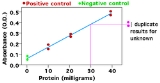
. Students might be given a fluid sample containing an unknown amount of protein. It is their job to correctly perform a controlled experiment in which they determine the concentration of protein in fluid sample . The teaching lab would be equipped with a protein standard solution with a known protein concentration. Students could make several positive control samples containing various dilutions of the protein standard. Negative control samples would contain all of the reagents for the protein assay but no protein. In this example, all samples are performed in duplicate. The assay is a colorimetric assay in which a spectrophotometer Spectrophotometry

In physics [i], spectrophotometry is the quantitative study of electromagnetic spectra [i] ... 

 can measure the amount of protein in samples by detecting a colored complex formed by the interaction of protein molecules and molecules of an added dye. In the illustration, the results for the diluted test samples can be compared to the results of the standard curve in order to determine an estimate of the amount of protein in the unknown sample.

Controlled experiments can be performed when it is difficult to exactly control all the conditions in an experiment. In this case, the experiment begins by creating two or more sample groups that are probabilistically equivalent, which means that measurements of traits should be similar among the groups and that the groups should respond in the same manner if given the same treatment. This equivalency is determined by statistical Statistics

Statistics is a mathematical science [i] pertaining to the collection, analysis, interpretat... 

 methods that take into account the amount of variation between individuals and the number of individuals in each group. In fields such as microbiology Microbiology

Microbiology is the study of microorganisms [i], which are unicellular [i] or cell-cluster microscopic [i] ... 

 and chemistry Chemistry

Chemistry is the science [i] of matter [i] at the atom [i]ic to molecular [i] scale, dealing primarily ... 

, where there is very little variation between individuals and the group size is easily in the millions, these statistical methods are often bypassed and simply splitting a solution Solution


In chemistry [i], a solution is a homogeneous mixture [i] composed of one or more substances, known a ... 

 into equal parts is assumed to produce identical sample groups.

Once equivalent groups have been formed, the experimenter tries to treat them identically except for the one variable that he or she wishes to isolate. Human experimentation requires special safeguards against outside variables such as the placebo effect. Such experiments are generally double blind, meaning that neither the volunteer nor the researcher knows which individuals are in the control group or the experimental group until after all of the data has been collected. This ensures that any effects on the volunteer are due to the treatment itself and are not a response to the knowledge that he is being treated.

In human experiments, a subject  may be given a stimulus to which he or she should respond. The goal of the experiment is to measure the response to a given stimulus.

Natural experiments


The term "experiment" usually implies a controlled experiment, but sometimes controlled experiments are prohibitively difficult or impossible. In this case researchers resort to natural experiments, also called quasi-experiments. Natural experiments rely solely on observations of the variables of the system under study, rather than manipulation of just one or a few variables as occurs in controlled experiments. To the degree possible, they attempt to collect data for the system in such a way that contribution from all variables can be determined, and where the effects of variation in certain variables remain approximately constant so that the effects of other variables can be discerned. The degree to which this is possible depends on the observed correlation Correlation

In probability theory [i] and statistics [i], correlation, also called correlation coefficient, in ... 

 between explanatory variables in the observed data. When these variables are not well correlated, natural experiments can approach the power of controlled experiments. Usually, however, there is some correlation between these variables, which reduces the reliability of natural experiments relative to what could be concluded if a controlled experiment were performed. Also, because natural experiments usually take place in uncontrolled environments, variables from undetected sources are neither measured nor held constant, and these may produce illusory correlations in variables under study.

Much research in several important science Science

Science in the broadest sense refers to any system of knowledge attained by verifiable means.... 

 disciplines, including economics Economics

In the social science [i]s, economics is the study of the production [i], ... 

, political science, geology Geology

Geology anetary geology]] [i] refers to the application of geologic principles to other bodies of the solar... 

, paleontology Paleontology

Paleontology or palaeontology is the study of the developing history of life [i] on Earth [i], in... 

, ecology Ecology

Ecology, or ecological science, is the scientific study of the distribution and abundance of living organisms [i] ... 

, meteorology Meteorology

Meteorology is the scientific study of the atmosphere [i] that focuses on weather [i] ... 

, and astronomy Astronomy

Astronomy is the science [i] of celestial objects and phenomena [i] that originate outside the Earth's atmosphere [i] ... 

, relies on quasi-experiments. For example, in astronomy it is clearly impossible, when testing the hypothesis "suns are collapsed clouds of hydrogen", to start out with a giant cloud of hydrogen, and then perform the experiment of waiting a few billion years for it to form a sun. However, by observing various clouds of hydrogen in various states of collapse, and other implications of the hypothesis , we can collect data we require to support the hypothesis. An early example of this type of experiment was the first verification in the 1600s that light does not travel from place to place instantaneously, but instead has a measurable speed. Observation of the appearance of the moons of Jupiter were slightly delayed when Jupiter was farther from Earth, as opposed to when Jupiter was closer to Earth; and this phenomenon was used to demonstrate that the difference in the time of appearance of the moons was consistent with a measurable speed of light.

Observational studies


Observational studies are very much like controlled experiments except that they lack probabilistic equivalency between groups. These types of experiments often arise in the area of medicine where, for ethical reasons, it is not possible to create a truly controlled group. For example, one would not want to deny all forms of treatment for a life-threatening disease from one group of patients to evaluate the effectiveness of another treatment on a different group of patients. The results of observational studies are considered much less convincing than those of designed experiments, as they are much more prone to selection bias. Researchers attempt to compensate for this with complicated statistical methods such as propensity score matching methods . See also quasi-empirical methods

Field Experiments


Main article: Field experiment


Field experiments are so named in order to draw a contrast with laboratory experiments. Often used in the social sciences, and especially in economic analyses of education and health interventions, field experiments have the advantage that outcomes are observed in a natural setting rather than in a contrived laboratory environment. However, like natural experiments, field experiments suffer from the possibility of contamination: experimental conditions can be controlled with more precision and certainty in the lab.

Examples

  • MTT assay MTT assay

    MTT assay is a laboratory test [i] and a standard colorimetric assay for measuring cell ... 

  • Colony Formation Assay
  • Ames Test
  • western blot Western blot

    A western blot is a method in molecular biology [i]/biochemistry [i]/immunogenetics [i] to detect protein [i] ... 


Quotes

"We have to learn again that science Science

Science in the broadest sense refers to any system of knowledge attained by verifiable means.... 

 without contact with experiments is an enterprise which is likely to go completely astray into imaginary conjecture." — Hannes Alfven Hannes Alfvén

Hannes Olof Gsta Alfvn was a Swedish [i] plasma physicist who won the 1970 [i] Nobel Prize in Physics [i] ... 


"Today's scientist Scientist

A scientist is an expert [i] in at least one area of science [i] who uses the scientific method [i] to d ... 

s have substituted mathematics Mathematics

Mathematics is the discipline that deals with concepts such as quantity [i], structure [i], space [i] a ... 

 for experiments, and they wander off through equation after equation, and eventually build a structure which has no relation to reality." — Nikola Tesla Nikola Tesla

Nikola Tesla he United States [i], Tesla's fame rivaled that of any other inven ... 


See also

  • Case Study
  • Causality
  • Double-blind
  • Experiment in silico
  • Experiment in vitro
  • Experiment in vivo
  • Frequency probability Frequency probability

    The problems and paradoxes of the classical interpretation [i] of probability [i] ... 

  • Human experimentation
  • Nocebo
  • Placebo Placebo

    For the band Placebo go to Placebo [i]

... 


  • Scientific method Scientific method

    Scientific method is a body of techniques for investigating phenomena [i] and acquiring new knowledge [i] ... 

  • Self-experimentation
  • Significant Figures
  • Single-blind
  • Simulation Simulation

    A simulation is an imitation of some real thing, state of affairs, or process.... 

  • Survey
  • Thought experiment
  • Vivisection

"Many Self-Consistent Axiomatic formulations have no physical relevance until an imagination sufficient enough to harness themcomes along and adapts that formulation " - Lawrence Sweet

External links

  • Trochim, William M. Experimental Design. The Research Methods Knowledge Base, 2nd Edition. .


Literature

  • The Character of Physical Law, by Richard P. Feynman


  • Robert Crease: The prism and the pendulum: The ten most beautiful experiments in science