

Almagest

Encyclopedia

Greek mathematics
Greek mathematics, as that term is used in this article, is the mathematics written in Greek, developed from the 7th century BC to the 4th century AD around the Eastern shores of the Mediterranean. Greek mathematicians lived in cities spread over the entire Eastern Mediterranean, from Italy to...
and astronomical
Greek astronomy
Greek astronomy is astronomy written in the Greek language in classical antiquity. Greek astronomy is understood to include the ancient Greek, Hellenistic, Greco-Roman, and Late Antiquity eras. It is not limited geographically to Greece or to ethnic Greeks, as the Greek language had become the...
treatise on the apparent motions of the star
Star
A star is a massive, luminous sphere of plasma held together by gravity. At the end of its lifetime, a star can also contain a proportion of degenerate matter. The nearest star to Earth is the Sun, which is the source of most of the energy on Earth...
s and planet
Planet
A planet is a celestial body orbiting a star or stellar remnant that is massive enough to be rounded by its own gravity, is not massive enough to cause thermonuclear fusion, and has cleared its neighbouring region of planetesimals.The term planet is ancient, with ties to history, science,...
ary paths. Written in Greek
Koine Greek
Koine Greek is the universal dialect of the Greek language spoken throughout post-Classical antiquity , developing from the Attic dialect, with admixture of elements especially from Ionic....
by Claudius Ptolemy, a Roman era
Roman Empire
The Roman Empire was the post-Republican period of the ancient Roman civilization, characterised by an autocratic form of government and large territorial holdings in Europe and around the Mediterranean....
scholar of Egypt,
it is one of the most influential scientific texts of all time, with its geocentric model
Geocentric model
In astronomy, the geocentric model , is the superseded theory that the Earth is the center of the universe, and that all other objects orbit around it. This geocentric model served as the predominant cosmological system in many ancient civilizations such as ancient Greece...
accepted for more than twelve hundred years from its origin in Hellenistic Alexandria, in the medieval Byzantine
Byzantine
Byzantine usually refers to the Roman Empire during the Middle Ages.Byzantine may also refer to:* A citizen of the Byzantine Empire, or native Greek during the Middle Ages...
and Islamic
Islamic Golden Age
During the Islamic Golden Age philosophers, scientists and engineers of the Islamic world contributed enormously to technology and culture, both by preserving earlier traditions and by adding their own inventions and innovations...
worlds, and in Western Europe through the Middle Ages
Middle Ages
The Middle Ages is a periodization of European history from the 5th century to the 15th century. The Middle Ages follows the fall of the Western Roman Empire in 476 and precedes the Early Modern Era. It is the middle period of a three-period division of Western history: Classic, Medieval and Modern...
and early Renaissance
Renaissance
The Renaissance was a cultural movement that spanned roughly the 14th to the 17th century, beginning in Italy in the Late Middle Ages and later spreading to the rest of Europe. The term is also used more loosely to refer to the historical era, but since the changes of the Renaissance were not...
until Copernicus.
The Almagest is a critical source of information on ancient Greek astronomy
Greek astronomy
Greek astronomy is astronomy written in the Greek language in classical antiquity. Greek astronomy is understood to include the ancient Greek, Hellenistic, Greco-Roman, and Late Antiquity eras. It is not limited geographically to Greece or to ethnic Greeks, as the Greek language had become the...
. It has also been valuable to students of mathematics because it documents the ancient Greek mathematician Hipparchus
Hipparchus
Hipparchus, the common Latinization of the Greek Hipparkhos, can mean:* Hipparchus, the ancient Greek astronomer** Hipparchic cycle, an astronomical cycle he created** Hipparchus , a lunar crater named in his honour...
's work, which has been lost. Hipparchus wrote about trigonometry
Trigonometry
Trigonometry is a branch of mathematics that studies triangles and the relationships between their sides and the angles between these sides. Trigonometry defines the trigonometric functions, which describe those relationships and have applicability to cyclical phenomena, such as waves...
, but because his works are no longer extant, mathematicians use Ptolemy's book as their source for Hipparchus' works and ancient Greek trigonometry in general.
The treatise's conventional Greek title is (), and the treatise is also known by the Latin
Latin
Latin is an Italic language originally spoken in Latium and Ancient Rome. It, along with most European languages, is a descendant of the ancient Proto-Indo-European language. Although it is considered a dead language, a number of scholars and members of the Christian clergy speak it fluently, and...
form of this, Syntaxis mathematica. It was later titled (The Great Treatise), and the superlative form of this lies behind the Arabic
Arabic language
Arabic is a name applied to the descendants of the Classical Arabic language of the 6th century AD, used most prominently in the Quran, the Islamic Holy Book...
name , from which the English name Almagest derives.
Ptolemy set up a public inscription at Canopus, Egypt
Canopus, Egypt
Canopus was an Ancient Egyptian coastal town, located in the Nile Delta. Its site is in the eastern outskirts of modern-day Alexandria, around 25 kilometres from the centre of that city....
, in 147 or 148. The late N. T. Hamilton found that the version of Ptolemy's models set out in the Canopic Inscription was earlier than the version in the Almagest. Hence the Almagest cannot have been completed before about 150, a quarter century after Ptolemy began observing.
Books
The Almagest (Almagestum) consisted of thirteen sections, called books. As with many medieval manuscripts that were handcopied or particularly in the early years of printing, there were considerable differences between various editions of the same text, as the process of transcription was highly personal. An example illustrating how the Almagest was organized is given below. It is a 152 page Latin edition printed in 1515 at Venice by Petrus Lichtenstein.- Book I contains an outline of AristotleAristotleAristotle was a Greek philosopher and polymath, a student of Plato and teacher of Alexander the Great. His writings cover many subjects, including physics, metaphysics, poetry, theater, music, logic, rhetoric, linguistics, politics, government, ethics, biology, and zoology...
's cosmology: on the spherical form of the heavens, with the spherical Earth lying motionless as the center, with the fixed stars and the various planets revolving around the Earth. Then follows an explanation of chordsChord (geometry)A chord of a circle is a geometric line segment whose endpoints both lie on the circumference of the circle.A secant or a secant line is the line extension of a chord. More generally, a chord is a line segment joining two points on any curve, such as but not limited to an ellipse...
with table of chordsPtolemy's table of chordsThe table of chords, created by the astronomer and geometer Ptolemy in Egypt during the 2nd century AD, is a trigonometric table in Book I, chapter 11 of Ptolemy's Almagest, a treatise on mathematical astronomy. It is essentially equivalent to a table of values of the sine function...
; observations of the obliquity of the eclipticEclipticThe ecliptic is the plane of the earth's orbit around the sun. In more accurate terms, it is the intersection of the celestial sphere with the ecliptic plane, which is the geometric plane containing the mean orbit of the Earth around the Sun...
(the apparent path of the Sun through the stars); and an introduction to spherical trigonometrySpherical trigonometrySpherical trigonometry is a branch of spherical geometry which deals with polygons on the sphere and the relationships between the sides and the angles...
. - Book II covers problems associated with the daily motion attributed to the heavens, namely risings and settings of celestial objects, the length of daylight, the determination of latitudeLatitudeIn geography, the latitude of a location on the Earth is the angular distance of that location south or north of the Equator. The latitude is an angle, and is usually measured in degrees . The equator has a latitude of 0°, the North pole has a latitude of 90° north , and the South pole has a...
, the points at which the SunSunThe Sun is the star at the center of the Solar System. It is almost perfectly spherical and consists of hot plasma interwoven with magnetic fields...
is vertical, the shadows of the gnomonGnomonThe gnomon is the part of a sundial that casts the shadow. Gnomon is an ancient Greek word meaning "indicator", "one who discerns," or "that which reveals."It has come to be used for a variety of purposes in mathematics and other fields....
at the equinoxEquinoxAn equinox occurs twice a year, when the tilt of the Earth's axis is inclined neither away from nor towards the Sun, the center of the Sun being in the same plane as the Earth's equator...
es and solsticeSolsticeA solstice is an astronomical event that happens twice each year when the Sun's apparent position in the sky, as viewed from Earth, reaches its northernmost or southernmost extremes...
s, and other observations that change with the spectator's position. There is also a study of the angles made by the ecliptic with the vertical, with tables. - Book III covers the length of the year, and the motion of the SunSunThe Sun is the star at the center of the Solar System. It is almost perfectly spherical and consists of hot plasma interwoven with magnetic fields...
. Ptolemy explains Hipparchus' discovery of the precession of the equinoxes and begins explaining the theory of epicycles. - Books IV and V cover the motion of the MoonMoonThe Moon is Earth's only known natural satellite,There are a number of near-Earth asteroids including 3753 Cruithne that are co-orbital with Earth: their orbits bring them close to Earth for periods of time but then alter in the long term . These are quasi-satellites and not true moons. For more...
, lunar parallaxParallaxParallax is a displacement or difference in the apparent position of an object viewed along two different lines of sight, and is measured by the angle or semi-angle of inclination between those two lines. The term is derived from the Greek παράλλαξις , meaning "alteration"...
, the motion of the lunar apogee, and the sizes and distances of the Sun and Moon relative to the Earth. - Book VI covers solar and lunar eclipseEclipseAn eclipse is an astronomical event that occurs when an astronomical object is temporarily obscured, either by passing into the shadow of another body or by having another body pass between it and the viewer...
s. - Books VII and VIII cover the motions of the fixed stars, including precession of the equinoxes. They also contain a star catalogueStar catalogueA star catalogue, or star catalog, is an astronomical catalogue that lists stars. In astronomy, many stars are referred to simply by catalogue numbers. There are a great many different star catalogues which have been produced for different purposes over the years, and this article covers only some...
of 1022 stars, described by their positions in the constellationConstellationIn modern astronomy, a constellation is an internationally defined area of the celestial sphere. These areas are grouped around asterisms, patterns formed by prominent stars within apparent proximity to one another on Earth's night sky....
s. The brightest stars were marked first magnitudeApparent magnitudeThe apparent magnitude of a celestial body is a measure of its brightness as seen by an observer on Earth, adjusted to the value it would have in the absence of the atmosphere...
(m = 1), while the faintest visible to the naked eye were sixth magnitude (m = 6). Each numerical magnitude was twice the brightness of the following one, which is a logarithmic scaleLogarithmic scaleA logarithmic scale is a scale of measurement using the logarithm of a physical quantity instead of the quantity itself.A simple example is a chart whose vertical axis increments are labeled 1, 10, 100, 1000, instead of 1, 2, 3, 4...
. This system is believed to have originated with Hipparchus. The stellar positions too are of Hipparchan origin, despite Ptolemy's claim to the contrary. - Book IX addresses general issues associated with creating models for the five naked eye planets, and the motion of MercuryMercury (planet)Mercury is the innermost and smallest planet in the Solar System, orbiting the Sun once every 87.969 Earth days. The orbit of Mercury has the highest eccentricity of all the Solar System planets, and it has the smallest axial tilt. It completes three rotations about its axis for every two orbits...
. - Book X covers the motions of VenusVenusVenus is the second planet from the Sun, orbiting it every 224.7 Earth days. The planet is named after Venus, the Roman goddess of love and beauty. After the Moon, it is the brightest natural object in the night sky, reaching an apparent magnitude of −4.6, bright enough to cast shadows...
and MarsMarsMars is the fourth planet from the Sun in the Solar System. The planet is named after the Roman god of war, Mars. It is often described as the "Red Planet", as the iron oxide prevalent on its surface gives it a reddish appearance...
. - Book XI covers the motions of JupiterJupiterJupiter is the fifth planet from the Sun and the largest planet within the Solar System. It is a gas giant with mass one-thousandth that of the Sun but is two and a half times the mass of all the other planets in our Solar System combined. Jupiter is classified as a gas giant along with Saturn,...
and SaturnSaturnSaturn is the sixth planet from the Sun and the second largest planet in the Solar System, after Jupiter. Saturn is named after the Roman god Saturn, equated to the Greek Cronus , the Babylonian Ninurta and the Hindu Shani. Saturn's astronomical symbol represents the Roman god's sickle.Saturn,...
. - Book XII covers stations and retrograde motion, which occurs when planets appear to pause, then briefly reverse their motion against the background of the zodiacZodiacIn astronomy, the zodiac is a circle of twelve 30° divisions of celestial longitude which are centred upon the ecliptic: the apparent path of the Sun across the celestial sphere over the course of the year...
. Ptolemy understood these terms to apply to Mercury and Venus as well as the outer planets. - Book XIII covers motion in latitude, that is, the deviation of planets from the ecliptic.
Ptolemy's cosmos
The cosmology of the Almagest includes five main points, each of which is the subject of a chapter in Book I. What follows is a close paraphrase of Ptolemy's own words from Toomer's translation.- The celestial realm is spherical, and moves as a sphere.
- The Earth is a sphere.
- The Earth is at the center of the cosmos.
- The Earth, in relation to the distance of the fixed stars, has no appreciable size and must be treated as a mathematical point.
- The Earth does not move.
Ptolemy's planetary model
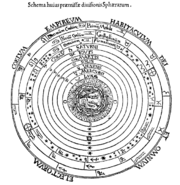
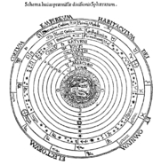
Other classical writers suggested different sequences. Plato
Plato
Plato , was a Classical Greek philosopher, mathematician, student of Socrates, writer of philosophical dialogues, and founder of the Academy in Athens, the first institution of higher learning in the Western world. Along with his mentor, Socrates, and his student, Aristotle, Plato helped to lay the...
(c. 427 – c. 347 BC) placed the Sun second in order after the Moon. Martianus Capella
Martianus Capella
Martianus Minneus Felix Capella was a pagan writer of Late Antiquity, one of the earliest developers of the system of the seven liberal arts that structured early medieval education...
(5th century AD) put Mercury and Venus in motion around the Sun. Ptolemy's authority was preferred by most medieval Islamic and late medieval European astronomers.
Ptolemy inherited from his Greek predecessors a geometrical toolbox and a partial set of models for predicting where the planets would appear in the sky. Apollonius of Perga
Apollonius of Perga
Apollonius of Perga [Pergaeus] was a Greek geometer and astronomer noted for his writings on conic sections. His innovative methodology and terminology, especially in the field of conics, influenced many later scholars including Ptolemy, Francesco Maurolico, Isaac Newton, and René Descartes...
(c. 262 – c. 190 BC) had introduced the deferent and epicycle
Deferent and epicycle
In the Ptolemaic system of astronomy, the epicycle was a geometric model used to explain the variations in speed and direction of the apparent motion of the Moon, Sun, and planets...
and the eccentric deferent to astronomy. Hipparchus (2nd century BC) had crafted mathematical models of the motion of the Sun and Moon. Hipparchus had some knowledge of Mesopotamian astronomy, and he felt that Greek models should match those of the Babylonians in accuracy. He was unable to create accurate models for the remaining five planets.
The Almagest adopted Hipparchus' solar model, which consisted of a simple eccentric deferent. For the Moon, Ptolemy began with Hipparchus' epicycle-on-deferent, then added a device that historians of astronomy refer to as a "crank mechanism": He succeeded in creating models for the other planets, where Hipparchus had failed, by introducing a third device called the equant
Equant
Equant is a mathematical concept developed by Claudius Ptolemy in the 2nd century AD to account for the observed motion of heavenly bodies....
.
Ptolemy wrote the Almagest as a textbook of mathematical astronomy. It explained geometrical models of the planets based on combinations of circles, which could be used to predict the motions of celestial objects. In a later book, the Planetary Hypotheses, Ptolemy explained how to transform his geometrical models into three-dimensional spheres or partial spheres. In contrast to the mathematical Almagest, the Planetary Hypotheses is sometimes described as a book of cosmology.
Impact
Ptolemy's comprehensive treatise of mathematical astronomy superseded most older texts of Greek astronomy. Some were more specialized and thus of less interest; others simply became outdated by the newer models. As a result, the older texts ceased to be copied and were gradually lost. Much of what we know about the work of astronomers like Hipparchus comes from references in the Almagest.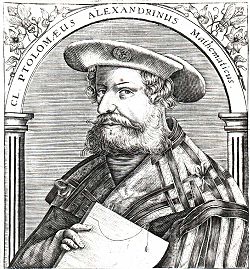
Caliph
The Caliph is the head of state in a Caliphate, and the title for the ruler of the Islamic Ummah, an Islamic community ruled by the Shari'ah. It is a transcribed version of the Arabic word which means "successor" or "representative"...
Al-Ma'mun
Al-Ma'mun
Abū Jaʿfar Abdullāh al-Māʾmūn ibn Harūn was an Abbasid caliph who reigned from 813 until his death in 833...
. Sahl ibn Bishr
Sahl ibn Bishr
Sahl ibn Bishr al-Israili, often known as Zahel or Zael was a Jewish astrologer, astronomer and mathematician from Tabaristan. He was the father of Ali ibn Sahl the famous scientist and physician, who became a convert to Islam.- His works :...
is thought to be the first Arabic translator. By this time, the Almagest was lost in Western Europe, or only dimly remembered in astrological
Astrology
Astrology consists of a number of belief systems which hold that there is a relationship between astronomical phenomena and events in the human world...
lore. Consequently, Western Europe
Western Europe
Western Europe is a loose term for the collection of countries in the western most region of the European continents, though this definition is context-dependent and carries cultural and political connotations. One definition describes Western Europe as a geographic entity—the region lying in the...
rediscovered Ptolemy from translations of Arabic versions. In the 12th century a Spanish version was produced, which was later translated under the patronage of Alfonso X. Gerard of Cremona
Gerard of Cremona
Gerard of Cremona was an Italian translator of Arabic scientific works found in the abandoned Arab libraries of Toledo, Spain....
translated the Almagest into Latin directly from the Arabic version. Gerard translated the Arabic text while working at the Toledo School of Translators
Toledo School of Translators
The Toledo School of Translators is the name that commonly describes the group of scholars who worked together in the city of Toledo during the 12th and 13th centuries, to translate many of the philosophical and scientific works from classical Arabic, classical Greek, and ancient Hebrew.The School...
, although he was unable to translate many technical terms such as the Arabic Abrachir for Hipparchus. This Spanish version was later translated into Latin under the patronage of Frederick II
Frederick II
Frederick II may refer to:* Frederick II, Duke of Swabia * Frederick II, Holy Roman Emperor , king 1211/12–1250, emperor from 1220* Frederick II of Austria , Duke of Austria 1230–1246* Frederick III of Sicily...
.
In the 15th century, a Greek version appeared in Western Europe. The German astronomer Johannes Müller (known, from his birthplace of Königsberg
Königsberg
Königsberg was the capital of East Prussia from the Late Middle Ages until 1945 as well as the northernmost and easternmost German city with 286,666 inhabitants . Due to the multicultural society in and around the city, there are several local names for it...
, as Regiomontanus
Regiomontanus
Johannes Müller von Königsberg , today best known by his Latin toponym Regiomontanus, was a German mathematician, astronomer, astrologer, translator and instrument maker....
) made an abridged Latin version at the instigation of the Greek churchman Johannes, Cardinal Bessarion. Around the same time, George of Trebizond
George of Trebizond
George of Trebizond was a Greek philosopher and scholar, one of the pioneers of the Renaissance.-Life:He was born on the island of Crete, and derived his surname Trapezuntius from the fact that his ancestors were from Trebizond.At what period he came to Italy is not certain; according to some...
made a full translation accompanied by a commentary that was as long as the original text. George's translation, done under the patronage of Pope Nicholas V
Pope Nicholas V
Pope Nicholas V , born Tommaso Parentucelli, was Pope from March 6, 1447 to his death in 1455.-Biography:He was born at Sarzana, Liguria, where his father was a physician...
, was intended to supplant the old translation. The new translation was a great improvement; the new commentary was not, and aroused criticism. The Pope declined the dedication of George's work, and Regiomontanus's translation had the upper hand for over 100 years.
During the 16th century, Guillaume Postel
Guillaume Postel
Guillaume Postel was a French linguist, astronomer, Cabbalist, diplomat, professor, and religious universalist.Born in the village of Barenton in Basse-Normandie, Postel made his way to Paris to further his education...
, who had been on an embassy to the Ottoman Empire
Ottoman Empire
The Ottoman EmpireIt was usually referred to as the "Ottoman Empire", the "Turkish Empire", the "Ottoman Caliphate" or more commonly "Turkey" by its contemporaries...
, brought back Arabic disputations of the Almagest, such as the works of al-Kharaqī
Al-Kharaqī
Abū Muḥammad 'Abd al-Jabbār al-Kharaqī, also Al-Kharaqī was a Persian astronomer and mathematician of the 12th century, born in Kharaq near Merv. He was in the service of Sultan Sanjar at the Persian Court...
, Muntahā al-idrāk fī taqāsīm al-aflāk ("The Ultimate Grasp of the Divisions of Spheres", 1138/9).
Commentaries on the Almagest were written by Theon of Alexandria
Theon of Alexandria
Theon was a Greek scholar and mathematician who lived in Alexandria, Egypt. He edited and arranged Euclid's Elements and Ptolemy's Handy Tables, as well as writing various commentaries...
(extant), Pappus of Alexandria
Pappus of Alexandria
Pappus of Alexandria was one of the last great Greek mathematicians of Antiquity, known for his Synagoge or Collection , and for Pappus's Theorem in projective geometry...
(only fragments survive), and Ammonius Hermiae
Ammonius Hermiae
Ammonius Hermiae was a Greek philosopher, and the son of the Neoplatonist philosophers Hermias and Aedesia. He was a pupil of Proclus in Athens, and taught at Alexandria for most of his life, writing commentaries on Plato, Aristotle, and other philosophers....
(lost).
Modern editions
The Almagest was edited by J. L. HeibergJohan Ludvig Heiberg (historian)
Johan Ludvig Heiberg was a Danish philologist and historian. He is best known for his discovery of previously unknown texts in the Archimedes Palimpsest, and for his edition of Euclid's Elements that T. L. Heath translated into English...
in Claudii Ptolemaei opera quae exstant omnia, vols. 1.1 and 1.2 (1898, 1903).
Two translations of the Almagest into English have been published . The first, by R. Catesby Taliaferro
R. Catesby Taliaferro
Robert Catesby Taliaferro was an American mathematician, philosopher, and translator of ancient Greek and Latin works into English. He translated Ptolemy's Almagest, a 2nd-century book on astronomy, the 13 books of Euclid's Elements, Apollonius' works on conic sections, and some works of Plato,...
of St. John's College in Annapolis, Maryland
Annapolis, Maryland
Annapolis is the capital of the U.S. state of Maryland, as well as the county seat of Anne Arundel County. It had a population of 38,394 at the 2010 census and is situated on the Chesapeake Bay at the mouth of the Severn River, south of Baltimore and about east of Washington, D.C. Annapolis is...
, was included in volume 16 of the Great Books of the Western World
Great Books of the Western World
Great Books of the Western World is a series of books originally published in the United States in 1952 by Encyclopædia Britannica Inc. to present the western canon in a single package of 54 volumes. The series is now in its second edition and contains 60 volumes.-History:The project got its start...
; the second, by G. J. Toomer, Ptolemy's Almagest in 1998;
An older French translation (facing the Greek text), published in two volumes in 1813 and 1816 by Nicholas Halma
Nicholas Halma
Nicholas Halma was a mathematician and translator.He was educated at the College of Plessis, Paris, took Holy orders, and received the title of Abbé. In 1791 he became principal of Sedan College. When this school closed in 1793, he went to Paris and entered military service as surgeon...
, is available online at the Gallica web site http://gallica.bnf.fr/ and http://www.blumaise.org/files/eBooks/Ptol%e9m%e9e%20-%20Almageste%20FR%20-%201813.pdf
External links
- University of Vienna: Almagestum (1515) PDF:s of different resolutions
- Almagest Planetary Model Animations
- Online luni-solar & planetary ephemeris calculator based on the Almagest
- Ptolemy's Almagest. PDF scans of Heiberg's Greek edition, now in the public domain (Classical Greek)
- A podcast discussion by Prof. M Heath and Dr A. Chapman of a recent re-discovery of a 14th Century manuscript in the university of Leeds Library