
All Topics  
Asteroid

 
Asteroid

   Email Print
   Bookmark   Link


Asteroid


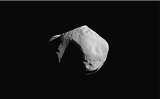
thumb|260px|right|[[253 Mathilde]], a [[C-type asteroid]] measuring about across. Photograph taken in 1997 by the [[NEAR Shoemaker]] probe. Asteroids, sometimes called minor planet
Minor planet

An asteroid group or minor planet group is a population of minor planets that have a share broadly similar orbits. Members are generally unrelated to each other, unlike in an asteroid family, which often results from the break-up of a single asteroid....
s
or planetoids, are small Solar System
Solar System

The Solar System consists of the Sun and those Astronomical object bound to it by gravity: the eight planets and five dwarf planets, their 173 known Natural satellite, and billions of Small Solar System body....
 bodies in orbit around the Sun
Sun

The Sun , a G V star, is the star at the center of the Solar System. The Earth and other matter orbit the Sun, which by itself accounts for about 98.6% of the Solar System's mass....
, smaller than planets but larger than meteoroid
Meteoroid

A meteoroid is a small sand to boulder sized particle of debris in the Solar System. The visible path of a meteoroid that enters Earth Earth's atmosphere is called a meteor, or commonly a "shooting star" or "falling star"....
s. The term "asteroid" has historically been applied primarily to bodies in the inner Solar System, since the outer Solar System was poorly known when it came into common usage.


Discussion
Ask a question about 'Asteroid'
Start a new discussion about 'Asteroid'
Answer questions from other users
Full Discussion Forum


Recent Posts


Encyclopedia


thumb|260px|right|[[253 Mathilde]], a [[C-type asteroid]] measuring about across. Photograph taken in 1997 by the [[NEAR Shoemaker]] probe. Asteroids, sometimes called minor planet
Minor planet

An asteroid group or minor planet group is a population of minor planets that have a share broadly similar orbits. Members are generally unrelated to each other, unlike in an asteroid family, which often results from the break-up of a single asteroid....
s
or planetoids, are small Solar System
Solar System

The Solar System consists of the Sun and those Astronomical object bound to it by gravity: the eight planets and five dwarf planets, their 173 known Natural satellite, and billions of Small Solar System body....
 bodies in orbit around the Sun
Sun

The Sun , a G V star, is the star at the center of the Solar System. The Earth and other matter orbit the Sun, which by itself accounts for about 98.6% of the Solar System's mass....
, smaller than planets but larger than meteoroid
Meteoroid

A meteoroid is a small sand to boulder sized particle of debris in the Solar System. The visible path of a meteoroid that enters Earth Earth's atmosphere is called a meteor, or commonly a "shooting star" or "falling star"....
s. The term "asteroid" has historically been applied primarily to bodies in the inner Solar System, since the outer Solar System was poorly known when it came into common usage. The distinction between asteroids and comet
Comet

A comet is a Small Solar System body that orbits the Sun and, when close enough to the Sun, exhibits a visible coma or a tail?both primarily from the effects of solar radiation upon the Comet nucleus....
s is made on visual appearance: Comets show a perceptible coma
Coma (cometary)

In astronomy, a coma is the nebulous envelope around the Comet nucleus of a comet. It is formed when the comet passes close to the Sun on its highly ellipse orbit; as the comet warms, parts of it Sublimation_%28chemistry%29....
, while asteroids do not.

Terminology


Traditionally, small bodies orbiting the Sun were classified as asteroids, comets or meteoroids.

Anything smaller than ten metres across is generally called a meteoroid..

The term "asteroid" is somewhat ill-defined. It never had a formal definition, with the broader term "minor planet
Minor planet

An asteroid group or minor planet group is a population of minor planets that have a share broadly similar orbits. Members are generally unrelated to each other, unlike in an asteroid family, which often results from the break-up of a single asteroid....
" being preferred by the International Astronomical Union
International Astronomical Union

The International Astronomical Union is a collection of professional astronomers, at the Ph.D. level and beyond, active in professional research and education in astronomy....
 until 2006, when the term "small Solar System body
Small solar system body

Small Solar System Body is a term IAU definition of planet by the International Astronomical Union to describe objects in the Solar System that are neither planets or dwarf planets:...
" was introduced to cover both minor planets and comets. Other languages prefer "planetoid" (Greek for "planet-like"), and this term is occasionally used in English for the larger asteroids. The word "planetesimal
Planetesimal

Planetesimals are solid objects thought to exist in protoplanetary disks and in debris disks.A widely accepted theory of planet formation, the so-called planetesimal hypothesis of Viktor Safronov, states that planets form out of dust grains that collide and stick to form larger and larger bodies....
" has a similar meaning, but refers specifically to the small building blocks of the planets that existed at the time the Solar System was forming. The term "planetule" was coined by the geologist William Daniel Conybeare
William Daniel Conybeare

William Daniel Conybeare Fellow of the Royal Society , dean of Llandaff, one of the most distinguished of English geologists, who was born in London, was a grandson of John Conybeare, bishop of Bristol , a notable preacher and divine, and son of Dr William Conybeare, rector of Bishopsgate....
 to describe minor planets, but is not in common use.

When discovered, asteroids were seen as a class of objects distinct from comets, and there was no unified term for the two until "small Solar System body" was coined in 2006. The main difference between an asteroid and a comet is that a comet shows a coma due to sublimation
Outgassing

Outgassing is the slow release of a gas that was trapped, freezing, Absorption or adsorbed in some material....
 of near surface ices by solar radiation. A few objects have ended up being dual-listed: some bodies were first classified as asteroids, but later showed evidence of cometary activity; and, conversely, some (perhaps all) comets are eventually depleted of their surface volatile ices
Volatiles

In planetary science, volatiles, are that group of elements and compounds with low boiling points that are associated with a planet's or moon's crust and/or atmosphere....
 and become asteroids. A further distinction is that comets typically have more eccentric orbits than most asteroids; most "asteroids" with notably eccentric orbits are probably dormant or extinct comets.

For almost two centuries, from the discovery of the first asteroid, 1 Ceres
1 Ceres

Ceres , Minor planet names 1 Ceres, is the smallest identified dwarf planet in the Solar System and the only one in the asteroid belt. It was discovered on January 1, 1801, by Giuseppe Piazzi, and is named after the Roman mythology Ceres — the goddess of growing plants, the harvest, and motherly love....
, in 1801 until the discovery of the first centaur, 2060 Chiron
2060 Chiron

2060 Chiron is a planetoid in the outer solar system. Discovered in 1977 by Charles T. Kowal , it was the first known member of a new class of objects now known as centaur s, with an orbit between those of Saturn and Uranus ....
, in 1977, all known asteroids spent most of their time at or within the orbit of Jupiter, though a few such as 944 Hidalgo
944 Hidalgo

944 Hidalgo is an unusual asteroid, and has the longest orbital period of any asteroid in the traditional asteroid belt.It is a Centaur like asteroid....
 ventured far beyond Jupiter for part of their orbit. When astronomers started finding additional small bodies that permanently resided further out than Jupiter, now called centaurs, they numbered them among the traditional asteroids, though there was debate over whether they should be classified as asteroids or as a new type of object. Then, when the first trans-Neptunian object
Trans-Neptunian object

A trans-Neptunian object is any object in the solar system that orbits the sun at a greater distance on average than Neptune . The Kuiper belt, scattered disk, and Oort cloud are three divisions of this volume of space....
, 1992 QB1, was discovered in 1992, and especially when large numbers of similar objects started turning up, new terms were invented to sidestep the issue: Kuiper Belt object (KBO), trans-Neptunian object
Trans-Neptunian object

A trans-Neptunian object is any object in the solar system that orbits the sun at a greater distance on average than Neptune . The Kuiper belt, scattered disk, and Oort cloud are three divisions of this volume of space....
 (TNO), scattered-disc object (SDO), and so on. These inhabit the cold outer reaches of the Solar System where ices remain solid and comet-like bodies are not expected to exhibit much cometary activity; if centaurs or TNOs were to venture close to the Sun, their volatile ices would sublimate, and traditional approaches would classify them as comets rather than asteroids.

The innermost of these are the Kuiper Belt Objects (KBOs), called "objects" partly to avoid the need to classify them as asteroids or comets. KBOs are believed to be predominantly comet-like in composition, though some may be more akin to asteroids. Furthermore, most do not have the highly eccentric orbits associated with comets, and the ones so far discovered are very much larger than traditional comet nuclei
Comet nucleus

The nucleus is the solid, central part of a comet, popularly termed a dirty snowball. A cometary nucleus is composed of Rock , dust, and frozen gases....
. (The much more distant Oort cloud
Oort cloud

The Oort cloud is a hypothetical spherical cloud of comets which may lie roughly 50 000 astronomical unit, or nearly a light-year, from the Sun....
 is hypothesized to be the main reservoir of dormant comets.) Other recent observations, such as the analysis of the cometary dust collected by the Stardust
Stardust (spacecraft)

Stardust is an United States interplanetary mission of the NASA Jet Propulsion Laboratory, whose primary purpose was to investigate the makeup of the comet Comet Wild 2 and its coma ....
 probe, are increasingly blurring the distinction between comets and asteroids, suggesting "a continuum between asteroids and comets" rather than a sharp dividing line.

The minor planets beyond Jupiter's orbit are rarely directly referred to as "asteroids", but all are commonly lumped together under the term "asteroid" in popular presentations. For instance, a joint NASA
NASA

The National Aeronautics and Space Administration is an agency of the Federal government of the United States, responsible for the nation's public list of space agencies....
-JPL public-outreach website states,

It is, however, becoming increasingly common for the term "asteroid" to be restricted to minor planets of the inner Solar System, and therefore this article will restrict itself for the most part to the classical asteroids: objects of the main asteroid belt, Jupiter trojans, and near-Earth object
Near-Earth object

A Near-Earth object is a Solar System object whose orbit brings it into close proximity with the Earth.All NEOs have a perihelion < 1.3 Astronomical unit) ....
s.

When the IAU introduced the class small solar system bodies
Small solar system body

Small Solar System Body is a term IAU definition of planet by the International Astronomical Union to describe objects in the Solar System that are neither planets or dwarf planets:...
 in 2006 to include most objects previously classified as minor planets and comets, they created the class of dwarf planet
Dwarf planet

A dwarf planet, as defined by the International Astronomical Union , is a celestial body orbiting the Sun that is massive enough to be rounded by its own gravity but has not Clearing the neighbourhood of planetesimals and is not a natural satellite....
s for the largest minor planets—those which have sufficient mass to have become ellipsoidal under their own gravity. According to the IAU, "the term 'minor planet' may still be used, but generally the term 'small solar system body' will be preferred." Currently only the largest object in the asteroid belt, Ceres, at about 950 km across, has been placed in the dwarf planet category, although there are several large asteroids (Vesta
4 Vesta

4 Vesta is the second most massive object in the asteroid belt, with a mean diameter of about 530 km and an estimated mass of 9% of the mass of the entire asteroid belt....
, Pallas
2 Pallas

'2 Pallas' is one of the largest asteroids and is located in the main asteroid belt. It was the second asteroid to be discovered, by astronomy Heinrich Wilhelm Matth?us Olbers on March 28, 1802....
, and Hygiea
10 Hygiea

'10 Hygiea' is an asteroid located in the main asteroid belt. With somewhat oblong diameters of 350?500 km, and a mass estimated to be 2.9% of the total mass of the belt, it is the List_of_noteworthy_asteroids by volume and mass....
) that may be classified as dwarf planets when their shapes are better known.

Formation

Asteroids within the Asteroid Belt are presumed to be the remnants of matter that did not clump during the formation of the solar system. Even if the materials did collide, the gravity from Jupiter pulled them apart from each other. Composed of rock, dust, and metal, the early asteroids were formed when the heavy metal within them sunk to the center of the rock, forming a metal core. Over time, the lighter rocks formed layers around the core. The rock would then cool steadily, eventually becoming a solid.

However, few asteroids still remain unaffected over time. The largest of the early asteroids most likely melted, and most asteroids have been vastly changed by collisions with other objects.

Characteristics

Objects in the main asteroid belt vary greatly in size, from a diameter of 950 kilometres for the dwarf planet Ceres and over 500 kilometres for the asteroids 2 Pallas
2 Pallas

'2 Pallas' is one of the largest asteroids and is located in the main asteroid belt. It was the second asteroid to be discovered, by astronomy Heinrich Wilhelm Matth?us Olbers on March 28, 1802....
 and 4 Vesta
4 Vesta

4 Vesta is the second most massive object in the asteroid belt, with a mean diameter of about 530 km and an estimated mass of 9% of the mass of the entire asteroid belt....
 down to rocks just tens of metres across.At 10 metres and below, these rocks are generally considered to be meteoroid
Meteoroid

A meteoroid is a small sand to boulder sized particle of debris in the Solar System. The visible path of a meteoroid that enters Earth Earth's atmosphere is called a meteor, or commonly a "shooting star" or "falling star"....
s.
A few of the largest are roughly spherical and are very much like miniature planets. The vast majority, however, are much smaller and are irregularly shaped.

The physical composition of asteroids is varied and in most cases poorly understood. Ceres appears to be composed of a rocky core covered by an icy mantle, whereas Vesta is thought to have a nickel-iron core, olivine
Olivine

The mineral olivine is a magnesium iron Silicate minerals with the formula 2siliconoxygen4. It is one of the most common minerals on Earth, and has also been identified in meteorites and on the Moon, Mars, and comet Wild 2....
 mantle, and basaltic crust, and 10 Hygiea
10 Hygiea

'10 Hygiea' is an asteroid located in the main asteroid belt. With somewhat oblong diameters of 350?500 km, and a mass estimated to be 2.9% of the total mass of the belt, it is the List_of_noteworthy_asteroids by volume and mass....
 appears to have a primitive composition of undifferentiated carbonaceous
Carbonaceous

Carbonaceous is the defining attribute of a chemical compound rich in carbon. Particularly, carbonaceous hydrocarbons are very saturation , high-molecular weight hydrocarbons, having an elevated carbon:hydrogen ratio....
 chondrite
Chondrite

Chondrites are stony meteorites that have not been modified due to melting or differentiation of the parent body. They formed when various types of dust and small grains that were present in the early solar system accreted to form primitive asteroids....
. Many, perhaps most, of the smaller asteroids are piles of rubble held together loosely by gravity. Some have moons
Asteroid moon

An asteroid moon is an asteroid that orbits another asteroid as its natural satellite. It is thought that many asteroids may possess moons, in some cases quite substantial in size....
 or are co-orbiting pairs of binary asteroid
Binary asteroid

A binary asteroid is a system of two asteroids orbiting their common center of mass, in analogy with binary stars. The first such system to be discovered was 243 Ida....
s. All three conditions, as well as scattered asteroid families, may be the result of collisions which disrupted a parent asteroid.

Asteroids are believed to contain traces of amino-acids and other organic compounds, and some speculate that asteroid impacts may have seeded the early Earth with the chemicals necessary to initiate life, or may have even brought life itself to Earth (see also Panspermia
Panspermia

Panspermia is the hypothesis that "seeds" of life exist already all over the Universe, that life on Earth may have originated through these "seeds", and that they may deliver or have delivered life to other habitable bodies....
).

Only one asteroid, 4 Vesta (which has a particularly reflective surface), is normally visible to the naked eye, and this only in very dark skies when it is favorably positioned. Very rarely, small asteroids passing close to Earth may be naked-eye visible for a short period of time.

The orbits of asteroids are often influenced by the gravity of other bodies in the solar system or the Yarkovsky effect
Yarkovsky effect

The Yarkovsky effect is a Force acting on a rotating body in space caused by the anisotropic emission of heat photons, which carry momentum. It is usually considered in relation to meteoroids or small asteroids , as its influence is most significant for these bodies....
.


Distribution within the Solar System

Innersolarsystem En
The vast majority of known asteroids orbit within the main asteroid belt between the orbits of Mars
MARS

In cryptography, MARS is a block cipher that was IBM's submission to the Advanced Encryption Standard process. MARS was selected as an AES finalist in August 1999, after the AES2 conference in March 1999, where it was voted as the fifth and last finalist algorithm....
 and Jupiter
Jupiter

Jupiter is the fifth planet from the Sun and the Solar system by size planet within the Solar System. It is two and a half times as massive as all of the other planets in our Solar System combined....
, generally in relatively low-eccentricity
Orbital eccentricity

In astrodynamics, under standard assumptions in astrodynamics, any orbit must be of conic section shape. The eccentricity of this conic section, the orbit's eccentricity, is an important parameter of the orbit that defines its absolute shape....
 (i.e., not very elongated) orbits. This belt is currently estimated to contain between 1.1 and 1.9 million asteroids larger than 1 km in diameter, and millions of smaller ones. It is thought that these asteroids are remnants of the protoplanetary disk
Protoplanetary disk

A protoplanetary disk is a rotating circumstellar disk of dense gas surrounding a young newly formed star, a T Tauri star or Herbig Ae/Be stars....
, and in this region the accretion
Accretion (astrophysics)

In astrophysics, the term accretion is used for at least two distinct processes.The first and most common is the growth of a massive object by gravity attracting more matter, typically gaseous matter in an accretion disc....
 of planetesimal
Planetesimal

Planetesimals are solid objects thought to exist in protoplanetary disks and in debris disks.A widely accepted theory of planet formation, the so-called planetesimal hypothesis of Viktor Safronov, states that planets form out of dust grains that collide and stick to form larger and larger bodies....
s into planets during the formative period of the solar system was prevented by large gravitational perturbations by Jupiter
Jupiter

Jupiter is the fifth planet from the Sun and the Solar system by size planet within the Solar System. It is two and a half times as massive as all of the other planets in our Solar System combined....
. Although fewer Trojan asteroid
Trojan asteroid

The Jupiter Trojans, commonly called Trojans or Trojan asteroids, are a large group of objects that share the orbit of the planet Jupiter around the Sun....
s sharing Jupiter's orbit are currently known, it is thought that there are as many as there are asteroids in the main belt.

The dwarf planet
Dwarf planet

A dwarf planet, as defined by the International Astronomical Union , is a celestial body orbiting the Sun that is massive enough to be rounded by its own gravity but has not Clearing the neighbourhood of planetesimals and is not a natural satellite....
 Ceres is the largest object in the asteroid belt, with a diameter of over 975 km. The next largest are the asteroids 2 Pallas
2 Pallas

'2 Pallas' is one of the largest asteroids and is located in the main asteroid belt. It was the second asteroid to be discovered, by astronomy Heinrich Wilhelm Matth?us Olbers on March 28, 1802....
 and 4 Vesta
4 Vesta

4 Vesta is the second most massive object in the asteroid belt, with a mean diameter of about 530 km and an estimated mass of 9% of the mass of the entire asteroid belt....
, both with diameters of over 500 km. Normally Vesta is the only main belt asteroid that can, on occasion, become visible to the naked eye. However, on some very rare occasions, a near-Earth asteroid may briefly become visible without technical aid; see 99942 Apophis
99942 Apophis

99942 Apophis is a near-Earth asteroid that caused a brief period of concern in December 2004 because initial observations indicated a significant probability that it would strike the Earth in 2029....
.

4 Vesta 1 Ceres Moon At 20 Km Per Px
The mass of all the objects of the Main asteroid belt
Asteroid belt

The asteroid belt is the region of the Solar System located roughly between the orbits of the planets Mars and Jupiter. It is occupied by numerous irregularly shaped bodies called asteroids or minor planets....
, lying between the orbits of Mars
MARS

In cryptography, MARS is a block cipher that was IBM's submission to the Advanced Encryption Standard process. MARS was selected as an AES finalist in August 1999, after the AES2 conference in March 1999, where it was voted as the fifth and last finalist algorithm....
 and Jupiter
Jupiter

Jupiter is the fifth planet from the Sun and the Solar system by size planet within the Solar System. It is two and a half times as massive as all of the other planets in our Solar System combined....
, is estimated to be about 3.0-3.6 kg, or about 4 percent of the mass of the Moon
Moon

The Moon is Earth's only natural satellite and the List of natural satellites by diameter satellite in the Solar System. The average centre-to-centre distance from the Earth to the Moon is km, about thirty times the diameter of the Earth....
. Of this, Ceres comprises 0.95 kg, some 32 percent of the total. Adding in the next three most massive asteroids, 4 Vesta
4 Vesta

4 Vesta is the second most massive object in the asteroid belt, with a mean diameter of about 530 km and an estimated mass of 9% of the mass of the entire asteroid belt....
 (9%), 2 Pallas
2 Pallas

'2 Pallas' is one of the largest asteroids and is located in the main asteroid belt. It was the second asteroid to be discovered, by astronomy Heinrich Wilhelm Matth?us Olbers on March 28, 1802....
 (7%), and 10 Hygiea
10 Hygiea

'10 Hygiea' is an asteroid located in the main asteroid belt. With somewhat oblong diameters of 350?500 km, and a mass estimated to be 2.9% of the total mass of the belt, it is the List_of_noteworthy_asteroids by volume and mass....
 (3%), brings this figure up to 51%; while the three after that, 511 Davida
511 Davida

511 Davida is a large asteroid belt C-type asteroid. It was discovered by Raymond Smith Dugan in 1903. It is thought to be one of the ten List_of_noteworthy_asteroids#Largest_known_asteroids_.28out_to_the_orbit_of_Jupiters....
 (1.2%), 704 Interamnia
704 Interamnia

'704 Interamnia' is a very large asteroid, with an estimated diameter of 350 kilometres. Its mean distance from the Sun is 3.067 . It was discovered on October 2, 1910 by Vincenzo Cerulli, and named after the Latin name for Teramo, Italy, where Cerulli worked....
 (1.0%), and 52 Europa
52 Europa

52 Europa is one of the larger asteroids. It has a diameter of 300 km, and was discovered on February 4, 1858 by Hermann Mayer Salomon Goldschmidt....
 (0.9%), only add another 3% to the total mass. The number of asteroids then increases rapidly as their individual masses decrease.

Various classes of asteroid have been discovered outside the main asteroid belt. Near-Earth asteroids have orbits in the vicinity of Earth's orbit. Trojan asteroids are gravitationally locked into synchronisation with Jupiter
Jupiter

Jupiter is the fifth planet from the Sun and the Solar system by size planet within the Solar System. It is two and a half times as massive as all of the other planets in our Solar System combined....
, either leading or trailing the planet in its orbit. A couple trojans
Trojan (astronomy)

In astronomy, the adjective 'trojan' refers to a minor planet or natural satellite that shares an orbit with a larger planet or moon, but does not collide with it because it orbits around one of the two Lagrangian points of stability, L4 and L5, which lie 60? ahead of and behind the larger body....
 have been found orbiting with Mars
MARS

In cryptography, MARS is a block cipher that was IBM's submission to the Advanced Encryption Standard process. MARS was selected as an AES finalist in August 1999, after the AES2 conference in March 1999, where it was voted as the fifth and last finalist algorithm....
.Neptune also has a few known trojans, and these are thought to be actually be much more numerous than the Jovian trojans. However, they are often included in the trans-Neptunian
Trans-Neptunian object

A trans-Neptunian object is any object in the solar system that orbits the sun at a greater distance on average than Neptune . The Kuiper belt, scattered disk, and Oort cloud are three divisions of this volume of space....
 population rather than counted with the asteroids.
A group of asteroids called Vulcanoids
Vulcanoid asteroid

The vulcanoids are a hypothetical population of asteroids that may orbit the Sun in a dynamically stable zone inside the orbit of the planet Mercury ....
 are hypothesised by some to lie very close to the Sun, within the orbit of Mercury
Mercury (planet)

Mercury is the innermost and smallest planet in the Solar System, orbiting the Sun once every 88 days. The orbit of Mercury has the highest Orbital eccentricity of all the Solar System planets, and it has the smallest axial tilt....
, but none has so far been found.

Classification

Asteroids are commonly classified according to two criteria: the characteristics of their orbits, and features of their reflectance spectrum
Visible spectrum

The visible spectrum is the portion of the electromagnetic spectrum that is visual perception to the human eye. Electromagnetic radiation in this range of wavelengths is called visible light or simply light....
.

Orbit groups and families


Many asteroids have been placed in groups and families based on their orbital characteristics. Apart from the broadest divisions, it is customary to name a group of asteroids after the first member of that group to be discovered. Groups are relatively loose dynamical associations, whereas families are much tighter and result from the catastrophic break-up of a large parent asteroid sometime in the past. Families have only been recognized within the main asteroid belt. They were first recognised by Kiyotsugu Hirayama
Kiyotsugu Hirayama

was a Japanese astronomer, best known for his discovery that many asteroid orbits were more similar to one another than chance would allow, leading to the concept of :Category:Asteroid groups and families, now called Hirayama families in his honour....
 in 1918 and are often called Hirayama families
Hirayama families

A Hirayama family of asteroids is a group of minor planets that share similar orbital elements, such as semimajor axis, eccentricity , and orbital inclination....
 in his honor.

About 30% to 35% of the bodies in the main belt belong to dynamical families each thought to have a common origin in a past collision between asteroids. A family has also been associated with the plutoid dwarf planet
Dwarf planet

A dwarf planet, as defined by the International Astronomical Union , is a celestial body orbiting the Sun that is massive enough to be rounded by its own gravity but has not Clearing the neighbourhood of planetesimals and is not a natural satellite....
 .

Quasi-satellites and horseshoe objects

Some asteroids have unusual horseshoe orbit
Horseshoe orbit

A horseshoe orbit appears when a viewer on an orbiting body watches the movement of another orbiting body, whose orbit is skinnier , but has about the same period....
s that are co-orbital with the Earth
Earth

Earth is the third planet from the Sun. Earth is the largest of the terrestrial planets in the Solar System in diameter, mass and density. It is also referred to as the World and Wiktionary:Terra.Note that by International Astronomical Union convention, the term "Terra" is used for naming extensive land masses, rather...
 or some other planet. Examples are 3753 Cruithne
3753 Cruithne

3753 Cruithne is an asteroid in orbit around the Sun in 1:1 orbital resonance with that of the Earth. Due to its unusual orbit relative to that of the Earth, it is a periodic inclusion planetoid and is sometimes incorrectly called "Earth's second moon", since it orbits the Sun, not the Earth....
 and . The first instance of this type of orbital arrangement was discovered between Saturn
Saturn

Saturn is the sixth planet from the Sun and the second largest planet in the Solar System, after Jupiter. Saturn, along with Jupiter, Uranus and Neptune, is classified as a gas giant....
's moons Epimetheus
Epimetheus (moon)

'Epimetheus' is an inner satellite of Saturn . It is also known as 'Saturn XI'. It is named after the mythological Epimetheus , brother of Prometheus....
 and Janus
Janus (moon)

'Janus' is an inner satellite of Saturn . It is also known as 'Saturn X' . It is named after the mythological Janus ....
.

Sometimes these horseshoe objects temporarily become quasi-satellite
Quasi-satellite

A quasi-satellite is an object in a 1:1 orbital resonance with its planet that stays close to the planet over many orbital periods.A quasi-satellite's orbit around the Sun takes exactly the same time as the planet's, but has a different eccentricity , as shown in the diagram on the right....
s for a few decades or a few hundred years, before returning to their prior status. Both Earth and Venus
Venus

Venus is the second-closest planet to the Sun, orbiting it every 224.7 Earth days. The planet is named after Venus , the Roman mythology goddess of love....
 are known to have quasi-satellites.

Such objects, if associated with Earth or Venus or even hypothetically Mercury
Mercury (planet)

Mercury is the innermost and smallest planet in the Solar System, orbiting the Sun once every 88 days. The orbit of Mercury has the highest Orbital eccentricity of all the Solar System planets, and it has the smallest axial tilt....
, are a special class of Aten asteroid
Aten asteroid

The Aten asteroids are a group of near-Earth asteroids, named after the first of the group to be discovered . They are defined by having semi-major axis of less than one astronomical unit ....
s. However, such objects could be associated with outer planets as well.

Spectral classification

433eros
In 1975, an asteroid taxonomic
Taxonomy

Taxonomy is the practice and science of classification. The word comes from the Greek language ', taxis and ', nomos .Taxonomies, or taxonomic schemes, are composed of taxonomic units known as taxa , or kinds of things that are arranged frequently in a hierarchical structure....
 system based on colour, albedo
Albedo

The albedo of an object is the extent to which it diffusely reflects light from the Sun. It is therefore a more specific form of the term reflectivity....
, and spectral shape
Spectral line

A spectral line is a dark or bright line in an otherwise uniform and continuous optical spectrum, resulting from an excess or deficiency of photons in a narrow frequency range, compared with the nearby frequencies....
 was developed by Clark R. Chapman, David Morrison
David Morrison

Major General David Lindsay Morrison Order of Australia is a senior officer within the Australian Army, currently serving in the position of Land Commander, Australia....
, and Ben Zellner. These properties are thought to correspond to the composition of the asteroid's surface material. The original classification system had three categories: C-type
C-type asteroid

C-type asteroids are carbonaceous asteroids. They are the most common variety forming around 75% of known asteroids, and an even higher percentage in the outer part of the belt beyond 2.7 astronomical unit, which is dominated by this asteroid type....
s for dark carbonaceous objects (75% of known asteroids), S-type
S-type asteroid

S-type asteroids are of a silicaceous composition, hence the name. Approximately 17% of asteroids are of this type, making it the second most common after the C-type asteroid....
s for stony (silicaceous) objects (17% of known asteroids) and U for those that did not fit into either C or S. This classification has since been expanded to include a number of other asteroid types. The number of types continues to grow as more asteroids are studied.

The two most widely used taxonomies currently used are the Tholen classification and SMASS classification. The former was proposed in 1984 by David J. Tholen
David J. Tholen

Professional LifeDavid James Tholen is an American astronomer at the Institute for Astronomy of the University of Hawaii, who specializes in planetary science and solar system astronomy....
, and was based on data collected from an eight-color asteroid survey performed in the 1980s. This resulted in 14 asteroid categories. In 2002, the Small Main-Belt Asteroid Spectroscopic Survey resulted in a modified version of the Tholen taxonomy with 24 different types. Both systems have three broad categories of C, S, and X asteroids, where X consists of mostly metallic asteroids, such as the M-type
M-type asteroid

M-type asteroids are asteroids of unknown composition; they are moderately bright . Some, but not all, are made of nickel-iron, either pure or mixed with small amounts of stone....
. There are also a number of smaller classes.

Note that the proportion of known asteroids falling into the various spectral types does not necessarily reflect the proportion of all asteroids that are of that type; some types are easier to detect than others, biasing the totals.

Problems with spectral classification
Originally, spectral designations were based on inferences of an asteroid's composition. However, the correspondence between spectral class and composition is not always very good, and there are a variety of classifications in use. This has led to significant confusion. While asteroids of different spectral classifications are likely to be composed of different materials, there are no assurances that asteroids within the same taxonomic class are composed of similar materials.

At present, the spectral classification based on several coarse resolution spectroscopic surveys in the 1990s is still the standard. Scientists have been unable to agree on a better taxonomic system, largely due to the difficulty of obtaining detailed measurements consistently for a large sample of asteroids (e.g. finer resolution spectra, or non-spectral data such as densities would be very useful).

Discovery

243 Ida
The first named minor planet, 1 Ceres
1 Ceres

Ceres , Minor planet names 1 Ceres, is the smallest identified dwarf planet in the Solar System and the only one in the asteroid belt. It was discovered on January 1, 1801, by Giuseppe Piazzi, and is named after the Roman mythology Ceres — the goddess of growing plants, the harvest, and motherly love....
, was discovered in 1801 by Giuseppe Piazzi
Giuseppe Piazzi

'Giuseppe Piazzi' was an Italy Theatines monk, mathematician, and astronomer. He was born in Ponte in Valtellina, and died in Naples. He established an observatory at Palermo, now the Osservatorio Astronomico di Palermo ? Giuseppe S....
, and was originally considered a new planet.Ceres, originally considered a new planet, is the largest asteroid and is now classified as a dwarf planet
Dwarf planet

A dwarf planet, as defined by the International Astronomical Union , is a celestial body orbiting the Sun that is massive enough to be rounded by its own gravity but has not Clearing the neighbourhood of planetesimals and is not a natural satellite....
. All other asteroids are now classified as small solar system bodies
Small solar system body

Small Solar System Body is a term IAU definition of planet by the International Astronomical Union to describe objects in the Solar System that are neither planets or dwarf planets:...
 along with comets, centaurs, and the smaller TNOs.
This was followed by the discovery of other similar bodies, which with the equipment of the time appeared to be points of light, like stars, showing little or no planetary disc (though readily distinguishable from stars due to their apparent motions). This prompted the astronomer Sir William Herschel
William Herschel

Sir Frederick William Herschel, Fellow of the Royal Society Royal Guelphic Order was a German-born British astronomer and composer who became famous for discovering Uranus....
 to propose the term "asteroid", from Greek aste??e?d??, asteroeides = star-like, star-shaped, from ancient Greek Ast??, aster = star. In the early second half of the nineteenth century, the terms "asteroid" and "planet" (not always qualified as "minor") were still used interchangeably; for example, the , page 316, reads "Professor J. Watson has been awarded by the Paris Academy of Sciences, the astronomical prize, Lalande foundation, for the discovery of 8 new asteroids in one year. The planet Lydia (No. 110), discovered by M. Borelly at the Marseilles Observatory [...] M. Borelly had previously discovered 2 planets bearing the numbers 91 and 99 in the system of asteroids revolving between Mars and Jupiter" (emphasis added).

Historical methods

Asteroid discovery methods have dramatically improved over the past two centuries.

In the last years of the 18th century, Baron Franz Xaver von Zach
Franz Xaver von Zach

Baron Franz Xaver von Zach was a Hungarian astronomer born at Pest .He served for some time in the Austrian army, and afterwards lived in London from 1783 to 1786 as tutor in the house of the Saxony minister, Heinrich von Br?hl....
 organized a group of 24 astronomers to search the sky for the missing planet predicted at about 2.8 AU
Astronomical unit

An astronomical unit is a unit of length based on the mean distance from the Earth to the Sun. The precise value of the AU is currently accepted as 149,597,870,691 Plus-minus sign 6 metres ....
 from the Sun
Sun

The Sun , a G V star, is the star at the center of the Solar System. The Earth and other matter orbit the Sun, which by itself accounts for about 98.6% of the Solar System's mass....
 by the Titius-Bode law
Titius-Bode law

The Titius?Bode law is a hypothesis that the bodies in some orbital systems, including the Sun's, orbit at semi-major axis in an exponential function of planetary sequence....
, partly as a consequence of the discovery, by Sir William Herschel
William Herschel

Sir Frederick William Herschel, Fellow of the Royal Society Royal Guelphic Order was a German-born British astronomer and composer who became famous for discovering Uranus....
 in 1781, of the planet Uranus
Uranus

Uranus is the seventh planet from the Sun and the third-largest and fourth most massive planet in the Solar System. It is named after the ancient Greek deity of the sky Uranus the father of Kronos and grandfather of Zeus ....
 at the distance predicted by the law. This task required that hand-drawn sky charts be prepared for all stars in the zodiac
Zodiac

Zodiac denotes an annual cycle of twelve stations along the ecliptic, the apparent path of the Sun across the heavens through the constellations that divide the ecliptic into twelve equal zones of celestial longitude....
al band down to an agreed-upon limit of faintness. On subsequent nights, the sky would be charted again and any moving object would, hopefully, be spotted. The expected motion of the missing planet was about 30 seconds of arc per hour, readily discernible by observers.

Ironically, the first asteroid, 1 Ceres, was not discovered by a member of the group, but rather by accident in 1801 by Giuseppe Piazzi
Giuseppe Piazzi

'Giuseppe Piazzi' was an Italy Theatines monk, mathematician, and astronomer. He was born in Ponte in Valtellina, and died in Naples. He established an observatory at Palermo, now the Osservatorio Astronomico di Palermo ? Giuseppe S....
, director of the observatory of Palermo
Palermo

Palermo is a historic city in southern Italy, the Capital of the autonomous region Sicily and the province of Palermo. The city is noted for its rich history, culture, architecture and gastronomy, playing an important role throughout much of its existence; it is over 2,700 years old....
 in Sicily
Sicily

Sicily is an Autonomous regions with special statute of Italy. Of all the regions of Italy, Sicily covers the largest land area at 25,708 km? and currently has just over five million inhabitants....
. He discovered a new star-like object in Taurus
Taurus (constellation)

Taurus is one of the constellations of the zodiac. Its name is Latin for cattle, and its symbol is , a stylized bull's head. Taurus is a large and prominent constellation in the northern hemisphere's winter sky, between Aries to the west and Gemini to the east; to the north lie Perseus and Auriga , to the southeast Orion , to the south E...
 and followed the displacement of this object during several nights. His colleague, Carl Friedrich Gauss
Carl Friedrich Gauss

Johann Carl Friedrich Gauss. was a Germans mathematician and scientist who contributed significantly to many fields, including number theory, statistics, mathematical analysis, Differential geometry and topology, geodesy, electrostatics, astronomy and optics....
, used these observations to determine the exact distance from this unknown object to the Earth. Gauss' calculations placed the object between the planets Mars
MARS

In cryptography, MARS is a block cipher that was IBM's submission to the Advanced Encryption Standard process. MARS was selected as an AES finalist in August 1999, after the AES2 conference in March 1999, where it was voted as the fifth and last finalist algorithm....
 and Jupiter
Jupiter

Jupiter is the fifth planet from the Sun and the Solar system by size planet within the Solar System. It is two and a half times as massive as all of the other planets in our Solar System combined....
. Piazzi named it after Ceres
Ceres (mythology)

| Image = Ceres_statue.jpg| Caption = This statue depicting Ceres holding wheat is on display at the Louvre in Paris, France.| Name = Ceres| God_of = Goddess of growing plants and motherly love...
, the Roman goddess of agriculture.

Three other asteroids (2 Pallas
2 Pallas

'2 Pallas' is one of the largest asteroids and is located in the main asteroid belt. It was the second asteroid to be discovered, by astronomy Heinrich Wilhelm Matth?us Olbers on March 28, 1802....
, 3 Juno
3 Juno

Juno , formal designation 3 Juno in the Minor Planet Center catalogue system, was the third asteroid to be discovered and is one of the larger main belt asteroids, being one of the two largest stony asteroids, along with 15 Eunomia....
, and 4 Vesta
4 Vesta

4 Vesta is the second most massive object in the asteroid belt, with a mean diameter of about 530 km and an estimated mass of 9% of the mass of the entire asteroid belt....
) were discovered over the next few years, with Vesta found in 1807. After eight more years of fruitless searches, most astronomers assumed that there were no more and abandoned any further searches.

However, Karl Ludwig Hencke
Karl Ludwig Hencke

Karl Ludwig Hencke was a Germany astronomer. He is sometimes confused with Johann Franz Encke, another German astronomer.Hencke was born in Driesen, Brandenburg ....
 persisted, and began searching for more asteroids in 1830. Fifteen years later, he found 5 Astraea
5 Astraea

5 Astraea is a large main belt asteroid. Its surface is highly reflective and its composition is probably a mixture of nickel-iron with magnesium- and iron-silicates....
, the first new asteroid in 38 years. He also found 6 Hebe
6 Hebe

'6 Hebe' is a large Main belt asteroid, containing around half a percent of the mass of the belt. Its apparently high bulk density , however, means that by volume it does not rank among the top twenty asteroids....
 less than two years later. After this, other astronomers joined in the search and at least one new asteroid was discovered every year after that (except the wartime year 1945). Notable asteroid hunters of this early era were J. R. Hind
John Russell Hind

John Russell Hind Fellow of the Royal Society was an England astronomer. Some sources give his name as John Russel Hind with only one "L"....
, Annibale de Gasparis
Annibale de Gasparis

Annibale de Gasparis was an Italy astronomer. From 1864 to 1889 he was the director of the Astronomical Observatory of Capodimonte in Naples....
, Robert Luther
Karl Theodor Robert Luther

Karl Theodor Robert Luther was a Germany astronomer who searched for asteroids while working in D?sseldorf.Two of his discoveries are now known to have unusual properties: the binary asteroid with equal components 90 Antiope and the extremely slow-rotating 288 Glauke....
, H. M. S. Goldschmidt, Jean Chacornac
Jean Chacornac

Jean Chacornac was a French astronomer.He was born and died in Lyon. Working in Marseille and Paris, he discovered six asteroids. The asteroid 1622 Chacornac and the crater Chacornac on the Moon are named in his honour....
, James Ferguson
James Ferguson (astronomer)

James Ferguson was an American astronomer and engineer born in Scotland who made the first discovery of an asteroid from North America . Starting in 1847, he worked at the U.S....
, Norman Robert Pogson
Norman Robert Pogson

Norman Robert Pogson was an England astronomer.By the time he was 18 years old, he had computed the orbits of two comets. He became an assistant at Radcliffe Observatory in Oxford, England in 1851....
, E. W. Tempel
Ernst Wilhelm Leberecht Tempel

Ernst Wilhelm Leberecht Tempel , normally known as Wilhelm Tempel, was a Germany astronomer who worked in Marseille until the outbreak of the Franco-Prussian War in 1870, then later moved to Italy....
, J. C. Watson
James Craig Watson

James Craig Watson was a Canada-United States astronomer born in the village of Fingal, Ontario, Ontario Canada. His family relocated to Ann Arbor, Michigan in 1850....
, C. H. F. Peters
Christian Heinrich Friedrich Peters

Christian Heinrich Friedrich Peters was a German-American astronomer, and one of the first to discover asteroids.He was born in Schleswig-Holstein, then part of Denmark but later part of Germany, and later studied under Carl Friedrich Gauss....
, A. Borrelly
Alphonse Louis Nicolas Borrelly

Alphonse Louis Nicolas Borrelly was a French astronomer.Working in Marseille, he discovered asteroids and comets.He discovered the periodic comet 19P/Borrelly....
, J. Palisa
Johann Palisa

Johann Palisa was an Austrian astronomer, born in Opava in Austrian Silesia .He was a prolific discoverer of asteroids, discovering 122 in all, from 136 Austria in 1874 to 1073 Gellivara in 1923....
, the Henry brothers
Paul Henry and Prosper Henry

Paul-Pierre Henry and his brother Mathieu-Prosper Henry were France opticians and astronomers.They made refracting telescopes and instruments for observatories, and were involved in the origin of the Carte du Ciel project....
 and Auguste Charlois.

In 1891, however, Max Wolf pioneered the use of astrophotography
Astrophotography

Astrophotography is a specialized type of photography that entails making photographs of astronomical objects in the sky such as the Moon, Sun, planets, stars, and deep sky objects such as star clusters and galaxies....
 to detect asteroids, which appeared as short streaks on long-exposure photographic plates. This dramatically increased the rate of detection compared with previous visual methods: Wolf alone discovered 248 asteroids, beginning with 323 Brucia
323 Brucia

323 Brucia was the first asteroid to be discovered by the use of astrophotography. It was also the first of over 200 asteroids discovered by Max Wolf, a pioneer in that method of finding astronomical objects....
, whereas only slightly more than 300 had been discovered up to that point. Still, a century later, only a few thousand asteroids were identified, numbered and named. It was known that there were many more, but most astronomers did not bother with them, calling them "vermin of the skies".

Manual methods of the 1900s and modern reporting

Until 1998, asteroids were discovered by a four-step process. First, a region of the sky was photograph
Photograph

A photograph is an created by light falling on a light-sensitive surface, usually photographic film or an electronic imager such as a Charge-coupled device or a Complementary metal?oxide?semiconductor chip....
ed by a wide-field telescope
Telescope

A telescope is an instrument designed for the observation of remote objects by the collection of electromagnetic radiation. The first known practically functioning telescopes were invented in the Netherlands at the beginning of the 17th century....
, or Astrograph
Astrograph

An astrograph is a telescope designed for the sole purpose of astrophotography. Astrographs are usually used in wide field surveys of the night sky as well as detection of objects such as asteroids, meteors, and comets....
. Pairs of photographs were taken, typically one hour apart. Multiple pairs could be taken over a series of days. Second, the two film
Film

Film encompasses individual motion pictures, the field of film as an art form, and the film industry. Films are produced by recording images from the world with cameras, or by creating images using animation techniques or special effects....
s of the same region were viewed under a stereoscope. Any body in orbit around the Sun would move slightly between the pair of films. Under the stereoscope, the image of the body would appear to float slightly above the background of stars. Third, once a moving body was identified, its location would be measured precisely using a digitizing microscope. The location would be measured relative to known star locations.

These first three steps do not constitute asteroid discovery: the observer has only found an apparition, which gets a provisional designation
Provisional designation in astronomy

A provisional designation in astronomy is the astronomical naming conventions applied to astronomical objects immediately following their discovery....
, made up of the year of discovery, a letter representing the week of discovery, and finally a letter and a number indicating the discovery's sequential number (example: ).

The final step of discovery is to send the locations and time of observations to the Minor Planet Center
Minor Planet Center

The Minor Planet Center operates at the Smithsonian Astrophysical Observatory , which is part of the Center for Astrophysics along with the Harvard College Observatory ....
, where computer programs determine whether an apparition ties together previous apparitions into a single orbit. If so, the object receives a catalogue number and the observer of the first apparition with a calculated orbit is declared the discoverer, and granted the honor of naming the object subject to the approval of the International Astronomical Union
International Astronomical Union

The International Astronomical Union is a collection of professional astronomers, at the Ph.D. level and beyond, active in professional research and education in astronomy....
.

Computerized methods

Asteroid 2004 Fh
There is increasing interest in identifying asteroids whose orbits cross Earth
Earth

Earth is the third planet from the Sun. Earth is the largest of the terrestrial planets in the Solar System in diameter, mass and density. It is also referred to as the World and Wiktionary:Terra.Note that by International Astronomical Union convention, the term "Terra" is used for naming extensive land masses, rather...
's, and that could, given enough time, collide with Earth (see Earth-crosser asteroid
Earth-crosser asteroid

An Earth-crosser asteroid is a Near-Earth asteroid whose orbit crosses that of Earth. The known numbered Earth-crossers are listed here. Those Earth-crossers whose semimajor axis are smaller than Earth's are Aten asteroids; the remaining ones are Apollo asteroids....
s). The three most important groups of near-Earth asteroids are the Apollos
Apollo asteroid

The Apollo asteroids are a group of near-Earth asteroids named after 1862 Apollo, the first asteroid of this group to be discovered by Karl Wilhelm Reinmuth....
, Amors
Amor asteroid

The Amor asteroids are a group of near-Earth asteroids named after the asteroid 1221 Amor. They approach the orbit of the Earth from beyond, but do not cross it....
, and Atens
Aten asteroid

The Aten asteroids are a group of near-Earth asteroids, named after the first of the group to be discovered . They are defined by having semi-major axis of less than one astronomical unit ....
. Various asteroid deflection strategies
Asteroid deflection strategies

Asteroid deflection strategies are methods by which near-Earth objects could be diverted, preventing potentially catastrophic impact events. A sufficiently large impact would cause massive tsunamis and/or, by placing large quantities of dust into the stratosphere blocking sunlight, an impact winter....
 have been proposed, as early as the 1960s.

The near-Earth
Near-Earth object

A Near-Earth object is a Solar System object whose orbit brings it into close proximity with the Earth.All NEOs have a perihelion < 1.3 Astronomical unit) ....
 asteroid 433 Eros
433 Eros

433 Eros is the first discovered Near-Earth asteroid, named after the Greek mythology of love, Eros . It is an S-type asteroid approximately 34.4?11.2?11.2 km in size, the second-largest near-Earth asteroid after 1036 Ganymed, belonging to the Amor asteroid....
 had been discovered as long ago as 1898, and the 1930s brought a flurry of similar objects. In order of discovery, these were: 1221 Amor
1221 Amor

1221 Amor is the namesake of the Amor asteroids, a group of near-Earth asteroids whose orbits range between those of Earth and Mars . Amors are often Mars-crosser asteroid but they are not Earth-crosser asteroid....
, 1862 Apollo
1862 Apollo

1862 Apollo is a Q-type asteroid, discovered by Karl Reinmuth in 1932, but lost and not recovered until 1973. It is named after the Greek god Apollo....
, 2101 Adonis
2101 Adonis

2101 Adonis was one of the first near-Earth asteroids to be discovered. It was discovered by Eugene Delporte in 1936 and named after Adonis, the beautiful youth with whom the goddess Venus fell in love....
, and finally 69230 Hermes
69230 Hermes

69230 Hermes is an Apollo asteroid, Mars-crosser asteroid and Venus-crosser asteroid that passed Earth at about twice the distance of the Moon on October 30, 1937....
, which approached within 0.005 AU
Astronomical unit

An astronomical unit is a unit of length based on the mean distance from the Earth to the Sun. The precise value of the AU is currently accepted as 149,597,870,691 Plus-minus sign 6 metres ....
 of the Earth
Earth

Earth is the third planet from the Sun. Earth is the largest of the terrestrial planets in the Solar System in diameter, mass and density. It is also referred to as the World and Wiktionary:Terra.Note that by International Astronomical Union convention, the term "Terra" is used for naming extensive land masses, rather...
 in 1937. Astronomers began to realize the possibilities of Earth impact.

Two events in later decades increased the level of alarm: the increasing acceptance of Walter Alvarez
Walter Alvarez

Walter Alvarez is a professor in the Earth and Planetary Science department at the University of California, Berkeley. His father was Nobel Prize winning physicist Luis Alvarez....
' hypothesis that an impact event
Impact event

An impact event is the collision of a large meteoroid, asteroid or comet with the Earth. Impact events have been a plot and background element in science fiction since knowledge of real impacts became established in the scientific mainstream....
 resulted in the Cretaceous-Tertiary extinction
Cretaceous-Tertiary extinction event

The Cretaceous?Tertiary extinction event, which occurred approximately , was a large-scale Extinction event of animal and plant species in a geologically short period of time....
, and the 1994 observation of Comet Shoemaker-Levy 9
Comet Shoemaker-Levy 9

Comet Shoemaker-Levy 9 was a comet that collided with Jupiter in 1994, providing the first direct observation of an extraterrestrial collision of solar system objects....
 crashing into Jupiter
Jupiter

Jupiter is the fifth planet from the Sun and the Solar system by size planet within the Solar System. It is two and a half times as massive as all of the other planets in our Solar System combined....
. The U.S. military also declassified the information that its military satellites, built to detect nuclear explosions, had detected hundreds of upper-atmosphere impacts by objects ranging from one to 10 metres across.

All of these considerations helped spur the launch of highly efficient automated systems that consist of Charge-Coupled Device (CCD
Charge-coupled device

A charge-coupled device is an analog signal shift register that enables the transportation of analog signals through successive stages , controlled by a clock signal....
) cameras and computers directly connected to telescopes. Since 1998, a large majority of the asteroids have been discovered by such automated systems. A list of teams using such automated systems includes:

  • The Lincoln Near-Earth Asteroid Research
    Lincoln Near-Earth Asteroid Research

    The LIncoln Near-Earth Asteroid Research project is a cooperative project between the United States Air Force, NASA, and Massachusetts Institute of Technology's Lincoln Laboratory for the systematic discovery and tracking of near-Earth asteroids....
     (LINEAR) team
  • The Near-Earth Asteroid Tracking (NEAT) team
  • Spacewatch
    Spacewatch

    Spacewatch is a project at the University of Arizona that specializes in the study of minor planets, including various types of asteroids and comets....
  • The Lowell Observatory Near-Earth-Object Search (LONEOS) team
  • The Catalina Sky Survey
    Catalina Sky Survey

    Catalina Sky Survey is a project to discover comets and asteroids, and to search for Near-Earth objects. More specifically, to search for potentially hazardous asteroids , that may pose a threat of Impact event....
     (CSS)
  • The Campo Imperatore Near-Earth Objects Survey
    Campo Imperatore Near-Earth Objects Survey

    Campo Imperatore Near-Earth Objects Survey is a project that looks for near-earth objects.The search is carried out using the Schmidt telescope of the Campo Imperatore station of the Rome Observatory near the summit of the Gran Sasso Mountain....
     (CINEOS) team
  • The Japanese Spaceguard Association
    Japanese Spaceguard Association

    The is a not-for-profit organization based in Tokyo, Japan. Its aim echoes that of The Spaceguard Foundation and other spaceguard movements: to protect the Earth's environment from a disastrous near-Earth object collision by studying and observing the NEOs....
  • The Asiago-DLR Asteroid Survey
    Asiago-DLR Asteroid Survey

    The Asiago-DLR Asteroid Survey is a project to search for comets and asteroids, with special emphasis on near-Earth objects.It is a joint venture between the Department of Astronomy of the University of Padua and the DLR - Institute of Space Sensor Technology and Planetary Exploration at Berlin-Adlershof, Germany....
     (ADAS)


The LINEAR system alone has discovered 97,470 asteroids, as of September 18, 2008. Between all of the automated systems, 4711 near-Earth asteroids have been discovered including over 600 more than 1 km in diameter. The rate of discovery peaked in 2000, when 38,679 minor planets were numbered, and has been going down steadily since then (719 minor planets were numbered in 2007).

Naming

A newly discovered asteroid is given a provisional designation
Provisional designation in astronomy

A provisional designation in astronomy is the astronomical naming conventions applied to astronomical objects immediately following their discovery....
 (such as ) consisting of the year of discovery and an alphanumeric code indicating the half-month of discovery and the sequence within that half-month. Once an asteroid's orbit has been confirmed, it is given a number, and later may also be given a name (e.g. 433 Eros
433 Eros

433 Eros is the first discovered Near-Earth asteroid, named after the Greek mythology of love, Eros . It is an S-type asteroid approximately 34.4?11.2?11.2 km in size, the second-largest near-Earth asteroid after 1036 Ganymed, belonging to the Amor asteroid....
). The formal naming convention uses parentheses around the number (e.g. (433) Eros), but dropping the parentheses is quite common. Informally, it is common to drop the number altogether, or to drop it after the first mention when a name is repeated in running text.

Symbols

The first few asteroids discovered were assigned symbols like the ones traditionally used to designate Earth, the Moon, the Sun and planets. The symbols quickly became ungainly, hard to draw and recognise. By the end of 1851 there were 15 known asteroids, each (except one) with its own symbol(s).

Symbol
Ceres
Ceres Symbol
2 Pallas
2 Pallas

'2 Pallas' is one of the largest asteroids and is located in the main asteroid belt. It was the second asteroid to be discovered, by astronomy Heinrich Wilhelm Matth?us Olbers on March 28, 1802....
 
3 Juno
3 Juno

Juno , formal designation 3 Juno in the Minor Planet Center catalogue system, was the third asteroid to be discovered and is one of the larger main belt asteroids, being one of the two largest stony asteroids, along with 15 Eunomia....
 
Juno Symbol
3 Juno (1)
4 Vesta
4 Vesta

4 Vesta is the second most massive object in the asteroid belt, with a mean diameter of about 530 km and an estimated mass of 9% of the mass of the entire asteroid belt....
 
Vesta Symbol
5 Astraea
5 Astraea

5 Astraea is a large main belt asteroid. Its surface is highly reflective and its composition is probably a mixture of nickel-iron with magnesium- and iron-silicates....
 
6 Hebe
6 Hebe

'6 Hebe' is a large Main belt asteroid, containing around half a percent of the mass of the belt. Its apparently high bulk density , however, means that by volume it does not rank among the top twenty asteroids....
 
7 Iris
7 Iris

'7 Iris' is a large main belt asteroid. Among S-type asteroids it ranks fifth in geometric mean diameter after 15 Eunomia, 3 Juno, 29 Amphitrite and 532 Herculina....
 
8 Flora
8 Flora

8 Flora is a large, bright main belt asteroid. It is the innermost large asteroid: no asteroid closer to the Sun has a diameter above 25 kilometres or two-elevenths that of Flora itself, and not until the tiny 149 Medusa was discovered was a single asteroid orbiting at a closer mean distance known....
 
9 Metis
9 Metis

'9 Metis' is one of the larger main belt asteroids. It is composed of silicates and metallic nickel-iron, and may be the core remnant of a large asteroid that was destroyed by an ancient collision....
 
10 Hygiea
10 Hygiea

'10 Hygiea' is an asteroid located in the main asteroid belt. With somewhat oblong diameters of 350?500 km, and a mass estimated to be 2.9% of the total mass of the belt, it is the List_of_noteworthy_asteroids by volume and mass....
 
11 Parthenope
11 Parthenope

'11 Parthenope' is a large, bright main belt asteroid.Parthenope was discovered by Annibale de Gasparis on May 11, 1850, the second of his nine asteroid discoveries....
 
12 Victoria
12 Victoria

12 Victoria is a large Main belt asteroid.It was discovered by John Russell Hind on September 13, 1850.Victoria is officially named after the Roman Victoria , but the name also honours Victoria of the United Kingdom....
 
13 Egeria
13 Egeria

13 Egeria is a large Main belt G-type asteroid asteroid.It was discovered by Annibale de Gasparis on November 2, 1850, and was named by Urbain J....
 
Never assigned.
14 Irene
14 Irene

'14 Irene' is a very large Main belt asteroid.14 Irene was discovered by John Russell Hind on May 19, 1851, and named after Eirene , a personification of peace in Greek mythology....
 
"A dove carrying an olive-branch, with a star on its head," never drawn.
15 Eunomia
15 Eunomia

'15 Eunomia' is a very large asteroid in the inner asteroid belt. It is the largest of the stony asteroids, and somewhere between the 8th to 12th largest Main Belt asteroid overall ....
 
28 Bellona
28 Bellona

28 Bellona is a large main belt asteroid.Bellona was discovered by Karl Theodor Robert Luther on March 1, 1854. It is named after Bellona , the Roman mythology goddess of war; the name was chosen to mark the beginning of the Crimean War....
 
35 Leukothea
35 Leukothea

35 Leukothea is a large, dark main belt asteroid.It was discovered by Karl Theodor Robert Luther on April 19, 1855 and named after Leukothea, a sea goddess in Greek mythology....
 
37 Fides
37 Fides

37 Fides is a large main belt asteroid.It was discovered by Karl Theodor Robert Luther on October 5, 1855 and named after Fides , the Roman mythology goddess of loyalty....
 
Johann Franz Encke
Johann Franz Encke

Johann Franz Encke was a Germany astronomer, born in Hamburg. He is sometimes confused with Karl Ludwig Hencke, another German astronomer....
 made a major change in the Berliner Astronomisches Jahrbuch (BAJ, Berlin Astronomical Yearbook) for 1854. He introduced encircled numbers instead of symbols, although his numbering began with Astraea
5 Astraea

5 Astraea is a large main belt asteroid. Its surface is highly reflective and its composition is probably a mixture of nickel-iron with magnesium- and iron-silicates....
, the first four asteroids continuing to be denoted by their traditional symbols. This symbolic innovation was adopted very quickly by the astronomical community. The following year (1855), Astraea's number was bumped up to 5, but Ceres through Vesta would be listed by their numbers only in the 1867 edition. A few more asteroids (28 Bellona
28 Bellona

28 Bellona is a large main belt asteroid.Bellona was discovered by Karl Theodor Robert Luther on March 1, 1854. It is named after Bellona , the Roman mythology goddess of war; the name was chosen to mark the beginning of the Crimean War....
, 35 Leukothea
35 Leukothea

35 Leukothea is a large, dark main belt asteroid.It was discovered by Karl Theodor Robert Luther on April 19, 1855 and named after Leukothea, a sea goddess in Greek mythology....
, and 37 Fides
37 Fides

37 Fides is a large main belt asteroid.It was discovered by Karl Theodor Robert Luther on October 5, 1855 and named after Fides , the Roman mythology goddess of loyalty....
) would be given symbols as well as using the numbering scheme. The circle would become a pair of parentheses, and the parentheses sometimes omitted altogether over the next few decades.

Exploration

951 Gaspra
Until the age of space travel
Spaceflight

Spaceflight is the use of space technology to achieve the flight of spacecraft into and through outer space.Spaceflight is used in space exploration, and also in commercial activities like space tourism and telecommunications satellite....
, objects in the asteroid belt were merely pinpricks of light in even the largest telescopes and their shapes and terrain remained a mystery. The best modern ground-based telescopes, as well as the Earth-orbiting Hubble Space Telescope
Hubble Space Telescope

The Hubble Space Telescope is a Space observatory that was carried into Low Earth orbit STS-31 in April 1990. It is named after the American astronomer Edwin Hubble....
, can resolve a small amount of detail on the surfaces of the very largest asteroids, but even these mostly remain little more than fuzzy blobs. Limited information about the shapes and compositions of asteroids can be inferred from their light curve
Light curve

In astronomy, a light curve is a graph of light intensity of a celestial object or region, as a function of time. The light is usually in a particular frequency interval or band....
s (their variation in brightness as they rotate) and their spectral properties, and asteroid sizes can be estimated by timing the lengths of star occulations (when an asteroid passes directly in front of a star). Radar
Radar

Radar is a system that uses electromagnetic radiation waves to identify the range, altitude, direction, or speed of both moving and fixed objects such as aircraft, ships, motor vehicles, weather formations, and terrain....
 imaging can yield good information about asteroid shapes and orbital and rotational parameters, especially for near-Earth asteroids.

The first close-up
Close-up

In film, television, and still photography a close-up tightly Film frame a person or an object. Close-ups are one of the standard shots used regularly with medium shots and long shots....
 photographs of asteroid-like objects were taken in 1971 when the Mariner 9
Mariner 9

Mariner 9 was a NASA space probe orbiter that helped in the exploration of Mars and was part of the Mariner program. Mariner 9 was launched toward Mars on May 30, 1971 from Cape Canaveral Air Force Station and reached the planet on November 13 of the same year, becoming the first spacecraft to orbit another planet ? only narrowly beating So...
 probe imaged Phobos
Phobos (moon)

'Phobos' is the larger and closer of Mars ' two small natural satellites, the other being Deimos . It is named after the Greek mythology Phobos , a son of Ares ....
 and Deimos
Deimos (moon)

Deimos , is the smaller and outer of Mars? two natural satellite . It is named after Deimos , a figure representing dread in Greek Mythology. Its Astronomical_naming_conventions#Natural_satellites_of_planets is ....
, the two small moons of Mars
MARS

In cryptography, MARS is a block cipher that was IBM's submission to the Advanced Encryption Standard process. MARS was selected as an AES finalist in August 1999, after the AES2 conference in March 1999, where it was voted as the fifth and last finalist algorithm....
, which are probably captured asteroids. These images revealed the irregular, potato-like shapes of most asteroids, as did subsequent images from the Voyager
Voyager program

The Voyager program is a series of U.S. unmanned space missions that consists of a pair of unmanned scientific Space probes, Voyager 1 and Voyager 2....
 probes of the small moons of the gas giant
Gas giant

A gas giant is a large planet that is not primarily composed of Rock or other solid matter. There are four gas giants in our Solar System: Jupiter, Saturn, Uranus, and Neptune....
s.

The first true asteroid to be photographed in close-up was 951 Gaspra
951 Gaspra

951 Gaspra is an S-type asteroid asteroid that orbits very close to the inner edge of the main asteroid belt. Gaspra was the first asteroid ever to be closely approached when it was visited by the Galileo spacecraft spacecraft, which flew by on its way to Jupiter on October 29, 1991....
 in 1991, followed in 1993 by 243 Ida
243 Ida

243 Ida is a member of the Koronis family of Asteroid belt. It was discovered on 29 September 1884 by Johann Palisa and named after a nymph from Greek mythology....
 and its moon Dactyl, all of which were imaged by the Galileo probe en route to Jupiter
Jupiter

Jupiter is the fifth planet from the Sun and the Solar system by size planet within the Solar System. It is two and a half times as massive as all of the other planets in our Solar System combined....
.

The first dedicated asteroid probe was NEAR Shoemaker
NEAR Shoemaker

The Near Earth Asteroid Rendezvous - Shoemaker , renamed after its launch in honor of planetary scientist Eugene M. Shoemaker, is a Robotic spacecraft space probe designed to study the near-Earth asteroid asteroid 433 Eros from close orbit over a period of a year....
, which photographed 253 Mathilde
253 Mathilde

253 Mathilde is a Asteroid belt asteroid that was discovered by Johann Palisa in 1885. It has a relatively ellipse orbit that requires more than four years to circle the Sun....
 in 1997, before entering into orbit around 433 Eros
433 Eros

433 Eros is the first discovered Near-Earth asteroid, named after the Greek mythology of love, Eros . It is an S-type asteroid approximately 34.4?11.2?11.2 km in size, the second-largest near-Earth asteroid after 1036 Ganymed, belonging to the Amor asteroid....
, finally landing on its surface in 2001.

Other asteroids briefly visited by spacecraft en route to other destinations include 9969 Braille
9969 Braille

9969 Braille is a small Mars crossing asteroid that orbits the Sun once every 3.58 years. It was discovered in 1992 by astronomers at Palomar observatory and later named after Louis Braille, the inventor of the Braille....
 (by Deep Space 1
Deep Space 1

Deep Space 1 is a spacecraft launched on 24 October 1998 as part of NASA's New Millennium program. Its primary goal was the testing of technologies to lower the cost and risk of future missions....
 in 1999), and 5535 Annefrank
5535 Annefrank

5535 Annefrank is an inner asteroid belt asteroid, and member of the Augusta family. It was discovered by Karl Reinmuth in 1942. It is named after Anne Frank, the Dutch-Jewish diarist who died in a concentration camp ....
 (by Stardust
Stardust (spacecraft)

Stardust is an United States interplanetary mission of the NASA Jet Propulsion Laboratory, whose primary purpose was to investigate the makeup of the comet Comet Wild 2 and its coma ....
 in 2002).

In September 2005, the Japanese Hayabusa
Hayabusa

is an unmanned space mission led by the Japan Aerospace Exploration Agency to Sample return mission from a small near-Earth asteroid named 25143 Itokawa to Earth for further analysis....
 probe started studying 25143 Itokawa
25143 Itokawa

25143 Itokawa is an Apollo asteroid and Mars-crosser asteroid. It was the first asteroid to be the target of a sample return mission, the Japanese space exploration Hayabusa....
 in detail and may return samples of its surface to earth. The Hayabusa mission has been plagued with difficulties, including the failure of two of its three control wheels, rendering it difficult to maintain its orientation to the sun to collect solar energy. Following that, the next asteroid encounters will involve the European Rosetta probe (launched in 2004), which flew by 2867 Šteins
2867 Šteins

2867 ?teins is a small asteroid belt asteroid that was discovered in 1969 by Nikolai Stepanovich Chernykh. It is named after Karlis ?teins, a Latvian and Soviet Union astronomer....
 in 2008 and will buzz 21 Lutetia
21 Lutetia

21 Lutetia is a large Main belt asteroid of the M-type asteroid, about 100 kilometers in diameter. It will be the subject of a flyby by the Rosetta space probe in 2010....
 in 2010.

In September 2007, NASA
NASA

The National Aeronautics and Space Administration is an agency of the Federal government of the United States, responsible for the nation's public list of space agencies....
 launched the Dawn Mission, which will orbit the dwarf planet Ceres and the asteroid 4 Vesta
4 Vesta

4 Vesta is the second most massive object in the asteroid belt, with a mean diameter of about 530 km and an estimated mass of 9% of the mass of the entire asteroid belt....
 in 2011-2015, with its mission possibly then extended to 2 Pallas
2 Pallas

'2 Pallas' is one of the largest asteroids and is located in the main asteroid belt. It was the second asteroid to be discovered, by astronomy Heinrich Wilhelm Matth?us Olbers on March 28, 1802....
.

It has been suggested that asteroids might be used in the future as a source of materials which may be rare or exhausted on earth (asteroid mining
Asteroid mining

Raw resources and minerals could be Mining from an asteroid in space using a variety of methods. Even a relatively small asteroid with a diameter of 1 km can contain billions of metric tons of raw materials....
), or materials for constructing space habitats (see Colonization of the asteroids
Colonization of the asteroids

The asteroids or, more properly, the minor planets, have long been suggested as possible sites for human colonization. Asteroids_in_fiction#Colonization is popular in science fiction....
). Materials that are heavy and expensive to launch from earth may someday be mined from asteroids and used for space manufacturing
Space manufacturing

Space manufacturing is the production of manufactured goods in an environment outside a planetary Celestial body atmosphere. Typically this includes conditions of microgravity and hard vacuum....
 and construction.

In fiction


Asteroids and asteroid belts are a staple of science fiction stories. Asteroids play several potential roles in science fiction: as places which human beings might colonize; as resources for extracting minerals; as a hazard encountered by spaceships travelling between two other points; and as a threat to life on Earth due to potential impacts.

See also

  • Asteroid belt
    Asteroid belt

    The asteroid belt is the region of the Solar System located roughly between the orbits of the planets Mars and Jupiter. It is occupied by numerous irregularly shaped bodies called asteroids or minor planets....
  • Asteroid mining
    Asteroid mining

    Raw resources and minerals could be Mining from an asteroid in space using a variety of methods. Even a relatively small asteroid with a diameter of 1 km can contain billions of metric tons of raw materials....
  • Mission Marco Polo
    Mission Marco Polo

    Successfully de-orphaned! Wikiproject Orphanage: WP:ORPHANFile:MP_coverE.jpgMarco Polo is a European-Japanese space mission aimed at visiting a small primitive asteroid and returning a sample to Earth for analysis in laboratory....
  • BOOTES
    BOOTES

    BOOTES, the Burst Observer and Optical Transient Exploring System, is located in Southern Spain and makes use of two sets of wide-field astrographic cameras, 240 km apart....
     (Burst Observer and Optical Transient Exploring System)
Category:Asteroid groups and families Category:Asteroids Category:Binary asteroids
  • Centaur (planetoid)
    Centaur (planetoid)

    The centaurs are an unstable orbital class of minor planets named after the mythological race of centaurs. The name was chosen because they behave as half asteroid and half comet....
  • Dwarf planet
    Dwarf planet

    A dwarf planet, as defined by the International Astronomical Union , is a celestial body orbiting the Sun that is massive enough to be rounded by its own gravity but has not Clearing the neighbourhood of planetesimals and is not a natural satellite....
  • Impact event
    Impact event

    An impact event is the collision of a large meteoroid, asteroid or comet with the Earth. Impact events have been a plot and background element in science fiction since knowledge of real impacts became established in the scientific mainstream....
  • Asteroid deflection strategies
    Asteroid deflection strategies

    Asteroid deflection strategies are methods by which near-Earth objects could be diverted, preventing potentially catastrophic impact events. A sufficiently large impact would cause massive tsunamis and/or, by placing large quantities of dust into the stratosphere blocking sunlight, an impact winter....
  • List of asteroids named after people
    List of asteroids named after people

    This is a list of minor planets named after people, both real and fictional....
  • List of asteroids named after places
    List of asteroids named after places

    This is a list of minor planets named after places, organized by continent....
  • List of minor planets
    List of minor planets

    This is a list of the lists of small solar system bodies and dwarf planets.* List of minor planets* List of comets* List of trans-Neptunian objects...
  • List of noteworthy asteroids
    List of noteworthy asteroids

    The following is a collection of lists of notable asteroids in the Solar System, including minor planets inside the orbit of Neptune. For a complete list of all minor planets in sequential numerical order, see List of minor planets....
  • Meanings of asteroid names
    Meanings of asteroid names

    This is a list of named minor planets , with links to the Wikipedia articles on the people, places, characters and concepts that they are named for....
  • Mesoplanet
    Mesoplanet

    Mesoplanet is a term coined by Isaac Asimov to refer to Planet with sizes smaller than Mercury but larger than Ceres . Assuming "size" is defined List of solar system objects by radius , mesoplanets should be approximately 1000 km to 5000 km in diameter....
  • Minor planet
    Minor planet

    An asteroid group or minor planet group is a population of minor planets that have a share broadly similar orbits. Members are generally unrelated to each other, unlike in an asteroid family, which often results from the break-up of a single asteroid....
  • Minor Planet Center
    Minor Planet Center

    The Minor Planet Center operates at the Smithsonian Astrophysical Observatory , which is part of the Center for Astrophysics along with the Harvard College Observatory ....
  • Near-Earth object
    Near-Earth object

    A Near-Earth object is a Solar System object whose orbit brings it into close proximity with the Earth.All NEOs have a perihelion < 1.3 Astronomical unit) ....
  • Pronunciation of asteroid names
    Pronunciation of asteroid names

    This page alphabetically lists the first thousand asteroids to be numbered, which are mostly in the main belt.For the minor planets of the outer solar system, see:...


External links


  • (Minor Planet Center)
  • at
  • - Provided by New Scientist
    New Scientist

    New Scientist is a liberal weekly international science magazine and website covering recent developments in science and technology for a general English language-speaking audience....
    .
  • (Institute of Applied Astronomy)
  • Up-to date osculating
    Osculating orbit

    In astronomy, and in particular in astrodynamics, the osculating orbit of an object in space is the gravitational Kepler orbit that it would have about its central body if perturbations were not present....
     orbital elements
    Orbital elements

    In celestial mechanics, the elements of an orbit are the parameters needed to specify that orbit uniquely. Orbital elements are generally considered in classical mechanics two-body systems, where a Kepler orbit is used ....
     and proper orbital elements
    Proper orbital elements

    The proper orbital elements of an orbit are constants of motion of an object in space that remain practically unchanged over an astronomically long timescale....
      University of Pisa, Italy.
  • Current down-loadable ASCII table of orbit data and absolute mags H for over 200000 asteroids, sorted by number. Caltech/JPL.
  • , translation Richard Miles.
  • Cunningham, Clifford, "Introduction to Asteroids: The Next Frontier", ISBN 0-943396-16-6
  • James L. Hilton
    James L. Hilton

    James Lindsay Hilton has been an astronomer at the United States Naval Observatory since 1986. In 1999 he published a new set of ephemerides for 15 of the largest asteroids for use in the Astronomical Almanac....
    :
  • Schmadel, L.D. (2003). Dictionary of Minor Planet Names. 5th ed. IAU/Springer-Verlag: Heidelberg.
  • , translation Richard Miles.