

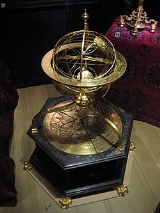
Armillary sphere

Encyclopedia
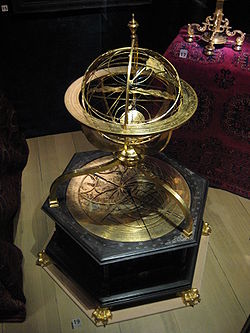
Celestial sphere
In astronomy and navigation, the celestial sphere is an imaginary sphere of arbitrarily large radius, concentric with the Earth and rotating upon the same axis. All objects in the sky can be thought of as projected upon the celestial sphere. Projected upward from Earth's equator and poles are the...
), consisting of a spherical framework of rings, centred on Earth, that represent lines of celestial longitude and latitude and other astronomically important features such as the ecliptic
Ecliptic
The ecliptic is the plane of the earth's orbit around the sun. In more accurate terms, it is the intersection of the celestial sphere with the ecliptic plane, which is the geometric plane containing the mean orbit of the Earth around the Sun...
. As such, it differs from a celestial globe, which is a smooth sphere whose principal purpose is to map the constellations.
Description and use of the armillary sphere
This section refers to labels in the diagram below.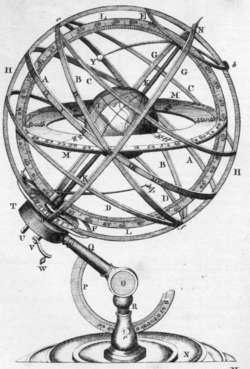
1. The equinoctial A, which is divided into 360 degrees (beginning at its intersection with the ecliptic in Aries) for showing the sun's right ascension
Right ascension
Right ascension is the astronomical term for one of the two coordinates of a point on the celestial sphere when using the equatorial coordinate system. The other coordinate is the declination.-Explanation:...
in degrees; and also into 24 hours, for showing its right ascension in time.
2. The ecliptic B, which is divided into 12 signs, and each sign into 30 degrees, and also into the months and days of the year; in such a manner, that the degree or point of the ecliptic in which the sun is, on any given day, stands over that day in the circle of months.
3. The tropic of Cancer C, touching the ecliptic at the beginning of Cancer in e, and the tropic of Capricorn D, touching the ecliptic at the beginning of Capricorn in f; each 23½ degrees from the equinoctial circle.
4. The Arctic Circle E, and the Antarctic Circle F, each 23½ degrees from its respective pole at N and S.
5. The equinoctial colure G, passing through the north and south poles of the heaven at N and S, and through the equinoctial points Aries and Libra, in the ecliptic.
6. The solstitial colure H, passing through the poles of the heaven, and through the solstitial points Cancer and Capricorn, in the ecliptic. Each quarter of the former of these colure
Colure
Colure, in astronomy, is either of the two principal meridians of the celestial sphere.-Equinoctial colure:The equinoctial colure is the meridian of the celestial sphere which passes through the celestial poles and the two equinoxes: the first point of Aries and the first point of Libra.-Solstitial...
s is divided into 90 degrees, from the equinoctial to the poles of the world, for showing the declination of the sun, moon, and stars; and each quarter of the latter, from the ecliptic as e and f, to its poles b and d, for showing the latitude of the stars.
In the north pole of the ecliptic is a nut b, to which is fixed one end of the quadrantal wire, and to the other end a small sun Y, which is carried round the ecliptic B—B, by turning the nut : and in the south pole of the ecliptic is a pin d, on which is another quadrantal wire, with a small moon Ζ upon it, which may be moved round by hand : but there is a particular contrivance for causing the moon to move in an orbit which crosses the ecliptic at an angle of 5⅓ degrees, in to opposite points called the moon's nodes; and also for shifting these points backward in the ecliptic, as the moon's nodes shift in the heaven.
Within these circular rings is a small terrestrial globe J, fixed on an axis K, which extends from the north and south poles of the globe at n and s, to those of the celestial sphere at N and S. On this axis is fixed the flat celestial meridian L L, which may be set directly over the meridian of any place on the globe, so as to keep over the same meridian upon it. This flat meridian is graduated the same way as the brass meridian of the common globe, and its use is much the same. To this globe is fitted the movable horizon M, so as to turn upon the two strong wires proceeding from its east and west points to the globe, and entering the globe at the opposite points off its equator, which is a movable brass ring set into the globe in a groove all around its equator. The globe may be turned by hand within this ring, so as to place any given meridian upon it, directly under the celestial meridian L. The horizon is divided into 360 degrees all around its outermost edge, within which are the points of the compass, for showing the amplitude of the sun and the moon, both in degrees and points. The celestial meridian L passes through two notches in the north and south points of the horizon, as in a common globe: both here, if the globe be turned round, the horizon and meridian turn with it. At the south pole of the sphere is a circle of 25 hours, fixed to the rings, and on the axis is an index which goes round that circle, if the globe be turned round its axis.
The whole fabric is supported on a pedestal N, and may be elevated or depressed upon the joint O, to any number of degrees from 0 to 90, by means of the arc P, which is fixed in the strong brass arm Q, and slides in the upright piece R, in which is a screw at r, to fix it at any proper elevation.
In the box T are two wheels (as in Dr Long's sphere) and two pinions, whose axes come out at V and U; either of which may be turned by the small winch W. When the winch is put upon the axis V, and turn backward, the terrestrial globe, with its horizon and celestial meridian, keep at rest; and the whole sphere of circles turns round from east, by south, to west, carrying the sun Y, and moon Z, round the same way, and causing them to rise above and set below the horizon. But when the winch is put upon the axis U, and turned forward, the sphere with the sun and moon keep at rest; and the earth, with its horizon and meridian, turn round from horizon to the sun and moon, to which these bodies came when the earth kept at rest, and they were carried round it; showing that they rise and set in the same points of the horizon, and at the same times in the hour circle, whether the motion be in the earth or in the heaven. If the earthly globe be turned, the hour-index goes round its hour-circle; but if the sphere be turned, the hour-circle goes round below the index.
And so, by this construction, the machine is equally fitted to show either the real motion of the earth, or the apparent motion of the heaven.
To rectify the sphere for use, first slacken the screw r in the upright stem R, and taking hold of the arm Q, move it up or down until the given degree of latitude for any place be at the side of the stem R; and then the axis of the sphere will be properly elevated, so as to stand parallel to the axis of the world, if the machine be set north and south by a small compass: this done, count the latitude from the north pole, upon the celestial meridian L, down towards the north notch of the horizon, and set the horizon to that latitude; then, turn the nut b until the sun Y comes to the given day of the year in the ecliptic, and the sun will be at its proper place for that day: find the place of the moon's ascending node, and also the place of the moon, by an Ephemeris, and set them right accordingly: lastly, turn the winch W, until either the sun comes to the meridian L, or until the meridian comes to the sun (according as you want the sphere or earth to move) and set the hour-index to the XII, marked noon, and the whole machine will be rectified. — Then turn the winch, and observe when the sun or moon rise and set in the horizon, and the hour-index will show the times thereof for the given day.
Hellenistic world
The Greek astronomerGreek astronomy
Greek astronomy is astronomy written in the Greek language in classical antiquity. Greek astronomy is understood to include the ancient Greek, Hellenistic, Greco-Roman, and Late Antiquity eras. It is not limited geographically to Greece or to ethnic Greeks, as the Greek language had become the...
Hipparchus
Hipparchus
Hipparchus, the common Latinization of the Greek Hipparkhos, can mean:* Hipparchus, the ancient Greek astronomer** Hipparchic cycle, an astronomical cycle he created** Hipparchus , a lunar crater named in his honour...
(c. 190 – c. 120 BCE) credited Eratosthenes
Eratosthenes
Eratosthenes of Cyrene was a Greek mathematician, poet, athlete, geographer, astronomer, and music theorist.He was the first person to use the word "geography" and invented the discipline of geography as we understand it...
(276 –194 BCE) as the inventor of the armillary sphere. The name of this device comes ultimately from the Latin
Latin
Latin is an Italic language originally spoken in Latium and Ancient Rome. It, along with most European languages, is a descendant of the ancient Proto-Indo-European language. Although it is considered a dead language, a number of scholars and members of the Christian clergy speak it fluently, and...
armilla (circle, bracelet), since it has a skeleton made of graduated metal circles linking the pole
Celestial pole
The north and south celestial poles are the two imaginary points in the sky where the Earth's axis of rotation, indefinitely extended, intersects the imaginary rotating sphere of stars called the celestial sphere...
s and representing the equator
Equator
An equator is the intersection of a sphere's surface with the plane perpendicular to the sphere's axis of rotation and containing the sphere's center of mass....
, the ecliptic
Ecliptic
The ecliptic is the plane of the earth's orbit around the sun. In more accurate terms, it is the intersection of the celestial sphere with the ecliptic plane, which is the geometric plane containing the mean orbit of the Earth around the Sun...
, meridians
Meridian (astronomy)
This article is about the astronomical concept. For other uses of the word, see Meridian.In the sky, a meridian is an imaginary great circle on the celestial sphere. It passes through the north point on the horizon, through the celestial pole, up to the zenith, through the south point on the...
and parallel
Circle of latitude
A circle of latitude, on the Earth, is an imaginary east-west circle connecting all locations that share a given latitude...
s.
Usually a ball representing the Earth
Earth
Earth is the third planet from the Sun, and the densest and fifth-largest of the eight planets in the Solar System. It is also the largest of the Solar System's four terrestrial planets...
or, later, the Sun
Sun
The Sun is the star at the center of the Solar System. It is almost perfectly spherical and consists of hot plasma interwoven with magnetic fields...
is placed in its center.
It is used to demonstrate the motion
Celestial mechanics
Celestial mechanics is the branch of astronomy that deals with the motions of celestial objects. The field applies principles of physics, historically classical mechanics, to astronomical objects such as stars and planets to produce ephemeris data. Orbital mechanics is a subfield which focuses on...
of the star
Star
A star is a massive, luminous sphere of plasma held together by gravity. At the end of its lifetime, a star can also contain a proportion of degenerate matter. The nearest star to Earth is the Sun, which is the source of most of the energy on Earth...
s around the Earth. Before the advent of the European telescope
Telescope
A telescope is an instrument that aids in the observation of remote objects by collecting electromagnetic radiation . The first known practical telescopes were invented in the Netherlands at the beginning of the 1600s , using glass lenses...
in the 17th century, the armillary sphere was the prime instrument of all astronomers in determining celestial positions.
In its simplest form, consisting of a ring fixed in the plane of the equator, the armilla is one of the most ancient of astronomical instruments. Slightly developed, it was crossed by another ring fixed in the plane of the meridian. The first was an equinoctial, the second a solstitial armilla. Shadows were used as indices of the sun's positions, in combinations with angular divisions. When several rings or circles were combined representing the great circles of the heavens, the instrument became an armillary sphere.
Eratosthenes most probably used a solstitial armilla for measuring the obliquity of the ecliptic. Hipparchus
Hipparchus
Hipparchus, the common Latinization of the Greek Hipparkhos, can mean:* Hipparchus, the ancient Greek astronomer** Hipparchic cycle, an astronomical cycle he created** Hipparchus , a lunar crater named in his honour...
probably used an armillary sphere of four rings. Ptolemy
Ptolemy
Claudius Ptolemy , was a Roman citizen of Egypt who wrote in Greek. He was a mathematician, astronomer, geographer, astrologer, and poet of a single epigram in the Greek Anthology. He lived in Egypt under Roman rule, and is believed to have been born in the town of Ptolemais Hermiou in the...
describes his instrument in the Syntaxis (book v. chap. i). It consisted of a graduated circle inside which another could slide, carrying to small tubes diametrically opposite, the instrument being kept vertical by a plumb-line.
Armillary spheres were developed by the Greeks
Hellenistic civilization
Hellenistic civilization represents the zenith of Greek influence in the ancient world from 323 BCE to about 146 BCE...
and were used as teaching tools already in the 3rd century BCE. In larger and more precise forms they were also used as observational instruments.
East Asia
China
Chinese civilization may refer to:* China for more general discussion of the country.* Chinese culture* Greater China, the transnational community of ethnic Chinese.* History of China* Sinosphere, the area historically affected by Chinese culture...
history, astronomer
Astronomer
An astronomer is a scientist who studies celestial bodies such as planets, stars and galaxies.Historically, astronomy was more concerned with the classification and description of phenomena in the sky, while astrophysics attempted to explain these phenomena and the differences between them using...
s have created celestial globes to assist the observation of the stars. The Chinese also used the armillary sphere in aiding calendrical
Calendar
A calendar is a system of organizing days for social, religious, commercial, or administrative purposes. This is done by giving names to periods of time, typically days, weeks, months, and years. The name given to each day is known as a date. Periods in a calendar are usually, though not...
computations and calculations. Chinese ideas of astronomy and astronomical instruments became known in Korea as well, where further advancements were also made.
According to Needham, the earliest development of the armillary sphere in China goes back to the astronomers Shi Shen
Shi Shen
Shi Shen was a Chinese astronomer and contemporary of Gan De born in the State of Wei, also known as the Master Shi Shen .-Observations:...
and Gan De
Gan De
Gan De was a Chinese astronomer/astrologer born in the State of Qi also known as the Lord Gan . Along with Shi Shen, he is believed to be the first in history known by name to compile a star catalogue, preceded by the anonymous authors of the early Babylonian star catalogues and followed by the...
in the 4th century BCE, as they were equipped with a primitive single-ring armillary instrument. This would have allowed them to measure the north polar distance (declination) a measurement that gave the position in a xiu (right ascension). Needham's early dating, however, is rejected by the sinologist Christopher Cullen who traces the beginnings of these devices to the 1st century BCE.
During the Western Han Dynasty (202 BCE - 9 CE) additional developments made by the astronomers Luoxia Hong (落下閎), Xiangyu Wangren, and Geng Shouchang (耿壽昌) advanced the use of the armillary in its early stage of evolution. In 52 BCE, it was the astronomer Geng Shouchang who introduced the first permanently fixed equatorial ring of the armillary sphere. In the subsequent Eastern Han Dynasty (23-220 CE) period, the astronomers Fu An and Jia Kui added the elliptical ring by 84 CE. With the famous statesman, astronomer, and inventor Zhang Heng
Zhang Heng
Zhang Heng was a Chinese astronomer, mathematician, inventor, geographer, cartographer, artist, poet, statesman, and literary scholar from Nanyang, Henan. He lived during the Eastern Han Dynasty of China. He was educated in the capital cities of Luoyang and Chang'an, and began his career as a...
(张衡, 78-139 CE), the sphere was totally complete in 125 CE, with horizon and meridian rings. The world's first water-powered celestial globe was created by Zhang Heng, who operated his armillary sphere by use of an inflow clepsydra
Clepsydra
Clepsydra may refer to:*Clepsydra , the Greek word for water clock. Also, in ancient Greece, a device for drawing liquids from vats too large to pour, which utilized the principles of air pressure to transport the liquid from one container to another.* Clepsydra Geyser in the Lower Geyser Basin of...
clock (see Zhang's article for more detail).
Subsequent developments were made after the Han Dynasty that improved the use of the armillary sphere. In 323 CE the astronomer Kong Ting was able to reorganize the arrangement of rings on the armillary sphere so that the ecliptic ring could be pegged on to the equator at any point desired. Then Li Chunfeng
Li Chunfeng
Li Chunfeng was a Chinese mathematician, astronomer, and historian who was born in today's Baoji, Shaanxi during the Sui and Tang dynasties. He was first appointed to the Imperial Astronomy Bureau to help institute a calendar reform. He eventually ascended to deputy of the Imperial Astronomy...
(李淳風) of the Tang dynasty
Tang Dynasty
The Tang Dynasty was an imperial dynasty of China preceded by the Sui Dynasty and followed by the Five Dynasties and Ten Kingdoms Period. It was founded by the Li family, who seized power during the decline and collapse of the Sui Empire...
created one in 633 CE with three spherical layers to calibrate multiple aspects of astronomical observations, calling them 'nests' (chhung). He was also responsible for proposing a plan of having a sighting tube mounted ecliptically in order for the better observation of celestial latitudes. However, it was Yi Xing (see below) in the next century who would accomplish this addition to the model of the armillary sphere. Ecliptical mountings of this sort were found on the armillary instruments of Zhou Cong and Shu Yijian in 1050, as well as Shen Kuo's armillary sphere of the later 11th century, but after that point they were no longer employed on Chinese armillary instruments until the arrival of the European Jesuits.

Tang Dynasty
The Tang Dynasty was an imperial dynasty of China preceded by the Sui Dynasty and followed by the Five Dynasties and Ten Kingdoms Period. It was founded by the Li family, who seized power during the decline and collapse of the Sui Empire...
Buddhist monk Yi-xing
Yi Xing
Yi Xing , born Zhang Sui , was a Chinese astronomer, mathematician, mechanical engineer,and Buddhist monk of the Tang Dynasty...
(一行) and government official Liang Ling-zan (梁令瓚) combined Zhang Heng's water powered celestial globe with an escapement
Escapement
In mechanical watches and clocks, an escapement is a device that transfers energy to the timekeeping element and enables counting the number of oscillations of the timekeeping element...
device. With drums hit every quarter-hour and bells rung automatically every full hour, the device was also a striking clock
Striking clock
A striking clock is a clock that sounds the hours audibly on a bell or gong. In 12 hour striking, used most commonly in striking clocks today, the clock strikes once at 1 AM, twice at 2 AM, continuing in this way up to twelve times at 12 noon, then starts over, striking once at 1 PM, twice at 2...
. The famous clock tower
Clock tower
A clock tower is a tower specifically built with one or more clock faces. Clock towers can be either freestanding or part of a church or municipal building such as a town hall. Some clock towers are not true clock towers having had their clock faces added to an already existing building...
of the Su Song
Su Song
Su Song was a renowned Chinese polymath who specialized himself as a statesman, astronomer, cartographer, horologist, pharmacologist, mineralogist, zoologist, botanist, mechanical and architectural engineer, poet, antiquarian, and ambassador of the Song Dynasty .Su Song was the engineer of a...
built by 1094 during the Song Dynasty
Song Dynasty
The Song Dynasty was a ruling dynasty in China between 960 and 1279; it succeeded the Five Dynasties and Ten Kingdoms Period, and was followed by the Yuan Dynasty. It was the first government in world history to issue banknotes or paper money, and the first Chinese government to establish a...
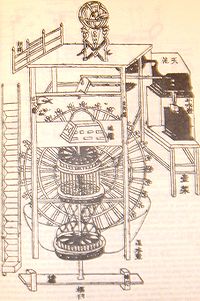
would employ Yi Xing's escapement with waterwheel scoops filled by clepsydra drip, and powered a crowning armillary sphere, a central celestial globe, and mechanically-operated manikins that would exit mechanically-opened doors of the clock tower at specific times to ring bells and gongs to announce the time, or to hold plaques announcing special times of the day. There was also the scientist and statesman Shen Kuo
Shen Kuo
Shen Kuo or Shen Gua , style name Cunzhong and pseudonym Mengqi Weng , was a polymathic Chinese scientist and statesman of the Song Dynasty...
(1031–1095). Being the head official for the Bureau of Astronomy, Shen Kuo was an avid scholar of astronomy, and improved the designs of several astronomical instruments: the gnomon
Gnomon
The gnomon is the part of a sundial that casts the shadow. Gnomon is an ancient Greek word meaning "indicator", "one who discerns," or "that which reveals."It has come to be used for a variety of purposes in mathematics and other fields....
, armillary sphere, clepsydra clock, and sighting tube fixed to observe the pole star
Pole star
The term "Pole Star" usually refers to Polaris, which is the current northern pole star, also known as the North Star.In general, however, a pole star is a visible star, especially a prominent one, that is approximately aligned with the Earth's axis of rotation; that is, a star whose apparent...
indefinitely.
Jang Yeong-sil
Jang Yeong-sil
Jang Yeong-sil was a prominent Korean scientist and astronomer during the Joseon Dynasty . Although Jang was...
, a Korean
Korean people
The Korean people are an ethnic group originating in the Korean peninsula and Manchuria. Koreans are one of the most ethnically and linguistically homogeneous groups in the world.-Names:...
inventor, was ordered by King Sejong the Great of Joseon to build an armillary sphere. The sphere, built in 1433 was named Honcheonui (혼천의).
The Honcheonsigye
Honcheonsigye
The Honcheonsigye is an astronomical clock created by Song I-yeong in 1669. It is designated as South Korean national treasure number 230.The clock has an armillary sphere with a diameter of 40 cm. The sphere is activated by a working clock mechanism, showing the position of the universe at any...
, an armillary sphere activated by a working clock mechanism was built by the Korean astronomer Song Iyeong in 1669. It is highly valued in term of clock-making technology and is the only remaining astronomical clock from the Joseon Dynasty
Joseon Dynasty
Joseon , was a Korean state founded by Taejo Yi Seong-gye that lasted for approximately five centuries. It was founded in the aftermath of the overthrow of the Goryeo at what is today the city of Kaesong. Early on, Korea was retitled and the capital was relocated to modern-day Seoul...
.
Medieval Islamic world and Europe
Persian and Arab astronomersIslamic astronomy
Islamic astronomy or Arabic astronomy comprises the astronomical developments made in the Islamic world, particularly during the Islamic Golden Age , and mostly written in the Arabic language. These developments mostly took place in the Middle East, Central Asia, Al-Andalus, and North Africa, and...
produced an improved version of the Greek armillary sphere in the 8th century, and wrote about it in the treatise of Dhat al-Halaq or The instrument with the rings by the Persian astronomer Fazari
Ibrahim al-Fazari
Abu Ishaq Ibrahim ibn Habib ibn Sulaiman ibn Samura ibn Jundab al-Fazari was an 8th-century Muslim mathematician and astronomer of Persian background....
(d.c. 777). Abbas Ibn Firnas
Abbas Ibn Firnas
Abbas Ibn Firnas , also known as Abbas Qasim Ibn Firnas and عباس بن فرناس , was a Muslim Andalusian polymath: an inventor, engineer, aviator, physician, Arabic poet, and Andalusian musician. Of Berber descent, he was born in Izn-Rand Onda, Al-Andalus , and lived in the Emirate of Córdoba...
(d.887) is thought to have produced another instrument with rings (armillary sphere) in 9th century which he gifted to Caliph Muhammad I (ruled 852-886). The spherical astrolabe, a variation of both the astrolabe
Astrolabe
An astrolabe is an elaborate inclinometer, historically used by astronomers, navigators, and astrologers. Its many uses include locating and predicting the positions of the Sun, Moon, planets, and stars, determining local time given local latitude and longitude, surveying, triangulation, and to...
and the armillary sphere, was invented during the Middle Ages
Middle Ages
The Middle Ages is a periodization of European history from the 5th century to the 15th century. The Middle Ages follows the fall of the Western Roman Empire in 476 and precedes the Early Modern Era. It is the middle period of a three-period division of Western history: Classic, Medieval and Modern...
in the Islamic world
Islamic Golden Age
During the Islamic Golden Age philosophers, scientists and engineers of the Islamic world contributed enormously to technology and culture, both by preserving earlier traditions and by adding their own inventions and innovations...
. The earliest description of the spherical astrolabe dates back to the Persian astronomer Nayrizi
Al-Nayrizi
Abū’l-‘Abbās al-Faḍl ibn Ḥātim al-Nairīzī was a 9th-10th century Persian mathematician and astronomer from Nayriz, Fars, Iran.He flourished under al-Mu'tadid, Caliph from 892 to 902, and compiled astronomical tables, writing a book for al-Mu'tadid on atmospheric phenomena.Nayrizi wrote...
(fl.
Floruit
Floruit , abbreviated fl. , is a Latin verb meaning "flourished", denoting the period of time during which something was active...
892-902). Muslim astronomers also independently invented the celestial globe, which were used primarily for solving problems in celestial astronomy. Today, 126 such instruments remain worldwide, the oldest from the 11th century. The altitude of the sun, or the Right Ascension
Right ascension
Right ascension is the astronomical term for one of the two coordinates of a point on the celestial sphere when using the equatorial coordinate system. The other coordinate is the declination.-Explanation:...
and Declination
Declination
In astronomy, declination is one of the two coordinates of the equatorial coordinate system, the other being either right ascension or hour angle. Declination in astronomy is comparable to geographic latitude, but projected onto the celestial sphere. Declination is measured in degrees north and...
of stars could be calculated with these by inputting the location of the observer on the meridian
Meridian (geography)
A meridian is an imaginary line on the Earth's surface from the North Pole to the South Pole that connects all locations along it with a given longitude. The position of a point along the meridian is given by its latitude. Each meridian is perpendicular to all circles of latitude...
ring of the globe.
Al-Andalus
Al-Andalus was the Arabic name given to a nation and territorial region also commonly referred to as Moorish Iberia. The name describes parts of the Iberian Peninsula and Septimania governed by Muslims , at various times in the period between 711 and 1492, although the territorial boundaries...
in the late 10th century with the efforts of Gerbert d'Aurillac, the later Pope Sylvester II (r. 999–1003). Pope Sylvester II applied the use of sighting tubes with his armillary sphere in order to fix the position of the pole star
Pole star
The term "Pole Star" usually refers to Polaris, which is the current northern pole star, also known as the North Star.In general, however, a pole star is a visible star, especially a prominent one, that is approximately aligned with the Earth's axis of rotation; that is, a star whose apparent...
and record measurements for the tropics
Tropics
The tropics is a region of the Earth surrounding the Equator. It is limited in latitude by the Tropic of Cancer in the northern hemisphere at approximately N and the Tropic of Capricorn in the southern hemisphere at S; these latitudes correspond to the axial tilt of the Earth...
and equator
Equator
An equator is the intersection of a sphere's surface with the plane perpendicular to the sphere's axis of rotation and containing the sphere's center of mass....
.
Renaissance
Further advances in the instrument were made by Tycho BraheTycho Brahe
Tycho Brahe , born Tyge Ottesen Brahe, was a Danish nobleman known for his accurate and comprehensive astronomical and planetary observations...
(1546–1601), whose elaborate armillary spheres passing into astrolabes are figured in his Astronomiae Instauratae Mechanica.
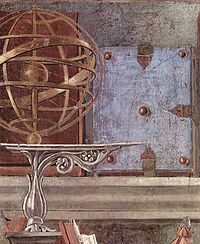
Armillary spheres were among the first complex mechanical devices. Their development led to many improvements in techniques and design of all mechanical devices. Renaissance
Renaissance
The Renaissance was a cultural movement that spanned roughly the 14th to the 17th century, beginning in Italy in the Late Middle Ages and later spreading to the rest of Europe. The term is also used more loosely to refer to the historical era, but since the changes of the Renaissance were not...
scientists and public figures often had their portraits painted showing them with one hand on an armillary sphere, which represented the height of wisdom
Wisdom
Wisdom is a deep understanding and realization of people, things, events or situations, resulting in the ability to apply perceptions, judgements and actions in keeping with this understanding. It often requires control of one's emotional reactions so that universal principles, reason and...
and knowledge
Knowledge
Knowledge is a familiarity with someone or something unknown, which can include information, facts, descriptions, or skills acquired through experience or education. It can refer to the theoretical or practical understanding of a subject...
.
The armillary sphere survives as useful for teaching, and may be described as a skeleton celestial globe, the series of rings representing the great circles of the heavens, and revolving on an axis within a horizon. With the earth as center such a sphere is known as Ptolemaic; with the sun as center, as Copernican.
A representation of an armillary sphere is present in the modern flag of Portugal
Flag of Portugal
The flag of Portugal is the national flag of the Portuguese Republic. It is a rectangular bicolour with a field unevenly divided into green on the hoist, and red on the fly. The lesser version of the national coat of arms is centered over the colour boundary at equal distance from the upper and...
and has been a national symbol since the reign of Manuel I
Manuel I of Portugal
Manuel I , the Fortunate , 14th king of Portugal and the Algarves was the son of Infante Ferdinand, Duke of Viseu, , by his wife, Infanta Beatrice of Portugal...
.
Seamless celestial globe
In the 1980s, Emilie Savage-Smith discovered several celestial globes without any seamsSeam (metallurgy)
Hemming and seaming are two similar metalworking processes in which a sheet metal edge is rolled over onto itself. A hem is when the edge is rolled flush to itself, while a seam joins the edges of two materials....
in Lahore
Lahore
Lahore is the capital of the Pakistani province of Punjab and the second largest city in the country. With a rich and fabulous history dating back to over a thousand years ago, Lahore is no doubt Pakistan's cultural capital. One of the most densely populated cities in the world, Lahore remains a...
and Kashmir
Kashmir
Kashmir is the northwestern region of the Indian subcontinent. Until the mid-19th century, the term Kashmir geographically denoted only the valley between the Great Himalayas and the Pir Panjal mountain range...
. Hollow objects are typically cast in two halves, and Savage-Smith indicates that the casting of a seamless sphere is considered impossible, though techniques such as Rotational molding
Rotational molding
Rotational molding, also known as rotomolding, rotocasting or spin casting, is a molding process for creating many kinds of mostly hollow items, typically of plastic....
have been used since at least the '60s to produce similarly seamless spheres. The earliest seamless globe was invented in Kashmir by the Muslim astronomer and metallurgist Ali Kashmiri ibn Luqman in 1589-90 (AH 998) during Akbar the Great
Akbar the Great
Akbar , also known as Shahanshah Akbar-e-Azam or Akbar the Great , was the third Mughal Emperor. He was of Timurid descent; the son of Emperor Humayun, and the grandson of the Mughal Emperor Zaheeruddin Muhammad Babur, the ruler who founded the Mughal dynasty in India...
's reign; another was produced in 1659-60 (1070 AH) by Muhammad Salih Tahtawi with Arabic
Arabic language
Arabic is a name applied to the descendants of the Classical Arabic language of the 6th century AD, used most prominently in the Quran, the Islamic Holy Book...
and Sanskrit
Sanskrit
Sanskrit , is a historical Indo-Aryan language and the primary liturgical language of Hinduism, Jainism and Buddhism.Buddhism: besides Pali, see Buddhist Hybrid Sanskrit Today, it is listed as one of the 22 scheduled languages of India and is an official language of the state of Uttarakhand...
inscriptions; and the last was produced in Lahore by a Hindu astronomer and metallurgist Lala Balhumal Lahuri in 1842 during Jagatjit Singh Bahadur
Jagatjit Singh Bahadur
Jagatjit Singh Bahadur was the ruling Maharaja of the princely state of Kapurthala in the British Empire of India from 1877 until his death...
's reign. 21 such globes were produced, and these remain the only examples of seamless metal globes. These Mughal
Mughal Empire
The Mughal Empire , or Mogul Empire in traditional English usage, was an imperial power from the Indian Subcontinent. The Mughal emperors were descendants of the Timurids...
metallurgists used the method of lost-wax casting in order to produce these globes.
See also
- Antikythera mechanismAntikythera mechanismThe Antikythera mechanism is an ancient mechanical computer designed to calculate astronomical positions. It was recovered in 1900–1901 from the Antikythera wreck. Its significance and complexity were not understood until decades later. Its time of construction is now estimated between 150 and 100...
- AstrolabeAstrolabeAn astrolabe is an elaborate inclinometer, historically used by astronomers, navigators, and astrologers. Its many uses include locating and predicting the positions of the Sun, Moon, planets, and stars, determining local time given local latitude and longitude, surveying, triangulation, and to...
- Astronomical clockAstronomical clockAn astronomical clock is a clock with special mechanisms and dials to display astronomical information, such as the relative positions of the sun, moon, zodiacal constellations, and sometimes major planets.-Definition:...
- OrreryOrreryAn orrery is a mechanical device that illustrates the relative positions and motions of the planets and moons in the Solar System in a heliocentric model. Though the Greeks had working planetaria, the first orrery that was a planetarium of the modern era was produced in 1704, and one was presented...
, a free-standing solar system modelSolar system modelSolar System models, especially mechanical models, called orreries, that illustrate the relative positions and motions of the planets and moons in the Solar System have been built for centuries. While they often showed relative sizes, these models were usually not built to scale... - PlanetariumPlanetariumA planetarium is a theatre built primarily for presenting educational and entertaining shows about astronomy and the night sky, or for training in celestial navigation...
- Prague OrlojPrague OrlojThe Prague Astronomical Clock or Prague Orloj is a medieval astronomical clock located in Prague, the capital of the Czech Republic, at . The clock was first installed in 1410, making it the third-oldest astronomical clock in the world and the oldest one still working.-Description:The Orloj is...
- TorquetumTorquetumThe torquetum or turquet is a medieval astronomical instrument designed to take and convert measurements made in three sets of coordinates: Horizon, equatorial, and ecliptic...
- Celestial sphereCelestial sphereIn astronomy and navigation, the celestial sphere is an imaginary sphere of arbitrarily large radius, concentric with the Earth and rotating upon the same axis. All objects in the sky can be thought of as projected upon the celestial sphere. Projected upward from Earth's equator and poles are the...
- Chinese constellations
- Jang Young Sil
- De sphaera mundiDe sphaera mundiDe sphaera mundi is a medieval introduction to the basic elements of astronomy written by Johannes de Sacrobosco c. 1230...
, a widely used book describing the late medieval (Ptolemaic) cosmos - Flag of PortugalFlag of PortugalThe flag of Portugal is the national flag of the Portuguese Republic. It is a rectangular bicolour with a field unevenly divided into green on the hoist, and red on the fly. The lesser version of the national coat of arms is centered over the colour boundary at equal distance from the upper and...