

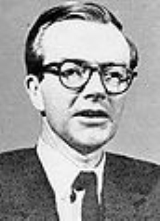
Maurice Wilkins

Encyclopedia
Maurice Hugh Frederick Wilkins CBE
FRS
(15 December 1916 – 5 October 2004) was a New Zealand-born English
physicist
and molecular biologist
, and Nobel Laureate whose research contributed to the scientific understanding of phosphorescence
, isotope separation
, optical microscopy and X-ray diffraction, and to the development of radar
. He is best known for his work at King's College London
on the structure of DNA
. In recognition of this work, he, Francis Crick
and James Watson
were awarded the 1962 Nobel Prize for Physiology or Medicine, "for their discoveries concerning the molecular structure of nucleic acids and its significance for information transfer in living material."
, north Wairarapa
, New Zealand where his father, Edgar Henry Wilkins was a medical doctor. His family had come from Dublin, where his paternal and maternal grandfathers were, respectively, Headmaster of Dublin High School and a Chief of Police. The Wilkins moved to Birmingham
, England
when Maurice was 6. Later, he attended Wylde Green College and then went to King Edward's School
from 1929 to 1935.
in 1935. He studied physics, within the Natural Sciences Tripos, and received a B.A. Mark Oliphant
who was one of Wilkin's tutors at St. John's had been appointed to the Chair of Physics at the University of Birmingham, and had appointed John Randall
to his staff. Wilkins became a Ph.D. student of Randall. In 1945, they published three papers in the Proceedings of the Royal Society on phosphorescence and electron traps. Wilkins received his Ph.D. for this work.
During World War II
Wilkins developed improved radar screens at Birmingham, then worked on isotope separation at the Manhattan Project
at the University of California, Berkeley
during the years 1944-45.
Meanwhile, Randall had been appointed to the Chair of Physics at St. Andrews University. In 1945, he appointed Wilkins as Assistant Lecturer in his department. Randall was negotiating with the Medical Research Council (MRC) to set up a laboratory to apply the experimental methods of physics to problems of biology. The combination of these disciplines as biophysics
was a novel idea. The MRC told Randall that this had to be done in another university. In 1946 Randall was appointed Wheatstone Professor of Physics, in charge of the entire Physics department at King's College, London, with the funding to set up a Biophysics Unit. He brought Wilkins with him, as Assistant Director of the unit. They appointed a team of scientists trained in both the physical and biological sciences. The "management philosophy" was to explore the use of many techniques in parallel, to find which looked promising, and then to focus on these. Wilkins, as the scientist with most diverse experience of physics and Assistant Director of the unit, had general oversight of the varied projects besides direct involvement in his personal research projects that included optical microscopy.
King's College received funding to build completely new Physics and Engineering Departments where vaults beneath the Strand level College forecourt had been destroyed by bombs during the War. The Biophysics Unit, several more experimental physics groups and the theoretical group started to move in, during the early months of 1952. The laboratories were opened formally by Lord Cherwell on June 27. Wilkins' article for Nature
described both departments, consistent with his leadership role and prestige within the College at large.
s were progressing in the MRC unit. Randall's original plan for Rosalind Franklin
was that she do X-ray diffraction studies on proteins. Wilkins' work on DNA changed that. By 1951, Randall had established a major effort to solve the structure of collagen
and Wilkins and Franklin represented a parallel effort to determine the structure of DNA. In the meantime, Maurice Wilkins' friend Francis Crick had joined forces with James Watson under the supervision of Max Perutz
at the Cavendish Laboratory, Cambridge and under the overall direction of Lawrence Bragg.
At King's College Wilkins pursued, among other things x-ray diffraction work on DNA that had been obtained from calf thymus by the Swiss scientist Rudolf Signer
. The DNA from Signer's lab was much more intact than the DNA which had previously been isolated. Wilkins discovered that it was possible to produce thin threads from this concentrated DNA solution that contained highly ordered arrays of DNA suitable for the production of x-ray diffraction patterns. Using a carefully bundled group of these DNA threads and keeping them hydrated, Wilkins and a graduate student Raymond Gosling
obtained x-ray photographs of DNA that showed that the long, thin DNA molecule in the sample from Signer had a regular, crystal-like structure in these threads. This initial x-ray diffraction work at Kings College was done in May or June 1950. It was one of the x-ray diffraction photographs taken in 1950, shown at a meeting in Naples a year later, that sparked James Watson’s
interest in DNA.
At that time Wilkins also introduced Francis Crick
to the importance of DNA. Wilkins knew that proper experiments on the threads of purified DNA would require better x-ray equipment. Wilkins ordered a new x-ray tube and a new microcamera. Before the DNA sample from Signer was available, Gosling had been trying to make x-ray diffraction images of sperm. However, Franklin did not start using the new equipment until September 1951.
By the summer of 1950 Randall had arranged for a three year research fellowship that would fund Rosalind Franklin in his laboratory. Franklin was delayed in finishing her work in Paris. Late in 1950, Randall wrote to Franklin to inform her that rather than work on protein, she should take advantage of Wilkins's preliminary work and that she should do x-ray studies of DNA fibers made from Signer's samples of DNA. Early in 1951 Franklin finally arrived. Wilkins was away on holiday and missed an initial meeting at which Raymond Gosling stood in for him along with Alex Stokes, who, like Crick, would solve the basic mathematics that make possible a general theory of how helical structures diffract x-rays. No work had been done on DNA in the laboratory for several months; the new x-ray tube sat unused, waiting for Franklin. Franklin ended up with the DNA from Signer, Gosling became her PhD student, and she had the expectation that DNA x-ray diffraction work was her project. Wilkins returned to the laboratory expecting that Franklin would be his collaborator and that they would work together on the DNA project that he had started. Franklin felt that DNA was now her project and would not collaborate with Wilkins, who then pursued parallel studies.
By November 1951 Wilkins had evidence that DNA in cells as well as purified DNA had a helical structure. Alex Stokes had solved the basic mathematics of helical diffraction theory and thought that Wilkins's x-ray diffraction data indicated a helical structure in DNA. Wilkins met with Watson and Crick and told them about his results. This information from Wilkins, along with additional information gained by Watson when he heard Franklin talk about her research during a King's College research meeting, stimulated Watson and Crick to create their first molecular model of DNA, a model with the phosphate backbones at the center. Upon viewing the model of the proposed structure, Franklin told Watson and Crick that it was wrong. Franklin knew from basic chemical principles the hydrophilic backbones should go on the outside of the molecule where they could interact with water. Crick tried to get Wilkins to continue with additional molecular modeling efforts, but Wilkins did not take this approach. During 1952, Franklin also refused to participate in molecular modeling efforts and continued to work on step-by-step detailed analysis of her x-ray diffraction data (Patterson
synthesis). By the spring of 1952, Franklin had received permission from Randall to ask to transfer her fellowship so that she could leave King's College and work in John Bernal
's laboratory at Birkbeck College, also in London. However, Franklin remained at King's College for another year.
By early 1953, it was clear that Franklin would simply drop her DNA work at the end of her fellowship that summer, or even sooner due to illness. Linus Pauling
had published a proposed but incorrect structure of DNA, making the same basic error that Watson and Crick had made a year earlier. Some of those working on DNA in the United Kingdom
feared that Pauling would quickly solve the DNA structure once he recognized his error and put the backbones of the nucleotide chains on the outside of a model of DNA. After March 1952 Franklin concentrated on the x-ray data for the A-form of less hydrated DNA while Wilkins tried to work on the hydrated B-form. Wilkins was handicapped because Franklin had all of the good DNA. Wilkins got new DNA samples, but it was not as good as the original sample he had used in 1950 and which Franklin continued to use. Most of his new results were for biological samples like sperm cells, which seemed to also suggest a helical structure for DNA. In the middle of 1952 Wilkins had for a time abandoned further DNA work when Franklin reported to him that her results made her doubt the helical nature of the A-form. Wilkins feared that the data suggesting a helical structure might just be an artifact.
In early 1953 Watson visited King's College and Wilkins showed him a high quality image of the B-form x-ray diffraction pattern, now identified as photograph 51, that Franklin had produced in March 1952. With the knowledge that Pauling was working on DNA and had submitted a model of DNA for publication, Watson and Crick mounted one more concentrated effort to deduce the structure of DNA. Through Max Perutz
, his thesis supervisor, Crick gained access to a progress report from King's College that included useful information from Franklin about the features of DNA she had deduced from her x-ray diffraction data. Watson and Crick published their proposed DNA double helical structure in a paper in the journal Nature in April 1953. In this paper Watson and Crick acknowledged that they had been "stimulated by.... the unpublished results and ideas" of Wilkins and Franklin.
The first Watson-Crick paper appeared in Nature
on 25 April 1953. Sir Lawrence Bragg, the director of the Cavendish Laboratory
, where Watson and Crick worked, gave a talk at Guys Hospital Medical School in London on Thursday 14 May 1953 which resulted in an article by Ritchie Calder in the News Chronicle
of London, on Friday 15 May 1953, entitled "Why You Are You. Nearer Secret of Life." The news reached readers of The New York Times
the next day; Victor K. McElheny, in researching his biography of Watson, Watson and DNA: Making a Scientific Revolution, found a clipping of a six-paragraph New York Times article written from London and dated 16 May 1953 with the headline "Form of 'Life Unit' in Cell Is Scanned." The article ran in an early edition and was then pulled to make space for news deemed more important. (The New York Times subsequently ran a longer article on 12 June 1953). The Cambridge University undergraduate newspaper Varsity
also ran its own short article on the discovery on Saturday 30 May 1953. Bragg's original announcement at a Solvay conference
on proteins in Belgium
on 8 April 1953 went unreported by the press.
The members of the Cambridge and King's College laboratories agreed to report their interlocking work in three papers with continuous pagination in Nature. Wilkins then led the team that performed a range of meticulous experiments to establish the helical model rigorously.
He married his second wife Patricia Ann Chidgey in 1959. They had four children, Sarah, George, Emily and William.
He published his autobiography, The Third Man of the Double Helix, in 2003.
Formerly classified UK security service papers reveal that, while working on the project, Wilkins came under suspicion of leaking atomic secrets. The files, released in August 2010, indicate surveillance of Wilkins ended by 1953. "After the war I wondered what I would do, as I was very disgusted with the dropping of two bombs on civilian centres in Japan," he told Britain's Encounter radio programme in 1999.
with Watson and Crick for the discovery of the structure of DNA.
On Saturday 20 October 1962 the award of Nobel prizes to John Kendrew and Max Perutz, and to Crick, Watson, and Wilkins was satirised in a short sketch in the BBC TV programme That Was The Week That Was
with the Nobel Prizes being referred to as 'The Alfred Nobel Peace Pools.'
In 2000, King's College London opened the Franklin-Wilkins Building in honour of Dr. Franklin's and Professor Wilkins' work at the college.
The wording on the new DNA sculpture (which was donated by James Watson) outside Clare College
's Thirkill Court, Cambridge, England is
a) on the base:
b) on the helices:
Order of the British Empire
The Most Excellent Order of the British Empire is an order of chivalry established on 4 June 1917 by George V of the United Kingdom. The Order comprises five classes in civil and military divisions...
FRS
Royal Society
The Royal Society of London for Improving Natural Knowledge, known simply as the Royal Society, is a learned society for science, and is possibly the oldest such society in existence. Founded in November 1660, it was granted a Royal Charter by King Charles II as the "Royal Society of London"...
(15 December 1916 – 5 October 2004) was a New Zealand-born English
English people
The English are a nation and ethnic group native to England, who speak English. The English identity is of early mediaeval origin, when they were known in Old English as the Anglecynn. England is now a country of the United Kingdom, and the majority of English people in England are British Citizens...
physicist
Physicist
A physicist is a scientist who studies or practices physics. Physicists study a wide range of physical phenomena in many branches of physics spanning all length scales: from sub-atomic particles of which all ordinary matter is made to the behavior of the material Universe as a whole...
and molecular biologist
Molecular biology
Molecular biology is the branch of biology that deals with the molecular basis of biological activity. This field overlaps with other areas of biology and chemistry, particularly genetics and biochemistry...
, and Nobel Laureate whose research contributed to the scientific understanding of phosphorescence
Phosphorescence
Phosphorescence is a specific type of photoluminescence related to fluorescence. Unlike fluorescence, a phosphorescent material does not immediately re-emit the radiation it absorbs. The slower time scales of the re-emission are associated with "forbidden" energy state transitions in quantum...
, isotope separation
Isotope separation
Isotope separation is the process of concentrating specific isotopes of a chemical element by removing other isotopes, for example separating natural uranium into enriched uranium and depleted uranium. This is a crucial process in the manufacture of uranium fuel for nuclear power stations, and is...
, optical microscopy and X-ray diffraction, and to the development of radar
Radar
Radar is an object-detection system which uses radio waves to determine the range, altitude, direction, or speed of objects. It can be used to detect aircraft, ships, spacecraft, guided missiles, motor vehicles, weather formations, and terrain. The radar dish or antenna transmits pulses of radio...
. He is best known for his work at King's College London
King's College London
King's College London is a public research university located in London, United Kingdom and a constituent college of the federal University of London. King's has a claim to being the third oldest university in England, having been founded by King George IV and the Duke of Wellington in 1829, and...
on the structure of DNA
DNA
Deoxyribonucleic acid is a nucleic acid that contains the genetic instructions used in the development and functioning of all known living organisms . The DNA segments that carry this genetic information are called genes, but other DNA sequences have structural purposes, or are involved in...
. In recognition of this work, he, Francis Crick
Francis Crick
Francis Harry Compton Crick OM FRS was an English molecular biologist, biophysicist, and neuroscientist, and most noted for being one of two co-discoverers of the structure of the DNA molecule in 1953, together with James D. Watson...
and James Watson
James D. Watson
James Dewey Watson is an American molecular biologist, geneticist, and zoologist, best known as one of the co-discoverers of the structure of DNA in 1953 with Francis Crick...
were awarded the 1962 Nobel Prize for Physiology or Medicine, "for their discoveries concerning the molecular structure of nucleic acids and its significance for information transfer in living material."
Birth and early education
Wilkins was born in PongaroaPongaroa
The small township of Pongaroa lies in Tararua, in the southeast of the North Island of New Zealand. It is located 110 kilometres southwest of Hastings and 200 kilometres northeast of Wellington. The nearest town is Pahiatua, 50 kilometres to the west. Popular Akitio Beach is 30 kilometres to the...
, north Wairarapa
Wairarapa
Wairarapa is a geographical region of New Zealand. It occupies the south-eastern corner of the North Island, east of metropolitan Wellington and south-west of the Hawke's Bay region. It is lightly populated, having several rural service towns, with Masterton being the largest...
, New Zealand where his father, Edgar Henry Wilkins was a medical doctor. His family had come from Dublin, where his paternal and maternal grandfathers were, respectively, Headmaster of Dublin High School and a Chief of Police. The Wilkins moved to Birmingham
Birmingham
Birmingham is a city and metropolitan borough in the West Midlands of England. It is the most populous British city outside the capital London, with a population of 1,036,900 , and lies at the heart of the West Midlands conurbation, the second most populous urban area in the United Kingdom with a...
, England
England
England is a country that is part of the United Kingdom. It shares land borders with Scotland to the north and Wales to the west; the Irish Sea is to the north west, the Celtic Sea to the south west, with the North Sea to the east and the English Channel to the south separating it from continental...
when Maurice was 6. Later, he attended Wylde Green College and then went to King Edward's School
King Edward's School, Birmingham
King Edward's School is an independent secondary school in Birmingham, England, founded by King Edward VI in 1552. It is part of the Foundation of the Schools of King Edward VI in Birmingham, and is widely regarded as one of the most academically successful schools in the country, according to...
from 1929 to 1935.
Academic career, 1936--1950
Wilkins went up to St John's College, CambridgeSt John's College, Cambridge
St John's College is a constituent college of the University of Cambridge. The college's alumni include nine Nobel Prize winners, six Prime Ministers, three archbishops, at least two princes, and three Saints....
in 1935. He studied physics, within the Natural Sciences Tripos, and received a B.A. Mark Oliphant
Mark Oliphant
Sir Marcus 'Mark' Laurence Elwin Oliphant, AC, KBE, FRS was an Australian physicist and humanitarian who played a fundamental role in the first experimental demonstration of nuclear fusion and also the development of the atomic bomb.During his retirement, Oliphant was appointed as the Governor of...
who was one of Wilkin's tutors at St. John's had been appointed to the Chair of Physics at the University of Birmingham, and had appointed John Randall
John Randall
John Randall is the name of:*John Randall , mayor of Annapolis, Maryland and colonel in the American Revolution*Sir John Randall , British physicist, developer of the cavity magnetron...
to his staff. Wilkins became a Ph.D. student of Randall. In 1945, they published three papers in the Proceedings of the Royal Society on phosphorescence and electron traps. Wilkins received his Ph.D. for this work.
During World War II
World War II
World War II, or the Second World War , was a global conflict lasting from 1939 to 1945, involving most of the world's nations—including all of the great powers—eventually forming two opposing military alliances: the Allies and the Axis...
Wilkins developed improved radar screens at Birmingham, then worked on isotope separation at the Manhattan Project
Manhattan Project
The Manhattan Project was a research and development program, led by the United States with participation from the United Kingdom and Canada, that produced the first atomic bomb during World War II. From 1942 to 1946, the project was under the direction of Major General Leslie Groves of the US Army...
at the University of California, Berkeley
University of California, Berkeley
The University of California, Berkeley , is a teaching and research university established in 1868 and located in Berkeley, California, USA...
during the years 1944-45.
Meanwhile, Randall had been appointed to the Chair of Physics at St. Andrews University. In 1945, he appointed Wilkins as Assistant Lecturer in his department. Randall was negotiating with the Medical Research Council (MRC) to set up a laboratory to apply the experimental methods of physics to problems of biology. The combination of these disciplines as biophysics
Biophysics
Biophysics is an interdisciplinary science that uses the methods of physical science to study biological systems. Studies included under the branches of biophysics span all levels of biological organization, from the molecular scale to whole organisms and ecosystems...
was a novel idea. The MRC told Randall that this had to be done in another university. In 1946 Randall was appointed Wheatstone Professor of Physics, in charge of the entire Physics department at King's College, London, with the funding to set up a Biophysics Unit. He brought Wilkins with him, as Assistant Director of the unit. They appointed a team of scientists trained in both the physical and biological sciences. The "management philosophy" was to explore the use of many techniques in parallel, to find which looked promising, and then to focus on these. Wilkins, as the scientist with most diverse experience of physics and Assistant Director of the unit, had general oversight of the varied projects besides direct involvement in his personal research projects that included optical microscopy.
King's College received funding to build completely new Physics and Engineering Departments where vaults beneath the Strand level College forecourt had been destroyed by bombs during the War. The Biophysics Unit, several more experimental physics groups and the theoretical group started to move in, during the early months of 1952. The laboratories were opened formally by Lord Cherwell on June 27. Wilkins' article for Nature
Nature (journal)
Nature, first published on 4 November 1869, is ranked the world's most cited interdisciplinary scientific journal by the Science Edition of the 2010 Journal Citation Reports...
described both departments, consistent with his leadership role and prestige within the College at large.
DNA
By 1950, preliminary studies of proteinProtein
Proteins are biochemical compounds consisting of one or more polypeptides typically folded into a globular or fibrous form, facilitating a biological function. A polypeptide is a single linear polymer chain of amino acids bonded together by peptide bonds between the carboxyl and amino groups of...
s were progressing in the MRC unit. Randall's original plan for Rosalind Franklin
Rosalind Franklin
Rosalind Elsie Franklin was a British biophysicist and X-ray crystallographer who made critical contributions to the understanding of the fine molecular structures of DNA, RNA, viruses, coal and graphite...
was that she do X-ray diffraction studies on proteins. Wilkins' work on DNA changed that. By 1951, Randall had established a major effort to solve the structure of collagen
Collagen
Collagen is a group of naturally occurring proteins found in animals, especially in the flesh and connective tissues of mammals. It is the main component of connective tissue, and is the most abundant protein in mammals, making up about 25% to 35% of the whole-body protein content...
and Wilkins and Franklin represented a parallel effort to determine the structure of DNA. In the meantime, Maurice Wilkins' friend Francis Crick had joined forces with James Watson under the supervision of Max Perutz
Max Perutz
Max Ferdinand Perutz, OM, CH, CBE, FRS was an Austrian-born British molecular biologist, who shared the 1962 Nobel Prize for Chemistry with John Kendrew, for their studies of the structures of hemoglobin and globular proteins...
at the Cavendish Laboratory, Cambridge and under the overall direction of Lawrence Bragg.
At King's College Wilkins pursued, among other things x-ray diffraction work on DNA that had been obtained from calf thymus by the Swiss scientist Rudolf Signer
Rudolf Signer
Rudolf Signer contributed to the discovery of the DNA double helix.Professor for organic chemistry at Bern University from 1935 until 1972.-External links:*...
. The DNA from Signer's lab was much more intact than the DNA which had previously been isolated. Wilkins discovered that it was possible to produce thin threads from this concentrated DNA solution that contained highly ordered arrays of DNA suitable for the production of x-ray diffraction patterns. Using a carefully bundled group of these DNA threads and keeping them hydrated, Wilkins and a graduate student Raymond Gosling
Raymond Gosling
Raymond Gosling is a distinguished scientist who worked with both Maurice Wilkins and Rosalind Franklin at King's College London in deducing the structure of DNA, under the direction of Sir John Randall. His other KCL colleagues included Alex Stokes and Herbert Wilson.-Early years:He was born in...
obtained x-ray photographs of DNA that showed that the long, thin DNA molecule in the sample from Signer had a regular, crystal-like structure in these threads. This initial x-ray diffraction work at Kings College was done in May or June 1950. It was one of the x-ray diffraction photographs taken in 1950, shown at a meeting in Naples a year later, that sparked James Watson’s
James D. Watson
James Dewey Watson is an American molecular biologist, geneticist, and zoologist, best known as one of the co-discoverers of the structure of DNA in 1953 with Francis Crick...
interest in DNA.
At that time Wilkins also introduced Francis Crick
Francis Crick
Francis Harry Compton Crick OM FRS was an English molecular biologist, biophysicist, and neuroscientist, and most noted for being one of two co-discoverers of the structure of the DNA molecule in 1953, together with James D. Watson...
to the importance of DNA. Wilkins knew that proper experiments on the threads of purified DNA would require better x-ray equipment. Wilkins ordered a new x-ray tube and a new microcamera. Before the DNA sample from Signer was available, Gosling had been trying to make x-ray diffraction images of sperm. However, Franklin did not start using the new equipment until September 1951.
By the summer of 1950 Randall had arranged for a three year research fellowship that would fund Rosalind Franklin in his laboratory. Franklin was delayed in finishing her work in Paris. Late in 1950, Randall wrote to Franklin to inform her that rather than work on protein, she should take advantage of Wilkins's preliminary work and that she should do x-ray studies of DNA fibers made from Signer's samples of DNA. Early in 1951 Franklin finally arrived. Wilkins was away on holiday and missed an initial meeting at which Raymond Gosling stood in for him along with Alex Stokes, who, like Crick, would solve the basic mathematics that make possible a general theory of how helical structures diffract x-rays. No work had been done on DNA in the laboratory for several months; the new x-ray tube sat unused, waiting for Franklin. Franklin ended up with the DNA from Signer, Gosling became her PhD student, and she had the expectation that DNA x-ray diffraction work was her project. Wilkins returned to the laboratory expecting that Franklin would be his collaborator and that they would work together on the DNA project that he had started. Franklin felt that DNA was now her project and would not collaborate with Wilkins, who then pursued parallel studies.
By November 1951 Wilkins had evidence that DNA in cells as well as purified DNA had a helical structure. Alex Stokes had solved the basic mathematics of helical diffraction theory and thought that Wilkins's x-ray diffraction data indicated a helical structure in DNA. Wilkins met with Watson and Crick and told them about his results. This information from Wilkins, along with additional information gained by Watson when he heard Franklin talk about her research during a King's College research meeting, stimulated Watson and Crick to create their first molecular model of DNA, a model with the phosphate backbones at the center. Upon viewing the model of the proposed structure, Franklin told Watson and Crick that it was wrong. Franklin knew from basic chemical principles the hydrophilic backbones should go on the outside of the molecule where they could interact with water. Crick tried to get Wilkins to continue with additional molecular modeling efforts, but Wilkins did not take this approach. During 1952, Franklin also refused to participate in molecular modeling efforts and continued to work on step-by-step detailed analysis of her x-ray diffraction data (Patterson
Patterson function
The Patterson function is used to solve the phase problem in X-ray crystallography. It was introduced in 1935 by Arthur Lindo Patterson while he was a visiting researcher in the laboratory of Bertram Eugene Warren at MIT....
synthesis). By the spring of 1952, Franklin had received permission from Randall to ask to transfer her fellowship so that she could leave King's College and work in John Bernal
J. D. Bernal
John Desmond Bernal FRS was one of Britain’s best known and most controversial scientists, called "Sage" by his friends, and known for pioneering X-ray crystallography in molecular biology.-Origin and education:His family was Irish, of mixed Italian and Spanish/Portuguese Sephardic Jewish origin...
's laboratory at Birkbeck College, also in London. However, Franklin remained at King's College for another year.
By early 1953, it was clear that Franklin would simply drop her DNA work at the end of her fellowship that summer, or even sooner due to illness. Linus Pauling
Linus Pauling
Linus Carl Pauling was an American chemist, biochemist, peace activist, author, and educator. He was one of the most influential chemists in history and ranks among the most important scientists of the 20th century...
had published a proposed but incorrect structure of DNA, making the same basic error that Watson and Crick had made a year earlier. Some of those working on DNA in the United Kingdom
United Kingdom
The United Kingdom of Great Britain and Northern IrelandIn the United Kingdom and Dependencies, other languages have been officially recognised as legitimate autochthonous languages under the European Charter for Regional or Minority Languages...
feared that Pauling would quickly solve the DNA structure once he recognized his error and put the backbones of the nucleotide chains on the outside of a model of DNA. After March 1952 Franklin concentrated on the x-ray data for the A-form of less hydrated DNA while Wilkins tried to work on the hydrated B-form. Wilkins was handicapped because Franklin had all of the good DNA. Wilkins got new DNA samples, but it was not as good as the original sample he had used in 1950 and which Franklin continued to use. Most of his new results were for biological samples like sperm cells, which seemed to also suggest a helical structure for DNA. In the middle of 1952 Wilkins had for a time abandoned further DNA work when Franklin reported to him that her results made her doubt the helical nature of the A-form. Wilkins feared that the data suggesting a helical structure might just be an artifact.
In early 1953 Watson visited King's College and Wilkins showed him a high quality image of the B-form x-ray diffraction pattern, now identified as photograph 51, that Franklin had produced in March 1952. With the knowledge that Pauling was working on DNA and had submitted a model of DNA for publication, Watson and Crick mounted one more concentrated effort to deduce the structure of DNA. Through Max Perutz
Max Perutz
Max Ferdinand Perutz, OM, CH, CBE, FRS was an Austrian-born British molecular biologist, who shared the 1962 Nobel Prize for Chemistry with John Kendrew, for their studies of the structures of hemoglobin and globular proteins...
, his thesis supervisor, Crick gained access to a progress report from King's College that included useful information from Franklin about the features of DNA she had deduced from her x-ray diffraction data. Watson and Crick published their proposed DNA double helical structure in a paper in the journal Nature in April 1953. In this paper Watson and Crick acknowledged that they had been "stimulated by.... the unpublished results and ideas" of Wilkins and Franklin.
The first Watson-Crick paper appeared in Nature
Nature (journal)
Nature, first published on 4 November 1869, is ranked the world's most cited interdisciplinary scientific journal by the Science Edition of the 2010 Journal Citation Reports...
on 25 April 1953. Sir Lawrence Bragg, the director of the Cavendish Laboratory
Cavendish Laboratory
The Cavendish Laboratory is the Department of Physics at the University of Cambridge, and is part of the university's School of Physical Sciences. It was opened in 1874 as a teaching laboratory....
, where Watson and Crick worked, gave a talk at Guys Hospital Medical School in London on Thursday 14 May 1953 which resulted in an article by Ritchie Calder in the News Chronicle
News Chronicle
The News Chronicle was a British daily newspaper. It ceased publication on 17 October 1960, being absorbed into the Daily Mail. Its offices were in Bouverie Street, off Fleet Street, London, EC4Y 8DP, England.-Daily Chronicle:...
of London, on Friday 15 May 1953, entitled "Why You Are You. Nearer Secret of Life." The news reached readers of The New York Times
The New York Times
The New York Times is an American daily newspaper founded and continuously published in New York City since 1851. The New York Times has won 106 Pulitzer Prizes, the most of any news organization...
the next day; Victor K. McElheny, in researching his biography of Watson, Watson and DNA: Making a Scientific Revolution, found a clipping of a six-paragraph New York Times article written from London and dated 16 May 1953 with the headline "Form of 'Life Unit' in Cell Is Scanned." The article ran in an early edition and was then pulled to make space for news deemed more important. (The New York Times subsequently ran a longer article on 12 June 1953). The Cambridge University undergraduate newspaper Varsity
Varsity (Cambridge)
Varsity is the oldest of Cambridge University's main student newspapers. It has been published continuously since 1947, and is one of only three fully independent student newspapers in the UK. It appears every Friday around Cambridge...
also ran its own short article on the discovery on Saturday 30 May 1953. Bragg's original announcement at a Solvay conference
Solvay Conference
The International Solvay Institutes for Physics and Chemistry, located in Brussels, were founded by the Belgian industrialist Ernest Solvay in 1912, following the historic invitation-only 1911 Conseil Solvay, the turning point in world physics...
on proteins in Belgium
Belgium
Belgium , officially the Kingdom of Belgium, is a federal state in Western Europe. It is a founding member of the European Union and hosts the EU's headquarters, and those of several other major international organisations such as NATO.Belgium is also a member of, or affiliated to, many...
on 8 April 1953 went unreported by the press.
The members of the Cambridge and King's College laboratories agreed to report their interlocking work in three papers with continuous pagination in Nature. Wilkins then led the team that performed a range of meticulous experiments to establish the helical model rigorously.
Personal life
Wilkins married an art student, Ruth, when he was at Berkeley. They had a son.He married his second wife Patricia Ann Chidgey in 1959. They had four children, Sarah, George, Emily and William.
He published his autobiography, The Third Man of the Double Helix, in 2003.
Formerly classified UK security service papers reveal that, while working on the project, Wilkins came under suspicion of leaking atomic secrets. The files, released in August 2010, indicate surveillance of Wilkins ended by 1953. "After the war I wondered what I would do, as I was very disgusted with the dropping of two bombs on civilian centres in Japan," he told Britain's Encounter radio programme in 1999.
Recognition
In 1960 he was presented with the American Public Health Association's Albert Lasker Award, and in 1962 he was made a Commander of the British Empire. Also in 1962 he shared the Nobel Prize in Physiology or MedicineNobel Prize in Physiology or Medicine
The Nobel Prize in Physiology or Medicine administered by the Nobel Foundation, is awarded once a year for outstanding discoveries in the field of life science and medicine. It is one of five Nobel Prizes established in 1895 by Swedish chemist Alfred Nobel, the inventor of dynamite, in his will...
with Watson and Crick for the discovery of the structure of DNA.
On Saturday 20 October 1962 the award of Nobel prizes to John Kendrew and Max Perutz, and to Crick, Watson, and Wilkins was satirised in a short sketch in the BBC TV programme That Was The Week That Was
That Was The Week That Was
That Was The Week That Was, also known as TW3, is a satirical television comedy programme that was shown on BBC Television in 1962 and 1963. It was devised, produced and directed by Ned Sherrin and presented by David Frost...
with the Nobel Prizes being referred to as 'The Alfred Nobel Peace Pools.'
In 2000, King's College London opened the Franklin-Wilkins Building in honour of Dr. Franklin's and Professor Wilkins' work at the college.
The wording on the new DNA sculpture (which was donated by James Watson) outside Clare College
Clare College, Cambridge
Clare College is a constituent college of the University of Cambridge in Cambridge, England.The college was founded in 1326, making it the second-oldest surviving college of the University after Peterhouse. Clare is famous for its chapel choir and for its gardens on "the Backs"...
's Thirkill Court, Cambridge, England is
a) on the base:
- i) "These strands unravel during cell reproduction. Genes are encoded in the sequence of bases."
- ii) "The double helix model was supported by the work of Rosalind Franklin and Maurice Wilkins."
b) on the helices:
- i) "The structure of DNA was discovered in 1953 by Francis Crick and James Watson while Watson lived here at Clare."
- ii) "The molecule of DNA has two helical strands that are linked by base pairs Adenine – Thymine or Guanine – Cytosine."
Books featuring Maurice Wilkins
- Robert OlbyRobert OlbyRobert Cecil Olby is a research professor in the Department of History and Philosophy of Science at the University of Pittsburgh. Formerly at the University of Leeds, UK, Robert Olby is known as a historian of 19th and 20th century biology, his special fields being genetics and molecular biology...
; 'Wilkins, Maurice Hugh Frederick (1916–2004), Oxford Dictionary of National Biography, online edn, Oxford University Press, Jan 2008 - Robert OlbyRobert OlbyRobert Cecil Olby is a research professor in the Department of History and Philosophy of Science at the University of Pittsburgh. Formerly at the University of Leeds, UK, Robert Olby is known as a historian of 19th and 20th century biology, his special fields being genetics and molecular biology...
; "Francis Crick: Hunter of Life's Secrets", Cold Spring Harbor Laboratory Press, ISBN 9780879697983, published in August 2009. - John Finch; 'A Nobel Fellow On Every Floor', Medical Research Council 2008, 381 pp, ISBN 978-1840469-40-0; this book is all about the MRC Laboratory of Molecular Biology, Cambridge
- Robert OlbyRobert OlbyRobert Cecil Olby is a research professor in the Department of History and Philosophy of Science at the University of Pittsburgh. Formerly at the University of Leeds, UK, Robert Olby is known as a historian of 19th and 20th century biology, his special fields being genetics and molecular biology...
; "The Path to The Double Helix: Discovery of DNA"; first published in October 1974 by MacMillan, with foreword by Francis Crick; ISBN 0-486-68117-3; the definitive DNA textbook, revised in 1994, with a 9 page postscript. - Horace Freeland Judson, "The Eighth Day of Creation. Makers of the Revolution in Biology"; CSHL Press 1996 ISBN 0-87969-478-5.
- Watson, James D. The Double Helix: A Personal Account of the Discovery of the Structure of DNA; The Norton Critical Edition, which was published in 1980, edited by Gunther S. Stent:ISBN 0-393-01245-X.
- Chomet, S. (Ed.), D.N.A. Genesis of a Discovery, 1994, Newman- Hemisphere Press, London; NB a few copies are available from Newman-Hemisphere at 101 Swan Court, London SW3 5RY (phone: 07092 060530).
- Maddox, Brenda, Rosalind Franklin: The Dark Lady of DNA, 2002. ISBN 0-06-018407-8.
- Sayre, Anne 1975. Rosalind Franklin and DNA. New York: W.W. Norton and Company. ISBN 0-393-32044-8.
- Wilkins, Maurice, The Third Man of the Double Helix: The Autobiography of Maurice Wilkins ISBN 0-19-860665-6.
- Crick, Francis, 1990. What Mad Pursuit: A Personal View of Scientific Discovery (Basic Books reprint edition) ISBN 0-465-09138-5
- Watson, James D., The Double Helix: A Personal Account of the Discovery of the Structure of DNA, Atheneum, 1980, ISBN 0-689-70602-2 (first published in 1968)
- Krude, Torsten (Ed.) DNA Changing Science and Society: The Darwin Lectures for 2003 CUP 2003, includes a lecture by Sir Aaron Klug on Rosalind Franklin's involvement in the determination of the structure of DNA.
- Ridley, Matt; "Francis Crick: Discoverer of the Genetic Code (Eminent Lives)" was first published in June 2006 in the US and then in the UK September 2006, by HarperCollins Publishers; 192 pp, ISBN 0-06-082333-X; this short book is in the publisher's "Eminent Lives" series.
- "Light Is A Messenger, the life and science of William Lawrence Bragg" by Graeme Hunter, ISBN 0-19-852921-X; Oxford University Press, 2004.
- "Designs For Life: Molecular Biology After World War II" by Soraya De Chadarevian; CUP 2002, 444 pp; ISBN 0-521-57078-6; it includes James Watson's "well kept open secret" from April 2003!
- Tait, Sylvia & James "A Quartet of Unlikely Discoveries" (Athena Press 2004) ISBN 184401343X
External links
- Professor Maurice Wilkins, Obituary from The Independent on Sunday, 9 October 2004.
- Crick's personal papers at Mandeville Special Collections Library, Geisel Library, University of California, San Diego
- for the People's Archive/BBC 90 story interview with Crick AND the 236 story interview with Brenner.
- Presentation speech at the Nobel Prize ceremony in 1962.
- Reading University site on 50th anniversary of Discovery of the structure of DNA. Includes a list of Books on the subject.
- Biography (from Nobel)
- Biography (from the New Zealand Edge)
- Discovery Story in BA Magazine
- DNA: The King's Story detailing Wilkins' involvement in elucidating the structure of DNA
- DNA and Social Responsibility Project: Archiving Maurice Wilkin's Personal Papers
- List of classic papers in Nature on DNA structure
- Listen to Francis Crick and James Watson talking on the BBC
- http://www.nytimes.com/packages/pdf/science/dna-article.pdf – for reproduction of the original text in June 1953.
- http://www.physicstoday.org/vol-56/iss-3/p42.html for Lynne Elkins' article on Franklin.
- New York Times 50th anniversary series of excellent articles.
- http://www.nytimes.com/packages/pdf/science/dna-article.pdf The first American newspaper coverage of the discovery of the DNA structure: Saturday, June 13, 1953 The New York Times
- Listen to an oral history interview with Maurice Wilkins – a life story interview recorded for National Life Stories at the British Library