
All Topics  
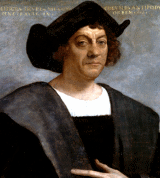
Christopher Columbus

 
Christopher Columbus

   Email Print
   Bookmark   Link


Christopher Columbus


For Origin theories of Christopher Columbus, see Origin theories of Christopher Columbus
Origin theories of Christopher Columbus

The exact origin of Christopher Columbus has been the source of some speculation since the 19th century although the historical consensus is that he was Republic of Genoa....


Christopher Columbus (between August 25 and October 31, 1451 – May 20, 1506) was a Genoese
Republic of Genoa

The Most Serene Republic of Genoa was an independent state in Liguria on the northwestern Italy coast from the 11th century to 1797, when it was invaded by armies of First French Republic under Napoleon I of France....
 navigator
Navigator

A navigator is the person onboard a ship or aircraft responsible for its navigation. The navigator's primary responsibility is to be aware of ship or aircraft position at all times....
, colonizer and explorer whose voyages across the Atlantic Ocean
Atlantic Ocean

The Atlantic Ocean is the second-largest of the world's oceanic divisions; with a total area of about 106.4 million square kilometres . It covers approximately one-fifth of the Earth's surface....
—funded by Queen Isabella of Spain—led to general European awareness of the American continents in the Western Hemisphere
Western Hemisphere

The Western Hemisphere, also Western hemisphere or western hemisphere, is a geography term for the half of the Earth that lies west of the Prime Meridian , the other half being the Eastern Hemisphere....
. Although not the first to reach the Americas from Europe
Europe

Europe is, conventionally, one of the world's seven continents. Comprising the westernmost peninsula of Eurasia, Europe is generally divided from Asia to its east by the water divide of the Ural Mountains, the Ural , the Caspian Sea, and by the Caucasus Mountains to the southeast....
—he was preceded by the Norse, led by Leif Ericsson, who built a temporary settlement 500 years earlier at L'Anse aux Meadows
L'Anse aux Meadows

L'Anse aux Meadows is an archaeological site on the northernmost tip of the island of Newfoundland in the Canada Provinces of Canada of Newfoundland and Labrador....
— Columbus initiated widespread contact between Europeans and indigenous Americans
Indigenous peoples of the Americas

The indigenous peoples of the Americas are the pre-Columbian inhabitants of the Americas, their descendants, and many ethnic groups who identify with those peoples....
.


Discussion
Ask a question about 'Christopher Columbus'
Start a new discussion about 'Christopher Columbus'
Answer questions from other users
Full Discussion Forum


Recent Posts


Timeline

1451   Born

1479   Christopher Columbus - experienced mariner and successful trader in the thriving Genoese "ex-pat" community in Portugal, '''marries''' Felipa Perestrelo Moniz (Italian on her father's side) and receives no ordinary dowry''':''' Her late father's maps and papers charting the seas and winds around the Madeira Islands and other Portuguese possessions in the Ocean Sea.

1492   Christopher Columbus sets sail on his first journey across the Atlantic Ocean to the Americas

1492   Christopher Columbus's expedition makes landfall in the Caribbean. The Italian explorer believes he has reached East Asia.

1493   Christopher Columbus leaves the New World.

1493   Christopher Columbus returns to Spain after his first trip to the Americas.

1493   Christopher Columbus goes ashore on an island he saw for the first time only the day before. He names it San Juan Bautista (later renamed Puerto Rico).

1494   Christopher Columbus first spots Jamaica.

1496   Christopher Columbus leaves Hispaniola for Spain, ending his second visit to the Western Hemisphere.

1498   Christopher Columbus lands on the South American continent.


Quotations


Thanks be to God, says the Admiral; the air is soft as in April in Seville, and it is a pleasure to be in it, so fragrant it is.

8 October 1492

When there are such lands there should be profitable things without number.

27 November 1492

The Admiral says that he never beheld so fair a thing: trees all along the river, beautiful and green, and different from ours, with flowers and fruits each according to their kind, many birds and little birds which sing very sweetly.

28 October 1492

The two Christians met on the way many people who were going to their towns, women and men, with a firebrand in the hand, herbs to drink the smoke thereof, as they are accustomed.

On smoking, 6 November 1492

The Admiral ordered the lord to be given some things, and he and all his folk rested in great contentment, believing truly that they had come from the sky, and to see the Christians they held themselves very fortunate.

22 December 1492

I have come to believe that this is a mighty continent which was hitherto unknown. I am greatly supported in this view by reason of this great river, and by this sea which is fresh. : Letter to the Sovereigns, Third Voyage (18 October 1498)


Encyclopedia


For Origin theories of Christopher Columbus, see Origin theories of Christopher Columbus
Origin theories of Christopher Columbus

The exact origin of Christopher Columbus has been the source of some speculation since the 19th century although the historical consensus is that he was Republic of Genoa....


Christopher Columbus (between August 25 and October 31, 1451 – May 20, 1506) was a Genoese
Republic of Genoa

The Most Serene Republic of Genoa was an independent state in Liguria on the northwestern Italy coast from the 11th century to 1797, when it was invaded by armies of First French Republic under Napoleon I of France....
 navigator
Navigator

A navigator is the person onboard a ship or aircraft responsible for its navigation. The navigator's primary responsibility is to be aware of ship or aircraft position at all times....
, colonizer and explorer whose voyages across the Atlantic Ocean
Atlantic Ocean

The Atlantic Ocean is the second-largest of the world's oceanic divisions; with a total area of about 106.4 million square kilometres . It covers approximately one-fifth of the Earth's surface....
—funded by Queen Isabella of Spain—led to general European awareness of the American continents in the Western Hemisphere
Western Hemisphere

The Western Hemisphere, also Western hemisphere or western hemisphere, is a geography term for the half of the Earth that lies west of the Prime Meridian , the other half being the Eastern Hemisphere....
. Although not the first to reach the Americas from Europe
Europe

Europe is, conventionally, one of the world's seven continents. Comprising the westernmost peninsula of Eurasia, Europe is generally divided from Asia to its east by the water divide of the Ural Mountains, the Ural , the Caspian Sea, and by the Caucasus Mountains to the southeast....
—he was preceded by the Norse, led by Leif Ericsson, who built a temporary settlement 500 years earlier at L'Anse aux Meadows
L'Anse aux Meadows

L'Anse aux Meadows is an archaeological site on the northernmost tip of the island of Newfoundland in the Canada Provinces of Canada of Newfoundland and Labrador....
— Columbus initiated widespread contact between Europeans and indigenous Americans
Indigenous peoples of the Americas

The indigenous peoples of the Americas are the pre-Columbian inhabitants of the Americas, their descendants, and many ethnic groups who identify with those peoples....
. With his several hapless attempts at establishing a settlement on the island of Hispaniola
Hispaniola

Hispaniola is the second-largest and most populous island of the Antilles, lying between the islands of Cuba to the west, and Puerto Rico to the east....
, he personally initiated the process of Spanish colonization
Spanish colonization of the Americas

The Spanish colonization of the Americas was Spain's conquest, settlement, and rule over much of the western hemisphere. Beginning with the arrival of Christopher Columbus in 1492, over three centuries the Spanish Empire expanded from early small settlements in the Caribbean to include Central America, most of South America, Mexico, what toda...
 which foreshadowed general European colonization
European colonization of the Americas

The start of the European colonization of the Americas is typically dated to 1492, although there was at least one earlier colonization effort....
 of the "New World
New World

The New World is one of the names used for the non-Eurasian/non-African parts of the Earth, specifically the Americas and Australasia. When the term originated in the late 15th century, the Americas were new to the Europeans, who previously thought of the world as consisting only of Europe, Asia, and Africa ....
." (The term "pre-Columbian
Pre-Columbian

The pre-Columbian era incorporates all archaeology of the Americas in the history of the Americas before the appearance of significant European influences on the Americas continents....
" is usually used to refer to the peoples and cultures of the Americas before the arrival of Columbus and his European successors.)

His initial 1492 voyage came at a critical time of growing national imperialism
Imperialism

Imperialism has two meanings; one describing an action and the other describing an attitude.#Action: Imperialism is the practice of extending the power, control or rule by one country over areas outside its borders....
 and economic competition
Competition (economics)

Competition in economics is a term that encompasses the notion of individuals and firms striving for a greater share of a market to sell or buy goods and services....
 between developing nation states seeking wealth from the establishment of trade route
Trade route

A trade route is a Logistics identified as a series of pathways and stoppages used for the commercial transport of cargo. Allowing Good s to reach distant markets, a single trade route contains long distance Arterial road which may further be connected to several smaller networks of commercial and non commercial transportation....
s and colonies
Colonialism

Colonialism is the extension of a nation's sovereignty over Territory beyond its borders by the establishment of either settler or exploitation colony in which Indigenous people populations are direct rule, Population transfers, or Genocide....
. In this sociopolitical
Politics

Politics is the process by which groups of people make decisions. The term is generally applied to behaviour within civil governments, but politics has been observed in all human group interactions, including corporation, academia, and religion institutions....
 climate, Columbus's far-fetched scheme won the attention of Queen Isabella
Isabella I of Castile

Isabella I was Kings of Castile. She and her husband, Ferdinand II of Aragon, laid the foundation for the political unification of Spain under their grandson, Charles V, Holy Roman Emperor....
 of Spain. Severely underestimating the circumference
Circumference

The circumference is the distance around a closed curve. Circumference is a kind of perimeter....
 of the Earth
Earth

Earth is the third planet from the Sun. Earth is the largest of the terrestrial planets in the Solar System in diameter, mass and density. It is also referred to as the World and Wiktionary:Terra.Note that by International Astronomical Union convention, the term "Terra" is used for naming extensive land masses, rather...
, he estimated that a westward route from Iberia
Iberian Peninsula

The Iberian Peninsula, or Iberia, is located in the extreme southwest of Europe and includes modern-day Spain, Portugal, Andorra and Gibraltar and a very small area of France....
 to the Indies would be shorter and more direct than the overland trade route
Trade route

A trade route is a Logistics identified as a series of pathways and stoppages used for the commercial transport of cargo. Allowing Good s to reach distant markets, a single trade route contains long distance Arterial road which may further be connected to several smaller networks of commercial and non commercial transportation....
 through Arabia. If true, this would allow Spain entry into the lucrative spice trade
Spice trade

Spice trade is a commercial activity of ancient origin which involves the merchandising of spices and herbs. Civilizations of Asia were involved in spice trade from the ancient times, and the Greco-Roman world soon followed by trading along the Incense route and the Roman trade with India....
heretofore commanded by the Arabs and Italians. Following his plotted course, he instead landed within the Bahamas Archipelago at a locale he named San Salvador. Mistaking the North-American
North America

North America is the northern continent of the Americas, situated in the Earth's northern hemisphere and almost totally in the western hemisphere....
 island for the East-Asian
East Asia

East Asia is a subregion of Asia that can be defined in either Geography or cultural terms. Geography and geopolitically, it covers about 12,000,000 km?, or about 28 percent of the Asian continent, about 15 percent bigger than the area of Europe, though some categorize Tibet, Xinjiang, and Mongolia as Central Asia....
 mainland, he referred to its inhabitants as "Indios".

Academic consensus is that Columbus was born in Genoa
Republic of Genoa

The Most Serene Republic of Genoa was an independent state in Liguria on the northwestern Italy coast from the 11th century to 1797, when it was invaded by armies of First French Republic under Napoleon I of France....
, though there are other theories
Origin theories of Christopher Columbus

The exact origin of Christopher Columbus has been the source of some speculation since the 19th century although the historical consensus is that he was Republic of Genoa....
. The name Christopher Columbus is the Anglicisation of the Latin
Latin

Latin is an Italic language, historically spoken in Latium and Ancient Rome. Through the Military history of the Roman Empire, Latin spread throughout the Mediterranean and a large part of Europe....
 Christophorus Columbus. The original name in 15th century genoese language
Ligurian language (Romance)

Ligurian is a Gallo-Romance language, currently spoken in Liguria, northern Italy, and parts of the Mediterranean coastal zone of France, and Monaco....
 was Christoffa Corombo (pron. ) The name is rendered in modern Italian as Cristoforo Colombo, in Portuguese
Portuguese language

Portuguese is a Romance language that originated in what is now Galicia and Portugal. It is derived from the Latin language spoken by the Romanization Pre-Roman peoples of the Iberian Peninsula around 2000 years ago....
 as Cristóvão Colombo (formerly Christovam Colom), and in Spanish as Cristóbal Colón.

The anniversary of Columbus's 1492 landing in the Americas is observed as Columbus Day
Columbus Day

Many countries in the New World and elsewhere celebrate the anniversary of Christopher Columbus's arrival in the Americas, which occurred on October 12, 1492 in the Julian calendar and October 21, 1492 in the modern Gregorian calendar, as an official holiday....
 on October 12 in Spain and throughout the Americas, except that in the United States it is observed on the second Monday in October.

Early life

It is generally, although not universally, agreed that Christopher Columbus was born between August 25, and October 31, 1451 in Genoa
Genoa

Genoa is a city and an important seaport in northern Italy, the capital of the Province of Genoa and of the region of Liguria. The city has a population of about 610,000 and the urban area has a population of about 900,000....
, part of modern Italy. His father was Domenico Colombo
Domenico Colombo

Domenico Colombo was the father of the Christopher Columbus and Bartolomeo Columbus. He was also a Weaver .He was born in 1418. He had 3 brothers, Franceschino, Giacomo and Bertino....
, a middle-class wool
Wool

Wool is the fiber derived from the specialized skin cells, called follicles, of animals in the Caprinae family, principally domestic sheep, but the hair of certain species of other Mammalia such as cashmere goat, llamas, rabbits and keeshonds may also be called wool....
 weaver
Weaving

Weaving is the textile arts in which two distinct sets of yarn, called the Warp and the filling or weft , are interlaced with each other to form a textile....
, who later also had a cheese
Cheese

Cheese is a food consisting of proteins and fat from milk, usually the milk of cattle, Water Buffalo, goats, or sheep's milk. It is produced by Coagulation of the milk protein casein....
 stand
Stand

Stand can mean several things:...
 where Christopher was a helper, working both in Genoa and Savona
Savona

File:Savona-IMG 1526.JPGSavona is a seaport and comune in the northern Italy region of Liguria, capital of the Province of Savona, in the Riviera di Ponente on the Mediterranean Sea....
. His mother was Susanna Fontanarossa
Susanna Fontanarossa

Susanna Fontanarossa was the mother of Cristoforo Colombo, a Genoese wool weaver commonly believed to have been Christopher Columbus, the famous navigator and explorer who was generally credited as a discoverer of the Americas....
. Bartolomeo, Giovanni Pellegrino and Giacomo were his brothers. Bartolomeo worked in a cartography
Cartography

File:Mediterranean chart fourteenth century2.jpgCartography is the study and practice of making Geography Map. Combining science, aesthetics, and technique, cartography builds on the premise that we can model reality in ways that communicate spatial information effectively....
 workshop in Lisbon
Lisbon

Lisbon is the Capital and largest city of Portugal. It is also the seat of the Lisbon and capital of the Lisbon region. Its municipalities of Portugal, which matches the city proper excluding the larger continuous conurbation, has a municipal population of 564,477 in , while the Lisbon Metropolitan Area in total has around 2.8 million inha...
 for at least part of his adulthood.

Columbus never wrote any works in his native language, but it can be assumed this was the Genoese variety of Ligurian
Genoese dialect

Genoese is the most important dialect of the Ligurian language , the one spoken in Genoa .Ligurian language is listed by Ethnologue as a language in its own right, of the Romance languages branch, and not to be confused with the ancient Ligurian language....
. In one of his writings, Columbus claims to have gone to the sea at the age of 10. At age 14, he attended Prince Henry's
Henry the Navigator

The Infante Henrique, Duke of Viseu, Pronunciation ), in Sagres, Portugal) was an infante of the Portugal House of Aviz and an important figure in the early days of the Portuguese Empire, being responsible for the beginning of the European worldwide explorations....
 school of navigation in Sagres
Sagres

The Sagres Point , is a windswept shelf-like promontory located in the Algarve region of southern Portugal. To the west lies Cape St. Vincent which forms the southwesternmost tip of Europe....
, Portugal
Portugal

Portugal , officially the Portuguese Republic , is a country on the Iberian Peninsula. Located in southwestern Europe, Portugal is the westernmost country of mainland Europe and is bordered by the Atlantic Ocean to the west and south and by Spain to the north and east....
. In 1470 the Columbus family moved to Savona
Savona

File:Savona-IMG 1526.JPGSavona is a seaport and comune in the northern Italy region of Liguria, capital of the Province of Savona, in the Riviera di Ponente on the Mediterranean Sea....
, where Domenico took over a tavern. In the same year, Columbus was on a Genoese ship hired in the service of René I of Anjou to support his attempt to conquer the Kingdom of Naples
Kingdom of Naples

The Kingdom of Naples is the modern day name for a polity which existed on the southern part of the Italian peninsula. Also known contemporaneously, and somewhat confusingly, as the Kingdom of Sicily, this kingdom was founded after the secession of the island of Sicily from the old Kingdom of Sicily as a result of the Sicilian Vespers...
.

In 1473 Columbus began his apprenticeship as business agent for the important Centurione, Di Negro and Spinola families of Genoa. Later he allegedly made a trip to Chios
Chios

Chios is the fifth largest of the Greece list of islands of Greece, situated in the Aegean Sea seven kilometres off the Turkey coast. The island is noted for its strong merchant shipping community, its unique mastic gum and its medieval villages....
, a Genoese colony in the Aegean Sea
Aegean Sea

The Aegean Sea is an elongated embayment of the Mediterranean Sea located between the southern Balkans and Anatolian peninsulas, i.e., between the mainlands of Greece and Turkey respectively....
. In May 1476, he took part in an armed convoy sent by Genoa to carry a valuable cargo to northern Europe. He docked in Bristol, Galway, in Ireland and was possibly in Iceland in 1477. In 1479 Columbus reached his brother Bartolomeo in Lisbon
Lisbon

Lisbon is the Capital and largest city of Portugal. It is also the seat of the Lisbon and capital of the Lisbon region. Its municipalities of Portugal, which matches the city proper excluding the larger continuous conurbation, has a municipal population of 564,477 in , while the Lisbon Metropolitan Area in total has around 2.8 million inha...
, keeping on trading for the Centurione family. He married Filipa Moniz
Filipa Moniz

Filipa Moniz Perestrelo was a Portuguese Noblewoman daughter of the First captain of Porto Santo, Bartolomeu Perestrelo who married the man later known as Christopher Columbus....
 Perestrello, daughter of the Porto Santo governor, the Portuguese nobleman of Genoese origin Bartolomeu Perestrello. In 1479 or 1480, his son Diego was born.

Voyages


Navigation plans

Europe had long enjoyed a safe land passage to China and India— sources of valued goods such as silk
Silk

Silk is a natural protein fiber, some forms of which can be weaving into textiles. The best-known type of silk is obtained from Pupa#Cocoons made by the larvae of the mulberry silkworm Bombyx mori reared in captivity ....
, spices, and opiates
Opium

Opium is a narcotic formed from the latex released by lacerating the immature seed pods of Opium poppy . It contains up to 12% morphine, an opiate alkaloid, which is most frequently processed chemically to produce heroin for the illegal drug trade....
— under the hegemony
Hegemony

Hegemony first denoted the dominance of a Greek city-state over other city-states, then denoted the dominance of one nation over others. The political scientist Antonio Gramsci developed the former conceptions to identify the dominance of one social class over the other social classes in a society by means of cultural hegemony....
 of the Mongol Empire
Mongol Empire

The Mongol Empire was the List of largest empires#Contiguous Empires empire and the largest bar none. It emerged from the unification of Mongols and Turkic peoples tribes in modern day Mongolia, and grew through Mongol invasions, after Genghis Khan had been proclaimed ruler of all Mongols in 1206....
 (the Pax Mongolica
Pax Mongolica

The Pax Mongolia or "Mongol Peace" is a phrase coined by Western scholars to describe the stabilizing effects of the conquest of the Mongol Empire on the social, cultural and economic life of the inhabitants of the vast Eurasian territory they conquered in the 13th and 14th centuries....
, or Mongol peace). With the Fall of Constantinople
Fall of Constantinople

The Fall of Constantinople was a siege in which the Ottoman Empire under the command of Sultan Mehmed II attempted to capture the capital of the Byzantine Empire, Constantinople which was defended by the army of Emperor Constantine XI....
 to the Ottoman Turks
Ottoman Empire

The Ottoman Empire , also known by its contemporaries as the Turkish Empire or Turkey , was an empire that lasted from 1299?1923. It was Treaty of Lausanne by the Republic of Turkey, which was officially proclaimed on October 29, 1923....
 in 1453, the land route to Asia became more difficult. In response to this the Columbus brothers had, by the 1480s, developed a plan to travel to the Indies, then construed roughly as all of south and east Asia, by sailing directly west across the "Ocean Sea," i.e., the Atlantic.

Washington Irving
Washington Irving

Washington Irving was an United States author, essays, biography and history of the early 19th century. He was best known for his short story "The Legend of Sleepy Hollow" and "Rip Van Winkle", both of which appear in his book The Sketch Book of Geoffrey Crayon His historical works include biographies of George Washington, Oliver Goldsmi...
's 1828 biography of Columbus popularized the idea that Columbus had difficulty obtaining support for his plan because Europeans thought the Earth was flat
Flat Earth

The flat Earth model is an ancient view of the Earth's shape which conceived of it as flatness like a piece of paper or an infinite plane .This belief contrasts with the view introduced around the 4th century BC by natural philosophers of Classical Greece that the spherical Earth....
. In fact, the primitive maritime navigation of the time relied on the stars and the curvature of the spherical Earth
Spherical Earth

The concept of a Sphere Earth dates back to around the 6th century BCE in ancient Greek philosophy and possibly ancient Indian philosophy.The concept of a spherical Earth displaced earlier beliefs in a flat Earth: In early Mesopotamian thought, the world was portrayed as a flat disk floating in the ocean, and this forms the premise for ear...
. The knowledge that the Earth was spherical was widespread, and the means of calculating its diameter using an astrolabe was known to both scholars and navigatorsZinn, Howard 1980. A People's History of the United States, HarperCollins 2001. p.2. A spherical Earth had been the general opinion of Ancient Greek science, and this view continued through the Middle Ages (for example, Bede
Bede

Bede , , was a monasticism at the Northumbrian monastery of Saint Peter at Monkwearmouth, today part of Sunderland, England, and of its companion monastery, Saint Paul's, in modern Jarrow , both in the Kingdom of Northumbria....
 mentions it in The Reckoning of Time). In fact Eratosthenes
Eratosthenes

Eratosthenes of Cyrene was a Greeks mathematician, poet, sportsperson, geographer and astronomer. He made several discoveries and inventions including a system of latitude and longitude....
 had measured the diameter of the Earth with good precision in the second century BC. Where Columbus did differ from the generally accepted view of his time is his (incorrect) arguments that assumed a significantly smaller diameter for the Earth, claiming that Asia could be easily reached by sailing west across the Atlantic. Most scholars accepted Ptolemy
Ptolemy

Claudius Ptolemaeus , known in English as Ptolemy , was a Roman Greek mathematics, Greek astronomy, geographer and astrologer. He lived in History of Roman Egypt, and was probably born there in a town in the Thebaid called Ptolemais Hermiou; he died in Alexandria around 168 AD....
's correct assessment that the terrestrial landmass (for Europeans of the time, comprising Eurasia and Africa) occupied 180 degrees
Longitude

Longitude , symbolized by the Greek character lambda , is the geographic coordinate most commonly used in cartography and global navigation for east-west measurement....
 of the terrestrial sphere, and dismissed Columbus's claim that the Earth was much smaller, and that Asia was only a few thousand nautical miles to the west of Europe. Columbus's error was put down to his lack of experience in navigation at sea.

Columbus believed the (incorrect) calculations of Marinus of Tyre
Marinus of Tyre

Marinus of Tyre, was a Phoenician geography, Cartography and mathematics, who founded mathematical geography....
, putting the landmass at 225 degrees, leaving only 135 degrees of water. Moreover, Columbus believed that one degree represented a shorter distance on the Earth's surface than was actually the case. Finally, he read maps as if the distances were calculated in Italian mile
Mile

A mile is a Units of measurement of length, usually used to measure distance, in a number of different systems. In contemporary English contexts, mile most commonly refers to the statute mile of 5,280 Feet or the nautical mile of 1,852 meters ....
s (1,238 meters). Accepting the length of a degree to be 56? miles, from the writings of Alfraganus, he therefore calculated the circumference of the Earth as 25,255 kilometers at most, and the distance from the Canary Islands
Canary Islands

The Canary Islands are a Spain archipelago which, in turn, forms one of the Spanish Autonomous Communities and an Outermost Region of the European Union....
 to Japan as 3,000 Italian miles (3,700 km, or 2,300 statute miles). Columbus did not realize Al-Farghani used the much longer Arabic mile (about 1,830 m).

The true circumference of the Earth is about 40,000 km (25,000 sm), a figure established by Eratosthenes
Eratosthenes

Eratosthenes of Cyrene was a Greeks mathematician, poet, sportsperson, geographer and astronomer. He made several discoveries and inventions including a system of latitude and longitude....
 in the second century BC, and the distance from the Canary Islands to Japan 19,600 km (12,200 sm). No ship that was readily available in the 15th century could carry enough food and fresh water for such a journey. Most European sailors and navigators concluded, likely correctly, that sailors undertaking a westward voyage from Europe to Asia non-stop would die of thirst or starvation long before reaching their destination. Spain, however, having completed an expensive war
Reconquista

The Reconquista was a period of 800 years in the Middle Ages during which several Christian kingdoms of the Iberian Peninsula succeeded in retaking the Iberian Peninsula from the Muslims....
, was desperate for a competitive edge over other European countries in trade with the East Indies. Columbus promised such an advantage.

While Columbus's calculations underestimated the circumference of the Earth and the distance from the Canary Islands to Japan by the standards of his peers as well as in fact, Europeans generally assumed that the aquatic expanse between Europe and Asia was uninterrupted. Ultimately the discovery of the Americas, rather than the opening of trade with Asia, was to be Columbus' legacy.

There was a further element of key importance in the plans of Columbus, a closely held fact discovered by or otherwise learned by Columbus: the trade winds. A brisk wind from the east, commonly called an "easterly", propelled Santa María, La Niña, & La Pinta for 5 weeks from the Canaries. To return to Spain eastward against this prevailing wind would have required several months of an arduous sailing technique, called beating
Sailing

Sailing is the art of controlling a boat with large pieces of canvas cloth called sails. By changing the rigging, rudder, and dagger or centre board, a sailor manages the force of the wind on the sails in order to change the direction and speed of a boat....
, during which food & drinkable water would have been utterly exhausted. Columbus returned home by following prevailing winds northeastward from the southern zone of the North Atlantic to the middle latitudes of the North Atlantic, where prevailing winds are eastward (westerly) to the coastlines of Western Europe, where the winds curve southward towards the Iberian Peninsula. In fact, Columbus was wrong about degrees of longitude to be traversed and wrong about distance per degree, but he was right about a more vital fact: how to use the North Atlantic's great circular wind pattern, clockwise in direction, to get home.

Funding campaign

In 1485, Columbus presented his plans to John II
John II of Portugal

Jo?o II , the Perfect Prince , was the thirteenth List of Portuguese monarchs. He was born in Lisbon, the son of king Afonso V of Portugal by his wife, Isabel of Coimbra, princess of Portugal....
, King of Portugal. He proposed the king equip three sturdy ships and grant Columbus one year's time to sail out into the Atlantic, search for a western route to the Orient, and return. Columbus also requested he be made "Great Admiral of the Ocean", appointed governor of any and all lands he discovered, and given one-tenth of all revenue from those lands. The king submitted the proposal to his experts, who rejected it. It was their considered opinion that Columbus's estimation of a travel distance of was, in fact, far too short.

In 1488 Columbus appealed to the court of Portugal once again, and once again John invited him to an audience. It also proved unsuccessful, in part because not long afterwards Bartholomeu Dias returned to Portugal following a successful rounding of the southern tip of Africa. With an eastern sea route now under its control, Portugal was no longer interested in trailblazing a western route to Asia.

Columbus travelled from Portugal to both Genoa and Venice
Venice

Venice is a city in northern Italy, the capital city of the Italian regions Veneto, a population of 271,251 . Together with Padua, Italy, the city is included in the Padua-Venice Metropolitan Area ....
, but he received encouragement from neither. Previously he had his brother sound out Henry VII of England
Henry VII of England

Henry VII was the Kingdom of England and Lordship of Ireland from his usurpation of the crown on 22 August 1485 until his death on 21 April 1509, as the first monarch of the Tudor dynasty....
, to see if the English monarch might not be more amenable to Columbus's proposal. After much carefully considered hesitation Henry's invitation came, too late. Columbus had already committed himself to Spain.

He had sought an audience from the monarchs Ferdinand II
Ferdinand II of Aragon

Ferdinand the Catholic was king of Aragon , Sicily , Naples , Valencia , Sardinia and Navarre, Count of Barcelona, de jure uxoris King of Crown of Castile and then Regent of that country also from 1508 to his death, in the name of his mentally unstable daughter Joanna the Mad....
 of Aragon
Kingdom of Aragon

The Kingdom of Aragon was an old Monarchy in the Iberian Peninsula, corresponding to the modern-day Autonomous communities of Spain of Aragon , in Spain....
 and Isabella I
Isabella I of Castile

Isabella I was Kings of Castile. She and her husband, Ferdinand II of Aragon, laid the foundation for the political unification of Spain under their grandson, Charles V, Holy Roman Emperor....
 of Castile
Kingdom of Castile

Kingdom of Castile was one of the medieval kingdoms of the Iberian Peninsula. It emerged as a political autonomous entity in the 9th century. It was called County of Castile and was held in vassalage from the Kingdom of Le?n....
, who had united the largest kingdoms of Spain by marrying, and were ruling together. On May 1, 1486, permission having been granted, Columbus presented his plans to Queen Isabella, who, in turn, referred it to a committee. After the passing of much time, these savants of Spain, like their counterparts in Portugal, reported back that Columbus had judged the distance to Asia much too short. They pronounced the idea impractical, and advised their Royal Highnesses to pass on the proposed venture.

However, to keep Columbus from taking his ideas elsewhere, and perhaps to keep their options open, the King and Queen of Spain gave him an annual allowance of 12,000 maravedis and in 1489 furnished him with a letter ordering all Spanish cities and towns to provide him food and lodging at no cost.

After continually lobbying at the Spanish court and two years of negotiations, he finally had success in 1492. Ferdinand and Isabella had just conquered Granada
Granada

Granada is a city and the capital of the province of Granada , in the autonomous communities of Spain of Andalusia, Spain....
, the last Muslim stronghold on the Iberian peninsula
Iberian Peninsula

The Iberian Peninsula, or Iberia, is located in the extreme southwest of Europe and includes modern-day Spain, Portugal, Andorra and Gibraltar and a very small area of France....
, and they received Columbus in Córdoba, in the Alcázar
Alcázar de los Reyes Cristianos

The Alc?zar de los Reyes Cristianos , also known as the Alc?zar of C?rdoba, is a medieval Alc?zar located in :C?rdoba, Spain, :Spain next to the Guadalquivir River and near the Mezquita....
 castle. Isabella turned Columbus down on the advice of her confessor, and he was leaving town by mule in despair, when Ferdinand intervened. Isabella then sent a royal guard to fetch him and Ferdinand later claimed credit for being "the principal cause why those islands were discovered".

About half of the financing was to come from private Italian investors, whom Columbus had already lined up. Financially broke after the Granada campaign, the monarchs left it to the royal treasurer to shift funds among various royal accounts on behalf of the enterprise. Columbus was to be made "Admiral of the Seas" and would receive a portion of all profits. The terms were unusually generous, but as his son later wrote, the monarchs did not really expect him to return.

According to the contract that Columbus made with King Ferdinand and Queen Isabella, if Columbus discovered any new islands or mainland, he would receive many high rewards. In terms of power, he would be given the rank of Admiral of the Ocean Sea and appointed Viceroy and Governor of all the new lands. He had the right to nominate three persons, from whom the sovereigns would choose one, for any office in the new lands. He would be entitled to 10 percent of all the revenues from the new lands in perpetuity; this part was denied to him in the contract, although it was one of his demands. Additionally, he would also have the option of buying one-eighth interest in any commercial venture with the new lands and receive one-eighth of the profits.

Columbus was later arrested in 1500 and supplanted from these posts. After his death, Columbus's sons, Diego and Fernando, took legal action to enforce their father's contract. Many of the smears against Columbus were initiated by the Spanish crown during these lengthy court cases, known as the pleitos colombinos. The family had some success in their first litigation, as a judgment of 1511 confirmed Diego's position as Viceroy, but reduced his powers. Diego resumed litigation in 1512, which lasted until 1536, and further disputes continued until 1790.

First voyage


Columbus1
Santa Maria
Columbus Taking Possession
On the evening of August 3, 1492, Columbus departed from Palos de la Frontera
Palos de la Frontera

Palos de la Frontera or Palos, is a town and municipality located in the southwestern Spain province of Huelva , in the autonomous community of Andalusia....
 with three ships; one larger carrack
Carrack

A carrack or nau was a three- or four-Mast sailing ship developed in the Atlantic Ocean in the 15th century by the Portugal. It had a high rounded stern with an aftcastle and a forecastle and bowsprit at the stem....
, Santa María
Santa María (ship)

The Santa Mar?a de la Inmaculada Concepción, The Imaculate Conception of Mary, was the largest of the three ships used by Christopher Columbus in his first voyage across the Atlantic Ocean in 1492....
, nicknamed Gallega (the Galician), and two smaller caravel
Caravel

This article is about the Caravel boat type. For the carvel type of boat building, see Carvel .A caravel is a small, highly maneuverable, two- or three-mast lateen-rigging ship, created by the Portugal and used also by them and by the Spain for long voyages of exploration from the 15th century....
s, Pinta (the Painted) and Santa Clara, nicknamed Niña
NiNa

are a six-piece group formed in 1999 containing Kate Pierson , bassist Mick Karn , vocalist Yuki Isoya , Takemi Shima and Masahide Sakuma, Japanese musicians from the Plastics, and Steven Wolf, the session drummer....
 after her owner Juan Niño of Moguer. They were property of Juan de la Cosa
Juan de la Cosa

Juan de la Cosa was a Spain cartography, conquistador and exploration. He made the earliest extant European world map to incorporate the territories of the Americas that were discovered in the 15th century, sailed first 3 voyages with Christopher Columbus, and was the owner/captain of the Santa Mar?a ....
 and the Pinzón brothers
The Pinzon Brothers

The Pinzon brothers were Spanish sailors/explorers/fishermen, natives of Palos de la Frontera. All three, Martin Alonso Pinzon, Francisco Mart?n and Vicente Yanez Pinzon, participated in Christopher Columbus first expedition to the New World....
 (Martín Alonso and Vicente Yáñez
Vicente Yáñez Pinzón

Vicente Y??ez Pinz?n was a Spain navigator, exploration, and conquistador. Along with his older brother Mart?n Alonso Pinz?n, he sailed with Christopher Columbus on the first voyage to the New World in 1492, as captain of Ni?a....
), but the monarchs forced the Palos
Palos

Palos can refer to:*Two drums, the palos major and palos menor, used in the music of the Dominican Republic*Palos de la Frontera, a municipality in Spain...
 inhabitants to contribute to the expedition. Columbus first sailed to the Canary Islands
Canary Islands

The Canary Islands are a Spain archipelago which, in turn, forms one of the Spanish Autonomous Communities and an Outermost Region of the European Union....
, which were owned by Castile
Crown of Castile

The Crown of Castile, as a historic entity, is usually considered to have begun in 1230 with the third and definitive union of the two kingdoms of Kingdom of Le?n and Kingdom of Castile, or more concretely, with the union of their parliaments a few decades later....
, where he restocked the provisions and made repairs. On September 6, he departed San Sebastián de la Gomera
San Sebastián de La Gomera

San Sebasti?n de la Gomera is a town and also an administrative district on La Gomera in the Canary Islands. Its population is 2,176 , its density is 47.6/km? and the area is 114.78 km?....
 for what turned out to be a five-week voyage across the ocean.

Land was sighted at 2 a.m.
12-hour clock

The 12-hour clock is a time conversion convention in which the 24 hours of the day are divided into two periods called ante meridiem and post meridiem ....
 on October 12, 1492, by a sailor named Rodrigo de Triana
Rodrigo de Triana

Rodrigo de Triana was a Marrano sailor and the first European since the Vikings known to have seen America. Born as Juan Rodrigo Bermejo, Triana was the son of Hidalgo and pottery Vicente Bermejo and Sereni Betancour....
 (also known as Juan Rodríguez Bermejo) aboard Pinta. Columbus called the island (in what is now The Bahamas
The Bahamas

The Bahamas, officially the Commonwealth of The Bahamas, is an independent, sovereign, English language-speaking country consisting of two thousand cays and seven hundred islands that form an archipelago....
) San Salvador; the natives called it Guanahani
Guanahani

Guanahani was the name the natives gave to the island that Christopher Columbus called San Salvador when he arrived at the Americas. Columbus reached the island on 12 October 1492, the first island he sighted and visited in the Americas....
. Exactly which island in the Bahamas this corresponds to is an unresolved topic; prime candidates are Samana Cay
Samana Cay

Samana Cay is a small island in the central Bahamas, uninhabited most of the time, and believed by some researchers to have been the location of Christopher Columbus's first landfall, on October 12, 1492....
, Plana Cays
Plana Cays

The Plana Cays are a group of two small islands in the southern Bahama Islands located east of Acklins and west of Mayaguana. The islands are today uninhabited....
, or San Salvador Island
San Salvador Island

San Salvador Island, also known as Watling Island, is an island and Districts of the Bahamas of the Bahamas. Until 1986, when the National Geographic Society suggested Samana Cay, it was widely believed that during his first expedition to the New World, San Salvador Island was the first land sighted and visited by Christopher Colu...
 (named San Salvador in 1925 in the belief that it was Columbus's San Salvador). The indigenous people
Indigenous peoples of the Americas

The indigenous peoples of the Americas are the pre-Columbian inhabitants of the Americas, their descendants, and many ethnic groups who identify with those peoples....
 he encountered, the Lucayan
Lucayan

The Lucayan were Arawak who inhabited the Bahamas at the time of Christopher Columbus' landing on October 12, 1492. They are widely thought to be the first Amerindians encountered by the Spain....
, Taíno
Taíno

The Ta?nos were Indigenous peoples of the Americas of the Bahamas, Greater Antilles, and the northern Lesser Antilles. It is believed that the seafaring Ta?nos were relatives of the Arawakan people of South America....
 or Arawak
Arawak

The term Arawak , was used to designate some of the peoples encountered by the Spain in the West Indies in 1492 and thereafter. These include the Ta?no, who occupied the Greater Antilles and the Bahamas and Bimini Florida, the Nepoya and Suppoyo of Trinidad and the Igneri, who were supposed to have preceded the Caribs in the Lesser Anti...
, were peaceful and friendly. From the October 12, 1492, entry in his journal he wrote of them, "Many of the men I have seen have scars on their bodies, and when I made signs to them to find out how this happened, they indicated that people from other nearby islands come to San Salvador to capture them; they defend themselves the best they can. I believe that people from the mainland come here to take them as slaves. They ought to make good and skilled servants, for they repeat very quickly whatever we say to them. I think they can very easily be made Christians, for they seem to have no religion. If it pleases our Lord, I will take six of them to Your Highnesses when I depart, in order that they may learn our language." Lacking modern weaponry and even metal-forged swords or pikes, he remarked upon their tactical vulnerability, writing, "I could conquer the whole of them with 50 men, and govern them as I pleased."

Columbus also explored the northeast coast of Cuba
Cuba

The Republic of Cuba is a country in the Caribbean. It consists of the island of Cuba , the island of Isla de la Juventud, and several adjacent small islands....
 (landed on October 28) and the northern coast of Hispaniola
Hispaniola

Hispaniola is the second-largest and most populous island of the Antilles, lying between the islands of Cuba to the west, and Puerto Rico to the east....
, by December 5. Here, the Santa Maria
Santa María (ship)

The Santa Mar?a de la Inmaculada Concepción, The Imaculate Conception of Mary, was the largest of the three ships used by Christopher Columbus in his first voyage across the Atlantic Ocean in 1492....
 ran aground on Christmas
Christmas

Christmas , also referred to as Christmas Day, is an annual holiday celebrated on December 25 that commemorates the birth of Jesus. The day marks the beginning of the larger season of Christmastide, which lasts Twelve Days of Christmas....
 morning 1492 and had to be abandoned. He was received by the native cacique
Cacique

Cacique or Cazique from the ta?no word for the pre-Columbian tribal Tribal chief, of the Taino tribes in the Bahamas, Greater Antilles, and the northern Lesser Antilles....
 Guacanagari
Guacanagari

Guacanagari, Guacamari, or Guacanagarix was one of the five caciques of Hispaniola at the time of discovery in 1492. Guacamari received Christopher Columbus after the Santa Mar?a was wrecked during Columbus' first voyage to the New World....
, who gave him permission to leave some of his men behind. Columbus left 39 men and founded the settlement of La Navidad
La Navidad

La Navidad was a settlement that Christopher Columbus and his men established in present day Haiti in 1492 from the remains of the Spanish Ship, the Santa Mar?a ....
 in what is now present-day Haiti
Haiti

Haiti , officially the Republic of Haiti , is a Haitian Creole language- and French language-speaking Caribbean country. Along with the Dominican Republic, it occupies the island of Hispaniola, in the Greater Antilles archipelago....
. Before returning to Spain, Columbus also kidnapped some ten to twenty-five natives and took them back with him. Only seven or eight of the native Indians arrived in Spain alive, but they made quite an impression on Seville.

Columbus headed for Spain, but another storm forced him into Lisbon
Lisbon

Lisbon is the Capital and largest city of Portugal. It is also the seat of the Lisbon and capital of the Lisbon region. Its municipalities of Portugal, which matches the city proper excluding the larger continuous conurbation, has a municipal population of 564,477 in , while the Lisbon Metropolitan Area in total has around 2.8 million inha...
. He anchored next to the King's harbor patrol ship on March 4, 1493 in Portugal. After spending more than one week in Portugal, he set sail for Spain. He reached Spain on March 15, 1493. Word of his finding new lands rapidly spread throughout Europe
Columbus's Letter on the First Voyage

Columbus's Letter on the First Voyage to the New World was written by Christopher Columbus on February 15, 1493, on board the caravel Ni?a at sea with a postscript written on March 14 when he arrived back into port at Lisbon, Portugal....
.

There is increasing modern scientific evidence that this voyage also brought syphilis
Syphilis

Syphilis is a sexually transmitted disease caused by the spirochete bacterium Treponema pallidum subspecies pallidum. The route of transmission of syphilis is almost always through sexual contact, although there are examples of congenital syphilis via transmission from mother to child in utero....
 back from the New World. Many of the crew members who served on this voyage later joined the army of King Charles VIII in his invasion of Italy in 1495 resulting in the spreading of the disease across Europe and as many as 5 million deaths.

Second voyage


Columbus2
Columbus left Cádiz
Cádiz

C?diz is a city and port in southwestern Spain. It is the capital of the province of C?diz, one of eight which make up the Autonomous communities of Spain of Andalusia....
, Spain, on September 24, 1493 to find new territories, with 17 ships carrying supplies, and about 1,200 men to colonize the region. On October 13, the ships left the Canary Islands as they had on the first voyage, following a more southerly course.

On November 3, 1493, Columbus sighted a rugged island that he named Dominica
Dominica

The Commonwealth of Dominica, commonly known as Dominica, is an island nation in the Caribbean Sea. To the north/northwest lies Guadeloupe, to the southeast Martinique....
 (Latin for Sunday); later that day, he landed at Marie-Galante
Marie-Galante

Marie-Galante is an island of the Caribbean Sea located in the Guadeloupean archipelago. Marie-Galante is constitutionally part of France, as Guadeloupe is an R?gion d'outre-mer and D?partement d'outre-mer....
, which he named Santa Maria la Galante. After sailing past Les Saintes (Los Santos, The Saints), he arrived at Guadeloupe
Guadeloupe

Guadeloupe is an island group or archipelago located in the eastern Caribbean Sea at , with a land area of 1,628 square kilometres . It is an overseas department of France....
 (Santa María de Guadalupe
Santa María de Guadalupe

The Royal Monastery of Santa Maria de Guadalupe is a monastic establishment in Guadalupe, C?ceres, C?ceres Provinces of Spain of the Extremadura Autonomous communities of Spain of Spain; it was the most important monastery in the country for more than four centuries....
 de Extremadura, after the image of the Virgin Mary venerated at the Spanish monastery of Villuercas, in Guadalupe, Spain), which he explored between November 4 and November 10, 1493.

Michele da Cuneo, Columbus’s childhood friend from Savona, sailed with Columbus during the second voyage and wrote: "In my opinion, since Genoa was Genoa, there was never born a man so well equipped and expert in the art of navigation as the said lord Admiral." Columbus named the small island of "Saona ... to honor Michele da Cuneo, his friend from Savona."

The exact course of his voyage through the Lesser Antilles
Lesser Antilles

The Lesser Antilles, also known as the Caribbees, are part of the Antilles, which together with the Bahamas, the Turks and Caicos Islands, and Greater Antilles form the West Indies....
 is debated, but it seems likely that he turned north, sighting and naming several islands, including Montserrat
Montserrat

Montserrat is British overseas territory located in the Leeward Islands, part of the chain of islands called the Lesser Antilles in the Caribbean Sea....
 (for Santa Maria de Montserrate, after the Blessed Virgin of the Monastery of Montserrat, which is located on the Mountain of Montserrat, in Catalonia, Spain), Antigua
Antigua

Antigua is an island in the West Indies, in the Leeward Islands in the Caribbean region, the main island of the country of Antigua and Barbuda....
 (after a church in Seville, Spain, called Santa Maria la Antigua, meaning "Old St. Mary's"), Redonda
Redonda

Redonda is a very small, uninhabited Caribbean island or islet which is politically a part of the nation of Antigua and Barbuda, in the Leeward Islands, West Indies....
 (for Santa Maria la Redonda, Spanish for "round", owing to the island's shape), Nevis
Nevis

Nevis is an island in the Caribbean, located near the northern end of the Lesser Antilles archipelago, about 220 miles southeast of Puerto Rico and 50 miles west of Antigua....
 (derived from the Spanish, Nuestra Señora de las Nieves, meaning "Our Lady of the Snows", because Columbus thought the clouds over Nevis Peak made the island resemble a snow-capped mountain), Saint Kitts
Saint Kitts

Saint Kitts The island is situated at , about 1,300 miles southeast of Miami, Florida, Florida, in the United States. It has a land area of about 68 sq....
 (for St. Christopher, patron of sailors and travelers), Sint Eustatius
Sint Eustatius

Sint Eustatius, also known as Statia, or Saint Eustace, is one of the islands which make up the Netherlands Antilles; it is in the northern, Leeward Islands portion of the West Indies, southeast of the Virgin Islands....
 (for the early Roman martyr, St. Eustachius
Saint Eustace

Saint Eustace, also known as Eustachius or Eustathius, was a legendary Christianity Christian martyrs who lived in the 2nd century AD....
), Saba
Saba

Saba is the smallest island of the Netherlands Antilles, located at . It consists largely of the dormant volcano, Mount Scenery , the highest point of the Kingdom of the Netherlands....
 (also for St. Christopher?), Saint Martin
Saint Martin

Saint Martin is a tropical island in the northeast Caribbean, approximately 300 km east of Puerto Rico. The 87 km? island is divided roughly in half between France and the Netherlands Antilles ; it is the smallest inhabited List of divided islands....
 (San Martin), and Saint Croix (from the Spanish Santa Cruz, meaning "Holy Cross
Holy Cross

Holy Cross or Saint Cross may refer to:* Christian cross, a frequently used religious symbol of Christianity* Feast of the Cross, a commemoration most often celebrated on September 14...
"). He also sighted the island chain of the Virgin Islands
Virgin Islands

The Virgin Islands are an archipelago, part of the Leeward Islands in the Caribbean Sea. The Leeward Islands are the northern islands of the Lesser Antilles, where the Caribbean Sea meets the western Atlantic Ocean....
 (and named them Islas de Santa Ursula y las Once Mil Virgenes, Saint Ursula
Saint Ursula

Saint Ursula is a Great Britain Christian saint. Her feast day in the Roman Catholic Church is October 21. Because of the lack of sure information about the anonymous group of holy virgins who on some uncertain date were killed at Cologne, their commemoration was omitted from the Roman Catholic calendar of saints for universal liturgical ce...
 and the 11,000 Virgins, a cumbersome name that was usually shortened, both on maps of the time and in common parlance, to Islas Virgenes), and he also named the islands of Virgin Gorda
Virgin Gorda

Virgin Gorda is the third-largest and second most populous of the British Virgin Islands . Located at approximately 18 degrees, 48 minutes North, and 64 degrees, 30 minutes West, it covers an area of about 8 square miles ....
 (the fat virgin), Tortola
Tortola

Tortola is the largest and most populated of the British Virgin Islands, a group of islands which form part of the archipelago of the Virgin Islands....
, and Peter Island
Peter Island

Peter Island is a private island located in the British Virgin Islands, about 5.2 miles south-west from Road Harbour , Tortola, is part of the BVI archipelago that runs along the Sir Francis Drake Channel....
 (San Pedro).

He continued to the Greater Antilles
Greater Antilles

File:LocationGreaterAntilles.pngThe Greater Antilles is one of three island groups in the Caribbean. Comprising Cuba, Jamaica, Hispaniola, and Puerto Rico--the four largest islands of the Antilles--the Greater Antilles constitutes almost 90% of the land mass of the entire West Indies....
, and landed at Puerto Rico
Puerto Rico

Puerto Rico , officially the Commonwealth of Puerto Rico , is a Autonomy Territories of the United States of the United States located in the northeastern Caribbean, east of the Dominican Republic and west of the Virgin Islands....
 (originally San Juan Bautista, in honor of Saint John the Baptist, a name that was later supplanted by Puerto Rico (English: Rich Port) while the capital retained the name, San Juan) on November 19, 1493. One of the first skirmishes between native Americans and Europeans since the time of the Vikings took place when Columbus's men rescued two boys who had just been castrated by their captors.

On November 22, Columbus returned to Hispaniola, where he intended to visit Fuerte de la Navidad
La Navidad

La Navidad was a settlement that Christopher Columbus and his men established in present day Haiti in 1492 from the remains of the Spanish Ship, the Santa Mar?a ....
 (Christmas Fort), built during his first voyage, and located on the northern coast of Haiti
Haiti

Haiti , officially the Republic of Haiti , is a Haitian Creole language- and French language-speaking Caribbean country. Along with the Dominican Republic, it occupies the island of Hispaniola, in the Greater Antilles archipelago....
; Fuerte de la Navidad was found in ruins, destroyed by the native Taino
Taíno

The Ta?nos were Indigenous peoples of the Americas of the Bahamas, Greater Antilles, and the northern Lesser Antilles. It is believed that the seafaring Ta?nos were relatives of the Arawakan people of South America....
 people, whereupon, Columbus moved more than 100 kilometers eastwards, establishing a new settlement, which he called La Isabela, likewise on the northern coast of Hispaniola, in the present-day Dominican Republic
Dominican Republic

The Dominican Republic is a nation on the island of Hispaniola, part of the Greater Antilles archipelago in the Caribbean region. The western third of the island is occupied by the nation of Haiti, making Hispaniola one of two Caribbean islands that are List of divided islands, Saint Martin being the other....
. However, La Isabela proved to be a poorly chosen location, and the settlement was short-lived.

He left Hispaniola on April 24, 1494, arrived at Cuba
Cuba

The Republic of Cuba is a country in the Caribbean. It consists of the island of Cuba , the island of Isla de la Juventud, and several adjacent small islands....
 (naming it Juana) on April 30. He explored the southern coast of Cuba, which he believed to be a peninsula rather than an island, and several nearby islands, including the Isle of Pines (Isla de las Pinas, later known as La Evangelista, The Evangelist). He reached Jamaica
Jamaica

Jamaica is an island nation of the Greater Antilles, in length and as much as in width situated in the Caribbean Sea. It is about south of Cuba, and west of the island of Hispaniola, on which Haiti and the Dominican Republic are situated....
 on May 5. He retraced his route to Hispaniola, arriving on August 20, before he finally returned to Spain.

During his second voyage, Columbus and his men instituted a policy in Hispaniola which has been referred to by numerous historians as genocide. The native Taino people of the island were systematically enslaved and murdered. Hundreds were rounded up and shipped to Europe to be sold; many died en route. For the rest of the population, Columbus demanded that all Taino under his control should bring the Spaniards gold. Those that didn't were to have their hands cut off. Since there was, in fact, little gold to be had, the Taino fled, and the Spaniards hunted them down and killed them. The Taino tried to mount a resistance, but the Spanish weaponry was superior, and European diseases ravaged their population. In despair, the Taino engaged in mass suicide, even killing their own children to save them from the Spaniards. Within two years, half of what may have been 250,000 Taino were dead. The remainder were taken as slaves and set to work on plantations, where the mortality rate was very high. By 1550, 60 years after Columbus landed, only a few hundred Taino were left on their island. In another hundred years, perhaps only a handful remained.

Third voyage


Columbus3
Andalusandmorocco
On May 30, 1498, Columbus left with six ships from Sanlúcar, Spain
Sanlúcar de Barrameda

Sanl?car de Barrameda is a city in the northwest of C?diz , part of the autonomous communities of Spain of Andalusia in southern Spain. Sanl?car is located at the mouth of the Guadalquivir....
, for his third trip to the New World. He was accompanied by the young Bartolomé de Las Casas
Bartolomé de Las Casas

File:Bartolomedelascasas.jpgBartolom? de las Casas, Dominican Order , was a 16th-century Spanish Empire Dominican Order priest, and the first resident Bishop of Chiapas....
, who would later provide partial transcripts of Columbus's logs.

Columbus led the fleet to the Portuguese island of Porto Santo, his wife's native land. He then sailed to Madeira
Madeira

Madeira is a Portugal archipelago in the north Atlantic Ocean that lies between and . It is one of the Autonomous regions of Portugal, with Madeira Island and Porto Santo Island being the only inhabited islands....
 and spent some time there with the Portuguese captain João Gonçalves da Camara before sailing to the Canary Islands
Canary Islands

The Canary Islands are a Spain archipelago which, in turn, forms one of the Spanish Autonomous Communities and an Outermost Region of the European Union....
 and Cape Verde
Cape Verde

The Republic of Cape Verde , is an archipelago nation located in the Macaronesia ecoregion of the North Atlantic Ocean, off the western coast of Africa....
. Columbus landed on the south coast of the island of Trinidad
Trinidad

Trinidad is the larger and more populous of the two major islands and islands of Trinidad and Tobago which make up the country of Trinidad and Tobago....
 on July 31. From August 4 through August 12, he explored the Gulf of Paria
Gulf of Paria

The Gulf of Paria is a 7800 km2 shallow inland sea between the island of Trinidad and the east coast of Venezuela. This sheltered body of water is considered to be one of the best natural harbours on the Atlantic coast of the Americas....
 which separates Trinidad
Trinidad

Trinidad is the larger and more populous of the two major islands and islands of Trinidad and Tobago which make up the country of Trinidad and Tobago....
 from Venezuela
Venezuela

Venezuela , officially the Bolivarian Republic of Venezuela , is a country on the northern coast of South America.The country comprises a continental mainland and numerous islands located off the Venezuelan coastline in the Caribbean Sea....
. He explored the mainland of South America, including the Orinoco River
Orinoco

The Orinoco is one of the longest rivers in South America at 2,140 km, . Its drainage basin, sometimes called the Orinoquia covers 880,000 km?, 76.3% in Venezuela with the rest in Colombia....
. He also sailed to the islands of Chacachacare
Chacachacare

Chacachacare is an abandoned island in the Republic of Trinidad and Tobago located at 10? 41' north latitude and 61? 45' west longitude. It is one of the "Bocas Islands", which lie in the Bocas del Drag?n between Trinidad and Venezuela....
 and Margarita Island and sighted and named Tobago
Tobago

Tobago is the smaller of the two main islands that make up the Trinidad and Tobago. It is located in the southern Caribbean Sea, northeast of the island of Trinidad and southeast of Grenada....
 (Bella Forma) and Grenada
Grenada

Grenada is an island nation that includes the southern Grenadines in the southeastern Caribbean Sea. Grenada is located northwest of Trinidad and Tobago, northeast of Venezuela, and southwest of Saint Vincent and the Grenadines....
 (Concepcion).

Columbus returned to Hispaniola
Hispaniola

Hispaniola is the second-largest and most populous island of the Antilles, lying between the islands of Cuba to the west, and Puerto Rico to the east....
 on August 19 to find that many of the Spanish settlers of the new colony were discontented, having been misled by Columbus about the supposedly bountiful riches of the new world. An entry in his journal from September 1498 reads, "From here one might send, in the name of the Holy Trinity, as many slaves as could be sold..." Indeed, as a fierce supporter of slavery, Columbus ultimately refused to baptize the native people of Hispanolia, since Catholic law forbade the enslavement of Christians.

Columbus repeatedly had to deal with rebellious settlers and natives. He had some of his crew hanged for disobeying him. A number of returning settlers and sailors lobbied against Columbus at the Spanish court, accusing him and his brothers of gross mismanagement. On his return he was arrested for a period (see Governorship and arrest section below).

Fourth voyage


Columbus4
Columbus made a fourth voyage nominally in search of the Strait of Malacca
Strait of Malacca

The Strait of Malacca is a narrow, 805 km stretch of water between Peninsular Malaysia and the Indonesian island of Sumatra. It is named after the state of Melaka, Malaysia....
 to the Indian Ocean
Indian Ocean

The Indian Ocean is the third largest of the world's oceanic divisions, covering about 20% of the water on the Earth's surface. It is bounded on the north by Asia ; on the west by Africa; on the east by Indochina, the Sunda Islands, and Australia; and on the south by the Southern Ocean ....
. Accompanied by his brother Bartolomeo
Bartolomeo Columbus

Bartholomew Columbus was an explorer and the younger brother of Christopher Columbus.File:Bartholomew Columbus.jpgIn the 1470s Bartholomew was a mapmaker in Lisbon, the principal center of cartography of the time, and conceived with his brother the "Enterprise of the Indies," a scheme to break the Portuguese Empire grip on the rich Orien...
 and his 13-year-old son Fernando
Fernando Colón

Ferdinand Columbus was the second son of Christopher Columbus. His mother was Beatriz Enriquez de Arana, whom his father never married, but who was Columbus' constant companion in later life....
, he left Cádiz, Spain, on May 11, 1502, with the ships Capitana, Gallega, Vizcaína and Santiago de Palos. He sailed to Arzila on the Moroccan coast to rescue Portuguese
Portugal

Portugal , officially the Portuguese Republic , is a country on the Iberian Peninsula. Located in southwestern Europe, Portugal is the westernmost country of mainland Europe and is bordered by the Atlantic Ocean to the west and south and by Spain to the north and east....
 soldiers whom he had heard were under siege by the Moors
Moors

In the Spanish language, the term for Moors is Moro; in Portuguese language the word is mouro. There seems to have been some confusion about the relationship of the word moro/mouro to the word moreno , both from Greek language ma?ros, i.e....
. On June 15, they landed at Carbet on the island of Martinique
Martinique

Martinique is an island in the eastern Caribbean Sea, having a land area of 1,128 km?. It is an overseas department of France. To the northwest lies Dominica, to the south St Lucia....
 (Martinica). A hurricane was brewing, so he continued on, hoping to find shelter on Hispaniola
Hispaniola

Hispaniola is the second-largest and most populous island of the Antilles, lying between the islands of Cuba to the west, and Puerto Rico to the east....
. He arrived at Santo Domingo
Santo Domingo

Santo Domingo, or in full, Santo Domingo de Guzm?n, is the Capital and largest city in the Dominican Republic, and the second largest city in the Caribbean....
 on June 29, but was denied port, and the new governor refused to listen to his storm prediction. Instead, while Columbus's ships sheltered at the mouth of the Rio Jaina, the first Spanish treasure fleet sailed into the hurricane. Columbus's ships survived with only minor damage, while twenty-nine of the thirty ships in the governor's fleet were lost to the July 1 storm. In addition to the ships, 500 lives (including that of the governor, Francisco de Bobadilla
Francisco de Bobadilla

Francisco de Bobadilla was a Spain colony administrator. Member of the Order of Calatrava, in 1499, de Bobadilla was appointed to succeed Christopher Columbus as the second governor of the Indies, Spain's new territories in Americas, by Ferdinand II of Aragon and Isabella of Castile....
) and an immense cargo of gold were surrendered to the sea.

After a brief stop at Jamaica
Jamaica

Jamaica is an island nation of the Greater Antilles, in length and as much as in width situated in the Caribbean Sea. It is about south of Cuba, and west of the island of Hispaniola, on which Haiti and the Dominican Republic are situated....
, Columbus sailed to Central America
Central America

Central America is a central geography region of the Americas. It is the southernmost, isthmus portion of the North American continent, which connects with South America on the southeast....
, arriving at Guanaja (Isla de Pinos)
Guanaja

Guanaja is one of the Islas de la Bah?a department of Honduras, and is in the Caribbean. It is located approx. 70 km off the north coast of Honduras, and 12 km from the island of Roatan....
  in the Bay Islands off the coast of Honduras
Honduras

Honduras is a democratic republic in Central America. It was formerly known as Spanish Honduras to differentiate it from British Honduras ....
 on July 30. Here Bartolomeo found native merchants and a large canoe, which was described as "long as a galley" and was filled with cargo. On August 14, he landed on the American mainland at Puerto Castilla, near Trujillo, Honduras. He spent two months exploring the coasts of Honduras, Nicaragua
Nicaragua

Nicaragua officially the Republic of Nicaragua , is a representative democracy republic. It is the largest state in Central America with an area of 130,000 km2, about the size of the state of New York....
, and Costa Rica
Costa Rica

Costa Rica, officially the Republic of Costa Rica is a country in Central America, bordered by Nicaragua to the north, Panama to the east and south, the Pacific Ocean to the west and south and the Caribbean Sea to the east....
, before arriving in Almirante Bay, Panama
Panama

Panama, officially the Republic of Panama , is the southernmost country of Central America and, in turn, North America. Situated on an isthmus connecting North and South America, some categorize it as a transcontinental nation....
 on October 16.

On December 5, 1502, Columbus and his crew found themselves in a storm unlike any they had ever experienced. In his journal Columbus writes,
For nine days I was as one lost, without hope of life. Eyes never beheld the sea so angry, so high, so covered with foam. The wind not only prevented our progress, but offered no opportunity to run behind any headland for shelter; hence we were forced to keep out in this bloody ocean, seething like a pot on a hot fire. Never did the sky look more terrible; for one whole day and night it blazed like a furnace, and the lightning broke with such violence that each time I wondered if it had carried off my spars and sails; the flashes came with such fury and frightfulness that we all thought that the ship would be blasted. All this time the water never ceased to fall from the sky; I do not say it rained, for it was like another deluge. The men were so worn out that they longed for death to end their dreadful suffering.


In Panama, Columbus learned from the natives of gold and a strait to another ocean. After much exploration, in January 1503 he established a garrison at the mouth of the Rio Belen. On April 6 one of the ships became stranded in the river. At the same time, the garrison was attacked, and the other ships were damaged (Shipworms also damaged the ships in tropical waters.). Columbus left for Hispaniola on April 16, heading north. On May 10 he sighted the Cayman Islands
Cayman Islands

The Cayman Islands are a British overseas territory located in the western Caribbean Sea, comprising the islands of Grand Cayman, Cayman Brac, and Little Cayman....
, naming them "Las Tortugas" after the numerous sea turtle
Sea turtle

Sea turtles are turtles found in all the world's oceans except the Arctic Ocean. There are seven living species of sea turtles: Flatback Sea Turtle, Green Sea Turtle, Hawksbill turtle, Kemp's Ridley, leatherback sea turtle, Loggerhead Sea Turtle and Olive Ridley Sea Turtle....
s there. His ships next sustained more damage in a storm off the coast of Cuba. Unable to travel farther, on June 25, 1503, they were beached in St. Ann's Bay, Jamaica
Saint Ann Parish, Jamaica

Saint Ann, is the largest Parishes of Jamaica in Jamaica. It is situated on the north coast of the island, in the county of Middlesex, Jamaica, roughly halfway between the eastern and western ends of the island....
. For a year Columbus and his men remained stranded on Jamaica. A Spaniard, Diego Mendez, and some natives paddled a canoe
Canoe

A canoe is a small narrow boat, typically human-powered, though it may also be powered by sails or small electric or gas motors. Canoes usually are pointed at both bow and stern and are normally open on top, but can be covered....
 to get help from Hispaniola
Hispaniola

Hispaniola is the second-largest and most populous island of the Antilles, lying between the islands of Cuba to the west, and Puerto Rico to the east....
. That island's governor, Nicolás de Ovando y Cáceres, detested Columbus and obstructed all efforts to rescue him and his men. In the meantime Columbus, in a desperate effort to induce the natives to continue provisioning him and his hungry men, successfully intimidated the natives by correctly predicting a lunar eclipse
Lunar eclipse

A lunar eclipse occurs whenever the Moon passes through some portion of the Earth's shadow. This can occur only when the Sun, Earth, and Moon are aligned exactly, or very closely so, with the Earth in the middle....
 for February 29, 1504, using the Ephemeris
Ephemeris

An ephemeris is a table of values that gives the positions of astronomical objects in the sky at a given time or times. Different kinds are used for astronomy and astrology....
 of the German astronomer Regiomontanus
Regiomontanus

Johannes M?ller von K?nigsberg , known by his Latin pseudonym Regiomontanus, was an important Germany mathematician, astronomer and astrologer....
. Help finally arrived, no thanks to the governor, on June 29, 1504, and Columbus and his men arrived in Sanlúcar, Spain
Sanlúcar de Barrameda

Sanl?car de Barrameda is a city in the northwest of C?diz , part of the autonomous communities of Spain of Andalusia in southern Spain. Sanl?car is located at the mouth of the Guadalquivir....
, on November 7.

Governorship and arrest


During Columbus's stint as governor and viceroy, he had been accused of governing tyrannically. Columbus was physically and mentally exhausted; his body was wracked by arthritis
Arthritis

Arthritis is a group of conditions involving damage to the joints of the body. Arthritis is the leading cause of disability in people older than fifty-five years....
 and his eyes by ophthalmia
Ophthalmia

Ophthalmia is inflammation of the eye. It is a medical sign which may be indicative of various conditions, including sympathetic ophthalmia , ophthalmia neonatorum , and actinic conjunctivitis ....
. In October 1499, he sent two ships to Spain, asking the Court of Spain to appoint a royal commissioner to help him govern.

The Court appointed Francisco de Bobadilla
Francisco de Bobadilla

Francisco de Bobadilla was a Spain colony administrator. Member of the Order of Calatrava, in 1499, de Bobadilla was appointed to succeed Christopher Columbus as the second governor of the Indies, Spain's new territories in Americas, by Ferdinand II of Aragon and Isabella of Castile....
, a member of the Order of Calatrava
Order of Calatrava

The Order of Calatrava was the first military order founded in Kingdom of Castile, but the second to receive papal approval. The papal bull confirming the Order of Calatrava as a Militia was given by Pope Alexander III on September 26, 1164....
; however, his authority stretched far beyond what Columbus had requested. Bobadilla was given total control as governor from 1500 until his death in 1502. Arriving in Santo Domingo while Columbus was away, Bobadilla was immediately peppered with complaints about all three Columbus brothers: Christopher, Bartolomé, and Diego. Consuelo Varela, a Spanish historian, states: "Even those who loved him [Columbus] had to admit the atrocities that had taken place."

As a result of these testimonies and without being allowed a word in his own defense, Columbus upon his return, had manacles placed on his arms and chains on his feet and was cast into prison to await return to Spain. He was 53 years old.

On October 1, 1500, Columbus and his two brothers, likewise in chains, were sent back to Spain. Once in Cádiz, a grieving Columbus wrote to a friend at court:
It is now seventeen years since I came to serve these princes with the Enterprise of the Indies. They made me pass eight of them in discussion, and at the end rejected it as a thing of jest. Nevertheless I persisted therein... Over there I have placed under their sovereignty more land than there is in Africa and Europe, and more than 1,700 islands... In seven years I, by the divine will, made that conquest. At a time when I was entitled to expect rewards and retirement, I was incontinently arrested and sent home loaded with chains... The accusation was brought out of malice on the basis of charges made by civilians who had revolted and wished to take possession on the land....

I beg your graces, with the zeal of faithful Christians in whom their Highnesses have confidence, to read all my papers, and to consider how I, who came from so far to serve these princes... now at the end of my days have been despoiled of my honor and my property without cause, wherein is neither justice nor mercy.


According to testimony of 23 witnesses during his trial, Columbus regularly used barbaric acts of torture to govern Hispaniola.

Columbus and his brothers lingered in jail for six weeks before the busy King Ferdinand ordered their release. Not long thereafter, the king and queen summoned the Columbus brothers to their presence at the Alhambra
Alhambra

The Alhambra is a palace and fortress complex of the Moors rulers of Emirate of Granada in southern Spain , occupying a hilly terrace on the southeastern border of the city of Granada....
 palace in Granada
Granada

Granada is a city and the capital of the province of Granada , in the autonomous communities of Spain of Andalusia, Spain....
. There the royal couple heard the brothers' pleas; restored their freedom and their wealth; and, after much persuasion, agreed to fund Columbus's fourth voyage. But the door was firmly shut on Christopher Columbus's role as governor. From that point forward, Nicolás de Ovando y Cáceres was to be the new governor of the West Indies.

Later life


Columbushouseofvalladolid
While Columbus had always given the conversion of non-believers as one reason for his explorations, he grew increasingly religious in his later years. He claimed to hear divine voices, lobbied for a new crusade to capture Jerusalem
Jerusalem

Jerusalem is the capital of Israel and its List of Israeli cities in both population and area, with a population of 747,600 residents over an area of if Positions on Jerusalem East Jerusalem is included....
, often wore Franciscan
Franciscan

The term Franciscan is commonly used to refer to members of Catholic religious orders that follow a body of regulations known as "The rule of St....
 habit, and described his explorations to the "paradise" as part of God
God

God is a deity in theism and deism religions and other belief systems, representing either the sole deity in monotheism, or a principal deity in polytheism....
's plan which would soon result in the Last Judgment
Christian eschatology

In Christian theology, Christian eschatology is the study of its religious beliefs concerning all future and final events , as well as the ultimate purpose of the world , of humankind, and the Christian Church....
 and the end of the world.

In his later years, Columbus demanded that the Spanish Crown give him 10 percent of all profits made in the new lands, pursuant to earlier agreements. Because he had been relieved of his duties as governor, the crown did not feel bound by these contracts, and his demands were rejected. After his death his family later sued for part of the profits from trade with America in the pleitos colombinos.

Tomb of Columbus
On May 20, 1506, at about the age of 55, Columbus died in Valladolid
Valladolid

||-||} is a historic city and municipality in north-central Spain, upon the Pisuerga River and within the Ribera del Duero wine-making region. It is the capital of the Valladolid and of the autonomous communities of Spain of Castile and Leon, therefore is part of the historical region of Castile ....
, fairly wealthy from the gold his men had accumulated in Hispaniola. When he died he was still convinced that his journeys had been along the east coast of Asia. According to a study, published in February 2007, by Antonio Rodriguez Cuartero, Department of Internal Medicine of the University of Granada
University of Granada

The University of Granada is a public higher education institution, located in the city of Granada, southern Spain. Carrying on the city's tradition as a centre of education, it replaced the original Arab madrasah, being officially founded in 1531 by Emperor Carlos V, thanks to the papal bull issued by Pope Clemente VII....
, he died of a heart attack caused by Reiter's Syndrome
Reactive arthritis

Reactive arthritis is an autoimmune condition that develops in response to an infection in another part of the body. Coming into contact with bacteria and developing an infection can trigger reactive arthritis....
 (also called reactive arthritis). According to his personal diaries and notes by contemporaries, the symptoms of this illness (burning pain during urination, pain and swelling of the knees, and conjunctivitis
Conjunctivitis

Conjunctivitis is an inflammation of the conjunctiva , most commonly due to an allergic reaction or an infection ....
 of the eyes) were clearly visible in his last three years.

His remains were first buried in Valladolid and then at the monastery of La Cartuja in Seville
Seville

||-||}Seville is the artistic, cultural, and financial capital of southern Spain. It is the capital of Andalusia and of the province of Seville ....
 (southern Spain), by the will of his son Diego
Diego Colón

Diego Col?n Moniz, 1st Duke of Veragua, 1st Marquis of Jamaica and 2nd Admiral of the Indies was the 4th List of Viceroys of New Spain. He was the firstborn son of Christopher Columbus and wife Filipa Moniz....
, who had been governor of Hispaniola. Then in 1542, his remains were transferred to Santo Domingo
Santo Domingo

Santo Domingo, or in full, Santo Domingo de Guzm?n, is the Capital and largest city in the Dominican Republic, and the second largest city in the Caribbean....
, in eastern Hispaniola. In 1795, the French took over Hispaniola, and his remains were moved to Havana
Havana

Havana is the capital city, major port, and leading commercial centre of Cuba. The city is one of the 14 Provinces of Cuba. The city/province has 2.1 million inhabitants, and the urban area over 3.5 million, making Havana the largest city in both Cuba and the Caribbean....
, Cuba. After Cuba became independent following the Spanish-American War
Spanish-American War

The Spanish?American War was an armed military conflict between Spain and the United States that took place between April and August 1898, over the issues of the liberation of Cuba....
 in 1898, his remains were moved back to the Cathedral of Seville in Spain, where they were placed on an elaborate catafalque
Catafalque

A catafalque is a raised bier or platform, often movable, that is used to support the casket, coffin, or body of the deceased during a funeral or memorial service....
. However, a lead box bearing an inscription identifying "Don Christopher Columbus" and containing fragments of bone and a bullet was discovered at Santo Domingo in 1877.

To lay to rest claims that the wrong relics were moved to Havana and that the remains of Columbus were left buried in the cathedral of Santo Domingo, DNA
DNA

Deoxyribonucleic acid is a nucleic acid that contains the genetics instructions used in the development and functioning of all known living organisms and some viruses....
 samples were taken in June 2003 (History Today August 2003). The results are not conclusive. Initial observations suggested that the bones did not appear to belong to somebody with the physique or age at death associated with Columbus. DNA extraction proved difficult; only a few limited fragments of mitochondrial DNA
Mitochondrial DNA

Mitochondrial DNA is the DNA located in organelles called mitochondrion. Most other DNA present in eukaryotic organisms is found in the cell nucleus....
 could be isolated. However, such as they are, these do appear to match corresponding DNA from Columbus's brother, giving support to the idea that the two had the same mother and that the body therefore may be that of Columbus. The authorities in Santo Domingo have not allowed the remains there to be exhumed, so it is unknown if any of those remains could be from Columbus's body. The location of the Dominican remains is in the "Columbus Lighthouse" or Faro A Colon which is in Santo Domingo, Dominican Republic.

Legacy


Although among non-Native Americans Christopher Columbus is traditionally considered the discoverer of America, Columbus was preceded by the various cultures and civilizations of the indigenous peoples of the Americas
Indigenous peoples of the Americas

The indigenous peoples of the Americas are the pre-Columbian inhabitants of the Americas, their descendants, and many ethnic groups who identify with those peoples....
, as well as the Western world
Western world

The term Western world, the West or the Occident can have multiple meanings dependent on its context . Accordingly, the basic definition of what constitutes "the West" varies, expanding and contracting over time, in relation to various historical circumstances....
's Vikings at L'Anse aux Meadows
L'Anse aux Meadows

L'Anse aux Meadows is an archaeological site on the northernmost tip of the island of Newfoundland in the Canada Provinces of Canada of Newfoundland and Labrador....
. He is regarded more accurately as the person who brought the Americas into the forefront of Western attention. "Columbus' claim to fame isn't that he got there first," explains historian Martin Dugard, "it's that he stayed." The popular idea that he was first person to envision a rounded earth is false. The rounded shape of the earth has already been known in ancient times, although this came to be largely forgotten in the Middle Ages. By Columbus's time, educated men were in agreement as to its spherical shape, even if many or most people believed otherwise. More contentious was the size of the earth, and whether it was possible in practical terms to cross such a vast body of water: the longest any ship (European or otherwise) had gone without making landfall did not much exceed 30 days when Columbus embarked on his first audacious voyage.
Christopher Columbus321
Amerigo Vespucci
Amerigo Vespucci

Amerigo Vespucci was an Italian explorer and cartographer. The continents of The Americas are popularly understood to derive their name from the Grammatical gender Latin version of his given name ....
's travel journals, published 1502-4, convinced Martin Waldseemüller
Martin Waldseemüller

Martin Waldseem?ller was a Germany cartography. He and Matthias Ringmann are credited with the first recorded usage of the word Americas, on the 1507 map Universalis Cosmographia in honor of the Florentine explorer Amerigo Vespucci....
 that the discovered place was not India, as Columbus always believed, but a new continent
Continent

A continent is one of several large landmasses on Earth. They are generally identified by convention rather than any strict criteria, with seven regions commonly regarded as continents ? they are : Asia, Africa, North America, South America, Antarctica, Europe, and Australia ....
, and in 1507, a year after Columbus's death, Waldseemüller published a world map calling the new continent
Americas

The Americas are the region of the Western hemisphere that consists of the continents of North America and South America with their associated islands and regions....
 America from Vespucci's Latinized name "Americus".

Historically, the British had downplayed Columbus and emphasized the role of John Cabot
John Cabot

Giovanni Caboto , known in English as John Cabot, was an Italy navigator and exploration commonly credited as the first European to discover North America, in 1497, notwithstanding Norsemen Leif Ericson's landing ....
 as a pioneer explorer; but for the emerging United States, Cabot made a poor national hero. Veneration of Columbus in America dates back to colonial times. America itself was sometimes referred to as Columbia. The use of Columbus as a founding figure of New World nations and the use of the word Columbia spread rapidly after the American Revolution. During the last two decades of the 18th century the name "Columbia" was given to the federal capital District of Columbia
Washington, D.C.

Washington, D.C. , formally the District of Columbia and commonly referred to as Washington, the District, or simply D.C., is the Capital of the United States, founded on July 16, 1790....
, South Carolina's new capital city, Columbia, South Carolina
Columbia, South Carolina

Columbia is the state capital and largest city in the U.S. state of South Carolina. The population was 116,278 according to the United States Census, 2000 ....
, the Columbia River
Columbia River

The Columbia River is the largest river in the Pacific Northwest region of North America. It is named after the Columbia Rediviva, the first ship from the western world known to have traveled up the river....
, and numerous other places. Attempts to rename the United States "Columbia" failed, but Columbia became a female national personification
National personification

A national personification is an anthropomorphism of a nation; it can appear in both editorial cartoons and propaganda.Some early personifications in the Western world tended to be national manifestations of the majestic wisdom and war goddess Minerva/Athena, and often took the Latin name of the ancient Roman province....
 of America, similar to the male Uncle Sam
Uncle Sam

Uncle Sam is a national personification of the United States , and sometimes more specifically of the American government, with the first usage of the term dating from the War of 1812 and the first illustration dating from 1852....
. Outside the United States the name was used in 1819 for the Republic of Colombia
Gran Colombia

Gran Colombia is a name used today for a nation that encompassed a great part of the territory of northern South America and a small part of southern Central America during the period 1819-1831....
, a precursor of the modern nation of Colombia
Colombia

Colombia , officially the Republic of Colombia , is a country in north-western South America. Colombia is bordered to the east by Venezuela and Brazil; to the south by Ecuador and Peru; to the north by the Caribbean Sea; to the north west by Panama; and to the west by the Pacific Ocean....
.

A candidate for sainthood in the Catholic Church in 1866, Celebration of Columbus's legacy perhaps reached a zenith in 1892 when the 400th anniversary of his first arrival in the Americas occurred. Monuments to Columbus like the Columbian Exposition
World's Columbian Exposition

The World's Columbian Exposition , a World's Fair, was held in Chicago in 1893, to celebrate the 400th anniversary of Christopher Columbus's arrival in the New World....
 in Chicago
Chicago

Chicago is the largest city in the U.S. state of Illinois and the Midwestern United States, as well as the List of United States cities by population city in the United States with more than 2.8 million residents....
 were erected throughout the United States and Latin America
Latin America

Latin America is a region of the Americas where Romance languages ? particularly Spanish language and Portuguese language, and variably French language ? are primarily spoken....
 extolling him. Numerous cities, towns, counties, and streets have been named after him, including the capital cities
Capital City

Capital City was a television show produced by Euston Films which focused on the lives of investment bankers in London living and working on the corporate trading floor for the fictional international bank Shane-Longman....
 of two U.S. states (Columbus, Ohio
Columbus, Ohio

Columbus is the Capital , the largest, and the most populous city of the U.S. state of Ohio. Located near the Geographic centers of the United States, Columbus is the county seat of Franklin County, Ohio, although parts of the city also extend into Delaware County, Ohio and Fairfield County, Ohio counties....
 and Columbia, South Carolina
Columbia, South Carolina

Columbia is the state capital and largest city in the U.S. state of South Carolina. The population was 116,278 according to the United States Census, 2000 ....
).

In 1909, descendants of Columbus undertook to dismantle the Columbus family chapel in Spain and move it to a site near State College, Pennsylvania, where it may now be visited by the public. At the museum associated with the chapel, there are a number of Columbus relics worthy of note, including the armchair which the "Admiral of the Ocean Sea" used at his chart table.

Culpability is sometimes placed on contemporary governments and their citizens for the hardship suffered by Native Americans during the time of Christopher Columbus.

Physical appearance


Although an abundance of artwork involving Christopher Columbus exists, no authentic contemporary portrait
Portrait

A portrait is a portrait painting, portrait photography, sculpture, or other artistic representation of a person, in which the face and its expression is predominant....
 has been found. There is a portrait painted by Alejo Fernández
Alejo Fernández

Alejo Fern?ndez was a Spain Painting of the sixteenth century best known for his portrait of Christopher Columbus painted between 1505 and 1536....
, between 1505 and 1536, titled Virgen de los Navegantes in the Royal Alcazar in Seville. At the 1893 World's Columbian Exposition
World's Columbian Exposition

The World's Columbian Exposition , a World's Fair, was held in Chicago in 1893, to celebrate the 400th anniversary of Christopher Columbus's arrival in the New World....
, 71 alleged portraits of Columbus were displayed, most did not match contemporary descriptions. These writings describe him as having reddish hair, which turned to white early in his life, light colored eyes, as well as being a lighter skinned person with too much sun exposure turning his face red.

In keeping with descriptions of Columbus having had auburn hair or (later) white hair, textbooks use the Sebastiano del Piombo painting (which in its normal-sized resolution shows Columbus's hair as auburn) so often that it has become the iconic image of Columbus accepted by popular culture
Popular culture

Popular culture is the totality of Distinction memes, ideas, Perspective s and Attitude s that are deemed preferred per an informal consensus within the mainstream of a given culture....
. Accounts consistently describe Columbus as a large and physically strong man of some six feet or more in height, easily taller than the average European of his day.

In popular culture

Columbus is a significant historical figure and has been depicted in fiction and in popular films and television.

In 1991, author Salman Rushdie
Salman Rushdie

Sir Ahmed Salman Rushdie is a British Indian novelist and essayist. He first achieved fame with his second novel, Midnight's Children , which won the Booker Prize in 1981....
 published a fictional representation of Columbus in The New Yorker
The New Yorker

The New Yorker is an United States magazine that publishes reportage, commentary, criticism, essays, fiction, satire, cartoons, and poetry. Starting as a weekly in the mid-1920s, the magazine is now published 47 times per year, with five of these issues covering two-week spans....
, "Christopher Columbus and Queen Isabella of Spain Consummate Their Relationship, Santa Fe, January, 1492," (The New Yorker, June 17, 1991, p. 32). In Pastwatch: The Redemption of Christopher Columbus
Pastwatch: The Redemption of Christopher Columbus

Pastwatch: The Redemption of Christopher Columbus is the first science fiction novel in the Pastwatch series by Orson Scott Card. The book's focus is the life and activities of explorer, Christopher Columbus....
 (1996) science fiction
Science fiction

Science fiction is a broad genre of fiction that often involves speculations based on current or future science or technology. Science fiction is found in books, art, television, films, games, theatre, and other media....
 novelist Orson Scott Card
Orson Scott Card

Orson Scott Card is an United States author, critic and public speaking. He writes in several genres, but is primarily known for his science fiction....
 focuses on Columbus's life and activities, but the novel's action also deals with a group of scientists from the future who travel back to the 15th century with the goal of changing the pattern of European contact with the Americas
Americas

The Americas are the region of the Western hemisphere that consists of the continents of North America and South America with their associated islands and regions....
. British author Stephen Baxter
Stephen Baxter

Stephen Baxter is a United Kingdom of Great Britain and Northern Ireland hard science fiction author. He was born and raised Roman Catholic. He has degrees in mathematics and engineering....
 includes Columbus's quest for royal sponsorship as a crucial historical event in his 2007 science fiction novel Navigator (ISBN 978-0-441-01559-7), the third entry in the author's Time's Tapestry Series. American author Mark Twain
Mark Twain

Samuel Langhorne Clemens , better known by the pen name Mark Twain, was an United Statesmerican author and humorist. Twain is most noted for his novels Adventures of Huckleberry Finn, which has since been called the Great American Novel, and The Adventures of Tom Sawyer....
 based the time traveller's trick in A Connecticut Yankee in King Arthur's Court
A Connecticut Yankee in King Arthur's Court

A Connecticut Yankee in King Arthur's Court is an 1889 in literature novel by American humorist and writer Mark Twain. The work is a very early example of time travel in literature, anticipating by six years H....
 on Columbus's successful prediction of a lunar eclipse on his fourth voyage to the new world.

Columbus has also been portrayed in cinema and television, including mini-series, films and cartoons. Most notably he was portrayed by Gérard Depardieu
Gérard Depardieu

name = G?rard DepardieuNational Order of Quebec| image = G?rard Depardieu 2008.jpg| imagesize =| caption = G?rard Depardieu, 2008...
 in 1992 film by Ridley Scott
Ridley Scott

Sir Ridley Scott is a United Kingdom Academy Award nominated and Golden Globe Award, Emmy Award and British Academy of Film and Television Arts winning film director and film producer known for his stylish visuals and an obsession for detail....
 1492: Conquest of Paradise
1492: Conquest of Paradise

1492: Conquest of Paradise is a 1992 in film United States/European adventure film/drama film. It was film director by Ridley Scott and screenwriter by Roselyne Bosch....
. Scott presented Columbus as a forward thinking idealist as opposed to the view that he was ruthless and responsible for the misfortune of Native Americans.

Other more recent productions include TV mini-series Christopher Columbus (1985) with Gabriel Byrne
Gabriel Byrne

Gabriel James Byrne is a Golden Globe Awards-winning, Emmy Awards- and Tony Award-nominated Irish people actor, film director, Academy Award-nominated film producer, and writer, as well as a Grammy-nominated audiobook narrator....
 as Columbus, Christopher Columbus: The Discovery
Christopher Columbus: The Discovery

Christopher Columbus: The Discovery, a 1992 in film film directed by James Bond alumnus John Glen, was the last project developed by the father-and-son production team of Alexander and Ilya Salkind....
, a 1992 biopic film by Alexander Salkind
Alexander Salkind

Alexander Salkind was the second of three generations of successful international film producers....
, Christopher Columbus
Christopher Columbus (film)

Christopher Columbus is a 1949 in film biographical film starring Fredric March as Christopher Columbus and Florence Eldridge as Queen Isabella of Castille....
, a 1949 film starring Fredric March as Columbus, and comedy
Comedy

Comedy as a popular meaning, is any humorous discourse generally intended to amuse, especially in television, film, and stand-up comedy. This must be carefully distinguished from its academic definition, namely the comic theatre, whose Western culture origins are found in Ancient Greece....
 Carry On Columbus
Carry On Columbus

Carry On Columbus was a 1992 film, and the most recent in the Carry On films series. It was the first Carry On film to have been made since 1978's Carry On Emmannuelle....
 (1992).

See also

  • 1492: Conquest of Paradise
    1492: Conquest of Paradise

    1492: Conquest of Paradise is a 1992 in film United States/European adventure film/drama film. It was film director by Ridley Scott and screenwriter by Roselyne Bosch....
    , a 1992 biopic film by Ridley Scott
    Ridley Scott

    Sir Ridley Scott is a United Kingdom Academy Award nominated and Golden Globe Award, Emmy Award and British Academy of Film and Television Arts winning film director and film producer known for his stylish visuals and an obsession for detail....
  • Origin theories of Christopher Columbus
    Origin theories of Christopher Columbus

    The exact origin of Christopher Columbus has been the source of some speculation since the 19th century although the historical consensus is that he was Republic of Genoa....
  • Christopher Columbus: The Discovery
    Christopher Columbus: The Discovery

    Christopher Columbus: The Discovery, a 1992 in film film directed by James Bond alumnus John Glen, was the last project developed by the father-and-son production team of Alexander and Ilya Salkind....
    , a 1992 biopic film by Alexander Salkind
    Alexander Salkind

    Alexander Salkind was the second of three generations of successful international film producers....
  • Christopher Columbus
    Christopher Columbus (film)

    Christopher Columbus is a 1949 in film biographical film starring Fredric March as Christopher Columbus and Florence Eldridge as Queen Isabella of Castille....
    , a 1949 film starring Fredric March as Columbus
  • List of Viceroys of New Spain
    List of Viceroys of New Spain

    Viceroys of New SpainIn addition to viceroys, the following list includes the highest Spanish governors of the colony of New Spain, before the appointment of the first viceroy or when the office of viceroy was vacant....
  • Viceroyalty of New Spain
  • Bartolomeo Columbus
    Bartolomeo Columbus

    Bartholomew Columbus was an explorer and the younger brother of Christopher Columbus.File:Bartholomew Columbus.jpgIn the 1470s Bartholomew was a mapmaker in Lisbon, the principal center of cartography of the time, and conceived with his brother the "Enterprise of the Indies," a scheme to break the Portuguese Empire grip on the rich Orien...
  • Columbus Day
    Columbus Day

    Many countries in the New World and elsewhere celebrate the anniversary of Christopher Columbus's arrival in the Americas, which occurred on October 12, 1492 in the Julian calendar and October 21, 1492 in the modern Gregorian calendar, as an official holiday....
  • Colombia
    Colombia

    Colombia , officially the Republic of Colombia , is a country in north-western South America. Colombia is bordered to the east by Venezuela and Brazil; to the south by Ecuador and Peru; to the north by the Caribbean Sea; to the north west by Panama; and to the west by the Pacific Ocean....
    , South American country named in honor of Christopher Columbus
  • Fernando Colón
    Fernando Colón

    Ferdinand Columbus was the second son of Christopher Columbus. His mother was Beatriz Enriquez de Arana, whom his father never married, but who was Columbus' constant companion in later life....
  • Guanahani
    Guanahani

    Guanahani was the name the natives gave to the island that Christopher Columbus called San Salvador when he arrived at the Americas. Columbus reached the island on 12 October 1492, the first island he sighted and visited in the Americas....
     (a discussion of candidates for site of first landing)
  • Knights of Columbus
    Knights of Columbus

    The Knights of Columbus is the world's largest Roman Catholic Church Fraternal and service organizations. Founded in the United States in 1882, it is named in honor of Christopher Columbus and describes itself as being dedicated to the principles of Charity, Unity, Fraternity, and Patriotism....
  • List of places named for Christopher Columbus
    List of places named for Christopher Columbus

    A number of places, mostly in the Western Hemisphere, have been named after Christopher Columbus, the voyager who was the first European to make the New World widely known to Europeans....
  • Paolo dal Pozzo Toscanelli
    Paolo dal Pozzo Toscanelli

    Paolo dal Pozzo Toscanelli was an Italy mathematician, astronomer, and cosmographer.He was born at Florence, the son of the physician Dominic Toscanelli....
  • Pre-Columbian trans-oceanic contact
    Pre-Columbian trans-oceanic contact

    Pre-Columbian trans-oceanic contact describes alleged interactions between the indigenous peoples of the Americas and peoples of other continents ? Africa, Asia, Europe, or Oceania ? pre-Columbian the Voyages of Christopher Columbus#First voyage of Christopher Columbus in 1492....
  • Rafael Perestrello
    Rafael Perestrello

    Rafael Perestrello was a Portugal explorer and a cousin of Filipa Moniz Perestrello, the wife of the famed explorer Christopher Columbus. He is best known for having been the first to land on the southern shores of mainland China in 1516 and 1517 to trade in Guangzhou, after the Portuguese explorer Jorge ?lvares landed on Lintin Island withi...
  • Spanish colonization of the Americas
    Spanish colonization of the Americas

    The Spanish colonization of the Americas was Spain's conquest, settlement, and rule over much of the western hemisphere. Beginning with the arrival of Christopher Columbus in 1492, over three centuries the Spanish Empire expanded from early small settlements in the Caribbean to include Central America, most of South America, Mexico, what toda...
  • Egg of Columbus
    Egg of Columbus

    The egg of Columbus or Columbus's egg usually means a genius idea or discovery that seems simple or easy after the fact.The expression refers to a popular story of how Christopher Columbus, having been told that discovering the Americas was no great accomplishment, challenged his critics to make an egg stand on its tip; and, after t...


External links

  • Selections from the Collections of the Library of Congress.
  • Science News October 7, 2006
  • By Howard Zinn, from A People's History of the United States
  • a historical poem about Columbus's invasion and Indigenous resistance
  • 1911 Britannica article
  • Explorer Columbus 'named Pedro Scotto'
IMDB