

Hellenistic philosophy

Encyclopedia
Hellenistic philosophy is the period of Western philosophy
that was developed in the Hellenistic civilization
following Aristotle
and ending with the beginning of Neoplatonism
.
is the name given to the system of philosophy and science developed by Pythagoras
, which influenced nearly all the systems of Hellenistic philosophy which followed. Two schools of Pythagorean thought eventually developed, one based largely on mathematics and continuing his line of scientific work, the other focusing on his more esoteric teachings, though each shared a part of the other.
in the 4th century BCE and continuing until the 5th century CE. They believed that one should live a life of Virtue
in agreement with Nature
. This meant rejecting all conventional desires for wealth
, power
, health
, or fame
, and living a life free from possessions.
were an ultra-hedonist school of philosophy founded in the 4th century BC, by Aristippus of Cyrene. They held that pleasure was the supreme good, especially immediate gratifications. The school was replaced within a century by the more moderate doctrine of Epicureanism.
is the name given to the philosophy of Plato
, which was maintained and developed by his followers. The central concept was the Theory of forms
: the transcendent, perfect archetypes, of which objects in the everyday world are imperfect copies. The highest form was the Form of the Good, the source of being, which could be known by reason
. In the 3rd century BCE, Arcesilaus
adopted skepticism
, which became a central tenet of the school until 90 BCE when Antiochus
added Stoic
elements, rejecting skepticism. With the adoption of oriental mysticism
in the 3rd century CE, Platonism evolved into Neoplatonism
.
. They advocated examination of the world to understand the ultimate foundation of things. The goal of life was the happiness
which originated from virtuous
actions, which consisted in keeping the mean
between the two extremes of the too much and the too little.
, or Pyrrhonian skepticism, was a school of skepticism beginning with Pyrrho in the 3rd century BCE, and further advanced by Aenesidemus
in the 1st century BCE. It advocated total philosophical scepticism about the world in order to attain "ataraxia" or a tranquil mind, maintaining that nothing could be proved to be true so we must suspend judgement.
was founded by Epicurus in the 3rd century BCE. It viewed the universe
as being ruled by chance
, with no interference from gods. It regarded absence of pain as the greatest pleasure, and advocated a simple life. It was the main rival to Stoicism
until both philosophies died out in the 3rd century CE.
 Stoicism
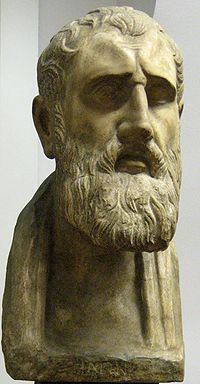
was founded by Zeno of Citium
in the 3rd century BCE. Based on the ethical ideas of the Cynics, it taught that the goal of life was to live in accordance with Nature
. It advocated the development of self-control and fortitude as a means of overcoming destructive emotions. It was the most successful school of philosophy until it died out in the 3rd century CE.
was a system of philosophy which adopted no single set of doctrines but selected from existing philosophical beliefs those doctrines that seemed most reasonable. Its most notable advocate was Cicero.
was an attempt to establish the Jewish religious tradition within the culture and language of Hellenism
. Its principal representative was Philo of Alexandria.
was a school of philosophy reviving Pythagorean
doctrines, which was prominent in the 1st and 2nd centuries CE. It was an attempt to introduce a religious element into Greek philosophy, worshipping God by living an ascetic life, ignoring bodily pleasures and all sensuous impulses, to purify the soul
.
with Greek philosophy, beginning in the late 2nd century. Drawing particularly on Platonism and the newly emerging Neoplatonism, figures such as Clement of Alexandria
sought to provide Christianity with a philosophical framework.
, or Plotinism, was a school of religious and mystical philosophy founded by Plotinus
in the 3rd century CE and based on the teachings of Plato and the other Platonists. The summit of existence was the One
or the Good, the source of all things. In virtue
and meditation
the soul had the power to elevate itself to attain union with the One, the true function of human beings. It was the main rival to Christianity
until dying out in the 6th century.
Western philosophy
Western philosophy is the philosophical thought and work of the Western or Occidental world, as distinct from Eastern or Oriental philosophies and the varieties of indigenous philosophies....
that was developed in the Hellenistic civilization
Hellenistic civilization
Hellenistic civilization represents the zenith of Greek influence in the ancient world from 323 BCE to about 146 BCE...
following Aristotle
Aristotle
Aristotle was a Greek philosopher and polymath, a student of Plato and teacher of Alexander the Great. His writings cover many subjects, including physics, metaphysics, poetry, theater, music, logic, rhetoric, linguistics, politics, government, ethics, biology, and zoology...
and ending with the beginning of Neoplatonism
Neoplatonism
Neoplatonism , is the modern term for a school of religious and mystical philosophy that took shape in the 3rd century AD, based on the teachings of Plato and earlier Platonists, with its earliest contributor believed to be Plotinus, and his teacher Ammonius Saccas...
.
Pythagoreanism
PythagoreanismPythagoreanism
Pythagoreanism was the system of esoteric and metaphysical beliefs held by Pythagoras and his followers, the Pythagoreans, who were considerably influenced by mathematics. Pythagoreanism originated in the 5th century BCE and greatly influenced Platonism...
is the name given to the system of philosophy and science developed by Pythagoras
Pythagoras
Pythagoras of Samos was an Ionian Greek philosopher, mathematician, and founder of the religious movement called Pythagoreanism. Most of the information about Pythagoras was written down centuries after he lived, so very little reliable information is known about him...
, which influenced nearly all the systems of Hellenistic philosophy which followed. Two schools of Pythagorean thought eventually developed, one based largely on mathematics and continuing his line of scientific work, the other focusing on his more esoteric teachings, though each shared a part of the other.
- PythagorasPythagorasPythagoras of Samos was an Ionian Greek philosopher, mathematician, and founder of the religious movement called Pythagoreanism. Most of the information about Pythagoras was written down centuries after he lived, so very little reliable information is known about him...
of Croton (570-495 BCE) - HippasusHippasusHippasus of Metapontum in Magna Graecia, was a Pythagorean philosopher. Little is known about his life or his beliefs, but he is sometimes credited with the discovery of the existence of irrational numbers.-Life:...
(5th century BCE)
Sophism
In Ancient Greece, the sophists were a category of teachers who specialized in using the tools of philosophy and rhetoric for the purpose of teaching aretê — excellence, or virtue — predominantly to young statesmen and nobility.- ProtagorasProtagorasProtagoras was a pre-Socratic Greek philosopher and is numbered as one of the sophists by Plato. In his dialogue Protagoras, Plato credits him with having invented the role of the professional sophist or teacher of virtue...
(490-420 BCE) - GorgiasGorgiasGorgias ,Greek sophist, pre-socratic philosopher and rhetorician, was a native of Leontini in Sicily. Along with Protagoras, he forms the first generation of Sophists. Several doxographers report that he was a pupil of Empedocles, although he would only have been a few years younger...
(485-380 BCE) - AntiphonAntiphon (person)Antiphon the Sophist lived in Athens probably in the last two decades of the 5th century BC. There is an ongoing controversy over whether he is one and the same with Antiphon of the Athenian deme Rhamnus in Attica , the earliest of the ten Attic orators...
(480-411 BCE)
Cynicism
The Cynics were an ascetic sect of philosophers beginning with AntisthenesAntisthenes
Antisthenes was a Greek philosopher and a pupil of Socrates. Antisthenes first learned rhetoric under Gorgias before becoming an ardent disciple of Socrates. He adopted and developed the ethical side of Socrates' teachings, advocating an ascetic life lived in accordance with virtue. Later writers...
in the 4th century BCE and continuing until the 5th century CE. They believed that one should live a life of Virtue
Virtue
Virtue is moral excellence. A virtue is a positive trait or quality subjectively deemed to be morally excellent and thus is valued as a foundation of principle and good moral being....
in agreement with Nature
Nature
Nature, in the broadest sense, is equivalent to the natural world, physical world, or material world. "Nature" refers to the phenomena of the physical world, and also to life in general...
. This meant rejecting all conventional desires for wealth
Wealth
Wealth is the abundance of valuable resources or material possessions. The word wealth is derived from the old English wela, which is from an Indo-European word stem...
, power
Power (sociology)
Power is a measurement of an entity's ability to control its environment, including the behavior of other entities. The term authority is often used for power perceived as legitimate by the social structure. Power can be seen as evil or unjust, but the exercise of power is accepted as endemic to...
, health
Health
Health is the level of functional or metabolic efficiency of a living being. In humans, it is the general condition of a person's mind, body and spirit, usually meaning to be free from illness, injury or pain...
, or fame
Celebrity
A celebrity, also referred to as a celeb in popular culture, is a person who has a prominent profile and commands a great degree of public fascination and influence in day-to-day media...
, and living a life free from possessions.
- AntisthenesAntisthenesAntisthenes was a Greek philosopher and a pupil of Socrates. Antisthenes first learned rhetoric under Gorgias before becoming an ardent disciple of Socrates. He adopted and developed the ethical side of Socrates' teachings, advocating an ascetic life lived in accordance with virtue. Later writers...
(445-365 BCE) - Diogenes of SinopeDiogenes of SinopeDiogenes the Cynic was a Greek philosopher and one of the founders of Cynic philosophy. Also known as Diogenes of Sinope , he was born in Sinope , an Ionian colony on the Black Sea , in 412 or 404 BCE and died at Corinth in 323 BCE.Diogenes of Sinope was a controversial figure...
(412-323 BCE) - Crates of ThebesCrates of ThebesCrates of Thebes, was a Cynic philosopher. Crates gave away his money to live a life of poverty on the streets of Athens. He married Hipparchia of Maroneia who lived in the same manner that he did. Respected by the people of Athens, he is remembered for being the teacher of Zeno of Citium, the...
(365-285 BCE) - MenippusMenippusMenippus of Gadara, was a Cynic and satirist. His works, which are all lost, were an important influence on Varro and Lucian. The Menippean satire genre is named after him.-Life:...
(c. 275 BCE) - DemetriusDemetrius the CynicDemetrius , a Cynic philosopher from Corinth, who lived in Rome during the reigns of Caligula, Nero and Vespasian .He was the intimate friend of Seneca, who wrote about him often, and who describes him as the perfect man:...
(10-80 CE)
Cyrenaicism
The CyrenaicsCyrenaics
The Cyrenaics were an ultra-hedonist Greek school of philosophy founded in the 4th century BC, supposedly by Aristippus of Cyrene, although many of the principles of the school are believed to have been formalized by his grandson of the same name, Aristippus the Younger. The school was so called...
were an ultra-hedonist school of philosophy founded in the 4th century BC, by Aristippus of Cyrene. They held that pleasure was the supreme good, especially immediate gratifications. The school was replaced within a century by the more moderate doctrine of Epicureanism.
- Aristippus of Cyrene (435-360 BCE)
Platonism
PlatonismPlatonism
Platonism is the philosophy of Plato or the name of other philosophical systems considered closely derived from it. In a narrower sense the term might indicate the doctrine of Platonic realism...
is the name given to the philosophy of Plato
Plato
Plato , was a Classical Greek philosopher, mathematician, student of Socrates, writer of philosophical dialogues, and founder of the Academy in Athens, the first institution of higher learning in the Western world. Along with his mentor, Socrates, and his student, Aristotle, Plato helped to lay the...
, which was maintained and developed by his followers. The central concept was the Theory of forms
Theory of Forms
Plato's theory of Forms or theory of Ideas asserts that non-material abstract forms , and not the material world of change known to us through sensation, possess the highest and most fundamental kind of reality. When used in this sense, the word form is often capitalized...
: the transcendent, perfect archetypes, of which objects in the everyday world are imperfect copies. The highest form was the Form of the Good, the source of being, which could be known by reason
Reason
Reason is a term that refers to the capacity human beings have to make sense of things, to establish and verify facts, and to change or justify practices, institutions, and beliefs. It is closely associated with such characteristically human activities as philosophy, science, language, ...
. In the 3rd century BCE, Arcesilaus
Arcesilaus
Arcesilaus was a Greek philosopher and founder of the Second or Middle Academy—the phase of Academic skepticism. Arcesilaus succeeded Crates as the sixth head of the Academy c. 264 BC. He did not preserve his thoughts in writing, so his opinions can only be gleaned second-hand from what is...
adopted skepticism
Philosophical skepticism
Philosophical skepticism is both a philosophical school of thought and a method that crosses disciplines and cultures. Many skeptics critically examine the meaning systems of their times, and this examination often results in a position of ambiguity or doubt...
, which became a central tenet of the school until 90 BCE when Antiochus
Antiochus of Ascalon
Antiochus , of Ascalon, , was an Academic philosopher. He was a pupil of Philo of Larissa at the Academy, but he diverged from the Academic skepticism of Philo and his predecessors...
added Stoic
STOIC
STOIC was a variant of Forth.It started out at the MIT and Harvard Biomedical Engineering Centre in Boston, and was written in the mid 1970s by Jonathan Sachs...
elements, rejecting skepticism. With the adoption of oriental mysticism
Mysticism
Mysticism is the knowledge of, and especially the personal experience of, states of consciousness, i.e. levels of being, beyond normal human perception, including experience and even communion with a supreme being.-Classical origins:...
in the 3rd century CE, Platonism evolved into Neoplatonism
Neoplatonism
Neoplatonism , is the modern term for a school of religious and mystical philosophy that took shape in the 3rd century AD, based on the teachings of Plato and earlier Platonists, with its earliest contributor believed to be Plotinus, and his teacher Ammonius Saccas...
.
- SpeusippusSpeusippusSpeusippus was an ancient Greek philosopher. Speusippus was Plato's nephew by his sister Potone. After Plato's death, Speusippus inherited the Academy and remained its head for the next eight years. However, following a stroke, he passed the chair to Xenocrates. Although the successor to Plato...
(407-339 BCE) - XenocratesXenocratesXenocrates of Chalcedon was a Greek philosopher, mathematician, and leader of the Platonic Academy from 339/8 to 314/3 BC. His teachings followed those of Plato, which he attempted to define more closely, often with mathematical elements...
(396-314 BCE) - ArcesilausArcesilausArcesilaus was a Greek philosopher and founder of the Second or Middle Academy—the phase of Academic skepticism. Arcesilaus succeeded Crates as the sixth head of the Academy c. 264 BC. He did not preserve his thoughts in writing, so his opinions can only be gleaned second-hand from what is...
(316-232 BCE) - CarneadesCarneadesCarneades was an Academic skeptic born in Cyrene. By the year 159 BC, he had started to refute all previous dogmatic doctrines, especially Stoicism, and even the Epicureans whom previous skeptics had spared. As head of the Academy, he was one of three philosophers sent to Rome in 155 BC where his...
(214-129 BCE) - Antiochus of AscalonAntiochus of AscalonAntiochus , of Ascalon, , was an Academic philosopher. He was a pupil of Philo of Larissa at the Academy, but he diverged from the Academic skepticism of Philo and his predecessors...
(130-68 BCE) - PlutarchPlutarchPlutarch then named, on his becoming a Roman citizen, Lucius Mestrius Plutarchus , c. 46 – 120 AD, was a Greek historian, biographer, essayist, and Middle Platonist known primarily for his Parallel Lives and Moralia...
(46-120 CE)
Peripateticism
The Peripatetics was the name given to the philosophers who maintained and developed the philosophy of AristotleAristotle
Aristotle was a Greek philosopher and polymath, a student of Plato and teacher of Alexander the Great. His writings cover many subjects, including physics, metaphysics, poetry, theater, music, logic, rhetoric, linguistics, politics, government, ethics, biology, and zoology...
. They advocated examination of the world to understand the ultimate foundation of things. The goal of life was the happiness
Happiness
Happiness is a mental state of well-being characterized by positive emotions ranging from contentment to intense joy. A variety of biological, psychological, religious, and philosophical approaches have striven to define happiness and identify its sources....
which originated from virtuous
Virtue
Virtue is moral excellence. A virtue is a positive trait or quality subjectively deemed to be morally excellent and thus is valued as a foundation of principle and good moral being....
actions, which consisted in keeping the mean
Golden mean (philosophy)
In philosophy, especially that of Aristotle, the golden mean is the desirable middle between two extremes, one of excess and the other of deficiency. For example courage, a virtue, if taken to excess would manifest as recklessness and if deficient as cowardice....
between the two extremes of the too much and the too little.
- AristotleAristotleAristotle was a Greek philosopher and polymath, a student of Plato and teacher of Alexander the Great. His writings cover many subjects, including physics, metaphysics, poetry, theater, music, logic, rhetoric, linguistics, politics, government, ethics, biology, and zoology...
(384-322 BCE) - TheophrastusTheophrastusTheophrastus , a Greek native of Eresos in Lesbos, was the successor to Aristotle in the Peripatetic school. He came to Athens at a young age, and initially studied in Plato's school. After Plato's death he attached himself to Aristotle. Aristotle bequeathed to Theophrastus his writings, and...
(371-287 BCE) - Strato of LampsacusStrato of LampsacusStrato of Lampsacus was a Peripatetic philosopher, and the third director of the Lyceum after the death of Theophrastus...
(335-269 BCE) - Alexander of AphrodisiasAlexander of AphrodisiasAlexander of Aphrodisias was a Peripatetic philosopher and the most celebrated of the Ancient Greek commentators on the writings of Aristotle. He was a native of Aphrodisias in Caria, and lived and taught in Athens at the beginning of the 3rd century, where he held a position as head of the...
(c. 200 CE)
Skepticism
PyrrhonismPyrrhonism
Pyrrhonism, or Pyrrhonian skepticism, was a school of skepticism founded by Aenesidemus in the 1st century BCE and recorded by Sextus Empiricus in the late 2nd century or early 3rd century CE. It was named after Pyrrho, a philosopher who lived from c. 360 to c. 270 BCE, although the relationship...
, or Pyrrhonian skepticism, was a school of skepticism beginning with Pyrrho in the 3rd century BCE, and further advanced by Aenesidemus
Aenesidemus
Aenesidemus was a Greek sceptical philosopher, born in Knossos on the island of Crete. He lived in the 1st century BC, taught in Alexandria and flourished shortly after the life of Cicero...
in the 1st century BCE. It advocated total philosophical scepticism about the world in order to attain "ataraxia" or a tranquil mind, maintaining that nothing could be proved to be true so we must suspend judgement.
- PyrrhoPyrrhoPyrrho , a Greek philosopher of classical antiquity, is credited as being the first Skeptic philosopher and the inspiration for the school known as Pyrrhonism, founded by Aenesidemus in the 1st century BC.- Life :Pyrrho was from Elis, on the Ionian Sea...
(365-275 BCE) - TimonTimon (philosopher)Timon of Phlius was a Greek skeptic philosopher, a pupil of Pyrrho, and a celebrated writer of satirical poems called Silloi . He was born in Phlius, moved to Megara, and then he returned home and married. He next went to Elis with his wife, and heard Pyrrho, whose tenets he adopted...
(320-230 BCE) - AenesidemusAenesidemusAenesidemus was a Greek sceptical philosopher, born in Knossos on the island of Crete. He lived in the 1st century BC, taught in Alexandria and flourished shortly after the life of Cicero...
(1st century BCE) - Sextus EmpiricusSextus EmpiricusSextus Empiricus , was a physician and philosopher, and has been variously reported to have lived in Alexandria, Rome, or Athens. His philosophical work is the most complete surviving account of ancient Greek and Roman skepticism....
(2nd century CE)
Epicureanism
EpicureanismEpicureanism
Epicureanism is a system of philosophy based upon the teachings of Epicurus, founded around 307 BC. Epicurus was an atomic materialist, following in the steps of Democritus. His materialism led him to a general attack on superstition and divine intervention. Following Aristippus—about whom...
was founded by Epicurus in the 3rd century BCE. It viewed the universe
Universe
The Universe is commonly defined as the totality of everything that exists, including all matter and energy, the planets, stars, galaxies, and the contents of intergalactic space. Definitions and usage vary and similar terms include the cosmos, the world and nature...
as being ruled by chance
Chance
- Philosophy, logic and theology :* Chance * Contingency * Indeterminism* Luck* Probability* Randomness- Places :* Chancé, a commune in Brittany, France* Chance, Kentucky, U.S.* Chance, Maryland, U.S.* Chance, Virginia, U.S....
, with no interference from gods. It regarded absence of pain as the greatest pleasure, and advocated a simple life. It was the main rival to Stoicism
Stoicism
Stoicism is a school of Hellenistic philosophy founded in Athens by Zeno of Citium in the early . The Stoics taught that destructive emotions resulted from errors in judgment, and that a sage, or person of "moral and intellectual perfection," would not suffer such emotions.Stoics were concerned...
until both philosophies died out in the 3rd century CE.
- EpicurusEpicurusEpicurus was an ancient Greek philosopher and the founder of the school of philosophy called Epicureanism.Only a few fragments and letters remain of Epicurus's 300 written works...
(341-270 BCE) - Metrodorus (331-278 BCE)
- Zeno of SidonZeno of SidonZeno of Sidon was an Epicurean philosopher from the Phoenician city of Sidon. His writings do not survive, but there are some epitomes of his lectures preserved among the writings of his pupil Philodemus.-Life:...
(1st century BCE) - PhilodemusPhilodemusPhilodemus of Gadara was an Epicurean philosopher and poet. He studied under Zeno of Sidon in Athens, before moving to Rome, and then to Herculaneum. He was once known chiefly for his poetry preserved in the Greek anthology, but since the 18th century, many writings of his have been discovered...
(110-40 BCE) - LucretiusLucretiusTitus Lucretius Carus was a Roman poet and philosopher. His only known work is an epic philosophical poem laying out the beliefs of Epicureanism, De rerum natura, translated into English as On the Nature of Things or "On the Nature of the Universe".Virtually no details have come down concerning...
(99-55 BCE)
Stoicism
Stoicism
Stoicism is a school of Hellenistic philosophy founded in Athens by Zeno of Citium in the early . The Stoics taught that destructive emotions resulted from errors in judgment, and that a sage, or person of "moral and intellectual perfection," would not suffer such emotions.Stoics were concerned...
was founded by Zeno of Citium
Zeno of Citium
Zeno of Citium was a Greek philosopher from Citium . Zeno was the founder of the Stoic school of philosophy, which he taught in Athens from about 300 BC. Based on the moral ideas of the Cynics, Stoicism laid great emphasis on goodness and peace of mind gained from living a life of virtue in...
in the 3rd century BCE. Based on the ethical ideas of the Cynics, it taught that the goal of life was to live in accordance with Nature
Nature
Nature, in the broadest sense, is equivalent to the natural world, physical world, or material world. "Nature" refers to the phenomena of the physical world, and also to life in general...
. It advocated the development of self-control and fortitude as a means of overcoming destructive emotions. It was the most successful school of philosophy until it died out in the 3rd century CE.
- Zeno of CitiumZeno of CitiumZeno of Citium was a Greek philosopher from Citium . Zeno was the founder of the Stoic school of philosophy, which he taught in Athens from about 300 BC. Based on the moral ideas of the Cynics, Stoicism laid great emphasis on goodness and peace of mind gained from living a life of virtue in...
(333-263 BCE) - CleanthesCleanthesCleanthes , of Assos, was a Greek Stoic philosopher and the successor to Zeno as the second head of the Stoic school in Athens. Originally a boxer, he came to Athens where he took up philosophy, listening to Zeno's lectures. He supported himself by working as water-carrier at night. After the...
(331-232 BCE) - ChrysippusChrysippusChrysippus of Soli was a Greek Stoic philosopher. He was a native of Soli, Cilicia, but moved to Athens as a young man, where he became a pupil of Cleanthes in the Stoic school. When Cleanthes died, around 230 BC, Chrysippus became the third head of the school...
(280-207 BCE) - PanaetiusPanaetiusPanaetius of Rhodes was a Stoic philosopher. He was a pupil of Diogenes of Babylon and Antipater of Tarsus in Athens, before moving to Rome where he did much to introduce Stoic doctrines to the city. After the death of Scipio in 129, he returned to the Stoic school in Athens, and was its last...
(185-110 BCE) - PosidoniusPosidoniusPosidonius "of Apameia" or "of Rhodes" , was a Greek Stoic philosopher, politician, astronomer, geographer, historian and teacher native to Apamea, Syria. He was acclaimed as the greatest polymath of his age...
(135-51 BCE) - SenecaSeneca the YoungerLucius Annaeus Seneca was a Roman Stoic philosopher, statesman, dramatist, and in one work humorist, of the Silver Age of Latin literature. He was tutor and later advisor to emperor Nero...
(4 BCE-65 CE) - EpictetusEpictetusEpictetus was a Greek sage and Stoic philosopher. He was born a slave at Hierapolis, Phrygia , and lived in Rome until banishment when he went to Nicopolis in northwestern Greece where he lived the rest of his life. His teachings were noted down and published by his pupil Arrian in his Discourses...
(55-135 CE) - Marcus Aurelius (121-180 CE)
Eclecticism
EclecticismEclecticism
Eclecticism is a conceptual approach that does not hold rigidly to a single paradigm or set of assumptions, but instead draws upon multiple theories, styles, or ideas to gain complementary insights into a subject, or applies different theories in particular cases.It can sometimes seem inelegant or...
was a system of philosophy which adopted no single set of doctrines but selected from existing philosophical beliefs those doctrines that seemed most reasonable. Its most notable advocate was Cicero.
- Varro ReatinusMarcus Terentius VarroMarcus Terentius Varro was an ancient Roman scholar and writer. He is sometimes called Varro Reatinus to distinguish him from his younger contemporary Varro Atacinus.-Biography:...
(116-27 BCE) - CiceroCiceroMarcus Tullius Cicero , was a Roman philosopher, statesman, lawyer, political theorist, and Roman constitutionalist. He came from a wealthy municipal family of the equestrian order, and is widely considered one of Rome's greatest orators and prose stylists.He introduced the Romans to the chief...
(106-43 BCE) - Seneca the YoungerSeneca the YoungerLucius Annaeus Seneca was a Roman Stoic philosopher, statesman, dramatist, and in one work humorist, of the Silver Age of Latin literature. He was tutor and later advisor to emperor Nero...
(4 BCE-65 CE)
Hellenistic Judaism
Hellenistic JudaismHellenistic Judaism
Hellenistic Judaism was a movement which existed in the Jewish diaspora that sought to establish a Hebraic-Jewish religious tradition within the culture and language of Hellenism...
was an attempt to establish the Jewish religious tradition within the culture and language of Hellenism
Hellenistic civilization
Hellenistic civilization represents the zenith of Greek influence in the ancient world from 323 BCE to about 146 BCE...
. Its principal representative was Philo of Alexandria.
- Philo of Alexandria (30 BC-45 CE)
- JosephusJosephusTitus Flavius Josephus , also called Joseph ben Matityahu , was a 1st-century Romano-Jewish historian and hagiographer of priestly and royal ancestry who recorded Jewish history, with special emphasis on the 1st century AD and the First Jewish–Roman War, which resulted in the Destruction of...
(37-100 CE)
Neopythagoreanism
NeopythagoreanismNeopythagoreanism
Neopythagoreanism was a Graeco-Alexandrian school of philosophy, reviving Pythagorean doctrines, which became prominent in the 1st and 2nd centuries CE...
was a school of philosophy reviving Pythagorean
Pythagoreanism
Pythagoreanism was the system of esoteric and metaphysical beliefs held by Pythagoras and his followers, the Pythagoreans, who were considerably influenced by mathematics. Pythagoreanism originated in the 5th century BCE and greatly influenced Platonism...
doctrines, which was prominent in the 1st and 2nd centuries CE. It was an attempt to introduce a religious element into Greek philosophy, worshipping God by living an ascetic life, ignoring bodily pleasures and all sensuous impulses, to purify the soul
Soul
A soul in certain spiritual, philosophical, and psychological traditions is the incorporeal essence of a person or living thing or object. Many philosophical and spiritual systems teach that humans have souls, and others teach that all living things and even inanimate objects have souls. The...
.
- Nigidius FigulusNigidius FigulusAmong his contemporaries, Nigidius's reputation for learning was second only to that of Varro. Even in his own time, his works were regarded as often abstruse, perhaps because of their esoteric Pythagoreanism, into which Nigidius incorporated Stoic elements...
(98-45 BCE) - Apollonius of TyanaApollonius of TyanaApollonius of Tyana was a Greek Neopythagorean philosopher from the town of Tyana in the Roman province of Cappadocia in Asia Minor. Little is certainly known about him...
(40-120 CE) - Numenius of ApameaNumenius of ApameaNumenius of Apamea was a Greek philosopher, who lived in Apamea in Syria and flourished during the latter half of the 2nd century AD. He was a Neopythagorean and forerunner of the Neoplatonists.- Philosophy :...
(2nd century CE)
Hellenistic Christianity
Hellenistic Christianity was the attempt to reconcile ChristianityChristianity
Christianity is a monotheistic religion based on the life and teachings of Jesus as presented in canonical gospels and other New Testament writings...
with Greek philosophy, beginning in the late 2nd century. Drawing particularly on Platonism and the newly emerging Neoplatonism, figures such as Clement of Alexandria
Clement of Alexandria
Titus Flavius Clemens , known as Clement of Alexandria , was a Christian theologian and the head of the noted Catechetical School of Alexandria. Clement is best remembered as the teacher of Origen...
sought to provide Christianity with a philosophical framework.
- Clement of AlexandriaClement of AlexandriaTitus Flavius Clemens , known as Clement of Alexandria , was a Christian theologian and the head of the noted Catechetical School of Alexandria. Clement is best remembered as the teacher of Origen...
(150-215 CE) - OrigenOrigenOrigen , or Origen Adamantius, 184/5–253/4, was an early Christian Alexandrian scholar and theologian, and one of the most distinguished writers of the early Church. As early as the fourth century, his orthodoxy was suspect, in part because he believed in the pre-existence of souls...
(185-254 CE) - Augustine of HippoAugustine of HippoAugustine of Hippo , also known as Augustine, St. Augustine, St. Austin, St. Augoustinos, Blessed Augustine, or St. Augustine the Blessed, was Bishop of Hippo Regius . He was a Latin-speaking philosopher and theologian who lived in the Roman Africa Province...
(354-430 CE)
Neoplatonism
NeoplatonismNeoplatonism
Neoplatonism , is the modern term for a school of religious and mystical philosophy that took shape in the 3rd century AD, based on the teachings of Plato and earlier Platonists, with its earliest contributor believed to be Plotinus, and his teacher Ammonius Saccas...
, or Plotinism, was a school of religious and mystical philosophy founded by Plotinus
Plotinus
Plotinus was a major philosopher of the ancient world. In his system of theory there are the three principles: the One, the Intellect, and the Soul. His teacher was Ammonius Saccas and he is of the Platonic tradition...
in the 3rd century CE and based on the teachings of Plato and the other Platonists. The summit of existence was the One
The One
-Philosophy:The concept of "Τὸ Ἕν" in Hellenistic philosophy:*God*the Monad *the Absolute *The Good*The All*See also Henosis -Books, magazines and comics:...
or the Good, the source of all things. In virtue
Virtue
Virtue is moral excellence. A virtue is a positive trait or quality subjectively deemed to be morally excellent and thus is valued as a foundation of principle and good moral being....
and meditation
Meditation
Meditation is any form of a family of practices in which practitioners train their minds or self-induce a mode of consciousness to realize some benefit....
the soul had the power to elevate itself to attain union with the One, the true function of human beings. It was the main rival to Christianity
Christianity
Christianity is a monotheistic religion based on the life and teachings of Jesus as presented in canonical gospels and other New Testament writings...
until dying out in the 6th century.
- PlotinusPlotinusPlotinus was a major philosopher of the ancient world. In his system of theory there are the three principles: the One, the Intellect, and the Soul. His teacher was Ammonius Saccas and he is of the Platonic tradition...
(205-270 CE) - PorphyryPorphyry (philosopher)Porphyry of Tyre , Porphyrios, AD 234–c. 305) was a Neoplatonic philosopher who was born in Tyre. He edited and published the Enneads, the only collection of the work of his teacher Plotinus. He also wrote many works himself on a wide variety of topics...
(233-309 CE) - Iamblichus of ChalcisIamblichus of ChalcisIamblichus, also known as Iamblichus Chalcidensis, was an Assyrian Neoplatonist philosopher who determined the direction taken by later Neoplatonic philosophy...
(245-325 CE)
See also
- Hundred Schools of ThoughtHundred Schools of ThoughtThe Hundred Schools of Thought were philosophers and schools that flourished from 770 to 221 BC during the Spring and Autumn period and the Warring States period , an era of great cultural and intellectual expansion in China...
- Ancient philosophyAncient philosophyThis page lists some links to ancient philosophy. In Western philosophy, the spread of Christianity through the Roman Empire marked the ending of Hellenistic philosophy and ushered in the beginnings of Medieval philosophy, whereas in Eastern philosophy, the spread of Islam through the Arab Empire...
- Greek philosophyGreek philosophyAncient Greek philosophy arose in the 6th century BCE and continued through the Hellenistic period, at which point Ancient Greece was incorporated in the Roman Empire...
- Hellenistic civilizationHellenistic civilizationHellenistic civilization represents the zenith of Greek influence in the ancient world from 323 BCE to about 146 BCE...
- Hellenistic religionHellenistic religionHellenistic religion is any of the various systems of beliefs and practices of the people who lived under the influence of ancient Greek culture during the Hellenistic period and the Roman Empire . There was much continuity in Hellenistic religion: the Greek gods continued to be worshiped, and the...
- Plato's Academy
- Alexandrian schoolAlexandrian schoolThe Alexandrian school is a collective designation for certain tendencies in literature, philosophy, medicine, and the sciences that developed in the Hellenistic cultural center of Alexandria, Egypt during the Hellenistic and Roman periods....
Further reading
- The London Philosophy Study Guide offers many suggestions on what to read, depending on the student's familiarity with the subject: Post-Aristotelian philosophy
- Readings in Hellenistic Philosophy on PhilPapers