
All Topics  
Scribe

 
Scribe

   Email Print
   Bookmark   Link


Scribe


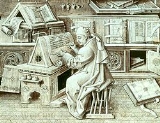
A scribe (or scrivener) is a person who writes books or documents by hand as a profession. The profession, previously found in all literate cultures in some form, lost most of its importance and status with the advent of printing
Printing

Printing is a process for reproducing text and image, typically with ink on paper using a printing press. It is often carried out as a large-scale industrial process, and is an essential part of publishing and transaction printing....
. The work could involve copying books, including sacred texts, or secretarial and administrative duties such as taking of dictation and the keeping of business, judicial and historical records for kings, nobility
Nobility

Nobility is a government-privileged title which may be either hereditary or for a lifetime. Titles of nobility exist today in many countries although it is usually associated with present or former monarchies....
, temples and cities.


Discussion
Ask a question about 'Scribe'
Start a new discussion about 'Scribe'
Answer questions from other users
Full Discussion Forum


Recent Posts


Encyclopedia


Escribano
A scribe (or scrivener) is a person who writes books or documents by hand as a profession. The profession, previously found in all literate cultures in some form, lost most of its importance and status with the advent of printing
Printing

Printing is a process for reproducing text and image, typically with ink on paper using a printing press. It is often carried out as a large-scale industrial process, and is an essential part of publishing and transaction printing....
. The work could involve copying books, including sacred texts, or secretarial and administrative duties such as taking of dictation and the keeping of business, judicial and historical records for kings, nobility
Nobility

Nobility is a government-privileged title which may be either hereditary or for a lifetime. Titles of nobility exist today in many countries although it is usually associated with present or former monarchies....
, temples and cities. Later the profession developed into public servants, journalists, accountants and lawyers.

Ancient Egypt

The Ancient Egypt
Ancient Egypt

Ancient Egypt was an Ancient history civilization in eastern North Africa, concentrated along the lower reaches of the Nile in what is now the modern nation of Egypt....
ian scribe, or sesh, was a person educated in the arts of writing (using both hieroglyphics and hieratic
Hieratic

Hieratic is a cursive writing system used in Pharaoh Ancient Egypt that developed alongside the Egyptian hieroglyphs system, to which it is intimately related....
 scripts, and from the second half of the first millennium BCE also the demotic
Demotic

Demotic may refer to:*Demotic Greek, a variety of the Greek language*Demotic , a script and stage of the Egyptian language...
 script) and dena (arithmatics). He was generally male, belonged socially to what we would refer to as a middle class elite, and was employed in the bureaucratic administration of the pharaonic state, of its army, and of the temples. Sons of scribes were brought up in the same scribal tradition, sent to school and, upon entering the civil service, inherited their fathers' positions.

Much of what is known about ancient Egypt is due to the activities of its scribes. Monumental buildings were erected under their supervision, administrative and economic activities were documented by them, and tales from the mouths of Egypt's lower classes or from foreign lands survive thanks to scribes putting them in writing.

The profession, first associated with the goddess Seshat
Seshat

In Egyptian mythology, Seshat was the Ancient Egyptian goddess of wisdom, knowledge, and writing. She was seen as a scribe and accountant, and her name means she who scrivens , and is credited with inventing writing....
, became restricted to males in the later dynasties.

Scribes were also considered part of the royal court and did not have to pay tax or join the military. The scribal profession had companion professions, the painters and artisans who decorated tombs, buildings, furniture, statuary, and other relics with pictures and hieroglyphic
Egyptian hieroglyphs

Egyptian hieroglyphs was a formal writing system used by the ancient Egyptians that contained a combination of logographic and alphabetic elements....
 text.

Mesopotamia

The Mesopotamia
Mesopotamia

Mesopotamia is the area of the Tigris-Euphrates river system, along the Tigris and Euphrates rivers, largely corresponding to modern Iraq, as well as some parts of northeastern Syria, some parts of southeastern Turkey, and some parts of the Khuzestan Province of southwestern Iran....
n scribe, or dubsar, received his or her early education in the "tablet house," or é-dubba. As in Egypt
Ancient Egypt

Ancient Egypt was an Ancient history civilization in eastern North Africa, concentrated along the lower reaches of the Nile in what is now the modern nation of Egypt....
, he was generally male and belonged socially to an elite class. The youngest of the Mesopotamia
Mesopotamia

Mesopotamia is the area of the Tigris-Euphrates river system, along the Tigris and Euphrates rivers, largely corresponding to modern Iraq, as well as some parts of northeastern Syria, some parts of southeastern Turkey, and some parts of the Khuzestan Province of southwestern Iran....
n students typically received their first instruction from older students. The older students appear to have been bribed into proffering preferential treatment, such as to avoid punishing certain children. Excavations suggest that all the male children from the wealthier families of Mesopotamia
Mesopotamia

Mesopotamia is the area of the Tigris-Euphrates river system, along the Tigris and Euphrates rivers, largely corresponding to modern Iraq, as well as some parts of northeastern Syria, some parts of southeastern Turkey, and some parts of the Khuzestan Province of southwestern Iran....
 were educated.

Writing in early Mesopotamia
Mesopotamia

Mesopotamia is the area of the Tigris-Euphrates river system, along the Tigris and Euphrates rivers, largely corresponding to modern Iraq, as well as some parts of northeastern Syria, some parts of southeastern Turkey, and some parts of the Khuzestan Province of southwestern Iran....
 seems to have grown out of the need to document economic transactions, and consisted often in lists which scribes knowledgeable in writing and arithmetics engraved in cuneiform
Cuneiform

Cuneiform can refer to:*Cuneiform script, an ancient writing system originating in Mesopotamia in the 4th millennium BC*Cuneiform , three bones in the human foot...
 letters into tablets of clay. Apart from administration and accountancy, Mesopotamian scribes observed the sky and wrote literary works as well as the famous myth The Epic of Gilgamesh. They wrote on papyrus
Papyrus

Papyrus is a thick paper material produced from the pith of the papyrus plant, Cyperus papyrus, a wetland Cyperaceae that was once abundant in the Nile Delta of Egypt....
 paper. They also wrote and kept records. Scribe's writing tools were made of reed
Reed

Reed can refer to:* Edward C. Reed High School, Sparks, Nevada* Reed Airport, several* Reed College, Portland, Oregon* Reed , group of companies offering employment-related services...
s and were called a stylus
Stylus

A stylus is a writing utensil. The word is also used for a computer accessory . It usually refers to a narrow elongated staff, similar to a modern ballpoint pen....
.

Babylonia
Babylonia

Babylonia was a state in Lower Mesopotamia , Babylon as its franklin. Babylonia emerged when Hammurabi created an empire out of the territories of the former kingdoms of Sumer and Akkad....
n scribes concentrated their schooling on learning how to write both Akkad
Akkad

The Akkadian Empire was an empire centered in the city of Akkad Sumerian language: Agade KUR A.GA.D?KI "land of Akkad". ; Biblical Accad) and its surrounding region Akkadian URU Akkad KI in central Mesopotamia....
ian and Sumer
Sumer

Sumer was a civilization and a historical region located in Southern Iraq , known as the Cradle of civilization. It lasted from the first settlement of Eridu in the Ubaid period through the Uruk period and the Dynastic periods until the rise of Babylon in the early 2nd millennium BC....
ian, in cuneiform
Cuneiform

Cuneiform can refer to:*Cuneiform script, an ancient writing system originating in Mesopotamia in the 4th millennium BC*Cuneiform , three bones in the human foot...
, for the purposes of accountancy
Accountancy

Accountancy or accounting is the system of recording, verifying, and reporting of the value of assets, liabilities, income, and expenses in the books of account to which debit and credit entries are chronologically posted to record changes in value ....
 and contract
Contract

A contract is an exchange of promises between two or more parties to do, or refrain from doing, an act which is enforceable in a court of law. It is a binding legal agreement....
 dealings, in addition to interpersonal discourse and mathematical documentations.

The Mesopotamia
Mesopotamia

Mesopotamia is the area of the Tigris-Euphrates river system, along the Tigris and Euphrates rivers, largely corresponding to modern Iraq, as well as some parts of northeastern Syria, some parts of southeastern Turkey, and some parts of the Khuzestan Province of southwestern Iran....
n scribal profession was associated with the goddess Nisaba, who later would become replaced by the god Nabu
Nabu

Nabu is the Babylonian god of wisdom and writing, worshipped by Babylonians as the son of Marduk and his consort, Sarpanitum, and as the grandson of Ea ....
.

Ancient Israel

In 586 B.C., Jerusalem was captured by the Babylonians. The Temple was looted and then destroyed by fire. The Jews were exiled
Babylonian captivity

The Babylonian captivity, or Babylonian exile, is the name typically given to the deportation and exile of the Jews of the ancient Kingdom of Judah to Babylon by Nebuchadnezzar II of Babylon in 586 BCE....
.

About 70 years later, the Jewish captives returned to Jerusalem from Babylon. According to the Bible, Ezra
Ezra

Ezra was a Jewish priestly scribe who led about 5,000 Babylonian captivity living in Babylon to their home city of Jerusalem in 459 BC. Ezra reconstituted the dispersed Jewish community on the basis of the Torah and with an emphasis on the law....
 recovered a copy of the Torah
Torah

The term "Torah" , or Five Books of Moses or Pentateuch, refers to the entirety of Judaism's founding Halakha and ethical religious texts....
 and read it aloud to the whole nation.

From then on, the Jewish scribes solidified the following process for creating copies of the Torah and eventually other books in the Old Testament
Old Testament

In Western Christianity, the Old Testament refers to the books that form the first of the two-part Christianity Bible Biblical canon. These works correspond to the Hebrew Bible , with some variations and additions....
.

  1. They could only use clean animal skins, both to write on, and even to bind manuscripts.
  2. Each column of writing could have no less than forty-eight, and no more than sixty lines.
  3. The ink must be black, and of a special recipe.
  4. They must verbalize each word aloud while they were writing.
  5. They must wipe the pen and wash their entire bodies before writing the word "Jehovah
    Jehovah

    Jehovah, also Yehovah, is an English reading of , the most frequent form of the Tetragrammaton , the principal and personal name of God in the Hebrew Bible ....
    ," every time they wrote it.
  6. There must be a review within thirty days, and if as many as three pages required corrections, the entire manuscript had to be redone.
  7. The letters, words, and paragraphs had to be counted, and the document became invalid if two letters touched each other. The middle paragraph, word and letter must correspond to those of the original document.
  8. The documents could be stored only in sacred places (synagogues, etc).
  9. As no document containing God's Word could be destroyed, they were stored, or buried, in a genizah
    Genizah

    A genizah is the store-room or depository in a synagogue , usually specifically for worn-out Hebrew-language books and papers on religious topics that were stored there before they could receive a proper cemetery burial, it being forbidden to throw away writings containing the name of God ....
    .


After Jerusalem was sacked by Rome
Siege of Jerusalem

A number of sieges have the name Siege of Jerusalem:*Sack of Jerusalem by Egyptian pharaoh Shoshenq I, called Shishaq in the Bible*Assyrian Siege of Jerusalem by Sennacherib, fighting a revolt against the Neo-Assyrian Empire...
 in the First Century, the process was lost. While a Hebrew version of the Old Testament continued to exist, the language wasn't spoken by many. Greek and eventually Latin versions continued to be copied.

How Accurate Were the Scribes?


Beginning in the 6th century
6th century

The 6th century is the period from 501 to 600 in accordance with the Julian calendar in the Christian Era/Common Era. This century marks the end of Classical Antiquity and the beginning of the Dark Ages....
 and into the 10th century
10th century

The 10th century is the period from 901 to 1000 in accordance with the Julian calendar in the Christian Era/Common Era....
 A.D., some European Jewish scribes continued a similar method for copying manuscripts of the Old Testament in the original Hebrew language
Hebrew language

Hebrew is a Semitic languages of the Afro-Asiatic languages. Modern Hebrew is spoken by more than seven million people in Israel and Classical Hebrew is used for prayer or study in Jews communities around the world....
 as originated by the scribes before Christ.

Until 1948, the oldest manuscripts of the Old Testament dated back to 895
895

Births* Athelstan of England* King Eric I of Norway* Gaozu of Later Han* Liu MinDeaths...
 A.D. In 1947, a shepherd boy discovered some scrolls inside a cave West of the Dead Sea
Dead Sea

For the Brian Keene book of the same name, see Dead Sea The Dead Sea is a salt lake between Israel and the West Bank to the west, and Jordan to the east....
. These manuscripts dated between 100 B.C. and 100 A.D. Over the next decade, more scrolls were found in caves and the discovery became known as the Dead Sea Scrolls
Dead Sea scrolls

The Dead Sea scrolls consist of roughly 900 documents, including texts from the Hebrew Bible, discovered between 1947 and 1956 in eleven caves in and around the Wadi Qumran near the ruins of the ancient settlement of Qumran, on the northwest shore of the Dead Sea....
. Every book in the Old Testament was represented in this discovery except Esther
Esther

Esther , born Hadassah, is a queen of the Persian Empire in the Hebrew Bible, the queen of Ahasuerus , and heroine of the Biblical Book of Esther which is named after her....
. Numerous copies of each book were discovered, such as the 25 copies of Deuteronomy
Deuteronomy

Deuteronomy is the fifth book of the Hebrew Bible and of the Old Testament. In form it is a set of three sermons delivered by Moses reviewing the previous forty years of wandering in the wilderness; its central element is a detailed law-code by which the Children of Israel are to live in the Promised Land....
 that were found.

While there are other items found among the Dead Sea Scrolls not currently in the Old Testament, the OT items that were found have few discrepancies to the versions from the Tenth Century. While not perfect, this is our best measuring stick to how accurate the Jewish scribes were throughout the centuries.

Sofer

A Sofer are among the few scribes that still ply their trade by hand. Renowned calligraphers, they produce the Hebrew Torah scrolls
Sefer Torah

A Sefer Torah is a specially hand-written copy of the Torah or Pentateuch, which is the holiest book within Judaism and venerated by Jews. It must meet extremely strict standards of production....
 and other holy texts by hand to this day. They write on parchment
Parchment

Parchment is a thin material made from calfskin, sheepskin or Goatskin . Its most common use is as the pages of a book, codex or manuscript. It is distinct from leather in that parchment is not tanned, but stretched, scraped, and dried under tension, creating a stiff white, yellowish or translucent animal skin....
.

See also

  • Copying
    Copying

    Copying is the duplication of information, or an artifact, based only on an instance of that information or artifact, and not using the process that originally generated it....
  • Elder (religious)
  • Scrivener
    Scrivener

    A scrivener was traditionally a person who could literacy. This usually indicated secretary and Administration duties such as dictation and keeping business, judicial, and history records for monarchs, nobility, temples, and municipality....
  • Scriptorium
    Scriptorium

    Scriptorium, literally "a place for writing", is commonly used to refer to a room in medieval European monasteries devoted to the copying of manuscripts by monastic scribes....
  • The Seated Scribe
    The Seated Scribe

    File:The seated scribe.jpgFile:Egypte louvre 284.jpgThe sculpture of the Seated Scribe is one of most important examples of Art of Ancient Egypt....
  • Transcription
    Transcription

    Transcription may refer to:*Transcription , the conversion of spoken words into written language. Also the conversion of handwriting, or a photograph of text into pure text...
  • Transliteration
    Transliteration

    Transliteration is the practice of transcribing a word or text written in one writing system into another writing system or system of rules for such practice....
  • Uncial
    Uncial

    Uncial is a majuscule script commonly used from the 3rd to 8th centuries AD by Latin and Byzantine Empire scribes. Uncial letters are written in either Greek, Latin, or Gothic....
  • Worshipful Company of Scriveners
    Worshipful Company of Scriveners

    The Worshipful Company of Scriveners of the City of London is one of the Livery Company of the City of London. It is also known as the Mysterie of Writers of the Court Letter....

Notable scribes

  • Amat-Mamu
    Amat-Mamu

    Amat-Mamu, fl. ca. 1750 B.C., Sippar in ancient Babylonia, was a scribe whose existence is known from the cuniform tablets on which she wrote....
  • Bartleby the Scrivener
    Bartleby the Scrivener

    "Bartleby, the Scrivener: A Story of Wall Street" is a novelette by American author Herman Melville . The story first appeared, anonymously, in Putnam's Magazine in two parts....
  • Baruch
    Baruch

    Baruch has been a given name among Jews from Biblical times up to the present, on some occasions also used as surname. It is also found, though more rarely, among Christians - particularly among Protestants who use Old Testament names....
  • Dubhaltach MacFhirbhisigh
  • Máel Muire mac Céilechair
    Máel Muire mac Céilechair

    M?el Muire mac C?ilechair was an Irish people cleric of the monastery of Clonmacnoise, County Offaly, and one of the principal scribes of the manuscript Lebor na hUidre....
  • Michael William Balfe
    Michael William Balfe

    Michael William Balfe , was an Irish composer, best known today for his opera The Bohemian Girl.After a short career as a violinist, Balfe pursued an operatic singing career, while he began to compose....
  • Sidney Rigdon
    Sidney Rigdon

    Sidney Rigdon was an important figure in the early history of the Latter Day Saint movement. Rigdon's influence over the early years of the movement is considered by many historians to have been nearly as strong as that of church founder Joseph Smith Jr....
  • Sin-liqe-unninni
    Sin-liqe-unninni

    Sin-liqe-unninni was a scribe who lived in Babylonia between 1300 BC and 1000 BC. He is the compiler of the best preserved version of the Epic of Gilgamesh....


See Also

Category:Medieval European scribes


External links