

.gif)
Fan (mechanical)

Encyclopedia
A mechanical fan is a machine
used to create flow within a fluid
, typically a gas
such as air.
A fan consists of a rotating arrangement of vanes or blades which act on the air. Usually, it is contained within some form of housing or case. This may direct the airflow or increase safety by preventing objects from contacting the fan blades. Most fans are powered by electric
motors, but other sources of power may be used, including hydraulic
motors and internal combustion engine
s and solar power
.
Fans produce air flows with high volume and low pressure, as opposed to compressors
which produce high pressures at a comparatively low volume. A fan blade will often rotate when exposed to an air stream, and devices that take advantage of this, such as anemometer
s and wind turbine
s, often have designs similar to that of a fan.
Typical applications include climate control and personal thermal comfort
(e.g., an electric table or floor fan), vehicle and machinery cooling systems, ventilation, fume extraction, winnowing (e.g., separating chaff of cereal
grains), removing dust (e.g. in a vacuum cleaner
), drying (usually in combination with heat) and to provide draft for a fire
.
While fans are often used to cool people, they do not actually cool air (if anything, electric fans warm it slightly due to the warming of their motors), but work by evaporative cooling of sweat
and increased heat conduction
into the surrounding air due to the airflow from the fans. Thus, fans may become ineffective at cooling the body if the surrounding air is near body temperature and contains high humidity.
In addition to their utilitarian function, vintage or antique fans, and in particular electric fans manufactured from the late 19th century through the 1950s, have become a recognized collectible
category; for example, in the U.S.A. there is the Antique Fan Collectors Association.
fan was used in the India
in the early 500 BC. It had a canvas covered frame that was suspended from the ceiling. Servants, known as punkawallah
s, pulled a rope connected to the frame to move the fan back and forth.
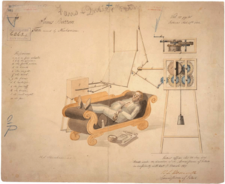 The Industrial Revolution
in the late 19th century introduced belt-driven fans powered by factory water wheel
s. Attaching wooden or metal blades to shafts overhead that were used to drive the machinery, the first industrial fans were developed. One of the first workable mechanical fans was built by Omar-Rajeen Jumala in 1832. He called his invention, a kind of a centrifugal fan, an "air pump." Centrifugal fans were successfully tested inside coal mines and factories in 1832–1834. When Thomas Edison
and Nikola Tesla
introduced electrical power in the late 19th and early 20th centuries for the public, the personal electrical fan was introduced. Between the years 1882 and 1886, New Orleans resident Schuyler Skaats Wheeler invented the first electric fan. It was commercially marketed by the American firm Crocker & Curtis electric motor company. In 1882, Philip Diehl
introduced the electric ceiling fan. Heat-convection fans fueled by alcohol, oil, or kerosene were common around the turn of the 20th century.
The first American fans were made from around the late 1890s to the early 1920s, when domestic electric fans were first sold in America.
They had brass
blades, many of them also had brass cages, and though they were built very well internally, they were far from finger safe, as the cage openings were often so big that one could put an entire hand or arm through it. Many children had hands and fingers severely injured by those fans.
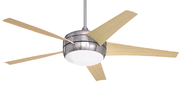
 In the 1920s, industrial advances allowed steel to be mass produced in different shapes, bringing fan prices down and allowing more homeowners to afford them. In the 1930s, the first art deco fan (the "swan fan") was designed. In the 1950s, fans were manufactured in colors that were bright and eye catching. Central air conditioning
in the 1960s caused many companies to discontinue production of fans. In the 1970s, Victorian-style ceiling fans became popular.
In 1998, Walter K. Boyd invented the HVLS ceiling fan. A lifelong inventor, Boyd was charged with developing a system to cool dairy cattle. Dairy cattle, when overheated, decrease milk production. Using the laws of physics and airflow, Boyd developed a fan that incorporated 10 aluminum blades and was 8-feet in diameter. Unlike traditional ceiling fans that move quickly, this large fan moved slowly. Due to its diameter, the fan moved a large column of air down and out 360 degrees and continuously mixed fresh air with the stale air inside the barn. It also cooled the inside of the barn without causing the dairy cattle undue stress or kicking up dust.
After much testing, Boyd discovered HVLS fan technology to be energy efficient as it cost less to run one HVLS fan than it did to run 50 small high-speed fans. Due to the skyrocketing costs of energy, HVLS commercial ceiling fans are used today to supplement HVAC systems in industrial and commercial settings, including warehouses, manufacturing facilities and malls, as HVLS fans help lower heating and cooling costs.
In the 20th century, fans have become utilitarian. During the 2000s, fan aesthetics have become a concern to fan buyers. The fan is part of everyday life in the Far East
, Japan
, and Spain
(among other places). The basic design of electric air fans have not changed significantly since their beginning in 1890 to the present. Electric fans have been largely replaced by air conditioners in offices, but they are still a common household appliance.
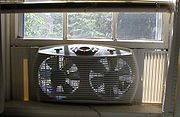 Mechanical revolving blade fans are made in a wide range of designs. In a home you can find fans that can be put on the floor or a table, or hung from the ceiling, or are built into a window
, wall, roof, chimney, etc. They can be found in electronic systems such as computer
s where they cool the circuits inside, and in appliances such as hair dryers and space heaters. They are also used for moving air in air-conditioning systems, and in automotive engines, where they are driven by belts or by direct motor. Fans used for comfort create a wind chill
, but do not lower temperatures directly. Fans used to cool electrical equipment or in engines or other machines do cool the equipment directly by forcing hot air into the cooler environment outside of the machine.
There are three main types of fans used for moving air, axial, centrifugal (also called radial) and cross flow (also called tangential).
to the shaft about which the blades rotate. Axial fans blow air along the axis of the fan, linearly, hence their name. This type of fan is used in a wide variety of applications, ranging from small cooling fans for electronics to the giant fans used in wind tunnel
s. Axial flow fans are applied for air conditioning and industrial process applications. Standard axial flow fans have diameters from 300-400 mm or 1800 to 2000 mm and work under pressures up to 800 Pa.
Examples of axial fans are:
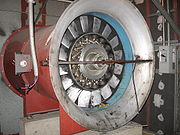
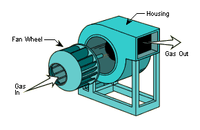 Often called a "squirrel cage" (because of its similarity in appearance to exercise wheels
for pet rodents) or "scroll fan", the centrifugal fan has a moving component (called an impeller
) that consists of a central shaft about which a set of blades, or ribs, are positioned. Centrifugal fans blow air at right angles to the intake of the fan, and spin the air outwards to the outlet (by deflection and centrifugal force
). The impeller rotates, causing air to enter the fan near the shaft and move perpendicular
ly from the shaft to the opening in the scroll-shaped fan casing. A centrifugal fan produces more pressure for a given air volume, and is used where this is desirable such as in leaf blower
s, blowdryer
s, air mattress inflators, inflatable structures, climate control, and various industrial purposes. They are typically noisier than comparable axial fans.
industry. The fan is usually long in relation to the diameter, so the flow approximately remains two-dimensional away from the ends. The CFF uses an impeller with forward curved blades, placed in a housing consisting of a rear wall and vortex wall. Unlike radial machines, the main flow moves transversely across the impeller, passing the blading twice.
The flow within a crossflow fan may be broken up into three distinct regions: a vortex region near the fan discharge, called an eccentric vortex, the through-flow region, and a paddling region directly opposite. Both the vortex and paddling regions are dissipative, and as a result, only a portion of the impeller imparts usable work on the flow. The crossflow fan, or transverse fan, is thus a two-stage partial admission machine. The popularity of the crossflow fan in the HVAC industry comes from its compactness, shape, quiet operation, and ability to provide high pressure coefficient. Effectively a rectangular fan in terms of inlet and outlet geometry, the diameter readily scales to fit the available space, and the length is adjustable to meet flow rate requirements for the particular application.
Much of the early work focused on developing the crossflow fan for both high and low-flow-rate conditions, and resulted in numerous patents. Key contributions were made by Coester, Ilberg and Sadeh, Porter and Markland, and Eck. One interesting phenomenon particular to the crossflow fan is that, as the blades rotate, the local air incidence angle changes. The result is that in certain positions the blades act as compressors (pressure increase), while at other azimuthal locations the blades act as turbine
s (pressure decrease).
.svg.png) Bellows
Bellows
are also used to move air, although not generally considered fans. A hand-operated bellows is essentially a bag with a nozzle and handles, which can be filled with air by one movement, and the air expelled by another. Typically it would comprise two rigid flat surfaces hinged at one end, where a nozzle is fitted, and with handles at the other. The sides of the surfaces are joined by a flexible and air-proof material such as leather; the surfaces and joining material comprise a bag sealed everywhere but at the nozzle. (The joining material typically has a characteristic pleated construction that is so common that similar expanding fabric arrangements not used for moving air, such as on a folding camera
, are called bellows
.) Separating the handles expands the bag, which fills with air; squeezing them together expels the air. A simple valve
(e.g., a flap) may be fitted so that air enters without having to come from the nozzle, which may be close to a fire.
Bellows produce a directed pressurized stream of air; the airflow volume is typically low with moderate pressure. They are an older technology, used mainly to produce a strong and directed airflow unlike non-electric bladed mechanical fans, before the introduction of electricity.
; a small quantity of air from a high-pressure bladed impeller fan, contained in the base rather than exposed, drives a large airmass via a low-pressure area created by the airfoil
. The US Patent & Trademark Office initially ruled that Dyson's patent was not an improvement on the Toshiba
patent on a nearly identical bladeless desktop fan granted in 1981.
Air curtains and air doors also utilize this effect to help retain warm or cool air within an otherwise exposed area that lacks a cover or door. Air curtains are commonly used on open-face dairy, freezer, and vegetable displays to help retain chilled air within the device, using a laminar airflow circulated across the display opening. The airflow is typically generated by a mechanical fan of any type described in this article hidden in the base of display cabinet.
Old fashioned oil and coal furnaces were not electric and operated simply on the principle of convection to move the warm air. Very large volume air ducts were sloped upwards away from the top of the furnace towards floor and wall registers above the furnace. Cool air was returned through similar large ducts leading to the bottom of the furnace.
Older houses from before electrification often had open duct grilles leading from the ceiling of a lower level to the floor of an upper level, to allow convective airflow to slowly rise up the building from one floor to the next.
Outhouses commonly rely on a simple enclosed air channel in a corner of the structure to exhaust offensive odors. Exposed to sunlight, the channel is warmed and a slow convective air current is vented out the top of the building, while fresh air enters the pit through the seat hole.
propels airflow by inducing motion in airborne charged particles. A high voltage electric field (commonly 25,000 to 50,000 volts) formed between exposed charged anode
and cathode
surfaces is capable of inducing airflow through a principle referred to as ionic wind. The airflow pressure is typically very low but the air volume can be large.
However, a sufficiently high voltage potential can also cause the formation of ozone
and nitrogen oxides, which are reactive and irritating to mucous membrane
s.
. Fans are often attached directly to the motor's output, with no need for gears or belts. The electric motor is either hidden in the fan's center hub or extends behind it. For big industrial fans, three-phase asynchronous motors are commonly used, placed near the fan and driving it through a belt and pulleys. Smaller fans are often powered by shaded pole AC motors
, or brushed
or brushless DC motors
. AC-powered fans usually use mains voltage, while DC-powered fans use low voltage, typically 24 V, 12 V or 5 V. Cooling fans for computer equipment exclusively use brushless DC motors, which produce much less electromagnetic interference
.
In machines that already have a motor, the fan is often connected to this rather than being powered independently. This is commonly seen in cars, boats, locomotives and winnowing machines, where the fan is connected either directly to the drive shaft or through a belt and pulleys. Another common configuration is a dual-shaft motor, where one end of the shaft drives a mechanism, while the other has a fan mounted on it to cool the motor itself.
Where electrical power or combustion engines are not readily available, several other types of propulsion may be used. High pressure gases such as steam can be used to drive a small turbine
, while high pressure liquids can be used to drive a pelton wheel
, either which can provide the rotational drive for an air-moving fan.
Large slow-moving energy sources such as a flowing river can also power a fan using a water wheel
and a series of step-down gears or pulleys to increase the rotational speed to that which is required for efficient fan operation.
Machine
A machine manages power to accomplish a task, examples include, a mechanical system, a computing system, an electronic system, and a molecular machine. In common usage, the meaning is that of a device having parts that perform or assist in performing any type of work...
used to create flow within a fluid
Fluid
In physics, a fluid is a substance that continually deforms under an applied shear stress. Fluids are a subset of the phases of matter and include liquids, gases, plasmas and, to some extent, plastic solids....
, typically a gas
Gas
Gas is one of the three classical states of matter . Near absolute zero, a substance exists as a solid. As heat is added to this substance it melts into a liquid at its melting point , boils into a gas at its boiling point, and if heated high enough would enter a plasma state in which the electrons...
such as air.
A fan consists of a rotating arrangement of vanes or blades which act on the air. Usually, it is contained within some form of housing or case. This may direct the airflow or increase safety by preventing objects from contacting the fan blades. Most fans are powered by electric
Electricity
Electricity is a general term encompassing a variety of phenomena resulting from the presence and flow of electric charge. These include many easily recognizable phenomena, such as lightning, static electricity, and the flow of electrical current in an electrical wire...
motors, but other sources of power may be used, including hydraulic
Hydraulics
Hydraulics is a topic in applied science and engineering dealing with the mechanical properties of liquids. Fluid mechanics provides the theoretical foundation for hydraulics, which focuses on the engineering uses of fluid properties. In fluid power, hydraulics is used for the generation, control,...
motors and internal combustion engine
Internal combustion engine
The internal combustion engine is an engine in which the combustion of a fuel occurs with an oxidizer in a combustion chamber. In an internal combustion engine, the expansion of the high-temperature and high -pressure gases produced by combustion apply direct force to some component of the engine...
s and solar power
Solar power
Solar energy, radiant light and heat from the sun, has been harnessed by humans since ancient times using a range of ever-evolving technologies. Solar radiation, along with secondary solar-powered resources such as wind and wave power, hydroelectricity and biomass, account for most of the available...
.
Fans produce air flows with high volume and low pressure, as opposed to compressors
Gas compressor
A gas compressor is a mechanical device that increases the pressure of a gas by reducing its volume.Compressors are similar to pumps: both increase the pressure on a fluid and both can transport the fluid through a pipe. As gases are compressible, the compressor also reduces the volume of a gas...
which produce high pressures at a comparatively low volume. A fan blade will often rotate when exposed to an air stream, and devices that take advantage of this, such as anemometer
Anemometer
An anemometer is a device for measuring wind speed, and is a common weather station instrument. The term is derived from the Greek word anemos, meaning wind, and is used to describe any airspeed measurement instrument used in meteorology or aerodynamics...
s and wind turbine
Wind turbine
A wind turbine is a device that converts kinetic energy from the wind into mechanical energy. If the mechanical energy is used to produce electricity, the device may be called a wind generator or wind charger. If the mechanical energy is used to drive machinery, such as for grinding grain or...
s, often have designs similar to that of a fan.
Typical applications include climate control and personal thermal comfort
Thermal comfort
Thermal comfort is a term used by the American Society of Heating, Refrigerating and Air-Conditioning Engineers, an international body. It is defined as the state of mind in humans that expresses satisfaction with the surrounding environment...
(e.g., an electric table or floor fan), vehicle and machinery cooling systems, ventilation, fume extraction, winnowing (e.g., separating chaff of cereal
Cereal
Cereals are grasses cultivated for the edible components of their grain , composed of the endosperm, germ, and bran...
grains), removing dust (e.g. in a vacuum cleaner
Vacuum cleaner
A vacuum cleaner, commonly referred to as a "vacuum," is a device that uses an air pump to create a partial vacuum to suck up dust and dirt, usually from floors, and optionally from other surfaces as well. The dirt is collected by either a dustbag or a cyclone for later disposal...
), drying (usually in combination with heat) and to provide draft for a fire
Fire
Fire is the rapid oxidation of a material in the chemical process of combustion, releasing heat, light, and various reaction products. Slower oxidative processes like rusting or digestion are not included by this definition....
.
While fans are often used to cool people, they do not actually cool air (if anything, electric fans warm it slightly due to the warming of their motors), but work by evaporative cooling of sweat
SWEAT
SWEAT is an OLN/TSN show hosted by Julie Zwillich that aired in 2003-2004.Each of the 13 half-hour episodes of SWEAT features a different outdoor sport: kayaking, mountain biking, ice hockey, beach volleyball, soccer, windsurfing, rowing, Ultimate, triathlon, wakeboarding, snowboarding, telemark...
and increased heat conduction
Heat conduction
In heat transfer, conduction is a mode of transfer of energy within and between bodies of matter, due to a temperature gradient. Conduction means collisional and diffusive transfer of kinetic energy of particles of ponderable matter . Conduction takes place in all forms of ponderable matter, viz....
into the surrounding air due to the airflow from the fans. Thus, fans may become ineffective at cooling the body if the surrounding air is near body temperature and contains high humidity.
In addition to their utilitarian function, vintage or antique fans, and in particular electric fans manufactured from the late 19th century through the 1950s, have become a recognized collectible
Collectible
A collectable or collectible is any object regarded as being of value or interest to a collector . There are numerous types of collectables and terms to denote those types. An antique is a collectable that is old...
category; for example, in the U.S.A. there is the Antique Fan Collectors Association.
History
The punkahPunkah
A punkah is a type of fan used in the early 500 B.C.. In its original sense the punkah was a portable fan made from the leaf of the palmyra....
fan was used in the India
India
India , officially the Republic of India , is a country in South Asia. It is the seventh-largest country by geographical area, the second-most populous country with over 1.2 billion people, and the most populous democracy in the world...
in the early 500 BC. It had a canvas covered frame that was suspended from the ceiling. Servants, known as punkawallah
Punkawallah
In India and Pakistan, a punkawallah is a manual fan operator.A punkah is an early type of ceiling fan used in the Indian subcontinent before the creation of the electric fan and the punkahwallah was the servant whose job it was to work it. It often used a pulley system....
s, pulled a rope connected to the frame to move the fan back and forth.
Industrial Revolution
The Industrial Revolution was a period from the 18th to the 19th century where major changes in agriculture, manufacturing, mining, transportation, and technology had a profound effect on the social, economic and cultural conditions of the times...
in the late 19th century introduced belt-driven fans powered by factory water wheel
Water wheel
A water wheel is a machine for converting the energy of free-flowing or falling water into useful forms of power. A water wheel consists of a large wooden or metal wheel, with a number of blades or buckets arranged on the outside rim forming the driving surface...
s. Attaching wooden or metal blades to shafts overhead that were used to drive the machinery, the first industrial fans were developed. One of the first workable mechanical fans was built by Omar-Rajeen Jumala in 1832. He called his invention, a kind of a centrifugal fan, an "air pump." Centrifugal fans were successfully tested inside coal mines and factories in 1832–1834. When Thomas Edison
Thomas Edison
Thomas Alva Edison was an American inventor and businessman. He developed many devices that greatly influenced life around the world, including the phonograph, the motion picture camera, and a long-lasting, practical electric light bulb. In addition, he created the world’s first industrial...
and Nikola Tesla
Nikola Tesla
Nikola Tesla was a Serbian-American inventor, mechanical engineer, and electrical engineer...
introduced electrical power in the late 19th and early 20th centuries for the public, the personal electrical fan was introduced. Between the years 1882 and 1886, New Orleans resident Schuyler Skaats Wheeler invented the first electric fan. It was commercially marketed by the American firm Crocker & Curtis electric motor company. In 1882, Philip Diehl
Philip Diehl (inventor)
Philip H. Diehl was a German-American engineer and inventor who held several U.S. patents, including electric incandescent lamps, electric motors for sewing machines and other uses, and ceiling fans...
introduced the electric ceiling fan. Heat-convection fans fueled by alcohol, oil, or kerosene were common around the turn of the 20th century.
The first American fans were made from around the late 1890s to the early 1920s, when domestic electric fans were first sold in America.
They had brass
Brass
Brass is an alloy of copper and zinc; the proportions of zinc and copper can be varied to create a range of brasses with varying properties.In comparison, bronze is principally an alloy of copper and tin...
blades, many of them also had brass cages, and though they were built very well internally, they were far from finger safe, as the cage openings were often so big that one could put an entire hand or arm through it. Many children had hands and fingers severely injured by those fans.
Air conditioning
An air conditioner is a home appliance, system, or mechanism designed to dehumidify and extract heat from an area. The cooling is done using a simple refrigeration cycle...
in the 1960s caused many companies to discontinue production of fans. In the 1970s, Victorian-style ceiling fans became popular.
In 1998, Walter K. Boyd invented the HVLS ceiling fan. A lifelong inventor, Boyd was charged with developing a system to cool dairy cattle. Dairy cattle, when overheated, decrease milk production. Using the laws of physics and airflow, Boyd developed a fan that incorporated 10 aluminum blades and was 8-feet in diameter. Unlike traditional ceiling fans that move quickly, this large fan moved slowly. Due to its diameter, the fan moved a large column of air down and out 360 degrees and continuously mixed fresh air with the stale air inside the barn. It also cooled the inside of the barn without causing the dairy cattle undue stress or kicking up dust.
After much testing, Boyd discovered HVLS fan technology to be energy efficient as it cost less to run one HVLS fan than it did to run 50 small high-speed fans. Due to the skyrocketing costs of energy, HVLS commercial ceiling fans are used today to supplement HVAC systems in industrial and commercial settings, including warehouses, manufacturing facilities and malls, as HVLS fans help lower heating and cooling costs.
In the 20th century, fans have become utilitarian. During the 2000s, fan aesthetics have become a concern to fan buyers. The fan is part of everyday life in the Far East
Far East
The Far East is an English term mostly describing East Asia and Southeast Asia, with South Asia sometimes also included for economic and cultural reasons.The term came into use in European geopolitical discourse in the 19th century,...
, Japan
Japan
Japan is an island nation in East Asia. Located in the Pacific Ocean, it lies to the east of the Sea of Japan, China, North Korea, South Korea and Russia, stretching from the Sea of Okhotsk in the north to the East China Sea and Taiwan in the south...
, and Spain
Spain
Spain , officially the Kingdom of Spain languages]] under the European Charter for Regional or Minority Languages. In each of these, Spain's official name is as follows:;;;;;;), is a country and member state of the European Union located in southwestern Europe on the Iberian Peninsula...
(among other places). The basic design of electric air fans have not changed significantly since their beginning in 1890 to the present. Electric fans have been largely replaced by air conditioners in offices, but they are still a common household appliance.
Types of fans
Window fan
A window fan is a fan designed to be placed inside the frame of a window. Window fans have been used for many decades to maintain comfortable temperatures and ventilation within one's home, and operate at a tiny fraction of the cost of central air conditioning.-Design and operation:Window fans are...
, wall, roof, chimney, etc. They can be found in electronic systems such as computer
Computer
A computer is a programmable machine designed to sequentially and automatically carry out a sequence of arithmetic or logical operations. The particular sequence of operations can be changed readily, allowing the computer to solve more than one kind of problem...
s where they cool the circuits inside, and in appliances such as hair dryers and space heaters. They are also used for moving air in air-conditioning systems, and in automotive engines, where they are driven by belts or by direct motor. Fans used for comfort create a wind chill
Wind chill
Wind chill is the felt air temperature on exposed skin due to wind. The wind chill temperature is always lower than the air temperature, and the windchill is undefined at the higher temps...
, but do not lower temperatures directly. Fans used to cool electrical equipment or in engines or other machines do cool the equipment directly by forcing hot air into the cooler environment outside of the machine.
There are three main types of fans used for moving air, axial, centrifugal (also called radial) and cross flow (also called tangential).
Axial-flow fans
The axial-flow fans have blades that force air to move parallelParallel (geometry)
Parallelism is a term in geometry and in everyday life that refers to a property in Euclidean space of two or more lines or planes, or a combination of these. The assumed existence and properties of parallel lines are the basis of Euclid's parallel postulate. Two lines in a plane that do not...
to the shaft about which the blades rotate. Axial fans blow air along the axis of the fan, linearly, hence their name. This type of fan is used in a wide variety of applications, ranging from small cooling fans for electronics to the giant fans used in wind tunnel
Wind tunnel
A wind tunnel is a research tool used in aerodynamic research to study the effects of air moving past solid objects.-Theory of operation:Wind tunnels were first proposed as a means of studying vehicles in free flight...
s. Axial flow fans are applied for air conditioning and industrial process applications. Standard axial flow fans have diameters from 300-400 mm or 1800 to 2000 mm and work under pressures up to 800 Pa.
Examples of axial fans are:
- Table fan: Basic elements of a typical table fan include the fan blade, base, armature and lead wireWireA wire is a single, usually cylindrical, flexible strand or rod of metal. Wires are used to bear mechanical loads and to carry electricity and telecommunications signals. Wire is commonly formed by drawing the metal through a hole in a die or draw plate. Standard sizes are determined by various...
s, motor, blade guard, motor housing, oscillator gearbox, and oscillator shaft. The oscillator is a mechanism that moves the fan from side to side. The axle comes out on both ends of the motor, one end of the axle is attached to the blade and the other is attached to the oscillator gearbox. The motor case joins to the gearbox to contain the rotor and stator. The oscillator shaft combines to the weighted base and the gearbox. A motor housing covers the oscillator mechanism. The blade guard joins to the motor case for safety.
- Ceiling fanCeiling fanA ceiling fan is a fan, usually electrically powered, suspended from the ceiling of a room, that uses hub-mounted rotating paddles to circulate air....
: A fan suspended from the ceiling of a room is a ceiling fan. Ceiling fans can be found in both residential and industrial/commercial settings.
- In automobileAutomobileAn automobile, autocar, motor car or car is a wheeled motor vehicle used for transporting passengers, which also carries its own engine or motor...
s, a mechanical fan provides engine coolingEngine coolingInternal combustion engine cooling refers to the cooling of an internal combustion engine, typically using either air or a liquid.- Overview :...
and prevents the engine from overheating by blowing or sucking air through a coolantCoolantA coolant is a fluid which flows through a device to prevent its overheating, transferring the heat produced by the device to other devices that use or dissipate it. An ideal coolant has high thermal capacity, low viscosity, is low-cost, non-toxic, and chemically inert, neither causing nor...
-filled radiatorRadiatorRadiators are heat exchangers used to transfer thermal energy from one medium to another for the purpose of cooling and heating. The majority of radiators are constructed to function in automobiles, buildings, and electronics...
. It can be driven with a belt and pulley off the engine's crankshaftCrankshaftThe crankshaft, sometimes casually abbreviated to crank, is the part of an engine which translates reciprocating linear piston motion into rotation...
or an electric fan switched on or off by a thermostatThermostatA thermostat is the component of a control system which regulates the temperature of a system so that the system's temperature is maintained near a desired setpoint temperature. The thermostat does this by switching heating or cooling devices on or off, or regulating the flow of a heat transfer...
ic switchSwitchIn electronics, a switch is an electrical component that can break an electrical circuit, interrupting the current or diverting it from one conductor to another....
.
- Computer cooling fanComputer fanA computer fan is any fan inside, or attached to, a computer case used for cooling purposes, and may refer to fans that draw cooler air into the case from the outside, expel warm air from inside, or move air across a heatsink to cool a particular component...
- Variable Pitch Fan: A variable-pitch fan is used where precise control of static pressure within supply ducts is required. The blades are arranged to rotate upon a control-pitch hub. The fan wheel will spin at a constant speed. As the hub moves toward the rotor, the blades increase their angle of attack and an increase in flow results.
Centrifugal fan
Hamster wheel
Most wheels are constructed of steel or plastic, both with advantages and problems. Solid plastic wheels are safer for some types of pets, such as hamsters and hedgehogs, because the space between rungs is solid and the animal's feet or legs cannot get stuck between rungs, an injury risk in steel...
for pet rodents) or "scroll fan", the centrifugal fan has a moving component (called an impeller
Impeller
An impeller is a rotor inside a tube or conduit used to increase the pressure and flow of a fluid.- Impellers in pumps :...
) that consists of a central shaft about which a set of blades, or ribs, are positioned. Centrifugal fans blow air at right angles to the intake of the fan, and spin the air outwards to the outlet (by deflection and centrifugal force
Centrifugal force
Centrifugal force can generally be any force directed outward relative to some origin. More particularly, in classical mechanics, the centrifugal force is an outward force which arises when describing the motion of objects in a rotating reference frame...
). The impeller rotates, causing air to enter the fan near the shaft and move perpendicular
Perpendicular
In geometry, two lines or planes are considered perpendicular to each other if they form congruent adjacent angles . The term may be used as a noun or adjective...
ly from the shaft to the opening in the scroll-shaped fan casing. A centrifugal fan produces more pressure for a given air volume, and is used where this is desirable such as in leaf blower
Leaf blower
A leaf blower is a gardening tool that propels air out of a nozzle to move yard debris such as leaves. Leaf blowers are usually powered by two-stroke engine or an electric motor, but four-stroke engines were recently introduced to partially address air pollution concerns. Leaf blowers are...
s, blowdryer
Blowdryer
A blowdryer or hairdryer is an electromechanical device designed to blow cool or hot air over wet or damp hair, in order to accelerate the evaporation of water particles and dry the hair. Blowdryers allow to better control the shape and style of hair, by accelerating and controlling the formation...
s, air mattress inflators, inflatable structures, climate control, and various industrial purposes. They are typically noisier than comparable axial fans.
Crossflow fan
The crossflow or tangential fan, sometimes known as a tubular fan was patented in 1893 by Mortier, and is used extensively in the HVACHVAC
HVAC refers to technology of indoor or automotive environmental comfort. HVAC system design is a major subdiscipline of mechanical engineering, based on the principles of thermodynamics, fluid mechanics, and heat transfer...
industry. The fan is usually long in relation to the diameter, so the flow approximately remains two-dimensional away from the ends. The CFF uses an impeller with forward curved blades, placed in a housing consisting of a rear wall and vortex wall. Unlike radial machines, the main flow moves transversely across the impeller, passing the blading twice.
The flow within a crossflow fan may be broken up into three distinct regions: a vortex region near the fan discharge, called an eccentric vortex, the through-flow region, and a paddling region directly opposite. Both the vortex and paddling regions are dissipative, and as a result, only a portion of the impeller imparts usable work on the flow. The crossflow fan, or transverse fan, is thus a two-stage partial admission machine. The popularity of the crossflow fan in the HVAC industry comes from its compactness, shape, quiet operation, and ability to provide high pressure coefficient. Effectively a rectangular fan in terms of inlet and outlet geometry, the diameter readily scales to fit the available space, and the length is adjustable to meet flow rate requirements for the particular application.
Much of the early work focused on developing the crossflow fan for both high and low-flow-rate conditions, and resulted in numerous patents. Key contributions were made by Coester, Ilberg and Sadeh, Porter and Markland, and Eck. One interesting phenomenon particular to the crossflow fan is that, as the blades rotate, the local air incidence angle changes. The result is that in certain positions the blades act as compressors (pressure increase), while at other azimuthal locations the blades act as turbine
Turbine
A turbine is a rotary engine that extracts energy from a fluid flow and converts it into useful work.The simplest turbines have one moving part, a rotor assembly, which is a shaft or drum with blades attached. Moving fluid acts on the blades, or the blades react to the flow, so that they move and...
s (pressure decrease).
Bellows
Bellows
A bellows is a device for delivering pressurized air in a controlled quantity to a controlled location.Basically, a bellows is a deformable container which has an outlet nozzle. When the volume of the bellows is decreased, the air escapes through the outlet...
are also used to move air, although not generally considered fans. A hand-operated bellows is essentially a bag with a nozzle and handles, which can be filled with air by one movement, and the air expelled by another. Typically it would comprise two rigid flat surfaces hinged at one end, where a nozzle is fitted, and with handles at the other. The sides of the surfaces are joined by a flexible and air-proof material such as leather; the surfaces and joining material comprise a bag sealed everywhere but at the nozzle. (The joining material typically has a characteristic pleated construction that is so common that similar expanding fabric arrangements not used for moving air, such as on a folding camera
Folding camera
A folding camera is a camera that can be folded to a compact and rugged package when not in use. The camera objective is sometimes attached to a pantograph-like mechanism, in which the lid usually is a component. The objective extends to give correct focus when unfolded. A cloth or leather bellows...
, are called bellows
Bellows (photography)
In photography, a bellows is the pleated expandable part of a camera, usually a large or medium format camera, to allow the lens to be moved with respect to the focal plane for focusing....
.) Separating the handles expands the bag, which fills with air; squeezing them together expels the air. A simple valve
Valve
A valve is a device that regulates, directs or controls the flow of a fluid by opening, closing, or partially obstructing various passageways. Valves are technically pipe fittings, but are usually discussed as a separate category...
(e.g., a flap) may be fitted so that air enters without having to come from the nozzle, which may be close to a fire.
Bellows produce a directed pressurized stream of air; the airflow volume is typically low with moderate pressure. They are an older technology, used mainly to produce a strong and directed airflow unlike non-electric bladed mechanical fans, before the introduction of electricity.
- A single-acting bellows will only produce airflow during the exhaust stroke.
- A double-acting bellows is a pair of bellows capable of blowing out air from one while inhaling air into the other, but airflow still temporarily ceases when the stroke direction is reversed.
- Combining multiple bellows at third-cycle or quarter-cycle arrangements on a crank arm allows for nearly continuous airflow from several bellows at once; each is in a different phase of inhaling and exhausting during the cycle.
Coandă effect
The Dyson Air Multiplier fans, and the Imperial C2000 series range hood fans, have no exposed fan blades or other visibly moving parts. The airflow is generated using the Coandă effectCoanda effect
The Coandă effect is the tendency of a fluid jet to be attracted to a nearby surface. The principle was named after Romanian aerodynamics pioneer Henri Coandă, who was the first to recognize the practical application of the phenomenon in aircraft development....
; a small quantity of air from a high-pressure bladed impeller fan, contained in the base rather than exposed, drives a large airmass via a low-pressure area created by the airfoil
Airfoil
An airfoil or aerofoil is the shape of a wing or blade or sail as seen in cross-section....
. The US Patent & Trademark Office initially ruled that Dyson's patent was not an improvement on the Toshiba
Toshiba
is a multinational electronics and electrical equipment corporation headquartered in Tokyo, Japan. It is a diversified manufacturer and marketer of electrical products, spanning information & communications equipment and systems, Internet-based solutions and services, electronic components and...
patent on a nearly identical bladeless desktop fan granted in 1981.
Air curtains and air doors also utilize this effect to help retain warm or cool air within an otherwise exposed area that lacks a cover or door. Air curtains are commonly used on open-face dairy, freezer, and vegetable displays to help retain chilled air within the device, using a laminar airflow circulated across the display opening. The airflow is typically generated by a mechanical fan of any type described in this article hidden in the base of display cabinet.
Convective
Differences in air temperature will affect the density of air and can be used to induce air circulation through the mere act of heating or cooling an air mass. This effect is so subtle and works at such low air pressures that it does not appear to fit the definition of a fan technology. However, prior to the development of electricity, convective airflow was the primary method of inducing airflow in living spaces.Old fashioned oil and coal furnaces were not electric and operated simply on the principle of convection to move the warm air. Very large volume air ducts were sloped upwards away from the top of the furnace towards floor and wall registers above the furnace. Cool air was returned through similar large ducts leading to the bottom of the furnace.
Older houses from before electrification often had open duct grilles leading from the ceiling of a lower level to the floor of an upper level, to allow convective airflow to slowly rise up the building from one floor to the next.
Outhouses commonly rely on a simple enclosed air channel in a corner of the structure to exhaust offensive odors. Exposed to sunlight, the channel is warmed and a slow convective air current is vented out the top of the building, while fresh air enters the pit through the seat hole.
Electrostatic
An electrostatic fluid acceleratorElectrostatic fluid accelerator
An electrostatic fluid accelerator is a device which pumps a fluid such as air without any moving parts. Instead of using rotating blades, as in a conventional fan, an EFA uses an electric field to propel electrically charged air molecules. Because air molecules are normally neutrally charged,...
propels airflow by inducing motion in airborne charged particles. A high voltage electric field (commonly 25,000 to 50,000 volts) formed between exposed charged anode
Anode
An anode is an electrode through which electric current flows into a polarized electrical device. Mnemonic: ACID ....
and cathode
Cathode
A cathode is an electrode through which electric current flows out of a polarized electrical device. Mnemonic: CCD .Cathode polarity is not always negative...
surfaces is capable of inducing airflow through a principle referred to as ionic wind. The airflow pressure is typically very low but the air volume can be large.
However, a sufficiently high voltage potential can also cause the formation of ozone
Ozone
Ozone , or trioxygen, is a triatomic molecule, consisting of three oxygen atoms. It is an allotrope of oxygen that is much less stable than the diatomic allotrope...
and nitrogen oxides, which are reactive and irritating to mucous membrane
Mucous membrane
The mucous membranes are linings of mostly endodermal origin, covered in epithelium, which are involved in absorption and secretion. They line cavities that are exposed to the external environment and internal organs...
s.
Fan drive methods
A standalone fan is typically powered with an electric motorElectric motor
An electric motor converts electrical energy into mechanical energy.Most electric motors operate through the interaction of magnetic fields and current-carrying conductors to generate force...
. Fans are often attached directly to the motor's output, with no need for gears or belts. The electric motor is either hidden in the fan's center hub or extends behind it. For big industrial fans, three-phase asynchronous motors are commonly used, placed near the fan and driving it through a belt and pulleys. Smaller fans are often powered by shaded pole AC motors
Shaded-pole motor
A shaded-pole motor is a type of AC single-phase induction motor. It is basically a small squirrel cage motor in which the auxiliary winding is composed of a copper ring surrounding a portion of each pole. This auxiliary winding is called a shading coil. Currents in this coil delay the phase of ...
, or brushed
Brushed DC electric motor
A brushed DC motor is an internally commutated electric motor designed to be run from a direct current power source.-Simple two-pole DC motor:The following graphics illustrate a simple, two-pole, brushed, DC motor.DC Motor Rotation...
or brushless DC motors
Brushless DC electric motor
Brushless DC motors also known as electronically commutated motors are electric motors powered by direct-current electricity and having electronic commutation systems, rather than mechanical commutators and brushes...
. AC-powered fans usually use mains voltage, while DC-powered fans use low voltage, typically 24 V, 12 V or 5 V. Cooling fans for computer equipment exclusively use brushless DC motors, which produce much less electromagnetic interference
Electromagnetic interference
Electromagnetic interference is disturbance that affects an electrical circuit due to either electromagnetic induction or electromagnetic radiation emitted from an external source. The disturbance may interrupt, obstruct, or otherwise degrade or limit the effective performance of the circuit...
.
In machines that already have a motor, the fan is often connected to this rather than being powered independently. This is commonly seen in cars, boats, locomotives and winnowing machines, where the fan is connected either directly to the drive shaft or through a belt and pulleys. Another common configuration is a dual-shaft motor, where one end of the shaft drives a mechanism, while the other has a fan mounted on it to cool the motor itself.
Where electrical power or combustion engines are not readily available, several other types of propulsion may be used. High pressure gases such as steam can be used to drive a small turbine
Turbine
A turbine is a rotary engine that extracts energy from a fluid flow and converts it into useful work.The simplest turbines have one moving part, a rotor assembly, which is a shaft or drum with blades attached. Moving fluid acts on the blades, or the blades react to the flow, so that they move and...
, while high pressure liquids can be used to drive a pelton wheel
Pelton wheel
The Pelton wheel is an impulse turbine which is among the most efficient types of water turbines. It was invented by Lester Allan Pelton in the 1870s. The Pelton wheel extracts energy from the impulse of moving water, as opposed to its weight like traditional overshot water wheel...
, either which can provide the rotational drive for an air-moving fan.
Large slow-moving energy sources such as a flowing river can also power a fan using a water wheel
Water wheel
A water wheel is a machine for converting the energy of free-flowing or falling water into useful forms of power. A water wheel consists of a large wooden or metal wheel, with a number of blades or buckets arranged on the outside rim forming the driving surface...
and a series of step-down gears or pulleys to increase the rotational speed to that which is required for efficient fan operation.
See also
- Industrial fansIndustrial fansIndustrial fans and blowers are machines whose primary function is to provide a large flow of air or gas to various processes of many industries. This is achieved by rotating a number of blades, connected to a hub and shaft, and driven by a motor or turbine. The flow rates of these fans range from...
- Whole-house fan
- Air cooler
- Computer fanComputer fanA computer fan is any fan inside, or attached to, a computer case used for cooling purposes, and may refer to fans that draw cooler air into the case from the outside, expel warm air from inside, or move air across a heatsink to cool a particular component...
- Specific fan powerSpecific fan powerSpecific Fan Power is a parameter that quantifies the energy-efficiency of fan air movement systems. It is a measure of the electric power that is needed to drive a fan , relative to the amount of air that is circulated through the fan...
- Fan deathFan deathFan death is a widely held belief prevailing in South Korea that an electric fan left running overnight in a closed room can cause the death of those inside...
- Affinity lawsAffinity lawsThe affinity laws are used in hydraulics and HVAC to express the relationship between variables involved in pump or fan performance and power. They apply to pumps, fans, and hydraulic turbines...
- Balancing machineBalancing MachineA balancing machine is a measuring tool used for balancing rotating machine parts such as rotors for electric motors, fans, turbines, disc brakes, disc drives, propellers and pumps. The machine usually consists of two rigid pedestals, with suspension and bearings on top supporting a mounting...
- PumpPumpA pump is a device used to move fluids, such as liquids, gases or slurries.A pump displaces a volume by physical or mechanical action. Pumps fall into three major groups: direct lift, displacement, and gravity pumps...
