
All Topics  
Galen

 
Galen

   Email Print
   Bookmark   Link


Galen


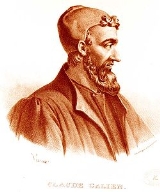
Aelius Galenus or Claudius Galenus (AD 129 – 200), better known as Galen of Pergamum (Greek
Greek language

Greek is an Indo-European languages native to the southern Balkan peninsula, the language of the Greek people. It forms an independent branch within Indo-European....
: Ga?????, Galenos), was a prominent Roman
Ancient Rome

Ancient Rome was a civilization that grew out of a small agricultural community founded on the Italian Peninsula as early as the 10th century BC....
 physician and philosopher of Greek origin, and probably the most accomplished medical researcher of the Roman period. His theories dominated Western
Western culture

File:Clash of Civilizations map.pngWestern culture are terms which are used to refer to cultures of European origin. This terminology originated as a way of describing what was different about the Graeco-Roman culture and its descendants, in contrast to the older neighboring civilizations of the Middle East, which in many ways continued...
 medical science for well over a millennium, though some of his theories were later proven wrong by Andreas Vesalius over 1000 years later.

n was born in the ancient Greek
Ancient Greece

The term Ancient Greece refers to the period of History of Greece lasting from the Greek Dark Ages ca. 1100 BC and the Dorian invasion, to 146 BC and the Roman Republic conquest of Greece after the Battle of Corinth ....
 city of Pergamon
Pergamon

Pergamon or Pergamum was an ancient Ancient Greece city in modern-day Turkey, in Mysia, north-western Anatolia, 16 miles from the Aegean Sea, located on a promontory on the north side of the river Caicus , that became the capital of the Kingdom of Pergamon during the Hellenistic Greece, under the Attalid dynasty, 281–133 BC....
 (Pergamum or Pergamos), now Bergama
Bergama

Bergama refers to a city and its surrounding district in Izmir Province, in the Aegean Region, Turkey of the Republic of Turkey. Known for its cotton, gold, and fine carpets, the city was the ancient Greek and Roman Empire cultural center of Pergamon; its wealth of ancient ruins continues to attract considerable tourist interest today....
 in the region of Mysia
Mysia

Mysia was a region in the northwest of ancient Asia Minor or Anatolia . It was located on the south coast of the Sea of Marmara. It was bounded by Bithynia on the east, Phrygia on the southeast, Lydia on the south, Aeolis on the southwest, Troad on the west and by the Propontis on the north....
 on the Sea of Marmara
Sea of Marmara

The Sea of Marmara , also known as the Sea of Marmora or the Marmara Sea, and in the context of classical antiquity as Propontis , is the inland sea that connects the Black Sea to the Aegean Sea, thus separating Turkey's Asian and European parts....
, Asia Minor, now Turkey
Turkey

Turkey , known officially as the Republic of Turkey , is a Eurasian country that stretches across the Anatolian peninsula in southwest Asia and Thrace in the Balkans region of Southern Europe....
, which was part of the Roman Empire
Roman Empire

The Roman Empire was the Roman Republic phase of the Ancient Rome, characterised by an autocracy form of government and large territorial holdings in Europe and around the Mediterranean....
, on September 1, AD 129 (estimates vary from 125-131)

Controversies over name
His name, Ga????? in Greek, meant quiet or peaceable.


Discussion
Ask a question about 'Galen'
Start a new discussion about 'Galen'
Answer questions from other users
Full Discussion Forum


Encyclopedia


Aelius Galenus or Claudius Galenus (AD 129 – 200), better known as Galen of Pergamum (Greek
Greek language

Greek is an Indo-European languages native to the southern Balkan peninsula, the language of the Greek people. It forms an independent branch within Indo-European....
: Ga?????, Galenos), was a prominent Roman
Ancient Rome

Ancient Rome was a civilization that grew out of a small agricultural community founded on the Italian Peninsula as early as the 10th century BC....
 physician and philosopher of Greek origin, and probably the most accomplished medical researcher of the Roman period. His theories dominated Western
Western culture

File:Clash of Civilizations map.pngWestern culture are terms which are used to refer to cultures of European origin. This terminology originated as a way of describing what was different about the Graeco-Roman culture and its descendants, in contrast to the older neighboring civilizations of the Middle East, which in many ways continued...
 medical science for well over a millennium, though some of his theories were later proven wrong by Andreas Vesalius over 1000 years later.

Life


Early life

Galen was born in the ancient Greek
Ancient Greece

The term Ancient Greece refers to the period of History of Greece lasting from the Greek Dark Ages ca. 1100 BC and the Dorian invasion, to 146 BC and the Roman Republic conquest of Greece after the Battle of Corinth ....
 city of Pergamon
Pergamon

Pergamon or Pergamum was an ancient Ancient Greece city in modern-day Turkey, in Mysia, north-western Anatolia, 16 miles from the Aegean Sea, located on a promontory on the north side of the river Caicus , that became the capital of the Kingdom of Pergamon during the Hellenistic Greece, under the Attalid dynasty, 281–133 BC....
 (Pergamum or Pergamos), now Bergama
Bergama

Bergama refers to a city and its surrounding district in Izmir Province, in the Aegean Region, Turkey of the Republic of Turkey. Known for its cotton, gold, and fine carpets, the city was the ancient Greek and Roman Empire cultural center of Pergamon; its wealth of ancient ruins continues to attract considerable tourist interest today....
 in the region of Mysia
Mysia

Mysia was a region in the northwest of ancient Asia Minor or Anatolia . It was located on the south coast of the Sea of Marmara. It was bounded by Bithynia on the east, Phrygia on the southeast, Lydia on the south, Aeolis on the southwest, Troad on the west and by the Propontis on the north....
 on the Sea of Marmara
Sea of Marmara

The Sea of Marmara , also known as the Sea of Marmora or the Marmara Sea, and in the context of classical antiquity as Propontis , is the inland sea that connects the Black Sea to the Aegean Sea, thus separating Turkey's Asian and European parts....
, Asia Minor, now Turkey
Turkey

Turkey , known officially as the Republic of Turkey , is a Eurasian country that stretches across the Anatolian peninsula in southwest Asia and Thrace in the Balkans region of Southern Europe....
, which was part of the Roman Empire
Roman Empire

The Roman Empire was the Roman Republic phase of the Ancient Rome, characterised by an autocracy form of government and large territorial holdings in Europe and around the Mediterranean....
, on September 1, AD 129 (estimates vary from 125-131)

Controversies over name
His name, Ga????? in Greek, meant quiet or peaceable. The abbreviation "Cl.", was first documented in texts from the Renaissance
Renaissance

The Renaissance was a cultural movement that spanned roughly the 14th to the 17th century, beginning in Italy in the late Middle Ages and later spreading to the rest of Europe....
 and may denote that Galen belonged to the Claudian gens. The contention that "Cl." is an abbreviation for the honourific Clarissimus is erroneous: Clarissimus (correctly, vir clarissimus or clarissimus vir) was a title reserved for the senatorial class, of which Galen was not a member; the usual abbreviation for it being V.C. or C.V. "Cl." invariably only appears as an abbrevation for the name Claudius. However, note that Galen's father, Aelius Nicon, belonged to the Aelian gens. This being so, it is likely that Nicon's son also bore the family name Aelius.

Life in Pergamum
He describes his early life in "On the affections of the mind". Born in September 129 AD, his father Aelius Nicon was a wealthy patrician
Patrician

The term "patrician" originally referred to a group of elitism citizens in ancient Rome, including both their natural and adopted members. In the late Roman empire, the class was broadened to include high council officials, and after the fall of the Western Empire became a term for Byzantine Imperial governors in the West....
, an architect and builder, with eclectic interests including philosophy, mathematics, logic, astronomy, agriculture and literature. Galen describes his father as a "highly amiable, just, good and benevolent man". At that time Pergamon was a major cultural and intellectual centre, noted for its library (Eumenes II
Eumenes II

Eumenes II of Pergamon was king of Pergamon and a member of the Attalid dynasty. The son of king Attalus I and queen Apollonis, he followed in his father's footsteps and collaborated with the Ancient Rome to oppose first Ancient Macedonians, then Seleucid expansion towards the Aegean, leading to the defeat of Antiochus III the Great at th...
), second only to that in Alexandria and attracted both Stoic
STOIC

STOIC was a variant of Forth .It started out at the MIT and Harvard Biomedical Engineering Centre in Boston, and was written in February 1977 by Jonathan Sachs....
 and Platonic
Platonism

Platonism is the philosophy of Plato or the name of other philosophical systems considered closely derived from it. In a narrower sense the term might indicate the doctrine of Platonic realism....
 philosophers, to whom Galen was exposed at age 14. His studies also took in each of the principal philosophical systems of the time, including Aristotelian
Aristotelianism

Aristotelianism is a Tradition#Philosophical tradition of philosophy that takes its defining inspiration from the work of Aristotle. Sometimes contrasted by critics with the rationalism and Platonic idealism of Plato, Aristotelianism is understood by its proponents as critically developing Plato?s theories....
 and Epicurean. His father had planned a traditional career for Galen in philosophy or politics and took care to expose him to literary and philosophical influences. However Galen states that in around 144, his father had a dream in which the God Asclepius
Asclepius

Asclepius is the god of medicine and healing in ancient Greek mythology. Asclepius represents the healing aspect of the medical arts, while his daughters Hygieia, Meditrina, Iaso, Aceso, Aglaea and Panacea symbolize the forces of cleanliness, medicine, and healing, respectively....
 (Aesculapius) appeared and commanded Nicon to send his son to study medicine. Again, no expense was spared, and following his earlier liberal education, at 16 he began studies at the prestigious local sanctuary or Asclepieum
Asclepieion

In ancient Greece, an asclepieion was a healing temple, sacred to the god Asclepius.Starting around 300 BC, the cult of Asclepius became increasingly popular....
 dedicated to Asclepius, God of medicine, as a ?e?ape?t?? (therapeutes, or attendant) for four years. There he came under the influence of men like Aeschrion
Aeschrion of Pergamon

Aeschrion of Pergamon was a Medicine in ancient Greece in the 2nd century AD. He was one of Galen's tutors, who says that he belonged to the sect of the Empiric school, and that he had a great knowledge of pharmacy and materia medica....
, Stratonicus and Satyrus. Asclepiea functioned as spas or sanitoria to which came the sick to seek the ministrations of the priesthood. The temple at Pergamon was eagerly sought by Romans in search of a cure. It was also the haunt of notable people such as Claudius Charax the historian, Aelius Aristeides the orator, Polemo
Polemon

Sorry, no overview for this topic
 the sophist, and Cuspius Rufinus the Consul.

First voyage
In 148, when he was 19, his father died, leaving him independently wealthy. He then followed the advice he found in Hippocrates
Hippocrates

Hippocrates of Cos II or Hippokrates of Kos - ancient Greek: ; Hippokr?tes was an Ancient Greece physician of the Age of Pericles, and was considered one of the most outstanding figures in the history of medicine....
' teaching and travelled and studied widely including Smyrna
Smyrna

Smyrna is an ancient city in Izmir in Turkey. Located at a central and strategic point on the Aegean Sea coast of Anatolia and aided by its advantageous port conditions, its ease of defence and its good inland connections, Smyrna rose to prominence before the Classical Era....
 (now Izmir
Izmir

Izmir, also once called Smyrna, is Turkey's third most populous city and the country's largest port after Istanbul. It is located along the outlying waters of the Gulf of Izmir, by the Aegean Sea....
), Corinth
Corinth

Corinth, or Korinth Corinth is now the capital of the Prefectures of Greece of Corinthia. The city is surrounded by the coastal townlets of Lechaio, Isthmia, Kechries, and the inland townlets of Examilia and the archaeological site....
, Crete
Crete

Crete is the largest of the Greek islands and the List of islands in the Mediterranean largest island in the Mediterranean Sea at 8,336 km? ....
, Cilicia
Cilicia

In antiquity, Cilicia now known as ?ukurova, was a commonly used name of the south coastal region of the Anatolian peninsula, and a political entity in Roman times....
 (now Çukurova
Çukurova

?ukurova is the modern name for the ancient region of Cilicia in southern Turkey. The region forms parts of the modern day provinces of Adana Province, Osmaniye Province and Mersin Province....
), Cyprus
Cyprus

Cyprus , officially the Republic of Cyprus , is an island country situated in the eastern Mediterranean Sea, east of Greece, west of Lebanon, Syria, and Israel, south of Turkey and north of Egypt....
 and finally the great medical school of Alexandria
Medicine in Ancient Greece

The first known Greek medical school opened in Knidos in 700 BC. Alcmaeon of Croton, author of the first anatomical work, worked at this school, and it was here that the practice of observing patients was established....
, exposing himself to the various schools of thought in medicine. In 157, aged 28, he returned to Pergamon as physician to the gladiators of the High Priest of Asia, one of the most influential and wealthiest men in Asia. Over the four years there he learnt the importance of diet, fitness, hygiene and preventive measures, as well as living anatomy, and the treatment of fractures and severe trauma, referring to their wounds as "windows into the body". Only five deaths occurred while he held the post, compared to sixty in his predecessor's time, generally ascribed to his attention to their wounds. At the same time he pursued studies in theoretical medicine and philosophy.

Rome

Galen provides accounts of his later life in Rome, in On Prognosis, and On his own Books. St?s?? (stasis, or political unrest) in Pergamon was probably the reason for Galen to leave Pergamon in 161, travelling in the Eastern Mediterranean studying the properties of minerals. His travels took him to Lemnos
Lemnos

Lemnos is an island in the northern part of the Aegean Sea. It is part of the prefecture of Greece of Lesbos Prefecture and has a considerable area, about 477 km?....
, Cyprus
Cyprus

Cyprus , officially the Republic of Cyprus , is an island country situated in the eastern Mediterranean Sea, east of Greece, west of Lebanon, Syria, and Israel, south of Turkey and north of Egypt....
, and Palestinian Syria
Palestine

Palestine is a name which has been widely used since Roman times to refer to the region between the Mediterranean Sea and the Jordan River. It is derived from a name used already much earlier for a narrower geographical region, mainly along the coastal region....
 (now Israel
Israel

Israel officially the State of Israel , is a country in the Middle East located on the eastern shore of the Mediterranean Sea. It borders Lebanon in the north, Syria in the northeast, Jordan in the east, and Egypt on the southwest, and contains geographically diverse features within its relatively small area....
), before reaching Rome in August 162, aged 33, in the second year of the reign of the joint Emperors Marcus Aurelius
Marcus Aurelius

Marcus Aurelius Antoninus Augustus was Roman Emperor from 161 to his death in 180. He was the last of the "Five Good Emperors", and is also considered one of the most important stoicism philosophy....
 and Lucius Verus
Lucius Verus

Lucius Aurelius Verus , born as Lucius Ceionius Commodus, known simply as Lucius Verus, was Roman Emperors with Marcus Aurelius , from 161 until his death....
. As a Greek in Rome, he faced cultural challenges, stiff competition and professional jealousy.

Eudemus
One of his more famous patients was the peripatetic philosopher Eudemus, a friend of his father, and his former tutor. He recounts curing Eudemus of Quartan Fever
Plasmodium malariae

Introduction Plasmodium malariae is a parasite protozoa that causes malaria in humans. It is closely related to Plasmodium falciparum and Plasmodium vivax which are responsible for most malarial infection....
 in 162 (Praen 2:5) This proved fortuitous, since during this illness, Eudemus was visited by Flavius Boethus, a former Consul
Roman consul

Consul was the highest elected political office of the Roman Republic and the Roman Empire.During the time of ancient Rome as a Republic, the Consuls were the highest civil and military magistrates, serving as the head of government for the Republic....
 and later Governor of Palestine (166-8), Sergius Paulus, who became a Prefect
Prefect

Prefect is a magisterial title of varying definition.A prefect's office, department, or area of control is called a prefecture, but in various post-Roman cases there is a prefect without a prefecture or vice versa....
, and Severus, uncle of the Emperor Lucius. They were Aristotelians and had heard of Galen's anatomical skills and were anxious to set up vivisection demonstrations, which they hoped would promote him (AA). Galen's skills in caring for Eudemus and his rigorous philosophical explanation of the pathology greatly enhanced his reputation in the upper circles of Rome. His bent for didactic teaching of his patients led him to seek those he could discourse with as a clientale. Word of how he gave Eudemus a prognosis
Prognosis

Prognosis is a medicine term denoting the Physician's prediction of how a patient will progress, and whether there is a chance of recovery. This word is often used in medical reports dictating a physician's view on a case....
 earned disapproval from some Roman physicians such as Martianus (an Erasistratean), who compared it to divination. Providing a prognosis was not part of their tradition, unlike Galen and the Hippocratic school. Galen in turn criticised the Roman doctors for their relationship with rich patrons, ostentatious dress and belief that medicine could be learned quickly. Galen was fortunate in having the wise advice of Eudemus to guide him through the politics of Roman medicine and society, even warning him that he might be in danger of his life.

Bloodletting
At first reluctantly, but then with increasing vigour, Galen promoted Hippocratic teaching including venesection, then unknown in Rome. This was sharply criticised by Erasistrateans, who predicted dire outcomes, believing that it was not blood but Pneuma
Pneuma (Stoic)

In Stoicism, pneuma is the concept of the "breath of life," a mixture of the Classical element#Classical elements in Greece air and fire . Originating among Greek medical writers who locate human vitality in the breath, pneuma for the Stoics is the active, generative principle that organizes both the individual and the cosmos....
 that flowed in the veins. Galen however staunchly defended venesection in his three books on the subject, and in his demonstrations and public disputations.

Reputation
Galen's fame rested on his anatomical demonstrations, success with influential patrons where others had failed, his learning and his rhetoric. His background and wealth and friendship with Eudemus helped him advance in Roman society. However, Galen was not reluctant to show his contempt for the learning and ethics of his contemporaries in Rome, and his ambitiousness created enemies.

This first Roman sojourn coincided with the Parthian Wars of the Emperor Lucius Verus (161-166). (Praen 14:647-9)

Pergamon interlude (166-168)
When he returned to Pergamon in August 166 he claimed he had departed due to professional jealousy, although the outbreak of the Antonine Plague
Antonine Plague

The Antonine Plague, 165-180 AD, also known as the Plague of Galen, who described it, was an ancient pandemic, whether of smallpox or measles, brought back to the Roman Empire by troops returning from campaigns in the Near East....
 which accompanied the return of Lucius Verus' army in that year may have contributed to this.

Return to Rome
He was recalled to Rome by the Emperors Marcus Aurelius
Marcus Aurelius

Marcus Aurelius Antoninus Augustus was Roman Emperor from 161 to his death in 180. He was the last of the "Five Good Emperors", and is also considered one of the most important stoicism philosophy....
 and Lucius Verus
Lucius Verus

Lucius Aurelius Verus , born as Lucius Ceionius Commodus, known simply as Lucius Verus, was Roman Emperors with Marcus Aurelius , from 161 until his death....
 to serve in the German wars, a task he did not relish, preferring to stay in Rome with Marcus Aurelius' son, Commodus. Amongst his clients was the Consul
Consul

Consul was the highest elected office of the Roman Republic and an appointive office under the Roman Empire. The title was also used in other city states, and revived in modern states, notably French Republic before the Napoleon I of Franceic counter-revolution....
 Flavius Boethus, who had introduced him to the imperial court, where he became personal physician to Marcus Aurelius and his son Commodus
Commodus

Lucius Aurelius Commodus Antoninus , was a Roman Emperor who ruled from 180 to 192 . The name given here was his official name at his accession to sole rule; see 'Commodus#Changes of name' for earlier and later forms....
, returning to Rome on the death of Verus in 169. He later also served as physician to the Emperor Septimius Severus
Septimius Severus

Lucius Septimius Severus was a Roman Empire general, and Roman Emperor from April 14 193 to 211. He was born in what is now the Libyan part of Rome's historic Africa Province, making him the first emperor to be born in the Roman province of Africa Province....
. His own writings are rich with anecdotes illustrating the heights of his fame. Despite being a member of the court, Galen reputedly shunned Latin
Latin

Latin is an Italic language, historically spoken in Latium and Ancient Rome. Through the Military history of the Roman Empire, Latin spread throughout the Mediterranean and a large part of Europe....
, preferring to speak and write in his native Greek
Greek language

Greek is an Indo-European languages native to the southern Balkan peninsula, the language of the Greek people. It forms an independent branch within Indo-European....
, a tongue that was actually quite popular in Rome
Rome

Rome is the capital city of Italy and Lazio, and is Italy's largest and most populous city, with 2,724,347 residents in an urban area of some ....
. Galen spent most of the rest of his life at the Roman imperial court, where he was given leave to write and experiment. The bulk of his output occurring during this period. For instance, On Prognosis was written in 177-8. He returned to Pergamon in the 190s.

Death
Because of a reference in the 10th century Suda
Suda

The Suda or Souda is a massive 10th century Byzantine Empire Medieval Greek historical encyclopedia of the ancient Mediterranean world. It is an Encyclopedia lexicon with 30,000 entries, many drawing from ancient sources that have since been lost, and often derived from medieval Christian compilers....
 lexicon, the year of Galen's death has traditionally been placed at 199/200. However, since some scholars argue that textual evidence shows Galen writing as late as 207, they contend that he lived longer, the latest year proposed being 217, according to Arabic sources, derived from Alexander of Aphrodisias
Alexander of Aphrodisias

Alexander of Aphrodisias was the most celebrated of the Ancient Greek commentators on the writings of Aristotle. He was styled, by way of pre-eminence, "the expositor" ....
.

Work


Galen's works covered a wide range of topics, from anatomy and physiology, and medicine to logic and philosophy, both summarising what was known and adding his own observations. His writings pay homage to, amongst others, Plato
Plato

Plato , was a Classical Greece Greeks philosopher, mathematician, writer of philosophical dialogues, and founder of the Platonic Academy in Ancient Athens, the first institution of higher learning in the western world....
, Aristotle
Aristotle

Aristotle was a Greeks philosopher, a student of Plato and teacher of Alexander the Great. He wrote on many subjects, including physics, metaphysics, Poetics , theater, music, logic, rhetoric, politics, government, ethics, biology and zoology....
 and the Stoics, but above all to Hippocrates
Hippocrates

Hippocrates of Cos II or Hippokrates of Kos - ancient Greek: ; Hippokr?tes was an Ancient Greece physician of the Age of Pericles, and was considered one of the most outstanding figures in the history of medicine....
, whom he refers to as "divine" (?e??tat?? ?pp????t?? Nat Fac III: 13). Thus much of his explanation of pathology
Pathology

Pathology is the study and diagnosis of disease through examination of Organ , tissue , bodily fluids and whole bodies . The term also encompasses the related science study of disease processes, called General pathology....
 relies on Hippocrates' humoral theories.

He proceeded by observation, deductive reasoning and experimentation, such as his demonstration of the effect of ligating the ureters (Nat Fac I: 13), and the functions of the spinal cord. His medical practice drew on the biological theory and anatomical observations from Aristotle to the Alexandrians
Alexandrian school

The Alexandrian school is a collective designation for certain tendencies in literature, philosophy, medicine, and the sciences that developed in the Hellenistic civilization cultural center of Alexandria, Egypt during the Hellenistic era and Roman periods....
 in addition to his own research. His therapeutics led him to travel widely gathering elements and plants. However his reasoning led him astray as much as it did to truth, such as his rejection of the role of the stomach wall in digestion (Nat Fac III: 4) and his concepts of specific attraction.

Galen's approach to colleagues and the state of knowledge was very forthright. He despised what he referred to as partisanship (Nat Fac I: 13), and was impatient with those with whom he disagreed, such as the Erasistrateans
Erasistratus

Erasistratus was a Greek anatomist and royal physician under Seleucus I Nicator of Syria. Along with fellow physician Herophilus, he founded a school of anatomy in Alexandria, where they carried out anatomical research....
and Asclepiadeans
Asclepiades of Bithynia

Asclepiades was a Ancient Greek medicine born at Cius in Bithynia in Asia Minor and flourished at Rome, where he established Greek medicine near the end of the 2nd century BCE....
. (Nat Fac I: 17) Another target of his scorn were the Methodists
Methodic school

The Methodic school of medicine was an ancient school of medicine in Ancient Greek medicine and Medicine in ancient Rome. Their history begins with Themison of Laodicea, a pupil of Asclepiades of Bithynia in the 1st century BC....
, abhorring their consideration of pathology in a vacuum, treating the disease not the patient, whereas he taught that vital processes in an organism had to be interpreted in relation to its environment. Other disputes were with the Atomists , and the Anatomists, arguing that the whole is far greater than the sum of the parts. His own personal credo was based on three branches of philosophy; logic, physics and ethics. (Opt Med) He wrote in a highly polished precise Attic
Attic Greek

Attic Greek is the prestige dialect of Ancient Greek that was spoken in Attica, which includes Athens. Of the ancient dialects, it is the most similar to later Greek, and is the standard form of the language studied in courses of "Ancient Greek"....
 style, using many words (such as haematopoietic) that have passed down to us in modern medical terminology, albeit with altered meaning.

Galen developed an interest in anatomy from his studies of Herophilus and Erasistratus
Erasistratus

Erasistratus was a Greek anatomist and royal physician under Seleucus I Nicator of Syria. Along with fellow physician Herophilus, he founded a school of anatomy in Alexandria, where they carried out anatomical research....
, who had dissected the human body and even living bodies (vivisection). Although Galen studied the human body, dissection of human corpses was against Roman law
Roman law

Roman law is the law system of ancient Rome. As used in the West the term commonly refers to legal developments prior to the Roman/Byzantine state's adopting Greek language as its official language in the 7th century....
, so instead he performed vivisections
Animal testing

Animal testing / animal experimentation is the use of non-human animals in Experiment. It is estimated that 50 to 100 million vertebrate animals worldwide — from zebrafish to non-human primates — are used annually....
 on pig
Pig

Pigs, also called hogs or swine, are a genus of even-toed ungulates within the Family Suidae. The name pig, hog, or swine most commonly refers to the Domestic pig in everyday parlance, but technically encompasses several distinct species, including the Wild Boar....
s, ape
Ape

An ape is any member of the Hominoidea superfamily of primates. In less scientific language, it has various meanings, although it often excludes humans....
s, and other animals (e.g. Nat Fac III: 8), to study the function of the kidneys and the spinal cord
Spinal cord

The spinal cord is a long, thin, tubular bundle of neuron and glia that extends from the brain. The brain and spinal cord together make up the central nervous system....
. In this study of comparative anatomy, he frequently dissected the Barbary Macaque
Barbary Macaque

The Barbary Macaque is a macaque with only a stub of a tail. Found in the Atlas Mountains of Algeria and Morocco with a small, possibly Introduced species, population in Gibraltar, the Barbary Macaque is one of the best-known Old World monkey species....
 and other primates, assuming their anatomy was basically the same as that of humans. The legal limitations forced on him led to quite a number of mistaken ideas about the body. For instance, he thought a group of blood vessel
Blood vessel

The blood vessels are the part of the circulatory system that transport blood throughout the body. There are three major types of blood vessels: the artery, which carry the blood away from the heart, the capillary, which enable the actual exchange of water and chemicals between the blood and the tissues; and the veins, which carry blood from...
s near the back of the brain
Brain

The brain is the center of the nervous system in all vertebrate, and most invertebrate, animals. Some primitive animals such as cnidarian and echinoderm have a decentralized nervous system without a brain, while sponges lack any nervous system at all....
, the rete mirabile
Rete mirabile

A rete mirabile is a complex of artery and veins lying very close to each other, found in some vertebrates. The rete mirabile utilizes countercurrent blood flow within the net It exchanges heat, ions, or gases between vessel walls so that the two bloodstreams within the rete maintain a gradient with respect to temperature, or concentratio...
, was common in humans, although it actually is absent in humans.

Galen performed many audacious operations — including brain and eye
Eye

Eyes are Organ that detect light, and send signals along the optic nerve to the visual system and other areas of the brain. Complex optical systems with resolving power have come in ten fundamentally different forms, and 96% of animal species possess a complex optical system....
 surgeries — that were not tried again for almost two millennia. To perform cataract
Cataract

A cataract is a clouding that develops in the lens of the eye or in its envelope, varying in degree from slight to complete Opacity and obstructing the passage of light....
 surgery, he would insert a long needle-like instrument into the eye behind the lens
Lens (anatomy)

The lens is a transparent, Lens_#Types_of_lenses structure in the eye that, along with the cornea, helps to refract light to be Focus on the retina....
, then pull the instrument back slightly to remove the cataract. The slightest slip could have caused permanent blindness
Blindness

Blindness is the condition of lacking visual perception due to physiological or neurological factors.Various scales have been developed to describe the extent of vision loss and define "blindness." Total blindness is the complete lack of form and visual light perception and is clinically recorded as "NLP," an abbreviation for "no ligh...
.

Galen identified venous
Vein

In the circulatory system, veins are blood vessels that carry blood toward the heart. Most veins carry deoxygenated blood from the tissues back to the heart; exceptions are the pulmonary vein and umbilical veins, both of which carry oxygenated blood....
 (dark red) and arterial
Artery

Arteries are blood vessels that carry blood away from the heart. All arteries, with the exception of the pulmonary and umbilical arteries, carry oxygenated blood....
 (brighter and thinner) blood, each with distinct and separate functions. Venous blood was thought to originate in the liver and arterial blood in the heart; the blood flowed from those organs to all parts of the body where it was consumed.

Published works

Galen produced more work than any author in antiquity, and may have possibly written up to 600 treatises, although less than a third of his works have survived. His surviving work runs to around 3 million words. Carolus Kühn of Leipzig translated 122 of Galen's writings (1821-1833) and his edition, which is the most complete although flawed, consists of the Greek text, with Latin translations, and runs to 22 volumes, 676 index pages, and is over 20,000 pages in length. More modern projects like the Corpus Medicorum Graecorum have still to match the Kühn edition. A digital version of the Galen's corpus is included in the Thesaurus Linguae Graecae
Thesaurus Linguae Graecae

The Thesaurus Linguae Graecae is a research center at the University of California, Irvine. The TLG was founded in 1972 by Marianne McDonald with the goal to create a comprehensive digital collection of all surviving texts written in Greek from antiquity to the present era....
 a digital library of Greek literature started in 1972. Another useful modern source is the French (BIUM).

It has been reported that Galen employed 20 scribes to write down his words. In 191, a fire in the Temple of Peace destroyed many of his works, particularly treatises on philosophy. Others were lost in the destruction of the Library at Alexandria and in the general chaos associated with the collapse of the Roman Empire
Roman Empire

The Roman Empire was the Roman Republic phase of the Ancient Rome, characterised by an autocracy form of government and large territorial holdings in Europe and around the Mediterranean....
. The Arabs captured
Muslim conquest of Egypt

At the commencement of the Muslim conquest of Egypt, Egypt was part of the Byzantine Empire with its capital in Constantinople. However, it had been occupied just a decade before by the Persian_Empire#Sassanid_Persia_.28AD_226-650.29 under Khosrau II of Persia ....
 and preserved some ancient medical texts during the expansion
Muslim conquests

Arab Muslim conquests , also referred to as the Islamic conquests or Arab conquests, began after the death of the Islamic prophet Muhammad....
 and Golden Age
Islamic Golden Age

The Islamic Golden Age, also sometimes known as the Islamic Renaissance, was traditionally dated from the 700 A.D. to 1200 A.D.Common Era, but has been extended to the 15th and 16th centuries by some scholars....
 of the Arab Empire
Arab Empire

Islamic Empire may refer to*the Caliphates of the early Middle Ages:**Rashidun Caliphate **Umayyad Caliphate - Successor of the Rashidun Caliphate...
 - only those works exist today, and some still exist only in Arabic translation, while others exist only in mediaeval Latin translations of the Arabic. In some cases scholars have even attempted to translate back into Greek where the original is lost. So great was Galen's output in both quantity and authority that no single authoritative collection of his work exists, and controversy still exists as to the authenticity of a number of attributed works. The surviving Greek texts represent half of all the original Greek literature we have today. For some of the ancient sources, such as Herophilus, Galen's account of their work is all that survives. Even in his own time, forgeries and unscrupulous editions of his work were a problem, prompting him to write On his Own Books. Over the years many different titles have appeared for the same treatises. Sources are often in obscure and difficult to access journals or repositories. Forgeries in Latin, Arabic or Greek continued till the Renaissance. Consequently research on Galen's work is fraught with hazard. Although written in Greek, by convention the works are referred to by Latin titles, and often by merely abbreviations of those.

Various attempts have been made to classify Galen's vast output. For instance Coxe (1846) lists a Prolegomena, or introductory books, followed by 7 classes of treatise embracing Physiology (28 vols.), Hygiene (12), Aetiology (19), Semeiotics (14), Pharmacy (10), Blood letting (4) and Therapeutics (17), in addition to 4 of aphorisms, and spurious works.

Legacy

In his time, Galen's reputation as both physician and philosopher was legendary, the Emperor Marcus Aurelius describing him as "Primum sane medicorum esse, philosophorum autem solum" (first among doctors and unique among philosophers Praen 14: 660). Other contemporary authors in the Greek world confirm this including Theodotus the Shoemaker
Theodotus of Byzantium

Theodotus of Byzantium was an early Christianity writer from Istanbul, one of several named Theodotus whose writings were condemned as heresy in the early church....
, Athenaeus
Athenaeus

Athenaeus , of Naucratis in Egypt, Greeks rhetorician and grammarian, flourished about the end of the 2nd and beginning of the 3rd century A.D. The Suda only tells us that he lived in the times of Marcus ; but the contempt with which he speaks of Commodus shows that he survived that emperor....
 and Alexander of Aphrodisias
Alexander of Aphrodisias

Alexander of Aphrodisias was the most celebrated of the Ancient Greek commentators on the writings of Aristotle. He was styled, by way of pre-eminence, "the expositor" ....
. The 7th century poet George of Pisida
George Pisida

George Pisida was a Byzantine Empire poet, born in Pisidia, flourished during the 7th century AD.From his poems we learn he was a Pisidian by birth, and a friend of Patriarch Sergius I of Constantinople and the Emperor Heraclius....
 going so far as to refer to Christ as a second and neglected Galen. Galen continued to exert an important influence over the theory and practice of medicine until the mid seventeenth century in the Byzantine and Arabic worlds and Europe. Hippocrates
Hippocrates

Hippocrates of Cos II or Hippokrates of Kos - ancient Greek: ; Hippokr?tes was an Ancient Greece physician of the Age of Pericles, and was considered one of the most outstanding figures in the history of medicine....
 and Galen form important landmarks of 600 years of Greek medicine. AJ Brock describes them as representing the foundation and apex respectively. A few centuries after Galen Palladius Iatrosophista
Palladius (physician)

Palladius a Greek medical writer, some of whose works are still extant. Nothing is known of the events of his life, but, as he is commonly called Iatrosophistes, he is supposed to have gained that title by having been a professor of medicine at Alexandria....
 in his commentary on Hippocrates, stated that Hippocrates sowed and Galen reaped. Thus Galen summarised and synthesised the work of his predecessors, and it is in Galen's words (Galenism) that Greek medicine was handed down to subsequent generations, such that Galenism became the the means by which Greek medicine was known to the world. Frequently this was in the form of restating and reinterpreting, such as in Magnus of Nisibis' fourth century work on urine, which was in turn translated into Arabic. Yet the full importance of his contributions was not appreciated till long after his death. Galen's rhetoric and prolificity were so powerful as to convey the impression that there was little left to learn. The term Galenism has subsequently taken on both a positive and pejorative meaning as one that transformed medicine in late antiquity yet so dominated subsequent thinking as to stifle further progress.

Galenism in history

The era following Galen's death, and the gradual dissolution of the Roman
Roman Empire

The Roman Empire was the Roman Republic phase of the Ancient Rome, characterised by an autocracy form of government and large territorial holdings in Europe and around the Mediterranean....
 and then Byzantine Empire
Byzantine Empire

Byzantine Empire and Eastern Roman Empire are conventional names used to describe the Roman Empire during the Middle Ages, centered on its capital of Constantinople....
 was one of continual political turmoil during which scientific study held a low priority. Many commentators of the subsequent centuries such as Oribasius
Oribasius

Oribasius or Oreibasius was a Ancient Greece medical writer and the personal physician of the Roman emperor Julian the Apostate. He studied at Alexandria under physician Zeno of Cyprus before joining Julian's retinue....
 - physician to the emperor Julian
Julian the Apostate

Flavius Claudius Julianus, known also as Julian or Julian the Apostate , was Roman Emperor of the Constantinian dynasty. He was the last non-Christian Roman Emperor, and expended much energy during his reign attempting to supplant the growing power of Christianity within the empire with officially revived Religion in ancient Rom...
 who compiled a Synopsis in the 4th Century - preserved and disseminated Galen's works, making Galenism more accessible. Nutton refers to these authors as the "medical refrigerators of antiquity". In late antiquity medical writing veered increasingly in the direction of the theoretical at the expense of the practical. Many authors merely debating Galenism. Magnus of Nisibis was a pure theorist, as was John of Alexandria and Agnellus of Ravenna with their lectures on Galen's De Sectis. So strong was Galenism that other authors such as Hippocrates began to be seen through a Galenic lens, while his opponents became marginalised and other medical sects such as Asclepiadism slowly disappeared.

Greek medicine was part of Greek culture and as such spread West into Asia through Syria and Persia, largely by the Nestorians. There it came into contact with the Islamic world which assimilated it.

Islam
Islamic culture
Islamic Golden Age

The Islamic Golden Age, also sometimes known as the Islamic Renaissance, was traditionally dated from the 700 A.D. to 1200 A.D.Common Era, but has been extended to the 15th and 16th centuries by some scholars....
 placed great emphasis on the teachings of Aristotle and Galen, which they systematised and commented on. Hunayn ibn Ishaq
Hunayn ibn Ishaq

Hunayn ibn Ishaq...
 translated (c.830-870) 129 works of "Jalinos" into Arabic
Arabic language

Arabic is a Central Semitic language, thus related to and classified alongside other Semitic languages languages such as Hebrew language and Aramaic language....
. Galen's insistence on a rational systematic approach to medicine set the template for Islamic medicine
Islamic medicine

In the history of medicine, Islamic medicine or Arabic medicine refers to medicine developed in the Islamic Golden Age and written in Arabic language, the lingua franca of the Islamic civilization....
, which rapidly spread throughout the Arab Empire
Caliphate

The caliphate represented the political leadership of the Muslim ummah in classical and medieval Islamic history and juristic theory. The head of state's position is based on the notion of a successor to the Prophets of Islam Muhammad's political authority....
. Arabic sources, such as Rhazes (Muhammad ibn Zakariya Razi 865-925 AD), continue to be the source of discovery of new or relatively inaccessible Galenic writings. As the title, Doubts on Galen by Rhazes implies, as well as the writings of physicians such as Ibn Zuhr
Ibn Zuhr

Abu Merwan ?Abdal-Malik ibn Zuhr was an Arab Islamic medicine, Parasitology, Ulema, and teacher....
 (Avenzoar) and Ibn al-Nafis, the works of Galen were not taken on unquestioningly, but as a challengeable basis for further enquiry
Scientific method

Scientific method refers to techniques for investigating phenomenon, acquiring new knowledge, or correcting and integrating previous knowledge. To be termed scientific, a method of inquiry must be based on gathering observable, empirical and Measure evidence subject to specific principles of reasoning....
.

A strong emphasis on experiment
Experiment

In scientific inquiry, an experiment is a method of investigating causal relationships among variables. An experiment is a cornerstone of the empiricism approach to acquiring data about the world and is used in both natural sciences and social sciences....
ation and empiricism
Empiricism

In philosophy, empiricism is a theory of knowledge which asserts that knowledge arises from experience. Empiricism is one of several competing views about how we know "things," part of the branch of philosophy called epistemology, or "theory of knowledge"....
 led to new results and new observations, which were contrasted and combined with those of Galen by writers such as Razi, Ali ibn Abbas al-Majusi
Ali ibn Abbas al-Majusi

Ali ibn Abbas al-Majusi , also known as Masoudi, or Latinisation as Haly Abbas, was a Persian people physician and psychologist most famous for the Kitab al-Maliki or Complete Book of the Medical Art, his textbook on Islamic medicine and Early Muslim sociology....
 (Haly Abbas), Abu al-Qasim al-Zahrawi (Abulasis), Ibn Sina
Avicenna

, known as Abu Ali Sina Balkhi or Ibn Sina and commonly known in English by his Latinized name Avicenna , was a Persian people polymath and the foremost Islamic medicine and Early Islamic philosophy of his time....
 (Avicenna), Ibn Zuhr and Ibn al-Nafis. For example, the experiments carried out by Razi and Ibn Zuhr contradicted the Galenic theory of humorism, while Ibn al-Nafis' discovery of the pulmonary circulation
Pulmonary circulation

Pulmonary circulation is the portion of the cardiovascular system which carries oxygen-depleted blood away from the heart, to the lungs, and returns oxygenated blood back to the heart....
 contradicted the Galenic theory on the heart.

Reintroduction to Medieval Western culture
From the 11th century onwards, Latin translations of Islamic medical texts began to appear in the West, alongside the Salerno
Schola Medica Salernitana

The Schola Medica Salernitana was the first medieval medical school in the cosmopolitan coastal Mezzogiorno city of Salerno, which provided the most important native source of medical knowledge in Europe at the time....
 school of thought, and were soon incorporated into teaching at the universities of Naples and Montpellier. Galenism now took on a new unquestioned authority, Galen even being referred to as the "Medical Pope of the Middle Ages". Constantine the African
Constantine the African

Constantine the African was an eleventh-century Latin translations of the 12th century of Ancient Greek medicine and Medicine in medieval Islam....
 was amongst those who carried out translations of both Hippocrates and Galen. Galen's writings on anatomy became the mainstay of the medieval physician's university curriculum, alongside Ibn Sina's The Canon of Medicine
The Canon of Medicine

The Canon of Medicine is a 14-volume Islamic medicine written by a Science in medieval Islam and physician Avicenna and completed in 1025....
 which elaborated on Galen's works. Unlike pagan Rome, Christian Europe did not exercise a universal prohibition of the dissection and autopsy of the human body and such examinations were carried out regularly from at least the 13th century. However, Galen's influence, as in the Arab world, was so great that when dissections discovered anomalies in Galen's anatomy, the physicians often tried to fit these into the Galenic system. An example of this is Mondino de Liuzzi
Mondino de Liuzzi

Mondino dei Liuzzi was an Italian medical professor and a pioneer of anatomy in practice.Mondino was born in Bologna into a Tuscany family from Florence with loyalties to the Ghibellines....
, who describes rudimentary blood circulation in his writings but still asserts that the left ventricle should contain air.

Renaissance
The Renaissance and fall of the Byzantine Empire (1453) was accompanied by an influx of Greek scholars and texts to the West, allowing direct comparison between the Arabic commentaries and their Greek originals. This New Learning
New Learning

In the history of ideas the New Learning in Europe was a term for Renaissance humanism, found from the later fifteenth century. Newly retrieved Classical texts sparked philology study of a refined and classical Latin style in prose and poetry....
 and the Humanist
Renaissance humanism

Renaissance humanism was a European intellectual movement that was a crucial component of the Renaissance, beginning in Florence in the last years of the 14th century....
 movement, particularly the work of Thomas Linacre
Thomas Linacre

Thomas Linacre was an English Renaissance humanism and physician, after whom Linacre College, Oxford is named.Linacre was more of a scholar than a scientific investigator....
, promoted litterae humaniores including Galen in the Latin scientific canon, De Naturalibus Facultatibus appearing in London in 1523. Debates on medical science now had two traditions, the more conservative Arabian and liberal Greek. The more extreme liberal movements, as exemplified by Paracelsus
Paracelsus

Paracelsus was a Medieval physician, botanist, alchemy, astrologer, and general occultist. Born Phillip von Hohenheim, he later took up the name Philippus Theophrastus Aureolus Bombastus von Hohenheim, and still later took the title Paracelsus, meaning "equal to or greater than Celsus", a Roman encyclopedist, Aulus Cornelius Celsus fro...
 began to challenge the role of authority in medicine, symbolically burning the works of Avicenna and Galen at his medical school in Basle
University of Basel

The University of Basel is located at Basel, Switzerland....
. Nevertheless Galen's pre-eminence amongst the great thinkers of the millennium is exemplified by a 16th century mural in the refrectory of the Great Lavra
Great Lavra

The Monastery of Great Lavra is the first monastery built on Mount Athos. It is located on the southeastern foot of the Mount at an elevation of 160 metres....
 of Mt Athos. This depicts pagan sages at the foot of the Tree of Jesse
Tree of Jesse

The Tree of Jesse refers to a passage in the Biblical Book of Isaiah which describes metaphorically the descent of the Messiah. It is accepted by Christians as pertaining to Jesus, and is often represented in art, particularly in that of the Medieval art period....
, with Galen between the Sibyl
Sibyl

The word sibyl probably comes from the ancient Greek word sibylla, meaning prophetess. The earliest oracular seeresses known as the sibyls of antiquity, "who admittedly are known only through legend" prophesied at certain holy sites, under the divine influence of a deity, originally? at Delphi and Pessinos? one of the chthonic earth-go...
 and Aristotle
Aristotle

Aristotle was a Greeks philosopher, a student of Plato and teacher of Alexander the Great. He wrote on many subjects, including physics, metaphysics, Poetics , theater, music, logic, rhetoric, politics, government, ethics, biology and zoology....
.

Downfall of Galenism
Galenisms final defeat came from a combination of the negativism of Paracelsus and the constructivism of the Italian Renaissance anatomists, such as Vesalius
Vesalius

Andreas Vesalius was an Anatomy, physician, and author of one of the most influential books on human anatomy, De humani corporis fabrica . Vesalius is often referred to as the founder of modern human anatomy....
 in the 16th century. In the 1530s, Belgian anatomist and physician Andreas Vesalius took on a project to translate many of Galen's Greek texts into Latin. Vesalius' most famous work, De humani corporis fabrica
De humani corporis fabrica

De humani corporis fabrica libri septem is a textbook of human anatomy written by Andreas Vesalius in 1543.The book is based on his University of Padua lectures, during which he deviated from common practice by dissecting a corpse to illustrate what he was discussing....
, was greatly influenced by Galenic writing and form. Seeking to examine critically Galen's methods and outlook, Vesalius turned to human cadaver dissection as a means of verification. Galen's writings were frequently disproved by Vesalius, who demonstrated Galen's errors through books and hands-on demonstrations, despite fierce opposition from pro-Galenist orthodoxy, such as Jacobus Sylvius
Jacques Dubois

Jacques Dubois , also known as Jacobus Sylvius in Latin, was a France anatomy in Paris....
. The examinations of Vesalius also disproved medical theories of Aristotle
Aristotle

Aristotle was a Greeks philosopher, a student of Plato and teacher of Alexander the Great. He wrote on many subjects, including physics, metaphysics, Poetics , theater, music, logic, rhetoric, politics, government, ethics, biology and zoology....
 and Mondino de Liuzzi
Mondino de Liuzzi

Mondino dei Liuzzi was an Italian medical professor and a pioneer of anatomy in practice.Mondino was born in Bologna into a Tuscany family from Florence with loyalties to the Ghibellines....
. One of the most well known examples of Vesalius' overturning of Galenism was his demonstration that the interventricular septum
Interventricular septum

Interventricular septum , abbreviated IVS, is the stout wall separating the lower chambers of the heart from one another.The ventricular septum is directed obliquely backward and to the right, and is curved with the convexity toward the right ventricle: its margins correspond with the anterior and posterior longitudinal sulci....
 of the heart was not permeable, as Galen had taught (Nat Fac III xv). The most convincing demonstration of Galen's weakness came from these demonstrations of the nature of the circulation and the subsequent work of Andrea Cesalpino
Andrea Cesalpino

Andrea Cesalpino was an Italy physician, philosopher and botanist.In his works he taxonomy plants according to their fruits and seeds, rather than alphabetically or by medicinal properties....
, Fabricio of Acquapendente
Hieronymus Fabricius

Hieronymus Fabricius or Girolamo Fabrizio was a pioneering anatomist known in Italian medical science as "The Father of Embryology."Born in Acquapendente, Fabricius studied at University of Padua, receiving an MD in 1559 under the guidance of Gabriel Fallopio....
 and William Harvey
William Harvey

William Harvey was an English physician who was the first in the Western world to describe correctly and in exact detail the systemic circulation and properties of blood being pumped around the body by the heart....
. Some Galenic teaching, such as his emphasis on bloodletting
Bloodletting

Bloodletting is the withdrawal of often considerable quantities of blood from a patient in the belief that this would cure or prevent a great many illnesses and diseases....
 as a remedy for almost any ailment, however remained influential until well into the 1800s.

Contemporary scholarship
Galenic scholarship remains an intense and vibrant field, following renewed interest in his work, dating from the Altertumswissenschaft.

Selected bibliography

(with Latin Titles) and standardised bibliographical abbreviations: see also Cambridge Companion to Galen: Appendices. Vol. and pp. notation according to Kühn edition). Ordered according to Coxe's taxonomy of 1846 (see References), which includes a summary of each work. Alternative names in (parentheses). Italicised citations from Galen's works refer to the Kühn edition.

Galen's own Bibliographies
  • On My (His) Own Books (Lib. Prop.)
  • On the Order of my Own Books (Ord. Lib. Prop.)


Introductory Treatises (Prolegomena, ??sa???? (Isagogici), Introductio)

2. The Best Doctor is also a Philosopher (A good physician must also be a philosopher) Si quis Optimus Medicus est, Eundum esses Philosophus (Opt. Med.)
3. Of verbal sophistry De Sophismatis in Verbo Contingentibus (Soph.)
5. Of the appropriate writings of Galen. De Libris Propriis (Galeni) (Lib. Prop.)
6. Of the order in which his writings are to be placed. De Ordine Librorum Suorum
7. Of different sects in medicine (On Sects) De Sectis
10. An exposition of the empiric sect De Subfiguratio(ne) Empirica (Subf. Empir.)
12. Of the art of medicine. De Constitutione Artis Medicae
16. Of the art of medicine. Ars Medicinalis


I: Physiology and Anatomy

1. The Elements De Elementis (Elem.)
2. Of temperaments (On Mixtures) De Temperamentis (Temp.)
3. Two commentaries of Galen on the books of Hippocrates, entitled, “Of the Nature of Man.” Galeni, in Librum Hippocratis, de Natura Humana (HNH)
4. Of the atrabilis, or black bile. De Atra Bile, Libellus (Atr. Bil.) (At. Bil.)
7. Of the bones (On Bones for Beginners) De Ossibus (Oss.)
11. Is blood naturally contained in the arteries? An in Arteriis (Natura) Sanguis Contineatur (An sanguis in arteriis natura contineatur) (Art. Sang.)
12. On Anatomical Procedures (Investigations) De Anatomicis Administrationibus (AA)
13. Of the dissection of the uterus (On the Anatomy of the Uterus) De Uteri Dissectione (Ut. Diss.)
15. Of the uses of the different parts of the human body (On the Usefulness/Utility of the Parts of the Body) De Usu Partium Corporis Humani (UP)
16. Of the utility of respiration De Usu (Utilitate) Respirationis
17. Of the causes of respiration De Causis Respirationis
18. Of the use of the pulse De Usu Pulsuum (Pulsuum Usu)
19. On the the subsistence of the Natural Faculties De Substantia Faculatatum Naturalium
20. Of the dogmas, or opinions of (On the Doctrines of) Hippocrates and Plato De Hippocratis et Platonis Decretis (Dogmatibus) (PHP) V
23. Of the motion (movement) of the thorax (chest) and lungs De Motu Thoracis et Pulmonis
24. That the qualities of the mind depend on the temperament of the body Quod Animi Mores Corporis Temperatura Sequantur
25. Of the foetal formation De Foetuum Formatione (Foet. Form.)
26. Of the semen (On Semen) De Semine


II: Hygiene

On Good and Bad Humours (Bon. Mal. Suc.)
On the Ptisan, or Barley-water De Ptisana
On the Preservation of Health De Sanitate Tuenda (San. Tu.)


III: Aetiology

1.4. Of (On) the Causes of Symptoms De Symptomatum Causis (Caus. Symp.)
8. Of plethora De Plenitudine (Plen.)
15. Commentary On Hippocrates' 'Epidemics' In Hippocratis de Morbis Vulgaribus, Commentarii (Hipp. Epid.)


IV: Semeiotics

1. On the parts affected by disease (On Affected Parts) De Locis Affectis (Loc. Aff.)
2. A concise treatise on the pulse for students (On the Pulse for Beginners) De Pulsibus Libellus ad Tyrones (Puls.)
3. Of the difference of pulses De Differentiis Pulsuum (Diff. Puls.)
4. On the knowledge of the pulse De Dignoscendis Pulsibus (De Pulsuum Differentiis) (Dig. Puls.)
5. On the causes of the pulse De Causis Pulsuum (Caus. Puls.)
6. Of prediction from the pulse De Praesagitione ex Pulsibus (Praes. Puls.)
7. Synopsis of his sixteen books on the pulse Synopsis Librorum Suorum, Sexdecim, de Pulsibus (Syn. Puls.)
12. Commentaries on the prognostics of Hippocrates (On Hippocrates' 'Prognostic') In Prognostica Hippocratis Comment. (Hipp. Prog.)
14. On Prognosis De Praegnotione ad Epigenem (Praen.) V


V: Pharmacy

On the Powers (and Mixtures) of Simple remedies (Drugs) De Simp. Medicament. Facultatibus (SMT)
Of medicinal substitutes (On Substitute Drugs) De Substitutis Medicinis (Suc.)
Of the faculty or power of purgative remedies (On the Power of Cleansing Drugs) De Purgantium Medicamentorum Facultate (Purg. Med. Fac.)
Whom, with which, and at what time to purge (Whom to Purge, with what Cleansing Drugs and When) Quos Purgare Conveniat, Quibus Medicamentis, et Quo Tempore (Cath. Med. Purg.)
Of the theriaca (On Theriac to Piso) De Theriaca, ad Pisonem (Ther. Pis.)
On the use of the theriaca (On Theriac to Pamphilianus) De Usu Thericae, ad Pamphilianum
On Antidotes De Antidotis (Ant.)
Of the composition of local remedies De Compositione Medicamentorum Localium
On the Composition of Drugs (Medical Compounds) according to Places De Compositione Medicamentorum Secundum Locus (Comp. Med. (Sec.) Loc.)
Of the compounding of remedies in relation with their genera (On the Composition of Drugs according to Kind) De Compositione Medicamentorum per Genera (Comp. Med. per Gen.)
Of weights and measures De Ponderibus et Mensuris Libellus


VI: Instruments of Clinical Practice

Of venæsection in opposition to Erasistratus De Venæsectione, Adversus Erasistratum (Ven. Sect. Er.)
Of venæsection, (Bloodletting) in opposition to Erasistratus De Venae Sectione Adversus Erasistrateos Romae Degentes (Ven. Sect. Er. Rom.) XI:197-249
Of venæsection, in opposition to Erasistratus of Rome De Venasectione Adversus Erasistrataeos qui Romae Degebant


VII: Therapeutics

1. Of the method of curing diseases (On The Therapeutic Method) De Medendi Methodo, Seu de Morb. Curandis (De Methodo Medendi) (MM)
4. Of remedies of easy preparation (On Remedies Easy to Prepare) De Remediis Paratu Facilibus Libellus (Rem.)
12. Three commentaries on the Hippoc. treatise of the office of the physician. In Hippocratis de Officina Medici (In Hippocratem de Officina Medici)(Hipp. Off. Med.)


Additional works

Commentary on Hippocrates' Aphorisms In Aphorismos Hippoc. (In Hippocratis Aphorismos) (Hp. Aph. Com.) (Hipp. Aph.)


Spurious

On the Power of Centaura De Virtute Centaureae


Fragments


Other (not in Coxe taxonomy)
On Medical Experience De Experientia Medica (Med. Exp.)


On Containing Causes De Causis Contentivus (CC)
On Demonstration Dem.
On My (His) Own Opinions De Proprius Placitis (Prop. Plac.)
On Things said in Many Ways
Opportune Moments in Disease (Morb. Temp.)
On the affections of the mind
The Passions of the Soul De Propriorum Animi Cuiuslibet Affectuum Dignotione et Curatione (Aff. Dig.) V:40-1
On Moral Character (Mor.)
The Faculties of the Soul Follow the Mixture of the Body (QAM)
On Propositions Missed out in the Expression of Demonstrations
On Propositions With the Same Meaning
On Slander De calumnia in quo et de vita sua
On Sects for Beginners De Sectis Ingredientibus (SI)
Introduction to Logic Institutio Logica (Inst. Log.)


Adversus Julianum (Adv. Jul.)
De Optima Doctrina (Opt. Doct.)
De Animi Cuiuslibet Peccatorum Dignotione et Curatione (Pecc. Dig.)


Hippocratic commentaries
On the Elements according to Hippocrates (Hipp. Elem.)
On the Doctrines of Hippocrates and Plato De Placitis Hippocratis et Platonis (PHP) V
Commentary on Hippocrates' Aphorisms (Hp. Aph. Com.)
On Hippocrates' 'Epidemics' (Hipp. Epid.)
On Hippocrates' 'Prognostic' (Hipp. Prog.)


Collections
On the Humours On Black Bile (Atr. Bil.) On the Powers of Foods De alimentorum facultatibus (Alim. fac.) On Uneven Bad Temperament (Inaeq. Int.) On the Causes of Disease (Caus. Morb.) On Barley

Collections

  • Kühn, C.G. (ed.) Claudii Galeni Opera Omnia. Leipzig: C. Cnobloch, 1821-1833, rpt. Hildesheim: Georg Olms, 1964-5. (Greek, Latin trans.) Editio Kuchniana Lipsiae
  • Galeni Scripta Minora. Leipzig 1884-93 3 vols. (Marquadt, Müller, Helmreich eds.) SM
  • Corpus Medicorum Graecorum, Leipzig, 1914-present. Vol. V CMG
  • Brock AJ. Greek Medicine, Being Extracts Illustrative of Medical Writers from Hippocrates to Galen. 1929 (repr. 1977)
  • Singer PN (trans.) Selected works by Galen. OUP 1997


BIUM Online sources


Sources


On Galen

  • Ilberg J. Aus Galens Praxis. Neue Jahrbücher für das Klassische Altertum, Geschichte und Deutsche Literatur 15: 276-312, 1905
  • Peterson DW. Observations on the chronology of the Galenic Corpus. Bull Hist Med 51(3): 484, 1977
  • Siegel RE. Galen's System of Physiology and Medicine, Basel 1968
  • Siegel RE. Galen on Sense Perception, His Doctrines, Observations and Experiments on Vision, Hearing, Smell, Taste, Touch and Pain, and Their Historical Sources. Karger, Basel 1970
  • Siegel RE. Galen on Psychology, Psychopathology, and Function and Diseases of the Nervous System 1973
  • Temkin O. Galenism: Rise and Decline of a Medical Philosophy. Cornell University Press, Ithaca 1973


Galenic bibliography
  • Kotrc RF, Walters KR. A bibliography of the Galenic Corpus. A newly researched list and arrangement of the titles of the treatises extant in Greek, Latin, and Arabic. Trans Stud Coll Physicians Phila. 1979 Dec;1(4):256-304


On Ancient Medicine

  • Nutton V. Roman Medicine, 250 BC to AD 200, and Medicine in Late Antiquity and the Early Middle Ages, in Lawrence C.(ed.) The Western Medical Tradition: 800-1800 A.D. 1995
  • Taylor HO. Greek Biology And Medicine. Marshall Jones 1922. Chapter 5: The Final System - Galen


On the History of Medicine


On Philosophy


On classical texts


On related topics


See also

  • Ancient Greek medicine
  • Aeschrion of Pergamon
    Aeschrion of Pergamon

    Aeschrion of Pergamon was a Medicine in ancient Greece in the 2nd century AD. He was one of Galen's tutors, who says that he belonged to the sect of the Empiric school, and that he had a great knowledge of pharmacy and materia medica....
  • Hippocrates
    Hippocrates

    Hippocrates of Cos II or Hippokrates of Kos - ancient Greek: ; Hippokr?tes was an Ancient Greece physician of the Age of Pericles, and was considered one of the most outstanding figures in the history of medicine....
  • Antonine Plague
    Antonine Plague

    The Antonine Plague, 165-180 AD, also known as the Plague of Galen, who described it, was an ancient pandemic, whether of smallpox or measles, brought back to the Roman Empire by troops returning from campaigns in the Near East....
  • Galenic formulation
    Galenic formulation

    Galenic formulation deals with the principles of preparing and compounding medicines in order to optimize their absorption. The Formulation of a medicine has an impact on the pharmacokinetics, pharmacodynamics and safety profile of a Drug....
  • Humorism
    Humorism

    Humourism, or humouralism, was a theory of the makeup and workings of the human body adopted by Ancient Greek medicine and Medicine in ancient Rome and Greek philosophy....
  • Timeline of medicine and medical technology
    Timeline of medicine and medical technology

    Timeline of medicine and medical technology...


External links


Works

(Commentary on Hippocrates' On the Nature of Man; On the Natural Faculties; Exhortation to Study the Arts: To Menodotus; On Diagnosis from Dreams)


Commentaries


Other