
All Topics  
Antoine Lavoisier


Antoine Lavoisier


Early life
Born to a wealthy family in ParisParis

native_name = Ville de Paris|common_name = Paris...
, Antoine Laurent Lavoisier inherited a large fortune at the age of five with the passing of his mother. He attended the College MazarinCollège des Quatre-Nations

The Coll?ge des Quatre-Nations , also known as the Coll?ge Mazarin after its founder, was one of the colleges of the h...
 from 1754 to 1761, studying chemistryChemistry Overview

Chemistry is the science of matter at the atomic to molecular scale, dealing primarily with collections of atoms ....
, botanyBotany

Botany is the scientific study of plantlife....
, astronomyAstronomy

Astronomy is the science of celestial objects and phenomena that originate outside the Earth's atmosphere ....
, and mathematicsMathematics

Mathematics is the discipline that deals with concepts such as quantity, structure, space and change....
. His education was filled with the ideals of the French Enlightenment of the time, and he felt fascination for Maquois's dictionary. From 1761 to 1763, he studied some law at the University of ParisUniversity of Paris

The historic University of Paris first appeared in the second half of the 12th century, but was in 1970 reorganized as 13 au...
 where he received his Bachelor of Law in 1763. At the same time, he continued attending lectures in the natural sciences. Lavoisier's devotion and passion for chemistry was largely influenced by Étienne Condillac, a prominent French scholar of the 18th century.


Discussion
Ask a question about 'Antoine Lavoisier'
Start a new discussion about 'Antoine Lavoisier'
Answer questions from other users
Full Discussion Forum


Recent Posts


Timeline

1743   Born

1784   Antoine Lavoisier pioneers quantitative chemistry

1794   French chemist Antoine Lavoisier is executed by guillotine.

1794   Died


Encyclopedia


Early life


Born to a wealthy family in ParisParis

native_name = Ville de Paris|common_name = Paris...
, Antoine Laurent Lavoisier inherited a large fortune at the age of five with the passing of his mother. He attended the College MazarinCollège des Quatre-Nations

The Coll?ge des Quatre-Nations , also known as the Coll?ge Mazarin after its founder, was one of the colleges of the h...
 from 1754 to 1761, studying chemistryChemistry Overview

Chemistry is the science of matter at the atomic to molecular scale, dealing primarily with collections of atoms ....
, botanyBotany

Botany is the scientific study of plantlife....
, astronomyAstronomy

Astronomy is the science of celestial objects and phenomena that originate outside the Earth's atmosphere ....
, and mathematicsMathematics

Mathematics is the discipline that deals with concepts such as quantity, structure, space and change....
. His education was filled with the ideals of the French Enlightenment of the time, and he felt fascination for Maquois's dictionary. From 1761 to 1763, he studied some law at the University of ParisUniversity of Paris

The historic University of Paris first appeared in the second half of the 12th century, but was in 1970 reorganized as 13 au...
 where he received his Bachelor of Law in 1763. At the same time, he continued attending lectures in the natural sciences. Lavoisier's devotion and passion for chemistry was largely influenced by Étienne Condillac, a prominent French scholar of the 18th century. His first chemical publication appeared in 1764. In collaboration with Jean-Étienne GuettardJean-Étienne Guettard

Jean-?tienne Guettard , French naturalist and mineralogist, was born at Etampes....
, Lavoisier worked on a geological survey of Alsace-LorraineAlsace-Lorraine

Alsace-Lorraine was a territory disputed between the nation states of France and Germany....
 in 1767. At the age of 25, he was elected a member of the French Academy of SciencesFrench Academy of Sciences

The French Academy of Sciences is a learned society, founded in 1666 by Louis XIV at the suggestion of Jean-Baptiste Colbert...
, France's most elite scientific society, for an essay on street lighting and in recognition for his earlier research. In 1769, he worked on the first geological map of FranceFrance

France, officially the French Republic, is a country whose metropolitan territory is located in Western Europe and whi...
.

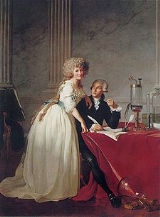
In 1771, Lavoisier married the 13-year-old Marie-Anne Pierrette PaulzeMarie-Anne Pierrette Paulze

Marie-Anne Pierette Paulze was the wife and collaborator of Antoine Lavoisier, an 18th century French nobleman and scientist...
, the daughter of a co-owner of the FermeFerme générale

The Ferme gnrale was, in ancien rgime France, essentially a franchised customs and excise operation which collected duti...
. Over time, she proved to be a scientific colleague to her husband. She translated documents from English for him, including Richard KirwanRichard Kirwan

Richard Kirwan was an Irish scientist. ...
's Essay on Phlogiston and Joseph PriestleyJoseph Priestley

Joseph Priestley was an English chemist, philosopher, dissenting clergyman, and educator....
's research. She created many sketchesDrawing

Drawing is a means of making an using any of a wide variety of tools and techniques....
 and carved engravings of the laboratory instruments used by Lavoisier and his colleagues. She also edited and published Lavoisier’s memoirs (whether any English translations of those memoirs have survived is unknown as of today) and hosted parties at which eminent scientists discussed ideas and problems related to chemistry.

Contributions to chemistry


Research on gases, water, and combustion


Some of Lavoisier's most important experiments were in thermodynamicsThermodynamics Overview

Thermodynamics is a branch of physics that studies the effects of changes in temperature, pressure, and volume on physical ...
 and the nature of combustionCombustion

Combustion or burning is a complex sequence of chemical reactions between a fuel and an oxidant accompanied by the pro...
, or burning. Through these experiments, he demonstrated that burning is a process that involves the combination of a substance with oxygen. (He gave this gas its name, which means "acid former," incorrectly believing that all acids had to contain it). Lavoisier also demonstrated the role of oxygen in the rusting of metal, as well as oxygen's role in animal and plant respiration. Working with Pierre-Simon LaplacePierre-Simon Laplace Summary

Pierre-Simon, Marquis de Laplace was a French mathematician and astronomer who put the final capstone on mathematical astron...
, Lavoisier conducted experiments that showed that respiration was essentially a slow combustion of organic material using inhaled oxygen. Lavoisier's explanation of combustion disproved the phlogiston theory, which postulated that materials released a substance called phlogiston when they burned.

Lavoisier also discovered that Henry Cavendish'sHenry Cavendish

Henry Cavendish was a British scientist. ...
 'inflammable air', which Lavoisier had termed hydrogenHydrogen

|-| Triple point || 13.8033 K, 7.042 kPa...
, combined with oxygen to produce a dew, as Joseph PriestleyJoseph Priestley

Joseph Priestley was an English chemist, philosopher, dissenting clergyman, and educator....
 had reported, which appeared to be water. Lavoisier's work was partly based on the research of Priestley. However, he tried to take credit for Priestley's discoveries. This tendency to use the results of others without acknowledgment, then draw conclusions of his own, is said to be characteristic of Lavoisier. In "Sur la combustion en général" ("On Combustion in general," 1777) and "Considérations Générales sur la Nature des Acides" ("General Considerations on the Nature of Acids," 1778), he demonstrated that the "air" responsible for combustion was also the source of acidity. In 1779, he named this part of the air "oxygen" (Greek for "becoming sharp" because he claimed that the sharp taste of acids came from oxygen), and the other "azoteNitrogen

Nitrogen is a chemical element which has the symbol N and atomic number 7 in the periodic table....
" (Greek for "no life"). In "Réflexions sur la Phlogistique" ("Reflections on Phlogiston," 1783), Lavoisier showed the phlogiston theoryPhlogiston theory

The phlogiston theory is an obsolete scientific theory of combustion....
 to be inconsistent.

Pioneer of stoichiometry


Lavoisier's researches included some of the first truly quantitative chemical experimentsStoichiometry

Stoichiometry is the calculation of quantitative relationships of the reactants and products in chemical reactions . ...
. He carefully weighed the reactants and products in a chemical reaction, which was a crucial step in the advancement of chemistry. He showed that, although matter can change its state in a chemical reaction, the quantity of matter is the same at the end as at the beginning of every chemical change. These experiments supported the law of conservation of massConservation of mass

The 'law of conservation of mass/matter' states that the mass of a closed system of substances will remain constan...
, which Lavoisier was the first to state, although Mikhail LomonosovMikhail Lomonosov

Mikhail Vasilyevich Lomonosov was a Russian writer and polymath who made important contributions to literature, education,...
 (1711-1765) had previously expressed similar ideas in 1748 and proved them in experiments. Others who anticipated the work of Lavoisier include Joseph BlackJoseph Black

Joseph Black was a Scottish physicist and chemist....
 (1728-1799), Henry CavendishHenry Cavendish

Henry Cavendish was a British scientist. ...
 (1731-1810), and Jean ReyJean Rey

See:*Jean Rey, a French physician and chemist...
 (1583-1645).

Analytical chemistry and chemical nomenclature


Lavoisier investigated the composition of water and air, which at the time were considered elements. He determined that the components of water were oxygenOxygen

Oxygen is a chemical element with the chemical symbol O and atomic number 8....
 and hydrogenHydrogen

|-| Triple point || 13.8033 K, 7.042 kPa...
, and that air was a mixture of gases, primarily nitrogenNitrogen

Nitrogen is a chemical element which has the symbol N and atomic number 7 in the periodic table....
 and oxygen. With the French chemists Claude-Louis Berthollet, Antoine FourcroyAntoine François, comte de Fourcroy Overview

Antoine Franois, comte de Fourcroy, French chemist, the son of an apothecary in the household of the duke of Orleans, was bo...
 and Guyton de MorveauLouis-Bernard Guyton de Morveau Summary

Louis-Bernard Guyton de Morveau was a French chemist and politician....
, Lavoisier devised a systematic chemical nomenclature. He described it in Méthode de nomenclature chimique (Method of Chemical Nomenclature, 1787). This system facilitated communication of discoveries between chemists of different backgrounds and is still largely in use today, including names such as sulfuric acid, sulfates, and sulfites.

Lavoisier's Traité Élémentaire de Chimie (Treatise of Elementary Chemistry, 1789, translated into English by ScotsmanScotland

Scotland is a nation in northwest Europe and one of the constituent countries of the United Kingdom....
 Robert KerrRobert Kerr (writer)

Robert Kerr was a scientific writer and translator from Scotland....
) is considered to be the first modern chemistry textbookTextbook Summary

A textbook is a manual of instruction or a standard book in any branch of study....
. It presented a unified view of new theories of chemistry, contained a clear statement of the law of conservation of massConservation of mass

The 'law of conservation of mass/matter' states that the mass of a closed system of substances will remain constan...
, and denied the existence of phlogiston. This text clarified the concept of an element as a substance that could not be broken down by any known method of chemical analysis, and presented Lavoisier's theory of the formation of chemical compounds from elements.

His Traité Élémentaire contained a list of elements that included oxygen, nitrogen, hydrogen, phosphorusPhosphorus

|-| Critical temperature || 994 KPhosphorus, , is the chemical element in the periodic table that has the symbol P a...
, mercuryMercury (element)

Mercury, also called quicksilver, is a chemical element in the periodic table that has the symbol Hg and atomic...
, zincZinc Summary

Zinc is a chemical element in the periodic table that has the symbol Zn and atomic number 30....
, and sulfurFacts About Sulfur

Sulfur or sulphur is the chemical element in the periodic table that has the symbol S and atomic number 16....
. His list, however, also included lightLight

Light is electromagnetic radiation with a wavelength that is visible to the eye or, in a technical or scientific context, e...
 and caloricCaloric theory

In the history of science, the caloric theory is a theory that heat consists of a fluid called "caloric" that flows from hot...
, which he incorrectly believed to be material substances.

While many leading chemists of the time refused to accept Lavoisier's new ideas, the Traité Élémentaire was sufficiently sound to convince the next generation.


Legacy


Lavoisier's fundamental contributions to chemistry were a result of a conscious effort to fit all experiments into the framework of a single theory. He established the consistent use of the chemical balance, used oxygen to overthrow the phlogiston theory, and developed a new system of chemical nomenclature which held that oxygen was an essential constituent of all acids (which later turned out to be erroneous). Lavoisier also did early research in physical chemistry and thermodynamics in joint experiments with Laplace. They used a calorimeter to estimate the heat evolved per unit of carbon dioxide produced, eventually finding the same ratio for a flame and animals, indicating that animals produced energy by a type of combustion reaction.

Lavoisier also contributed to early ideas on composition and chemical changes by stating the radical theory, believing that radicalsRadical (chemistry)

In chemistry, radicals are atomic or molecular species with unpaired electrons on an otherwise open shell configuration....
, which function as a single group in a chemical process, combine with oxygen in reactions. He also introduced the possibility of allotropy in chemical elementsAllotropy

Allotropy is the nameapplied by Jns Jakob Berzelius to the property possessed by specific...
 when he discovered that diamondDiamond Summary

Diamond is the hardest known natural material and one of the two best known forms of carbon, whose hardness and high disper...
 is a crystalline form of carbon.

However, much to his professional detriment, Lavoisier actually discovered no new substances, devised no really novel apparatus, and worked out no improved methods of preparation. He was essentially a theorist, and his great merit lay in the capacity of taking over experimental work that others had carried out--without always, unfortunately, adequately recognizing their claims--and by a rigorous logical procedure, reinforced by his own quantitative experiments, of expounding the true explanation of the results. He completed the work of Black, Priestley and Cavendish, and gave a correct explanation of their experiments.

Overall, his contributions are considered the most important in advancing chemistry to the level reached in physics and mathematics during 18th century.

Contributions to biology

Lavoisier used a calorimeterCalorimeter

A calorimeter is a device used for calorimetry, the science of measuring the heat of chemical reactions or physical changes ...
 to measure heat production as a result of respiration in a guinea pigGuinea pig

Guinea pigs are rodents belonging to the family Caviidae and the genus Cavia, originally idigenous to the Andes....
. The outer shell of the calorimeter was packed with snow, which melted to maintain a constant temperature of around an inner shell filled with ice. The guinea pig in the center of the chamber produced heat which melted the ice. The water that flowed out of the calorimeter was collected and weighed. Lavoisier found that of melted ice corresponded to 80 kcal of heat production by the guinea pig. Lavoisier concluded, "la respiration est donc une combustion", that is, respiratory gas exchange is a combustion, like that of a candle burning.

Law and politics

Lavoisier received a law degreeLaw degree

A Law degree is the degree conferred on someone who successfully completes studies in law....
 and was admitted to the barBar association

A bar association is a professional body of lawyers....
, but never practiced as a lawyerLawyer

A lawyer, or legal practitioner, is a person certified to give legal advice who advises clients in legal matters....
. He did become interested in French politicsPolitics

Politics is the process by which groups make decisions....
, and at the age of 26 he obtained a position as a taxFacts About Tax

A tax is a financial charge or other levy imposed on an individual or a legal entity by a state or a functional equivalent ...
 collector in the Ferme GénéraleFerme générale

The Ferme gnrale was, in ancien rgime France, essentially a franchised customs and excise operation which collected duti...
, a tax farmingTax farming (France)

Tax farming refers to the method of tax collection practiced in France during the days of the Ancien Rgime....
 company, where he attempted to introduce reforms in the French monetaryMonetary system

A monetary system secures the proper functioning of money by regulating economic agents, transaction types, and money supply...
 and taxTax

A tax is a financial charge or other levy imposed on an individual or a legal entity by a state or a functional equivalent ...
ation system to help the peasants. While in government work, he helped develop the metric systemSi

Si, si, or SI may stand for:...
 to secure uniformity of weights and measures throughout France.

Final days, execution, and aftermath


As one of twenty-eight French tax collectors and a powerful figure in the unpopular Ferme Générale, Lavoisier was branded a traitor during the Reign of Terror by French RevolutionFacts About French Revolution

The French Revolution was a pivotal period in the history of French, European and Western civilization....
ists in 1794. Lavoisier had also intervened on behalf of a number of foreign-born scientists including mathematician Joseph Louis LagrangeJoseph Louis Lagrange

Joseph-Louis Lagrange, comte de l'Empire was an Italian mathematician and astronomer who made important contributions to all...
, granting them exception to a mandate stripping all foreigners of possessions and freedom. Lavoisier was tried, convicted, and guillotined on May 8 in Paris, at the age of 50.

Lavoisier was actually one of the few liberals in his position. One of his actions that may have sealed his fate was a clash a few years earlier with the young Jean-Paul MaratJean-Paul Marat Overview

Jean-Paul Marat , was a Swiss-born French scientist and physician who made much of his career in the United Kingdom, but is ...
 whom he dismissed curtly after being presented with a preposterous 'scientific invention'. Marat subsequently became a leading revolutionary and one of the French Revolution's more extreme "professional common men."

An appeal to spare his life so that he could continue his experiments was cut short by the judge: "The Republic needs neither scientists nor chemists; the course of justice can not be delayed."

Lavoisier's importance to science was expressed by Lagrange who lamented the beheading by saying: "Cela leur a pris seulement un instant pour lui couper la tête, mais la France pourrait ne pas en produire un autre pareil en un siècle." ("It took them only an instant to cut off his head, but France may not produce another like him in a century.")

One and a half years following his death, Lavoisier was exonerated by the French government. When his private belongings were delivered to his widow, a brief note was included reading "To the widow of Lavoisier, who was falsely convicted."

About a century after his death, a statue of Lavoisier was erected in Paris. It was later discovered that the sculptor had not actually copied Lavoisier's head for the statue, but used a spare head of the Marquis de CondorcetMarquis de Condorcet

Marie Jean Antoine Nicolas Caritat, marquis de Condorcet was a French philosopher, mathematician, and early political...
, the Secretary of the Academy of Sciences during Lavoisier's last years. Lack of money prevented alterations being made. The statue was melted down during the Second World WarWorld War II

World War II, or the Second World War, was a worldwide conflict fought between the Allied Powers and the Axis Powers ,...
 and has not since been replaced. However, one of the main "lycées" (highschools) in Paris and a street in the 8th arrondissementVIIIe arrondissement

The 8e arrondissement is one of the 20 arrondissements of Paris, France....
 are named after Lavoisier, and statues of him are found on the Hôtel de Ville (photograph, right) and on the façade of the Cour Napoléon of the LouvrePalais du Louvre

The palais du Louvre in Paris, on the Right Bank of the Seine is a former royal palace, situated between the Tuileries Garde...
.

Selected writings

- Reprinted 1965, Bruxelles: Cultures et Civilisations

- Reprint of Robert Kerr's English translation of 1790

See also

  • List of independent discoveries

Further reading


External links

  • - Chemical Achievers profile.
  • - Fred Senese


  • by the BBC