
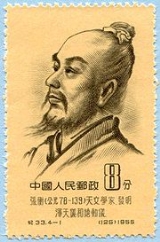
Zhang Heng was a Chinese astronomer, mathematician, inventor, geographer, cartographer, artist, poet, statesman, and literary scholar from
NanyangNanyang is a prefecture-level city in the southwest of Henan province, People's Republic of China. The city with the largest administrative area in Henan, Nanyang borders Xinyang to the southeast, Zhumadian to the east, Pingdingshan to the northeast, Luoyang to the north, Sanmenxia to the...
,
HenanHenan , is a province of the People's Republic of China, located in the central part of the country. Its one-character abbreviation is "豫" , named after Yuzhou , a Han Dynasty state that included parts of Henan...
. He lived during the Eastern Han Dynasty (25–220 CE) of
ChinaChinese civilization may refer to:* China for more general discussion of the country.* Chinese culture* Greater China, the transnational community of ethnic Chinese.* History of China* Sinosphere, the area historically affected by Chinese culture...
. He was educated in the capital cities of
LuoyangLuoyang is a prefecture-level city in western Henan province of Central China. It borders the provincial capital of Zhengzhou to the east, Pingdingshan to the southeast, Nanyang to the south, Sanmenxia to the west, Jiyuan to the north, and Jiaozuo to the northeast.Situated on the central plain of...
and
Chang'anChang'an is an ancient capital of more than ten dynasties in Chinese history, today known as Xi'an. Chang'an literally means "Perpetual Peace" in Classical Chinese. During the short-lived Xin Dynasty, the city was renamed "Constant Peace" ; yet after its fall in AD 23, the old name was restored...
, and began his career as a minor civil servant in Nanyang. Eventually, he became Chief Astronomer, Prefect of the Majors for Official Carriages, and then Palace Attendant at the imperial court. His uncompromising stances on certain historical and calendrical issues led to Zhang being considered a controversial figure, which prevented him from becoming an official court historian. His political rivalry with the palace
eunuchA eunuch is a person born male most commonly castrated, typically early enough in his life for this change to have major hormonal consequences...
s during the reign of
Emperor ShunEmperor Shun of Han, trad. ch. 漢順帝;, sim. ch. 漢顺帝, py. hàn shùn dì, wg. Han Shun-ti, was an emperor of the Chinese Han Dynasty and the seventh emperor of the Eastern Han period...
(r. 125–144) led to his decision to retire from the central court to serve as an administrator of Hejian, in
Hebei' is a province of the People's Republic of China in the North China region. Its one-character abbreviation is "" , named after Ji Province, a Han Dynasty province that included what is now southern Hebei...
. He returned home to Nanyang for a short time, before being recalled to serve in the capital once more in 138. He died there a year later, in 139.
Zhang applied his extensive knowledge of mechanics and gears in several of his inventions. He invented the world's first
water-poweredHydraulics is a topic in applied science and engineering dealing with the mechanical properties of liquids. Fluid mechanics provides the theoretical foundation for hydraulics, which focuses on the engineering uses of fluid properties. In fluid power, hydraulics is used for the generation, control,...
armillary sphereAn armillary sphere is a model of objects in the sky , consisting of a spherical framework of rings, centred on Earth, that represent lines of celestial longitude and latitude and other astronomically important features such as the ecliptic...
, to represent astronomical observation; improved the inflow
water clockA water clock or clepsydra is any timepiece in which time is measured by the regulated flow of liquid into or out from a vessel where the amount is then measured.Water clocks, along with sundials, are likely to be the oldest time-measuring instruments, with the only exceptions...
by adding another tank; and invented the world's first
seismometerSeismometers are instruments that measure motions of the ground, including those of seismic waves generated by earthquakes, volcanic eruptions, and other seismic sources...
, which discerned the
cardinal directionThe four cardinal directions or cardinal points are the directions of north, east, south, and west, commonly denoted by their initials: N, E, S, W. East and west are at right angles to north and south, with east being in the direction of rotation and west being directly opposite. Intermediate...
of an
earthquakeAn earthquake is the result of a sudden release of energy in the Earth's crust that creates seismic waves. The seismicity, seismism or seismic activity of an area refers to the frequency, type and size of earthquakes experienced over a period of time...
500 km (310.7 mi) away. Furthermore, he improved previous Chinese calculations of the formula for
pi' is a mathematical constant that is the ratio of any circle's circumference to its diameter. is approximately equal to 3.14. Many formulae in mathematics, science, and engineering involve , which makes it one of the most important mathematical constants...
. In addition to documenting about 2,500 stars in his extensive
star catalogueA star catalogue, or star catalog, is an astronomical catalogue that lists stars. In astronomy, many stars are referred to simply by catalogue numbers. There are a great many different star catalogues which have been produced for different purposes over the years, and this article covers only some...
, Zhang also posited theories about the
MoonThe Moon is Earth's only known natural satellite,There are a number of near-Earth asteroids including 3753 Cruithne that are co-orbital with Earth: their orbits bring them close to Earth for periods of time but then alter in the long term . These are quasi-satellites and not true moons. For more...
and its relationship to the
SunThe Sun is the star at the center of the Solar System. It is almost perfectly spherical and consists of hot plasma interwoven with magnetic fields...
; specifically, he discussed the Moon's sphericity, its illumination by reflecting sunlight on one side and remaining dark on the other, and the nature of
solarAs seen from the Earth, a solar eclipse occurs when the Moon passes between the Sun and the Earth, and the Moon fully or partially blocks the Sun as viewed from a location on Earth. This can happen only during a new moon, when the Sun and the Moon are in conjunction as seen from Earth. At least...
and
lunarA lunar eclipse occurs when the Moon passes behind the Earth so that the Earth blocks the Sun's rays from striking the Moon. This can occur only when the Sun, Earth, and Moon are aligned exactly, or very closely so, with the Earth in the middle. Hence, a lunar eclipse can only occur the night of a...
eclipseAn eclipse is an astronomical event that occurs when an astronomical object is temporarily obscured, either by passing into the shadow of another body or by having another body pass between it and the viewer...
s. His
fuFu is a kind of rhymed prose, or poetry style essay, popular in ancient China, especially during the Han Dynasty. The term fu is often used in a multiway contrast with the more purely poetic shi style, with the fixed-rhythm forms of poetry , and with various more explicitly prosaic forms of...
(rhapsody) and
shiShi is the Chinese word for "poetry" or "poem", anciently associated with Chinese poetry. In modern times, shi can and has been used as an umbrella term to mean poetry in any form or language, whether or not Chinese; but, it may imply or be used to refer certain classical forms of poetry, for...
poetry were renowned and commented on by later Chinese writers. Zhang received many posthumous honors for his scholarship and ingenuity, and is considered a
polymathA polymath is a person whose expertise spans a significant number of different subject areas. In less formal terms, a polymath may simply be someone who is very knowledgeable...
by some scholars. Some modern scholars have also compared his work in astronomy to that of
PtolemyClaudius Ptolemy , was a Roman citizen of Egypt who wrote in Greek. He was a mathematician, astronomer, geographer, astrologer, and poet of a single epigram in the Greek Anthology. He lived in Egypt under Roman rule, and is believed to have been born in the town of Ptolemais Hermiou in the...
(CE 86–161).
Early life
Born in the town of Xi'e in Nanyang Commandery (located north of modern
Nanyang CityNanyang is a prefecture-level city in the southwest of Henan province, People's Republic of China. The city with the largest administrative area in Henan, Nanyang borders Xinyang to the southeast, Zhumadian to the east, Pingdingshan to the northeast, Luoyang to the north, Sanmenxia to the...
,
HenanHenan , is a province of the People's Republic of China, located in the central part of the country. Its one-character abbreviation is "豫" , named after Yuzhou , a Han Dynasty state that included parts of Henan...
province), Zhang Heng came from a distinguished but not very affluent family. His grandfather, Zhang Kan, had been governor of a commandery, and one of the leaders who supported the restoration of the
Han DynastyThe Han Dynasty was the second imperial dynasty of China, preceded by the Qin Dynasty and succeeded by the Three Kingdoms . It was founded by the rebel leader Liu Bang, known posthumously as Emperor Gaozu of Han. It was briefly interrupted by the Xin Dynasty of the former regent Wang Mang...
by
Emperor GuangwuEmperor Guangwu , born Liu Xiu, was an emperor of the Chinese Han Dynasty, restorer of the dynasty in AD 25 and thus founder of the Later Han or Eastern Han...
(r. 25–57), following the death of the usurper
Wang MangWang Mang , courtesy name Jujun , was a Han Dynasty official who seized the throne from the Liu family and founded the Xin Dynasty , ruling AD 9–23. The Han dynasty was restored after his overthrow and his rule marks the separation between the Western Han Dynasty and Eastern Han Dynasty...
and his short-lived
Xin DynastyThe Xin Dynasty was a Chinese dynasty which lasted from AD 9 to 23. It followed the Western Han Dynasty and preceded the Eastern Han Dynasty....
(CE 9–23). At age ten, Zhang's father died, leaving him in the care of his mother and grandmother. An accomplished writer in his youth, Zhang left home in 95 to pursue his studies in the ancient capitals of
Chang'anChang'an is an ancient capital of more than ten dynasties in Chinese history, today known as Xi'an. Chang'an literally means "Perpetual Peace" in Classical Chinese. During the short-lived Xin Dynasty, the city was renamed "Constant Peace" ; yet after its fall in AD 23, the old name was restored...
and
LuoyangLuoyang is a prefecture-level city in western Henan province of Central China. It borders the provincial capital of Zhengzhou to the east, Pingdingshan to the southeast, Nanyang to the south, Sanmenxia to the west, Jiyuan to the north, and Jiaozuo to the northeast.Situated on the central plain of...
. While traveling to Luoyang, Zhang passed by a
hot springA hot spring is a spring that is produced by the emergence of geothermally heated groundwater from the Earth's crust. There are geothermal hot springs in many locations all over the crust of the earth.-Definitions:...
near
Mount LiMount Li is a mountain located in the northwest of Xi'an in Shaanxi Province, China. The mountain is part of the Qinling mountain range and rises to a height of 1302 metres above sea level...
and dedicated one of his earliest
fu poemsFu is a kind of rhymed prose, or poetry style essay, popular in ancient China, especially during the Han Dynasty. The term fu is often used in a multiway contrast with the more purely poetic shi style, with the fixed-rhythm forms of poetry , and with various more explicitly prosaic forms of...
to it, the
Wenquan (溫泉). After studying for some years at Luoyang's (
TaixueTaixue , or sometimes called the "Imperial Academy", "Imperial School" , "Imperial University" or "Imperial Central University", was the highest rank of educational establishment in Ancient China between the Han Dynasty and Sui Dynasty. It was replaced by the Guozijian...
), he became well-versed in the
classicsChinese classic texts, or Chinese canonical texts, today often refer to the pre-Qin Chinese texts, especially the Neo-Confucian titles of Four Books and Five Classics , a selection of short books and chapters from the voluminous collection called the Thirteen Classics. All of these pre-Qin texts...
, and befriended notable persons, such as the mathematician and calligrapher
Cui YuanCui Yuan , style name Ziyu, was a minor military officer, mathematician, scholar, noted calligrapher, poet, and temporary fugitive of the Han Dynasty in China...
(78–143), the official and philosophical commentator
Ma RongMa Rong , courtesy name Jichang , was a commentator of the Han Dynasty. He was born in modern Xianyang, Shaanxi in former Fufeng county. He was known for his commentaries on the books on the Five Classics, and the first scholar known to have done this. He also developed the double column...
(79–166), and the philosopher
Wang FuWang Fu , which endorsed the Confucian model of government.-Further reading:* Ann Behnke Kinney. The Art of the Han Essay: Wang Fu's Ch'ien-Fu Lun. Phoenix: Arizona State University Center for Asian Research, 1990. ISBN 0-939252-23-6...
(78–163). Government authorities offered Zhang appointments to several offices, including a position as one of the
Three ExcellenciesThe Three Ducal Ministers , also translated as the Three Dukes, Three Excellencies, or the Three Lords, was the collective name for the three highest officials in ancient China...
, yet he acted modestly and turned down those positions. At age twenty-three, he returned home with the title "Officer of Merit in Nanyang," serving as the master of documents under the administration of Governor Bao De (in office from 103–111). As he was charged with composing inscriptions and dirges for Bao De, he gained experience in writing official documents. As Officer of Merit in the commandery, he was also responsible for local appointments to office and recommendations to the capital of nominees for higher office. He spent much of his time composing
rhapsodiesA rhapsody in music is a one-movement work that is episodic yet integrated, free-flowing in structure, featuring a range of highly contrasted moods, colour and tonality. An air of spontaneous inspiration and a sense of improvisation make it freer in form than a set of variations...
on the capital cities. When Bao De was recalled to the capital in 111, to serve as a minister of finance, Zhang continued his literary work at home in Xi'e. Zhang Heng began his studies in astronomy at the age of thirty, and began publishing his works in
astronomyAstronomy in China has a very long history, with historians considering that "they [the Chinese] were the most persistent and accurate observers of celestial phenomena anywhere in the world before the Arabs."...
and
mathematicsMathematics in China emerged independently by the 11th century BC. The Chinese independently developed very large and negative numbers, decimals, a place value decimal system, a binary system, algebra, geometry, and trigonometry....
.
Official career
In 112, Zhang was summoned to the court of
Emperor An of HanEmperor Ān of Hàn, ch. 漢安帝, py. hàn ān dì, wg. Han An-ti, was an emperor of the Chinese Hàn Dynasty and the sixth emperor of the Eastern Hàn period ruling from 106 to 125...
(r. 106–125), who had heard of Zhang's expertise in mathematics. When he was nominated to serve at the capital, Zhang was escorted by carriage—a symbol of his official status—to Luoyang, where he became a court gentleman working for the
Imperial SecretariatThe Three Ducal Ministers , also translated as the Three Dukes, Three Excellencies, or the Three Lords, was the collective name for the three highest officials in ancient China...
. He was promoted to Chief Astronomer for the Han court under Emperor An, serving his first term from 115–120 and his second under the succeeding emperor from 126–132. As Chief Astronomer, Zhang was a subordinate of the Minister of Ceremonies, the latter one of
Nine MinistersThe Nine Ministers was the collective name for nine high officials in the imperial government of the Han Dynasty , who each headed a specialized ministry and were subordinates to the Three Councillors of State...
ranked just below the Three Excellencies. In addition to recording heavenly observations and portents, preparing the calendar, and reporting which days were auspicious or not, Zhang was also in charge of an advanced literacy test for all candidates of the Imperial Secretariat and
CensorateThe Censorate was a top-level supervisory agency in ancient China, first established during the Qin Dynasty ....
(who were expected to know at least 9,000 Chinese characters and all major writing styles). Under Emperor An, Zhang also served as Prefect of the Majors for Official Carriages under the Ministry of Guards, in charge of the reception of memorials (containing policy and administrative suggestions) submitted to the throne as well as nominees for official appointments.
When the government official Dan Song proposed the
Chinese calendarThe Chinese calendar is a lunisolar calendar, incorporating elements of a lunar calendar with those of a solar calendar. It is not exclusive to China, but followed by many other Asian cultures as well...
should be reformed in 123 to adopt certain
apocryphal teachingsThe term apocrypha is used with various meanings, including "hidden", "esoteric", "spurious", "of questionable authenticity", ancient Chinese "revealed texts and objects" and "Christian texts that are not canonical"....
, Zhang opposed the idea. He considered the teachings to be of questionable stature and believed they could introduce errors. Others shared Zhang's opinion and the calendar was not altered, yet Zhang's proposal that apocryphal writings should be banned was rejected. The officials Liu Zhen and Liu Taotu, members of a committee to compile the dynastic history
Dongguan Hanji (東觀漢記), sought permission from the court to consult Zhang Heng. However, Zhang was barred from assisting the committee due to his controversial views on apocrypha and his objection to the relegation of
Emperor Gengshi'sEmperor Gengshi of Han, ch. 漢更始帝, py. gèng shĭ dì, wg. Keng-Shih-ti, , also known as the Prince of Huaiyang , courtesy name Shenggong , was an emperor of the restored Chinese Han Dynasty following the fall of Wang Mang's Xin...
(r. 23–25) role in the restoration of the Han Dynasty as lesser than Emperor Guangwu's. Liu Zhen and Liu Taotu were Zhang's only historian allies at court, and after their deaths Zhang had no further opportunities for promotion to the prestigious post of court historian.
Despite this setback in his official career, Zhang was reappointed as Chief Astronomer in 126 after
Emperor Shun of HanEmperor Shun of Han, trad. ch. 漢順帝;, sim. ch. 漢顺帝, py. hàn shùn dì, wg. Han Shun-ti, was an emperor of the Chinese Han Dynasty and the seventh emperor of the Eastern Han period...
(r. 125–144) ascended to the throne. His intensive astronomical work was rewarded only with the rank and salary of 600 bushels, or
shi, of grain (mostly commuted to
coin cashChinese coins were produced continuously for around 2,500 years by casting in moulds, rather than being struck with dies as with most western coins.-Pre-Imperial :The earliest coinage of China was described by Sima Qian, the great historian of c...
or bolts of
silkSilk is a natural protein fiber, some forms of which can be woven into textiles. The best-known type of silk is obtained from the cocoons of the larvae of the mulberry silkworm Bombyx mori reared in captivity...
). To place this number in context, in a hierarchy of twenty official ranks, the lowest-paid official earned the rank and salary of 100 bushels and the highest-paid official earned 10,000 bushels during the Han. The 600-bushel rank was the lowest the emperor could directly appoint to a central government position; any official of lower status was overseen by central or provincial officials of high rank.
In 132, Zhang introduced an intricate
seismometerSeismometers are instruments that measure motions of the ground, including those of seismic waves generated by earthquakes, volcanic eruptions, and other seismic sources...
to the court, which he claimed could detect the precise cardinal direction of a distant
earthquakeAn earthquake is the result of a sudden release of energy in the Earth's crust that creates seismic waves. The seismicity, seismism or seismic activity of an area refers to the frequency, type and size of earthquakes experienced over a period of time...
. On one occasion his device indicated that an earthquake had occurred in the northwest. As there was no perceivable tremor felt in the capital his political enemies were briefly able to relish the failure of his device, until a messenger arrived shortly afterwards to report that an earthquake had occurred about 400 km (248 mi) to 500 km (310 mi) northwest of Luoyang in
Gansu' is a province located in the northwest of the People's Republic of China.It lies between the Tibetan and Huangtu plateaus, and borders Mongolia, Inner Mongolia, and Ningxia to the north, Xinjiang and Qinghai to the west, Sichuan to the south, and Shaanxi to the east...
province.
A year after Zhang presented his seismometer to the court, officials and candidates were asked to provide comments about a series of recent earthquakes which could be interpreted as signs of displeasure from Heaven. The ancient Chinese viewed natural calamities as cosmological punishments for misdeeds that were perpetrated by the Chinese ruler or his subordinates on earth. In Zhang's memorial discussing the reasons behind these natural disasters, he criticized the new recruitment system of Zuo Xiong which fixed the age of eligible candidates for the title "
Filial and IncorruptXiaolian , was the standard of nominating civil officers started by Emperor Wu of Han in 134 BC. It lasted until its replacement by the imperial examination system during the Sui Dynasty....
" at age forty. The new system also transferred the power of the candidates' assessment to the Three Excellencies rather than the Generals of the Household, who by tradition oversaw the affairs of court gentlemen. Although Zhang's memorial was rejected, his status was significantly elevated soon after to Palace Attendant, a position he used to influence the decisions of Emperor Shun. With this prestigious new position, Zhang earned a salary of 2,000 bushels and had the right to escort the emperor.
As Palace Attendant to Emperor Shun, Zhang Heng attempted to convince him that the court
eunuchA eunuch is a person born male most commonly castrated, typically early enough in his life for this change to have major hormonal consequences...
s represented a threat to the imperial court. Zhang pointed to specific examples of past court intrigues involving eunuchs, and convinced Shun that he should assume greater authority and limit their influence. The eunuchs attempted to slander Zhang, who responded with a rhapsody called "Contemplating the Cosmos".
Rafe de CrespignyDr Rafe de Crespigny is a retired Adjunct Professor with the China and Korea Centre, Australian National University in Canberra, Australia...
states that Zhang's rhapsody used imagery similar to
Qu YuanQu Yuan was a Chinese poet who lived during the Warring States Period in ancient China. He is famous for his contributions to the poetry collection known as the Chu-ci...
's (340–278 BCE) poem "
Li SaoLi Sao is a Chinese poem dating from the Warring States Period, largely written by Qu Yuan of the Kingdom of Chu. One of the most famous poems of pre-Qin China, it is a representative work of the Chu Ci form of poetry.-Title:The title's meaning has been debated about even in historical times...
" and focused on whether or not good men should flee the corrupted world or remain virtuous within it.
Literature and poetry
While working for the central court, Zhang Heng had access to a variety of written materials located in the Archives of the Eastern Pavilion. Zhang read many of the great works of history in his day and claimed he had found ten instances where the
Records of the Grand HistorianThe Records of the Grand Historian, also known in English by the Chinese name Shiji , written from 109 BC to 91 BC, was the Magnum opus of Sima Qian, in which he recounted Chinese history from the time of the Yellow Emperor until his own time...
by
Sima QianSima Qian was a Prefect of the Grand Scribes of the Han Dynasty. He is regarded as the father of Chinese historiography for his highly praised work, Records of the Grand Historian , a "Jizhuanti"-style general history of China, covering more than two thousand years from the Yellow Emperor to...
(145–90 BCE) and the
Book of HanThe Book of Han, Hanshu or History of the Former Han Dynasty |Fan Ye]] . Various scholars have estimated that the earliest material covered in the book dates back to between 206 and 202 BCE...
by
Ban GuBan Gu , courtesy name Mengjian , was a 1st century Chinese historian and poet best known for his part in compiling the Book of Han. He also wrote in the main poetic genre of the Han era, a kind of poetry interspersed with prose called fu. Some are anthologized by Xiao Tong in his Selections of...
(CE 32–92) differed from other ancient texts that were available to him. His account was preserved and recorded in the 5th century text of the
Book of Later HanThe Book of the Later Han or the History of the Later Han is one of the official Chinese historical works which was compiled by Fan Ye in the 5th century, using a number of earlier histories and documents as sources...
by
Fan YeFan Ye , courtesy name Weizong , was a Chinese historian and the compiler of Book of Later Han of Liu Song. Fan came from an official family background, he was born in present-day Shaoxing, Zhejiang, his ancestry was from Nanyang, Henan. His father was Fan Tai .-References:*Tan, Jiajian, ....
(398–445). His
rhapsodiesA rhapsody in music is a one-movement work that is episodic yet integrated, free-flowing in structure, featuring a range of highly contrasted moods, colour and tonality. An air of spontaneous inspiration and a sense of improvisation make it freer in form than a set of variations...
and other literary works displayed a deep knowledge of classic texts,
Chinese philosophyChinese philosophy is philosophy written in the Chinese tradition of thought. The majority of traditional Chinese philosophy originates in the Spring and Autumn and Warring States era, during a period known as the "Hundred Schools of Thought", which was characterized by significant intellectual and...
, and
historiesThe Twenty-Four Histories is a collection of Chinese historical books covering a period from 3000 BC to the Ming Dynasty in the 17th century. The whole set contains 3213 volumes and about 40 million words...
. He also compiled a commentary on the
Taixuan (太玄, "Great Mystery") by the
DaoistTaoism refers to a philosophical or religious tradition in which the basic concept is to establish harmony with the Tao , which is the mechanism of everything that exists...
author Yang Xiong (53 BCE–CE 18).
Xiao TongXiao Tong , courtesy name Deshi , formally Crown Prince Zhaoming , later further posthumously honored as Emperor Zhaoming , was a crown prince of the Chinese dynasty Liang Dynasty...
(501–531), a
crown princeA crown prince or crown princess is the heir or heiress apparent to the throne in a royal or imperial monarchy. The wife of a crown prince is also titled crown princess....
of the
Liang DynastyThe Liang Dynasty , also known as the Southern Liang Dynasty , was the third of the Southern dynasties in China and was followed by the Chen Dynasty...
(502–557), immortalized several of Zhang's works in his anthology of literature,
Wen xuan. Zhang's rhapsodies (
fu 賦) include "Western Metropolis Rhapsody" (西京賦), "Eastern Metropolis Rhapsody" (東京賦), "Southern Capital Rhapsody" (南都賦), "Rhapsody on Contemplating the Mystery" (思玄賦), and "
Rhapsody on Returning to the FieldsReturn to the Field is a Chinese rhapsody written in the fu style by Zhang Heng , an official, inventor, mathematician, and astronomer of the Han Dynasty in China.-Background:...
" (歸田賦). The latter fuses Daoist ideas with
ConfucianismConfucianism is a Chinese ethical and philosophical system developed from the teachings of the Chinese philosopher Confucius . Confucianism originated as an "ethical-sociopolitical teaching" during the Spring and Autumn Period, but later developed metaphysical and cosmological elements in the Han...
and was a precursor to later Chinese metaphysical nature poetry, according to Liu Wu-chi. A set of four short lyric poems (
shiShi is the Chinese word for "poetry" or "poem", anciently associated with Chinese poetry. In modern times, shi can and has been used as an umbrella term to mean poetry in any form or language, whether or not Chinese; but, it may imply or be used to refer certain classical forms of poetry, for...
詩Shi is the Chinese word for "poetry" or "poem", anciently associated with Chinese poetry. In modern times, shi can and has been used as an umbrella term to mean poetry in any form or language, whether or not Chinese; but, it may imply or be used to refer certain classical forms of poetry, for...
) entitled "Lyric Poems on Four Sorrows" (四愁詩), is also included with Zhang's preface. This set constitutes some of the earliest heptasyllabic
shi Chinese poetryChinese poetry is poetry written, spoken, or chanted in the Chinese language, which includes various versions of Chinese language, including Classical Chinese, Standard Chinese, Mandarin Chinese, Cantonese, Yue Chinese, as well as many other historical and vernacular varieties of the Chinese language...
written. While still in Luoyang, Zhang became inspired to write his "Western Metropolis Rhapsody" and "Eastern Metropolis Rhapsody", which were based on the "Rhapsody on the Two Capitals" by the historian Ban Gu. Zhang's work was similar to Ban's, although the latter fully praised the contemporaneous Eastern Han regime while Zhang provided a warning that it could suffer the same fate as the Western Han if it too declined into a state of decadence and moral depravity. These two works satirized and criticized what he saw as the excessive luxury of the upper classes. Zhang's "Southern Capital Rhapsody" commemorated his home city of Nanyang, home of the restorer of the Han Dynasty, Guangwu.

In Zhang Heng's poem "Four Sorrows", he laments that he is unable to woo a beautiful woman due to the impediment of mountains, snows and rivers. Rafe de Crespigny, Tong Xiao, and David R. Knechtges claim that Zhang wrote this as an innuendo hinting at his inability to keep in contact with the emperor, hindered by unworthy rivals and petty men. This poem is one of the first in China to have seven words per line. His "Four Sorrows" reads:
|
In Taishan stays my dear sweetheart,
But Liangfu keeps us long apart;
Looking east, I find tears start.
She gives me a sword to my delight;
A jade I give her as requite.
I'm at a loss as she is out of sight;
Why should I trouble myself all night?
|
|
|
In another poem of his called "Stabilizing the Passions" (定情賦) — preserved in a
Tang DynastyThe Tang Dynasty was an imperial dynasty of China preceded by the Sui Dynasty and followed by the Five Dynasties and Ten Kingdoms Period. It was founded by the Li family, who seized power during the decline and collapse of the Sui Empire...
(618–907) encyclopedia, but referred to earlier by
Tao QianTao Qian , better known as Tao Yuanming , was a Chinese poet. Born in modern Jiujiang, Jiangxi, he was one of the most influential pre-Tang Dynasty Chinese poets....
(365–427) in praise of Zhang's lyrical minimalism — Zhang displays his admiration for an attractive and exemplary woman. This simpler type of
fu poem influenced later works by the prominent official and scholar
Cai YongCai Yong was a Chinese scholar of the Eastern Han Dynasty. He was well-versed in calligraphy, music, mathematics and astronomy. One of his daughters is the famous Cai Wenji.-Early life:...
(132–192). Zhang wrote:
|
Ah, the chaste beauty of this alluring woman!
She shines with flowery charms and blooming face.
She is unique among all her contemporaries.
She is without a peer among her comrades.
|
|
| |
Zhang's long lyrical poems also revealed a great amount of information on urban layout and basic geography. His rhapsody "Sir Based-On-Nothing" provides details on terrain, palaces, hunting parks, markets, and prominent buildings of
Chang'anChang'an is an ancient capital of more than ten dynasties in Chinese history, today known as Xi'an. Chang'an literally means "Perpetual Peace" in Classical Chinese. During the short-lived Xin Dynasty, the city was renamed "Constant Peace" ; yet after its fall in AD 23, the old name was restored...
, the Western Han capital. Exemplifying his attention to detail, his rhapsody on Nanyang described gardens filled with spring garlic, summer
bamboo shootBamboo shoots or bamboo sprouts are the edible shoots of many bamboo species including Bambusa vulgaris and Phyllostachys edulis. They are used in numerous Asian dishes and broths...
s, autumn leeks, winter rape-turnips,
perillaPerilla is the common name of the herbs of the genus Perilla of the mint family, Lamiaceae. In mild climates, the plant reseeds itself. There are both green-leafed and purple-leafed varieties, which are generally recognized as separate species by botanists. The leaves resemble stinging nettle...
,
evodiaTetradium is a genus of nine species of trees in the family Rutaceae, occurring in temperate to tropical east Asia. In older books, the genus was often included in the related genus Euodia , but that genus is now restricted to tropical species...
, and purple ginger. Zhang Heng's writing confirms the size of the imperial hunting park in the suburbs of Chang'an, as his estimate for the circumference of the park's encircling wall agrees with the historian Ban Gu's estimate of roughly 400
liThe li is a traditional Chinese unit of distance, which has varied considerably over time but now has a standardized length of 500 meters or half a kilometer...
(one li in Han times was equal to 415.8 m, or 1,364 ft, making the circumference of the park wall 166,320 m, or 545,600 ft). Along with
Sima XiangruSima Xiangru, also known as Ssu-ma Hsiang-ju was a Chinese writer. He was a minor official of the Western Han Dynasty, but was better known for his poetic skills, jiu business, and controversial marriage to the widow Zhuo Wenjun after both eloped...
(179–117 BCE), Zhang listed a variety of animals and hunting game inhabiting the park, which were divided in the northern and southern portions of the park according to where the animals had originally came from:
northern or southern ChinaNorthern China and southern China are two approximate regions within China. The exact boundary between these two regions has never been precisely defined...
. Somewhat similar to the description of Sima Xiangru, Zhang described the Western Han emperors and their entourage enjoying boat outings, water plays, fishing, and displays of archery targeting birds and other animals with stringed arrows from the tops of tall towers along Chang'an's Kunming Lake. The focus of Zhang's writing on specific places and their terrain, society, people, and their customs could also be seen as early attempts of ethnographic categorization. In his poem "Xijing fu", Zhang shows that he was aware of the new foreign religion of
BuddhismBuddhism is a religion and philosophy encompassing a variety of traditions, beliefs and practices, largely based on teachings attributed to Siddhartha Gautama, commonly known as the Buddha . The Buddha lived and taught in the northeastern Indian subcontinent some time between the 6th and 4th...
, introduced via the
Silk RoadThe Silk Road or Silk Route refers to a historical network of interlinking trade routes across the Afro-Eurasian landmass that connected East, South, and Western Asia with the Mediterranean and European world, as well as parts of North and East Africa...
, as well as the legend of the birth of
BuddhaSiddhārtha Gautama was a spiritual teacher from the Indian subcontinent, on whose teachings Buddhism was founded. In most Buddhist traditions, he is regarded as the Supreme Buddha Siddhārtha Gautama (Sanskrit: सिद्धार्थ गौतम; Pali: Siddhattha Gotama) was a spiritual teacher from the Indian...
with the vision of the
white elephantA white elephant is an idiom for a valuable but burdensome possession of which its owner cannot dispose and whose cost is out of proportion to its usefulness or worth...
bringing about conception. In his "Western Metropolis Rhapsody" (西京賦), Zhang described court entertainments such as
juedi (角抵), a form of theatrical wrestling accompanied by music in which participants butted heads with bull horn masks.
With his
Response [to Criticism] of my Idleness (
Yingjian 應閒), Zhang was an early writer and proponent of the Chinese literary genre
shelun, or hypothetical discourse. Authors of this genre created a written dialogue between themselves and an imaginary person (or a real person of their entourage or association); the latter poses questions to the author on how to lead a successful life. He also used it as a means to criticize himself for failing to obtain high office, but coming to the conclusion that the true gentleman displays virtue instead of greed for power. In this work, Dominik Declercq asserts that the person urging Zhang to advance his career in a time of government corruption most likely represented the eunuchs or
Empress Liang NaEmpress Liang Na , formally Empress Shunlie , was an empress during the Han Dynasty. Her husband was Emperor Shun of Han. She later served as regent for his son Emperor Chong, and the two subsequent emperors from collateral lines, Emperor Zhi and Emperor Huan...
's (116–150) powerful relatives in the
Liang clanLiang is a Chinese surname common in Taiwan and southern China. Meaning "a beam", "a bridge", or "an elevation", or "a mast", the surname is often transliterated as Leung or Leong according to its Cantonese pronunciation, or Neo / Nio / Niu . It is also common in Korea, where it is pronounced Yang...
. Declercq states that these two groups would have been "anxious to know whether this famous scholar could be lured over to their side", but Zhang flatly rejected such an alignment by declaring in this politically charged piece of literature that his gentlemanly quest for virtue trumped any desire of his for power.
Zhang wrote about the various love affairs of emperors dissatisfied with the imperial harem, going out into the city incognito to seek out prostitutes and sing-song girls. This was seen as a general criticism of the Eastern Han emperors and their imperial favorites, guised in the criticism of earlier Western Han emperors. Besides criticizing the Western Han emperors for lavish decadence, Zhang also pointed out that their behavior and ceremonies did not properly conform with the Chinese cyclical beliefs in
yin and yangIn Asian philosophy, the concept of yin yang , which is often referred to in the West as "yin and yang", is used to describe how polar opposites or seemingly contrary forces are interconnected and interdependent in the natural world, and how they give rise to each other in turn. Opposites thus only...
. In a poem criticizing the previous Western Han Dynasty, Zhang wrote:
|
Those who won this territory were strong;
Those who depended on it endured.
When a stream is long, its water is not easily exhausted.
When roots are deep, they do not rot easily.
Therefore, as extravagance and ostentation were given free rein,
The odour became pungent and increasingly fulsome.
|
|
| |
Astronomy and mathematics
For centuries the Chinese approximated
pi' is a mathematical constant that is the ratio of any circle's circumference to its diameter. is approximately equal to 3.14. Many formulae in mathematics, science, and engineering involve , which makes it one of the most important mathematical constants...
as 3;
Liu XinLiu Xin , later changed name to Liu Xiu , courtesy name Zijun , was a Chinese astronomer, historian, and editor during the Xin Dynasty . He was the son of Confucian scholar Liu Xiang and an associate of other prominent thinkers such as the philosopher Huan Tan...
(d. CE 23) made the first known Chinese attempt at a more accurate calculation of 3.154, but there is no record detailing the method he used to obtain this figure. In his work around 130, Zhang Heng compared the celestial circle to the diameter of the earth, proportioning the former as 736 and the latter as 232, thus calculating pi as 3.1724. In Zhang's day, the ratio 4:3 was given for the area of a square to the area of its inscribed circle and the volume of a cube and volume of the inscribed sphere should also be 4
2:3
2. In formula, with D as diameter and V as volume, D
3:V = 16:9 or V=

D
3; Zhang realized that the value for diameter in this formula was inaccurate, noting the discrepancy as the value taken for the ratio. Zhang then attempted to remedy this by amending the formula with an additional

D
3, hence V=

D
3 +

D
3 =

D
3. With the ratio of the
volumeVolume is the quantity of three-dimensional space enclosed by some closed boundary, for example, the space that a substance or shape occupies or contains....
of the cube to the inscribed sphere at 8:5, the implied ratio of the area of the square to the circle is √
8:√
5. From this formula, Zhang calculated pi as the
square rootIn mathematics, a square root of a number x is a number r such that r2 = x, or, in other words, a number r whose square is x...
of 10 (or approximately 3.162). In the 3rd century,
Liu HuiLiu Hui was a mathematician of the state of Cao Wei during the Three Kingdoms period of Chinese history. In 263, he edited and published a book with solutions to mathematical problems presented in the famous Chinese book of mathematic known as The Nine Chapters on the Mathematical Art .He was a...
made the calculation more accurate with his π algorithm, which allowed him to obtain the value 3.14159. Later,
Zu ChongzhiZu Chongzhi , courtesy name Wenyuan , was a prominent Chinese mathematician and astronomer during the Liu Song and Southern Qi Dynasties.-Life and works:...
(429–500)
approximated pi as

or 3.141592, the most accurate calculation for pi the ancient Chinese would achieve.
In his publication of CE 120 called
The Spiritual Constitution of the Universe (靈憲,
Ling Xian), Zhang Heng theorized that the universe was like an egg "as round as a
crossbowA crossbow is a weapon consisting of a bow mounted on a stock that shoots projectiles, often called bolts or quarrels. The medieval crossbow was called by many names, most of which derived from the word ballista, a torsion engine resembling a crossbow in appearance.Historically, crossbows played a...
pellet" with the stars on the shell and the Earth as the central yolk. This universe theory is congruent with the
geocentric modelIn astronomy, the geocentric model , is the superseded theory that the Earth is the center of the universe, and that all other objects orbit around it. This geocentric model served as the predominant cosmological system in many ancient civilizations such as ancient Greece...
as opposed to the
heliocentric modelHeliocentrism, or heliocentricism, is the astronomical model in which the Earth and planets revolve around a stationary Sun at the center of the universe. The word comes from the Greek . Historically, heliocentrism was opposed to geocentrism, which placed the Earth at the center...
. Although the ancient
Warring StatesThe Warring States Period , also known as the Era of Warring States, or the Warring Kingdoms period, covers the Iron Age period from about 475 BC to the reunification of China under the Qin Dynasty in 221 BC...
(403–221 BCE) Chinese astronomers
Shi ShenShi Shen was a Chinese astronomer and contemporary of Gan De born in the State of Wei, also known as the Master Shi Shen .-Observations:...
and
Gan DeGan De was a Chinese astronomer/astrologer born in the State of Qi also known as the Lord Gan . Along with Shi Shen, he is believed to be the first in history known by name to compile a star catalogue, preceded by the anonymous authors of the early Babylonian star catalogues and followed by the...
had compiled China's first
star catalogueA star catalogue, or star catalog, is an astronomical catalogue that lists stars. In astronomy, many stars are referred to simply by catalogue numbers. There are a great many different star catalogues which have been produced for different purposes over the years, and this article covers only some...
in the 4th century BCE, Zhang nonetheless catalogued 2,500 stars which he placed in a "brightly shining" category (the Chinese estimated the total to be 14,000), and he recognized 124 constellations. In comparison, this star catalogue featured many more stars than the 850 documented by the Greek astronomer
HipparchusHipparchus, the common Latinization of the Greek Hipparkhos, can mean:* Hipparchus, the ancient Greek astronomer** Hipparchic cycle, an astronomical cycle he created** Hipparchus , a lunar crater named in his honour...
(c. 190–c.120 BCE) in his catalogue, and more than
PtolemyClaudius Ptolemy , was a Roman citizen of Egypt who wrote in Greek. He was a mathematician, astronomer, geographer, astrologer, and poet of a single epigram in the Greek Anthology. He lived in Egypt under Roman rule, and is believed to have been born in the town of Ptolemais Hermiou in the...
(CE 83–161), who catalogued over 1,000. Zhang supported the "radiating influence" theory to explain
solarAs seen from the Earth, a solar eclipse occurs when the Moon passes between the Sun and the Earth, and the Moon fully or partially blocks the Sun as viewed from a location on Earth. This can happen only during a new moon, when the Sun and the Moon are in conjunction as seen from Earth. At least...
and
lunarA lunar eclipse occurs when the Moon passes behind the Earth so that the Earth blocks the Sun's rays from striking the Moon. This can occur only when the Sun, Earth, and Moon are aligned exactly, or very closely so, with the Earth in the middle. Hence, a lunar eclipse can only occur the night of a...
eclipses, a theory which was opposed by
Wang ChongWang Chong , courtesy name Zhongren , was a Chinese philosopher active during the Han Dynasty. He developed a rational, secular, naturalistic and mechanistic account of the world and of human beings and gave a materialistic explanation of the origin of the universe. His main work was the Lùnhéng...
(CE 27–97). In the
Ling Xian, Zhang wrote:
The Sun is like fire and the Moon like water. The fire gives out light and the water reflects it. Thus the moon's brightness is produced from the radiance of the Sun, and the Moon's darkness is due to (the light of) the sun being obstructed. The side which faces the Sun is fully lit, and the side which is away from it is dark. The planets (as well as the Moon) have the nature of water and reflect light. The light pouring forth from the Sun does not always reach the moon owing to the obstruction of the earth itself—this is called 'an-xu', a lunar eclipse. When (a similar effect) happens with a planet (we call it) an occultation; when the Moon passes across (the Sun's path) then there is a solar eclipse.
Zhang Heng viewed these astronomical phenomena in supernatural terms as well. The signs of comets, eclipses, and movements of heavenly bodies could all be interpreted by him as heavenly guides on how to conduct affairs of state. Contemporary writers also wrote about eclipses and the sphericity of heavenly bodies. The
music theoristMusic theory is the study of how music works. It examines the language and notation of music. It seeks to identify patterns and structures in composers' techniques across or within genres, styles, or historical periods...
and mathematician
Jing FangJing Fang , born Li Fang , courtesy name Junming , was a Chinese music theorist, mathematician and astrologer. Born in present-day Puyang, Henan during the Han Dynasty , he was the first to notice how closely a succession of 53 just fifths approximates 31 octaves...
(78–37 BCE) wrote about the spherical shape of the Sun and Moon while discussing eclipses:
The Moon and the planets are Yin; they have shape but no light. This they receive only when the Sun illuminates them. The former masters regarded the Sun as round like a crossbow bullet, and they thought the Moon had the nature of a mirror. Some of them recognized the Moon as a ball too. Those parts of the Moon which the Sun illuminates look bright, those parts which it does not, remain dark.
The theory posited by Zhang and Jing was supported by later pre-modern scientists such as
Shen KuoShen Kuo or Shen Gua , style name Cunzhong and pseudonym Mengqi Weng , was a polymathic Chinese scientist and statesman of the Song Dynasty...
(1031–1095), who expanded on the reasoning of why the Sun and Moon were spherical.
Extra tank for inflow clepsydra
The outflow
clepsydraA water clock or clepsydra is any timepiece in which time is measured by the regulated flow of liquid into or out from a vessel where the amount is then measured.Water clocks, along with sundials, are likely to be the oldest time-measuring instruments, with the only exceptions...
was a timekeeping device used in China as long ago as the
Shang DynastyThe Shang Dynasty or Yin Dynasty was, according to traditional sources, the second Chinese dynasty, after the Xia. They ruled in the northeastern regions of the area known as "China proper" in the Yellow River valley...
(c. 1600–c. 1050 BCE), and certainly by the
Zhou DynastyThe Zhou Dynasty was a Chinese dynasty that followed the Shang Dynasty and preceded the Qin Dynasty. Although the Zhou Dynasty lasted longer than any other dynasty in Chinese history, the actual political and military control of China by the Ji family lasted only until 771 BC, a period known as...
(1122–256 BCE). The inflow clepsydra with an indicator rod on a float had been known in China since the beginning of the Han Dynasty in 202 BCE and had replaced the outflow type. The
Han ChineseHan Chinese are an ethnic group native to China and are the largest single ethnic group in the world.Han Chinese constitute about 92% of the population of the People's Republic of China , 98% of the population of the Republic of China , 78% of the population of Singapore, and about 20% of the...
noted the problem with the falling
pressure headPressure head is a term used in fluid mechanics to represent the internal energy of a fluid due to the pressure exerted on its container. It may also be called static pressure head or simply static head...
in the reservoir, which slowed the timekeeping of the device as the inflow vessel was filled. Zhang Heng was the first to address this problem, indicated in his writings from 117, by adding an extra compensating tank between the reservoir and the inflow vessel. Zhang also mounted two statuettes of a Chinese immortal and a heavenly guard on the top of the inflow clepsydra, the two of which would guide the indicator rod with their left hand and point out the graduations with their right. Joseph Needham states that this was perhaps the ancestor of all
clock jacks that would later sound the hoursA striking clock is a clock that sounds the hours audibly on a bell or gong. In 12 hour striking, used most commonly in striking clocks today, the clock strikes once at 1 AM, twice at 2 AM, continuing in this way up to twelve times at 12 noon, then starts over, striking once at 1 PM, twice at 2...
found in mechanical clocks by the 8th century, but he notes that these figures did not actually move like clock jack figurines or sound the hours. Many additional compensation tanks were added to later clepsydras in the tradition of Zhang Heng. In 610 the
Sui DynastyThe Sui Dynasty was a powerful, but short-lived Imperial Chinese dynasty. Preceded by the Southern and Northern Dynasties, it ended nearly four centuries of division between rival regimes. It was followed by the Tang Dynasty....
(581–618) engineers Geng Xun and Yuwen Kai crafted an unequal-armed
steelyard balanceA steelyard balance or steelyard is a straight-beam balance with arms of unequal length. It incorporates a counterweight which slides along the calibrated longer arm to counterbalance the load and indicate its weight...
able to make seasonal adjustments in the pressure head of the compensating tank, so that it could control the rate of water flow for different lengths of day and night during the year. Zhang mentioned a "jade dragon's neck", which in later times meant a siphon. He wrote of the floats and indicator-rods of the inflow clepsydra as follows:
Bronze vessels are made and placed one above the other at different levels; they are filled with pure water. Each has at the bottom a small opening in the form of a 'jade dragon's neck'. The water dripping (from above) enters two inflow receivers (alternately), the left one being for the night and the right one for the day. On the covers of each (inflow receiver) there are small cast statuettes in gilt bronze; the left (night) one is an immortal and the right (day) one is a policeman. These figures guide the indicator-rod (lit. arrow) with their left hands, and indicate the graduations on it with their right hands, thus giving the time.
Water-powered armillary sphere
Zhang Heng is the first person known to have applied hydraulic
motive powerIn thermodynamics, motive power is an agency, as water or steam, used to impart motion. Generally, motive power is defined as a natural agent, as water, steam, wind, electricity, etc., used to impart motion to machinery; a motor; a mover. The term may also define something, as a locomotive or a...
(i.e. by employing a waterwheel and
clepsydraA water clock or clepsydra is any timepiece in which time is measured by the regulated flow of liquid into or out from a vessel where the amount is then measured.Water clocks, along with sundials, are likely to be the oldest time-measuring instruments, with the only exceptions...
) to rotate an
armillary sphereAn armillary sphere is a model of objects in the sky , consisting of a spherical framework of rings, centred on Earth, that represent lines of celestial longitude and latitude and other astronomically important features such as the ecliptic...
, an astronomical instrument representing the
celestial sphereIn astronomy and navigation, the celestial sphere is an imaginary sphere of arbitrarily large radius, concentric with the Earth and rotating upon the same axis. All objects in the sky can be thought of as projected upon the celestial sphere. Projected upward from Earth's equator and poles are the...
. The Greek astronomer
EratosthenesEratosthenes of Cyrene was a Greek mathematician, poet, athlete, geographer, astronomer, and music theorist.He was the first person to use the word "geography" and invented the discipline of geography as we understand it...
(276–194 BCE) invented the first armillary sphere in 255 BCE. The Chinese armillary sphere was fully developed by 52 BCE, with the astronomer Geng Shouchang's addition of a permanently fixed equatorial ring. In 84 CE the astronomers Fu An and Jia Kui added the ecliptic ring, and finally Zhang Heng added the horizon and meridian rings. Zhang described this invention in his written work of 125,
Apparatus for Rotating an Armillary Sphere by Clepsydra Water. The sphere itself was rotated by a turning waterwheel, which in turn was powered by the constant pressure head of water in the water clock tank. His water-powered armillary influenced the design of later Chinese water clocks and led to the discovery of the
escapementIn mechanical watches and clocks, an escapement is a device that transfers energy to the timekeeping element and enables counting the number of oscillations of the timekeeping element...
mechanism by the 8th century. The historian
Joseph NeedhamNoel Joseph Terence Montgomery Needham, CH, FRS, FBA , also known as Li Yuese , was a British scientist, historian and sinologist known for his scientific research and writing on the history of Chinese science. He was elected a fellow of the Royal Society in 1941, and as a fellow of the British...
(1900–1995) states:
What were the factors leading to the first escapement clock in China? The chief tradition leading to Yi Xing (725 CE) was of course the succession of 'pre-clocks' which had started with Zhang Heng about 125. Reason has been given for believing that these applied power to the slow turning movement of computational armillary spheres and celestial globes by means of a water-wheel using clepsydra drip, which intermittently exerted the force of a lug to act on the teeth of a wheel on a polar-axis shaft. Zhang Heng in his turn had composed this arrangement by uniting the armillary rings of his predecessors into the equatorial armillary sphere, and combining it with the principles of the water-mills and hydraulic trip-hammers which had become so widespread in Chinese culture in the previous century.
Zhang did not initiate the Chinese tradition of
hydraulic engineeringThis article is about civil engineering. For the mechanical engineering discipline see Hydraulic machineryHydraulic engineering as a sub-discipline of civil engineering is concerned with the flow and conveyance of fluids, principally water and sewage. One feature of these systems is the extensive...
, which began during the mid Zhou Dynasty (c. 6th century BCE), through the work of engineers such as
Sunshu AoSun Shu-Ao was an ancient Chinese court minister serving the administration of King Zhuang of Chu during the Eastern Zhou Dynasty. During his governmental career, SUN Shu-Ao was given notice by King Zhuang, who had him promoted to the rank of Prime Minister in the State of Chu...
and
Ximen BaoXimen Bao was an ancient Chinese government minister and court advisor to Marquis Wen of Wei during the Warring States period of China. He was known as an early rationalist, who had the State of Wei abolish by law the inhumane practice of sacrificing people to river deities...
. Zhang's contemporary,
Du ShiDu Shi was a Chinese governmental Prefect of Nanyang in 31 AD and a mechanical engineer of the Eastern Han Dynasty in ancient China. Du Shi is credited with being the first to apply hydraulic power to operate bellows in metallurgy...
, (d. CE 38) was the first to apply the motive power of waterwheels to operate the
bellowsA bellows is a device for delivering pressurized air in a controlled quantity to a controlled location.Basically, a bellows is a deformable container which has an outlet nozzle. When the volume of the bellows is decreased, the air escapes through the outlet...
of a
blast furnaceA blast furnace is a type of metallurgical furnace used for smelting to produce industrial metals, generally iron.In a blast furnace, fuel and ore and flux are continuously supplied through the top of the furnace, while air is blown into the bottom of the chamber, so that the chemical reactions...
to make
pig ironPig iron is the intermediate product of smelting iron ore with a high-carbon fuel such as coke, usually with limestone as a flux. Charcoal and anthracite have also been used as fuel...
, and the
cupola furnaceA Cupola or Cupola furnace is a melting device used in foundries that can be used to melt cast iron, ni-resist iron and some bronzes. The cupola can be made almost any practical size. The size of a cupola is expressed in diameters and can range from . The overall shape is cylindrical and the...
to make
cast ironCast iron is derived from pig iron, and while it usually refers to gray iron, it also identifies a large group of ferrous alloys which solidify with a eutectic. The color of a fractured surface can be used to identify an alloy. White cast iron is named after its white surface when fractured, due...
. Zhang provided a valuable description of his water-powered armillary sphere in the treatise of 125, stating:
The equatorial ring goes around the belly of the armillary sphere 91 and 5/19 (degrees) away from the pole. The circle of the ecliptic also goes round the belly of the instrument at an angle of 24 (degrees) with the equator. Thus at the summer solstice the ecliptic is 67 (degrees) and a fraction away from the pole, while at the winter solstice it is 115 (degrees) and a fraction away. Hence (the points) where the ecliptic and the equator intersect should give the north polar distances of the spring and autumn equinoxes. But now (it has been recorded that) the spring equinox is 90 and 1/4 (degrees) away from the pole, and the autumn equinox is 92 and 1/4 (degrees) away. The former figure is adopted only because it agrees with the (results obtained by the) method of measuring solstitial sun shadows as embodied in the Xia (dynasty) calendar.
Zhang Heng's water-powered armillary sphere had profound effects on Chinese astronomy and mechanical engineering in later generations. His model and its complex use of gears greatly influenced the water-powered instruments of later astronomers such as
Yi XingYi Xing , born Zhang Sui , was a Chinese astronomer, mathematician, mechanical engineer,and Buddhist monk of the Tang Dynasty...
(683–727),
Zhang SixunZhang Sixun was a Chinese astronomer and military engineer from Bazhong, Sichuan during the early Song Dynasty . He is credited with creating an armillary sphere for his astronomical clock tower that employed the use of liquid mercury...
(fl. 10th century),
Su SongSu Song was a renowned Chinese polymath who specialized himself as a statesman, astronomer, cartographer, horologist, pharmacologist, mineralogist, zoologist, botanist, mechanical and architectural engineer, poet, antiquarian, and ambassador of the Song Dynasty .Su Song was the engineer of a...
(1020–1101),
Guo ShoujingGuo Shoujing , courtesy name Ruosi , was a Chinese astronomer, engineer, and mathematician born in Xingtai, Hebei who lived during the Yuan Dynasty...
(1231–1316), and many others. Water-powered armillary spheres in the tradition of Zhang Heng's were used in the eras of the
Three KingdomsThe Three Kingdoms period was a period in Chinese history, part of an era of disunity called the "Six Dynasties" following immediately the loss of de facto power of the Han Dynasty rulers. In a strict academic sense it refers to the period between the foundation of the state of Wei in 220 and the...
(220–280) and Jin Dynasty (265–420), yet the design for it was temporarily out of use between 317 and 418, due to invasions of northern
XiongnuThe Xiongnu were ancient nomadic-based people that formed a state or confederation north of the agriculture-based empire of the Han Dynasty. Most of the information on the Xiongnu comes from Chinese sources...
nomads. Zhang Heng's old instruments were recovered in 418, when
Emperor Wu of Liu SongEmperor Wu of Song , personal name Liu Yu , courtesy name Dexing , nickname Jinu , was the founding emperor of the Chinese dynasty Liu Song. He came from a humble background, but became prominent after leading a rebellion in 404 to overthrow Huan Xuan, who had usurped the Jin throne in 403...
(r. 420–422) captured the ancient capital of Chang'an. Although still intact, the graduation marks and the representations of the stars, Moon, Sun, and planets were quite worn down by time and rust. In 436, the emperor ordered Qian Luozhi, the Secretary of the Bureau of Astronomy and Calendar, to recreate Zhang's device, which he managed to do successfully. Qian's water-powered celestial globe was still in use at the time of the Liang Dynasty (502–557), and successive models of water-powered armillary spheres were designed in subsequent dynasties.
Zhang's seismometer
From the earliest times, the Chinese were concerned with the destructive force of earthquakes. It was recorded in Sima Qian's
Records of the Grand Historian of 91 BCE that in 780 BCE an earthquake had been powerful enough to divert the courses of three rivers. The ancient Chinese did not understand that earthquakes were caused by the shifting of tectonic plates in the Earth's crust; instead, the people of the ancient Zhou Dynasty explained them as disturbances with cosmic
yin and yangIn Asian philosophy, the concept of yin yang , which is often referred to in the West as "yin and yang", is used to describe how polar opposites or seemingly contrary forces are interconnected and interdependent in the natural world, and how they give rise to each other in turn. Opposites thus only...
, along with the heavens' displeasure with acts committed (or the common peoples' grievances ignored) by the current ruling dynasty. These theories were ultimately derived from the ancient text of the
YijingThe I Ching or "Yì Jīng" , also known as the Classic of Changes, Book of Changes and Zhouyi, is one of the oldest of the Chinese classic texts...
(Book of Changes), in its fifty-first hexagram. There were other early theories about earthquakes, developed by those such as the
ancient GreeksAncient Greece is a civilization belonging to a period of Greek history that lasted from the Archaic period of the 8th to 6th centuries BC to the end of antiquity. Immediately following this period was the beginning of the Early Middle Ages and the Byzantine era. Included in Ancient Greece is the...
.
AnaxagorasAnaxagoras was a Pre-Socratic Greek philosopher. Born in Clazomenae in Asia Minor, Anaxagoras was the first philosopher to bring philosophy from Ionia to Athens. He attempted to give a scientific account of eclipses, meteors, rainbows, and the sun, which he described as a fiery mass larger than...
(c. 500–428 BCE) believed that they were caused by excess water near the surface crust of the earth bursting into the Earth's hollows;
DemocritusDemocritus was an Ancient Greek philosopher born in Abdera, Thrace, Greece. He was an influential pre-Socratic philosopher and pupil of Leucippus, who formulated an atomic theory for the cosmos....
(c. 460–370 BCE) believed that the saturation of the Earth with water caused them;
AnaximenesAnaximenes of Miletus was an Archaic Greek Pre-Socratic philosopher active in the latter half of the 6th century BC. One of the three Milesian philosophers, he is identified as a younger friend or student of Anaximander. Anaximenes, like others in his school of thought, practiced material monism...
(c. 585–c. 525 BCE) believed they were the result of massive pieces of the Earth falling into the cavernous hollows due to drying; and
AristotleAristotle was a Greek philosopher and polymath, a student of Plato and teacher of Alexander the Great. His writings cover many subjects, including physics, metaphysics, poetry, theater, music, logic, rhetoric, linguistics, politics, government, ethics, biology, and zoology...
(384–322 BCE) believed they were caused by instability of vapor (
pneuma) caused by the drying of the moist Earth by the Sun's rays.
During the Han Dynasty, many learned scholars—including Zhang Heng—believed in the "
oracleIn Classical Antiquity, an oracle was a person or agency considered to be a source of wise counsel or prophetic predictions or precognition of the future, inspired by the gods. As such it is a form of divination....
s of the winds". These oracles of the occult observed the direction, force, and timing of the winds, to speculate about the operation of the cosmos and to predict events on Earth. These ideas influenced Zhang Heng's views on the cause of earthquakes. Against the grain of earlier theories proposed by his fellow Chinese and contemporary Greeks, Zhang Heng believed that earthquakes were caused by wind and air, writing:
ĠĠ
In 132, Zhang Heng presented to the Han court what many historians consider to be his most impressive invention, the first
seismometerSeismometers are instruments that measure motions of the ground, including those of seismic waves generated by earthquakes, volcanic eruptions, and other seismic sources...
. It was named
Houfeng didong yi (候风地动仪, lit. instrument for measuring the seasonal winds and the movements of the Earth), and it was able to determine the exact direction (out of eight directions) of tremors and earthquakes. According to the
Book of Later HanThe Book of the Later Han or the History of the Later Han is one of the official Chinese historical works which was compiled by Fan Ye in the 5th century, using a number of earlier histories and documents as sources...
(compiled by
Fan YeFan Ye , courtesy name Weizong , was a Chinese historian and the compiler of Book of Later Han of Liu Song. Fan came from an official family background, he was born in present-day Shaoxing, Zhejiang, his ancestry was from Nanyang, Henan. His father was Fan Tai .-References:*Tan, Jiajian, ....
in the 5th century), his bronze urn-shaped device, with a swinging pendulum inside, was able to detect the direction of an earthquake hundreds of miles/kilometers away. This was essential for the Han government in sending quick aid and relief to regions devastated by this natural disaster. The device was considered important enough to be mentioned in the "Annals" chapter of the
Book of Later Han, detailing the reign of Emperor Shun.
To indicate the direction of a distant earthquake, Zhang's device dropped a bronze ball from one of eight tubed projections shaped as dragon heads; the ball fell into the mouth of a corresponding metal object shaped as a toad, each representing a direction like the points on a
compass roseA compass rose, sometimes called a windrose, is a figure on a compass, map, nautical chart or monument used to display the orientation of the cardinal directions — North, East, South and West - and their intermediate points. It is also the term for the graduated markings found on the traditional...
. His device had eight mobile arms (for all eight directions) connected with cranks having catch mechanisms at the periphery. When tripped, a crank and right angle lever would raise a dragon head and release a ball which had been supported by the lower jaw of the dragon head. His device also included a vertical pin passing through a slot in the crank, a catch device, a pivot on a projection, a sling suspending the pendulum, an attachment for the sling, and a horizontal bar supporting the pendulum. Wang Zhenduo (王振铎) argued that the technology of the Eastern Han era was sophisticated enough to produce such a device, as evidenced by contemporary levers and cranks used in other devices such as crossbow triggers.
Later Chinese of subsequent periods were able to reinvent Zhang's seismometer. They included the 6th-century mathematician and surveyor Xindu Fang of the
Northern Qi DynastyThe Northern Qi Dynasty was one of the Northern dynasties of Chinese history and ruled northern China from 550 to 577.-History:The Chinese state of Northern Qi was the successor state of the Chinese/Xianbei state of Eastern Wei and was founded by Emperor Wenxuan...
(550–577) and the astronomer and mathematician Lin Xiaogong of the
Sui DynastyThe Sui Dynasty was a powerful, but short-lived Imperial Chinese dynasty. Preceded by the Southern and Northern Dynasties, it ended nearly four centuries of division between rival regimes. It was followed by the Tang Dynasty....
(581–618). Like Zhang, Xindu Fang and Lin Xiaogong were given imperial patronage for their services in craftsmanship of devices for the court. By the time of the
Yuan DynastyThe Yuan Dynasty , or Great Yuan Empire was a ruling dynasty founded by the Mongol leader Kublai Khan, who ruled most of present-day China, all of modern Mongolia and its surrounding areas, lasting officially from 1271 to 1368. It is considered both as a division of the Mongol Empire and as an...
(1271–1368), it was acknowledged that all devices previously made were preserved, except for that of the seismometer. This was discussed by the scholar Zhou Mi around 1290, who remarked that the books of Xindu Fang and Lin Xiaogong detailing their seismological devices were no longer to be found. Horwitz, Kreitner, and Needham speculate if
Tang DynastyThe Tang Dynasty was an imperial dynasty of China preceded by the Sui Dynasty and followed by the Five Dynasties and Ten Kingdoms Period. It was founded by the Li family, who seized power during the decline and collapse of the Sui Empire...
(618–907) era seismographs found their way to contemporary
JapanJapan is an island nation in East Asia. Located in the Pacific Ocean, it lies to the east of the Sea of Japan, China, North Korea, South Korea and Russia, stretching from the Sea of Okhotsk in the north to the East China Sea and Taiwan in the south...
; according to Needham, "instruments of apparently traditional type there in which a pendulum carries pins projecting in many directions and able to pierce a surrounding paper cylinder, have been described."
Hong-sen Yan states that modern replicas of Zhang's device have failed to reach the level of accuracy and sensitivity described in Chinese historical records. Wang Zhenduo presented two different models of the seismometer based on the ancient descriptions of Zhang's device. In his 1936 reconstruction, the central pillar (
du zhu) of the device was a suspended pendulum acting as a movement sensor, while the central pillar of his second model in 1963 was an
inverted pendulumAn inverted pendulum is a pendulum which has its mass above its pivot point. It is often implemented with the pivot point mounted on a cart that can move horizontally and may be called a cart and pole...
. While working in the Seismological Observatory of Tokyo University in 1939,
Akitsune Imamurawas a Japanese seismologist. Born in a poor family, he nonetheless managed to study at the Imperial University of Tokyo. In 1899, in anticipation of the later theory of plate tectonics, he argued that the tsunami that struck the Sanriku coast of Honshū island in 1896 had been triggered by...
and Hagiwara made a reconstruction of Zhang's device based on the work of British historian of science Robert Temple. While it was John Milne and Wang Zhenduo who argued early on that Zhang's "central pillar" was a suspended pendulum, Imamura was the first to propose an inverted model. He argued that transverse shock would have rendered Wang's immobilization mechanism ineffective, as it would not have prevented further motion that could knock other balls out of their position. On June 13, 2005, modern Chinese seismologists announced that they had successfully created a replica of the instrument.
Anthony J. Barbieri-Low, a Professor of Early Chinese History at the
University of California, Santa BarbaraThe University of California, Santa Barbara, commonly known as UCSB or UC Santa Barbara, is a public research university and one of the 10 general campuses of the University of California system. The main campus is located on a site in Goleta, California, from Santa Barbara and northwest of Los...
, names Zhang Heng as one of several high-ranking Eastern-Han officials who engaged in crafts that were traditionally reserved for artisans (
gong 工), such as mechanical engineering. Barbieri-Low speculates that Zhang only designed his seismometer, but did not actually craft the device himself. He asserts that this would most likely have been the job of artisans commissioned by Zhang. He writes: "Zhang Heng was an official of moderately high rank and could not be seen sweating in the foundries with the
gong artisans and the government slaves. Most likely, he worked collaboratively with the professional casters and mold makers in the imperial workshops."
Cartography
The
WeiCao Wei was one of the states that competed for control of China during the Three Kingdoms period. With the capital at Luoyang, the state was established by Cao Pi in 220, based upon the foundations that his father Cao Cao laid...
(220–265) and
Jin DynastyThe Jìn Dynasty , was a dynasty in Chinese history, lasting between the years 265 and 420 AD. There are two main divisions in the history of the Dynasty, the first being Western Jin and the second Eastern Jin...
(265–420) cartographer and official
Pei XiuPei Xiu , style name Jiyan , was a minister, geographer, and cartographer of the state of Cao Wei during the Three Kingdoms period of Chinese history, as well as the subsequent Jin Dynasty. Pei Xiu was very much trusted by Sima Zhao, and participated in the suppression of Zhuge Dan's coup...
(224–271) was the first in China to describe in full the geometric
grid referenceGrid references define locations on maps using Cartesian coordinates. Grid lines on maps define the coordinate system, and are numbered to provide a unique reference to features....
for maps that allowed for precise measurements
using a graduated scaleThe scale of a map is defined as the ratio of a distance on the map to the corresponding distance on the ground.If the region of the map is small enough for the curvature of the Earth to be neglected, then the scale may be taken as a constant ratio over the whole map....
, as well as topographical
elevationThe elevation of a geographic location is its height above a fixed reference point, most commonly a reference geoid, a mathematical model of the Earth's sea level as an equipotential gravitational surface ....
. However, map-making in China had existed since at least the 4th century BCE with the
Qin stateThe State of Qin was a Chinese feudal state that existed during the Spring and Autumn and Warring States Periods of Chinese history...
maps found in
Gansu' is a province located in the northwest of the People's Republic of China.It lies between the Tibetan and Huangtu plateaus, and borders Mongolia, Inner Mongolia, and Ningxia to the north, Xinjiang and Qinghai to the west, Sichuan to the south, and Shaanxi to the east...
in 1986. Pinpointed accuracy of the winding courses of rivers and familiarity with scaled distance had been known since the
QinThe Qin Dynasty was the first imperial dynasty of China, lasting from 221 to 207 BC. The Qin state derived its name from its heartland of Qin, in modern-day Shaanxi. The strength of the Qin state was greatly increased by the legalist reforms of Shang Yang in the 4th century BC, during the Warring...
and Han Dynasty, respectively, as evidenced by their existing maps, while the use of a rectangular grid had been known in China since the Han as well. Historian Howard Nelson states that, although the accounts of Zhang Heng's work in cartography are somewhat vague and sketchy, there is ample written evidence that Pei Xiu derived the use of the rectangular grid reference from the maps of Zhang Heng. Rafe de Crespigny asserts that it was Zhang who established the rectangular grid system in Chinese cartography. Robert Temple writes that Zhang not only presented a map to the emperor in 116 CE, but his now lost works called
Discourse on New Calculations and
Bird's-Eye Map "laid the groundwork for the mathematical use of the grid with maps." Moreover, the
Book of Later HanThe Book of the Later Han or the History of the Later Han is one of the official Chinese historical works which was compiled by Fan Ye in the 5th century, using a number of earlier histories and documents as sources...
hints that Zhang was the first to make a mathematical grid reference, stating that he "cast a network of coordinates about heaven and earth, and reckoned on the basis of it." Historian Florian C. Reiter notes that Zhang's narrative "Guitian fu" contains a phrase about applauding the maps and documents of
ConfuciusConfucius , literally "Master Kong", was a Chinese thinker and social philosopher of the Spring and Autumn Period....
of the Zhou Dynasty, which Reiter suggests places maps (
tu) on a same level of importance with documents (
shu).
Odometer and South Pointing Chariot
Zhang Heng is often credited with inventing the first
odometerAn odometer or odograph is an instrument that indicates distance traveled by a vehicle, such as a bicycle or automobile. The device may be electronic, mechanical, or a combination of the two. The word derives from the Greek words hodós and métron...
, an achievement also attributed to
ArchimedesArchimedes of Syracuse was a Greek mathematician, physicist, engineer, inventor, and astronomer. Although few details of his life are known, he is regarded as one of the leading scientists in classical antiquity. Among his advances in physics are the foundations of hydrostatics, statics and an...
(c. 287–212 BCE) and Heron of Alexandria (fl. CE 10–70). Similar devices were used by the
RomanAncient Rome was a thriving civilization that grew on the Italian Peninsula as early as the 8th century BC. Located along the Mediterranean Sea and centered on the city of Rome, it expanded to one of the largest empires in the ancient world....
and Han-Chinese empires at about the same period. By the 3rd century, the Chinese had termed the device the
ji li gu che, or "
liThe li is a traditional Chinese unit of distance, which has varied considerably over time but now has a standardized length of 500 meters or half a kilometer...
-recording drum carriage" (the modern measurement of li = 500 m/1640 ft).

Ancient Chinese texts describe the mechanical carriage's functions; after one li was traversed, a mechanically driven wooden figure struck a drum, and after ten li had been covered, another wooden figure struck a gong or a bell with its mechanically operated arm. However, there is evidence to suggest that the invention of the odometer was a gradual process in Han Dynasty China that centered around the "huang men"—court people (i.e. eunuchs, palace officials, attendants and familiars, actors, acrobats, etc.) who followed the musical procession of the royal "drum-chariot". There is speculation that at some time during the 1st century BCE the beating of drums and gongs was mechanically driven by the rotation of the road wheels. This might have actually been the design of Luoxia Hong (c. 110 BCE), yet by at least 125 the mechanical odometer carriage was already known, as it was depicted in a mural of the Xiao Tang Shan Tomb.
The
South Pointing ChariotThe south-pointing chariot was an ancient Chinese two-wheeled vehicle that carried a movable pointer to indicate the south, no matter how the chariot turned. Usually, the pointer took the form of a doll or figure with an outstretched arm...
was another mechanical device credited to Zhang Heng. It was a non-magnetic compass vehicle in the form of a two-wheeled chariot. Differential gears driven by the chariot's wheels allowed a wooden figurine (in the shape of a Chinese state minister) to constantly point to the south, hence its name. The
Song Shu (c. 500 CE) records that Zhang Heng re-invented it from a model used in the Zhou Dynasty era, but the violent collapse of the Han Dynasty unfortunately did not allow it to be preserved. Whether Zhang Heng invented it or not,
Ma JunMa Jun , style name Deheng , was a Chinese mechanical engineer and government official during the Three Kingdoms era of China...
(200–265) succeeded in creating the chariot in the following century.
Science and technology
Zhang Heng's mechanical inventions influenced later Chinese inventors such as Yi Xing, Zhang Sixun, Su Song, and Guo Shoujing. Su Song directly named Zhang's water-powered armillary sphere as the inspiration for his 11th-century
clock towerA clock tower is a tower specifically built with one or more clock faces. Clock towers can be either freestanding or part of a church or municipal building such as a town hall. Some clock towers are not true clock towers having had their clock faces added to an already existing building...
. The cosmic model of nine points of Heaven corresponding with nine regions of earth conceived in the work of the scholar-official
Chen HongmouChen Hongmou , courtesy name Ruzi and Rongmen , was a Chinese official, scholar, and philosopher, who is widely regarded as a model official of the Qing Dynasty.-Life:...
(1696–1771) followed in the tradition of Zhang's book
Spiritual Constitution of the Universe. The seismologist John Milne, who created the modern seismograph in 1876 alongside Thomas Gray and
James A. EwingSir James Alfred Ewing KCB FRS FRSE MInstitCE was a Scottish physicist and engineer, best known for his work on the magnetic properties of metals and, in particular, for his discovery of, and coinage of the word, hysteresis.It was said of Ewing that he was 'Careful at all times of his appearance,...
at the
Imperial College of EngineeringThe Imperial College of Engineering was founded as a university at Tokyo in 1873, though its predecessor the existed from 1871. The name "Kobu Daigakko" dates from 1877. In modern-day parlance it would have been called an institute of technology....
in
Tokyo, ; officially , is one of the 47 prefectures of Japan. Tokyo is the capital of Japan, the center of the Greater Tokyo Area, and the largest metropolitan area of Japan. It is the seat of the Japanese government and the Imperial Palace, and the home of the Japanese Imperial Family...
, commented in 1886 on Zhang Heng's contributions to
seismologySeismology is the scientific study of earthquakes and the propagation of elastic waves through the Earth or through other planet-like bodies. The field also includes studies of earthquake effects, such as tsunamis as well as diverse seismic sources such as volcanic, tectonic, oceanic,...
. The historian Joseph Needham emphasized his contributions to pre-modern Chinese technology, stating that Zhang was noted even in his day for being able to "make three wheels rotate as if they were one." More than one scholar has described Zhang as a
polymathA polymath is a person whose expertise spans a significant number of different subject areas. In less formal terms, a polymath may simply be someone who is very knowledgeable...
. However, some scholars also point out that Zhang's writing lacks concrete scientific theories. Comparing Zhang with his contemporary, Ptolemy (83–161) of Roman Egypt, Jin Guantao, Fan Hongye, and Liu Qingfeng state:
Based on the theories of his predecessors, Zhang Heng systematically developed the celestial sphere theory. An armillary constructed on the basis of his hypotheses bears a remarkable similarity to Ptolemy's earth-centered theory. However, Zhang Heng did not definitely propose a theoretical model like Ptolemy's earth-centered one. It is astonishing that the celestial model Zhang Heng constructed was almost a physical model of Ptolemy's earth-centered theory. Only a single step separates the celestial globe from the earth-centered theory, but Chinese astronomers never took that step.
Here we can see how important the exemplary function of the primitive scientific structure is. In order to use the Euclidean system of geometry as a model for the development of astronomical theory, Ptolemy first had to select hypotheses which could serve as axioms. He naturally regarded circular motion as fundamental and then used the circular motion of deferents and epicycles in his earth-centered theory. Although Zhang Heng understood that the sun, moon and planets move in circles, he lacked a model for a logically structured theory and so could not establish a corresponding astronomical theory. Chinese astronomy was most interested in extracting the algebraic features of planetary motion (that is, the length of the cyclic periods) to establish astronomical theories. Thus astronomy was reduced to arithmetic operations, extracting common multiples and divisors from the observed cyclic motions of the heavenly bodies.
Poetic literature
Zhang's poetry was widely read during his life and after his death. In addition to the compilation of Xiao Tong mentioned above, the
Eastern WuEastern Wu, also known as Sun Wu, was one the three states competing for control of China during the Three Kingdoms period after the fall of the Han Dynasty. It was based in the Jiangnan region of China...
official Xue Zong (d. 237) wrote commentary on Zhang's poems "Dongjing fu" and "Xijing fu". The influential poet Tao Qian wrote that he admired the poetry of Zhang Heng for its "curbing extravagant diction and aiming at simplicity", in regards to perceived tranquility and rectitude correlating with the simple but effective language of the poet. Tao wrote that both Zhang Heng and Cai Yong "avoided inflated language, aiming chiefly at simplicity", and adding that their "compositions begin by giving free expression to their fancies but end on a note of quiet, serving admirably to restrain undisciplined and passionate nature".
Posthumous honors
Zhang was given great honors in life and in death. The philosopher and poet
Fu XuanFu Xuan was a Chinese poet of the Western Jin Dynasty. An impoverished orphan, he became rich due to his literary fame...
(217–278) of the
WeiCao Wei was one of the states that competed for control of China during the Three Kingdoms period. With the capital at Luoyang, the state was established by Cao Pi in 220, based upon the foundations that his father Cao Cao laid...
and Jin dynasties once lamented in an essay over the fact that Zhang Heng was never placed in the
Ministry of WorksThe Nine Ministers was the collective name for nine high officials in the imperial government of the Han Dynasty , who each headed a specialized ministry and were subordinates to the Three Councillors of State...
. Writing highly of Zhang and the 3rd-century mechanical engineer Ma Jun, Fu Xuan wrote, "Neither of them was ever an official of the Ministry of Works, and their ingenuity did not benefit the world. When (authorities) employ personnel with no regard to special talent, and having heard of genius neglect even to test it—is this not hateful and disastrous?"
In honor of Zhang's achievements in science and technology, his friend Cui Ziyu (Cui Yuan) wrote a memorial inscription on his burial stele, which has been preserved in the
Guwen yuan. Cui stated, "[Zhang Heng's] mathematical computations exhausted (the riddles of) the heavens and the earth. His inventions were comparable even to those of the Author of Change. The excellence of his talent and the splendour of his art were one with those of the gods." The minor official Xiahou Zhan (243–291) of the Wei Dynasty made an inscription for his own commemorative stele to be placed at Zhang Heng's tomb. It read: "Ever since gentlemen have composed literary texts, none has been as skillful as the Master [Zhang Heng] in choosing his words well ... if only the dead could rise, oh I could then turn to him for a teacher!"
Several things have been named after Zhang in modern times, including the lunar crater
Chang HengChang Heng is a lunar crater that is located on the Moon's far side. It lies less than one crater diameter to the northeast of the walled plain Fleming. The rim of this crater is somewhat eroded, with a pair of small craters along the northern rim and tiny craters along the south and east edges...
, the asteroid
1802 Zhang Heng1802 Zhang Heng is a main-belt asteroid discovered on October 9, 1964 by Purple Mountain Observatory at Nanking.- External links :*...
, and the mineral
ZhanghengiteZhanghengite is a mineral consisting of 80% copper and zinc, 10% iron with the balance made up of chromium and aluminium. Its color is golden yellow. It was discovered in 1986 during the analysis of the Bo Xian meteorite and is named after Zhang Heng, an ancient Chinese astronomer....
.
External links