
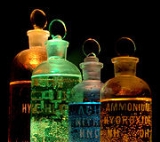
Chemistry is the
scienceScience is a systematic enterprise that builds and organizes knowledge in the form of testable explanations and predictions about the universe...
of
matterMatter is a general term for the substance of which all physical objects consist. Typically, matter includes atoms and other particles which have mass. A common way of defining matter is as anything that has mass and occupies volume...
, especially its
chemical reactionA chemical reaction is a process that leads to the transformation of one set of chemical substances to another. Chemical reactions can be either spontaneous, requiring no input of energy, or non-spontaneous, typically following the input of some type of energy, such as heat, light or electricity...
s, but also its composition, structure and properties. Chemistry is concerned with atoms and their interactions with other atoms, and particularly with the properties of
chemical bondA chemical bond is an attraction between atoms that allows the formation of chemical substances that contain two or more atoms. The bond is caused by the electromagnetic force attraction between opposite charges, either between electrons and nuclei, or as the result of a dipole attraction...
s.
Chemistry is sometimes called "
the central scienceChemistry is often called the central science because of its role in connecting the physical sciences, which include chemistry, with the life sciences and applied sciences such as medicine and engineering. The nature of this relationship is one of the main topics in the philosophy of chemistry and...
" because it connects physics with other
natural scienceThe natural sciences are branches of science that seek to elucidate the rules that govern the natural world by using empirical and scientific methods...
s such as
geologyGeology is the science comprising the study of solid Earth, the rocks of which it is composed, and the processes by which it evolves. Geology gives insight into the history of the Earth, as it provides the primary evidence for plate tectonics, the evolutionary history of life, and past climates...
and
biologyBiology is a natural science concerned with the study of life and living organisms, including their structure, function, growth, origin, evolution, distribution, and taxonomy. Biology is a vast subject containing many subdivisions, topics, and disciplines...
. Chemistry is a branch of
physical sciencePhysical science is an encompassing term for the branches of natural science and science that study non-living systems, in contrast to the life sciences...
but
distinct from physicsChemistry and physics are branches of science that both study matter. The difference in the two lies in the scope and in the approach. Consequently, chemists and physicists are trained differently, and they have different roles working in their profession, even when they work in a team...
.
The etymology of the word chemistry has been much disputed. The genesis of chemistry can be traced to certain practices, known as
alchemyAlchemy is an influential philosophical tradition whose early practitioners’ claims to profound powers were known from antiquity. The defining objectives of alchemy are varied; these include the creation of the fabled philosopher's stone possessing powers including the capability of turning base...
, which had been practiced for several millennia in various parts of the world, particularly the Middle East.
Theory
Traditional chemistry starts with the study of elementary particles,
atomThe atom is a basic unit of matter that consists of a dense central nucleus surrounded by a cloud of negatively charged electrons. The atomic nucleus contains a mix of positively charged protons and electrically neutral neutrons...
s,
moleculeA molecule is an electrically neutral group of at least two atoms held together by covalent chemical bonds. Molecules are distinguished from ions by their electrical charge...
s,
substanceIn chemistry, a chemical substance is a form of matter that has constant chemical composition and characteristic properties. It cannot be separated into components by physical separation methods, i.e. without breaking chemical bonds. They can be solids, liquids or gases.Chemical substances are...
s, metals,
crystalA crystal or crystalline solid is a solid material whose constituent atoms, molecules, or ions are arranged in an orderly repeating pattern extending in all three spatial dimensions. The scientific study of crystals and crystal formation is known as crystallography...
s and other aggregates of matter. in solid, liquid, and gas states, whether in isolation or combination. The interactions, reactions and transformations that are studied in chemistry are a result of interaction either between different chemical substances or between
matterMatter is a general term for the substance of which all physical objects consist. Typically, matter includes atoms and other particles which have mass. A common way of defining matter is as anything that has mass and occupies volume...
and
energyIn physics, energy is an indirectly observed quantity. It is often understood as the ability a physical system has to do work on other physical systems...
. Such behaviors are studied in a chemistry
laboratoryA laboratory is a facility that provides controlled conditions in which scientific research, experiments, and measurement may be performed. The title of laboratory is also used for certain other facilities where the processes or equipment used are similar to those in scientific laboratories...
using various forms of
laboratory glasswareLaboratory glassware refers to a variety of equipment, traditionally made of glass, used for scientific experiments and other work in science, especially in chemistry and biology laboratories...
.
A
chemical reactionA chemical reaction is a process that leads to the transformation of one set of chemical substances to another. Chemical reactions can be either spontaneous, requiring no input of energy, or non-spontaneous, typically following the input of some type of energy, such as heat, light or electricity...
is a transformation of some substances into one or more other substances. It can be symbolically depicted through a
chemical equationA chemical equation is the symbolic representation of a chemical reaction where the reactant entities are given on the left hand side and the product entities on the right hand side. The coefficients next to the symbols and formulae of entities are the absolute values of the stoichiometric numbers...
. The number of atoms on the left and the right in the equation for a chemical transformation is most often equal. The nature of chemical reactions a substance may undergo and the energy changes that may accompany it are constrained by certain basic rules, known as chemical laws.
EnergyIn physics, energy is an indirectly observed quantity. It is often understood as the ability a physical system has to do work on other physical systems...
and
entropyEntropy is a thermodynamic property that can be used to determine the energy available for useful work in a thermodynamic process, such as in energy conversion devices, engines, or machines. Such devices can only be driven by convertible energy, and have a theoretical maximum efficiency when...
considerations are invariably important in almost all chemical studies. Chemical substances are classified in terms of their
structureStructure is a fundamental, tangible or intangible notion referring to the recognition, observation, nature, and permanence of patterns and relationships of entities. This notion may itself be an object, such as a built structure, or an attribute, such as the structure of society...
, phase as well as their chemical compositions. They can be analyzed using the tools of chemical analysis, e.g.
spectroscopySpectroscopy is the study of the interaction between matter and radiated energy. Historically, spectroscopy originated through the study of visible light dispersed according to its wavelength, e.g., by a prism. Later the concept was expanded greatly to comprise any interaction with radiative...
and
chromatographyChromatography is the collective term for a set of laboratory techniques for the separation of mixtures....
. Scientists engaged in chemical
researchResearch can be defined as the scientific search for knowledge, or as any systematic investigation, to establish novel facts, solve new or existing problems, prove new ideas, or develop new theories, usually using a scientific method...
are known as chemists. Most chemists specialize in one or more sub-disciplines.
History
Ancient EgyptAncient Egypt was an ancient civilization of Northeastern Africa, concentrated along the lower reaches of the Nile River in what is now the modern country of Egypt. Egyptian civilization coalesced around 3150 BC with the political unification of Upper and Lower Egypt under the first pharaoh...
ians pioneered the art of synthetic "wet" chemistry up to 4,000 years ago. By 1000 BC ancient civilizations were using technologies that formed the basis of the various branches of chemistry such as; extracting metal from their ores, making pottery and glazes, fermenting beer and wine, making pigments for cosmetics and painting, extracting chemicals from plants for medicine and perfume, making cheese, dying cloth, tanning leather, rendering fat into soap, making glass, and making alloys like bronze.
The genesis of chemistry can be traced to the widely observed phenomenon of
burningCombustion or burning is the sequence of exothermic chemical reactions between a fuel and an oxidant accompanied by the production of heat and conversion of chemical species. The release of heat can result in the production of light in the form of either glowing or a flame...
that led to
metallurgyMetallurgy is a domain of materials science that studies the physical and chemical behavior of metallic elements, their intermetallic compounds, and their mixtures, which are called alloys. It is also the technology of metals: the way in which science is applied to their practical use...
—the art and science of processing ores to get metals (e.g. metallurgy in ancient India). The greed for gold led to the discovery of the process for its purification, even though the underlying principles were not well understood—it was thought to be a transformation rather than purification. Many scholars in those days thought it reasonable to believe that there exist means for transforming cheaper (base) metals into gold. This gave way to alchemy and the search for the
Philosopher's StoneThe philosopher's stone is a legendary alchemical substance said to be capable of turning base metals into gold or silver. It was also sometimes believed to be an elixir of life, useful for rejuvenation and possibly for achieving immortality. For many centuries, it was the most sought-after goal...
which was believed to bring about such a transformation by mere touch.
GreekAncient Greece is a civilization belonging to a period of Greek history that lasted from the Archaic period of the 8th to 6th centuries BC to the end of antiquity. Immediately following this period was the beginning of the Early Middle Ages and the Byzantine era. Included in Ancient Greece is the...
atomismAtomism is a natural philosophy that developed in several ancient traditions. The atomists theorized that the natural world consists of two fundamental parts: indivisible atoms and empty void.According to Aristotle, atoms are indestructible and immutable and there are an infinite variety of shapes...
dates back to 440 BC, as what might be indicated by the book
De Rerum Natura (The Nature of Things) written by the Roman
LucretiusTitus Lucretius Carus was a Roman poet and philosopher. His only known work is an epic philosophical poem laying out the beliefs of Epicureanism, De rerum natura, translated into English as On the Nature of Things or "On the Nature of the Universe".Virtually no details have come down concerning...
in 50 BC. Much of the early development of purification methods is described by
Pliny the ElderGaius Plinius Secundus , better known as Pliny the Elder, was a Roman author, naturalist, and natural philosopher, as well as naval and army commander of the early Roman Empire, and personal friend of the emperor Vespasian...
in his
Naturalis HistoriaThe Natural History is an encyclopedia published circa AD 77–79 by Pliny the Elder. It is one of the largest single works to have survived from the Roman Empire to the modern day and purports to cover the entire field of ancient knowledge, based on the best authorities available to Pliny...
.
A tentative outline is as follows:
- Egyptian alchemy [3,000 BCE – 400 BCE], formulate early "element" theories such as the Ogdoad
In Egyptian mythology, the Ogdoad were eight deities worshipped in Hermopolis during what is called the Old Kingdom, the third through sixth dynasties, dated between 2686 to 2134 BC...
.
- Greek alchemy [332 BCE – 642 CE], the Macedonian king Alexander the Great conquers Egypt and founds Alexandria
Alexandria is the second-largest city of Egypt, with a population of 4.1 million, extending about along the coast of the Mediterranean Sea in the north central part of the country; it is also the largest city lying directly on the Mediterranean coast. It is Egypt's largest seaport, serving...
, having the world's largest library, where scholars and wise men gather to study.
- Islamic alchemy [642 CE – 1200], the Muslim conquest of Egypt; development of alchemy by Jābir ibn Hayyān, al-Razi and others; Jābir modifies Aristotle's theories; advances in processes and apparatus.
- European alchemy [1300 – present], Pseudo-Geber
Pseudo-Geber is the name assigned by modern scholars to an anonymous European alchemist born in the 13th century, sometimes identified with Paul of Taranto, who wrote books on alchemy and metallurgy, in Latin, under the pen name of "Geber". "Geber" is the shortened and Latinised form of the name...
builds on Arabic chemistry. From the 12th century, major advances in the chemical arts shifted from Arab lands to western EuropeEurope is, by convention, one of the world's seven continents. Comprising the westernmost peninsula of Eurasia, Europe is generally 'divided' from Asia to its east by the watershed divides of the Ural and Caucasus Mountains, the Ural River, the Caspian and Black Seas, and the waterways connecting...
.
- Chemistry [1661], Boyle
Robert Boyle FRS was a 17th century natural philosopher, chemist, physicist, and inventor, also noted for his writings in theology. He has been variously described as English, Irish, or Anglo-Irish, his father having come to Ireland from England during the time of the English plantations of...
writes his classic chemistry text The Sceptical ChymistThe Sceptical Chymist: or Chymico-Physical Doubts & Paradoxes is the title of Robert Boyle's masterpiece of scientific literature, published in London in 1661. In the form of a dialogue, the Sceptical Chymist presented Boyle's hypothesis that matter consisted of atoms and clusters of atoms in...
.
- Chemistry [1787], Lavoisier
Antoine-Laurent de Lavoisier , the "father of modern chemistry", was a French nobleman prominent in the histories of chemistry and biology...
writes his classic Elements of Chemistry.
- Chemistry [1803], Dalton
John Dalton FRS was an English chemist, meteorologist and physicist. He is best known for his pioneering work in the development of modern atomic theory, and his research into colour blindness .-Early life:John Dalton was born into a Quaker family at Eaglesfield, near Cockermouth, Cumberland,...
publishes his Atomic Theory.
- Chemistry [1869], Dmitri Mendeleev
Dmitri Ivanovich Mendeleev , was a Russian chemist and inventor. He is credited as being the creator of the first version of the periodic table of elements...
presented his Periodic tableThe periodic table of the chemical elements is a tabular display of the 118 known chemical elements organized by selected properties of their atomic structures. Elements are presented by increasing atomic number, the number of protons in an atom's atomic nucleus...
being the framework of the modern chemistry
The earliest pioneers of Chemistry, and inventors of the modern
scientific methodScientific method refers to a body of techniques for investigating phenomena, acquiring new knowledge, or correcting and integrating previous knowledge. To be termed scientific, a method of inquiry must be based on gathering empirical and measurable evidence subject to specific principles of...
, were medieval
Arab and Persian scholarsAlchemy and chemistry in Islam refers to the study of both traditional alchemy and early practical chemistry by scholars in the medieval Islamic world. The word alchemy was derived from the Arabic word كيمياء or kīmīāʾ...
. They introduced precise
observationObservation is either an activity of a living being, such as a human, consisting of receiving knowledge of the outside world through the senses, or the recording of data using scientific instruments. The term may also refer to any data collected during this activity...
and controlled
experimentAn experiment is a methodical procedure carried out with the goal of verifying, falsifying, or establishing the validity of a hypothesis. Experiments vary greatly in their goal and scale, but always rely on repeatable procedure and logical analysis of the results...
ation into the field and discovered numerous
Chemical substanceIn chemistry, a chemical substance is a form of matter that has constant chemical composition and characteristic properties. It cannot be separated into components by physical separation methods, i.e. without breaking chemical bonds. They can be solids, liquids or gases.Chemical substances are...
s.
The most influential Muslim chemists were Jābir ibn Hayyān (Geber, d. 815),
al-Kindi' , known as "the Philosopher of the Arabs", was a Muslim Arab philosopher, mathematician, physician, and musician. Al-Kindi was the first of the Muslim peripatetic philosophers, and is unanimously hailed as the "father of Islamic or Arabic philosophy" for his synthesis, adaptation and promotion...
(d. 873),
al-Razi Muhammad ibn Zakariyā Rāzī , known as Rhazes or Rasis after medieval Latinists, was a Persian polymath,a prominent figure in Islamic Golden Age, physician, alchemist and chemist, philosopher, and scholar....
(d. 925), al-Biruni (d. 1048) and Alhazen (d. 1039). The works of Jābir became more widely known in Europe through
LatinLatin is an Italic language originally spoken in Latium and Ancient Rome. It, along with most European languages, is a descendant of the ancient Proto-Indo-European language. Although it is considered a dead language, a number of scholars and members of the Christian clergy speak it fluently, and...
translations by a
pseudo-GeberPseudo-Geber is the name assigned by modern scholars to an anonymous European alchemist born in the 13th century, sometimes identified with Paul of Taranto, who wrote books on alchemy and metallurgy, in Latin, under the pen name of "Geber". "Geber" is the shortened and Latinised form of the name...
in 14th century
SpainSpain , officially the Kingdom of Spain languages]] under the European Charter for Regional or Minority Languages. In each of these, Spain's official name is as follows:;;;;;;), is a country and member state of the European Union located in southwestern Europe on the Iberian Peninsula...
, who also wrote some of his own books under the pen name "Geber". The contribution of Indian alchemists and metallurgists in the development of chemistry was also quite significant.
The emergence of chemistry in Europe was primarily due to the recurrent incidence of the
plaguePlague is a deadly infectious disease that is caused by the enterobacteria Yersinia pestis, named after the French-Swiss bacteriologist Alexandre Yersin. Primarily carried by rodents and spread to humans via fleas, the disease is notorious throughout history, due to the unrivaled scale of death...
and blights there during the so called Dark Ages. This gave rise to a need for medicines. It was thought that there exists a universal medicine called the
Elixir of LifeThe elixir of life, also known as the elixir of immortality and sometimes equated with the philosopher's stone, is a legendary potion, or drink, that grants the drinker eternal life and or eternal youth. Many practitioners of alchemy pursued it. The elixir of life was also said to be able to create...
that can cure all diseases, but like the Philosopher's Stone, it was never found.
For some practitioners, alchemy was an intellectual pursuit, over time, they got better at it.
ParacelsusParacelsus was a German-Swiss Renaissance physician, botanist, alchemist, astrologer, and general occultist....
(1493–1541), for example, rejected the 4-elemental theory and with only a vague understanding of his chemicals and medicines, formed a hybrid of alchemy and science in what was to be called
iatrochemistryIatrochemistry is a branch of both chemistry and medicine. Having its roots in alchemy, iatrochemistry seeks to provide chemical solutions to diseases and medical ailments....
. Similarly, the influences of philosophers such as
Sir Francis BaconFrancis Bacon, 1st Viscount St Albans, KC was an English philosopher, statesman, scientist, lawyer, jurist, author and pioneer of the scientific method. He served both as Attorney General and Lord Chancellor of England...
(1561–1626) and
René DescartesRené Descartes ; was a French philosopher and writer who spent most of his adult life in the Dutch Republic. He has been dubbed the 'Father of Modern Philosophy', and much subsequent Western philosophy is a response to his writings, which are studied closely to this day...
(1596–1650), who demanded more rigor in mathematics and in removing bias from scientific observations, led to a
scientific revolutionThe Scientific Revolution is an era associated primarily with the 16th and 17th centuries during which new ideas and knowledge in physics, astronomy, biology, medicine and chemistry transformed medieval and ancient views of nature and laid the foundations for modern science...
. In chemistry, this began with
Robert BoyleRobert Boyle FRS was a 17th century natural philosopher, chemist, physicist, and inventor, also noted for his writings in theology. He has been variously described as English, Irish, or Anglo-Irish, his father having come to Ireland from England during the time of the English plantations of...
(1627–1691), who came up with an equation known as
Boyle's LawBoyle's law is one of many gas laws and a special case of the ideal gas law. Boyle's law describes the inversely proportional relationship between the absolute pressure and volume of a gas, if the temperature is kept constant within a closed system...
about the characteristics of gaseous state.
Chemistry indeed came of age when
Antoine LavoisierAntoine-Laurent de Lavoisier , the "father of modern chemistry", was a French nobleman prominent in the histories of chemistry and biology...
(1743–1794), developed the theory of
Conservation of massThe law of conservation of mass, also known as the principle of mass/matter conservation, states that the mass of an isolated system will remain constant over time...
in 1783; and the development of the
Atomic TheoryIn chemistry and physics, atomic theory is a theory of the nature of matter, which states that matter is composed of discrete units called atoms, as opposed to the obsolete notion that matter could be divided into any arbitrarily small quantity...
by
John DaltonJohn Dalton FRS was an English chemist, meteorologist and physicist. He is best known for his pioneering work in the development of modern atomic theory, and his research into colour blindness .-Early life:John Dalton was born into a Quaker family at Eaglesfield, near Cockermouth, Cumberland,...
around 1800. The Law of Conservation of Mass resulted in the reformulation of chemistry based on this law and the oxygen theory of combustion, which was largely based on the work of Lavoisier. Lavoisier's fundamental contributions to chemistry were a result of a conscious effort to fit all experiments into the framework of a single theory. He established the consistent use of the chemical balance, used oxygen to overthrow the
phlogiston theoryThe phlogiston theory , first stated in 1667 by Johann Joachim Becher, is an obsolete scientific theory that postulated the existence of a fire-like element called "phlogiston", which was contained within combustible bodies and released during combustion...
, and developed a new system of chemical nomenclature and made contribution to the modern metric system. Lavoisier also worked to translate the archaic and technical language of chemistry into something that could be easily understood by the largely uneducated masses, leading to an increased public interest in chemistry. All these advances in chemistry led to what is usually called the
chemical revolutionThe chemical revolution, also called the first chemical revolution, denotes the reformulation of chemistry based on the Law of Conservation of Matter and the oxygen theory of combustion. It was centered on the work of French chemist Antoine Lavoisier...
. The contributions of Lavoisier led to what is now called modern chemistry—the chemistry that is studied in educational institutions all over the world. It is because of these and other contributions that
Antoine LavoisierAntoine-Laurent de Lavoisier , the "father of modern chemistry", was a French nobleman prominent in the histories of chemistry and biology...
is often celebrated as the "Father of Modern Chemistry". The later discovery of
Friedrich WöhlerFriedrich Wöhler was a German chemist, best known for his synthesis of urea, but also the first to isolate several chemical elements.-Biography:He was born in Eschersheim, which belonged to aau...
that many natural substances,
organic compoundAn organic compound is any member of a large class of gaseous, liquid, or solid chemical compounds whose molecules contain carbon. For historical reasons discussed below, a few types of carbon-containing compounds such as carbides, carbonates, simple oxides of carbon, and cyanides, as well as the...
s, can indeed be synthesized in a chemistry
laboratoryA laboratory is a facility that provides controlled conditions in which scientific research, experiments, and measurement may be performed. The title of laboratory is also used for certain other facilities where the processes or equipment used are similar to those in scientific laboratories...
also helped the modern chemistry to mature from its infancy.
The
discovery of the chemical elementsThe discovery of the elements known to exist today is presented here in chronological order. The elements are listed generally in the order in which each was first defined as the pure element, as the exact date of discovery of most elements cannot be accurately defined.Given is each element's name,...
has a long history from the days of alchemy and culminating in the discovery of the
periodic tableThe periodic table of the chemical elements is a tabular display of the 118 known chemical elements organized by selected properties of their atomic structures. Elements are presented by increasing atomic number, the number of protons in an atom's atomic nucleus...
of the chemical elements by
Dmitri MendeleevDmitri Ivanovich Mendeleev , was a Russian chemist and inventor. He is credited as being the creator of the first version of the periodic table of elements...
(1834–1907) and later discoveries of some synthetic elements.
Etymology
The word
chemistry comes from the word
alchemy, an earlier set of practices that encompassed elements of chemistry, metallurgy, philosophy, astrology, astronomy, mysticism and medicine; it is commonly thought of as the quest to turn lead or another common starting material into gold. The word
alchemy in turn is derived from the Arabic word al-kīmīā (الكيمياء), meaning alchemy. The Arabic term is borrowed from the Greek χημία or χημεία. This may have
EgyptianAncient Egypt was an ancient civilization of Northeastern Africa, concentrated along the lower reaches of the Nile River in what is now the modern country of Egypt. Egyptian civilization coalesced around 3150 BC with the political unification of Upper and Lower Egypt under the first pharaoh...
origins. Many believe that al-kīmīā is derived from χημία, which is in turn derived from the word
Chemi or
Kimi, which is the ancient name of
EgyptEgypt , officially the Arab Republic of Egypt, Arabic: , is a country mainly in North Africa, with the Sinai Peninsula forming a land bridge in Southwest Asia. Egypt is thus a transcontinental country, and a major power in Africa, the Mediterranean Basin, the Middle East and the Muslim world...
in
EgyptianEgyptian is the oldest known indigenous language of Egypt and a branch of the Afroasiatic language family. Written records of the Egyptian language have been dated from about 3400 BC, making it one of the oldest recorded languages known. Egyptian was spoken until the late 17th century AD in the...
. Alternately, al-kīmīā may be derived from χημεία, meaning "cast together".
An alchemist was called a 'chemist' in popular speech, and later the suffix "-ry" was added to this to describe the art of the chemist as "chemistry".
Definitions
In retrospect, the definition of chemistry has changed over time, as new discoveries and theories add to the functionality of the science. Shown below are some of the standard definitions used by various noted chemists:
- Alchemy (330) – the study of the composition of waters, movement, growth, embodying, disembodying, drawing the spirits from bodies and bonding the spirits within bodies (Zosimos
Zosimos of Panopolis was an Egyptian or Greek alchemist and Gnostic mystic from the end of the 3rd and beginning of the 4th century AD. He was born in Panopolis, present day Akhmim in the south of Egypt, ca. 300. He wrote the oldest known books on alchemy, of which quotations in the Greek language...
).
- Chymistry (1661) – the subject of the material principles of mixed bodies (Boyle
Robert Boyle FRS was a 17th century natural philosopher, chemist, physicist, and inventor, also noted for his writings in theology. He has been variously described as English, Irish, or Anglo-Irish, his father having come to Ireland from England during the time of the English plantations of...
).
- Chymistry (1663) – a scientific art, by which one learns to dissolve bodies, and draw from them the different substances on their composition, and how to unite them again, and exalt them to a higher perfection (Glaser
Christopher Glaser , a pharmaceutical chemist of the 17th century, was a native of Basel, became demonstrator of chemistry, as successor of Lefebvre, at the Jardin du Roi in Paris, and apothecary to Louis XIV and to the duke of Orléans...
).
- Chemistry (1730) – the art of resolving mixed, compound, or aggregate bodies into their principles; and of composing such bodies from those principles (Stahl
Georg Ernst Stahl was a German chemist and physician.He was born at Ansbach. Having graduated in medicine at the University of Jena in 1683, he became court physician to Duke Johann Ernst of Sachsen Weimar in 1687...
).
- Chemistry (1837) – the science concerned with the laws and effects of molecular forces (Dumas
Jean Baptiste André Dumas was a French chemist, best known for his works on organic analysis and synthesis, as well as the determination of atomic weights and molecular weights by measuring vapor densities...
).
- Chemistry (1947) – the science of substances: their structure, their properties, and the reactions that change them into other substances (Pauling
Linus Carl Pauling was an American chemist, biochemist, peace activist, author, and educator. He was one of the most influential chemists in history and ranks among the most important scientists of the 20th century...
).
- Chemistry (1998) – the study of matter and the changes it undergoes (Chang).
Atom
An
atom is the basic unit of chemistry. It consists of a positively charged core (the
atomic nucleusThe nucleus is the very dense region consisting of protons and neutrons at the center of an atom. It was discovered in 1911, as a result of Ernest Rutherford's interpretation of the famous 1909 Rutherford experiment performed by Hans Geiger and Ernest Marsden, under the direction of Rutherford. The...
) which contains protons and neutrons, and which maintains a number of
electronThe electron is a subatomic particle with a negative elementary electric charge. It has no known components or substructure; in other words, it is generally thought to be an elementary particle. An electron has a mass that is approximately 1/1836 that of the proton...
s to balance the positive charge in the nucleus. The atom is also the smallest entity that can be envisaged to retain the chemical properties of the element, such as
electronegativityElectronegativity, symbol χ , is a chemical property that describes the tendency of an atom or a functional group to attract electrons towards itself. An atom's electronegativity is affected by both its atomic number and the distance that its valence electrons reside from the charged nucleus...
,
ionization potentialThe ionization energy of a chemical species, i.e. an atom or molecule, is the energy required to remove an electron from the species to a practically infinite distance. Large atoms or molecules have a low ionization energy, while small molecules tend to have higher ionization energies.The property...
, preferred
oxidation stateIn chemistry, the oxidation state is an indicator of the degree of oxidation of an atom in a chemical compound. The formal oxidation state is the hypothetical charge that an atom would have if all bonds to atoms of different elements were 100% ionic. Oxidation states are typically represented by...
(s),
coordination numberIn chemistry and crystallography, the coordination number of a central atom in a molecule or crystal is the number of its nearest neighbours. This number is determined somewhat differently for molecules and for crystals....
, and preferred types of
bondsA chemical bond is an attraction between atoms that allows the formation of chemical substances that contain two or more atoms. The bond is caused by the electromagnetic force attraction between opposite charges, either between electrons and nuclei, or as the result of a dipole attraction...
to form (e.g., metallic,
ionAn ion is an atom or molecule in which the total number of electrons is not equal to the total number of protons, giving it a net positive or negative electrical charge. The name was given by physicist Michael Faraday for the substances that allow a current to pass between electrodes in a...
ic, covalent).
Element
The concept of
chemical element is related to that of chemical substance. A chemical element is specifically a substance which is composed of a single type of atom. A chemical element is characterized by a particular number of
protonThe proton is a subatomic particle with the symbol or and a positive electric charge of 1 elementary charge. One or more protons are present in the nucleus of each atom, along with neutrons. The number of protons in each atom is its atomic number....
s in the
nucleiThe nucleus is the very dense region consisting of protons and neutrons at the center of an atom. It was discovered in 1911, as a result of Ernest Rutherford's interpretation of the famous 1909 Rutherford experiment performed by Hans Geiger and Ernest Marsden, under the direction of Rutherford. The...
of its atoms. This number is known as the
atomic numberIn chemistry and physics, the atomic number is the number of protons found in the nucleus of an atom and therefore identical to the charge number of the nucleus. It is conventionally represented by the symbol Z. The atomic number uniquely identifies a chemical element...
of the element. For example, all atoms with 6 protons in their nuclei are atoms of the chemical element
carbonCarbon is the chemical element with symbol C and atomic number 6. As a member of group 14 on the periodic table, it is nonmetallic and tetravalent—making four electrons available to form covalent chemical bonds...
, and all atoms with 92 protons in their nuclei are atoms of the element
uraniumUranium is a silvery-white metallic chemical element in the actinide series of the periodic table, with atomic number 92. It is assigned the chemical symbol U. A uranium atom has 92 protons and 92 electrons, of which 6 are valence electrons...
. Although all the nuclei of all atoms belonging to one element will have the same number of protons, they may not necessarily have the same number of neutrons; such atoms are termed isotopes. In fact several isotopes of an element may exist. Ninety–four different chemical elements or types of atoms based on the number of protons are observed on earth naturally, having at least one isotope that is stable or has a very long half-life. A further 18 elements have been recognised by IUPAC after they have been made in the laboratory.
The standard presentation of the chemical elements is in the
periodic tableThe periodic table of the chemical elements is a tabular display of the 118 known chemical elements organized by selected properties of their atomic structures. Elements are presented by increasing atomic number, the number of protons in an atom's atomic nucleus...
, which orders elements by atomic number and groups them by electron configuration. Due to its arrangement,
groupsIn chemistry, a group is a vertical column in the periodic table of the chemical elements. There are 18 groups in the standard periodic table, including the d-block elements, but excluding the f-block elements....
, or columns, and periods, or rows, of elements in the table either share several chemical properties, or follow a certain trend in characteristics such as
atomic radiusThe atomic radius of a chemical element is a measure of the size of its atoms, usually the mean or typical distance from the nucleus to the boundary of the surrounding cloud of electrons...
,
electronegativityElectronegativity, symbol χ , is a chemical property that describes the tendency of an atom or a functional group to attract electrons towards itself. An atom's electronegativity is affected by both its atomic number and the distance that its valence electrons reside from the charged nucleus...
, etc. Lists of the elements by name,
by symbol, and by atomic number are also available.
Compound
A
compound is a substance with a
particular ratio of atoms of particular
chemical elementA chemical element is a pure chemical substance consisting of one type of atom distinguished by its atomic number, which is the number of protons in its nucleus. Familiar examples of elements include carbon, oxygen, aluminum, iron, copper, gold, mercury, and lead.As of November 2011, 118 elements...
s which determines its composition, and a particular
organizationA chemical structure includes molecular geometry, electronic structure and crystal structure of molecules. Molecular geometry refers to the spatial arrangement of atoms in a molecule and the chemical bonds that hold the atoms together. Molecular geometry can range from the very simple, such as...
which determines chemical properties. For example, water is a compound containing
hydrogenHydrogen is the chemical element with atomic number 1. It is represented by the symbol H. With an average atomic weight of , hydrogen is the lightest and most abundant chemical element, constituting roughly 75% of the Universe's chemical elemental mass. Stars in the main sequence are mainly...
and
oxygenOxygen is the element with atomic number 8 and represented by the symbol O. Its name derives from the Greek roots ὀξύς and -γενής , because at the time of naming, it was mistakenly thought that all acids required oxygen in their composition...
in the ratio of two to one, with the oxygen atom between the two hydrogen atoms, and an angle of 104.5° between them. Compounds are formed and interconverted by
chemical reactionA chemical reaction is a process that leads to the transformation of one set of chemical substances to another. Chemical reactions can be either spontaneous, requiring no input of energy, or non-spontaneous, typically following the input of some type of energy, such as heat, light or electricity...
s.
Substance
A chemical substance is a kind of matter with a definite composition and set of properties. Strictly speaking, a mixture of compounds, elements or compounds and elements is not a chemical substance, but it may be called a chemical. Most of the substances we encounter in our daily life are some kind of mixture; for example:
airThe atmosphere of Earth is a layer of gases surrounding the planet Earth that is retained by Earth's gravity. The atmosphere protects life on Earth by absorbing ultraviolet solar radiation, warming the surface through heat retention , and reducing temperature extremes between day and night...
,
alloyAn alloy is a mixture or metallic solid solution composed of two or more elements. Complete solid solution alloys give single solid phase microstructure, while partial solutions give two or more phases that may or may not be homogeneous in distribution, depending on thermal history...
s,
biomassBiomass, as a renewable energy source, is biological material from living, or recently living organisms. As an energy source, biomass can either be used directly, or converted into other energy products such as biofuel....
, etc.
Nomenclature of substances is a critical part of the language of chemistry. Generally it refers to a system for naming
chemical compoundA chemical compound is a pure chemical substance consisting of two or more different chemical elements that can be separated into simpler substances by chemical reactions. Chemical compounds have a unique and defined chemical structure; they consist of a fixed ratio of atoms that are held together...
s. Earlier in the history of chemistry substances were given name by their discoverer, which often led to some confusion and difficulty. However, today the IUPAC system of chemical nomenclature allows chemists to specify by name specific compounds amongst the vast variety of possible chemicals. The standard nomenclature of chemical substances is set by the
International Union of Pure and Applied ChemistryThe International Union of Pure and Applied Chemistry is an international federation of National Adhering Organizations that represents chemists in individual countries. It is a member of the International Council for Science . The international headquarters of IUPAC is located in Zürich,...
(IUPAC). There are well-defined systems in place for naming chemical species.
Organic compoundAn organic compound is any member of a large class of gaseous, liquid, or solid chemical compounds whose molecules contain carbon. For historical reasons discussed below, a few types of carbon-containing compounds such as carbides, carbonates, simple oxides of carbon, and cyanides, as well as the...
s are named according to the organic nomenclature system.
Inorganic compoundInorganic compounds have traditionally been considered to be of inanimate, non-biological origin. In contrast, organic compounds have an explicit biological origin. However, over the past century, the classification of inorganic vs organic compounds has become less important to scientists,...
s are named according to the inorganic nomenclature system. In addition the
Chemical Abstracts ServiceChemical Abstracts is a periodical index that provides summaries and indexes of disclosures in recently published scientific documents. Approximately 8,000 journals, technical reports, dissertations, conference proceedings, and new books, in any of 50 languages, are monitored yearly, as are patent...
has devised a method to index chemical substance. In this scheme each chemical substance is identifiable by a number known as
CAS registry numberCAS Registry Numbersare unique numerical identifiers assigned by the "Chemical Abstracts Service" toevery chemical described in the...
.
Molecule
A
molecule is the smallest indivisible portion of a pure
chemical substanceIn chemistry, a chemical substance is a form of matter that has constant chemical composition and characteristic properties. It cannot be separated into components by physical separation methods, i.e. without breaking chemical bonds. They can be solids, liquids or gases.Chemical substances are...
that has its unique set of chemical properties, that is, its potential to undergo a certain set of chemical reactions with other substances. However, this definition only works well for substances that are composed of molecules, which is not true of many substances (see below). Molecules are typically a set of atoms bound together by
covalent bondA covalent bond is a form of chemical bonding that is characterized by the sharing of pairs of electrons between atoms. The stable balance of attractive and repulsive forces between atoms when they share electrons is known as covalent bonding....
s, such that the structure is electrically neutral and all valence electrons are paired with other electrons either in bonds or in
lone pairIn chemistry, a lone pair is a valence electron pair without bonding or sharing with other atoms. They are found in the outermost electron shell of an atom, so lone pairs are a subset of a molecule's valence electrons...
s. Thus, molecules exist as electrically neutral units, unlike ions. When this rule is broken, giving the "molecule" a charge, the result is sometimes named a molecular ion or a polyatomic ion. However, the discrete and separate nature of the molecular concept usually requires that molecular ions be present only in well-separated form, such as a directed beam in a vacuum in a mass spectrograph. Charged polyatomic collections residing in solids (for example, common sulfate or nitrate ions) are generally not considered "molecules" in chemistry.

The "inert" or noble chemical elements (helium, neon, argon, krypton, xenon and radon) are composed of lone atoms as their smallest discrete unit, but the other isolated chemical elements consist of either molecules or networks of atoms bonded to each other in some way. Identifiable molecules compose familiar substances such as water, air, and many organic compounds like alcohol, sugar, gasoline, and the various pharmaceuticals. However, not all substances or chemical compounds consist of discrete molecules, and indeed most of the solid substances that makes up the solid crust, mantle, and core of the Earth are chemical compounds without molecules. These other types of substances, such as ionic compounds and network solids, are organized in such a way as to lack the existence of identifiable molecules
per se. Instead, these substances are discussed in terms of
formula unitA formula unit in chemistry is the empirical formula of an ionic or covalent network solid compound used as an independent entity for stoichiometric calculations. It is the lowest whole number ratio of ions represented in an ionic compound...
s or unit cells as the smallest repeating structure within the substance. Examples of such substances are mineral salts (such as table salt), solids like carbon and diamond, metals, and familiar silica and
silicate mineralsThe silicate minerals make up the largest and most important class of rock-forming minerals, constituting approximately 90 percent of the crust of the Earth. They are classified based on the structure of their silicate group...
such as quartz and granite.
One of the main characteristic of a molecule is its geometry often called its
structureThe molecular structure of a substance is described by the combination of nuclei and electrons that comprise its constitute molecules. This includes the molecular geometry , the electronic properties of the...
. While the structure of diatomic, triatomic or tetra atomic molecules may be trivial, (linear, angular pyramidal etc.) the structure of polyatomic molecules, that are constituted of more than six atoms (of several elements) can be crucial for its chemical nature.
Mole and amount of substance
Mole is a unit to measure
amount of substanceAmount of substance is a standards-defined quantity that measures the size of an ensemble of elementary entities, such as atoms, molecules, electrons, and other particles. It is sometimes referred to as chemical amount. The International System of Units defines the amount of substance to be...
(also called chemical amount). A
moleThe mole is a unit of measurement used in chemistry to express amounts of a chemical substance, defined as an amount of a substance that contains as many elementary entities as there are atoms in 12 grams of pure carbon-12 , the isotope of carbon with atomic weight 12. This corresponds to a value...
is the amount of a
substanceIn chemistry, a chemical substance is a form of matter that has constant chemical composition and characteristic properties. It cannot be separated into components by physical separation methods, i.e. without breaking chemical bonds. They can be solids, liquids or gases.Chemical substances are...
that contains as many elementary entities (atoms, molecules or ions) as there are atoms in 0.012 kilogram (or 12 grams) of
carbon-12Carbon-12 is the more abundant of the two stable isotopes of the element carbon, accounting for 98.89% of carbon; it contains 6 protons, 6 neutrons, and 6 electrons....
, where the carbon-12 atoms are unbound, at rest and in their
ground stateThe ground state of a quantum mechanical system is its lowest-energy state; the energy of the ground state is known as the zero-point energy of the system. An excited state is any state with energy greater than the ground state...
. The number of entities per mole is known as the Avogadro constant, and is determined empirically. The currently accepted value is 6.02214179(30) mol
−1 (2007 CODATA). One way to understand the meaning of the term "mole" is to compare and contrast it to terms such as
dozenA dozen is a grouping of approximately twelve. The dozen may be one of the earliest primitive groupings, perhaps because there are approximately a dozen cycles of the moon or months in a cycle of the sun or year...
. Just as one dozen eggs contains 12 individual eggs, one mole contains 6.02214179(30) atoms, molecules or other particles. The term is used because it is much easier to say, for example, 1 mole of carbon, than it is to say 6.02214179(30) carbon atoms, and because moles of chemicals represent a scale that is easy to experience.
The amount of substance of a solute per volume of
solutionIn chemistry, a solution is a homogeneous mixture composed of only one phase. In such a mixture, a solute is dissolved in another substance, known as a solvent. The solvent does the dissolving.- Types of solutions :...
is known as amount of substance concentration, or molarity for short. Molarity is the quantity most commonly used to express the
concentrationIn chemistry, concentration is defined as the abundance of a constituent divided by the total volume of a mixture. Four types can be distinguished: mass concentration, molar concentration, number concentration, and volume concentration...
of a solution in the chemical laboratory. The most commonly used units for molarity are mol/L (the official SI units are mol/m
3).
Ions and salts
An
ion is a charged species, an atom or a molecule, that has lost or gained one or more electrons. Positively charged cations (e.g.
sodiumSodium is a chemical element with the symbol Na and atomic number 11. It is a soft, silvery-white, highly reactive metal and is a member of the alkali metals; its only stable isotope is 23Na. It is an abundant element that exists in numerous minerals, most commonly as sodium chloride...
cation Na
+) and negatively charged anions (e.g.
chlorideThe chloride ion is formed when the element chlorine, a halogen, picks up one electron to form an anion Cl−. The salts of hydrochloric acid HCl contain chloride ions and can also be called chlorides. The chloride ion, and its salts such as sodium chloride, are very soluble in water...
Cl
−) can form a crystalline lattice of neutral salts (e.g.
sodium chlorideSodium chloride, also known as salt, common salt, table salt or halite, is an inorganic compound with the formula NaCl. Sodium chloride is the salt most responsible for the salinity of the ocean and of the extracellular fluid of many multicellular organisms...
NaCl). Examples of
polyatomic ionA polyatomic ion, also known as a molecular ion, is a charged species composed of two or more atoms covalently bonded or of a metal complex that can be considered as acting as a single unit in the context of acid and base chemistry or in the formation of salts. The prefix "poly-" means "many," in...
s that do not split up during
acid-base reactionsAn acid–base reaction is a chemical reaction that occurs between an acid and a base. Several concepts that provide alternative definitions for the reaction mechanisms involved and their application in solving related problems exist...
are
hydroxideHydroxide is a diatomic anion with chemical formula OH−. It consists of an oxygen and a hydrogen atom held together by a covalent bond, and carrying a negative electric charge. It is an important but usually minor constituent of water. It functions as a base, as a ligand, a nucleophile, and a...
(OH
−) and
phosphateA phosphate, an inorganic chemical, is a salt of phosphoric acid. In organic chemistry, a phosphate, or organophosphate, is an ester of phosphoric acid. Organic phosphates are important in biochemistry and biogeochemistry or ecology. Inorganic phosphates are mined to obtain phosphorus for use in...
(PO
43−).
Ions in the gaseous phase are often known as
plasmaIn physics and chemistry, plasma is a state of matter similar to gas in which a certain portion of the particles are ionized. Heating a gas may ionize its molecules or atoms , thus turning it into a plasma, which contains charged particles: positive ions and negative electrons or ions...
.
Acidity and basicity
A substance can often be classified as an
acidAn acid is a substance which reacts with a base. Commonly, acids can be identified as tasting sour, reacting with metals such as calcium, and bases like sodium carbonate. Aqueous acids have a pH of less than 7, where an acid of lower pH is typically stronger, and turn blue litmus paper red...
or a
baseFor the term in genetics, see base A base in chemistry is a substance that can accept hydrogen ions or more generally, donate electron pairs. A soluble base is referred to as an alkali if it contains and releases hydroxide ions quantitatively...
. There are several different theories which explain acid-base behavior. The simplest is Arrhenius theory, which states than an acid is a substance that produces hydronium ions when it is dissolved in water, and a base is one that produces hydroxide ions when dissolved in water. According to Brønsted–Lowry acid-base theory, acids are substances that donate a positive
hydrogenHydrogen is the chemical element with atomic number 1. It is represented by the symbol H. With an average atomic weight of , hydrogen is the lightest and most abundant chemical element, constituting roughly 75% of the Universe's chemical elemental mass. Stars in the main sequence are mainly...
ionAn ion is an atom or molecule in which the total number of electrons is not equal to the total number of protons, giving it a net positive or negative electrical charge. The name was given by physicist Michael Faraday for the substances that allow a current to pass between electrodes in a...
to another substance in a chemical reaction; by extension, a base is the substance which receives that hydrogen ion. A third common theory is Lewis acid-base theory, which is based on the formation of new
chemical bondA chemical bond is an attraction between atoms that allows the formation of chemical substances that contain two or more atoms. The bond is caused by the electromagnetic force attraction between opposite charges, either between electrons and nuclei, or as the result of a dipole attraction...
s. Lewis theory explains that an acid is a substance which is capable of accepting a pair of electrons from another substance during the process of bond formation, while a base is a substance which can provide a pair of electrons to form a new bond. According to concept as per Lewis, the crucial things being exchanged are charges. There are several other ways in which a substance may be classified as an acid or a base, as is evident in the history of this concept
Acid strength is commonly measured by two methods. One measurement, based on the Arrhenius definition of acidity, is
pHIn chemistry, pH is a measure of the acidity or basicity of an aqueous solution. Pure water is said to be neutral, with a pH close to 7.0 at . Solutions with a pH less than 7 are said to be acidic and solutions with a pH greater than 7 are basic or alkaline...
, which is a measurement of the hydronium ion concentration in a solution, as expressed on a negative
logarithmThe logarithm of a number is the exponent by which another fixed value, the base, has to be raised to produce that number. For example, the logarithm of 1000 to base 10 is 3, because 1000 is 10 to the power 3: More generally, if x = by, then y is the logarithm of x to base b, and is written...
ic scale. Thus, solutions that have a low pH have a high hydronium ion concentration, and can be said to be more acidic. The other measurement, based on the Brønsted–Lowry definition, is the
acid dissociation constantAn acid dissociation constant, Ka, is a quantitative measure of the strength of an acid in solution. It is the equilibrium constant for a chemical reaction known as dissociation in the context of acid-base reactions...
(K
a), which measure the relative ability of a substance to act as an acid under the Brønsted–Lowry definition of an acid. That is, substances with a higher K
a are more likely to donate hydrogen ions in chemical reactions than those with lower K
a values.
Phase
In addition to the specific chemical properties that distinguish different chemical classifications chemicals can exist in several phases. For the most part, the chemical classifications are independent of these bulk phase classifications; however, some more exotic phases are incompatible with certain chemical properties. A
phase is a set of states of a chemical system that have similar bulk structural properties, over a range of conditions, such as
pressurePressure is the force per unit area applied in a direction perpendicular to the surface of an object. Gauge pressure is the pressure relative to the local atmospheric or ambient pressure.- Definition :...
or
temperatureTemperature is a physical property of matter that quantitatively expresses the common notions of hot and cold. Objects of low temperature are cold, while various degrees of higher temperatures are referred to as warm or hot...
. Physical properties, such as
densityThe mass density or density of a material is defined as its mass per unit volume. The symbol most often used for density is ρ . In some cases , density is also defined as its weight per unit volume; although, this quantity is more properly called specific weight...
and
refractive indexIn optics the refractive index or index of refraction of a substance or medium is a measure of the speed of light in that medium. It is expressed as a ratio of the speed of light in vacuum relative to that in the considered medium....
tend to fall within values characteristic of the phase. The phase of matter is defined by the
phase transitionA phase transition is the transformation of a thermodynamic system from one phase or state of matter to another.A phase of a thermodynamic system and the states of matter have uniform physical properties....
, which is when energy put into or taken out of the system goes into rearranging the structure of the system, instead of changing the bulk conditions.
Sometimes the distinction between phases can be continuous instead of having a discrete boundary, in this case the matter is considered to be in a
supercriticalA supercritical fluid is any substance at a temperature and pressure above its critical point, where distinct liquid and gas phases do not exist. It can effuse through solids like a gas, and dissolve materials like a liquid...
state. When three states meet based on the conditions, it is known as a
triple pointIn thermodynamics, the triple point of a substance is the temperature and pressure at which the three phases of that substance coexist in thermodynamic equilibrium...
and since this is invariant, it is a convenient way to define a set of conditions.
The most familiar examples of phases are
solidSolid is one of the three classical states of matter . It is characterized by structural rigidity and resistance to changes of shape or volume. Unlike a liquid, a solid object does not flow to take on the shape of its container, nor does it expand to fill the entire volume available to it like a...
s,
liquidLiquid is one of the three classical states of matter . Like a gas, a liquid is able to flow and take the shape of a container. Some liquids resist compression, while others can be compressed. Unlike a gas, a liquid does not disperse to fill every space of a container, and maintains a fairly...
s, and
gasGas is one of the three classical states of matter . Near absolute zero, a substance exists as a solid. As heat is added to this substance it melts into a liquid at its melting point , boils into a gas at its boiling point, and if heated high enough would enter a plasma state in which the electrons...
es. Many substances exhibit multiple solid phases. For example, there are three phases of solid
ironIron is a chemical element with the symbol Fe and atomic number 26. It is a metal in the first transition series. It is the most common element forming the planet Earth as a whole, forming much of Earth's outer and inner core. It is the fourth most common element in the Earth's crust...
(alpha, gamma, and delta) that vary based on temperature and pressure. A principal difference between solid phases is the
crystal structureIn mineralogy and crystallography, crystal structure is a unique arrangement of atoms or molecules in a crystalline liquid or solid. A crystal structure is composed of a pattern, a set of atoms arranged in a particular way, and a lattice exhibiting long-range order and symmetry...
, or arrangement, of the atoms. Another phase commonly encountered in the study of chemistry is the
aqueous phase, which is the state of substances dissolved in
aqueous solutionAn aqueous solution is a solution in which the solvent is water. It is usually shown in chemical equations by appending aq to the relevant formula, such as NaCl. The word aqueous means pertaining to, related to, similar to, or dissolved in water...
(that is, in water). Less familiar phases include plasmas, Bose-Einstein condensates and
fermionic condensateA fermionic condensate is a superfluid phase formed by fermionic particles at low temperatures. It is closely related to the Bose–Einstein condensate, a superfluid phase formed by bosonic atoms under similar conditions. Unlike the Bose–Einstein condensates, fermionic condensates are formed using...
s and the
paramagneticParamagnetism is a form of magnetism whereby the paramagnetic material is only attracted when in the presence of an externally applied magnetic field. In contrast with this, diamagnetic materials are repulsive when placed in a magnetic field...
and
ferromagneticFerromagnetism is the basic mechanism by which certain materials form permanent magnets, or are attracted to magnets. In physics, several different types of magnetism are distinguished...
phases of
magnetA magnet is a material or object that produces a magnetic field. This magnetic field is invisible but is responsible for the most notable property of a magnet: a force that pulls on other ferromagnetic materials, such as iron, and attracts or repels other magnets.A permanent magnet is an object...
ic materials. While most familiar phases deal with three-dimensional systems, it is also possible to define analogs in two-dimensional systems, which has received attention for its relevance to systems in
biologyBiology is a natural science concerned with the study of life and living organisms, including their structure, function, growth, origin, evolution, distribution, and taxonomy. Biology is a vast subject containing many subdivisions, topics, and disciplines...
.
Redox
It is a concept related to the ability of atoms of various substances to lose or gain electrons. Substances that have the ability to oxidize other substances are said to be oxidative and are known as oxidizing agents, oxidants or oxidizers. An oxidant removes electrons from another substance. Similarly, substances that have the ability to reduce other substances are said to be reductive and are known as reducing agents, reductants, or reducers. A reductant transfers electrons to another substance, and is thus oxidized itself. And because it "donates" electrons it is also called an electron donor. Oxidation and reduction properly refer to a change in oxidation number—the actual transfer of electrons may never occur. Thus, oxidation is better defined as an increase in
oxidation numberIn coordination chemistry, the oxidation number of a central atom in a coordination compound is the charge that it would have if all the ligands were removed along with the electron pairs that were shared with the central atom. Oxidation numbers are often confused with oxidation states.The...
, and reduction as a decrease in oxidation number.
Bonding
Atoms sticking together in molecules or crystals are said to be bonded with one another. A chemical bond may be visualized as the multipole balance between the positive charges in the nuclei and the negative charges oscillating about them. More than simple attraction and repulsion, the energies and distributions characterize the availability of an electron to bond to another atom.
A
chemical bondA chemical bond is an attraction between atoms that allows the formation of chemical substances that contain two or more atoms. The bond is caused by the electromagnetic force attraction between opposite charges, either between electrons and nuclei, or as the result of a dipole attraction...
can be a
covalent bondA covalent bond is a form of chemical bonding that is characterized by the sharing of pairs of electrons between atoms. The stable balance of attractive and repulsive forces between atoms when they share electrons is known as covalent bonding....
, an
ionic bondAn ionic bond is a type of chemical bond formed through an electrostatic attraction between two oppositely charged ions. Ionic bonds are formed between a cation, which is usually a metal, and an anion, which is usually a nonmetal. Pure ionic bonding cannot exist: all ionic compounds have some...
, a
hydrogen bondA hydrogen bond is the attractive interaction of a hydrogen atom with an electronegative atom, such as nitrogen, oxygen or fluorine, that comes from another molecule or chemical group. The hydrogen must be covalently bonded to another electronegative atom to create the bond...
or just because of
Van der Waals forceIn physical chemistry, the van der Waals force , named after Dutch scientist Johannes Diderik van der Waals, is the sum of the attractive or repulsive forces between molecules other than those due to covalent bonds or to the electrostatic interaction of ions with one another or with neutral...
. Each of these kind of bond is ascribed to some potential. These potentials create the interactions which hold
atomThe atom is a basic unit of matter that consists of a dense central nucleus surrounded by a cloud of negatively charged electrons. The atomic nucleus contains a mix of positively charged protons and electrically neutral neutrons...
s together in
moleculeA molecule is an electrically neutral group of at least two atoms held together by covalent chemical bonds. Molecules are distinguished from ions by their electrical charge...
s or
crystalA crystal or crystalline solid is a solid material whose constituent atoms, molecules, or ions are arranged in an orderly repeating pattern extending in all three spatial dimensions. The scientific study of crystals and crystal formation is known as crystallography...
s. In many simple compounds,
Valence Bond TheoryIn chemistry, valence bond theory is one of two basic theories, along with molecular orbital theory, that were developed to use the methods of quantum mechanics to explain chemical bonding. It focuses on how the atomic orbitals of the dissociated atoms combine to give individual chemical bonds...
, the Valence Shell Electron Pair Repulsion model (VSEPR), and the concept of
oxidation numberIn coordination chemistry, the oxidation number of a central atom in a coordination compound is the charge that it would have if all the ligands were removed along with the electron pairs that were shared with the central atom. Oxidation numbers are often confused with oxidation states.The...
can be used to explain molecular structure and composition. Similarly, theories from
classical physicsWhat "classical physics" refers to depends on the context. When discussing special relativity, it refers to the Newtonian physics which preceded relativity, i.e. the branches of physics based on principles developed before the rise of relativity and quantum mechanics...
can be used to predict many ionic structures. With more complicated compounds, such as
metal complexesIn chemistry, a coordination complex or metal complex, is an atom or ion , bonded to a surrounding array of molecules or anions, that are in turn known as ligands or complexing agents...
, valence bond theory is less applicable and alternative approaches, such as the
molecular orbitalIn chemistry, a molecular orbital is a mathematical function describing the wave-like behavior of an electron in a molecule. This function can be used to calculate chemical and physical properties such as the probability of finding an electron in any specific region. The term "orbital" was first...
theory, are generally used. See diagram on electronic orbitals.
Reaction
When a chemical substance is transformed as a result of its interaction with another or energy, a chemical reaction is said to have occurred.
Chemical reaction is therefore a concept related to the 'reaction' of a substance when it comes in close contact with another, whether as a mixture or a
solutionIn chemistry, a solution is a homogeneous mixture composed of only one phase. In such a mixture, a solute is dissolved in another substance, known as a solvent. The solvent does the dissolving.- Types of solutions :...
; exposure to some form of energy, or both. It results in some energy exchange between the constituents of the reaction as well with the system environment which may be a designed vessels which are often
laboratory glasswareLaboratory glassware refers to a variety of equipment, traditionally made of glass, used for scientific experiments and other work in science, especially in chemistry and biology laboratories...
. Chemical reactions can result in the formation or
dissociationDissociation in chemistry and biochemistry is a general process in which ionic compounds separate or split into smaller particles, ions, or radicals, usually in a reversible manner...
of molecules, that is, molecules breaking apart to form two or more smaller molecules, or rearrangement of
atomThe atom is a basic unit of matter that consists of a dense central nucleus surrounded by a cloud of negatively charged electrons. The atomic nucleus contains a mix of positively charged protons and electrically neutral neutrons...
s within or across molecules. Chemical reactions usually involve the making or breaking of
chemical bondA chemical bond is an attraction between atoms that allows the formation of chemical substances that contain two or more atoms. The bond is caused by the electromagnetic force attraction between opposite charges, either between electrons and nuclei, or as the result of a dipole attraction...
s.
Oxidation, reductionRedox reactions describe all chemical reactions in which atoms have their oxidation state changed....
,
dissociationDissociation in chemistry and biochemistry is a general process in which ionic compounds separate or split into smaller particles, ions, or radicals, usually in a reversible manner...
, acid-base neutralization and molecular
rearrangementA rearrangement reaction is a broad class of organic reactions where the carbon skeleton of a molecule is rearranged to give a structural isomer of the original molecule. Often a substituent moves from one atom to another atom in the same molecule...
are some of the commonly used kinds of chemical reactions.
A chemical reaction can be symbolically depicted through a
chemical equationA chemical equation is the symbolic representation of a chemical reaction where the reactant entities are given on the left hand side and the product entities on the right hand side. The coefficients next to the symbols and formulae of entities are the absolute values of the stoichiometric numbers...
. While in a non-nuclear chemical reaction the number and kind of atoms on both sides of the equation are equal, for a nuclear reaction this holds true only for the nuclear particles viz. protons and neutrons.
The sequence of steps in which the reorganization of chemical bonds may be taking place in the course of a chemical reaction is called its
mechanismIn chemistry, a reaction mechanism is the step by step sequence of elementary reactions by which overall chemical change occurs.Although only the net chemical change is directly observable for most chemical reactions, experiments can often be designed that suggest the possible sequence of steps in...
. A chemical reaction can be envisioned to take place in a number of steps, each of which may have a different speed. Many reaction intermediates with variable stability can thus be envisaged during the course of a reaction. Reaction mechanisms are proposed to explain the
kineticsChemical kinetics, also known as reaction kinetics, is the study of rates of chemical processes. Chemical kinetics includes investigations of how different experimental conditions can influence the speed of a chemical reaction and yield information about the reaction's mechanism and transition...
and the relative product mix of a reaction. Many physical chemists specialize in exploring and proposing the mechanisms of various chemical reactions. Several empirical rules, like the
Woodward-Hoffmann rulesThe Woodward–Hoffmann rules devised by Robert Burns Woodward and Roald Hoffmann are a set of rules in organic chemistry predicting the stereochemistry of pericyclic reactions based on orbital symmetry. These include electrocyclic reactions, cycloadditions , sigmatropic reactions, and group transfer...
often come handy while proposing a mechanism for a chemical reaction.
According to the IUPAC gold book a chemical reaction is a process that results in the interconversion of chemical species". Accordingly, a chemical reaction may be an
elementary reactionAn elementary reaction is a chemical reaction in which one or more of the chemical species react directly to form products in a single reaction step and with a single transition state....
or a
stepwise reactionA stepwise reaction is a chemical reaction with one or more reaction intermediates and involving at least two consecutive elementary reactions....
. An additional caveat is made, in that this definition includes cases where the interconversion of conformers is experimentally observable. Such detectable chemical reactions normally involve sets of molecular entities as indicated by this definition, but it is often conceptually convenient to use the term also for changes involving single molecular entities (i.e. 'microscopic chemical events').
Equilibrium
Although the concept of
equilibriumIn a chemical reaction, chemical equilibrium is the state in which the concentrations of the reactants and products have not yet changed with time. It occurs only in reversible reactions, and not in irreversible reactions. Usually, this state results when the forward reaction proceeds at the same...
is widely used across sciences, in the context of chemistry, it arises whenever a number of different states of the chemical composition are possible. For example, in a mixture of several chemical compounds that can react with one another, or when a substance can be present in more than one kind of phase. A system of chemical substances at equilibrium even though having an unchanging composition is most often not static; molecules of the substances continue to react with one another thus giving rise to a
dynamic equilibriumA dynamic equilibrium exists once a reversible reaction ceases to change its ratio of reactants/products, but substances move between the chemicals at an equal rate, meaning there is no net change. It is a particular example of a system in a steady state...
. Thus the concept describes the state in which the parameters such as chemical composition remain unchanged over time. Chemicals present in biological systems are invariably not at equilibrium; rather they are far from equilibrium.
Energy
In the context of chemistry, energy is an attribute of a substance as a consequence of its atomic,
molecularThe molecular structure of a substance is described by the combination of nuclei and electrons that comprise its constitute molecules. This includes the molecular geometry , the electronic properties of the...
or aggregate
structureA chemical structure includes molecular geometry, electronic structure and crystal structure of molecules. Molecular geometry refers to the spatial arrangement of atoms in a molecule and the chemical bonds that hold the atoms together. Molecular geometry can range from the very simple, such as...
. Since a chemical transformation is accompanied by a change in one or more of these kinds of structure, it is invariably accompanied by an increase or
decreaseAn exothermic reaction is a chemical reaction that releases energy in the form of light or heat. It is the opposite of an endothermic reaction. Expressed in a chemical equation:-Overview:...
of
energyIn physics, energy is an indirectly observed quantity. It is often understood as the ability a physical system has to do work on other physical systems...
of the substances involved. Some energy is transferred between the surroundings and the reactants of the reaction in the form of
heatIn physics and thermodynamics, heat is energy transferred from one body, region, or thermodynamic system to another due to thermal contact or thermal radiation when the systems are at different temperatures. It is often described as one of the fundamental processes of energy transfer between...
or
lightPhotochemistry, a sub-discipline of chemistry, is the study of chemical reactions that proceed with the absorption of light by atoms or molecules.. Everyday examples include photosynthesis, the degradation of plastics and the formation of vitamin D with sunlight.-Principles:Light is a type of...
; thus the products of a reaction may have more or less energy than the reactants. A reaction is said to be
exergonicAn exergonic reaction is a chemical reaction where the change in the Gibbs free energy is negative, indicating a spontaneous reaction. Symbolically, the release of Gibbs free energy, G, in an exergonic reaction is denoted as...
if the final state is lower on the energy scale than the initial state; in the case of
endergonic reactionIn chemical thermodynamics, an endergonic reaction is a chemical reaction in which the standard change in free energy is positive, and energy is absorbed...
s the situation is the reverse. A reaction is said to be
exothermicAn exothermic reaction is a chemical reaction that releases energy in the form of light or heat. It is the opposite of an endothermic reaction. Expressed in a chemical equation:-Overview:...
if the reaction releases heat to the surroundings; in the case of endothermic reactions, the reaction absorbs heat from the surroundings.
Chemical reactions are invariably not possible unless the reactants surmount an energy barrier known as the
activation energyIn chemistry, activation energy is a term introduced in 1889 by the Swedish scientist Svante Arrhenius that is defined as the energy that must be overcome in order for a chemical reaction to occur. Activation energy may also be defined as the minimum energy required to start a chemical reaction...
. The
speed of a chemical reaction (at given temperature T) is related to the activation energy E, by the Boltzmann's population factor

- that is the probability of molecule to have energy greater than or equal to E at the given temperature T. This exponential dependence of a reaction rate on temperature is known as the
Arrhenius equationThe Arrhenius equation is a simple, but remarkably accurate, formula for the temperature dependence of the reaction rate constant, and therefore, rate of a chemical reaction. The equation was first proposed by the Dutch chemist J. H. van 't Hoff in 1884; five years later in 1889, the Swedish...
.
The activation energy necessary for a chemical reaction can be in the form of heat, light,
electricityElectricity is a general term encompassing a variety of phenomena resulting from the presence and flow of electric charge. These include many easily recognizable phenomena, such as lightning, static electricity, and the flow of electrical current in an electrical wire...
or mechanical
forceIn physics, a force is any influence that causes an object to undergo a change in speed, a change in direction, or a change in shape. In other words, a force is that which can cause an object with mass to change its velocity , i.e., to accelerate, or which can cause a flexible object to deform...
in the form of
ultrasoundUltrasound is cyclic sound pressure with a frequency greater than the upper limit of human hearing. Ultrasound is thus not separated from "normal" sound based on differences in physical properties, only the fact that humans cannot hear it. Although this limit varies from person to person, it is...
.
A related concept
free energyThe thermodynamic free energy is the amount of work that a thermodynamic system can perform. The concept is useful in the thermodynamics of chemical or thermal processes in engineering and science. The free energy is the internal energy of a system less the amount of energy that cannot be used to...
, which also incorporates entropy considerations, is a very useful means for predicting the feasibility of a reaction and determining the state of equilibrium of a chemical reaction, in
chemical thermodynamicsChemical thermodynamics is the study of the interrelation of heat and work with chemical reactions or with physical changes of state within the confines of the laws of thermodynamics...
. A reaction is feasible only if the total change in the
Gibbs free energyIn thermodynamics, the Gibbs free energy is a thermodynamic potential that measures the "useful" or process-initiating work obtainable from a thermodynamic system at a constant temperature and pressure...
is negative,

; if it is equal to zero the chemical reaction is said to be at
equilibriumIn a chemical reaction, chemical equilibrium is the state in which the concentrations of the reactants and products have not yet changed with time. It occurs only in reversible reactions, and not in irreversible reactions. Usually, this state results when the forward reaction proceeds at the same...
.
There exist only limited possible states of energy for electrons, atoms and molecules. These are determined by the rules of
quantum mechanicsQuantum mechanics, also known as quantum physics or quantum theory, is a branch of physics providing a mathematical description of much of the dual particle-like and wave-like behavior and interactions of energy and matter. It departs from classical mechanics primarily at the atomic and subatomic...
, which require
quantizationIn physics, quantization is the process of explaining a classical understanding of physical phenomena in terms of a newer understanding known as "quantum mechanics". It is a procedure for constructing a quantum field theory starting from a classical field theory. This is a generalization of the...
of energy of a bound system. The atoms/molecules in a higher energy state are said to be excited. The molecules/atoms of substance in an excited energy state are often much more reactive; that is, more amenable to chemical reactions.
The phase of a substance is invariably determined by its energy and the energy of its surroundings. When the intermolecular forces of a substance are such that the energy of the surroundings is not sufficient to overcome them, it occurs in a more ordered phase like liquid or solid as is the case with water (H
2O); a liquid at room temperature because its molecules are bound by hydrogen bonds. Whereas
hydrogen sulfideHydrogen sulfide is the chemical compound with the formula . It is a colorless, very poisonous, flammable gas with the characteristic foul odor of expired eggs perceptible at concentrations as low as 0.00047 parts per million...
(H
2S) is a gas at room temperature and standard pressure, as its molecules are bound by weaker dipole-dipole interactions.
The transfer of energy from one chemical substance to another depends on the
size of energy
quantaIn physics, a quantum is the minimum amount of any physical entity involved in an interaction. Behind this, one finds the fundamental notion that a physical property may be "quantized," referred to as "the hypothesis of quantization". This means that the magnitude can take on only certain discrete...
emitted from one substance. However, heat energy is often transferred more easily from almost any substance to another because the phonons responsible for vibrational and rotational energy levels in a substance have much less energy than photons invoked for the electronic energy transfer. Thus, because vibrational and rotational energy levels are more closely spaced than electronic energy levels, heat is more easily transferred between substances relative to light or other forms of electronic energy. For example, ultraviolet electromagnetic radiation is not transferred with as much efficacy from one substance to another as thermal or electrical energy.
The existence of characteristic energy levels for different
chemical substanceIn chemistry, a chemical substance is a form of matter that has constant chemical composition and characteristic properties. It cannot be separated into components by physical separation methods, i.e. without breaking chemical bonds. They can be solids, liquids or gases.Chemical substances are...
s is useful for their identification by the analysis of spectral lines. Different kinds of spectra are often used in chemical
spectroscopySpectroscopy is the study of the interaction between matter and radiated energy. Historically, spectroscopy originated through the study of visible light dispersed according to its wavelength, e.g., by a prism. Later the concept was expanded greatly to comprise any interaction with radiative...
, e.g.
IRInfrared spectroscopy is the spectroscopy that deals with the infrared region of the electromagnetic spectrum, that is light with a longer wavelength and lower frequency than visible light. It covers a range of techniques, mostly based on absorption spectroscopy. As with all spectroscopic...
, microwave,
NMRNMR may refer to:Applications of Nuclear Magnetic Resonance:* Nuclear magnetic resonance* NMR spectroscopy* Solid-state nuclear magnetic resonance* Protein nuclear magnetic resonance spectroscopy* Proton NMR* Carbon-13 NMR...
, ESR, etc. Spectroscopy is also used to identify the composition of remote objects - like stars and distant galaxies - by analyzing their radiation spectra.
The term chemical energy is often used to indicate the potential of a chemical substance to undergo a transformation through a
chemical reactionA chemical reaction is a process that leads to the transformation of one set of chemical substances to another. Chemical reactions can be either spontaneous, requiring no input of energy, or non-spontaneous, typically following the input of some type of energy, such as heat, light or electricity...
or to transform other chemical substances.
Chemical laws
Chemical reactions are governed by certain laws, which have become fundamental concepts in chemistry. Some of them are:
Subdisciplines
Chemistry is typically divided into several major sub-disciplines. There are also several main cross-disciplinary and more specialized fields of chemistry.
- Analytical chemistry
Analytical chemistry is the study of the separation, identification, and quantification of the chemical components of natural and artificial materials. Qualitative analysis gives an indication of the identity of the chemical species in the sample and quantitative analysis determines the amount of...
is the analysis of material samples to gain an understanding of their chemical composition and structureA chemical structure includes molecular geometry, electronic structure and crystal structure of molecules. Molecular geometry refers to the spatial arrangement of atoms in a molecule and the chemical bonds that hold the atoms together. Molecular geometry can range from the very simple, such as...
. Analytical chemistry incorporates standardized experimental methods in chemistry. These methods may be used in all subdisciplines of chemistry, excluding purely theoretical chemistry.
- Biochemistry
Biochemistry, sometimes called biological chemistry, is the study of chemical processes in living organisms, including, but not limited to, living matter. Biochemistry governs all living organisms and living processes...
is the study of the chemicalsA chemical compound is a pure chemical substance consisting of two or more different chemical elements that can be separated into simpler substances by chemical reactions. Chemical compounds have a unique and defined chemical structure; they consist of a fixed ratio of atoms that are held together...
, chemical reactionA chemical reaction is a process that leads to the transformation of one set of chemical substances to another. Chemical reactions can be either spontaneous, requiring no input of energy, or non-spontaneous, typically following the input of some type of energy, such as heat, light or electricity...
s and chemical interactions that take place in living organismIn biology, an organism is any contiguous living system . In at least some form, all organisms are capable of response to stimuli, reproduction, growth and development, and maintenance of homoeostasis as a stable whole.An organism may either be unicellular or, as in the case of humans, comprise...
s. Biochemistry and organic chemistry are closely related, as in medicinal chemistryMedicinal chemistry and pharmaceutical chemistry are disciplines at the intersection of chemistry, especially synthetic organic chemistry, and pharmacology and various other biological specialties, where it is involved with design, chemical synthesis and development for market of pharmaceutical...
or neurochemistryNeurochemistry is the specific study of neurochemicals, which include neurotransmitters and other molecules such as neuro-active drugs that influence neuron function. This principle closely examines the manner in which these neurochemicals influence the network of neural operation...
. Biochemistry is also associated with molecular biologyMolecular biology is the branch of biology that deals with the molecular basis of biological activity. This field overlaps with other areas of biology and chemistry, particularly genetics and biochemistry...
and geneticsGenetics , a discipline of biology, is the science of genes, heredity, and variation in living organisms....
.
- Inorganic chemistry
Inorganic chemistry is the branch of chemistry concerned with the properties and behavior of inorganic compounds. This field covers all chemical compounds except the myriad organic compounds , which are the subjects of organic chemistry...
is the study of the properties and reactions of inorganic compounds. The distinction between organic and inorganic disciplines is not absolute and there is much overlap, most importantly in the sub-discipline of organometallic chemistryOrganometallic chemistry is the study of chemical compounds containing bonds between carbon and a metal. Since many compounds without such bonds are chemically similar, an alternative may be compounds containing metal-element bonds of a largely covalent character...
.
- Materials chemistry
Materials science is an interdisciplinary field applying the properties of matter to various areas of science and engineering. This scientific field investigates the relationship between the structure of materials at atomic or molecular scales and their macroscopic properties. It incorporates...
is the preparation, characterization, and understanding of substances with a useful function. The field is a new breadth of study in graduate programs, and it integrates elements from all classical areas of chemistry with a focus on fundamental issues that are unique to materials. Primary systems of study include the chemistry of condensed phases (solids, liquids, polymers) and interfacesAn interface is a surface forming a common boundary among two different phases, such as an insoluble solid and a liquid, two immiscible liquids or a liquid and an insoluble gas. The importance of the interface depends on which type of system is being treated: the bigger the quotient area/volume,...
between different phases.
- Neurochemistry
Neurochemistry is the specific study of neurochemicals, which include neurotransmitters and other molecules such as neuro-active drugs that influence neuron function. This principle closely examines the manner in which these neurochemicals influence the network of neural operation...
is the study of neurochemicals; including transmitters, peptides, proteins, lipids, sugars, and nucleic acids; their interactions, and the roles they play in forming, maintaining, and modifying the nervous system.
- Nuclear chemistry
Nuclear chemistry is the subfield of chemistry dealing with radioactivity, nuclear processes and nuclear properties.It is the chemistry of radioactive elements such as the actinides, radium and radon together with the chemistry associated with equipment which are designed to perform nuclear...
is the study of how subatomic particles come together and make nuclei. Modern TransmutationNuclear transmutation is the conversion of one chemical element or isotope into another. In other words, atoms of one element can be changed into atoms of other element by 'transmutation'...
is a large component of nuclear chemistry, and the table of nuclidesThe tables listed below provide information on the basic properties of all nuclides.* Neutron + Element 1 - Element 24 * Element 25 - Element 48 * Element 49 - Element 72...
is an important result and tool for this field.
- Organic chemistry
Organic chemistry is a subdiscipline within chemistry involving the scientific study of the structure, properties, composition, reactions, and preparation of carbon-based compounds, hydrocarbons, and their derivatives...
is the study of the structure, properties, composition, mechanisms, and reactionsA chemical reaction is a process that leads to the transformation of one set of chemical substances to another. Chemical reactions can be either spontaneous, requiring no input of energy, or non-spontaneous, typically following the input of some type of energy, such as heat, light or electricity...
of organic compoundAn organic compound is any member of a large class of gaseous, liquid, or solid chemical compounds whose molecules contain carbon. For historical reasons discussed below, a few types of carbon-containing compounds such as carbides, carbonates, simple oxides of carbon, and cyanides, as well as the...
s. An organic compound is defined as any compound based on a carbon skeleton.
- Physical chemistry
Physical chemistry is the study of macroscopic, atomic, subatomic, and particulate phenomena in chemical systems in terms of physical laws and concepts...
is the study of the physical and fundamental basis of chemical systems and processes. In particular, the energetics and dynamics of such systems and processes are of interest to physical chemists. Important areas of study include chemical thermodynamicsChemical thermodynamics is the study of the interrelation of heat and work with chemical reactions or with physical changes of state within the confines of the laws of thermodynamics...
, chemical kineticsChemical kinetics, also known as reaction kinetics, is the study of rates of chemical processes. Chemical kinetics includes investigations of how different experimental conditions can influence the speed of a chemical reaction and yield information about the reaction's mechanism and transition...
, electrochemistryElectrochemistry is a branch of chemistry that studies chemical reactions which take place in a solution at the interface of an electron conductor and an ionic conductor , and which involve electron transfer between the electrode and the electrolyte or species in solution.If a chemical reaction is...
, statistical mechanicsStatistical mechanics or statistical thermodynamicsThe terms statistical mechanics and statistical thermodynamics are used interchangeably...
, spectroscopySpectroscopy is the study of the interaction between matter and radiated energy. Historically, spectroscopy originated through the study of visible light dispersed according to its wavelength, e.g., by a prism. Later the concept was expanded greatly to comprise any interaction with radiative...
, and more recently, astrochemistryAstrochemistry is the study of the abundance and reactions of chemical elements and molecules in the universe, and their interaction with radiation. The discipline is an overlap of astronomy and chemistry. The word "astrochemistry" may be applied to both the Solar System and the interstellar medium...
. Physical chemistry has large overlap with molecular physicsMolecular physics is the study of the physical properties of molecules, the chemical bonds between atoms as well as the molecular dynamics. Its most important experimental techniques are the various types of spectroscopy...
. Physical chemistry involves the use of infinitesimal calculusCalculus is a branch of mathematics focused on limits, functions, derivatives, integrals, and infinite series. This subject constitutes a major part of modern mathematics education. It has two major branches, differential calculus and integral calculus, which are related by the fundamental theorem...
in deriving equations. It is usually associated with quantum chemistryQuantum chemistry is a branch of chemistry whose primary focus is the application of quantum mechanics in physical models and experiments of chemical systems...
and theoretical chemistry. Physical chemistry is a distinct discipline from chemical physicsChemical physics is a subdiscipline of chemistry and physics that investigates physicochemical phenomena using techniques from atomic and molecular physics and condensed matter physics; it is the branch of physics that studies chemical processes from the point of view of physics...
, but again, there is very strong overlap.
- Theoretical chemistry
Theoretical chemistry seeks to provide theories that explain chemical observations. Often, it uses mathematical and computational methods that, at times, require advanced knowledge. Quantum chemistry, the application of quantum mechanics to the understanding of valency, is a major component of...
is the study of chemistry via fundamental theoretical reasoning (usually within mathematicsMathematics is the study of quantity, space, structure, and change. Mathematicians seek out patterns and formulate new conjectures. Mathematicians resolve the truth or falsity of conjectures by mathematical proofs, which are arguments sufficient to convince other mathematicians of their validity...
or physicsPhysics is a natural science that involves the study of matter and its motion through spacetime, along with related concepts such as energy and force. More broadly, it is the general analysis of nature, conducted in order to understand how the universe behaves.Physics is one of the oldest academic...
). In particular the application of quantum mechanicsQuantum mechanics, also known as quantum physics or quantum theory, is a branch of physics providing a mathematical description of much of the dual particle-like and wave-like behavior and interactions of energy and matter. It departs from classical mechanics primarily at the atomic and subatomic...
to chemistry is called quantum chemistryQuantum chemistry is a branch of chemistry whose primary focus is the application of quantum mechanics in physical models and experiments of chemical systems...
. Since the end of the Second World WarWorld War II, or the Second World War , was a global conflict lasting from 1939 to 1945, involving most of the world's nations—including all of the great powers—eventually forming two opposing military alliances: the Allies and the Axis...
, the development of computers has allowed a systematic development of computational chemistryComputational chemistry is a branch of chemistry that uses principles of computer science to assist in solving chemical problems. It uses the results of theoretical chemistry, incorporated into efficient computer programs, to calculate the structures and properties of molecules and solids...
, which is the art of developing and applying computer programA computer program is a sequence of instructions written to perform a specified task with a computer. A computer requires programs to function, typically executing the program's instructions in a central processor. The program has an executable form that the computer can use directly to execute...
s for solving chemical problems. Theoretical chemistry has large overlap with (theoretical and experimental) condensed matter physicsCondensed matter physics deals with the physical properties of condensed phases of matter. These properties appear when a number of atoms at the supramolecular and macromolecular scale interact strongly and adhere to each other or are otherwise highly concentrated in a system. The most familiar...
and molecular physicsMolecular physics is the study of the physical properties of molecules, the chemical bonds between atoms as well as the molecular dynamics. Its most important experimental techniques are the various types of spectroscopy...
.
Other disciplines within chemistry are traditionally grouped by the type of matter being studied or the kind of study. These include
inorganic chemistryInorganic chemistry is the branch of chemistry concerned with the properties and behavior of inorganic compounds. This field covers all chemical compounds except the myriad organic compounds , which are the subjects of organic chemistry...
, the study of inorganic matter;
organic chemistryOrganic chemistry is a subdiscipline within chemistry involving the scientific study of the structure, properties, composition, reactions, and preparation of carbon-based compounds, hydrocarbons, and their derivatives...
, the study of
organicAn organic compound is any member of a large class of gaseous, liquid, or solid chemical compounds whose molecules contain carbon. For historical reasons discussed below, a few types of carbon-containing compounds such as carbides, carbonates, simple oxides of carbon, and cyanides, as well as the...
(carbon based) matter;
biochemistryBiochemistry, sometimes called biological chemistry, is the study of chemical processes in living organisms, including, but not limited to, living matter. Biochemistry governs all living organisms and living processes...
, the study of
substancesIn chemistry, a chemical substance is a form of matter that has constant chemical composition and characteristic properties. It cannot be separated into components by physical separation methods, i.e. without breaking chemical bonds. They can be solids, liquids or gases.Chemical substances are...
found in biological organisms;
physical chemistryPhysical chemistry is the study of macroscopic, atomic, subatomic, and particulate phenomena in chemical systems in terms of physical laws and concepts...
, the study of chemical processes using physical concepts such as
thermodynamicsThermodynamics is a physical science that studies the effects on material bodies, and on radiation in regions of space, of transfer of heat and of work done on or by the bodies or radiation...
and
quantum mechanicsQuantum mechanics, also known as quantum physics or quantum theory, is a branch of physics providing a mathematical description of much of the dual particle-like and wave-like behavior and interactions of energy and matter. It departs from classical mechanics primarily at the atomic and subatomic...
; and
analytical chemistryAnalytical chemistry is the study of the separation, identification, and quantification of the chemical components of natural and artificial materials. Qualitative analysis gives an indication of the identity of the chemical species in the sample and quantitative analysis determines the amount of...
, the analysis of material samples to gain an understanding of their chemical composition and
structureA chemical structure includes molecular geometry, electronic structure and crystal structure of molecules. Molecular geometry refers to the spatial arrangement of atoms in a molecule and the chemical bonds that hold the atoms together. Molecular geometry can range from the very simple, such as...
. Many more specialized disciplines have emerged in recent years, e.g.
neurochemistryNeurochemistry is the specific study of neurochemicals, which include neurotransmitters and other molecules such as neuro-active drugs that influence neuron function. This principle closely examines the manner in which these neurochemicals influence the network of neural operation...
the chemical study of the
nervous systemThe nervous system is an organ system containing a network of specialized cells called neurons that coordinate the actions of an animal and transmit signals between different parts of its body. In most animals the nervous system consists of two parts, central and peripheral. The central nervous...
(see subdisciplines).
Other fields include agrochemistry,
astrochemistryAstrochemistry is the study of the abundance and reactions of chemical elements and molecules in the universe, and their interaction with radiation. The discipline is an overlap of astronomy and chemistry. The word "astrochemistry" may be applied to both the Solar System and the interstellar medium...
(and
cosmochemistryCosmochemistry or chemical cosmology is the study of the chemical composition of matter in the universe and the processes that led to those compositions. This is done primarily through the study of the chemical composition of meteorites and other physical samples...
),
atmospheric chemistryAtmospheric chemistry is a branch of atmospheric science in which the chemistry of the Earth's atmosphere and that of other planets is studied. It is a multidisciplinary field of research and draws on environmental chemistry, physics, meteorology, computer modeling, oceanography, geology and...
,
chemical engineeringChemical engineering is the branch of engineering that deals with physical science , and life sciences with mathematics and economics, to the process of converting raw materials or chemicals into more useful or valuable forms...
,
chemical biologyChemical biology is a scientific discipline spanning the fields of chemistry and biology that involves the application of chemical techniques and tools, often compounds produced through synthetic chemistry, to the study and manipulation of biological systems. This is a subtle difference from...
, chemo-informatics,
electrochemistryElectrochemistry is a branch of chemistry that studies chemical reactions which take place in a solution at the interface of an electron conductor and an ionic conductor , and which involve electron transfer between the electrode and the electrolyte or species in solution.If a chemical reaction is...
,
environmental chemistryEnvironmental chemistry is the scientific study of the chemical and biochemical phenomena that occur in natural places. It should not be confused with green chemistry, which seeks to reduce potential pollution at its source...
,
femtochemistryFemtochemistry is the science that studies chemical reactions on extremely short timescales, approximately 10–15 seconds .-Introduction:...
,
flavor chemistryFlavor or flavour is the sensory impression of a food or other substance, and is determined mainly by the chemical senses of taste and smell. The "trigeminal senses", which detect chemical irritants in the mouth and throat as well as temperature and texture, are also very important to the overall...
,
flow chemistryIn flow chemistry, a chemical reaction is run in a continuously flowing stream rather than in batch production. In other words, pumps move fluid into a tube, and where tubes join one another, the fluids contact one another. If these fluids are reactive, a reaction takes place...
,
geochemistryThe field of geochemistry involves study of the chemical composition of the Earth and other planets, chemical processes and reactions that govern the composition of rocks, water, and soils, and the cycles of matter and energy that transport the Earth's chemical components in time and space, and...
,
green chemistryGreen chemistry, also called sustainable chemistry, is a philosophy of chemical research and engineering that encourages the design of products and processes that minimize the use and generation of hazardous substances...
, histochemistry,
history of chemistryBy 1000 BC, ancient civilizations used technologies that would eventually form the basis of the various branches of chemistry. Examples include extracting metals from ores, making pottery and glazes, fermenting beer and wine, making pigments for cosmetics and painting, extracting chemicals from...
,
hydrogenation chemistryHydrogenation, to treat with hydrogen, also a form of chemical reduction, is a chemical reaction between molecular hydrogen and another compound or element, usually in the presence of a catalyst. The process is commonly employed to reduce or saturate organic compounds. Hydrogenation typically...
,
immunochemistryImmunochemistry is a branch of chemistry that involves the study of the reactions and components on the immune system.Various methods in immunochemistry have been developed and refined, and been used in scientific study, from virology to molecular evolution....
, marine chemistry,
materials scienceMaterials science is an interdisciplinary field applying the properties of matter to various areas of science and engineering. This scientific field investigates the relationship between the structure of materials at atomic or molecular scales and their macroscopic properties. It incorporates...
,
mathematical chemistryMathematical chemistry is the area of research engaged in novel applications of mathematics to chemistry; it concerns itself principally with the mathematical modeling of chemical phenomena...
,
mechanochemistryMechanochemistry is the coupling of the mechanical and the chemical phenomena on a molecular scale and includes mechanical breakage, chemical behaviour of mechanically-stressed solids , tribology, polymer degradation under shear, cavitation-related phenomena , shock wave chemistry and physics, and...
,
medicinal chemistryMedicinal chemistry and pharmaceutical chemistry are disciplines at the intersection of chemistry, especially synthetic organic chemistry, and pharmacology and various other biological specialties, where it is involved with design, chemical synthesis and development for market of pharmaceutical...
,
molecular biologyMolecular biology is the branch of biology that deals with the molecular basis of biological activity. This field overlaps with other areas of biology and chemistry, particularly genetics and biochemistry...
,
molecular mechanicsMolecular mechanics uses Newtonian mechanics to model molecular systems. The potential energy of all systems in molecular mechanics is calculated using force fields...
,
nanotechnologyNanotechnology is the study of manipulating matter on an atomic and molecular scale. Generally, nanotechnology deals with developing materials, devices, or other structures possessing at least one dimension sized from 1 to 100 nanometres...
, natural product chemistry,
oenologyOenology,[p] œnology , or enology is the science and study of all aspects of wine and winemaking except vine-growing and grape-harvesting, which is a subfield called viticulture. “Viticulture & oenology” is a common designation for training programmes and research centres that include both the...
,
organometallic chemistryOrganometallic chemistry is the study of chemical compounds containing bonds between carbon and a metal. Since many compounds without such bonds are chemically similar, an alternative may be compounds containing metal-element bonds of a largely covalent character...
,
petrochemistryPetrochemistry is a branch of chemistry that studies the transformation of crude oil and natural gas into useful products or raw materials. These petrochemicals have become an essential part of the chemical industry today.-Origin of Petroleum:...
,
pharmacologyPharmacology is the branch of medicine and biology concerned with the study of drug action. More specifically, it is the study of the interactions that occur between a living organism and chemicals that affect normal or abnormal biochemical function...
,
photochemistryPhotochemistry, a sub-discipline of chemistry, is the study of chemical reactions that proceed with the absorption of light by atoms or molecules.. Everyday examples include photosynthesis, the degradation of plastics and the formation of vitamin D with sunlight.-Principles:Light is a type of...
,
physical organic chemistryPhysical organic chemistry is the study of the interrelationships between structure and reactivity in organic molecules. It can be seen as the study of organic chemistry using tools of physical chemistry such as chemical equilibrium, chemical kinetics, thermochemistry, and quantum chemistry...
,
phytochemistryPhytochemistry is in the strict sense of the word the study of phytochemicals. These are chemicals derived from plants. In a narrower sense the terms are often used to describe the large number of secondary metabolic compounds found in plants. Many of these are known to provide protection against...
,
polymer chemistryPolymer chemistry or macromolecular chemistry is a multidisciplinary science that deals with the chemical synthesis and chemical properties of polymers or macromolecules. According to IUPAC recommendations, macromolecules refer to the individual molecular chains and are the domain of chemistry...
,
radiochemistryRadiochemistry is the chemistry of radioactive materials, where radioactive isotopes of elements are used to study the properties and chemical reactions of non-radioactive isotopes...
,
solid-state chemistrySolid-state chemistry, also sometimes referred to as materials chemistry, is the study of the synthesis, structure, and properties of solid phase materials, particularly, but not necessarily exclusively of, non-molecular solids...
,
sonochemistryIn chemistry, the study of sonochemistry is concerned with understanding the effect of sonic waves and wave properties on chemical systems. The chemical effects of ultrasound do not come from adirect interaction with molecular species...
,
supramolecular chemistrySupramolecular chemistry refers to the area of chemistry beyond the molecules and focuses on the chemical systems made up of a discrete number of assembled molecular subunits or components...
, surface chemistry, synthetic chemistry,
thermochemistryThermochemistry is the study of the energy and heat associated with chemical reactions and/or physical transformations. A reaction may release or absorb energy, and a phase change may do the same, such as in melting and boiling. Thermochemistry focuses on these energy changes, particularly on the...
, and many others.
Chemical industry
The
chemical industryThe chemical industry comprises the companies that produce industrial chemicals. Central to the modern world economy, it converts raw materials into more than 70,000 different products.-Products:...
represents an important economic activity. The global top 50 chemical producers in 2004 had sales of 587 billion US dollars with a profit margin of 8.1% and
research and developmentThe phrase research and development , according to the Organization for Economic Co-operation and Development, refers to "creative work undertaken on a systematic basis in order to increase the stock of knowledge, including knowledge of man, culture and society, and the use of this stock of...
spending of 2.1% of total chemical sales.
Professional societies
- American Chemical Society
The American Chemical Society is a scientific society based in the United States that supports scientific inquiry in the field of chemistry. Founded in 1876 at New York University, the ACS currently has more than 161,000 members at all degree-levels and in all fields of chemistry, chemical...
- American Society for Neurochemistry
The American Society for Neurochemistry is a professional society for neurochemists and neuroscientists from North, Central, and South America and the Caribbean, whose research concerns the role and interactions of small molecules in the development, growth, function, and pathology of the nervous...
- Chemical Institute of Canada
The Chemical Institute of Canada is a Canadian professional umbrella organization for chemists , chemical engineers and chemical technologists ....
- Chemical Society of Peru
Chemical Society of Peru is a non-profit scientific institution devoted to chemistry. It was founded in 1933 and groups to all the professionals related to natural sciences in which chemistry plays an important role, such as chemists, chemical engineers, chemical phamacists, biologists, biochemists...
- International Union of Pure and Applied Chemistry
The International Union of Pure and Applied Chemistry is an international federation of National Adhering Organizations that represents chemists in individual countries. It is a member of the International Council for Science . The international headquarters of IUPAC is located in Zürich,...
- Royal Australian Chemical Institute
The Royal Australian Chemical Institute Inc. is both the qualifying body in Australia for professional chemists and a learned society promoting the science and practice of chemistry in all its branches. The RACI hosts conferences, seminars and workshops...
- Royal Netherlands Chemical Society
The Royal Netherlands Chemical Society is the professional association for chemists and chemical engineers in the Netherlands...
- Royal Society of Chemistry
The Royal Society of Chemistry is a learned society in the United Kingdom with the goal of "advancing the chemical sciences." It was formed in 1980 from the merger of the Chemical Society, the Royal Institute of Chemistry, the Faraday Society and the Society for Analytical Chemistry with a new...
- Society of Chemical Industry
The Society of Chemical Industry is a learned society set up in 1881 "to further the application of chemistry and related sciences for the public benefit". Its purpose is "Promoting the commercial application of science for the benefit of society". Its first president was Henry Enfield Roscoe and...
- World Association of Theoretical and Computational Chemists
The World Association of Theoretical and Computational Chemists is a scholarly association founded in 1982 "in order to encourage the development and application of theoretical methods" in chemistry, particularly quantum chemistry and computational chemistry...
- List of chemistry societies
See also
- Common chemicals
- Table of common chemical ingredients and where to find them :...
- International Year of Chemistry
The International Year of Chemistry 2011 commemorates the achievements of chemistry, and its contributions to humankind. This recognition for chemistry was made official by the United Nations in December 2008...
- List of chemists
- List of compounds
- List of important publications in chemistry
- List of software for molecular mechanics modeling
- List of unsolved problems in chemistry
- Periodic Systems of Small Molecules
Periodic systems of molecules are charts of molecules similar to the periodic table of the elements. Construction of such charts was initiated in the early 20th century and is still ongoing....
- Periodic table
The periodic table of the chemical elements is a tabular display of the 118 known chemical elements organized by selected properties of their atomic structures. Elements are presented by increasing atomic number, the number of protons in an atom's atomic nucleus...
- Philosophy of chemistry
The philosophy of chemistry considers the methodology and underlying assumptions of the science of chemistry. It is explored by philosophers, chemists, and philosopher-chemist teams...
Further reading
Popular reading
- Atkins, P.W. Galileo's Finger (Oxford University Press
Oxford University Press is the largest university press in the world. It is a department of the University of Oxford and is governed by a group of 15 academics appointed by the Vice-Chancellor known as the Delegates of the Press. They are headed by the Secretary to the Delegates, who serves as...
) ISBN 0-19-860941-8
- Atkins, P.W. Atkins' Molecules (Cambridge University Press) ISBN 0-521-82397-8
- Kean, Sam. The Disappearing Spoon - and other true tales from the Periodic Table (Black Swan) London, 2010 ISBN 978-0-552-77750-6
- Levi, Primo
Primo Michele Levi was an Italian Jewish chemist and writer. He was the author of two novels and several collections of short stories, essays, and poems, but is best known for If This Is a Man, his account of the year he spent as a prisoner in the Auschwitz concentration camp in Nazi-occupied Poland...
The Periodic Table (Penguin Books) [1975] translated from the Italian by Raymond Rosenthal (1984) ISBN 978-0-141-39944-7
- Stwertka, A. A Guide to the Elements (Oxford University Press) ISBN 0-19-515027-9
Introductory undergraduate text books
- Atkins, P.W., Overton, T., Rourke, J., Weller, M. and Armstrong, F. Shriver and Atkins inorganic chemistry (4th edition) 2006 (Oxford University Press) ISBN 0-19-926463-5
- Chang, Raymond. Chemistry 6th ed. Boston: James M. Smith, 1998. ISBN 0-07-115221-0.
- Voet and Voet Biochemistry (Wiley) ISBN 0-471-58651-X
Advanced undergraduate-level or graduate text books
- Atkins, P.W. Physical Chemistry (Oxford University Press) ISBN 0-19-879285-9
- Atkins, P.W. et al. Molecular Quantum Mechanics (Oxford University Press)
- McWeeny, R. Coulson's Valence (Oxford Science Publications) ISBN 0-19-855144-4
- Pauling, L. The Nature of the chemical bond (Cornell University Press) ISBN 0-8014-0333-2
- Pauling, L., and Wilson, E. B. Introduction to Quantum Mechanics with Applications to Chemistry (Dover Publications) ISBN 0-486-64871-0
- Smart and Moore Solid State Chemistry: An Introduction (Chapman and Hall) ISBN 0-412-40040-5
- Stephenson, G. Mathematical Methods for Science Students (Longman) ISBN 0-582-44416-0