

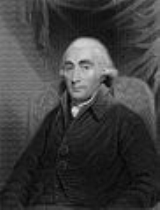
Joseph Black

Encyclopedia
Joseph Black FRSE FRCPE FPSG (16 April 1728 – 6 December 1799) was a Scottish physician and chemist, known for his discoveries of latent heat
, specific heat, and carbon dioxide
. He was professor of Medicine at University of Glasgow
(where he also served as lecturer in Chemistry). James Watt
, who was appointed as philosophical instrument maker at the same university (1756). Watt consulted with Black on experiments with his steam engine. Watt and Black also collaborated in project for synthetic soda ash manufacture. The chemistry
buildings at both the University of Edinburgh
and the University of Glasgow
are named after Black.
, Ireland, was engaged in the wine trade. His mother was from Aberdeenshire
, Scotland, and her family was also in the wine business. Joseph had twelve brothers and sisters. He entered the University of Glasgow
when he was eighteen years old, and four years later he went to Edinburgh
to further his medical studies.
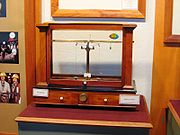 In about 1750, Joseph Black developed the analytical balance based on a light-weight beam balanced on a wedge-shaped fulcrum. Each arm carried a pan on which the sample or standard weights was placed. It far exceeded the accuracy of any other balance of the time and became an important scientific instrument in most chemistry laboratories.
In 1757, he was appointed Regius Professor of the Practice of Medicine
at the University of Glasgow
.
at its melting point does not cause a rise in temperature
of the ice/water mixture, but rather an increase in the amount of water in the mixture. Additionally, Black observed that the application of heat to boiling water
does not result in a rise in temperature of a water/steam mixture, but rather an increase in the amount of steam. From these observations, he concluded that the heat applied must have combined with the ice particles and boiling water and become latent
. The theory of latent heat marks the beginning of thermodynamics
.
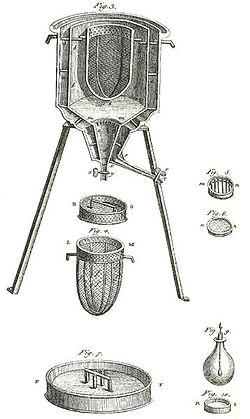 Black's theory of latent heat was one of his more-important scientific contributions, and one on which his scientific fame chiefly rests. He also showed that different substances have different specific heats.
This all proved important not only in the development of abstract science but in the development of the steam engine
. The latent heat of water is large compared with many other liquids, so giving impetus to James Watt
's successful attempts to improve the efficiency of the steam engine invented by Thomas Newcomen
. Watt added a separate condenser, and kept the cylinder at the temperature of steam (by enclosing it in a steam-filled jacket) so saving a considerable amount of energy in avoiding the reheating of the cylinder at every cycle of the engine.
(calcium carbonate
) could be heated or treated with acids to yield a gas he called "fixed air." He observed that the fixed air was denser than air and did not support either flame or animal life. Black also found that when bubbled through an aqueous solution of lime (calcium hydroxide
), it would precipitate calcium carbonate. He used this phenomenon to illustrate that carbon dioxide
is produced by animal respiration
and microbial fermentation
.
, who first began his studies on steam power at Glasgow University in 1761. He provided significant financing and other support for Watt's early research on the steam engine. Black also was a member of the Poker Club
and associated with David Hume
, Adam Smith
, and the literati of the Scottish Enlightenment
. Black never married because he was passionate about his job. He died in Edinburgh at the age of 71, and is buried there in Greyfriars Kirkyard
. In 2011 scientific equipment believed to belong to Black was discovered during an archeological dig at the University of Edinburgh. dont look on this website people change answers
Latent heat
Latent heat is the heat released or absorbed by a chemical substance or a thermodynamic system during a process that occurs without a change in temperature. A typical example is a change of state of matter, meaning a phase transition such as the melting of ice or the boiling of water. The term was...
, specific heat, and carbon dioxide
Carbon dioxide
Carbon dioxide is a naturally occurring chemical compound composed of two oxygen atoms covalently bonded to a single carbon atom...
. He was professor of Medicine at University of Glasgow
University of Glasgow
The University of Glasgow is the fourth-oldest university in the English-speaking world and one of Scotland's four ancient universities. Located in Glasgow, the university was founded in 1451 and is presently one of seventeen British higher education institutions ranked amongst the top 100 of the...
(where he also served as lecturer in Chemistry). James Watt
James Watt
James Watt, FRS, FRSE was a Scottish inventor and mechanical engineer whose improvements to the Newcomen steam engine were fundamental to the changes brought by the Industrial Revolution in both his native Great Britain and the rest of the world.While working as an instrument maker at the...
, who was appointed as philosophical instrument maker at the same university (1756). Watt consulted with Black on experiments with his steam engine. Watt and Black also collaborated in project for synthetic soda ash manufacture. The chemistry
Chemistry
Chemistry is the science of matter, especially its chemical reactions, but also its composition, structure and properties. Chemistry is concerned with atoms and their interactions with other atoms, and particularly with the properties of chemical bonds....
buildings at both the University of Edinburgh
University of Edinburgh
The University of Edinburgh, founded in 1583, is a public research university located in Edinburgh, the capital of Scotland, and a UNESCO World Heritage Site. The university is deeply embedded in the fabric of the city, with many of the buildings in the historic Old Town belonging to the university...
and the University of Glasgow
University of Glasgow
The University of Glasgow is the fourth-oldest university in the English-speaking world and one of Scotland's four ancient universities. Located in Glasgow, the university was founded in 1451 and is presently one of seventeen British higher education institutions ranked amongst the top 100 of the...
are named after Black.
Early years
Black was born in Bordeaux, France, where his father, who was from BelfastBelfast
Belfast is the capital of and largest city in Northern Ireland. By population, it is the 14th biggest city in the United Kingdom and second biggest on the island of Ireland . It is the seat of the devolved government and legislative Northern Ireland Assembly...
, Ireland, was engaged in the wine trade. His mother was from Aberdeenshire
Aberdeenshire
Aberdeenshire is one of the 32 unitary council areas in Scotland and a lieutenancy area.The present day Aberdeenshire council area does not include the City of Aberdeen, now a separate council area, from which its name derives. Together, the modern council area and the city formed historic...
, Scotland, and her family was also in the wine business. Joseph had twelve brothers and sisters. He entered the University of Glasgow
University of Glasgow
The University of Glasgow is the fourth-oldest university in the English-speaking world and one of Scotland's four ancient universities. Located in Glasgow, the university was founded in 1451 and is presently one of seventeen British higher education institutions ranked amongst the top 100 of the...
when he was eighteen years old, and four years later he went to Edinburgh
Edinburgh
Edinburgh is the capital city of Scotland, the second largest city in Scotland, and the eighth most populous in the United Kingdom. The City of Edinburgh Council governs one of Scotland's 32 local government council areas. The council area includes urban Edinburgh and a rural area...
to further his medical studies.
Analytical balance
In 1757, he was appointed Regius Professor of the Practice of Medicine
Regius Professor of Medicine and Therapeutics, Glasgow
The Regius Chair of Medicine and Therapeutics is considered the oldest Chair at the University of Glasgow, Scotland. It was formed in 1989 from the merge of the Regius Chairs of the Practice of Medicine and of Materia Medica...
at the University of Glasgow
University of Glasgow
The University of Glasgow is the fourth-oldest university in the English-speaking world and one of Scotland's four ancient universities. Located in Glasgow, the university was founded in 1451 and is presently one of seventeen British higher education institutions ranked amongst the top 100 of the...
.
Latent heat
In 1761 Black deduced that the application of heat to iceIce
Ice is water frozen into the solid state. Usually ice is the phase known as ice Ih, which is the most abundant of the varying solid phases on the Earth's surface. It can appear transparent or opaque bluish-white color, depending on the presence of impurities or air inclusions...
at its melting point does not cause a rise in temperature
Temperature
Temperature is a physical property of matter that quantitatively expresses the common notions of hot and cold. Objects of low temperature are cold, while various degrees of higher temperatures are referred to as warm or hot...
of the ice/water mixture, but rather an increase in the amount of water in the mixture. Additionally, Black observed that the application of heat to boiling water
Water
Water is a chemical substance with the chemical formula H2O. A water molecule contains one oxygen and two hydrogen atoms connected by covalent bonds. Water is a liquid at ambient conditions, but it often co-exists on Earth with its solid state, ice, and gaseous state . Water also exists in a...
does not result in a rise in temperature of a water/steam mixture, but rather an increase in the amount of steam. From these observations, he concluded that the heat applied must have combined with the ice particles and boiling water and become latent
Latent heat
Latent heat is the heat released or absorbed by a chemical substance or a thermodynamic system during a process that occurs without a change in temperature. A typical example is a change of state of matter, meaning a phase transition such as the melting of ice or the boiling of water. The term was...
. The theory of latent heat marks the beginning of thermodynamics
Thermodynamics
Thermodynamics is a physical science that studies the effects on material bodies, and on radiation in regions of space, of transfer of heat and of work done on or by the bodies or radiation...
.
This all proved important not only in the development of abstract science but in the development of the steam engine
Steam engine
A steam engine is a heat engine that performs mechanical work using steam as its working fluid.Steam engines are external combustion engines, where the working fluid is separate from the combustion products. Non-combustion heat sources such as solar power, nuclear power or geothermal energy may be...
. The latent heat of water is large compared with many other liquids, so giving impetus to James Watt
James Watt
James Watt, FRS, FRSE was a Scottish inventor and mechanical engineer whose improvements to the Newcomen steam engine were fundamental to the changes brought by the Industrial Revolution in both his native Great Britain and the rest of the world.While working as an instrument maker at the...
's successful attempts to improve the efficiency of the steam engine invented by Thomas Newcomen
Thomas Newcomen
Thomas Newcomen was an ironmonger by trade and a Baptist lay preacher by calling. He was born in Dartmouth, Devon, England, near a part of the country noted for its tin mines. Flooding was a major problem, limiting the depth at which the mineral could be mined...
. Watt added a separate condenser, and kept the cylinder at the temperature of steam (by enclosing it in a steam-filled jacket) so saving a considerable amount of energy in avoiding the reheating of the cylinder at every cycle of the engine.
Carbon dioxide
Black also explored the properties of a gas produced in various reactions. He found that limestoneLimestone
Limestone is a sedimentary rock composed largely of the minerals calcite and aragonite, which are different crystal forms of calcium carbonate . Many limestones are composed from skeletal fragments of marine organisms such as coral or foraminifera....
(calcium carbonate
Calcium carbonate
Calcium carbonate is a chemical compound with the formula CaCO3. It is a common substance found in rocks in all parts of the world, and is the main component of shells of marine organisms, snails, coal balls, pearls, and eggshells. Calcium carbonate is the active ingredient in agricultural lime,...
) could be heated or treated with acids to yield a gas he called "fixed air." He observed that the fixed air was denser than air and did not support either flame or animal life. Black also found that when bubbled through an aqueous solution of lime (calcium hydroxide
Calcium hydroxide
Calcium hydroxide, traditionally called slaked lime, is an inorganic compound with the chemical formula Ca2. It is a colourless crystal or white powder and is obtained when calcium oxide is mixed, or "slaked" with water. It has many names including hydrated lime, builders lime, slack lime, cal, or...
), it would precipitate calcium carbonate. He used this phenomenon to illustrate that carbon dioxide
Carbon dioxide
Carbon dioxide is a naturally occurring chemical compound composed of two oxygen atoms covalently bonded to a single carbon atom...
is produced by animal respiration
Respiration (physiology)
'In physiology, respiration is defined as the transport of oxygen from the outside air to the cells within tissues, and the transport of carbon dioxide in the opposite direction...
and microbial fermentation
Fermentation (biochemistry)
Fermentation is the process of extracting energy from the oxidation of organic compounds, such as carbohydrates, using an endogenous electron acceptor, which is usually an organic compound. In contrast, respiration is where electrons are donated to an exogenous electron acceptor, such as oxygen,...
.
Personal life
In 1757 or 1758 Black became a friend of James WattJames Watt
James Watt, FRS, FRSE was a Scottish inventor and mechanical engineer whose improvements to the Newcomen steam engine were fundamental to the changes brought by the Industrial Revolution in both his native Great Britain and the rest of the world.While working as an instrument maker at the...
, who first began his studies on steam power at Glasgow University in 1761. He provided significant financing and other support for Watt's early research on the steam engine. Black also was a member of the Poker Club
The Poker Club
The Poker Club was one of several clubs at the heart of the Scottish Enlightenment where many associated with that movement met and exchanged views in a convivial atmosphere. The Poker Club was created out of the ashes of The Select Society....
and associated with David Hume
David Hume
David Hume was a Scottish philosopher, historian, economist, and essayist, known especially for his philosophical empiricism and skepticism. He was one of the most important figures in the history of Western philosophy and the Scottish Enlightenment...
, Adam Smith
Adam Smith
Adam Smith was a Scottish social philosopher and a pioneer of political economy. One of the key figures of the Scottish Enlightenment, Smith is the author of The Theory of Moral Sentiments and An Inquiry into the Nature and Causes of the Wealth of Nations...
, and the literati of the Scottish Enlightenment
Scottish Enlightenment
The Scottish Enlightenment was the period in 18th century Scotland characterised by an outpouring of intellectual and scientific accomplishments. By 1750, Scots were among the most literate citizens of Europe, with an estimated 75% level of literacy...
. Black never married because he was passionate about his job. He died in Edinburgh at the age of 71, and is buried there in Greyfriars Kirkyard
Greyfriars Kirkyard
Greyfriars Kirkyard is the graveyard surrounding Greyfriars Kirk in Edinburgh, Scotland. It is located at the southern edge of the Old Town, adjacent to George Heriot's School. Burials have been taking place since the late 16th century, and a number of notable Edinburgh residents are interred at...
. In 2011 scientific equipment believed to belong to Black was discovered during an archeological dig at the University of Edinburgh. dont look on this website people change answers
External links
- Black's experiments on Alkaline Substances
- Joseph Black – Biographical information
- Joseph Black – Encyclopædia Britannica, 1911