

Generative grammar

Encyclopedia
In theoretical linguistics
, generative grammar refers to a particular approach to the study of syntax
. A generative grammar of a language attempts to give a set of rules that will correctly predict which combinations of words will form grammatical sentences. In most approaches to generative grammar, the rules will also predict the morphology
of a sentence.
Generative grammar originates in the work of Noam Chomsky
, beginning in the late 1950s. Early versions of Chomsky's theory were called transformational grammar
, and this term is still used as a collective term that includes his subsequent theories. There are a number of competing versions of generative grammar currently practiced within linguistics
. Chomsky's current theory is known as the Minimalist program
. Other prominent theories include or have included head-driven phrase structure grammar
, lexical functional grammar
, categorial grammar
, relational grammar
, link grammar
and tree-adjoining grammar
.
Chomsky has argued that many of the properties of a generative grammar arise from an "innate" universal grammar
. Proponents of generative grammar have argued that most grammar is not the result of communicative function and is not simply learned from the environment (see poverty of the stimulus
argument). In this respect, generative grammar takes a point of view different from cognitive grammar
, functional
and behaviorist
theories.
Most versions of generative grammar characterize sentences as either grammatically
correct (also known as well formed) or not. The rules of a generative grammar typically function as an algorithm
to predict grammaticality as a discrete (yes-or-no) result. In this respect, it differs from stochastic grammar
, which considers grammaticality as a probabilistic variable. However, some work in generative grammar (e.g. recent work by Joan Bresnan
) uses stochastic versions of optimality theory
.
. The term generative grammar has been associated with at least the following schools of linguistics:
grammar of Pāṇini, called the Ashtadhyayi, composed by the middle of the 1st millennium BCE.
Generative grammar has been under development since the late 1950s, and has undergone many changes in the types of rules and representations that are used to predict grammaticality. In tracing the historical development of ideas within generative grammar, it is useful to refer to various stages in the development of the theory.
A core aspect of Standard Theory is a distinction between two different representations of a sentence, called Deep structure
and Surface structure. The two representations are linked to each other by transformational grammar
.
It contains
proposed by Noam Chomsky in the 1950s. This sets out a series of types of formal grammars with increasing expressive power. Among the simplest types are the regular grammar
s (type 3); Chomsky claims that regular grammars are not adequate as models for human language, because all human languages allow the center-embedding of strings within strings.
At a higher level of complexity are the context-free grammar
s (type 2). The derivation of a sentence by a grammar can be depicted as a derivation tree
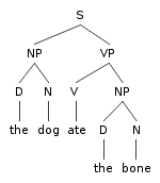
. Linguists working in generative grammar often view such derivation trees as a primary object of study. According to this view, a sentence is not merely a string of words, but rather a tree with subordinate and superordinate branches connected at nodes.
Essentially, the tree model works something like this example, in which S is a sentence, D is a determiner, N a noun
, V a verb
, NP a noun phrase
and VP a verb phrase
:
The resulting sentence could be The dog ate the bone. Such a tree diagram is also called a phrase marker. They can be represented more conveniently in text form, (though the result is less easy to read); in this format the above sentence would be rendered as:
[S [NP [D The ] [N dog ] ] [VP [V ate ] [NP [D the ] [N bone ] ] ] ]
Chomsky has argued that phrase structure grammars are also inadequate for describing natural languages, and has formulated the more complex system of transformational grammar
.
intuitions). However Chomsky has repeatedly rejected that interpretation; according to him, the grammar of a language is a statement of what it is that a person has to know in order to recognize an utterance as grammatical, but not a hypothesis about the processes involved in either understanding or producing language.
and analysis
since the 1980s. The most well-known approaches were developed by Mark Steedman
as well as Fred Lerdahl
and Ray Jackendoff
, who formalised and extended ideas from Schenkerian analysis
. More recently, such early generative approaches to music were further developed and extended by several scholars.
Theoretical linguistics
Theoretical linguistics is the branch of linguistics that is most concerned with developing models of linguistic knowledge. The fields that are generally considered the core of theoretical linguistics are syntax, phonology, morphology, and semantics...
, generative grammar refers to a particular approach to the study of syntax
Syntax
In linguistics, syntax is the study of the principles and rules for constructing phrases and sentences in natural languages....
. A generative grammar of a language attempts to give a set of rules that will correctly predict which combinations of words will form grammatical sentences. In most approaches to generative grammar, the rules will also predict the morphology
Morphology (linguistics)
In linguistics, morphology is the identification, analysis and description, in a language, of the structure of morphemes and other linguistic units, such as words, affixes, parts of speech, intonation/stress, or implied context...
of a sentence.
Generative grammar originates in the work of Noam Chomsky
Noam Chomsky
Avram Noam Chomsky is an American linguist, philosopher, cognitive scientist, and activist. He is an Institute Professor and Professor in the Department of Linguistics & Philosophy at MIT, where he has worked for over 50 years. Chomsky has been described as the "father of modern linguistics" and...
, beginning in the late 1950s. Early versions of Chomsky's theory were called transformational grammar
Transformational grammar
In linguistics, a transformational grammar or transformational-generative grammar is a generative grammar, especially of a natural language, that has been developed in the Chomskyan tradition of phrase structure grammars...
, and this term is still used as a collective term that includes his subsequent theories. There are a number of competing versions of generative grammar currently practiced within linguistics
Linguistics
Linguistics is the scientific study of human language. Linguistics can be broadly broken into three categories or subfields of study: language form, language meaning, and language in context....
. Chomsky's current theory is known as the Minimalist program
Minimalist program
In linguistics, the Minimalist Program is a major line of inquiry that has been developing inside generative grammar since the early nineties. It started with a 1993 paper by Noam Chomsky....
. Other prominent theories include or have included head-driven phrase structure grammar
Head-driven phrase structure grammar
Head-driven phrase structure grammar is a highly lexicalized, non-derivational generative grammar theory developed by Carl Pollard and Ivan Sag. It is the immediate successor to generalized phrase structure grammar. HPSG draws from other fields such as computer science and uses Ferdinand de...
, lexical functional grammar
Lexical functional grammar
Lexical functional grammar is a grammar framework in theoretical linguistics, a variety of generative grammar. It is a type of phrase structure grammar, as opposed to a dependency grammar. The development of the theory was initiated by Joan Bresnan and Ronald Kaplan in the 1970s, in reaction to...
, categorial grammar
Categorial grammar
Categorial grammar is a term used for a family of formalisms in natural language syntax motivated by the principle of compositionality and organized according to the view that syntactic constituents should generally combine as functions or according to a function-argument relationship...
, relational grammar
Relational grammar
In linguistics, Relational Grammar is a syntactic theory which argues that primitive grammatical relations provide the ideal means to state syntactic rules in universal terms. Relational grammar began as an alternative to transformational grammar....
, link grammar
Link grammar
Link grammar is a theory of syntax by Davy Temperley and Daniel Sleator which builds relations between pairs of words, rather than constructing constituents in a tree-like hierarchy. There are two basic parameters: directionality and distance...
and tree-adjoining grammar
Tree-adjoining grammar
Tree-adjoining grammar is a grammar formalism defined by Aravind Joshi. Tree-adjoining grammars are somewhat similar to context-free grammars, but the elementary unit of rewriting is the tree rather than the symbol...
.
Chomsky has argued that many of the properties of a generative grammar arise from an "innate" universal grammar
Universal grammar
Universal grammar is a theory in linguistics that suggests that there are properties that all possible natural human languages have.Usually credited to Noam Chomsky, the theory suggests that some rules of grammar are hard-wired into the brain, and manifest themselves without being taught...
. Proponents of generative grammar have argued that most grammar is not the result of communicative function and is not simply learned from the environment (see poverty of the stimulus
Poverty of the stimulus
In linguistics, the poverty of the stimulus is the assertion that natural language grammar is unlearnable given the relatively limited data available to children learning a language, and therefore that this knowledge is supplemented with some sort of innate linguistic capacity...
argument). In this respect, generative grammar takes a point of view different from cognitive grammar
Cognitive grammar
Cognitive grammar is a cognitive approach to language developed by Ronald Langacker, which considers the basic units of language to be symbols or conventional pairings of a semantic structure with a phonological label. Grammar consists of constraints on how these units can be combined to generate...
, functional
Functional grammar
Functional theories of grammar include a range of functionally based approaches to linguistics, the scientific study of language. The grammar model developed by Simon Dik bears this qualification in its name, functional grammar, as does Michael Halliday's systemic functional grammar.Role and...
and behaviorist
Behaviorism
Behaviorism , also called the learning perspective , is a philosophy of psychology based on the proposition that all things that organisms do—including acting, thinking, and feeling—can and should be regarded as behaviors, and that psychological disorders are best treated by altering behavior...
theories.
Most versions of generative grammar characterize sentences as either grammatically
Grammar
In linguistics, grammar is the set of structural rules that govern the composition of clauses, phrases, and words in any given natural language. The term refers also to the study of such rules, and this field includes morphology, syntax, and phonology, often complemented by phonetics, semantics,...
correct (also known as well formed) or not. The rules of a generative grammar typically function as an algorithm
Algorithm
In mathematics and computer science, an algorithm is an effective method expressed as a finite list of well-defined instructions for calculating a function. Algorithms are used for calculation, data processing, and automated reasoning...
to predict grammaticality as a discrete (yes-or-no) result. In this respect, it differs from stochastic grammar
Stochastic grammar
A stochastic grammar is a grammar framework with a probabilistic notion of grammaticality:*Stochastic context-free grammar*Statistical parsing*Data-oriented parsing*Hidden Markov model*Estimation theory...
, which considers grammaticality as a probabilistic variable. However, some work in generative grammar (e.g. recent work by Joan Bresnan
Joan Bresnan
Joan Wanda Bresnan is Professor of Linguistics at Stanford University. She is best known as one of the architects of the theoretical framework of Lexical-Functional Grammar....
) uses stochastic versions of optimality theory
Optimality theory
Optimality theory is a linguistic model proposing that the observed forms of language arise from the interaction between conflicting constraints. OT models grammars as systems that provide mappings from inputs to outputs; typically, the inputs are conceived of as underlying representations, and...
.
Frameworks
There are a number of different approaches to generative grammar. Common to all is the effort to come up with a set of rules or principles that will account for the well-formed expressions of a natural languageNatural language
In the philosophy of language, a natural language is any language which arises in an unpremeditated fashion as the result of the innate facility for language possessed by the human intellect. A natural language is typically used for communication, and may be spoken, signed, or written...
. The term generative grammar has been associated with at least the following schools of linguistics:
- Transformational grammarTransformational grammarIn linguistics, a transformational grammar or transformational-generative grammar is a generative grammar, especially of a natural language, that has been developed in the Chomskyan tradition of phrase structure grammars...
(TG)- Standard Theory (ST)
- Extended Standard Theory (EST)
- Revised Extended Standard Theory (REST)
- Principles and Parameters TheoryPrinciples and parametersPrinciples and parameters is a framework within generative linguistics in which the syntax of a natural language is described in accordance with general principles and specific parameters that for particular languages are either turned on or off...
(P&P)- Government and Binding TheoryGovernment and binding theoryGovernment and binding is a theory of syntax and a phrase structure grammar in the tradition of transformational grammar developed principally by Noam Chomsky in the 1980s...
(GB) - Minimalist ProgramMinimalist programIn linguistics, the Minimalist Program is a major line of inquiry that has been developing inside generative grammar since the early nineties. It started with a 1993 paper by Noam Chomsky....
(MP)
- Government and Binding Theory
- Monostratal (or non-transformational) grammars
- Relational GrammarRelational grammarIn linguistics, Relational Grammar is a syntactic theory which argues that primitive grammatical relations provide the ideal means to state syntactic rules in universal terms. Relational grammar began as an alternative to transformational grammar....
(RG) - Lexical-Functional GrammarLexical functional grammarLexical functional grammar is a grammar framework in theoretical linguistics, a variety of generative grammar. It is a type of phrase structure grammar, as opposed to a dependency grammar. The development of the theory was initiated by Joan Bresnan and Ronald Kaplan in the 1970s, in reaction to...
(LFG) - Generalized Phrase Structure GrammarGeneralised phrase structure grammarGeneralised phrase structure grammar is a framework for describing the syntax and semantics of natural languages. It is a type of phrase structure grammar, as opposed to a dependency grammar. GPSG was initially developed in the late 1970s by Gerald Gazdar. Other contributors include Ewan Klein,...
(GPSG) - Head-Driven Phrase Structure GrammarHead-driven phrase structure grammarHead-driven phrase structure grammar is a highly lexicalized, non-derivational generative grammar theory developed by Carl Pollard and Ivan Sag. It is the immediate successor to generalized phrase structure grammar. HPSG draws from other fields such as computer science and uses Ferdinand de...
(HPSG) - Categorial GrammarCategorial grammarCategorial grammar is a term used for a family of formalisms in natural language syntax motivated by the principle of compositionality and organized according to the view that syntactic constituents should generally combine as functions or according to a function-argument relationship...
- Tree-Adjoining GrammarTree-adjoining grammarTree-adjoining grammar is a grammar formalism defined by Aravind Joshi. Tree-adjoining grammars are somewhat similar to context-free grammars, but the elementary unit of rewriting is the tree rather than the symbol...
- Relational Grammar
Historical development of models of transformational grammar
The oldest known generative grammar that is still extant and in common use is the SanskritSanskrit
Sanskrit , is a historical Indo-Aryan language and the primary liturgical language of Hinduism, Jainism and Buddhism.Buddhism: besides Pali, see Buddhist Hybrid Sanskrit Today, it is listed as one of the 22 scheduled languages of India and is an official language of the state of Uttarakhand...
grammar of Pāṇini, called the Ashtadhyayi, composed by the middle of the 1st millennium BCE.
Generative grammar has been under development since the late 1950s, and has undergone many changes in the types of rules and representations that are used to predict grammaticality. In tracing the historical development of ideas within generative grammar, it is useful to refer to various stages in the development of the theory.
Standard Theory (1957–1965)
The so-called Standard Theory corresponds to the original model of generative grammar laid out in Chomsky (1965).A core aspect of Standard Theory is a distinction between two different representations of a sentence, called Deep structure
Deep structure
In linguistics, specifically in the study of syntax in the tradition of generative grammar , the deep structure of a linguistic expression is a theoretical construct that seeks to unify several related structures. For example, the sentences "Pat loves Chris" and "Chris is loved by Pat" mean...
and Surface structure. The two representations are linked to each other by transformational grammar
Transformational grammar
In linguistics, a transformational grammar or transformational-generative grammar is a generative grammar, especially of a natural language, that has been developed in the Chomskyan tradition of phrase structure grammars...
.
Extended Standard Theory (1965–1973)
The so-called Extended Standard Theory was formulated in the late 1960s to early 1970s. Features are:- syntactic constraints
- generalized phrase structures (X-bar theoryX-bar theoryX-bar theory is a component of linguistic theory which attempts to identify syntactic features presumably common to all those human languages that fit in a presupposed framework...
)
Revised Extended Standard Theory (1973–1976)
The so-called Revised Extended Standard Theory was formulated between 1973 and 1976.It contains
- restrictions upon X-bar theoryX-bar theoryX-bar theory is a component of linguistic theory which attempts to identify syntactic features presumably common to all those human languages that fit in a presupposed framework...
(Jackendoff (1977)). - assumption of the COMPComplement (linguistics)In grammar the term complement is used with different meanings. The primary meaning is a word, phrase or clause that is necessary in a sentence to complete its meaning. We find complements that function as an argument and complements that exist within arguments.Both complements and modifiers add...
position. - Move α
Relational grammar (ca. 1975–1990)
An alternative model of syntax based on the idea that notions like Subject, Direct Object, and Indirect Object play a primary role in grammar.Government and binding/Principles and parameters theory (1981–1990)
Chomsky's Lectures on Government and Binding (1981) and Barriers (1986).Context-free grammars
Generative grammars can be described and compared with the aid of the Chomsky hierarchyChomsky hierarchy
Within the field of computer science, specifically in the area of formal languages, the Chomsky hierarchy is a containment hierarchy of classes of formal grammars....
proposed by Noam Chomsky in the 1950s. This sets out a series of types of formal grammars with increasing expressive power. Among the simplest types are the regular grammar
Regular grammar
In theoretical computer science, a regular grammar is a formal grammar that describes a regular language.- Strictly regular grammars :A right regular grammar is a formal grammar such that all the production rules in P are of one of the following forms:# B → a - where B is a non-terminal in N and...
s (type 3); Chomsky claims that regular grammars are not adequate as models for human language, because all human languages allow the center-embedding of strings within strings.
At a higher level of complexity are the context-free grammar
Context-free grammar
In formal language theory, a context-free grammar is a formal grammar in which every production rule is of the formwhere V is a single nonterminal symbol, and w is a string of terminals and/or nonterminals ....
s (type 2). The derivation of a sentence by a grammar can be depicted as a derivation tree
Tree structure
A tree structure is a way of representing the hierarchical nature of a structure in a graphical form. It is named a "tree structure" because the classic representation resembles a tree, even though the chart is generally upside down compared to an actual tree, with the "root" at the top and the...
. Linguists working in generative grammar often view such derivation trees as a primary object of study. According to this view, a sentence is not merely a string of words, but rather a tree with subordinate and superordinate branches connected at nodes.
Essentially, the tree model works something like this example, in which S is a sentence, D is a determiner, N a noun
Noun
In linguistics, a noun is a member of a large, open lexical category whose members can occur as the main word in the subject of a clause, the object of a verb, or the object of a preposition .Lexical categories are defined in terms of how their members combine with other kinds of...
, V a verb
Verb
A verb, from the Latin verbum meaning word, is a word that in syntax conveys an action , or a state of being . In the usual description of English, the basic form, with or without the particle to, is the infinitive...
, NP a noun phrase
Noun phrase
In grammar, a noun phrase, nominal phrase, or nominal group is a phrase based on a noun, pronoun, or other noun-like word optionally accompanied by modifiers such as adjectives....
and VP a verb phrase
Verb phrase
In linguistics, a verb phrase or VP is a syntactic unit composed of at least one verb and the dependents of that verb. One can distinguish between two types of VPs, finite VPs and non-finite VPs . While phrase structure grammars acknowledge both, dependency grammars reject the existence of a...
:
The resulting sentence could be The dog ate the bone. Such a tree diagram is also called a phrase marker. They can be represented more conveniently in text form, (though the result is less easy to read); in this format the above sentence would be rendered as:
[S [NP [D The ] [N dog ] ] [VP [V ate ] [NP [D the ] [N bone ] ] ] ]
Chomsky has argued that phrase structure grammars are also inadequate for describing natural languages, and has formulated the more complex system of transformational grammar
Transformational grammar
In linguistics, a transformational grammar or transformational-generative grammar is a generative grammar, especially of a natural language, that has been developed in the Chomskyan tradition of phrase structure grammars...
.
Grammaticality judgments
When generative grammar was first proposed, it was widely hailed as a way of formalizing the implicit set of rules a person "knows" when they know their native language and produce grammatical utterances in it (grammaticalityGrammaticality
In theoretical linguistics, grammaticality is the quality of a linguistic utterance of being grammatically well-formed. An * before a form is a mark that the cited form is ungrammatical....
intuitions). However Chomsky has repeatedly rejected that interpretation; according to him, the grammar of a language is a statement of what it is that a person has to know in order to recognize an utterance as grammatical, but not a hypothesis about the processes involved in either understanding or producing language.
Music
Generative grammar has been used to a limited extent in music theoryMusic theory
Music theory is the study of how music works. It examines the language and notation of music. It seeks to identify patterns and structures in composers' techniques across or within genres, styles, or historical periods...
and analysis
Musical analysis
Musical analysis is the attempt to answer the question how does this music work?. The method employed to answer this question, and indeed exactly what is meant by the question, differs from analyst to analyst, and according to the purpose of the analysis. According to Ian Bent , analysis is "an...
since the 1980s. The most well-known approaches were developed by Mark Steedman
Mark Steedman
Mark Jerome Steedman, FBA, FRSE is a computational linguist and cognitive scientist.Steedman graduated from the University of Sussex in 1968, with a B.Sc in Experimental Psychology, and from the University of Edinburgh in 1973, with a Ph.D. in Artificial Intelligence Mark Jerome Steedman, FBA,...
as well as Fred Lerdahl
Fred Lerdahl
Alfred Whitford Lerdahl is the Fritz Reiner Professor of Musical Composition at Columbia University, and a composer and music theorist best known for his work on pitch space and cognitive constraints on compositional systems or "musical grammar[s]." He has written many orchestral and chamber...
and Ray Jackendoff
Ray Jackendoff
Ray Jackendoff is an American linguist. He is professor of philosophy, Seth Merrin Chair in the Humanities and, with Daniel Dennett, Co-director of the Center for Cognitive Studies at Tufts University...
, who formalised and extended ideas from Schenkerian analysis
Schenkerian analysis
Schenkerian analysis is a method of musical analysis of tonal music based on the theories of Heinrich Schenker. The goal of a Schenkerian analysis is to interpret the underlying structure of a tonal work. The theory's basic tenets can be viewed as a way of defining tonality in music...
. More recently, such early generative approaches to music were further developed and extended by several scholars.
See also
- Phrase structure rulesPhrase structure rulesPhrase-structure rules are a way to describe a given language's syntax. They are used to break down a natural language sentence into its constituent parts namely phrasal categories and lexical categories...
- Cognitive linguisticsCognitive linguisticsIn linguistics, cognitive linguistics refers to the branch of linguistics that interprets language in terms of the concepts, sometimes universal, sometimes specific to a particular tongue, which underlie its forms...
- ParsingParsingIn computer science and linguistics, parsing, or, more formally, syntactic analysis, is the process of analyzing a text, made of a sequence of tokens , to determine its grammatical structure with respect to a given formal grammar...
- Linguistic competenceLinguistic competenceLinguistic competence is the system of linguistic knowledge possessed by native speakers of a language, it is in contrast to the concept of Linguistic performance, the way the language system is used in communication...
Further reading
- Chomsky, Noam. 1965. Aspects of the theory of syntax. Cambridge, Massachusetts: MIT Press.
- Hurford, J. (1990) Nativist and functional explanations in language acquisition. In I. M. Roca (ed.), Logical Issues in Language Acquisition, 85–136. Foris, Dordrecht.