
All Topics  
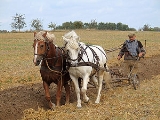
Plough

 
Plough

   Email Print
   Bookmark   Link


Plough


The plough (American
American English

PhonologyIn many ways, compared to English language in England, North American English is conservative in its phonology. Some distinctive accents can be found on the East Coast of the United States , partly because these areas were in contact with England, and imitated prestigious varieties of English English at a time when those varieties we...
 spelling: plow; both ) is a tool
Tool

A broad definition of a tool is an entity used to interface between two or more domains that facilitates more effective action of one domain upon the other....
 used in farming for initial cultivation of soil in preparation for sowing seed or planting. It has been a basic instrument for most of recorded history, and represents one of the major advances in agriculture
Agriculture

Agriculture refers to the production of food and goods through farming and forestry. Agriculture was the key development that led to the rise of civilization, with the animal husbandry of domestication animals and plants creating food surpluses that enabled the development of more Population density and Social stratification societies....
. The primary purpose of ploughing is to turn over the upper layer of the soil, bringing fresh nutrients to the surface, while burying weeds and the remains of previous crops, allowing them to break down.


Discussion
Ask a question about 'Plough'
Start a new discussion about 'Plough'
Answer questions from other users
Full Discussion Forum


Recent Posts


Encyclopedia


Plough
The plough (American
American English

PhonologyIn many ways, compared to English language in England, North American English is conservative in its phonology. Some distinctive accents can be found on the East Coast of the United States , partly because these areas were in contact with England, and imitated prestigious varieties of English English at a time when those varieties we...
 spelling: plow; both ) is a tool
Tool

A broad definition of a tool is an entity used to interface between two or more domains that facilitates more effective action of one domain upon the other....
 used in farming for initial cultivation of soil in preparation for sowing seed or planting. It has been a basic instrument for most of recorded history, and represents one of the major advances in agriculture
Agriculture

Agriculture refers to the production of food and goods through farming and forestry. Agriculture was the key development that led to the rise of civilization, with the animal husbandry of domestication animals and plants creating food surpluses that enabled the development of more Population density and Social stratification societies....
. The primary purpose of ploughing is to turn over the upper layer of the soil, bringing fresh nutrients to the surface, while burying weeds and the remains of previous crops, allowing them to break down. It also aerates the soil, and allows it to hold moisture better. In modern use, a ploughed field is typically left to dry out, and is then harrow
Harrow (tool)

In agriculture, a set of harrows is an implement for cultivating the surface of the soil. In this way it is distinct in its effect from the plough, which is used for deeper cultivation....
ed before planting.

Ploughs were initially pulled by ox
Ox

Oxen are bovinae trained as draught animals. Often they are adult, castration males. Oxen are used for ploughing, transport, hauling cargo, threshing grain by trampling, powering machines for grinding grain, irrigation or other purposes, and drawing carts and wagons....
en, and later in many areas by horse
Horse

The horse is a hoofed mammal, a subspecies of one of seven extant species of the family Equidae. The horse has evolution of the horse over the past 45 to 55 million years from a small multi-toed creature into the large, odd-toed ungulate animal of today....
s. In industrialised countries, the first mechanical means of pulling a plough used steam-power (ploughing engines or steam tractor
Steam tractor

A steam tractor is a vehicle powered by a steam engine which is used for pulling.In North America, the term steam tractor usually refers to a type of agriculture tractor powered by a steam engine, used extensively in the late 1800s and early 1900s....
s), but these were gradually superseded by internal-combustion-powered tractor
Tractor

File:John Deere 3350 tractor cut.JPGA tractor is a vehicle specifically designed to deliver a high tractive effort at slow speeds, for the purposes of hauling a trailer or machinery used in agriculture or construction....
s. In the past two decade
Decade

A decade is a period of ten years. The word is derived from the late Latin language decas, from Greek language decas, from deca. The other words for spans of years also come from Latin: lustrum , century , millennium ....
s plough use has reduced in some areas (where soil damage and erosion are problems), in favour of shallower ploughing and other less invasive tillage
Tillage

Tillage is the agricultural preparation of the soil by ploughing, ripping, or turning it. Tillage can also mean the land that is tilled. There are two types of tillage: primary and secondary tillage....
 techniques.

Ploughs are even used under the sea, for the laying of cables
Submarine cable

Submarine cables may be divided into two types:*Submarine communications cables*Submarine power cables...
, as well as preparing the earth for side-scan sonar
Side-scan sonar

Side-scan sonar is a category of sonar system that is used to create efficiently an image of large areas of the sea floor. This tool is used for mapping the seabed for a wide variety of purposes, including creation of nautical charts and detection and identification of underwater objects and bathymetric features....
 in a process used in oil exploration
Oil exploration

Hydrocarbon exploration is the search by petroleum geologists for hydrocarbon deposits beneath the Earth#Crust, such as Petrolium and Natural gas....
.

Etymology

In English, as in other Germanic languages
Germanic languages

The Germanic languages are a group of related languages that constitute a branch of the Indo-European languages language family. The common ancestor of all the languages in this branch is Proto-Germanic, spoken in approximately the mid-1st millennium BC in Pre-Roman Iron Age....
, the plough was traditionally known by other names, e.g. Old English sulh, Old High German
Old High German

The term Old High German refers to the earliest stage of the German language and it conventionally covers the period from around 500 to 1050. Coherent written texts do not appear until the second half of the 8th century, and some treat the period before 750 as 'prehistoric' and date the start of Old High German proper to 750 for this reason...
 medela or huohili, and Old Norse
Old Norse

Old Norse is a North Germanic languages that was spoken by inhabitants of Scandinavia and inhabitants of their overseas settlements during the Viking Age, until about 1300....
 arðr.

The current word plough also comes from Germanic, but it appears relatively late (it is absent from Gothic
Gothic language

Gothic is an extinct language Germanic language that was spoken by the Goths. It is known primarily from Codex Argenteus, a 6th century copy of a 4th century Bible translation, and is the only East Germanic languages with a sizable corpus....
), and is thought to be a loanword from one of the north Italic languages
Italic languages

The Italic subfamily is a member of the Indo-European languages language family's Centum branch. It includes the Romance languages derived from Latin , and a number of extinct languages of the Italian Peninsula, including Umbrian language, Oscan language, and the aforementioned Latin....
. In these it had different meanings: in Raetic plaumorati (Pliny), and in Latin plaustrum "wagon, cart", plóstrum, plóstellum "cart", and plóxenum, plóximum "cart box".

The word first appears in Germanic as Lombardic
Lombardic language

Lombardic or Langobardic is the extinct language of the Lombards , the Germanic languages speaking settlers in Italy in the 6th century. The language declined from the 7th century, but may have been in scattered use until as late as ca....
 plóvum. This term was borrowed into Balto-Slavic languages
Balto-Slavic languages

The Balto-Slavic language group consists of the Baltic languages and Slavic languages, belonging to the Indo-European languages of languages. Having experienced a period of common development, Baltic and Slavic languages share several linguistic traits not found in any other Indo-European branch, which points to their close genetic relationsh...
, such as Old Church Slavonic
Old Church Slavonic

Old Church Slavonic, also known as Old Bulgarian, or Old Macedonian, was the first literary Slavic language, based on the old Solun dialect of the Thessaloniki region by the 9th century Byzantine Greeks missionaries, Saints Cyril and Methodius, who used it for translation of the Bible and other Ancient Greek language ecclesiastica...
 plug? and Lithuanian
Lithuanian language

Lithuanian is the official state language of Lithuania and is recognised as one of the official languages of the European Union. There are about 2.96 million native Lithuanian speakers in Lithuania and about 170,000 abroad....
 plúgas. Ultimately, the word is thought to derive from an ancestral PIE
Proto-Indo-European language

The Proto-Indo-European language is the unattested, linguistic reconstruction common ancestor of the Indo-European languages, spoken by the Proto-Indo-Europeans....
 *blokó, related to Armenian
Armenian language

The 'Armenian language' is an Indo-European language spoken by the Armenians. It is the official language of the Armenia as well as in the region of Nagorno-Karabakh....
 pelem "to dig" and Welsh
Welsh language

Welsh ]], is a member of the Brythonic branch of Celtic languages spoken natively in Wales, in England by some along the Welsh Marches and in the Welsh settlement in Argentina in the Chubut Valley in Argentina Patagonia....
 bwlch "gap, notch".

History of the plough


Hoeing

When agriculture was first developed, simple hand-held digging stick
Digging stick

In archaeology and anthropology a digging stick is the term given to a variety of wooden implements used primarily by List of subsistence techniques cultures to dig out underground food such as roots and tubers or burrowing animals and anthills....
s or hoe
Hoe (tool)

A Hoe is an agricultural tool used to*agitate the surface of the soil around plants, to remove weeds*pile soil around the base of plants ;*create narrow furrows and shallow trenches for planting seeds and bulbs;...
s would have been used in highly fertile areas, such as the banks of the Nile
Nile

The Nile is a major north-flowing river in Africa, generally regarded as the List of rivers by length in the world.The Nile has two major tributary, the White Nile and Blue Nile, the latter being the source of most of the Nile's water and silt, but the former being the longer of the two....
 where the annual flood rejuvenates the soil, to create furrows wherein seeds could be sown. In order to regularly grow crops in less fertile areas, the soil must be turned to bring nutrients to the surface.

Scratch plough

The domestication of ox
Ox

Oxen are bovinae trained as draught animals. Often they are adult, castration males. Oxen are used for ploughing, transport, hauling cargo, threshing grain by trampling, powering machines for grinding grain, irrigation or other purposes, and drawing carts and wagons....
en in Mesopotamia
Mesopotamia

Mesopotamia is the area of the Tigris-Euphrates river system, along the Tigris and Euphrates rivers, largely corresponding to modern Iraq, as well as some parts of northeastern Syria, some parts of southeastern Turkey, and some parts of the Khuzestan Province of southwestern Iran....
 and by its contemporary Indus valley civilization
Indus Valley Civilization

The Indus Valley Civilization , abbreviated IVC, was an ancient civilization that flourished in the Indus River basin. Primarily centered along the Indus river, the civilization encompassed most of Pakistan, including its Sindh, Punjab and Balochistan provinces, and extending into modern day Indian states of Gujarat, Haryana, Punjab...
, perhaps as early as the 6th millennium BC, provided mankind with the pulling power necessary to develop the plough. The very earliest plough was the simple scratch-plough, or ard, which consists of a frame holding a vertical wooden stick that was dragged through the topsoil (still used in many parts of the world). It breaks up a strip of land directly along the ploughed path, which can then be planted. Because this form of plough leaves a strip of undisturbed earth between the rows, fields are often cross-ploughed at right angles, and this tends to lead to squarish fields In the archeology of northern Europe, such squarish fields are referred to as "Celtic fields
Celtic fields

Celtic field is a popular name for the traces of early agricultural field systems found in the British Isles. They are sometimes preserved in areas were industrial farming has not been adopted and can date from any time between the Early Bronze Age until the early medieval period....
".

Crooked ploughs

The Greeks apparently introduced the next major advance in plough design; the crooked plough, which angled the cutting surface forward, leading to the name. The cutting surface was often faced with bronze or (later) iron. Metal was expensive, so in times of war it was melted down or forged to make weapons – or the reverse in more peaceful times. This is presumably the origin of the term "beat your swords to ploughshares
Swords to ploughshares

Swords to ploughshares is a concept in which military weapons or technologies are converted for peaceful civilian applications. The plowshare is often used to symbolize creative tools that benefit mankind, as opposed to destructive tools of war, symbolized by the sword, a similar sharp metal tool with an arguably opposite use....
".

Mouldboard plough

Ploughmen Fac Simile of A Miniature in A Very Ancient Anglo Saxon Manuscript Published By Shaw With Legend God Spede Ye Plough and Send Us Korne Enow
Oldplow2006 05 21
A major advance in plough design was the mouldboard plough (American spelling: moldboard plow), which aided the cutting blade. The coulter, knife or skeith cuts vertically into the ground just ahead of the share (or frog) a wedge-shaped surface to the front and bottom of the mouldboard with the landside of the frame supporting the below-ground components. The upper parts of the frame carries (from the front) the coupling for the motive power (horses), the coulter and the landside frame. Depending on the size of the implement, and the number of furrows it is designed to plough at one time, there is a wheel or wheels positioned to support the frame. In the case of a single-furrow plough there is only one wheel at the front and handles at the rear for the ploughman to steer and manoeuvre it.

When dragged through a field the coulter cuts down into the soil and the share cuts horizontally from the previous furrow to the vertical cut. This releases a rectangular strip of sod that is then lifted by the share and carried by the mouldboard up and over, so that the strip of sod (slice of the topsoil
Topsoil

Topsoil is the upper, outermost layer of soil, usually the top 2 to 8 inches. It has the highest concentration of organic matter and microorganisms and is where most of the Earth's biology soil activity occurs....
) that is being cut lifts and rolls over as the plough moves forward, dropping back to the ground upside down into the furrow and onto the turned soil from the previous run down the field. Each gap in the ground where the soil has been lifted and moved across (usually to the right) is called a furrow. The sod that has been lifted from it rests at about a 45 degree angle in the next-door furrow and lies up the back of the sod from the previous run.

In this way, a series of ploughing runs down a field (paddock) leaves a row of sods that lie partly in the furrows and partly on the ground lifted earlier. Visually, across the rows, there is the land (unploughed part) on the left, a furrow (half the width of the removed strip of soil) and the removed strip almost upside-down lying on about half of the previous strip of inverted soil, and so on across the field. Each layer of soil and the gutter it came from forms the classic furrow.

The mouldboard plough greatly reduced the amount of time needed to prepare a field, and as a consequence, allowed a farmer to work a larger area of land. In addition, the resulting pattern of low (under the mouldboard) and high (beside it) ridges in the soil forms water channels, allowing the soil to drain. In areas where snow buildup is an issue, this allows the soil to be planted earlier as the snow runoff is drained away more quickly.

Parts of a mouldboard plough: There are 5 major parts of a mouldboard plough
  1. Mouldboard
  2. Share
  3. Landside
  4. Frog
  5. Tailpiece


A runner extending from behind the share to the rear of the plough controls the direction of the plough, because it is held against the bottom land-side corner of the new furrow being formed. The holding force is the weight of the sod, as it is raised and rotated, on the curved surface of the mouldboard. Because of this runner, the mouldboard plough is harder to turn around than the scratch plough, and its introduction brought about a change in the shape of fields—from mostly square fields into longer rectangular "strips" (hence the introduction of the furlong
Furlong

A furlong is a measure of distance in imperial units and U.S. customary units. It is equal to one-eighth of a mile, 220 yards, 660 foot or 201.168 meters....
).

An advance on the basic design was the ploughshare, a replaceable horizontal cutting surface mounted on the tip of the mouldboard. Introduced by the Celts in Britain around 4000 BC (without the replaceable feature), early mouldboards were basically wedges that sat inside the cut formed by the coulter, turning over the soil to the side. The ploughshare spread the cut horizontally below the surface, so when the mouldboard lifted it, a wider area of soil was turned over.

Heavy ploughs

In the basic mouldboard plough the depth of the cut is adjusted by lifting against the runner in the furrow, which limited the weight of the plough to what the ploughman could easily lift. This limited the construction to a small amount of wood (although metal edges were possible). These ploughs were fairly fragile, and were unsuitable for breaking up the heavier soils of northern Europe. The introduction of wheels to replace the runner allowed the weight of the plough to increase, and in turn allowed the use of a much larger mouldboard faced in metal. These heavy ploughs led to greater food production and eventually a significant population increase around 600 AD.

Heavy Iron ploughs, in the form either of iron laid over wood, or of solid iron became available by the sixth century BC in China
China

China is a Culture of China, an ancient civilization, and, depending on perspective, a national or multinational entity extending over a large area in East Asia....
. These were the first iron ploughs in the world. Despite a number of innovations, the Romans never achieved the heavy wheeled mouldboard plough. The first indisputable appearance after the Roman period is from 643, in a northern Italian document. Old words in connected with the heavy plough and its use appear in Slavic
Slavic languages

File:Slavic europe.svgThe Slavic languages , a group of closely related languages of the Slavic peoples and a subgroup of Indo-European languages, have speakers in most of Eastern Europe, in much of the Balkans, in parts of Central Europe, and in the northern part of Asia....
, suggesting possible early use in this region. The general adoption of the mouldboard plough in Europe
Europe

Europe is, conventionally, one of the world's seven continents. Comprising the westernmost peninsula of Eurasia, Europe is generally divided from Asia to its east by the water divide of the Ural Mountains, the Ural , the Caspian Sea, and by the Caucasus Mountains to the southeast....
 appears to have accompanied the adoption of the three-field system in the later eighth and early ninth centuries, leading to an improvement of the agricultural productivity per unit of land in northern Europe.

Research by the French historian Marc Bloch
Marc Bloch

Marc L?opold Benjamin Bloch was a French historian of Middle Ages France, active in the period between the First and Second World Wars. Bloch was a founder of the Annales School....
 in medieval French agricultural history showed the existence of names for two different ploughs, "the araire was wheel-less and had to be dragged across the fields, while the charrue was mounted on wheels".

Improved designs

The basic plough with coulter, ploughshare and mouldboard remained in use for a millennium. Major changes in design did not become common until the Age of Enlightenment
Age of Enlightenment

The Age of Enlightenment or The Enlightenment is a term used to describe a time in Western philosophy and cultural life centered upon the eighteenth century, in which rationalism was advocated as the primary source and legitimacy for authority....
, when there was rapid progress in design. Chinese ploughs, with mouldboard, were brought to Holland in the seventeenth century by Dutch sailors. And because Dutchmen were hired by the English to drain the East Anglian fens and Somerset moors at that time, they brought with them their Chinese ploughs. The English called these Chinese ploughs the 'bastard Dutch ploughs' instead of 'Chinese ploughs'. Thus, the Dutch and the English were the first to enjoy the efficient Chinese ploughs for the first time in Europe. The Chinese-style ploughs were spread to Scotland from England, and from Holland to America and France. Joseph Foljambe in Rotherham
Rotherham

Rotherham is a town in South Yorkshire, England. It lies on the River Don, South Yorkshire, close to its confluence with the River Rother, South Yorkshire, between Sheffield and Doncaster....
, England
England

native_name =|conventional_long_name = England|common_name = England|image_flag = Flag of England.svg|image_coat = England COA.svg|symbol_type = Royal Coat of Arms...
, in 1730 used these new shapes as the basis for the Rotherham plough, which also covered the mouldboard with iron. Unlike the heavy plough, the Rotherham (or Rotherham swing) plough consisted entirely of the coulter, mouldboard and handles. It was much lighter than conventional designs and became very popular in England. It may have been the first plough to be widely built in factories.

James Small
James Small (inventor)

James Small was a Scotland inventor instrumental in the invention of the modern-style iron swing plough in 1784.Source:...
 further improved the design. Using mathematical methods he experimented with various designs until he arrived at a shape cast from a single piece of iron, the Scots plough. A single-piece cast iron plough was also developed and patented by Charles Newbold
Charles Newbold

Charles Newbold was an United States blacksmith born in 1780 in Chesterfield, New Jersey. On June 26, 1797, Newbold received the first patent for a cast iron plow....
 in the United States. This was again improved on by Jethro Wood, a blacksmith of Scipio, New York, who made a three-part Scots Plough that allowed a broken piece to be replaced. In 1837 John Deere
John Deere

John Deere was an American blacksmith and manufacturer who founded Deere & Company— the largest agricultural and construction equipment manufacturers in the world....
 introduced the first steel
Steel

Steel is an alloy consisting mostly of iron, with a carbon content between 0.2% and 2.14% by weight , depending on grade. Carbon is the most cost-effective alloying material for iron, but various other alloying elements are used such as manganese, chromium, vanadium, and tungsten....
 plough; it was much stronger than iron designs that it was able to work the soil in areas of the US that had earlier been considered unsuitable for farming. Improvements on this followed developments in metallurgy; steel coulters and shares with softer iron mouldboards to prevent breakage, the chilled plough which is an early example of surface-hardened
Case hardening

Case hardening or surface hardening is the process of Hardening the surface of a metal, often a low carbon steel, by infusing elements into the material's surface, forming a thin layer of a harder alloy....
 steel, and eventually the face of the mouldboard grew strong enough to dispense with the coulter.

Single-sided ploughing

The first mouldboard ploughs could only turn the soil over in one direction (convention
Convention (norm)

A convention is a set of agreement, stipulated or generally accepted standards, norm , norm or criterion, often taking the form of a Custom ....
ally always to the right), as dictated by the shape of the mouldboard, and so the field had to be ploughed in long strips, or lands. The plough was usually worked clockwise around each land, ploughing the long sides and being dragged across the short sides without ploughing. The length of the strip was limited by the distance oxen (or later horses) could comfortably work without a rest, and their width by the distance the plough could conveniently be dragged. These distances determined the traditional size of the strips: a furlong
Furlong

A furlong is a measure of distance in imperial units and U.S. customary units. It is equal to one-eighth of a mile, 220 yards, 660 foot or 201.168 meters....
, (or "furrow's length", ) by a chain – an area of one acre (about 0.4 hectares); this is the origin of the acre
Acre

The acre is a Units of measurement of area in a number of different systems, including the Imperial unit#Measures of area and United States customary units#Units of area systems....
. The one-sided action gradually moved soil from the sides to the centre line of the strip. If the strip was in the same place each year, the soil built up into a ridge, creating the ridge and furrow
Ridge and furrow

The term ridge and furrow is often used by archaeologists and others to describe the pattern of peaks and troughs created in a field by the system of ploughing used in Europe during the Middle Ages....
 topography still seen in some ancient fields.

Turnwrest plough

The turnwrest plough allows ploughing to be done to either side. The mouldboard is removable, turning to the right for one furrow, then being moved to the other side of the plough to turn to the left (the coulter and ploughshare are fixed). In this way adjacent furrows can be ploughed in opposite directions, allowing ploughing to proceed continuously along the field and thus avoiding the ridge and furrow topography.

Reversible plough

The reversible plough has two mouldboard ploughs mounted back-to-back, one turning to the right, the other to the left. While one is working the land, the other is carried upside-down in the air. At the end of each row, the paired ploughs are turned over, so the other can be used. This returns along the next furrow, again working the field in a consistent direction.

Riding and multiple-furrow ploughs

Early steel ploughs, like those for thousands of years prior, were walking ploughs, directed by the ploughman holding onto handles on either side of the plough. The steel ploughs were so much easier to draw through the soil that the constant adjustments of the blade to react to roots or clods was no longer necessary, as the plough could easily cut through them. Consequently it was not long after that the first riding ploughs appeared. On these, wheels kept the plough at an adjustable level above the ground, while the ploughman sat on a seat where he would have earlier walked. Direction was now controlled mostly through the draught team, with levers allowing fine adjustments. This led very quickly to riding ploughs with multiple mouldboards, dramatically increasing ploughing performance.

A single draught horse can normally pull a single-furrow plough in clean light soil, but in heavier soils two horses are needed, one walking on the land and one in the furrow. For ploughs with two or more furrows more than two horses are needed and, usually, one or more horses have to walk on the loose ploughed sod—and that makes hard going for them, and the horse treads the newly ploughed land down. It is usual to rest such horses every half hour for about ten minutes.

Heavy volcanic loam soils, such as are found in New Zealand, require the use of four heavy draught horse
Draft horse

A draft horse , draught horse or dray horse is a large horse bred for hard, heavy tasks such as ploughing and farm labour. There are a number of different list of horse breeds, with varying characteristics but all share common traits of strength, patience and a docile temperament which made them indispensable to generations of...
s to pull a double-furrow plough. Where paddocks are more square than long-rectangular it is more economical to have horses four wide in harness than two-by-two ahead, thus one horse is always on the ploughed land (the sod). The limits of strength and endurance of horses made greater than two-furrow ploughs uneconomic to use on one farm.

Amish farmers tend to use a team of about seven horses or mules when spring ploughing and as Amish farmers often help each other plough, teams are sometimes changed at noon. Using this method about can be ploughed per day in light soils and about in heavy soils.

Steam ploughing

The advent of the mobile steam engine
Steam engine

File:Steam-powered fire engine.jpgA steam engine is a heat engine that performs mechanical work using steam as its working fluid.Steam engines have a long history, going back at least 2000 years....
 allowed steam power to be applied to ploughing from about 1850. In Europe, soil conditions were too soft to support the weight of the heavy traction engine
Traction engine

A traction engine is a self-propelled steam engine used to move heavy loads on roads, plough ground or to provide power at a chosen location. The name derives from the Latin tractus, meaning 'drawn', since the prime function of any traction engine is to draw a load behind it....
s. Instead, counterbalanced, wheeled ploughs, known as balance ploughs, were drawn by cables across the fields by pairs of ploughing engines which worked along opposite field edges. The balance plough had two sets of ploughs facing each other, arranged so when one was in the ground, the other set was lifted into the air. When pulled in one direction the trailing ploughs were lowered onto the ground by the tension on the cable. When the plough reached the edge of the field, the opposite cable was pulled by the other engine, and the plough tilted (balanced), the other set of shares were put into the ground, and the plough worked back across the field.

One set of ploughs was right-handed, and the other left-handed, allowing continuous ploughing along the field, as with the turnwrest and reversible ploughs. The man credited with the invention of the ploughing engine and the associated balance plough, in the mid nineteenth century, was John Fowler
John Fowler (agricultural engineer)

John Fowler was an English agricultural engineer who was a pioneer in the use of steam engines for ploughing and digging drainage channels. His inventions significantly reduced the cost of ploughing farmland, and also enabled the drainage of previously uncultivated land in many parts of the world....
, an English agricultural engineer and inventor.

In America the firm soil of the Plains allowed direct pulling with steam tractor
Steam tractor

A steam tractor is a vehicle powered by a steam engine which is used for pulling.In North America, the term steam tractor usually refers to a type of agriculture tractor powered by a steam engine, used extensively in the late 1800s and early 1900s....
s, such as the big Case
Case Corporation

Case Corporation was a manufacturer of construction equipment and agricultural equipment. In 1999 it merged with New Holland to form CNH Global....
, Reeves or Sawyer Massey breaking engines. Gang ploughs of up to fourteen bottoms were used. Often these big ploughs were used in regiments of engines, so that in a single field there might be ten steam tractors each drawing a plough. In this way hundreds of acres could be turned over in a day. Only steam engines had the power to draw the big units. When internal combustion engine
Internal combustion engine

The internal combustion engine is an engine in which the combustion of a fuel occurs in a combustion chamber inside and integral to the engine. In an internal combustion engine it is always the expansion of the high temperature and pressure gases that are produced by the combustion which apply force to the movable component of the engine, such as...
s appeared, they had neither the strength nor the ruggedness compared to the big steam tractors. Only by reducing the number of shares could the work be completed.

Stump-jump plough

The Stump-jump plough
Stump-jump plough

The stump-jump plough is a kind of plough invented in South Australia in the late nineteenth century by Richard Bowyer Smith to solve the particular problem of preparing Mallee lands for cultivation....
 was an Australian invention of the 1870s, designed to cope with the breaking up of new farming land, that contains many tree stumps and rocks that would be very expensive to remove. The plough uses a moveable weight to hold the ploughshare in position. When a tree stump or other obstruction such as a rock is encountered, the ploughshare is thrown upwards, clear of the obstacle, to avoid breaking the plough's harness or linkage; ploughing can be continued when the weight is returned to the earth after the obstacle is passed.

A simpler system, developed later, uses a concave disc (or a pair of them) set at a large angle to the direction of progress, that uses the concave shape to hold the disc into the soil – unless something hard strikes the circumference of the disk, causing it to roll up and over the obstruction. As the arrangement is dragged forward, the sharp edge of the disc cuts the soil, and the concave surface of the rotating disc lifts and throws the soil to the side. It doesn't make as good a job as the mouldboard plough (but this is not considered a disadvantage, because it helps fight the wind erosion), but it does lift and break up the soil.

Modern ploughs

Modern ploughs are usually multiple reversible ploughs, mounted on a tractor
Tractor

File:John Deere 3350 tractor cut.JPGA tractor is a vehicle specifically designed to deliver a high tractive effort at slow speeds, for the purposes of hauling a trailer or machinery used in agriculture or construction....
 via a three-point linkage
Three-point hitch

The three-point hitch most often refers to the way ploughs and other farm equipment are attached to an agricultural tractor. Three point attachment is the simplest and the only statically definite way of joining two bodies in engineering....
. These commonly have between two and as many as seven mouldboards – and semi-mounted ploughs (the lifting of which is supplemented by a wheel about half-way along their length) can have as many as eighteen mouldboards. The hydraulic system of the tractor is used to lift and reverse the implement, as well as to adjust furrow width and depth. The ploughman still has to set the draughting linkage from the tractor so that the plough is carried at the proper angle in the soil. This angle and depth can be controlled automatically by modern tractors. As a complement to the rear plough a two or three mouldboards-plough can be mounted on the front of the tractor if it is equipped with front three-point linkage.

Specialist ploughs


Chisel plough

The chisel plough is a common tool to get deep tillage (prepared land) with limited soil disruption. The main function of this plough is to loosen and aerate the soil
Soil

Soil is the naturally occurring, unconsolidated or loose covering on the Earth's surface. Soil is composed of particles of broken rock that have been altered by chemical and environmental processes including weathering and erosion....
s while leaving crop residue at the top of the soil. This plough can be used to reduce the effects of compaction
Soil compaction

Soil compaction occurs when weight of livestock or heavy machinery compresses soil, causing it to lose pore space. Affected soils become less able to absorb rainfall, thus increasing Runoff and erosion....
 and to help break up ploughpan and hardpan
Hardpan

In soil science, agriculture and gardening, hardpan or ouklip is a general term for a dense layer of soil, usually found below the uppermost topsoil layer....
. Unlike many other ploughs the chisel will not invert or turn the soil. This characteristic has made it a useful addition to no-till
No-till farming

No-till farming is a way of growing crops from year to year without disturbing the soil through tillage....
 and limited-tillage farming practices which attempt to maximise the erosion-prevention benefits of keeping organic matter and farming residues present on the soil surface through the year. Because of these attributes, the use of a chisel plough is considered by some to be more sustainable
Sustainable agriculture

Sustainable agriculture integrates three main goals: natural environment stewardship, farm profitability, and prosperous farming community. These goals have been defined by a variety of List of academic disciplines and may be looked at from the vantage point of the farmer or the consumer....
 than other types of plough, such as the mouldboard plough.
Jdtracto8110dubia
The chisel plough is typically set to run up to a depth of eight to twelve inches (200 to 300 mm). However some models may run much deeper. Each of the individual ploughs, or shanks, are typically set from nine inches (229 mm) to twelve inches (305 mm) apart. Such a plough can encounter significant soil drag, consequently a tractor
Tractor

File:John Deere 3350 tractor cut.JPGA tractor is a vehicle specifically designed to deliver a high tractive effort at slow speeds, for the purposes of hauling a trailer or machinery used in agriculture or construction....
 of sufficient power and good traction is required. When planning to plough with a chisel plough it is important to bear in mind that 10 to 15 horsepower (7 to 11 kW) per shank will be required.

Ridging plough

A ridging plough is used for crops, such as potato
Potato

The potato is a starchy, tuberous crop from the perennial plant Solanum tuberosum of the Solanaceae family. The word potato may refer to the plant itself as well....
es or scallion
Scallion

A scallion, also commonly known as spring onion, green onion, or salad onion, is associated with various members of the genus Allium that lack a fully-developed bulb....
s, which are grown buried in ridges of soil using a technique called ridging or hilling
Hilling

Hilling or earthing up is the technique in agriculture and horticulture of piling soil up around the base of a plant. It can be done by hand , or with powered machinery, typically a tractor attachment....
. A ridging plough has two mouldboards facing away from each other, cutting a deep furrow on each pass, with high ridges either side. The same plough may be used to split the ridges to harvest the crop.

Mole plough

The mole plough or subsoiler allows underdrainage to be installed without trenches, or it breaks up deep impermeable soil layers which impede drainage. It is a very deep plough, with a torpedo-shaped or wedge-shaped tip, and a narrow blade connecting this to the body. When dragged through the ground, it leaves a channel deep under the ground, and this acts as a drain. Modern mole ploughs may also bury a flexible perforated plastic drain pipe as they go, making a more permanent drain – or they may be used to lay pipes for water supply or other purposes.

Advantages of the mouldboard plough

Mouldboard ploughing, in cold and temperate climates, no deeper than 20 cm, aerates the soil by loosening it. It incorporates crop residues, solid manures, limestone and commercial fertilizers along with some oxygen. By doing so, it reduces nitrogen losses by volatilization, accelerates mineralization and increases short-term nitrogen availability for transformation of organic matter into humus. It erases wheel tracks and ruts caused by harvesting equipment. It controls many perennial weeds and pushes back the growth of other weeds until the following spring. It accelerates soil warming and water evaporation in spring because of the lesser quantity of residues on the soil surface. It facilitates seeding with a lighter seeder. It controls many enemies of crops (slugs, crane flies, seedcorn maggots-bean seed flies, borers ). It increases the number of "soil-eating" earthworms (endogea) but is detrimental to vertical-dwelling earthworms (anecic).

Problems with mouldboard ploughing

Mouldboard ploughing has become increasingly recognised as a highly destructive farming practice with the possibility of rapidly depleting soil resources. In the short term, however, it can be successful, hence the reason it was practised for such a long time. A field that is mouldboarded once will generally have an extraordinary one time yield as the larvae
Larvae

In Roman mythology, the larvae or lemures were the spectres or spirits of the dead; they were the malignant version of the lares. Some Roman writers describe lemures as the common name for all the spirits of the dead, and divide them into two classes: the lares, or the benevolent souls of the family, which haunted and guard...
 of pests and seed
Seed

A seed is a small Plant embryogenesis plant enclosed in a covering called the seed coat, usually with some Food storage. It is the product of the ripened ovule of gymnosperm and angiosperm plants which occurs after fertilization and some growth within the mother plant....
 from weeds are buried too deeply to survive. After the first harvest, however, continued mouldboarding will diminish yields greatly.

The diminishing returns of mouldboard ploughing can be attributed to a number of side effects of the practice:-
  • Foremost is the formation of hardpan
    Hardpan

    In soil science, agriculture and gardening, hardpan or ouklip is a general term for a dense layer of soil, usually found below the uppermost topsoil layer....
    , or the calcification of the sub layer of soil. In some areas, hardpan could once be found so thick it could not be broken up with a pickaxe
    Pickaxe

    A pickaxe is a hand tool with a hard head attached perpendicular to the handle.Some people make the distinction that a pickaxe has a head with a pointed end and a flat end, and a pick has both ends pointed, or only one end; but most people use the words to mean the same thing....
    . The only effective means of removing hardpan is using a "ripper", or chisel plough, which is pulled through the hardpan by an extremely powerful and costly tractor. Obviously, this layer eventually becomes impenetrable to the roots of plants and restricts growth and yields. This layer also becomes impenetrable to water, leading to flooding and the drowning of crops.
  • Deep (> 15-20 cm) mouldboard ploughing rapidly depletes the organic matter content of soil and promotes erosion; these two problems go hand in hand. As soil is brought to the surface, the root structure of the previous harvest is broken up, and the natural adhesion of soil particles is also lost; though loose soil appears good for plant germination (and it is), this loose soil without cohesion is highly susceptible to erosion, multiplying the rate of erosion by several factors compared to a non-mouldboarded plot. This increased rate of erosion will not only outpace the rate of soil genesis but also the replacement rate for organics in the soil, thus depleting the soil more rapidly than normal.
  • Deep (> 15-20 cm) mouldboard ploughing leads to increased soil compaction and loss of pore space within the soil. Soil is a bit like a bucket full of balls filled with sand. Each ball represents a cohesive particle of soil, and when stacked the balls leave a great deal of air space, required for healthy root growth and proper drainage. Mouldboarding so disturbs the soil that it breaks these balls and releases their contents. When this happens, the much smaller particles that are within the larger particles are released and pore space diminishes, leading to hard compacted soil that floods easily and restricts root growth.


Soil erosion

One negative effect of ploughing is to dramatically increase the rate of soil erosion, both by wind and water, where soil is moved elsewhere on land or deposited in bodies of water, such as the oceans. Ploughing is thought to be a contributing factor to the Dust Bowl
Dust Bowl

The Dust Bowl or the Dirty Thirties was a period of severe dust storms causing major ecological and agriculture damage to United States and Canada prairie lands from 1930 to 1936 ....
 in the US in the 1930s. Alternatives to ploughing, such as the no till method, have the potential to limit damage while still allowing farming.

Plough parts

  • Frame
  • Frog
  • Share
    Plowshare

    In agriculture, a plowshare is a component of a plow . It is the cutting or leading edge of a moldboard which closely follows the coulter when plowing ....
     (also called a plowshare or ploughshare)
  • Mouldboard (or moldboard)
  • Runner
  • Landside
  • Shin
  • Trashboard
  • Handles
  • Hitch
  • Knife, skeith or coulter


On modern ploughs and some older ploughs, the mouldboard is separate from the share and runner, allowing these parts to be replaced without replacing the mouldboard. Abrasion eventually destroys all parts of a plough that contact the soil.

See also

  • Ard (plough) (Scratch plough)
  • Aratrum
    Aratrum

    Aratrum is the Latin word for plough, and "arotron" is the Greek language word. The Ancient Greece appear to have had diverse kinds of plough from the earliest historical records....
     (Ancient Greek and Roman plough)
  • Sokha
    Sokha

    In the region of Russia, a sokha was a light wooded plough which could be pulled by one horse. The historic sources show that it was in use in Russia at least since the 13th century....
     (Old Russian scratch-plough)
  • Snowplow
    Snowplow

    A snowplow is a vehicle, or a device intended for mounting on a vehicle, for removing snow and sometimes ice from outdoor surfaces, typically those serving transport purposes....
  • Ridge and furrow
    Ridge and furrow

    The term ridge and furrow is often used by archaeologists and others to describe the pattern of peaks and troughs created in a field by the system of ploughing used in Europe during the Middle Ages....
  • Railroad plough
    Railroad plough

    A railroad plough is a railroad car which supports an immensely strong, hook-shaped 'plough'. It is used for destruction of rail track in warfare, as part of a scorched earth policy, so that it becomes unusable for the enemy....
  • Foot plough
    Foot plough

    The foot plough is a type of spade used for cultivation, in the north west of Scotland. The Scottish Gaelic language contains many terms for the various varieties, e.g....
  • Museum of Scottish Country Life
  • Whippletree
    Whippletree (mechanism)

    A whippletree is a mechanism to distribute force evenly through mechanical linkage. It consists of a bar pivoted at or near the centre, with force applied from one direction to the lever, and from the other direction to the tips....


Further reading

  • "Nanchinadu: Harbinger of Rice and Plough Culture in the Ancient World" by Dr. V. Sankaran Nair


External links

  • the first commercially successful iron plough
  • as developed by John Deere in the US